
King of Swords Reversed · Core Meaning
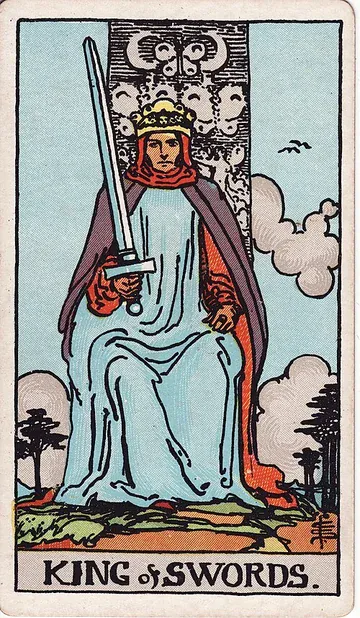
The lawgiver has stopped serving the law and started using it. The throne is still stone. The sword is still long. The butterflies are still on the back of the chair, and the crescent moons are still carved behind his shoulders — but his face has shifted. The level gaze has narrowed. The unhurried hand grips. The verdict is no longer being formed in service of the room; the verdict is being formed to confirm that he has never been wrong, has never needed to be wrong, will never have to consider the possibility of being wrong. The reversed card's central knot is not coldness. It is the rigidity that pretends to be clarity.
In the reversed image, the small rightward tilt of the upright sword has become a tighter hold. The blade is no longer the median line; it is the weapon. The cold pale sky has gone from working temperature to moral position — what used to be altitude is now a refusal to come down. The two distant birds have either disappeared from the frame or, worse, are now read as evidence of the king's perceptive superiority: see how he notices what others miss, see how no detail escapes him, see how he is right again. The seeker has confused exactness with virtue, and the confusion has hardened.
This is the reversed card's first flavour: cold reason that has learned to perform itself. The temperament is still articulate. The intelligence is still real. But the speech has begun to function as armour rather than as service. Sentences that once cut to the matter now cut to the speaker's image of himself. The clause that used to be the gift to the room is now a small monument to the speaker's accuracy. The room loses warmth. The work suffers. The marriage curdles. Nobody notices yet, because the prose is still good.
Upright, the rare gift of this seat is that it rewrites a tangled dispute into one question that can be answered. Reversed, the gift runs backwards: every question brought to him is quietly rewritten into one he has already answered. A grievance about how he spoke at dinner comes back as a debate over whether your memory of the evening is accurate. A worry about money returns as a seminar on your relationship to risk. Nothing in the rewriting is false, which is exactly what makes it so hard to name out loud. The blade still cuts cleanly. It has simply been turned to cut the question instead of the matter, and whoever brought the question walks away holding less than they arrived with.
There is a second flavour: the tyrant of correctness. The seeker who has trained "I see more clearly than you" into a daily reflex, until even the closest people in their life find themselves only on the side of the judged. The partner who comes home and is corrected on the way they spelled a name. The friend whose opinion is met with a small lecture. The colleague whose suggestion is dismantled in front of the team. The reversed King of Swords is not loud. He does not need to be. He simply withholds the small social warmth that other adults extend to each other — and lets the absence do the punishing work.
The card keeps its hour in this orientation — the minute before daybreak at winter's end — but the man in the chair has concluded that the light is not coming and has stopped waiting for it. The steel still smells of the whetstone. It has been sharpened well past the work it has to do, which is how a tool quietly becomes a habit. Of the two plants that belong to this seat, the holly has taken the whole garden: evergreen, armed, unchanging, with nothing left of the wormwood's medicinal use and only its bitterness kept. Look for the reversal in small domestic detail rather than in grand scenes — the correction delivered at the school gate, the accuracy deployed at a birthday dinner, the email sent at eleven at night whose real content is a footnote proving a point from a meeting that ended on Tuesday.
The astrological signature reverses too. Capricorn into Aquarius, upright, is structure that is willing to admit reform. Reversed, it becomes structure that has frozen, with reform forbidden, and rule-of-law replaced by rule-as-shield. Air-of-air, upright, is the high wind that holds direction. Reversed, it becomes the still air at altitude that nothing can move through — the cabin pressure that no longer changes when the weather below has changed. The teaching from Justice's neighbor kabbalistic position is unavailable in this orientation; the seeker has stopped holding the scales and has started holding the gavel.
One version of this card is not tyranny at all, and it may be the more common one. The seeker is tired. They have been the one who has to decide — at work, at home, in the family group chat, about the parent in hospital — for years without relief, and somewhere in those years the deciding stopped being a service and became the only way they know how to be present in a room. Judgment as the last available form of participation. Read that way, the reversed King of Swords is less a fault of character than a repetitive strain injury of the mind, and the treatment for it is rest rather than remorse.
Reversed, the King of Swords asks: when did you last admit a real error? And: who in your life is currently afraid of your reasoning? And: what would you have to change if you let yourself be wrong on this one thing today?
King of Swords Reversed · Love & Relationships
One partner is using clarity as a weapon. The arguments are technically won. The points are technically made. The other person has technically been corrected. And what is technically a victory is, in lived reality, a slow erosion of the bond. The reversed card is the clean blade pointed inward at the marriage instead of outward at the matter.
For an existing partnership, the reversed King of Swords often describes the dynamic in which one partner has appointed themselves the calibrator of the other's behavior, language, and choices. The partner being calibrated has stopped speaking freely at home. They edit their sentences before delivery to anticipate the correction. They no longer share a half-formed thought because half-formed thoughts get dismantled. The bond has become a courtroom where one person is permanently the defense and the other is permanently the bench. The card warns that this dynamic, unaddressed, ends the relationship — usually not in a dramatic exit but in a slow, courteous withdrawal. The other partner stops being present long before they leave the house.
For someone in a new connection, the reversed card can describe a partner who is impressive in conversation but quietly punitive in feeling. They will out-argue you. They will be right about the small things you got wrong. They will frame their corrections as care. The card asks you to notice what your body does when they speak. If you flinch slightly before they make a comment — if you have begun to brace — the warmth has already left the connection, even if the language is still intact.
For someone using "I am right" as the emotional posture in their own relationship, the reversed card is the gentle and uncomfortable mirror. You are pinning the other to the wall with rightness. Even if no one rebuts in the end, what you have won is only a debate no one applauds. The other partner is not a project to correct. The other partner is not a thesis to refute. The other partner is a person, and people withdraw from being permanently judged. Re-enter as a partner. The King reversed becomes upright the moment the blade is set down at the dinner table and not picked back up.
For a single seeker, the reversed King of Swords can describe two distinct patterns. One: a string of brief connections that all end the same way, with the other person leaving and citing a vague phrase like "too critical" or "exhausting to be around." The pattern is not the others. The pattern is yours. Two: the protective tendency to date partners who flatter rather than challenge, because the flatterer cannot wound the rightness you have built around yourself. Either way, the work is the same — let one part of your dating life be honest. Be wrong in front of someone who can hold it. The card returns to upright through visible fallibility.
Separated parents get a particular version of this card. The co-parenting is conducted by email, and the emails are excellent — dated, numbered, unanswerable, each one quietly built so that it would read well to a third party who might one day be asked to look. The children are being raised inside a case file. The reversed King of Swords names the point at which being right about the Thursday handover has become more important than the eight-year-old who can feel exactly what the two households think of each other. One practical move belongs here, and it is small: send one message this week that contains no record, no clause, and nothing that could be read aloud in a hearing. The logistics, and one sentence about the child.
For love after a wound, the reversed card warns of the post-grief temperament that has chosen to never be misled again. The previous relationship hurt you. You have responded by becoming a sharper analyst of human behavior. You catch the lies earlier. You spot the patterns sooner. You explain to your friends, in clean language, exactly what was wrong with the last partner. And in the process, you have begun to relate to all future partners as cases to be analyzed rather than people to be met. The protection has become the prison. The blade is now between you and any future love.
Much of what couples now fight about is fought in writing, and the reversed King of Swords thrives in that medium. The message is drafted, re-read, made airtight, and sent at the moment calculated to land hardest. Old exchanges are kept and produced later as exhibits. If either side of that is recognisable — the one building the case, or the one who has started screenshotting in self-defense — the card is describing a bond that has migrated out of conversation and into evidence. Written words hold their edge, and that is the whole trouble: nothing said in a kitchen survives a year the way a paragraph does. The repair is almost embarrassingly plain. Hard subjects go back to being spoken aloud, in one room, where a sentence can still be taken back.
For reconciliation questions, the reversed King of Swords offers a hard answer. Reconciliation is possible only if you can name your share of what broke the relationship in plain language, without rhetorical retreat to "but they did x first." The card respects honesty about your own role and rejects the version of the conversation in which you have already prepared the closing argument. If you can say one true sentence about how your reasoning hurt them, reconciliation has a chance. If you cannot, the card cools.
For seekers who suspect their partner is the reversed King of Swords, the card offers permission to name the dynamic. Not in the partner's preferred language of debate. In the language of feeling: "I do not feel safe to think out loud at home anymore." That sentence is precisely the one the reversed King is least equipped to argue with — because it is not a thesis. It is a state. The card responds, sometimes, when the other person finally lets the conversation be about feeling rather than about being right.
Sometimes the question behind this card is about a parent rather than a partner, and it answers there as well. An adult who grew up being out-argued by a mother or father of this temperament tends to arrive in romantic life carrying two things: an unusual ability to build an argument, and a deep private conviction that being wrong is dangerous. Both are worth saying out loud to whoever you are with now, in ordinary language, before the next disagreement rather than during it. Nobody can be careful with a fear they have never been told about, and the partner across from you has been handling this one blind.
A final flavour for love. The reversed King of Swords can describe the partner who uses "logic" to dodge accountability. The emotional harm they have caused is reframed as a misunderstanding, an overreaction, a logical error you made in interpreting them. The card warns that this is not love. It is the avoidance of love wearing the costume of clarity. Real clarity includes apology. Real precision includes the words "I was wrong." If neither has appeared in years, the card has been reversed for a long time.
King of Swords Reversed · As Feelings
When the King of Swords reversed appears to describe how someone feels about you, the picture is precise and uncomfortable. They have feelings. The feelings are not warm. The feelings are tangled with judgment, with private superiority, with the small pleasure of having figured you out and being able to predict you. They have not arrived at love. They have arrived at a position about you. The position is held tightly. The position is what they are protecting when they speak to you.
This is the card of the partner who is privately keeping score. The list of your missteps is detailed. The list of their patient corrections is also detailed. They feel themselves to be the more reasonable party in every disagreement, and the feeling has become the architecture of their love. They are not necessarily aware of this. The reversed King's most painful quality is its opacity to itself. He believes he is being fair. He believes he is being clear. He believes he is being kind, by his standards. The other person, meanwhile, is being slowly worn down.
If they are reserved by nature, the reversed King of Swords in feelings can mean withholding. The silence is not protection of the bond — the silence is a strategic refusal to give you the warmth you have not earned by their standards. They are punishing you in the only register they have. The body language is composed. The voice is even. The withholding is total. Read the silence as a verdict, not as introspection. They have decided something about you and are letting you marinate in it.
If they are demonstrative, the reversed King can express itself as articulate disappointment. They will tell you exactly what is wrong with your behavior. They will frame the telling as honesty. They will reject any softer rendering as evasion. Their feelings about you are real, but the dominant feeling is the wish that you would adjust to be more like the version of you they had decided was correct. They love a thesis of you. They are less in love with the actual you, who keeps deviating from the thesis.
For a partner you have been with a long time, the reversed King of Swords in feelings is one of the harder cards to read. The feelings have curdled into a quiet contempt that is not yet fully visible to either of you. They love you, in the sense that they have arranged their life around your presence. They no longer admire you, in the sense that the small daily noticing has stopped. The card asks for honesty about the plateau the relationship has reached. Re-noticing is hard work for this temperament. Sometimes it is unavailable.
For a new connection, the reversed King of Swords can describe the partner who is fascinated by you but already cataloguing your flaws. The interest is real. The future is at risk. They are deciding, in a quiet internal court, whether you are worth their tolerance. The card asks you to notice whether you are auditioning. If you are, the relationship has started on uneven ground. The work is to refuse the audition early. Either they meet you as a peer, or they do not get to meet you at all.
There is a particular flavour that shows up sometimes: the reversed King's feelings can include a kind of intellectual possessiveness. They feel they have understood you better than other people do. They feel they have seen through you. They feel their analysis of you is more accurate than your own self-knowledge. This is not the same as love. It is a form of acquisition. The card asks you to notice when their care for you has shifted from companionship to curatorship.
A second flavour: the reversed King's feelings can take the form of strategic patience that is really withdrawal. They are still here. They have not left. They will tell anyone who asks that the relationship is fine. And inside, they have already moved to the high seat where you are no longer a partner, but a case. The card asks for a direct conversation: are we still partners, or have you become my judge? The question itself begins to reverse the reversal.
For seekers worried they are the one reading the reversed card about themselves — that they have begun to feel about a beloved with a measuring eye rather than a meeting one — the card is forgiving. The recognition is the beginning of the return. Lay the blade down. Walk to the other room. Notice one thing about the beloved that you have stopped seeing because you stopped looking. The feelings can warm again. The reversed card, met honestly, becomes upright in surprisingly little time.
King of Swords Reversed · Career & Work
Intelligence has become a defense rather than a service. The clever colleague whose cleverness is now mostly performed for an audience of one — themselves. The senior figure whose verdicts are technically correct but no longer help anyone do better work. The team in which being right has replaced making progress. The card describes the gap between competence and contribution, and asks whether you are currently standing in it.
For someone considering whether to stay in a current role, the reversed King of Swords warns against the comfortable corner that authority has carved for you. You are good at your work. Everyone agrees. You have, however, stopped reaching. You spend your days correcting people younger than you, defending positions you no longer have to defend, and explaining things in slightly elaborate language because the explanation has become the point. The card asks: when did you last learn something at work? If the answer is more than a year ago, the role has begun to ossify around you. The throne is still stone, but it is no longer the right shape for you.
For someone considering a new role, the reversed card asks whether the new role is being chosen for the right reasons. Are you taking the title because the work calls you, or because the title will let you finally tell the people who underestimated you what you really think? The card does not endorse career moves driven by the wish to win an old argument. The motive curdles the role. Find a different reason or pass on the offer.
Entrepreneurs and freelancers should read the reversed card as a check on the temptation to use clarity as a brand without examining whether the clarity is still earned. The contrarian post that gets engagement is not necessarily the contrarian post that is true. The bold position taken in public to attract attention is not necessarily the bold position you would still hold under careful scrutiny. The card warns of the slow drift from honest expertise to entertaining contrarianism. The audience grows; the work hollows.
For a creative practice, the reversed King of Swords describes the season when the editor inside you has fully overpowered the maker. You can articulate what is wrong with everything you produce. You cannot finish anything because nothing meets the standard you have built. The card is the cold pale sky that has swallowed the studio. Lower the standard for the draft phase. Raise it back for the final phase. The two are different moves and require different temperaments. The reversed King can no longer tell.
For a workplace dispute, the reversed card warns of the seductive pleasure of being right at the wrong altitude. You may, in fact, be correct. You may, in fact, have caught the mistake your colleague made. The question the card asks is: is correcting it now, in this way, with this audience, the move that serves the work — or the move that serves your image? If it is the second, swallow it. The blade lowered today preserves the relationships that will let you ship next quarter.
For someone working under a reversed King of Swords — a manager, a senior colleague, a partner — the card is unusually precise. They are not going to be argued out of the position. They are not going to be persuaded by your better thesis. They will treat any disagreement as a junior employee not yet understanding the situation. The card asks you to stop trying to win the argument. Either accept the dynamic and find your scope inside it, or quietly prepare your exit. The card validates either move; it cools only on the strategy of continuing to argue.
For someone using "the rules say so" as a shield to dodge a judgment that should be theirs to make, the reversed card is the direct mirror. The rule is the sword in your hand, not your substitute. You are being paid to make the call. Hiding behind procedure is not authority — it is the avoidance of authority dressed as fidelity to it. The card asks you to step out from behind the policy and deliver the verdict in your own name. The temperament that does this is rare; it is also what real seniority looks like.
For job-search at the senior level, the reversed King of Swords can warn of the interviewer who is using the conversation to confirm their existing biases rather than to assess you. They are not actually evaluating fit. They are testing whether you mirror their tastes. The card permits you to opt out of organisations where the interview process itself reveals the reversed dynamic. Better to find the seat at a different throne than to spend years explaining yourself to one that has frozen.
King of Swords Reversed · Money & Finances
Financial decisions here come from the head's worst instincts: contrarianism, intellectual pride, the wish to be the one who saw what everybody else missed. The seeker who buys the unconventional position partly because it is unconventional. The seeker who refuses the index fund because it is for ordinary people. The seeker who has built a financial identity around being smarter than the consensus and is now trapped inside that identity even when the position has stopped serving them.
For a question about whether a financial gamble will pay off, the reversed King of Swords answers with caution turned into warning. The thesis is too clever. The reasoning is too proud. Have you stress-tested the position with a skeptical friend? Have you written the case against your own bet and read it carefully? If not, the card asks for the second pass before the trade. The cleverness is not enough. The blade is upright only when it has been examined from both sides.
For someone whose finances have become a battleground in a relationship, the reversed card warns of using money as the proxy for an old argument. Joint accounts in which one partner is permanently the responsible adult and the other is permanently the corrected child — this is the reversed King's signature in shared finances. The card asks for a renegotiation that treats both partners as competent adults, even if their relationships with money differ.
For investments, the reversed card cools on speculative bets, contrarian stock picks, the seductive newsletter, the friend with the obvious thesis. The pattern the card describes is the pattern of the seeker who cannot resist the appearance of insight. Sometimes the reversed King is right. Often, he was right but exited too late because he had to also prove his rightness to spectators. The discipline that the upright card carries — written policy, dispassionate execution, no theater — has been compromised by the wish to be seen as smart.
For someone in financial recovery, the reversed King of Swords warns against the trap of overcomplicating the path out. The plan is simple: name the debt, schedule the instalments, hold to the schedule. The temperament that is reading this card may want to optimise the plan, build a spreadsheet of strategies, identify the cleverest ordering of payoffs. Sometimes that work helps. Often it is procrastination wearing the costume of analysis. The card asks for boring execution. Not analysis. Not contrarianism. The unsexy steady payment, made on time, every month.
For a major purchase, the reversed card warns of the purchase made to demonstrate one's discernment. The car chosen because no one else like you would have chosen it. The house that confirms a particular self-image. The watch that is a position. The card asks what you would be buying if no one else were going to see it. If the answer is something different, you are paying for the audience as much as the object. The blade lowered today saves the budget.
For windfall, the reversed King's warning is the seductive temptation to make a clever use of the gift. The newly inherited money is not a chance to prove you are sharper than other heirs. The bonus is not an opportunity to make a contrarian bet. The settlement is not the moment to deploy the unconventional strategy. The card asks for the boring move: accounts, policy, a season of waiting before any action. The wisdom in the reversed orientation is to recognize the impulse and refuse it.
For tax matters, contracts, financial documents, the reversed King's warning is to read them more carefully than your pride allows. The seeker who skims the contract because they know how this kind of thing works has, over a career, lost more money to that confidence than to any other source. Slow down. Read the small clauses. Ask the second question. The reversed orientation cools the moment the second question has been asked and answered.
King of Swords Reversed · Health
The head's bad habits have taken over the management of the body. Over-research at three in the morning. Diagnosis-by-search-engine. The patient who arrives at the appointment having already drafted the case — and refuses to update it when the doctor presents new information. The card describes the gap between knowing facts about health and inhabiting a healthy body.
The card's particular signature in the reversed orientation is the head that will not stop. Insomnia. Tension headaches that have lived above the eyebrows for months. Jaw clenching that the dentist has finally noticed. Eye strain from screens. The nervous system stuck in the analytical register so long that the body has forgotten how to drop into rest. The card warns that the over-thinking is no longer a tool — it has become a low-grade chronic injury.
For someone with a medical condition who is using their intelligence to avoid the difficult treatment recommendation, the reversed card is the direct mirror. You have read more than most patients. You have a thesis. The thesis allows you to dismiss your doctor's advice as insufficiently evidence-based or as not accounting for your particular circumstances. Sometimes the patient is right and the doctor needs to be challenged. Often, in this reversed pattern, the patient is using clever reasoning to dodge the inconvenient correct treatment. The card asks for an honest audit of your motives.
For a chronic condition, the reversed King of Swords describes the season when the system you built to manage the condition has hardened into a control problem. The diet is so optimised that you can no longer eat with friends. The exercise is so optimised that injury has begun. The supplement stack is so optimised that you have started managing the side effects of supplements meant to manage the side effects of other supplements. The card warns of the long slow drift from health behavior into health performance. Loosen one rule this week and see what happens.
For mental health questions, the reversed card is one of the deck's clearer signals that thinking has stopped being the answer and has become part of the problem. The seeker who has read every book on anxiety and is still anxious. The seeker who can articulate their patterns better than their therapist and does not get better. The card asks whether the analytical work is now a defense against the actual emotional work. Often it is. The reversed orientation cools through somatic practice — the body, the breath, the slower modes that the head cannot win.
For acute issues, the reversed King's warning is to stop refining your understanding of the problem and go to the appointment. The over-thinking is a delaying tactic. The body needs intervention, not more analysis. The card asks for one practical move this week: the call, the visit, the test. The verdict, when it lands from a real practitioner, will be more useful than another night of search results.
For somatic stress patterns related to argument and conflict, the reversed card describes the body of someone who never stops drafting clauses against people who have hurt them. The replays of the argument continue at four in the morning. The right thing to have said arrives in the shower. The mental court session is in permanent session. The body has begun to absorb the cost. The card asks for the practice of dropping the case. Not winning it. Not losing it. Setting it down. The body returns when the trial finally ends.
For seekers managing addictive or compulsive patterns, the reversed King of Swords describes the relapse that arrives wearing the costume of a careful argument. "I have thought about this carefully and decided that one is fine." "The rule was an over-correction; this is the more measured position." The card warns that the part of you doing the careful arguing is the part of you that wants to use. Notice the rhetoric. The clarity that walks you back into the pattern is not clarity. It is the addiction speaking in the King's voice.
Noticing the rhetoric is the work here; medical advice is not on offer. The card describes a felt season of intellectual rigidity, not a diagnosis. Keep your practitioners. Take your medicine. The card simply offers a gentle, unflattering mirror: thinking is sometimes the medicine, and sometimes it is the symptom.
King of Swords Reversed · Spirituality
Everything has been read and nowhere has been arrived at. The library is impressive. The annotations are thorough. The vocabulary spans several traditions. And the actual seat — the silent half-hour, the morning practice, the willingness to be wrong about the universe — has been quietly skipped for years. The card is the cold pale sky over an empty meditation cushion.
This is the spiritual seeker who can deliver excellent verdicts on the failings of every major teacher, the contradictions in every tradition, the historical errors of every lineage. The verdicts are often correct. The verdicts are also a beautiful, sustained dodge. As long as the seeker is grading the teachings, the seeker does not have to enter the practice. The reversed King has discovered that critical clarity feels almost as good as awakening, and is much, much easier.
For someone in active practice, the reversed King of Swords warns of the practice that has hardened into method without softening into encounter. You sit. You count breaths. You log the sit. You can articulate, exactly, the difference between the schools of meditation you have sampled. And nothing has touched you in a long time. The card asks whether the practice has been protecting you from the very thing you sat down to meet. Sometimes the medicine is to abandon the careful method for a season and try something less optimised.
For someone exploring belief, the reversed card warns of the seeker who treats traditions as positions to evaluate rather than as places to live. You have read the Tao Te Ching. You have read the Gita. You have read the Christian mystics. You have read the Sufis. The reading was honest. The living has not begun. The card asks: what would happen if you actually inhabited one of these for a year, not as a project but as a home? The reversed orientation cools the moment the seeker steps inside one tradition long enough to be changed by it.
The card's signature spiritual caution is the substitution of the verdict for the encounter. The reversed King is excellent at telling you what is wrong with each spiritual offering, including the one he himself was using last year. Each verdict is its own small altar. Each altar gets in the way of the practice. The integration work is to notice when criticism has become a defensive posture and to set it down for an hour. Just an hour. The card responds to small openings.
There is a second flavour. The reversed King of Swords can describe the spiritual teacher who has stopped serving and started ruling. The community that began as inquiry has become a court. The teacher's verdicts on members' behavior are now the architecture. Disagreement is treated as failure to understand. The reversed orientation, in this flavour, is a serious warning to seekers in such communities: the form is real, the dynamic is corrosive, the exit may be necessary.
For questions about path, the reversed King asks the most uncomfortable question this card has. What if you have been wrong, in a fundamental way, about the shape of your inner life? Not in detail. Wrong in posture. Wrong in priority. Wrong in the very assumption that the correct thinker would arrive somewhere by thinking. The card cools the moment the seeker entertains the question seriously rather than dismantling it.
A small practice when this card appears reversed: read nothing for a week. No books. No essays. No threads. No newsletters. No commentary. Sit, instead, in a quiet room, for ten minutes a day, and let the head do whatever it does without commentary from you. The card returns to upright through the discipline of not-reading, not-arguing, not-evaluating — the ascetic move the King has been avoiding by hiding inside the library.
The reversed King of Swords, integrated, becomes one of the most powerful spiritual temperaments — clarity offered as service rather than as performance. Until the integration, however, the card is exactly what it looks like: a man on a stone throne, alone in the cold sky, speaking exact sentences into a room that has emptied of listeners.
King of Swords Reversed · Yes or No
No — or a yes that you should not yet trust yourself to deliver.
The King of Swords reversed is rarely a clean yes. Even when the answer to the surface question is technically yes, the orientation suggests that the verdict you are about to render is being formed for the wrong reasons — to win an argument, to confirm an old grievance, to defend a position you have grown attached to. The card asks you to delay the ruling. Not forever. Long enough to notice why you are about to rule the way you are about to rule.
For yes-or-no questions about a confrontation you are planning, the reversed answer is wait. The conversation you have rehearsed in your head is not the one that will help. You are preparing to be right rather than to be heard. The card cools on the version of the conversation in which you arrive with the closing argument. Drop the closing argument. Walk in with one honest question. The yes-or-no question itself is the wrong question; the right question is whether you are willing to enter the conversation without already knowing the verdict.
For yes-or-no questions about whether to send a sharp message — the email, the text, the public reply, the dismantling comment — the reversed King of Swords answers no. Not yet. Sleep on it. Re-read the draft in the morning. The card is the temperament that does its best ruling after the cold sky has cleared, not in the heat of the impulse to be precisely cutting. The blade swung in the moment is the blade that bounces back.
For questions about whether someone is being honest, whether an offer is fair, whether a plan will hold, the reversed card's answer is more diagnostic than directional. Yes, you are detecting something — the suspicion is real. And: your suspicion is being magnified by your own pattern. Both can be true at once. The card asks you to slow down before drawing the conclusion. Get a second perspective from someone whose judgment you trust. The reversed King is the temperament that, alone, is most likely to confirm his own bias and call the confirmation rigour.
For binary action questions — should I act, should I wait — the reversed card answers wait. Particularly when the action is corrective, punitive, or designed to teach someone a lesson. The lesson the card asks you to teach yourself first is restraint. There will be a better moment to make the move. The cleaner version of you makes a cleaner version of the move. Wait for that version of yourself to arrive.
For questions about whether to trust your own analysis, the reversed King of Swords is paradoxically humble. Maybe — but check. Run the thesis past someone who will disagree honestly. The thinking that survives a serious challenge from a serious peer is the thinking worth acting on. The thinking that requires a deferential audience to feel correct is the thinking the reversed orientation has produced.
For timing questions — will it happen soon — the reversed card suggests delay. The thing you are waiting for is being held up by the rigidity in the situation. Sometimes the rigidity is yours. Sometimes it belongs to someone else. Either way, the answer arrives only after one position softens. The card asks who is willing to soften first.
For deserving questions — do I deserve this — the reversed King answers with a hard, useful sentence. You deserve fair consideration, not vindication. You deserve to be heard, not to be confirmed in every detail. You deserve real engagement, not a monologue with a respectful audience. If your deserving question is really a wish for total agreement with your version of events, the card cools. If your deserving question is genuinely about fair consideration, the card warms slightly.
The integrated version of this no is not refusal. It is delay. Wait. Re-examine. Soften the position one degree. Then ask the question again. Often the second time, the question itself has changed shape, and the answer that arrives is one you can live with.
King of Swords Reversed · Advice
Admit one error today, out loud. Not all the errors. Not the catalogue. One. Choose the easiest one and say it out loud in plain language to a person who will be affected by the admission. The card returns to upright the moment the admission is made — and not before. The integration is not theoretical. It is verbal. It happens in a specific room, with a specific person, on a specific Tuesday.
If there is one specific instruction the reversed card offers, it is this: lower the blade. Whatever argument you are currently preparing to win, set it down. Whatever message you are sharpening, soften it by one degree. Whatever verdict you are about to deliver, sit on it for forty-eight hours. The card describes a temperament that, left to itself, will cut and then notice the wound it made too late. The instruction is to install a delay between the impulse and the cut.
A second instruction: stop using "the rules say so" as a shield. If the situation requires your judgment, deliver your judgment in your own name. If you find yourself hiding behind procedure, the procedure is now the costume of avoidance. The card asks you to step out and rule in plain language: "I have decided this for these reasons." The temperament that does this is rare. It is also what real authority looks like.
A third instruction: praise something. The reversed King has a default register that is critical, corrective, evaluative. The repair is not to suspend the criticism — that would be artificial. The repair is to add the missing register. Praise one specific thing, in one specific person, with one specific sentence, today. Not flattery. Specific recognition. "The way you handled that meeting." "The line in the document." "The patience with which you listened." The card warms by the small daily addition of accurate appreciation.
A fourth instruction: ask the other person what part of their position is right. The reversed King's signature failure is the assumption that the other side has nothing to teach him. The card cools the moment the seeker says, in genuine inquiry rather than rhetorical performance, "what part of what you are saying am I missing?" The question, asked seriously, dismantles the reversed orientation in one move. Most reversed Kings will find the question hard to ask. The card respects the difficulty and rewards the asking.
A fifth instruction, gentler than the others: forgive yourself for the rigidity. Most adults who carry the reversed King in some part of their life carry it for honest reasons — they were once not believed, not heard, not protected. The clarity hardened around an old wound. The blade is up because the body once needed it. The card asks for compassion toward the part of yourself that built the throne. The throne can be left without being despised. The blade can be set down without being broken. The work is to thank the protector and to ask whether the protection is still required, today, in this room, with this person.
Practical advice for the day the card appears reversed: do one thing that requires you to be wrong about something small and visible. Ask for help with a task. Take advice from a junior colleague. Try a recipe you do not understand. Be a beginner for an hour. The reversed orientation cools through the small daily practice of unmastery. The temperament is healed by the practice that the temperament resists.
A final note. The reversed King of Swords does not need to become someone else. He does not need to abandon his clarity, dilute his thinking, or pretend to be warmer than he is. He needs only one thing: the capacity to be wrong without collapse. The seeker who can hold the sentence "I was wrong on this" without it threatening their entire identity is the integrated King. The seeker who cannot is the reversed one. The bridge between the two is shorter than it looks. It is one sentence, said to one person, on one ordinary day.
King of Swords Reversed · Card Combinations
When the King of Swords reverses next to other cards, the dynamic each pairing reveals tends to be diagnostic — the reversed orientation surfaces the rigidity in the relationship, the unfair advantage in the negotiation, the cleverness substituting for presence. Read the combined image as a single composite, with the reversed King's defensive clarity bleeding into the neighbor card.
King of Swords Reversed + Justice
The personal lawgiver reversed beside the cosmic lawgiver. The combination describes the situation in which the seeker has been delivering verdicts that diverge from any external standard of fairness. They have been right by their own measure and wrong by the measure of the room. The pairing asks for the seeker to bring their reasoning into the open and let it be tested by an impartial witness — a friend, a therapist, a colleague who will tell them the truth. The card warms the moment the private court is dissolved and the matter is brought into shared light.
King of Swords Reversed + Queen of Swords
Both blades, both reversed if the spread shows it, become a courtroom in which two intelligent people are punishing each other in articulate language. Even when the Queen is upright and the King is not, the pairing warns of a partnership in which mind is meeting mind without warmth. The combination asks one party to break the pattern with a non-analytical move: a meal, a quiet hour, a question with no thesis attached. The clarity, in this pairing, has become the wound. The repair is not more clarity. The repair is to step out of the courtroom together, even briefly.
King of Swords Reversed + Page of Swords
The pupil approaches the throne, and the throne refuses the question. The Page's curiosity is met not with a sharper formulation but with a dismissive verdict. The combination describes the mentor who has stopped teaching and started credentialling — letting only the questions that flatter the mentor through the gate. For seekers in apprenticeship, the pairing is a warning: this teacher is no longer transmitting. For mentors, the combination is a quiet, uncomfortable mirror. The Page brings the next chapter; the reversed King is currently locking the door.
King of Swords Reversed + The Emperor
Two seats of authority, both at risk of ossification. The Emperor's structure becomes inflexible architecture; the reversed King's verdicts become tyrannical decree. Together they describe an institution — a household, a company, a movement — in which rule-as-shield has replaced rule-as-service. For careers, the combination warns of an organisation in which the structure exists to protect the seniors, not to support the work. For households, the pairing describes the family in which the rules are clear, the warmth is gone, and the children are quietly preparing to leave at the earliest possible moment. The repair, if it is possible, requires both authorities to soften at once.
King of Swords Reversed + King of Cups
Same throne height, opposite element, and the contrast becomes painful when the swords side has reversed. The cold judge is now actively cold, and the warm father is being asked to absorb the chill. For partnerships in which one person plays the warm role and the other plays the rigorous one, this combination is a serious caution: the warm partner has been carrying the emotional work alone for too long, and the cold partner has begun to interpret their own withdrawal as fairness. The card asks for a redistribution. The cold partner is invited to do one warm thing without analysing it. The warm partner is invited to deliver one clean ruling without softening it. Both blades and both cups in one room, finally, in honest exchange.
Card Combinations
Justice
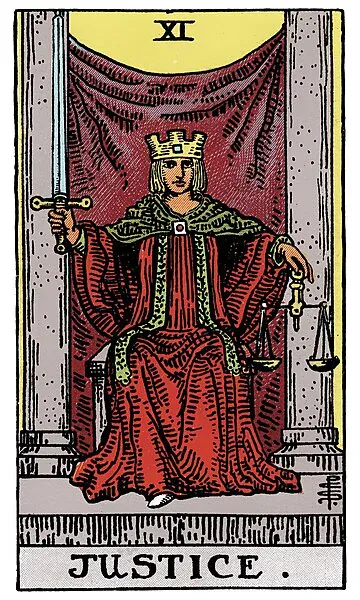
Personal lawgiver beside the cosmic one. The verdict you are about to deliver is mirrored by a structural truth in the situation — the line you draw in your living room is the line a court would draw, the line the moral imagination would draw. There is no shadow side to the ruling. Speak it. The combination is overdetermined; trust it.
Queen of Swords
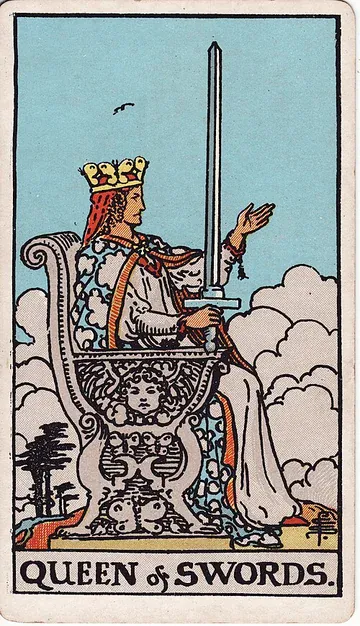
The court-suit pair, the dyad of mind. The Queen pierces; the King rules. Together they describe a partnership built on shared exactness — neither softens the other's blade, and the affection is expressed through the work of seeing accurately. The caution: when both blades are upright in the same room, leave warmth in the room on purpose, or the marriage becomes a courtroom.
Page of Swords
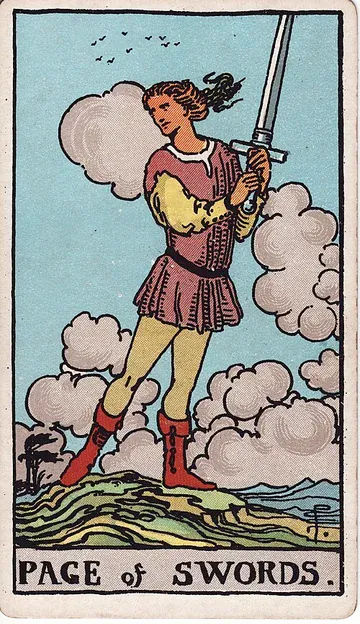
The pupil approaches the throne. The Page's restless question is received and translated into the clause that can finally be answered. For apprentices, this is mentorship at its best — the older mind making the younger mind's question more precise rather than dismissing it. For mentors, the image is a reminder that the question, treated with respect, becomes the ruling that opens the next chapter.
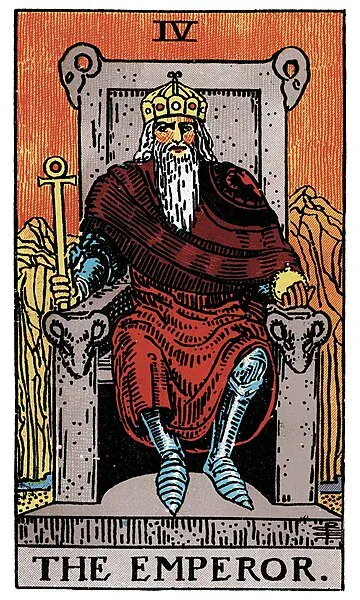
The Emperor
Two seats of authority — the Emperor's structural rule and the King of Swords' judicial rulings working in concert. Together they describe an institution functioning well: hierarchy taken seriously without being abused, decisions actually getting made, the work given the dignity of structure. The caution embedded in the pair: two patriarchs in one room can ossify. Leave a window open for the butterflies.
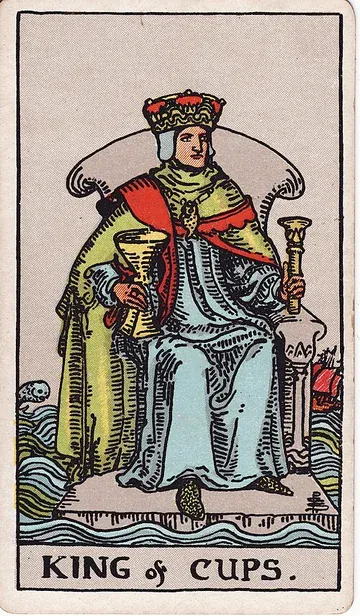
King of Cups
Same throne height, opposite element. The cold judge meets the warm father. The combination describes a counsel that finally has both kinds of authority in the room — the one who tells the precise truth and the one who can hold the feeling that the truth produces. Neither King is enough alone; together they are the rare composite the situation actually needs. Sometimes two people, sometimes two parts of yourself in conversation.
Frequently Asked Questions
Should I deliver the verdict I have already drafted in my head?
Not today. The reversed King is more often a no — or a yes that is better delayed before delivering. The orientation suggests the verdict you are about to render is being formed for the wrong reasons: to win an old argument, to confirm a grievance, to defend a position. The card asks you to wait. The cleaner version of yourself will arrive in a day or two, and the cleaner version will make the cleaner ruling.
What happens to a marriage in which one person keeps winning the arguments?
It thins out quietly. Reversed in love, the King of Swords describes the relationship in which clarity has become a weapon. One partner is winning the arguments and losing the bond. The other has stopped speaking freely at home. The card warns that this dynamic, unaddressed, ends slowly through a quiet courteous withdrawal rather than a dramatic exit. The repair begins with the harder partner admitting one error in plain language.
What does the King of Swords reversed meaning carry in a tarot reading?
The reversed meaning is rule-as-shield. The temperament that once delivered clean verdicts is now using clever reasoning to avoid being wrong, to dodge accountability, to maintain a self-image of correctness. The blade has turned from servant to weapon. The integration work is to admit one error today, lower the blade, and re-enter the room as a peer rather than as a judge.
Can someone admire me and quietly look down on me at the same time?
This card says yes, and describes the combination precisely: warmth tangled with judgment. They have feelings about you. The feelings include private superiority, the small pleasure of having figured you out, a quiet contempt for the ways you have not adjusted to their preferred version of you. The card asks you to notice whether you are auditioning. If you are, the connection is on uneven ground and the work is to refuse the audition.
Which error should I admit first, if the King of Swords has reversed?
The easiest one, today, in plain language, to a person who is affected by the admission. Not all the errors — one. The card returns to upright the moment the admission is made and not before. Lower the blade. Stop using rules as a shield. Praise one specific thing about one specific person. Ask what part of their position is right. The integration happens in a specific room, on a specific day, with a specific sentence.