
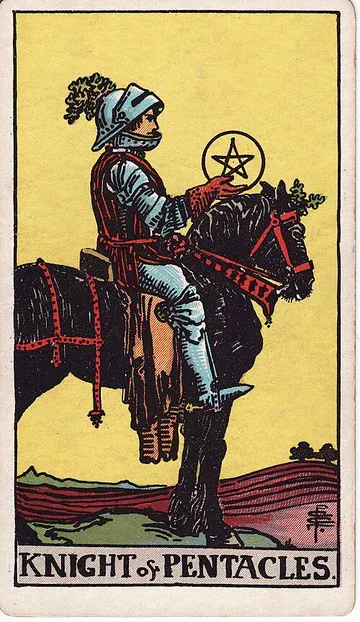
Knight of Pentacles · Core Meaning
The Knight of Pentacles is the slowest of the four knights and the most likely to actually arrive. In the Rider-Waite-Smith image, he sits a heavy plow-horse at the edge of a freshly-turned field. The horse's hooves are sunk into damp earth. The road behind them has been walked smooth; the road ahead has not yet been walked. The knight holds a single golden coin up before him — not appraising it, not flourishing it, but reading it the way a craftsman reads the next thing on his list. His armor is dark and unmarked. His face is level. He is in no rush, and he has not stopped.
This is the card's signature tension and the reason readers underestimate it: nothing in the picture wants to be impressive. There is no charge, no flag, no flourish. The Knight of Sword's wind is not blowing here. The Knight of Wands' horse is not rearing. The Knight of Cups is not offering anyone a drink. This knight is the figure beside the plow-horse who has been working since before dawn and will be working when the others have gone home, and who would, if asked, simply say: no need to rush — I will see it through.
The dates assigned to him carry the same patience: as a court card, the Knight of Pentacles spans the Leo–Virgo cusp, the date range from August twelfth to September eleventh. That cusp is a particular kind of weather: the late-summer field that knows it has work left to do before frost. Leo's pride has burned down into Virgo's discipline. The fire is no longer above ground; it has gone underground and become the patient warmth that does the actual work. Read the card's element this way — not earth alone, but fire-within-earth. Charcoal buried beneath the hearth. No open flame, but heat through the night. The knight's slowness is not cold; it is the slowness of something that has already been burning a long time.
Hermetic readers know the four court ranks as four temperaments around a single suit. The Page of Pentacles is earth's beginner — the apprentice with a coin in his hand and his eyes still on the horizon. The Knight is earth's mature laborer, the one who has learned that horizons are reached by feet, not by wishes. The Queen is earth's gardener, the one who tends. The King is earth's authority, the one who governs. Each is necessary; this knight's particular gift is the half-walked field, the work begun and not yet finished, the willingness to come back tomorrow morning and pick up the plow where it was dropped.
His symbols, read carefully, all say the same thing in different registers. The held coin is homework, not treasure — he reads it as a task to be done, not a prize to be polished. The plow-horse is strength in the feet, not the chest — power that lives in patient locomotion, not in spectacle. The freshly turned field is work half-done — soil already broken, seed not yet sown, second half still to come from the same hands. The untrodden road is a future he knows he will not reach today — not because he has given up on it, but because he is responsible only for today's stretch of it. Each image is a different door into the same room: the room of slow, complete work.
Read the Knight of Pentacles in any spread as the figure who shows up. He is not the card of breakthrough. He is the card of the person who is still there in March, doing the same boring competent thing they were doing in November, and who will be there again in June. If the reading is asking whether something will be completed, this knight says yes, on his timeline. If the reading is asking whether someone is dependable, this knight says yes, more than they advertise. If the reading is asking whether to wait, this knight says wait — but wait the way he waits, by continuing to work while waiting.
Read the Knight of Pentacles as a tarot card meaning the soft answer the deck offers when the question is about endurance, dependability, and the quiet completion of slow work. He is the patron saint of the second half, the second draft, the second year. Whatever is being done with him in the spread is being done in earnest. He will not glamorize it. He will not abandon it.
Knight of Pentacles · Love & Relationships
In love readings, the Knight of Pentacles describes the steady partner — the one who picks you up from work every single time, the one who remembers what you said about your mother in March and asks about her in October, the one whose love is not the love of fireworks but the love of the lamp left on. He is one of the deck's most trustworthy signals when the question is whether the bond will hold. He is also one of its most underestimated, because his love language is so unspectacular that readers raised on the dramas of Cups can mistake his quiet for absence. It is not absence. It is presence that has stopped needing to announce itself.
For an existing long-term partnership, the Knight of Pentacles is one of the cards you most want to draw. He describes the relationship that has worn its furrow into the year — the rituals of breakfast, the rhythms of bedtime, the small rotating favors that neither partner counts but both partners notice. The arguments that nearly broke the bond have been integrated into the soil. The early-passion intensity has cooled into a different kind of warmth: the warmth of charcoal under a banked fire, no flame visible, the kitchen warm all winter anyway. Couples drawing this card after a hard year often describe the same thing — they have stopped wondering whether the other person will stay; the other person has stopped being a question.
For a new spark, the Knight of Pentacles upright is a slow but reliable yes. The person you are looking at is not going to dazzle you in the first week. They are not going to text you twelve times before noon. They are going to show up to the date a little early, listen carefully, remember what you said, and follow up in a way that is so undramatic you may not even notice the consistency until the third month. This is the card of the partner you were warned about by your friends as "boring," who turns out to be the only person who has ever actually known what you needed without being told. Give the new spark time. The Knight does not bloom in week one.
For a single seeker who is asking whether love is possible, the Knight of Pentacles answers yes, in the practical register. The card describes a meeting that comes through ordinary infrastructure — a colleague who has been quietly attentive, a friend-of-a-friend who keeps appearing at the same parties, a neighbor who has been holding the door for you for nine months without announcing why. The Knight's love is rarely a thunderclap meeting. It is a slow recognition: the realization, sometime after the third or fourth time, that this person has been quietly building toward you the whole time.
For love after a wound — after a divorce, after a death, after the long stretch of refusing to try again — the Knight of Pentacles is one of the gentlest cards the deck offers. He is the partner who can hold the wound without flinching from it. He will not require you to perform the recovered version of yourself. He will not move faster than you can move. He will sit, in the practical sense, at the kitchen table while you are still putting your life back together, and he will not interpret the unfinished room as a flaw. This is the card of the second love that asks for nothing the first love drained out of you.
For "is this person in love with me" — the Knight of Pentacles upright reads as a quiet, deliberate yes that you may have to look closely to see. They are not going to perform the love. They are going to embody it. Watch what they do with their time, not what they say with their words. The boyfriend who reschedules the dentist appointment to be at your work event and does not mention having done so. The partner who learns the names of your siblings without being asked. The lover who, when you are sick, simply arrives with soup and stays the right amount of time. These are the love-signs of the Knight. He is not going to write you a poem. He has already written you, in his life, into the calendar of the next ten years.
A note on the Knight's particular love language: he loves the way a steward loves. He maintains. He does not need the relationship to be exciting; he needs it to be real. His care is shown through repetition — the same texts at the same times, the same Sunday morning, the same way of asking about your day. To partners who grew up on Cups passion, this can feel like a flatness; to partners who grew up on Swords brilliance, it can feel like a slowness. To anyone who has lived through the wreckage of the dramatic alternative, it feels like landfall.
For couples in the long courtship phase considering whether to commit publicly — engagement, marriage, moving in, sharing money — the Knight of Pentacles upright says yes, with the further note that you are not committing to a peak. You are committing to a slope. The slope continues for decades. If the slope feels right, walk it. If you are looking for the peak, this card warns you that you are looking for the wrong card.
There is one quiet caution. The Knight of Pentacles can over-rely on his unspoken reliability and forget that the partner needs to be told as well as shown. Maintenance without articulation eventually erodes; the partner who is shown for fifteen years and never told once will, sooner or later, doubt. If you are the Knight in your relationship, speak. If you are with a Knight, ask for the words sometimes. Both can be done without losing the slow steady warmth that is the card's gift.
Knight of Pentacles · As Feelings
The answer the Knight of Pentacles gives is a schedule rather than a sonnet. It is a settled, quiet, practical regard — the feeling of someone who has decided you are part of the architecture of their life and is no longer arguing with themselves about it. They feel committed. They feel calm. They feel like they have found someone who will not require them to be performative, and the relief of that is large, even if they do not name it.
If they are reserved by nature, the Knight of Pentacles describes the partner whose feelings live in their actions almost entirely. They will not text "I miss you" twelve times a day. They will, however, notice that you forgot your charger and bring one to your office. Their silence is not absence. It is the way a steady person carries weight: low, internalized, and so consistent that they have stopped feeling the need to comment on it. Read silence here as evidence of a feeling that has stopped being volatile, not as evidence of a feeling that is fading.
If they are demonstrative — which is rarer for this card, but possible — the Knight of Pentacles in feelings describes the partner whose demonstrativeness has settled into ritual. The same morning kiss. The same goodnight phrase. The same Friday dinner. Their love is shown in repetitions, not in surprises. Watch the rituals. The rituals are the love. The day they stop is the day to ask; the year they continue is the year of evidence.
For a partner you have been with a long time, the Knight of Pentacles in feelings is a profound and underread signal. It means they have stopped wishing you were a different version of yourself. They have integrated your edges. They have made peace with the ways you irritate them and the ways they irritate you, and they have decided, fully and without performance, that you are the person they want to be next to in the long fading light of an ordinary Tuesday. This is the card of the partner who has stopped doing the cost-benefit analysis. They are home.
For a new connection, the Knight of Pentacles in feelings describes someone who is taking you seriously without yet saying so. They are not in the giddy phase of a new attraction; they have, almost from the first conversation, treated you the way they would treat someone who was already part of their life. This can feel slightly unromantic in the early weeks — they are not chasing you, they are welcoming you — but it is the most reliable early signal of a partner who will still be there in the difficult years.
For Knight-of-Pentacles feelings in someone who has been quiet about the relationship — withdrawn, distant, hard to read — the card asks you to look at the practical track record before reading the silence. Are they still showing up? Are they still doing the small maintenance — picking you up, remembering the dentist, asking about the sibling? If yes, the silence is not the feeling. The work is the feeling. If no — if both the words and the work have thinned — the Knight has stopped being this card and has slipped toward the reversed reading. Read the practical, not the verbal.
For someone you are watching from a distance, asking whether they have feelings for you, the Knight of Pentacles indicates a slow build. They have noticed you. They have, possibly without your knowing, started to fold you into their plans in small ways. They are not going to confess in week three. They are going to wait until they are sure, and they are going to be sure when the practical evidence of compatibility has accumulated. This can take months. It is not coldness. It is the way this knight loves: through accumulation.
For long-distance or constrained relationships — the partner who has not yet been able to be physically present, the bond that lives mostly in correspondence — the Knight of Pentacles in feelings indicates someone who is treating the relationship as real even without the usual proofs. They are showing up in the small forms available to them: the daily check-in, the planned visit, the pragmatic conversation about logistics. Their feelings have already decided. The form is waiting on the world.
A small caution: the Knight of Pentacles in feelings can become invisibly invested. The partner so steady that you stop registering their effort eventually becomes the partner you take for granted. If you are the one being loved by a Knight, notice. Say the gratitude out loud. The card does not require thunderous reciprocity. It just asks for occasional acknowledgment that the maintenance is being seen. Without acknowledgment, even charcoal eventually goes cold.
Knight of Pentacles · Career & Work
Reliability is a competence, and at work the Knight of Pentacles is the card that treats it as one. He describes the worker who shows up before everyone else, leaves after everyone else, does not require the dramatic project to feel valued, and who, three years later, is the only person in the building who has actually finished anything. He is the patron saint of follow-through. He is the antidote to the Knight of Wands' burnout pattern and the Knight of Swords' premature decisions. Where the others sprint, he walks the field.
For someone in a current role asking whether to stay, the Knight of Pentacles upright says: yes, for at least one more season. The work you are doing is real. The compounding has begun, even if it is invisible. The boring stretch you are in is not a sign of misalignment; it is the actual middle of a real project. Sprinters mistake the middle for failure because the middle has no fireworks. The Knight knows the middle is where the work happens.
For someone considering a new role, the Knight of Pentacles upright reads as a yes specifically when the new role offers structure, clear scope, and the kind of work that rewards consistency. He is less excited about the role that requires constant pivot, constant re-org, constant performance. If the new role is a stable craft — engineering, writing, teaching, building, healing — he confirms it. If it is a circus — he does not refuse, but he warns: this is not your weather.
For someone in the freelance / contractor / small-business career stage, the Knight of Pentacles is the card of the second year. The first year is the Page — the apprentice, learning the trade, accepting that the income is unstable. The second year is the Knight: the year you start to look professional from outside but still feel underwater inside. The card affirms that the second year is the right place to be. Keep going. The third year is when others begin to see you the way the work has always seen you.
For creative practice — writing a book, building a body of paintings, recording an album, developing a craft — the Knight of Pentacles is one of the most important cards the deck offers. He is the card of the daily practice. The morning pages that no one will read. The studio time that produced no completed work. The hour of scales before the song. He confirms that this kind of slow, unglamorous practice is the actual foundation, and that the breakthrough you are waiting for cannot exist without this groundwork.
For someone facing layoff or industry transition, the Knight of Pentacles is gentle but specific. He does not promise the dramatic pivot. He recommends the slow, deliberate skill-build. Update the resume. Send three applications a week, not thirty in one panic afternoon. Keep the routine: same wake time, same lunch, same evening walk. The card warns that desperate sprinting in transitions actively damages the next placement. Walk the field while you wait. The next job is more likely to come from a colleague you already know than from a job board.
For promotion questions, the Knight of Pentacles upright says yes — eventually, and through demonstrable accumulated work. He is not the card of the political promotion or the lateral fast-track. He is the card of the worker whose body of completed work eventually becomes undeniable. If you are waiting for the promotion that should have come a year ago, this card asks you to keep producing for one more cycle. The work is recognized late, but it is recognized.
For someone managing a team — the manager, the lead, the senior — the Knight of Pentacles is a reminder of which of your reports is doing the actual work. He is the quiet engineer who never asks for recognition but is the only one who closes tickets reliably. He is the analyst whose reports are always on time and always correct. He is the operations person who keeps the building running while the executives debate. Reward this person. Promote them. They will not ask. They leave silently when ignored, and the absence shows up only afterward, when the building has stopped functioning and no one quite remembers when the sound went out of it.
For entrepreneurs, the Knight of Pentacles is the card of the second pivot — the one where you stop chasing the dramatic launch and start building the boring, durable revenue stream. The product that does not need to be exciting. The customer base that does not need to be viral. The unit economics that are unglamorous but real. He confirms the pivot if you are ready to make it.
For career seekers in a long stuck stretch — the worker who has been at the same level for three years, the freelancer who has plateaued, the artist whose audience has not grown — the Knight of Pentacles is the card of trust in the slow work, but with one quiet caution embedded in the upright reading. Verify, periodically, that the slow work is still alive. The Knight upright is a furrow being walked once again with awareness. The reversed knight is the furrow walked without awareness — see the reversed section. Keep your work slow, but keep it conscious. The plow-horse is patient, not asleep.
For job interview readings, the Knight of Pentacles upright signals that the interviewer is looking for evidence of follow-through, not for charisma. Tell the story of the long project that finished. Skip the brilliant near-miss. The Knight rewards completion narratives.
Knight of Pentacles · Money & Finances
Habit, not event, is how the Knight of Pentacles handles money. He describes the slow accumulation, the boring discipline, the steady savings rate that, after fifteen years, has produced the financial life everyone else assumed required luck. He is not the card of the windfall. He is the card of compound interest. Anyone reading him in a financial spread is being shown the same answer: the unspectacular practice you have been quietly maintaining is, in fact, the strategy.
For the seeker who has been managing money carefully and finds the Knight in the spread, the card affirms the work. The budget is correct. The savings rate, however small, is real. The slow paydown of the debt is going to land. Do not let the financial advice industry talk you into a riskier position than your character can hold. The Knight does not chase yield. He compounds.
For someone considering a major financial decision — a house, a car, a large investment, a career-driven move — the Knight of Pentacles upright reads as a yes specifically when the decision is durable rather than speculative. The house you live in for fifteen years: yes. The flip property: he is uncertain. The career move that increases steady income: yes. The career move that gambles on a startup payout: he does not refuse, but he warns the gamble is not his weather.
For someone managing debt, the Knight of Pentacles is the card of the boring schedule that works. Pay the same amount each month. Skip the fancy debt-acceleration tactics that require attention you do not have. The slow, automated, unspectacular paydown is the strategy. The card confirms it.
For someone in financial recovery — after the layoff, after the illness, after the bad investment, after the divorce — the Knight is a particularly gentle card. He says: the rebuild is real. It is happening at the speed of life, not the speed of fantasy. Each month that you are not adding to the wreckage, you are recovering. The recovery does not require you to be impressive. It requires you to keep showing up, the way the knight shows up to the field.
For a question about a windfall — a bonus, an inheritance, a gift, a tax refund — the Knight of Pentacles upright recommends the unglamorous deployment. Pay down the debt. Top up the emergency fund. Make the boring contribution to the long-term account. The dramatic deployment of a windfall — the trip, the upgrade, the splurge — feels right in the week of the windfall and is regretted within the year. The Knight does not refuse you a small celebration. He simply asks you to put most of the windfall to work the same way the rest of your money is working.
For investment questions, the Knight of Pentacles is plain. He likes index funds, real estate held for the long term, businesses with durable economics, savings accounts. He distrusts the hot tip. He distrusts the asset class that requires you to learn its vocabulary in a hurry. He is not against risk, but he is against risk that is not within the character of the seeker. Know your character. Invest within it.
For someone whose income is growing but whose savings are not, the Knight of Pentacles names the lifestyle creep without judgment and asks for one boring intervention: increase the automatic transfer to savings the same week the raise hits, before the new income has time to expand into the budget. The card responds well to this kind of automated discipline. Without it, the raise dissolves.
A note on financial fear: the Knight of Pentacles does not believe in financial scarcity narratives, and he also does not believe in financial abundance narratives. He believes in financial reality. The bank balance is what it is. The income is what it is. The expenses are what they are. The spreadsheet does not care how you feel about it. Look at the numbers. Make the small adjustments. Repeat next month. This is the unglamorous work that produces actual financial freedom; nothing else does, regardless of what is being sold to you on the internet.
Knight of Pentacles · Health
Recovery under the Knight of Pentacles happens at the pace of a field walked one furrow at a time. He is the patron of the routine that works. The walk every day at the same time. The eight hours of sleep that, after six months, change everything. The medication taken on schedule. The therapy attended weekly without negotiation. Anyone drawing him in a health reading is being shown the same answer: the unspectacular practice is the medicine.
The card's body associations are the legs and the lower back — the parts of the body that bear weight and that get tired before any other part. The Knight's body is the body that has been working, and the body that needs to remember that the legs and the lower back also require maintenance. Watch for tightness in the lower back from too many hours sitting. Watch for hip flexors that have shortened from a year of desk work. Walk. Stretch. Squat once a day. The body of this card is held strong through small daily practice; it is broken through the absence of it.
The card's elemental temperament is fire-within-earth — charcoal buried underground, no open flame, but a steady warmth through the night. Read this for the body's own metabolism. The Knight is not a cardiovascular sprint card. He is a slow, sustained warmth — the body that has metabolic stamina, the body that can work for hours without spiking. Build practices that match this temperament: long walks rather than sprints. Strength training with patience. Nutrition that sustains over the day rather than spiking and crashing. The fire is real, but it is buried. Do not try to make it perform like a different fire.
For someone managing a chronic condition, the Knight of Pentacles is one of the most important cards the deck offers. He is the card of the maintenance protocol. The morning medication. The evening walk. The regular bloodwork. The standing appointments with the practitioner. He says: this is the way the condition is held in remission. There is no dramatic cure being withheld from you. The unglamorous routine is the cure that exists, and it is sufficient. Keep it.
For acute conditions, the Knight is gentler. He says rest. He says return to the practitioners. He says do the boring practical things — take the medication on time, drink the water, sleep the long sleeps, eat the simple food, move the body gently when permitted. The acute illness will pass on its own timeline. The Knight does not believe in rushing recovery any more than he believes in rushing crops. The body heals at its speed.
For someone considering a major health change — a new diet, a new training program, a new sleep protocol, a new mental health intervention — the Knight of Pentacles upright says yes, with the caveat that the change must be one you can sustain for two years, not two weeks. He distrusts the dramatic reset. He recommends the change small enough to keep. Walk thirty minutes a day for a year. Skip one bad habit at a time. Commit to one small intervention and let it become routine before adding the next.
For mental health, the Knight of Pentacles is a particularly underread card. He is the card of the depression that lifts not through breakthrough but through routine — the morning that becomes a habit, the daily walk, the journal, the conversation with the therapist that feels like nothing for months and then, somewhere in the seventh month, has changed everything. He confirms that the work is working even when it does not feel like it is working. None of this is medical advice — he describes a felt season, not a diagnosis. The therapist stays, the regimen stays, and the unglamorous daily portion stays too. The card simply says: the work is good. Continue.
For someone in burnout, the Knight is gentle but specific. He says: the recovery is not going to be fast. The body needs longer than you think. The schedule needs to slow more than you think. The honest rest — actual nothing-to-do rest, not productive rest — needs to be more than you have given yourself. He warns against the sprint back into productivity, the false recovery, the early return that triggers the next burnout cycle. Walk the field slowly. Walk it honestly.
A small caution: the Knight of Pentacles can become rigidly devoted to a routine that is no longer serving the body. The diet that worked five years ago that the body has outgrown. The exercise routine that was right at thirty and is wrong at forty. He asks for routine, not for inflexibility. Once a year, audit the practice. Keep what works. Change what doesn't.
Knight of Pentacles · Spirituality
The most reliable spiritual practice in the deck is the one that stopped feeling like a practice, and it belongs to the Knight of Pentacles. He is the patron of the sit-down at the same time every morning. The walk along the same loop. The same five-minute prayer. The same Sunday ritual. He distrusts the spiritual breakthrough chased through retreats and intensives; he trusts the slow erosion of resistance that comes from showing up to the same low chair, the same low cushion, the same simple form, day after day after day.
His element is fire-within-earth — charcoal buried underground, no open flame, the warmth that lasts through the night. Read this spiritually as the discipline that does not burn brightly but that does not go out. The seeker who has been meditating ten minutes a day for seven years has more interior weather than the seeker who has done three vipassana retreats and stopped. The Knight knows this. He confirms the slow path.
For seekers in active practice — meditation, journaling, devotional work, somatic practice, prayer — the Knight of Pentacles confirms the form. The form is correct. The repetition is the work. The plateau is not a sign of failure; the plateau is the actual interior shape practice produces, and the seeker who pushes through the plateau by changing forms every six months never accumulates anything. He recommends staying with the form longer than feels productive. The longer staying is itself the producing.
For seekers who are exploring belief, the Knight of Pentacles is gentle. He does not require you to commit to a tradition. He requires you to commit to a practice. Pick a form — any honest form — and walk it for a year before changing it. Most spiritual seekers under-commit to forms because they have been sold the idea that there is a more powerful tradition just over the next hill. The Knight says: there is not. Or rather, there is, but the more powerful tradition is just any tradition you have walked deeply enough.
For questions about path, the Knight of Pentacles asks: are you walking the path, or are you reading about walking the path? The seeker who has accumulated forty books and four podcasts and three online courses and zero established practice is being addressed by this card. Stop reading. Start walking. The book that has helped you is the book whose practice you are doing; the rest are decoration.
A real practice the card invites: thirty minutes, this week, of sitting in one place doing one boring thing. Not a workout. Not a productive task. Sitting and breathing. Or walking the same loop in your neighborhood and noticing what is the same and what is different. Or doing the same simple devotional gesture you would do if you had a tradition, even if you do not. The Knight does not require sophistication. He requires return.
The card's sephirah-equivalent is grounding work — Malkuth-colored spirituality, the kingdom that is not a kingdom-of-ideas but a kingdom-of-the-body-doing-the-work. Spirit lives in the legs and the lower back, in the same hour repeated, in the room that becomes sacred because you have sat in it for ten years. He says: do not skip the body. Do not skip the room. Do not skip the routine. These are not obstacles to spirit; they are how spirit is held.
For someone whose practice has gone cold — the meditator who has stopped meditating, the writer who has stopped writing the morning pages, the seeker who has let the daily form lapse — the Knight is gentle and specific. Return tomorrow morning. Not to the heroic version of the practice. To the smallest version. Five minutes. Three. One, even, if one is what you can do. The card responds to return, not to ambition. Do not require the comeback to be impressive. Require it to be real.
Knight of Pentacles · Yes or No
Yes — but slowly.
The Knight of Pentacles upright is a soft yes, perhaps the deck's softest yes. As the steward, the diligent worker, the figure who shows up tomorrow the same way he showed up today, the card confirms that what you are asking about will arrive — but it will arrive on his timeline, not yours. The yes is real. The yes is durable. The yes is just not fast.
For yes-or-no questions about a relationship, a job, a project, a decision: yes. The thing under consideration carries the shape of something that holds. The person being asked about is dependable. The path being weighed is the right one. The structure under construction holds its weight. None of this lands in week one, or even in month one. By year's end, looking back, the answer was yes the whole time, and the only thing that almost broke the yes was the seeker's impatience with how slow the yes had to be.
For questions about whether someone is being honest, whether an offer is genuine, whether a plan will hold, the Knight of Pentacles upright says yes. There is no hidden agenda. The offer is what it appears to be. The plan, if walked patiently, will land. The person asking the question is sometimes the one who is generating the doubt, not the situation itself.
For binary questions about whether to act, the Knight upright says act, but act in the slow form. Do not send the dramatic email; send the small, deliberate one. Do not make the dramatic pivot; make the small adjustment. Do not throw the big launch; do the daily work that will make the launch unnecessary. The action the Knight blesses is the action that compounds, not the action that announces.
Asked whether it is soon, the Knight of Pentacles says soon by his calendar, which is a slower calendar than yours. Not weeks. Months. Sometimes a season. The seeker who is asking "this week?" is not yet aligned with the timeline of this card. The seeker who is asking "this year?" is closer. The seeker who is asking "by next harvest?" is reading him correctly.
For questions about whether to wait, the Knight of Pentacles says: wait, but wait by working. He does not believe in passive waiting. He believes in the kind of waiting that is also doing — keeping up the routine, keeping the body in shape, keeping the work moving — so that when the answer arrives, the seeker is ready to receive it without scrambling. The plow-horse does not stand still in the field; it walks the next furrow while the next answer makes its way.
Sometimes the question is whether the years of practice have earned it. The Knight answers yes, and adds — quietly, without commentary — that you have already earned it through the practice you have been keeping. The card sees the work you have been doing that you assumed no one was seeing. Continue.
The only condition on the yes is that you not abandon the slow path because the slow path feels too slow. The most common way the Knight's yes fails to materialize is impatience — the seeker who decides, two months in, that the yes was actually a no, and pivots, and abandons the field that was about to crop. Do not abandon the field. Walk the next furrow.
Knight of Pentacles · Advice
Walk today's furrow — the Knight of Pentacles asks for nothing larger than that. Not the year's furrow. Not the decade's furrow. Today's. Whatever the long project you are working on, whatever the slow recovery you are inside, whatever the relationship you are stewarding, the work is one inch at a time. Show up tomorrow morning the same way you showed up this morning. Do the boring practical thing. Do not require the work to feel exciting before you do it. Excitement is not the fuel of this card. Repetition is.
If there is one specific instruction, it is this: do the dull-but-necessary task today. The expense report. The unanswered email. The thirty minutes of practice. The walk. The thing you have been avoiding because it does not feel like the real work. The Knight insists: it is the real work. The dramatic project you keep putting off until the dull tasks are cleared is the project that never gets done because the dull tasks never get cleared. Clear them. The dramatic project unfolds in the cleared space.
A second instruction: keep the routine. The daily practice you have been keeping is more important than you realize. The walk. The journal. The morning page. The Sunday call. The bedtime ritual. These are not decorative. They are the soil. Do not let the busy week strip them out. The week that strips them out is the week that, six months later, often surfaces as the inflection point where things began to fall apart. Defend the routine.
A third instruction: trust the slow accumulation. You are further along than the metrics suggest. The reason the metrics do not show it is that the metrics are designed to capture spectacle, and what you are doing is not spectacle. The novel that is in its third year of writing. The relationship that is in its eighth year of slow integration. The career that is in its twelfth year of unsexy mastery. The savings that are in their fifteenth year of compounding. None of this looks like progress to the impatient eye. All of it is progress to the eye that knows what to look for.
A fourth instruction: change one small step. The Knight upright is faithful to the routine. The Knight reversed is trapped in the routine. The line between them is narrow, and the way to stay on the upright side is to vary, every so often, one small element of the practice. Walk the route in the opposite direction one morning. Take the journaling to a different cafe. Do the meditation outside instead of inside. Reorder the morning. The point is not the change for its own sake; the point is to keep the practice conscious, to refuse the sleepwalk that turns the steady walker into the millstone donkey. Change one small step a month. Keep the rest.
A fifth instruction, gentler than the others: receive what is being given. The Knight of Pentacles can over-rely on his own work and refuse the small offerings of help, comfort, or care that come from the people around him. Notice the help. Accept the meal. Let the partner pick you up. The card is not just about the work the knight does; it is about the small ecosystem of care he is held within, which he sometimes forgets to notice.
Practical advice for the day the card appears: choose one task you have been avoiding because it is dull, do it before lunch, and do not allow yourself a reward for doing it. The Knight does not need a reward for the work; the work itself is the practice. By the end of the week, do five such tasks. By the end of the month, twenty. The compounding is the answer. The compounding is everything.
A note for ambitious readers who find the Knight's advice underwhelming: the slow path is the only path. Every other path is a fantasy. The seekers who appeared, in retrospect, to have leapfrogged the slow path were doing the slow work somewhere you could not see. The breakthrough you are envying was twelve years of unobserved labor. There is no shortcut, and the longer you spend looking for one, the further behind on the actual work you fall. Walk the field.
Knight of Pentacles · Card Combinations
The Knight of Pentacles is most legible when read against neighbors — other knights for tonal contrast, the suit's queen for what he grows into, the Hermit for the lantern that confirms his slow walk, the Devil for the shadow he tilts toward, the Eight of Pentacles for the disciplined craft beside his steady labor. Each pairing reframes him. Read in the spread the same way you would read him alone: by what is being walked, by whose feet, in what season.
Knight of Pentacles + Knight of Swords
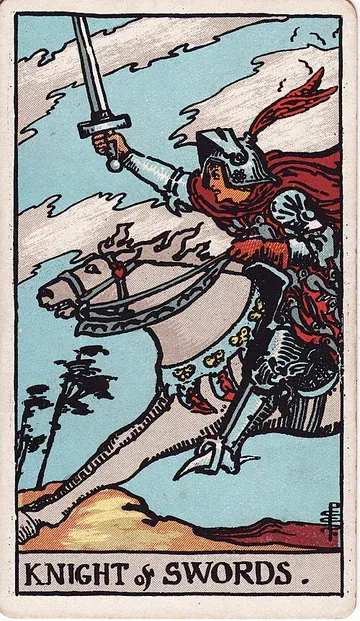
The slow knight beside the fast knight. This is the most legible knight-pairing in the deck. The Knight of Swords arrives on a charging horse, sword raised, decision already made; the Knight of Pentacles is still at the edge of the field with one coin in hand, the second furrow not yet walked. Read together, the spread is asking which timing the seeker is aligned with — and the answer is rarely both. Most situations require one or the other; the combined image is a warning to choose. Pick the slow path or the fast one, but do not try to alternate. Alternating produces the worst outcomes of both.
Knight of Pentacles + Queen of Pentacles
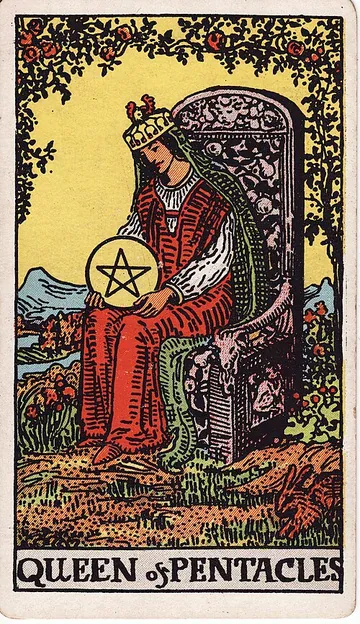
The diligent knight beside the gardener queen. This is the suit's interior arc — what the knight grows into. The Queen has done the work the Knight is doing now; she has stopped having to prove the work to herself; she has settled into the tending. Read together, the cards describe the long arc of mastery in any earth-element pursuit — relationship, craft, business, body, garden. The Knight is in the middle of the work. The Queen is in the long late-afternoon of it. The combination tells the seeker that the path they are on does not end with the Knight; it eventually deepens into the Queen.
Knight of Pentacles + The Hermit
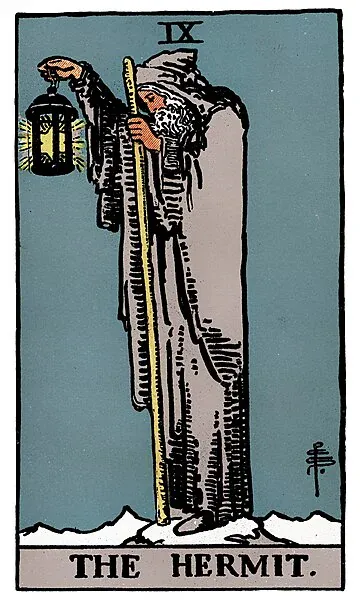
The slow walker beside the lantern-bearer. The Hermit is the Major Arcana's confirmation of the slow path — the figure who has retreated from spectacle, who has lit a single light in the dark, who is walking the same trail with care. Read together with the Knight, the cards confirm that the slow private practice the seeker has been keeping is, in fact, the spiritual path the seeker is meant to walk. The Hermit is the lantern that confirms the field is being walked correctly. The combination is rarely about action; it is about validation. The work is good. Continue.
Knight of Pentacles + The Devil
The diligent knight beside the chained figures. This is the Knight's most important shadow-pairing. The Devil is the Major's portrait of voluntary bondage — the chains around the figures' necks are loose enough to be slipped off, but the figures have stopped noticing them. Read together with the Knight, the cards warn of the rut that has dressed itself as discipline. The phrase "this is how I've always done it" has become a chain; the routine has stopped being a practice and has started being a cell. The combination asks for the small, immediate disturbance — change one element of the routine, today, before the routine becomes the bondage. The Knight upright is a furrow walked with awareness. The Devil pairing warns of the furrow walked without it.
Knight of Pentacles + Eight of Pentacles
The steady knight beside the disciplined craftsman. This is the suit's tightest decan-and-elemental neighbor pairing — the Knight's Virgo earth meeting the Eight's Virgo (Sun-in-Virgo) earth. Both cards are about disciplined repetition. The Eight is the apprentice at the bench, head down, eight pentacles already crafted, ninth in progress. The Knight is the steward in the field, the same daily work at a different scale. Read together, the cards describe a phase of life entirely given to craft — the year of the apprenticeship, the year of the new instrument, the year the body of work begins to compound. There is nothing dramatic in this combination. There is everything reliable. Make the work. Make it again tomorrow.
Card Combinations
Knight of Swords
The slow knight beside the fast one. The Knight of Pentacles holds today's furrow; the Knight of Swords charges past with sword raised and decision already made. Read together, the spread asks which timing the seeker is aligned with. Most situations require one or the other — the combined image warns against alternating, which produces the worst of both. Pick the slow path or the fast one, walk it cleanly, and refuse the temptation to switch mid-field when the chosen pace gets uncomfortable.
Queen of Pentacles
The diligent knight beside the gardener queen. This is the suit's interior arc: what the Knight grows into. The Queen of Pentacles has done the work the Knight is doing now and has settled into the tending — earth's mature form. Read together, they describe the long arc of mastery in any earth pursuit (relationship, craft, business, body, garden). The Knight is in the middle of the work. The Queen is in the late afternoon of it. The path does not end with the Knight; it deepens into the Queen.
The Hermit
The slow walker beside the lantern-bearer. The Hermit confirms what the Knight of Pentacles is already doing — the slow private practice that does not need an audience. Together they say: the work you have been keeping, in the quiet, is the spiritual path you are meant to walk. The Hermit's lantern is the proof that the field is being walked correctly. This combination is rarely about action; it is about validation. Continue. The discipline is good. The unobserved labor is the actual work.
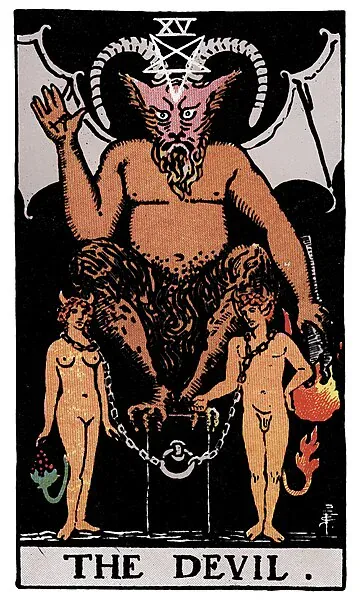
The Devil
The diligent knight beside the chained figures. The Devil names what the Knight reversed has begun to be — the routine that has hardened into voluntary bondage. The chains around the figures' necks are loose enough to slip; the figures have stopped noticing them. The phrase "this is how I've always done it" has become a cell. The combination asks for the small, immediate disturbance: change one element of the routine today, before the routine becomes the bondage. Walk the field with awareness, or the field will walk you.
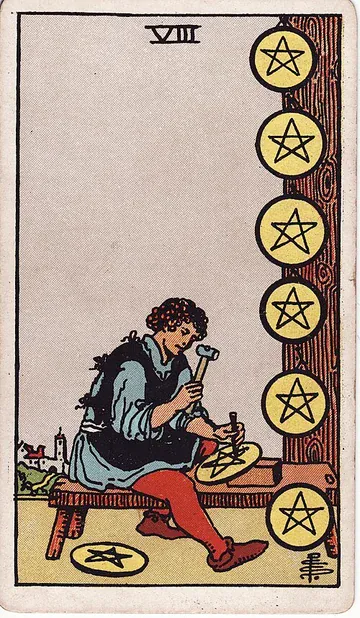
Eight of Pentacles
The steady knight beside the disciplined craftsman. This is the suit's tightest decan-and-elemental neighbor pairing — Virgo earth meeting Sun-in-Virgo earth. Both cards describe disciplined repetition at different scales: the Eight is the apprentice at the bench, head down, ninth pentacle in progress; the Knight is the steward in the field, the same daily work spread across the year. Together they describe a season entirely given to craft — the year of the apprenticeship, the new instrument, the body of work that begins to compound. Make the work. Make it again tomorrow.
Frequently Asked Questions
Does the Knight of Pentacles mean yes, but not for a long while?
The Knight of Pentacles upright is a soft yes — one of the deck's most reliable, but also one of its slowest. The yes is real and durable; it is just not fast. Whatever you are asking about will land on his timeline, which is measured in seasons rather than weeks. The most common way this yes fails is impatience: abandoning the field two months in, before the crop has had time to come up.
Is the steadiness of the Knight of Pentacles the same thing as being boring?
In love, the Knight of Pentacles describes the steady, dependable partner — the one whose love language is maintenance, not fireworks. He picks you up from work every time. He remembers what you said in March and follows up in October. He is not going to dazzle you in week one; he is going to still be there in year ten. For long-term partnerships, he confirms the bond. For new sparks, he asks for patience. For singles, he describes love that arrives through ordinary infrastructure.
Does the Knight of Pentacles mean they have already decided about me?
When the Knight of Pentacles appears as feelings, the answer is a settled, quiet, practical regard — the feeling of someone who has decided you are part of the architecture of their life and is no longer arguing with themselves about it. Their feelings live in their actions almost entirely. Read what they do with their time, not what they say with their words. Silence here is usually evidence of feelings that have stopped being volatile, not feelings that are fading.
What is the astrological signature of the Knight of Pentacles?
The Knight of Pentacles spans the Leo-Virgo cusp — August twelfth to September eleventh — and embodies a fire-within-earth temperament: charcoal buried underground, no open flame, but warm through the night. Leo's pride has burned down into Virgo's discipline. The fire has gone underground and become the patient warmth that does the actual work. Read his slowness this way: not cold, but the slowness of something that has already been burning a long time.
What is the central lesson of the Knight of Pentacles?
The central lesson is that the slow path is the only path, and that breakthrough is almost always the visible top of an iceberg of unobserved labor. Show up tomorrow the same way you showed up today. Do the dull-but-necessary task. Defend the routine. Trust the slow accumulation. Change one small step a month to keep the practice conscious. The compounding is the answer. There is no shortcut — there has never been one.
Continue Reading
Knight of Pentacles · Card overview · symbols · correspondences →
Return to the full card view — image, symbols, sensory correspondences, and Hermetic axes.
Read the reversed meaning →
Read the same depth on the opposite orientation.
Draw your reading now →
Bring this card to a question — open a quiet ritual.