
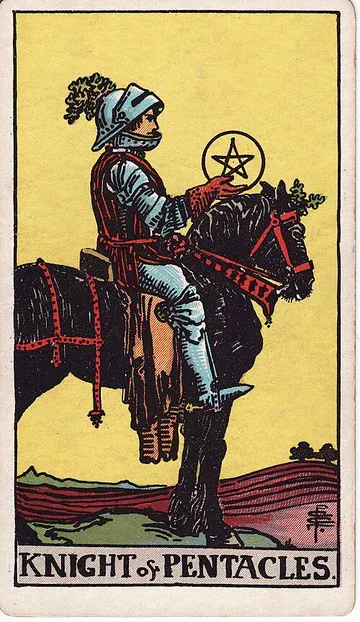
Knight of Pentacles Reversed · Core Meaning
A rut and a discipline look identical from the outside, and reversed, the Knight of Pentacles is where the difference starts to matter. The same field walked one too many times; the furrow that has worn into a millstone's groove; the donkey that has been turning the same wheel for two years and has stopped noticing the wheel. The cups are not broken. The horse has not lost its strength. The work is still being done. The seeker is still showing up. And yet, somewhere in the last cycle, the practice stopped being practice and became sleepwalk. "I've always done it this way" became the answer to questions it had never been the answer to before. The drudgery accumulated under the surface of the routine, and the routine continued, identical to the eye, hollow at its center.
This is the reversed card's central knot: steadiness that has hardened into refusal. The Knight upright was the figure who walked the furrow with awareness. The Knight reversed is the figure who walks the furrow because he no longer remembers how to do anything else. The horse keeps moving. The coin is still held up. The field is still being plowed. But the knight has stopped reading the coin as homework and started reading it as proof — proof that he is still the person who plows the field, proof that he has not changed, proof that the world should not require change of him. The phrase "this is how I've always done it" has become a wall. The wall has begun to enclose him.
There is a second flavor of the reversed card: the work that has tipped into drudgery without enough self-honesty to admit it. The job that pays the bills and quietly kills the soul. The relationship that has stabilized at a level beneath what either partner needs. The practice that was once sustaining and is now a husk. The seeker is so committed to the steadiness that they cannot let themselves see that the steadiness has become the prison. The card warns: regularity that becomes a reason not to think is no longer practice. It is sleepwalk.
The astrological signature reverses too. The Leo-Virgo cusp upright is the fire of late summer settling into the discipline of harvest. Reversed, the fire has not just gone underground; it has gone out. The charcoal that was warming the room through the night has cooled. The room is still arranged the same way. The kettle is still on the stove. But the heat is no longer there, and the seeker has not yet noticed.
For "as a person" — the Knight of Pentacles reversed describes a recognizable human archetype. He is the boss who blocks every change with "we tried that in 2019." He is the partner whose stability has become a wall against any growth that might disturb the current rhythm. He is the colleague whose competence is real and whose curiosity has been retired. He is the parent who is dependable in every practical way and who has stopped being curious about who their child is becoming. He is the friend who is loyal and who has stopped being able to hold a new conversation. He is not a villain. He is the person whose virtues have hardened past their usefulness — the diligent worker who has accumulated enough discipline to be unable to learn, the steady steward whose steadiness has become the obstacle. Most people meet this person somewhere in their lives. Many people, in their thirties or forties, become this person without noticing. The reversed card is the mirror.
The reversed card's gentlest reading is "you have walked this furrow long enough that you have stopped seeing it." Its sterner reading is "you are using the routine as a reason not to think." Its sternest reading is "the work has become a refusal of growth, and the people around you can feel it." All three readings are the same card at different distances from awareness. The seeker who picks up the card has the chance to choose which distance they want to be at. The choice is not dramatic. It is small. Disturb one step of the walk. Move the teapot to the other side of the table. Take the long route home. Read a book in a section you do not normally read. Begin somewhere small to interrupt the groove. The reversed card returns to upright through the smallest honest disturbance, repeated.
Reversed, the Knight of Pentacles asks: are you still walking the field, or has the field begun to walk you?
Knight of Pentacles Reversed · Love & Relationships
Steadiness can go to sleep without anyone noticing, and that is the reversed Knight of Pentacles inside a partnership. The relationship looks fine in photographs. The structure is intact. The friends say the right things. And yet, sitting at the table together, both partners have stopped reaching. The cups are full. The conversation has thinned to the same three topics. Neither partner dares touch the long-overdue question, lest the current rhythm be disturbed. The drudgery has crept into the rhythm without anyone noticing the moment it arrived.
For an existing long-term partnership, the reversed Knight is one of the deck's most accurate mirrors. He describes the relationship that has stabilized at a level beneath what either partner needs. The bond is real. The agreements are still being kept. The boring practical maintenance — the picking up from work, the splitting of chores, the same Sunday morning — is still being done. And underneath the maintenance, both partners have quietly begun to live private lives the other partner does not know about. Not affairs. Hobbies. Friends. Inner shifts. New ideas. A second self has begun to emerge that the relationship has not been told about. The card asks: when was the last real conversation? Not the logistics conversation. The conversation that surprised at least one of you.
For a new connection, the Knight of Pentacles reversed describes a partner who is settling for stability before the relationship has earned it. They are skipping the early-spark phase entirely. They are treating you like the long-term partner before the long-term has been built. This sounds romantic and is, in practice, the opposite — they are asking the structure to hold what the foundation has not yet been laid for. Read this as a quiet warning: the relationship is being installed too fast. The foundation will, two years from now, be the problem.
For someone questioning whether to stay in a long relationship, the reversed Knight is gentle but specific. He says: the question is not whether the partner is good. The question is whether the relationship is alive. Stable can mean alive (the upright reading) or it can mean asleep (the reversed). The audit is on the aliveness, not the stability. If the answer to "have we grown together in the last year" is no, the relationship is in the reversed half of the card. The fix is not necessarily to leave; the fix is, first, to disturb the sleep with one honest conversation. Some relationships return to upright through that conversation. Some do not. Both outcomes are useful.
For "is this person in love with me" reversed — the Knight of Pentacles reversed describes love that has become routine in the dull sense. They love you. They are not currently in love with you. The verbs are different. Love is stable; in love is alive. The reversed card warns that the verbs have separated and that the seeker has been, perhaps for a long time, in a relationship where the steady verb has been mistaken for the live one. This is uncomfortable to read. It is also useful. The fix, again, is not to leave. The fix is to ask whether the live verb can be retrieved by both partners doing one new thing together. Sometimes yes. Sometimes no.
For the question of reconciliation after a break, the reversed Knight is one of the more sobering cards. He says: returning to the relationship in its previous form will rebuild the rut, not the love. The previous form is the form that produced the break. If both partners are willing to come back as different people — not just nostalgic for the comfort, but genuinely changed — the reconciliation can hold. If both partners are returning because the old shape was familiar and the alternative is hard, the reconciliation will not hold. The card asks for honesty about the version of yourself you would be returning as.
For the single seeker, the reversed Knight is a gentle warning specifically about the trap of the comfortable solitude that has stopped being chosen and started being inertial. The single life can be deliberate, beautiful, intentionally walked. It can also be the default of someone who has stopped showing up to the rooms where new people might be met because the routine has become more comfortable than risk. The card asks: is your solitude alive, or is it asleep? The fix is small. One new room a month. One coffee with one new person. Not a transformation; a disturbance.
For partners who have been together a long time and find the reversed card in a love spread, do not panic. Most long relationships pass through reversed-Knight seasons. The card is not predicting the end. It is describing a season that requires intervention. The intervention is small: one date that breaks the routine. One conversation that asks a question neither of you has asked recently. One piece of honesty that breaks the comfortable silence. The card responds to small disturbances. It does not require a dramatic intervention; dramatic interventions usually overshoot. Disturb gently. Repeat.
A note on the reversed Knight's specific risk: the partner who has the reversed Knight as their type can become invisibly resentful. They are still doing the practical maintenance — the rides, the chores, the dependable presence — but a layer of resentment has begun to accumulate beneath the maintenance, and the resentment is the thing the partner cannot articulate because they cannot articulate why the steadiness has begun to feel like a sentence. Watch for this. If you are the one whose Knight has tipped reversed, name it before it solidifies. If you are the partner of one, ask. The card responds to articulation. Without articulation, the steady erosion continues.
Knight of Pentacles Reversed · As Feelings
Comfort is the entire temperature of the reversed Knight of Pentacles when the question is feelings. They feel a quiet, unexamined attachment. They no longer think of you as a question. They are not still asking themselves who you are; they have decided who you are, and the decision has not been updated in some time. The feelings are real. The feelings are also stale.
If they are reserved by nature, the reversed Knight in feelings can mean that the silence has become a form. They have always been quiet. The quiet used to carry a felt weight. Now the quiet carries less — they have not stopped feeling, but they have stopped paying attention to what they feel. Their quietness is no longer protection; it is sleepwalk. Watch for the partner who is technically present and emotionally elsewhere. Watch for the conversations where their answer is reflexive rather than considered. The feelings are still under the silence; they have just stopped being attended to.
If they are demonstrative, the reversed Knight in feelings warns of performative steadiness. They say the right things. They post the right photographs. They tell their friends the same things they have been telling them for three years. But in the room with you, alone, the depth has thinned. The morning kiss has become a habit they no longer feel. The Sunday call has become a calendar entry. The love is still there underneath the routine. They have stopped noticing that they love you, which over time is its own kind of erosion.
For a partner you have been with a long time, the reversed Knight as feelings is one of the most subtle and important readings the deck offers. It does not say the partner has fallen out of love. It says the partner has fallen asleep inside the love. They have stopped re-noticing you. They no longer ask who you are becoming. They love a frozen photograph of you, taken three years ago, and the photograph is increasingly unlike the live person you actually are. The work, if there is work, is to ask them to look at the live version of you. Some partners can. Some have forgotten how. Both outcomes are information.
For a new connection, the reversed Knight in feelings describes someone who is approaching you with the routine of someone who has done this before and is no longer fully present to the specific person in front of them. They are running the courtship script they always run. The script is competent. The script is not about you. They feel something — pleasant, attached, comfortable — but the feelings are not yet specific enough to you to be alive. The card asks for patience and discernment: are they capable of waking up to you specifically, or will the script continue to be the relationship? Time will reveal. Do not commit to the script.
For "as a person" — when the reversed Knight describes a personality archetype rather than a feeling state — the card describes the partner whose feelings have become structural. They feel about you the way a homeowner feels about their house: comfortably, possessively, without much need to look at it. They are not abusive. They are not absent. They are just no longer fully there. This is one of the most common quiet partnerships in the second half of long relationships. The card names it without judgment.
For the partner who has been distant or hard to read, the reversed Knight in feelings can mean that they are not actually distant in the active sense — they are absent in the unconscious sense. They have not deliberately withdrawn. They have, slowly, stopped showing up to the relationship in their interior even while continuing to show up in their exterior. Read this honestly. Do not interpret unconscious absence as conscious distance; the fix is different. Conscious distance can be addressed by conversation; unconscious absence requires the partner to wake up first, which is harder.
For someone you are watching from a distance — the long-time crush, the partner you have not yet had the conversation with — the reversed Knight as feelings indicates that they have, possibly without meaning to, settled into a frozen image of you that does not match the live person you have become. They are interacting with their idea of you, not with you. Whether they can update the idea is the question. Some can. Some cannot. Thawing a frozen image is slow work, and it belongs to the one who froze it.
A small caution for the seeker who finds the reversed Knight in a feelings reading and feels the pull to fix it: you cannot wake the partner up alone. You can disturb the routine. You can ask the question. You can refuse to be reduced to the frozen image. You cannot do their interior work for them. The card's reversal returns to upright through the partner's renewed attention, not through your over-effort.
Knight of Pentacles Reversed · Career & Work
Treadmill is the word the reversed Knight of Pentacles uses for work that has stopped asking anything of you. The role pays. The colleagues are familiar. The competence is real. And the seeker has been doing exactly the same thing for long enough that "this is how I've always done it" has become an answer to questions it was never the right answer to. The phrase has, in the last year, turned away three chances to upgrade. The seeker did not even register that the chances were chances; they read them as inconvenient noise that interrupted the routine.
For someone in a current role asking whether to stay, the reversed Knight is one of the more challenging cards to sit with. He says: the role is not bad enough to leave, and the role is not alive enough to stay for. This is the well-furnished cage diagnosis. Nothing in the role is making you suffer. Nothing in the role is making you grow, either. You have plateaued, and the plateau has been long enough that you have begun to mistake it for the destination. The card asks for honest audit: is the plateau a season or a verdict? If a season, the upright path is to disturb one element of the role — take on the project that scares you, ask for the new responsibility, learn the next skill — and see if the role wakes up. If a verdict, the seeker is being asked to admit it.
For someone considering a new role with the reversed Knight in the spread, the card warns specifically of moving from one rut to the same rut at a different company. The seeker who is leaving job A because they are bored, and is taking job B because the salary is higher and the title is better, but is in fact moving into the same shape of work with the same shape of culture — that seeker is not leaving the rut. They are moving the rut. The reversed Knight asks for clarity about whether the new role is structurally different or just cosmetically different. Cosmetically different reorganizes the boredom; structurally different reorganizes the work.
For the freelance / contractor / small-business career stage, the reversed Knight is the card of the practice that has stopped growing. The same clients. The same offerings. The same rates. The same average month for the third year running. The seeker is paying the bills and is not building anything new, and the not-building has become invisible because each month, individually, has been fine. The card asks: when did you last raise rates? When did you last add a new offering? When did you last decline a client because the client no longer matched where you are going? If the answer to all three is "I cannot remember," the practice has slipped reversed. Disturb one element. Raise the rate on the next quote. Decline the next client whose work no longer fits. Add the new offering you have been describing to friends for two years. The reversed practice returns to upright through one structural change, repeated.
For creative practice, the reversed Knight describes the artist who has been making the same work in the same way for so long that the work has stopped being a search. The technical execution is competent. The audience response is steady. The artist is no longer surprised by their own pieces. The card asks for the artistic disturbance: a new medium for one project, a new constraint, a collaboration with someone whose practice unsettles your own. The reversed Knight in creative work returns to upright through the willingness to make something bad on purpose, in service of finding the next good.
For someone facing layoff or industry transition with the reversed Knight in the spread, the card is gentle but specific. He says: the transition is not the catastrophe. The catastrophe was the long stretch before the transition, in which the seeker stayed in a role that had stopped serving them long past the moment when leaving would have been the cleaner move. The layoff is, in many cases, the corrective the seeker had been unable to give themselves. The work now is not to recreate the previous shape of work in a new company. The work is to use the disruption to ask a question the seeker had stopped asking: what work would I be doing if the routine of the last role had not enclosed me? The answer is often surprising. Honor it.
For promotion questions reversed, the Knight is sometimes a difficult signal. He can mean that the promotion the seeker has been waiting for is not coming because the seeker has, without realizing it, been performing the role they currently have rather than performing the role they want to be promoted into. The boss has not seen what the next role would look like in the seeker's hands because the seeker has been giving competent versions of the current role rather than glimpses of the next. The card asks for the small acts of next-level work, made visible. Take on the project the next-level person would take. Show the analysis the next-level person would show. The promotion follows visibility, not just competence.
For someone managing a team and finding the reversed Knight, the card is asking the manager to audit which of their reports has slipped into rut. The reliable engineer who has been doing the same caliber of work for three years and is no longer growing is being mismanaged by neglect. They have been left in a comfortable role. They are about to leave the company without anyone understanding why, because the steady worker rarely articulates the boredom — they just, quietly, leave. The card asks the manager to have the conversation now, before the resignation arrives.
For entrepreneurs, the reversed Knight describes the business that has stopped innovating and has started maintaining. Maintenance is fine for some businesses. For most, especially in early stages, maintenance is decline disguised as stability. The card asks for the next deliberate disturbance: the new product line, the new market, the new pricing structure. Not for novelty's sake. For the sake of refusing to let the business slip into the rut that, three years from now, will be the explanation for the slow market-share loss.
For job interview questions with the reversed Knight in the spread, the warning is that the interviewer is sensing the rut in the candidate's stories. The candidate is telling the same successful project from four years ago. The interviewer is wondering, politely, what the candidate has done since. Update the stories. The card responds well to the candidate who can show recent growth. It punishes the candidate who is still relying on the work of their younger self.
Knight of Pentacles Reversed · Money & Finances
Financial habits outlive the lives they were designed for, and the reversed Knight of Pentacles is where that shows. The savings rate set in the first year of the job that no longer fits the current income. The budget categories that no longer match how the seeker actually spends. The investment allocation that was correct at thirty and is wrong at forty. The seeker is still doing the financial discipline that produced their previous stability, and the discipline has become so automatic that it is now slightly off-target. The numbers are real. The numbers are also stale.
For the seeker who has been managing money carefully and finds the reversed Knight, the card is not warning of imminent disaster. It is warning of slow drift. Each month, individually, looks fine. Cumulatively, the wrong allocation, the under-saving, the over-conservatism, or the missed adjustment has begun to compound in the wrong direction. The card asks for the annual financial audit that the seeker has been postponing. Look at the numbers honestly. Update the spreadsheet. Move the auto-transfer up by the small percentage that matches the new income. Rebalance the portfolio, even if it has not been rebalanced in three years. The reversed routine returns to upright through one honest annual review.
For someone managing debt with the reversed Knight in the spread, the card warns of the discipline that has become permanent. The seeker entered austerity for a real reason — to pay down the debt — and the austerity has continued past the moment when it should have been relaxed. The debt may, in some cases, already be paid; the budget has not been updated. The seeker is still living as though the financial fire is being fought, after the fire has been out for some time. The card asks for the gentle relaxation of the budget where the budget no longer needs to be tight. The relief is permitted.
For the opposite case — the seeker who has been overspending in routine ways and not noticing — the reversed Knight is also accurate. The lifestyle creep has become invisible. The takeout that started as a treat is now five nights a week. The subscriptions accumulated. The car insurance auto-renewed at a worse rate than the alternative. The card asks for the same audit, in the opposite direction. Track one week of spending honestly. The places the budget has slipped will reveal themselves.
For investment questions with the reversed Knight, the warning is specific: the strategy that worked in the previous market regime may not be the strategy for the current one. Not because the seeker should chase trends, but because the underlying assumptions baked into the original allocation may no longer match the current life. The thirty-year-old's aggressive allocation does not match the forty-five-year-old's nearer retirement. The single person's portfolio does not match the parent's. The seeker who has not updated the asset allocation since they set it has been inadvertently making a decision through inaction. The card asks for one honest review.
For windfall questions reversed, the Knight describes the trap of routine deployment. The seeker has been so trained to put windfalls into the savings account that the windfall this time may actually need to go to the long-deferred dental work, the long-deferred therapy, the long-deferred trip with the aging parent. Routine deployment is good in most cases; routine deployment that ignores the actual current need is sleepwalk. The card asks: what is the windfall actually for, this time?
For someone in financial recovery with the reversed Knight, the card is gentle but specific. The recovery has, in some cases, slipped into a permanent austerity that no longer matches the actual situation. The seeker is performing the recovery long after the recovery has technically completed. Permission is granted. The honest small treats are not the failure of discipline; they are the marker of recovery successfully completed. Take them.
A note on financial fear in the reversed Knight: the card describes the seeker who has, through long discipline, built a real financial position and has not yet allowed themselves to feel it. They are still operating from the scarcity script of a previous decade. The numbers are different now. The script has not updated. The seeker is, in some real sense, financially fine and emotionally still in the lean year. The card asks for honesty about the gap.
A practical move when the reversed Knight appears in money: do one financial review you have been postponing. Open the spreadsheet. Look at the numbers honestly. Make one small structural adjustment. The card responds well to small honest disturbances of the routine. It punishes the seeker who keeps the discipline running in the same form for years past the moment it should have been updated.
Knight of Pentacles Reversed · Health
The body changed and the routine did not — the reversed Knight of Pentacles reads health that way. The exercise program that was right at thirty and is wrong at forty. The diet that worked five years ago that the body has outgrown. The sleep schedule that fits the previous life and not the current one. The medication regimen that has not been reviewed in some time. The seeker is still doing the disciplined practice that produced their previous health, and the practice has become so automatic that the body has been quietly asking for an update for some months that the seeker has not heard.
For someone in chronic-condition management, the reversed Knight is one of the most important warning cards the deck offers. He describes the protocol that has slipped from active management into automated maintenance. The medication is still being taken — sometimes. The exercise is still being done — sometimes. The bloodwork has not been done in eighteen months. The follow-up appointment was rescheduled twice and then forgotten. The condition is, in many cases, being managed adequately enough that nothing has gone wrong, but the active relationship to the management has gone passive. The card asks for the re-engagement before the condition forces it. None of this is medical advice; the seeker should keep their practitioners and follow medical guidance. The card simply names the pattern: passive management eventually becomes inadequate management.
For the body's specific vulnerabilities under this card — the legs and the lower back — the reversed Knight describes the chronic stiffness that has become invisible. The seeker has lived with the lower back tightness for so long that it has stopped registering as a problem. It has become the baseline. The hip flexors have shortened. The legs have weakened. The card asks for the small interventions that the upright practice has not been making: the stretches in the morning, the walks longer than the routine allows, the strength work that the seeker has not been doing because it was not part of the original protocol. Add it.
For someone managing weight, food, or appetite with the reversed Knight, the card describes the relationship with food that has become numb. The seeker is eating the same things at the same times for the same reasons, and the body has stopped being asked what it actually wants. The eating is competent. The eating is not nourishing in the felt sense. The card asks: when did you last cook a new dish? When did you last actually taste a meal rather than perform the routine of one? The fix is small. One new ingredient a week. One meal made slowly. One dinner without the screen. The body responds to attention. Numb routine erodes that attention; small acts of presence restore it.
For someone managing alcohol, recreational substances, screen time, or other comfort behaviors that have crossed into routine, the reversed Knight is a sober mirror. The behavior is no longer chosen. It is automatic. The third drink at dinner that was not chosen this evening any more than it was chosen last evening; the two-hour evening scroll that has displaced the reading the seeker used to do; the substance that has stopped being recreational and started being scheduled. The card asks for the honest naming. Not necessarily the abandoning. The naming. Once named, the seeker can choose. While unnamed, the routine continues.
For chronic fatigue, low energy, sleep disturbance, or persistent low-grade illness with the reversed Knight, the card asks the seeker to look at the routine as part of the problem, not just as the maintenance against it. The same wake time that was right ten years ago may not be right now. The same caffeine pattern may have crept past its useful dose. The same evening shape may be undermining the sleep. The fix is rarely dramatic. The fix is the small, honest adjustment that the routine has been resisting because the routine was the discipline. Loosen the discipline where the discipline has become rigid. Hold it where it has become slack.
For mental health, the reversed Knight can describe the season after a depressive or anxious episode, when the practices that held the seeker through the episode have been continued past their need without examination. The therapy that was crucial in the bad year has become a routine the seeker is not actually using. The medication regimen has not been reviewed. The journaling has become a chore rather than a tool. The walks have become ten minutes shorter each month for a year. The recovery has, in some cases, completed without the seeker updating to a different relationship to the practices. The card asks for the conversation with the practitioner about what comes next, in the season after acute work has passed. The conversation about what comes next belongs to your practitioner; the Queen has no medical advice to give. Keep the practitioners. Take the medicine. Update the relationship to the work.
For someone in burnout with the reversed Knight, the warning is specific: the recovery that should have happened has not yet happened because the seeker has continued the previous routine intact, in the belief that the routine itself was the problem. The routine was not the problem. The unconscious continuation of the routine, past the point of fit, was the problem. Recovery here requires not just rest but honest re-evaluation of the shape of life that produced the burnout. Without the re-evaluation, the rest is preparing the seeker for the next cycle of the same burnout.
A practical move when the reversed Knight appears in health: change one element of the daily routine this week. Walk a different route. Eat one new food. Sleep an hour earlier. Take a class outside your usual training. The body responds to small, honest disturbances of the groove. Without the disturbance, the routine that was discipline becomes the routine that is rut, and the rut, eventually, breaks the body in some way the routine had been protecting against.
Knight of Pentacles Reversed · Spirituality
Form with nobody home inside it is the reversed Knight of Pentacles' spiritual diagnosis. The seeker is still meditating. They are still sitting on the cushion at the same time. They are still running the same form they have run for years. And somewhere in the last cycle, the practice stopped being practice and became performance — performance for an audience that may include only the seeker themselves. The form is still being kept. The animating attention behind the form has gone quiet. The fire-within-earth that gives this card its warmth has cooled to ember and then to ash, and the ash is still arranged the way the fire used to be arranged.
For seekers in active practice, the reversed Knight is the most subtle warning the deck offers. He does not say the practice is wrong. He says the practice has become a routine in the dull sense — the seeker is doing the right form for the wrong relationship to it. The morning sit is still the morning sit. The seeker has stopped meeting it. They are sitting through it the way they sit through traffic. The form is correct. The practitioner is not present.
The fix is small and uncomfortable. Disturb one element of the practice. Sit in a different chair. Sit at a different time. Change the form for a week. Add a question to the practice — the question that you have been not asking yourself for some months. Read a book by a teacher whose tradition is not yours. The card responds to the small honest disturbance of the form. Without the disturbance, the form accumulates dust, and the dust eventually becomes the practice itself, and the seeker is now devoutly practicing a form whose interior has departed.
For seekers exploring belief with the reversed Knight, the card warns specifically of the teaching that has stopped being interrogated. The seeker has accepted a tradition or framework as their own, and the framework has stopped being a living thing they are in conversation with and started being a furniture they live among. The card asks: when did you last argue with the teaching? When did you last read a book that disturbed your framework? When did you last meet a practitioner from a different tradition whose seriousness made you re-examine your own? The reversed Knight is not asking the seeker to abandon the framework. He is asking the seeker to wake up inside it.
For questions about path with the reversed Knight, the card describes the seeker who has been on the same path long enough that they have begun to mistake the path for the destination. The path is a vehicle, not a place. The reversed Knight asks: are you still moving along the path, or have you set up camp at the spot where the vehicle stopped? The fix is to keep walking — not necessarily to leave the path, but to remember that the path was supposed to take you somewhere, and that being on the path is not the same as being at the destination, and that some seekers spend twenty years on a path that was supposed to take three because they confused the comfort of the path with the work it was supposed to do.
The card's particular shadow at this register is the spiritual seeker who has accumulated enough discipline to be unable to learn. They have meditated long enough that they have a teacher's confidence; they have read deeply enough that they have a scholar's vocabulary; and they have stopped being a beginner, which means they have stopped being a learner, which means they have begun to die spiritually. The card asks for the deliberate return to beginner's mind. Pick up a practice you are bad at. Sit beside a teacher whose tradition is not yours. Meet the room as if you have not been here before. The reversed Knight returns to upright through the willingness to be a student again.
A real practice the card invites: this week, change one element of the spiritual routine. Sit at a different time. Use a different prayer. Read a teaching from outside your tradition. Speak the practice to one person you would not normally speak it to. The point is not the change for its own sake; the point is to refuse the sleepwalk that has begun to dress itself as devotion. Devotion that has gone unconscious is no longer devotion. It is autopilot wearing devotion's clothes.
For someone whose practice has gone cold but who has not yet noticed — the meditator who is still meditating but is no longer finding anything in the meditations, the journal-keeper whose entries have become identical, the prayer-keeper whose prayers have become incantations — the reversed Knight is gentle and specific. The cure is not a more dramatic practice. The cure is a smaller, more present one. Sit for five minutes with full attention rather than thirty with none. Write one honest sentence rather than five rote pages. The card responds to honest presence, however brief. It does not respond to performed duration.
The reversed Knight's deepest spiritual reading is that the seeker has confused continuity for life. They have continued the practice unbroken for so long that they have mistaken the unbroken continuation for the working of the practice. Continuity is one virtue of a practice, not its essence. The essence is the live attention. Without the attention, the continuity is a corpse upright in the chair. The card asks for the small, honest disturbance that returns attention to the form.
Knight of Pentacles Reversed · Yes or No
Maybe — or not in this form.
The answer is stuck rather than closed. It is more often a conditional no, a yes-in-the-wrong-form, or a yes that has been delayed past usefulness by the seeker's own rut. The card almost never refuses outright. It says: not this way, or not yet, or yes-but-the-form-needs-to-change-first.
For yes-or-no questions about a relationship, a job, a project, a decision, the reversed Knight asks first whether the question itself has slipped into rut. Has the seeker been asking the same question for so long that asking it has become the avoidance of answering it? The reversed card is almost always more diagnostic than predictive — it describes the seeker's current relationship to the question more than it describes the answer. If the answer is "yes, but in a different form than the one I have been considering," the card is signaling. If the answer is "yes, but only after I disturb the routine that has been preventing it from arriving," the card is also signaling.
For questions about whether someone is being honest, whether an offer is genuine, whether a plan will hold, the reversed Knight does not warn of deception. It warns of staleness. The offer was once genuine; the offer may now be obsolete because the situation has changed since the offer was made. The plan was once viable; the plan may have aged past its viability while the seeker was deliberating. The card is asking the seeker to verify that the question is still the right question to be asking, before answering it.
For binary decisions — should I act, should I wait — the reversed Knight says: act, but act differently than you have been acting. The seeker who has been waiting in the same form for the same answer for too long is being asked to either change the form of the waiting, change the form of the action, or both. The reversed card punishes the seeker who continues the same approach in the face of repeated null results. It rewards the seeker who, even slightly, changes the approach.
Asked why it is taking this long, the reversed Knight indicates that the timing is being delayed by something the seeker is doing without realizing it. Not a hostile force in the world; a routine in the seeker that is preventing the answer from arriving. The card asks: what would you have to change in your daily approach for the answer to be able to land in your life? Whatever the answer, do that. The reversed card responds well to small structural change in the seeker's own approach. It does not respond to repeated identical effort.
For the most common reversed Knight yes-or-no — "should I leave the relationship / job / city / situation that has stabilized into a rut" — the card does not say leave. It does not say stay. It says: disturb the situation, and then look again. Most ruts mistake themselves for verdicts. The seeker who has been calling something a verdict for two years often discovers, after one honest disturbance, that the situation was never a verdict; it was a routine that had stopped being examined. The card asks for the disturbance first. The decision is clearer on the other side of it.
If the question was: do I deserve more than this? The reversed Knight answers: yes, and the reason you are still in less is that you have built the routine that is keeping you in less. Disturb the routine. The "more" you are imagining is, in many cases, available; the routine is the wall.
The reversed card's cleanest reading: it is rarely the situation that is the problem. It is the seeker's relationship to the situation that has gone unconscious. Wake up. Look again. The yes or the no is on the other side of waking up. Without the waking up, the same question can be asked of the same situation for years and produce no answer; the situation has not been the question for some time, but the seeker has not noticed.
Knight of Pentacles Reversed · Advice
Pick one routine this week and take it apart — the Knight of Pentacles reversed asks for exactly that much. Not all of them. One. Choose the routine that has felt most unimpeachable — the one you would have defended without thinking. The morning routine, the work routine, the relationship routine, the practice routine. Look at it honestly. Ask: when was this last updated? Whom does it currently serve? What part of the original purpose still holds, and what part has gone vestigial? The card responds well to one honest disturbance. It does not respond to a complete overhaul, which usually overshoots and has to be unwound.
If there is one specific instruction, it is this: change one element today. Move the teapot to the other side of the table. Walk the route in the opposite direction. Take the long way to work. Cook something you have never cooked. Read a book in a section you do not normally read. Write the journal in a different notebook. The reversed card returns to upright through the smallest, most honest disturbance, repeated. The seeker who tries to overhaul their entire life produces drama and rebounds. The seeker who changes one small element a week produces actual change, slowly, in a way that holds.
A second instruction: re-articulate the routine's purpose. Most ruts are routines whose original purpose has departed and whose form has continued. Sit down with one routine and ask: why am I doing this? If the answer is a specific original purpose that still holds, keep the routine. If the answer is "because I have always done it" or "because it would feel weird to stop," the routine has slipped. Update or release.
A third instruction: invite the disturbance from outside. The reversed Knight is bad at disturbing himself. He benefits enormously from a friend, a teacher, a partner, a stranger whose presence introduces something his routine had been excluding. Ask the friend who has been quietly noticing your stuckness for what they have been noticing. Take the class. Visit the teacher. Read the book that was recommended six months ago and that you have not yet picked up. The reversed card is gentler when the disturbance comes from outside than when the seeker has to manufacture it from within.
A fourth instruction, gentler than the others: forgive yourself for the rut. Most adults pass through reversed-Knight seasons. The competence that produced the previous stability is the same competence that, unexamined, produces the rut; you cannot avoid the rut by avoiding the competence. The work is to keep the competence and renew the awareness. The seeker who berates themselves for having ended up in a rut is not yet doing the work. The seeker who notices the rut without judgment, and then disturbs one small element, is doing it.
A fifth instruction, important specifically when the reversed Knight describes a person rather than a feeling state: do not try to wake the other person up by force. The reversed Knight as a person — the boss who blocks every change with "we tried that in 2019," the partner whose stability has become a wall, the colleague whose competence has retired its curiosity — cannot be argued out of the rut. The argument confirms their position. The most that can be done is to refuse to be enclosed by their rut. Continue your own growth. Disturb your own routine. Sometimes the other person follows when they see growth happening beside them. Sometimes they do not. Both outcomes are useful information, and neither outcome is the seeker's responsibility to engineer.
Practical advice for the day the card appears: choose one routine you are most defensive about. Sit with it for five minutes. Ask whether it is still alive or has slipped to autopilot. Make one small change. Do not announce the change. Do not require the change to be impressive. Do not allow yourself to overhaul the rest of your life off the back of this one disturbance — that is the rebound pattern, and it always re-establishes the rut in a slightly different costume. Change the one small thing. Repeat next week with a different small thing. By the end of the season, the seeker has, without drama, returned the practice to upright.
A note for ambitious readers who find the reversed Knight's advice underwhelming: the cure for the rut is not the dramatic reinvention. The dramatic reinvention is a rut wearing a new outfit. The cure is the small, honest, sustained re-attending. This is the patient work that the reversed Knight himself failed to do, and the work that, when resumed, returns him to himself.
Knight of Pentacles Reversed · Card Combinations
The Knight of Pentacles reversed reads sharpest when paired with cards that name the rut in different registers — sibling knights showing speed contrast, the Devil naming the bondage, the Hermit warning of solitude that has gone unproductive, Major modulators that reframe the slow walk into a richer or thinner light. Each pairing diagnoses where, exactly, the rut is loudest.
Knight of Pentacles Reversed + Knight of Swords
The frozen knight beside the impulsive knight. This is one of the deck's most sobering pairings. The Knight of Pentacles reversed has stopped moving, while the Knight of Swords has begun moving without thought; together they describe the seeker stuck between two failures of pace. The cure is neither speed nor stillness; it is the conscious mid-tempo — the willingness to act, but only after the pause that the Knight of Swords skips, and only by an amount that disturbs the rut the Knight of Pentacles has settled into. Take one small considered step, this week, that the routine has been preventing.
Knight of Pentacles Reversed + The Devil
The frozen knight beside the chained figures. This is the reversed Knight's most diagnostic Major Arcana pairing. The Devil names what the reversed Knight has begun to be: the routine that was once chosen has hardened into the chain that no longer feels like a chain. The figures could slip the chain in an afternoon, and they have stopped trying. Read together with the reversed Knight, the cards say: the rut has become voluntary bondage, and the bondage is loose enough to be left. Try one element of leaving. Move the teapot. Take the long way home. The Devil's chains are released through small, honest acts of refusal repeated.
Knight of Pentacles Reversed + The Hermit
The frozen knight beside the lantern-bearer. This pairing is gentler than the Devil pairing and just as accurate. The Hermit upright is solitude that produces depth; the Hermit beside the reversed Knight warns of solitude that has produced narrowing. The seeker has been alone with their practice for so long that the practice has begun to circle. The cure is not to abandon solitude but to introduce one outside voice — a teacher, a friend, a tradition not your own. The Hermit's lantern looks better when it has been raised in the company of one other lantern, even briefly.
Knight of Pentacles Reversed + Queen of Pentacles
The frozen knight beside the gardener queen. This pairing describes the suit's interior contrast at a difficult angle. The Queen has done the work of growing into earth's mature form; the reversed Knight has stalled before the growth completed. Read together, the cards describe the seeker who has the discipline of the Knight without the integration of the Queen — diligent without yet being alive. The cure is the Queen's particular gift: tending. Bring the practice into relation with what is around it. Garden it rather than just maintain it. The reversed Knight returns to upright by walking toward the Queen.
Knight of Pentacles Reversed + Eight of Pentacles
The stalled knight beside the apprentice at his bench. This is the suit's most specific decan-and-elemental pairing reversed: Virgo earth meeting Virgo (Sun-in-Virgo) earth. The Eight upright is the disciplined craftsman, head down, work in front of him; reversed Knight beside upright Eight reads as the seeker who has been doing the craft so long that the craft has stopped teaching them anything. The cure is to take the apprentice's posture again. Approach an element of the work as if learning it for the first time. Use the wrong tool deliberately to see what it teaches. The pairing returns to alive practice through deliberate beginner's mind, applied to the work the seeker has stopped seeing.
Card Combinations
Knight of Swords
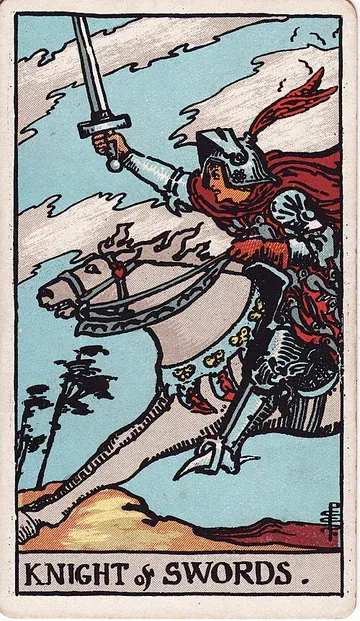
The slow knight beside the fast one. The Knight of Pentacles holds today's furrow; the Knight of Swords charges past with sword raised and decision already made. Read together, the spread asks which timing the seeker is aligned with. Most situations require one or the other — the combined image warns against alternating, which produces the worst of both. Pick the slow path or the fast one, walk it cleanly, and refuse the temptation to switch mid-field when the chosen pace gets uncomfortable.
Queen of Pentacles
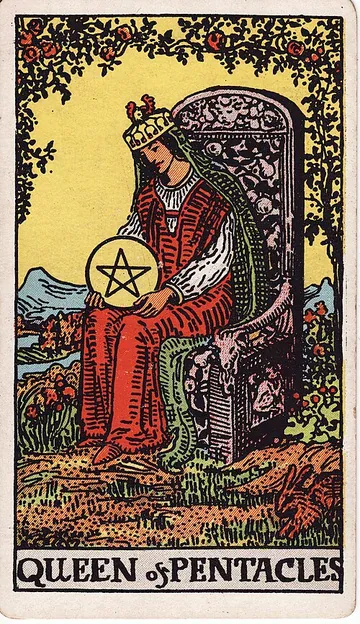
The diligent knight beside the gardener queen. This is the suit's interior arc: what the Knight grows into. The Queen of Pentacles has done the work the Knight is doing now and has settled into the tending — earth's mature form. Read together, they describe the long arc of mastery in any earth pursuit (relationship, craft, business, body, garden). The Knight is in the middle of the work. The Queen is in the late afternoon of it. The path does not end with the Knight; it deepens into the Queen.
The Hermit
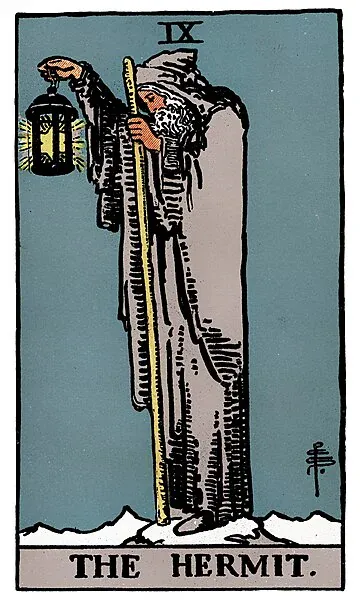
The slow walker beside the lantern-bearer. The Hermit confirms what the Knight of Pentacles is already doing — the slow private practice that does not need an audience. Together they say: the work you have been keeping, in the quiet, is the spiritual path you are meant to walk. The Hermit's lantern is the proof that the field is being walked correctly. This combination is rarely about action; it is about validation. Continue. The discipline is good. The unobserved labor is the actual work.
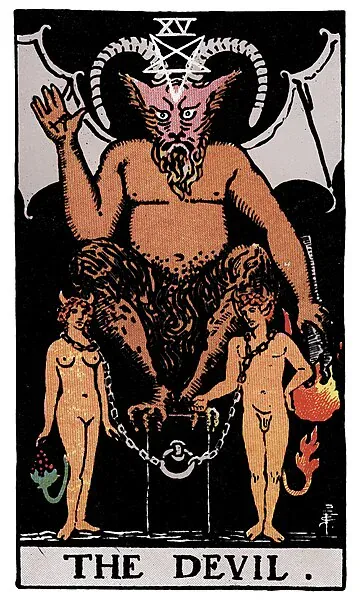
The Devil
The diligent knight beside the chained figures. The Devil names what the Knight reversed has begun to be — the routine that has hardened into voluntary bondage. The chains around the figures' necks are loose enough to slip; the figures have stopped noticing them. The phrase "this is how I've always done it" has become a cell. The combination asks for the small, immediate disturbance: change one element of the routine today, before the routine becomes the bondage. Walk the field with awareness, or the field will walk you.
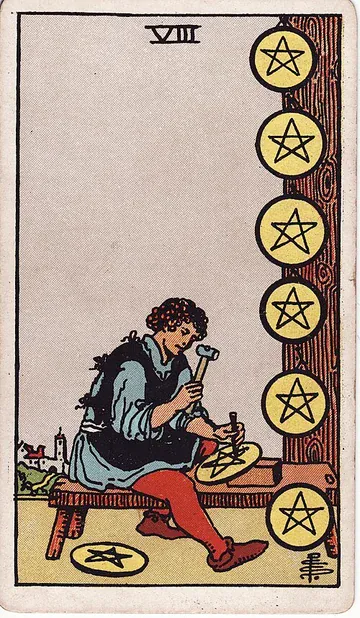
Eight of Pentacles
The steady knight beside the disciplined craftsman. This is the suit's tightest decan-and-elemental neighbor pairing — Virgo earth meeting Sun-in-Virgo earth. Both cards describe disciplined repetition at different scales: the Eight is the apprentice at the bench, head down, ninth pentacle in progress; the Knight is the steward in the field, the same daily work spread across the year. Together they describe a season entirely given to craft — the year of the apprenticeship, the new instrument, the body of work that begins to compound. Make the work. Make it again tomorrow.
Frequently Asked Questions
Is the Knight of Pentacles reversed a no, or a yes stuck in my own rut?
The reversed Knight is rarely a clean no. It is more often a maybe, a not-in-this-form, or a yes that has been delayed by the seeker's own rut. The card almost never refuses outright; it asks whether the question has slipped into rut, whether the form needs to change before the yes can land, whether the routine itself is preventing the answer from arriving. Disturb one small element of the approach and look again — the answer is usually clearer on the other side of the disturbance.
With the Knight of Pentacles reversed, has the relationship gone stale or only quiet?
Reversed in love, the Knight of Pentacles describes steadiness that has hardened into sleep. The relationship looks fine in photographs; the maintenance is still being done; both partners have quietly stopped reaching. For long-term partners, it warns of the verbs separating — they love you, they are not currently in love with you. For new connections, it warns of installing the structure too fast. The fix is a small, honest disturbance: the conversation neither of you has been daring to have.
Does the Knight of Pentacles reversed mean they love an older version of me?
The reversed Knight as feelings describes warmth that has gone routine. They feel attached, comfortable, settled — but the feelings have stopped being attended to. They love a frozen photograph of you taken some time ago; the photograph is increasingly unlike the live person you are. They have not stopped feeling. They have stopped noticing they feel. The work, if there is work, is the partner's: to wake up to the live version of you, not the remembered one.
What does the Knight of Pentacles reversed mean as a person?
As a person, the reversed Knight describes a recognizable archetype: the boss who blocks every change with "we tried that in 2019," the partner whose stability has become a wall, the colleague whose competence has retired its curiosity, the parent dependable in every practical way and no longer curious about who their child is becoming. He is not a villain. He is the person whose virtues have hardened past their usefulness — diligence accumulated past learning, steadiness solidified into refusal. Most people meet him; some, in their forties, become him.
Which routine should I disturb when the Knight of Pentacles reversed turns up?
The reversed advice is to interrogate one routine this week and disturb one small element. Move the teapot. Walk the route in the opposite direction. Take a class outside your usual training. Re-articulate the routine's original purpose; if the purpose has departed and only the form remains, update or release. Invite an outside voice — a friend, a teacher — whose presence introduces what the routine has been excluding. Do not overhaul the whole life; that always rebounds. Change one small thing. Repeat next week with a different small thing.
Continue Reading
Knight of Pentacles · Card overview · symbols · correspondences →
Return to the full card view — image, symbols, sensory correspondences, and Hermetic axes.
Read the upright meaning →
Read the same depth on the opposite orientation.
Draw your reading now →
Bring this card to a question — open a quiet ritual.