Knight of Swords · Core Meaning
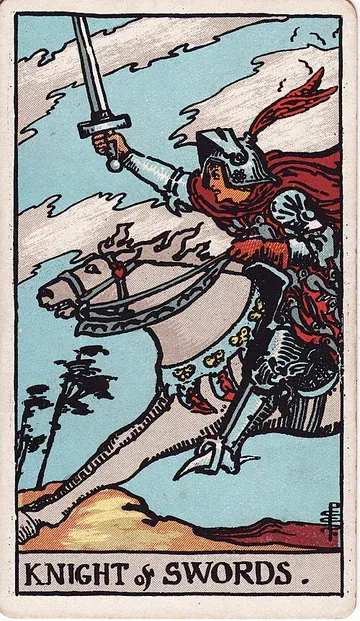
A knight in full plate, a white horse at full gallop, the long sword raised and the visor down: the whole body is pitched forward into a motion already decided. He is not a figure of deliberation. He is a figure of conclusion already reached, already moving, already cutting whatever still hangs unfinished in the air. The card arrives the way he arrives: too fast to argue with, too clear to ignore, the answer to a question you had been postponing for weeks.
In the Rider-Waite-Smith image, the sky behind him is torn into strips by quick gray cloud. Birds scatter. The plume on his helmet and the mane of the horse stream backward as one continuous line. His face is hidden behind the lowered visor, because at this speed the face is no longer the relevant feature — the trajectory is. He is committed. The horse does not need the rein. The horse already wants to run. The work of the rider, in this card, is not to start the motion but to point it.
This is the card's signature tension: speed as virtue and speed as risk, held in the same body. The knight has the courage to break through what has been stuck. He also has the visor down. He sees the target with absolute clarity. He cannot see what is sitting beside the target. The traditional Knight of Swords meaning is exactly this paradox — the rider whose strength is decisiveness and whose blind spot is everything outside the line of charge. Read upright, the strengths are foregrounded; read reversed, the blind spots are.
The astrological signature of the Knight of Swords spans the cusp of Taurus into Gemini, roughly May 11 through June 10 — the moment late spring breaks into the first real wind of summer. As a court card, his outer suit is Air (Swords), his inner element is Fire. Air is intellect; Fire is the will to act on it. Fire-within-air is the temper of someone whose thinking ignites and demands an immediate body. He cannot bear to think and not move. The conclusion in his head must, the same hour, become a memo, a phone call, a resignation, a sentence said out loud. He is the knight whose mind drives the legs of the horse.
Look closely at the bridle. Tied to the leather are small butterfly ornaments — tiny, light, decorative. Thought is by nature a butterfly: airy, mobile, capable of landing where it likes. But here, the butterfly has been tethered to a galloping horse. At the horse's speed, even the lightness becomes something sharp. This is the symbol that explains the whole card. The Knight's mind is not heavier than yours. It is moving faster. At his velocity, the same insight that would land softly in conversation becomes a cut. The butterflies on the bridle are the warning the upright card carries inside its strength: light things attached to fast bodies do not stay light. They become weapons or banners depending on the rider.
Set the Knight of Swords next to a Pentacle and watch him bristle. Air grates against Earth — the ledger, the lease, the body that needs eight hours of sleep — and the knight reads every one of those as a hand on his bridle. Yet that friction is the lesson he most needs: the real is the only thing that can teach a fast mind to aim. Next to Wands the opposite happens — Fire feeds Air, the conclusion goes straight into action, and nobody in the spread is asking whether the action was needed. Beside Cups he slows a little, diluted by feeling, which does his edge no harm. Beside another Sword, two riders egg each other on, and the conclusion can arrive before the facts that were supposed to justify it. Read the cards touching him as the rein he does not hold himself.
Read the Knight of Swords as the card of the day when something gets decided. Not the day of the long discussion. Not the day of the careful plan. The day when the discussion ends, the plan crystallizes, the unfinished sentence finally gets cut clean. He is also the card of the person who arrives in your life with this energy — the colleague who ends a six-month debate in a thirty-minute memo, the friend who says the thing no one else will say, the lover who finally asks the question. Whether you are the knight or the knight is coming for you depends on the spread.
Knight of Swords · Love & Relationships
The conversation finally happens, and it happens today. The bond has reached the point where ambiguity itself has become unkind. One clear sentence today is more merciful than another year of haze. The card is the day the question gets asked, the proposal gets made, the breakup gets named, the cards get put on the table — whatever the truth is, the Knight of Swords meaning in love is that the truth gets said out loud and the relationship reorganizes around what was said.
For an existing partnership, the Knight of Swords upright often arrives in the season when one partner has been quietly carrying a sentence and finally rides it out into the open. "I want to get married." "I do not want children after all." "I need us to live in the same city." "I have been unhappy." None of these are predictions. All of them are the shape of weather the card describes. If you are the one carrying the sentence, the card validates the carrying — the relationship deserves the clarity. If you are the one about to receive the sentence, the card asks you to hear it without bracing. The arrival of the Knight does not have to mean the end. Often it means the beginning of the relationship that was actually possible, after the unsaid thing was said.
For a new spark, the Knight of Swords upright is the date that moves quickly. Not romantic-novel quickly — sharp-minded quickly. You meet, you talk, the conversation is unusually direct, and within three meetings you both know whether this is going somewhere. The Knight does not slow-burn. He rides in, he is interesting, he asks the questions other suitors avoid, and either you find the directness thrilling or you find it abrasive. The card is honest about this — the Knight is not for everyone. The reader who finds him thrilling is the reader who has been waiting for a partner whose mind moves at speed.
For a single seeker who is asking whether love is possible, the Knight of Swords upright says yes — and adds that the love that is coming will be the kind that does not coast. Whoever arrives will want real conversations. Whoever arrives will not let you avoid the topics the last partner let you avoid. The card is preparing you for a love whose primary affection is honesty. If you have been hoping for the soft rescuer, the empath who reads you without your having to speak, the long quiet courtship — the Knight of Swords is not that card. He is the love that arrives saying what it sees.
In the question of love after a wound, the Knight of Swords upright is the card of the cleanly named ending. The relationship that ended did not end mysteriously. It ended because something was finally said. You said it, or they said it, or the situation said it through both of you. The wound is real. The wound is also clean — no infected ambiguity, no unanswerable questions. The Knight cuts; the cut bleeds; the cut also heals in a way that the unspoken endings never do. Use the clarity. The next love can begin on honest ground.
A note on the Knight's particular love language. He loves by saying. He courts by asking the question other suitors do not ask. He shows up by texting at 11pm with the thing he was thinking on the drive home — not "I miss you," but "I have been turning over what you said about your father, and I think you are right." This is love through the mind. The body comes later, usually, but the mind comes first. If you read the Knight of Swords for someone you are dating and you find yourself wishing they would lead with sentiment instead of analysis, the card is asking you to recognize the analysis as the sentiment. He is not avoiding feeling. He is feeling through the sword.
For a long-distance relationship or a partnership where one person travels constantly, the Knight of Swords upright is favorable. He thrives on language. The relationship that runs through long phone calls and longer text threads is exactly the relationship he was built for. The card affirms that the absence is not eroding what you have. The talking is the closeness.
For the seeker rebuilding after a divorce or a major rupture, the Knight of Swords upright is the day the truth about what happened finally settles into a sentence you can say without crying. Not yet a sentence you can say without grief — but a sentence with a verb. "He stopped trying." "I stopped trying." "We chose differently." "It ended because both of us were lying." The clarity is the threshold the card marks.
If you are asking whether a specific person is in love with you and the Knight of Swords arrives upright, read it as a yes that will be expressed in words rather than gestures. Nothing about this Knight is built for aloofness; the horse does not know how to walk. They are also not bringing flowers. They are bringing the conversation. Watch what they ask you. Watch what they tell you that no one else seems to know. Watch the texts that come at the time they should be sleeping. The Knight loves through the mind, and the mind, in love, does not stop.
For polyamorous, queer, or non-traditional structures, the Knight of Swords upright is the card of the negotiation that finally happens in writing. The unspoken agreement becomes the written one. Boundaries get named, schedules get sketched, the quiet jealousy gets brought to the table and described. The card respects whatever shape the love takes — it cares about whether the shape has been said out loud.
Knight of Swords · As Feelings
Sharp, clear, and currently in motion. The person whose feelings you are asking about is not in a fog. They are not ambivalent. They have decided something — about you, about the situation, about what they want next — and the decision is riding through their body at speed. They feel decisively. Whatever they feel, they feel it with the visor down and the sword raised. There is no "maybe" in this card.
If they are a person who tends toward reserve, the Knight of Swords as feelings does not mean cold — it means concentrated. They have arrived at a position. They are not yet announcing the position publicly. They are, however, organizing the next move around it. Read this as private decisiveness rather than public confession. The sword is up; the visor is down; the announcement is being drafted in their head, not yet sent. If you press, they will tell you. If you wait, they will tell you anyway, on their schedule.
If they are a person who tends toward expression, the Knight of Swords as feelings means they are about to say it. The sentence is loaded. The horse is already moving. Within a short stretch — a date, a phone call, a long text — they will name what they think about you. The naming will be unusually direct. They will not use the soft phrases people use when they are protecting themselves from being heard. They will say the thing.
For a partner you have been with a long time, the Knight of Swords in feelings can mean a sudden recommitment or a sudden honesty. They have been thinking. They have arrived at something. The relationship you have been quietly worried about is, from their side, not quietly anything — they have a position, and the position is forming itself into a sentence. Ask. Or wait, and they will offer.
For a new connection, the Knight of Swords in feelings means they have already concluded that you are interesting. Not safe, not comfortable, not familiar — interesting. They are pursuing the conclusion. You are being read, asked about, thought through. They have decided you are worth their attention. Whether the conclusion turns into love is a different question, but the attention is real and currently aimed at you with full focus.
For a complicated situation — a former partner, an unclear flirtation, a relationship that ended without ending — the Knight of Swords in feelings says they have stopped pretending not to know what they think. The denial phase is over. Whether what they think is "I miss you" or "I am done" is in the next paragraph of the spread, not in this card alone. The Knight only confirms that the feelings have crystallized. The shape of the crystal is a different question.
The question is not always romantic. Asked about a friend who has gone quiet, a sibling after the argument at the funeral, a co-parent, a manager whose opinion of you decides the next year — the Knight of Swords as feelings says the same thing in a different key: they have reached a verdict, and the verdict has a date on it. The friend is drafting the message that ends the silence, one way or the other. The sibling has decided what they think happened and is waiting for the room in which to say it. The manager has already written your name in a column. The card cannot tell you which column. What it tells you is that the deliberation phase, on their side, is over — and that the sooner you ask the direct question, the less time you spend inventing their answer for them.
There is one caution to read carefully when the Knight of Swords appears as feelings: this is the card of the person who can mistake the sharpness of their conclusion for the truth of it. They have decided what they feel about you. Their decision feels true to them with the conviction of a sword raised at full gallop. This does not always mean their decision is accurate. They may have decided you are unavailable based on a single misread text. They may have decided you are devoted based on a moment you barely registered. The Knight's feelings are real. They are also, sometimes, racing ahead of the actual evidence. Read the card as: they feel something with full conviction. Then check the evidence yourself.
Read as feelings, the Knight of Swords describes a partner whose interior weather has stopped being uncertain. The decision has been made. The body is already moving toward whatever the decision implies. Read it as a partner who is no longer holding back, even if they have not yet spoken.
Take the Knight of Swords in feelings as confirmation that the question of "what do they think" has an answer. The answer is sharp. The answer is in motion. The answer will become visible to you sooner than you expect — usually in words.
Knight of Swords · Career & Work
The decision gets made today, and it gets made out loud. A project that has been dragging finally gets a verdict. A hire that has been pending finally gets the offer. A resignation that has been written and rewritten finally gets sent. The card arrives with the hard wind of late spring — the temperament of the air after the storm has decided which way it is going.
For someone in a current role wondering whether to stay or go, the Knight of Swords upright reads as the card of the conversation with your manager that you have been postponing. Have it. Not the long, careful conversation that hedges every sentence — the short, direct one that names what you actually want and asks for an answer. The card affirms that ambiguity is now the cost. The relationship with the role cannot continue to be unspoken. Either the role grows toward what you need, today, or you start preparing the next move. The Knight does not let the question stay open another quarter.
For someone considering a new role, the Knight of Swords upright is a green light to move quickly when the offer is right. Do not over-deliberate. The Knight is the card of the candidate who decides in a day, sometimes an hour, after months of looking. The reading you have been waiting for — the one that says "this is the role" — is in your body already. The card validates trusting it. Sign. Negotiate from a position of clarity, not from a position of fear that this is your last chance. It is not your last chance. It is, however, the right chance, and the card respects the seeker who recognizes a fit and acts on it.
Entrepreneurs and freelancers should read the Knight of Swords upright as the card of the launch you have been holding back. The product is not perfect. The website is not finished. The pitch deck has another pass in it. Ship anyway. The Knight is the card of the founder who knows that perfect is the enemy of the conversation with the market — you cannot learn what the customer thinks until the customer can buy the thing. Open the door. Let the feedback come in. The next version will be sharper because the first version had real readers, not imagined ones.
For a creative practice, the Knight of Swords upright is the card of the editorial cut. The novel that has been at 110,000 words for two years gets cut to 85,000 in a week. The album that has been adding tracks gets stripped to nine. The painting that has been overworked gets scraped back to its first underdrawing. The card honors the courage to cut what is not working, even when the cut is painful and the not-working has cost you months. The work begins to live again the moment the unnecessary is removed.
For a job search, the Knight of Swords upright reads as the moment to send the application that intimidates you. The role that feels slightly above your level. The introduction email to the person you have been telling yourself you are not ready to email yet. Send it. The card is not promising the role; the card is honoring the action. The seeker who rides at the question gets answers — sometimes "no," sometimes "yes," but always faster than the seeker who waits.
For someone considering a layoff, restructuring, or being asked to leave, the Knight of Swords upright is the card of the clean exit. If the exit is happening, do it cleanly. Do not slow-walk the resignation, do not negotiate yourself into a smaller version of the same trap. Take the package, sign the paperwork, write the gracious goodbye, and ride out. The Knight does not turn back. The card respects the worker who recognizes when the role is over and walks out with the sword still in hand.
For team leadership, the Knight of Swords upright is the card of the meeting that ends with a decision instead of a follow-up meeting. Run the meeting that way. Bring the question, hear the inputs, name the call before everyone leaves the room. The Knight is the antidote to the workplace that has confused process with progress. Sometimes the right move is the one decided on the spot.
For freelance pricing or contract negotiation, the Knight of Swords upright says quote the higher number. The number that scares you slightly. The card is the card of the practitioner who knows their value and states it without softening. The client who refuses at that number was not your client. The client who agrees was waiting for you to take yourself seriously enough to ask for the right rate.
A note on the limit of this card in career: the Knight of Swords is not the card of the long-haul build. He is the card of the decisive move. For the question of whether to grind through the next eighteen months on a project that requires sustained patience, this is not the card you want. The Knight cannot pace. He is built for the charge. If your career season is a marathon, look to the King of Pentacles or the Hermit, not the Knight. If your career season is the day the fork in the road shows up — the Knight is the card you want at your back.
Knight of Swords · Money & Finances
A financial decision gets made and acted on within the same week. The portfolio rebalanced. The credit card called. The accountant emailed. The subscription canceled. The card respects the worker who treats money as a problem with answers, not a problem with feelings — though it warns the same worker against deciding so quickly that the decision is uninformed.
For a question about whether to make a major purchase, the Knight of Swords upright reads as a green light when you have done the work and a yellow light when you have not. The Knight does not endorse impulse spending. He endorses the trained instinct that has watched the price drop for three months and recognizes the moment to act. If the purchase has been considered, decided, and the only remaining obstacle is the small fear of pulling the trigger — pull the trigger. If the purchase is being considered for the first time today, sleep on it. The Knight rewards prepared decisiveness, not hot-headed expense.
For investments and speculative moves, the Knight of Swords upright is the card of cutting losses. The position that has been bleeding for a year gets closed. The stock that you bought at the wrong price gets sold even at a loss, because the loss is now smaller than the loss in three months. The card respects the trader who recognizes when the thesis was wrong and exits without ceremony. The opposite move — averaging down on a position out of pride — is the reversed card, not this one. Upright, the Knight cuts the bad position clean.
For someone managing debt, the Knight of Swords upright is the card of the call you have been avoiding. Call the creditor. Negotiate the payment plan. Ask for the rate reduction. The card is firm: the avoidance is more expensive than the conversation. Most debts soften when addressed directly. The Knight is the energy that finally addresses them.
For windfall income — a bonus, an inheritance, an unexpected check — the Knight of Swords upright says decide deliberately and quickly. Do not let the money sit in checking for six months while you wait to feel ready. Within thirty days, write the plan: what portion to debt, what portion to savings, what portion to invest, what portion to enjoy. Then execute. The card respects the windfall that is met with structure rather than allowed to evaporate.
For someone in a long climb out of financial difficulty, the Knight of Swords upright is the card of the conversation with yourself you have been postponing. Open the spreadsheets you have been avoiding. Look at the numbers. Make the plan. The card is the card of the worker who has stopped pretending not to know the situation and starts to act on the actual figures. The relief that follows the honest accounting is real and immediate.
For a question about whether to negotiate a raise, ask for back pay, dispute a charge, or push for the higher number on any financial transaction, the Knight of Swords upright says go. Make the ask. State the number. The seeker who never asks never gets. The Knight is the card of the seeker who asks, with the visor down and the sword raised, knowing that "no" is a survivable answer and "yes" is the answer they will not get if they do not ask.
Two more situations wear the Knight's plate. The first is shared money — the partner, the sibling, the business co-owner with whom the numbers have never been fully spoken. Upright, the card is the evening you put both accounts on the kitchen table and say the figure out loud: what is owed, what is earned, what has been quietly moved. Most couples argue about money for years without once stating the total. The knight states the total. The second is the person on the other side of the desk who has the knight's speed and wants you to match it — the dealer with the offer that expires at five, the advisor who needs the signature today. Here the upright card is yours to keep, not theirs to borrow: your decisiveness is to close the folder and say you answer tomorrow. Speed that belongs to someone else's timeline is not the Knight's virtue. It is his costume, worn by a salesman.
A practical note: the Knight of Swords in money asks for the action this week, not the strategy this year. The long-term financial planning belongs to other cards. This card is the card of the move that gets the wheel turning. Once the wheel is turning, other cards take over the steering.
Knight of Swords · Health
The appointment finally gets made, the test finally taken, the symptom finally named. The body has been giving signals for a while. The card is the day you stop ignoring them and pick up the phone. Not panic, not fear — the decisive action that turns the worry into a plan. The card respects the seeker who treats the body as a system worth investigating rather than a problem to be denied.
The Knight of Swords' traditional bodily territory is the lungs and throat — the breath and the voice. This is the air-court card whose physical signature shows up in the parts of the body that move and shape air. When the card appears in a health reading, the somatic register often involves breathing, speech, or the upper respiratory system. Asthma flare-ups, bronchitis recovery, the throat that has been hoarse for two weeks, the cough that has been showing up at night — these are within the Knight's territory. Listing the Knight's respiratory territory is not medical advice. It is the symbolic field the card draws from. Keep your practitioners. The card simply suggests where the body's current attention may be focused.
For someone managing a chronic condition, the Knight of Swords upright is the card of the protocol decided and followed. The medication taken on the correct schedule. The exercise that finally has a routine. The diet that finally has a structure. The card is the antidote to the chronic-condition drift where the management slowly slips back into avoidance. Re-decide. Re-implement. The body responds to the same decisiveness the mind brings to other questions.
For acute illness or injury, the Knight of Swords upright reads as a swift recovery — provided the seeker matches the recovery's pace with their own action. Take the medicine. Show up to the physical therapy. Do the breathing exercises. The card honors the body that meets the treatment halfway. It does not honor the body that decides to skip the second half of the antibiotic course because it feels better already. Finish the protocol.
For mental health, the Knight of Swords upright is the card of the difficult appointment — the first session with the new therapist, the conversation with the psychiatrist about adjusting medication, the disclosure to a family member that you have been struggling. The card honors the act of saying the thing out loud. The relief that follows the honest conversation, even when the conversation is hard, is the card's particular grace in this register. Speech is the medicine the air court most often prescribes.
For someone considering surgery or a major medical procedure, the Knight of Swords upright reads as the card of the decision made cleanly. If you have done the consultations, gotten the second opinion, weighed the options — schedule. The card respects the deliberate seeker who has become decisive. The procedure that has been postponed three times because the calendar was full is the procedure the card asks you to schedule today.
Sometimes the body in question is not yours. The parent whose symptoms have been dismissed at three appointments, the child whose teacher keeps saying it is nothing, the partner who has stopped mentioning the pain because mentioning it has never gone anywhere — the Knight of Swords upright is the card of the advocate who rides into the clinic and asks for the referral by name. The air court's gift in the waiting room is speech: the question asked twice, the note taken while the doctor is talking, the sentence "I would like that written in the file." The knight is not rude. He is specific. Bodies that cannot speak for themselves are heard fastest through the person willing to say the plain sentence on their behalf, and this card lights that person — the one who stops waiting to be asked and asks.
For the body under chronic stress, the Knight of Swords' caution is real: the rider who never dismounts wears the horse out. If the card has been showing up in your readings repeatedly, the body may be telling you that the speed at which you live is the symptom, not the immune system, not the sleep, not the appetite. The cure is dismounting for an hour a day. The breath you take while not riding is the breath that allows the riding to continue. The card affirms speed. The card also asks for the daily pause that lets speed remain sustainable.
Knight of Swords · Spirituality
The vow finally gets taken rather than considered. The decision to commit to a practice, after months of considering it. The morning you stop reading about meditation and actually sit. The week you finally book the retreat. The conversation with the teacher you have been hesitating to approach. The card respects the seeker who recognizes the moment for action and does not let it pass.
The card's spiritual signature is the air court's particular gift: the sword that cuts through the noise of constant rumination and arrives at the question worth sitting with. Most spiritual seekers, after some years, accumulate too many practices. They have the meditation app, the breathwork class, the journaling notebook, the tarot deck, the astrology chart, the Sunday yoga, the new moon ritual, the morning pages, the evening gratitude list, the four gurus they follow on substack. The Knight of Swords upright, in spirituality, is the card of cutting the list. Pick the one practice that is actually changing you. Drop the rest. The cut creates the space the practice needs to deepen.
For someone in active practice, the Knight of Swords upright reads as the breakthrough that arrives the morning after a long stretch of seeming nothing. You have been sitting for months without obvious progress. The card is the morning the door opens. Not dramatically. Not as enlightenment. As the small, sharp recognition of something you had not seen before — about your own mind, about the practice, about the teacher, about the way you have been holding the question. The recognition cuts. The recognition is the gift.
For a seeker exploring belief, the Knight of Swords upright invites the honest sentence. What do you actually believe? Not what you grew up with, not what your community professes, not what the books on your shelf advocate — what does your own examined position actually say? The Knight asks you to write it down. One paragraph. Then sit with it. The seeker who has put their belief into a sentence has done more spiritual work than the seeker who has read a hundred books and never made the statement.
For questions of vocation or path, the Knight of Swords upright says trust the conclusion. You have known for a while. The work has been clarifying itself in you, even when you have not been working on it. The card is the day you stop asking other people what to do with your life and write the answer yourself. Then act on it. The seeker who waits for permission from the cosmos for what the cosmos has already, quietly, been telling them gets nothing. The seeker who acts on the inner sentence gets the next inner sentence, and then the next.
There is a quieter spiritual situation this card lights: the departure. The seeker who has sat in the same pew, the same sangha, the same circle for years and has known for at least one of those years that it no longer holds them. The Knight of Swords upright does not argue the theology. He names the leaving. Write the letter to the teacher. Tell the group at the next meeting instead of fading from the roster. The sword here is not contempt for what was — the swallow and the falcon in this card's bestiary both leave a field cleanly, without circling back to explain themselves — it is respect for a practice that deserves a real ending rather than an unanswered email. Leaving the way this card leaves keeps the door honest for whoever needs to walk back through it later.
A practical contemplative practice when this card appears: take a small notebook to a quiet place for thirty minutes. Write the question that has been actually pressing on you — not the one you have been telling yourself is pressing on you. Write the most honest answer you can give in this moment. Then close the notebook and act on the answer this week. The card responds to acted-on insight, not collected insight.
Knight of Swords · Yes or No
Yes — sharp, fast, and clear.
The Knight of Swords upright is one of the deck's clearer yes-cards when the question is about decisive action, communication, or bringing a stalled situation to resolution. The answer rides in at full gallop. There is no hedging, no "maybe in three months," no "depends on what you mean." The Knight cuts the unfinished sentence level — and the sentence, when cut, says yes.
For yes-or-no questions about whether to act, whether to say the thing, whether to send the message, whether to take the meeting, whether to make the move: yes. The window the Knight describes is the window for action, not deliberation. Act now. The same question in a month will have lost the velocity that makes the answer yes today.
For yes-or-no questions about whether someone will respond, whether the offer is real, whether the conversation will bear fruit: yes — and probably faster than you expect. The Knight is the card of the swift reply. The email that sits in your inbox by morning. The phone call that comes the same day. The card describes a season in which the channels are open and the responses are quick.
For yes-or-no questions about the truth of a situation — is this person honest, is this offer what it appears to be, will the deal hold — the Knight of Swords upright says yes when the seeker is willing to ask the direct question. He is not a card of hidden traps. Nothing moving at this speed has time to arrange a disguise. Ask the direct question and the direct answer comes back. The Knight does not protect the asker from the answer; he simply confirms that the answer is available if the question is asked clearly.
The single caveat embedded in the yes is this: the Knight of Swords answers the question you ask, not the question you wish you had asked. If you asked "will I get the job," he answers yes — and may not address whether the job is the right job for you. If you asked "will they say yes to the date," he answers yes — and may not address whether the relationship that follows is the one you actually want. Read the card as a confirmation of the literal question, then check whether the literal question is the question that matters.
For questions of timing — will it happen soon — the Knight of Swords upright says yes, and probably sooner than the timeframe you had in mind. The card's pace is days and weeks, not months and seasons. If you were hoping for confirmation that something will land within the year, the Knight upgrades the timeline: it will land within the month, often within the week, sometimes by the end of the day you draw the card.
If the question was: should I be the one to make the first move? The Knight of Swords answers yes, with extra emphasis. He is the card of the seeker who acts first — and who finds, in the acting, that the action itself was what the situation needed.
Knight of Swords · Advice
Charge — but aim before you charge. The card's sword is raised at the front of the gallop, leading the line. The leading blade has one job before any other: to point at the actual problem, not at the problem closest to hand. The seeker who rides at the wrong question, no matter how decisively, arrives nowhere useful.
The first instruction is to write down the question you are actually trying to answer. Not the topic — the question. "Should I take this job" is a topic. "If I take this job, am I trading the salary I want for the autonomy I cannot live without?" is a question. The Knight responds to questions, not topics. The thirty seconds you spend sharpening the question is the thirty seconds that turns the charge from a flailing into a cut.
The second instruction is to write the conclusion before the meeting. The Knight is the card of the worker who walks into the meeting with the call already made and uses the meeting to confirm or revise it, not to discover it. Most decisions are made in private and only ratified in public. The Knight asks you to do the private work first. Write the answer down. Then walk into the room willing to defend it.
The third instruction is to send the message today. Not after one more revision. Not when you feel ready. Not on Monday when the week is fresh. Today. The card is the antidote to the postponement that has eaten the last six weeks of your life. Whatever sentence you have been carrying — the resignation, the apology, the request, the breakup, the proposal, the question — the Knight asks you to send it before you sleep. The version that lives in your head is no longer doing useful work for anyone. The version that exists in the inbox, however imperfect, has begun to move the situation.
The fourth instruction, gentler than the others, is to dismount once the charge is finished. The Knight is built for the gallop, not for permanent residence in the saddle. Once the decision is made and the action is taken, dismount. Walk. Eat. Sleep. Let the body recover from the speed. The seeker who tries to live the Knight's pace as a default state burns out within a season. The Knight is the card of the moment, not the lifestyle.
The fifth instruction, specific to this card's signature, is to point at one question. The Knight of Swords' raised long sword does not flail at five concerns — it leads at one. If you are reading this card while juggling a job decision, a relationship question, a financial worry, and a health concern simultaneously, the card is asking you to pick the one whose answer would settle the most. Charge at that one. The other four will reorganize themselves around the answer to the first. The seeker who tries to charge at all four at once is the seeker whose horse breaks a leg in the middle of the field.
A practical exercise when this card appears: set a timer for ten minutes. Write the difficult sentence you have been postponing. Send it before the timer ends. Do not edit. Do not soften. Do not apologize. Then close the laptop and go for a walk. The Knight rewards the seeker who acts on the time pressure rather than allowing the time pressure to be the excuse for further delay.
A second exercise, for the seeker who finds the first too aggressive: write the question you are actually asking on a single index card. Tape the index card to the wall above your desk for one week. Notice what the question makes you do during the week. Most of the work the Knight respects happens in the eyes of the seeker who has been forced to look at the actual question, every morning, instead of the camouflage version that keeps offering itself in place of the real one.
Knight of Swords · Card Combinations
The Knight of Swords reads most clearly in combination — the speed of the charge takes its meaning from what stands beside it. A charge into wisdom is a different card than a charge into walls. The pairings below are the load-bearing ones for this card; each illuminates a different facet of the gallop.
Knight of Swords + Queen of Swords
The charging mind beside the matured cut. The Queen has learned what the Knight does not yet know — that the right cut is sometimes the cut delayed by a day, sometimes the cut not made at all. Read together, this is the seeker who has the courage to act and the discernment to choose when. The combination is the worker who finally makes the right decision after years of making the wrong ones quickly. The Queen does not blunt the Knight; she aims him.
Knight of Swords + The Chariot
Two willed motions in the same spread. Both cards charge — but the Chariot drives a chariot with reins, two sphinxes pulling in opposite directions, the rider holding both. The Knight has only the horse and the sword. Together, they describe a season of forward motion that requires more steering than either card alone — the will to move and the discipline to manage the conflicting forces being moved. Read this combination as: yes, charge, but the charge will require you to hold contradiction in both hands as you ride.
Knight of Swords + Four of Swords
Tonal contrast. The Four asks for stillness; the Knight refuses it. When these two appear together, the spread is naming the central tension of the seeker's current season — the rest the body needs and the action the situation requires, both real, both pulling. The combination is honest: do not pretend you can have only one. The work is to find the cadence that includes both. Charge for an hour, then lie down. The Knight rides; the Four sleeps; the seeker who learns the rhythm survives both.
Knight of Swords + Knight of Wands
Air-knight beside fire-knight. Two different kinds of haste. The Knight of Wands rides toward what excites him. The Knight of Swords rides toward what the truth requires. Together, they double the speed and double the risk — the spread is naming a season in which the seeker is moving so fast that calibration matters more than commitment. Pause once a week and ask which knight is currently in the saddle. Both have their place. The seeker confused about which is currently riding is the seeker most likely to break something.
Knight of Swords + The Tower
The charge meeting the wall it does not see. This is the rare and difficult pairing in which the Knight's blind spot — the visor down, the speed too high to register peripheral vision — encounters the structure that was about to come down anyway. The Knight rides into the building the moment the building falls. The combination is not a curse. The Tower is not random; it falls on what was already false. The Knight is not foolish; he was already moving on what was already needed. Together, they describe the season when the rapid action coincides with the structural collapse. Whether the seeker is the cause or the witness depends on the rest of the spread. Either way: rebuild. The structure that follows the Tower is the structure the Knight was riding toward all along, even when he did not know what stood between him and it.
Card Combinations
Queen of Swords
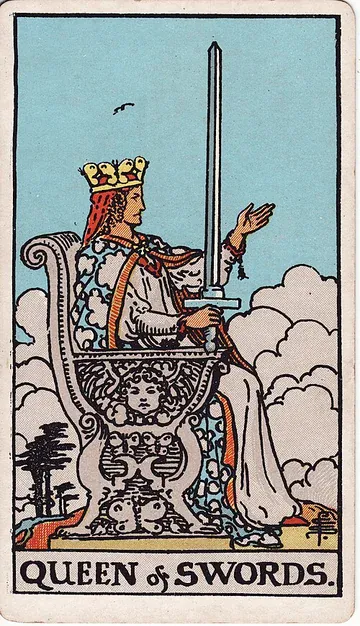
The charging mind beside the matured cut. The Queen has learned what the Knight does not yet know — that the right cut is sometimes the cut delayed by a day, sometimes the cut not made at all. The Knight is the courage to act; the Queen is the discernment that aims him. Together, the worker who finally makes the right decision after years of making the wrong ones quickly.
The Chariot
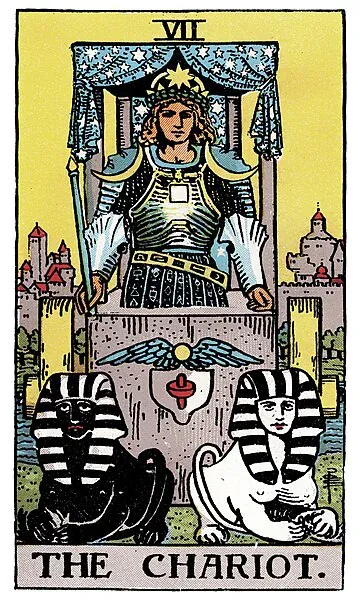
Two willed motions in the same spread — both charge, but the Chariot drives with reins, two sphinxes pulling in opposite directions, the rider holding both. The Knight has only the horse and the sword. Together, a season of forward motion that requires more steering than either card alone — the will to move and the discipline to manage the conflicting forces being moved.
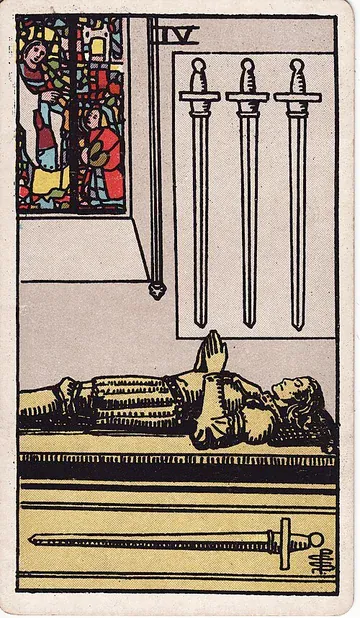
Four of Swords
Tonal contrast. The Four asks for stillness; the Knight refuses it. Together, the spread is naming the central tension of the seeker's current season — the rest the body needs and the action the situation requires, both real, both pulling. The work is to find the cadence that includes both. Charge for an hour, then lie down.
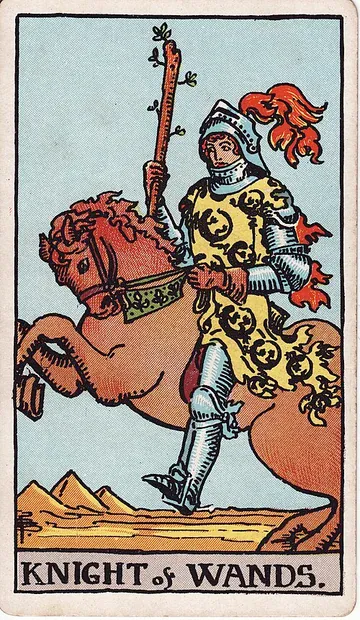
Knight of Wands
Air-knight beside fire-knight — two different kinds of haste. The Knight of Wands rides toward what excites him; the Knight of Swords rides toward what the truth requires. Together, double the speed and double the risk. Pause once a week and ask which knight is currently in the saddle. Both have their place. The seeker confused about which is currently riding is the seeker most likely to break something.
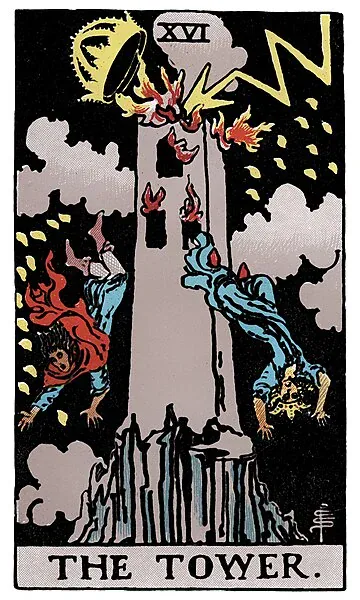
The Tower
The charge meeting the wall it does not see. The Knight's visor is down, the speed too high to register peripheral vision; the Tower is the structure that was about to come down anyway. Together, the season when rapid action coincides with structural collapse. The Tower is not random; it falls on what was already false. Rebuild — the structure that follows is the one the Knight was riding toward all along.
Frequently Asked Questions
Does the Knight of Swords answer the question I asked, or the one I should have asked?
The one you asked, at full gallop. The upright Knight is one of the deck's clearer yes-cards, especially for questions about action, communication, or whether to bring a stalled situation to resolution. Read it as a sharp, fast yes — the answer rides in at full gallop. The only caveat is that the Knight answers the literal question you asked; he does not protect you from whether the literal question was the right one to ask.
Is the conversation the Knight of Swords brings a rupture or a relief?
Usually both, and in that order. Upright in love, this is the card of the conversation that finally happens — the question asked, the truth named, the unfinished sentence cut clean. For existing partnerships, it often signals a clarifying conversation that reorganizes the bond around what was actually said. For new sparks, it is the date that moves quickly through honest talk. For singles, it suggests love that arrives speaking, not love that arrives quietly waiting.
Has the person in a Knight of Swords reading already decided about me?
They have, and the decision is already in motion. The person has stopped being uncertain about you. They have arrived at a position — and the position is currently in motion. They feel decisively, with the visor down and the sword raised. Whether they are reserved or expressive, the underlying signal is that the decision has been made and the announcement, in some form, is coming. Watch what they say next.
What kind of mind does the Knight of Swords ride with?
A charging one. He is the air court's charging mind — outer Air, inner Fire, zodiac span Taurus into Gemini (May 11 to June 10). His meaning is decisive intellect in motion: the conclusion that has crystallized, the truth being said out loud, the action being taken before the window closes. He is the card of the day something gets decided rather than the season of weighing options.
What is the Knight of Swords' advice?
Charge — but aim before you charge. Sharpen the question into one sentence before you ride at it. Write the conclusion before the meeting. Send the difficult message today rather than after one more revision. Then dismount once the action is taken. The Knight rewards decisive action on the right question, not flailing speed on the closest question. Three seconds of aim is enough.
Continue Reading
Knight of Swords · Card overview · symbols · correspondences →
Return to the full card view — image, symbols, sensory correspondences, and Hermetic axes.
Read the reversed meaning →
Read the same depth on the opposite orientation.
Draw your reading now →
Bring this card to a question — open a quiet ritual.