Knight of Wands · Core Meaning
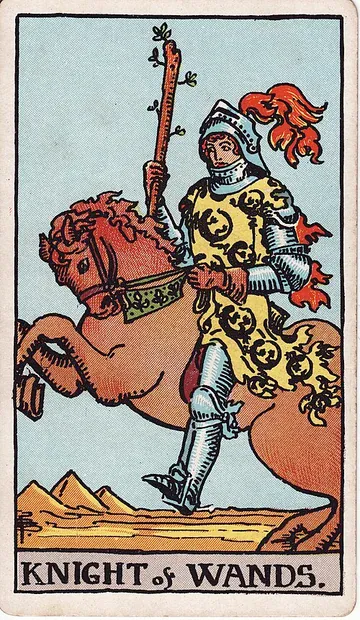
The Knight of Wands is the deck's purest charge of fire — fire-within-fire, on horseback, mid-air. In the Rider-Waite-Smith image, a fully armored knight sits a chestnut warhorse rearing high above the sand-gold floor of the wilderness; three pyramids stand on the horizon, and his eyes have already fixed on the far-right edge of the frame. The horse has not yet landed. Neither has he. The whole card is held in the second before a hoof finds ground, and that suspension is the meaning.
Look at his head. From the helm streams a crest of flame-red plumes — a literal fire above the body, upright in the wind even at gallop. Look at his cloak: stitched with tail-biting salamanders, the same emblem the Page of Wands wears, the figure of fire folded on itself. The Page lit the spark and turned it over in his hands. The Knight has put on the spark like a coat and ridden out with it. The cloak is the same; the relationship to it has changed. It is no longer something to study. It is something to carry into the field.
In his right hand, a green wand still leafing — wood that has not yet become weapon, vegetable life still inside the shaft of action. This detail is what saves the card from being merely impulsive. The wand is alive. The journey is alive. The fire he carries has roots in something organic and ongoing, not in the cold steel of conquest. Whatever he is riding toward, it grew before he chose it.
Three pyramids stand on the horizon behind his shoulder, and he is not looking at them. They are the geometry of a slower labor — stone stacked by generations working at a pace this rider would find unbearable — and they mark the heading he has held since before the card began. The point of the pyramids is not that he reaches them. It is that they have stayed where they are, fixed, while every other element of the picture is in motion. Read them as the part of an intention that does not move: the thing you want that has outlived three or four versions of your plan for getting it. The Knight is unreliable about method and completely reliable about direction. Notice, too, that there is no road in this image. Only sand, a horizon, and a horse willing to cross unmarked ground to keep a heading.
This is the card's signature tension: direction-already-chosen versus method-not-yet-resolved. He is not deciding what. He is already committed. He is mid-air on the question of how. Whatever he does next will be improvised — but the heading was decided before he mounted, and the decision will not be reopened. The Knight of Wands is the energy of departure that has crossed the threshold of reconsideration. He is not asking whether to go. He is asking how fast.
The traditional astrological signature reinforces this paradox. The Knight's zodiac span runs from the third decan of Scorpio into the first two decans of Sagittarius — November 13 to December 12. The first half is Scorpio's intensity, the secret-burning fire that has held its tongue for years; the second half is Sagittarius's open-road heading, the Jupiterian arrow released. The Knight inherits both. He is the moment Scorpio's banked heat vents into Sagittarius's flight. He is the secret long held that is now being said out loud, at speed, on the way to somewhere new.
A court card arrives at the table in three different guises, and the Knight of Wands rewards asking which one you drew. Sometimes he is a person — the friend, the colleague, the new arrival whose speed is about to become a fact in your life. Sometimes he is a posture you are being asked to take: your own hand on the reins, your own week rearranged around a departure. And sometimes he is only the hour — noon on the day of setting out, hot leather and roasted pinewood, the smell of a house that has already been packed. If the cards around him are crowded with other people, read the person. If they are crowded with your own choices, read the posture. If they are crowded with dates and deferrals, read the hour, and count how long you have been standing in the doorway with the bag by your foot.
His element is fire-within-fire. He has no moisture, no earth, no air softening the blaze. The Page of Wands has the freshness of newness; the Queen of Wands has the warmth of the hearth that draws others in; the King of Wands has the calm authority of a fire that has learned to govern. The Knight has only the run. He is the suit's purest verb. Read him in any spread as the moment a decision becomes a body in motion. The thinking is over. The riding has begun.
Knight of Wands · Love & Relationships
In love readings, the Knight of Wands is one of the most kinetic cards the deck offers — and one of the most easily misread. The card describes a love that arrives at speed, declares itself early, and asks you to pack quickly. Whether this is good news or hard news depends entirely on what the seeker is asking, and on who is sitting on the horse.
For an existing partnership that has settled into routine, the Knight of Wands often arrives as the card of re-ignition. Something has woken your partner — a project, a role, a long-deferred dream — and the wakefulness is showing up at the dinner table again. Conversations that had narrowed to logistics widen back into appetite. The body that had been merely cohabiting reaches across the bed. Read this as the spring after a long winter of practical love. The fire returned because something outside the relationship reminded one of you that the fire was still possible.
For a new spark, the Knight of Wands is the textbook fast attachment. The first three weeks have already produced more honesty, more momentum, and more declared future than the previous year of being single did. They are texting the way someone texts when they have decided. The trips are being planned. The introductions to friends are happening earlier than your past data would have predicted. The card describes the courtship that compresses six months of normal pace into one. Read it as real — and as a course that has to be learned by riding, before it learns to throw the rider.
For a single seeker asking whether love is possible in the near season, the Knight of Wands answers yes with unusual clarity. The card is not about whether love arrives but how. It will not arrive as a soft slow recognition. It will arrive as a person who walks into your week and rearranges it. The introduction will come from an unexpected angle — a friend's friend, a work trip, a place you went only because you canceled the plan you had made for the weekend. The Knight of Wands does not deliver love in the architecture you arranged for it. He delivers love that breaks the architecture.
For love after a wound — a divorce, a long heartbreak, the slow return after grief — the Knight of Wands is more complicated. He can describe the quick rebound that feels alive but is, on closer look, a way of skipping the part that still hurts. Or he can describe the genuine return of life-force, the morning the body remembers it has wanted. The difference is in whether you are riding the horse or being carried by it. If you can name what you are running toward, the card is healing. If you cannot, the card is bypassing.
The Knight of Wands' particular love language is the chase. He loves the way a hunter loves: alert, persistent, willing to travel. Real meals get eaten in this love, but they are eaten quickly. Real trips happen, but the suitcase is half-unpacked when the next trip is announced. Real promises are made, but the promises are about going somewhere together rather than building a place to stay. Read the card's love as a moving love. It will not stand still long enough to become a portrait. It will keep changing position, and that motion is not a flaw — it is the form of the affection.
If you are asking whether someone in your life is in love with you and the Knight of Wands appears, read it as yes — at speed, with their whole chest, in a way that may genuinely surprise them. They have decided. They are not playing it cool because they are not cool: they are heated. They are showing up early, calling on impulse, telling other people about you before they have even told you what they are calling it. Their feeling has outrun their words. The work for you is to decide whether you can match the pace, slow them down without dousing them, or let them know what you actually need. They will hear you. The Knight responds to direct speech. He does not respond to hint.
For the question "will this person come back" — usually asked after a fast bond ended fast — the Knight of Wands upright suggests yes, but on his terms and at his timing. He has not stopped feeling what he felt. He has, more likely, run into a wall in his own life that nothing in the relationship was equipped to dismantle. If he returns, he will return at full speed, and the test will not be whether he comes back but whether the arrival has matured. Some of these returns are the beginning of a different relationship; some are a second pass through the same patterns. Watch the second week.
For the question of long-term commitment, the Knight of Wands is honest about what he is and what he is not. He is the suit's runner. He is not the suit's settler — that is the King. The Knight will commit, but the commitment will look like a shared journey rather than a shared porch. If you want someone to ride beside you toward a moving horizon, the Knight is the right card. If you want someone to plant the orchard and watch it grow over twenty years, you are reading the wrong rider for the wrong season. Both can become true; the orchard usually requires the Knight to grow into the King first, and that growth is its own arc.
A note on the question "are they into me" when the Knight is reversed-adjacent or when the rider on the card is someone you have read before in past relationships: not all flames are the same flame. Some Knights of Wands have learned the rhythm of arrival and departure, and that rhythm is itself the romance. The body comes close, the body leaves, the body comes close again. This is not bad faith — but it is its own pattern. Notice the pattern. The card is not a verdict; it is a description.
Knight of Wands · As Feelings
Heat, undisguised and undelayed and slightly inconvenient for the person carrying it — that is the Knight of Wands' answer on feelings. They are excited by you in a way that is interfering with their ability to plan their week. They are thinking about you when they should be thinking about other things. Whatever poker face they have worked to maintain in past relationships, you are getting under it. The card describes the feeling of someone whose composure has been broken in a small but real way by a person who arrived at speed.
For a partner who is reserved by nature, the Knight of Wands in feelings is unusual. Their fire is not the public fire of someone who flirts loudly; it is the private fire of someone who has decided. The signal will not look like a Knight. It will look like a quiet person doing uncharacteristic things: clearing their schedule, traveling further than they normally would, naming you to other people in moments they would normally stay vague. Their reserve is not coldness — it is containment. The fire is inside the cup. Read the small actions as large.
For a partner who is demonstrative, the Knight of Wands in feelings is exactly what it looks like. They are saying it out loud. They are saying it to your friends. They are sometimes saying it to people they have just met, with that slightly embarrassed glow of someone who cannot keep the thing contained. The card warns against discounting the volume as performance. They mean it. The volume is the form their feeling takes; the feeling is real underneath.
For a long bond that has been together a while, the Knight of Wands in feelings can describe a renewed flush — the morning your partner looks at you and remembers that they chose you, that they would choose you again, and that the choice is not theoretical. Pay attention to the second week of this. The Knight at full intensity is sustainable for a sprint, not for a season. The healthy version of this card in long love is when the renewed fire becomes the warmer steady fire of the Queen — bright at the start, settled by the end of the month. The unhealthy version burns hot and then goes silent, and the silence becomes the new normal until the next flare.
For a new connection, the Knight of Wands in feelings means they are convinced. Not falling — already fallen. Not exploring whether you are the answer — already deciding that you are. They have run ahead of where the relationship objectively is, and they may know it. The card describes the partner who is privately a little embarrassed by how much they feel, which is the feeling's surest signature. Performed feeling is loud and stable; real Knight-of-Wands feeling is loud and a little wobbly, because it is real.
The Knight carries one caution in the saddle with him. The Knight of Wands feeling, undirected, can confuse intensity with attention. They feel a great deal — but they may be feeling toward an idea of you they have constructed at speed, without yet meeting the slower textures of who you actually are. This is not a lie. It is a stage. Most Knights of Wands feelings, given a little time and a little structure, refine into something more accurate. The work, if there is work, is to let them see the unflattering parts of you while the fire is still warm. The fire that knows the unflattering parts is the fire that lasts.
For the Knight of Wands read as feelings — the way most readers put the question — the simplest honest answer is: they want you, urgently, with a feeling that is using their whole chest and not just their head. They feel the way they feel when they have decided a thing and the deciding has produced energy in the body that wants somewhere to go. You are the somewhere. Whether the somewhere is safe for both of you depends on what comes next. Today, in this reading, simply read the heat as real.
For the question of whether someone is over you and the Knight of Wands appears: no. They are decidedly not over you. They may be silent, they may be physically distant, they may be telling other people that they have moved on. The card describes a feeling at full ride, regardless of whether the rider has admitted it to himself. Their absence is loud. Read silence here as banked fire, not as ember. Whether they will return is a different question. That they have not stopped feeling is what the card is naming.
A note on body language: the Knight of Wands in feelings shows in the body before the words. Watch how they walk into the room when you are in it — the small acceleration, the slight squaring of the shoulders, the way the eyes find you before the rest of the face decides what to do. Read those signals as the card. The mouth lies more than the body lies, and the Knight of Wands is a card of the body deciding before the mouth has caught up.
Knight of Wands · Career & Work
The Knight of Wands works by charging — the morning you grab the coat before the meeting adjourns and walk out mid-sentence with the words "go with this — we'll decide the rest on the road." It describes the project that has stopped being a discussion and started being a body of work. It describes the role that requires you to leave the office and meet someone face to face. It describes the launch where the strategy deck stops mattering and the execution begins. The card is not about planning. It is about the moment planning ends.
For someone asking whether to take a new role, the Knight of Wands upright is a pro-action card with a specific texture. The role will reward speed, initiative, and visible movement. If the new job description requires a person who can cold-call, ship a v1 in three weeks, travel to clients, evangelize a product internally, or break ground in a market that hasn't been opened — take it. The card is matched to that work. If the role rewards careful incremental refinement, slow consensus-building, archival research, or quiet maintenance of an existing system, the Knight is misaligned. He will land in that role and within four months be either restless or in conflict with the manager. Read the card as a vocational signature, not just a yes.
For someone in a current role asking whether to stay, the Knight of Wands upright often signals a season of momentum. Whatever has felt stuck is moving. The colleague who blocked the project has been transferred, retired, or is finally on board. The funding came through. The proposal got approved. The thing you had been carrying alone now has co-conspirators. Use this season. Knights of Wands seasons are sprints, not eras. The season closes. Make the visible move while the wind is at your back, because the wind does not always blow this direction.
For entrepreneurs and freelancers, the Knight of Wands upright is the card of the lead, the launch, and the new market. Take the meeting that came in cold. Send the proposal you have been redrafting for six weeks. Book the trip to meet the prospective partner in person. Run the email campaign that you have been scared to run because you did not want to be the one being too forward. The card explicitly favors forward. Forward is what the Knight delivers. The brand you have built around quiet expertise will not be undone by one season of visible motion. Quiet expertise plus visible motion is, in fact, the formula many small businesses miss.
For a creative practice, the Knight of Wands describes the season where the work leaves the studio. The book has been written; now the readings, the interviews, the public conversations begin. The album has been recorded; now the tour is being booked. The series of paintings is finished; now the gallery is being courted. The card is not about making the next thing — it is about getting the made thing into the world. For makers, this is often the harder labor. The Knight is the cure for the maker's perfectionist refuge.
For someone considering a career pivot, the Knight of Wands upright reads as confirmation that the heading you have been quietly nursing is real. You have already been thinking about the new field for longer than you have admitted to anyone. The card is asking you to stop researching and start moving. Take the coffee with the person already in the field. Sign up for the certificate program. Apply for the entry-level role even though it feels like a step backwards in title. The pivot is a journey, not a leap, and the journey starts when you put the body in motion. A second year of research in your current job is a second year of not yet being on the horse.
For job-search questions specifically, the Knight of Wands favors the active strategy: cold outreach, in-person events, asking for introductions, sending the unsolicited application to the company you actually want. The passive strategy of applying through portals will under-perform. The card is matched to the energy of the candidate who walks into the room and announces themselves. If that posture is uncomfortable for you, the card asks you to do the uncomfortable thing anyway, just for this season. The job that arrives via the Knight of Wands is the job you went and got. It is not the job that was assigned to you.
For questions of authority and leadership, the Knight of Wands describes the lieutenant rather than the general. He is the person who carries the order to the field, who fights at the front, who reports back on what actually happens when the plan meets terrain. He is invaluable in this role and dangerous when promoted past it without earning the King's stillness. If you are this person at work, lean into the role; do not yet aim for the corner office. If you are managing this person, give them the field, give them clear targets, and do not ask them to chair the planning committee. They will perform poorly there and resent you for it.
For collaboration questions — should I work with this person, will the partnership hold — the Knight of Wands warns of the pace mismatch. He is fast. If your collaborator is slow, careful, and process-oriented, the partnership will produce conflict in the third or fourth month. This is not insurmountable. The conflict, named early, becomes the thing that makes the partnership stronger. Knight pairs with Pages and Queens of other suits well; he pairs hard with the Four of Pentacles and the Hermit. Read the pace before the personality. Personality is negotiable. Pace is rarely negotiable without resentment.
For burnout questions, the Knight of Wands upright is paradoxically a positive sign. The card describes the version of you that still has fuel — even in a hard season, even after a long run. If you are exhausted but the Knight appears, you are exhausted from doing the right work, not from doing the wrong work. The cure is not to stop. The cure is to let one of the three current things go so this one can be done at full ride. Burnout from the right work is rest-able. Burnout from the wrong work requires a different card to address.
Knight of Wands · Money & Finances
Money here is a bet that pays, and pays only for someone willing to ride alongside it — that is how the Knight of Wands prices risk. The card is not about passive wealth or compounded patience. It is about active money, money in motion, money chasing an opportunity that closes in a finite window. Whatever financial decision you are weighing, the Knight is asking whether you have the courage to act in time.
For someone considering a calculated risk — investing in a new venture, putting capital behind a side project, taking the leap into self-employment — the Knight of Wands upright says yes, with the standard warning attached: the opportunity has a window, and the window will not stay open while you research one more month. Do the diligence you can do in two weeks. Then move. The card describes the financial profile that profits from being early. It does not describe the profile that profits from being thorough.
For windfall — bonus, unexpected gift, settlement — the Knight of Wands upright suggests the money should be deployed rather than parked. Not spent foolishly; deployed. Pay off the high-interest debt that has been a slow drain. Fund the certification you have been postponing. Buy the equipment that will let your side practice become a real practice. The Knight does not love money sitting still. He loves money in service of motion.
For the seeker who has been managing scarcity, the Knight of Wands can describe a real shift — the gig that pays well above scale, the contract that closes after the long drought, the season the work suddenly comes in. There is a quality of vindication in the card around money, similar to the way the same card vindicates a long-deferred career heading. The lean years are ending. Receive the income with intention. The card warns against immediately scaling the lifestyle to match. Your past self lived through the lean year for a reason. Honor that lived discipline by saving the first three months of the new income before adjusting your fixed costs.
The card's signature financial trap is the impulse purchase that pretends to be an investment. The Knight of Wands, given a sudden cash flow, can spend on the new equipment, the new car, the new trip — and call it strategic. Sometimes the call is honest. Sometimes the call is a way to feel like the money is moving when in fact it is leaving. Slow down on the purchases over a certain dollar threshold, even when the rest of the card says move. The thing you can buy without thinking is the thing the card is most likely to be wrong about.
For investments, the Knight of Wands favors the high-conviction bet over the diversified spread. Not because diversification is wrong — it is right, in the long run. But the Knight is not the long-run card. The Knight is the season-of-decisive-action card. If you have been studying a particular company, instrument, or sector for a year and you have a thesis, this is the season to put real money behind the thesis. The card is matched to the seeker who has done the homework and is finally ready to write the check. He is not matched to the seeker who is mostly gambling.
For debt, the Knight of Wands upright reads as encouragement to consolidate aggressively. Pay the highest-rate debt off in one ride, even if it requires reallocating from accounts you would rather not touch. The slow grind of minimums-only repayment is not the Knight's terrain. He moves on debt the way he moves on roads — at speed, through. After the consolidation, the relief is immediate and behavioral: one less weight on the back of every other decision.
For long-term financial planning, the Knight of Wands is best read as a season within a longer plan. He is not the framework. He is the year inside the framework where you do the thing the framework has been waiting for you to do — buy the property, fund the rollover, make the major contribution, start the business. After the Knight's season, return to the slower cards. He is the engine for the move; he is not the destination.
Knight of Wands · Health
A body in active output — high energy, high heat, capable of long effort and running close to the edge of its own combustion — is the Knight of Wands' physical signature. The card's body is the chest and the back, the cardiovascular center, the engine of motion rather than the cerebrum of analysis. When the Knight appears in a health reading, the body is asking to be used, not analyzed.
If you are asking whether your energy is real or whether you are running on adrenaline, the Knight of Wands upright suggests the energy is real for this season. You have access to a reserve that is not always available. Use it. Take the long hike, do the demanding training cycle, schedule the creative sprint that requires fourteen-hour days. The body will repay you with something like vitality, not with damage. The window for this is finite — the Knight is not a permanent state — but in this season the body is willing.
For someone managing a chronic condition, the Knight of Wands can describe a season of remission or stable control. The condition has not vanished, but the body has more margin than usual. Use the margin for the things you have been deferring — the trip, the procedure that requires recovery time, the experiment with a new movement practice. The card warns against treating the remission as permanent. Build the habits during the easy season that will hold during the next harder one.
For acute issues — a cold, an injury, a sudden flare — the Knight of Wands is a fast card. Acute conditions on this card resolve quickly when treated quickly. Do not wait the symptom out. Take the antibiotic, see the physical therapist, ice the joint immediately. The card is matched to the body that responds to early intervention. The body that gets ignored on this card tends to escalate the signal.
The Knight's particular health signature is heart and circulation — the chest that runs hot, the pulse that quickens, the body that warms easily. Watch for the conditions that fire-element bodies are prone to: hypertension when the fire is unprocessed, inflammation when the heat has nowhere to go, agitation that masks as productivity. The card asks for outlets. Cardio, contact sport, dance, sex, vigorous walking — anything that lets the body burn its fuel cleanly. The trapped Knight develops chest tightness and irritability. The discharged Knight rests well at night.
For mental health, the Knight of Wands upright reads as a season of capacity. Depression has lifted enough that the body can move; anxiety, when present, has the productive edge that drives action rather than the paralytic edge that locks the body. This is the season to schedule the harder therapeutic work — the somatic practice, the EMDR cycle, the conversation with the family member you have been avoiding. The card supplies the energy. Match the energy to the work that has been waiting for it. None of this is medical advice; keep your practitioners, take your medications, and treat the card as a description of weather, not a prescription.
For sleep, the Knight of Wands warns against the late-night second wind. The Knight tends to feel most alive between nine and midnight. That alive-feeling does not translate to good sleep if it is ridden past the body's actual bedtime. Set the cap. The Knight's day is best when it ends on a cool walk and a closed laptop, not on an inspired email at 1 a.m. that the morning version of you finds embarrassing.
For diet and habits, the card favors warming foods, decisive meals, and vigorous appetite. Cold-and-raw eating tends to dampen the Knight's fire; cooked, spiced, deeply nourishing food sustains it. Honor the body that wants real meals at speed. Skip the trendy dietary austerity — it will not match this card. The Knight needs fuel, not restriction.
Knight of Wands · Spirituality
Spiritually, the Knight of Wands upright describes the practitioner who has stopped reading about the path and started walking it. The shelf of spiritual books has been useful and is no longer the practice. The retreats attended have become the soil for what gets done at home, alone, on a Tuesday morning, without anyone watching. The card is the moment the spiritual life moves from collection to motion.
For seekers in active practice, the Knight of Wands marks a season of breakthrough through embodiment rather than insight. The teaching that finally lands lands in the body, not in the head. The pose held for the first time without strain, the mantra spoken until the throat opens, the long walking meditation where the conceptual self quiets into the rhythm of the feet — these are the Knight's victories. He does not reward intellectual mastery. He rewards practice that has worn a groove in the nervous system.
For seekers exploring belief, the Knight of Wands warns against the spiritual dilettante's pattern of starting many traditions and finishing none. Pick one for this season. Yoga or zazen, devotional Christianity or kabbalah study, the medicine path or the breath path — any one of them can hold a life. None of them holds a life when sampled. The card asks for the year of singular practice, the year that builds the muscle that will let the syncretism that comes later actually carry weight.
The Knight's spiritual signature is courage. Not the courage of facing a battle — most spiritual life requires no battle — but the courage of consistency without external reward. The card describes the morning practice on day forty when no one is praising you, no one is watching, no measurable result has appeared, and the practice happens anyway. The fire above his helm is upright in the wind because the fire is structural to him, not contingent on the day's weather. Practitioners who hold this card hold the practice like that.
For the question of whether to commit publicly to a spiritual path — to take vows, to be baptized, to receive a teacher's name, to come out as a serious practitioner to your family — the Knight of Wands upright says yes. The card favors visible commitment over private dabbling. The vow that other people know about is the vow that survives the bad weeks. The teacher who has named you is the teacher whose teaching you cannot easily abandon when it becomes uncomfortable. The card asks you to make the commitment legible.
The card's spiritual caution is the conflation of intensity with depth. Intensity is the Knight's natural mode, but spiritual depth is not always intense. Sometimes spiritual depth is profoundly still. The Knight, mistaking intensity for the goal, can spend years in fervent practice that never settles into the deeper stratum that only stillness reaches. The work is to let the Knight ride hard for the season the riding is required, then to let the horse rest, and to let the rider sit with the unmoving fire that follows. The Knight's hidden teacher is the King.
For a practice the card invites, give yourself thirty minutes this week to walk somewhere new without your phone, without a destination, without checking the time. Move at the pace your body wants. Notice what the head does when there is no plan to enforce on the walk. The Knight of Wands' spirituality is not in the destination of the walk but in the willingness to be in motion without an itinerary. Most spiritual life is rehearsal for that willingness.
Knight of Wands · Yes or No
Yes — and don't wait.
The Knight of Wands upright is one of the deck's clearest yes cards on questions of action, initiative, departure, and pursuit. Whatever you are asking about — should I send the message, should I take the trip, should I make the move, should I say it out loud — the card answers in the affirmative, and adds the small further note that the window for the yes is shorter than you think.
For yes-or-no questions about a relationship, a job, a creative move: yes. The path is right. The hesitation that has kept you parked has done its work; the homework is done; the next phase requires the body in motion. The Knight does not deliver subtle yeses. He delivers loud ones.
For questions about whether someone is being honest, whether an offer is genuine, whether a plan will hold: yes, and the energy behind the offer is real. The person on the other side is not playing games. They are decided. The hesitation, if any, is on your side rather than theirs. Match the energy or decline the energy — but stop hovering between.
Asked how fast, the Knight of Wands answers within weeks, not months. The card describes a horse mid-gallop, not a horse mid-stable. Whatever you are asking is in motion now. The arrival is closer than your nerves are telling you.
The card's caveat is also its character. Knight of Wands yeses are fast, vivid, and not always durable. The yes will land. The yes will require active maintenance to remain a yes through the harder weeks. If you take the card's confirmation and then revert to the same passive posture that delayed you in the first place, the yes can spoil into a missed opportunity. The yes is not a guarantee. It is an open door, and doors close.
For binary decisions — should I act, should I wait — the Knight of Wands says act. The card has almost no patience for "wait and see." Wait-and-see is the posture of the cards that come before this one in the suit's procession; the Knight is the moment waiting ends. If your gut has been telling you to move and your head has been listing reasons to delay, the card sides with the gut.
For questions about a person — will they say yes, will they show up, will they choose me — the Knight of Wands upright suggests they will, with their whole chest, in a way that may surprise you with how unhedged it is. Their yes will not be careful. Their yes will be more "let's go" than "let me think about it." Receive the unhedged yes as a gift; do not look at it for hidden hedges that aren't there.
Questions that wait on someone else's move — will the reply come, will the offer be renewed, will the invitation be repeated — get a yes from this card too, but the Knight relocates the verb. His yes rarely arrives while the seeker holds still; it turns up because a body went out and met it. If you are asking whether a door will reopen, the honest reading is that it opens to the person who walks up and knocks on it. That is not a burden the card is laying on you. It is the card telling you which half of the outcome is actually in your hands, and quietly declining to discuss the other half.
If you were asking the question because part of you was hoping the cards would give you permission to delay one more time — the card declines to give that permission. It is, gently and definitively, telling you to ride.
Knight of Wands · Advice
Mount up. The Knight of Wands gives its instruction in two words and intends them literally. Whatever you have been preparing for, planning for, training for, the preparation phase is closing. The card asks you to put the body in motion and let the route correct itself on the road. Most of what one more month of research could teach is taught faster by one week of action. Sit on the horse. Choose the heading. Go.
If there is one specific instruction the card offers, it is to ship the imperfect version. The book that is eighty percent done has more impact in the world than the book that is one hundred percent done in a year and a half. The product released this quarter at v0.7 will teach you what the v1.0 needed to be. The conversation you have with your partner now, even though you have not yet found the perfect words, will go better than the conversation you keep postponing while you script it. Knights of Wands know that the rough version, in motion, is the version that gets refined. The polished version, sitting still, is the version that never leaves the desk.
A second instruction: stop riding three horses. The reversed Knight rides three horses and arrives nowhere. The upright Knight rides one. If you are currently splitting your energy between three jobs, three relationships, three projects, three half-pursued paths — pick one for this season. The other two will still be there if you return; usually one or two of them will reveal themselves as the wrong choice during the season you ignored them, which is itself useful information. The card respects focus. It does not respect breadth pretending to be progress.
A third instruction: travel. Literally, if you can. The Knight is the deck's traveler — the figure who finds the answer not by sitting in his usual room but by getting on the road. Book the trip you have been deferring. Take the conference. Drive somewhere new for the weekend. The card believes that the answer to your question is not in the geography of your habits. It is in a new geography that will, by being new, surface what your habitual environment was hiding. If actual travel is impossible, change one thing about your daily route — a different route to the office, a different cafe to write in, a different gym, a different time of day for the walk.
A fourth instruction, gentler: tell someone what you are doing. The Knight makes the announcement before he has the whole plan. He tells the team where he is going. He tells the friend what he is attempting. He puts the intention into the social field so the social field holds him to it. The seeker who keeps the goal entirely private has given themselves an easy escape. The seeker who has told three people is harder to talk out of the move.
Practical advice for the day this card appears: do one thing today that you have been postponing for more than a month. Send the email. Make the appointment. Buy the ticket. Sign up for the course. Start the conversation. The Knight responds to the specific small actions that close the gap between intention and motion. Generic motion does not work — running on the treadmill, busy-work, performative effort. The card asks for the action that is genuinely costly, the action that reveals you have left the safety of the not-yet.
A note on speed: the Knight is not a card of recklessness, despite his appearance. He is a card of decisive action by someone whose preparation is already complete. If you are not yet prepared, the card is not telling you to skip the preparation. It is telling you to recognize when preparation has been done and to stop using more preparation as a shield. The horse is rearing because the rider is ready. If you are not ready, the horse is the wrong horse. Read the card carefully against your own situation.
Knight of Wands · Card Combinations
Knight of Wands + Page of Wands
The court line of the suit running together: spark and gallop, lit and pursuing. The Page lights what the Knight rides. Read the pair as the announcement followed by the answer, the spotted opportunity followed by the decision to chase it. In a love reading, this is the meeting that moves quickly from interest to commitment. In a work reading, this is the idea that becomes the launch within weeks. Watch the gap between them — when it is short, the energy is clean; when too long, the Page's spark gets reread as overthinking.
Knight of Wands + The Chariot
The Knight at his most disciplined. The Chariot is the directed force the Knight always wants to be — the rider who has learned to steer the same flame without dousing it. Together, this pair is the campaign that wins, the long pursuit that closes, the move whose speed is matched by its precision. Read the combination as confirmation that the heading and the discipline have aligned. Whatever you are pursuing, you have both the will and the structure to bring it home. The card asks you not to apologize for being decisive.
Knight of Wands + Five of Wands
Tonal contrast — the rider charging into a tangle of competing tempos. The Knight wants to move; the Five is the meeting where four other people each want to move differently. Read the pair as a warning about pace mismatch. The energy is not lacking — there is plenty of energy in the room, on every side. The energy is uncoordinated. The work is not to outrun the others but to find which two of the five you can actually ride with, and to let the other three sort their conflict on their own time. Charging through the tangle without naming it produces resentment that surfaces later, in worse weather.
Knight of Wands + Eight of Wands
Speed doubled, and one of the two speeds has no rider on it. The Eight is eight staves already in flight over open country, motion that has left the hand which threw it and cannot be called back. Beside the Knight it reads as the week when replies, offers and answers all land at once while you are yourself mid-gallop. This is not a warning; it is a report on volume. The question it puts to you is a triage question: of everything now in the air, which piece needs your hand on it, and which will land perfectly well without you? The Knight's instinct is to chase all eight at once. Chase the one going where the pyramids are. In love, this pairing often marks the sudden resumption of contact after a silence — a message that arrives fast, from someone who had been deciding for far longer than the silence suggested.
Knight of Wands + Knight of Cups
The series sibling, same rank different suit — fire's knight beside water's. The fire-knight rides at full gallop; the water-knight floats, cup raised, slowly approaching. Read the combination as a study in pace and form: arrival mid-gallop versus arrival in a cup, departure as method versus presence as method. In love, this pair often shows when one partner moves at one speed and the other at another, and the relationship's work is the slow translation between them. Neither speed is wrong. Both are real. The translation is the love.
Knight of Wands + Four of Pentacles
The rearing horse next to the clamped hands. The Four sits very still with its coin held against the chest; the Knight is already past the fence with a wand that is still putting out leaves. In a money reading the pair is the argument you have been having with yourself about the deposit, the ticket, the resignation letter — one half of you has costed the whole journey, the other half has decided the reserve is sacred and untouchable. Read it as a genuine tension rather than a fault. The Four's caution is the only structure in the spread; the Knight's motion is the only future in it. What usually works is a bounded ride: a sum named in advance, a season with an end date, a way back you can afford. Where the pairing goes wrong is when the two take turns instead of negotiating — five frozen months of thrift, then one unplanned afternoon that spends what the thrift protected.
Knight of Wands + Death
The major modulator that sits inside the Knight's own zodiac span. Scorpio's third decan opens the Knight's calendar; Death is Scorpio's heart. Read the pair as the headlong rider meeting transformation — impulsive departure that ends in passage rather than arrival. The journey will not bring you to where you thought you were going. The journey will deliver you to a different person, in a different geography, holding a different question. Sometimes this is welcome; sometimes this is the year the old self is genuinely left on the road. Either way, the card asks you not to look back at the dust you raise.
Card Combinations
Page of Wands
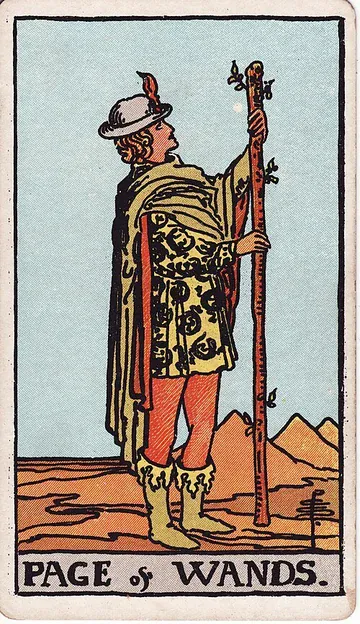
Page and Knight of the same suit running together — the salamander-spark moving from announcement into pursuit. The Page lights what the Knight rides. Read the pair as the spotted opportunity becoming the chase, the idea becoming the launch within weeks. When the gap between them is short, the energy is clean; when too long, the Page's spark gets reread as overthinking. In love, the meeting that moves from interest to commitment quickly. In work, the bold proposal that immediately becomes execution.
The Chariot
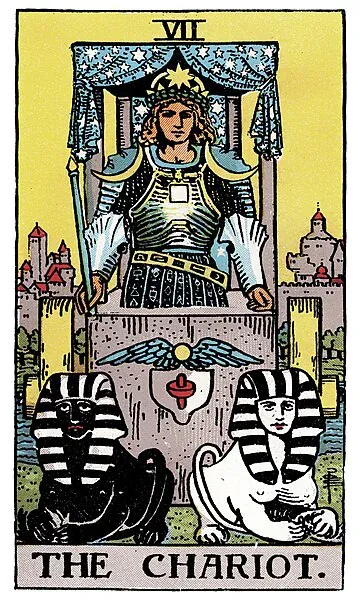
The Knight at his most disciplined — fire that has learned to steer without dousing the flame. The Chariot is the directed force the Knight always wants to be: same heat, mature steering. Together, this pair is the campaign that wins, the long pursuit that closes, the move whose speed is matched by precision. Read the combination as confirmation that will and structure have aligned. Whatever you are pursuing, you have both the energy and the architecture to bring it home — do not apologize for being decisive.
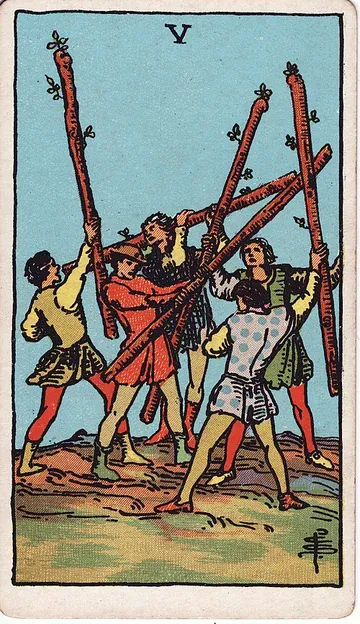
Five of Wands
The rider charging into a tangle of competing tempos. The Knight wants to move; the Five is the meeting where four other people each want to move differently. Read the pair as warning of pace mismatch — the energy is plentiful and uncoordinated. Find which two of the five you can actually ride with; let the other three sort their conflict on their own time. Charging through the tangle without naming it produces resentment that surfaces later in worse weather.
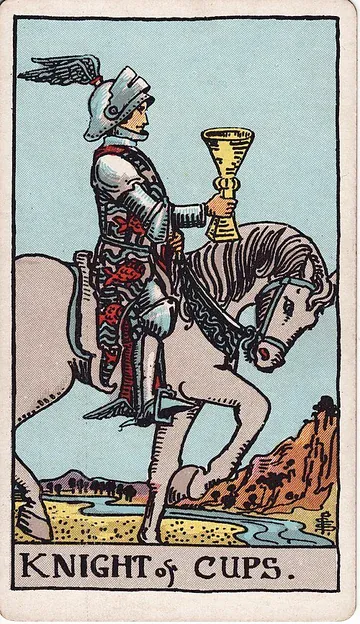
Knight of Cups
Series sibling, same rank different suit — the water-knight beside the fire-knight. The fire-knight rides at full gallop; the water-knight floats, cup raised, slowly approaching. Arrival mid-gallop versus arrival in a cup, departure as method versus presence as method. In love, this pair often shows when one partner moves at one speed and the other at another, and the relationship's work is the slow translation between them. Neither speed is wrong. Both are real. The translation is the love.
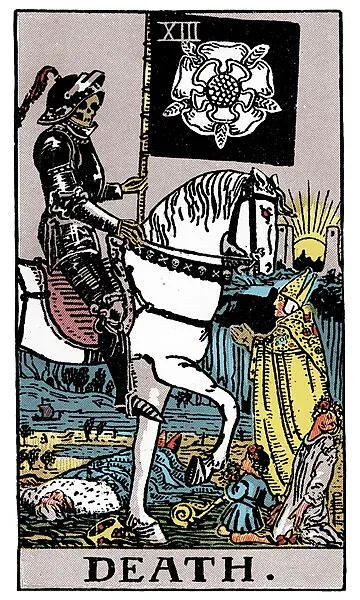
Death
The Knight's zodiac span begins in Scorpio's third decan — Death's heart. Read the pair as the headlong rider meeting transformation: impulsive departure that ends in passage rather than arrival. The journey will not bring you where you thought you were going; it will deliver you to a different person, in a different geography, holding a different question. Sometimes welcome, sometimes the year the old self is genuinely left on the road. Either way, the card asks you not to look back at the dust you raise.
Frequently Asked Questions
What is the Knight of Wands tarot card meaning?
The Knight of Wands is the deck's purest charge of fire — a knight on a rearing horse, mid-air, eyes already on the horizon. He carries fire-within-fire: outer fire, inner fire, no moisture or earth softening the blaze. As a card, he means the moment thinking ends and motion begins: a chosen direction, decisive action, and the willingness to let the route correct itself on the road. He favors speed over stillness, departure over arrival.
How short is the window on the Knight of Wands' yes?
Shorter than nervous seekers want it to be — this is a horse mid-gallop, not a horse mid-stable. The card is one of the deck's clearest yes answers on questions of action, initiative, departure and pursuit, and the yes is tied to motion rather than to the merits of the plan. Practically, that means the action which lets it land is the one taken this week, not the one scheduled for next quarter. Nothing about the situation forbids waiting; what happens with waiting is that the heat drains out of it, and this particular card has no other fuel. If the question is whether to send the message, make the call, book the ticket, the answer and its deadline are the same sentence.
Is the Knight of Wands' love about going somewhere or building somewhere?
Going, unambiguously — and knowing that in advance prevents most of the disappointment this card produces. In love the Knight is fast, declarative and physical: the person who decides early, says so out loud, and packs quickly. New connections under it compress months into weeks. Established bonds re-ignite when something from outside reminds one partner that fire is still available to them. But the promises it makes are travel promises, not architecture: a trip taken on nine days' notice, meals eaten fast because there is somewhere to be, a future described as a direction rather than as a house. None of that is insincerity. It is a different offer from the one Cups makes, and it works beautifully for people who want the same thing and badly for people quietly waiting for the building to start.
Knight of Wands: has their composure already broken?
It has, in a small and quite legible way, which is most of what this card is reporting. The feeling is heat — undisguised, undelayed, mildly inconvenient for the person carrying it, and already interfering with how they plan their week. They have decided about you. What gives it away is not what they say but the break in their usual pattern: a reserved person doing something uncharacteristic, arriving early, offering a lift nobody asked for, remembering a detail they had no business retaining. Demonstrative people simply announce it, occasionally to strangers. The body moves before the mouth catches up here, so the reliable evidence is the small acceleration when they come into a room, not the wording of the message they sent afterward.
What kind of person is the Knight of Wands?
The Knight of Wands as a person is the friend who calls you from the airport on the way to a country they decided on yesterday, the colleague who walks out of the meeting with the coat already on, the lover who texts on impulse and means every word. He is fire on horseback — direction-already-chosen, method-not-yet-resolved. His zodiac span runs from late Scorpio into early Sagittarius (Nov 13 – Dec 12), giving him secret intensity that vents into open-road heading. Loyal at speed, restless at rest, generous with his fire, hard to slow.
Continue Reading
Knight of Wands · Card overview · symbols · correspondences →
Return to the full card view — image, symbols, sensory correspondences, and Hermetic axes.
Read the reversed meaning →
Read the same depth on the opposite orientation.
Draw your reading now →
Bring this card to a question — open a quiet ritual.