Knight of Wands Reversed · Core Meaning
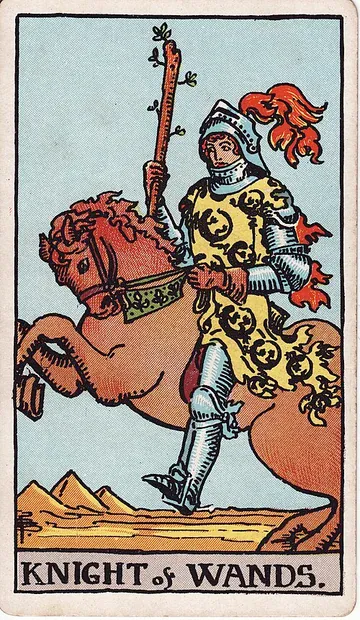
The Knight of Wands reversed is the same rider, the same flame-cloak, the same rearing horse — but the heading has come loose. The horse rears first; the rider is still mid-air, still undecided. He is out past the fence already, and the map is hanging on the fence behind him. The card's image inverts in a precise way: not a different scene, the same scene with the orientation question unresolved. He has crossed the threshold of departure without having crossed the threshold of decision.
This is the card's first knot: motion without direction. The energy is real. The horse is real. The fire above the helm is still upright, still streaming. What has changed is the relationship between the body and the heading. He is moving as fast as ever, but the moving is no longer in service of an arrival. It is in service of itself. The reversed Knight is the form of action that has forgotten its content.
The second knot is the inverse of the upright card's chase. Where the upright Knight rides one horse hard, the reversed Knight is on three. Each horse gets him three miles out before he turns to look at the other two. None of them arrive. He is committed to all three and arrives at none. Read the card in any reading where the seeker has been splitting their energy across multiple ambitious starts — three half-pursued careers, two simultaneous love interests, four open creative projects, the small business that is also the side hustle that is also the renovation. The fire is not lacking. The fire is dispersed across too many fronts.
The third knot is pace. The Knight reversed runs fast and can stop running just as fast — the same speed in both directions. Promises arrive at a sprint and retreat at the same pace. Between the promise and the act lies a stretch the horse cannot cover. The card describes the partner whose ardor is real on Tuesday and absent on Friday, the colleague who proposes the bold initiative on Monday and quietly drops it by Wednesday, the seeker who declares the new diet at midnight and orders takeout at noon. The intensity is genuine. The endurance is the missing element.
The astrological signature reverses too. The Knight's span runs from Scorpio's third decan into Sagittarius's first two, and the reversed card pulls the worst from each. Scorpio's intensity, ungrounded, becomes the volatility that flares without container. Sagittarius's open-road heading, ungoverned, becomes the dispersal that mistakes motion for progress. The reversed Knight is fire that has lost its hearth — fire that warms nothing because it cannot stay in one place long enough to form coals.
There is a fourth, more compassionate reading. Sometimes the reversed Knight is not failure but a stage. The seeker who has been trapped in stagnation, in the wrong life, in years of suppression, may surface into the reversed Knight first — the burst of energy that does not yet know where to go. This is not the card's pathology. This is the card's beginning of recovery. The energy returning is good news; the directionlessness is the part that needs the next card to address. Be kind to the version of you that has just remembered it has fuel. Then choose a direction.
Knight of Wands Reversed · Love
Ardor arrives at a sprint here and leaves at the same pace; the reversed Knight of Wands is that rhythm. The intensity is real. The endurance is questionable. Whether the reading is good news or hard news depends on which side of the dynamic the seeker is sitting on, and whether the pattern is a one-time stumble or the relationship's structural shape.
For an existing partnership, the reversed Knight often signals a season of pace mismatch and quarrel-over-tempo. One partner wants to move on something — relocation, marriage, the next child, the renovation, the trip — and the other partner is not ready. The argument is not about whether to do the thing. It is about when. The card describes the relationship where the loud fights are about logistics and the quiet ache underneath is about whether the two of you are still moving through life at the same speed. Read this carefully. Sometimes the cure is for the slower partner to accelerate; sometimes the cure is for the faster one to wait. The card itself does not vote. It names the mismatch.
For a new connection, the reversed Knight warns of the partner whose declarations have outpaced their behavior. They told you they were all in by the second date. By the fourth date, the texting frequency has halved. They have not become cold; they have simply burned through the initial run of attention and not yet found the rhythm of sustained presence. This is one of the card's most common patterns. Some of these connections recover into a slower healthier shape. Some of them do not. Watch what happens at the six-week mark. The Knight reversed often reveals itself there.
For a single seeker who has just met someone, the reversed Knight asks a question rather than gives an answer: are you reading this person's enthusiasm at the speed they are actually offering it, or at the speed you wish they were offering it? The card warns gently against projecting more endurance onto a fast start than the start itself is signaling. Take the heat as real. Do not yet take the heat as a forecast. The next two months are the data; the first two weeks are the prologue.
For love after a wound, the reversed Knight can describe the rebound that wears the costume of recovery. The new person is exciting; the body is alive again; the mornings have stopped being gray. And underneath, the part that the previous relationship broke is still broken, and the new pace is being used to outrun the still-broken part. The card is not condemning the rebound. Sometimes the body does need a return of motion before it can return to the harder work. But the card is asking you to know which is which. The healing rebound becomes a real relationship. The bypassing rebound ends within a season and leaves the original wound exactly where it was, plus a new one.
For a long-term partnership in trouble, the reversed Knight can describe the pattern of fights that flare and disappear without resolution. You both lose your tempers; you both apologize; nothing actually changes; the same fight repeats two weeks later in a different costume. The card describes anger that has become the relationship's primary form of contact. Read this honestly. Couples can recover from this pattern. Recovery requires the harder work of cooling the fight before the apology rather than after. The card asks for that discipline.
For the question of reconciliation after a break — which often hides inside the love question — the card's answer is mixed. Reconciliation in this card's terrain is possible but rarely durable on the first attempt. The same fast affection that brought you together will rush you back together; the same fast affection will rush you apart again on the next stress. If you reconcile, build a slower second start. Do not trust the fire of the first week. Trust the consistency of the eighth.
For someone who is themselves the Knight of Wands type — the partner who has run hot and cold across multiple relationships and is wondering whether they are the problem — the reversed card is, paradoxically, an invitation rather than an accusation. Yes, the pattern is yours. The pattern is also workable. The work is to stay in the room past the temperature drop, past the moment when your nervous system tells you to ride out, past the third week when it has stopped being thrilling. Most of your past relationships ended at the third week not because the other person failed but because that is the week your fire reaches the natural valley. Cross the valley. The fire on the other side is the fire that lasts.
For a single seeker who has been hurt by Knights of Wands repeatedly, the reversed card is the gentle warning to read pace before passion. The next person who arrives at full sprint, declaring everything by the second date, may or may not be the version of this card who has matured. Most are not. Trust pace; do not let intensity overrule it.
For the question of a partner cheating, the reversed Knight is one of the deck's more honest cards. It does not always mean infidelity, but it does describe the personality whose energy can split across multiple objects, whose attention can be in two places, whose sense of possibility outruns their sense of obligation. If your gut is telling you something, the card is not telling you to discount the gut. It is telling you to gather data slowly rather than confront on impulse. Confronting on impulse, with this card on the table, escalates faster than the relationship can absorb. The conversation needs to happen — but it needs to happen in a cooler hour.
Knight of Wands Reversed · As Feelings
Reversed, this Knight feels something genuine for you on the days he feels it — and that qualifier is the entire reading. They also have days where the feeling is, somehow, not where they left it. They are not lying about the warmth. They are not lying about the cool. They are telling you the truth of an emotional life that runs at high amplitude and low resolution — big swings, quick changes, real on every reading and not the same reading from one week to the next.
For a partner who is reserved by nature, the reversed Knight in feelings is unusual. Their fire is contained, but the containment is not stable in this card. They will appear cool and unreadable for two weeks, then reach out with a depth of disclosure that surprises both of you, then retreat again into the cool. Read this not as games but as a nervous system that has not learned to sustain the contact at the temperature their feeling actually runs. The work is not yours. The work is theirs — to learn that sustained contact at moderate temperature is possible without the periodic flare-and-retreat.
For a partner who is demonstrative, the reversed Knight in feelings is the partner whose declarations are larger than their available bandwidth. They tell you they love you on Sunday and forget to text on Tuesday. The forgetting is not coldness. The forgetting is that their lives have outpaced their attention. They are over-promising the relationship in the moments of intensity and under-delivering in the moments between. The card describes someone whose feeling is real and whose execution lags it by about a week.
For a long bond, the reversed Knight in feelings can describe the partner who has stopped renewing the active gesture. The feeling has not died. The behavior that signaled the feeling has thinned. They love you; they have stopped reaching for you the way they used to. This is one of the card's gentler warnings: the feeling without the gesture quietly becomes ambient. Not nothing. Not anything either. The card asks for the renewed gesture from somewhere — from one partner, ideally from both. A small specific motion in the right direction can shift this card more than long discussion can.
For a new connection, the reversed Knight in feelings means they are excited but not yet decided. The excitement is genuine. The decision is not. They are flickering between full-pursuit and casual-interest because they have not yet metabolized what they actually want. Do not pressure them to decide on your timeline. The decision will not be hurried; it will, when it arrives, arrive at speed, in a moment that surprises both of you. The card asks you to hold position without becoming brittle. Easier said than done.
For someone you have been chasing rather than the other way around — the question of whether the reversed Knight of Wands is thinking of you — yes. They are. They are also thinking of three other things, and the cycle of attention rotates faster than your nervous system can comfortably track. They have not forgotten you. They have simply not held you in steady focus. This is not personal. This is the card's signature pattern. Whether you can accept that signature, or whether you need a different signature, is your call.
For someone who has gone silent after a fast start, the reversed Knight in feelings reads as ambivalence rather than coldness. They feel something for you. They are also overwhelmed, busy, in their own life crisis, distracted, or simply unsure how to follow up after the initial run. The silence is not about you most of the time. The silence is about them. Whether to wait it out depends on your own architecture. Some of these silences break in two weeks; some never break. The card cannot predict which.
Read as feelings, the reversed Knight of Wands gives an answer that holds across most situations: real feeling, unstable expression, fast amplitude shifts. They feel what they feel intensely on the days they feel it. They have days they feel less. The feeling is not a lie. The expression is the part that needs work. The card does not say to leave them. It does say to read what they are offering at the speed they are offering it, not at the speed you wish they were.
For the question of whether someone is angry at you and the reversed Knight appears, the answer is often yes — and the anger is more flare than fixture. They are heated about something that has happened recently. Given a few days, the heat will subside; the underlying issue may or may not have been the actual issue. If you can wait three days and then have the conversation when both of you are cool, the card supports the conversation. If you push to resolve the heat in the heat, the card warns against the escalation that will follow.
Knight of Wands Reversed · Career
Three horses, three miles each, and no arrivals: the reversed Knight of Wands keeps that ledger at work. The energy is being spent. The progress is illegible. The card is not about a lack of ambition; it is about ambition that has dispersed itself across too many fronts to consolidate any of them. Whatever you are working on, the Knight reversed asks the question: which two of these projects can you let go so the third can actually finish?
For someone in a current role asking whether to stay, the reversed Knight often signals burnout shaped like restlessness. You have been performing well at speed for too long without the rest cycle the body and the role both required. The current role is not necessarily wrong. The current pace inside the role is wrong. Read this carefully — the temptation under the reversed Knight is to interpret the burnout as a sign that the role is wrong and to leap to a new role, only to find the same exhaustion arrives in the new chair within a quarter. Most of the time, the work is to address the pace before changing the geography.
For someone considering a new role, the reversed Knight warns of the impulse-pivot that has not been fully thought through. The new role looks better because the new role is unfamiliar; in three months, the unfamiliar will become the familiar, and the parts of the old role you were running from will appear in the new role wearing different clothes. The card asks: have you addressed what is actually broken about your current situation, or are you outsourcing the problem to a job change? If the latter, the new role will inherit the unaddressed problem. Pause two weeks. Take the offer if the offer survives the pause; decline it if the appeal was contingent on the pivot's adrenaline.
For entrepreneurs and freelancers, the reversed Knight is one of the deck's clearest mirrors of the founder's particular trap. Too many initiatives at once. The launch announced before it was ready. The pivot announced before the previous pivot proved itself. The customers being chased in three different segments simultaneously. The card asks for ruthless concentration on one segment, one product, one channel for a meaningful season — six months minimum. The breadth that feels like agility is, often, the form of avoidance that prevents any one bet from being given enough breath to succeed.
For a creative practice, the reversed Knight describes the maker who has started ten projects and finished one. The starting is the easy part for this temperament; the finishing is where the muscle is underdeveloped. The card asks for the discipline of the closing chapter. Pick the project nearest to completion. Set the deadline. Get it across the line — even imperfectly. The next project, after the closure, comes easier — finishing has been proven possible by the body that just did it. Most creative blocks for the Knight-of-Wands type are not blocks of starting; they are blocks of finishing.
For someone considering a career pivot, the reversed Knight asks whether the pivot is the third pivot in five years. If so, the card warns that the pattern is now the problem rather than the answer. Each pivot has taught you something, but the cumulative effect of five pivots is a resume that no employer can read coherently and a self-narrative that has no spine. The card asks for one full cycle — at least three years — in the next direction before allowing yourself the next pivot. Restlessness is not always wisdom. Sometimes restlessness is the symptom that needs to be sat with rather than acted on.
For job-search questions, the reversed Knight warns of the spray-and-pray approach: forty applications submitted in one weekend, none of them tailored, none of them followed up. The card asks for fewer applications, each one personally directed, each one followed by a real conversation. The Knight reversed is not about volume. He is about the moment volume becomes a substitute for the harder work of being specifically wanted by a specific employer.
For collaboration questions, the reversed Knight describes the partnership where one person is consistently outpacing the other and both are quietly resentful. The fast partner thinks the slow partner is dragging; the slow partner thinks the fast partner is reckless. Both readings have truth. The work is to name the pace mismatch out loud and design the collaboration around it — give the fast partner the early phases, give the slow partner the closing phases, and route the tension through the structure rather than through the emotional channel. Most collaborations on this card recover when the pace conversation finally happens.
On career, the most common practical advice the reversed Knight of Wands delivers is: cancel one commitment this week. Pick the project, the meeting, the side gig, the speaking engagement, the favor you said yes to — pick the one whose cancellation will hurt the least and the cancellation of which will free the most bandwidth. Cancel it. The bandwidth you free is the bandwidth that lets the remaining work actually finish. The reversed Knight does not return to upright through doing more. The reversed Knight returns to upright through doing less, with full focus.
For burnout questions specifically, the reversed Knight is unambiguous about the cause. You are running on three horses. The fix is not motivation. The fix is subtraction. Burnout does not lift by adding a meditation practice on top of the three horses; it lifts when one of the horses is genuinely sent away. The card has no tolerance for the productivity-hack culture's promise that you can do everything if you optimize hard enough. The Knight reversed knows you cannot.
Knight of Wands Reversed · Money
Spending moves faster than earning under this reversal, and the Knight of Wands knows all three versions of it — the impulsive spender, the over-leveraged optimist, the founder whose burn rate has outrun his revenue. The card is not always about disaster, but it is always about the gap between the speed of spending and the speed of earning. Whatever you are asking about, the card asks you to look at the numbers — actually look at them — rather than at the narrative you have been telling yourself about the numbers.
For someone considering a calculated risk, the reversed Knight warns against the bet that has been made in the heat of an idea without a clear stop-loss. Investments, business ventures, and major purchases under this card need a defined exit. How much are you willing to lose? At what threshold do you walk away? The Knight reversed without a stop-loss tends to keep doubling down on the losing position because doubling down feels like commitment. It is, instead, the loss compounding. Define the exit before you enter.
For windfall, the reversed Knight describes the unfortunately common pattern of receiving a meaningful sum and watching it evaporate within a season. The bonus, the inheritance, the settlement, the unexpected gift — gone faster than you would believe, redistributed into purchases that felt necessary at the time and prove forgettable later. The card asks for the cooling-off period: three months minimum between receiving and deploying. Park the money somewhere with friction. The friction is the thing that will save you.
For someone managing scarcity, the reversed Knight is sometimes the card of the bad gamble — the lottery ticket bought every week, the trading account opened during a stressful month, the multi-level marketing pitch that promised the way out. None of these are the way out. The card warns against the financial decision that comes from the body's panic rather than the head's calculation. If the decision is being made because you cannot stand the current financial pressure for one more day, the decision is going to make the pressure worse.
The reversed Knight's signature financial trap is the compulsive purchase that pretends to be an investment. The expensive course that never gets finished. The high-end equipment for the side practice that gets dropped past the third week. The new car that you "need" for the new business that has not yet generated its first dollar. The Knight reversed loves to spend on the future version of himself who will use the purchase well. That future version often does not arrive. Spend on the present version. He is the version with the actual track record.
For investments, the reversed Knight warns against the strategy that requires near-perfect timing. Day trading, options without protection, leveraged real estate flips, speculative crypto plays. The Knight is not patient enough for the strategies that reward patience and not careful enough for the strategies that reward precision. Most people in this card's terrain do better with index funds and a calmer instrument. The card asks for the slower vehicle. Boring is the friend of the reversed Knight's portfolio.
For debt, the reversed Knight is one of the harder readings the deck offers. The card describes the seeker whose debt has expanded faster than their income, whose minimum payments are barely keeping up with the interest, whose credit cards have been used to pay off other credit cards. None of this is shameful. All of this is fixable. The card asks for the plan that involves an outside accountability structure — a credit counselor, a financial advisor, a partner you trust to look at the numbers with you. The Knight reversed does not get out of debt alone. He gets out with help.
For long-term financial planning, the reversed Knight asks the seeker to slow the lifestyle inflation. Each raise has produced a corresponding lifestyle expansion; the savings rate has stayed flat for five years despite the income rising substantially. The card describes the slow leak that hides behind the appearance of doing well. The fix is unglamorous: track expenses for one month, identify the three largest avoidable line items, cut one of them in half, redirect the savings to the long-term plan. The Knight reversed responds to the action that closes the leak. He does not respond to elaborate spreadsheet plans that will not be followed past the third week.
Knight of Wands Reversed · Health
The body has been pushed past its margin and has started signaling; reversed, the Knight of Wands is that signal. The energy that powered the upright Knight has either turned against itself — agitation, inflammation, the body burning its own reserves — or has dropped out altogether into the exhausted collapse that follows sustained overwork. The card is not punishing. It is naming. The body is asking for something the schedule has not let it have.
If you are asking whether your fatigue is real or whether you are imagining it, the reversed Knight confirms it is real and gives a rough cause: you have been running too hard for too long without the rest cycle the body required. This is not weakness. This is biology. Even the most resilient bodies have a finite reserve, and the Knight reversed describes the exhaustion that follows depleting it. The cure is not a supplement. The cure is rest — actual rest, days of it, sustained — combined with the reduction of whatever load created the depletion.
For someone managing a chronic condition, the reversed Knight can describe a flare. Whatever the condition is, the management has slipped, the symptoms have returned, and the body is signaling more loudly than it has in a while. Read this not as failure but as information. The flare is the body's diagnostic. Re-engage with the practitioners; resume the practices that worked; do the boring thing of taking the medications on schedule even when you are tired of taking them. The card supports return to discipline. It does not support magical thinking about wellness without the underlying work.
For acute issues — fevers, injuries, sudden symptoms — the reversed Knight warns against ignoring the signal. Fire-element bodies often pride themselves on pushing through. The push-through that worked at twenty-five does not work at thirty-eight. See the doctor earlier than you would have. Take the day off rather than gutting it out. The acute issue, treated promptly, resolves. The acute issue, ignored, escalates faster than the body can compensate.
The reversed Knight's particular health signature concerns the heart — both literally (the cardiovascular system, the chest tightness that flares under stress, the blood pressure that runs high) and figuratively (the emotional heart that has been operating in defensive mode for too long). The card asks for cooling practices: long walks rather than sprints, slower breath, time in water, time in shade, the reduction of stimulants. Coffee that worked for ten years can stop working; the body that has been over-stimulated reads more stimulation as threat. Notice if your morning anxiety has crept up. The cup before the email check is not the cure.
For someone managing alcohol, recreational substance use, or other comfort behaviors that started as pleasures and became routines, the reversed Knight is one of the deck's clearer mirrors. The behavior was managing something the schedule did not allow other resources to manage. The behavior is now the additional stressor. Read this gently — you are not bad for having reached for the comfort; you are responsible now for finding a less costly form. The card supports professional help, real conversations with people who have been here, the structural change rather than the willpower fix.
For mental health questions, the reversed Knight describes anxiety that has shifted from productive edge to paralytic edge. The sharpness that once drove decisive action now drives looping rumination. The body is too activated to act; the mind is too activated to rest. The card asks for the deactivation practices that the upright Knight tends to dismiss as too slow: the long bath, the early bedtime, the conversation with someone who is calm, the deliberate underscheduling of the next two weeks. None of this is medical advice; keep your practitioners, take your medications, and treat the card as a reading of weather.
For sleep specifically, the reversed Knight warns about the compounding sleep debt. Three weeks of short nights creates a deficit that one good night does not repay. The card asks for a stretch — five nights minimum — of deliberately protected sleep. No screens past nine, no email after the dinner, no late-night second wind followed by 3 a.m. wakeups. The sleep work is the most important health work the reversed Knight can do this season. Other health gains compound from there. Without the sleep, every other intervention runs at half power.
For diet, the card warns against the hot-and-spicy comfort eating that the fire body craves under stress. Cooling foods — soups, water-rich vegetables, cooked grains — match the recovery the body is asking for. The seeker whose diet has been getting more aggressive (more spice, more meat, more stimulants) under stress is feeding the flare rather than soothing it. Cool the diet for two weeks. Notice what shifts.
Knight of Wands Reversed · Spirituality
Intensity gets mistaken for depth in the reversed Knight of Wands, and the heat of striving gets taken for the substance of a practice. The retreats attended, the books read, the teachers followed, the disciplines initiated — all real, all genuinely sought, none yet allowed to settle into the quieter stratum where actual spiritual life accumulates. The card is not condemning the seeking. It is asking the seeking to do its harder work: to stop changing terrain and to let the current terrain become deep.
For seekers in active practice, the reversed Knight names the pattern of the half-finished disciplines. The yoga practice that was profound for two months and then dropped. The meditation cushion in the corner that has not been sat on in six weeks. The journaling practice that started intensely and tapered. The breathwork course that was completed and never integrated. The card asks not for a new discipline but for the return to one of the abandoned ones. Pick the one that, on honest review, was working. Resume it. Without ceremony. Without the elaborate restart ritual that itself becomes a form of avoidance.
For seekers exploring belief, the reversed Knight warns against spiritual tourism — the consumption of traditions as products, the sampling that never commits. This is one of the modern era's most common spiritual pathologies. The seeker has spent five years exploring; the cumulative depth is no greater than year one. The card asks for the harder choice: pick one tradition, stay in it for at least a year, do the unglamorous parts. The depth that comes from staying is the depth no amount of sampling produces.
The reversed Knight's spiritual signature is the pattern of the breakthrough that did not stick. You have had real experiences. Genuinely real. The retreat where something opened. The therapy session where the old pattern dissolved. The night under the stars where the self felt reorganized. And then, two months later, you were the same person living the same life, and the experience had become a story rather than a change. The card asks why. The honest answer is usually that the breakthrough was not followed by the slow integration work. Insight without practice degrades into nostalgia.
For someone considering a spiritual commitment — vows, baptism, taking a teacher, joining a community — the reversed Knight asks for delay. Not because the commitment is wrong, but because this seeker, in this season, has been making fast commitments and unmaking them. The card asks for six months of unflashy practice before the commitment, to verify that the impulse is not the same impulse that produced the previous abandoned commitments. Real commitments survive the boring season. Make the commitment after you have proven, to yourself, that the practice can survive the boring season.
The card's spiritual caution is the conflation of stimulation with progress. The reversed Knight loves intensity — the loud kirtan, the powerful workshop, the charismatic teacher, the visceral retreat. These are not bad. They are also not the substance of the path. The substance accumulates in the long quiet practice between the intense events. Most spiritual maturation happens on the morning when nothing dramatic is occurring and the practice happens anyway. Re-locate the practice from the events to the mornings.
For the question of whether to leave a teacher or community, the reversed Knight is mixed. Sometimes leaving is right — the teacher is genuinely off, the community has gone toxic, the path was always the wrong path. The card supports those leavings. But the card also describes the seeker who has left every teacher within a year, every community within eighteen months, on increasingly persuasive justifications. If the pattern is yours, the question to ask is whether the next leaving will produce a different outcome or simply repeat the cycle. The card does not tell you what to do. It does ask you to be honest about which version of leaving this is.
A small practice when this card appears: forty days of one short practice, at the same time each day, with no upgrades, no expansions, no replacements. Five minutes of breath, ten minutes of journal, fifteen minutes of walking — pick one, keep it small enough to be undeniable, hold it for forty days. The reversed Knight returns to upright through the discipline of consistency rather than through the discovery of a new technique. There is no new technique. There is only the practice that survives the eighteenth day.
Knight of Wands Reversed · Yes or No
Soft no — or wait.
The Knight of Wands reversed is rarely a clean yes. It is more often the answer that warns of the wrong moment, the wrong target, or the wrong amount of motion. The yes the seeker is hoping for, in this card's terrain, would land badly even if it landed. The card is not punishing. It is being precise about timing.
For yes-or-no questions about acting now — should I send the message, should I confront the issue, should I quit, should I propose — the reversed Knight answers wait. Not forever. Long enough for the heat that is generating the urge to cool, so the action that emerges is decision rather than reaction. Most actions taken in the reversed Knight's hour are regretted within a week. Most of those same actions, taken two weeks later, would have been received differently or would have proved unnecessary entirely.
For questions about a relationship — should I stay, should I leave, should I commit — the reversed Knight asks the seeker to honestly check whether the question is being asked at peak heat or at baseline. If at peak heat (after a fight, after a flare, after a disappointment), the card declines to answer. Wait until the temperature returns to normal. Ask the same question. Often it has reshaped itself.
For job-search and career questions, the reversed Knight is similarly cautionary. The impulsive resignation, the burnt-bridge departure, the sudden pivot in the middle of a stressful quarter — the card warns against all of them. Whatever the underlying issue is, the action that addresses it well is unlikely to be the action your stressed body is currently demanding.
For questions about a person — will they change, will they show up, can I trust them — the reversed Knight gives a soft no. The change you are hoping for, in this card's terrain, has not happened yet and is not happening on the timeline you need. This is not the same as saying it will never happen. It is saying that, today, the trustworthiness has not landed. Plan for the present, not for the version of the person you wish were already here.
Asked when, the reversed Knight indicates delay. Whatever was supposed to happen quickly is not happening on the original schedule. The reasons may be external (logistics, other people's choices, circumstances) or internal (your own readiness has not consolidated). The card invites the seeker to use the delay rather than fight it. Most delays under this card are protective.
Asked as a yes-or-no specifically, the most accurate single answer is: not yet. Not no forever; not yes today. The card describes the season where action is premature and patience is the active practice. This will frustrate the seeker who came to the cards hoping to be released to do the thing they have been wanting to do. The card respects the wanting. It also names that the wanting needs a different season to become a yes that holds.
If the seeker insists on acting anyway — and many will — the card does not punish; it simply lets the consequences clarify the lesson. Most seekers who act on a Knight-reversed yes return to the cards within two months wishing they had waited. The cards have nothing to add at that point. They will say the same thing again.
Knight of Wands Reversed · Advice
Subtract. Whatever the current load is, the reversed Knight of Wands reads it as one or two more than can actually be ridden. The cure is not better time management, sharper prioritization, or more efficient execution. The cure is genuine reduction. Cancel one thing. Decline one new opportunity. End one commitment that has been quietly draining you. The reversed Knight does not return to upright through more effort. He returns to upright through less.
If there is one specific instruction the card offers, it is to send two of the three horses away. Whatever three pursuits you are currently splitting your fire across, the card asks you to look honestly and let two of them go. Not delay them; let them go. The fear behind keeping all three is that the two you abandon will turn out to have been the right ones. The card answers that fear directly: probably one of them would have been viable, but none of them will be viable while you are riding all three. One viable horse is worth two abandoned ones if the alternative is three abandoned ones in a different shape.
A second instruction: cool the body before you speak. Whatever conversation you are about to have — the confrontation with the partner, the resignation email, the public callout, the message to the friend who hurt you — wait at least one full sleep cycle before sending it. Most of the reversed Knight's casualties are conversations that happened in the heat. The conversation that happens after the heat has cleared is a different conversation. It carries the same content with a fraction of the damage.
A third instruction: do the boring repair work. Whatever the reversed Knight has broken — the relationship strained by your impatience, the project hurt by your over-promising, the body run down by your over-extension, the trust dented by your inconsistency — the repair is unglamorous. It is the conversation. It is the slow re-earning of credibility through showing up the way you said you would, every time, for a season. The card has no shortcut for this. The shortcut you are looking for is the next instance of the original problem.
A fourth instruction, gentler: forgive yourself the dispersal. Most seekers who draw this card have been carrying shame about their pattern of starting many things and finishing few. The shame is not productive. The pattern is workable, and the work begins after the self-blame ends. You are not bad for being a fire body. You are responsible for learning the pace your fire actually sustains. That is a craft, not a moral failure.
A fifth, more specific instruction: pick the smallest possible commitment and finish it. The reversed Knight has been making large commitments and abandoning them. Make a small one. Forty pages of the book, not the whole book. One workout per week for six weeks, not five workouts per week starting tomorrow. One conversation with one estranged friend, not the reconciliation tour of all eight. The pattern of finishing one small thing rebuilds the muscle that finishing larger things requires. Most of the reversed Knight's recovery starts with proof of completion at any scale.
For the advice of the reversed Knight of Wands specifically, the practical instruction the card most often delivers, summarized for the reader who came straight to this question: stop, breathe, subtract one thing, finish one thing, repair one thing. In that order. Most seekers will skip the first instruction and try to subtract while still moving at full speed. That does not work. The body needs to actually stop — for a full day, not for fifteen minutes between meetings — before the rest of the advice has any traction.
A note for those who are themselves the Knight of Wands type and have been reading this section recognizing themselves: the card is not your enemy. The reversed Knight is the difficult side of the same gift the upright Knight celebrates. The gift is real. The work, for this temperament, is to learn the pace at which the gift sustains rather than burns. Most fire bodies learn this in their thirties or forties, often after a meaningful breakdown. The card is asking you to learn it sooner if possible, with less wreckage.
Knight of Wands Reversed · Combinations
Knight of Wands Reversed + Page of Wands
The court line of the suit running together with both cards turned. Spark and gallop, but neither has found its footing. The Page is the spark that does not become a fire; the reversed Knight is the gallop that does not arrive. Together, the pair describes the seeker whose ideas are arriving at the right pace and whose execution is collapsing under the weight of too many simultaneous starts. Pick one idea. Hold it past the spark phase. Let it become work. The reversed Knight + reversed Page recovers to upright through the slow business of seeing one specific thing through, which is the only thing that teaches the rest.
Knight of Wands Reversed + The Chariot
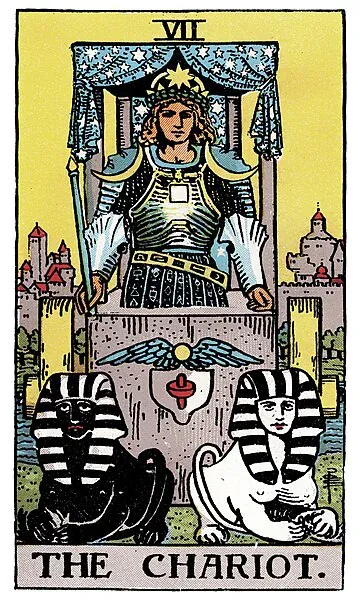
Disciplined force meeting dispersed force. The Chariot is what the reversed Knight is failing to be. Read the pair as a clear message: the discipline is missing, and the discipline is what would let the energy land. Whatever you are pursuing has the raw fuel; what it lacks is the steering. The card asks for the structure that the seeker has been resisting — the schedule, the plan, the commitment to a single direction — as the only way the fuel becomes movement instead of combustion. The Chariot's stillness is not the opposite of the Knight's fire; it is the container the fire has been running without.
Knight of Wands Reversed + Five of Wands
The reversed knight charging into the tangle of competing tempos — and joining the tangle rather than resolving it. Read the combination as warning of escalation. The fight you are about to enter into already has four other people in it, each at their own pace, and your charge will not bring clarity; it will multiply the tempo conflict. Step back. Let the others sort their own pace. The card asks for the unusual discipline of not entering a fight that is technically yours to enter. Some fights resolve through everyone's withdrawal rather than anyone's victory.
Knight of Wands Reversed + Knight of Cups
Two knights, both turned, traveling in opposite directions of failure. The fire-knight reversed is pace without arrival; the water-knight reversed is feeling without action. Together, they describe the relationship where one partner has too much intensity and not enough sustained presence, while the other has too much sentiment and not enough capacity to act. Both are real. Both are stuck. Read the pair as a study in complementary stuck-ness — neither partner can solve their problem by becoming the other partner. They have to each, separately, do their own work. The fire-knight learns endurance; the water-knight learns motion. Until both have done that work, the relationship cycles through the same fight.
Knight of Wands Reversed + Death
The headlong rider meeting transformation while still mid-air on the question of where he is going. Read the pair as the difficult mercy of an ending the seeker did not yet know was coming. The dispersed energy of the reversed Knight is being collected, against his will, into a single passage. The job ends; the relationship ends; the geography ends; the version of self that was riding three horses ends. This is not punishment. This is a kind of grace that only arrives when the seeker has run too long without reckoning. After Death's passage, the next Knight that emerges will be a different rider. Most of the reversed Knight's deepest growth happens on the other side of an ending he did not see coming.
Card Combinations
Page of Wands
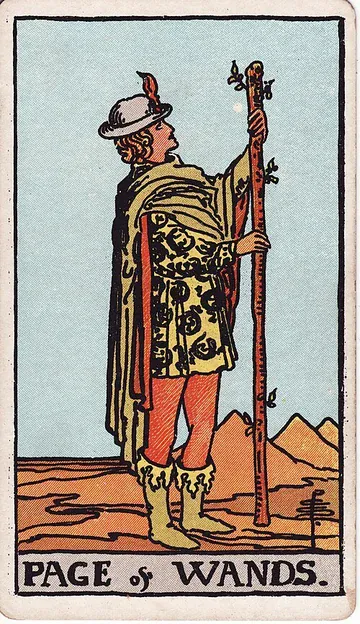
Page and Knight of the same suit running together — the salamander-spark moving from announcement into pursuit. The Page lights what the Knight rides. Read the pair as the spotted opportunity becoming the chase, the idea becoming the launch within weeks. When the gap between them is short, the energy is clean; when too long, the Page's spark gets reread as overthinking. In love, the meeting that moves from interest to commitment quickly. In work, the bold proposal that immediately becomes execution.
The Chariot
The Knight at his most disciplined — fire that has learned to steer without dousing the flame. The Chariot is the directed force the Knight always wants to be: same heat, mature steering. Together, this pair is the campaign that wins, the long pursuit that closes, the move whose speed is matched by precision. Read the combination as confirmation that will and structure have aligned. Whatever you are pursuing, you have both the energy and the architecture to bring it home — do not apologize for being decisive.
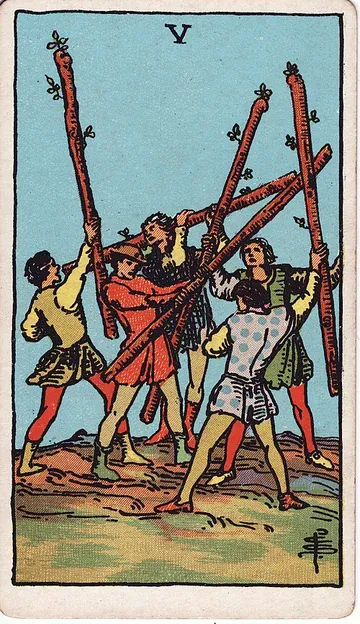
Five of Wands
The rider charging into a tangle of competing tempos. The Knight wants to move; the Five is the meeting where four other people each want to move differently. Read the pair as warning of pace mismatch — the energy is plentiful and uncoordinated. Find which two of the five you can actually ride with; let the other three sort their conflict on their own time. Charging through the tangle without naming it produces resentment that surfaces later in worse weather.
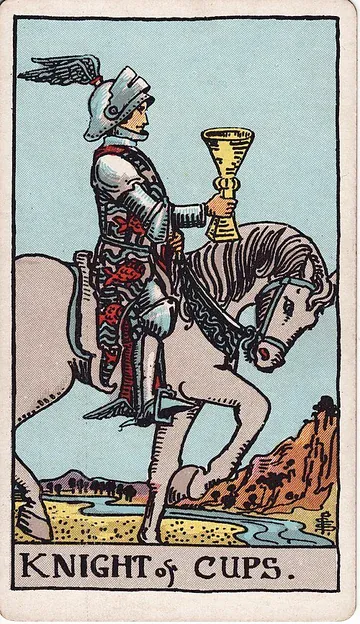
Knight of Cups
Series sibling, same rank different suit — the water-knight beside the fire-knight. The fire-knight rides at full gallop; the water-knight floats, cup raised, slowly approaching. Arrival mid-gallop versus arrival in a cup, departure as method versus presence as method. In love, this pair often shows when one partner moves at one speed and the other at another, and the relationship's work is the slow translation between them. Neither speed is wrong. Both are real. The translation is the love.
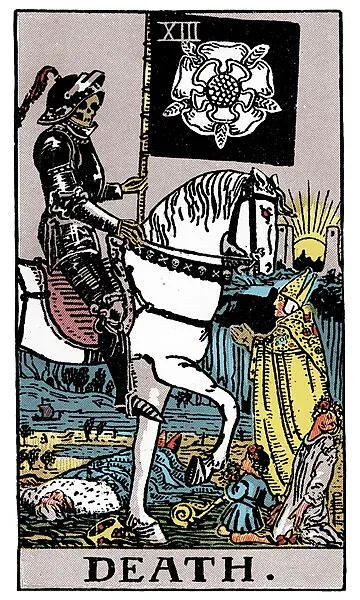
Death
The Knight's zodiac span begins in Scorpio's third decan — Death's heart. Read the pair as the headlong rider meeting transformation: impulsive departure that ends in passage rather than arrival. The journey will not bring you where you thought you were going; it will deliver you to a different person, in a different geography, holding a different question. Sometimes welcome, sometimes the year the old self is genuinely left on the road. Either way, the card asks you not to look back at the dust you raise.
Frequently Asked Questions
Should I wait out the Knight of Wands reversed before I send it?
Yes, and the wait is shorter than it feels. Reversed, this card is rarely a clean refusal; it flags the wrong hour for an action that may well be right — the confrontation, the resignation, the leap, the proposal, the message composed at eleven at night with the whole argument already written. Actions taken inside the reversed Knight's hour are typically regretted within the week, not because they were wrong in substance but because the heat chose the wording. The same actions taken a fortnight later either land far better or turn out to be unnecessary, which is its own useful information. So the instruction is delay rather than denial: one full sleep cycle at minimum, two weeks where the stakes are large, and then read the impulse again in daylight.
Knight of Wands reversed: are we fighting about tempo rather than substance?
Very often, yes — and arguments about tempo are unusually hard to name, because both people believe they are arguing about commitment. Reversed, the card describes ardor at a sprint and retreat at the same speed: declarations larger than the available bandwidth, fast attachment followed by a cooling nobody explains. One partner experiences that as withdrawal of love. The other experiences the request to slow down as rejection. Neither is wrong about what they felt. For a newer connection the warning is against projecting endurance onto a fast start, since speed at the beginning says nothing about stamina later. For an established bond it usually names a pace mismatch that predates the current quarrel. For a reconciliation the answer is mixed: possible, seldom durable on the first attempt, and much better on a deliberately slower second start.
Knight of Wands reversed: why is the temperature different every week?
Because the fire is genuine and the regulation is not yet built. Reversed, the feeling runs intensely on the days it runs and is measurably absent on the others, and the amplitude between those two states is wide enough to make anyone on the receiving end feel slightly unwell. None of it is deception. What you are watching is a nervous system that has not learned to hold contact at the temperature its own feeling operates at, so it surges, exhausts itself, retreats to recover, and surges again — and the retreat gets read by you as a verdict when it is closer to a nap. The workable response is to stop calibrating to the peak weeks. Read what is being offered at the speed it is actually offered, decide whether that average is enough for you, and say so plainly.
What does the Knight of Wands reversed mean as advice?
The advice is to subtract. Cancel one thing this week. Send two of the three horses you are riding away and ride the remaining one in a single breath to where you can safely dismount. Cool the body before you speak — wait one full sleep cycle before sending the heated message. The reversed Knight does not return to upright through more effort; he returns through less, with full focus on the one thing that remains.
Who is the Knight of Wands reversed as a person?
As a person, the Knight of Wands reversed is the friend whose enthusiasm outruns their follow-through, the partner who proposes the bold move on Monday and quietly drops it by Wednesday, the colleague mounted on three horses at once. They are not bad. Their fire is real. They have not yet learned the pace their fire sustains. Most fire bodies learn this in their thirties or forties, usually after a meaningful breakdown. The card asks for compassion alongside boundaries — they are workable, but on a longer timeline than the relationship initially expected.
Continue Reading
Knight of Wands · Card overview · symbols · correspondences →
Return to the full card view — image, symbols, sensory correspondences, and Hermetic axes.
Read the upright meaning →
Read the same depth on the opposite orientation.
Draw your reading now →
Bring this card to a question — open a quiet ritual.