
Nine of Pentacles · Core Meaning
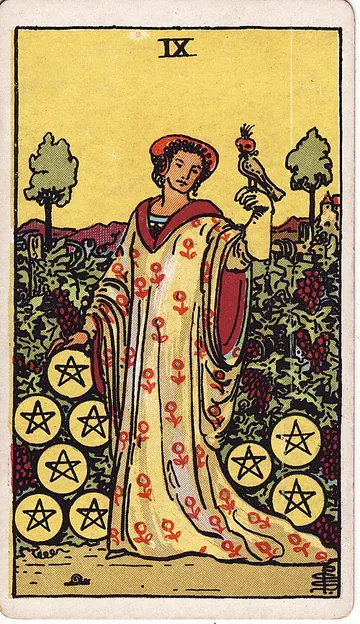
Nine of Pentacles opens on a September afternoon in a private vineyard. A woman in an embroidered robe stands beneath the trellis, hooded falcon perched on her gloved hand, grape clusters heavy enough to bend the vines. The stone wall is tall — but she laid it herself, year by year, stone by stone. A snail crosses the path at its own pace. No one is calling her elsewhere. No one needs to. This is the tarot card of earned solitude, of refined abundance, of a life that no longer needs witnesses to feel real.
The signature tension of the Nine of Pentacles is the difference between isolation and self-possession. Both produce a person who is alone. Only one of them is at peace there. The card draws that line precisely: the wall is not there to keep people out; the wall is there so this small plot of earth can be properly tended. The falcon is hooded not because pleasure has been suppressed, but because instinct has been trained — wildness folded into rhythm. Even the grape clusters carry the same teaching: ripe enough to pick, ripe enough to leave another week. Nothing demands. Nothing rushes. The card holds the rare equilibrium of a person who has built something and is no longer afraid of losing it.
Astrologically, Nine of Pentacles is Venus in Virgo's second decan — September 2 to September 11, the heart of late summer's slow gold. Venus here is not the seductress of cups; she is the connoisseur. She knows the difference between a fabric that drapes and one that clings, between a wine ready this year and one that needs another. Virgo refines her; she does not loosen Virgo. The result is a Venus who loves exactly: not by quantity, not by display, but by the precision of the chosen thing. Beauty in this card is never excess ornament — it is the right number of stitches, the right depth of color, the right amount of space around an object so it can be seen.
Kabbalistically the card sits at Yesod in Assiah — Foundation in the World of Action. Yesod is where image and feeling settle into stable form before they enter matter; in Assiah, the realm of the body and the made world, that settling becomes this garden itself. The vineyard is not a metaphor for the inner life; it is the inner life made visible, walled, planted, kept. The card teaches a hard lesson about Yesod-in-Assiah: foundations in the material world are slow. They take seasons. They take craft. They cannot be rushed by enthusiasm. The wall the woman stands beside was built one stone at a time, with mortar set between courses that needed days to cure.
Within the elemental dignities, Nine of Pentacles is friendly with Cups, opposed by Swords, and neutral toward Wands and other Pentacles. The garden comes alive in the company of feeling — when Cups arrive in the spread, the vineyard is no longer only displayed; it is enjoyed. Wine is poured. Friends sit. The card's quiet pleasure becomes shared pleasure. With Swords, the refinement is replaced by analysis — the seeker walks the garden inspecting it for flaws, and the warmth leaks out through the cracks the analysis itself opens. With Wands, ambition pierces the stillness; what was a season of harvest tilts back toward a season of clearing new ground. Read the dignities to know whether the seeker should rest in the card or move through it.
The sensory signature of the card belongs to early autumn in temperate latitude — wine red and muted gold, the scent of ripe grape and old vine wood, the slow note F holding under the afternoon. The animals are paired: falcon and snail, the trained predator and the unhurried gastropod, two opposite tempos meeting in the same garden without conflict. This is the card's deepest teaching about pace. Speed is not virtue. Slowness is not sloth. The right tempo is the one the work itself asks for, and a mature life has learned to recognize it without fighting.
In any spread, read Nine of Pentacles as a permission slip the seeker has not yet given themselves. The work is largely done. The fruit is ripening. What remains is the harder task — to walk the garden without working, to sit with the falcon without feeding it, to let abundance be used rather than only displayed. The card does not promise more. It asks whether the seeker can finally enjoy what is already theirs.
Nine of Pentacles · Love & Relationships
Nine of Pentacles in love is the rarest weather — a person no longer using the relationship to plug a hole in themselves. The card describes someone who can host or be hosted, can invite or stay alone, without the choice meaning anything more than the choice itself. Boundaries are soft and clear — not walls of self-protection, but the contour of a fully-occupied self. This is what mature partnership looks like from the inside: two gardens, sometimes shared, never confused.
For an existing long-term partnership, the card reads as a season of gentle abundance. The early storms are over. The roles are settled. Each partner has their own work, their own rhythm, their own private hour. They meet in the evening not because they have to, but because they have chosen to keep meeting. The risk in this season is not conflict — it is benign drift, where comfort dulls into routine. The card asks the long-paired seeker whether they are still being curious about the other, or whether they have begun to live as two well-walled gardens that share a path but no longer cross.
For a new spark, Nine of Pentacles signals a connection that the seeker is meeting from full ground rather than from need. There is no urgency to define, to lock down, to test. This is unusual — most early sparks burn precisely because of urgency. Here the spark is steadier, slower, more like the September light slanting through the vines. The card does not predict whether this becomes a lifelong tie; it describes the texture of a meeting between two people who have already done their solo work. Trust the slowness. The snail's pace is real.
For the single seeker asking whether love is possible, Nine of Pentacles answers with a question of its own: are you single, or are you alone? The card distinguishes between them sharply. Single is a relationship status — solitary is a posture. The woman in the vineyard has built a life so complete she does not require love to validate it. That is precisely why love finds her without panic. The card is not telling the seeker to perform self-sufficiency until someone notices; it is asking whether the garden has been tended to the point that another person walking in would meet a real life, not a waiting room.
For love after wound, the card is unusually kind. It says the seeker has done the slow recovery — not by forgetting, but by walling off the part of life that needs to grow back without trampling. The hooded falcon is the relevant image: instinct survived the wound, but it has been re-trained, gentled, made trustworthy again. The person at this stage of recovery is not closed to love; they are simply unwilling to be reopened cheaply. They will not buy back into anything that does not match the calm they have earned.
For the Nine of Pentacles' particular love language, the signal is detail rather than declaration. The card's lover gives the right book without ceremony, fills the bowl with the fruit you actually like, remembers the name of the friend you mentioned once. Love at this register is composed of small precisions, repeated. It does not announce itself; it accretes. If the seeker has been waiting for grand gestures, the card asks whether they have been failing to read the quiet language being spoken in their direction for some time.
For the disambiguation question — is this person actually in love with me? — Nine of Pentacles speaks of someone whose feelings are real, contained, and slow to articulate. They are not playing games. They are not withholding. They are simply someone who builds rather than declares. Watch the structure of their care: do they protect your time, remember your appetites, make your life materially easier without comment? If yes, the card says you are loved. The absence of speeches is not the absence of feeling; it is the form the feeling takes in this person.
For relationships that span a difference of life-pace, Nine of Pentacles often falls as a warning to the faster partner not to mistake the slower partner's quiet for indifference. This is a card about the tempo of the snail. Some loves are built that way. They are not less.
For new spark plus reading the other side, the card describes someone who is choosing carefully because they have been hurt before — not jaded, but literate. They will not rush the seeker because they have learned that rushed unions give back exactly what was rushed in. If the seeker can match the tempo, what is being built will outlast almost anything faster.
For the situation where the seeker fears they are the only one investing, Nine of Pentacles flips the question: investment in a refined love is not loud. The other may be investing precisely in the way the card teaches — by the quiet detail, the held space, the absence of demand. Look again with the right eyes.
For the older seeker meeting love later in life, Nine of Pentacles is one of the kindest cards in the deck. It speaks of meetings between two people who arrive with their own gardens already tended, their own walls already built, their own histories already metabolized. The card does not ask either to dismantle their existing life for the other; it imagines two adjacent vineyards with a gate between them. The love is not less for being adjacent rather than merged. It may be more.
For cohabiting partnerships negotiating shared space, the card is unusually concrete. Each partner needs a corner that is theirs — a room, an alcove, a chair that is not negotiated. The Nine of Pentacles model of love is not the merging of two gardens into one; it is the keeping of two real gardens with a known path between them. Insist on the corner. Defend the path.
For the seeker considering whether to commit deeper — move in, marry, share finances — the card is favorable but specific: commit at the tempo the card itself moves. No grand declaration timed to anniversaries. No public ceremony before the private one is real. The Nine of Pentacles deepening is small, dated, and unrushed. Many of the most enduring partnerships under this card never had a clear moment of commitment; they simply accumulated into one over years.
Nine of Pentacles · As Feelings
Nine of Pentacles as feelings describes the texture of a person who feels you steadily, privately, and without urgency to broadcast. The body language is composed: open enough to be reached, closed enough not to leak. They do not flood. They do not perform absence. They feel toward you the way the woman in the vineyard regards the grape clusters — with attention, with quiet pleasure, with no need to pluck before the time is right.
If the person in question is reserved by nature, their silence in the Nine of Pentacles register is not cold. It is full. They are running their feelings through the same fine sieve they use for everything else — choosing the right word rather than rushing the first one, waiting until they can offer something durable instead of something blurted. The seeker who reads this silence as rejection is misreading the card. Silence here is a kind of investment. They are deciding whether to give you the careful version of themselves, the version that does not get given lightly.
If the person is demonstrative by nature, the card softens their public signals into something more private. They will still warm a room when you walk into it, but the strongest signals come quietly — the small gift that matches your taste exactly, the meal at the place you mentioned, the question that proves they were listening when you forgot you were speaking. Public affection is real but not the main channel. The main channel is precision.
For a long bond, Nine of Pentacles describes a feeling that has stabilized into something the other no longer questions. The seeker is part of their structure now — their internal weather, their daily rhythm, the assumed presence in their evenings. Feelings at this depth do not announce themselves daily because they are no longer events; they are the climate. The risk for the seeker is hearing this as flatness when it is actually permanence.
For a new connection, the card describes someone who is concluding something quietly favorable about you. They are not yet certain — they are too careful for premature certainty — but the ledger is gathering toward yes. They are noticing what you do, not just what you say. They are testing the seriousness of what you build, not the brightness of what you promise. If the seeker can keep showing up the way they have been, the conclusion will land where the card already suggests.
For an ex who has gone quiet, Nine of Pentacles is unusual: it suggests they have not stopped feeling, but they have walled off the feeling so they can keep tending the rest of their life. They are not in agony. They are not pining. They are doing the slow work of becoming the person who could either return or not return — and they will not contact the seeker until they know which. Respect the wall. It is not a refusal; it is a process.
For someone in a position of restraint — married, professionally tied, geographically distant — the card describes feelings that are sincere and structurally bounded. They are not double-dealing. They are holding two real things at once, and the part addressed to the seeker is real even though it cannot become loud. The seeker has to decide whether the contained version is enough; the card does not pretend it is, and does not pretend it is not.
For a friendship that the seeker suspects has tipped toward more, Nine of Pentacles signals the other has noticed too, and is sitting with it carefully rather than rushing it into definition. They value what you already are too much to let romantic acceleration crash the existing form. If the seeker raises it, raise it gently — match their tempo, match their care.
For someone the seeker meets only intermittently — a long-distance friend, a periodic colleague, an old flame — the card describes feelings that survive the gaps because they have been built on something durable rather than something stimulating. The other thinks of the seeker often, holds them with affection, and feels no urgency to fill every silence with contact. Read this as steadiness rather than indifference; it is the stable form of caring under this card.
For a small caution: Nine of Pentacles can describe a person who feels deeply but expects the seeker to read the feeling rather than be told. This is not mind-games; it is a worldview. They believe love is shown in detail, not declared in speeches. If the seeker is someone who needs words, the card asks whether they can also learn to read what is being said in the quieter language, while gently asking the other for a sentence now and then. Both literacies are real.
For friendships that cross the platonic line and are wondering whether to keep going, the card describes someone who is genuinely fond but is in no hurry to redefine. They like the form. They like the seeker. They are not romantically panicked. The seeker who pushes for definition will get a slow, careful answer — and may not like that the carefulness applies in both directions equally.
For a final note on tempo: this card describes a love that survives by not being measured against louder loves. The seeker who keeps comparing to past intensities will starve in this register. Nine of Pentacles love is not the love that storms; it is the love that holds.
Nine of Pentacles · Career & Work
Nine of Pentacles in career is the season when the years of work begin to work for the seeker. Reputation has compounded. The body of work is large enough to recommend itself. Each new day no longer has to be a fresh proof of competence — clients arrive having already decided. This is the rare professional weather where craft has tipped into authority, and the question shifts from how do I get there to how do I tend what I have.
For the seeker in a current role that is working, Nine of Pentacles confirms it: the role fits, the rhythm fits, the level fits. The card warns against the restless instinct that mistakes plateau for stagnation. Some plateaus are vineyards. The grapes are already heavy on the vine. Walking away in search of a new climb when the current one has just paid off in shade is the move the card explicitly resists. Stay. Tend. Take the harvest before chasing the next field.
For the seeker considering a new role, the card pulls toward caution. The current garden is producing. A new role would mean clearing fresh ground, building a new wall, training a new falcon. None of that is wrong, but it is a starting season, not a harvest season. If the seeker does take the new role, do it knowing the reset is real — and be willing to spend the next several years rebuilding the slow infrastructure that the current position took years to lay.
For the entrepreneur or freelancer, Nine of Pentacles is profoundly favorable but specific. It confirms that the practice is actually working — the niche is right, the rate is right, the clientele is right. The card warns against the founder's compulsion to scale every working thing into something larger. Some businesses are vineyards, not vineyards-into-empires. Refusing to scale is not a failure of ambition; it can be a form of mastery. The card asks whether the seeker is honest with themselves about what kind of practice they actually want.
For the creative practitioner with a body of work, Nine of Pentacles is the card of the mature catalog. The seeker has produced enough that newcomers are now finding their old work. The temptation is to feel obligated to keep producing at the same volume — to feed the audience the harvest expects. The card resists this. Some seasons are about pruning, archiving, presenting the existing work better. Re-issuing. Curating. Letting the catalog be visited rather than always stacking new shelves on top of it.
For the job-search context, the card is unusually specific: stop sending applications to roles that ask the seeker to prove themselves from scratch. The Nine of Pentacles seeker has earned the right to be approached, not to apply. Tighten the public-facing surface of the work — portfolio, credentials, references — so that the right opportunity finds the wall and recognizes it. The card prefers fewer, better applications over volume.
For the layoff or transition seeker, Nine of Pentacles is gentle and counterintuitive: this is a good moment to be in a transition. The years of compounded craft do not vanish because the role did. The garden is still planted; only the immediate paycheck has changed. The card argues for resisting the panic that drives the seeker into the first role offered. Hold out for the role that respects what the seeker has already built. Three months of careful searching is cheaper than three years in the wrong role.
For the seeker considering retirement or a step back, Nine of Pentacles often falls as permission. Stepping back does not mean stepping out — it can mean reducing the field of attention to what genuinely deserves it. Many of the most refined careers are not their busiest years. They are years 25 through 35 of a craft, when the practitioner does less and each piece is more.
For the seeker negotiating compensation, the card supports asking for the higher number. The Nine of Pentacles seeker is not in a position of need. They are in a position of value. Negotiation from that ground is not greed; it is correctness. The robe is embroidered for a reason: long sustained craft has earned its visible measure.
For the seeker considering teaching, mentoring, or formal succession — taking on apprentices, founding a school, training the next generation — Nine of Pentacles is a quietly favorable card. The vineyard has produced enough that the question of who walks the garden after me has begun to matter. The card recommends teaching one or two real students rather than founding a school. Slow apprenticeship matches the card's tempo. A school becomes a structure that demands its own maintenance.
For the question of public visibility — speaking, publishing, social platforms, building an audience — the card asks the seeker to choose one channel and tend it deeply rather than attempting many. The Nine of Pentacles seeker can have a public voice that travels well, but only if it issues from the same walled garden as the work. Visibility that requires the seeker to be a different person than the gardener will exhaust the garden first and the audience second.
Nine of Pentacles · Money & Finances
Nine of Pentacles in money is the card of refined sufficiency. Income is steady, savings are real, and the immediate stress of cash flow has receded. This is not a lottery card or a windfall card. It is the card of the slow vineyard — money that has been planted, tended, and is now beginning to produce a yield that no longer requires the seeker to work each grape by hand. Assets are starting to do their own work in the background.
The card's relationship with abundance is precise rather than expansive. It does not preach excess. It does not chase the next zero. The Venus-in-Virgo decan that rules the card refines money the way she refines beauty — by quality and exactness, not volume. A small portfolio held with discipline. A modest home tended impeccably. A wardrobe of fewer pieces, all chosen. The Nine of Pentacles seeker can afford more but chooses better.
For a financial bet, investment, or large purchase, the card recommends the slow position: index funds over speculation, established assets over hot tips, the home in the well-walked neighborhood over the speculative new development. The card does not promise outsized returns. It promises kept returns. The seeker is at the stage of life where the goal is no longer to multiply capital aggressively but to ensure the capital already earned is protected from the seeker's own restlessness.
The Nine of Pentacles seeker's signature trap with money is gilding — buying the more expensive version of a thing they already have, because the upgrade signals refinement. The robe is already embroidered; another robe will not improve the garden. The card asks whether each purchase actually expands life, or only re-decorates a life that does not need decoration.
For recovery from debt, the card is encouraging without being naive. The seeker has either crossed into the clear or is within sight of clearing — the immediate panic is past. The remaining work is steady, slow, and unspectacular: the same payment every month, the same restraint every quarter, the same boring discipline that built the wall stone by stone in the first place. There is no shortcut, but there is no longer any emergency either.
For the seeker considering generosity — supporting a family member, donating substantially, lending to a friend — the card permits it from a posture of overflow rather than depletion. The grapes are heavy enough to share. The card warns against generosity that is actually self-image management, where the gift is more about the giver than the receiver. Real Nine of Pentacles giving is unannounced, precise, and structured to genuinely help — not to be remembered.
For estate and longer-horizon planning, the card is favorable to the slow conversation. Wills, trusts, beneficiaries, the question of what the seeker wants the wall around the garden to do after they are gone. Nine of Pentacles seekers often defer this conversation because they are still actively tending — but the card prefers the planning to be done in season, not in emergency. Set the structure now while the snail still has time to cross the path.
For the relationship between money and time, the card asks the seeker to convert one currency into the other deliberately this season. The Nine of Pentacles position is precisely the position from which the seeker can begin buying back unstructured time — the afternoon off, the long weekend, the month of quiet work — instead of accumulating more capital that will simply sit. Money translated into time is the move the upright card most quietly endorses.
Nine of Pentacles · Health
Nine of Pentacles in health is the body of someone who has earned a sustainable rhythm. The card's element is earth, its temperament melancholic-but-stable, its body part the hand and wrist — where the falcon is held and the vineyard shears rest. This is the body of a person who has trained the falcon of appetite, neither starving it nor letting it rule. Health here is not a project. It is the cumulative effect of consistent small tendings over years.
For chronic conditions, the card recommends the slow protocol — the version of a treatment plan that compounds over months rather than the heroic intervention. If the seeker has been managing a chronic condition, the Nine of Pentacles approach is to stop hunting for the breakthrough cure and instead refine the daily handling: better sleep architecture, better hand-and-wrist care if those joints carry the work, gentler hydration, longer walks at slower paces. The card believes in the cumulative dignity of small habits.
For acute issues, the card is a good omen but not a license. The body has reserves. The earned constitution has resilience built in. But the card warns against using that resilience as cover — against working through illness because the seeker has the stamina to absorb it. The Nine of Pentacles teaching is that walls require maintenance. So does the body that built them.
For the emotional-to-somatic mapping, this card often reveals tightness that has settled in the dominant hand and forearm — the place where work meets the world. Repetitive strain, mouse-arm, wrist tension, grip problems, even early arthritis in the gentlest reading. The body is recording the years of holding the trained falcon. The seeker may need to change the tool, soften the grip, or rotate the load.
For the melancholic temperament that this card carries, the warning is autumnal: a tendency to slip into self-contained low mood that is mistaken for solitude. The vineyard at three in the September afternoon is gold; at five it is shadow; at seven it is alone. The seeker who has built a life of beautiful solitary practice should keep one or two warm rooms in the schedule — a friend's table, a class, a recurring social bookmark — so that the wall does not become a horizon.
The card frames health as what kind of attention the body is asking for, not as what is wrong. At Nine of Pentacles register, the body is asking for the gardener's attention: patient, regular, observant, unhurried. Hand-and-wrist care, breath that keeps pace with the snail, walks that are not workouts. Sleep that is treated as the harvest of the day, not the leftover of it.
For the seeker undergoing recovery — from surgery, illness, exhaustion, burnout — the card is profoundly supportive. Recovery is exactly this kind of work: slow, walled, private, unrushed. Honor the wall. Let the season be the season. The grapes will ripen.
For the long-term constitutional view, Nine of Pentacles upright describes a body that has earned the right to age well. Decades of small tendings have built reserves that will carry the seeker through the unavoidable difficulties. The card does not promise immunity from illness; it promises that when illness comes, the body will have something to draw on. The discipline now is the kindness shown to the older self the seeker is becoming.
For the question of pleasure in the body — sensuality, food, rest, touch — the card is unambiguously affirming. The Venus rulership specifically blesses these. The seeker is permitted, even encouraged, to take genuine pleasure in being inside their own skin. The hooded falcon image teaches the way: appetite is not the enemy. Appetite without rhythm is. Trained pleasure — the meal eaten slowly, the long bath, the unhurried touch — is precisely what the card calls health.
Nine of Pentacles · Spirituality
Nine of Pentacles' spiritual question is the question of enclosure. What does it mean to wall a small piece of the world for sacred attention? The card sits at Yesod in Assiah — Foundation in the realm of action — and Yesod is the sphere of the mirror, the moon, the place where image and feeling settle. In Assiah, that settling is concrete: it becomes a real garden, a real wall, a real practice that meets you in matter.
The spiritual practice the card invites is small and durable. Mark off thirty minutes of one day a week as garden time. Not productive time, not journaling time, not even meditation in the formal sense — just a walled half-hour where nothing useful is required. Walk the garden if there is one. Sit by a window. Pour tea. Watch the light. The discipline is not what is done in the half-hour but the unbreakable wall around it.
The card teaches that solitude is not the absence of connection but the cultivated form of connection — to the self that has been trained, to the body that has been earned, to the work that has been laid down. The hooded falcon is the spiritual image. Wildness is not killed; it is hooded, available, brought out at the right moment. The practice asks the seeker to learn the difference between hooding the falcon and starving it.
The shadow of this card's spirituality is aesthetic refuge — the trap of confusing well-curated beauty with depth. A beautiful altar is not a practice. A perfectly tended garden is not a meditation. The card asks whether the seeker's spiritual life is being lived inside the wall, or only displayed against it. Yesod can become a hall of mirrors if the foundation never holds anything heavier than its own image.
For a dry season, when nothing seems to be growing, the card gives unusual permission: dry seasons are real seasons. The vineyard does not produce in winter. The work in winter is to keep the wall, prune the vines, sharpen the shears. Spiritual life is not always green. Some of its most important months are the quiet ones in which the seeker maintains structure with no immediate reward.
The card's particular spiritual gift is the practice of enough. Most spiritual traditions teach contentment as a discipline against grasping. Nine of Pentacles teaches it as a discipline against the more sophisticated trap — the grasping that disguises itself as refinement. The seeker who has learned to want only the precise, only the well-made, only the considered, can still be grasping. The card's question is whether the seeker can sit, today, in a vineyard that produces nothing this hour, and find that hour sufficient. That is the practice. It is harder than it sounds.
For the seeker drawn toward formal practice — sitting meditation, contemplative prayer, ritual study — the card supports a small, rigorous, daily form rather than an impressive weekly one. Twenty minutes every morning beats two hours every Sunday. The vineyard is built daily, in small attentions. The wall is laid one stone at a time. The card has no patience with spiritual life that depends on rare grand sessions to feel real.
Nine of Pentacles is also unusually friendly to the hospitable spirituality — the practice of preparing the home for a guest, even when no guest is expected. Light the candle. Set the second cup. Make the bed in the spare room. The card understands hospitality as a quiet sacrament, the wall opened intentionally for what may or may not arrive. Many spiritual lives are kept alive precisely by this small ritual of expectant readiness, in seasons when nothing dramatic is happening.
Nine of Pentacles · Yes or No
Yes — but a private yes. Nine of Pentacles answers in the affirmative, but the yes is quieter than the seeker may have imagined. It is not the loud yes of new beginnings. It is the slow yes of a thing that has already taken root — the yes of a craft that is finally paying out, a love that has matured past audition, a body that has learned its own pace.
The yes is conditioned on the seeker honoring the form. This card does not bless rushed expansion or dramatic public moves. The yes belongs to the version of the question that involves cultivation, refinement, the next season of an existing thing. If the question has been should I keep going with this work / this person / this practice, the answer is unambiguously yes. If the question has been should I burn it all down and start over, the card is not your card today.
In lived life, the Nine of Pentacles yes looks like a long exhale rather than a thunderclap. A contract that quietly finalizes. A relationship that decides to stay without ceremony. A body that turns a corner on a long-managed condition. A piece of work that finds its readers two years after publication. Most Nine of Pentacles yeses are noticed only in retrospect — the seeker realizes, six months later, that yes had been answering them all along, in the slow accumulation of small confirmations.
The card warns against treating the yes as a finish line. The vineyard is yes. So is the work of tending it. The yes is not a removal of responsibility; it is a permission to keep doing what is already working. If the seeker hears yes and immediately starts looking for the next field to clear, they have heard the wrong card.
For questions that are urgent, time-bounded, or binary — should I take the offer by Friday — Nine of Pentacles often resists the frame itself. It says: the kind of yes you are asking for is not the kind I give. If the question deserves yes, the question can also wait a week. Slowness is part of the answer.
For the question phrased as a fear — will I lose what I have built — the card answers steadily: not from inside the card itself. The Nine of Pentacles register is structurally durable. The wall holds. The vineyard holds. What the card cannot promise is that the seeker will not, in some future pivot, choose to dismantle it themselves; but it will not be taken from them. The loss the seeker fears is not the loss the card describes.
For questions about whether the seeker is enough — enough on their own, enough without the partner, enough without the next achievement — Nine of Pentacles answers with the cleanest yes in the deck. The card's whole image is the answer: the woman alone in her vineyard, hooded falcon at hand, ripe grapes overhead, no one calling her elsewhere. The yes does not depend on what the seeker accomplishes next. The yes is the present tense of a life already sufficient.
For the binary love question — will this become something — the card's yes is conditional on the seeker matching the slow tempo. If the seeker can stop trying to force the connection into a faster shape, yes. If the seeker is already plotting how to accelerate it, the answer becomes ambiguous, because the seeker has not yet inhabited the register the card describes.
For the question the seeker is most often asking under this card — am I doing enough — the yes is total and unembellished. The card sees the wall the seeker laid stone by stone, and confirms it. The seeker is doing more than enough. The question itself is the residue of an older scarcity that no longer applies. Set it down.
Nine of Pentacles · Advice
Nine of Pentacles' first advice is to actually use the garden. The seeker has spent years building something — a career, a body, a relationship, a savings account, a body of work — and the advice the card gives most often is the one the seeker resists hardest: enjoy what you have already built. Walk the vineyard not to inspect it but to be in it. Eat the grapes. Wear the embroidered robe on a Tuesday. Pouring abundance down the drain in the name of humility is not virtue; it is a refusal of the harvest the seeker themselves planted.
The second advice is to let one new person into the garden this season. The Nine of Pentacles wall is a feature, not a flaw, but walls become tombs when they are not opened on purpose. Identify one person — an old friend, a new colleague, a neighbor — and offer them a real entry: a meal, a long walk, a quiet evening. Not networking. Not a calculated tie. Just one act of letting someone past the wall into the actual life. The card gets dangerous when nobody has been admitted in a year.
The third advice is to refuse one invitation that does not match the garden. Not every offer deserves access. The Nine of Pentacles seeker has earned the right to decline — the part-time gig, the favor that costs three weekends, the dinner with the person who only takes. The wall is permission to say no without explanation. Practice it on something small this week so the muscle is ready when it matters.
The fourth advice is to tend the falcon. Whatever the seeker's primary instinct is — creativity, sensuality, ambition, hunger — give it a structured outlet this week. The hood is not denial; the hood is rhythm. A trained instinct is more useful than a starved one. If the seeker has been suppressing the falcon, take it out and fly it on something purposeful. If the seeker has been letting it run wild, hood it. The card asks for measured access, not absence.
The fifth and quietest advice is to stop performing self-sufficiency. The Nine of Pentacles seeker can be alone, but they do not have to be alone for the audience. There is no one keeping score. Asking for help when help is genuinely useful does not unbuild the wall — it proves the wall is generous. The card distinguishes carefully between independence as a capacity and independence as a performance. The capacity is the gift. The performance is the trap.
The sixth advice is the most counterintuitive: schedule a useless afternoon. Block three hours this week with no purpose, no errand, no planned reading, no productive aim. The Nine of Pentacles seeker has often grown so accomplished at structuring time that even rest has become a deliverable. Genuinely uncommitted time is the soil from which the next real season grows. Without it the garden becomes a calendar. Treat the empty afternoon as the most important entry on the schedule, and refuse to let it be backfilled.
The seventh and final advice is to write down, this week, what the wall is actually for. Not the official version. Not the one that goes on the resume. The honest version — what does the seeker keep behind it, what is being protected, what is the wall there to hold? The Nine of Pentacles seeker rarely articulates this aloud and almost never in writing, and the act of articulating reorients the whole life around the thing the wall was originally built to keep. Without that anchor the wall becomes ambient and starts walling things in for no reason. With it, the wall becomes generous again — a frame around something specific and real.
Nine of Pentacles · Card Combinations
Nine of Pentacles reads in conversation with other cards — its meaning sharpens when paired with cards that share its register or contrast it. The five pairings below are load-bearing: each one teaches something the seeker cannot get from the Nine of Pentacles alone.
With the Nine of Cups, the same number resounds in two suits — the wish-card next to the garden-card. Cups Nine is fulfillment held in the heart; Pentacles Nine is fulfillment held in the hand. Together they describe a life where emotional satisfaction has matched material sufficiency, but they also flag a risk: both nines are seated, both are private, both have a tendency toward complacency. Read the pair as permission to enjoy, with a quiet warning to keep moving anyway.
With the Ten of Pentacles, Nine becomes the foundation for the multi-generational household. Where Nine is the solo gardener, Ten is the courtyard full of family — children, elders, dogs, banners. The progression is not always linear; many seekers stay in the Nine register their whole life, and the card does not punish them for it. The combination tells whether the seeker is choosing the solitary garden or simply has not yet been ready to admit the household.
With the Hermit, two solitary cards meet — the lantern and the walled garden. The Hermit is solitude as quest; Nine of Pentacles is solitude as harvest. Together they describe a seeker who has spent years inside, doing the slow work, and is now in a season where the inner work has produced an outer life. The pair warns the seeker not to mistake the Nine of Pentacles abundance as evidence the Hermit's work is over. Both keep going.
With the Empress, Venus is doubled — the Venus that rules Nine of Pentacles' decan meets the Venus archetype at full strength. The Empress brings the abundance of the natural world; Nine of Pentacles brings the abundance of cultivated craft. Together they describe a season of generative beauty that is both effortless and earned. Watch this pair in love readings — it often signals a relationship that is genuinely nourishing rather than only stimulating.
With the Five of Pentacles, the contrast is sharpest. Five of Pentacles is the cold outside the lit window — exile, scarcity, exclusion. Nine of Pentacles is the warm garden inside the wall. Together the pair often appears in readings about who is inside and who is outside — about wealth and the loneliness it can build, or about a seeker who feels exiled from a privilege others assume they share. Read carefully; the pair refuses to flatter either card.
A few briefer pairings worth knowing in passing. With the Star, Nine of Pentacles deepens into the season after a long darkness — the seeker's vineyard producing precisely because the prior crisis was survived rather than avoided; the abundance has been earned through emptying. With the Moon, the card becomes ambiguous: is the wall protecting the garden or hiding what the seeker does not yet want to look at? With the Eight of Pentacles, the seeker meets their own past — the apprentice still hammering at the bench inside the same wall the master now walks; one card grows into the other, decade by decade. With the Knight of Pentacles, the steady builder rides into the seeker's mature garden — not to disturb but to extend; the pair often counsels marrying patience to forward motion, refusing both restless change and complacent stillness.
Card Combinations
Nine of Cups
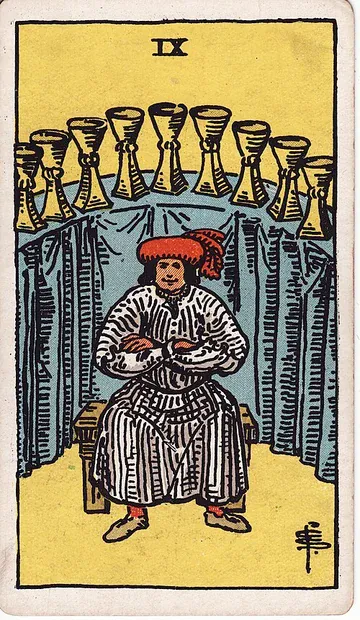
Two nines side by side — the wish-card and the garden-card. Cups Nine fulfills the heart; Pentacles Nine fulfills the hand. Together they describe a seeker whose emotional and material lives have both come into season simultaneously, a rare alignment. Both cards are private, seated, complete-feeling, which means the pair also flags the risk of complacency: enough has been achieved that the next motion will require deliberate intent rather than necessity.
Ten of Pentacles
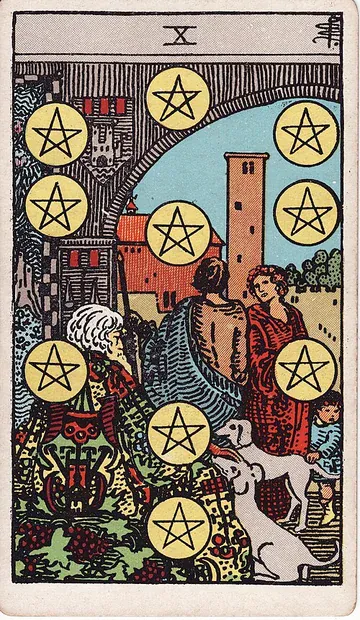
The walled garden meets the multi-generational household. Where Nine of Pentacles is the solo gardener at her trellis, Ten of Pentacles is the courtyard full of family, dogs, banners, and elders. The pair describes the choice — or the unfolding — between cultivated solitude and committed kinship. Read the pair to understand whether the seeker is choosing the smaller, refined garden or moving toward the larger, less controllable household. Neither is failure.
The Hermit
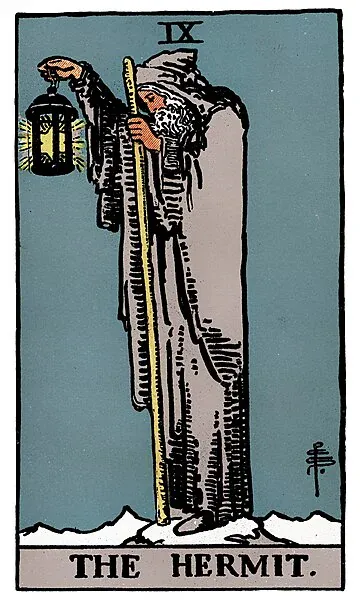
Two solitudes meet — the lantern in the wilderness and the wall around the vineyard. The Hermit is solitude as quest, the inward search; Nine of Pentacles is solitude as harvest, the outward fruit of inward years. Together they show a seeker whose hermit work has compounded into a tangible life. The pair warns against treating the visible abundance as evidence the inner work is over — both cards keep going, indefinitely, in their respective registers.
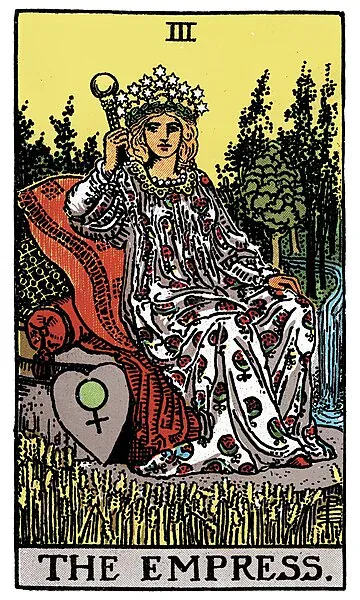
The Empress
Venus doubled. The Empress carries Venus at full natural strength; Nine of Pentacles carries Venus refined through Virgo's exactness. Together they describe a season of generative, cultivated beauty — abundance that nourishes rather than only impresses. In love readings the pair often signals a relationship that is genuinely sustaining rather than only stimulating; in creative readings it signals a body of work that is both fertile and exact, each piece chosen rather than spilled.
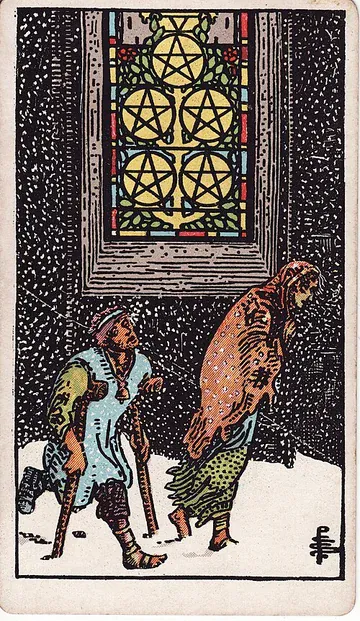
Five of Pentacles
The sharpest contrast in the suit. Five of Pentacles is the cold outside the lit window — exclusion, scarcity, the figures passing the church in the snow. Nine of Pentacles is the warm vineyard inside the wall. Together the pair often reads on questions of inside-versus-outside: who is included in the seeker's abundance, who has been left out, or whether the seeker themselves has begun to feel exiled from a privilege others assume they hold. The pair refuses to flatter either card.
Frequently Asked Questions
Why is the woman in the Nine of Pentacles standing alone in her own vineyard?
Nine of Pentacles is the card of earned solitude and refined abundance. It describes a person standing alone in a vineyard they walled themselves — self-possessed, materially comfortable, no longer needing to prove anything. Astrologically Venus in Virgo's second decan, kabbalistically Yesod in Assiah, the card is about cultivated sufficiency rather than excess.
Is the Nine of Pentacles a yes for something I want to grow slowly?
Yes, but a private yes. Nine of Pentacles favors the slow, cultivated continuation of something already taking root — a maturing relationship, a craft paying out after years, a body finding its rhythm. It resists urgent or dramatic yes-or-no framings. If the question is about tending what already exists, the answer is clearly yes; if it is about burning it down to start over, the card is not the card.
Does the Nine of Pentacles mean I am better off on my own?
Nine of Pentacles in love describes someone who can host or be alone without either choice meaning more than itself. For couples, mature ease and the risk of comfortable drift. For singles, the card asks whether they are single or solitary — a fully-occupied life attracts company without panic. For new sparks, a slower, surer connection between two people who have done their solo work.
Does the Nine of Pentacles mean they feel something steady but will not say it yet?
As feelings, Nine of Pentacles describes someone whose feeling for you is steady, private, and slow to articulate. They invest in detail rather than declaration — the right gift, the remembered preference, the protected hour. Silence in this register is not coldness; it is a person choosing the careful word over the rushed one. Read the structure of their care, not the volume of their speech.
What is the meaning of the Nine of Pentacles tarot card?
Nine of Pentacles is Venus in Virgo's second decan, sitting at Yesod in Assiah — the card where cultivated craft meets material foundation. The image is a woman alone in her own vineyard, hooded falcon on her glove, ripe grapes overhead. Core themes: earned solitude, refined rather than excessive abundance, self-possession without arrogance, the discipline of enjoying what one has built.
Continue Reading
Nine of Pentacles · Card overview · symbols · correspondences →
Return to the full card view — image, symbols, sensory correspondences, and Hermetic axes.
Read the reversed meaning →
Read the same depth on the opposite orientation.
Draw your reading now →
Bring this card to a question — open a quiet ritual.