
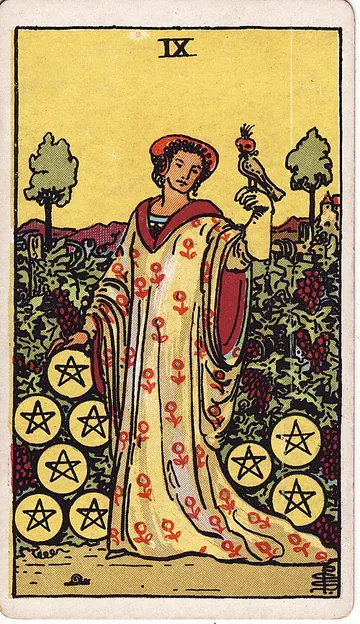
Nine of Pentacles Reversed · Core Meaning
Nine of Pentacles reversed shows the same vineyard, the same wall, the same hooded falcon — but the angle has shifted. The light slants differently. Now the question is not what has been built but what is the cost of keeping it walled. The independence has stiffened into unapproachability. The refinement has tipped into display. The wall, once a frame for cultivation, has become a barrier the seeker no longer notices crossing themselves.
Or the reversed card asks the more cutting question: did the seeker actually build this? The vineyard upright is laid stone by stone. The vineyard reversed is sometimes inherited — from family wealth, from a partner's achievement, from privilege the seeker has metabolized as their own. The card reversed does not condemn inheritance; it asks for the honesty of acknowledging what was given versus what was made. The 'I built this' that has hardened into a habitual half-truth is the lie this orientation specifically reveals.
There is a third reading the reversed card sometimes carries: the wall has not yet been built. The seeker is performing the Nine of Pentacles posture — the refined apartment, the curated life, the gestures of self-sufficiency — without having earned the ground underneath. The grapes are imported. The robe is borrowed. The falcon is a costume bird. Nothing here is sustainable, because nothing here has been laid stone by stone. The reversed card invites the seeker to stop performing arrival and start the slower work the upright orientation describes.
The signature tension of Nine of Pentacles reversed is the difference between a cultivated solitude and an avoidant fortification. They look identical from the outside. The wall is the wall either way. From inside, the difference is felt as warmth versus chill — a garden that hosts oneself versus a garden where the gardener is increasingly the only living thing. The card reversed names the turn from one to the other, often before the seeker has noticed it themselves.
Astrologically, Venus-in-Virgo's second decan reversed becomes refinement that has lost its purpose. Beauty for its own sake. Detail without warmth. The connoisseur who can no longer be moved because nothing is good enough. Virgo's exactness without Venus's love is a sterile precision — and reversed, the card sometimes shows precisely that drift.
Kabbalistically, Yesod in Assiah reversed is foundation that has rigidified. Yesod's role is to receive image and feeling and let them settle into form; reversed, the settling becomes setting, and the form becomes a cage. In Assiah — the realm of matter — that cage is concrete: the routines that no longer serve, the wealth held but not used, the solitude that has become the only practiced posture.
Within the elemental dignities reversed, the card's friendship with Cups becomes harder to access — the seeker has stopped letting feeling water the garden, and what was a hosting culture has become a curated one. The opposition with Swords sharpens: every quiet moment in the garden is interrupted by analysis, the seeker auditing their own life rather than living it. With Wands, ambition has either rusted or has begun to attack the structure; the seeker either no longer wants anything new or wants chaotically. The reversed dignities all point toward a single repair — return to the body, return to feeling, return to the simplest sensory contact with the garden as a place, not a project.
Astrologically, Venus-in-Virgo's second decan reversed is the connoisseur who has lost the love. The exact eye remains; the affection that originally produced it has thinned. The seeker can still tell which fabric is the better one, which wine has aged correctly, which detail was the right detail — and none of it pleases them anymore. The reversed card warns the seeker that taste without delight is the most exquisite cage of all.
In any spread, read Nine of Pentacles reversed as a question about access. Who can still walk into this garden? When was the last time someone did? When was the last time the seeker walked out? The card is rarely about catastrophe. It is about the slow constriction of a life that became a museum of itself.
Nine of Pentacles Reversed · Love & Relationships
Nine of Pentacles reversed in love is the place where independence has crystallized into something brittle — the elegant refusal that hides a fear of being needed. Or its mirror: the gilded partnership that looks impeccable from the outside while quietly going dry inside. The card reversed describes love that has become well-curated rather than well-lived.
For an existing long-term partnership, the reversed card warns of beautiful coexistence that no longer touches. Two people who manage their household perfectly, host elegantly, photograph well — and have not had a real conversation in months. The wall is no longer the protective frame around the shared garden; it has run between the partners. The repair is unglamorous: a single honest evening, no agenda, no hosting. The reversed card asks whether the seeker has been performing the relationship for an audience that includes the seeker themselves.
For a new spark, the reversed card warns of the seeker meeting the connection from a posture of curated self-presentation. They are showing the embroidered robe — the credentials, the apartment, the carefully chosen anecdotes — but the actual self, the one who is sometimes lonely or uncertain, has not been allowed past the gate. The other senses the wall and either retreats or stays for the wrong reasons. If the seeker wants this to become real, something less polished has to be offered.
For the single seeker asking why love is not coming, Nine of Pentacles reversed is uncomfortable but useful. The card suggests the wall has become higher than the seeker realizes. Not lonely enough to invite anyone in. Not desperate enough to compromise standards that have become defenses dressed as standards. Refinement reversed becomes a velvet rope. The card is not asking the seeker to lower the standards — it is asking whether some of those standards are real preferences or armor against having to be vulnerable.
For love after wound, the reversed card flags incomplete recovery — the wall built too high, the falcon kept always hooded, the door kept always shut. The seeker has stopped bleeding, but they have also stopped letting anything in. The vineyard has become a mausoleum to the last love rather than ground for the next one. The card asks for one small reopening — not a flood, just a window cracked. The garden cannot be a memorial forever.
For the disambiguation question — do they love me? — Nine of Pentacles reversed often signals that they are choosing comfort and stability over feeling. They are with the seeker, but the choice is logistical rather than romantic. This is not nothing. Many durable lives are built on logistical fit. But the seeker should be honest about what they are choosing too — a life of beautiful coexistence is not the same as being loved, and pretending it is creates a slow leak that takes years to find.
For the gilded-cage scenario — financially comfortable partnership where one partner feels trapped — the reversed card reads it directly. The gold is real. The cage is real. Both can be true simultaneously. The wall the partner built around the household has also become the wall around the seeker's autonomy. The card does not necessarily counsel leaving; it counsels naming the trade-off honestly so it can be renegotiated rather than denied.
For the partnership that has become beautifully transactional — the seeker provides one specific value, the other provides another, the exchange is fair, and intimacy has slowly drained out — Nine of Pentacles reversed reads it without flinching. Many marriages survive in this register for decades; the card does not say they fail. It asks whether the seeker chose this register or simply found themselves inside it. There is a difference between a chosen arrangement and an arrangement the seeker fell into through fatigue. The reversed card asks for the honesty of naming which one this is.
For the inherited-garden scenario — a relationship that arrived with a ready-made life attached, often through family or partner's wealth — the reversed card asks the seeker to sit with the truth that they did not build this. That does not invalidate the relationship. It does mean the seeker has not yet earned the easy mastery the upright card describes. There is real work to do, even inside an already-walled garden, and skipping it leaves the seeker unrooted.
For the performed-refinement scenario, where the seeker is showing the partner a curated version of themselves to keep being chosen, the reversed card calls the bluff. The performance is exhausting. It is also legible. The partner usually knows. The reversed card asks whether the seeker can risk being known instead of being admired — a different relationship will result, but it will be one that can hold actual weight.
For a friendship that has tipped into something colder, Nine of Pentacles reversed often shows the friend has retreated behind their own wall and the seeker has not noticed. The friendship looks intact in form — texts answered, birthdays remembered, the right photos liked — but the inside has gone hollow. If the seeker values the friendship, an unstructured invitation, no agenda, is the best repair. The reversed card is not about confrontation; it is about presence.
Nine of Pentacles Reversed · As Feelings
Nine of Pentacles reversed as feelings describes someone whose interior has gone harder than its exterior would suggest. They feel for the seeker — possibly a great deal — but the feeling has been walled in too long, and the wall has begun to mistake itself for the feeling. They are no longer sure how to translate what they feel into something the seeker can receive.
If the person is reserved by nature, the reversed card warns that their reserve has tipped into shutdown. They are not gathering quietly toward a careful word; they have stopped reaching for words at all. The seeker who reads upright Nine of Pentacles silence as 'investment' may be reading reversed silence the same way and missing the difference. The body language to watch for: distance that no longer feels chosen, only inherited; pleasantness without warmth; the right answers to the wrong questions.
If the person is demonstrative by nature, the reversed card describes feelings that have become performance. They still warm the room. They still give the right gift on the right day. But there is a slight glaze on it — the gestures are correct and somehow uninhabited. The seeker is being treated to the shape of attention without the substance of it. Often the demonstrative person reversed in this card is themselves not aware of the drift; they are doing what they have always done and have lost contact with the meaning of it.
For a long bond, the reversed card flags feelings that have ossified into infrastructure. The seeker is part of the other's furniture. They are not unloved — the other would protest if asked, and would mean it — but love has stopped being something noticed and become something assumed. The reversed card warns that infrastructure can fail without warning if it is never inspected. The repair is to ask each other what the relationship is for, not just how it works.
For a new connection, the reversed card describes someone concluding things too quickly behind a wall the seeker has not been allowed to see. They are sorting the seeker into a category — promising / not / safe / risky — and the seeker is being judged by criteria they were not told about. This is unfair, and the reversed card resists pretending it is not. If the seeker can ask the other to slow the categorization down, they have a chance. If not, the category is going to win.
For an ex who has gone cold, the reversed card is bleaker than upright: they have walled the seeker out specifically. This is not the upright card's slow contemplative wall; this is a deliberate exclusion. The seeker may not learn the reason. Respect the wall by not assaulting it; the reversed card is unusually clear that breaching it now will not produce the conversation the seeker wants.
For the structurally-bounded scenario (married, distant, professionally tied), Nine of Pentacles reversed asks the seeker to consider that the boundedness is being used as armor. The other claims they cannot give more because of structural constraints, and that is partly true — and it is also partly an excuse for not having to risk anything. The seeker should not accept indefinitely the explanation that comforts both parties.
For the friendship suspected to have tipped, the reversed card warns of feelings that have either ossified into platonic infrastructure or have been suppressed so long they have soured. Either way, the seeker is unlikely to find the simple romance the upright card hinted at. A real conversation, not a confession, is the only path.
For the seeker reading the feelings of a person who keeps mixed signals running — warm one week, distant the next — the reversed card describes someone who is using the seeker as a stabilizer for an internal weather they cannot regulate. The feeling toward the seeker is real but is being modulated by the other's private ups and downs. The mistake the seeker makes is reading each pulse as the relationship's true state. Reversed, the card recommends responding only to the long-running average, not to the daily texture.
For the cautionary note: Nine of Pentacles reversed sometimes describes a person who feels strongly but has decided the seeker is not, in their private accounting, worth the risk of opening. This is hard to hear and rarely said directly. Watch for the gestures that tell the seeker the other is keeping options open while never quite arriving. Eventually the kindest thing is to read the reversed card honestly and stop waiting at a closed gate.
For the long-bond version of the same problem — a partner who has settled into adjacent solitude rather than shared life — the reversed card describes feelings that have become roommate-warm. Polite. Considerate. Not loving in the active sense. The seeker is unlikely to fix this by working harder; this is not a quantity problem. The reversed card recommends one honest evening, no logistics, no schedule, in which the seeker asks the partner what the partnership is currently for. The answer, however uncomfortable, is the only real beginning.
Nine of Pentacles Reversed · Career & Work
Nine of Pentacles reversed in career is the season the seeker has stopped noticing they are stagnating because the trappings are still impressive. The title is good. The salary is fine. The office is enviable. And the seeker has not done genuinely new work in two years. The reversed card is the polite warning that the vineyard, however walled, has begun to produce only out of last season's vines.
For a current role that looks fine on paper, the reversed card asks the dangerous question: when was the last time the seeker was learning? The Nine of Pentacles upright is the harvest of compounded craft. Reversed, it is the long plateau where compounding has stopped — but the seeker is still drawing on the reserve. Reserves run out. The card is asking the seeker to start something new inside the role before the role itself ends them.
For a new role decision, the reversed card warns of accepting a role for the robe — the title, the brand, the social signal — rather than the work. The Nine of Pentacles seeker reversed is unusually vulnerable to this trap because their existing life signals success, and they assume the next move must signal more success. The reversed card prefers a step that looks lateral or even backward but reopens contact with actual craft. Do not accept the gilded role that will reduce the seeker to its emblem.
For the entrepreneur or freelancer, the reversed card flags the practice that has become a personal museum. Clients still come — but they are coming for what the seeker did three years ago. The seeker is taking the same retainer, doing the same deliverables, growing nothing. Reversed, this is the moment to refuse a renewal that would buy another year of comfortable repetition. The wall around the practice has become the limit of the practice.
For the creative practitioner, the reversed card is one of the harder readings to hear: the body of work has become a brand, and the brand has begun to dictate what the next piece can be. The seeker is repeating themselves not by creative decision but by audience expectation. The card asks whether the seeker can risk a piece that disappoints the audience they have built. Sometimes that is the only way the practice keeps being a practice.
For the job-search context, Nine of Pentacles reversed warns the seeker that the wall they have built — the credentials, the references, the precise self-presentation — is filtering out exactly the kind of role they actually want. The polished surface attracts polished offers, and polished offers are often the most extractive. The reversed card permits a less polished application: a shorter cover letter, a riskier portfolio piece, a reach toward something the seeker has wanted but not previously claimed.
For the layoff scenario, the reversed card is harder than upright. The seeker has been let go from the role that was most of their identity, and the years of compounded craft suddenly feel like they have evaporated. They have not. But the seeker will need to grieve before they can apply. The reversed card warns against the panic move into the next equivalent role, which often is not equivalent and which the seeker accepts because the gap is unbearable. Three months of held terror are still cheaper than three years in the wrong replacement.
For the seeker considering retirement, the reversed card asks whether the retirement is a chosen step back or an exhausted collapse. There is a difference, and the reversed card is unusually firm about it. A retirement that is a collapse becomes the gilded cage in two years. The seeker should rest first, then choose, not collapse-then-justify.
For compensation, the reversed card warns of the seeker accepting less than they should because they are afraid of seeming greedy. The Nine of Pentacles reversed seeker often has internalized the wall as a brake on their own ambition. The robe is not greed. Earned value is not greed. Underbidding the self is its own quiet violence.
For the inheritance scenario in career — the seeker who runs a family firm, took over a parent's practice, or stepped into a position that came with a ready name — the reversed card asks for the long-postponed reckoning with how much of the success is theirs versus the structure they inherited. This is not to undo the inheritance; it is to claim it honestly. Without that, the work always feels slightly false to the seeker, and the falseness leaks into everything they do.
For the seeker tempted to coast on past reputation — the speaking circuit on the strength of one book, the consulting career on the strength of one decade-old project, the residual goodwill from a role left long ago — the reversed card calls the bluff. Reputation has a half-life. Each year the credit decays a little, and at some point the seeker is being paid for a person they no longer entirely are. The reversed card asks whether the seeker can produce one new piece of real work this year — not for the audience, not for the resume, but for the simple proof that the practice still functions.
Nine of Pentacles Reversed · Money & Finances
Nine of Pentacles reversed in money is the gilded slide. The accounts still look good. The lifestyle still looks good. And underneath, something has begun to leak — sometimes literal cash flow, sometimes the harder leak where money is being spent to maintain a life that no longer brings actual pleasure. The reversed card asks the seeker to look past the trappings and check the actual ledger.
For the seeker in apparent comfort, the reversed card warns of lifestyle creep dressed as refinement. Each upgrade was justified — the better neighborhood, the nicer car, the wardrobe of fewer-but-finer pieces. Each by itself was reasonable. Together they have raised the seeker's monthly burn to a level that requires them to keep working in a role that is no longer serving them. The wall built from refined purchases has become the prison of having to pay for them.
For a financial bet or investment, the reversed card warns of the seeker being seduced by an opportunity that looks like the slow Nine of Pentacles harvest but is in fact speculative dressed as conservative. The pitch sounds like vineyards and patience; the reality is the same multi-level scheme in a better suit. Run the numbers cold. Reversed, the card is unusually skeptical of any money move that depends on the seeker feeling refined for taking it.
The reversed card's signature trap is display spending — buying the embroidered robe to signal that the work has paid off, rather than buying the robe because the seeker actually wants it. If the seeker can imagine the purchase being made in a world where no one would ever see them in it, they should make it. If not, it is signaling, and signaling does not feed the seeker.
For recovery from debt, the reversed card flags the dangerous middle stage where the worst is past, the immediate fear is gone, and the seeker has begun to relax discipline. This is precisely when the slide back happens — not in the panic phase, but in the comfortable phase where the new better-looking purchases creep in faster than the slow income can absorb them. The reversed card warns: the wall that kept the panic out also has to keep the new spending out.
For the inheritance scenario in money — windfall, family wealth, partner's income — the reversed card asks the painful question. The seeker has comfort but has not built the muscle that the comfort theoretically requires. If the inheritance ended tomorrow, would the seeker have the skill to rebuild it? If the answer is uncertain, the reversed card recommends the seeker quietly start practicing — earning a side income, managing the money themselves, doing the unglamorous work the comfort has spared them. Not because the comfort will end, but because the seeker's autonomy has been silently atrophying.
For generosity, the reversed card flags giving that has become performative. Donations that are publicized. Loans that come with reminders. Gifts that arrive with implied debts. The reversed card recommends one act of unannounced, unattributed generosity this season — paid in full, never mentioned again. This is the muscle the upright card has and the reversed card has lost.
For the seeker whose income has begun to stagnate while expenses creep — a quiet form of decline that the surface comforts hide — the reversed card asks for the unwelcome accounting. List actual income against actual outflow without rounding. Most reversed Nine of Pentacles seekers find a quiet gap they have been bridging with savings or credit, telling themselves it is temporary while the temporary stretches into a year. The card requires the seeker to look. The gap does not close on its own.
For the seeker considering a major purchase reversed — the larger home, the second property, the upgrade that would lock in higher recurring costs — the card is unusually firm: not now. The reversed card is the card of the last refinement that tipped the seeker into the gilded slide. One more upgrade is the one that binds the seeker to maintaining the upgrade. The repair is not punishment but pause. Sit with the current setup for one full year before the next significant purchase, and notice how often the urge to upgrade was actually an urge to feel something other than the seeker's current life.
Nine of Pentacles Reversed · Health
Nine of Pentacles reversed in health is the body that looks well-maintained on the surface and is quietly going stiff. The morning routine is intact. The supplements are taken. The skin is good. And the seeker has not actually felt their body in months — has not been moved, sweated through choice, slept the deep sleep that comes only from real fatigue. The reversed card warns of the body becoming a project rather than a home.
For chronic conditions, the reversed card warns of the protocol that has become a substitute for getting better. The seeker has refined the management so well that they have stopped looking for actual improvement. The hand-and-wrist care of the upright card has reversed into a fussy ritual that lets the underlying problem keep advancing while the seeker performs vigilance. Reversed, the card asks whether the daily attention has become avoidance.
For acute issues, the reversed card warns the seeker of the body's signals being overridden by the seeker's belief in their own constitution. I have always recovered from these things is the precise sentence that keeps the seeker working through the warning sign. Reversed, the card is firm: the body is asking for something the daily routine does not provide. The intervention may need to be larger than the seeker's pride wants to admit.
For the emotional-to-somatic mapping, the reversed card often shows the wall having moved inward — the seeker walling off feeling itself, and the body recording the unprocessed weight as tension. Hand and forearm tightness, jaw clenching, shallow breath, a chronic low hum of something the seeker no longer notices because it has been there for so long. The reversed card asks whether there is grief, anger, or longing the seeker has decided is too inconvenient to feel, and which the body is now feeling on its behalf.
For the melancholic temperament, the reversed card describes the slide from contemplative quiet into actual depression — the kind that hides well because the externals still look composed. The seeker keeps the appointments, sends the emails, lights the candles. And inside, the gold has gone gray. The reversed card recommends, gently and firmly, that the seeker tell one trusted person the actual texture of the inside, and consider whether professional support would help. The wall around the inner life is also the wall against the help that could reach it.
For the seeker undergoing recovery, the reversed card warns against the curated recovery — the photogenic version where every meal is plated and every walk is documented. Real recovery is messier. The reversed card prefers the honest day in pajamas to the well-lit performance of healing. Stop posting the recovery and have it.
For the body's actual ask, the reversed card requests the seeker stop optimizing and start inhabiting. Sleep without measuring. Eat without photographing. Walk without tracking. The Nine of Pentacles reversed body is not asking for a better protocol; it is asking to be lived in.
For the question of cosmetic procedures, weight management, anti-aging regimens, the reversed card is unusually direct: most of the seeker's body interventions under this orientation are about maintaining a public surface that the seeker has begun to confuse with the body itself. The card does not condemn the choice — it asks the seeker to be honest about whose gaze they are tending the body for, and whether the gaze is actually still there. The body of the upright card is for the woman in the garden. The body of the reversed card is too often for an audience of mirrors.
For sleep specifically — the most diagnostic vital sign at this register — the reversed card almost always shows it has gone quietly bad. Long enough hours but shallow. Asleep but waking unrested. The wall has begun to extend into the night, and the seeker cannot fully drop because the structure itself requires constant low-grade vigilance. The repair is not a better mattress; it is the dismantling work the rest of the card is asking for. Sleep recovers when the seeker stops needing to defend the perimeter at three in the morning.
Nine of Pentacles Reversed · Spirituality
Nine of Pentacles reversed in spirituality is the well-decorated altar that has not been used in a season. The cushion is in place. The incense is the right kind. The books are the correct books. And the seeker has not actually sat down in two months. The reversed card describes the spiritual life that has become aesthetic infrastructure — a beautiful frame around no practice.
The reversed card sits at Yesod in Assiah inverted: foundation that has become decoration, image that has become substitute. Yesod's danger has always been the mirror that reflects without going deeper. The reversed card is precisely that mirror. The seeker is admiring the spiritual life they have curated rather than living it. The garden looks beautiful from the photograph the seeker takes of it.
The shadow practice the reversed card invites is uncurated time. Thirty minutes a week, like the upright recommendation, but with one twist: nothing aesthetic permitted. No incense. No music. No journal. No photo afterward. Just the seeker, alone, with no record being kept. The reversed card asks whether the seeker can be spiritual without the spiritual life being witnessed — even by themselves, even by the part of themselves that is keeping score.
The reversed card warns about spiritual gilding — the habit of decorating the inner life so that even private experience becomes content. The mantra in the perfect language. The retreat at the right place. The meditation app's streak. None of this is wrong; reversed, the card asks whether it has begun to substitute for the unornamented thing it was supposed to support. Strip one layer of decoration and see what is underneath.
For the inheritance scenario in spirituality — a tradition, a practice, a teacher passed down — the reversed card asks whether the seeker has actually claimed it or is only carrying it. Inherited practice can be deeply real, but it requires the seeker to do the inner work of making it theirs. Without that, the practice is the seeker's parents' garden, walked through respectfully, never inhabited.
For the dry season the upright card affirms, the reversed card warns about the prolonged dry season that has stopped being a season and become a permanent climate. Three months without practice is winter. Three years is something else. Reversed, the card is gentle but firm: the seeker is not in a dry season; they are no longer practicing. Naming this honestly is the first repair.
For the seeker who has built a spiritual identity rather than a spiritual life, the reversed card is uncomfortably specific. The reputation as the contemplative one. The friend who is known for the practice. The role inside the community. None of this is wrong — except when the role itself has begun to substitute for the practice that earned it. The reversed card asks the seeker to let the role lapse for a season and see whether anything actually disappears. If something does, the role had become real. If nothing does, the role had been theater.
The smallest reparative move the card recommends is silence. Not curated silence with a candle and an intention — bare silence. Twenty minutes a day with the seeker, alone, with no chosen practice. Long enough that the seeker becomes uncomfortable. The reversed card believes the discomfort is the doorway, and the seeker has been steadily decorating the doorway shut.
For the seeker who has been spiritually shopping — moving between traditions, teachers, retreats, books, never settling deeply into one — the reversed card is unusually firm. The Nine of Pentacles register requires the wall around a single chosen practice. Variety is not depth. The repair is to pick one form, however imperfect, and stay with it through at least one full year of unspectacular continuation. The vineyard is one vineyard. The wall is one wall. Spiritually, the reversed card asks the seeker to commit to the smaller, less photogenic choice and let it actually take root.
Nine of Pentacles Reversed · Yes or No
No, while the garden is being shown rather than lived in. Nine of Pentacles reversed answers in the negative for most direct questions, but the no is more diagnostic than punitive. The card is not blocking the seeker; it is asking whether the question itself is asking the right thing, of the right ground, from the right posture.
The no applies most clearly when the question concerns expansion of something already gilded. Should the seeker scale the practice that has become a museum? No. Should they marry into the comfortable life that has become a cage? No. Should they accept the role for the title? No. Reversed, the card refuses to bless moves whose primary appeal is signal rather than substance.
The yes that the reversed card sometimes gives is conditional and uncomfortable. Yes — but at the cost of acknowledging the seeker did not build this alone. Yes — but only if the seeker is willing to dismantle the part of the wall that has become the cage. Yes — but the abundance the seeker thinks they are choosing is partly the privilege they have not been honest about. The reversed card's yes always comes with an invoice attached, and the invoice is usually the seeker's accumulated avoidance.
In lived life, Nine of Pentacles reversed no looks like a series of small refusals from reality — the call that does not come, the offer that is rescinded, the relationship that quietly does not deepen. The seeker can read these as bad luck or as the universe being unkind, but the reversed card is unusually direct: this is the wall the seeker built coming back to them as the wall the world meets them with. The repair is not louder pursuit. The repair is dismantling the part of the wall that has been keeping reality out.
For questions about whether to leave — a role, a partnership, a city — the reversed card's no is precise. Do not leave from inside the cage; the seeker will simply build another. The card asks the seeker to dismantle the cage first, then ask the question again from open ground. Many of the leaving-decisions Nine reversed sees in spreads dissolve once the seeker has actually let one person in, refused one performance, taken one wall stone down. The question that survived that work is the question worth answering.
For questions about whether to confront — a partner, a colleague, a parent — the reversed card warns against the confrontation that is really an exit dressed as honesty. If the goal is to actually be heard, the reversed card says yes only when the seeker has done the prior work of softening the wall. Confrontation through the gate is conversation. Confrontation over the wall is announcement, and announcement does not change anything.
For questions about whether the seeker is being authentic — whether the life they are showing the world matches the life they are actually living — the reversed card answers honestly: not entirely. The yes the seeker wants is not available. The reversed card is unusually firm here because the gap between the curated and the actual is precisely the thing the orientation diagnoses. The repair is not catastrophic. The seeker does not need to dismantle their public life. They need to drop one performance — pick the easiest one — and notice that nothing collapses. The yes available to the seeker is the yes of becoming less curated, not the yes of being told they are already authentic.
For questions that are urgent, the reversed card is the cleanest no in the deck. Anything that requires the seeker to perform sufficiency, perform refinement, perform independence — the answer is no. The reversed card is the card of the costume falling off. Whatever question depends on the costume staying up will not survive contact with the answer.
Nine of Pentacles Reversed · Advice
Nine of Pentacles reversed advice begins with the hardest single act: invite one person across the wall this week, no agenda. Not a networking move, not a professional ask, not a date, not anything with a goal attached. A friend over for dinner. A neighbor for coffee. A long phone call with the person the seeker has not called in a year. The reversed card believes most of the seeker's other problems will start to ease once one human has actually walked through the gate without performing first.
The second advice is to spend something this week on a thing that is purely useless. Not refined. Not curated. Not justifiable. A bad paperback. A cheap dessert. A movie ticket for a film the seeker would not normally admit to watching. The reversed card has identified that the seeker has been buying refinement so consistently that they have forgotten how to spend money on simple pleasure. Break the streak deliberately.
The third advice is to take one thing off the wall. Whatever the seeker has been performing — independence, refinement, self-sufficiency, success, mature recovery — pick one and put it down for a week. Tell a friend the truth: the recovery is not as far along as the photos suggest. Ask for help on the thing the seeker has been pretending to handle alone. Let the household be untidy. The reversed card is unusually firm that the wall the seeker has built around the public self is what is suffocating them, and only the seeker can let one stone drop.
The fourth advice is to look at the inheritance honestly. Whatever the seeker has been claiming as fully self-built — career, wealth, relationship, even spiritual practice — sit down and write the actual list of what was given and what was made. The reversed card does not want the seeker to feel guilty about the gifts; it wants the seeker to stop having to maintain a quiet lie. Acknowledged inheritance becomes ground. Denied inheritance becomes the wall that has to keep growing higher.
The fifth advice is to take the falcon out and let it actually fly. The reversed card warns that the seeker has hooded their instinct so consistently that they have lost contact with what it would even hunt. One afternoon this week, do something the seeker would have done at twenty before they learned restraint — not destructively, but vividly. Eat the messy thing. Say the unguarded thing. Want what the seeker actually wants, in front of someone, for an hour. The wall stays. But the falcon is supposed to be a hunting bird, not a centerpiece.
The sixth advice is to walk out of the garden, not just into it. The reversed card has seen the seeker spend years inside their walled life, and the wall has begun to feel like the only legible terrain. Pick a place outside the routine — a part of the city the seeker never visits, a friend's neighborhood, a road two hours away — and spend an afternoon in it without making it productive. Reversed, the card believes the gardener has forgotten the world that exists past the wall, and the only repair is occasional visible reminder that the world is larger than what the seeker has tended.
The seventh advice is to tell one truth this week the seeker has been smoothing over. Not a confession, not a confrontation — a small, accurate sentence said in the conversation where the seeker would normally substitute a polite version. Reversed, the card is precise about this: the wall has been built largely from the unsaid. Every smoothed-over response added a stone. The repair is not to demolish the wall in a single dramatic announcement; it is to stop adding stones, one truthful sentence at a time. The wall will lower itself, course by course, as the masonry stops being delivered.
Nine of Pentacles Reversed · Card Combinations
Nine of Pentacles reversed reads in conversation with the same five neighbors, but the angles sharpen. The reversed orientation asks a harder question of every pairing — what is the cost of the wall, who is keeping the gate, and whether the abundance has begun to feed only itself.
With Nine of Cups, the reversed pair shows two private fulfillments that have stopped speaking to each other — the wish-card and the garden-card both turned inward to the point of solipsism. The seeker has what they wanted in feeling and in form, and is somehow lonelier for it. The pair asks whether 'enough' has become 'too sealed.' Open the wish to a witness; open the garden to a guest.
With Ten of Pentacles reversed-influence, the household around the garden has begun to fracture or become a stage. Inheritance disputes, family wealth that controls more than it provides, the family seat that everyone visits and no one truly enters. Nine reversed beside Ten warns the seeker that the abundance was structural and the structure is no longer being honestly tended. Audit the inheritance.
With the Hermit reversed-influence, two solitudes meet badly — the lantern that has gone out and the wall that has hardened. The seeker is alone, has been alone, and has lost contact with whether the solitude is still serving them or has become the only posture they remember how to hold. The pair counsels a deliberate return — not to society as performance, but to one or two specific people who can verify the seeker is still in there.
With the Empress reversed-influence, the doubled Venus inverts into beauty without warmth — the well-curated home that nourishes no one, the relationship that photographs perfectly and never actually meets. The pair asks the seeker to choose between continuing to perform abundance and risking the messier fertility that the Empress upright would actually want.
With Five of Pentacles, the contrast deepens reversed: the seeker may discover they have been the cold figure outside the lit window all along — exiled from a privilege they thought they had, or exiling themselves from a warmth that was actually offered. Nine reversed plus Five often shows the seeker realizing the wall they thought protected them is the wall keeping them out of their own life. The pair is one of the deck's clearer calls to dismantle, slowly, what was built defensively.
A brief note on three further reversed pairings. With the Tower, the wall does not need to be patiently dismantled — the card is warning the seeker that if they refuse to open the gate themselves, life is preparing to remove a section of wall by force, and the rebuild afterwards will be loud rather than slow. With the Devil, the gilded cage shows itself plainly: the seeker is bound to the structure they built and have begun to confuse the binding with stability. With Eight of Pentacles reversed-influence, the original craft has gone hollow — the master is still in the garden, but the work that built the wall has been abandoned for the maintenance of its appearance.
With the Hanged Man, the reversed card asks the seeker to surrender the posture deliberately rather than waiting for life to invert it. The voluntary upside-down look at the garden — the choice to see what the seeker has been refusing to see about their own walled life — is precisely the move that softens the reversed card back toward upright. Hanged Man teaches what Nine of Pentacles reversed has been resisting: that surrender is sometimes the only honest motion left.
With the Page of Pentacles, the reversed card meets its own beginning. The Page is the apprentice, the one still learning to lay the first stones. Beside Nine reversed, the Page reads as a reminder of the seeker's own younger self — the one who built the original wall when there was nothing inside it yet. The pair often counsels the seeker to return to that beginner's tempo, to lay one new stone with the same fresh attention, to remember that mastery without beginning's care eventually petrifies into the cage.
Card Combinations
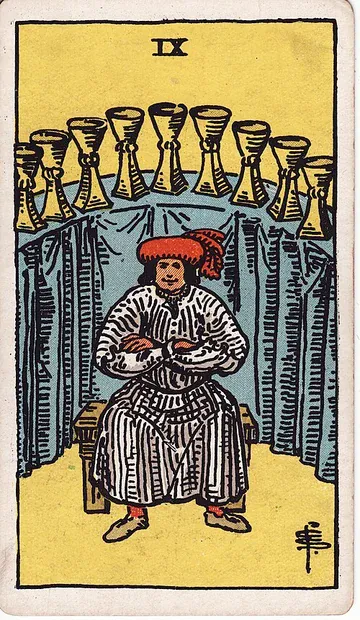
Nine of Cups
Two nines side by side — the wish-card and the garden-card. Cups Nine fulfills the heart; Pentacles Nine fulfills the hand. Together they describe a seeker whose emotional and material lives have both come into season simultaneously, a rare alignment. Both cards are private, seated, complete-feeling, which means the pair also flags the risk of complacency: enough has been achieved that the next motion will require deliberate intent rather than necessity.
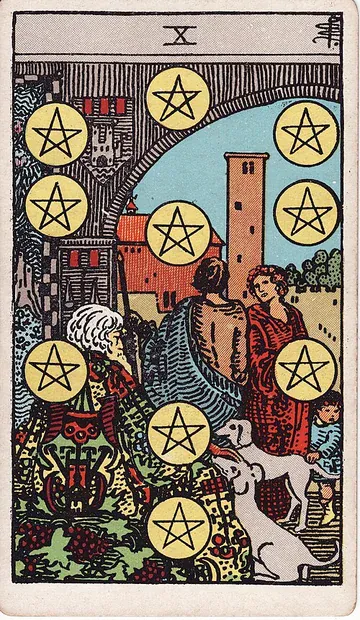
Ten of Pentacles
The walled garden meets the multi-generational household. Where Nine of Pentacles is the solo gardener at her trellis, Ten of Pentacles is the courtyard full of family, dogs, banners, and elders. The pair describes the choice — or the unfolding — between cultivated solitude and committed kinship. Read the pair to understand whether the seeker is choosing the smaller, refined garden or moving toward the larger, less controllable household. Neither is failure.
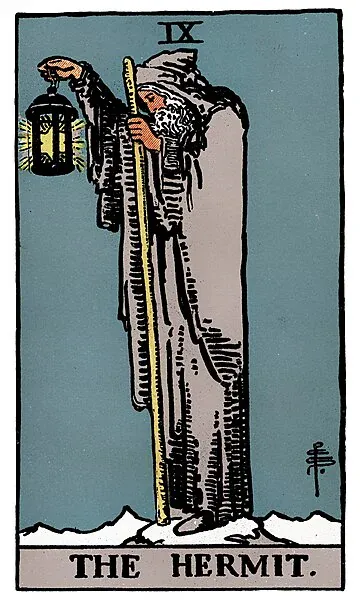
The Hermit
Two solitudes meet — the lantern in the wilderness and the wall around the vineyard. The Hermit is solitude as quest, the inward search; Nine of Pentacles is solitude as harvest, the outward fruit of inward years. Together they show a seeker whose hermit work has compounded into a tangible life. The pair warns against treating the visible abundance as evidence the inner work is over — both cards keep going, indefinitely, in their respective registers.
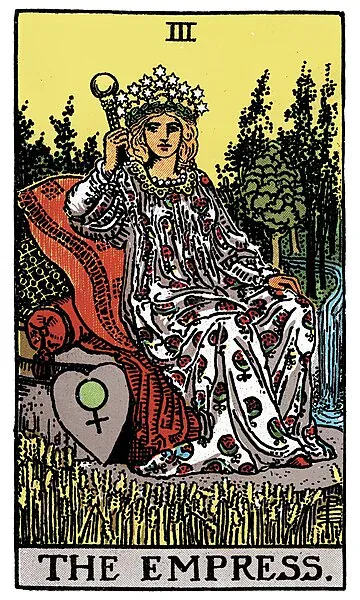
The Empress
Venus doubled. The Empress carries Venus at full natural strength; Nine of Pentacles carries Venus refined through Virgo's exactness. Together they describe a season of generative, cultivated beauty — abundance that nourishes rather than only impresses. In love readings the pair often signals a relationship that is genuinely sustaining rather than only stimulating; in creative readings it signals a body of work that is both fertile and exact, each piece chosen rather than spilled.
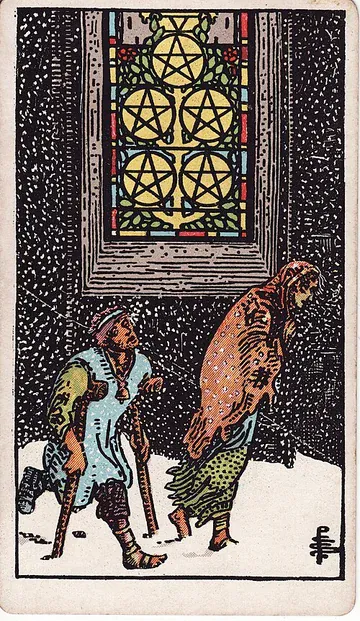
Five of Pentacles
The sharpest contrast in the suit. Five of Pentacles is the cold outside the lit window — exclusion, scarcity, the figures passing the church in the snow. Nine of Pentacles is the warm vineyard inside the wall. Together the pair often reads on questions of inside-versus-outside: who is included in the seeker's abundance, who has been left out, or whether the seeker themselves has begun to feel exiled from a privilege others assume they hold. The pair refuses to flatter either card.
Frequently Asked Questions
Is the Nine of Pentacles reversed refusing the question, or the way I asked it?
Soft no in most cases — Nine of Pentacles reversed declines questions that ask the seeker to perform sufficiency, scale a gilded structure, or expand something whose primary appeal is signal rather than substance. The card sometimes gives a conditional yes, but the condition is usually that the seeker honestly acknowledge what is inherited rather than built, or dismantle the part of the wall that has become a cage.
What separates the Nine of Pentacles' walled garden from its gilded cage?
Nine of Pentacles reversed is the gilded cage. Independence has hardened into unapproachability, refinement has tipped into display, abundance is being maintained rather than enjoyed. The reversed card also reveals inheritance the seeker has been claiming as self-built. The wall is still standing — the question is who it is keeping out, and who actually laid the stones.
With the Nine of Pentacles reversed, is my independence protecting me or isolating me?
Nine of Pentacles reversed in love describes independence that has stiffened into refusal, or partnership that has become beautiful coexistence without contact. Couples can drift into curated performance; singles can have refinement that functions as armor against vulnerability. The card asks whether the seeker is choosing solitude or has simply forgotten how to let anyone past the gate.
If the wall is up, how would I know the Nine of Pentacles reversed still means they feel it?
As feelings reversed, the other person feels for you but has walled the feeling in too long, and the wall has begun to mistake itself for the feeling. Reserved natures shut down; demonstrative ones perform. Long bonds ossify into infrastructure. The reversed card asks the seeker to read distance honestly rather than romanticize it as quiet investment.
How do I open the wall the Nine of Pentacles reversed has built?
Invite one person across the wall this week with no agenda. Spend money on something purely useless and unrefined. Take one performed quality off the wall — independence, refinement, recovery — and let a friend see the unperformed version. Sit honestly with what is inherited versus built. Take the hooded falcon out and let it fly. The reversed card wants the wall opened, not torn down.
Continue Reading
Nine of Pentacles · Card overview · symbols · correspondences →
Return to the full card view — image, symbols, sensory correspondences, and Hermetic axes.
Read the upright meaning →
Read the same depth on the opposite orientation.
Draw your reading now →
Bring this card to a question — open a quiet ritual.