
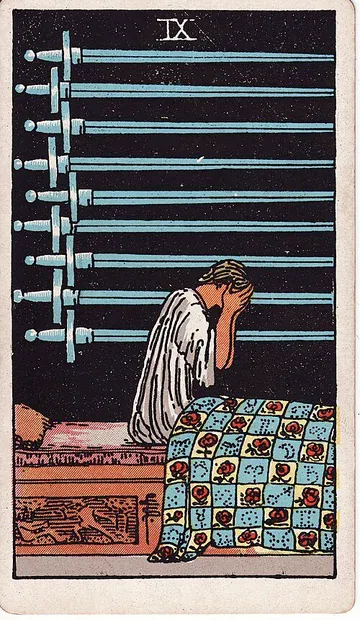
Nine of Swords · Core Meaning
Three in the morning is the only hour this card keeps. A figure has sat upright, hands pressed to the face, while behind them, against an ink-black wall, nine long swords hang in parallel — none touching, arranged like a list someone has revisited too many times. The quilt across the lap is patterned with roses and the signs of the zodiac, as though the entire cosmos has been dragged into the sleeplessness. At the foot of the bed, a thin gray seam where the floor meets the wall is the only non-black thing in the room — the night's last quiet promise that daylight is, eventually, coming.
This is not the card of the wound. The Three of Swords is the wound. The Nine of Swords is the night-rehearsal of it. The blades on the wall are not currently piercing anything. They are catalogued. The figure has become the librarian of their own injuries, opening the same drawer over and over by candlelight, re-reading the same sentence, deciding it means something slightly worse than it did the last time. The traditional reading collapses this into a single phrase — anxiety, nightmares, despair — but those words are too loud for what the card actually shows. The card shows precision. The card shows a person who has worked very hard, in the dark, to make their suffering exact.
The Nine of Swords' signature tension is the gap between the night version and the day version of the same problem. The blades are real swords, but they are hung — not held. Whatever was said yesterday afternoon, whatever was implied in an email, whatever the colleague's pause meant at the meeting — the Nine of Swords is the hour after midnight when those small things grow into instruments. The card asks a quiet, terrible question: are you reading the situation, or are you re-reading it until it agrees with the worst version of itself?
The traditional astrological signature is Mars in Gemini, second decan — early June, the last ten days before solstice. Mars is the planet of cut and force. Gemini is the sign of language. Mars in Gemini is violence at the level of a sentence. The decan rules the part of the year when the days are longest and the nights are shortest, which is exactly when sleep becomes paradoxically harder — too much daylight thought to compress into too little dark. A sentence rehearsed in this decan, spoken aloud only to oneself in the dark, is ground sharper than the original cut. The Nine of Swords is the card of self-rehearsed cruelty — the kind that uses one's own voice as the weapon.
The kabbalistic placement reinforces this. The card lives in Yesod — the sephirah of foundation, the dream-layer, the world of image and reflection beneath the surface. Yesod is where the day's thoughts become night's content. A worry that merely stood up by daylight will grow roots by night, because Yesod gives it the weight of dream. Air, the suit's element, in Yesod, in the world of Yetzirah (formation), is wind that has stopped moving and turned inward. Without Yesod's groundedness in the body, mental air becomes recursive — the breath that rebreathes the same panic.
The room in the Rider-Waite-Smith image has no window. There is no outside referent. This is the structural truth of the card: the seeker has become sealed inside their own commentary on what happened. The way out is not deeper inside. The way out is the thin gray line at the floor — daylight, eventually, on its own schedule. The Nine of Swords describes the season before that gray line widens. Read it as a card of intense interior work that is not yet productive, and that will become productive only when the seeker stops trying to finish it tonight.
Nine of Swords · Love & Relationships
In love readings, the Nine of Swords describes the relationship at three in the morning — not the daytime relationship, the one in which both people are kind and reasonable and tired, but the version that lives inside the seeker's head when sleep refuses. The Nine of Swords love question is rarely about the actual partner. It is about the version of the partner that the seeker has been polishing in the dark for weeks. This is the card's first hard truth, and the place every querent type begins.
For the seeker in an existing partnership, the Nine of Swords often appears when the relationship is technically fine and privately unbearable. The arguments have stopped, but the rehearsal of the arguments has not. You are no longer fighting them — you are fighting them every night, in your head, with the speeches you should have made, with the line that would have ended it cleanly. The card asks a difficult question: what is the relationship actually doing wrong, and what are you doing to it after midnight that it cannot defend itself against? Sometimes the partner is the problem. Sometimes the partner is fine and the rehearsal is the problem. The card refuses to decide for you. It only insists you notice the rehearsal.
For a new spark, the Nine of Swords is the card of the text that has not been answered yet, magnified by night into a verdict. They have not replied for six hours. By daylight, this is nothing. By three a.m., it is the proof of a story you have been quietly writing. The card warns: do not act on the night version. Whatever message you draft after midnight, hold it until at least sunrise. Most of the time, by ten in the morning, the message will have rewritten itself into something kinder, or there is no need to send it at all because they have already replied.
For a single seeker asking whether love is even possible after the recent stretch of difficulty, the Nine of Swords is one of the deck's most painful cards to draw. It is not a no. It is a description of the loneliness that has begun to interrogate itself — the late-night session where you make a list of why you are unlovable, and the list grows longer the more carefully you keep it. The card asks you to notice that the list itself is the obstacle, not the truth of the obstacle. You are not unlovable. You are exhausted, and you have begun to use your exhaustion as evidence.
For love after a wound, the Nine of Swords is precise: this is the card of the post-breakup season when the breakup has technically ended but the breakup-conversation continues nightly in the bedroom. You are still arguing with the ex. You are still drafting the email. The card does not say the wound is wrong. It says the rehearsal has begun to outlive the wound, and the rehearsal is what keeps the wound fresh. The integration is not forgetting. The integration is letting the conversation actually finish.
For someone dating after years alone, the Nine of Swords describes the pre-emptive grief. You meet someone, and before the second date, you have already lived through the breakup in your head. You have already imagined the ways it will go wrong. You have already armoured yourself against a loss that has not happened. The card warns this is the grief of safety, not the grief of wisdom. It costs you the relationship before the relationship has begun.
For long-distance partnerships, the Nine of Swords describes the asymmetry of nighttimes. You are awake at three; they are asleep across an ocean. The thoughts you have about them tonight are not thoughts they will receive. The card asks you to write them down — actually write them, in a notebook, not as a message to send — and then sleep. The act of putting the rehearsal on paper outside your head is one of the card's most reliable solvents.
For couples in conflict, the card warns specifically against the late-night text war. The escalation that happens between 1 a.m. and 4 a.m. is not negotiation. It is two Nine of Swords states reflecting each other across a screen, each amplifying the other. Whatever is said in that window will not be the truth of the relationship by morning. The card's instruction is structural: no relationship-level conversations after eleven at night. The vow to wait for daylight is itself the medicine.
For the question of whether someone you have been quietly attached to is in love with you, the Nine of Swords offers a difficult mirror. The card is rarely about them. The card is about the months you have spent building the case for whether they are or are not, late at night, alone, with no new information. They cannot be the answer to the question while the question is being asked at three a.m. Ask in daylight, in their actual presence, with your eyes open, or accept that the question is not yet ready to be answered. Either path is more honest than the rehearsal.
The card's particular love language is interrogation — and that is the card's wound. The Nine of Swords loves by examining. It wants to be sure. It rehearses every conversation against every scenario, and at its worst, this stops feeling like care and starts feeling like surveillance. If this is your love language, the card asks: can you let your partner be unobserved for a single night? Can you let the relationship rest, even from your own monitoring? The bond grows in the hours you stop tending it.
Nine of Swords · As Feelings
What the sleepless figure holds toward you is not what you fear, and not a comfort either. The card describes someone whose feelings about you have become tangled with their own self-accusation. They are not lying awake hating you. They are lying awake being cruel to themselves, often about a small thing they said to you, often replaying a conversation that you barely remember. The intensity is real. The intensity is also private. It has not yet become anything they can hand to you.
If they are reserved by nature, the Nine of Swords in feelings describes someone who has been silently scoring themselves against a private rubric of how they should have behaved with you. They feel that they let you down, in a small way, weeks ago. They have not said this. They have rehearsed the apology and discarded it nightly. To you, they appear quiet, perhaps slightly distant. To themselves, they are loud — a relentless internal critic running an old monologue. The card asks the seeker to read the silence as guilt rather than indifference. It also asks the seeker not to confuse this with love that is asking to be received.
If they are demonstrative, the Nine of Swords in feelings can describe someone whose worry about losing you has begun to contaminate their actual presence with you. They overcompensate. They text too often. They check too much. The smallest pause from you is processed at midnight as evidence that the bond is failing. They feel they are losing you when they are not. The card asks the seeker to be both kind and clear: name the pattern, do not rescue them from it. The Nine of Swords spirals are not solved by reassurance from the other person. They are solved by the rehearsal stopping inside the head where it lives.
For a long bond, the Nine of Swords can describe a partner whose love has become a worry-shaped love. They love you by worrying about you. They check on you because the alternative — not checking — is a kind of helplessness they cannot tolerate. The card warns this is a closed loop. The worry is not feeding the love. It is metabolizing it. Reading the card here means seeing that you are loved, and that the love has knotted itself around an old fear that predates you.
For a new connection, the Nine of Swords as feelings describes someone who has built a case about you in private, often before they have enough information. They have decided you are too good for them, or that they are too damaged for you, or that the timing is wrong, or that you are about to leave. None of this has been said to you. They are arguing with you in their head, and they are losing. The card asks: are they actually still interested, or have they written the breakup before the relationship arrived? You cannot know without asking — and the card's specific advice here is to ask in daylight, in person, without warning, so the night-version of the conversation cannot be rehearsed in advance.
For an ex, the Nine of Swords in feelings is one of the deck's clearer signals. They are still rehearsing what happened. They are still drafting the message. They have not sent it. They may never send it. The feelings are real. The feelings are also locked inside a loop that has begun to be the relationship for them, replacing the actual contact you used to have. Read the card here as a mirror: this is what unprocessed grief looks like in someone else, the same way it looks in you.
For someone you suspect is angry with you but has not said so, the Nine of Swords in feelings is sharper. The card describes a private interrogation that has decided you are at fault, whether or not the verdict is just. They have catalogued your offenses on the wall. They have not held them up to daylight. The risk is that one day they will hand you the list, fully formed, and the conversation will collapse before it begins because the case has been built without you in the room. The card asks you, the seeker, to pre-empt this. Open the conversation in daylight, before the list completes itself.
For a partner you have been with through difficult years, the Nine of Swords in feelings describes the love that has been worn down by self-recrimination. They believe they have failed you, often in small ways, often invisibly. They love you. They cannot forgive themselves. The two feelings are tangled, and from the outside, they can look like distance. The card asks for tenderness directed toward their self-accusation, not toward your suspicion. They are not done caring. They are done absolving themselves.
A small caution embedded in this card: not all night-feelings are real feelings. The Nine of Swords describes the version of someone's interior that emerges only at three in the morning. By daylight, it may not be the dominant feeling. Read the card as a description of what is happening inside them in the dark, not as the totality of what they feel about you. The complete feeling is wider. The card shows the narrowest, hardest, most rehearsed slice.
Nine of Swords · Career & Work
A daytime mistake expands, after midnight, to a size out of all proportion to itself. The email you sent at four p.m. that has gone unanswered. The line you said in the meeting that no one reacted to. The number on the report that you suspect is wrong but cannot bring yourself to recheck. The Nine of Swords is the card of work-anxiety that has crossed from useful vigilance into recursive self-prosecution. It is rarely the card of an actual workplace problem. It is the card of the worker who has begun to be the problem to themselves.
For someone asking whether they are doing well in a current role, the Nine of Swords answers carefully: probably yes, by external measures, but you have stopped being able to feel that. Your manager has not said anything wrong. Your colleagues have not signaled discontent. And yet, every night, you are running the trial. The card warns that this gap between external reality and internal verdict will, eventually, become its own crisis if it is not interrupted. The work is not yet failing. You are exhausting yourself preparing for a failure that has not arrived.
For someone considering a new role, the Nine of Swords appears when the decision has begun to be re-litigated in the dark. By daylight, the offer is good. By midnight, you are listing every reason it will go wrong. The card cautions against making this kind of decision in the rehearsal-state. Whatever you decide while running the night-trial will be a decision about the trial, not about the role. Wait until daylight. Make the call when the room has windows.
For the freelancer or entrepreneur who has built a small practice and is now asking whether it will survive, the Nine of Swords is the card of the founder at three a.m. doing the math one more time. The math is fine. You have done it twelve times this week. Each repetition has not changed the answer. The repetition itself is the symptom. The card describes the founder whose doubt has become the work — who is no longer doing the actual work because the doubt has crowded it out. The integration is to do one piece of the actual work at a time, in the actual hours, and to refuse the doubt-rehearsal as a substitute for action.
For the creative worker — writer, designer, artist — the Nine of Swords describes the inner critic that has stopped being useful. There is a critic who reads the work and improves it. There is a critic who reads the work and convicts you of being a fraud. The first is craft. The second is the Nine of Swords. The card asks you to learn to tell them apart by the hour at which they appear. The useful critic shows up while you are working. The Nine of Swords critic shows up after you have closed the file, when there is nothing you can do with the verdict it hands down.
For someone in the middle of a job search after a layoff, the Nine of Swords is one of the deck's most accurate cards. The daytime is sending applications, polite emails, careful follow-ups. The nighttime is the catalog of every reason the job goes to someone else, every flaw in your résumé, every thing you should have done differently in the previous role. The card warns: this rehearsal does not improve the outcome. It only worsens the next day's energy for the search. The integration is structural — close the laptop at a fixed time, do not reopen it after dark, give the search its hours and protect the rest of the day from being recolonized by the search.
For someone managing a difficult colleague or a hostile workplace, the Nine of Swords describes the way the workplace begins to live in your bedroom. The sentences they said to you are repeated all night. The slights are itemized. The card asks: can you put the colleague down before sleep? Not forgive them — simply put them down. The Nine of Swords integrates not by resolution but by the practice of refusing to take work to bed.
For questions of authority and recognition — promotion, acknowledgment, raise — the Nine of Swords often describes the worker who has been quietly excellent and quietly invisible, and who has begun to read the invisibility as a verdict. The card asks: have you actually asked for what you want, in daylight, in plain language, or have you only rehearsed the asking at night? The Nine of Swords frequently appears for those who have run the conversation a hundred times in their head and never had it once with their manager. The integration is the actual conversation. It will go better than the rehearsal predicted. It almost always does.
For the decan-specific reading — Mars in Gemini, the work of words — the Nine of Swords often describes a worker whose specific gift is verbal precision (writing, editing, communications, teaching) and whose specific suffering is the way that gift turns inward at night. The same talent that lets you craft the perfect line for a client lets you craft the perfect indictment of yourself. The card asks for the discipline of pointing the talent outward only. Use the words on the work; do not use them on yourself in the dark.
For ambitious seekers worrying that they will never make the leap, the Nine of Swords is gentler than it looks. The card is not predicting failure. It is describing a stage — the long stretch of night between the decision and the action, during which the seeker builds the entire imagined catastrophe of the leap. Most leaps look like this from the inside before they happen. The card does not want you to leap blind. It wants you to recognize that the catalog of risk is itself a stage, not the verdict. Sleep. Decide in daylight. The leap, when it happens, will be smaller than the rehearsal made it.
Nine of Swords · Money & Finances
In money readings, the Nine of Swords describes the financial worry that has stopped being action and started being rehearsal. The numbers are what they are. You have looked at the spreadsheet. You have looked at it again. The looking has not changed the numbers, and the looking has begun to be the way you cope with the numbers, which means the looking has begun to replace the actual financial decisions you need to make. The card is the three-a.m. balance check, the panicked re-read of the credit card statement, the calculation of how many months of runway remain done for the seventh time this week.
For a question about whether a financial bet will pay off — a side business, a freelance jump, a major purchase — the Nine of Swords is rarely a clean answer because the card is suspicious of the question itself. It asks: are you actually asking for guidance, or are you running the rehearsal of failure one more time, hoping the cards will let you sleep? If the second, the answer is: sleep first, ask in daylight. If the first, the card cautions against decisions made in this particular state. The seeker is not seeing the numbers clearly. They are seeing the numbers through the filter of a long night.
For someone in actual financial difficulty — debt, late rent, unexpected medical cost — the Nine of Swords does not deny the real weight. It describes how the real weight is being carried. There is a way to carry financial difficulty that allows for sleep, action, and structural problem-solving. There is a way that does not. The Nine of Swords is the second way. It does not solve the debt; it makes the debt heavier by adding to it the cost of insomnia, depleted decision-making, and the slow erosion of the body's reserves. The card asks: can you call the bank in daylight, write down one concrete step, and then refuse the rehearsal until the next daylight hour?
For someone managing well financially but unable to feel managed, the Nine of Swords is precise. The numbers are fine. The savings are growing. The income is reliable. And every night, you are convinced you are about to lose it. This is a flavor of the card sometimes called the post-scarcity Nine of Swords — the seeker who survived a hard financial period years ago and never updated the internal alarm system. The body is still in the lean year. The accounts are not. The integration is gentle, slow, and largely structural: write down the actual numbers, in daylight, weekly, so the night version of the numbers cannot float free of evidence.
For a question about a major purchase — the house, the car, the business expense — the Nine of Swords cautions against the decision made at midnight either way. The yes that comes from "I cannot bear this rehearsal anymore, let me just buy it" is not a yes. The no that comes from "I have catastrophized this for so long I cannot remember why I wanted it" is not a no. Both are the card speaking, not the seeker. Wait. Sleep. Decide on a Saturday morning, with coffee, with someone who does not have insomnia about it.
For investments and speculation, the card warns specifically against the late-night portfolio check. The 3 a.m. scroll through the trading app is the visible form of the Nine of Swords in modern finance. Whatever it shows you, by 3 a.m. it has already been magnified into a verdict. Do not act on it. Most of what looks like a crisis at 3 a.m. is normal volatility by 10 a.m. The discipline is to remove the app from the bedside.
For debt and recovery questions, the card supports the boring path: one step at a time, in daylight hours, with a written plan, with a person who is not you reviewing it monthly. The Nine of Swords is the card of the seeker who can do all the math but cannot sustain the momentum because the night re-litigates every choice. The integration is not better math. It is a witness — a financial advisor, a friend with a spreadsheet, a partner — someone who can hold the plan when your night-self tries to dismantle it.
For windfall — inheritance, gift, surprise income — the Nine of Swords warns of the trap of late-night allocation. The money has arrived. The mind, in the dark, has a hundred ways to spend it. The card asks: can you let the money sit, untouched, for a season? Can you refuse the urgency that says you must decide tonight what to do with it? Most windfall mistakes are made under the pressure of a self-generated urgency that has nothing to do with the actual money.
A practical move when the Nine of Swords appears in a money question: track one week of actual transactions, in writing, by daylight. Not as discipline. As reality testing. The card responds to evidence. The night version of your finances often differs from the daytime version by a factor of two or more. Bringing the two into the same room is the work.
Nine of Swords · Health
The suit's old body associations — the lungs and the nerves — carry this whole health reading. Air, in the body, is breath. Air, in the mind, is thought. The Nine of Swords describes the place where these two systems collide — the night-anxiety that becomes a real somatic event, the racing thought that becomes a racing pulse, the shallow breath of three a.m. that the chest cannot quite widen. The card is the most literal portrait the deck offers of the body holding nighttime mental distress.
For sleep specifically, the Nine of Swords is the card of insomnia — but the card cares about the kind. There is the insomnia of a single hard week, and there is the chronic three-a.m. wake that has begun to be a feature of the seeker's life. The card describes the second. The waking is not random. The body has learned to wake at the hour when the mind is most defenseless against rehearsal. The integration is structural: a sleep-protective practice at the same hour every night, removal of the phone from the bedroom, a short written discharge of the day's residue before sleep, and acceptance that the wake itself is not the problem — what you do during it is.
For someone with anxiety as a diagnosed condition or a long-running pattern, the Nine of Swords is the card of the symptom at its loudest. The body is responding to mental rehearsal as if it were physical danger. The chest tightens. The breath shortens. The heart speeds. None of this is medical advice — keep your practitioners, take your medicine, do the work — but the card validates what is happening. It is not imagined. The body is holding what the mind is producing. The integration is the long, slow practice of teaching the body that the thought is not the threat.
For depression, the Nine of Swords describes the late-night thinking that intensifies depressive states. The depression itself may be a different card. The Nine of Swords is what happens when the depression has access to the seeker for hours, alone, in the dark, with no daylight evidence to correct it. The thoughts at three a.m. are not the truth of the depression. They are the depression's loudest hour. The card's instruction is to refuse to make decisions during this hour. Whatever the night-thought says about your worth, your future, your relationships — it is not a verdict. It is a symptom.
For panic attacks, the Nine of Swords often appears in the period leading up to them rather than during them. The night-rehearsal is the build-up. The catalog of what could go wrong tomorrow is the wood, and the panic is the fire that eventually catches. The integration is upstream — interrupt the catalog before it completes. Body-first practices (cold water, paced breath, walking) are more useful than thought-first practices, because the card describes a state in which thought has become the problem and cannot be the solution.
For the body's nervous system more broadly, the Nine of Swords describes a pattern of chronic sympathetic activation — the body running the danger response on low constant burn. This wears down digestion, immunity, and recovery. None of these are diagnoses; the card is suggesting a felt pattern. If the felt pattern matches your actual symptoms, take it seriously enough to ask a doctor. The body keeps the score, and the Nine of Swords is one of the card-shapes that score takes.
For chronic pain, the Nine of Swords does not describe the pain itself but the night relationship with it. Pain that flares at three a.m. when the distractions of the day fall away is real pain, but it is also the body in its most defenseless state. The card warns against making sense of chronic pain only at night. Daytime patterns — what helps, what hurts, what builds resilience — are the trustworthy ones. Night patterns are the loudest, not the most accurate.
For mental health practice — therapy, medication, self-care — the Nine of Swords supports the patient discipline of sticking with the work even when the night is loud. The card describes seasons in which the work feels not to be working. It often is working. The night-version of "this isn't working" is not a clinical verdict. The integration is to bring the night-thought to the daylight conversation with the practitioner, where it can be examined without amplification.
For someone managing addiction or compulsive behavior — alcohol, screens, food, gambling — the Nine of Swords describes the late-night vulnerability when the rehearsal becomes a justification for the behavior. The voice that says "you have already failed today, you may as well" is the card's voice. The integration is to recognize the voice as a known weather rather than an instruction. The card does not predict relapse. It describes the hour when relapse becomes most accessible. Knowing this is most of the work.
For body practices — yoga, breathwork, walking, swimming — the Nine of Swords supports the slow, repeated, daytime practices over the dramatic ones. The card responds to evidence accumulated by the body that it is safe. This evidence is built in small, daily increments, not in single intense sessions. Evidence of safety accumulated in daily increments describes how a body learns, not medical advice. The card simply names a felt season and offers an honest mirror: the body and the mind are speaking to each other in the dark, and the conversation will improve when both are tended in daylight.
Nine of Swords · Spirituality
The dark night has two versions, and this is not the famous one. This is not the dark night of mystical tradition, the soul stripped of consolation in service of deeper union. This is the smaller, lonelier, more recursive dark night: the seeker awake at three with the lights off, running the same catalog of inadequacies for the eleventh time. The card describes the spiritual cost of using introspection as self-prosecution. There is a way to examine the soul that opens it. There is a way that closes it. The Nine of Swords is the second way, run for too long.
The kabbalistic placement is precise here. Yesod, the sephirah of foundation, is the dream-layer beneath the surface of consciousness. It is the sphere of the moon, of image, of reflection, of the pool that mirrors what is held above it. The card lives here because the night version of the soul takes the day's thoughts and makes them luminous and heavy. A worry of the daytime, dropped into Yesod, becomes a vision of the night. The decan — Mars in Gemini, the second decan of the sign of language — adds the specific signature of words that have begun to cut. Yesod, holding a Mars-in-Gemini worry, produces the recurring nightmare in which one's own voice becomes the weapon.
For seekers in active practice — meditation, prayer, ritual, devotional work — the Nine of Swords often appears when the practice has, paradoxically, given the seeker more time alone with their mind, and the mind has used the time poorly. This is a known stage in contemplative traditions. The first season of practice can amplify rather than soothe. The card is not a sign that the practice is failing. It is a sign that the practice has begun to surface material that needs more than the practice alone can hold. A teacher, a therapist, a sangha, a witness — the integration almost always involves bringing another person into the work that has been entirely solitary.
For seekers exploring belief, the Nine of Swords can describe a season of theological scrupulosity — the late-night re-examination of every doubt, every contradiction, every place where the chosen tradition does not quite fit. The seeker has begun to use the tradition's tools against themselves. The card asks: is this the tradition's invitation, or is it your habit of self-prosecution wearing the tradition's clothes? Many spiritual seekers carry the Nine of Swords pattern from before they began practicing. The pattern adapts. It can sound just as cruel in the language of the dharma as in the language of any other inheritance.
For the question of path, the Nine of Swords often appears when the seeker has been dutifully on a path that no longer fits but cannot bear the verdict of having chosen wrongly. The night-rehearsal becomes "I should have done X, I should have left Y, I should have known when I was twenty." The card warns against this entire mode. The path was the path. The path is now this. There is no version of the past in which the right choice was visible. The integration is to put down the trial of the past self and tend the present one.
A specific spiritual practice the card invites is the deliberate, ritual letting-down of the day before sleep. Not journaling as analysis. Journaling as discharge. Three sentences about what happened today. No judgment. No revision. Then close the book. The discipline is in the closing. The Nine of Swords lives in the open book that is reopened nightly. Closing it — actually closing it — is more difficult and more useful than any of the heavier practices the seeker may already be attempting.
A second practice: a thirty-minute walk, in daylight, alone, without a phone. The card responds to walking because walking is the body refusing to stay seated with its own commentary. The Nine of Swords is a stationary card. The figure does not move. The blades do not move. The integration is movement. Not exercise — gentle movement, of the body, in the world, with eyes open.
A third practice, harder: speak the rehearsal aloud, once, to one person you trust, in daylight. Not to be fixed. Not to be reassured. Simply to be heard. The Nine of Swords is the card of the monologue that has lived only inside one head. Bringing it into the air, even briefly, even to one witness, returns it to its actual size. Most rehearsed pain shrinks measurably the first time it is spoken aloud. The card responds to this discipline more than to any private one.
The card's spiritual question, finally, is the question of mercy. The Nine of Swords seeker has often forgotten how to be merciful to themselves. They have confused self-prosecution with moral seriousness. They believe that to torment oneself is to take the soul seriously. The reversed card is the beginning of the answer. The upright card is the long winter before the answer. Ask the card: what would it look like, just for tonight, to leave the courtroom and go to sleep?
Nine of Swords · Yes or No
Soft no — but read carefully.
The Nine of Swords upright is one of the deck's most consistent no cards, but it is not a no about the situation you asked about. It is a no about the state you are in while asking. The card describes a seeker who is not currently in shape to receive a yes or a no usefully. Whatever answer arrives will be filtered through the rehearsal, and the rehearsal will distort it.
For yes-or-no questions about a relationship, a job, a move, a decision: the card answers no — not because the path is wrong, but because the question is being asked at three in the morning. Sleep first. Ask in daylight. If the question still feels real at ten in the morning, the answer it receives will be trustworthy. If the question dissolves by noon, that itself is the answer.
For questions about whether someone is being honest with you, whether an offer is genuine, whether a plan will hold: the Nine of Swords answers with caution. Not because anyone is lying. Because you have begun to read every word as evidence in a trial you are running, and the trial cannot return a clean verdict. The card is not telling you the offer is false. It is telling you that your apparatus for evaluating it is overloaded.
For questions about whether someone is in love with you, whether a relationship will reconcile, whether a friendship will return: the Nine of Swords answers softly. The card knows that the question has been asked many times tonight. It has been asked so many times that the answer no longer changes the seeker. Whatever the deck says, the seeker will return to the question by morning. The card asks: what would you do if the answer were yes? What would you do if it were no? The work is in those two answers, not in the verdict itself.
For timing — will it happen soon, will it happen at all — the Nine of Swords cautions against the urgency. The seeker often asks the timing question because the rehearsal has built up enough pressure that an answer would relieve it. The card says: the relief you are looking for is not the answer. The relief is the rehearsal stopping. Stop the rehearsal first. Then ask the timing question and trust whatever the deck says.
For binary decisions — should I act, should I wait — the card answers wait. Not because waiting is the right strategy. Because acting from the night-state will produce action shaped by the night-state, and the night-state cannot make decisions that survive the daylight test. Sleep. Eat. Walk in the sun for an hour. Then decide.
For the question of whether you deserve something — a promotion, a partner, a rest — the Nine of Swords answers yes, and asks why you are running this particular trial again. The deck is not impressed by self-prosecution. Mercy, here, is the higher path. The card asks you to lay down the catalog and notice that you are exhausted and that the question of deserving has nothing to do with what comes next.
The only clean yes the Nine of Swords gives is to one question: will the night end on its own? Yes. The thin gray line at the foot of the bed is the deck's promise. Daylight does come. The catalog you have built will not survive contact with morning. Wait. Sleep. The yes is in the dawn.
Nine of Swords · Advice
Refuse to be held accountable, in the morning, to the version of yourself that shows up at three a.m. The card's first instruction is the most important: label that version. Call it "the three-o'clock self." Notice when it is speaking. Refuse to take notes from it. The three-o'clock self is real, but it is not the seeker. It is the seeker's worst rehearsal, and it does not get a vote in tomorrow's actions.
If there is one specific instruction the card offers, it is this: write the rehearsal down. Not as analysis. As discharge. When the night-monologue starts, get up, sit at the kitchen table, and write three pages by hand, without stopping. Not for anyone to read. Not even for you to reread. The act of moving the rehearsal from the head to the page outside the body is one of the card's most reliable solvents. After the three pages, drink a glass of water and return to bed. The rehearsal will often be quieter on the second attempt at sleep.
A second instruction: a letter written in the night must wait until at least sunrise before any decision is made about whether to send it. This is the card's most specific rule. Anything composed in the Nine of Swords state will read differently by daylight. Most of the time, the daylight version is kinder, shorter, and either does not need to be sent or needs to be sent in an entirely different form. The discipline is structural. Hold the letter. Daylight will edit it.
A third instruction: speak the rehearsal aloud, once, to one person you trust, by daylight. The Nine of Swords lives in the monologue that has only ever been heard by one person — you. Bringing it into the air, even briefly, even to one witness who does not need to fix it, returns it to its actual size. Most rehearsed pain shrinks measurably the first time it is spoken aloud. Choose the witness carefully. They do not need to solve. They need to receive.
A fourth instruction: walk in daylight for at least thirty minutes, without a phone, every day until the rehearsal eases. The card responds to walking because walking is the body's refusal to stay sealed inside its commentary. The Nine of Swords is a stationary card — the figure does not move, the blades do not move. Walking is the literal medicine the image is missing.
A fifth instruction: remove the phone from the bedroom. This is small and structural and works. The Nine of Swords amplifies through the nighttime scroll — the late check of email, the message from yesterday re-read, the social media that confirms whatever the rehearsal already suspected. A bedroom that does not contain the phone is a bedroom in which the rehearsal has fewer ingredients.
A sixth instruction, gentler than the others: forgive yourself for the rehearsal itself. The card describes a seeker who has often added a layer of shame to the night-state — shame for being awake, shame for being anxious, shame for not being able to stop. The shame does not help. It feeds the rehearsal. The integration begins with the recognition that this is a known weather, that many people pass through it, that you are not failing at being a person because you are awake at three a.m. You are awake at three a.m. That is a fact, not a verdict.
Practical advice for the day after the card appears: do one thing that the daylight self can be proud of, and refuse the night-trial about everything else. Make the bed. Eat the meal. Send the kind email. Walk the walk. The card responds to small, daylight, completed actions more than to any introspection. The cure for the rehearsal is not better thinking. It is action that gives the body proof that the seeker is alive, capable, and present.
A final instruction, from the card's deepest layer: practice mercy as a discipline. Not as a feeling. As a daily practice. When the night-self begins its catalog, answer it with one sentence: "You are tired. Go to sleep." Repeat as needed. The Nine of Swords does not respond to argument. It responds to the calm, repeated refusal to engage. The seeker becomes a different kind of seeker not by winning the trial but by leaving the courtroom, again and again, until the courtroom forgets to convene.
Nine of Swords · Card Combinations
The Nine of Swords reads especially clearly next to certain other cards, because its specific weather — night-rehearsal, self-interrogation, the catalog of imagined wounds — sharpens or dissolves depending on what stands beside it. The five pairings below are load-bearing: a reader holding the Nine of Swords with one of these will learn something they would not get from either card alone.
Nine of Swords + Ten of Swords
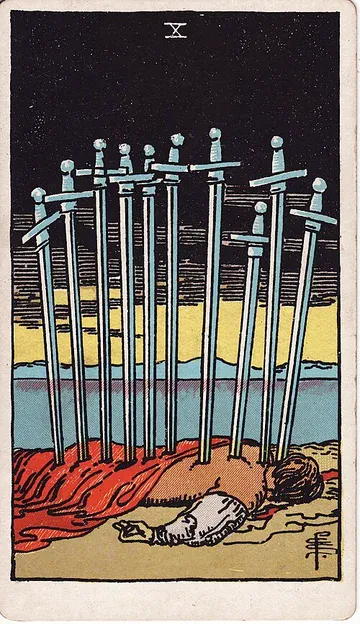
The night-rehearsal collapsed into the morning's exhaustion. The figure who sat upright in bed has fallen forward across it, finally still. This combination is the suit's hardest stretch — the Nine is the rehearsal of the wound, the Ten is the rehearsal having finally exhausted itself. Together, they describe the season in which insomnia gives way to depressive collapse, and the collapse is, paradoxically, the beginning of recovery. There is nothing left to rehearse. The body has insisted on rest. The integration is to allow the rest without adding rehearsal about needing the rest.
Nine of Swords + Three of Swords
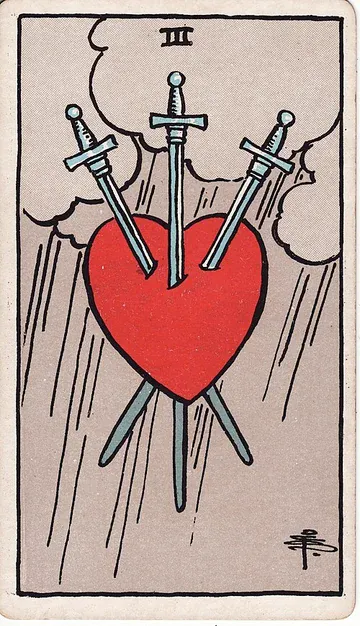
The originating wound and its night-rehearsal in the same draw. The Three is the actual cut — the news, the betrayal, the loss. The Nine is the months of nightly review of that cut. Together, they describe a seeker who has not let the wound fully metabolize because the rehearsal keeps reopening it. The combination warns: grief that is rehearsed instead of grieved becomes geometry. It locks into a shape that no longer changes. The integration is to grieve the original wound directly — speak it aloud, write it, sit in it during daylight — so the night does not keep volunteering to do the work the daylight has refused.
Nine of Swords + Nine of Cups
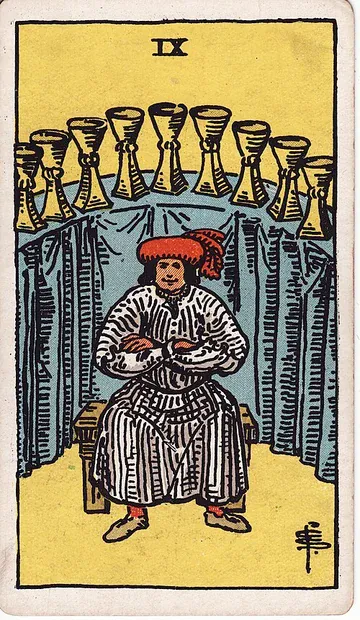
The deck's most precise tonal mirror. Both cards are the number nine — the place of inner arrival, completion on the dream-layer. Nine of Cups is sated satisfaction, the wish granted, the figure pleased with the cups behind him. Nine of Swords is self-interrogation, the figure unable to look at the swords behind him. Together, the combination is a mirror question: what have you been keeping behind your back? In one image, fullness; in the other, accusation. The seeker who draws both is asked to notice that completion can take either form, and that the chosen form is partly a discipline. Look at what you have made. Decide which nine you are sitting in front of.
Nine of Swords + The Moon
The major modulator that amplifies everything the Nine of Swords does. The Moon is the card of nighttime imagination, the path between the towers, the dream-water rising. Beside the Nine of Swords, the Moon makes the night-rehearsal larger, more vivid, more convincing. This is not a sign to act on what is being seen. This is a sign that the seeing itself is heightened by lunar weather, and that whatever conclusions arrive in this state should be held lightly until the moon's tide recedes. The integration is patience. The combination is loud. Most of what it shows will be smaller by daylight.
Nine of Swords + The Sun
The major modulator that ends the rehearsal. The Sun is daylight, the child on the horse, the wall of sunflowers, the open field. Beside the Nine of Swords, the Sun is the morning that the night cannot survive. Whatever the night was certain of, the Sun has not heard the case. This combination is one of the deck's quiet promises: the rehearsal does end. Not because you win the argument. Because daylight comes, and daylight does not respect the night's verdict. The integration is to wait. The Sun is on the way. The card pair is the dawn arriving on schedule, regardless of how long the night felt.
Card Combinations
Ten of Swords
The night-rehearsal followed by the morning collapse. The Ten of Swords is the suit successor — the bottoming-out the Nine had been rehearsing toward. Together, they describe insomnia exhausting itself into depressive stillness, which is paradoxically the threshold of recovery. The body has insisted on rest. Allow the rest without adding rehearsal about needing it.
Three of Swords
The Three of Swords is the originating wound — the actual pierce, the news, the loss. The Nine is the months of nightly review of that pierce. Together, they describe a seeker whose grief has not metabolized because the rehearsal keeps reopening the wound. Grieve the original cut directly — speak it, write it, sit in it during daylight — so the night does not keep volunteering to do the work the daylight has refused.
Nine of Cups
The deck's most precise tonal mirror. Both cards are nines — inner arrival on the dream-layer. The Nine of Cups is the wish granted, the figure pleased with cups behind him. The Nine of Swords is the figure unable to look at the swords behind him. The combination asks: what have you been keeping behind your back? Completion can take either form. The chosen form is partly a discipline.
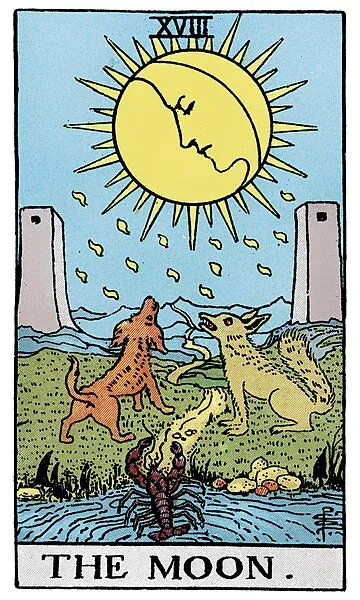
The Moon
The Moon as major modulator amplifies everything the Nine of Swords does. Lunar weather makes the night-rehearsal larger, more vivid, more convincing. Whatever conclusions arrive in this state should be held lightly until the moon's tide recedes. The integration is patience. Most of what the combination shows will be measurably smaller by daylight.
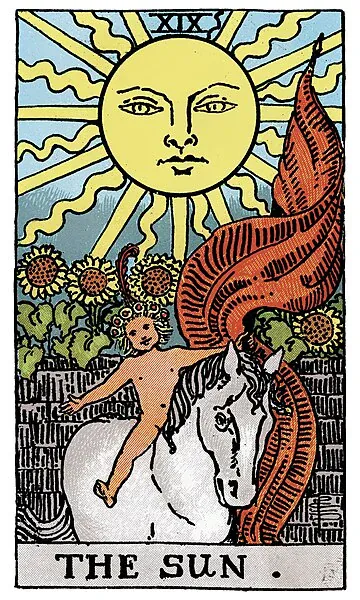
The Sun
The Sun as major modulator ends the rehearsal. The Sun is daylight, the child on the horse, the wall of sunflowers, the open field — the morning the night cannot survive. Whatever the night was certain of, the Sun has not heard the case. The integration is to wait. The Sun is on the way. The pair is the dawn arriving on schedule, regardless of how long the night felt.
Frequently Asked Questions
Why do the nine swords hang on the wall instead of touching the figure?
Because not one of them has actually struck. This is the deck's three-a.m. card. Nine swords hang on the wall behind a figure who has woken into self-interrogation, hands pressed to the face. The card describes night-rehearsal — the catalog of imagined wounds the mind compiles when sleep refuses. It is rarely about an actual external problem; it is about the way a small daytime worry becomes monstrous after midnight.
Should I decide anything while the Nine of Swords is describing my state?
Not tonight. Read the card as a soft no — and read the no carefully. The Nine of Swords does not reject the question; it rejects the state in which the question is being asked. The seeker is exhausted, mid-rehearsal, and not currently able to receive a clean verdict. Sleep first, ask in daylight. If the question still feels real by ten in the morning, the answer it receives will be trustworthy.
Am I seeing my partner, or the version of them I built after midnight?
The second one, in almost every case. In love the Nine of Swords describes the relationship as it appears at three a.m. — usually not the actual partner but the version of the partner the seeker has been polishing in the dark for weeks. The card warns against acting on the night version: do not send the message after midnight, do not draft the breakup at two a.m., do not decide the fate of the bond while running the trial of it. Hold until daylight.
Does the Nine of Swords as feelings mean they are angry with me?
At themselves, far more likely. The other person is not lying awake hating you — they are lying awake being cruel to themselves, often about something they said to you weeks ago. The intensity is real but private. They have not handed you the rehearsal. Read the silence as guilt rather than indifference, and do not confuse self-prosecution with absence of love.
What advice does the Nine of Swords give?
Refuse to be held accountable, in the morning, to the version of yourself that shows up at three a.m. Label that voice as the three-o'clock self, write the rehearsal down by hand, hold any night-letter until sunrise, walk in daylight for thirty minutes, remove the phone from the bedroom, and forgive yourself for being awake. The card responds to small, daylight, completed actions more than to any further introspection.
Continue Reading
Nine of Swords · Card overview · symbols · correspondences →
Return to the full card view — image, symbols, sensory correspondences, and Hermetic axes.
Read the reversed meaning →
Read the same depth on the opposite orientation.
Draw your reading now →
Bring this card to a question — open a quiet ritual.