
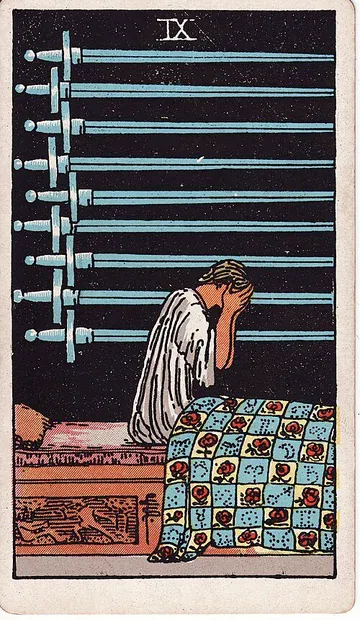
Nine of Swords Reversed · Core Meaning
The grip of the night has loosened by a degree. The figure is still upright in bed, hands still pressed to the face — but the hands are slightly less tight, and behind them, the room is no longer sealed. The thin gray line at the foot of the bed has begun to widen. Either daylight has actually arrived, or the seeker has finally said the rehearsed monologue aloud to another waking person, or the body has simply exhausted itself out of the cycle for one night. Whichever it is, the cycle is breaking.
This is the central knot of the reversed card: relief without drama. Most cards in their reversed form have a clear inversion — the wish becomes the curdled wish, the celebration becomes the hollow performance. The Nine of Swords reversed is gentler. The catalog has not been disproved. The wounds have not been healed. The figure is simply, quietly, beginning to be released from the loop. Sometimes this release is instantaneous (the trusted friend listens for an hour, and the rehearsal collapses into ordinary tears). Sometimes it is slow (a week of better sleep, a month of returned appetite, a season of remembering what daylight feels like). The card respects both speeds.
There is a second flavor of the reversed card: the rehearsal beginning to be examined rather than performed. The seeker has finally noticed the loop. They have noticed that the night-monologue has been running for years. They have not yet stopped it, but they have moved from being inside it to standing slightly outside it, watching it run. This is a fragile, important shift. The reversed Nine of Swords often marks this exact threshold — the moment the seeker begins to see the catalog as a habit rather than a truth. Once seen, it can be loosened. Before seen, it cannot.
Watch what the hands do once the card turns. Upright they are clamped over the face — the refusal to be seen by anyone at all, including the self in the mirror. Reversed, they come down. What meets the eye first is then not the wall of blades but the ordinary furniture of a room: a glass of water gone flat, a chair with yesterday's shirt over the back of it, a door left half open onto the hallway. This is a small decision the seeker has been making every night without noticing — where the eye goes on waking. The Nine of Swords reversed is the morning it goes to the chair instead of the wall.
There is also a more difficult reading of the reversed card, worth naming honestly. Sometimes the reversal is not yet release. Sometimes it is suppression — the seeker has decided not to feel the night-anxiety, has buried it under work or screens or substances or the cultivation of a calm exterior, and the rehearsal has gone underground rather than dispersed. The card warns against this version. The way out of the Nine of Swords is through, not under. If the calm is purchased by refusing to acknowledge the wound, the wound will return louder. The reversed card asks for honest examination, not bypass.
The astrological signature reverses with similar precision. Mars in Gemini upright is the violence of words turned against the self. Reversed, Mars in Gemini becomes the same Mars-edged language, but pointed outward — toward articulation, naming, telling. The seeker speaks. The rehearsal becomes a sentence the seeker can say to another person, and the saying is the medicine. Yesod, the dream-layer, opens slightly — what was sealed inside becomes shareable. The cosmos that had been dragged into the sleeplessness recedes back to its proper distance. Roses on the quilt become decorative again. The zodiac becomes pattern, not interrogation.
The number reads differently once the card turns, too. Nine is completion on the dream-layer, and what stands completed in this card is a catalog, not a life. Reversed, the seeker begins to notice that the list has in fact been finished for a long while — nothing new has been added to it in months. The same nine grievances, in the same order, in the same voice. A finished list can be read straight through, and a list that can be read straight through can be closed. Yesod builds in images rather than in arguments, which is why the closing almost never arrives by winning the case. It arrives when the image loses its charge. One night the ninth sword is simply a sword on a wall.
Reversed, the Nine of Swords asks: what has begun to ease? Who finally heard you? What did you finally say aloud? And: how do you protect the easing without immediately filling the new quiet with a fresh rehearsal?
Nine of Swords Reversed · Love & Relationships
The relationship is being released from its night-version. The mid-night text wars are slowing. The catalog of grievances each partner has built privately is being put down, often because one of them finally said something honest in daylight that interrupted the loop. The card is gentler than its upright twin. It is rarely dramatic. It is often the first quiet morning after a long string of bad nights.
For an existing partnership that has been suffocating under nighttime rehearsal, the reversed card describes the moment one partner says, "I have been arguing with you in my head for weeks, and I do not want to do that anymore." The other partner, often surprised, often relieved, hears it. Whatever the relationship is, it now has a slightly different chance — not because the issues have been solved, but because the issues are now in the same room as both people, in daylight, where they can be addressed by both. The card supports this conversation. It also asks the seeker to make sure the conversation actually happens in daylight rather than in another late-night text.
For someone in a new connection where anxiety has begun to dominate, the reversed card describes the relief of first honest disclosure. You have been catastrophizing for weeks about whether they like you, whether you are too much, whether they are about to disappear. You finally say something — a vulnerable line, a real question, an honest sentence about what you feel. They respond with kindness. The catastrophe you had constructed in private dissolves on contact with their actual reply. The card is the post-disclosure exhale.
For a single seeker who has been running a long late-night case about being unlovable, the reversed card describes the small, structural shift that begins to break the case. Often it is a friend who hears the case patiently and gently disagrees, with specifics. Often it is a therapist. Often it is the seeker themselves writing the case down on paper and seeing how thin it actually is in writing. The reversed card does not promise a partner. It promises that the rehearsal can stop, and that the stopping is the prerequisite for the partner.
For love after a wound, the reversed Nine of Swords is the card of the conversation finally being closed. You have argued with the ex in your head for months. The argument finally finishes, often because you have written the unsendable letter and not sent it, or because you have actually had a final, ordinary conversation with them in person, or because enough time has passed that the argument has simply lost its energy. The card describes the mercy of the rehearsal ending. The wound may still be there, but the loop has stopped.
For someone dating after years of pre-emptive grief, the reversed card describes the discipline of staying present with a new person rather than fast-forwarding to the imagined breakup. You meet them. You feel the old pattern beginning. You name it to yourself: "I am pre-empting the loss." You return to the actual evening. The card supports this practice. It is not heroic. It is small and structural and it works.
Some seekers arrive at the Nine of Swords holding the other chair. You are the one who sleeps beside the three-o'clock person, woken at intervals for a year by someone sitting bolt upright and then apologizing for it. Reversed, the card marks the night they tell you the monologue instead of swallowing it — and your part in it is smaller than it looks. Hear it. Do not solve it. Go back to sleep beside them. Solving it would only send them into the courtroom again with a better lawyer. Company is what dissolves a rehearsal; counter-argument trains it.
For long-distance partnerships, the reversed card describes the ritual that breaks the asymmetry of nighttimes. You write the night-thoughts in a notebook rather than in a message. You send the daytime version of the message in the morning. The relationship begins to be lived in waking hours rather than in late-night doom-spirals. The reversed card respects this discipline. It is dull. It is also the integration.
For couples in active conflict, the reversed card supports the structural rule: no relationship-level conversations after eleven at night. Once the rule is in place, the Nine of Swords loop has fewer doorways into the bond. The card describes the season in which both partners learn to honor the rule, gently, even when one of them is in the night-state and the other is also in the night-state. The discipline is mutual. The reward is sleep.
A particular kind of night belongs to the couple rebuilding after a betrayal: the reel of imagined scenes, assembled out of fragments and run at three in the morning with all the detail of something actually witnessed. The Nine of Swords reversed marks the week that reel begins to lose resolution. It is not forgiveness and does not pretend to be. It is the image thinning — fewer details each time it runs, less charge, a shorter run. Say the thinning aloud to your partner on the day it happens. Repair after betrayal is built out of these unremarkable reports, not out of one large conversation.
For the question of whether someone you have been quietly attached to feels something for you, the reversed card describes the moment you finally ask in daylight. You ask plainly. They answer plainly. Whatever the answer, the rehearsal is over. The card supports the asking even when the answer is no, because the months of rehearsal had already cost more than the no will. Knowledge is mercy. The unknowing was the wound.
For the seeker whose love language has been interrogation — the partner who loves by examining, who needs to be sure, who rehearses every conversation — the reversed card describes the slow practice of loving without surveillance. You let an evening pass without checking in. You do not ask the third question. You allow the relationship a moment of being unobserved. The card respects this discipline as the deepest love-work the upright card was asking for and could not yet name.
Nine of Swords Reversed · As Feelings
When the Nine of Swords reversed appears to describe how someone feels about you, the long private interrogation is beginning to ease. The case they had been silently building — about how they let you down, or about how you had drifted, or about how the bond was not what they hoped — is loosening. Sometimes because they have finally said something honest to you. Sometimes because they have noticed they have been running the case and have decided to stop. Either way, the door that was sealed is beginning to open.
If they are reserved by nature, the reversed card describes a partner who has finally said the small honest sentence they had been rehearsing for weeks. It is rarely a dramatic disclosure. It is often a single quiet line — "I have been worrying about us" / "I have not been sleeping" / "I have been meaning to say." Whatever the line, it represents the rehearsal finally crossing into the room. Read the moment as load-bearing. Their bringing it to you is the entire integration. Receive it gently. Do not expand it into more than it is.
If they are demonstrative, the reversed card describes a partner whose worry-spiral about losing you is beginning to settle. They have stopped checking too often. They have stopped reading meaning into your every pause. The reversed card here is not a sign that they have stopped caring. It is a sign that the caring has stopped being driven by panic. The bond is recovering its actual shape — the shape it would have had if neither of you had been running the night-catalog about it.
For a long bond, the reversed Nine of Swords in feelings is one of the deck's quieter graces. The partner whose love had become worry-shaped is beginning to remember how to love without the worry. They are sleeping. Their attention has returned to you as you actually are, rather than to the imagined version of you that the rehearsal kept producing. The card asks the seeker to receive this with patience. The recovery is not instantaneous. It is a season. The season is real.
For a new connection, the reversed card describes someone whose private case about you is being put down. They had built, in private, an elaborate story about why this could not work — you were too good for them, the timing was wrong, they were too damaged. The story is collapsing. They are beginning to be in the actual relationship rather than in the imagined breakup of it. Read this as cause for cautious optimism, not for fast escalation. They are vulnerable in a new way. Treat the vulnerability with care.
For an ex, the reversed Nine of Swords in feelings describes the rehearsal finally ending, in them. The unsent message has been written and not sent and finally let go. The argument they had been having with you in their head has finished. This does not necessarily mean reconciliation. Often it means clean grief — they have grieved the relationship rather than rehearsed it, and the grief has the grace the rehearsal did not have. Whatever they feel about you now, they feel it without the loop. The bond, in whatever form, has its real proportions back.
For someone you suspect is angry with you, the reversed card describes the conversation finally happening. They bring the case. You hear it. You respond. Whatever the verdict, the case is in the open. The reversed card respects this even when the conversation is hard, because the hard daylight conversation is always lighter than the hard night-rehearsal. Your relationship — whatever it is — now has a chance to be the relationship you and they both actually live, rather than the parallel relationship each of you was running in private.
For a partner who has been worn down by self-recrimination, the reversed card describes the slow re-emergence of self-mercy. They have begun to forgive themselves for the ways they think they failed you. The forgiveness is not yet stable. It is a practice. The card asks the seeker to make space for the practice — to receive their tenderness toward themselves as part of how they love you, not as evidence that you have been forgotten. Self-mercy is the prerequisite for any sustainable mutual mercy.
A small caution embedded in the reversed card: the easing of the rehearsal is real but not always permanent. The Nine of Swords loop tends to return, often at the same hour, often around the same season. The reversed card is the threshold of release, not the guarantee of it. Read the card as confirmation that this particular night, or this particular week, or this particular season, has loosened. Honor the relief. Build the structure that will help it last.
Nine of Swords Reversed · Career & Work
Work-anxiety is beginning to lose its hold. The night-version of the workplace has stopped expanding. The mistake you made yesterday is, today, the same size as it was yesterday — not larger, not catastrophic, just an ordinary mistake. The catalog has stopped lengthening. Sometimes this is because the actual work situation has resolved (the colleague replied, the project shipped, the manager confirmed you are doing well). Sometimes this is because the seeker has begun to refuse the rehearsal even when the situation has not changed.
For someone in a current role who has been running the trial nightly, the reversed card describes the conversation that finally happens with the manager. You ask, plainly: how am I doing? They tell you. The answer is, almost always, less catastrophic than the rehearsal predicted. The card respects this conversation as the integration the upright card was unable to deliver. The rehearsal needed evidence; the conversation supplied it. The work is the same work; the relationship to it has changed.
For someone considering a new role, the reversed Nine of Swords supports the daylight decision. You have had the offer for weeks. You have re-litigated it nightly. Today, in daylight, with coffee, with someone who does not have your insomnia about it, you decide. The card supports either outcome — yes or no — as long as it is made in daylight. The rehearsal-state was not the right state for the decision. The reversed card describes the seeker stepping out of that state and choosing.
For the freelancer or entrepreneur who has been re-running the math at three a.m., the reversed card describes the moment they ask another founder, mentor, or accountant to look at the actual numbers. The numbers are fine — or they are not fine in a specific, addressable way. Either is better than the rehearsal. The reversed card respects the discipline of bringing one's work into another person's daylight gaze. The Nine of Swords loop is solitary by definition. The integration is mutual.
For the creative worker whose inner critic has been running rehearsed verdicts, the reversed card describes the practice of separating the useful critic from the cruel one. You begin to notice when the cruel version starts speaking — usually after the work is closed, usually in the dark, usually with a verdict that has nothing to do with the next draft. You name it. You refuse it. You return to the work the next day, with the useful critic only. The card supports this practice. It is the most reliable form of creative integration the deck offers.
For someone in the middle of a job search after a layoff, the reversed Nine of Swords describes the structural discipline that breaks the rehearsal. You set the search hours — for example, ten a.m. to four p.m. — and you do not re-engage with the search after six. The evening is yours. The night is yours. The rehearsal-loop has fewer doorways. The card respects this discipline more than any further effort on the search itself, because the search will go better when the seeker is rested.
For someone managing a difficult colleague or a hostile workplace, the reversed card describes the moment the seeker stops taking the colleague to bed. They write the day's grievances down before sleep. They close the notebook. The colleague has had their hours; they do not get the night. The card respects this boundary as one of the most reliable career-preservation practices available to the Nine of Swords seeker.
For the question of authority and recognition, the reversed Nine of Swords often describes the seeker finally asking for what they want. The hundred rehearsed conversations with the manager have not happened. The one actual conversation does. It goes better than the rehearsals predicted. The seeker receives a partial yes, or a clear timeline, or honest feedback about what would unlock the request. The card respects the asking, regardless of the answer. The rehearsal was costing more than the no would.
For the decan-specific reading — Mars in Gemini, the worker whose gift is words — the reversed card describes the talent finally returning to its proper outward direction. The verbal precision is back on the work, on the page, on the client's behalf. The cruel inward use of the same talent has loosened. The seeker writes the brief, sends the email, drafts the proposal — and does not, that night, write the indictment of themselves. The card respects this redirection.
For ambitious seekers worrying that the leap will never come, the reversed card describes the leap finally being made — not heroically, not after the rehearsal has been won, but quietly, on a Tuesday, in daylight, after the seeker has decided that the rehearsal has run long enough. The leap is smaller than the rehearsal predicted. The leap is also real. The card supports the seeker who has done the patient structural work of getting the rehearsal out of the way and now simply acts.
A practical move when the reversed card appears in a career reading: do one piece of the actual work today, in daylight, with focus, without re-engaging with any of the night-thoughts about it. The card responds to evidence. The evidence is the work, completed. The rehearsal cannot survive a body that keeps proving, in small daylight increments, that it is still capable.
Nine of Swords Reversed · Money & Finances
Financial worry is returning to its proper proportions. The numbers, examined in daylight, are what they are — neither the catastrophe the night-version predicted nor the perfect calm the seeker hoped for. Just numbers. The card describes the seeker beginning to be able to see them again, without the filter of midnight magnification.
For someone who has been running the spreadsheet at three a.m., the reversed card describes the practice that breaks the loop. The spreadsheet is open only during fixed daytime hours. The bank app is removed from the bedroom. The body learns that money decisions happen in daylight, in writing, with a specific allotted time, and not at any other time. The reversed card respects this structural discipline above any further analysis.
For someone in actual financial difficulty, the reversed Nine of Swords describes the moment the seeker calls the bank, the creditor, the financial advisor, in daylight, and has the actual conversation. The conversation produces a plan. The plan is partial — debt is rarely solved in one call — but it is real, and it is in writing, and it has been spoken aloud. The rehearsal had been larger than the actual conversation. The conversation has, finally, returned the difficulty to its real size.
For someone managing well financially but unable to feel managed, the reversed card describes the slow recalibration of the internal alarm system. The seeker has begun to notice that the alarm is mismatched to the actual situation. They review the numbers weekly, in daylight, in writing, with a witness if possible. Over months, the body begins to trust the evidence. The reversed card does not promise an instant rewiring — the alarm took years to install — but it respects the practice of supplying daylight evidence patiently.
For a question about a major purchase, the reversed Nine of Swords supports the daylight decision. The decision has been deferred until a Saturday morning, with coffee, with someone present who does not have insomnia about it. The decision is made. The card supports the yes or the no equally — its concern is only that the decision not be made in the night-state. The reversed card is the dawn allowing the choice to be made cleanly.
For investments and speculation, the reversed card describes the discipline of not checking the portfolio at night. The trading app is no longer on the bedside. The check-ins happen at fixed daytime intervals. The volatility that looked catastrophic at three a.m. is, by ten in the morning, ordinary. The card respects this structural distance from the markets as the most reliable protection against panic-trading.
For debt and recovery questions, the reversed card describes the witness — the financial advisor, the friend, the partner — who is now in the loop. The plan is no longer solely in the seeker's head. The plan is shared. The seeker is no longer dismantling it nightly because the witness is holding it through the dark hours. The card respects this enormously. The Nine of Swords integration is mutual; the reversed card describes the seeker who has finally allowed the help.
For windfall — inheritance, gift, surprise income — the reversed Nine of Swords describes the practice of letting the money sit. The seeker has refused the late-night allocation impulse. The money is in a savings account, untouched, for a season. The card respects this patience. Most windfall mistakes are made under self-generated urgency. The reversed card is the seeker who has waited the urgency out.
For the question of whether you can afford something — a trip, a class, a piece of equipment — the reversed card describes the moment the seeker actually does the math, in daylight, in writing, and either confirms the yes or accepts the not-yet. The math is no longer the night-version of the math. It is the actual math. The card respects this clarity above any further worry.
A practical move when the reversed card appears in a money question: tell one trusted person the actual numbers — what is in the accounts, what is owed, what the monthly burn looks like. Not for advice. For witness. The Nine of Swords financial loop dissolves measurably the first time the numbers are spoken aloud. The reversed card describes the moment of the speaking. The relief is structural and immediate.
Nine of Swords Reversed · Health
A long sympathetic activation is finally winding down. The lungs are deeper. The breath is slower. The shoulders, which had been hauled up toward the ears for months, are descending. The nervous system is starting to remember what rest feels like. The card is the body's first honest exhale after a long stretch of shallow breathing.
For sleep specifically, the reversed Nine of Swords is the card of the cycle beginning to break. The three-a.m. wake still happens, sometimes, but it is shorter. The seeker returns to sleep within twenty minutes rather than hours. The body has begun to trust that night is for sleeping rather than for trial-running. None of this is medical advice — keep your practitioners, keep your medications, keep the work. The card simply names a felt season: the insomnia is loosening.
For someone with anxiety as a diagnosed condition or a long-running pattern, the reversed card describes the practice that has begun to take. The therapy is working, even when the night-thoughts insist it is not. The medication is helping, even when the seeker doubts it. The body-first practices — paced breath, cold water, walking — are accumulating evidence that the body is safe. The reversed card respects the slow, unglamorous, repeated nature of the work. Anxiety integration is not heroic. It is daily.
For depression, the reversed card describes the lifting that begins before it is felt. Sleep is slightly better. The morning is slightly less heavy. The walking has resumed, even in small doses. The seeker often does not yet feel the lifting; the lifting is happening underneath the felt experience. The card asks for patience with the lag. Many depressive seasons are well past their nadir before the seeker notices.
For panic attacks, the reversed Nine of Swords describes the seeker beginning to recognize the build-up rather than only the panic. The catalog of catastrophe begins, and the seeker notices it begin, and intervenes — body-first, with cold water, with walking, with paced breath, with one phone call to a friend. The intervention is not heroic. It works because it is repeated. The card respects this repetition.
For the body's nervous system more broadly, the reversed card describes the slow rebuild of parasympathetic capacity. Digestion improves. Sleep deepens. The body begins to recover the resilience that long sympathetic activation had eroded. None of this is diagnosis; the card is offering a felt mirror of a known pattern. If the felt mirror matches your symptoms, take it seriously enough to ask a doctor and to keep showing up to the small practices that build the recovery.
For chronic pain, the reversed Nine of Swords describes a slightly easier night relationship with the pain. The pain is still pain. The night-amplification of it is loosening. The seeker has learned, often through long practice, to wait the night out — to recognize that the three-a.m. version of the pain is louder than the daytime version, and to refuse the verdict the night-version tries to deliver. The reversed card respects this patient discrimination.
For mental health practice — therapy, medication, journaling — the reversed Nine of Swords is one of the deck's quieter validations. The work is working. It is working slowly. It is not always felt. The reversed card asks the seeker to keep going through the seasons in which the work appears not to be working. Most of those seasons are, in retrospect, the seasons in which the work was working most.
For someone managing addiction or compulsive behavior, the reversed card describes the seeker beginning to know the loud hour and to plan around it. The late-night vulnerability is no longer a surprise. There is a structure for it — a friend to call, a meeting at 10 p.m., a journaling discipline, a removal of the substance from the home. The card respects the structure as the actual recovery. The willpower in the moment is not the work. The architecture that prevents the moment from arriving alone is the work.
For body practices, the reversed card supports the slow daily ones — yoga held lightly, walking unspectacular, swimming patient, breathwork brief and repeated. The card responds to evidence accumulated by the body. The evidence is built in small increments. The reversed card describes the body beginning to register the increments. The recovery is real even when the felt experience lags.
A small caution embedded in the reversed card: the relief is real but is also a fragile threshold. The Nine of Swords pattern returns. The reversed card is not the final integration; it is the beginning of one. Honor the relief. Build the structures — sleep hygiene, written daily discharge, walking, witnessing — that will help the relief generalize over time.
Nine of Swords Reversed · Spirituality
Mercy is beginning to be practiced, which is not the same as being felt. The seeker who has been using introspection as self-prosecution has begun to notice the pattern. They have not yet stopped it. They have begun to see it. This is the load-bearing shift. The court that had convened nightly is, slowly, losing its quorum.
The kabbalistic placement opens slightly in reversal. Yesod, the dream-layer, is no longer sealing every daytime worry into a nightmare. The pool that had been mirroring the worst version of the seeker has stilled enough to mirror something closer to what is actually there. The card lives in the moment when the dream-layer remembers that it is, also, the layer of imagination, of poetry, of the soul's restorative content — and not only of the recursive trial.
For seekers in active practice — meditation, prayer, devotional work — the reversed card describes the practice beginning to soothe rather than amplify. The first season of practice often surfaces material; the second season begins to integrate it. The reversed Nine of Swords often marks this exact threshold. The same sitting that had been intolerable a month ago is now bearable. The same prayer that had felt empty is beginning to land. The card respects the slow ripening of practice.
For seekers exploring belief, the reversed card describes the easing of theological scrupulosity. The seeker is no longer running every doubt through a private courtroom nightly. The doubts remain — the card does not promise certainty — but they have stopped being interrogations and have become questions. Questions can be lived with. Interrogations cannot.
For the question of path, the reversed Nine of Swords often appears when the seeker has finally laid down the trial of the past self. The version of you who chose the previous job, ended the previous relationship, took the road that led here — that version is being granted mercy. The seeker sees that the chooser of the past was working with the information they had, and that the information was incomplete, and that this is true of every chooser. The card respects this as the deepest integration the spiritual work was asking for.
A specific practice the reversed card invites: the structured letting-down of the day. Each evening, before sleep, three written sentences. What happened. What the body felt. What the seeker is grateful for. Not for analysis. As discharge. The discipline is in the closing. The reversed Nine of Swords lives in the practice that has actually begun to take. The book is closed before bed, and the night does not reopen it.
A second practice: the daylight walk, alone, without a phone, for thirty minutes. The card responds to walking because walking is the body refusing the rehearsal. The reversed card describes the seeker for whom the walk has become a near-daily practice. Not heroic. Not religious. Simply taken. The body, walked in daylight, accumulates evidence that it is alive and capable, and the evidence accumulates faster than the rehearsal can erode it.
A third practice, harder and most central: speak the rehearsal aloud, once, to one person you trust. The reversed Nine of Swords is the card of the speaking having happened. The witness was present. The seeker was heard. The rehearsal that had lived only inside one head has been brought into the air. Most rehearsed pain shrinks measurably the first time it is spoken aloud. The reversed card describes the post-speaking exhale. The path forward is patient, but the central reversal has happened.
The reversed card's spiritual question, finally, is: what does it look like to live without the courtroom? The seeker has not been in this country before. The hours that used to be devoted to the trial are now empty. The card warns against immediately filling them with a new rehearsal. Let the empty hours be empty for a season. The soul will, on its own schedule, find what the empty hours are for. Often they are for sleep, for slow breakfasts, for listening to other people at their actual volume rather than at the rehearsed volume the night-self had assigned them. The reversed Nine of Swords respects the empty hours as sacred.
Nine of Swords Reversed · Yes or No
Conditional yes — the rehearsal can stop.
The Nine of Swords reversed is the rare card that flips its yes-no answer cleanly across orientations. Where the upright was a soft no (do not decide in this state), the reversed is a conditional yes (the state is loosening, daylight is arriving, decisions can begin to be made). The condition is that the seeker honors the loosening rather than immediately constructing a new rehearsal to fill the quiet.
For yes-or-no questions about a relationship, a job, a move, a decision: the answer trends toward yes — provided the question is being asked in daylight, after sleep, with the body fed and the rehearsal interrupted. The reversed card respects the yes that comes from a rested seeker more than the yes from any other state.
For questions about whether someone is being honest, whether an offer is genuine, whether a plan will hold: the reversed card answers more clearly than the upright. The night-filter has lifted. The seeker can read the actual evidence. If the evidence supports the yes, the yes is trustworthy. If it supports the no, the no is also trustworthy. The card has restored the seeker's ability to see.
For questions about whether someone is in love with you, whether a relationship will reconcile, whether a friendship will return: the reversed card often describes the actual conversation finally happening. You ask. They answer. The answer is the answer. Whatever it is, the rehearsal is over, and the over-ness is the gift the card delivers regardless of the verdict.
For timing questions, the reversed card answers with patience. The thing that was supposed to happen is happening — sometimes already, sometimes in a season — and the seeker has the bandwidth to recognize it because the rehearsal is no longer eating the daylight hours. The card respects timing that arrives in its own shape rather than in the shape the rehearsal had predicted.
For binary decisions, the reversed card answers act. Not heroically. Quietly. In daylight. After sleep. With one trusted witness consulted. The act itself does not need to be large. The act needs to be made by the seeker who is no longer running the trial. That seeker is the one whose decisions can be lived with.
For the question of whether you deserve something, the reversed card answers yes, and notices that the question has begun to ease. You are no longer asking it as often. The rehearsal has lost the energy to pose it nightly. The seeker is closer to simply living the answer than to demanding it from the deck.
One narrower question reaches this card constantly: the thing decided at three in the morning — send it, say it, do it? There the answer stays no, and stays no cheerfully. The reversed Nine of Swords is not a license to act on the night's conclusions; it is the return of the morning's right to overrule them. Read the message again at nine, in daylight, with something eaten. If it survives that reading, send it. Most of them do not survive, and their not surviving is the card doing its work.
The reversed Nine of Swords also answers cleanly to one question that the upright answered cleanly to as well: will the night end? Yes. The thin gray line at the foot of the bed has widened. Daylight is in the room. The card is the dawn arriving on schedule, regardless of how long the night felt.
Nine of Swords Reversed · Advice
Honor the easing without immediately building a new rehearsal to fill the quiet. This is the card's most specific instruction, and it is harder than it sounds. The seeker who has been running a nightly catalog for months has built a habit. The habit will look for new content. The reversed card asks the seeker to refuse the habit's hunger — to let the quiet hours be quiet, even when the mind suggests fresh things to interrogate.
If there is one specific instruction the card offers, it is to keep speaking. The rehearsal began to break because something was said aloud — to a friend, a therapist, a partner. The reversed card asks the seeker to make the speaking a practice rather than an event. One conversation a week, with a witness who can hear without trying to fix. The card respects the structural witnessing as the most reliable protection against the loop's return.
A second instruction: protect the sleep. The reversed Nine of Swords is fragile. The cycle has loosened, but the architecture that supports the loosening — bedtime routine, phone removed from bedroom, no relationship-level conversations after eleven, gentle wind-down — is the structure that keeps the cycle from re-tightening. The card asks for the structure to be honored even when it feels unnecessary. It feels unnecessary precisely because it is working.
A third instruction: walk every day. The body needs daylight evidence that it is alive. Thirty minutes, alone, without a phone, in actual daylight. Not as exercise — as the body's answer to the rehearsal. The reversed card respects this above any further introspection. The Nine of Swords integration is more somatic than mental.
A fourth instruction: do not, in the moment of relief, take on a major new project. The seeker who has been running the loop for months has been depleted in ways that are not yet visible. The energy that returns first feels like full energy and is not. The card warns against the over-extension that often follows the easing. Rest first. Build slowly. The capacity will return.
A fifth instruction: forgive the past version of yourself who could not stop the rehearsal. This is harder than the others. The seeker often arrives at the reversed card carrying shame about how long the loop ran, how much was lost to it, how many decisions were warped by it. The reversed card does not respect that shame. The shame is the loop's last shape. The integration is to release it. You did what you could with the information you had. The information is now better. The work is now possible.
A sixth instruction: keep the journal. Not the analytical journal. The discharge journal — three sentences a night, no analysis, no editing, no rereading. The discipline is in the closing. The reversed card describes the practice that actually works, which is small, repeated, and unspectacular.
A seventh instruction, the deepest: practice mercy as a habit. When the night-self begins, even briefly, to speak its catalog, answer it the same way every time: "You are tired. Go to sleep." The Nine of Swords does not respond to argument. It responds to calm, repeated refusal to engage. The seeker becomes a different kind of seeker not by winning the trial but by leaving the courtroom, again and again, until the courtroom forgets to convene.
Practical advice for the day after the card appears in reversal: do one thing that the daylight self can be quietly proud of, and refuse the night-trial about everything else. Make the bed. Eat the meal. Send the kind email. Walk the walk. The card responds to small, daylight, completed actions more than to any introspection. The cure for the rehearsal was never better thinking. It was action, slowly accumulated, in daylight, by a body that learned over time that it was safe.
Nine of Swords Reversed · Card Combinations
The Nine of Swords reversed reads especially clearly next to certain other cards, because its weather — the breaking of the night-loop, the return of mercy, the rehearsal beginning to ease — gains specificity when read alongside cards that mark either the end of a long suffering or the threat of its return. The pairings below carry across the orientation, with reversed-specific notes where the meaning shifts.
Nine of Swords Reversed + Ten of Swords
The morning after the collapse. The Ten of Swords has bottomed out — the rehearsal that exhausted itself has finally laid the body down — and the reversed Nine of Swords describes the seeker waking into the new quiet. The blades are still there, on the back, but the body has stopped fighting them. There is a kind of peace in the giving up that is not defeat. It is permission. The combination supports the slow rebuilding from a true zero. Whatever was rehearsed for so long has, at last, run its full distance and ended. The card pair asks for gentleness with the seeker who arrives here. The integration is rest, not strategy.
Nine of Swords Reversed + Four of Swords
The prescription, and the permission to take it. The Four is the effigy laid flat in its chapel, three blades stowed on the wall above and one beneath the body — rest as a formal act rather than a collapse into one. Read beside the reversed Nine, it names what the loosened night is actually for: convalescence, not recovered productivity. The seeker who has just stopped rehearsing tends to reach straight for the hours the rehearsal had been eating and fill them. This pair refuses that. Lie down while it is still light out. Cancel the thing. A nervous system that has been on trial for months recovers in weeks of deliberate dullness, and the two cards together give that dullness the dignity of an instruction rather than the shame of a lapse.
Nine of Swords Reversed + Three of Swords
The originating wound, finally mourned cleanly. The Three's pierce has been received as grief rather than rehearsed as injury. The seeker has cried the cry the rehearsal was substituting for. The reversed Nine of Swords here is the after-tears exhale. The wound is real. The wound is also no longer being relitigated nightly. The combination respects the shift from rehearsed pain to grieved pain as one of the most important psychological turns the deck describes.
Nine of Swords Reversed + Nine of Cups
Both nines, both arrivals. The Cups Nine is the wish granted; the Swords Nine reversed is the rehearsal ending. Together, they describe a seeker who has arrived at two completions on the dream-layer simultaneously. Something they wanted has come true, and the night-monologue that would have prevented them from feeling the truth of it has loosened enough to let the feeling in. This is one of the deck's quieter graces. The combination asks for patience with the integration: receiving a wish requires the same nervous system the seeker has just spent months exhausting. Take the wish slowly. Both arrivals are real.
Nine of Swords Reversed + The Moon
The major modulator that warns of the loop's return. The Moon is nighttime imagination, lunar weather, the path between the towers. Beside the reversed Nine of Swords, the Moon cautions that the easing is fragile. The next full moon, the next anniversary, the next stretch of poor sleep — any of these can re-summon the rehearsal. The integration is structural: the practices that broke the loop must be honored even when the loop has stopped. Removed phone. Walked daylight. Spoken witness. The reversed card respects the architecture as the actual recovery.
Nine of Swords Reversed + The Sun
The major modulator that confirms the dawn. The Sun is the morning the night could not survive, and the reversed Nine of Swords is the seeker on the threshold of it. Together, the combination is one of the deck's clearest reassurances: the rehearsal does end, daylight does come, the body does remember how to be alive. The card pair asks the seeker to step out of the bedroom. Walk in the actual sun. Let the eye see something other than the wall of swords. The integration is the world, returned at full daylight scale, and the seeker walking back into it.
Card Combinations
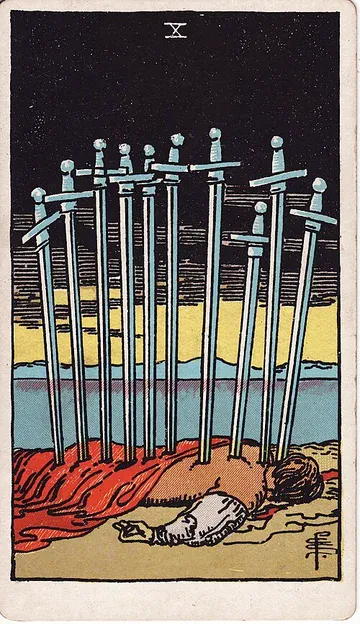
Ten of Swords
The night-rehearsal followed by the morning collapse. The Ten of Swords is the suit successor — the bottoming-out the Nine had been rehearsing toward. Together, they describe insomnia exhausting itself into depressive stillness, which is paradoxically the threshold of recovery. The body has insisted on rest. Allow the rest without adding rehearsal about needing it.
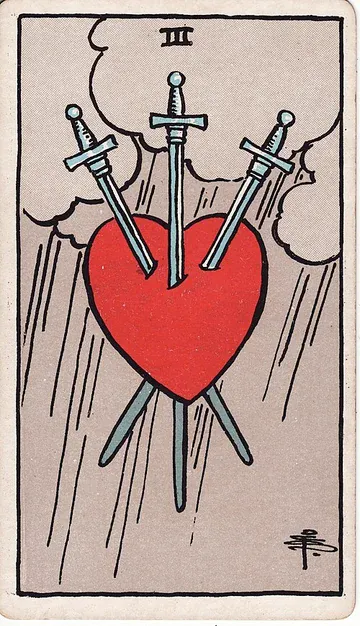
Three of Swords
The Three of Swords is the originating wound — the actual pierce, the news, the loss. The Nine is the months of nightly review of that pierce. Together, they describe a seeker whose grief has not metabolized because the rehearsal keeps reopening the wound. Grieve the original cut directly — speak it, write it, sit in it during daylight — so the night does not keep volunteering to do the work the daylight has refused.
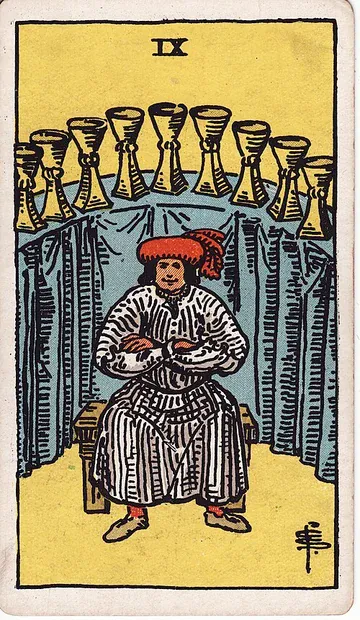
Nine of Cups
The deck's most precise tonal mirror. Both cards are nines — inner arrival on the dream-layer. The Nine of Cups is the wish granted, the figure pleased with cups behind him. The Nine of Swords is the figure unable to look at the swords behind him. The combination asks: what have you been keeping behind your back? Completion can take either form. The chosen form is partly a discipline.
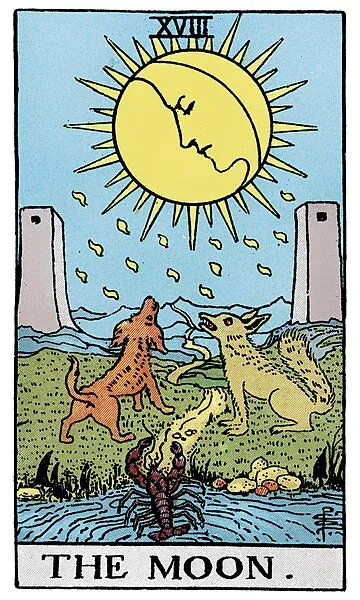
The Moon
The Moon as major modulator amplifies everything the Nine of Swords does. Lunar weather makes the night-rehearsal larger, more vivid, more convincing. Whatever conclusions arrive in this state should be held lightly until the moon's tide recedes. The integration is patience. Most of what the combination shows will be measurably smaller by daylight.

The Sun
The Sun as major modulator ends the rehearsal. The Sun is daylight, the child on the horse, the wall of sunflowers, the open field — the morning the night cannot survive. Whatever the night was certain of, the Sun has not heard the case. The integration is to wait. The Sun is on the way. The pair is the dawn arriving on schedule, regardless of how long the night felt.
Frequently Asked Questions
What actually breaks the three-a.m. loop in the Nine of Swords?
One of three things, and none of them is more thinking. Reversed, the card is the loosening of the night-loop. Sometimes daylight has actually arrived, sometimes the seeker has finally spoken the rehearsed monologue aloud to a trusted witness, sometimes the body has simply exhausted the cycle. The catalog of imagined wounds is shrinking. The cycle is breaking — slowly, quietly, often without drama. The card asks the seeker to honor the easing without immediately constructing a new rehearsal to fill the quiet.
Can I trust a decision made the morning after the reversed Nine of Swords?
You can, with one condition attached. Read the card as a conditional yes. The state that the upright card refused — the rehearsal-soaked seeker unable to receive a clean answer — has loosened. Decisions made now, in daylight, after sleep, with the rehearsal interrupted, are trustworthy. The condition is that the seeker honor the loosening rather than rush to act. Sleep, eat, walk in the sun, then ask the question. The yes will hold.
What changes in a relationship when someone finally says the night-thought out loud?
The loop loses its privacy, which was most of its power. In love, the reversed card describes the relationship beginning to be released from its night-version. The mid-night text wars are slowing. The catalog each partner had built privately is being put down, often because someone has finally said something honest in daylight. For singles, the long late-night case about being unlovable is being interrupted by a friend, a therapist, or the seeker writing it down and seeing how thin the case actually is in writing.
Is it a good sign if they bring me the thing they had been rehearsing alone?
It is the sign this card exists to mark: the long private interrogation is easing. The case the other person had been silently building — about how they let you down, or how the bond had drifted — is loosening, often because they have finally said something honest. Read the moment as load-bearing. Their bringing the rehearsal to you is the integration. Receive it gently; do not expand it into more than it is.
What should I do with the quiet once the night-loop lets go?
Leave it quiet. Honor the easing without immediately constructing a new rehearsal. Keep speaking — make the witness conversation a practice, not a one-time event. Protect the sleep architecture even when it feels unnecessary; it feels unnecessary because it is working. Walk in daylight. Forgive the past version of yourself who could not stop the loop. Practice mercy as a habit: when the night-self begins, answer it the same way every time — "You are tired. Go to sleep."