
Queen of Swords · Core Meaning
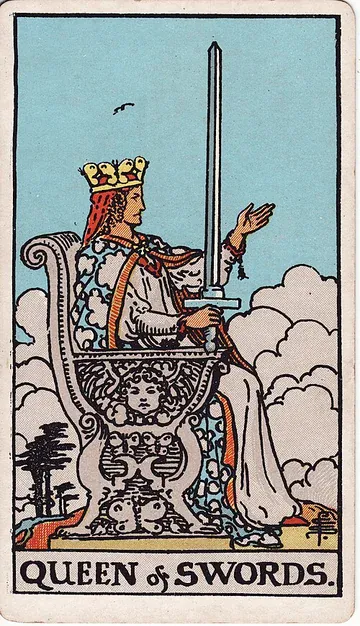
The Queen of Swords sits on a throne above the clouds, facing east. The clouds beside her do not block her view; they simply pass. The back of her throne is carved in low relief — cherubim above, butterflies below, the two old emblems of mind: the angel that knows, the soul that changes shape. Her right hand grips a sword held upright, point indicating the sky rather than any person in front of her. Her left hand is extended forward, palm slightly lifted, the gesture of an elder saying, "Go on. Tell me." High above her head, a single bird passes alone, in a sky that has just begun to turn transparent. Her face is calm and exact. She looks at us without pressing.
This is the card of the intelligence that has been through something. Not the brilliance of the Page of Swords, who is still bright with first ideas; not the edge of the King, who has long since accepted his sword as a tool of state. The Queen of Swords is the figure between them — the one who has lost what mattered most, once, and emerged not crushed but clarified. The traditional epithets, "the widow," "the divorcée," "the woman who has known sorrow," are not insults the deck is throwing. They are precise. The card describes the kind of seeing that becomes available only after a particular grief has been lived through.
The signature tension of the card is held in two simultaneous postures: the upright sword and the open left hand. She is armed and listening. She has not put the sword down — that would be the King's gesture, the one who has institutionalized his judgment. She still carries the blade because the blade is what survived loss with her, and she trusts it. But the left hand is the gesture that distinguishes her from every cold portrait of a sharp woman. The hand is open. The palm is forward. She is asking the petitioner to finish their sentence before she names the axis it turns on.
The traditional astrological signature places her across the Virgo–Libra cusp — Virgo's third decan into Libra's first, dates roughly 9/12 to 10/12, the autumn equinox at the center of her span. Virgo's analytical clarity meeting Libra's discernment of fairness; the harvest's last light meeting the equinox's exact balance. She is the queen of the season when air begins to turn transparent, when the year has stopped pretending it is summer, when the body knows it is moving toward dark. The decanic rulers (Mercury into Venus) give her the Virgo gift of fine distinction and the Libran gift of weighing without bias. The combination is rare — most courts of this register tilt either toward coldness or toward indecision. She does neither.
The kabbalistic placement, as a court Queen of Swords, is in Briah, the world of creation, channeling the Mother letter Heh through the suit of air. She is one of the throne-figures of mind: the receptive intelligence that takes what the world brings and shapes it into nameable form. Heh is the letter of breath, of window, of "behold" — the act of attentive seeing. The card lives at the level of mind that is still creative, still generative, but no longer naive. She has lost the illusion that thought can spare you from being hurt. What she has gained is the discipline of using thought, after the hurt, to keep from hurting others gratuitously.
Read the Queen of Swords the way you would read a photograph of someone who has just listened, in silence, to a long and slightly self-pitying complaint, and who is about to speak. The blade is upright. The bird passes alone. The east is opening. Whatever she says next will not flatter you and will not waste your time. The card is not a mirror that softens. It is a window held at the exact angle that lets the cold morning light in.
Queen of Swords · Love & Relationships
The bond this card describes requires honesty in order to function — not the painful honesty of the Three of Swords, which is the wound itself, but honesty as architecture. The relationship she describes — or invites — is one in which both parties have stopped trying to manage each other's perceptions. Each can say the difficult thing without it ending the room. The upright sword stands. The left hand opens. The card asks: can your love hold a true sentence?
For an existing long-term partnership, the Queen of Swords often arrives during a season of overdue conversation. There is a thing one of you has been postponing — a frustration, a hope you stopped voicing because it had stopped being received, a quiet resentment that has hardened into a lens. The card describes the morning the conversation finally happens, in measured tones, in daylight, without the catastrophic register the night had given it. Nobody leaves. Both people are slightly more recognizable to each other than before. The bond is not damaged by the truth; it is calibrated by it. This is the card of the marriage that has weathered an actual loss — a parent, a child, a job, a year of illness — and emerged into the kind of intimacy that softer cards cannot describe.
For a new spark, the Queen of Swords is more particular than romantic. The connection is intelligent. The conversation, even at the start, has a precision that surprises you both. They ask follow-up questions. They notice when you contradict yourself, gently. They tell you the small true thing about themselves on the second meeting rather than the curated thing. This is not a card of fireworks. It is a card of recognizing kin — someone whose mind moves at your speed and whose grief you sense without being told. The danger embedded in this beauty is misreading the precision as coldness. She is not cold. She is uninterested in performance. If you can sit with the absence of theater, what remains is rare.
For a single seeker asking whether love is possible, the Queen of Swords answers yes — and asks a return question that the card carries everywhere. Are you willing to be seen by someone who will not look away from the parts of you you have been hiding? She does not require perfection. She requires that you stop curating. The card suggests that the seeker's loneliness has often been a function not of unavailability but of unwillingness to be exact about what they actually want. The Queen of Swords' partner, when they arrive, will not be solved by hint. They will be solved by sentence.
For love after a wound, the card is one of the deck's most precise. She is herself the figure who has been through. She sits on a throne above clouds because the clouds beneath her are the loss; she has not erased it, she has lifted to where it does not block the view. The reading is direct: the wound did its work. You have not been ruined by it. You have been clarified. The next bond will be different, and the difference is not damage. It is discernment. The Queen of Swords does not promise the next person will arrive soon. She promises only this: when they arrive, the difference between this person and the one who hurt you is something you can recognize — and the recognition is itself the medicine.
For someone dating after a long period alone, the card describes the gift and the trap of having developed a strong taste. You know what you like. You know what does not survive the second date for you. The gift is that you waste no one's time. The trap is that "having taste" can quietly become a defense — a sword held forward rather than held upright. The card's instruction is to keep the left hand open. Hear them out. Let the morning have its full conversation before deciding the verdict. You are unusually good at reading people; that is your power. Power, mishandled, becomes pre-emption.
For long-distance partnerships, the Queen of Swords is a steadying card. She supports clarity over volume. The relationship that thrives at distance is one in which both parties say what is true rather than what fills the silence. She asks for the deliberate letter rather than the constant text, the scheduled conversation rather than the panicked check-in. The card describes a love that respects the other person's solitude as much as their company.
For couples in conflict, the Queen of Swords is one of the most useful cards in the deck. She does not take sides; she names the axis the disagreement is actually rotating on. Her presence in a reading suggests that the surface argument is not the real argument, and that the real argument can only be reached by one of you saying the postponed sentence in measured language. She is patient with the saying. She is not patient with the avoidance.
For the question of whether someone you have been quietly attached to is in love with you, the Queen of Swords delivers a specific answer: ask them. Plainly, in person, without preamble. Whatever they say will be more useful than the months of rehearsal you have been running. The card has zero patience for the long internal interrogation. The petitioner stands; she opens the left hand; you say it.
For the seeker whose love language is inquiry — who loves by examining, who needs to be sure — the Queen of Swords is uniquely your card and uniquely your warning. The same intelligence that protects you from being deceived can become the wall that prevents anyone from being trusted. The card invites you, this season, to let one question go unanswered for a week. To let one story your partner told stand without interrogation. To love, briefly, without surveillance. Not as discipline against your nature. As the practice that returns the sword to its upright position rather than letting it angle slightly forward.
Queen of Swords · As Feelings
Respect, of a particular and unsentimental kind, is what this queen reports. They have noticed your intelligence. They have noticed the moments you said the difficult sentence well. They feel about you the way they feel about a small number of people in their life — that you are the kind of person they would tell the true thing to, and that you would not flinch. This is not the warm sentimental texture of the Cups courts. It is a colder, rarer, longer-lasting feeling. They believe you can be trusted with the complicated version.
If they are reserved by nature, the Queen of Swords as feelings describes someone who is paying close, careful, almost forensic attention. They have read you. They have noticed the contradictions. They have decided, after weighing, that the contradictions add up to a person they want to know rather than to dismiss. The signal of their feeling is the precision of their questions. They ask things no one else asks. They remember details you mentioned once. The reservation is not coldness; it is the discipline of someone who does not want to perform an interest they do not yet feel certain of. Read the precision as love.
If they are demonstrative, the reversed register here matters — but for the upright Queen of Swords as feelings, demonstrative does not mean effusive. It means they show their care through the cleanness of their language. They tell you what they want. They tell you what they do not. They schedule the time and keep it. They are accountable to their word. The bird passing overhead is a single bird; their attention to you is undivided in the moments they have allocated to you, and outside those moments, they are not pretending to be available. This is one of the deck's most underrated portraits of love: care expressed as reliability rather than as ardor.
For a long bond, the Queen of Swords as feelings describes a partner who has accepted you in the particular shape you actually are. They have stopped wishing you were softer or sharper or more available or less. They have done the internal work of grieving the imagined partner they once thought you might become. What is left is recognition of the actual you. The card here is one of the more peaceful long-bond signals in the deck — not the romance of the Two of Cups, but the durable companionship of two people who have looked at each other directly and chosen to stay.
For a new connection, the Queen of Swords as feelings can describe someone who is privately impressed by you and who is also being deliberate. They have decided, somewhere in their interior, that you are a person worth being careful with. They do not want to begin and then have to retract. They are not playing it cool — they are honoring you by waiting until they can be exact. The card suggests the seeker not mistake the deliberateness for indifference. The deliberateness is the offering.
For an ex, the Queen of Swords as feelings is one of the more complex readings. They feel clear about you now, in a way they were not while you were together. The clarity is not always favorable; it is honest. They have done the work of looking at the relationship without the distortion of being inside it. They may have arrived at conclusions that are uncomfortable for both of you. They are not running a private campaign against you. They are also not pretending the bond was simpler than it was. The card asks the seeker to let them have the clarity without trying to shape it. If reconciliation is the question, see the reversed card; if respect is the question, the upright card answers yes.
For someone you suspect is angry with you but has not said so, the Queen of Swords as feelings is a useful mirror. If they were angry, you would know. The card describes a person who does not bank grievance. They name the issue when they see it. The fact that they have not named one is information. The seeker's worry that there is a hidden critique is more often the seeker's own night-rehearsal than the actual feeling state of the queen-shaped person across from them.
For a partner with whom you have weathered hard years, the Queen of Swords as feelings describes a love that has been forged rather than discovered. You have seen each other at worst. You have argued through the things that ended other people's bonds. The feeling is not innocent. It is also not exhausted. It is the kind of love that has been calibrated by repeated honesty until it can hold weight that simpler loves cannot. The card respects this love unusually. The deck is generally suspicious of intensity; this love is not intense, it is structural.
For someone you barely know but have interpreted for, the Queen of Swords as feelings asks the seeker to slow down. They have not had the data yet to feel anything precise about you. What you are reading as deep feeling may be the projection your hope has cast onto a small number of attentive moments. The card respects the possibility. It just insists on patience. A queen does not declare. She watches. Let her watch. Show up consistently. The verdict will arrive in its own time, and it will be more accurate than the version your hope is currently composing.
A small caution: the Queen of Swords' feelings, even at their warmest, do not look like the Cups feelings. The reader who is hoping for the Knight of Cups will misread her as cold. She is not cold. She is exact. If you can let exactness be the texture of love, the card answers in your favor. If you cannot, no card answer will satisfy you, and that is information worth sitting with.
Queen of Swords · Career & Work
Every meeting eventually needs the person who can name the axis it is rotating on. The room has been talking around the problem for an hour. Someone, finally, says the actual sentence. The room becomes uncomfortable for half a minute, and then becomes useful. The card is the figure who said the sentence — and who then opened the left hand and let the room respond. She is not cruel. She is unwilling to waste anyone's afternoon.
For someone asking whether they are doing well in a current role, the Queen of Swords answers carefully. The work itself is being done well. The recognition may be lagging because the kind of intelligence the card embodies is often invisible to organizations that prefer warmer signals. You are the colleague people consult quietly when they need the truth before going to the official meeting. The card validates this role. It also asks: is the unofficial respect satisfying, or are you waiting to be made official? If the latter, name it. The card does not reward those who hope to be noticed without asking.
For someone considering a new role, the Queen of Swords supports the move that requires you to bring more of your judgment, not less. The role that uses you well is the one in which your discernment is the asset, where your manager wants the difficult sentence rather than the diplomatic one. The card warns against roles that nominally hire your expertise but punish its exercise. Within ninety days it is clear whether the manager wants the queen or the chorister. If they want the chorister, leave.
For the entrepreneur or freelancer, the Queen of Swords is one of the deck's clearest signs of professional maturity. The practice has stopped being driven by the need to please and has become driven by the need to be accurate. Clients are paying for the truth they cannot get elsewhere. The card describes the consultant whose unique value is the willingness to tell the difficult finding plainly, in a voice that does not flinch and does not preen. This is rare and well-paid when calibrated correctly. The trap, in this register, is the slow drift toward harshness that mistakes itself for clarity. The card insists on the upright sword and the open left hand. The diagnosis must be true; the delivery must respect the petitioner.
For the creative worker — writer, designer, artist, editor — the Queen of Swords is the editor in your own head who has finally become useful instead of cruel. The internal critic has matured. It can now name what is wrong with the draft without convicting the writer of being a fraud. It can edit a sentence rather than the soul that wrote the sentence. The card supports the discipline of letting this voice run while the work is in progress and dismissing it once the work is closed for the night. The same intelligence that improves the draft, when it stays past the editing hours, becomes the Nine of Swords. Honor the boundary.
For someone in the middle of a job search, the Queen of Swords supports the strategy of clarity over volume. The cover letter that says exactly what you want and why, to a small number of carefully chosen targets, will outperform the hundred generic applications. The card describes the search that respects both the seeker's time and the receiver's time. Hiring managers are tired. The Queen of Swords letter is the one they read to the end because it does not waste their afternoon.
For someone managing a difficult colleague or a hostile workplace, the Queen of Swords offers a precise instruction: name the issue once, in measured language, with specifics, in writing. Do not name it five times in different tones. Do not name it through hints. Once, plainly, in writing, with the date. The card supports this discipline as a protection of both the worker and the workplace. Most workplace cruelty thrives in the ambiguity that the queen refuses. Removing the ambiguity is itself the medicine.
For questions of authority and recognition — promotion, acknowledgment, raise — the Queen of Swords is unusually direct. Ask for what you want. Use the precise words. Bring the document. The card has zero patience for the long internal rehearsal of asking. She asks. She listens to the answer. If the answer is no, she takes it as data and decides whether to stay. If the answer is yes, she says thank you and continues working. The seeker who has been silently hoping to be seen for two years, the card warns, will not be seen. The seeker who asks, in measured language, with evidence, in daylight, will receive a response. The response may not be what they hoped, but the response is the integration. The hoping was the suffering.
For the decanic reading — Virgo into Libra, the late-September seeker — the Queen of Swords often describes a worker whose specific gift is fine distinction and whose specific suffering is the way that gift turns inward into perfectionism. The same eye that sees the typo in the report sees the typo in the self. The card asks for the discipline of pointing the eye outward. Use the precision on the work. Forgive the same precision in yourself for one hour each evening. The work improves; the worker survives.
For ambitious seekers worrying about whether they have what it takes, the Queen of Swords is gentler than she looks. The card is not predicting the result. It is asking whether the seeker has built the structure that lets ambition be sustained. The structures it asks for are unromantic: clear language, written records, a willingness to name what you want, a refusal to bank grievance, mercy for yourself when the result is mixed. Ambition without these structures becomes either harshness or burnout. With them, it becomes a long, quiet, productive career.
For the question of leaving a long-tenured role, the card respects departure when the role no longer requires the queen's intelligence. She does not stay because the title is comfortable. She does not stay because the colleagues are familiar. She stays as long as the work asks for what she actually has, and she leaves when the work has stopped asking. The card does not make the decision for the seeker. It clarifies the question on which the decision should turn.
Queen of Swords · Money & Finances
Clear-eyed judgment is the financial register here — not abundance, not scarcity, but clarity. She knows what she has. She knows what she owes. She knows what she will not buy because the buying would compromise the freedom the money is supposed to be protecting. The card is the financial mind that has stopped pretending the numbers are different from what they are.
For a question about whether a financial bet will pay off — a side business, an investment, a major purchase — the Queen of Swords answers in the form of the question she returns. Have you read the document? Have you asked the inconvenient questions? Have you checked the assumptions you are making about your own future income? The card supports the move that has been examined; it cautions against the move that has been hoped for. She does not predict the outcome. She predicts that an examined decision survives a bad outcome better than an unexamined decision survives a good one.
For someone in actual financial difficulty, the Queen of Swords is one of the more practically useful cards in the deck. She does not soften the situation. She also does not catastrophize. She names what the difficulty is in plain language, on paper, in daylight, and asks the seeker to stop carrying the difficulty as a feeling and start carrying it as a number. Numbers can be addressed. Feelings can only be metabolized. The card supports the structural move: a written budget, a phone call to the bank, a conversation with the partner that does not happen at midnight, one concrete action this week.
For someone managing well financially but unable to feel managed, the Queen of Swords is the corrective. The numbers are fine. The internal alarm is louder than the numbers. The card asks the seeker to honor the numbers as data and to hear the alarm as legacy. Often this seeker grew up with scarcity, and the scarcity-shaped nervous system has not noticed that the present is different. The discipline is to look at the numbers, in writing, weekly, until the body learns the new state. She is patient with this practice. She insists on it.
For a question about a major purchase, the Queen of Swords supports the decision that has been thought through across more than one daylight. Sleep on it. Look at it again next week. Notice whether the desire is consistent or merely intense. The card has zero respect for the urgency that says the decision must be made now. Real opportunity respects deliberation. The opportunity that demands haste is, more often than not, the opportunity that does not survive scrutiny.
For investments and speculation, the Queen of Swords cautions against trading from any state that is not the queen's state. Do not trade angry. Do not trade after a hard conversation. Do not trade at three in the morning. The card supports a written rules-based discipline rather than instinct, particularly for the seeker whose instinct has begun to be contaminated by anxiety. Boring rules win.
For debt and recovery, the Queen of Swords supports the slow, structural climb out. List the debts in writing. Order them by interest. Address them one at a time. Do not borrow against the future to fund the present. The card describes the seeker who has come back from a hard financial period intact because they refused to lie to themselves about the math. There is dignity in this discipline. The card honors it.
For windfall — inheritance, unexpected income, a gift — the Queen of Swords advises a season of stillness before allocation. Let the money sit. Take advice from someone whose judgment you trust. Resist the urge to allocate immediately, because the urgency to allocate is often the discomfort of having received rather than the wisdom about what to do with it. She does not tell you not to enjoy the money. She tells you to wait until enjoyment can be calibrated rather than impulsive.
For questions about negotiation — salary, contract, fee — the Queen of Swords is one of the deck's strongest cards. She knows her worth. She has it written down. She asks for it, in plain language, in writing, with precedent, and she does not apologize for the asking. The card supports the discipline of preparing the negotiation in daylight, rehearsing the language, anticipating the counter, and keeping the left hand open while the other party responds. Most underpayment in careers, the card suggests, is the result of asking from the night-state — from anxiety, hedging, pre-emptive concession. She asks from the throne. The number changes accordingly.
A practical move when the Queen of Swords appears in a money question: write the actual numbers on a single page, in daylight, this week, and read them aloud once. The card responds to evidence and to articulation. The bank balance read silently inside the head is not the same number as the bank balance spoken aloud. Speaking it returns it to its actual size, which is usually different from the size it had become while it lived only in worry.
Queen of Swords · Health
Skull, lungs, throat — the suit's old body associations set the terms of this reading. Air, in the body, is breath. Air, in the throne, is articulation. The card describes the place where these systems meet — the breath that becomes voice, the thought that becomes spoken sentence, the silent self-narrative that finally becomes a question asked aloud to a doctor. The Queen of Swords is, in health, the patient who has stopped self-diagnosing in private and has finally booked the appointment.
For sleep specifically, the Queen of Swords is the card of the seeker who has begun to honor their own rhythm. The body knows when it needs rest. The card asks for the discipline of trusting that signal rather than overriding it with the work or the screen or the fear of dreams. The thin gray light at the foot of her throne is dawn — she has slept; she has woken when sleep was complete; she rises into the day without the residue of insomnia. This is the model the card recommends: regular sleep, dignified hours, the room kept dark, the phone kept elsewhere.
For someone with anxiety as a diagnosed condition or a long-running pattern, the Queen of Swords is one of the deck's better allies. She does not deny the anxiety. She does not dramatize it. She names it plainly and treats it the way she treats other facts — with the discipline of articulation. The instruction is to write the anxiety down in the morning, name it with as much precision as possible, and read it back later in the day. Most anxiety, named plainly in daylight, becomes smaller by evening. None of this is medical advice — keep your practitioners, take your medicine, do the work — but the card validates the practice of articulation as one of the body's reliable tools.
For respiratory health, the Queen of Swords is precise. She rules the lungs and the throat. The card invites attention to breath patterns: the shallow tight breath of the held emotion, the deeper slower breath of the released one. She supports breath practices over more dramatic interventions for the management of the body's daily anxiety. The body responds to twenty deliberate slow exhales the way a courtroom responds to a measured witness — with attention. The practice is small. It is also reliable.
For voice and throat — for those whose work is teaching, speaking, singing, presenting — the Queen of Swords is a warning and a blessing. The blessing is that voice, used well, is the seat of her power. The warning is that voice held back, swallowed, postponed, builds pressure in the throat that the body eventually metabolizes as physical strain. The card asks: have you been swallowing the thing you needed to say? If the throat is sore, ask not first about pollen but about whether there is an unsent sentence in the chest.
For chronic conditions, the Queen of Swords supports the patient who has read the literature, asked the inconvenient questions, and become a partner with the practitioner rather than a passive recipient of treatment. She is the patient who keeps the symptom diary, who tracks the medication response, who arrives at the appointment with the written list of questions. None of this replaces medical care; all of it makes medical care more useful. The card honors the discipline.
For mental health practice — therapy, medication, self-care — the Queen of Swords supports the long, undramatic practice of showing up. The work that produces durable change is rarely the dramatic single insight; it is the repeated small honesty across years. She is patient with this and unimpressed by quicker fixes. The card warns against substituting consumption of self-help content for actual practice. Reading the book is not doing the work. The book opens; the work is what happens after.
For someone managing addiction or compulsive behavior, the Queen of Swords is one of the deck's clearer mirrors. She does not moralize. She names. She asks: what does the behavior actually deliver, and what does it actually cost, in honest accounting? Most habits survive only because the accounting has been left vague. Forced into clear language, the cost-benefit re-balances. The card supports the integration of the behavior into a life rather than its dramatic exorcism. Recovery is structural, slow, and unromantic. She is good at it.
For questions about the body's mid-life — perimenopause, menopause, the shifts of the second half of life — the Queen of Swords is uniquely fitting. She is, in much traditional reading, the figure of the woman who has crossed into this stage without losing herself. The card supports the honesty of the transition: speaking about it plainly, with the doctor and with the partner, refusing the cultural pressure to perform a youth that is no longer the truth. The body is changing. The mind is, often, sharpening. The card honors both.
For body practices — yoga, walking, swimming, weight training — the Queen of Swords supports the practice that becomes a discipline rather than a phase. The card cares less about which practice and more about whether it has been kept across seasons. She is suspicious of the dramatic six-week program; she trusts the modest five-year habit. The body responds to consistency more than to intensity, and the queen knows this from having lived long enough to test it.
Preferring the modest five-year habit to the dramatic program is a temperament, not medical advice. The card simply names a felt season and offers an honest mirror: the body trusts the voice that finally says the true sentence, and the body is patient with the long discipline of saying it again tomorrow.
Queen of Swords · Spirituality
Spiritually, the Queen of Swords is the figure of the survived intelligence — the seeker whose practice has been calibrated by loss into something usable. The card lives in Briah, the world of creation, channeling the Mother letter Heh through the suit of air. Heh is breath, window, the act of attentive seeing. The card describes the spiritual life that has stopped trying to spare itself from being hurt, and has begun, instead, to use the hurt as the polish that makes the seeing exact.
The bird passing above her head, alone, is the card's spiritual signature. Her thought rises higher than the throne. Truly clear judgment, the bird is saying, must first stand outside the situation. The seeker who is too embedded in their grief, their argument, their hope — that seeker cannot yet see what the bird sees. The practice the card invites is not detachment. It is the discipline of finding, for one hour each day, the place outside the immediate weather. Walking, sitting, journaling without comment, watching a body of water — any practice that lets the bird's altitude become accessible.
For seekers in active practice — meditation, prayer, ritual, devotional work — the Queen of Swords often arrives when the practice has matured past its initial enthusiasms and become a discipline. The dramatic visions have receded. The morning sit is just the morning sit. The seeker may, at this stage, fear that the practice has stopped working. The card disagrees. The maturation is the work. Mystics across traditions describe this stage; it is the long middle, less photogenic than the early epiphanies and more reliable. She supports the seeker who keeps showing up.
For seekers exploring belief, the Queen of Swords is friendly to honesty about doubt. She is uninterested in performances of certainty. The card supports the seeker who can sit, in the same evening, with both the longing for the tradition and the genuine questions about it, without resolving either prematurely. Most spiritual seriousness, the card suggests, lives in this honest middle. Premature resolution — either dogmatic acceptance or dogmatic rejection — is the soul's equivalent of the rushed financial decision. Wait. Sleep. Let the question keep working.
For the question of path, the Queen of Swords often appears for the seeker who has been quietly outgrowing a tradition that they no longer find themselves entirely inside but cannot bear to formally leave. The card respects the slow exit. She does not dramatize departure. She does not require the seeker to issue a public renunciation. She supports the integration that quietly relocates the practice to a place that fits — sometimes inside the same tradition, lived more honestly; sometimes adjacent to it; sometimes elsewhere entirely. The decision is between the seeker and their own voice. The card insists only that the voice be honest with itself.
A specific spiritual practice the card invites is the discipline of the daily true sentence. Each morning, write down one true sentence about the present state of your life. Not aspirational. Not what you wish were true. Not what would be socially advantageous to say. One actual sentence. Some mornings the sentence will be small ("I am tired"); some mornings it will be large ("I have outgrown the role I have been performing"). The accumulation of these sentences, across months, is the path the card describes. She does not need elaborate ritual. She needs the willingness to say the true sentence and to keep saying it.
A second practice: the deliberate hour outside the immediate weather. Not as escape. As altitude. Walk somewhere with a horizon. Sit somewhere with a body of water. Read a long book. Listen to music written before you were born. The bird passes overhead in the card because the queen knows that judgment which has not stepped outside the situation cannot be trusted. Her counsel is structural: build the altitude into the day so the seeing is available when needed.
A third practice: practice mercy as an articulation. Not as a feeling. The Queen of Swords' mercy is exact — she names the thing rather than dressing it up, but she names it without contempt. The discipline is to find the language that is true and respectful at the same time. Most cruelty in our exchanges, in any tradition, comes from sacrificing one of these to the other. Her practice is to refuse the sacrifice. The sentence must be true, and the sentence must respect the petitioner. Both. Always.
The card's spiritual question, finally, is the question of voice. The Queen of Swords seeker has often been silent in places where they should have spoken — about a wound, about an injustice, about a hope, about a refusal. The card does not ask for theatrics. It asks for the deliberate, measured, daylight saying of the things that have lived too long in private. The throne is high above the clouds. The view is open. The east is light. What needs to be said?
Queen of Swords · Yes or No
Conditional yes — if honesty is the currency you are willing to spend.
The Queen of Swords upright is one of the deck's more demanding yes-cards. She does not refuse the question; she conditions the answer. The yes is contingent on whether the seeker is willing to hear the rest of the sentence. The path is open if you are willing to be exact. The role works out if you can speak plainly. The bond holds if you can say the postponed thing in measured language. She will not bless an unexamined yes.
For yes-or-no questions about a relationship, a job, a move, a decision: the card answers yes when the seeker is willing to bring their full intelligence to the situation rather than their hope or their fear. The promotion that comes through the queen's gate is the one the seeker has prepared for honestly. The relationship that survives is the one in which both parties have chosen seeing over sentiment. The move that lands is the move that has been examined with the inconvenient questions asked. None of this is forbidding; it is precise. She is not a stingy yes. She is an accurate one.
For questions about whether someone is being honest with you, whether an offer is genuine, whether a plan will hold: the Queen of Swords is unusually clear. Yes, if you are willing to ask the second question, in writing, with the specifics. Most deception thrives in the ambiguity the queen refuses. Removing the ambiguity is itself the medicine. The card almost never appears for situations in which the actual answer is hidden. It appears for situations in which the answer is available and the seeker has been postponing the asking.
For questions about whether someone is in love with you, whether a relationship will reconcile, whether a friendship will return: the Queen of Swords' answer is to ask, in daylight, in plain language, in person if possible, and to accept whatever response comes as data. The card is uninterested in the long internal interrogation. The yes or no it can give is not as useful as the yes or no the actual person can give if asked. She invites the asking. She supports the receiving.
For timing — will it happen soon, will it happen at all — the Queen of Swords answers in the affirmative when the seeker has stopped trying to manage the timing through anxiety. The thing arrives when it arrives. Your job is to be ready, in the queen's sense of ready: clear about what you want, prepared to receive it cleanly, unwilling to negotiate it down to a smaller version because the smaller version is more comfortable. She will not rush the cosmos. She also will not let you waste the wait by spending it in worry.
For binary decisions — should I act, should I wait — the card answers with a question. What does the morning version of you, having slept, having eaten, having walked, decide? That is the answer. Whatever the night version decides, the queen distrusts. Whatever the rested daylight version decides, she supports. The card is consistent across decisions: trust the version of yourself that operates from the throne, not the version that operates from the unmade bed.
For the question of whether you deserve something — a promotion, a partner, a rest — the Queen of Swords answers yes, plainly, and then asks whether you are willing to ask for it. Deserving is not the question that interests her. Asking is. Many seekers wait, year after year, for the deserving to be confirmed by some authority that will never arrive. The queen does not wait. She asks. She receives the response. She continues from the response.
The cleanest yes the Queen of Swords gives is to one specific question: will the truth, told in measured language, in daylight, improve this situation? Yes. Almost always. The card has a small number of certainties, and this is one of them. The exception is the situation in which the truth, told well, has already been told and rejected. There, the answer is to leave the room. But before the leaving, the saying. The card insists on the saying.
A note for the seeker hoping for a softer card: the Queen of Swords is not unkind. She is exact. If exactness reads as cold to you in this season, sit with the possibility that the longing for warmth is, this time, the longing to be flattered. Flattery is what the deck most reliably refuses. She offers something rarer: an answer you can build on.
Queen of Swords · Advice
Say the postponed sentence, and say it this week. There is one — in your work, in your relationship, in the conversation with a parent or a friend or yourself — that has lived too long in the chest. The card asks you to bring it into the room, this week, in measured language, in daylight, with the left hand open while the other person responds. The card has zero patience for the long internal rehearsal. The integration is the saying.
If there is one specific instruction the card offers, it is this: write the sentence first. Not as evasion. As precision. Sit at the kitchen table and write the actual words you intend to say. Read them aloud to yourself. Edit them so the truth survives intact and the contempt does not slip in. Then say them, when the moment arrives, from the document you have already shaped. Most postponed sentences fail in delivery because they were composed in the mouth at the moment of speaking. The queen prepares her words. So should you.
A second instruction: keep the left hand open. After you have said the difficult sentence, stop talking. Do not fill the silence with softening, qualifying, retracting. Let the petitioner respond. The card's signature gesture — the upright sword and the open palm — is the model. The blade has done its work. Now the listening begins. Many honest sentences are undone by the speaker's failure to wait for the response.
A third instruction: refuse the late-night sentence. Anything composed after eleven at night must wait until at least sunrise before it is delivered. This is the same discipline the Nine of Swords requires, and the queen, who lives one card up the suit's ladder, knows the rule from the inside. The night-version of the sentence is not the queen's voice. Wait for the morning. The morning version will be cleaner.
A fourth instruction: build the daily true sentence into the structure of your week. Each morning, write one true sentence about the state of your life. Some mornings small, some large. The accumulation is the path. Most people do not have access to their own honest voice because they have not asked for it for years. Asking once a day, on paper, returns it. Once it returns, it becomes available for the larger sentences when those are needed.
A fifth instruction: stop banking grievance. The queen does not collect injuries to be deployed later. She names the issue when she sees it. She is done with it once named. The discipline is to refuse the comfort of the silent grievance and to require yourself to either name the thing now or release it without naming. Banking grievance is the slow corruption that turns the queen into the reversed queen. The card insists on the discharge of grievance into clear language, on time, with respect.
A sixth instruction: practice the altitude. Each day, find one hour in which you are not embedded in the immediate weather. Walk without a phone. Sit by water. Read something written in another century. The bird passes over the throne in the card because the queen knows judgment that has not lifted out of the situation cannot be trusted. The hour is structural. The hour is where the queen actually lives.
A seventh instruction, gentler than the others: forgive yourself for the past silences. The card describes a seeker who has, in many years, not said the things they should have said, and who carries the silence as private regret. The integration is not to flagellate the past self. The integration is to begin saying now what was not said then. The past silences are released by the present sentences, not by being argued with retrospectively.
Practical advice for the day after the card appears: identify the postponed sentence, write it, sleep on it, refine it in the morning, deliver it in measured language, and stop. Do not deliver it five times. Do not deliver it through hints. Once, plainly, with the date if necessary, in daylight, with the left hand open. The card responds to this discipline more than to any further introspection.
A final instruction, from the card's deepest layer: love by listening. The seeker who carries the queen's intelligence has often been valued for their capacity to name things, and has begun to perform the naming as their offering. The card asks for the inverse practice: love the people in your life by hearing them out before you name. The upright sword waits. The left hand opens. The petitioner finishes their sentence. Then, and only then, does she speak. This is the deepest love-work the card carries, and the seeker often discovers that the relationships in their life rearrange around the new posture more than they would have rearranged around any sharper tongue.
Queen of Swords · Card Combinations
The Queen of Swords reads especially clearly next to certain other cards because her particular weather — survived intelligence, exact language, the gaze that has been polished by tears — sharpens or softens depending on what stands beside her. The five pairings below are load-bearing: a reader holding the Queen of Swords with one of these will learn something they would not get from either card alone.
Queen of Swords + Three of Swords
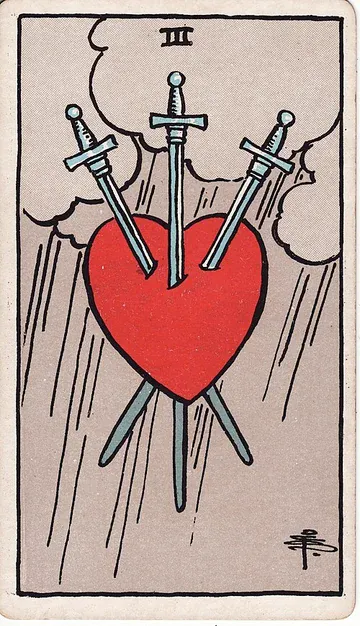
The wound and the survivor of it, in the same draw. The Three is the cut — the news, the betrayal, the loss. The Queen is the figure who has already taken that cut and emerged not destroyed but clarified. Together, the cards describe a seeker either currently inside the cut who needs to remember that the queen is the future on the far side of it, or a seeker who carries the queen's intelligence and is being asked to look back, with mercy, at the Three of Swords version of themselves who once thought the cut would be the end. The integration is to honor the wound that whetted the blade.
Queen of Swords + King of Swords
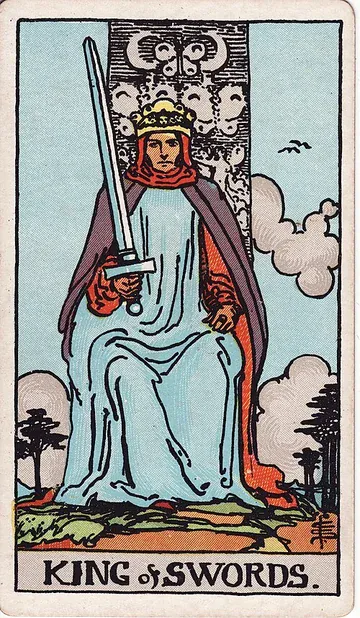
The two thrones of air. The queen still holds the sword angled slightly in invitation; the king holds his vertical, in command. Together, the pairing is the deck's portrait of a partnership of intelligences — two minds that have agreed to a shared discipline of clarity. This combination often appears in readings about a working relationship, a consultancy, a co-founded practice, a marriage built on intellectual respect. The card pair is unusually durable when calibrated. The danger is that one will quietly take the other's voice if the boundary of authority is not articulated. The integration is the explicit division of which axis each of them rules.
Queen of Swords + Justice (XI)
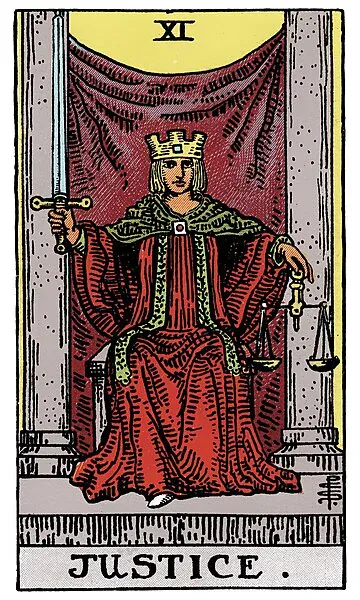
The cosmic form of clear judgment beside the human queen who has lived it. Justice is the Major modulator of the entire suit of swords — the formal, balanced, archetypal weighing. Beside the Queen of Swords, Justice is the seeker called to make a particular decision with both the human's earned wisdom and the cosmic standard's discipline of fairness. This combination appears in readings about leaving a marriage, taking a case, making a public statement, declaring a position. The card pair insists on both the personal gravity and the wider standard. The integration is to bring both to the moment of decision.
Queen of Swords + Queen of Cups
The water-queen across from the air-queen — feeling against thinking, but only on the surface. Both are queens; both rule by being the receptive intelligence of their suit. The Queen of Cups loves by intuition, by holding, by letting the water of feeling carry the petitioner. The Queen of Swords loves by clarity, by articulation, by the upright sword and the open palm. Together they are the deck's portrait of the seeker who has access to both — who can feel without being submerged, who can see without becoming cold. This pairing often appears in readings about a friendship between two close women, about the seeker's own integration of feeling and thinking, about a relationship that has matured past either-or. The integration is to refuse the false choice.
Queen of Swords + Page of Swords
The same suit, two stages apart on the court ladder. The Page is the first bright intelligence — curious, alert, a little reckless, untested by real loss. The Queen is what that Page becomes if the Page survives well. The combination appears in readings about a teacher and student, a parent and adult child, a mentor and protégé, the seeker's own younger self and present self. The card pair invites the queen to remember the page she once was, and to extend mercy to the version of intelligence that has not yet been clarified by grief. It also invites the page to recognize that the queen's apparent sharpness is the older form of their own brightness, and not a different kind of person.
Card Combinations
Three of Swords
The wound that whetted the blade. The Three is the cut — the news, the betrayal, the loss. The Queen is the figure who took the cut and emerged not destroyed but clarified. Together, the pair describes either a seeker currently inside the wound who needs to remember the queen is on its far side, or a queen-shaped seeker being asked to look back, with mercy, at the version of themselves that did not yet know they would survive it.
King of Swords
The two thrones of air. The queen still angles the sword in invitation; the king holds his vertical, in command. Together, the pair is the deck's portrait of a partnership of intelligences — two minds that have agreed to a shared discipline of clarity. Durable when calibrated; corrosive when one party silently takes the other's voice. The integration is the explicit articulation of which axis each of them rules.
Justice
The cosmic form of clear judgment beside the human queen who has lived it. Justice — Libra, air, the formal balanced weighing — modulates the entire suit, and beside this queen it amplifies her gift and her risk. The combination appears for the seeker called to make a particular decision with both earned wisdom and the cosmic standard's discipline of fairness. The integration is to bring both gravities to the moment.
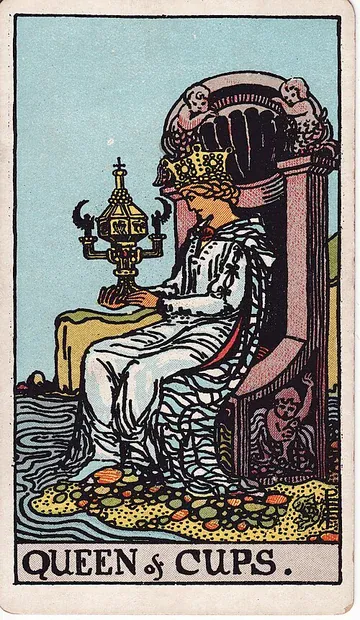
Queen of Cups
Water-queen mirror to her water-within-air. The Queen of Cups loves by holding, by intuition, by letting feeling carry the petitioner; the Queen of Swords loves by clarity, by articulation, by the upright sword and the open palm. Together they portray the seeker who has access to both — who can feel without being submerged and see without becoming cold. The integration is the refusal of the false choice.
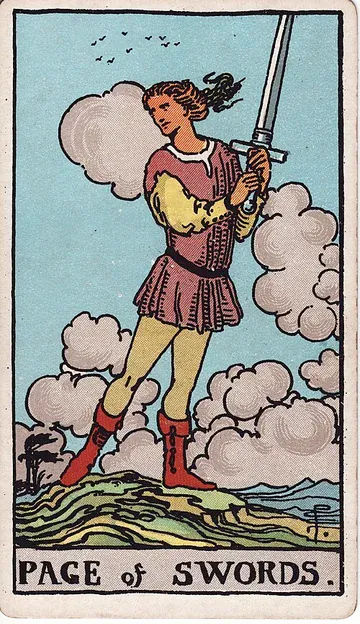
Page of Swords
Same-suit court ladder, two stages apart. The Page is the first bright intelligence — alert, curious, untested by real loss. The Queen is what that page becomes if it survives well. Together the pair invites the queen to remember the page she once was, and the page to recognize the queen's apparent sharpness as the older form of their own brightness, polished by everything between them.
Frequently Asked Questions
What is the open left hand of the Queen of Swords for?
It is the invitation that keeps her raised sword from reading as a threat. She is the card of the survived intelligence. She sits on a throne above the clouds with the sword held upright and the left palm open in invitation — a figure who has lost what mattered most, once, and emerged not crushed but clarified. The card describes the gaze that has been polished by tears and now lands exactly on the axis a thing turns on, and the discipline of speaking the true sentence in measured language.
Does the Queen of Swords bless a decision I have not examined?
She does not, and she says so without apology. Read the card as a conditional yes. The path is open, the role works out, the bond holds — if you are willing to bring your full intelligence and say the postponed thing in measured language. The card is not a stingy yes; it is an accurate one. She will not bless an unexamined yes, and she has zero patience for the long internal interrogation that postpones the actual asking.
Can a relationship survive being told the truth in plain language?
That is the question this queen puts to a bond. In love she describes the relationship that requires honesty to function — the relationship in which both parties have stopped managing each other's perceptions and can say the difficult sentence without ending the room. For singles, she promises that the next bond will be calibrated by the wounds you have survived rather than damaged by them. The card respects love expressed as reliability and clear language rather than as theater.
Is precision a form of affection when the Queen of Swords describes feelings?
In this court it is the principal one. The other person feels a particular kind of respect for you. They have noticed your intelligence, the moments you said the difficult sentence well, and have decided you are someone who could be trusted with the complicated version. The signal is precision rather than warmth — the careful question, the remembered detail, the kept appointment. Read reliability as the offering.
What does survived grief do to the quality of someone's seeing?
It polishes it. The lesson of this queen is to let the survived loss become the polish that makes the seeing exact. The card lives in Briah, channeling the Mother letter Heh through the suit of air — breath becoming articulation, silent self-narrative becoming the spoken true sentence. The practice is the daily discipline of saying one true thing in measured language, building the altitude that lets the bird pass overhead, and refusing the comfort of banked grievance.
Continue Reading
Queen of Swords · Card overview · symbols · correspondences →
Return to the full card view — image, symbols, sensory correspondences, and Hermetic axes.
Read the reversed meaning →
Read the same depth on the opposite orientation.
Draw your reading now →
Bring this card to a question — open a quiet ritual.