
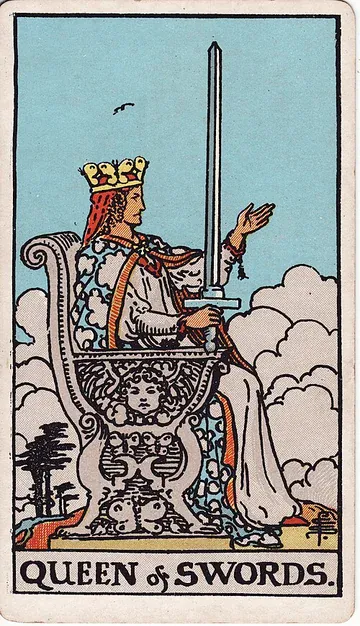
Queen of Swords Reversed · Core Meaning
The surviving has not yet been metabolized, and the intelligence shows it. The figure is still on the throne, still holding the sword — but the angle has shifted. The blade is no longer pointed at the sky. It points slightly forward now, or slightly inward, at the wrong target. The left hand has begun to close, fingers curling toward the palm in a fist or a grip rather than an open invitation. The single bird passing overhead is no longer noticed. The clouds beside the throne are no longer transparent; they have begun to obscure the view rather than pass through it. The east is still where the morning will rise, but the figure has stopped looking that way.
This is the card's central knot: the same eye that learned to see clearly through grief has begun to look for grief everywhere. The same tongue that learned to say the true sentence has begun to deliver true sentences with a chill that the upright queen would have warmed by a degree. Nothing said is incorrect. Everything said costs more in the room than it should. The colleague flinches and stops bringing problems to her office. The partner withdraws and stops mentioning the small things that used to be mentionable. The friend, slowly, stops calling. The reversed queen is, often, the last to notice.
There is a second flavor of the reversed card, equally important: the blade turned inward. The same precision that once examined the situation has begun to examine the self with the same forensic chill, and the self does not survive that examination. The reversed queen, in this form, has become her own most exacting prosecutor. She is sharper to herself in private than she would ever be to anyone in the room. The Nine of Swords pattern is adjacent here — the night rehearsal of inadequacies — but the reversed queen's version is more articulate, more precise, more devastating because she actually has the language. The same mind that could have been her best friend has become her most fluent enemy.
There is also a third reading, more difficult to name. Sometimes the reversed card is the figure who has used "honesty" as a permission slip for cruelty. She tells herself she is just being direct. She tells herself the petitioner needs to hear it. She tells herself the cold phrasing is more useful than the warm one. The card warns this version honestly. Directness without warmth is not the queen's gift. It is the queen's pathology. The upright card holds both the upright sword and the open palm, simultaneously. The reversed card has dropped the palm. What remains is not clarity. It is judgment used as weapon.
The astrological signature reverses too. Virgo into Libra, the late-September seeker, becomes Virgo's perfectionism unmoored from Libra's balance — the eye that catches the typo and convicts the writer, the ear that hears the off-note and dismisses the song. The decanic rulers (Mercury into Venus) become Mercury without Venus, articulation without grace, the speech that is technically correct and spiritually incomplete. Briah, the world of creation, in this form, has stopped creating. It is examining what already exists and finding it wanting.
Reversed, the Queen of Swords asks: at whom is the blade currently pointed? When did you last extend warmth without the second sentence withdrawing it? Whose silence in your life has become longer than it used to be — and what is that silence telling you, that you have been refusing to hear? And: are you willing to warm one sentence by a degree this week, without changing the stance?
Queen of Swords Reversed · Love & Relationships
The bond has been cooling quietly because one or both parties uses clarity as armor rather than as honesty. The conversations are still happening. They are technically correct. They have stopped being warm. The partner across the table has begun to choose their words with the careful precision of someone who is being graded, and the grader is exhausting them.
For an existing long-term partnership, the reversed queen often arrives in the season when one partner has begun to deliver every observation as critique. The dishes are wrong. The tone is wrong. The choice of word is wrong. None of the observations are entirely false. All of them, taken together, are dismantling the bond. The card asks the seeker — whichever side of the dynamic they are on — to notice the cumulative cost. The relationship is not failing because of any individual sentence. It is failing because the room has stopped being a place of mutual recognition and has become a courtroom in which one party is permanently the witness and the other permanently the judge. The reversed card asks for one week of explicit suspended judgment. Stop ruling. Sit beside.
For someone in a new connection, the reversed queen describes the seeker who has begun to use past wounds as defenses against today's person. Every offered warmth must first pass the test of "prove it to me." Every kindness is examined for ulterior motive. Every small inconsistency is filed as evidence in a trial that has not been disclosed to the defendant. The card warns: no one stays natural under that test. The connection that might have flourished is being interrogated into withdrawal. The reversed card asks the seeker to extend, for one week, the courtesy of presumed innocence. Not naive. Just open.
For a single seeker who has been alone for a stretch, the reversed queen describes the slow hardening that long solitude can produce in the queen-shaped seeker. The intelligence that protected you when there was no one to protect you has stayed on duty past its necessary hours. It is now keeping you alone. The card respects the protection. It also names the cost. Most queens, after enough years alone, develop a refined critical eye that no actual person can satisfy. The integration is not lowering the standards. It is recognizing which of the standards are values and which are calluses.
For love after a wound, the reversed queen is one of the more honest cards in the deck. She knows that the wound did happen. She knows that the precaution is not paranoid. She also knows that the seeker is now, two or three years past the wound, still using the wound's vocabulary in conversations with people who had nothing to do with it. The card asks for a specific discipline: when you are about to deliver a sentence whose energy comes from the old wound, pause. Ask whether the person across from you is the one who caused the wound. If not, deliver the sentence at the person it actually belongs to — even if that person is no longer reachable, even if the only reachable form is your journal. Stop billing the present partner for the past one's debts.
For someone dating with a long history of pre-emptive grief, the reversed queen describes the trap of "having seen this movie before." You meet someone. You begin, almost immediately, to narrate the inevitable disappointment. You read every small inconsistency as the foreshadowing of the eventual betrayal. The card warns: the narration is not foresight. It is exhaustion projected as wisdom. You may, in fact, be right about this person. You may also be wrong. The card asks for one season of disciplined uncertainty — the willingness to not know in advance.
For long-distance partnerships, the reversed queen describes the chill that creeps in when articulate people stop offering each other warmth in their carefully composed messages. The letters are perfect. The conversation is on schedule. The actual feeling has thinned. The card asks for the deliberate inclusion of unguarded sentences — the small, uncurated, slightly silly thing that the old queen would not have hesitated to include. The reversed queen has been editing those out, and the relationship is becoming a transcript rather than a bond.
For couples in active conflict, the reversed queen warns specifically against the tactic of being right. Both parties may be deploying clear language. Both may be technically correct in their critiques. The card insists that being right is not the same as being a partner. Being right, sustained across months, is the slow euthanizing of the bond. The integration is to set down the case for one conversation per week and ask the simpler human question: are we okay? Then to listen to the answer with the left hand open.
For the question of reconciliation after a break, the reversed queen offers a measured response. Reconciliation is possible if, and only if, both parties are willing to give up the need to be the person who was right. If the reconciliation requires the queen to admit that her clarity was, in this case, also armor — and the other party to admit something correspondingly true — then the bond can rebuild on better ground. If the reconciliation is a return to the dynamic in which one of you is the perpetual judge, the card answers no. The same shape will fail again.
For the question of whether someone you have been quietly attached to has feelings for you, the reversed queen warns the seeker against pre-emptive verdicts. You may have decided, after months of observation, that they do not. Your verdict may be wrong. The reversed queen has, in many readings, written off perfectly real interest because the interest did not present itself in the form she expected. The card asks: are you willing to ask, in plain language, in person, before you have ruled? If the answer is no, sit with the question of whether the ruling is serving you.
For the seeker whose love language has been interrogation, the reversed queen names the exact cost. The same questions that once expressed care have begun to function as control. The partner has stopped offering the small spontaneous disclosures because every disclosure becomes the evidence in a follow-up. The card asks for one week without questions. Just receive what is offered. The bond will recalibrate. The reversed queen returns to upright, often, through this single discipline.
Queen of Swords Reversed · As Feelings
When the Queen of Swords reversed appears to describe how someone feels about you, the warmth has cooled and the analysis has not. They are still paying attention. They are still noticing. The noticing has acquired an edge it did not used to have. They feel, often without naming it, that you have somehow let them down — sometimes about something specific they have not said, sometimes about a pattern they have privately catalogued. The intensity is real. The feeling, in this form, has become something closer to grievance than affection.
If they are reserved by nature, the reversed queen as feelings describes someone who has gone slightly colder in your presence and would not, if asked, be able to entirely articulate why. They sense a drift. They have begun to default to the formal version of themselves around you. The seeker often reads this as them having stopped caring. The truer reading is that they have stopped trusting that the caring will be received well, and have withdrawn the more vulnerable forms of presence as a protection. The card asks the seeker to consider: what was the last small honest thing they offered you, and how did you receive it? The answer to that question often explains the chill better than any larger story.
If they are demonstrative, the reversed queen warns that the demonstrations may have become performances. They still post the photographs. They still say the right phrases. The energy beneath the phrases has shifted. The warmth has been replaced by the maintenance of an image they want to keep. The card here is one of the deck's clearer caution flags about a relationship that looks fine on the outside and has begun to be hollow on the inside. The integration is the difficult, daylight conversation in which both of you put down the curated version and face what the actual texture has become.
For a long bond, the reversed queen as feelings describes the partner whose love has not vanished but has acquired a chill that the partner themselves may not be aware of. They are not unfaithful. They are not lying. They are, however, often slightly impatient with you in moments when patience would have come easily before. The card asks: has either of you been carrying an unspoken disappointment for so long that it has become part of the architecture? Naming the disappointment, in measured language, in daylight, is the medicine. The queen reversed restores to the queen upright through the discipline of bringing the postponed sentence into the room.
For a new connection, the reversed queen as feelings can describe someone who began with genuine interest and has, after a few interactions, decided that you are too much like a previous person they were hurt by, or not enough like the imagined version they had cast you as. The decision has happened privately. They have not told you. They are pulling back. The card asks the seeker to consider whether to ask plainly. Sometimes the asking restores them — they realize the projection was unfair. Sometimes it confirms the verdict and frees you both. Either is more honest than the slow fade.
For an ex, the reversed queen as feelings is a difficult reading. They have processed the relationship. They have arrived at conclusions. The conclusions are not warm. They have, in many cases, decided that the relationship was a mistake or a phase or a wound, and they have begun to tell themselves a tidy story about it that does not include the parts in which they were the harder party. The card warns: this story is not the truth. It is the story they are using to survive the loss. The seeker, hoping for a softer reading, will be disappointed. The honest reading is that they are currently calibrated against you, and the calibration is not your work to undo. Time, often, returns the warmth to its actual shape. Pursuit accelerates the chill.
For someone you suspect is angry with you but has not said so, the reversed queen as feelings is one of the more accurate cards in the deck. Yes, they are. They have begun to bank the grievance. They have collected several small instances and arranged them, in private, into a case. The case has not yet been delivered. It may never be delivered in spoken language; it may simply manifest as a slow withdrawal. The card asks the seeker, urgently, to open the conversation in daylight before the case completes itself. Most banked grievances dissolve when named early. Few survive direct daylight inquiry.
For a partner with whom you have weathered hard years, the reversed queen as feelings describes a love that has been worn into a sharper shape by what you have been through. They love you. The love has acquired callus. The callus is not betrayal; it is the protective tissue that grew around the parts of the bond that took repeated impact. The card warns that callused love can ossify into critique if it is not tended. The integration is a deliberate practice of soft sentences — small, unguarded, warm — even when the temptation is to default to the shorthand of the long-married. The reversed queen returns when the warmth is reintroduced as discipline rather than waited for as feeling.
For someone whose silence you cannot read, the reversed queen as feelings is consistent: the silence is more often grievance than absence. They have feelings about you that they have not articulated. Whether you press for the articulation depends on the relationship. In some cases, asking honors the bond. In others, the silence is itself their boundary. Read the room. The card insists only that you not interpret silence as proof of feelings you wish were there. Most silences are richer in negative content than the seeker hopes.
A small caution: the reversed queen's feelings, even in their colder forms, are usually recoverable. The card describes a state, not a sentence. The integration is almost always the daylight saying of the postponed sentence, by whichever party is willing to say it first. The card respects whoever speaks. The bond is restored by speech more reliably than by any other intervention.
Queen of Swords Reversed · Career & Work
Intelligence has started functioning as isolation instead of contribution. Every sentence she says is correct. The colleagues have begun to avoid her office. The same precision that once made her invaluable in the room has, slowly, made her unwelcome in it. She is the last to know. The card asks for an honest audit: when was the last time anyone disagreed with you in a meeting? When did a junior colleague last bring you a half-formed idea? When did a peer last stop by your desk for non-task conversation? The pattern of those answers is the diagnosis.
For someone asking whether their current role is working, the reversed queen answers carefully. The role is, technically, working. The metrics are met. The output is competent. The career, however, has begun to suffer the social cost of being correct without being collegial. The card asks: have you begun to treat colleagues as adversaries to be outflanked rather than as partners in shared work? The answer matters more than the next promotion. The next promotion will not happen if the answer is yes — not because the work is wrong, but because no one will advocate for someone they have stopped enjoying being around.
For someone considering a new role, the reversed queen warns that the next role will not solve the pattern. If the dynamic in the current role is "everyone is wrong except me," the new role will, within ninety days, have the same shape with different faces. The card asks the seeker to consider whether the move is genuinely about fit or whether it is about escaping the consequences of the dynamic that has accumulated in the current place. If escape, decline. The pattern travels.
For the entrepreneur or freelancer, the reversed queen describes the consultant whose value proposition was honest diagnosis and who has, slowly, begun to deliver the diagnoses with chill. The clients are still paying. The clients are no longer recommending. The card warns: word of mouth in expert work is built on the experience of having been told the truth in a way that did not damage the client's relationship with their own work. The reversed queen has been correct and unkind, and the unkindness travels. The integration is the discipline of warming one sentence per client meeting by a degree without changing the stance. The diagnosis stays. The delivery shifts. The renewal rate, the card suggests, will follow.
For the creative worker, the reversed queen is the inner critic that has stopped editing the draft and started prosecuting the writer. The same voice that could improve a sentence is, in this form, convicting the soul that wrote it. The work is no longer being made because the voice has become so loud that the silence required for actual writing has been crowded out. The card asks for a structural separation: editing hours and writing hours kept distinct. The voice is permitted only during editing. During writing, the voice is asked, with measured discipline, to wait its turn.
For someone in the middle of a job search, the reversed queen warns against the cover letter that explains the previous role's faults. The story you tell about why you left, the card insists, is more about you than about them. If the story is "the colleagues were beneath me, the manager was incompetent, the work was beneath my abilities" — even if all three are true — the listener hears the queen who has begun to harden into someone they do not want to hire. The card asks for the discipline of telling the same true story without the contempt. Hard, often. The work that comes from the integration is real.
For someone managing a difficult colleague or a hostile workplace, the reversed queen offers a precise warning: do not match the workplace's energy. If the workplace is hostile, becoming the queen reversed is the easy adaptation, and the easy adaptation will follow you to your next job. The card asks for the harder discipline: name the issue plainly, in writing, with specifics; protect your own conduct from contamination by theirs; leave when leaving is necessary. The hardest move is leaving without bitterness — without the year-long monologue, internal or external, about how the place was beneath you.
For questions of authority and recognition, the reversed queen warns specifically against the trap of waiting to be discovered while privately accumulating evidence of how unappreciated you are. The accumulation does not produce recognition. It produces the chill that makes you unrecognizable to the system that might have promoted you. The card asks: have you actually asked, in daylight, in plain language, with evidence, for the thing you want? Or have you been performing the worthy silence and resenting the system for not reading minds? The integration is the asking. The reversed queen's career almost always recovers when the seeker stops banking grievance and begins articulating want.
For the decanic reading — the late-September worker, the Virgo-into-Libra mind — the reversed queen often appears for the perfectionist whose perfectionism has crossed from quality into hostility. The eye for the typo has become the eye for the typo's author. The card asks: can you keep the standard and lose the contempt? Can you require excellence without dispensing condescension to the colleagues who have not yet reached it? The integration is unromantic and sustained. It is also the difference between the queen and the reversed queen.
For ambitious seekers worrying about whether they have what it takes, the reversed queen is one of the gentler readings in the deck for this question. She is not predicting failure. She is naming a specific risk: the risk that the seeker's intelligence will, in service of ambition, harden into the form that makes ambition impossible to actually realize. The career that ascends past a certain altitude requires both the queen's discernment and the queen's open palm. The reversed queen has the first; the second has gone to sleep. The integration is to wake it.
For the question of leaving a long-tenured role, the reversed queen counsels honest examination. She does not romanticize departure. She also does not romanticize loyalty. She asks: what is keeping you here that is genuinely value, and what is keeping you here that is fear of admitting the time was wrong? The first is durable. The second corrodes. The card supports the leaving when the second has become larger than the first.
Queen of Swords Reversed · Money & Finances
The financial mind has stopped serving the seeker and started serving the worry. The clarity that once let her see the numbers and act on them has, in this form, become a pattern of running the numbers obsessively and acting on none of them. The accounts are reviewed constantly. The decisions remain unmade. The seeker has confused the act of looking at money for the act of managing it.
For a question about whether a financial bet will pay off, the reversed queen answers cautiously. The card warns that the seeker is currently asking from a state of contracted fear, not from the queen's actual seat. Whatever decision is made from this state will be a decision about the fear, not about the opportunity. The card asks for a delay: sleep on it for a week, write the actual numbers down, talk to one person whose financial judgment you trust, then ask the question again. If the question still feels real, the answer it receives will be more accurate.
For someone in actual financial difficulty, the reversed queen is one of the more painful cards to draw. The difficulty is real. The way the difficulty is being carried has begun to compound it. The card describes the seeker who has been running the catastrophic version of the numbers for so many months that the running has become the relationship with money. The actual structural moves — the call to the bank, the conversation with the partner, the meeting with the financial counselor — have been postponed because the running has felt like action. The card asks for one structural move this week, in daylight, with evidence, with another person involved. The act of bringing the difficulty into a room with another person is the integration. Carrying it alone, articulately, is the wound.
For someone managing well financially but unable to feel managed, the reversed queen describes the seeker whose nervous system has not updated to the present. The accounts are fine. The body is still in the lean year. The card warns specifically against the use of articulation as further self-prosecution — the seeker who can name precisely why they should feel safer and uses the naming as further evidence of their own dysfunction. The integration is gentler. Look at the numbers in writing. Speak them aloud once. Allow the body the time it needs to recalibrate. None of this is failure of the queen's intelligence. It is the slow work the queen's intelligence is asked to do for the body that carries her.
For a question about a major purchase, the reversed queen warns specifically against the purchase that is being made to relieve the discomfort of having money. Some seekers, after a long climb out of scarcity, find that abundance itself is uncomfortable, and the body's instinct is to discharge the discomfort by spending. The card asks: is this purchase about the thing being purchased, or about the discharge of the abundance? If the second, sit with the abundance until it stops being uncomfortable. The body will adjust.
For investments and speculation, the reversed queen warns specifically against trading from contempt. The seeker who has decided the market is foolish, who has decided their colleagues are wrong, who has decided that they alone can see — that seeker is the reversed queen, and that seeker often loses money in distinctive ways. The card supports humility as a financial discipline. The market is not the queen's pupil. It is more often the queen's teacher.
For debt and recovery, the reversed queen describes the seeker who has built a tidy story about the debt that absolves them from confronting it. The card refuses the story. The integration is the unromantic discipline: list the debts, address them in order, sustain the discipline across years, refuse the late-night re-litigation. The reversed queen restores to the upright queen through the patient practice of treating the difficulty as a project rather than as a verdict.
For windfall, the reversed queen warns of the trap of immediate, articulate allocation. The seeker is given money. The seeker, within an hour, has constructed a beautifully reasoned plan for it. The plan, examined, often turns out to be the seeker's anxieties dressed as strategy. The card asks for stillness. Let the money sit. Take advice. Resist the plan that came too quickly. The plan that survives a season of stillness is the trustworthy one.
For questions about negotiation, the reversed queen warns against the temptation of the cold negotiation — the one in which the seeker's own intelligence is deployed as a weapon to extract maximum value at the cost of the relationship with the other party. Some negotiations require this. Most do not. The card asks: is the value you are extracting worth the relationship you are damaging? Often, in expert work, the answer is no. The reversed queen has, in many cases, won the negotiation and lost the client. The integration is the negotiation that gets a fair number and leaves the room with the relationship intact.
A practical move when the reversed queen appears in a money question: stop the obsessive review for one week. Look at the accounts once, on a scheduled day, with intention. The rest of the week, refuse the reflexive check. The card responds to this discipline more than to any further analysis. Most reversed-queen money questions are not about the numbers. They are about the seeker's relationship with looking at the numbers. The integration is to look once, with care, and to live in the rest of the week without the looking.
Queen of Swords Reversed · Health
The mind has ruled the body so long that it has begun to mistake itself for the whole self. The seeker is articulate about their symptoms. They have read the literature. They have a precise vocabulary for what is happening. They are also, often, exhausted in a way they cannot quite name, because the constant articulation is itself a tax. The card describes the body whose fatigue has become a feature of the intelligence rather than a signal the intelligence has been listening to.
For sleep specifically, the reversed queen is the card of the seeker whose mind will not stop composing sentences after lights out. The next day's emails are written. The unsent letter to the parent is drafted. The argument with the colleague is rehearsed in measured language. None of this is sleep. The card asks for the structural intervention: the notebook by the bed, the writing of three pages by hand, the closing of the book, the return to bed. The reversed queen integrates through the discipline of refusing the mind's nighttime hospitality.
For someone with anxiety as a long-running pattern, the reversed queen describes the form of anxiety that has acquired articulate language. The seeker can name the anxiety with precision. They can describe its texture, its triggers, its evolutionary purpose. The naming has not made it smaller; it has, in some cases, made it more sophisticated. The card warns: knowing the name of the storm does not stop the storm. The integration is body-first practices — cold water, paced breath, walking — rather than further linguistic engagement with the anxiety. The reversed queen, in this register, has been treating with words a condition that requires breath. Cold water and paced breath appear here as images, not as medical advice. Keep your practitioners.
For respiratory health, the reversed queen warns of the breath that has become shallow because the chest has begun to function as the holding place for what the throat will not say. The unsent sentence does not stay in the throat; it migrates downward into the chest, and the lungs do the carrying. The card asks: what have you been swallowing? The answer is often a sentence directed at a specific person, and the integration is finding a way to deliver the sentence — even if only to a journal, a therapist, an empty room — so the chest can release the carrying.
For the throat specifically, the reversed queen is the most direct card the deck offers. The throat suffers when the queen will not say what she means. Hoarseness, soreness, the dry tightness that comes in seasons — read these, the card insists, before reading them as the season's pollen. The body has not abandoned its messengers. The integration is to ask, when the throat acts up: what have I postponed saying? Then to say it, in some form, this week.
For chronic conditions, the reversed queen describes the patient who has acquired so much expertise in their own condition that the expertise has begun to interfere with the practitioner's care. They challenge the doctor on every nuance. They have a position on every protocol. The card warns: the same intelligence that protected you when no one else was paying attention can, in this form, prevent you from receiving the care that is now available. The integration is to bring expertise as partnership rather than as adversarial rigor. Ask the inconvenient questions. Then let the practitioner answer.
For mental health practice, the reversed queen describes the patient who has weaponized their own diagnosis. They use the vocabulary of the condition to dismiss critique, to explain away patterns, to maintain the very behaviors the diagnosis was supposed to illuminate. The card refuses this use. The diagnosis is a key, not a shield. The integration is the willingness to keep working past the moment when the vocabulary has provided the comforting explanation. The work that produces durable change is on the far side of the comforting explanation.
For someone managing addiction or compulsive behavior, the reversed queen names the specific risk: rationalization in articulate form. The seeker can construct a perfectly defensible case for the behavior. The case is, often, technically correct in all its premises and entirely wrong in its conclusion. The card warns: the queen's intelligence, in service of addiction, is one of the most formidable defenses against recovery in the deck. The integration almost always involves a witness — a sponsor, a therapist, a partner — whose only job is to refuse the case without engaging it. The seeker cannot dismantle their own articulate defense alone.
For body practices, the reversed queen warns of the practice that has become another arena for self-criticism. The yoga that began as breath has become an opportunity to grade one's pose. The walking that began as movement has become an exercise in measuring the steps. The card asks for one practice per week that has no metric — one walk that is not counted, one stretch that is not corrected, one breath that is just breath. The body, the card insists, learns to trust the seeker again only when the seeker stops grading the body's performance.
For perimenopause, menopause, and the body's mid-life shifts, the reversed queen describes the trap of fighting the transition with the queen's own tools. The seeker tries to think their way through what is fundamentally a hormonal weather system. The thinking does not change the weather. The card asks for the integration of the transition with grace rather than with mastery. The body is wiser than the queen here. The queen learns by following.
Following the body rather than ruling it is a posture, not medical advice. The card simply names a felt season and offers an honest mirror: the body, after enough years of being ruled by the articulate mind, will begin to ask for the mind's silence. The reversed queen returns to the upright queen by giving the silence.
Queen of Swords Reversed · Spirituality
Practice has acquired this queen's intelligence and mislaid her warmth. The teachings are precise. The vocabulary is exact. The seeker can name the doctrine and parse the lineage. The seeker can also, increasingly, look around the room at less articulate practitioners and feel a chill that the practice was supposed to dissolve. The card warns: the chill is the whole problem. Whatever clarity the practice has brought, if it has not brought warmth toward those who are not yet clear, it has brought the wrong fruit.
For seekers in active practice, the reversed queen often arrives in the season when the practice has produced enough understanding that the seeker has begun to teach others — informally, perhaps in conversation, perhaps in writing — and has begun to teach with chill. The teaching is correct. The students are uncomfortable. The card asks: are you teaching to liberate them, or are you teaching to confirm your own arrival? The first is the upright queen's gift. The second is the reversed queen's pathology. The integration is to teach less and listen more, for one season, until the chill has metabolized.
For seekers exploring belief, the reversed queen warns against the use of intellectual sophistication as a shield against actual practice. The seeker has read the books. They can deconstruct any tradition's claims. They have not, however, sat in silence for an hour in seven months. The articulate critique of contemplative traditions has become the substitute for contemplation. The card refuses the substitution. The integration is to set down the critique for one season and do the practice the critique was supposed to be informing. The findings, the card suggests, will revise the critique in unexpected directions.
For the question of path, the reversed queen often appears for the seeker who has decided that no available tradition is sophisticated enough for them. They have left the church of their childhood, sampled and dismissed several adult traditions, constructed their own bricolage practice, and arrived at a place that is theoretically defensible and spiritually starved. The card warns: the bricolage is the queen reversed. It is intellectually elegant and practically barren. The integration is humility — the willingness to sit, for a season, in a tradition the seeker would have, ten years ago, felt above. The lineage carries something the bricolage cannot.
For someone whose practice has become performative, the reversed queen is direct. The aesthetics have replaced the practice. The altar is more curated than the meditation. The vocabulary is more developed than the silence. The card asks for the deliberate dismantling of one element of the aesthetic this week. Not as guilt. As recalibration. The practice survives without the presentation. The presentation, in the absence of practice, becomes the queen reversed.
A specific spiritual practice the card invites is the discipline of warmth as a willed direction of the same intelligence. The queen reversed has begun to use her intelligence to find what is wrong. The integration is to use the same intelligence, with the same precision, to find what is right and articulate it back. Each evening, name one specific true beauty that crossed your day — not generic, not abstract, specific. The way the light fell on the kitchen counter at six. The exact phrasing of a friend's text that you noticed and did not respond to. The sound of a particular bell. The discipline is hard for the reversed queen, and that is precisely why it is the medicine.
A second practice: silence. Not metaphorical silence. Actual unbroken silence for one hour each day. No phone, no book, no music, no journal, no conversation. The reversed queen has, often, never given herself this. The intelligence runs constantly. The hour of silence is not contemplation in the technical sense; it is simply the discipline of withdrawing the queen's intelligence from its constant deployment. The body settles. The mind, after the first thirty minutes, starts to rest. The card responds to this practice unusually well.
A third practice: be wrong on purpose. Once a week, allow yourself to take a position that is, in some small way, less than perfectly defensible. Let it stand. Let someone correct you. Let yourself be corrected without the queen's instinct to fortify. This is not anti-intellectual; it is the discipline of softening the muscle that has overdeveloped. The reversed queen rebuilds, in part, by tolerating the experience of being on the receiving end of the very gesture she has been delivering to others.
The card's spiritual question, finally, is the question of whom the intelligence is for. The Queen of Swords seeker has, in many cases, used their intelligence in service of survival, in service of dignity, in service of refusing to be deceived. These are honorable services. The reversed queen has begun to use the same intelligence in service of separation. The integration is to redirect the intelligence toward connection — not by becoming less intelligent, but by deploying the intelligence in service of the people in the room rather than against them. The throne is high above the clouds. The view is open. The east is light. Whom is this seeing for?
Queen of Swords Reversed · Yes or No
Soft no — and the no is more about the state of the asker than the merit of the question.
The Queen of Swords reversed is not a stingy no card; it is an accurate one. The card describes a seeker currently asking from a state of contracted intelligence — sharp, articulate, slightly too cold to receive a useful answer. Whatever yes or no arrives will be filtered through the chill, and the chill will distort it. The card's primary instruction is to recover the warmth before asking for a verdict.
For yes-or-no questions about a relationship, a job, a move, a decision: the answer is no, not because the path is wrong, but because the asker is currently the version of themselves whose decisions don't survive the daylight test. Ask again next week, after sleep, after walking, after one warm conversation with a friend. If the question still feels real, the answer it receives will be more trustworthy.
For questions about whether someone is being honest with you, whether an offer is genuine, whether a plan will hold: the reversed queen warns against the verdict that has already been written. The seeker has, often, decided that the offer is suspect, the partner is hiding something, the colleague is preparing a betrayal — and is now asking the cards to confirm a verdict that has been formed in the absence of evidence. The card refuses to confirm. The seeker is asked to bring genuine inquiry rather than retroactive validation.
For questions about whether someone is in love with you, whether a relationship will reconcile, whether a friendship will return: the reversed queen warns specifically against the pre-emptive ruling. You may have decided, after months of private analysis, that they do not, that it will not, that they will not. The decision may be wrong. The card asks: are you willing to ask, in plain language, in person, before you have ruled? Most reversed-queen no-verdicts are reversed by the actual conversation that the seeker has been postponing.
For timing — will it happen soon, will it happen at all — the reversed queen warns against the urgency of the contracted state. The seeker is impatient because the intelligence has begun to interpret waiting as failure. Most things that the queen wanted required patience the reversed queen has lost access to. The card asks for the recovery of patience as a discipline, not a feeling. The thing arrives when it arrives. The wait, well-spent, is not loss.
For binary decisions, the reversed queen answers wait — and adds a particular condition. Wait until you have had one warm conversation, one good night of sleep, one walk in daylight. Then ask the question again. If the question still feels real, the answer that arrives will be the queen's answer rather than the reversed queen's. If the question dissolves, that itself is the answer.
For the question of whether you deserve something, the reversed queen answers yes, plainly, and then warns the seeker against the long internal trial about deserving. The deck has no patience for the catalog of inadequacies that the reversed queen has been keeping. The integration is to set down the catalog and ask the actual question of the actual person who can answer it.
For the question of whether the situation you are in is salvageable, the reversed queen answers carefully. Salvageable, yes, almost always — but only if the seeker is willing to be the one who warms first. The card refuses to bless the strategy of waiting for the other party to soften. Whoever moves toward warmth first is the one who shifts the dynamic. The reversed queen, in many readings, has been waiting for a long time. The card asks: how much longer?
The cleanest yes the reversed queen gives is to one specific question: can the chill be reversed? Yes, almost always, and the means is articulation paired with warmth — the same true sentence that the upright queen would deliver, warmed by a degree, with the left hand reopened. The card responds to this discipline more reliably than to any other intervention. The verdict is recoverable. The path is recoverable. The bond is recoverable. Begin with one warm sentence this week.
Queen of Swords Reversed · Advice
Warm one sentence by a degree this week, without changing the stance at all. The card's first instruction is the most important: identify the sentence you are about to deliver coldly, and rehearse it once in your mind in a slightly warmer register before opening your mouth. Same content. Same conclusion. Different temperature. The reversed queen integrates through this single discipline more reliably than through any larger reform.
If there is one specific instruction the card offers, it is this: open the left hand. The upright queen's signature gesture is the simultaneity of the upright sword and the open palm. The reversed queen has dropped the palm. The integration is structural — actually, physically, when entering a difficult conversation, notice your hand. Open it. Let the petitioner finish their sentence before you respond. Most reversed-queen damage in conversations is delivered in the first two seconds of response, before the speaker has actually heard the petition.
A second instruction: stop banking grievance. The reversed queen has begun to collect injuries to be deployed later. Each banked grievance is a small calcification that accumulates in the chest until it begins to govern the relationships from a place beneath conscious deliberation. The discipline is to either name the injury within the week of its occurrence, in measured language, or release it. Banking is the disease. Discharge is the medicine. Discharge can be release rather than confrontation; the form is less important than the refusal to bank.
A third instruction: love by listening, not by naming. The reversed queen has, in many cases, been valued for her ability to name the axis a thing turns on, and has begun to perform the naming as her primary offering. The card asks for the inverse practice this season: listen to one person you care about, this week, with the full attention you usually reserve for diagnosis, and refuse to name the axis. Just receive. The relationship, the card promises, will rearrange around the new posture more than it would have rearranged around any sharper observation.
A fourth instruction: write the kind sentence. Each evening, write down one specific kind thing that someone in your life did, said, or simply was today. Not generic. Not aspirational. One specific sentence about one specific person. The reversed queen has been keeping a different kind of catalog; the integration is to begin a parallel catalog of kindness. After a month, the chill begins to reverse itself, often without the seeker noticing the moment of reversal.
A fifth instruction: refuse the late-night sentence, more strictly than the upright queen requires. The reversed queen at night is at her most articulate and her most uncalibrated. Anything composed after eleven at night must wait until the morning, and the morning version must be checked against the question of whether warmth has been preserved. The night version, by definition, has not preserved it. The morning version often has.
A sixth instruction: return to a tradition, a practice, a relationship, or a place that you had grown to consider beneath you. Sit there for a season. The reversed queen has often, in recent years, been climbing — outgrowing, leaving behind, sharpening her standards. The integration is the deliberate descent into something her standards have rejected. Some of those rejections were earned. Some, the card warns, were the reversed queen's chill rather than the seeker's actual values. Sitting with one of them, for a season, distinguishes the two.
A seventh instruction, gentler than the others: forgive yourself for the chill. The card describes a seeker who has often added a layer of shame to the reversed-queen state — shame for being sharp, shame for being lonely, shame for losing the warmth they used to have. The shame does not help. It feeds the chill. The integration begins with the recognition that the chill was earned by real losses, that the cooling was a survival response that worked at the time, and that the seeker is not failing at being a person because the response has outlived its usefulness. Notice. Adjust. Try again tomorrow.
Practical advice for the day after the card appears: identify one person in your life who has gone slightly quieter around you in the last six months. Reach out to them, this week, with a single warm message. Not an apology — apologies tend to be more about the apologizer than the recipient. A simple acknowledgment of the relationship: "I have been thinking about you. I appreciate you. Are we okay?" Send it before sleep. The card responds to this gesture more than to any further introspection.
A final instruction, from the card's deepest layer: the chill is not who you are. It is a season, often longer than the seasons it is named after, but a season nonetheless. The reversed queen, integrated, becomes the queen who has been through both the original loss and the secondary loss of having gone cold to survive the first one. That double survival is rare in the deck and rarer in life. It is also the figure the card most respects. Begin to become her, this week, by warming one sentence by a degree, opening the left hand, and refusing the sixth banked grievance. The shape of the throne does not change. The view from it widens.
Queen of Swords Reversed · Card Combinations
The reversed Queen of Swords reads especially clearly next to certain other cards because her chill — the cold blade, the closed palm, the banked grievance — sharpens or softens depending on what stands beside her. The five pairings below are load-bearing: a reader holding the reversed queen with one of these will learn something they would not get from either card alone.
Queen of Swords Reversed + Three of Swords
The original wound and the chill it produced. The Three is the cut — the news, the betrayal, the loss that the seeker has not entirely recovered from. The reversed queen is the form the recovery took: cold, articulate, vigilant, no longer trustingly soft. Together, the cards describe a seeker whose intelligence has been calibrated by the wound but has, in the calibration, lost something the wound did not require to be lost. The integration is to grieve the original wound directly, in tears, in body, in language, so the chill no longer has to do the carrying. Most reversed queens are figures of unfinished grief. The Three is the grief that needs finishing.
Queen of Swords Reversed + King of Swords
The two thrones of air, both now slightly hardened. The reversed queen has lost the warmth of the open palm; the king, beside her, has often become the figure of authority used as bludgeon rather than as service. Together, the pairing is the deck's portrait of a partnership of intelligences that has crossed from shared discipline of clarity into shared discipline of being right. The combination often appears in readings about a marriage of two articulate people that has begun to be a competition rather than a partnership, or a working relationship in which both parties have begun to police each other's language at the cost of the work. The integration is for one of them to soften first, deliberately, structurally, without waiting for the other.
Queen of Swords Reversed + Justice (XI)
The cosmic form of clear judgment beside the queen who has begun to use judgment as armor. Justice is the Major modulator that asks for measured, balanced, accountable weighing. The reversed queen has the form of Justice without its warmth. Together, the pairing warns specifically against the seeker who has begun to render verdicts with the certainty of the cosmic standard but without the cosmic standard's accountability to actual mercy. The card pair appears in readings about someone preparing to issue a public denunciation, leave a marriage with a tidy story about its failure, or take a position in a community conflict from a place of moral certainty. The integration is to slow the verdict and ask whether the judgment, once issued, will heal anything. If not, postpone.
Queen of Swords Reversed + Queen of Cups
The water-queen and the air-queen, both reversed in different forms. This pairing, when both are reversed in a draw, is one of the deck's clearer mirrors of an internal split — the seeker whose feeling-self has gone underground (Cups reversed) and whose thinking-self has gone cold (Swords reversed). Together they describe the integration the seeker has been postponing: the willingness to feel and think in the same room, in the same hour, without sacrificing either. The card pair appears in readings about a seeker who has been alternating between numb intellectualizing and unprocessed emotional flooding, and who is now being asked to bring the two into conversation. The integration is patient, often professional, often slow.
Queen of Swords Reversed + Page of Swords
The same suit, two stages apart on the court ladder, both now in their less generous forms. The reversed Page is the bright young intelligence used recklessly — the casual cruelty, the gossip, the witty barb at the wrong target. The reversed Queen is the older form: refined, articulate, no longer reckless but still cold. Together, the pairing often appears in readings about a teacher and student, a parent and adult child, a senior and junior colleague who have begun to mirror each other's chill in a self-reinforcing loop. The integration asks the queen, who has the longer view, to break the loop first. The page cannot. The queen can.
Card Combinations
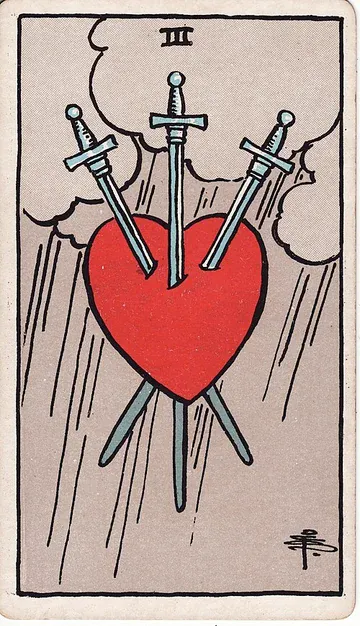
Three of Swords
The wound that whetted the blade. The Three is the cut — the news, the betrayal, the loss. The Queen is the figure who took the cut and emerged not destroyed but clarified. Together, the pair describes either a seeker currently inside the wound who needs to remember the queen is on its far side, or a queen-shaped seeker being asked to look back, with mercy, at the version of themselves that did not yet know they would survive it.
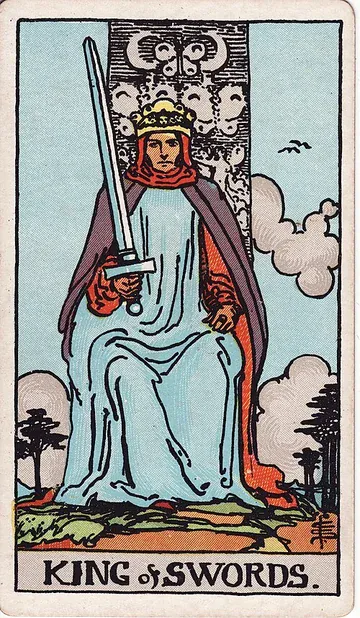
King of Swords
The two thrones of air. The queen still angles the sword in invitation; the king holds his vertical, in command. Together, the pair is the deck's portrait of a partnership of intelligences — two minds that have agreed to a shared discipline of clarity. Durable when calibrated; corrosive when one party silently takes the other's voice. The integration is the explicit articulation of which axis each of them rules.
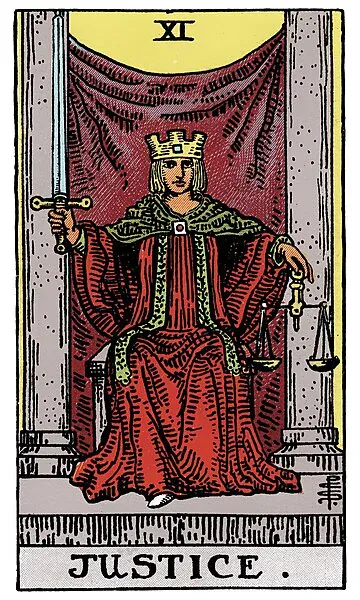
Justice
The cosmic form of clear judgment beside the human queen who has lived it. Justice — Libra, air, the formal balanced weighing — modulates the entire suit, and beside this queen it amplifies her gift and her risk. The combination appears for the seeker called to make a particular decision with both earned wisdom and the cosmic standard's discipline of fairness. The integration is to bring both gravities to the moment.
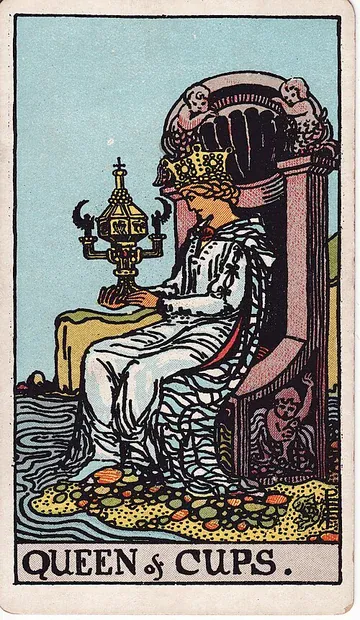
Queen of Cups
Water-queen mirror to her water-within-air. The Queen of Cups loves by holding, by intuition, by letting feeling carry the petitioner; the Queen of Swords loves by clarity, by articulation, by the upright sword and the open palm. Together they portray the seeker who has access to both — who can feel without being submerged and see without becoming cold. The integration is the refusal of the false choice.
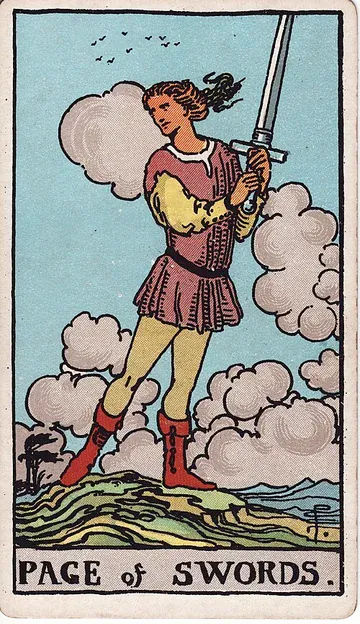
Page of Swords
Same-suit court ladder, two stages apart. The Page is the first bright intelligence — alert, curious, untested by real loss. The Queen is what that page becomes if it survives well. Together the pair invites the queen to remember the page she once was, and the page to recognize the queen's apparent sharpness as the older form of their own brightness, polished by everything between them.
Frequently Asked Questions
Should I ask the question again once the coldness has lifted?
Yes, and the card would much rather you did. Read it as a soft no, with the no aimed more at the asker than at the question. The card describes a seeker currently asking from a state of contracted intelligence — articulate, sharp, slightly too cold to receive a useful verdict. Recover the warmth first: sleep, walk, have one good conversation with a friend, then ask again. If the question still feels real, the answer it receives will be trustworthy.
When does clarity in a relationship start working as armor?
At the point where it stops being offered and starts being deployed. Reversed in love, the Queen of Swords describes the bond cooling for exactly that reason. The conversations are technically correct and have stopped being warm. For partnerships, it warns of the trap of being right at the cost of the partnership; for new connections, it warns of using past wounds as defenses against today's person. The integration is the discipline of warming one sentence by a degree, without changing the stance.
Have they stopped caring, or started keeping a private ledger?
The ledger, in almost every case. The warmth has cooled and the analysis has not. They are still paying careful attention; the noticing has acquired an edge. They feel, often without naming it, that you have somehow let them down — sometimes about something specific, sometimes about a pattern they have privately catalogued. The integration is the daylight conversation in which the postponed sentence finally enters the room.
What is the smallest change that thaws the reversed Queen of Swords?
One sentence, warmed by a degree. Open the left hand. Stop banking grievance. The reversed queen integrates more reliably through these three small disciplines than through any larger reform. Identify the sentence you are about to deliver coldly, rehearse it once in a slightly warmer register, then deliver it. Let the petitioner finish their sentence before responding. Either name the small injury within the week of its occurrence or release it.
What does the Queen of Swords reversed mean in career or for a difficult colleague?
In career readings, the reversed queen describes the worker whose intelligence has begun to function as isolation rather than contribution — every sentence correct, the colleagues steadily more avoidant. For a difficult colleague who carries this energy, the warning is mutual: do not match their chill, do not bank grievance against them, name the issue once in writing with specifics, and protect your own conduct from being contaminated by theirs. The card warns that the next role will not solve the pattern if the pattern travels.
Continue Reading
Queen of Swords · Card overview · symbols · correspondences →
Return to the full card view — image, symbols, sensory correspondences, and Hermetic axes.
Read the upright meaning →
Read the same depth on the opposite orientation.
Draw your reading now →
Bring this card to a question — open a quiet ritual.