
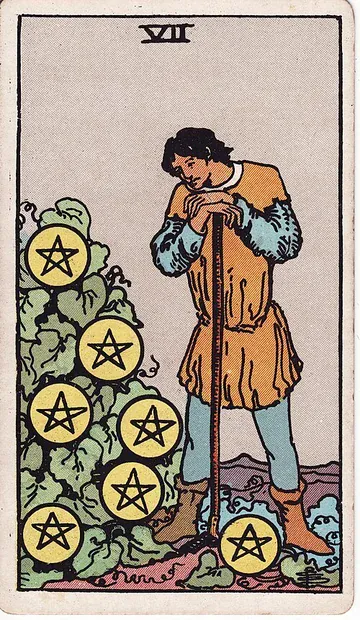
Seven of Pentacles · Core Meaning
The Seven of Pentacles meaning, in the simplest reading, is the hour of reckoning — the pause where you stop tending and start counting. The farmer in the Rider-Waite-Smith image leans on the long handle of his hoe at the edge of his row. One hand still rests on the tool; the other hangs empty. He is neither pleased nor disappointed. He is looking. The work has not stopped because the work is finished. It has stopped because the season has reached the moment when looking is the work.
Seven pentacles cluster on the leafed side of the vine. They are heavy, gold against green, ripening but not yet ripe. A single pentacle rests at his foot — perhaps an earlier yield, perhaps a piece of fruit not yet grafted on, perhaps a coin he set down when his hands needed to be free. The card does not tell you which. The hour of looking is not yet the hour of deciding. The shadowless field beneath him stretches level and unremarkable. There is nowhere for the facts to hide. Whatever the labor has produced, it lies in the light.
This is the card's signature tension: visible growth held in suspension against an unfinished harvest. The investment has gone in. The plants have responded. And yet the question of whether to keep tending or to move to different soil cannot yet be answered, because the harvest is still some way off. The Seven of Pentacles is the card you draw when you have stopped running long enough to look back and count. The looking is uncomfortable. The looking is also the only honest move.
The traditional astrological signature reinforces the slowness. This card carries Saturn in Taurus, the third decan, dated 5/11 to 5/20 in the tropical wheel — late spring tipping into early summer. Saturn is the planet of time, of slow compression, of reckoning. Taurus is fixed earth — the most patient ground in the zodiac, where what is planted does not negotiate its season. Together, Saturn in Taurus is time pressing down on slow earth: the harvest answers not to will but to season. Patience here is not a temperament. It is a discipline imposed by the soil itself.
In the kabbalistic schema, the Seven of Pentacles sits at Netzach in Assiah — Victory in the World of Action. Netzach is the irrational pull of the heart, the force that keeps you tending the vine even when the spreadsheet says move on. In Assiah, that force lands in the body, in the literal field, in the hands that have done the literal work. The card is not abstract. It is the felt experience of a real laborer in a real season measuring real fruit. The card is also the soul's question to itself: do I keep loving this work, or have I been loving the act of loving it past the point where the loving was useful?
There is also, embedded in the image, the quiet weight of the melancholic temperament — the long-considering disposition the elemental detail names directly. The melancholic does not act first. The melancholic looks. The looking is the gift the temperament brings to the work. It is also the trap, when the looking has tipped into the rumination that prevents the next move from being made. The card holds both possibilities in suspension. Whether the looking is the medicine or the symptom depends entirely on whether it ends in honest action or in the indefinite postponement that calls itself patience.
Two hours before dusk — the time the card carries — is the hour when the shadows have begun to lengthen but the air is still warm. It is not yet the hour for going inside. It is also not the hour for beginning new fieldwork. It is the hour of the long survey: walking the rows you have already worked, looking at what has been done, what is still doing its underground work, what will need attention tomorrow. Most cards in the deck describe doing. The Seven of Pentacles describes the surveying that is the necessary middle between today's doing and tomorrow's. The hour is itself the practice.
Read the Seven of Pentacles as a photograph of the moment before a decision, not the decision itself. The image is not "should I quit." The image is "I have stopped to count." Whatever lives in that pause — patience, dread, quiet pride, the suspicion that you have wasted a season, the recognition that the work has actually paid — is the meaning of the card for that reading. The picture itself is neutral. The pause asks you who you are inside it.
Seven of Pentacles · Love & Relationships
In love readings, the seven of pentacles love meaning is the unsentimental look at the relationship — the moment you put down the work of being a partner and ask, plainly, what has actually grown. Not because something is wrong. Because enough time has passed that the question can finally be asked honestly. The arms relax. The eyes go to the vine. The card asks: of what I have planted in this person, what has taken root?
For an existing long partnership, the Seven of Pentacles arrives when the pace of the relationship has slowed enough to permit reckoning. The early urgency is over. The middle work is mostly done. You are standing at the edge of the row looking at what the years have produced — the rituals you both keep without thinking, the silences that feel companionable rather than threatening, the small kindnesses that have become the architecture of the days. The card does not promise the harvest. It offers the count. Often, what the count reveals is that more has grown than either of you had been letting yourselves notice.
For a partnership in the middle stretch — past the first delight, not yet at the long stability — the card describes the season of honest appraisal. The two of you have been tending. The vine is leafed. The question is whether the seven pentacles forming on the leafed side are the fruit you actually wanted. If the appraisal feels good — yes, this is the love I built for, this is the partner I chose to plant beside — the card confirms the work. If the appraisal feels hollow, the card is asking you to name the hollow without rushing to act on it. Naming is not deciding. Naming is the first honest move.
For a new spark, the Seven of Pentacles has unusual weight. It tells you to slow down. The early spark is genuine — the leaves are unfurling, the tendrils are reaching — but you are still some weeks or months from the season when the connection's true shape can be read. Do not graft the future onto a vine that has not yet shown what kind of fruit it bears. The card is not a refusal of new love. It is an instruction in patience that early-stage attraction usually refuses.
For a single seeker asking whether love is possible, the Seven of Pentacles meets you where you are. The card asks: what have you been planting in your own ground while the partner has not arrived? Some seekers, on this card, recognize that they have been gardening their own life so attentively that the second chair is genuinely empty for someone to sit in — the card confirms that the work has not been wasted. Other seekers, on this card, recognize that they have been so busy preparing the soil that they forgot to leave the gate of the garden open. Either reading is honest. Both ask for the same response: keep the looking gentle.
For love after a wound, the Seven of Pentacles is the kindest card the deck offers. The wound has been tended. Time has done what time does. The vine that was cut back has grown. You are now at the edge of the row, looking at the seven pentacles that have formed on a plant you were sure had died. The card says: more is here than you thought. Begin counting before deciding whether to plant a second time.
For a question about reconciliation after a break, the Seven of Pentacles asks you to evaluate the harvest of the original season honestly before deciding whether to resow. What did the relationship actually grow, when it was at its best? What did it consistently fail to grow? The card refuses both the impulse to romanticize what the bond had been and the impulse to write off what it actually offered. Count. Then decide.
For the disambiguation question — is this person in love with me — the card answers with patience rather than verdict. They are tending. Whether the tending will yield what you want is a question of the season, not of this hour. The signal you are watching for is not declarative. It is whether they keep showing up to the row when no one is asking them to. If they do, the harvest is forming. If they don't, the vine you have planted is theirs to abandon, not yours to force.
A note on the card's particular love language: this card loves through patience. The Seven of Pentacles partner is the one who quietly waters for years, who plants something in early spring whose meaning won't be visible until autumn, who refuses both the dramatic gesture and the dramatic withdrawal. They love by staying in the row. They love by not pulling up the seedling to check the roots. If you are asking whether this kind of love is enough, the card respectfully suggests that, for the long bonds, this is the love that lasts.
Seven of Pentacles · As Feelings
When the seven of pentacles as feelings is the question, the texture is patient, considering, and quietly invested. The Seven of Pentacles partner is not deciding. They are looking. The leaning hoe in the card mirrors what is happening in their interior — the activity has paused so that the looking can begin. They feel something steady about you. They have been feeling it for long enough that the feeling has stopped being news.
If they are reserved by nature, the Seven of Pentacles in feelings often describes the partner who has decided, internally, that you are someone they want to stay with — and is now privately measuring whether the relationship is at the season when that decision can be acted on. Nobody counts an unripe harvest in order to look aloof. They are calibrating. The reservation is not absence. It is the careful Saturn-in-Taurus weight of someone who does not act before the season permits.
If they are demonstrative, the Seven of Pentacles in feelings has a different shape. They have shown you what they feel; they are now sitting with the question of whether what they have built with you is yielding what they hoped. Their public warmth has not changed. Their private interior has gone into reckoning. Do not read the silence as withdrawal. They are doing the slow work of honest looking, and the looking includes you as a subject, not as an audience.
For a long bond, the Seven of Pentacles in feelings is the texture of the partner who has stopped expecting you to be different. They have arrived at the count. They are not unhappy with what has grown; they are also not pretending it is more than it is. There is a particular maturity in this feeling-state. It is not the high of a new spark. It is the warmth of someone who has been planted in the ground beside you long enough to have grown roots into the same soil.
For a new connection, the Seven of Pentacles in feelings means they think you are worth the patience. The early intensity has not yet finished crystallizing into the shape it will hold long-term, and they are willing to wait for that crystallization without trying to force it. They feel something true. They are letting the truth ripen rather than picking it half-formed.
For a partner you have been with several years, the Seven of Pentacles in feelings can mean a season of honest re-evaluation that is not a threat. Long bonds need this. They are looking at you, not to find fault, but to make sure they still know who you are. Most partners avoid this looking; the Seven of Pentacles partner is doing it. The card is not a warning. The card is a sign of honest love.
For a partner who has recently been distant, the Seven of Pentacles in feelings often means they are doing internal work that has nothing to do with you and everything to do with their own season. The pause is theirs. Read it as their own reckoning with their own vine, not as a verdict on yours. They will return to the row when their internal looking is done.
For someone you have been on the edge of a relationship with — a friend, a coworker, an ex — the Seven of Pentacles in feelings means they are quietly carrying you in their interior life. They have not yet decided what to do about it. They are feeling the weight of what could grow if they planted, and they are not sure whether the season for planting is now. The card asks for your patience. Pushing here, pulling the seedling up to check the root, will end the consideration before it has finished.
For a friend, mentor, or family member whose feelings about you the card is asked to describe, the Seven of Pentacles often means they have arrived at a quiet pride in who you have become. The years of watching have produced a verdict they may not have spoken aloud: you are someone they are glad to know. Not in the demonstrative way; in the way that the Saturn-in-Taurus partner experiences pride — slowly, deliberately, with the count fully done. If they have been distant lately, read it as their own season of internal work, not as a withdrawal of the underlying regard.
A small caution embedded in the card's feeling shape: the Seven of Pentacles partner can confuse the reckoning with the decision. They can sit with the looking so long that the looking becomes the only thing they do. If you sense them stuck in the count, gently invite them to name what they have seen. The card responds well to direct, slow questions. It does not respond well to ambush.
Seven of Pentacles · Career & Work
In career readings, the Seven of Pentacles is the card of the open ledger — the moment in the work when you put the tool down, sit at the edge of the row, and read what the labor of the last season has actually produced. Not the metrics that look good in the all-hands. The honest harvest. What has the work yielded that you can hold in your hands? What has it failed to yield? What was the soil capable of, and what were you asking it for that it was never going to give?
For someone in a current role asking whether to stay, the card describes the necessary appraisal that comes before the answer can be honest. The instinct to leave, when this card appears, is usually premature. The instinct to grind on without looking is usually self-protective. The card asks for an actual hour at the desk with the actual numbers — what have you built here, and is it on track to ripen? If progress is visible, the card supports staying. If two seasons have passed and the soil has yielded nothing, the card supports moving — but only after the looking, never before it.
For someone considering a new role, the Seven of Pentacles indicates that you should not accept or refuse the offer in the heat of the moment it arrives. Stand at the edge of the row. Count the harvest your current ground has produced. Project, honestly, what the new ground would yield in two years if you tended it as well as you have tended this one. The card is asking for the boring discipline of the comparison. The new-role rush is exactly what this card distrusts. If, after the looking, the new offer still calls — accept it, with the full weight of the count behind you. If, after the looking, the new offer has thinned — let it pass, and return to the row.
For an entrepreneur or freelancer, the Seven of Pentacles is the card of the quarterly review nobody enjoys. The product is shipping. The clients are paying. The hours are going in. The question the card forces is whether the trajectory is actually heading toward the harvest you were planting for, or whether you have been so busy with the daily watering that you have not noticed the vine is producing the wrong fruit. Schedule the hour. Open the books. Ask the harder of the two honest questions: not "is this working" but "is this working for the reason I started."
For a creative practice, the Seven of Pentacles describes the season after a body of work has been built but before it has ripened into reception. The novel drafted. The album recorded. The portfolio shot. You are standing at the row looking at what the labor produced, and the harvest — the audience, the response, the validation — has not yet arrived. The card asks for patience that creative practitioners frequently refuse. The work needs the season the work needs. Watering it more does not ripen it faster. Pulling it up to check the root kills it.
For someone considering a layoff or a forced transition, the Seven of Pentacles holds unusual gentleness. The vine you tended in the role you are leaving is not lost. The skills the soil grew in you have produced fruit that travels with you to the next ground. The reckoning the card asks for is not "what did I waste" but "what did I actually grow." Most departures, evaluated honestly with the Seven of Pentacles, reveal more harvest than the departing worker had been letting themselves count.
For someone considering a promotion or a role expansion, the Seven of Pentacles asks the question the eager seeker often skips: do you actually want what the larger plot of land will require of you? More ground means more rows to tend. More tending means less looking. Some careers, the card suggests, are richer at a smaller, more attentive scale. Take the promotion if the larger ground genuinely calls. Refuse it if the larger ground would force you to abandon the row you have been quietly proud of.
For a creative practice that is mid-project, the card asks for fidelity to the slow time the work needs. Do not rush to finish. Do not skip the boring middle stretch where nothing dramatic is happening but the underground roots are doing the actual structural work. The seven pentacles on the vine are the proof that the boring middle has been productive.
For someone in a job they suspect they have outgrown, the Seven of Pentacles holds two simultaneous truths in honest balance. The role has yielded what it could yield. The soil is exhausted of the particular nutrient you came for. The looking does not yet require you to leave; it requires you to acknowledge, internally, what the soil has stopped producing. Once that acknowledgement is fully held, the question of when and how to move becomes practical rather than emotional.
For team leads and managers, the card has a particular weight. The harvest you are counting includes not just your own labor but the labor of everyone whose work you tend. The honest count includes them as subjects: what have your reports actually grown under your stewardship, and what has the team consistently failed to grow because of structural constraints you have not yet addressed? The card asks for the appraisal that includes the people. Most managers skip this looking; the Seven of Pentacles manager does it. The role is heavier in the doing of it. The work the doing produces is also more honest.
For someone returning to work after a long break — parental leave, recovery, sabbatical, caregiving — the Seven of Pentacles is unusually gentle. The vine you tended in your absence from the role grew in different ground; the skills the new soil produced are real even when they do not appear on a résumé. The card asks you to count what the absence actually grew before assuming the absent time was wasted. Most returners discover, in the honest count, that they bring more to the work than they did before, even though the inventory of those gains takes patience to read.
Seven of Pentacles · Money & Finances
The first signs of yield are showing, and the Seven of Pentacles is the card that asks you not to pick yet. The soil is responding. The numbers are moving in the right direction. The fruit on the vine is real, even if it is not yet ripe. The card asks for the discipline of slow finance — the willingness to hold the position long enough for it to mature, rather than picking it half-formed in the urgency to verify that the labor was worth it.
For a question about a long-term investment, the Seven of Pentacles answers with cautious optimism. The strategy is sound. The holdings are growing. The temptation to liquidate at the first sign of yield is exactly the impulse the card warns against. Saturn in Taurus rules slow accumulation. The harvest is on a multi-season timeline. Honor the timeline.
For a question about a short-term gamble, the Seven of Pentacles is less generous. The card is not built for speed. It does not approve of the quick move, the speculative bet, the urgent flip. If you must act quickly, do so with money you have already accepted you might lose; do not stake the patient holdings on the impatient bet.
For someone managing debt, the card describes the season when the long climb out of arrears has begun to show its first measurable progress. The balance has stopped growing. The principal is finally being touched. The card asks you to keep the slow rhythm — the same monthly payment, the same restraint on new spending, the same patience with the boredom of the climb. The vine is not yet bearing fruit, but the leaves are forming. Keep watering.
For a question about a major purchase, the Seven of Pentacles asks the question the eager buyer skips: have you sat with the desire for long enough to know whether the desire is real? The card supports the purchase made after honest looking. It distrusts the purchase made in the heat of the moment when the soil of your finances has not yet recovered from the previous expenditure. Postpone the decision by a season if you can. The desire, if real, will still be there. The desire, if hollow, will dissolve in the time the postponement creates.
For someone in financial recovery after a hard year, the Seven of Pentacles is one of the deck's gentler cards. The recovery is visible. The labor has begun to translate. The card asks for patience with the speed of the recovery — slower than you wished, faster than you feared. Do not abandon the practice that began the recovery just because the practice has not yet produced the dramatic turnaround you were hoping for. Keep tending.
For a question about a windfall, the Seven of Pentacles asks for slowness. Money that arrives suddenly evaporates suddenly when it is not invested with the patience the card requires. Sit with the windfall for at least a full month before deciding what to do with it. The soil needs time to absorb the unexpected nutrient before you can decide what to plant in it.
The card's signature trap with money is the sunk-cost fallacy — the temptation to keep watering a vine that has stopped producing, because of the years of watering that came before. The Seven of Pentacles asks for honesty here. If the vine is dead, the labor that died with it is not recoverable; the only honest move is to release the row and turn to a new one. The card supports the patience that yields harvest. It does not support the patience that is actually disguised denial.
For someone considering a long-term financial commitment — a mortgage, a multi-year savings goal, a slow-build retirement plan — the Seven of Pentacles is one of the most aligned cards in the deck. The slow accumulation is exactly what the card honors. Set the plan with the patience of a farmer planting a vineyard rather than a gardener planting an annual. The harvest will arrive in the season the plan permits, not in the season the impatient checking would prefer.
For freelancers and small-business owners reading their books, the Seven of Pentacles asks for the quarterly look — not the daily anxiety, not the annual surprise, but the steady seasonal reckoning that catches drift while it can still be corrected. Most small operators either check too often (the daily revenue refresh that produces only anxiety) or check too rarely (the annual reveal that arrives with no time to course-correct). The card prefers the middle pace. Quarterly. Honest. Without immediate action — looking first, deciding second.
Seven of Pentacles · Health
Health under the Seven of Pentacles runs on a season's clock — months, not weeks, before the protocol reports back. The body has been responding. The signs are subtle but real. The discipline of the practice has begun to translate into measurable change. The card asks for the willingness to keep going through the long flat stretch where nothing dramatic is happening, because the underground work — the cellular slow change, the gradual hormonal recalibration, the long rebuild of the foundation — is exactly what the body needs the time to do.
The card's traditional bodily signature is the lower back — the part of the body that tires from standing long to survey the ground. The musculature that holds the upright human in place. When the Seven of Pentacles appears in health readings, watch for tension in the lumbar region, in the hips, in the muscles that hold posture during long periods of patient looking. The body that has been doing the work of reckoning often holds the reckoning physically. Stretch. Walk. Sit on the ground and let the lower back release.
For a chronic condition, the card describes the management plateau where the protocol has stabilized the situation but not cured it. The card supports the patience with the plateau. Cures are not always available. Stabilization, held with care over years, is sometimes the harvest the soil is capable of yielding. The card asks you to count the stability as a real outcome rather than as a failure to reach a more dramatic one.
For an acute condition, the Seven of Pentacles is less direct. It does not predict outcomes. It does ask you to take the slow protocol seriously — to take the medication on the schedule, to attend the appointments, to refuse the impatient impulse to abandon the treatment because the early days have not yet shown results. Most acute treatments need a full course before their effect can be honestly read.
For someone managing weight, sleep, or a long-term physical practice, the card holds the long timeline gently. The work compounds. The week-to-week change is invisible; the month-to-month change is small; the year-to-year change is genuine. The card asks you to keep the practice without measuring it daily. Daily measurement is the equivalent of pulling up the seedling to check the root.
For mental health, the Seven of Pentacles describes the slow work of therapy, of journaling, of any practice whose effect cannot be felt in the session itself but only in the gradual softening of patterns over months. The card supports the practitioner. It supports the patient. It does not promise the dramatic breakthrough. It promises the slow accumulation that, over time, becomes the breakthrough you did not notice arriving.
For someone in recovery from a long illness, the Seven of Pentacles describes the season of careful re-entry — the body that is no longer acutely sick but not yet at full strength, the days that require the patient pacing of someone whose energy budget is smaller than it used to be. The card asks for honesty about the budget. Do not spend the day's energy on what will not nourish; do not refuse to spend it at all out of fear of relapse. The middle path is the patient one: small attempts at fuller engagement, with the looking afterward to count what the body actually had capacity for.
A note on the melancholic temperament the card carries: Saturn-ruled, slow-considering, prone to weighing rather than acting. If your health questions are surfacing this temperament — the long sit with the body's complaint, the careful tracking of symptoms, the patience with practitioners who do not yet have the answer — the card affirms the disposition. The body sometimes needs the patient observer rather than the urgent fixer. Affirming the patient observer is not medical advice. Keep your practitioners. Take your medicine. The card simply names the season of the work.
Seven of Pentacles · Spirituality
A practice only becomes visible to its own owner in retrospect, and the Seven of Pentacles is the hour of looking back. The meditation cushion that you have sat on for two hundred mornings. The journal that fills, slowly, with the same recurring questions. The walking, the breathing, the small daily ritual that you began years ago without expecting it to change anything. The card asks you to stand at the edge of the practice and count what has actually grown.
For seekers in active practice, the Seven of Pentacles often arrives during the season when the early intensity has subsided and the practice has become routine in the steady sense, not the dull one. The card affirms that this season is not failure. The leaves are forming. The vine is producing the fruit the soil is capable of yielding. The breakthroughs you were hoping for in the first months of practice were never the harvest the practice was actually planted to grow. The actual harvest is the slow change in how you meet your own days.
For seekers exploring belief, the card is the patient reckoning with what the search has actually produced. Have the years of reading, of tradition-sampling, of provisional commitment yielded a felt practice you can stand on, or have they yielded only a library of borrowed words? The card asks the honest question without judgment. It also asks you to count the small things — the moment last week when you remembered to breathe before reacting, the moment last month when you let an injury go without the old retaliation — as the actual harvest, not as preliminaries to a more impressive one.
For someone in a season of doubt, the Seven of Pentacles is gentle. The doubt is the looking. The looking is the practice. The fact that you have stopped to count means the practice has matured to the stage where it can hold an honest interrogation without dissolving. Continue. The looking is not the end of the practice; it is the practice growing into its next form.
The card's spiritual question is the Saturn-in-Taurus question: am I willing to wait for what the season actually wants to give, rather than the season I was hoping for? Netzach in Assiah grounds this in the body — the heart's irrational pull toward continued tending, even when the spreadsheet of the soul says move on. The card asks you to honor the heart's pull, but with eyes open. Pure devotion without honest looking becomes superstition. Honest looking without devotion becomes accountancy. The card is the union of both.
For seekers in a tradition that values silence — Buddhist sitting, Christian contemplative practice, the long Quaker meeting — the Seven of Pentacles is one of the cards most aligned with the form. The silence is the looking. The looking is the harvest. The card affirms that the apparently uneventful sit is exactly what the work requires. The dramatic spiritual states the seeker may have come for were never the harvest the silence was planted to grow. The actual harvest is the slow softening of the reactive patterns, the small lengthening of the pause between stimulus and response. Count those.
A practice the card invites: take a single hour, in the next few days, to sit at the edge of your life as the farmer sits at the edge of his row. No phone, no music, no agenda. Bring a notebook if it helps, or do not. Look at what the year has actually grown — in your work, in your relationships, in your interior life. Do not yet decide what to do with the count. Just look. The reckoning, held without immediate decision, is the entire practice the card is asking for.
Seven of Pentacles · Yes or No
Conditional yes — but only after honest reckoning.
For seekers asking the seven of pentacles yes or no question, the card refuses the clean binary. It is not the bright yes of the wish-card, and it is not the soft no of cards that close doors. It is the patient yes that arrives only after the looking has been done — the yes that is conditional on you sitting with the actual count of what your labor has produced before you commit to the next move.
For yes-or-no questions about whether a current situation will resolve well — a project, a job, a relationship, a recovery — the card answers yes, with the further note that the resolution is on a timeline you do not control. The harvest will arrive in its season. Pulling the seedling up to check the root will end the answer before it has finished forming.
For yes-or-no questions about whether to continue a current course — keep tending, keep investing, keep showing up — the card answers yes when the labor has produced visible signs of growth. The seven pentacles on the vine are the proof. If you can name what the work has actually grown, the card supports continuation. If you cannot, the card is asking you to look longer before deciding.
For yes-or-no questions about whether to start something new while the current work is still in its slow middle, the card answers no — not because the new thing is wrong, but because the current ground deserves the patience to be brought to harvest before you commit your hours elsewhere. Two unfinished rows yield less than one finished one.
For yes-or-no questions about a reconciliation, a return, a re-engagement with something you stepped away from, the Seven of Pentacles asks for the appraisal first. What did the original season actually grow? What did it consistently fail to grow? If the appraisal yields a harvest worth replanting, the card answers conditional yes. If the appraisal yields the recognition that the soil never produced what you needed, the card respectfully suggests that the answer is no — but only after the honest looking, never before it.
For binary decisions you have been turning over for weeks, the Seven of Pentacles often means the looking itself is the answer. You have not decided because you have not yet finished the count. Take the hour. Look honestly. Most decisions, after the honest count, decide themselves.
For yes-or-no questions about timing — will it happen this season, this year, soon — the Seven of Pentacles refuses the precision the question is asking for. The harvest arrives in the season that suits the soil, and Saturn in Taurus does not negotiate that timing for the impatience of the gardener. The answer is yes, eventually, on a timeline you do not get to set. Plant the row. Tend it. The season that yields will be the season that yields.
For yes-or-no questions about whether someone will return — to the relationship, to the project, to the city — the card asks the question back. They will return when the season permits. The card does not predict their movements. It does suggest that the patience the upright card describes applies to waiting for them as much as it applies to anything else: keep watering your own row, keep counting your own harvest, and let the question of their return ripen on its own timeline rather than yours.
For yes-or-no questions where the seeker is hoping for permission to act on something they have already decided in the body, the Seven of Pentacles offers neither the permission nor the refusal. It offers, instead, the mirror. The card asks: have you actually finished the looking, or are you using the question as a way to skip it? Most yes-or-no questions, asked of this card, are diagnostic rather than predictive — they reveal where the seeker has been refusing the honest hour the upright card requires.
If the question was: am I wasting my time? The card answers, with patience: stop running long enough to count. Then ask the question again. The answer to the question changes when the question is asked from the row instead of from the rush.
Seven of Pentacles · Advice
Put the hoe down — the Seven of Pentacles is asking for a pause, not a retirement. Not for long. For an hour. For an afternoon. For one full season's pause from the urgency of the next move. Stand at the edge of the row you have been working. Lean on the hoe. Look at what your labor has actually produced. The card asks for the discipline of the count, not the dramatic withdrawal — you are not quitting, you are looking.
A first specific instruction: schedule the count. Block an hour this week with no agenda but the looking. Bring the actual numbers — the bank statement, the project tracker, the relationship inventory, the body's symptoms. Do not yet decide anything. Read the actual harvest as it is, not as you hoped it would be, not as you feared it would be. The reckoning, done honestly without immediate decision, is the entire move the card is asking for.
A second instruction: distinguish the patience that yields from the patience that hides. The first sits with the slow growth because the slow growth is real. The second sits with the dead vine because looking at the death would force you to grieve the years of watering. The card respects both forms of patience but asks you to know which one you are practicing. If you have been tending the same row for two seasons and the vine has produced nothing, the patience has tipped into denial. Release the row. Turn to new ground.
A third instruction: do not pull the seedling up to check the root. Most of what is failing in the modern seeker's life is failing because the seeker keeps interrupting the underground work to verify that the underground work is happening. The vine that has just been planted does not yet have visible growth. The vine that is between yields looks identical to the vine that has stopped producing. Trust the season. Tend the surface. Let the roots do their underground work without daily inspection.
A fourth instruction: count the small fruit. The Seven of Pentacles partner often misses the actual harvest because the actual harvest is smaller than the harvest they were dreaming of. The seven pentacles on the vine are not the vineyard you imagined when you planted; they are the seven pentacles. Count them honestly. The small real harvest, fully counted, is more nourishing than the large imagined one held at the back of the throat as a perpetual disappointment.
A fifth instruction: name the deadline. Saturn-in-Taurus answers to time, not to vibes. Without a deadline, the looking can become permanent. With a deadline, the looking is bounded. Decide, internally, that by the next solstice, by the new moon two months from now, by your next birthday — either you recommit to the row or you release it. The deadline is a gift to yourself. It honors the slow time the card requires while preventing the slow time from becoming an alibi.
Practical advice for the day the card appears: do nothing dramatic. Do one slow thing. Walk a long distance without music. Cook a meal that takes three hours. Sit in the garden for forty minutes without a screen. The card responds to the embodied slow. It does not respond to the manufactured slow you tried to schedule into a fifteen-minute calendar slot. Give the slowness real time. The reckoning will follow.
Seven of Pentacles · Card Combinations
Seven of Pentacles + The Hanged Man
The pause becomes deliberate suspension. When these cards appear together, the looking has tipped into the kind of held stillness that is no longer optional — the season requires you to stop. The work is in the soil; you cannot accelerate it. The Hanged Man clarifies what the Seven of Pentacles only implies: the suspension is the practice, not the prelude to the practice. Honor it. Do not return to the row until the held stillness has yielded its quiet revelation.
Seven of Pentacles + Wheel of Fortune
The reckoning meets the cycle. When these cards appear together, the harvest you are counting is part of a larger turning that has been moving you through alternating seasons of growth and loss for longer than you may have noticed. The Wheel asks you to read the count not as a verdict on your effort but as one frame in a longer rotation. Some years yield seven pentacles; some yield three; some yield none. The patience the Seven of Pentacles requires is the patience of a farmer who has lived through enough cycles to trust the rhythm.
Seven of Pentacles + Eight of Pentacles
The pause and the return to the work. When these cards appear together, the count has been done and the answer is to keep tending — to put the hoe back in the soil and continue the disciplined daily practice the Eight of Pentacles describes. The combination affirms the long-form labor. The looking was honest; the work was real; the next season requires the same fidelity the previous season required. Saturn in Taurus has spoken; Mercury in Virgo answers with the steady hand returning to the bench.
Seven of Pentacles + Three of Pentacles
The harvest of the apprentice's labor is now visible to count. When these cards appear together, the Three's collaborative effort — the apprentice's careful chisel-strokes, the team's coordinated work — has matured to the season where its yield can be honestly read. The Three planted; the Seven counts. The combination often appears for craftspeople, for coordinators, for anyone whose work depends on the patient layering of small contributions over long stretches. The harvest is real. The collaboration was worth it.
Seven of Pentacles + Eight of Wands
Slow time meets the rapid messengers. This is the most tonally dissonant combination the Seven of Pentacles forms — the leaning hoe beside the eight wands flying through the air. The combination warns that an external urgency is asking you to abandon the row before the harvest is ready. The card asks you to hold the slow time even as the world tries to accelerate it. The wands will arrive with their news; the soil will not yield faster because they did. Read the news. Return to the row. The harvest answers to the soil, not to the messenger.
A note as a set: the Seven of Pentacles forms its strongest combinations with cards that either deepen the slow time (Hanged Man, Eight of Pentacles, Three of Pentacles) or that contrast against it (Eight of Wands, Wheel of Fortune). The card rarely combines well with cards of urgency or rapid change without the dissonance becoming the point of the reading. When in doubt, read the Seven of Pentacles as the temporal counterweight — the slowness against which the other card's speed becomes legible. The reading that places the Seven of Pentacles next to a fast card is almost always asking the seeker to choose between two registers of time, and the card's vote is consistently for the slower register's discipline.
Card Combinations
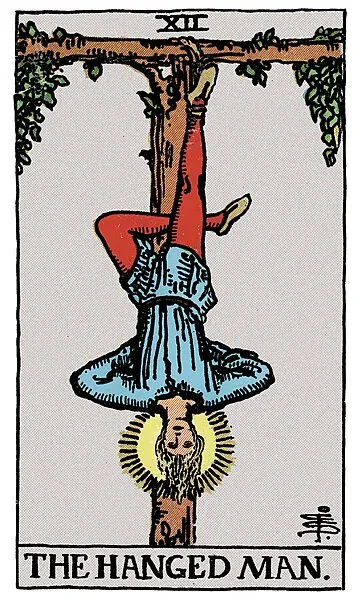
The Hanged Man
The pause becomes deliberate suspension — the looking is no longer optional, the season requires you to stop. The Hanged Man clarifies what the Seven of Pentacles only implies: the suspension is the practice, not the prelude. Honor it. Do not return to the row until the held stillness has yielded its quiet revelation.
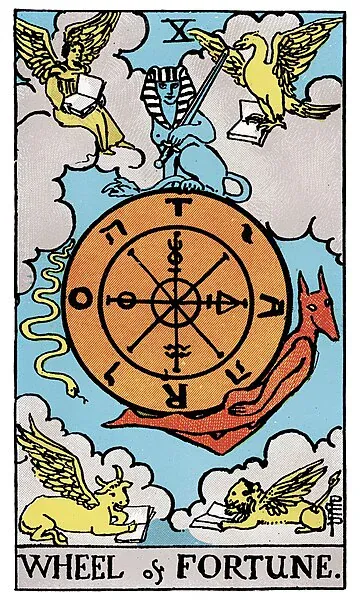
Wheel of Fortune
The reckoning meets the cycle. The harvest you are counting is part of a larger turning that has been moving you through alternating seasons of growth and loss for longer than you may have noticed. Read the count as one frame in the rotation. Some years yield seven pentacles; some yield three; some yield none. The patience is the patience of a farmer who trusts the rhythm.
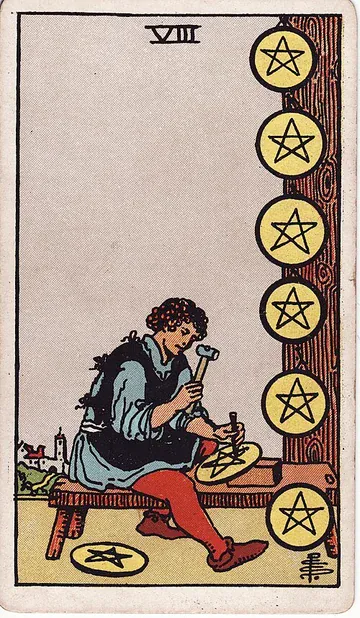
Eight of Pentacles
The pause and the return to the work. The count has been done and the answer is to put the hoe back in the soil and continue the disciplined daily practice the Eight of Pentacles describes. The combination affirms the long-form labor — Saturn in Taurus has spoken; Mercury in Virgo answers with the steady hand returning to the bench.
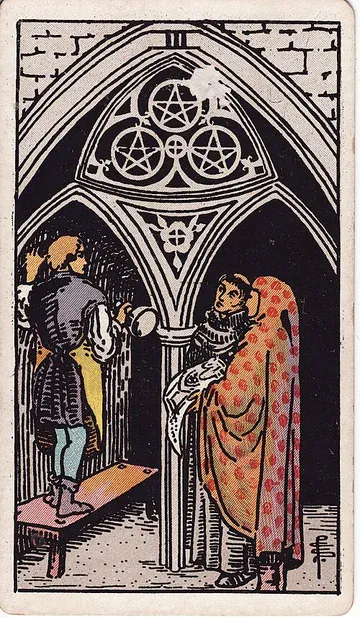
Three of Pentacles
The harvest of the apprentice's labor is now visible to count. The Three's collaborative effort has matured to the season where its yield can be honestly read. The Three planted; the Seven counts. Often appears for craftspeople and coordinators whose work depends on the patient layering of small contributions over long stretches.
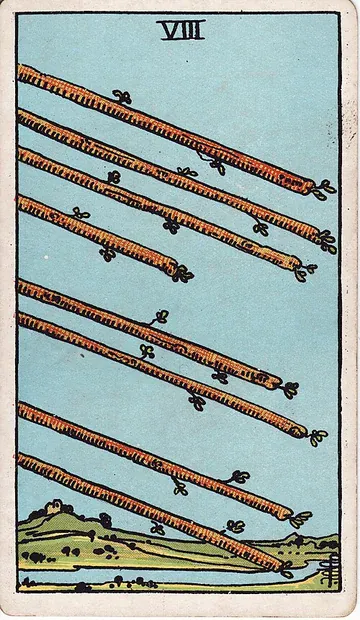
Eight of Wands
Slow time meets the rapid messengers. The most tonally dissonant pairing the Seven of Pentacles forms — the leaning hoe beside the eight wands flying through the air. An external urgency is asking you to abandon the row before the harvest is ready. Read the news. Return to the row. The harvest answers to the soil, not to the messenger.
Frequently Asked Questions
What is the seven of pentacles tarot card meaning?
The Seven of Pentacles tarot card meaning is the hour of reckoning — the pause where you stop tending the work long enough to count what your labor has actually produced. The image shows a farmer leaning on his hoe at the edge of his vine, neither pleased nor disappointed, simply looking. Read it as a call to honest assessment before the next move, with the patience of Saturn in Taurus governing the timeline.
Does the Seven of Pentacles say keep going, or cut my losses?
The seven of pentacles yes or no answer is a conditional yes — but only after honest reckoning. The card refuses the clean binary. It supports continuation when your labor has produced visible signs of growth, and it asks you to look longer before deciding when it has not. For decisions you have been turning over for weeks, the looking itself is usually the answer the card is offering.
Does the Seven of Pentacles mean a relationship has stalled, or that it is still growing underground?
In love readings, the seven of pentacles love meaning is the unsentimental look at what the relationship has actually grown. For long partnerships, it confirms more harvest than either of you had been letting yourselves count. For new sparks, it asks for patience with the season. For singles, it confirms the work you have been doing in your own ground has not been wasted. The card's love language is patience — the partner who waters quietly for years.
Does the Seven of Pentacles mean the person is quietly evaluating me?
When the seven of pentacles appears as feelings, the texture is patient, considering, and quietly invested. They feel something steady about you and have been feeling it long enough that the feeling has stopped being news. For reserved partners, they are calibrating; for demonstrative ones, they have shifted from showing to reckoning. Read the silence as honest looking, not absence — the Seven of Pentacles partner does the slow work most partners avoid.
What does the Seven of Pentacles say about a practice that has run for years?
Spiritually, the Seven of Pentacles is the card of the long practice that has begun to bear its quiet fruit. The card sits at Netzach in Assiah — the heart's irrational pull grounded in the body — and carries Saturn in Taurus, the planet of time pressing on slow earth. The practice it asks for is honest reckoning: stop running long enough to count what the season has actually grown, without immediate decision. The looking, held patiently, is itself the practice.
Continue Reading
Seven of Pentacles · Card overview · symbols · correspondences →
Return to the full card view — image, symbols, sensory correspondences, and Hermetic axes.
Read the reversed meaning →
Read the same depth on the opposite orientation.
Draw your reading now →
Bring this card to a question — open a quiet ritual.