
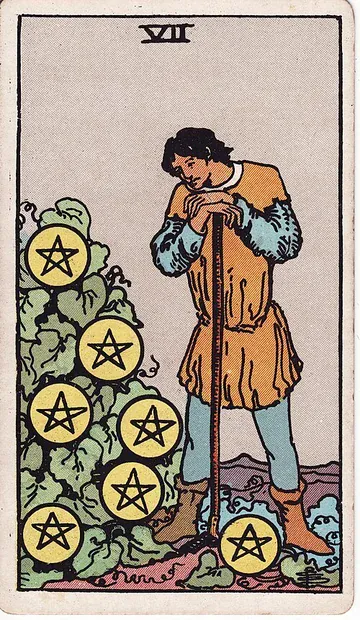
Seven of Pentacles Reversed · Core Meaning
The Seven of Pentacles reversed meaning splits along two distinct axes, and the card asks you to know which one is yours. The first axis is impatience — the seeker who could not bear the slow time the harvest required and pulled the fruit before it ripened. The hoe is set down, but not for honest looking. It is set down because the gardener has decided, prematurely, that the soil has failed. The seedling is uprooted to check the root. The vine is cut back before it has finished its season. The leaving happens before the work has yielded.
The second axis is attachment — the seeker who keeps watering a vine that has stopped producing because the years of watering before make the leaving feel impossible. The pentacle at the foot has become the only one that exists, and the gardener keeps polishing it rather than facing the empty rest of the vine. The patience of the upright card has tipped into denial. The reckoning has been refused. The looking has not been done because the looking would require grieving the seasons that the soil never gave back.
These are two distinct failures of the same hour. The card reversed asks the same question the upright card asked, more sharply: have you done the honest count, or have you avoided it in one of these two directions? Most reversed readings point to one axis or the other; some, painfully, point to both — impatient with the things still ripening and attached to the things long dead.
The astrological signature reverses too. Saturn in Taurus upright is the discipline of slow time — patience as a virtue imposed by the season. Reversed, Saturn becomes the harsh teacher of the lesson you did not learn the first time. Time still presses on slow earth, but now the seeker has tried to hurry it or refuse it, and the soil teaches by withholding what it would otherwise have given. Taurus in its third decan, late spring tipping into early summer, is the season when the pace cannot be negotiated. The reversed card describes the seeker who tried.
In the kabbalistic schema, Netzach reversed in Assiah is the heart's pull turned against the body — the irrational force that keeps you tending what should be released, or the irrational force that abandons what should be held. The card asks you to ground the heart's pull back in honest physical assessment. Look at the actual vine. Look at the actual harvest. Let the count be the count, regardless of which direction the heart wanted the answer to go.
The shadowless field underfoot intensifies the reversed reading. The hour of looking casts no cover; the facts lie in the light with nowhere to hide. The reversed seeker has been standing in this same shadowless field but with the gaze averted — looking somewhere else, at the next field, at the next season, at the imagined harvest of soil not yet planted, anywhere but at the actual vine in front of them. The card asks for the brave move of returning the gaze to what is.
The pentacle at the foot, in the reversed reading, takes on a particular weight. In the upright card, it could be an earlier yield, a piece not yet grafted, or simply a coin set down. Reversed, it often becomes the single thing the seeker has been polishing while refusing to look at the rest of the vine — the small concrete success that has been used as evidence the season is fine, even as the larger field has gone untended. The card asks you to lift the gaze from the polished pentacle to the actual row.
Reversed, the Seven of Pentacles asks: what have I been refusing to look at? And: which of the two ways of refusing is mine?
Seven of Pentacles Reversed · Love
Reversed, the Seven of Pentacles distorts the appraisal in one of two directions, and a relationship registers each one differently. The first is the relationship cut short before its true season — the impatience that decides the bond has failed before the bond has been given enough time to produce its actual fruit. The second is the relationship held past its season — the attachment that keeps watering a partnership that has visibly stopped producing, because the years of watering before make releasing it feel like betraying the labor.
For an existing long partnership, the reversed Seven of Pentacles often describes the long bond that has stopped being honestly looked at. The reckoning has been postponed for years. Both partners know, somewhere in the back of the throat, that the count would not yield what they would want. So the count has not been done. The card is asking, gently but firmly, for the honest hour. Not to end the bond — that is not the card's preference. To finally name what has actually grown and what has not, so the next season can be planted with eyes open.
For a partnership in the middle stretch, the reversed card warns of the impulse to leave because the slow middle is uncomfortable. The work has stopped being thrilling. The patterns have stabilized. The early intensity is over. The reversed seeker reads the stabilization as failure, when often it is exactly what the upright card promised — the season of honest looking. Do not pull the vine before its harvest. Sit with the boredom of the slow middle. The boredom is not the problem; the impatience with the boredom is.
For a new spark, the reversed card warns of two opposite distortions. The first is grafting the future onto a vine that has not yet shown what kind of fruit it bears — moving in too fast, naming the relationship too early, demanding declarations the season has not yet earned. The second is refusing to plant at all, because the early appraisal has decided, prematurely, that the soil cannot yield. The card asks for patience in both directions: the patience to let the vine show what it actually is, and the patience to plant in the first place when the soil is willing.
For a single seeker, the reversed Seven of Pentacles often describes the season when the patient gardening of one's own life has tipped into the gardener's refusal to leave the gate open. The garden has become so well-tended that letting anyone walk in would disturb the carefully arranged rows. The card is gentle here. The garden you have built is real. The work was not wasted. But the harvest the work was planted for cannot ripen if there is no one standing in the row to taste it. Open the gate. Let the strangers in. The garden survives the visitors.
For love after a wound, the reversed Seven of Pentacles asks the harder question: have you finished the looking the wound required, or have you been polishing the single pentacle at your foot — the one piece of damage that became the only thing you can see — until it has hidden the rest of the vine the next love would grow on? The wound was real. The looking was necessary. There is also a season when the looking becomes its own avoidance. The card invites you to lift the gaze.
For a question about reconciliation after a break, the reversed Seven of Pentacles answers no in the most cases — the original count, honestly done, would yield the recognition that the soil never gave what you needed, and the rebuild would yield the same. There are exceptions. If both parties have done genuine internal work in the time apart, the reckoning can yield a different answer than it did the first time. But the card warns against the reconciliation built on memory rather than honest current appraisal. Count what is, not what was.
For someone in an affair or in a complicated triangulation, the reversed Seven of Pentacles is one of the deck's clearer mirrors. The vine you have been watering in secret has not produced the fruit you keep telling yourself it will produce. The looking has been postponed because the looking would force the choice. Do the looking. The choice will follow.
For a partner who has recently been distant, the reversed card warns of two opposite mistakes. Do not pull the seedling up to check the root — do not demand declarations, force the conversation that requires more time, ambush them with ultimatums about a season they have not finished moving through. Equally, do not water the empty row indefinitely — do not keep tending a partnership where the partner has, in honest terms, already left in everything but body. The card asks for patience with the necessary waiting and clarity about the dead vine. A slow vine and a dead vine take the same water from you and return different harvests.
For a question about the partner's actual feelings, the reversed Seven of Pentacles often describes the partner whose looking has tipped into one of the two distortions. They are either rushing the appraisal to a verdict the season has not earned, or they are refusing to look at the relationship at all because the looking would require an honest answer they do not want to give. Neither is malice. Both are the human shapes of the reversed card. Read it as information, not as accusation. The work, if there is work, is to invite them to the honest hour without forcing it.
Seven of Pentacles Reversed · As Feelings
When the Seven of Pentacles appears reversed as feelings, the texture is conflicted — they have been looking at you, but the looking has gone wrong in one of two directions. Either the appraisal has rushed to a verdict the season did not earn, or the appraisal has been refused entirely because the honest count would force a decision they are not ready to make. The reversed card asks you to read the texture carefully rather than the verdict.
If they are reserved by nature, the seven of pentacles reversed as feelings often describes the partner who has decided, internally, that the relationship is not yielding what they hoped — but who has not yet found the way to say so, or who is using the silence as a way to avoid having to. The reservation has tipped into withdrawal. They are not in active reckoning; they are in the quiet leaving that precedes the announced one. Read the silence with care. It may not yet be a verdict; it may still be revisable. But it is also not the patient looking the upright card describes.
If they are demonstrative, the reversed card has a different shape. They have been performing the satisfaction without doing the underground reckoning. The public warmth continues; the private work has been postponed. They are not unhappy with you in any way they could name. They have also not honestly counted what the relationship has produced for them in the last year. The card asks you, not them, what the texture of being received by someone whose looking is paused actually feels like.
For a long bond, the reversed Seven of Pentacles in feelings can mean settled comfort that has stopped being curious about you. They love you, and they have stopped looking. The annual reckoning that long bonds require — the honest hour where each partner names what the year actually grew — has been quietly skipped for several years. The card invites the conversation. Not as accusation. As honest care for the vine you have both planted.
For a new connection, the reversed card warns of the partner who is privately measuring you against criteria they have not shared. They are looking, but the looking has the quality of judgment rather than appraisal. You cannot pass the test you do not know is being administered. If you sense this texture, ask. The card responds well to direct questions about what the partner actually wants. It does not respond well to performance.
For a partner who has been distant for a season, the reversed Seven of Pentacles in feelings often means they are stuck in their own reckoning — unable to finish the count, unable to act on what the count has shown, oscillating between the two distortions of the reversed card. Their distance is theirs. It is not a verdict on you. But it is also not the patient looking that produces the honest answer; it is the avoidance of the looking. They will need to do their own work. You cannot do it for them.
For someone you have been on the edge of a relationship with, the reversed card often describes the person whose feelings about you have ripened past the season when acting on them would have been easy, and who is now sitting with the pentacle at their foot — the small, formed possibility — without yet daring to graft it onto the rest of their life. The feelings are real. The action is paused, and the pause has tipped from honest to avoidant. The card respects the difficulty. It also names it.
For a partner you have recently reconciled with, the reversed Seven of Pentacles in feelings warns that the rebuilding has been done on the strength of memory rather than the honest count of what the original season actually produced. They feel something — but what they feel is closer to the shape of the past relationship than to the present one. The card asks you both for the honest hour. Without it, the rebuild will yield the same harvest as the original.
A small caution embedded in the reversed feeling-state: the Seven of Pentacles reversed partner can mistake the discomfort of the honest looking for evidence that the relationship is wrong. The looking is supposed to be uncomfortable. Discomfort is not a verdict; it is the texture of the appraisal itself. If you sense them ready to abandon the bond on the strength of the discomfort alone, gently invite them to sit with the discomfort longer before acting on it. The vine often yields its actual harvest on the far side of the uncomfortable hour, not before.
Seven of Pentacles Reversed · Career
Quit too early, or stayed too long — at work the reversed Seven of Pentacles is almost always one of those two. The first is the impatient quit — the role abandoned before its actual harvest had time to ripen, the project pulled before its slow middle had finished doing its underground work, the career-pivot made on the strength of a few bad months rather than an honest count of what the years had built. The second is the attached stay — the role kept long past its yielding season because the years of investment make the leaving feel like wasting the labor.
For someone in a current role asking whether to leave, the reversed card warns of the impulse to leave because the role has stopped feeling thrilling. Most roles, after eighteen months, stop feeling thrilling. The thrill was the seasoning of the new soil, not the harvest of the work. The card asks: has the role actually stopped producing what you came for, or has it merely stopped producing the dopamine of novelty? If the answer is the second, the impulse to leave is the reversed-card impatience. Sit with the boredom. The harvest is forming on the leafed side of the vine, even if the leaves have lost their first-spring shine.
For someone who has been in a role for years and feels they should leave but cannot, the reversed card asks the harder question. Have you been counting honestly, or have you been polishing the pentacle at your foot — the one secure piece of the role, the salary, the title, the relationships with colleagues — until it has hidden the rest of the vine that has stopped producing? The card is gentle here. Most workers in this position need the honest hour, not the dramatic departure. Take the hour. Look at what the role has actually produced for you in the last two years, and at what it has consistently failed to produce. The decision will follow.
For someone considering a new role, the reversed Seven of Pentacles warns of the rush. The new offer carries the urgency of novelty. The current role carries the inertia of investment. Neither urgency nor inertia is the honest count. Postpone the decision by at least a week of slow looking. The honest answer, after the looking, will not be the answer the rush would have produced.
For an entrepreneur or freelancer, the reversed card describes the practice that has either been pivoted too soon or held too long. The pivot too soon is the impatient gardener — the founder who abandoned the product before the long middle stretch yielded its actual fit, the freelancer who jumped ship from a niche before the niche had matured into a livelihood. The held too long is the attached gardener — the founder who keeps shipping into a market that has stopped responding, the freelancer who keeps tending a client roster that has stopped paying what the work is worth. The reversed card asks you to know which gardener you are.
For a creative practice, the reversed Seven of Pentacles often describes the project abandoned in its slow middle, when the early thrill is over and the late satisfaction of completion is still distant. Most creative work dies in this stretch. The card asks for the discipline to hold the row through the boring middle. The fruit is forming. You cannot see it because you are too close. Trust the season. Return to the bench.
For someone considering a layoff or a forced transition, the reversed Seven of Pentacles can mean the transition is the right one — the old soil had stopped producing, and the leaving was the universe doing the count for you. Or it can mean the transition is the wrong one — the soil was about to yield, and the timing of the layoff has cut the season short. The card asks for the honest count of the role you are leaving, regardless of whether the leaving was your choice. The information you take into the next role depends on the count being honest about the previous one.
For someone considering a promotion, the reversed Seven of Pentacles warns of the trap of the upgraded role that does not actually want what your soul came to do. The seven pentacles you have grown in the smaller, more attentive role may not graft onto the larger plot of land. The card asks you to look at the count of what you are actually proud of having grown in the current role, and to ask whether the larger role would let you grow the same things at scale or would force you to abandon them. Take the promotion if the answer is the first; refuse it if the answer is the second.
For a creative practice that has had a long fallow stretch, the reversed Seven of Pentacles asks whether the fallow was necessary rest or has tipped into avoidance. Necessary rest yields the next phase of work. Avoidance disguised as rest yields nothing. The card invites the honest distinction. Return to the bench for one short, low-stakes session. The body will know which one the fallow has been.
Seven of Pentacles Reversed · Money
Money under the reversed Seven of Pentacles moves either too fast or not at all. The first is the panic sell — the investment liquidated at the first sign of yield because the seeker could not tolerate the slow time the position required. The second is the sunk-cost hold — the position kept long past its yielding season because the years of investment make the selling feel like admitting waste.
For a long-term investment, the reversed card warns of both impulses. Do not panic sell on a few bad weeks; do not refuse to liquidate a position that has objectively been failing for years. The reversed card asks for the honest count, regardless of which direction the heart wants the answer to go. Look at the actual numbers. Hold what is yielding. Release what has stopped.
For someone managing debt, the reversed Seven of Pentacles describes the recovery that has either been abandoned in impatience — the seeker who decided the climb was too slow and started spending again before the principal had been touched — or that has been held with such rigid attachment to the original plan that genuinely improved circumstances have not been allowed to accelerate it. The card asks for the honest re-appraisal. The plan that began the recovery may not be the plan that will finish it.
For a question about a major purchase, the reversed card warns of two opposite mistakes. Do not buy on impulse because the desire feels urgent; the urgency is usually a signal to wait, not to act. Equally, do not refuse to buy what you genuinely need because the years of frugality have made spending feel like betrayal. The card asks for the count of what the purchase would actually yield in your life over the next five years, made without the urgency and without the over-corrected refusal.
For someone in financial recovery after a hard year, the reversed Seven of Pentacles can describe the rebound that has either gone too fast — overspending on the strength of the early returns, before the recovery had stabilized — or too slow — refusing to relax the austerity even as the situation has objectively improved. The card asks for the honest re-appraisal of what the season actually allows.
For a question about a windfall, the reversed card warns of the impulsive disposition. Money that arrives suddenly has a way of evaporating suddenly when the seeker has not done the slow looking the upright card requires. The reversed card describes the windfall already half-spent on purchases that, in honest retrospect, were not what the seeker actually wanted. Slow down. The remaining portion of the windfall can still be deployed with the patience the upright card describes, even if the first portion was not.
The card's signature trap, reversed, is the inability to distinguish necessary patience from disguised denial. Some positions are slow yielders that need to be held; some positions are dead vines that need to be released. The two look identical from the outside. The work the reversed card asks for is the internal honesty about which one you are actually holding. Most seekers, asked the question directly, know the answer in their body before they let themselves know it in their mind.
For someone caught in the loop of consumer overspending — small daily purchases that add up to undermined savings — the reversed Seven of Pentacles describes the failure of the looking. The spending is invisible because it has never been honestly counted. The card asks for the simple, boring discipline of writing each purchase down for one full week. Not to feel ashamed; to make the invisible visible. Most of what the reversed card describes dissolves when the actual figures are seen.
For someone considering a financial commitment that involves another person — co-signing a loan, lending to family, joining finances — the reversed card asks for the honest count of the previous comparable arrangements. What did they actually yield? Did the borrower repay? Did the joint plans hold? The reversed card warns against entering new arrangements on the strength of hope rather than the count of history. The history is the only honest data.
A practical move when the reversed card appears in a money question: take the actual hour. Open the actual statements. Read the actual numbers. Do not yet act. Sit with what the numbers say for at least overnight. The looking, held without immediate decision, is the entire move the reversed card is asking for. The decision that follows the looking will be more honest than the decision that would have followed the rush.
Seven of Pentacles Reversed · Health
A protocol can be dropped too early or kept long past its yield, and reversed, the Seven of Pentacles asks a body which of the two it is living with. The first is the seeker who started the new diet, the new exercise, the new medication, and quit before the slow middle had time to produce its actual results. The second is the seeker who kept the protocol long past the season when it had stopped yielding, because the years of discipline made the changing feel like betraying the labor.
For someone managing a chronic condition, the reversed card warns of both directions. Do not abandon the protocol that has stabilized you because the stabilization has stopped feeling like progress; the stabilization is the harvest the soil is yielding, even if it is not the cure you were hoping for. Equally, do not cling to a protocol that has objectively stopped working out of loyalty to the years of practice; protocols update as bodies update, and the body that needed one approach at thirty may need a different one at forty.
For an acute condition, the Seven of Pentacles reversed asks for fidelity to the prescribed slow time. Do not abandon the course of treatment because the early days have not yet shown results; most acute treatments need a full course before their effect can be honestly read. Equally, do not refuse to follow up when the course is complete; the season for the next protocol may have already begun. The card asks for the patient observer who is also willing to update the protocol when the observation requires.
For someone managing weight, sleep, or a long-term physical practice, the reversed card describes the practice abandoned in the slow middle — the gym membership canceled at week six, the new sleep schedule dropped after the first bad night, the food protocol broken because the early changes felt invisible. The reversed card asks the honest question: did you stop because the practice was wrong for you, or did you stop because the slow middle was uncomfortable? The two reasons require different responses.
For mental health, the reversed Seven of Pentacles describes the therapy ended too early, the journal closed when it stopped feeling new, the practice dropped because the breakthroughs had stopped arriving on the timeline you wanted. The card asks for the honest count. What has actually changed in the year of practice? Often, more than the seeker has been letting themselves notice. The slow change in how you meet your own days is the actual harvest. Count it.
The card's traditional bodily signature, reversed, intensifies. The lower back tension that the upright card hints at can become chronic when the reversed card describes a pattern of either over-extension (the gardener who refused to rest) or under-engagement (the gardener who quit before the body had built the strength the work required). Stretch. Walk. Sit on the ground. The body is asking for the honest engagement that is neither too much nor too little.
For someone whose sleep, appetite, or energy has been gradually undermined by the kind of low-grade chronic stress that does not announce itself, the reversed Seven of Pentacles asks for the brave move of taking the symptoms seriously while they are still subtle. The reversed-card pattern is to wait until the body's complaint has become loud enough to force action. The card prefers the earlier intervention. Look while the looking is easy. The harvest of attention paid early is significantly larger than the harvest of attention paid late.
A note on the melancholic temperament reversed: when Saturn-ruled patience tips into Saturn-ruled rumination, the body holds the rumination physically. The shoulders carry it. The jaw carries it. The lower back carries it. Saying the jaw carries the rumination is figurative language, not medical advice. Keep your practitioners. Take your medicine. The card simply notes that the body and the season are in conversation, and that the reversed card describes the seasons when the conversation has gone quiet.
Seven of Pentacles Reversed · Spirituality
Reversed in the spiritual register, the Seven of Pentacles finds a practice abandoned in its boring stretch — or one that has outlived the thing it was for. The first is the abandoned practice — the meditation cushion that was sat on for three months and then quietly retired, the journal that was kept for a season and then closed, the discipline that was begun in earnest and then released in the impatient season when the breakthroughs did not arrive on the schedule the seeker had wanted. The second is the ossified practice — the discipline that has been kept for years past the season when it stopped yielding, because the identity of being a practitioner has become more important than what the practice was originally planted to grow.
For seekers in active practice, the reversed card asks the honest question. What has the practice actually produced in the last year? Not what you tell yourself it has produced. Not what the tradition says it should produce. What has actually shifted in how you meet your own days? If the answer is genuine — even small, even subtle — the reversed card asks you to count the small fruit and continue. If the answer is hollow — if the practice has become routine in the dull sense, not the steady one — the card invites the honest update.
For seekers exploring belief, the reversed Seven of Pentacles describes the search that has either been cut short by impatience — the seeker who tried three traditions in three years and abandoned each before the actual work began — or has been held in indefinite seeking — the seeker who keeps reading without ever committing, because committing would require the count of what the reading has actually produced. Both are reversed-card patterns. The card asks for the honest move toward fidelity.
For someone in a season of doubt, the reversed Seven of Pentacles is gentler than it appears. The doubt is not the failure of the practice. The doubt is the season requiring the honest reckoning the upright card describes. The reversed reading appears when the seeker is trying to act on the doubt before sitting with it — abandoning the practice on the strength of the first hour of doubt, or doubling down on the practice as a refusal to let the doubt do its honest work. The card asks you to sit with the doubt without acting on it for at least one full season.
The card's spiritual question, reversed, is the same as the upright but more sharply put: am I refusing to look at what the practice has actually grown, in one of the two directions of refusal? Pure devotion that refuses the looking becomes superstition. The accountancy of the looking that refuses the devotion becomes empty. The reversed card asks you to bring both back into honest conversation.
A practice the reversed card invites: take the same hour the upright card asks for, but bring with you the courage to act on what the looking yields. The reversed card does not let you postpone the decision indefinitely. Set the deadline. By the next moon, by the equinox, by your birthday, either you recommit to the practice with full understanding of what it has actually produced, or you release it with the same understanding. The deadline is not punishment. The deadline is the gift that prevents the looking from becoming the new avoidance.
For someone whose practice has been ritualistic without yielding, the reversed Seven of Pentacles asks for the brave move of sitting in the practice without the ritual for one session. No candle, no script, no sequence. Just the bare time. The card asks whether the practice still holds when the supports are removed. The answer is information. Either response — the practice held or the practice dissolved — gives you what you need to know about what the practice has actually been.
For someone who has been collecting traditions without committing — sampling teachings as if they were products, accumulating books without sustained engagement, attending workshops as a substitute for daily practice — the reversed Seven of Pentacles names the pattern with unusual clarity. The accumulation is not the harvest. The accumulation is the deferral of the season when an actual commitment would have to be made. The card asks for the move from acquisition to fidelity. Pick one practice. Give it a season. The harvest the season yields will be more nourishing than the library of borrowed words.
Seven of Pentacles Reversed · Yes or No
Soft no — but read which kind of no it is.
The seven of pentacles reversed yes or no answer is rarely a clean refusal. It is more often the answer that names the reason the literal question is failing — and asks you to address the reason rather than re-asking the question. The card refuses the binary in a different direction than the upright card; where upright asks for the patient yes after honest looking, reversed asks for the honest no that distinguishes between necessary release and impatient abandonment.
For yes-or-no questions about whether a current situation will resolve well, the reversed card answers no — not because the situation is doomed, but because the resolution requires honest action that has not yet been taken. The vine is either being watered past its season or pulled up before its season. Until the looking is done and the action follows, the resolution will not arrive.
For yes-or-no questions about whether to continue a current course, the reversed card answers no when the labor has produced no visible signs of growth across two seasons. Two seasons of nothing is enough information. The card asks you to release the row and turn to new ground. Continued tending of dead soil is not patience; it is denial.
For yes-or-no questions about whether to start something new while the current work is still in its slow middle, the reversed card answers a more complicated no. The new thing is often the impulse to escape the discomfort of the current slow middle, and starting it would compound the pattern of pulling vines before their season. Finish the current row first. Then plant.
For yes-or-no questions about a reconciliation, a return, a re-engagement with something you stepped away from, the reversed Seven of Pentacles usually answers no. The original season did not yield what you needed; the rebuild on the strength of memory rather than honest current appraisal will yield the same. The exception is when both parties have done genuine internal work in the time apart and can bring genuinely changed soil to the new planting.
For binary decisions you have been turning over for months, the reversed card often means the inability to decide is itself the answer. Most decisions, held in the indecision of the reversed card for months, are decisions the seeker has already made in the body and refused to let into the mind. The card asks you to listen to the body. The decision is usually already there.
For yes-or-no questions about whether you have wasted your time, the reversed card answers with painful honesty. Sometimes yes — sometimes the labor was poured into ground that could not yield, and the honest count requires admitting it. The card does not soften this. It does, gently, add: the labor that did not yield the harvest you wanted often yielded a different harvest you have not yet noticed. The skills the soil grew in you, the patience the soil taught you, the honest count itself — these are also harvest. Count them before you write off the season.
For yes-or-no questions about timing — has the moment passed, am I too late, is there still a window — the reversed card answers with painful precision. Sometimes yes, the moment did pass; the season the question is asking about is over, and the work now is to grieve it rather than to chase it. Sometimes no, the window is still open but narrowing; the honest looking will tell you which. The card refuses to romanticize the closed window as still open or to declare the open window already closed.
For yes-or-no questions about whether to forgive, to reach out, to attempt repair, the reversed Seven of Pentacles answers with the mirror. Have you finished the count of what the original injury actually grew in you, or are you trying to skip the reckoning by leaping to the gesture of repair? The card supports the repair that follows the honest count. It distrusts the repair that is itself the avoidance of the looking.
If the question was: should I quit now? The reversed card answers, with discipline: do the looking first. Most quits made on the strength of the impulse rather than the count are the wrong quits. The right quits, after the honest hour, decide themselves.
Seven of Pentacles Reversed · Advice
Name which gardener you are — the Seven of Pentacles reversed will not counsel anything until that is settled. Are you the gardener who keeps pulling the seedling up to check the root, who cannot tolerate the slow middle, who has been quitting things in their boring stretch for years? Or are you the gardener who keeps watering the vine that has stopped producing, who cannot bear to grieve the seasons of investment, who has been holding things long past their yielding season for years? The card asks you to name your pattern and to act against it for at least one full season.
A first specific instruction for the impatient distortion: practice not pulling the seedling. Pick one current project, one current relationship, one current practice that you have been tempted to abandon in the boring middle. Commit to it for one more full season — three months, no negotiations, no checking the root — and at the end of the season, do the honest count. Often, the season's harvest will surprise you. The card responds to the discipline of the held row.
A second instruction for the attached distortion: practice the release. Pick one current vine that you have been watering past its season — the role you should have left two years ago, the relationship you have been propping up on the strength of memory, the project you keep refusing to declare finished. Set a deadline. By the next moon, by the next solstice, by your birthday, you release the row. The card responds to the deadline. Without it, the watering becomes infinite.
A third instruction, for both distortions: do the actual looking. Take the hour. Bring the actual numbers, the actual relationship inventory, the actual symptoms, the actual appraisal of the practice. Read what is, not what you fear, not what you hoped. The reckoning, done honestly, is the entire move the card is asking for. Most reversed-card patterns dissolve in the first honest hour of looking.
A fourth instruction: distinguish the heart's pull from the heart's refusal. Netzach, reversed, can be either — the irrational pull toward continued tending, the irrational refusal to keep tending. Both can feel like the heart speaking. Honor what the body says when you sit with the actual question. The body usually knows which direction the heart is going before the mind has caught up.
A fifth instruction, for the chronic version of either distortion: ask a witness. The reversed Seven of Pentacles often persists because the seeker is alone with the looking, and the looking that is supposed to be honest has been distorted by the years of self-protection. Invite a friend, a therapist, a trusted reader of your own life into one honest hour with the actual numbers, the actual situation. The witness does not decide for you. The witness simply makes it harder to lie to yourself in the count.
A sixth instruction, gentler than the others: forgive yourself for the pattern. Most adults arrive at the reversed Seven of Pentacles in some area of their life. The impatient gardener and the attached gardener are both well-known shapes of the human seeker. The card is not punishing the pattern. It is naming it so the next season can be planted differently.
A seventh instruction, for the seeker who has been in the reversed-card pattern for years: do not try to address every distorted row at once. The reversed Seven of Pentacles often coexists across multiple areas of life — the role held too long, the relationship pulled too soon, the practice abandoned, the body neglected. Trying to correct all of them simultaneously produces only fresh exhaustion. Pick one. Address it. Let the corrective in one row teach the body what the corrective looks like in the others. The card responds to the focused move more reliably than to the comprehensive one.
Practical advice for the day the reversed card appears: do one thing slowly that you have been doing fast, or one thing decisively that you have been doing in indefinite postponement. Walk somewhere instead of driving. Send the email you have been drafting for three weeks. Sit through a meeting without checking your phone. Cancel the subscription you have known for months you no longer use. The card responds to the embodied corrective. Small honest actions, taken in the direction opposite to your distortion, return the card to upright.
Seven of Pentacles Reversed · Card Combinations
Seven of Pentacles Reversed + The Hanged Man
The pause becomes paralysis. When these cards appear together reversed, the suspension that the upright Hanged Man would describe as fertile has tipped into the stuck loop where the seeker has stopped without the looking. The vine is being watched but not counted. The card asks for the brave move into the actual reckoning — the honest hour the postponement keeps deferring.
Seven of Pentacles Reversed + Wheel of Fortune
The cycle has turned and the seeker has refused to update. The harvest of the previous rotation has been counted falsely, and the next rotation is being entered with the wrong assumptions. The combination asks for the brave move of letting the wheel be the wheel — releasing the previous season's count and meeting the new season's soil with fresh eyes.
Seven of Pentacles Reversed + Eight of Pentacles
The discipline of the steady bench has been abandoned in the impatient middle. The combination describes the apprentice who quit before the slow accumulation of skill had time to produce its actual mastery. The card asks for the return to the bench. The skills the body remembers from the previous practice will return faster than the seeker fears.
Seven of Pentacles Reversed + Three of Pentacles
The collaboration has yielded less than the original planning promised, and the seeker is weighing whether to release the team or rebuild the project. The combination asks for the honest count of what the collaboration actually produced, regardless of what the original blueprint had hoped for. Sometimes the harvest of working together is the working together itself, even when the visible product fell short.
Seven of Pentacles Reversed + Eight of Wands
The slow time has been forcibly accelerated by external pressure, and the harvest that needed another season has been pulled prematurely. The combination warns of the deadline that arrived before the work was ready. The card asks for whatever salvage is possible — the partial harvest, the half-ripe fruit — while honestly naming what the rushed timeline cost. Saturn in Taurus does not negotiate with the messenger; what was pulled before its season cannot be unpulled. The next planting can be done with the lesson held.
A note on these combinations as a set: the reversed Seven of Pentacles rarely appears in isolation. It almost always arrives with another card that names which of the two distortions is operative — Hanged Man for paralysis, Wheel for refused updating, Eight of Pentacles for abandoned discipline, Three of Pentacles for collaboration unhonored, Eight of Wands for forced acceleration. Read the partner card as the diagnosis. The Seven reversed is the symptom; the partner card tells you the cause. The treatment, in every case, is the honest hour the upright card describes — held with the additional gentleness the reversed card requires for the seeker who has been refusing it.
Card Combinations
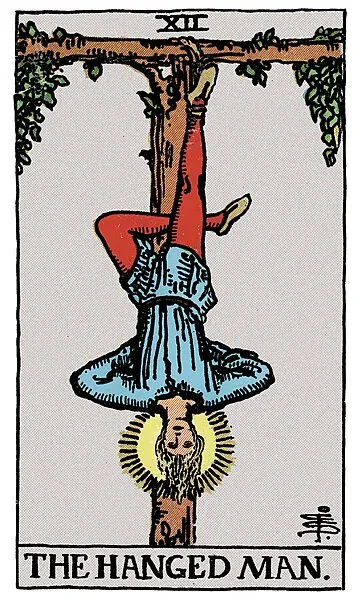
The Hanged Man
The pause becomes deliberate suspension — the looking is no longer optional, the season requires you to stop. The Hanged Man clarifies what the Seven of Pentacles only implies: the suspension is the practice, not the prelude. Honor it. Do not return to the row until the held stillness has yielded its quiet revelation.
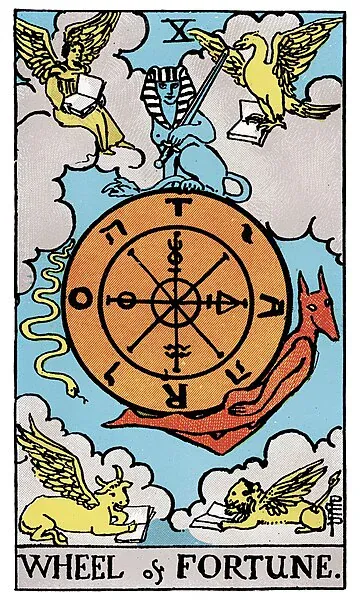
Wheel of Fortune
The reckoning meets the cycle. The harvest you are counting is part of a larger turning that has been moving you through alternating seasons of growth and loss for longer than you may have noticed. Read the count as one frame in the rotation. Some years yield seven pentacles; some yield three; some yield none. The patience is the patience of a farmer who trusts the rhythm.
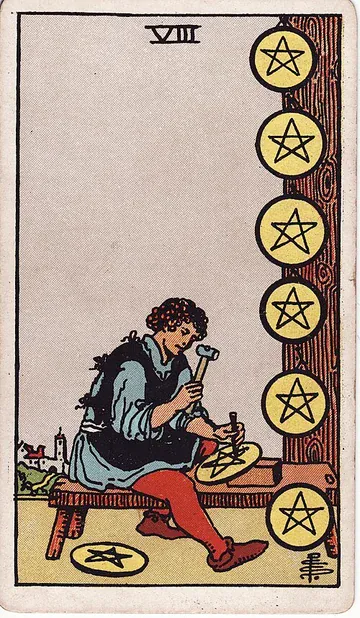
Eight of Pentacles
The pause and the return to the work. The count has been done and the answer is to put the hoe back in the soil and continue the disciplined daily practice the Eight of Pentacles describes. The combination affirms the long-form labor — Saturn in Taurus has spoken; Mercury in Virgo answers with the steady hand returning to the bench.
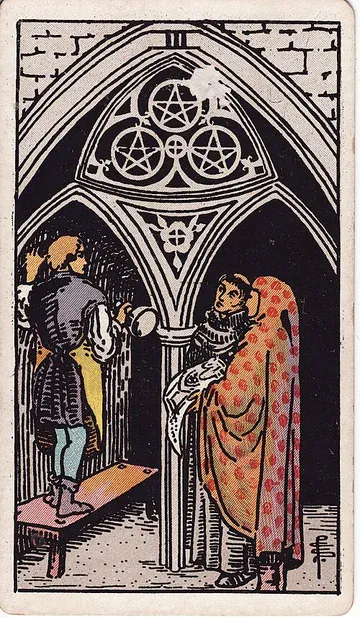
Three of Pentacles
The harvest of the apprentice's labor is now visible to count. The Three's collaborative effort has matured to the season where its yield can be honestly read. The Three planted; the Seven counts. Often appears for craftspeople and coordinators whose work depends on the patient layering of small contributions over long stretches.
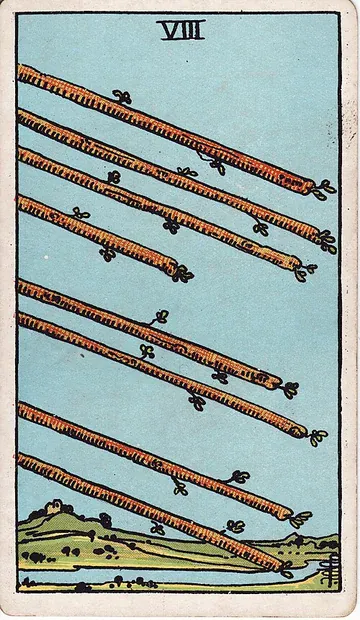
Eight of Wands
Slow time meets the rapid messengers. The most tonally dissonant pairing the Seven of Pentacles forms — the leaning hoe beside the eight wands flying through the air. An external urgency is asking you to abandon the row before the harvest is ready. Read the news. Return to the row. The harvest answers to the soil, not to the messenger.
Frequently Asked Questions
Is the Seven of Pentacles reversed telling me to quit, or telling me I already quit too early?
The seven of pentacles reversed yes or no answer is a soft no — but read which kind of no it is. The card asks you to distinguish between necessary release and impatient abandonment. For two seasons of no visible growth, the answer is release the row. For decisions held in indecision for months, the inability to decide is itself the answer the body has already made. The looking, done honestly, decides itself.
What are the two mistakes the Seven of Pentacles reversed is describing?
The seven of pentacles reversed meaning splits along two distinct axes. The first is impatience — pulling the seedling up to check the root, abandoning the work before its slow middle has yielded. The second is attachment — watering the vine past its season because the years of investment make the leaving feel like wasting the labor. The card asks you to know which distortion is yours and to act against it for one full season.
With the Seven of Pentacles reversed, did I leave the relationship too soon or stay too long?
In love readings, the seven of pentacles reversed love meaning describes the partnership cut short before its true season — or the partnership held past its yielding season. For long bonds, it warns of postponed reckoning; for new sparks, of either grafting too fast or refusing to plant at all; for reconciliation questions, the rebuild on memory rather than honest current count usually yields the same harvest as the original.
Why does the Seven of Pentacles reversed say their read on me has gone wrong?
When the seven of pentacles reversed appears as feelings, the partner has been looking at you but the looking has gone wrong — either rushing the appraisal to a verdict the season has not earned, or refusing the looking entirely because the honest count would force a decision they are not ready to make. Read the texture as conflicted reckoning, not as a verdict. The work, if there is work, is theirs to finish.
How do I act against the distortion the Seven of Pentacles reversed has named?
The seven of pentacles reversed advice is to name your distortion and act against it. If you are the impatient gardener, hold one row through one full season without checking the root. If you are the attached gardener, set a deadline by which one dead vine will be released. Do the actual looking. Bring the actual numbers. The reckoning, done honestly with a deadline attached, returns the card to upright.
Continue Reading
Seven of Pentacles · Card overview · symbols · correspondences →
Return to the full card view — image, symbols, sensory correspondences, and Hermetic axes.
Read the upright meaning →
Read the same depth on the opposite orientation.
Draw your reading now →
Bring this card to a question — open a quiet ritual.