
Seven of Swords · Core Meaning
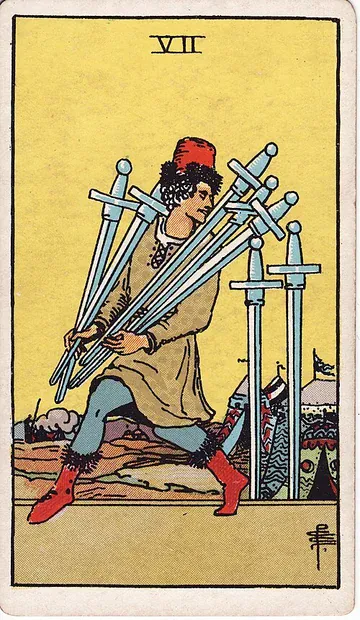
The Seven of Swords begins at the edge of a camp, not in the center of a battle. A man in a red robe moves on tiptoe with five swords clutched in his arms. Their blades point in uneven directions, too long for his body, too many to carry with grace. Two swords remain planted behind him in the ground. The tents are striped and orderly. The sky is the color of old ochre. Somewhere the watch is changing, the campfire is almost out, and no one has fully noticed the departure.
The traditional seven of swords meaning is not simple theft. Theft is too blunt for this card. The image is stranger than that. The man carries five, not seven. He leaves proof that he did not take everything. His posture betrays both urgency and calculation. His backward glance is the most honest part of the scene: he knows the act is not perfectly clean, and he also knows staying would not be perfectly clean either. This is the card of the quiet exit, the private workaround, the decision made outside the meeting because the meeting has become a theater of delay.
Upright, the Seven of Swords names the moment when strategy becomes more merciful than confrontation. It can describe stealth diplomacy: saying less than the whole argument because the whole argument would only harden everyone; leaving before the last insult; keeping a plan private until it has enough shape to survive commentary. It can also describe the necessary solitude of certain decisions. No one else can carry these swords without cutting themselves. No committee can decide how much of your dignity belongs in the room.
The card's fact spine sharpens this reading. It is Air, but not the clear Air of pure reason. It is the Moon in Aquarius, third decan: a detached mind nudged by a private interest it meant to rise above. Aquarius can see the system, the group, the abstract future. The Moon brings memory, instinct, secrecy, the small personal ache under the universal principle. The plan bends. Not because thought has failed, but because thought has discovered it is not as impersonal as it claimed.
Kabbalistically, the Seven of Swords sits in Netzach in Yetzirah: victory and desire moving through the world of formation. Seven is the private weight beneath reason, the inner pull that tips the scale before the mind admits it has leaned. In this card, victory is not conquest. It is escape with enough of yourself intact. The danger is that every successful escape teaches the body to prefer the side door. The gift is knowing when the front door has become a trap.
The objects in the image keep the meaning from becoming abstract. The five swords are carried badly, so the card never lets strategy look glamorous. The two remaining swords are upright, visible, almost ceremonial, so the card never lets withdrawal become total disappearance. The striped tents imply rules, rank, habit, a community with its own version of order. The nearly spent campfire and the gap in the watch give the moment its timing: not midnight drama, but the thin hour when systems briefly fail to look at themselves.
There is also humor in the image, and the humor matters. He is not a master assassin. He is a person carrying too many sharp ideas at once, trying to look casual while every blade points somewhere inconvenient. That awkwardness keeps the card human. Most Seven of Swords situations are not grand conspiracies. They are overmanaged exits, private edits, social evasions, and the little grin that appears when a person thinks they have solved the problem without admitting what the problem is.
Notice also what the card does not show. There is no enemy, no pursuer, no drawn blade against him. The danger is internal: the camp behind him is full of people he chose, allies he once needed, agreements he once made. The moral pressure of this card comes not from being attacked but from being implicated. The five swords are not loot from a fortress; they are inventory from a place he once helped to build. That is why the backward glance is the heart of the image. It is the look of a person measuring his own complicity in the room he is leaving.
The ochre sky is worth one more sentence. It is neither dawn nor dusk. It is the color sand takes when the wind has been blowing too long without rain. In that light, contours soften and shadows shorten, which is exactly the visual register strategy prefers. People look less specific in ochre light. Faces blur into camp at large. The card uses that softening to remind us that quiet exits depend on the eye not focusing too hard on any one figure. The ethical question is whether the soft light is a mercy or a hiding place.
Read the Seven of Swords as a question of proportion. What must be carried away? What must be left behind so the act remains ethical? What information belongs to the whole camp, and what information belongs to the soul that is trying to leave it? Upright, the card does not glorify secrecy. It refines it. It asks whether silence is protecting truth or avoiding truth. The answer lives in the two swords left standing.
Seven of Swords · Love & Relationships
In love, the Seven of Swords upright is the card of the relationship that cannot bear another public trial. Seven of Swords love is rarely loud. It appears in the hallway after the argument, in the message drafted and not sent, in the small decision to stop offering every detail to someone who uses detail as ammunition. The card does not automatically accuse anyone of betrayal. More often, it shows a person trying to preserve dignity inside a bond where directness has become unsafe, exhausting, or theatrically useless.
For an existing partnership, the upright Seven of Swords can describe a tactical retreat. One partner stops engaging in the old pattern. They do not announce the retreat, because announcing it would restart the pattern. They stop defending every motive. They stop offering the long explanation. They take five swords, leave two, and walk away from the version of the marriage or partnership that requires constant proof. This can be healthy when the retreat protects peace. It becomes corrosive when it becomes a private life built inside the shared one.
For a relationship where trust has been strained, the card asks for precise language. It does not say, "They are lying," and it does not say, "Everything is clean." It says something is being handled indirectly. A person may be omitting details because every detail becomes a cross-examination. A person may be hiding plans because they fear punishment more than conversation. A person may be keeping a friendship, a bank account, a grief, or a doubt outside the circle of the relationship. The question is not only what is hidden. The question is why the open table feels unusable.
For a new connection, the Seven of Swords often describes the early instinct to protect one's exit. Someone likes the spark, but keeps one foot near the door. They answer warmly but not completely. They share charm before history. They may be testing whether the room is safe before they bring in the heavier swords. This is not inherently cruel. Early intimacy requires thresholds. But the card asks whether the private reserve is proportionate, or whether old wounds are making the present person pay for a previous camp.
For a single seeker asking whether love is possible, the Seven of Swords points to the ways solitude has become strategy. You may have learned to leave before being asked to stay, to keep plans deliberately flexible, to describe yourself as independent when the deeper truth is vigilance. The card respects that intelligence. It also asks whether the intelligence is still serving you. A life designed entirely around escape routes has fewer rooms where love can sit down.
For love after betrayal or emotional injury, the Seven of Swords can be compassionate. It says a quiet exit may be cleaner than another courtroom. Not every ending needs a final debate in which the wounded person presents evidence and the other person contests it. Sometimes the dignified move is to gather what remains yours: the passwords, the books, the promise you made to yourself, the part of your voice that stopped asking permission. Leave two swords behind. Let the other person keep enough face that the exit does not become another war.
For a long-distance or private relationship, the card can describe secrecy that has a reason. There may be families, workplaces, cultural pressure, immigration timing, or social exposure around the bond. The Seven of Swords does not flatten all privacy into deception. It distinguishes secrecy that protects a tender thing from secrecy that protects cowardice. The difference is whether the hidden arrangement has mutual consent. If both people know where the swords are, privacy can be a cloak. If one person is left in the camp while the other carries off the map, the cloak has become a theft.
For the question "Is this person serious about me?" the Seven of Swords gives a qualified answer. They may be serious, but they are not moving through the front gate. Their seriousness may be strategic, careful, even anxious. They could be watching the room for risk, measuring the consequences, deciding what can be said without triggering a cascade. Look for consistency rather than declarations. A person in this card proves feeling by what they quietly protect and what they refuse to exploit.
For a relationship triangle, undefined attachment, or situation with exes still in the field, the card becomes sharper. Five swords in the arms can mean someone is taking what benefits them while leaving enough behind to claim innocence. "I never promised," "I did not technically lie," "I left the important parts visible" are the two swords planted in the dirt. Here the card asks for ethical arithmetic. Technical innocence may still wound. A half-truth can be clean on paper and cruel in the body.
For couples trying to repair, the Seven of Swords advises a limited disclosure done carefully. Not a theatrical confession. Not a data dump designed to transfer burden. One clean truth, named without ornament, can restore more dignity than a hundred evasive reassurances. The love lesson of this card is not radical transparency at all costs. It is accountable privacy: knowing what belongs to the self, what belongs to the bond, and what has been kept private only because courage has not arrived yet.
For relationships under family pressure, cultural scrutiny, or workplace visibility, the card becomes more subtle. A couple may need to move quietly because too many watchers turn tenderness into a public referendum. The Seven of Swords protects the small flame from wind. But even here, the lovers must know they are both choosing the cloak. If one person calls secrecy protection and the other experiences it as erasure, the card has already begun to reverse.
For blended families, co-parenting arrangements, or households built after a previous ending, the Seven of Swords can describe the careful management of information across more than two adults. There may be a former spouse, a stepchild, an elder, an in-law whose access to the story shapes everyone's mood. The card supports filtering: not every adult needs every detail, and not every child needs to carry adult weather. But it warns against using the children's presence as cover for an avoidance the adults owe each other. The two swords left behind in this case are usually the agreements about how decisions get communicated, not whether they get made.
For the person tempted to check a phone, search a drawer, or investigate through a mutual friend, the Seven of Swords asks a difficult question: are you seeking truth, or trying to become stealthier than the person you mistrust? Suspicion can make thieves of the innocent. The card does not forbid investigation when safety or consent is at stake. It asks that the method not destroy the dignity you are trying to protect.
For couples who have settled into long companionship, the Seven of Swords can show a milder shape: the small private rooms each person keeps even inside a healthy bond. A book read alone. A friendship that does not need an introduction. A walk no one is asked to share. Maturity in this card is the recognition that complete fusion is not the highest form of love. Two people allowed to keep their own weather can stand closer for longer. Privacy that is announced and respected becomes part of the architecture, not a leak in it.
Seven of Swords · As Feelings
Seven of Swords as feelings is guarded interest with an exit route. The body language is the card's first answer: someone is carrying more than they can easily hold, glancing back, trying not to be seen wanting what they want. They may feel drawn to you, alert around you, privately invested, and reluctant to expose the full shape of that investment. Their feelings move like a person crossing a camp before dawn: quick, clever, not fully innocent, not fully dishonest.
If the person is reserved by nature, the Seven of Swords can show feelings kept deliberately offstage. They do not want their emotional life handled by other people's commentary. They may watch more than they speak. They may remember details and reveal little. Their silence is not empty. It is a guarded room. The question is whether they are guarding the feeling until it has dignity, or guarding themselves from the vulnerability the feeling requires.
If the person is normally expressive, this card marks a noticeable change. They may still joke, flirt, send messages, or show up in public ways, but some part of them has gone private. The warmth remains; the full explanation does not. This can happen when they are afraid of being caught caring too much, when they are navigating another obligation, or when they are deciding whether the bond can survive truth. The charm is the striped tent. The glance backward is the confession.
For a long bond, the Seven of Swords as feelings can mean someone loves you and is tired of fighting for the right to have a private interior. They may feel cornered by the expectation that intimacy means total access. The card asks both people to distinguish secrecy from solitude. A partner can need a room inside themselves that is not hostile to the relationship. But if that room contains plans that materially affect the other person, the two swords left behind are not enough.
For a new connection, the card often describes fascination mixed with caution. They want to know you without being known too quickly. They may be gathering impressions, testing your reactions, seeing whether you punish complexity. The feeling can be real and still indirect. The Seven of Swords does not rush toward the beloved with open hands. It circles the camp, learns the exits, and only then decides what can be carried forward.
If there has been conflict, the person may feel defensive and slightly ashamed. The backward glance matters. They know they have not been perfectly transparent. They may also feel that direct honesty has been punished before, by you or by someone long before you. This does not excuse evasion. It explains the shape. Their feeling may be, "I care, and I do not know how to tell the truth here without losing my footing."
If you are asking about someone who disappeared, became inconsistent, or left a conversation unfinished, the Seven of Swords suggests they chose avoidance over confrontation. That choice may have been cowardly, merciful, overwhelmed, or strategic; the surrounding cards decide the tone. As a feelings card, it shows a person who would rather be thought mysterious than be pinned down. They may still look back. Looking back is not the same as returning.
If the bond is forbidden, complicated, or socially inconvenient, the card can indicate feelings hidden because exposure has consequences. This is the lover who keeps the message thread muted, the colleague who never lingers when others are watching, the friend whose eyes say more than their public language allows. The feeling exists inside a surveillance field. The moral question remains: who consented to the secrecy, and who is being used as cover?
If they are trying to end something without saying so, the card feels different in the body. The attention becomes efficient rather than tender. They answer the practical question but not the emotional one. They keep enough contact alive to say they did not vanish, yet remove the future from the room. This is the two-sword logic in feeling form: leaving enough behind to avoid the charge of cruelty while carrying away the living part of the bond.
If they are asking friends about you but not asking you, the Seven of Swords suggests indirect curiosity. They want intelligence before exposure. They may be trying to learn whether the camp is safe: whether you are available, angry, attached, healed, watching. This can be immature, but it can also be the behavior of someone who has lost faith in direct approach. The card asks whether the indirectness is a bridge toward contact or a substitute for contact.
If you are reading for someone you have not met yet, or a person who exists more in correspondence than in shared rooms, the Seven of Swords can describe feelings that have learned to live in writing rather than in body. They may be more candid in messages than in person. They may protect tone of voice, gesture, and breath, while letting language carry the real interest. This is not unfeeling. It is feeling that has chosen a narrower channel because the wider one has hurt before. Read for the steady cadence of contact rather than the temperature of any one note.
If they go quiet for stretches and return without explanation, the card warns against assigning the silence too quickly. Some absences are strategy; some are crisis the person did not want to bring into your room; some are the accumulated weight of an undisclosed obligation. The Seven of Swords as feelings does not ask you to read minds. It asks you to read the pattern of return. Do they come back lighter, with more truth, or do they come back smoother, with more polish? The first is repair finding language. The second is the loop tightening.
The caution is simple: do not confuse strategy with depth. Some people are private because the feeling is precious. Others are private because privacy lets them avoid responsibility. The Seven of Swords as feelings asks you to read the quality of the secrecy. Does it protect a living thing, or does it protect a loophole? The answer is usually visible in what they leave behind.
Seven of Swords · Career & Work
The meeting runs slow, the approval chain is performative, the room is in love with consensus — so one person quietly carries the necessary tools out of the camp and does the thing. That solo workaround is this card's working shape at work. Seven of Swords career is not always misconduct. Sometimes it is the exact intelligence required to keep a project alive when official process has become a shrine to delay.
For a current role, the card asks where you are spending more energy managing visibility than doing the work. You may be in a culture where every decision needs witnesses, every draft needs ritual commentary, every improvement threatens someone's territory. The Seven of Swords says reduce the noise. Finish the necessary part before inviting the room to decorate it. Leave two swords behind: enough documentation, enough notice, enough respect that the workaround remains a tactic rather than a betrayal.
For a new role decision, the card advises careful research outside the official pitch. Read the contract closely. Ask the quiet former employee. Notice what the recruiter does not say. This is not paranoia; it is due diligence. The orderly tents in the distance show an institution with its own story about itself. The Seven of Swords asks you to walk the perimeter before pledging your sword to the center.
For entrepreneurs and freelancers, this card can be excellent. It favors lean moves, stealth launches, prototypes made before public announcement, and the refusal to let committee energy dilute a sharp idea. It says protect the early work from spectators. A seed does not need a press release. A draft does not need a jury. Carry the five swords somewhere quiet and build the thing before the camp invents reasons it cannot be done.
For creative practice, the Seven of Swords describes the private theft that all artists know: stealing back time from obligations, borrowing an hour before dawn, hiding the rough pages from the people who would ask whether the work is practical. The card supports secrecy in the service of craft. It does not support stealing another person's voice, labor, or credit. The difference is clean. Take your time back. Do not take what belongs to another maker.
For job search, the card favors discretion. Do not announce the search to the whole camp. Update the portfolio quietly. Take the interview during the watch-change gap. Keep your current obligations intact enough that departure does not become sabotage. This card often appears when the next move needs privacy until it is real. It also warns against leaving so few traces of your work that others can rewrite the story after you go.
For promotion or internal politics, the Seven of Swords says the official path may not be the only path. A lateral alliance, a carefully timed memo, a proof-of-concept shown to the one person who can actually decide, a private conversation after the group meeting: these are Seven of Swords tools. Use them with restraint. Strategy is not manipulation unless the hidden move deprives others of informed choice.
For layoffs, restructuring, or a company in quiet trouble, the card advises preparation before disclosure. Save your work samples. Understand your benefits. Keep copies of what you are allowed to keep. Reach out to the network before the announcement makes everyone reach at once. The card's watch-change timing matters here. There is a gap between sensing the camp is unstable and hearing the official horn. Use the gap ethically.
For team conflict, the card may show someone bypassing agreed process. It could be you; it could be a colleague. The symptom is a decision that appears finished before others knew it had begun. Upright, this can be necessary when process is being weaponized. It can also erode trust if repeated. The card asks for a post-action accounting: after the thing is done, who needs to know, and what must be repaired so the team can still function?
For students, researchers, or knowledge work, the Seven of Swords warns against cleverness that becomes plagiarism, data trimming, or selective citation. Air loves a loophole. The Moon in Aquarius can rationalize the private bend in the plan as service to the larger idea. Do not let the elegance of the argument hide a missing source. Take only what is yours. Name what came from elsewhere. Leave enough swords standing that the path back remains visible.
For consultants, contractors, and other people who walk into camps without belonging to them, the Seven of Swords is a familiar weather. The work depends on entering a room, gathering enough of its truth to be useful, and leaving cleanly enough that the room still trusts outsiders next time. The card supports that movement when it is named. It becomes cloudy when the consultant takes more pattern, more intellectual property, or more relationship than the engagement quietly authorized. The five swords are your synthesis of the visit. The two left standing are the credit, the references, and the parts of the story that belong to the client.
For public-sector, regulated, or compliance-heavy environments, the card sharpens its ethics. The official channels exist because earlier cleverness produced harm at scale. Working around them, even for genuinely good reasons, can place colleagues, beneficiaries, or vulnerable people at risk you do not directly bear. If the Seven of Swords appears here, the question is not only "Can I move faster alone?" but "What protections were the slow channels designed to create?" Use the side door only when you can name what the front door was built to guard.
For academics, peer reviewers, and people whose currency is intellectual credit, the upright card is acutely concerned with attribution micro-ethics. A footnote moved, an idea overheard at a conference and quietly absorbed, a co-author's draft re-shaped without acknowledgement: these are the small five-sword moves that stack into a career nobody fully trusts. The card's gift here is conscience finer than the formal rules require. Cite what you are not legally required to cite. Name what you could safely omit. The standing is built quietly over decades.
For managers, the upright card can describe the need to shield a team from premature noise. Not every draft needs executive visibility. Not every fragile conflict needs a public channel. A leader sometimes carries the five swords by absorbing the chaos before it reaches the makers. The ethical test is whether shielding preserves the team's agency or simply keeps them uninformed. Good protection leaves people stronger when the truth arrives. Bad protection makes them dependent on the protector's private map.
Seven of Swords · Money & Finances
Discretion is the financial virtue this card names. It favors quiet planning, private saving, debt strategy, careful exit from a shared expense, and the refusal to let the whole camp vote on your survival. Money here is not the feast; it is the bundle of swords held awkwardly while you cross a threshold before anyone wakes.
For a household or partnership budget, the card can indicate a need for separate accounts, personal reserves, or clearer boundaries around what belongs to whom. This is not automatically secrecy against the bond. Some relationships become healthier when every coin is not interpreted as a moral statement. The two swords left behind matter: shared obligations must remain visible. Rent, children, debt, promises, care work. Carry your five, but do not pretend the two do not exist.
For a big purchase, investment, or financial risk, the Seven of Swords says read the fine print and do not be dazzled by the camp's confidence. The orderly tents may belong to a sales office. The striped fabric may be branding. Ask what is missing from the presentation. Ask who benefits if you rush. This card favors quiet due diligence over public excitement. If the offer cannot survive private scrutiny, let it remain in the camp.
For debt and recovery, the card supports a private plan that reduces shame. Automate the payment. Negotiate the rate. Consolidate without announcing the entire history to people who only know how to judge. But do not hide debt from a person whose life is materially tied to yours. That kind of secrecy turns the five swords into a burden that cuts both carriers. The ethical line is whether another person is being denied information they need to consent.
For work compensation, the Seven of Swords often says gather evidence before asking. Know the salary range. Save the praise emails. Document the invisible labor. The card does not walk into the negotiation empty-handed and call it confidence. It carries blades. It prepares. Then, when the moment comes, it can speak briefly because the private work has already been done.
For people leaving a job, a shared home, or a financially entangled relationship, the card is practical. Photograph documents you are allowed to keep. Know account numbers. Separate what can be separated before the emotional weather turns. Do not drain the shared field. Do not use money as punishment. The Seven of Swords wants the exit to remain narrow and clean: enough preparation to be safe, not enough taking to become the harm you are leaving.
For a business owner, the card can advise quiet reserves. Keep runway. Protect cash flow from public optimism. Build the emergency account before the team needs to hear the word emergency. Yet the two swords still stand: taxes, payroll, vendor obligations, and investor agreements do not become optional because the founder is anxious. The card supports prudence, not concealed insolvency.
For freelancers and project-based workers, the Seven of Swords reads the rhythm of feast and famine with clear eyes. The discretion here is not glamorous: separate the tax money the moment the invoice clears, keep a quiet reserve in a different account from the one your daily card draws on, and do not let a single fat month re-set your sense of normal. The five swords are the working capital you actually trust; the two left standing are the obligations the year will not forgive — quarterly tax, professional fees, the equipment that wears out on its own schedule. Privacy here protects against the camp's own optimism.
For people with irregular incomes from creative work, gig platforms, or commissions, the card warns against confusing visibility with stability. A viral month is not a salary. A waiting list is not a contract. The Seven of Swords advises you to translate every windfall into months of runway before translating it into upgrade. This is not pessimism; it is the literacy of carrying sharp things across uneven ground.
For family money, the card points to the old problem of privacy inside obligation. Adult children may need financial boundaries with parents. Parents may need to stop rescuing one child in secret while expecting the others to trust the household story. Inheritance conversations, caregiving costs, and shared property often carry Seven of Swords weather because everyone has a private version of fairness. Bring enough of the ledger into daylight that love is not forced to do accounting in the dark.
For people supporting relatives across borders or generations, the card recognizes that financial silence sometimes serves dignity. Not every recipient wants every detail of the support announced at the table. Not every supporter wants the rest of the family to expect the same flow. The card supports those agreements when they are mutual and stable. It warns when the silence becomes a hierarchy: one helper carrying the camp without receiving back even acknowledgement, one recipient assuming endless supply because asking would make the arrangement real.
The financial trap of this card is clever leakage. Small hidden charges, quiet subscriptions, cash moved to avoid a conversation, a purchase justified because no one took all seven swords. The amounts may be defensible one by one. The pattern is not. If the money question carries anxiety, examine the private loopholes first. The card asks for an accounting that is calm enough to be honest and private enough to be usable.
Seven of Swords · Health
For health, the Seven of Swords upright speaks through Air: the throat, the lungs, and the nervous system. Its temperament is sanguine, quick and keen, but here that quickness has learned to move around direct strain rather than through it. The body in this card is not collapsed. It is alert, wired, listening for footsteps. It carries too much in an awkward grip and calls the awkwardness efficiency.
In acute matters, the card points to symptoms that are easy to minimize because functioning continues. A tight throat after the conversation. Shallow breathing during the meeting. Sleep interrupted by the mind rehearsing what not to say. The Seven of Swords does not diagnose. It describes attention that has become evasive. The body may be asking for the plain statement, the postponed appointment, the breath that is not organized around escape.
For chronic stress, this card often appears when secrecy or constant strategy has become a physical climate. Managing impressions, hiding distress, keeping a plan from the wrong people, deciding which truth is safe for which room: these are not only mental acts. They live in the lungs and nerves. They shorten the breath. They sharpen the startle response. They make rest feel like negligence. The card asks what the body has been carrying because the mouth has not been allowed to carry it.
For recovery, the Seven of Swords favors small, private systems. Not every healing effort needs public accountability. A walk before anyone wakes, a breathing practice in the car, a medication box kept without drama, a script written before the difficult call: these are honorable five-sword tactics. The two swords left behind are professional care and trustworthy witnesses. Privacy supports healing; isolation endangers it.
For mental health and emotional strain, the card asks about self-protective omission. What feeling is being edited before it reaches language? What fact are you keeping from a therapist, partner, doctor, or friend because naming it changes the map? Again, this is not medical advice; it is symbolic attention. The Seven of Swords describes the cost of carrying truth awkwardly. A truth held too long against the chest begins to cut the carrier.
For the throat, the card asks about unsaid sentences. Not every sentence must be spoken to the person it concerns; some belong first with a clinician, therapist, journal, or trusted witness. But a sentence that has no place to go often returns as tension. For the lungs, the card asks about the breath that never fully arrives because the system is always listening. For the nervous system, it asks what environment has trained alertness to feel like intelligence.
For sleep, the Seven of Swords often describes the wakefulness that arrives in the watch-change hour: three or four in the morning, the mind clear but the body refusing rest, the inner monologue rehearsing tomorrow's careful sentences. This is not insomnia from caffeine or screens alone. It is the body declining to sleep beside an unresolved strategy. The medicine is not pharmacological cleverness. It is the act of writing down, before bed, the one sentence the day refused to let you speak. The page becomes the room where the sentence can sleep so the body can.
There is also a social health layer. The Seven of Swords can appear when privacy has become the only rest available. If every room requires performance, the body learns to steal solitude in unhealthy ways: staying up too late because night is the only unobserved hour, hiding food, hiding tears, hiding fatigue, hiding the need to be untouched. The card asks for sanctioned solitude, not stolen collapse.
For the highly conscientious or chronically responsible — the carer, the eldest child, the manager who absorbs the team's weather — the Seven of Swords describes the particular exhaustion of always being the watcher. The nervous system has been trained to monitor everyone else's footing. Rest itself feels like a dereliction of duty. The card asks for the deliberate construction of unmonitored time: hours when nobody knows where you are, not because you are hiding, but because the body has learned that watchfulness is its only currency. Gradually, slowly, give it another one.
For everyday care, the card favors small interventions that remove surveillance from the nervous system. Close the extra tab. Silence the thread that keeps pulling the breath high. Step outside without explaining the walk as productivity. Keep water nearby before the throat becomes a messenger of neglect. These are not cures. They are the two swords left standing for the body: evidence that the self has not been abandoned to strategy.
The health advice is practical and modest: lengthen the exhale; make one appointment; tell one qualified person the part you keep stepping around; remove one avoidable source of nervous surveillance. The card does not demand a dramatic reveal. It asks for one clean breath through the front door.
Seven of Swords · Spirituality
Spiritually, the Seven of Swords is the discipline of honest concealment. That phrase sounds contradictory only in a culture that confuses visibility with truth. Seeds work underground. Retreats close their doors. Vows are often kept in silence before they can be spoken. This card asks what part of the path needs privacy because it is sacred, and what part needs privacy because it cannot withstand examination.
Netzach in Yetzirah gives the card its inner heat. Desire shapes the subtle world before reason writes its public explanation. The Moon in Aquarius adds the strange chill of the outsider: the person who sees the pattern of the camp and knows they cannot remain fully inside it. Spiritually, this is the card of leaving a group mind without turning the group into an enemy. It is apostasy without performance. It is the private rite of taking back the symbols that still belong to you.
The shadow practice of the Seven of Swords is self-deception disguised as initiation. "No one understands my path" can be a true sentence. It can also be a locked door built to keep out accountability. The card asks for a witness, even if only one. Every private ritual needs some contact with reality: a journal dated honestly, a teacher who can challenge the beautiful excuse, a friend who notices when solitude becomes disappearance.
A thirty-minute practice for this card: sit with seven small objects on a table. Name five that are truly yours to carry this month: responsibilities, desires, skills, griefs, decisions. Leave two on the table and name why they are not yours, or not yours now. Do not dramatize the exercise. The power is in proportion. The soul learns ethics by touching limits.
In spiritual community, the Seven of Swords is especially exact. Leaving a circle, temple, church, coven, sangha, study group, or teacher can require more delicacy than outsiders understand. Public denunciation may be true and still not be the task. Quiet departure may be cowardly and still be the only safe route. The card asks for discernment rather than ideology. What protects the vulnerable? What protects only your image? The same act can be holy or evasive depending on its hidden motive.
For private devotion, the card asks that secrecy remain alive rather than merely hidden. A practice kept away from social media may deepen because no audience drains it. A prayer not described to friends may become more exact. But the card warns against making privacy into superiority. A hidden altar is not purer because it is hidden. It is purer only if the concealment lets attention become more honest.
For practitioners who travel between traditions or hold contradictory sources at once — a household with two faiths, a syncretic personal lineage, a Buddhist who still loves a particular psalm — the Seven of Swords is unusually kind. It defends the right not to publish your synthesis. Some practices need to deepen before language is asked of them. The card does not require that you flatten your inner cosmos for the comfort of any single audience. It only asks that you not use the privacy to evade serious correspondence with each tradition's actual form.
The plant correspondences, mugwort and cocklebur, carry the same lesson. Mugwort belongs to threshold, dream, and protective bitterness; cocklebur clings. The Seven of Swords asks which private thing is medicine and which private thing is merely stuck to your coat. Spiritual maturity here is not total disclosure. It is the ability to tell medicine from burr.
The card also speaks to the spiritual ethics of timing. The Moon in Aquarius watches the whole calendar; it knows that disclosure in the wrong season can wound a tender practice as surely as exposure can. There is a discipline in choosing not yet — not as evasion, but as protection of a thing still becoming itself. The two swords left standing in the dirt can also be the public commitments that anchor the private work: a pledge kept, a promise honored, a duty performed even while the inner room remains undescribed. Privacy without those anchors drifts. Privacy with them becomes architecture.
The spiritual gift of the Seven of Swords is the right to leave. Not every temple remains a temple. Not every teacher remains a teacher. Not every inherited belief deserves your lifelong attendance. The card blesses the quiet exit when the exit preserves the living thread. But it asks you to leave with clean hands, to take only what is yours, and to let the two standing swords testify that you did not confuse liberation with taking everything.
Seven of Swords · Yes or No
Conditional yes — if the quiet route is ethical.
For Seven of Swords yes or no questions, the upright card rarely gives a clean public yes. It says yes to strategy, yes to discretion, yes to the side door when the front door has become performative or unsafe. It does not say yes to deceit for convenience. The card's verdict depends on proportion: are you taking only what is yours, or are you using secrecy to avoid the cost of being known?
For relationship questions, the answer is usually "not openly yet." If the question is whether to speak, the card may say wait until the words can be carried safely. If the question is whether to leave, it may say yes, leave quietly and preserve dignity. If the question is whether someone is hiding something, the answer is also yes, but the hidden thing may be fear, strategy, or an unfinished plan rather than a simple betrayal.
For work and money questions, the upright card is often a yes for preparation and a no for announcement. Apply. Save. Research. Prototype. Gather the documents. Move before the camp organizes its resistance. But keep the two swords visible: legal obligations, ethical credit, shared commitments, notice where notice is owed. The card supports stealth; it does not bless theft.
For timing, the Seven of Swords points to the gap in the watch: before the public moment, before the meeting, before the fire is fully out. It favors action in a narrow window. That does not make the answer frantic. It makes it precise. If the right window is gone, forcing the move can turn the card reversed.
For love yes-or-no, this card often answers yes to leaving a destructive pattern and no to testing someone through hidden maneuvers. Yes to taking space before the next conversation. No to creating a trap so the other person proves what you already fear. If the question is "Should I reach out?" the answer may be yes only after the message has been stripped of bait. Say the thing. Do not plant a sword and pretend it is a flower.
For career yes-or-no, the card is a strong yes for preparation and a cautious answer for execution. Apply quietly, negotiate privately, protect the prototype, check the contract. But if the move requires misrepresenting a colleague, hiding a conflict of interest, or taking work that belongs to the organization, the answer becomes no. The blade has crossed from strategy into theft.
For money yes-or-no, the card says yes to saving privately and no to financial concealment that changes another person's life. Yes to reading the contract before the excited announcement. Yes to waiting before a purchase that feels like revenge. No to moving shared money without agreement. The card's answer is never only about the cash; it is about who gets to know what the cash is doing.
For family or community questions where the camp has expectations, the Seven of Swords answers yes to the private decision and no to the announced rebellion. Yes to enrolling in the program nobody approved. Yes to ending the visit early. Yes to not attending the gathering that costs more nervous system than it gives back. But no to performing the rebellion for an audience. Quiet is the card's preferred volume. A boundary that has to be defended in the family group chat is already half-eaten by it.
For questions about whether to investigate, search, audit, or check on someone — financial activity, social media, medical history, immigration status — the card answers conditionally. Yes if consent or safety is genuinely at stake and the method does not destroy what you are trying to protect. No if the investigation is mostly looking for permission to be already certain. The card respects discernment. It does not respect surveillance disguised as discernment.
If the yes-or-no question contains the word "should," ask one more question: who is harmed by not knowing? If no one is deprived of consent, the quiet yes may stand. If someone needs the information to make their own choice, the card shifts toward no. The Seven of Swords is not afraid of secrecy. It is afraid of cowardice dressed as wisdom.
Seven of Swords · Advice
Reduce the audience before you make the move. Stop treating every decision as material for the whole camp. Choose the two or three people who truly need to know, tell them cleanly, and let the rest meet the finished fact later. Overexposure can kill a delicate move before it has bones.
Take only what is yours. This is the card's central instruction. In a breakup, take your dignity, your belongings, your records, your promise to yourself. Do not take revenge. In work, take your portfolio and your ideas. Do not take credit that belongs to the team. In money, take your privacy. Do not take another person's informed consent. The five swords must be counted before you leave.
Leave two swords behind. Give the situation enough truth to remain human. That might be a short note, a clean boundary, a handoff document, a paid bill, a shared password returned, an apology without a performance. The two swords are not weakness. They are the ethical trace that keeps a quiet exit from becoming a wound.
Use the side door once, not as a lifestyle. A tactic repeated too often becomes a character. If every room requires stealth, examine the rooms you choose and the self you bring into them. The Seven of Swords is brilliant in emergencies and corrosive as an identity. Let strategy serve freedom, then return to daylight.
Prepare before speaking. Draft the exit email and do not send it for one night. Gather the documents before the negotiation. Put the boundary in one sentence before entering the room. The Seven of Swords is awkward because the swords are too many for improvisation. Reduce improvisation. Let the private hour do the work the public moment cannot do.
Watch the smile. In the image, the half-smile is neither pure malice nor pure relief. It is the face of someone enjoying the intelligence of the move. That enjoyment is the danger point. If you begin to love the cleverness more than the freedom it creates, stop. The advice then is not to become less intelligent. It is to become less enchanted by your own escape.
Make a map of the camp. Write down who truly has standing in the matter, who is only noisy, who is entitled to an explanation, and who wants an explanation because explanations make them feel central. The Seven of Swords becomes cleaner when the audience is sorted. Many evasions begin because the mind treats all watchers as equal. They are not equal.
If apology is needed, keep it small enough to be trusted. Do not explain the whole weather system that made the side door attractive. Say what you did, why it affected the other person, and what changes now. The upright card can still apologize before it reverses. That is one of its hidden mercies.
Finally, set a time to be seen again. A quiet exit can be right; permanent vanishing is another matter. Decide when the necessary people receive the necessary truth. The Seven of Swords is healthiest when privacy has an end point, a threshold where the carried swords are set down and counted in open air.
If no such threshold can be named, the plan may already be less clean than it sounds. Name the threshold before the first step, and the card remains counsel rather than camouflage.
This week, make one private plan and one public repair. The private plan should move a stuck matter forward without inviting noise. The public repair should tell one person what they need to know. Together, those actions honor both sides of the card: the intelligence to move quietly and the courage to remain trustworthy.
Seven of Swords · Card Combinations
Seven of Swords + Five of Swords
This pairing sharpens the battlefield. The Five of Swords shows open conflict after the damage; the Seven shows the attempt to leave with something before the damage becomes public. Together they describe a situation where winning has already begun to taste bitter. Someone may be trying to salvage advantage from a fight that has no clean victor. The counsel is to stop confusing escape with triumph.
Seven of Swords + Eight of Swords
Here the escape route meets the mental prison. The Seven carries swords away; the Eight stands bound among them. Together they ask whether the secret plan is liberation or another form of captivity. A person may be sneaking around a limit that exists mainly in the mind. Or they may be using cleverness to avoid admitting how trapped they feel. The useful move is smaller and plainer than the strategy suggests.
Seven of Swords + The Moon
The watch-change gap becomes fog. With The Moon, the Seven of Swords enters dream, projection, and unreliable light. This combination can show deception, but it more often shows uncertainty so thick that everyone becomes suspicious. The backward glance sees shapes in the dark. Slow down. Do not act on every fear. Name what is known, what is guessed, and what belongs to old night.
Seven of Swords + Justice
Justice brings the side door into the court of consequence. This combination asks for records, contracts, receipts, and clean attribution. If the Seven's strategy has been ethical, Justice protects it by giving it form. If it has been evasive, Justice exposes the missing sword. The pair is especially strong for legal, workplace, and relationship questions where fairness depends on what was disclosed.
Seven of Swords + The Magician
The Magician gives the Seven skill, language, and tools. Together they can describe brilliant strategy: the pitch made to the right person, the prototype built in secret, the words chosen with surgical care. The danger is persuasion without consent. The Magician can make the side door look like a main entrance. Use the combination to make the plan articulate, not to enchant others past their own judgment.
Seven of Swords + The Hermit
The Hermit makes the exit contemplative rather than tactical. The person leaves the camp not to win, but to hear their own thought without the clatter of tents. Together the cards favor withdrawal for study, healing, and ethical review. They also warn against using wisdom language to avoid human obligation. A lantern is not a hiding place if it eventually shows the way back.
Seven of Swords + Seven of Pentacles
Two sevens stand together: private strategy and patient cultivation. The Seven of Pentacles slows the Seven of Swords down. Not every problem needs an escape; some need a season of tending before the result can be judged. Together they describe the quiet plan that must be sustained over time: saving money, leaving a job well, repairing trust, building the exit before using it.
Seven of Swords + The Lovers
The Lovers ask for a clean choice between two paths; the Seven of Swords prefers a third route nobody is offering. Together they describe a person trying to honor real feeling while avoiding the explicit declaration the situation is asking for. The pair is sharpest in love triangles, undefined attachments, and decisions about whether to commit to one shape of life over another. The combination warns that postponing the choice indefinitely is itself a choice — usually one made for the person not in the room.
Seven of Swords + Three of Swords
The strategy meets the cut. The Three of Swords carries grief that has already happened; the Seven of Swords often appears when someone is trying to organize themselves around that grief without naming it. Together they describe the maneuver that protects an old wound from inspection. The repair is not a cleverer strategy. It is the willingness to let the grief be visible long enough to be honored, before the strategy can be put down.
Seven of Swords + The Star
The Star opens after a long depletion; the Seven of Swords often arrives in the months before that opening, when the seeker is still rationing, still planning, still leaving carefully. Together they describe the quiet exit that finally lets restoration begin. The combination favors the slow, private hours of refilling — not the dramatic announcement of recovery, but the unannounced practice of pouring water again. Hold the strategy lightly. Let the Star do the part the swords cannot.
Card Combinations
Five of Swords
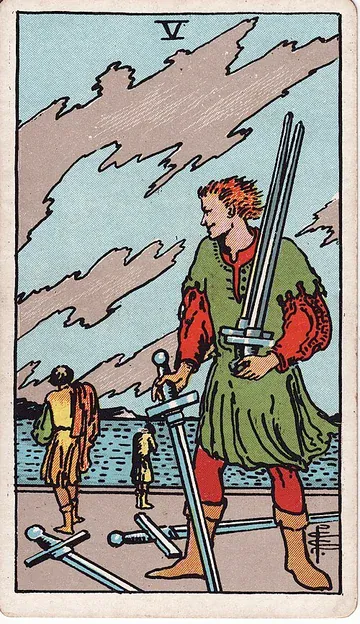
Seven of Swords with Five of Swords shows the line between strategic retreat and bitter victory. The Seven tries to leave before the fight consumes the room; the Five shows what happens when the fight has already named winners and losers. Together they ask whether the quiet move prevents harm or merely preserves advantage after harm has begun.
Eight of Swords
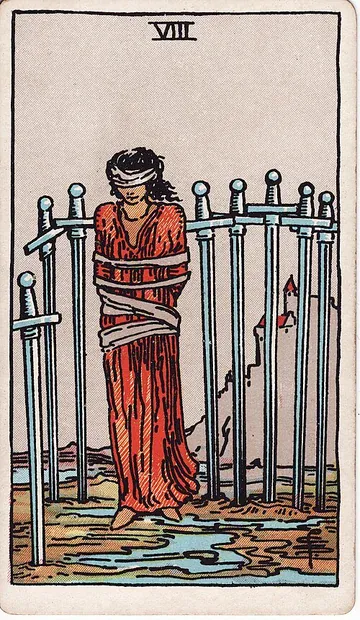
Seven of Swords with Eight of Swords places the escape route beside the mental prison. A person may be clever enough to evade the camp and still bound by fear, guilt, or an old story. The combination asks whether secrecy is true freedom or a more elaborate form of captivity.

The Moon
Seven of Swords with The Moon turns strategy into fog. The backward glance sees shapes that may be real or imagined; the path out of camp runs through dream, suspicion, and projection. This pair asks for slow evidence, clean instinct, and the humility to admit when fear is writing the map.
Justice
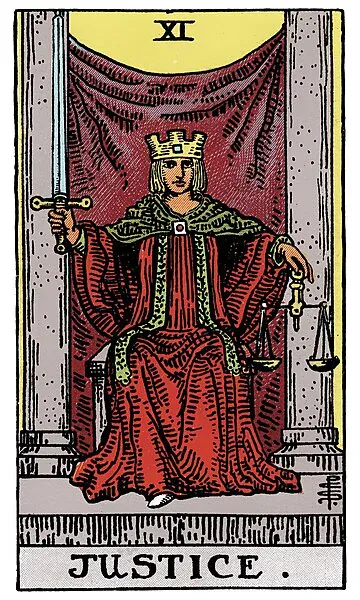
Seven of Swords with Justice brings the quiet act before the scale. If the strategy is ethical, Justice gives it language, record, and proportion. If something was taken, omitted, or miscredited, Justice names the missing sword. Together they favor documentation, accountability, and repair that can be measured.
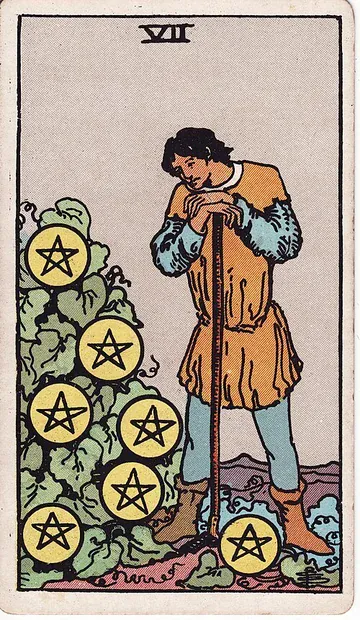
Seven of Pentacles
Seven of Swords with Seven of Pentacles slows the side-door tactic into a season of cultivation. Not every stuck situation needs escape; some need patient tending, measured withdrawal, or an exit built without damaging the field. The pair asks what can be carried quietly and what must be allowed to ripen.
Frequently Asked Questions
Is the Seven of Swords a card of strategy, or a card of theft?
The picture declines to settle it, and so does the card. It means strategy, privacy, and a quiet exit from a situation where direct confrontation may waste more than it repairs. It can show stealth diplomacy, a solo workaround, or taking back what belongs to you. Its caution is ethical proportion: secrecy protects dignity when it leaves two swords standing, but it becomes harm when it deprives others of truth they need.
Does the Seven of Swords approve of taking the side door?
Conditionally, and the condition is who is left standing without information. The upright card says yes to discretion, preparation, and the side door when the front door has become unsafe or merely useless. It says no to deception used for convenience. Ask who is affected by not knowing. If no one loses an informed choice, the quiet route may well be right; if someone does, the card turns cautionary and stays that way. Two swords are left standing in the picture, and the ethics of the whole card sit in that detail.
Why has the truth gone underground in this relationship?
That is the exact question the Seven of Swords is built to ask. In love it points to indirect handling: guarded feelings, private plans, withheld details, or a quiet exit from a bond that cannot bear another public fight. It does not always mean cheating. It asks whether the privacy is mutual, what made directness feel expensive, and what has to be spoken so that dignity survives the telling. A household where one person has started narrating selectively is usually a household where a plain answer once cost too much.
Is guarded interest still interest, when the Seven of Swords answers a feelings question?
It is — interest with an escape route deliberately left open. Someone may feel drawn to you while working hard not to expose how much they care. They watch, they measure, they protect their private interior, and they keep one hand on the tent flap. The feeling can be entirely real while the expression stays indirect, which is why this card asks you to read consistent effort and quiet protection rather than waiting for a dramatic confession that may never be offered.
Is the Seven of Swords always about lying?
No. The Seven of Swords can describe lying, especially with harsh surrounding cards, but upright it often describes strategy, discretion, or a necessary retreat. The image itself shows five swords taken and two left behind, which makes the ethics complex. The key question is whether privacy protects something rightful or hides information another person needs.
Continue Reading
Seven of Swords · Card overview · symbols · correspondences →
Return to the full card view — image, symbols, sensory correspondences, and Hermetic axes.
Read the reversed meaning →
Read the same depth on the opposite orientation.
Draw your reading now →
Bring this card to a question — open a quiet ritual.