
Seven of Swords Reversed · Core Meaning
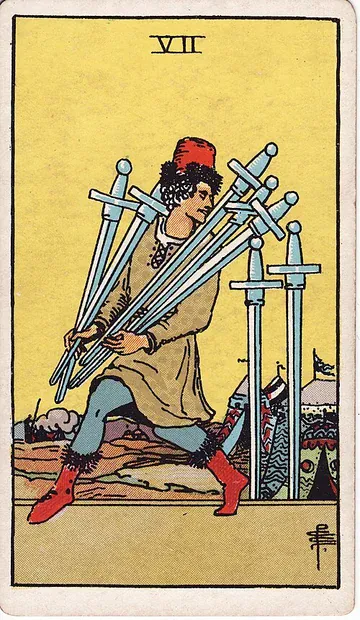
The Seven of Swords reversed turns the quiet exit into the moment after the noise begins. The man still carries five blades, but the awkwardness can no longer be hidden. The camp has seen him. The two swords left behind no longer prove restraint; they prove identity. The backward glance, which upright was a private conscience, becomes public evidence. Someone knows. Something has been traced. A plan that depended on the watch-change gap has met daylight.
Seven of Swords reversed meaning has two main faces. The first is exposure: being caught out, a half-truth revealed, the missing context returning with witnesses. A message appears. A receipt surfaces. A colleague asks the one question the strategy did not prepare for. The clever route was not as invisible as it felt. The card does not need melodrama. Its reversal is often quiet and devastating: the email forwarded to the wrong person, the omission noticed, the story failing by one detail.
The second face is self-deception. Reversed, the thief may not be sneaking past the camp as much as sneaking past himself. He tells himself he took only what was his. He tells himself the two swords left behind make the act fair. He tells himself the system forced his hand, the partner would not understand, the colleague had it coming, the body can carry the strain. The reversal exposes the inner loophole before or after the outer world does. Either way, the hidden arithmetic breaks.
The Moon in Aquarius is especially important here. Upright, it gives the detached mind a private curve. Reversed, the curve becomes rationalization. Aquarius speaks in principles while the Moon smuggles a personal need under the robe. The person says "for the group," "for efficiency," "for peace," "for the future," while the body is protecting pride, fear, appetite, or resentment. The mind may be brilliant. Brilliance does not cleanse motive.
Netzach in Yetzirah also turns. Desire shapes the subtle field, but reversed desire refuses to admit it is desire. The victory sought becomes thinner than trust. The private weight beneath reason becomes the whole scale. Seven, here, is not the sacred inner pull; it is the repeated preference for the side door until the front door feels impossible. The card asks for reintegration: return to the visible path, not because visibility is always superior, but because invisibility has begun to deform the walker.
The image vocabulary becomes harsher when reversed. The five awkward swords now look less like necessary cargo and more like evidence mishandled. The two swords left behind no longer say restraint; they say incompletion. The striped tents no longer represent a consensus one might need to leave; they become witnesses, records, procedures, other people with memory. Even the ochre sky changes character. It is not dawn enough for renewal, not night enough for cover.
This is why the reversed card can feel more humiliating than catastrophic. Catastrophe has grandeur. Humiliation has details: the typo in the lie, the timestamp, the person who remembers a different version, the object left in the wrong place. The Seven of Swords reversed is full of details. It teaches that truth often returns through the smallest thing, not through thunder.
There is also a third face the reversal can wear: the strategy that has aged into a personality. Upright, the side-door move is a tactic for a specific situation. Reversed, after long use, it has become a habit the person can no longer name. They do not feel evasive. They feel ordinary. Every conversation has its filter; every decision its quiet revision. The reversal can arrive as the slow, accumulated discovery — by partner, employer, friend, or one's own quiet self — that the person nobody quite trusts is not a stranger but the present occupant of the body. This is harder to repair than a single exposed deceit, because nothing dramatic broke. The architecture itself is the problem.
The reversal can also arrive inwardly before anyone outside notices. A person wakes with the old explanation still available and suddenly cannot use it. The sentence that worked yesterday tastes false. The cleverness that once felt like survival feels like a costume. This is a blessed discomfort. It means conscience has reached the camp before consequence does.
Read the reversed Seven of Swords as a call to come back once. Admit the plan. Correct the record. Speak the part that was omitted. Give back what was not yours, including credit, context, money, time, or emotional clarity. The reversal can be merciful when it arrives early. Being caught at the edge of the camp is painful; being caught after building a life around evasion costs far more.
Seven of Swords Reversed · Love & Relationships
In love, the Seven of Swords reversed is the private pattern becoming visible. Seven of Swords reversed love can be the text found, the contradiction noticed, the emotional absence finally named, or the old habit of slipping away brought into the room. It can also be the relief of confession. A truth that had been carried awkwardly against the chest is set down. The relationship may hurt from the impact, but the body no longer has to keep tiptoeing.
For an existing partnership, the reversed card often appears when avoidance has accumulated interest. The issue is no longer only what happened; it is the architecture of not saying. Small omissions have made the shared house crooked. One partner says they did not lie, and technically they may be right. The other partner points to the two swords left behind and says the evidence of omission is still evidence. Repair begins when technical innocence stops being the center.
For a relationship affected by actual betrayal, the card is direct. Something concealed is exposed or ready to be confessed. It may concern another person, money, private messages, relapse, resentment, a plan to leave, or a history edited beyond recognition. The Seven of Swords reversed does not decide whether the relationship can repair. It insists the repair cannot be built on the same hidden floor. The first task is full enough truth for the injured person to know where they are standing.
For a new connection, reversed Seven of Swords can show the moment someone realizes their guardedness is becoming sabotage. They may have kept options open, softened facts, avoided labels, or disappeared whenever intimacy required a name. Now the pattern is visible. The other person may ask for clarity. The card's gift is that clarity is still possible if the person stops performing mystery and starts speaking in usable sentences.
For a single seeker, the reversed card asks where self-protection has become self-deception. You may tell yourself no one is available, no one is trustworthy, no one deserves access, while quietly arranging life so no one can approach without failing a hidden test. This is not a moral accusation. It is a tender, severe mirror. The wound taught strategy. The strategy now needs review.
For love after a difficult ending, the Seven of Swords reversed can mark the return of unprocessed material. A former partner's version of events surfaces. Your own private motive becomes harder to deny. The clean story of who left and who was wronged gets more complicated. The card does not ask you to surrender your dignity. It asks you to let the fuller truth make the dignity real.
For secret relationships or undefined arrangements, the reversal is especially loud. What was private may become public, or the cost of privacy may become too heavy for one person to carry. If the secrecy was mutual and protective, the pair may need a new agreement. If the secrecy served only one person, the imbalance is exposed. The question shifts from "Can this stay hidden?" to "Who has been paying for it to stay hidden?"
For couples in repair, the reversed Seven of Swords advises structured disclosure rather than chaotic confession. Confession can become another selfish act if it is used to unload guilt without regard for the listener's capacity. The card asks for truth with accountability: dates if dates matter, context without excuses, apology without bargaining, and a clear statement of what changes in behavior. The goal is not to win forgiveness. The goal is to restore reality.
For the question "Do they still have feelings?" the reversed card can mean yes, but those feelings are tangled with shame, avoidance, or the fear of being exposed. They may care and still be behaving poorly. They may miss you and still not know how to stand in the front door. Do not turn the presence of feeling into a pardon for the absence of integrity. The card separates the two.
For the person who has been hiding something and wants to repair, the reversed card asks for pacing. Confession is not the same as flooding. The injured person does not need every image your guilt produces; they need the facts that restore their map. Speak what affects consent, safety, money, health, loyalty, and choice. Keep self-punishment out of the center. The point is not to make yourself the most visibly ashamed person in the room. The point is to make reality usable again.
For relationships where one person repeatedly says the other is "too sensitive" or "too suspicious," the reversed card asks whether suspicion has been manufactured by inconsistency. A nervous partner is not always intuitive; sometimes they are responding to a room where the furniture keeps moving. The cure is not contempt for their alarm. The cure is a stable reality. If there is nothing to hide, the pattern should become easier to describe, not harder.
For the partner who has become the investigator, the card also has a mirror. Living as the one who checks, traces, tests, and waits for contradiction is its own wound. Even if suspicion began for good reason, the soul cannot make a home inside surveillance. The reversed Seven of Swords asks whether repair is possible, and if not, whether leaving openly is kinder than staying as a detective in the house of love.
For long marriages or partnerships where the old rhythm has begun to resemble polite cohabitation, the reversed Seven of Swords can expose the small daily evasions that have become the wallpaper of the bond. Pretending the meal was good. Pretending the holiday was easy. Pretending the in-law's comment did not land. None of these are individually a betrayal. Together, they form a marriage in which neither person can quite reach the other through the layers of accommodation. The repair here is unglamorous: name the small daily false notes before they become the whole song.
For a person tempted to confront the partner with surveillance — a hidden install, a pulled record, an account quietly accessed — the reversed card adds a stern note. Even if what is found is real, the method has its own gravity. Confronting someone with information they did not know you had often shifts the entire conversation onto the question of how you found it. The card asks you to choose the method that allows the future to remain usable, even if it costs you a little of the certainty you wanted first.
For the person deciding whether to stay, the reversed card asks for one criterion: has the hidden pattern stopped, or has it only become more careful? Tears, explanations, and dramatic remorse can be sincere and still insufficient. Look for the return of visibility. Look for voluntary truth before discovery. Look for the willingness to leave two swords standing in plain sight and account for the five that were carried away.
Seven of Swords Reversed · As Feelings
Seven of Swords reversed as feelings is exposed guardedness. The person may feel caught, ashamed, defensive, relieved, or suddenly unable to keep the private corridor intact. The emotional texture is not simple affection or simple guilt. It is the feeling of turning around with five swords in the arms and realizing the camp is looking back. Whatever they feel about you now has to pass through the fact of what was hidden, avoided, or misnamed.
If they are reserved by nature, the reversed card may show privacy becoming visible against their will. They may feel invaded, misunderstood, or frightened by how much has been noticed. They might retreat further at first. Under that retreat is a difficult truth: some part of them knows the old method of staying safe has begun to injure trust. Their feeling may be real, but their system for protecting it has failed.
If they are normally expressive, the reversed card can show performative openness collapsing. The words were many; the missing truth was small and central. They may feel embarrassed that charm no longer works. They may try to explain, joke, soften, or reframe. The card asks you to listen beneath style. A person can speak beautifully and still not answer the question. A person can stumble and still be telling the truth at last.
For a long bond, Seven of Swords reversed as feelings often means someone feels known in the uncomfortable way. The partner has seen the avoidance pattern too clearly to unsee it. The person may feel resentment at being called out and relief that the lonely work of hiding has ended. That mixture can look contradictory: irritation and tenderness, apology and withdrawal, a wish to be held and a wish to escape the room.
For a new connection, the reversed card can show someone realizing they have mishandled the beginning. They may feel attraction, curiosity, and regret for the mixed signals. Perhaps they kept another option alive. Perhaps they avoided naming what they wanted. Perhaps they acted cooler than they felt and now the distance has become real. Their feelings are not absent, but they are entangled with the consequences of trying not to be vulnerable.
If there has been no contact, the reversed card suggests the silence has become harder for them to justify. They may be noticing the cost of leaving without explanation. They may feel watched by their own conscience, even if no one else is watching. This does not require action from you. The card describes their interior weather: a private rationale losing its power.
If the question concerns remorse, the Seven of Swords reversed is one of the clearer cards for discomfort after evasion. It can show guilt, yes, but guilt is not automatically accountability. Some guilt wants only relief. Some guilt wants repair. The difference is whether they move toward the person harmed with usable truth, or toward the nearest exit with a better excuse.
If the relationship involved secrecy, the reversed card can show feelings complicated by exposure. They may still desire you, still miss the private world, still feel the charge of the hidden bond. They may also resent the consequences. This is a difficult mixture. Desire does not make the secrecy ethical. Shame does not erase desire. The card asks both to be named separately.
If the person is angry after being confronted, the anger may be a shield around shame. That does not make the anger acceptable as a weapon. It only explains why the first response may be accusation: "Why were you looking?" "Why do you not trust me?" "Why are you making this dramatic?" The reversed card asks you to keep the sequence clear. The discovery method can be discussed. The concealed truth still exists.
If the person is relieved, the card can be kinder. Some people carry a secret until being found becomes the only way they can stop carrying it. They may feel exposed and grateful in the same breath. The danger is mistaking relief for repair. Relief belongs to the carrier. Repair belongs to the bond.
If the person blames you for seeing too much, the card has entered its sharpest emotional register. They may feel cornered and try to turn the lantern toward your method, tone, timing, or need. Some of those concerns may deserve later attention. They do not erase the hidden sword. The reversed card asks you to separate two questions: how truth was found, and what truth was found.
If they are quiet after exposure, the silence may not mean indifference. It may be calculation leaving the body. A person who has lived by exits can become strangely still when there is no exit left. Watch what follows the silence. Do they use it to gather courage, or to wait until the pressure passes? The reversed card reads the next movement more than the first reaction.
If their first response is a counter-revelation — "Well, since we are being honest, you should know that I…" — the reversed card asks you to slow down. Sometimes a partner offers their own confession in the same breath as yours, because they cannot tolerate carrying the lit room alone. Sometimes, however, a counter-revelation is a tactic: a way of restoring symmetry, distributing shame, and making the original disclosure harder to keep at the center. Both can happen. The card asks you to receive what is offered without immediately conceding the original question. Two truths can sit on the table; one of them was the one you came in to discuss.
If they begin to feel watched after exposure — flinching at your phone, asking what the look means, reading judgment into ordinary tiredness — the reversed card recognizes a real second wound. Living under suspicion, even deserved suspicion, is its own slow damage. The feeling may turn defensive in ways that look like callousness. Read carefully. Some of the chill is the cost of being known after a long performance. Repair, if it is going to come, comes through smaller and more frequent ordinary contact, not through more interrogations.
The caution in Seven of Swords reversed as feelings is to avoid becoming the court that tries the case forever. Once the truth is visible, the next question is not how many times the person can be made to admit it. The next question is whether a different pattern exists. Feelings matter. Pattern matters more. The card asks for the evidence of changed movement, not only changed language.
Seven of Swords Reversed · Career & Work
In career and work, the Seven of Swords reversed is the workaround discovered. The decision made outside process returns to the process with witnesses. The shortcut leaves a record. The private deal becomes office knowledge. The copied paragraph, missing attribution, hidden job search, quiet alliance, or unilateral choice no longer stays in the watch-change gap. This card can be uncomfortable, but it is also useful: it restores consequence to a system that had become too clever.
For a current role, the reversed card asks where trust has thinned because of indirect action. Maybe you bypassed a manager for good reason, but the bypass now needs explanation. Maybe someone else excluded you from a decision and called it efficiency. Maybe the team has adapted to dysfunction by creating secret channels. The card says the hidden workflow has become part of the problem. Bring it into design or end it.
For a new role decision, Seven of Swords reversed warns against a company whose official story fails under scrutiny. The salary range shifts. The duties multiply. The recruiter dodges direct questions. Former employees speak in careful half-sentences. The card advises taking those signals seriously. It can also show your own temptation to polish your history past truth. Do not let ambition write a resume the body cannot defend.
For entrepreneurs and freelancers, the reversal can expose weak foundations: a borrowed concept too close to its source, a contract skipped because trust felt easier, a tax or invoice issue postponed until it has teeth, a promise to a client made before capacity existed. None of this requires panic. It requires paper, correction, and clearer boundaries. The clever early-stage move now needs adult structure.
For creative work, the card is particularly concerned with attribution. Inspiration has crossed into taking. Research has become uncredited dependence. A collaborator's contribution has been folded into the public story as if it arrived alone. The Seven of Swords reversed does not allow the romance of genius to hide the hands that carried the swords. Name the source. Pay the person. Correct the caption. The work becomes stronger when its lineage is honest.
For job search, the reversed card can mean secrecy has become risky. A current employer may sense your departure before you are ready. A reference may be contacted. A public profile update may reveal timing. Tighten the plan, but do not lie where a simple boundary works. "I am not ready to discuss that yet" is cleaner than an invented story that needs maintenance.
For promotion, politics, or leadership, Seven of Swords reversed shows the cost of back-channel governance. Decisions made privately may now face public resistance. A leader who thought they were reducing noise may discover they bypassed the people whose consent made the work possible. The repair is not self-abasement. It is process repair: who should have been consulted, what information was withheld, and how decisions are made next time.
For layoffs, restructuring, or legal risk, the reversed card says document carefully and avoid clever shortcuts. Do not take files you are not permitted to take. Do not delete messages. Do not rely on verbal assurances when written terms matter. The two swords left behind become evidence in this orientation. Make sure the evidence says what you can stand behind.
For students, research, or exams, the reversed card is a plain warning against cheating, plagiarism, data manipulation, or using artificial polish to hide missing understanding. The issue may already be visible. The better path is to correct before correction is forced. Ask for an extension. Cite the source. Redo the analysis. The humiliation of repair is smaller than the identity built around concealment.
For managers and founders, the reversal can expose the cost of overprotective secrecy. Perhaps you withheld runway concerns to keep morale steady. Perhaps you negotiated a sale, restructure, or pivot in too small a circle. The motive may have included care, but the effect may still be disempowerment. Adults in a system need enough truth to make adult choices. The reversed card asks leadership to stop confusing control of information with stewardship.
For whistleblowing or ethical escalation, the Seven of Swords reversed is delicate. It can show hidden wrongdoing coming to light, but it also asks the revealer to keep the method clean. Preserve evidence. Use protected channels where possible. Avoid embellishment. The truth does not need theatrical smoke. It needs enough structure to survive denial.
For performance reviews, the card can expose invisible labor or invisible avoidance. A person may have been doing the real work quietly while another carried the public story. Or a person may have avoided the hard work and survived on clever presentation. The reversal asks the review to become more evidentiary: what was delivered, who touched it, what was promised, what changed, what record supports the claim.
For remote teams and digital work, this card is especially modern. Status can be performed. Availability can be staged. Work can be copied, delayed, renamed, or hidden behind green dots and confident updates. The reversed Seven of Swords asks for systems that make reality visible without turning the workplace into surveillance. Clear artifacts, shared decisions, and written ownership do more than suspicion ever can.
For people who have just been caught — the unauthorized side project, the moonlighting, the resume embellishment, the data exfiltration to a personal drive, the relationship across reporting lines — the reversed card asks for an early, plain account rather than a managed leak. The longer the discovery is allowed to drift through HR or leadership without your voice in it, the more the story will be shaped by people who do not have your nuance. The card's mercy here is uncomfortable: speak first, briefly, factually, before the camp speaks for you.
For people in regulated industries — finance, medicine, law, education — the reversal is sharper. The shortcuts that pass without notice in lighter rooms often become licensure questions, sanctions, or audits in regulated ones. The card does not want you to be paranoid; it wants you to know which industry you are actually working in. The protections that exist in your field were built because someone earlier preferred a side door. Treat the procedures as colleagues, not obstacles.
For team members who feel wronged by someone else's stealth, the card advises calm exposure rather than revenge. Bring the record, not the rumor. Ask the clean question in the room where the answer matters. The Seven of Swords reversed favors truth that can be documented. It does not favor turning the whole camp into a mob. The goal is accountability, not spectacle.
Seven of Swords Reversed · Money & Finances
In money, the Seven of Swords reversed is the hidden ledger opening. A charge is found, a debt is disclosed, a tax issue surfaces, a shared account reveals a pattern, or a private financial strategy can no longer stay private. The card can feel severe because money records what memory edits. Numbers do not care how elegant the explanation sounds.
For couples or families, the reversed card often points to financial omission. Secret spending, undisclosed debt, private savings, money sent to relatives, gambling, subscriptions, loans, or quiet resentment over unequal contribution may come into view. The card does not treat every private account as betrayal. It asks whether another person made life decisions without information they deserved. Consent is the ethical hinge.
For investments, purchases, and contracts, the reversal warns that the fine print may not be friendly. A loophole may favor someone else. A fee may be hidden in the structure. A too-clever opportunity may depend on your reluctance to ask blunt questions. Delay the signature until the document has been read by someone calm. The Seven of Swords reversed is expensive when pride refuses a second set of eyes.
For debt recovery, the card can be merciful if it marks confession. Naming the amount ends the private haunting. The repair may be long, but the nervous system stops carrying a number in secrecy. Make the list. Contact the creditor. Tell the person whose consent matters. The first honest ledger is not the final solution, but it is the first solid floor.
For workplace money, the reversal can expose wage inequity, mishandled reimbursement, misclassified labor, unpaid invoices, or a promise that was never put into writing. Bring records. Keep the tone clean. The card favors evidence over accusation. If you have been underpaid, the truth belongs in daylight. If you have been careless with company money, correction matters before clever explanation.
For separation, divorce, inheritance, or dissolving a business, the reversed card asks for clean inventory. Hidden accounts and missing records make every later conversation more expensive. If fear has led to concealment, get counsel and restore the process through proper channels. If someone else is concealing, do not rely on intuition alone. Gather documentation. The reversed Seven of Swords respects paper because paper keeps panic from becoming the only witness.
For personal budgeting, the card can mark the uncomfortable moment of seeing the actual pattern. The problem may not be one dramatic purchase. It may be the small recurring avoidance: fees ignored, returns not made, cash advances normalized, unopened envelopes stacked like little tents. The reversal asks for one ledger that does not flatter you. Shame can leave the room after the numbers enter it.
For people whose money is tangled with addiction — gambling, shopping, substances, gaming purchases, day trading framed as research — the reversed Seven of Swords can name the small private channel that has been quietly draining the household. The card does not moralize. It simply notes that the elegance of the explanations has begun to cost more than the original behavior. Telling one trustworthy person, opening the statements together, and putting a structural friction between impulse and account is the work this card is built for. Privacy can be repaired. The first repair is letting one calm witness see the pattern.
For people whose income comes from cash, tips, or under-the-table arrangements, the reversed card flags the slow tax debt that no one wants to look at. The longer it sits, the more elaborate the avoidance becomes. The card recommends a quiet professional consultation rather than a continued private rationalization. Most tax authorities are far more interested in voluntary correction than in punishment of the carefully self-disclosed. The fear is usually larger than the actual structural penalty.
For scams, manipulative sales, or unclear financial advice, Seven of Swords reversed asks you to notice the pressure around secrecy. "Do not tell anyone yet," "this window is closing," "only a few people understand," "the official channels are too slow": these may be true in rare cases, but the card treats them as smoke until proven otherwise. A sound financial choice can tolerate daylight and a second reader.
For taxes, benefits, insurance, and institutional forms, the reversal advises plain accuracy. Do not guess where records are needed. Do not round a fact into convenience. Bureaucracy may be dull, but dull systems become sharp when fed half-truths. The card's medicine is boring and strong: keep copies, correct errors, ask questions early, and let the paper trail be cleaner than the fear.
The shadow of Seven of Swords reversed in finances is rationalized taking: "I earned this," "they can afford it," "no one noticed," "it balances out." Sometimes those sentences point to real inequity. Sometimes they hide entitlement. The card asks for accounting without romance. What was yours? What was shared? What was taken because asking felt impossible? Restore the distinction before money turns every room into court.
Seven of Swords Reversed · Health
For health, the Seven of Swords reversed brings the avoided signal into awareness. The throat tightens until it cannot be ignored. The breath shortens enough to interrupt the day. The nervous system, long praised for its clever management of stress, begins to reveal the cost of management. Again, the card does not diagnose. It describes the moment the body stops cooperating with evasion.
In acute concerns, this card asks for prompt, practical attention to what has been minimized. Make the call. Keep the appointment. Describe the symptom plainly. Do not edit the timeline to sound more disciplined, less frightened, or less human. The reversed Seven of Swords is often about the missing detail that changes care. The body needs accurate witnesses.
For chronic stress, the reversal suggests that secrecy itself has become a symptom loop. Hiding exhaustion, hiding panic, hiding a habit, hiding grief, hiding the degree to which a situation is unsustainable: each act may have once protected function. Together, they strain the lungs and nerves. The card asks what private strategy has become a health environment.
For recovery, Seven of Swords reversed can describe relapse or the fear of admitting relapse. It can also describe the relief after admission. The important distinction is whether shame drives the next move. Shame wants another side door. Care uses the front door even with a trembling hand. Tell the practitioner, sponsor, therapist, friend, or support person who can help you return to structure.
For mental health, the card asks about the story beneath the story. What are you saying is fine because the alternative would require a change? What are you calling strategy because need feels humiliating? The mind under this card can be brilliant at survival and poor at surrender. Bringing one concealed fact into language can lower the internal noise more than another week of private analysis.
For the throat, the reversal can feel like the sentence that refuses to stay swallowed. For the lungs, it can feel like the breath that will not deepen while the hidden matter remains unnamed. For the nervous system, it can feel like exhaustion after a long campaign of looking fine. These are symbolic correspondences, not clinical claims. They are invitations to notice where the body's language resembles the card's image.
For care teams and loved ones, the reversed card asks for accurate disclosure. How much sleep, how much pain, how much drinking, how much panic, how often the symptom appears: the number matters because care depends on scale. Editing the number to protect pride is another side door. If the person receiving the information is unsafe or punitive, choose a better witness. Do not choose no witness.
For people who have built an identity around being healthy, athletic, or "the strong one," the reversal is particularly sharp. The injury you have been training around. The fatigue you have been calling discipline. The skipped check-up because the numbers might require a different self-image. The reversed Seven of Swords is not asking you to abandon strength. It is asking strength to make room for the witness it has been refusing. Athletes who keep training through warning signals do not become more durable; they become more brittle in private.
For people managing food, body, or appetite in concealed ways — restricting, secret eating, the long quiet rituals around weight — the reversed card describes the cost of a life negotiated in the watch-change hour, when no one is supposed to be watching. The card does not require public exposure. It does ask for one professional witness who does not need the explanations. The relief of being seen by someone trained to receive the seeing is sometimes the first medicine the body recognizes.
For the person who has been managing everyone else's perception of their health, the card offers a hard mercy. Stop making the camp comfortable at the expense of the body. The polite version may keep people calm, but calm built on false information is not support. Give one trusted person the unedited version. Let care become inconvenient enough to be real.
For burnout, the reversed card often appears after the high-functioning disguise cracks. The missed deadline, the sudden tears, the illness after months of "fine," the anger that surprises even the speaker: these are not random failures of character. They are the camp noticing what the body has carried out in secret. Repair begins by reducing the load, not by improving the disguise.
The health advice is to stop performing wellness for the camp. The people who only need a polite answer can receive one. The person responsible for care needs the real answer. The lungs belong to Air; the throat belongs to speech. Give them one true sentence. Let the body discover that the front door is not always fatal.
Seven of Swords Reversed · Spirituality
The private myth is what gets exposed here — the story every seeker keeps in order to justify the side door: I am different, I am misunderstood, the rules are for people with simpler lives, my wound exempts me, my insight places me beyond ordinary repair. Sometimes the story contains truth. Reversed, the card asks where truth has been used as a hiding place.
The Moon in Aquarius can make detachment feel holy. From a distance, the camp looks foolish, bound by consensus, trapped in tents. The outsider sees clearly. But reversed, the outsider may become addicted to the superiority of leaving. No community is pure enough. No teacher is subtle enough. No accountability is spiritually advanced enough. The soul mistakes refusal for freedom.
Netzach in Yetzirah turns desire into form even when desire is denied. The ritual, the doctrine, the private practice, the chosen silence: all may be shaped by a need the seeker has not named. The reversed card is not anti-mystery. It is anti-evasion. Mystery deepens the soul. Evasion flatters it.
A practice for this reversal is confession without theater. Write one sentence beginning, "The part I have not wanted to admit is..." Then write the plainest ending available. No grand explanation. No spiritual vocabulary. No defense. Fold the page. Decide who, if anyone, needs to hear the sentence in order for reality to be restored. The practice is not exposure for its own sake. It is the end of inner smuggling.
In spiritual relationships, this card can reveal borrowed authority. A phrase taken from a teacher without digestion. A ritual copied without lineage. A certainty worn because uncertainty felt too naked. The reversed Seven of Swords asks for source and humility. It is possible to carry a tradition's sword without having earned the right to swing it. Return the blade to context. Learn the handling before claiming mastery.
For solitary seekers, the reversal can expose the private bargain that has governed the path: "I practice so I never have to be ordinary," "I study so no one can correct me," "I withdraw so no one can disappoint me." The card does not mock these bargains. It asks what they have cost. A path that cannot tolerate correction may be another camp built from stolen swords, orderly, impressive, and empty of true witness.
For people who have used spiritual language to soften ordinary harm — "We are all just on our own paths," "Holding space for the lesson," "It was karmic timing" — the reversed card asks the language to step aside. These phrases can be true. They can also be sophisticated camouflage. A teaching used to avoid a conversation about money owed, a child unprotected, a friend stood up, an apology never spoken, becomes a costume the soul cannot wear long without sickening. The card asks for plain speech where plain speech is owed, even at the cost of one's elegance.
For people who left a tradition, teacher, or community badly — slipping out without a goodbye, taking practices forward without acknowledging the source, badmouthing in private after a polite exit — the reversed card opens the question of how to come back once. Not always to return permanently. Sometimes to write the letter, send the donation, name the lineage in the next teaching, return the borrowed book. The two swords left standing in this reversal are often relational rather than ritual.
The gemstones, gray moonstone and smoky quartz, offer a quiet image for the reversal. Moonstone receives shifting light; smoky quartz absorbs and grounds what would otherwise remain vapor. The reversed card needs both: the willingness to see the motive change under light, and the discipline to bring that motive into ordinary repair. Mystical insight without repair is only beautiful smoke.
The card also asks the seeker to examine the relationship between solitude and accountability. Solitude is one of the genuine medicines of the spiritual life. But solitude that never intersects with another consciousness — never hears a real "no," never receives correction, never owes attention back — is not solitude. It is a long private weather system pretending to be a discipline. The reversed Seven of Swords asks for at least one witness whose response you cannot edit before it arrives.
The spiritual gift of the reversed Seven of Swords is return. Return to the teacher after leaving badly. Return to the altar after using practice as avoidance. Return to the friend who asked the clean question. Return to your own body after living as a strategist above it. The front door may be humiliating. It is also where the next initiation begins.
Seven of Swords Reversed · Yes or No
No — not while the truth is missing.
For Seven of Swords reversed yes or no questions, the answer is usually no, or not yet. The plan is too clever, the motive too edited, the facts too incomplete. Something omitted matters. Something hidden changes consent. Something rationalized cannot bear the light. The card does not forbid action forever. It refuses action built on a half-truth.
For relationship questions, the reversed card says no to secrecy as the foundation. No to the message that has to be hidden. No to the arrangement one person cannot name. No to forgiving before reality has been restored. If the question is whether to confess, the answer is yes, but that yes belongs to repair, not to getting the outcome you prefer.
For work and money questions, the answer is no if the move depends on a loophole, missing disclosure, uncredited work, hidden debt, or documents no one has read. If the question is whether to correct the issue, the answer is yes, immediately and plainly. The reversed card distinguishes the action that deepens concealment from the action that ends it.
For timing, the Seven of Swords reversed says the watch-change gap has closed. The camp is awake. Trying to sneak now increases the cost. Pause, gather the record, and approach through a visible channel. A delayed honest move is stronger than a rushed evasive one.
For love, the reversed yes-or-no answer is no to continuing as if nothing has happened. No to accepting a partial story when your body knows a central piece is absent. No to building commitment on the hope that the hidden matter stays hidden. If the question is whether a repair conversation is worth having, the card says yes only when both people agree that reality, not comfort, is the table.
For career, the answer is no to the shortcut that depends on being untraceable. No to claiming work without attribution. No to concealing a conflict of interest. No to accepting a role whose terms keep shifting under polite language. If the question is whether to document, cite, disclose, or ask for written terms, the answer is yes. The clean record is the way out.
For money, the reversed answer is no to the hidden transaction and yes to the honest ledger. No to signing because pride hates asking for help. No to spending because resentment wants a private reward. No to keeping debt secret from a person whose future is tied to yours. Yes to naming the number, reading the clause, calling the professional, and letting the arithmetic become visible enough to work with.
For health, the answer is no to waiting if the only reason for waiting is shame. No to editing the symptom. No to pretending the lungs are calm when the breath is telling a different story. Yes to the appointment, the message, the second opinion, the support call, the true number. The reversed card does not promise an outcome. It insists that care needs facts.
For questions about leaving — a marriage, a job, a city, a tradition — the reversed card answers conditionally. Yes to leaving openly, with notice, with the necessary handover, with the people who depend on you informed in time to respond. No to leaving by gradual disappearance, edited explanations, or a letter that arrives after the fact. The card is not against the door. It is against the kind of departure that leaves the people behind you reading clues for years.
For questions about returning — to a person, an institution, a city, a spiritual practice you abandoned without ceremony — the reversed card answers yes more often than people expect, but with one strict condition. The return must include the part of the original leaving that was unfinished. A clean return wears the truth of the prior departure visibly. A return designed to skip past the unfinished business simply restarts the old loop.
If the question is "Will they get caught?" the symbolic answer leans yes, but the more useful answer is this: the pattern is already visible somewhere. Someone's body knows. The ledger knows. The missing context knows. Treat the card as an invitation to step into truth before truth arrives with witnesses.
Seven of Swords Reversed · Advice
Go back once, and go back through the front door. Return to the conversation, the document, the partner, the colleague, the doctor, the ledger, the friend. Name the thing that was handled indirectly. Do not decorate the return with a speech about your complexity. Begin with the fact.
Correct the record. If someone has an incomplete version of events and that incompleteness affects their choice, give them the missing piece. If credit is misplaced, restore it. If money is hidden, account for it. If an apology has been implied but never spoken, speak it. The reversal is repaired through specificity, not mood.
Give back what is not yours. That may be literal property, borrowed language, emotional labor, decision power, time, or the right another person has to know where they stand. The Seven of Swords reversed often hurts because the stolen thing is not always an object. Sometimes it is context. Sometimes it is the other person's ability to consent.
Stop arguing from technical innocence. "I did not technically lie" is one of the two swords left behind in the reversed card. It may be true. It may also be irrelevant. Ask whether the other person had the truth they needed, not whether your sentence can survive cross-examination.
Apologize without trying to manage the verdict. The reversed Seven of Swords often wants to confess and control the response in the same breath. Do not do both. Offer the fact, the ownership, the repair available, and then let the other person have their own weather. A confession that demands immediate absolution is still a theft of context.
Make restitution measurable when possible. Pay the money. Return the object. Add the citation. Send the correction. Put the agreement in writing. Change the password. Move the recurring charge. Specific repair gives the nervous system somewhere to stand. Vague remorse keeps everyone inside fog.
Retire the elegant explanation. The reversed Seven of Swords is fluent; it can explain anything. It can turn avoidance into sensitivity, taking into compensation, omission into timing, disappearance into self-care. Before speaking, cut the explanation in half. Then cut it again. What remains is usually the truth someone else can use.
Ask for help with the repair, not rescue from the consequence. A lawyer, therapist, accountant, mediator, doctor, mentor, or sober friend may be needed. Choose the helper who increases reality, not the helper who helps you polish the story. The reversed Seven of Swords heals through witnesses who do not enjoy punishment and do not collude with evasion.
Choose one front-door sentence and practice it before the meeting. "I did not tell you the whole truth." "I used your work without naming it." "The amount is larger than I said." "I am leaving, and I should have said so earlier." A sentence that plain may feel unbearable. It is also merciful because it gives everyone a floor.
After the sentence, stop talking long enough for the floor to be felt. The reversed Seven of Swords often tries to keep moving because stillness lets consequence arrive. Let it arrive. Let the other person ask the next question. Let the document be opened. Let the number sit on the table. Repair begins when the strategist remains present after the strategy has failed.
Do not ask secrecy to heal secrecy. If a private repair is necessary at first, give it a visible container: a scheduled follow-up, a written agreement, a third-party witness, a deadline, a receipt. The reversed card does not demand public humiliation. It demands that the hidden pattern no longer governs the terms of its own correction. The camp does not need every detail. The people whose choices were affected need enough detail to choose freely now.
Resist the urge to confess to the wrong person. The reversed Seven of Swords sometimes redirects guilt toward whoever is closest, kindest, or least likely to push back, because telling the right person feels too costly. A confession poured into the wrong listener relieves the carrier without repairing the bond that was actually injured. Choose the recipient whose life was changed by the hidden fact, not the friend who can be relied on to tell you it was not so bad.
When telling a child or someone with less power than you what was concealed, scale the truth to their capacity, but do not lie by omission. Children, employees, junior colleagues, people in care relationships often sensed the inconsistency long before the explanation arrived. The reversed card asks you to confirm what they already partly knew. The relief of being trusted with a true sentence is part of how trust gets rebuilt across a power gap.
Build a front-door practice. Once a week, choose one matter that usually sends you toward avoidance and handle it plainly: reply to the message, ask the direct question, log the expense, cite the source, say no without inventing a reason. The point is not moral purity. The point is muscle. A life with a usable front door does not need so many escape routes.
Seven of Swords Reversed · Card Combinations
Seven of Swords Reversed + Five of Swords
The hidden tactic meets open defeat. Together, these cards show a conflict where cleverness has not prevented harm; it has only changed the route by which harm arrived. Someone may be exposed after trying to win quietly, or a bitter victory may reveal the private maneuver behind it. The repair begins when the need to win is named as the wound.
Seven of Swords Reversed + Eight of Swords
This pairing shows the trap inside the escape plan. A person may be caught not by enemies, but by the story they built to justify evasion. The Eight's blindfold and the Seven's exposed workaround make a strong image of self-deception. The first freedom is not another strategy. It is admitting where the strategy has become the cage.
Seven of Swords Reversed + The Moon
The fog thickens around the exposed half-truth. With The Moon, the reversal can bring confusion, projection, and fear after something hidden comes to light. Not every suspicion is fact. Not every fact is complete. Move slowly. Separate evidence from dream residue. The combination asks for lantern work: one known thing at a time.
Seven of Swords Reversed + Strength
Strength changes the meaning of exposure. Instead of punishment, it asks for courage under the hand: the difficult softness required to stop defending and stay present. This combination is powerful when someone wants to repair after evasion but fears the shame of being seen. The lion is not conquered by another trick. It is calmed by honest contact.
Seven of Swords Reversed + The Magician
The Magician reversed through the Seven can show skill used to distort: rhetoric, charm, technical fluency, or presentation hiding the missing fact. Upright in the pair, The Magician can also help repair by giving language to what was previously smuggled. The question is whether the tool serves clarity or control. A wand pointed at fog is still responsible for where the fog goes.
Seven of Swords Reversed + The Hermit
The Hermit gives the exposed person a lantern and a room, but not an escape hatch. This combination favors withdrawal for examination after a hidden pattern comes to light. It can be the retreat after confession, the study of one's own motives, the quiet month of rebuilding trust through fewer words. The warning is isolation that avoids repair. The lantern must eventually face the road.
Seven of Swords Reversed + Justice
Justice formalizes the consequence. Contracts, courts, HR processes, relationship agreements, and moral accounting all come forward. If confession has begun, Justice gives it structure. If evasion continues, Justice makes the missing piece harder to deny. This combination is a demand for clean records and proportional repair.
Seven of Swords Reversed + Seven of Pentacles
The exposed shortcut meets the long field. The Seven of Pentacles asks what has been damaged over time by repeated evasion: trust, money, craft, health, soil. The repair is not instant. It is seasonal. Together they counsel patient restitution: keep showing up through the boring months after the dramatic admission has passed.
Seven of Swords Reversed + The Devil
The Devil names the bond beneath the strategy. Together, these cards show the addiction or compulsive pattern that the side-door tactic was protecting. The lie kept the appetite hidden; the appetite kept the lie necessary. The combination asks for a deeper repair than confession alone: the loop itself must be interrupted, not just the most recent symptom of it. Honesty about the chain matters more than honesty about the specific link.
Seven of Swords Reversed + Judgement
Judgement raises a long-buried matter into the open. With the reversed Seven, this pair often describes the moment a pattern that has lived underground for years finally asks for full account. Family secrets, professional misconduct quietly outgrown, an old harm the person now sees with adult eyes. The combination is not punitive. It is the trumpet that lets the figure step out of the coffin and own a different life. The repair is large because the silence was long.
Seven of Swords Reversed + Ace of Swords
The Ace cuts cleanly. Where the reversed Seven holds the muddied tactic, the Ace asks for a single, sharp, true sentence. Together they describe the moment a person stops elaborating their position and finally names the matter in one line. The pair favors plain disclosure, plain apology, plain decision. The Ace is the sword that should have been spoken first; the reversed Seven is the room where it was not. Speak it now.
Card Combinations
Five of Swords
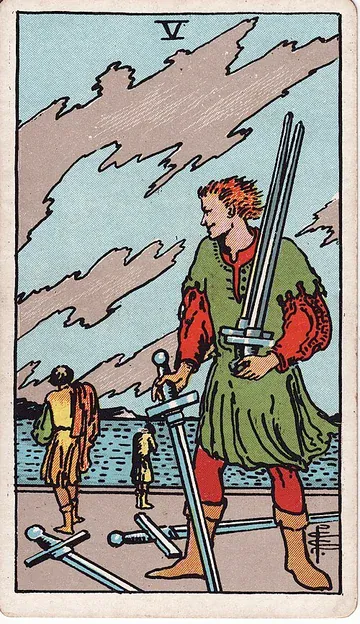
Seven of Swords with Five of Swords shows the line between strategic retreat and bitter victory. The Seven tries to leave before the fight consumes the room; the Five shows what happens when the fight has already named winners and losers. Together they ask whether the quiet move prevents harm or merely preserves advantage after harm has begun.
Eight of Swords
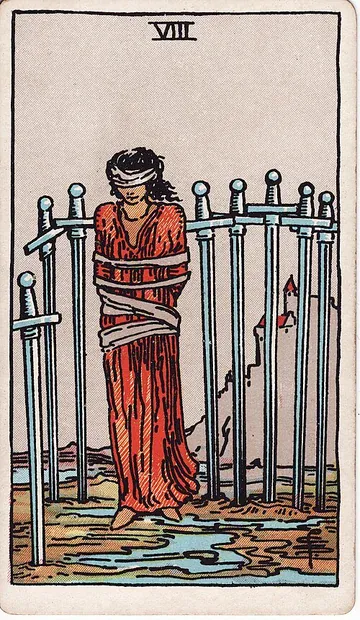
Seven of Swords with Eight of Swords places the escape route beside the mental prison. A person may be clever enough to evade the camp and still bound by fear, guilt, or an old story. The combination asks whether secrecy is true freedom or a more elaborate form of captivity.

The Moon
Seven of Swords with The Moon turns strategy into fog. The backward glance sees shapes that may be real or imagined; the path out of camp runs through dream, suspicion, and projection. This pair asks for slow evidence, clean instinct, and the humility to admit when fear is writing the map.
Justice
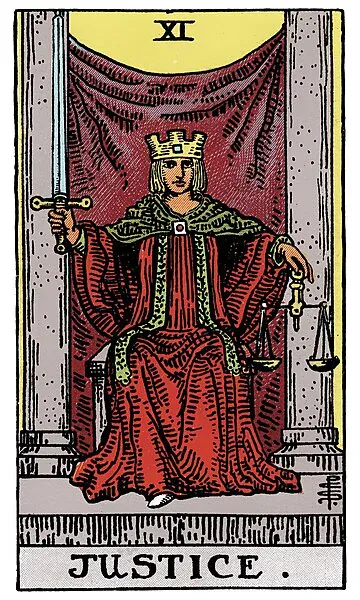
Seven of Swords with Justice brings the quiet act before the scale. If the strategy is ethical, Justice gives it language, record, and proportion. If something was taken, omitted, or miscredited, Justice names the missing sword. Together they favor documentation, accountability, and repair that can be measured.
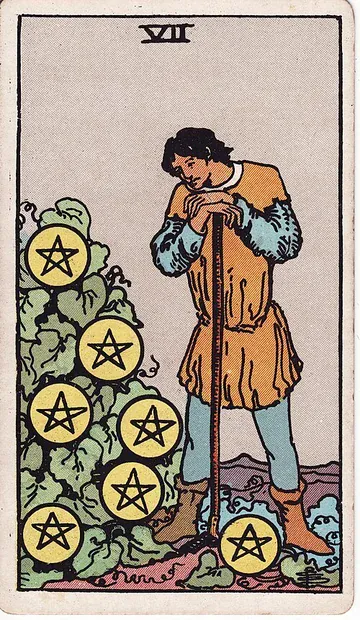
Seven of Pentacles
Seven of Swords with Seven of Pentacles slows the side-door tactic into a season of cultivation. Not every stuck situation needs escape; some need patient tending, measured withdrawal, or an exit built without damaging the field. The pair asks what can be carried quietly and what must be allowed to ripen.
Frequently Asked Questions
What happens when someone finally counts the swords taken from the camp?
The card turns over. Reversed, the Seven of Swords means a hidden strategy becoming visible, a half-truth exposed, or self-deception finally losing its cover. It can show being caught out, confessing, correcting the record, or the quieter version: recognizing on your own that clever avoidance has begun to cost more than plain truth would have. The card asks for repair through specificity — the named fact, the exact date, the actual number — rather than through the general apology that leaves the pattern intact.
Does the reversed Seven of Swords tell me to come back through the front door?
That is the one route it endorses. Otherwise it reads as no, or not yet, especially where the situation depends on missing information. It says no to secrecy as a foundation and no to moves that require technical innocence. If the question is whether to confess, correct, cite, disclose, or return through the front door, the answer becomes yes.
Is an exposed secret the end of a relationship, or the beginning of its repair?
The card declines to settle that in advance. Reversed in love it points to avoidance becoming visible: a message found, a contradiction noticed, a private plan confessed, a guarded pattern finally named out loud. It can indicate betrayal. It can equally indicate the relief that follows a truth being spoken after months of careful editing. Repair depends on whether the hidden behavior stops, not on whether remorse is performed well, and the card is unsentimental about that distinction.
Can shame be the loudest thing someone feels under the reversed Seven of Swords?
Frequently it is. Reversed, the card describes guardedness that has been exposed, and the person inside it may feel ashamed, defensive, relieved, or simply unable to keep hiding what they feel. They may care a great deal. The trouble is that their method of protecting that care has damaged the trust it needed. Read for changed behavior and for truth offered before it is demanded, rather than for guilt, which is cheap to feel and costs nothing to display.
Does the Seven of Swords reversed mean someone got caught?
It can. The reversed card often shows the moment a private tactic meets witnesses: a receipt, message, omission, or contradiction comes forward. But it also describes being caught by one's own conscience. The useful question is not only who discovered it, but what truth now needs to be named so the pattern can end.
Continue Reading
Seven of Swords · Card overview · symbols · correspondences →
Return to the full card view — image, symbols, sensory correspondences, and Hermetic axes.
Read the upright meaning →
Read the same depth on the opposite orientation.
Draw your reading now →
Bring this card to a question — open a quiet ritual.