
Seven of Wands · Tarot Card Meaning
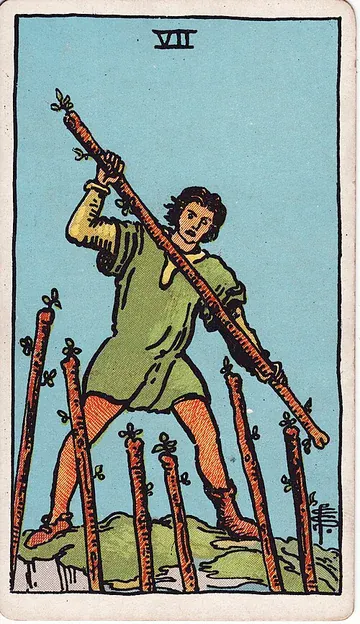
A lone figure stands on a rock that juts up from a shallow valley. He grips a rough staff, braced not at chest height but slightly forward, the wood unpolished, knotted, still showing the bark. Below him, six staves rise at angles — not coordinated, not a phalanx, just six separate arms reaching up from positions he cannot see. His feet do not match. One is booted. One is bare. The fight came faster than the dressing did. This is the Seven of Wands.
Look at the footwear before anything else. Most readers go to the staves first, but the mismatched feet are the card's quiet honesty: the situation arrived before the person did. He has not chosen the high ground in the way a general would. He found himself on it, looked down, and discovered that what he was standing on was now a position to defend. The card describes this exact texture. You are not in the fight you planned for. You are in the fight that found you while you were doing something else.
The Seven of Wands is a tarot card about holding what you have already taken — not seizing more, not advancing, not retreating. The holding. The card sits in the suit of fire after the parade of the Six of Wands. The crowd has gone home. The applause has thinned. What you won in the Six is now what you must keep, and the keeping is private work. No one is watching the staff being braced. No one is photographing the bare foot.
The traditional astrological signature reinforces the stance. Mars in Leo's third decan, the dates running roughly August 12 to 22 — the late afternoon of high summer, when the heat has stopped climbing and started pressing. Mars is the planet of contention; Leo is the sign of pride; the third decan, ruled again by Mars, doubles the martial signature inside the proud sign. This is not the bright Mars of the open challenge. This is Mars defending what Leo's pride has already gathered. The flame turns inward and braces.
The Kabbalistic placement is Netzach in Atziluth — Victory in the world of pure flame. Netzach is the seventh sephirah, the sphere of Venus, the place where desire becomes commitment. Coupled with the world of Atziluth, the highest world of pure spirit, the meaning sharpens: holding the position of what has been desired, in the realm of pure will. Number seven across the deck carries the same psychological weight — the inner pull, the hidden labor, the part of the work no one else sees. Seven is what you do when the audience leaves.
Notice the rough staff. There is no carved hilt. No leaf-work. No polish. The card is showing that defense does not need adornment. The Six of Wands' staff was crowned with a laurel wreath. The Seven's is bare wood. The thing that wins is not the same as the thing that holds. Whatever skill carried you to this rise, the skill that keeps you there is plainer.
Read the Seven of Wands the way you would read a still photograph of someone the moment before they have to decide whether the next step is forward, backward, or refusal of motion. The card freezes that pause. It does not promise victory. It does not predict defeat. It describes the texture of the choice — the burnished copper of the late sun, the smell of pine resin from the staves, the tension between the booted foot and the bare one. The card asks: what will you do with the position you did not exactly choose but now occupy?
Seven of Wands · Love & Relationships
In love readings, the seven of wands love signature is the relationship being tested — not by an outside threat, exactly, but by the slow pressure of being asked to hold a line you did not realize was a line until someone leaned on it. The Seven of Wands describes the bond that has reached a small altitude and now has to be defended against everyday erosion. The challenge is not dramatic. It is patient. It comes from below, in six small ways at once, and the question is whether you brace or whether you let the position go.
For an existing partnership, the Seven of Wands often arrives in the season when family, schedule, friends, or finances have all started to angle their staves up at the relationship from different directions. The mother-in-law who has opinions about the holiday. The friend who keeps suggesting a separate evening. The work travel that has become a pattern. None of these is hostile. Each, alone, would be answerable. Together, they amount to the slow erosion of the rock you and your partner have been standing on. The card asks you both to recognize the rock — to name the position out loud — before defending it. Defense without naming becomes paranoia. Defense with naming becomes commitment.
For a new spark, the Seven of Wands describes early-stage testing. The other person is not against you. They are also not yet for you. They are angling small questions up from below to see how you respond. Will you cancel the plans you made first? Will you change the rule about the phone at dinner? Will you abandon the friend who has been there longer? The card says: hold one or two lines, calmly, and watch what happens. The right person will respect the held line and step back. The wrong person keeps pushing the same staff up at the same angle, week after week — the pattern, not the prediction, tells you which person is in the chair across from you.
For a solo seeker asking whether love is possible, the Seven of Wands answers yes — and adds that the love arriving will require you to keep being the person you have spent the last few years becoming. This is the card of the seeker who has done the inner work, found their stance, and now has to hold it against the polite pressure to soften back into the older self. Do not soften. The right partner is looking for the person on the rock, not the person who climbed back down to make conversation easier.
For love after a wound, the Seven of Wands is unusual. Most cards in the post-wound space are about reopening, softening, daring again. This card is about the opposite — protecting the new ground you have just barely climbed onto. After a difficult break, after a bereavement, after a betrayal, the soul reaches a small high ground from which the world looks survivable again. The card warns that this high ground will be tested. Old patterns will angle up at you. Familiar voices from the old life will say the new altitude is unfair, performative, cold. Hold the rise. The bare foot is not failure. It is evidence that you came up here in a hurry, before you were ready. That is fine. The position is real anyway.
For a reconciliation question — should we get back together, should I respond to the message, should I let them in again — the Seven of Wands answers conditionally. If the reconciliation requires you to descend from the position you have built, no. If they can climb up to where you are now, possibly. The card does not refuse reconciliation in principle. It refuses reconciliation that asks the climber to forfeit the climb. Read carefully: many returns are framed as them coming to you while quietly requiring you to come back to them. Notice which direction the actual movement runs.
For long-distance or cross-cultural relationships, the Seven of Wands is the card of holding the bond against the constant low pressure of distance. No single week ends the relationship. The accumulation of weeks does. The card asks for a small, repeated, visible act of brace — the standing call, the named anniversary, the kept ritual — that signals to both of you that the position is being held even when the staves of distance angle up.
For the pursuer-distancer dynamic, the Seven of Wands often shows the distancer's hidden experience. They feel pursued. They feel the staves coming. They are not cold; they are bracing. If you are the pursuer reading this, the card asks for a softer angle — fewer staves, less frequently, from a side they can see. If you are the distancer, the card asks whether the rock you are defending is really worth the loneliness it produces.
For households where the constraint is practical — small space, small income, children under a roof, elderly parents nearby — the Seven of Wands can describe the daily work of holding the relationship's center against logistical erosion. You are not fighting each other. You are both fighting the schedule. The card asks you to name the staff each of you is bracing against, so the bracing happens together rather than at cross-purposes.
For desire mismatch — the partner who wants more, the partner who wants less, the partner whose timing is different — the Seven of Wands says the bond can survive the mismatch only if both parties hold their actual line. The trap is the false yes: the partner who agrees out loud and resents in private. The card prefers the honest no held with care over the dishonest yes held with corrosion.
A note on the card's love language: the Seven of Wands loves the way a steward loves. It guards. It shows up. It refuses the easy departure. It is not effusive. It is not performative. Its love is the kind that becomes visible only when something tries to take you away and meets a quiet refusal. Read this card in love readings as the proof that someone, somewhere, is holding a position for the relationship even when no one is praising them for it.
Seven of Wands · As Feelings
Braced is the whole of what the Seven of Wands says about someone's feelings. Not closed, not rejecting — alert, holding a stance, watching where the next staff will come from. They feel something for you, and they are protecting whatever it is from the things that have, in the past, taken similar feelings from them. The brace is not a verdict against you. It is the residue of older fights they have not yet finished telling you about.
If they are reserved by nature, the Seven of Wands as feelings means their silence is a guarding silence, not an empty one. They are holding the position they have arrived at with you — they have decided you matter — and the decision is private because they do not yet trust that announcing it will not invite the staves of other people's commentary. Read their quiet as care. They are not making you wait because they are uncertain. They are making you wait because they are certain and protective of the certainty.
If they are demonstrative, the Seven of Wands as feelings can mean they will defend you publicly before they speak to you privately about the same thing. They will say the loyal sentence to others. They will not yet say it to you. This is the texture of someone who fights for the relationship in conversation but has not yet found the language for fighting alongside you in person. Watch for the proxy — what they tell their friends about you is often the message they cannot yet send directly.
For a long bond, the Seven of Wands as feelings often describes settled commitment that has stopped explaining itself. They have decided. They are not announcing the decision again. The feeling has stabilized into stance. If this card arrives in a long-bond reading and you are looking for fresh declarations, you may not find them. What is on offer is something quieter — the unbroken pattern of being chosen. Read the pattern, not the lack of new statements.
For a new connection, the Seven of Wands as feelings can read as cautious interest. They are intrigued by you. They are also testing whether you hold up under the small staves they are angling up — the canceled plan, the slow reply, the deliberate gap. This is not cruelty. This is the recently-wounded person checking whether the new high ground is real before climbing onto it themselves. Hold steady. Do not chase. The card responds well to seekers who do not flinch.
For the post-conflict reading — what do they feel after the fight — the Seven of Wands says they are still bracing. The fight is technically over. The stance has not yet relaxed. They are watching the doorway to see whether the next staff comes. Give them the absence of the next staff. Let the silence after the conflict be unweaponized. The card eases when the bracing is no longer required.
For distance — long-distance relationships, partners who have moved, friendships sustained across time zones — the Seven of Wands as feelings describes the deliberate, defended commitment that distance produces. They are choosing you against the natural drift. The choosing requires effort, and the effort itself is the feeling. Do not mistake the lack of spontaneous warmth for absence. Distance turns warmth into discipline, and the discipline is the proof.
For divided warmth — the partner whose feelings seem to alternate, hot and then cool — the Seven of Wands as feelings can describe a person whose stance toward you is solid but whose energy for displaying it varies. They are not changing their mind. They are managing their reserves. The cool weeks are not a withdrawal. The hot weeks are not a sudden return. The position has been held all along; what fluctuates is the visibility of the holding.
For the pursuer-distancer dynamic at the level of feeling, the Seven of Wands often surfaces the distancer's interior. They feel a great deal. They are guarding the feeling rather than withdrawing from it. The pursuer's reading of the distancer as cold is often a misreading of the brace. Ask the distancer's nervous system, not their words: are they leaving, or are they holding their ground?
The most useful question this card asks of the feelings reading is the one Lunarcana readers find unfamiliar: is this person guarding me out, or guarding me in? The same brace, at the same angle, can do both. Guarded out: the staff is between you and them. Guarded in: the staff is between the world and the two of you. The image is identical. The meaning is opposite. Listen to which side of the stance you are on. If the brace stands between you, you are the staff being answered. If the brace stands beside you, you are the rock being defended.
Seven of Wands · Career & Work
You won the thing, and the week after winning it is when the pressure starts; the Seven of Wands lives inside that week. You have arrived at something — a title, a project lead, an accepted proposal, a stake in a decision — and the arrival is not the end of the story. The card is the morning after the announcement, when the calendar fills with meetings you did not expect, the inbox carries notes from people whose interest in you has just changed, and the seat you took looks suddenly more exposed than it did from below.
For the current role question — is this job working, should I stay, what does the card say about my position — the Seven of Wands answers: the role is yours, but holding it requires more than continued performance of the work. You are now in a season where the political layer of the role demands attention. Other people's interpretations of your seat are starting to matter. The card is not telling you to play politics. It is telling you that ignoring politics from this rock will not work the way it worked from the lower ground.
For someone who has just landed a new role or promotion, the Seven of Wands is the card of the first ninety days. The hire has happened. The announcement has gone out. Now you discover who in the organization had wanted the seat, who had wanted the seat for someone else, who has decided to test whether you can hold it, and who is simply curious. Brace lightly. Answer the staves that come at the position itself, not the ones that come at you personally — they are different fights. The card warns against treating every approach as a challenge. Most are. A few are not. Sort.
For a freelancer or founder, the Seven of Wands describes the season after the breakthrough — first major client signed, first round closed, first product shipped — when the very fact of having something now means you have something to defend. Competitors notice. Imitators arrive. The weight of the inbox triples. The card is asking for a deliberate stance about what you do and do not do with this new ground. Founders without a defended stance get pulled in six directions; founders with one get pulled in the one or two that matter.
For a creative worker — writer, artist, musician, designer — the Seven of Wands often appears around the body of work that has finally been seen. The book is out. The show opened. The album dropped. Suddenly the staves of opinion angle up: critics, peers, an audience with thoughts. The card is the morning of the bracing. Hold your line about what the work is and is not. Do not relitigate it in every comment thread. Refuse the urge to reply to every staff. The card defends the work most effectively when the artist refuses the small, public, exhausting fights.
For a student or apprentice, the Seven of Wands can describe the moment you have begun to know something — a craft, a language, a discipline — and now have to defend the early competence against both your own imposter syndrome and the people who knew you before you knew anything. The card respects beginners who hold their ground. The bare foot is not failure of preparation. It is evidence that the learning has outpaced the dressing.
For a manager or team lead, the Seven of Wands is the card of standing for the team's decisions in rooms where the team is not present. You have made a choice. Other leaders are testing it. The card asks you to defend the decision honestly — not by smuggling its merits past objection, but by naming the trade-offs out loud and refusing to descend from them. The team feels the difference. They know whether you held the rock or quietly stepped off it the moment the room got difficult.
For someone in a layoff or transition, the Seven of Wands has a less obvious meaning. The card describes the stance you take in the gap. You have lost the position. The pressure now is to take any next position quickly, to soften the line about what you do and do not do, to descend from the rock that made you valuable in the first place. The card resists this. Hold the line about the work that suits you. The right next role will recognize the held line as a feature, not a stubbornness. The wrong next role will pressure you to abandon it before the contract is signed; that pressure is the answer.
For a cross-functional team scenario — the engineer working with marketing, the designer reporting to product, the operations lead embedded with sales — the Seven of Wands describes the persistent micro-defense of your discipline against the gravity of the dominant function. You are not failing to collaborate. You are protecting the perspective that the cross-functional setup ostensibly hired you to bring. Do not soften the perspective for the sake of meeting flow. The meeting flow that erases your perspective also erases the reason you were brought in.
For care or teaching work — nurses, teachers, therapists, social workers — the Seven of Wands describes the boundary the role itself requires. Your good colleagues are not the staves. The system is. The card supports the small daily acts of holding the role's boundary against systemic pressure to expand without resource. Refusing the seventh email after hours is the staff. Saying no to the eighth student in a class already too large is the staff. Not feeling guilty about either is the rock.
For contract negotiation, the Seven of Wands is unambiguous: hold your number. Hold your terms. The other party expects to chip you down by half a degree and is testing whether you descend. Stay on the rock. State your position once. Repeat it without elaboration. The card is the held line that closes the deal at the number you actually wanted.
Seven of Wands · Money & Finances
In money readings, the Seven of Wands describes the financial position recently won and now requiring active defense. You have built something — savings, a small portfolio, a paid-off debt, a steady cash flow — and the work now is the holding. Not the building. The holding. The card is the discipline of refusing to let small, repeated pressures erode the structure you have just barely finished assembling.
For the seeker who has climbed out of a long financial difficulty and reached the first rest point, the Seven of Wands is one of the deck's quiet allies. The high ground here is the buffer — the months of expenses sitting in the account, the plan that has stopped being theoretical, the credit card balance that finally reads zero. The card warns that this high ground will be tested. Friends will ask for loans. Family will mention emergencies. The car will need work. The roof will leak. None of this is conspiracy. It is the texture of life, and the Seven of Wands is asking whether you hold the buffer or slowly let it bleed.
For investment questions, the card is the case for the patient position. Whatever you have invested in is being tested. The market, the project, the side venture — something is angling staves at it. The card does not say sell. It says hold the line you set when you began. Decisions made under the pressure of fluctuation are usually decisions to descend from the rock. If the original thesis is still intact, the card supports staying braced. If the thesis has actually changed — not the price, the thesis — the card supports a deliberate exit, but only after the change is named in writing, not felt in the chest.
For someone considering a major purchase, the Seven of Wands is cautious. The thing you are about to buy will require defense — of the budget, of the storage, of the time it asks for. Make the purchase only if you are willing to hold the position the purchase creates. A house bought without the willingness to defend the household budget against lifestyle creep becomes the slow staff that erodes the rock. A car bought without the will to refuse the upgrade in three years becomes the same. The card asks for honest projection.
For debt, the Seven of Wands supports the boring discipline of held repayment. The minimum payment is not the position. The accelerated payment is. Hold the accelerated number against the pressure of the small reasons to skip a month — the trip, the celebration, the upgrade. The card respects unglamorous consistency more than dramatic effort. One held number, every month, beats six dramatic months and three skipped ones.
For a windfall — bonus, inheritance, lucky sale — the Seven of Wands warns against descending from the rock to spend it. The position you have built does not become more secure with the windfall; it becomes a target. People who would not have asked for help before the windfall will ask after it. The card suggests holding the position for at least a season before any major movement. Park the windfall. Let the announcement quiet. Then decide.
For someone in active financial recovery — bankruptcy, default, repossession — the Seven of Wands describes the season of re-establishing credit, savings, and the basic dignity of the held line. Every month you do not relapse into the patterns that produced the collapse is the staff answered. The card is patient with this work. Recovery is not glamorous. The rock is small. The footwear is mismatched. The position is, nevertheless, real. Hold it.
For windfall earned through your own work — a successful project, a paid-off business — the card asks for stewardship. The temptation is to assume that having proven you can build, you should immediately build again. The Seven of Wands disagrees. The next chapter starts after the position is consolidated, not in the middle of holding it. Rest the rock first. Then look at the next climb.
Seven of Wands · Health
For health readings, the Seven of Wands describes the body in the posture of held defense — and the wear that posture produces when held too long. The card's body parts are the spine and the forearms. The spine because of the bracing — the long muscles that stand the body up against gravity, the subtle architecture that holds height without conscious thought. The forearms because of the grip — the rough staff held without slipping, the wrists that have been working overtime to keep the position. Pay attention to both.
The card's element is fire, and its temperament is choleric in the old four-temperament system — the hot, dry, sharp constitution that runs hard and short-fuses easily. Mars in Leo's third decan amplifies the signature. The body under this card tends to run inflamed. The shoulders are tight. The jaw is set. The breath is shallow because the diaphragm has been held in the bracing position. None of this is a diagnosis. It is the texture of the body the card describes, and the texture is asking for attention.
For chronic conditions, the Seven of Wands often indicates the period when self-management has tightened into rigidity. You are doing the right things — the medication, the exercise, the careful diet — and the doing has lost its breath. The discipline that began as care is now the new staff angled at the body. The card asks for one small softening: the day off the routine that does not break the routine. Health protected by clenching is health half-lived.
For acute issues, the card supports patient defense over heroic intervention. Whatever the body is fighting, the body is fighting. Brace lightly. Sleep when sleep is possible. Eat warm food. Drink water. Refuse the urge to power through. The Seven of Wands is unusual among the wands in that it counsels against the active strike — the body's wisdom here is in the held position, not in the swing.
For mental health, the Seven of Wands describes the psyche in defended composure. The work has been done. The therapy has stuck. The patterns that nearly destroyed you are now patterns you can name. And the cost of the new ground is constant low-grade vigilance — watching for the old pattern's return, refusing the small permissions that used to spiral. The card validates the vigilance. It also asks: what would it cost to relax the brace by ten percent? Sometimes the answer is nothing. Sometimes the answer is the relapse you have been preparing for. Test the answer in small experiments, not in dramatic gestures.
For someone managing anxiety, the Seven of Wands is a precise mirror. The anxious nervous system feels exactly like this card looks: braced on a small high ground, watching for staves to come up from below, certain that any moment will require a defense. The work is not to dismantle the brace. The brace is, sometimes, accurate. The work is to ask the body, gently and repeatedly, whether each particular staff actually requires an answer. Most of them do not. The body learns this slowly. The card respects the slowness.
For someone who has recently survived a serious health event — surgery, hospitalization, a diagnosis that reshaped the year — the Seven of Wands describes the rock you have just barely climbed onto. The body is on the other side. The recovery is real. The position is also fragile. The card warns against the well-meaning friend who suggests too much, too soon. Hold the small high ground of recovery. Refuse the staves of premature ambition. The card supports patience here more than any wand in the suit.
For physical training, the Seven of Wands supports the program that has just begun to produce visible results. Do not change the program now. The temptation will be to add. The card prefers depth over expansion. Hold the form. Hold the cadence. The body grows in the held repetition more than in the novel addition.
The card's trap, in any health question, is the bare foot held too long. The mismatched footwear was tolerable in the moment of the fight. It becomes a problem when the fight goes on for weeks. Get the second boot. Tend the small, unglamorous detail of taking care of yourself the way you would take care of someone you were defending. The Seven of Wands does not ask for collapse. It asks for the second boot. Put it on.
Seven of Wands · Spirituality
Every practice eventually meets the pressure to come down off its own small hill, and the Seven of Wands is the hour of that pressure. The seeker has climbed onto a small high ground — a daily sit, a morning prayer, a kept silence, a refused habit — and the practice is now under the patient erosion of life. The card asks: will you hold the practice when no one is watching, when the result is invisible, when the staves angled up from below come from voices you respect?
The card's sephirah is Netzach in Atziluth — Victory in the world of pure flame, the seventh sphere on the Tree of Life, the place of Venus. Netzach is the sphere of held desire, of love that has decided what it loves and refuses to let the loving be argued out of it. Coupled with Atziluth, the world of pure will, the meaning sharpens to spiritual stance. You have decided what you are devoted to. The decision is no longer on the table. The card describes the daily defense of the decision against the world's quieter offers.
For seekers in active practice — meditation, yoga, devotional work, fasting, ritual silence — the Seven of Wands describes the season after the practice has produced its first real fruit. You are no longer hoping the practice works. You know it works. And the knowing brings a new kind of fight: the practice that produces results begins to look like an asset other parts of life would like to use. The card asks you to keep the practice for itself, not for the secondary uses it can be pressed into. A meditation kept for the sake of meditation outlasts a meditation kept for the sake of productivity.
For seekers exploring belief, the Seven of Wands describes the stance taken after long searching. You have arrived somewhere. The arrival is private. The temptation is to argue the arrival into the people around you — to defend it conversationally, to convert, to win the case. The card asks for the opposite: hold the position quietly. Do not descend to the dinner-table debate. The arrival becomes most stable when it stops requiring external validation. Let the practice prove the position to you. Do not require the practice to prove it to anyone else.
The card's spiritual caution is the rigid stance. The seeker who has climbed onto a small spiritual rock and now defends it against any new teaching becomes the figure on the rock with no one left to talk to. Held position is not the same as closed mind. The card asks for the brace that can listen — the staff held but not yet swung. New teachings that genuinely belong on your rock will climb up. The ones you needed to refuse will turn back at the lower slope. Trust the slope to do its work.
A real practice for seekers under this card: thirty minutes of held silence, alone, with no input. No phone. No book. No journal. Sit with the position you have built and refuse the small pressures to interrupt it. Notice what arrives when the staves of distraction are not allowed to angle up. The card eases when this practice is kept weekly. It tightens when this practice is skipped for a month.
For questions about path, the Seven of Wands answers that you are on it. The work now is not to find the path. It is to hold the path against the patient erosion of doubt. Doubt is not the enemy. Doubt is the staff being answered. Answer it once, calmly, in writing or in prayer or in conversation with the part of you that holds the rock. Do not relitigate the answer with every new wave of doubt. The card respects the seeker who has stopped negotiating with the same staff each season.
Seven of Wands · Yes or No
Yes — but only on the line that is yours.
The Seven of Wands answers seven of wands yes or no questions with a held, conditional yes. The card supports the path you are considering, but only if the path is the one your actual position calls for. It refuses to support the path that asks you to descend from the rock you have built. The yes is real. The conditioning is also real. Read both.
For questions about a relationship, a job, a move, a stand: yes, hold the line. The card supports the partner you are considering staying with — if the staying is on the ground that is yours, not the ground their convenience prefers. The card supports the role you are considering keeping — if the keeping is on the terms you actually want, not the terms the politics has been quietly moving you toward. The card supports the move you are considering — if the move protects the position you have spent real effort building, not if it asks you to abandon that position to satisfy someone else's plan.
For questions about whether to confront, push back, or hold ground in a conflict, the Seven of Wands is unambiguous. Yes. Hold the ground. Speak the held position once, clearly. Do not repeat. The card warns specifically against the pattern of saying the held line three or four times in escalating tones — that is descent, not defense. State the line. Brace. Refuse to relitigate.
For questions about timing — should I act now, should I wait — the Seven of Wands prefers held timing over urgent timing. The position is yours. It does not need to be defended in the next hour. State it when the next staff actually angles up. Do not preemptively swing at staves that have not yet arrived.
The shadow of this card's yes is the wrong-fight yes — saying yes to a defense the situation does not actually require. Before you commit to the bracing, ask whether the staff is actually being raised. Some of the staves the anxious mind sees are not in the picture. The card answers yes when the threat is real and the position is yours. It quietly shifts to no when either condition fails.
For binary action questions — should I send the message, should I take the offer, should I stay in the room — the Seven of Wands says yes, on the condition that the action is consistent with the position you have already taken. If the action is the natural extension of the held line, yes. If the action would require explaining away the held line afterward, no.
If the question was: do I have the right to defend this? The card answers yes, and asks why you needed to ask. The right is not granted. The right is the position itself. You are already on the rock. The yes simply confirms what your stance has already declared.
Seven of Wands · Advice
Hold the line that is actually yours, and refuse the ones that are not, however loudly they are handed to you. That is the Seven of Wands' instruction entire. Most of the exhaustion this card describes comes from defending positions the seeker did not choose — inherited fights, stranger's grievances, the ambient hostility of news and discourse. The card supports defense. It does not support the indiscriminate brace. Sort the staves before you swing.
The first instruction is to name the rock. Out loud, in writing, on a single page: what position am I actually holding? The unnamed position is the position that drains. The named position is the position that becomes defensible. Most seekers under this card discover, in the naming, that two of the staves they have been answering for months were not aimed at the rock at all. They were aimed somewhere else and you stepped into the path. Name the rock. Then notice which staves actually require an answer.
The second instruction is to answer one staff at a time. The image in the card is precise: the figure does not swing wildly. He braces against one. The Seven of Wands warns against the omnidirectional defense — the email that addresses six concerns at once, the conversation that tries to settle six grievances in a single breath, the public stance that takes on every critic simultaneously. None of this works. Defense at scale becomes spectacle. Defense at the level of the single staff becomes credible. Pick the most important staff. Answer it. Then look up.
The third instruction is to put on the second boot. The card's mismatched footwear is the unattended self-care that the bracing has crowded out. The sleep skipped. The meal eaten standing up. The friend not called. The walk not taken. None of these is defection from the defense. All of them are infrastructure for the defense. The figure on the rock with two boots holds the position for years. The figure with one collapses in months. Tend the small detail.
The fourth instruction, gentler than the others, is to ask whether this hill is worth the next round. The card respects defended ground. It does not require infinite defense. Some hills, after honest examination, are not yours to hold. Some hills were yours once and have stopped being yours through changes you did not notice. The card supports the deliberate descent from a position you no longer believe in. The descent is not failure. The failure is staying on a rock you no longer remember why you climbed.
Practical advice for the day this card appears: speak your held line once today, to the person who needs to hear it, in the shortest possible sentence. Do not elaborate. Do not justify. Do not apologize for the brevity. Then close the conversation. The card supports the seeker who has stopped using a paragraph where a sentence was enough.
A second practical move: this week, refuse one staff that you have been answering out of habit. Not the important one. The smallest one. The chronic email reply you have been sending out of obligation. The recurring argument with the family member who never updates their position. The internet thread you keep returning to. Drop one. Notice what the rock feels like with one fewer staff to track. The Seven of Wands often eases through subtraction more reliably than through addition.
A third move: write the line. Whatever your held position is — about the relationship, the role, the practice, the boundary — write the single sentence that names it. Carry the sentence. When the next staff angles up, read the sentence, decide whether the staff is aimed at it, and answer or pass. The card respects the seeker who has externalized the position into language. The position you have to recompute in your head every time is the position you eventually lose.
Seven of Wands · Card Combinations
The Seven of Wands rarely arrives alone in a spread. Its meaning sharpens or softens depending on what stands beside it — what the high ground is being held against, what the bracing is for, whether the figure on the rock is in fact about to be relieved or about to discover the staves were not staves at all. Read it always in conversation. The cards below illuminate the most useful pairings.
Seven of Wands + Six of Wands
The pairing of the parade and the held rock. The Six of Wands is the public victory, the wreathed staff, the procession through the crowd. The Seven is the morning after — the same victor, alone now, defending the prize that the parade announced. When these cards arrive together, the spread is asking you to remember that the celebrated ground requires private defense after the public moment ends. The applause will not hold the rock for you. The card warns against the seeker who confuses the parade for the position. Most positions are won in the Six and lost in the Seven by the people who did not realize the Seven was a separate fight.
Seven of Wands + Seven of Swords
The pairing of two opposite tactical responses to the same pressure. The Seven of Swords is the figure walking off with the stolen staves, head turned, half-smiling, leaving the camp behind. The Seven of Wands is the figure who refuses to leave. When these cards meet in a spread, the question is which response your situation actually calls for. Most readers reach for the Seven of Wands instinctively — confrontation, stand, defense — when the Seven of Swords' answer (strategic withdrawal, refusal to engage on the offered terrain) would serve them better. Read the staves carefully. Some of the staves angled up are inviting a stand the situation does not deserve. The card pairing asks: do you fight here, or do you take what is yours and disappear?
Seven of Wands + Seven of Pentacles
The pairing of active defense and patient observation. The Seven of Pentacles is the figure leaning on his hoe, watching the vines grow, refusing to harvest before the fruit is ready. The Seven of Wands is the figure who is actively bracing. When they appear together, the spread is describing the tension between intervention and waiting. The pair asks which posture this season requires. The Seven of Pentacles answers: not yet, the work is in the watching. The Seven of Wands answers: now, the work is in the swing. Some seasons are both — patient observation about the long arc, active defense about the immediate staff. The combination supports the seeker who knows which time scale each posture serves.
Seven of Wands + Strength (Major Eight)
A Mars-in-Leo signature complement. Strength carries the same astrological flavor as the Seven's Mars-in-Leo decan — the proud, contained, sun-warmed force — and softens the Seven's defensive sharpness. When they arrive together, the spread is showing the seeker whose held position has become an exercise in calm rather than tension. Strength's woman closes the lion's jaw without fear. The Seven's figure braces without swinging wildly. Together, they describe the held line that no longer requires aggression to hold. This is the card pairing of the seasoned defender — the person whose stance is so settled that its effort has become invisible. Hold the position. The lion does not need to be loud.
Seven of Wands + Seven of Cups
A pairing of stark contrast. The Seven of Cups is fantasy, illusion, the seven floating cups offering everything and committing to nothing. The Seven of Wands is the actual position on the actual rock. When these cards arrive together, the spread is naming the difference between the imagined defense and the real one. The seeker has been bracing in their head against threats that do not exist while the actual staves angle up unanswered. Or, inversely, has been entertaining fantasies of comfort while the rock requires their full attention. The combination asks for honest sorting: which staves are imagined and which are real, which cups are real opportunities and which are dreams that ask for nothing in return. The card pairing is the wake-up call disguised as a tarot reading.
Seven of Wands + The Tower (Major Sixteen)
A pairing that warns about the rock that was always going to fall. The Tower is the structure struck by lightning, the foundation revealed as inadequate, the sudden collapse of what looked stable. When the Seven of Wands stands beside the Tower, the spread is asking whether the position you are defending is, in fact, defensible. Some rocks fall regardless of how well they are held. The card pairing supports the deliberate evacuation of a position before its collapse — better to descend on your own terms than to be thrown. Read carefully. Not every difficult position is the Tower. But when the Tower arrives, the Seven of Wands' instruction shifts from hold to leave.
Card Combinations
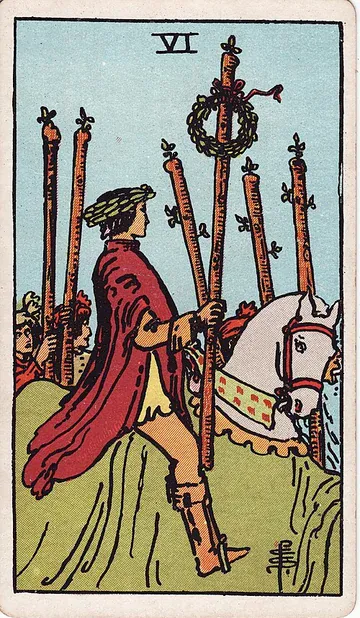
Six of Wands
The Six of Wands' parade beside the Seven of Wands' lone rock — the celebrated victor now standing alone, defending in private the prize the procession announced. Most positions are won in the Six and lost in the Seven by people who did not realize the held season was a separate fight from the celebrated one. Hold the rock with the discipline you used to win the parade.
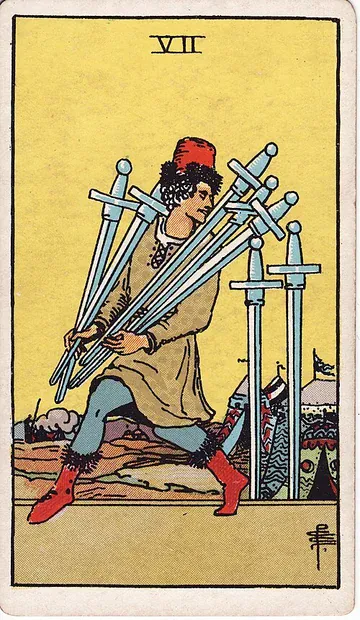
Seven of Swords
The opposite tactical response. Swords Seven walks off with what is taken; Wands Seven refuses to leave. When they pair in a spread, the question is which response the situation actually calls for. Most readers reach for confrontation reflexively when strategic withdrawal would serve better. Read the staves carefully. Some invite a stand the situation does not deserve.
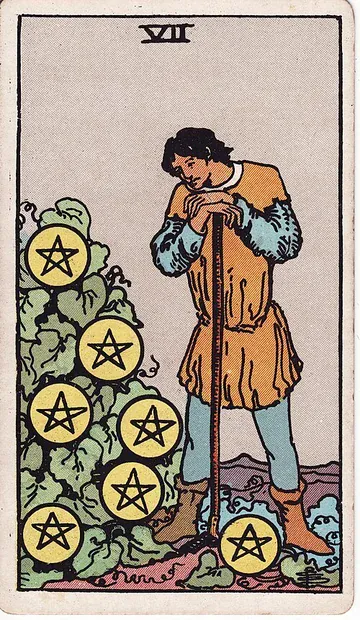
Seven of Pentacles
Patient observation beside active defense. The Seven of Pentacles leans on his hoe and watches the vines; the Seven of Wands braces against the staves. Together they ask which posture this season requires. Some defenses succeed through absence — the work is in the watching, and the swing interrupts the slow processes that would have produced the actual harvest.
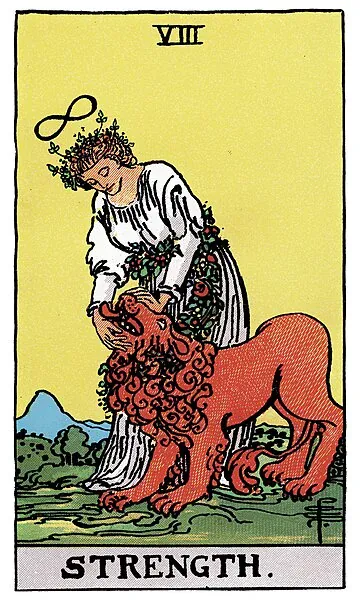
Strength
The Mars-in-Leo signature complement. Strength's woman closes the lion's jaw without fear; the Seven of Wands' figure braces without swinging wildly. Together they describe the held line that has stopped requiring aggression to hold. This is the card pairing of the seasoned defender — the stance so settled that its effort has become invisible. The lion does not need to be loud.
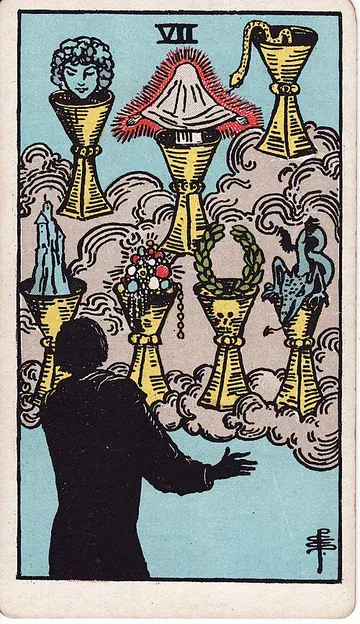
Seven of Cups
The fantasy contrast. Seven of Cups' floating illusions beside the Seven of Wands' actual rock often surfaces the source of misfired defense — bracing against projections rather than the actual room. The combination asks for honest sorting of the imagined staves from the real ones. Most exhaustion under the Seven of Wands turns out to be Seven of Cups overlay.
Frequently Asked Questions
What is the meaning of the Seven of Wands tarot card?
The Seven of Wands describes the position recently won and now under defense. The image — a figure on a jutting rock, six staves angling up from below, mismatched footwear from a fight that came faster than dressing — is the card of holding what you have already taken. Mars in Leo's third decan, Netzach in Atziluth. The keywords are defending position, high ground held, courage, standing alone.
Does the Seven of Wands back me if I have to stand alone on this?
It does — standing alone is the condition the card was built for, not an argument against the plan. The figure on the rock has no allies in the frame and holds the high ground anyway, and the Seven of Wands gives a conditional yes on exactly those terms: yes, where the path asks you to keep the position you have already built, and no, where it asks you to come down off it for someone else's convenience. What the card does not supply is reinforcement. It supplies stance. So state the line in one sentence, brace once rather than continuously, and stop relitigating a decision that has already been made. Held action beats urgent action here, and being outnumbered is not the same as being wrong.
What does the Seven of Wands mean in love readings?
In seven of wands love questions, the card describes the bond being tested by patient pressure rather than dramatic threat. The relationship is at a small altitude that requires defense — against schedule, family, distance, or the partner's old patterns. Hold the line that is yours. The right partner will respect held ground; the wrong one will keep angling the same staff up week after week.
Is Seven of Wands reserve about me, or about their last relationship?
Almost always about what came before you. The card's answer as feelings is braced — alert, stance held, the feeling itself guarded against staves raised in fights they have not finished telling you about. That is a description of history, not of verdict. Someone in this posture is protecting something they consider worth protecting, which is a strange sort of compliment delivered in an uncomfortable form. Read the reserve as guarding rather than as absence. The distinction shows up in direction: a brace aimed at the past goes quiet as trust accumulates, while a brace aimed at you produces specific accusations and does not soften with time. If nothing you actually did is ever named, you are standing in the residue of what a previous love asked them to defend.
What's the difference between Six of Wands and Seven of Wands?
The Six of Wands is the public victory — the wreathed staff, the procession, the applause. The Seven of Wands is the morning after, when the same victor stands alone defending the prize the parade announced. The Six is won in front of the crowd. The Seven is held in private, with no one watching the brace. Most seekers confuse the two and lose in the Seven what they won in the Six.
Continue Reading
Seven of Wands · Card overview · symbols · correspondences →
Return to the full card view — image, symbols, sensory correspondences, and Hermetic axes.
Read the reversed meaning →
Read the same depth on the opposite orientation.
Draw your reading now →
Bring this card to a question — open a quiet ritual.