
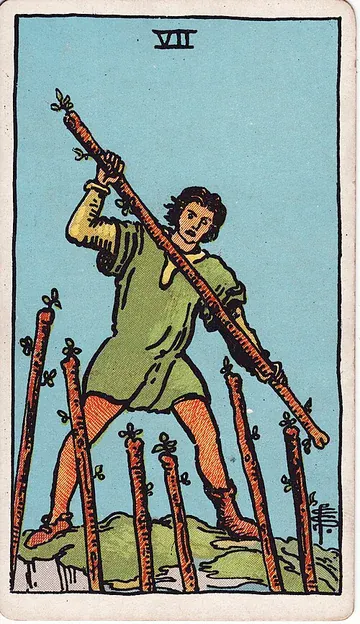
Seven of Wands Reversed · Meaning
Turn the Seven of Wands over and nothing in the picture changes except the cost of standing there. The lone figure is still on the jutting rock. The six staves are still angled up. The footwear is still mismatched. But the bracing has begun to misfire. Either the figure has been guarding a hill that no one is actually attacking and the staves are imagined, or — the inverse case — the figure is guarding the wrong hill and the line that actually mattered has been quietly conceded somewhere off the edge of the frame. The card is the failure of stance, not the failure of strength.
The reversed card describes two distinct breakdowns and the spread context tells you which. The first breakdown is paranoid bracing — the seeker who has been on the rock so long that every approach now reads as a challenge. The colleague offering help looks like a saboteur. The friend asking after the relationship looks like an interloper. The family member with a question looks like a critic. The seeker is exhausting themselves answering staves that were never raised. The card asks for an honest audit of the threat. Which of the six staves is actually angled at the rock, and which were always pointing somewhere else?
The second breakdown is the wrong hill. The figure is still bracing — still feet apart, still staff in hand — but the rock under him has, at some point, stopped being the rock that mattered. Maybe it never was. Maybe he climbed the wrong rise in a hurry and has spent six months defending it. Maybe the position was correct once and the situation has moved on. Either way, the reversed card warns that the energy of defense is being spent on terrain that no longer rewards it. The staves the figure should be answering are angling up at a different rock entirely, and no one is on that one.
There is a third, gentler reading. The reversed card sometimes describes the figure who has correctly recognized that the bracing is no longer required and has begun to stand down. The shoulders soften. The staff lowers. The bare foot finds something to slip into. This is the integration reading — the seeker who learned to defend, defended well, and now learns to release the brace because the season of attack has actually ended. The trap to avoid here is the false standing-down — the surrender that calls itself wisdom. Real release happens when the threat ends. False release happens when the bracer gets tired. The two look identical in the moment and feel different a season later.
The astrological signature complicates similarly. Mars in Leo's third decan reversed is Mars in Leo's third decan with the heat turned up past usefulness — the proud flame defending so hard that it begins to burn the rock it stood on. Or, inversely, the proud flame that has talked itself out of being a flame at all and gone cold to avoid the work. Both fail. The card asks the seeker to find the middle: warm enough to defend the position that matters, cool enough to recognize the staves that do not.
Netzach in Atziluth reversed is Victory misapplied. The sphere of held desire has begun to defend the wrong desire — to hold the position out of pride rather than alignment, to refuse the descent because the descent looks like loss when it is actually rest. The reversed card asks: what are you actually defending? The answer the seeker reaches for first is rarely the honest answer. The honest answer requires sitting with the position long enough to see whether it is yours or whether you have been holding it for someone else.
A fourth and rarer reading: the seven of wands reversed can describe the seeker who has, after long bracing, finally received the relief — the colleague who steps in, the partner who shows up, the institution that takes its share of the load. The position is no longer held alone. The seeker, who learned to defend in solitude, must now learn to defend with company. This is hard. The reversed card respects the difficulty. The figure who knows how to hold the rock alone often resists the help that arrives, because help looks like loss of position. It is not. It is the position becoming sustainable.
Read the reversed card in any spread by asking three questions. First: is the rock still the right rock? Second: are the staves real? Third: is the bracing producing defense or producing exhaustion? The honest answers to those three questions tell you which version of the reversed card you are sitting with — paranoid, misplaced, releasing, or finally relieved.
Seven of Wands Reversed · Love
In seven of wands reversed love readings, the card describes the relationship where the defending has tipped into either the wrong target or the wrong fight. You are still bracing. The staves are still angling up. But the hill has moved, and the bracing has not noticed. The card asks: are you still protecting the relationship that exists, or are you protecting a relationship that ended quietly some time ago and no one has yet said the word?
For an existing partnership, the reversed card often indicates the slow drift into defensive coupling — the bond held against the world by two people who have stopped holding each other. The relationship is "us against them" without much "us" left underneath. Both partners are competent at the bracing. Both have forgotten what the position they were defending was for. The card asks for a frank conversation about what the relationship is actually protecting, and whether the protection has become the entire substance of the bond.
For a new spark, the reversed card warns of premature defensiveness. You have just begun to know this person and already you are explaining yourself, justifying your patterns, defending small choices that did not require defense. The card asks where the brace came from. Often the answer is the previous wound — you are bracing against the staves of an old relationship that this new person has not raised. The brace tells the new person you are not yet available for the soft ground a new bond requires. Notice the brace. Lower it deliberately, not by ten percent, but enough that the new person can climb up.
For a solo seeker, the seven of wands reversed love can describe the closed circle of the well-defended single life. You have built a position that works. The staves of well-meaning advice have been angled at it for years and you have answered them all. The position has stabilized. The card asks, gently, whether the position is now the obstacle. Some seekers' single lives are real ground. Some are bunkers. The card asks honest curiosity about which one you are on. Bunkers are defensible. Bunkers are also not where love can climb up to find you.
For love after a wound, the reversed card warns of permanent vigilance. You have done the work. The new ground is real. And the bracing that protected you in the recovery has continued past the season of recovery. Every approach reads as the old pattern returning. Every gentle question reads as the old criticism. The card asks whether the brace has become identity. The wound does not need to be redefended forever. The position is yours. You can lower the staff for the next person who climbs up.
For a reconciliation question — the seven of wands reversed answer to "should we get back together" — the card is unusually clear. Soft no. Or: yes, but only if both parties are leaving the rock that produced the breakup. Most reconciliations under this card are attempts to reclimb the same hill that fell apart the first time. The hill is not different. The card asks whether the rebuilding is actually rebuilding or is a rebracing of the old position that produced the original collapse.
For long-distance or cross-cultural relationships, the reversed card warns of the bracing that has replaced the relationship. You are both so good at protecting the bond against distance that you have forgotten to enjoy the bond when distance briefly closes. The visit becomes another deployment. The call becomes another check-in. The card asks for one date that is not maintenance — one moment of the bond that exists for itself rather than against the staves of distance.
For the pursuer-distancer dynamic, the reversed card surfaces the breakdown. The pursuer has begun to push staves up at a hill that was never going to be their seat. The distancer has begun to brace against a person who is not actually attacking. Both are exhausted. The card asks for honesty: the pursuit is not love, and the distancing is not autonomy. They are both the same fight in different costumes. The relationship requires both parties to step off their rocks and meet on level ground.
For households under practical strain — small space, small income, children, elderly parents — the reversed card warns of the misdirected bracing. You are not actually fighting each other. You are fighting the schedule, the budget, the demand. The card asks whether your staves have been angling up at the wrong rock — at the partner instead of at the system. Allies are not enemies. The seven of wands reversed love is often the moment a couple realizes they have been treating each other as the staff when the staff was the calendar all along.
For desire mismatch, the reversed card warns of the held line that has become a refusal of contact. The partner who wants more has been told no for so long that the no is now the entire conversation. The partner who wants less has braced against the request for so long that the bracing is the entire posture. The card asks for a re-opening — not a yes, not a no, but a real conversation about what each person actually wants and what the bond can sustain.
Seven of Wands Reversed · As Feelings
When the Seven of Wands appears as feelings reversed, the seven of wands reversed as feelings answer is exhausted bracing — they feel something for you, and the feeling has begun to break under the weight of staves that should never have been raised. They are not falling out of love, exactly. They are running out of energy to hold the love against everything around it. The card asks both of you to look at what they have been defending against, and whether the defense was ever the work this love actually required.
If they are reserved by nature, the reversed card describes the silence that has begun to mean withdrawal rather than guarding. You used to read their quiet as care. The card asks whether the quiet has shifted. Are they still on the rock with you, or have they descended without saying so? Reserved people rarely announce a stand-down. The card warns that the change happens before the announcement. Pay attention to the body language, not the words.
If they are demonstrative, the reversed card describes the public bracing that has stopped matching the private feeling. They will still defend the relationship in conversation. They will still post the picture. They will still say the loyal sentence. And the loyal sentence is now the entire weight of the feeling — there is little left underneath it. The card asks for honesty about the gap. Some demonstrative defense is genuine love showing up. Some is performative bracing concealing a shifted interior. The two look identical from outside and feel completely different from inside.
For a long bond, the seven of wands reversed as feelings can describe the partner who has begun to defend the relationship out of obligation rather than choice. The position is still held. The choice has been removed from the holding. This is not infidelity. This is something subtler — the slow conversion of an active love into a passive duty. The card asks whether the duty is recoverable into love or whether the duty is now the actual texture of the bond. Both answers are possible. Honest naming is required.
For a new connection, the reversed card warns of the partner who has been bracing too much, too early. They are interested in you. They are also frightened. Each small pressure they feel reads as a staff angling up — the casual mention of the future, the affectionate text, the suggestion of a third date. They are not rejecting you. They are running out of energy to brace against what is not actually attack. The card asks for slower approach. Lower the implicit pressure. The brace eases when the staves stop arriving. Some new connections under this card recover when one party stops pushing and the other discovers there is nothing to defend against.
For the post-conflict reading — what do they feel after the fight, reversed — the card describes lingering vigilance. The fight ended. The bracing did not. They are still watching the doorway. The work is to give the absence of the next staff long enough that their nervous system believes the fight is actually over. Days. Sometimes weeks. The card respects the slowness of the disarming.
For distance, the reversed card warns of the partner whose feeling has been worn down by the discipline of distance into something administrative. They love you. The love is now a series of scheduled tasks. The feeling no longer surprises them. The card asks for one unannounced moment — a message that is not a check-in, a call that is not a calendar item — that returns the bond to the territory of feeling rather than logistics.
For divided warmth, the reversed card surfaces the alternation as the symptom of incomplete bracing. They are not regulating their feelings. They are bracing in the warm weeks against staves that arrive in the cool weeks. The pattern is not them choosing you sometimes and rejecting you other times. The pattern is them defending the bond against pressures you may not be seeing. Ask what the pressure is. Often the pressure is internal — old shame, family expectation, fear of repetition.
For the pursuer-distancer dynamic at the level of feeling, the reversed card describes the distancer who has braced so long that the brace has begun to feel like the relationship. They are not running. They are stuck on the rock, unable to climb down. The pursuer's reading of withdrawal is wrong. The distancer is paralyzed. The card asks the distancer for one small descent — one moment of stepping off the rock to meet the other person on level ground. The pursuer cannot do this for them. They have to step down themselves.
The most useful question this card asks of the reversed feelings reading is precise: are they still bracing for the relationship, or have they begun bracing against it? The same posture serves both. The first protects you both. The second is the early sign of the bond unraveling. Look at what they say with their body when they are not performing. The honest answer is in the feet, not the words.
Seven of Wands Reversed · Career
A professional defense can go wrong in three separate directions, and the reversed Seven of Wands walks through each of them. Either you are bracing against colleagues who are not your enemies, or you have ceded ground that you should have held, or you have stayed too long defending a role that has stopped being yours to defend. The card asks for a clear-eyed audit of the current stance.
For the current role question, the reversed card warns of the defended seat that has become a trap. You won the position. You have held it. You have begun to spend more energy keeping it than the keeping rewards. The work has thinned into the politics around the work. The card asks whether the role still belongs to the person you are now, or whether the role is the rock that the person you used to be needed to climb. Some seats outgrow their occupants. Some occupants outgrow their seats. Both produce the same exhaustion.
For someone who has just landed a new role, the reversed card warns of the imposter brace. You have arrived at the seat, and you are already bracing against the people you now report to and the people who report to you. The brace reads, to everyone, as defensiveness. They were not attacking. The card asks for the deliberate stand-down of the new-job vigilance. Lower the staff in the meeting. Ask the question instead of defending the answer. The seat becomes solid through occupation, not through perpetual self-defense.
For a freelancer or founder, the reversed card warns of the season after the breakthrough where the bracing has begun to consume the practice. You have something to defend now. Competitors are real. Imitators are real. And the energy spent on defense has begun to outweigh the energy spent on the work itself. The card asks for honest reallocation. Build the next thing. Defense by attrition is not strategy. The thing that wins is the next product, not the perfect rebuttal of the last critic.
For a creative worker, the seven of wands reversed describes the artist who has been so busy defending the body of work against critics, peers, and the audience's misreadings that they have stopped making new work. The defense has become the practice. The card warns that the rock is shrinking. New work is the only honest defense of old work. Stop replying. Start drafting.
For a student or apprentice, the reversed card describes the early-stage learner who has begun to defend their incompetence as if it were competence. The bare foot has become a posture. The mismatched footwear has become an aesthetic. The card asks for honest re-entry into the learning. Defense of the unfinished position is not the same as occupation of the finished one. Get the second boot. Keep climbing.
For a manager or team lead, the seven of wands reversed warns of the leader who defends every team decision in every room as if the team's authority were under perpetual threat. Sometimes it is. Often it is not. The card asks for the differentiation. Defend the decisions that require defense. Let the others stand on their own merits. The leader who insists on bracing for every choice signals that none of the choices was strong enough to stand alone. They were. The bracing is the problem.
For someone in a layoff or transition, the reversed card has a sharper meaning. You may be defending the wrong seat. The position you lost may not have been the one that was actually yours. The grief of the loss is real. The card asks whether the energy spent grieving could be redirected toward the position that was always yours and that the layoff has now made possible. Not always — some losses are simply losses. But often, under this card, the layoff was the staff that finally moved the seeker off a rock they had been wrongly defending for years.
For a cross-functional team scenario, the reversed card warns of the discipline-defense that has become tribal. You have stopped collaborating. You are now protecting territory. The other functions notice. The card asks for the deliberate descent into shared work. Some of your staves were aimed at allies who looked, from the rock, like enemies. They were not. The relief of putting the staff down for ten minutes a day is the relief the role was always meant to produce.
For care or teaching work, the reversed card warns of the boundary that has hardened into refusal. The role's necessary defense has become the refusal of any new student, any new patient, any new request for time. The seven of wands reversed advice career here is to ask whether the defense is still about the role or has become about the self. Both are valid. The card just asks for the honest naming. Burnout is not a strategy.
For contract negotiation reversed, the card warns of two opposite failures. Either you have descended from the held number under pressure that did not warrant it, or you have braced so hard at the negotiated number that you have lost the deal that would have been good at a slightly lower number. Both fail. The card asks for the held line that knows which line it is — number, terms, scope, timeline — and lets the others negotiate freely.
Seven of Wands Reversed · Money
What is the money actually defending? Reversed, the Seven of Wands finds that the answer has drifted. Either you have been hoarding the position so tightly that the position itself has become a constraint on your life, or you have ceded ground in small concessions that have, over time, eroded the position you spent years building. The card asks for honest audit before any move.
For the seeker who has built financial stability and now finds the reversed card, the warning is paranoid bracing. The savings are real. The buffer is real. And the bracing against every conceivable financial threat has begun to shrink the life the savings were meant to protect. The trip not taken. The course not enrolled in. The gift not given. The card asks whether the defense has begun to defend you out of the life that the money was supposed to fund. Money held against an imagined future at the expense of the actual present is not security. It is hoarding.
For someone in financial difficulty, the reversed card warns of the silent concessions that have accumulated past tolerability. The credit card increase that became the new baseline. The minimum payment that became permanent. The skipped contribution that became routine. None of these was the staff that broke the rock. All of them, together, mean the rock has been quietly eroding while you were defending against larger imagined threats. The card asks for the small reclaimed inch. Restart the contribution this month. Pay one dollar above minimum. The position recovers in small reclaimed acts, not in dramatic gestures.
For investment questions reversed, the card warns of two opposite failures. The first is the held position that should have been exited months ago — the thesis has changed, the data has shifted, and the seeker has confused stubbornness for conviction. The second is the position panic-sold under pressure that did not warrant it — the dip read as the trend, the bad month read as the bad year. Both fail. The card asks for written re-statement of the original thesis. If the thesis still holds, hold the position. If the thesis has actually changed, exit deliberately. Do not let the chest decide.
For a major purchase under the reversed card, the warning is the purchase that defends a position that no longer exists. The bigger house to defend the family that has now grown up. The car to defend the commute that no longer happens. The membership to defend the lifestyle that no longer suits. The card asks: is the purchase actually consistent with the position you currently hold, or is it the artifact of an older self defending an older rock? Honest answers save real money.
For debt under the reversed card, the warning is the discipline that has cracked. You have skipped one accelerated payment. Then two. Then three. The position has not collapsed yet. The pattern of slipping has begun. The card asks for the immediate restart, not the dramatic catch-up. One held month is the staff answered. Three held months is the position recovered. Do not try to make up the lost months by punishing yourself. The card prefers consistency over heroics.
For a windfall reversed, the warning is the panicked deployment. The bonus arrived. The gift landed. The lucky sale closed. And the seeker, made nervous by the unexpected resource, has rushed to deploy it before the resource can be threatened. Some windfalls are deployed before the seeker has thought about what the position they were building actually needed. The card asks for the seasonal pause. Park the windfall in a deliberately boring account for ninety days. Let the urgency dissipate. Then decide.
For active financial recovery, the seven of wands reversed describes the seeker who has built the fragile new position and is now defending it against the wrong threats. The temptation to reward yourself with the meal you used to eat. The friend who wants the loan they never got back. The family member who treats your recovery as a resource. The card asks for the held line specifically against the threats that produced the original collapse. Other people's emergencies, in this season, are not your emergencies. The position is still small. Hold it.
A practical move when the reversed card arrives in a money reading: list the three financial defenses you are currently running. Examine each. Is each defending the position you currently hold, the position you used to hold, or the position you were afraid you would never reach? Honest sorting reduces the bracing by half. The position that no longer requires defense is the position that becomes available for the next climb.
Seven of Wands Reversed · Health
A body can brace for so long that it forgets it is bracing, and the reversed Seven of Wands is that body. The shoulders are up. The jaw is set. The diaphragm has forgotten the soft fall of full breath. The chronic vigilance has become a state, not a response. The card asks for a deliberate, slow audit of the bracing — what is actually under attack, and what is the body defending against by reflex when the threat ended months ago.
For chronic conditions, the reversed card warns of the management that has become rigidity. The protocol that began as care has become the cage. The medication taken to the second. The exercise scheduled to the minute. The diet held to the letter. None of this is wrong. All of it has tipped past sustainability. The card asks for one deliberate crack in the routine — not abandonment, not rebellion, but the soft refusal to be perfect. Health that requires perfection to survive is not yet health.
For acute issues reversed, the card warns of the seeker who has continued bracing past the moment when the threat resolved. The illness ended. The vigilance did not. The card describes the post-recovery anxiety where every small sensation reads as the recurrence. This is the body's old pattern, not the body's actual signal. Trust your practitioner. Trust the lab work. Allow the body to step off the rock and discover that the staves have been lowered.
For mental health reversed, the seven of wands reversed describes the psyche that has confused recovery with permanent vigilance. The patterns are named. The therapy has worked. The relapses are increasingly rare. And the seeker has begun to identify with the recovery work itself — the support group as social life, the recovery vocabulary as personality, the protective discipline as the entire shape of the self. The card asks whether the self under the recovery is being permitted to emerge, or whether the recovery has become the only self the seeker now recognizes. Recovery is meant to enable a life, not replace it.
For someone managing anxiety reversed, the card describes the loop where the brace has become the threat. You are anxious about being anxious. You are bracing against the brace. The nervous system reads the bracing as evidence of danger and increases the bracing in response. The card asks for the small, repeated, non-dramatic interruption. One breath that is not vigilant. One minute of not scanning the body. Not the elimination of anxiety — the brief, repeated, evidence-gathering experience that the body can survive ten seconds of unbraced presence. The card supports this work above almost any other.
For someone post-recovery from a major event, the reversed card describes the over-correction. The diagnosis ended the previous life. The new life is built around the prevention of the diagnosis returning. And the prevention has begun to consume the new life. The card asks for the deliberate practice of one small thing the previous self loved that the recovery has not contraindicated. Music. A meal. A walk in the old place. The recovery is not erased by these. The recovery becomes integrated into a self that is, again, more than its illness.
For physical training reversed, the warning is overtraining or under-recovery. You are still doing the program. The body has begun to give early signals — the persistent fatigue, the slow heart rate variability, the small repeating injury. The card asks for the deliberate week of less. Not rest. Not deload. A real week of refusing the prescribed volume because the body's actual signal contradicts the prescribed volume. Training that ignores its own feedback is the staff angled at the wrong rock.
For sleep, the seven of wands reversed describes the bracing that has invaded the night. You sleep with the body still tight. You wake with the jaw still set. The card asks for one named, deliberate practice before sleep — a stretch, a breath sequence, ten minutes of reading something not related to the day's defenses — that signals to the nervous system that the bracing is not required for the next eight hours. The body learns, slowly, that the rock can be unattended overnight.
The card's deeper health caution is the bare foot held too long. Months of mismatched footwear in the bracing have become the state of self-care. You are still defending. You are no longer tending. The card asks: who would you defend like this? You would put two boots on them. You would feed them. You would let them rest. Do for the body what you would do for someone you were defending. The reversed card eases through this exact reframe.
Seven of Wands Reversed · Spirituality
A practice turns into a fortress without anyone deciding to build walls, and reversed, the Seven of Wands is the day you notice them. The seeker climbed onto a small high ground of belief, ritual, or discipline. The climb was real. The position is real. And the position has, over time, become so well-defended against alternative perspectives that the practice itself has stopped breathing. The card asks for the deliberate softening of the brace.
For seekers in long active practice, the reversed card describes the fundamentalism of personal devotion — the meditation that has stopped surprising you, the prayer that has stopped opening anything new, the fast that has become identity rather than offering. The form is intact. The contents have hollowed. The card warns that the well-defended form, emptied of contents, is one of the harder spiritual traps because it produces the social signals of seriousness while the seeker quietly stops growing. The work is to break the form just enough to let breath back in. A new teacher. A new tradition. A different question. A skipped session, deliberately, to test what the practice has actually been doing.
For seekers exploring belief, the reversed card warns of the position taken too early and defended too long. You arrived somewhere in your twenties and have now spent fifteen years braced against the alternatives. The arrival might still be correct. The bracing has cost you the experience of testing it. The card asks for one honest re-encounter with the question you closed years ago. The encounter does not require changing your mind. It requires letting the question be open again for an hour, a day, a season. Faith that has never been re-questioned tends to thin into reflex.
The card's reversed caution toward the spiritual ego is gentle but precise. Some seekers under this card have made the rock the practice. They are no longer seeking. They are defending the seat they reached. The seat is real. The defense has eclipsed the seeking that produced it. The card asks: are you a person who practices, or are you a person whose identity is the practice? The first is sustainable. The second slowly turns brittle.
For questions about path, the reversed card asks whether the path has changed and you have not noticed. Spiritual paths often shift seasons. The path you began on may not be the path you are on now. The defended commitment to the original framing can be the staff angled at the seat you have actually outgrown. The card supports the deliberate descent from the old framing — not to abandon the path, but to let the path become whatever it is becoming. Most spiritual losses are produced by clinging to the form that worked five years ago in a year when a new form is required.
A real practice for seekers under the reversed card: thirty minutes of unscripted spiritual presence. No meditation method. No prayer formula. No reading. Sit. Allow the position to be unbraced for the duration. Notice what arrives that the bracing has been excluding. The card eases when the seeker discovers that the practice survives unbraced — and tightens when the seeker refuses to find out.
For community, the reversed card warns of the spiritual fellowship that has become the rock. You have been with the group long enough that defending the group has become the work. The group's practices may be intact. Your participation has slowly shifted into role. The card asks whether your devotion is to the practice or to the group's idea of you as the devoted one. The two diverge slowly and the divergence is rarely felt until a crisis names it.
For the seeker recovering from spiritual harm — a previous tradition, a teacher who failed, a community that turned out to be a structure of control — the reversed card has a softer reading. The bracing was earned. The brace protected you. And now, years later, the brace is preventing the next phase of practice from arriving. New traditions are not the old one. New teachers are not the old one. The card asks for the deliberate, careful experiment with the small spiritual offering that the brace has been refusing. The next phase requires lowered staves.
Seven of Wands Reversed · Yes or No
Soft no — wrong hill.
A clean no is not what this reversal hands over. It is more often the answer that asks you to question the position from which the question is being asked. The card refuses to support the bracing on a hill that does not deserve it, and refuses to support the descent from a hill that does. Read the question carefully before reading the answer.
For yes-or-no questions about a confrontation, a stand, or a refusal: the reversed card answers no, do not pick this fight. The fight is not yours. The staff was not actually angled at you. The energy required to win this confrontation will not return what it costs. The card respects the seeker who learns to walk past the small provocation. Save the bracing for the position that is actually yours.
For yes-or-no questions about whether to keep defending the current position — the relationship, the role, the practice, the boundary — the reversed card asks whether the position is still the position. Some defenses are honorable holdings of real ground. Some are exhausted refusals to descend from rocks that have stopped being homes. The card answers conditional yes when the position is still aligned, soft no when the position has quietly become inertia.
For yes-or-no questions about whether to retreat, surrender, or back down — the reversed card answers carefully. If retreat means the deliberate stepping off a rock you have outgrown, yes. If retreat means abandoning a position you actually still believe in because the defense has gotten tiring, no. The card distinguishes ruthlessly between the two. Tiredness is not a signal to descend. Honest re-evaluation is.
For yes-or-no questions about whether someone is actually attacking you, the reversed card is one of the deck's quieter mirrors. Often, no. The person you are bracing against is not your enemy. They are confused, overworked, or carrying their own staves angled at someone else. The card warns against paranoia disguised as discernment. Most of the staves the anxious mind sees are not in the picture.
For timing — should I act now, should I wait — the reversed card prefers wait. Not forever. Long enough to see whether the staff was real. Most premature defenses produce more wounds than the threat they were defending against. A week of patience before answering the email. A month before the confrontation. The card respects the seeker who has stopped reflexively responding.
For binary action questions — should I send the message, should I push back, should I make the call — the reversed card answers no in most cases. Not because the action is wrong, but because the action is being chosen from the brace rather than from the position. Step off the rock first. Choose from level ground. The action that is right at level ground may be the same action; what changes is the seeker's relationship to it.
If the question was: am I right to be defending this? The reversed card answers maybe — and asks why the question keeps recurring. Persistent doubt about a held position is itself information. Listen to the doubt before defending against it.
Seven of Wands Reversed · Advice
The seven of wands reversed advice begins with a clear-eyed audit of what is actually being defended. Most of the exhaustion under this card comes from bracing against threats that are not present and ceding ground to threats that are. The card asks for the deliberate sorting of the two. Sit with the position, name what it is, name what is angled at it, and notice which of the staves are imagined.
The first instruction is to lower one staff this week. Not all of them. Pick the staff you have been answering most automatically — the recurring argument, the chronic email reply, the daily defensive thought — and put it down for seven days. Not as resignation. As experiment. Notice what happens when the bracing is interrupted. The card almost always reveals that the staff was lighter than the bracing suggested, or that it was never aimed at you in the first place.
The second instruction is to examine the rock. Sit with the position you have been holding. Ask, in writing: is this still my rock, or is it the rock I climbed onto five years ago and have been defending out of habit? Some rocks are still home. Some have become posts. The card respects the seeker who can tell the difference. The descent from a rock that has stopped being yours is not failure. It is the first move of the next climb.
The third instruction is to put on the second boot. The reversed card describes the seeker who has been bracing so long that basic self-care has lapsed. The sleep skipped. The meal eaten standing up. The friend not called. The walk not taken. None of these is luxury. All of them are the infrastructure that makes the actual defense sustainable. The seven of wands reversed advice is unambiguous here: tend the small, unglamorous self-care. The defense recovers when the defender is actually fed.
The fourth instruction is to invite a witness. The card describes the figure alone on the rock, and the aloneness has become part of the trap. You have been defending without any external check on whether the defense is real, proportional, or correct. Tell one trusted person — a friend, a therapist, a partner, a journal you actually re-read — what you have been bracing against. Out loud. Watch what happens to the position when it is named to a witness. Many of the staves dissolve in the naming.
The fifth instruction is to ask whether this hill is worth the next round. The reversed card respects defended ground. It does not require infinite defense. Some hills, after honest examination, are not worth the next round. The card supports the deliberate descent. Resignation is not the same as wisdom; sometimes wisdom is the resignation rightly chosen. Three rounds of unresolved bracing on the same hill is the card's invitation to consider stepping off.
Practical advice for the day this card appears reversed: write down the three positions you are currently defending. Read them. Star the one that is most exhausting and least clearly aligned with your actual life. Spend ten minutes asking, honestly, whether the defense is yours or whether you have been holding ground for someone else — a parent's expectation, a previous self's commitment, an institutional default. Most reversed Seven of Wands readings clarify in this exercise. Some defended rocks turn out to belong to ghosts.
A second practical move: this week, accept one form of help that you have been refusing. The card describes the figure who has refused to share the rock for so long that the refusal has become identity. Some of the staves you have been answering alone could have been answered with a colleague, a partner, an institution, a friend. Accept the help. Notice the relief. The card eases through admitted company more reliably than through perfected isolation.
A third move, gentler than the others: forgive the bracing. Most seekers under the reversed card are people who learned, somewhere, that no one would defend them if they did not defend themselves. The bracing is, often, exactly correct as origin. It has become the wrong tool for the current life. The card supports the slow re-tooling — not the abandonment of defense, but the discovery of the new shape the defense should take in the season you are actually in.
Seven of Wands Reversed · Card Combinations
The Seven of Wands reversed sharpens or softens depending on the cards beside it, often more dramatically than the upright version. The reversed card is a question, not a verdict, and the question changes shape depending on what the spread places next to it. The pairings below illuminate the most common combinations.
Seven of Wands Reversed + Six of Wands
The pairing of the parade and the misfired defense. The Six of Wands' public victory next to the reversed Seven describes the seeker who won the celebrated round and then, instead of holding the rock, has begun bracing against the wrong threats. Often the threat the seeker imagines is the next public opponent. The actual threat is private — the loneliness of the rock once the parade ends, the lack of internal preparation for the held position. The combination asks for honest grief about what the parade did and did not deliver. The crown does not solve the rock.
Seven of Wands Reversed + Seven of Swords
The pairing of two breakdowns of stance — confrontation that has become exhaustion, and stealth that has become avoidance. When these cards meet reversed-adjacent, the spread describes the seeker oscillating between bracing too hard and walking away too quickly. Neither posture is producing what the situation requires. The combination asks for the deliberate middle: the named, calm refusal to engage the wrong fight without the secret retreat that pretends the fight does not exist. State the position. Walk past the staves that are not yours. Do not perform either the bracing or the disappearance.
Seven of Wands Reversed + Seven of Pentacles
The pairing of misfired active defense and patient observation. The Seven of Pentacles in the spread next to the reversed Seven of Wands often signals that the seeker has been swinging when watching was the work. The vines were growing. The fruit was ripening. The bracing interrupted the slow processes that would have produced the actual harvest. The combination asks for the deliberate hands-off — not abandonment, but the willingness to let the position settle without your active intervention. Some defenses succeed by being absent. The card pairing is unusually clear about this.
Seven of Wands Reversed + Strength (Major Eight)
The Mars-in-Leo signature complement, reversed-adjacent. Strength's quiet containment of the lion next to the misfired Seven describes the seeker whose held position has lost its calm and become tense. The combination asks for the return to the deeper register — the bracing that does not require aggression, the defense that does not require declaration. Strength's woman closes the lion's jaw without a word. The card pairing supports the seeker who is ready to defend the position without any longer needing the defense to be visible.
Seven of Wands Reversed + Seven of Cups
The contrast pairing in its most useful form. The Seven of Cups' floating fantasies next to the reversed Seven of Wands often surfaces the source of the misfired defense. You have been bracing against threats that exist in the fantasy field rather than in the actual situation. The seven floating cups have populated the lower ground with imagined staves. None of them are real. The combination asks for the patient work of distinguishing the imagined attack from the real one. Most reversed Seven of Wands exhaustion is produced by Seven of Cups overlay — fighting projections rather than the actual room.
Seven of Wands Reversed + The Tower (Major Sixteen)
A pairing that sharpens into clarity. The Tower next to the reversed Seven describes the rock that was already falling while the seeker was bracing against staves on its surface. The defense was real. The rock was unsound. The combination supports the deliberate evacuation — better to step off before the structure goes than to be thrown clear by lightning. The card pairing's instruction is unambiguous: leave the position. The next position will be built on different ground.
Card Combinations
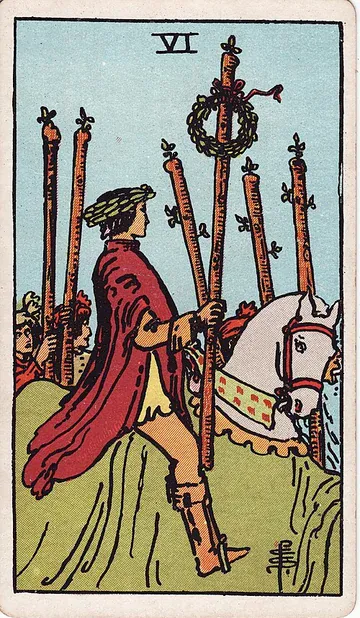
Six of Wands
The Six of Wands' parade beside the Seven of Wands' lone rock — the celebrated victor now standing alone, defending in private the prize the procession announced. Most positions are won in the Six and lost in the Seven by people who did not realize the held season was a separate fight from the celebrated one. Hold the rock with the discipline you used to win the parade.
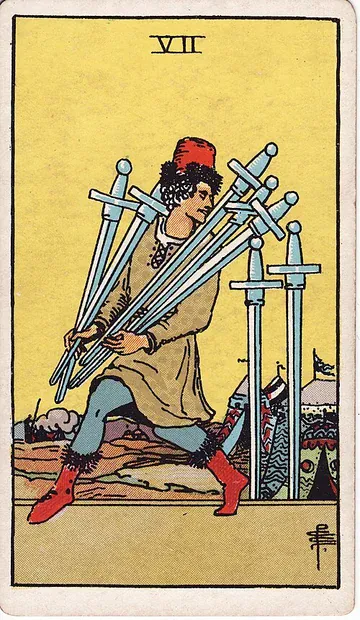
Seven of Swords
The opposite tactical response. Swords Seven walks off with what is taken; Wands Seven refuses to leave. When they pair in a spread, the question is which response the situation actually calls for. Most readers reach for confrontation reflexively when strategic withdrawal would serve better. Read the staves carefully. Some invite a stand the situation does not deserve.
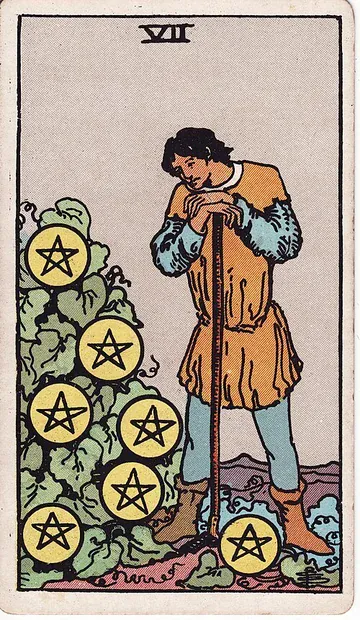
Seven of Pentacles
Patient observation beside active defense. The Seven of Pentacles leans on his hoe and watches the vines; the Seven of Wands braces against the staves. Together they ask which posture this season requires. Some defenses succeed through absence — the work is in the watching, and the swing interrupts the slow processes that would have produced the actual harvest.
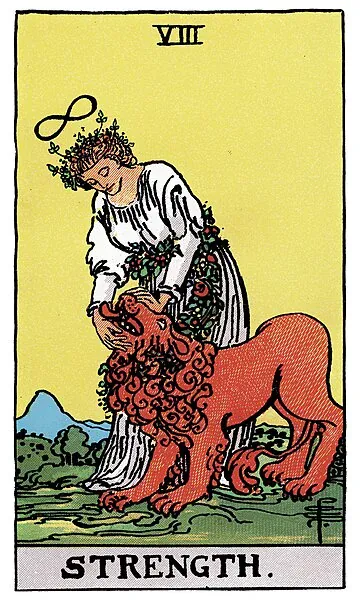
Strength
The Mars-in-Leo signature complement. Strength's woman closes the lion's jaw without fear; the Seven of Wands' figure braces without swinging wildly. Together they describe the held line that has stopped requiring aggression to hold. This is the card pairing of the seasoned defender — the stance so settled that its effort has become invisible. The lion does not need to be loud.
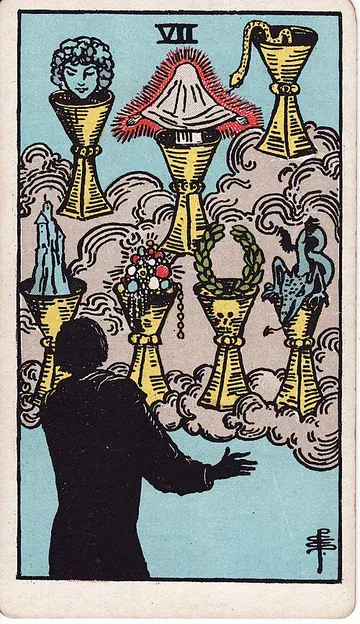
Seven of Cups
The fantasy contrast. Seven of Cups' floating illusions beside the Seven of Wands' actual rock often surfaces the source of misfired defense — bracing against projections rather than the actual room. The combination asks for honest sorting of the imagined staves from the real ones. Most exhaustion under the Seven of Wands turns out to be Seven of Cups overlay.
Frequently Asked Questions
Am I defending the right hill with the Seven of Wands reversed?
That is the only question the reversal is interested in, and it declines to give a yes or no until you have answered it. Soft no — wrong hill — is its usual shape: a warning against bracing on ground that has stopped deserving the defense, and equally against quietly ceding the ground that still does. Both failures feel identical from inside, because both feel like effort. So examine the question before reading the answer. Ask who chose this position, and when. A line you picked up from a parent, an industry, a former version of yourself, or the general hostility of the news is an inherited line, and the card will not fund it. A line you chose knowingly gets its full support, exhaustion included.
Seven of Wands reversed: has defending the relationship become the relationship?
That is the card's sharpest question, and it is worth answering before anything else gets decided. Reversed, the bracing has misfired in one of two directions: the bond is being guarded against threats that are not actually present — his mother, her ex, the friends who said something once in 2019 — or the line that genuinely mattered was ceded so gradually that nobody can date the loss. Both produce couples who are tired in a way that has stopped being about each other. The test is what remains when the defending stops. If there is a bond underneath, the exhaustion is circumstantial and eases through subtraction. If the defending is the only shared activity left, the card is naming that plainly. For a reconciliation it reads as a soft no: most attempts here are a reclimb of the same hill that gave way the first time.
Seven of Wands reversed: are they pulling away, or out of energy to keep the guard up?
Out of energy, in nearly every reading where this card is the answer. The reversed feeling is exhausted bracing: something real is there, and it has begun to buckle under the weight of staves that should never have been raised around it — the family opinions, the scheduling war, the friends with commentary, the internal argument they have been having about themselves since long before you arrived. Withdrawal and depletion look identical from the outside and behave differently up close. Someone pulling away gets colder as contact increases. Someone depleted gets warmer when the pressure drops, even slightly. Test it by lowering the implicit demand for a fortnight — no summit conversation, no request for reassurance — and watch which way the temperature moves.
What is the warning of the Seven of Wands reversed?
The seven of wands reversed meaning carries two main warnings: paranoid bracing, where the seeker treats every approach as a challenge and exhausts themselves answering staves no one raised; and the wrong hill, where the seeker has been guarding ground that has stopped being theirs to hold. The card asks for honest audit of both the rock and the staves before any further defense.
What is the Seven of Wands reversed advice?
The seven of wands reversed advice is to lower one staff this week as experiment, examine whether the rock is still your rock, put on the second boot of basic self-care, invite a witness to the position, and ask whether this hill is worth the next round. Most reversed Seven of Wands exhaustion eases through subtraction rather than further effort.