
Six of Cups · Core Meaning
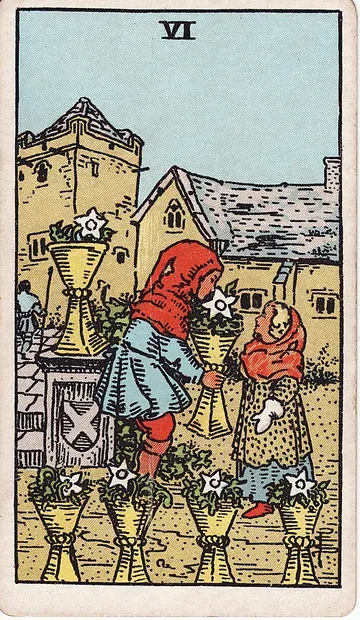
The Six of Cups meaning sits inside one quiet picture. An older child stands in a courtyard and offers a cup to a smaller one. The cup is brimming with white star-flowers, not water, and the smaller child reaches for it with both hands. Behind them, last night's frost still clings to the flagstones. In the middle distance a guard walks past and does not look in. There is no transaction in the frame — no apple to bite, no coin to weigh, no door to walk through. Only the moment a kindness is offered and received with seriousness.
This is the card's signature tension: that childhood is still happening, somewhere, inside an adult life. The Six of Cups is the card of the friend who finds you on a street where you no longer live. The card of the song that plays at the supermarket and stops your hand on the cart. The card of the smell of the kitchen you grew up in, intercepted in a stranger's hallway. The card does not promise that the past will return; it promises that the past has not, in fact, gone anywhere. It has been keeping warm, behind the courtyard wall, waiting to be poured.
The image's particulars are load-bearing. The flowers are white — not red, not gold — because memory at its tenderest is uncolored by craving. The cups are six, the number of harmony, of giving and receiving brought into balance. The two children are not equals in size; the older offers, the younger receives, and the gift moves down the chain of generations. The guard in the distance is the most often missed detail of the card. He is the reason the courtyard is safe enough for this exchange. The world outside continues to run; the courtyard is possible because someone is keeping watch at the border. Childhood is never absolute; it is conditional on a perimeter held by someone else.
The traditional astrological signature deepens this. The Six of Cups is the Sun in Scorpio's second decan — November 3 to November 12, the days when autumn deepens into something almost wintered, when the leaves have already done their loud work and the bare branches start to show. The Sun is the planet of warmth, recognition, the bright eye. Scorpio is the deepest of the water signs, the one that holds what other waters let pass. Together they are warm light inside deep water — not the brilliant noon sun on a swimming pool, but a single lamp lit beside a still pond at dusk. Memory gently illuminated. The card belongs to the kabbalistic sphere of Tiphareth in Briah — Beauty in the World of Creation, the center where feeling finds its balance. The Six of Cups is the heart-center of the entire suit of Cups, the place where the suit's grief and longing and hope are briefly equalized into something the body can hold without trembling.
Read the Six of Cups the way you would read an old photograph found inside a book you forgot you owned. The picture itself is a record, not a promise. The picture asks who you are, here, now, holding it. Whatever rises in the chest while you look — gratitude, sweetness, the small ache of a door you wish you had not closed, the quiet relief of a friend remembered — that rising is the meaning of the card for that reading. The card describes the shape of the weather. You are the one inside the weather, deciding what to do with the warmth.
Six of Cups · Love & Relationships
Nothing in a love reading disarms quite like the Six of Cups upright, and being disarmed is something that happens to a person rather than something they decide. It does not throb the way the Two of Cups throbs, or burn the way the Knight of Wands burns. It is gentler than that, and older. It describes the love that arrives with the recognition built in — the partner who feels familiar from the first afternoon, the friend who returns after a decade and picks up the same sentence. The Six of Cups in love speaks of the person who knew you before you needed to be impressive. It is the card of soft return.
For an existing partnership, the Six of Cups marks the season the relationship goes back to its earliest sweetness. After the long stretch where the bills and the schedules and the quiet resentments did their grinding work, the card describes a weekend when neither of you can quite remember what the fight was about. You make the simple meal you ate the year you met. You play the playlist from the move-in. You are not pretending. The bond has remembered itself. Many couples draw this card in the second half of an autumn, when the body slows down and the calendar has fewer obligations, and the small rituals reassert themselves over the louder ones. The Six of Cups is the card of the long bond at home with itself.
For a new spark, the card means the person across the table has the texture of someone you have already known. Not a past life, necessarily — though the card is friendly to that interpretation when the seeker holds it. More often, the Six of Cups in a new connection means you recognize their rhythm. Their humor lands without subtitling. Their silences feel like the silences of a friend, not the silences of a stranger. After years of having to introduce yourself fully to anyone you slept with, this person seems to skip a step. The card asks you not to mistake that ease for shallowness. Some loves arrive pre-translated. The work is to honor the rare gift of being already understood.
For a single seeker who is asking whether love is possible, the Six of Cups answers yes — and adds that it may come from a direction you stopped watching. The card is famous for the returning ex, but its actual reach is wider. It can mean an old classmate writes to you out of nowhere. The neighbor you used to wave at moves into the same building as a friend. A long-ago colleague turns up in a city you both reluctantly relocated to. The Six of Cups is the card of the address book you thought had gone cold suddenly warming on one specific name. The instruction in the answer is simple: when the message comes, answer it. Do not perform busyness. Do not test them. The card works in the opposite direction from games.
In the question of love after a wound, the Six of Cups is one of the most hopeful cards the deck offers. The grief has done enough of its work that the body remembers it can be tender without being torn. After the breakup, after the loss, after the season you thought love had used you up — the card is the morning you find yourself smiling at a child on the train without bracing. The capacity has returned, quietly, in advance of the next person. The card asks you not to rush the next person; the capacity is the news. Sit with the capacity for a season. The next love will come into a hand that has remembered how to open.
A note on the card's particular love language: the Six of Cups loves the way a small gift loves. It writes the note. It picks the song. It remembers the offhand thing you said you wanted in March and gives it to you in November. It does not perform grand romance. It performs accuracy — the cup of star-flowers handed over because the recipient has been seen. If you are asking what it would feel like to be loved by someone in the Six-of-Cups season, the answer is: like being known. The body does not have to defend itself. The mind does not have to explain. The cup arrives already pointing toward you.
If you are asking whether someone is in love with you and the Six of Cups arrives upright, read it as a yes that wears the clothes of friendship. They love you the way they love their oldest people — durably, without a campaign, and with the kind of attention that does not need to be demonstrative because it is built into the way they remember you. They notice what you mention. They keep the dates. They will not embarrass either of you with a public declaration before they are sure. But they have already decided. The cup has already been filled. They are looking for the right courtyard to hand it to you in.
For a seeker considering reaching out to someone from before — the old flame, the friend you fell out with, the partner you never quite finished saying goodbye to — the Six of Cups upright is permission. The reaching out is allowed. It does not have to mean reconciliation. It does not have to mean repair. It can simply mean acknowledgement: I remembered you. I am glad you existed in my life. I am writing to tell you. The card supports the unconditional gesture. It also asks that you keep the gesture unconditional. Send the note without expecting the reply.
For a seeker who is asking, instead, whether to let someone reach back — when an old name surfaces in a message after years and the body does not know whether to flinch or to soften — the Six of Cups upright says: read the message slowly. The person reaching for you may not have the same outcome in mind that you fear. They may simply be doing what the card describes: handing you a cup of star-flowers because the thought of you crossed their afternoon. You are allowed to receive the gesture without taking it as the opening move of a longer plot. Most reaching-back, in this card, is not strategic. It is the human thing of someone remembering they once loved you and wanting that to be acknowledged before more time passes.
For a seeker in a long-distance relationship, the Six of Cups means the bond's emotional storage is larger than its weekly bandwidth. You are not failing each other on the days you do not talk. The bond is being held in the same way the courtyard holds the children — by a perimeter neither of you has to actively reinforce. Use the card as an invitation to send small specific tokens: a photograph of the place you used to walk, a quote from a book you read together, a song that reminded you. Specificity is the love language. Volume is not.
For a seeker who is single and content, asking whether the card is telling them to seek something they have not been missing — the Six of Cups answers no. Not all warm cards are recruitments. The Six of Cups can simply mean that the love you already have, including the love you have for your own past selves, is what is alive in this season. Honor it. Write the letters to the friends. Visit the parent. Sit with the child in your life if there is one. Love is not only romantic. The card has more shapes than the romance industry sells.
Six of Cups · As Feelings
Tender, and facing slightly backward. The Six of Cups as feelings is rarely about a hot pursuit. It describes a softer interior state — the person looking at you with the kind of warmth one reserves for very early friends, family at their kindest, the people one has loved without strategy. They feel like they have already known you. Whether that is true or only feels true, the texture is the same: the body is not braced when they think of you.
If they are reserved, the Six of Cups means their reserve is not absence. It is care. They are not the kind of person who makes a public move. They are, however, the kind of person who keeps the small things you have mentioned — the book you were reading in the spring, the kind of tea you said you preferred, the name of the friend whose situation you were worrying about. Their attention to you is granular. The way to read their feelings is not in declarations but in the inventory of what they have remembered. If you cannot remember telling them something they recall — the Six of Cups is doing its work in their interior. The cup is full.
If they are demonstrative, the Six of Cups in feelings means they want to make small, specific gifts. They will bring you the thing they saw and thought of you. They will play you the song they cannot stop hearing your voice inside. They will recreate, sometimes without realizing it, a small ritual from your shared past. The body language is not seductive — it is sentimental, in the older, undefensive sense of that word. They feel toward you the way one feels toward a place one used to live and still misses. You are, in their interior, a kind of homecoming.
For a partner you have been with a long time, the Six of Cups in feelings is the card of the person who has stopped wanting you to be different. Not because they have given up. Because they have remembered why they chose you. The card describes the season after the long argument has finally cooled, when you find yourselves laughing at a thing only the two of you know is funny. They feel — not always, but often, in the back of the day — quietly glad you exist. They might not say it that day. The feeling is steady whether or not it is spoken.
For a new connection, the Six of Cups in feelings can mean they are sorting you, mentally, into the category of "people I want to know for a long time." Not just this month. Not just this season. They are not in a hurry. They are doing the slow inventory people do when they have decided someone is worth the durability. If you have been wondering why the connection feels unhurried — the Six of Cups answers that the unhurriedness is the message. Slowness here is not a tactic held in reserve. They are conserving the bond for a longer life.
For a partner who has been distant lately, the Six of Cups in feelings is gentler than it might first read. Their distance may be them returning to something inside themselves that has nothing to do with you — an old grief, a season of remembering, a piece of childhood that is moving through. The card describes a person doing private interior work that has temporarily occupied the space they would otherwise share with you. They are not falling away. They are sorting. Give them the courtyard. Do not knock too loudly.
For a connection that ended and is reaching back to you, the Six of Cups as feelings is the most tender of the deck's signals. They feel toward you the way one feels toward a chapter one regrets closing too quickly. The reaching back is not necessarily strategic — it is the body's natural movement toward a warmth it remembers. They are not certain what they want to ask of you. They are certain they want you to know they have not forgotten. Read the message in that key.
There is a small caution embedded in this gentle card. The Six of Cups in feelings can sometimes mean someone is in love with the version of you that lived inside the shared past — the younger you, the hopeful you, the you they first met. If you have grown beyond that version, the card does not mean their feelings are insincere; it means the feelings need to update to match the present you. Let them meet who you are now. If the warmth survives the introduction, the card has done its work. If the warmth needed the old you to exist, that is information.
Take the Six of Cups in feelings as confirmation that whatever is moving in the other person toward you is sincere, slow, and rooted in something older than the question you are currently asking. Whatever they feel, it is durable. Whatever they feel, it is built on memory the body trusts. The work, if there is work, is to let the feeling be what it is — a small, accurate, white-flower offering — without demanding it become a louder shape.
Six of Cups · Career & Work
Your own past has a recommendation to make, and the Six of Cups upright is the card of it arriving in writing. It is rarely about ambition or breakout success. It is the card of the colleague from three jobs ago who suddenly emails you about a role at her new company. The card of the mentor you assumed had forgotten you remembering you in a board meeting. The card of the project that finally pays off because someone you helped quietly years ago is now in the position to help you back. The Six of Cups in work life describes the slow, gratifying mathematics of being the kind of person whose old colleagues stay in touch.
If you are asking whether a current role will turn out well, the Six of Cups answers in a particular accent: the role will turn out well in proportion to the relationships you have invested in inside it. The promotion may not be the next obvious one on the org chart; it may be the lateral move someone you trained years ago invents because they want to work with you again. The card does not promise career glory. It promises that the soil you have been quietly tending is now beginning to bear what soil bears — slow, perennial, cumulative.
For someone considering a new role, the Six of Cups upright reads as a positive omen with one specific test. Is the new role a return to something you used to do well? A field you left? A company you used to belong to? A city you grew up in? The card is friendly to the loop — going back to an environment that fits you better than the one you tried to grow into is not a failure. It is the wisdom of recognizing where the soil is good. Take the role if the body softens at the thought of it. Wait if the body braces.
For a job-search seeker, the Six of Cups upright is one of the deck's most encouraging cards, but in a non-obvious way. It tells you the job will not come from cold applications. It will come from someone who knows you. Spend a day this week writing to five people you used to work with and have not been in touch with for a year or more. Not asking for jobs. Asking how they are. The reply chain is the network the card describes. Within the season, one of those replies will surface a lead. The card responds to maintenance of old bonds, not to fresh outreach into strangers' inboxes.
For a freelancer or independent practitioner, the Six of Cups upright signals the season of returning clients. The person you did good work for two years ago is preparing to commission a second piece. The colleague who recommended you once is preparing to recommend you again, this time to a larger circle. Reputation has the half-life this card describes — long, gentle, accumulating. The card asks you to keep the door open with kindness. Reply to the old client's casual message. Send the holiday card. Remember the names of their children. The work flows from the relationship, not from the brand.
For a creative practice, the Six of Cups can describe the season when you go back to a body of work you set aside years ago. The novel you stopped writing in your twenties, the medium you abandoned for paying work, the hobby that used to be a calling. The card validates the return. The work has been waiting. Some part of you is still the artist of that earlier room, and that part has not aged the way you have. The instruction is to sit with that earlier room and listen to what it asks for next, with the maturity you now have. The card produces some of its best work in this exact return.
For an entrepreneur, the Six of Cups upright says: the business model you keep dismissing as too soft, too relational, too slow — that is the model the card supports. The Six of Cups does not build empires. It builds relationships that build small durable enterprises that outlast the empires. If you are torn between two paths and one of them looks like growing slowly with people who know you and the other looks like scaling fast with strangers, the card sides with the first. Not because the second is wrong — but because the second is not the card's accent.
For someone considering a return to a former employer, the Six of Cups upright is friendly to that move with one important honesty: you are not the person who left. They may not be the company you left. The return is not a rewind; it is a re-meeting. Go in with the maturity you earned in the years between. Do not try to replay the old role. Negotiate based on what you can offer now, which is more than you could offer then. The card supports the return when the return is built on present, not on nostalgia.
For someone in a workplace dispute, conflict, or stalled negotiation, the Six of Cups upright suggests the way through is via the relational history. Find the colleague who knew both parties before the disagreement. Find the shared early period when the work felt good. The card believes that the way out of the present knot is through the memory of when the bond was uncomplicated. Re-establish that ground first. The terms will follow.
For a layoff or a forced transition, the Six of Cups upright is unusually kind. It often shows up to say that the people you helped along the way are about to become the people who help you. Make the calls. Tell the truth. The Six of Cups will not let a generous worker land alone. The card is the deck's reminder that work is, finally, made of people, and the people you chose to be decent to are the soil out of which the next season grows.
A note on stability: the Six of Cups is not a card of expansion in career. It does not say "go bigger." It says "go deeper into the relationships you already have." For ambitious seekers measuring themselves against louder peers, this can feel like the card is underselling the moment. Trust the undersell. The Six of Cups builds careers that survive the cycles that flatten louder ones. The instruction is patience. The reward is durability.
Six of Cups · Money & Finances
Money that arrives because somebody remembered you spends differently from money you earned. The Six of Cups upright deals almost exclusively in that kind — the unexpected gift, the small inheritance, the envelope addressed in an old hand. Not the lottery — the card is too personal for that. The card is the great-aunt's bequest. The grandparent's slow trust. The friend who insists on covering the meal because of a kindness you forgot doing for them years ago. The card is money with a relational provenance, money that carries memory in it.
For the seeker who has been managing scarcity, the Six of Cups can describe a small but meaningful softening. Not a transformation of circumstances. A specific easing — the medical bill someone covers, the rent month a relative absorbs, the sudden refund that arrives in a season you needed it. The card is not promising abundance. It is promising that you are not, in fact, alone in the math. There are people in your life who would help if asked. The card sometimes shows up to remind you that the asking is allowed.
For a question about whether a financial gamble will pay off, the Six of Cups answers cautiously. The card does not love speculation. It loves return-of-principal — the money that comes back after you let it sit. The savings account that quietly compounds. The bond that matures on its slow schedule. The investment in a friend's small business that turns out to have been the right thing precisely because it was made out of relational trust rather than market analysis. If your gamble has a relational dimension — backing someone you actually know — the card is friendlier to it than it would otherwise be. If it is anonymous, the card prefers you wait.
For a windfall — inheritance, gift, unexpected income — the Six of Cups upright is one of its most typical placements. The card supports the receiving. It also asks for a particular instruction: do not spend the gift on yourself entirely. The Six of Cups is the card of the inherited cup, and the inheritance carries a quiet obligation toward continuity. Use part of the money to make a gift to someone who would not have expected it from you. Pay forward something that was paid to you. Sponsor the niece's class trip. Cover the friend's rough month. The card multiplies its luck when the luck is shared down the chain the way the older child shares with the smaller one in the image.
For someone managing debt, the Six of Cups can describe a moment of relief — a debt forgiven, a loan extended on more humane terms, a creditor who turns out to be more reasonable than feared. The card is friendly to the conversation that opens with honesty. Do not avoid the call. The person on the other end of the call is more often the older child in the courtyard than the guard at the wall.
For a long-term financial plan, the Six of Cups upright supports the slow strategies. Save into the boring vehicles. Build the emergency fund. Pay the small extra against the principal each month. The card does not get excited about hot tips. It gets quietly satisfied by the spreadsheet that, three years from now, looks better than you remembered. Its temperament is patient capital — the kind of money that grows because it was not asked to perform.
A specific note on family money: the Six of Cups often appears around questions of inheritance, family loans, and the tangle of money that moves between generations. The card asks you to read these transactions for what they actually are — not just transfers of value, but transfers of memory. The money the grandparent leaves carries the grandparent's love into a season they will not be present for. Receive it that way. Spend it accordingly. The hardest financial lessons of this card are not about getting more; they are about honoring the source.
For someone making a significant purchase — a home, a car, a major instrument or tool — the Six of Cups upright supports the purchase that returns you to something familiar. The neighborhood you grew up in. The kind of car your parent drove. The instrument you started learning at twelve and put down. These purchases tend to satisfy in the long run more than the impressive purchase that has no roots. Buy what feels like coming back, not what feels like climbing up.
Six of Cups · Health
The body remembers a former condition of itself, and the Six of Cups upright describes the unhurried return toward it. The condition that worried you is settling into a manageable pattern. The recovery is taking the shape of slow re-acquaintance with your own physicality. The card sits inside the element of Water, in the West, in the season of autumn, with a phlegmatic temperament — its medicine is gentle, retentive, slow. The body part it traditionally touches is the pericardium, the membrane around the heart, the place where old affection is stored.
If you are asking whether a treatment will work, whether a procedure will go well, whether a recovery will hold, the Six of Cups answers yes — and adds that the recovery's success will be in proportion to the rest you allow yourself to take. The card does not love hurry. It loves convalescence. The slow afternoon, the long bath, the soup made from a recipe that someone older taught you. These are not luxuries during a recovery; they are the medicine. The card asks you not to rush back to the version of yourself who got sick.
For someone managing a chronic condition, the Six of Cups can describe a season of remission shaped by a return to old practices that worked. The yoga you used to do. The walk you used to take. The diet that was simpler. The sleep schedule of your better years. The card asks: what did your body know how to do, before the present pattern took over? Some part of that earlier knowledge is waiting to be re-activated. Not nostalgically — practically. Try it for a month. The body remembers.
For someone managing an emotional wound that is presenting somatically — the chest tightness during family visits, the migraine that arrives the week before the anniversary of a loss, the appetite that disappears in certain rooms — the Six of Cups upright is unusually direct. It tells you the body is keeping the score the mind has not yet read. The pericardium is a real organ; old affection is a real cargo. The work is not to suppress the somatic signal. The work is to listen to what year the body is in. Often it is younger than your driver's license suggests.
For someone managing food, weight, or appetite, the Six of Cups can describe a quiet return to nourishing eating after a long period of eating distractedly. Cooking the meal you grew up on. Eating at the table instead of the laptop. Sharing food with someone who does not require you to perform. The card is friendly to the body's older and more honest hungers. It does not love regimens, exactly — it loves the meal that remembers it is a meal.
For mental health questions, the Six of Cups upright is gentle good news. The depressive season is lifting. The anxiety has loosened enough that you can think about the past without flinching. The therapeutic work has begun to do the slow integration the body needs — not to forget, but to remember without being held hostage by the remembering. The card is the morning after a long dream you cannot quite recover, when the day starts and the dream's heaviness gradually drains away as the kettle boils. Nothing here is medical advice — the courtyard is a picture of a season being felt, and a season is not a diagnosis. Keep your practitioners. Take your medicine. The card simply confirms that the inner weather is shifting toward warmth.
For older adults, or for someone caring for an aging parent or grandparent, the Six of Cups is one of the most particular cards in the deck. It asks for time spent in actual presence with the person who is moving through their last seasons. Not productive time — porch time. Looking at old photographs together. Letting the same story be told for the third time without correcting. The card believes that this kind of attention is, in fact, medicine — for both of you. The presence the older child gives the smaller child in the image is the presence an adult child can give an aging parent. The cup of star-flowers is also time.
For someone recovering from a more recent injury or illness, the Six of Cups upright suggests the recovery will be smoother than the worst hours suggested. The body has resources you have not yet had to draw on. Rest into them. Eat the simple foods. Sleep the long sleeps. The card is the deck's reminder that healing happens in the slow time the calendar resents, and that giving the body its slow time is the work, not the obstacle.
Six of Cups · Spirituality
Every practice has a sweetness in its first months that later gets called beginner's luck and dismissed; the Six of Cups upright is that sweetness coming back on its own. The card describes the moment in a long meditation when the strain leaves the shoulders and the breath becomes the same breath you had as a child sleeping in the back seat of a car. The card is the stone you picked up on a beach when you were eight and that turns out, decades later, to still mean something the rest of the beach did not. Spirituality, here, is not new. It is the old thing remembered with adult attention.
For seekers in active practice — meditation, journaling, ritual, devotional work — the Six of Cups means the practice has finally settled into the body. The strain of trying to do it correctly has loosened. The original reason you started — whatever wordless thing called you in — has begun to make itself felt again, underneath the technique. The card is friendly to returning to a simpler version of your practice. Drop the complication. Sit for ten minutes. Let the practice be the small thing it was, the kindness you did yourself before you started measuring it.
For seekers exploring belief, the Six of Cups can describe the return of an earlier piety in a more honest form. The seeker who left the religion of their childhood in their twenties may now, in their thirties or forties, find themselves drawn to a small, specific piece of it — the prayer, the candle, the song, the seasonal ritual — without needing to re-adopt the whole structure. The card supports this kind of selective return. It is not regression. It is the maturity of taking back what was actually nourishing while leaving what was not.
For seekers who never had a religious childhood, the Six of Cups can describe finding a tradition that feels strangely familiar despite being culturally foreign — a Buddhist retreat that feels like the silence you grew up in, a Sufi gathering that feels like the music of your grandparents, a Christian liturgy that hits a chord you did not know you had. The card is friendly to these recognitions. The body knows ancestral grammars the mind has not catalogued. Trust the recognition without forcing it into a doctrine.
The card's spiritual caution is gentle but worth naming: nostalgia is not a practice. The Six of Cups can become an excuse for a spirituality that is mostly memory of when spirituality was easier. The remedy is to take one element of the remembered sweetness and make it into a current discipline. Light the candle every morning, not just on the holiday. Sit at the same time each day, not just when the mood strikes. The card responds to small fidelities. It curdles into reverie when the sweetness is only consumed and never re-enacted.
For questions about path, the Six of Cups upright answers that you are aligned with something older in yourself than the current ambition. Whatever you are doing that feels like it is reconnecting you to the person you were before adulthood started its compromises — keep doing that. The next phase of the practice will grow from this honest tap-root. The newer enthusiasms can wait their turn. The card asks you to honor the long memory.
A small specific practice when this card appears: spend one half hour, this week, with an object from your childhood. A book you read. A toy you kept. A piece of clothing in the back of a drawer. Not nostalgically — attentively. Let the object be itself, not a screen for memory. Then write three sentences about what the object knows that the adult you has forgotten. The Six of Cups is the card of objects that hold time. The ritual is to listen to them.
Six of Cups · Yes or No
Yes — soft, warm, a little nostalgic.
The Six of Cups upright is one of the deck's gentler yes-cards. Asked whether something will happen, the card answers yes, with the specific texture of an outcome that arrives wearing the clothes of something you have known before. The yes is not loud. The yes is not dramatic. The yes is the kind that makes you smile in spite of yourself, recognizing a pattern you had filed under "not for me anymore."
For yes-or-no questions about a relationship, the answer is yes, especially if the relationship in question has any prior history at all — an old connection rekindled, a friendship deepening into something more, a partner returning after a season of distance. The card loves the relational loop. The reconciliation, the second chapter, the bond that picks back up. If the relationship is brand-new, the yes is still yes, but with the caveat that the connection will feel as if it has been going on for longer than the calendar admits. Read the familiarity as a gift, not a warning.
For yes-or-no questions about a job, opportunity, or move: yes, particularly if the move involves a return — to a former employer, to an older field, to a city you used to live in, to a kind of work you set aside. The Six of Cups smiles on returns. If the question is about an entirely new direction with no prior history, the card is still gently yes, but it is not the card's most enthusiastic placement.
For yes-or-no questions about whether someone is being honest, whether an offer is genuine, whether a plan will hold: yes. The card has very little shadow in upright. Whatever is being offered is being offered in good faith. The honesty in the gesture is real. The plan, if it is rooted in past relationships and not in new strategy, will hold the way old things hold. There is no hidden cost in the cup of star-flowers; it is exactly what it appears to be.
Asked how soon the old thing comes back around, the Six of Cups upright answers within the season, often within the same fall or the same spring. The card is not instant. It is not far. It tends to arrive with a certain seasonal rhyming — things that mattered to you at this time of year before tend to come back at this time of year now. Watch for the signal in the calendar. Anniversaries quietly become inflection points under this card.
For questions about whether to act on an instinct — should I send the message, should I show up, should I make the small gesture — the Six of Cups upright is one of the most encouraging cards possible. Yes. Send it. The risk you are imagining is smaller than your nervous system is reporting. The other person will receive the gesture in the spirit you mean it. The card is the deck's permission to extend the small kindness without architecting the response.
For questions about whether to revisit something painful — should I reach out to the person who hurt me, should I go back to the place where the loss happened, should I open the box of letters — the Six of Cups upright says yes, with a specific instruction: revisit it the way you would revisit an old friend, not the way you would revisit a crime scene. The card has the gentleness for that kind of return. Hold the past with both hands, the way the smaller child holds the cup. Receive what is in it. Set it down again when you are ready.
If the question was: am I allowed to want this? The card answers yes, and adds that the wanting is older than you knew, and more honest than you have been letting it be. Stop apologizing for the want. The cup is being handed to you. Take it.
Six of Cups · Advice
Make the small gesture you have been postponing; the Six of Cups upright is asking for nothing larger than that. Write the note. Send the song. Mail the photograph you found of the two of you that summer. The card is not interested in grand declarations; it is interested in accuracy. The specific small thing that says "I remembered you" is the medicine the season is asking you to administer. There is no second move required. The note is the entire instruction.
If there is one specific person on your mind right now — and the Six of Cups almost always brings one to the surface — reach out to them. Not strategically. Not to begin a longer conversation that has an outcome. Reach out to acknowledge that they exist in your interior. Say the kind specific thing you would have said years ago and did not. The card supports the unilateral kindness. You do not need a return on the gesture for it to be the right gesture.
A second instruction: spend an hour with something from your past that has been waiting for your attention. The drawer of letters you have not opened. The album you have not listened to in a decade. The neighborhood you grew up in — visit it, walk slowly through it, let it be the place it actually is rather than the place memory has been editing. The Six of Cups responds to the practice of being honestly present with the past, rather than performing distance from it.
A third instruction: give something to a younger person without expecting them to understand its value yet. The book you read at their age. The advice you wish someone had given you. The story of the mistake you made that they are about to make. The card is the chain of small gifts moving down the generations. You are now the older child in the courtyard. There is a smaller child within reach. Hand the cup over with seriousness.
A fourth instruction, gentler than the others: forgive someone in the privacy of your own chest. Not necessarily out loud. Not necessarily to their face. Inside yourself, set down a grudge you have been carrying about a person who can no longer hurt you because the relationship has cooled or ended or moved on. The Six of Cups loves the inner ledger getting cleared. The forgiveness is for you, not for them. It clears space for the present love to move.
Practical advice for the day the card appears: cook something from a recipe an older relative gave you. Take a longer walk than is strictly necessary, in a part of town that has personal history. Listen to one piece of music you have not heard since adolescence. Write a single page in a journal about the year of your life that the card has put on your mind. The Six of Cups responds to slow attention. It does not respond to performance. The instructions are quiet on purpose.
A specific caution: do not turn the card into a license for re-litigation. The Six of Cups is not the card of the long phone call where you finally tell the ex what you really thought. It is not the card of the family group text where the old fight is reopened. The card's gentleness depends on the gestures being one-directional and unconditional. The moment the gesture has a demand attached, it becomes a different card. Keep the gift a gift.
Six of Cups · Card Combinations
The Six of Cups rarely arrives alone. It is a relational card by temperament, and its meanings shift quickly depending on which neighbor it stands beside. A few of the most useful pairings, drawn from the suit's neighbors, the Major Arcana modulators that most often show up beside it, and the contrast cards that sharpen its edge.
Six of Cups + Five of Cups
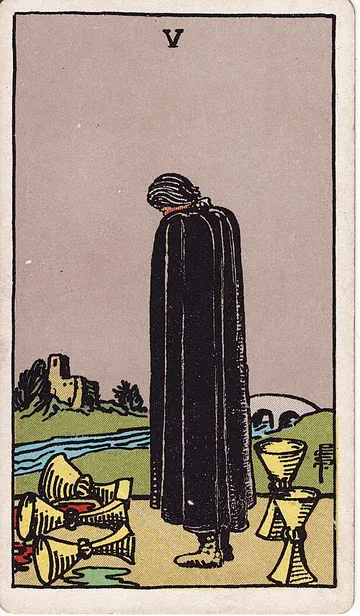
The grief that the homecoming returns from. The Five of Cups is the figure mourning the spilled wine; the Six of Cups is the same figure, weeks or years later, learning that the cups still standing are enough. Together, the pair describes the precise emotional arc of integrating a loss — not erasing the spill, but coming to live alongside it without being consumed. Often appears in readings about a relationship that ended badly and has begun, very slowly, to be remembered with more tenderness than anger. The instruction is not to rush the integration. The Six is the gift the Five gives once the Five has been allowed to do its full crying.
Six of Cups + Seven of Cups
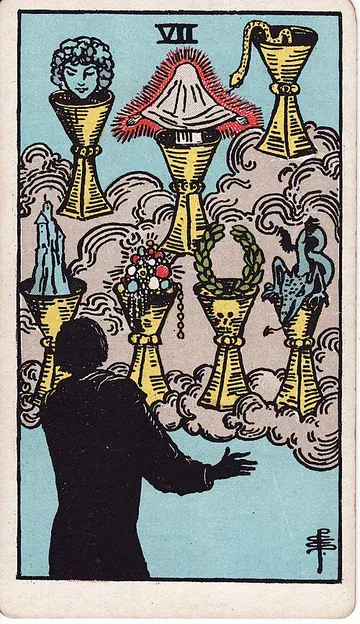
The decan neighbor — the Sun in Scorpio gives way to the Venus in Scorpio of the Seven. Together, the pair warns of clean nostalgia tipping into over-romanticized fantasy. The Six remembers what was; the Seven embellishes it. When the two appear together, the seeker is being asked to inventory which of the warm memories are accurate and which have been quietly upgraded by longing. The combination is not negative — it is honest. Some of the cups are real. Some are projection. The work is to tell the difference.
Six of Cups + Six of Pentacles
The number sibling — both sixes, both about giving and receiving, but with very different temperaments. The Six of Cups is the unconditional childhood gift. The Six of Pentacles is the measured, transactional kindness of the merchant weighing coins. Together, they pose a question about the kind of giver you want to be. The combination often appears when a seeker is trying to decide whether to help a loved one with money — and the cards are asking you to read carefully whether the help is the unconditional cup or the calibrated coin. Both are valid; they are different gestures. Do not confuse them.
Six of Cups + The Sun
The decan ruler doubled — Sun in Scorpio II amplified by the Sun himself. The pair describes a particularly luminous return — the long-lost friend who arrives in the same week the personal weather lifts, the recovery that coincides with a season of unusually warm light, the project from your past that, when revisited, blooms into one of the brightest things in your present. This is one of the deck's most generous combinations for any reading about renewal. The instruction is to be in the warmth. Do not interrogate it. Do not measure it. Sit in it.
Six of Cups + Death
The tonal contrast — Death is the card that cuts what the Six of Cups returns to. Together, the pair describes a seeker being asked to honor what has ended even as they hold what continues. The combination often shows up in readings about the last visit with a dying relative, the final stage of a long illness, the closing of a chapter that has been kept warm by memory. The Six is permission to remember tenderly. Death is permission to let the remembering be remembering, not denial. Together, they are the deck's most honest grammar for the love that survives the body of its object.
Six of Cups + The Lovers
A specifically romantic recognition. The Lovers' card of choice meeting the Six of Cups' card of recognition produces the seeker who realizes that the right person has been within reach for a long time and is only now ready to be seen as such. The friend who became the partner. The childhood acquaintance now a soulmate. The combination supports the choice that feels both new and obvious. Do not overthink the obviousness. Some loves arrive announced by familiarity.
Card Combinations
Five of Cups
The grief the homecoming returns from. The Five of Cups is the figure mourning the spilled wine; the Six is the same figure, weeks or years later, learning that the cups still standing are enough. Together the pair maps the precise emotional arc of integrating a loss — not erasing the spill, but coming to live alongside it. Often appears in readings about a relationship that ended badly and has begun, very slowly, to be remembered with more tenderness than anger. Do not rush the integration; the Six is the gift the Five gives once the Five has cried itself out.
Seven of Cups
The decan neighbor — Sun in Scorpio handing off to Venus in Scorpio. Together the pair warns of clean nostalgia tipping into over-romanticized fantasy. The Six remembers what was; the Seven embellishes it. When both appear, the seeker is being asked to inventory which warm memories are accurate and which have been quietly upgraded by longing. Some of the cups are real. Some are projection. The work is to tell them apart, and to let the real ones keep their warmth while the projected ones return to the air they were made of.

Six of Pentacles
The number sibling — both sixes, both about giving and receiving, but with very different temperaments. The Six of Cups is the unconditional childhood gift; the Six of Pentacles is the measured, transactional kindness of the merchant weighing coins. Together they pose a question about the kind of giver you want to be. Often appears when a seeker is deciding whether to help a loved one with money — the cards ask whether the help is the unconditional cup or the calibrated coin. Both are valid; they are different gestures. Do not confuse them.

Death
The tonal contrast — Death cuts what the Six of Cups returns to. Together the pair describes a seeker being asked to honor what has ended even as they hold what continues. Often appears in readings about the last visit with a dying relative, the final stage of a long illness, the closing of a chapter that has been kept warm by memory. The Six is permission to remember tenderly. Death is permission to let the remembering stay remembering, not denial. Together they are the deck's most honest grammar for the love that survives the body of its object.

The Sun
The decan ruler doubled — Sun in Scorpio II amplified by the Sun himself. The pair describes a particularly luminous return: the long-lost friend arriving in the same week the personal weather lifts, the recovery coinciding with a season of unusually warm light, the project from your past blooming into one of the brightest things in your present. One of the deck's most generous combinations for any reading about renewal. The instruction is simply to be in the warmth. Do not interrogate it. Do not measure it. Sit in it for as long as it lasts.
Frequently Asked Questions
What is the Six of Cups meaning in tarot?
The Six of Cups is the deck's card of homecoming, tender memory, and unconditional gift. Its image — an older child handing a cup brimming with white star-flowers to a smaller one in a quiet courtyard — captures a specific kind of warmth: the offering made without expectation of return. Read it as a soft signal of the past returning in some form (an old friend, an old place, an old self) and asking only to be received with care.
Does the Six of Cups say yes to something new, or only to something returning?
Its clearest yes is reserved for the return. The Six of Cups upright is a soft yes. The card answers yes especially to questions involving any return, reconciliation, or relational loop — an old friend reaching back, a former employer wanting you again, a city you used to live in calling you back. The yes is gentle rather than triumphant. Trust the warm answer; the card has very little shadow in its upright orientation.
Does the Six of Cups point to an ex, or to someone new who simply feels familiar?
It genuinely can be either, and the difference lives in whether the familiarity has a name. In love, the Six of Cups upright signals tender recognition — a partner who feels familiar from the first afternoon, a friendship deepening into something more, an old flame returning with the past gently softened. For existing partnerships, it marks a season of returning to the bond's earliest sweetness. For singles, it often points to love arriving from a direction you stopped watching: an old colleague, a former neighbor, a face from years ago.
Is the Six of Cups a romantic feeling, or the feeling of being someone's safe old place?
Usually the second, which in this suit is not a lesser thing. The texture is tender, durable, and rooted in something older than the current question. They feel like they have already known you. They notice the small things you mention. They are not in a hurry to declare anything because the warmth does not need announcing. Read it as care that is being held quietly, often expressed in specific small gestures rather than grand statements.
What is the spiritual lesson of the Six of Cups?
The spiritual lesson of the Six of Cups is that the past is not past; it is keeping warm, available to be drawn from. Treat memory as a well you can visit — not a house to live in. The card asks you to honor the small, specific kindnesses you received as a child or earlier self, and to pass equivalent kindnesses down the chain to whoever is younger than you in some way. The cup of star-flowers is meant to be handed on, not hoarded.