
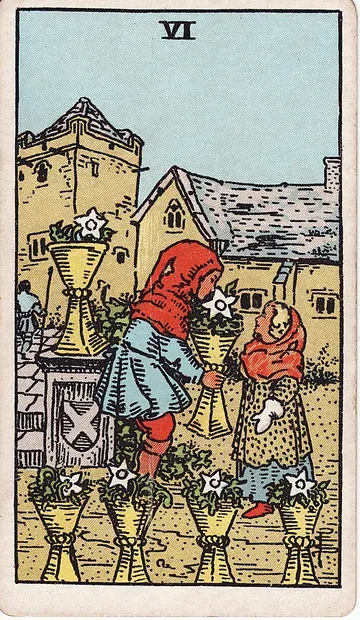
Six of Cups Reversed · Core Meaning
The Six of Cups reversed meaning hinges on a small but decisive shift in the courtyard. The older child is still standing there. The smaller one is still reaching for the cup. The white star-flowers are still in the cup. But something in the picture has tilted: the children no longer notice the guard in the distance, or the courtyard wall, or the morning that is moving past the frost. They are inside the gesture and they have stopped looking up. The exchange has stopped being one moment in a larger life. It has become the only life. The reversed card is the picture frozen — beautiful, warm, and unable to advance.
This is the reversed card's central knot: the past has stopped being a well and started being a house. The seeker has set up residence inside an earlier season — an ex, a friendship, a job, a city, a self — and the present is being asked to perform as a continuation of that earlier season rather than as its own thing. The card is not punishing the love of the past. It is naming the cost of refusing to update. The cups are still warm. The room they are in has stopped having windows.
There is a second flavor of the reversed card: the unfinished child. The reversed Six of Cups often appears when something from the seeker's actual childhood has not been processed and is now leaking into adult relationships in ways the seeker may not yet recognize. The partner who is being unconsciously cast as a parent. The boss being read as the older sibling who got more attention. The friend being asked, without their knowing, to repair an old wound they did not cause. The reversed card is gentle but precise about this — the leak is not malice; it is unprocessed material asking for attention. The work is not to suppress the leak. The work is to identify the source.
The astrological signature reverses too. The Sun in Scorpio's second decan upright is warm light inside deep water — memory gently illuminated. Reversed, the same configuration becomes warm light that has begun to refract into something distorting — the lamp lit beside the pond not to show what is in the water, but to keep the seeker from looking up at the night sky moving above. Tiphareth in Briah, reversed, is beauty without circulation — the heart center that has stopped pumping. The water that was held in balance has begun to stagnate.
There is a third flavor worth naming, lighter than the first two: the reversed Six of Cups can sometimes simply mean it is finally time to leave the past where it is. The card upright has done its work — the integration has happened, the memory has been honored — and the reversed orientation is the cue that the next chapter is now waiting in the present. This is a hopeful reversal, not a cautionary one. Most readings will have the heavier flavor; some will have the lighter. The seeker's life will tell you which.
Reversed, the Six of Cups asks: is the past you keep returning to actually feeding you, or is it consuming the bandwidth your present needed? And: what happens in the courtyard when you finally let the children grow up and leave it?
Six of Cups Reversed · Love & Relationships
A relationship can be kept warm by an older story the way a room is kept warm by a radiator nobody has looked at in years. Reversed in love, the Six of Cups describes that suspension — a tender bond held in place by something that finished a long time ago. The relationship looks loving in the surface terms. The partner is kind. The dates are kept. The body is not in active distress. And yet, sitting with the relationship honestly, you notice that one or both of you is in love with someone the other person used to be — a younger version, an earlier self, a fantasy of who they would become — rather than the present person actually in the room.
For an existing partnership, the reversed Six of Cups can describe the season when nostalgia has begun to function as avoidance. The partners spend more time talking about the year they met than the year they are in. The shared playlist is from a decade ago. The vacations replicate trips from earlier in the relationship rather than venturing into new ground. None of this is wrong. All of it can be sweet. The card is asking: when did you last build a new memory together that was not a remix of an older one? If the answer is not within recent reach, the bond has begun to live on rations from the past instead of feeding itself in the present.
For someone in a new connection, the reversed Six of Cups can describe the partner who is unconsciously casting you in the role of someone from their earlier life — a first love, a parent figure, an idealized friend from adolescence. They feel something powerful toward you, but the something is not exactly about you. It is about the figure you have been mapped onto. Naming it stings, and the sting costs less than another year spent standing in for someone else. The intensity is real. The accuracy is not. The card asks you to test, gently, whether they are actually meeting you or whether they are renewing a contract with someone from before, in your face.
Asked whether someone loves you, the reversed Six of Cups wants a slow answer rather than a fast one. They feel something — the warmth is not faked — but the warmth is rooted in their interior chronology rather than in present accuracy. They are loving the version of you that fits the slot in their past. If you have changed since they last looked at you closely, the love has not yet caught up. The work, if there is work, is to make yourself visible as you are now. Some Six-of-Cups-reversed loves will adapt and refresh. Some will not. The card does not tell you in advance which kind you are looking at; it asks for the experiment of being seen now.
For the question of an old flame reaching back to you — and the reversed Six of Cups is one of the most common cards to appear in this exact question — read the gesture with a clear eye. The warmth is real. The reaching back is sincere. The question is whether the person reaching back has any current information about you. If they are reaching back to the version of you they last knew, they are not, in the technical sense, reaching back to you. They are reaching back to a memory wearing your name. You are allowed to receive the gesture. You are also allowed to wait until they have actually met the present you before reorganizing your life around the renewal. The card supports caution without coldness.
For the question of reconciliation after a long separation, the reversed Six of Cups is one of the deck's most ambivalent cards. It does not say no. It does not say yes. It says: the relationship that broke is the relationship you would be returning to, in its broken shape, unless something has actually changed inside one or both of you. Returning to the comfortable old form will reproduce the comfortable old failures. The card asks you to verify, in concrete current terms, what is different now. If you can name three specific shifts — therapy completed, addiction in real recovery, a pattern actually broken — the reconciliation has ground to stand on. If you cannot name anything specific, you are returning to the courtyard frozen in the picture, and the cups will not refill themselves.
For someone whose partner is heavily emotionally entangled with their family of origin in unresolved ways, the reversed Six of Cups names this dynamic precisely. The partner is being pulled by an old story they have not finished — a parent's approval not yet given, a sibling rivalry still active in adulthood, a wound from childhood still defining what is acceptable. They love you. They also love (or fight) the older figures with a portion of their attention that you cannot access without their conscious work. The card asks you not to take this personally. It also asks you to be honest with yourself about whether you have the patience for the long work of someone else's interior archeology.
For a single seeker, the reversed Six of Cups can describe a particular kind of loneliness — the loneliness of being unable to fall in love with anyone in the present because the imagination keeps returning to a figure from the past. The first love. The one who got away. The relationship you ended that you now mythologize. The card is gentle about this but firm: the figure in your imagination is not available. The figure in your imagination, if pursued or remembered too vividly, will keep crowding out the actual person who could walk through the door. The work is to grieve the figure properly so the imagination clears for the present. This is not easy. It is necessary.
For a seeker who has been ghosted, abandoned, or left without explanation, the reversed Six of Cups can describe the trap of replaying the relationship in private. The card sees you doing this. It does not judge. It also asks: how many more months of your one life are you going to spend in the courtyard with someone who has already walked out of it? The cup is full of star-flowers no one is currently reaching for. Set it down. The hands that put it down are the same hands that will eventually open to receive what comes next.
For someone whose partner has died, the reversed Six of Cups is one of the deck's most delicate placements. The card does not ask you to forget. It does not ask you to move on by some calendar. It asks only that you check, with great gentleness, whether the love you continue to give the absent person is also being allowed to flow toward the people still alive in your life. Both can be true. The cup can hold both. The card is the deck's reminder that grief and presence are not zero-sum, and that the love that survives the body of its object can become a particular kind of warmth available to others if you let it.
Six of Cups Reversed · As Feelings
The warmth is genuine, and it is filed under a previous chapter. Reversed, the Six of Cups describes someone whose tenderness toward you works the way tenderness works toward a place one used to live. The body remembers you fondly. The mind has not yet updated to the present you. They are loving a version of you that may or may not still exist.
This is the card of the partner who keeps comparing you to who you were when you met. The friend who introduces you with stories that are five years out of date. The family member who treats you as the version of yourself you were before you grew. The reversed Six of Cups in feelings is not negative — the feeling is real warmth, not coldness. It is, however, frozen. Their interior calendar is running behind the actual one. The work is theirs, not yours, but you can help by gently insisting on being met now.
If they are reserved, the reversed Six of Cups can mean nostalgia masquerading as love. They feel something sweet toward you, and they have not interrogated whether the sweetness is about you specifically or about a season they remember. They may not even be aware of the substitution. Their feelings are not strategic — they are unexamined. The body will keep returning to the warmth without asking what the warmth is anchored in.
If they are demonstrative, the reversed Six of Cups can warn of someone whose affection arrives in oddly retrograde forms — references to old shared moments while ignoring current ones, gifts that recreate things you used to like but no longer do, gestures that would have landed three years ago and no longer fit the person you have become. The reversed card asks you to read these signals with patience. They mean to be loving. They are loving slightly past you, into a version of you that has moved.
For a partner you have been with a long time, the reversed Six of Cups in feelings can mean loving routines that have become substitutes for present attention. They love the meal you cook on Sundays more than they have noticed who you have become this year. They love the rituals of the bond and have stopped seeing the partner inside the rituals. The card asks for the difficult conversation: are you being loved, or is the relationship being loved? Both are possible. Distinguishing them is the work.
For a new connection, the reversed Six of Cups in feelings can describe the partner who is in love with the idea of meeting someone like you more than they are in love with the actual you sitting across the table. They feel the right things. The feelings are not hollow. The feelings are, however, slightly displaced — addressed to the silhouette of someone they have been waiting for, with you currently occupying that silhouette. The card asks for time. Either they will adjust to the actual you, in which case the love deepens into something accurate, or they will keep loving the silhouette, in which case the relationship will eventually thin.
For someone who left and is now reaching back, the reversed Six of Cups as feelings is uncomfortable to read but important. They feel real warmth. The warmth is rooted in their memory of who you were. They have not done the work of finding out who you are now. If you are asked back into the connection, you are being asked back as the past version of yourself. You are allowed to require otherwise. The card does not condemn the reaching back; it asks for the prerequisite of mutual updating.
For the reversed card as feelings, the texture is the same: warmth held in the past tense. The body has not braced. The voice has not arrived in the present. Bringing the warmth forward into this year is their errand, not yours.
A specific note when the reversed Six of Cups in feelings arrives in a reading about an ex: the ex remembers you tenderly. They are not over you in the cool, finished sense. They are, however, also not in a position to be the partner the present you needs, because their interior model of you is out of date. Whatever warmth flows from them is real and worth respecting. Whatever decisions you make about whether to re-engage should account for the lag between their feelings and the current truth.
Take the reversed Six of Cups in feelings as confirmation that real care exists, but the care is not yet calibrated. The instruction is patience plus honesty. Allow them the warmth. Insist, gently, on being met now. The card returns to upright when the feelings move from memory into present recognition.
Six of Cups Reversed · Career & Work
The team changed and no memo went out — or one went out and was read too quickly. At work the Six of Cups reversed is that lag: a role, a team, a company that has shifted underneath someone still running on the old shorthand. The reversed card is the worker who is half a beat late on every meeting because they are still using the previous quarter's mental model. The card is the leader whose team has reorganized while their instructions have not. The card is the freelancer whose old clients remember them as the person they were five years ago and keep recommending them for work that no longer fits.
For someone considering whether to stay in a current role, the reversed card warns against staying out of habit, history, or relational loyalty alone. The job you had three years ago was a good job. The job you have today, in the same company, may not be. The colleagues have changed. The work has changed. The reasons that drew you in may have evaporated. The card asks: are you staying because the present role serves you, or because leaving would feel like betraying the version of yourself who was excited to start here? Loyalty to your earlier self is not the same as loyalty to your future. Distinguish them.
For someone considering returning to a former employer, the reversed card is more cautious than its upright counterpart. The company is not the company you remember. The team has scattered. The mentor who made it work has moved on. You can still go back, but go back with eyes adjusted to the present version of the place — not to the version you carry in your memory. The reversed card has watched many seekers return to a former job under the impression that they were returning to the relationships, only to find that the relationships had quietly emigrated.
For someone considering a new role, the reversed Six of Cups is not against the move, but it asks a question: are you taking the new role because it is the right next step, or because it reminds you of an earlier version of yourself you have been missing? Both can coexist. But if the entire appeal of the role is that it would recreate a season you remember fondly, the role will likely disappoint. You are not the person who would have thrived in that earlier season. You have grown. Take the role only if it serves the current you.
For a job-search seeker, the reversed Six of Cups warns against over-relying on the old network for opportunities that no longer fit. Your former colleagues remember you as you were when you worked together. Their referrals will be calibrated to that earlier you. If you have changed direction, level, or industry since then, you may need to build a new network adjacent to where you are going, rather than mining the network from where you have been. Both can run in parallel. The card is asking you to notice the limit of the old well.
For a freelancer or independent practitioner, the reversed card can describe the slow problem of being trapped by the work that built your reputation. You are known for the thing you did three years ago. New clients keep asking for that thing. You have, internally, moved on. The reversed Six of Cups asks you to do the work of slowly redirecting the public version of your practice toward what you actually want to be doing now. This is uncomfortable, sometimes financially nervous-making work. It is necessary. The reversed card is the deck's permission to disappoint clients who would only hire the old version of you.
For an entrepreneur, the reversed Six of Cups can warn of running the company on assumptions that were true when you started and are no longer true now. The customer base has shifted. The market has matured. The original differentiator has been copied or eclipsed. The card asks for honest re-examination. Founders often resist this because the original story is part of how they explain themselves. The card is gentle but clear: the company you started is not the company you are running today. Update the model.
For a creative practice, the reversed Six of Cups can describe the artist whose work has gotten stuck in a recursive loop with their earlier work. Every new piece references the breakthrough of three years ago. Every new project is structurally an echo of the project that succeeded. The reversed card asks you to do the harder work of letting the next piece be its own thing — not a continuation, not a reference, not a remix. The earlier work happened. It does not need you to keep refilming it. Trust that something new is on the other side of the willingness to look away from the rear-view.
For a workplace conflict, the reversed Six of Cups suggests the conflict may be carrying old material — between you and the person, between you and someone the person reminds you of, between this organization and an organization you worked at before. Disentangle the layers. Some of what you are angry about belongs to this present situation. Some of it belongs to last year, or a previous job, or your family of origin. The reversed card responds to the work of separating the strands. The conflict, once disentangled, is often smaller and more solvable than the entangled version felt.
For a layoff or a forced transition handled by the reversed card, there is a particular kindness in this orientation: the role that ended was already, quietly, ending. The transition is harsher than you wanted, but it is not random. Something had been calcifying. The reversed card supports the seeker who can name what was already over before it was officially announced over. The next chapter will require letting the courtyard image of the previous role finally fade, so that the next role can arrive in actual focus.
Six of Cups Reversed · Money & Finances
Somewhere an earlier version of you is still authorizing the payments, and the Six of Cups reversed is the card that notices. The spending pattern that fit your life two years ago and no longer does. The subscriptions you forgot to cancel after the season they served ended. The financial commitments to people from your past whose claim on your wallet was once obvious and is now worth re-examining. The card asks for an honest audit not of the math, but of the assumptions underneath the math.
For the seeker who has been managing money well, the reversed Six of Cups can describe a particular drag: you are still saving for goals you set when your life looked different. The fund for the house in the city you no longer want to live in. The retirement target calibrated for a career path you have left. The savings goal that made sense before the relationship ended or began. The card is not against saving. It is asking for the goals to be updated in light of who you have become.
For someone in financial recovery, the reversed Six of Cups can describe the trap of replicating old comfort patterns the moment the constraint loosens. You have eaten cheaply for two years; the moment the bonus arrives, you order the same takeout you used to in your earliest comfort. You denied yourself the small luxuries; now you compensate by recreating the consumption habits of a previous version of yourself. The card asks you not to spend the recovery on becoming who you were. Spend it on becoming who you are now.
For a question about whether to make a major purchase that has historical weight — the home in the neighborhood you grew up in, the car your parent drove, the instrument you played as a teenager — the reversed Six of Cups raises a flag without saying no. The flag is the question of whether you actually want the thing or whether you want the person you would be if you owned the thing. They are not the same. If the answer is the thing, the purchase is fine. If the answer is the person you would be, the purchase will not deliver. You cannot purchase your way back into a previous self.
For someone managing financial entanglements with family — a loan to a sibling, support for a parent, repayment of a debt to an in-law — the reversed Six of Cups asks for clarity about what era of the family you are operating in. The dynamic that made the financial arrangement reasonable five years ago may no longer apply. The sibling who needed help once may not need it now. The parent who could not be relied on may have stabilized. Update the arrangement. Family money becomes corrosive when it freezes the relationships into roles people have already grown out of.
For a windfall handled by the reversed card, the warning is specific: the temptation will be to spend the gift on undoing a regret from your past — the trip you did not take, the gift you did not give, the school you did not attend. Some of these undoings are wise. Some are nostalgia spending the future. The card asks you to wait long enough to know which is which. Hold the windfall for a season. Watch what your present self, not your remembering self, actually wants to do with it.
For a business decision with historical weight — whether to keep an old client, an old vendor, an old contract from earlier in your career — the reversed Six of Cups asks for the cool look. Loyalty to the original relationship was earned in a previous season. The present terms may not justify the loyalty anymore. You are allowed to renegotiate. You are allowed to part ways. The reversed card does not love the relational rupture; it does, however, prefer rupture to slow rot.
For someone managing debt that was incurred during an earlier life chapter, the reversed Six of Cups offers a quiet permission: it is allowed to feel like a different person paying off the debt of an earlier person. The debt is yours. The shame, if there is shame, can be set down. The earlier you was doing what made sense at the time. The current you is paying the bill. Both can be honored without collapsing them into one identity.
A practical move when the reversed card appears in a money question: list every recurring financial commitment you have, and beside each one note what year of your life it was set up to serve. Anything serving a year you no longer live in is a candidate for honest revision. The reversed Six of Cups responds to this kind of inventory. The reversed card returns to upright when the seeker stops financing a life they have already left.
Six of Cups Reversed · Health
Habits formed in one decade are still being billed to a body living in another, and the Six of Cups reversed reads health entirely through that lag. The diet that made sense in your twenties and no longer fits the body of your forties. The exercise pattern set up around a job you no longer have. The sleep schedule shaped by a relationship that has ended. The reversed card asks for an honest acknowledgment that the body is not a museum of who you were; it is a current organism, and the protocols that took care of it then may not be the protocols that take care of it now.
If you are asking whether a treatment will work, whether a procedure will go well, whether a recovery will hold, the reversed card answers cautiously yes — with the addition that the recovery requires you to actually let the body convalesce in its present state, not in the version of the body you remember being. You are not the same physiology you were five years ago. The recovery has to be calibrated to today's body. Old protocols may need updating. Old assumptions about your resilience may need to soften.
For someone managing a chronic condition, the reversed Six of Cups can describe the seeker who has been operating on outdated information about their own condition. The diagnosis you received years ago has more research now. The medication landscape has changed. The community of people managing the same condition has new resources. The reversed card asks you to do the small uncomfortable work of catching up. The information you formed your habits on may have been the best at the time and is no longer current.
For someone managing weight, food relationships, or appetite, the reversed Six of Cups warns of the dynamic where the comfort foods of your childhood are quietly running your adult eating. The dishes your grandmother made that you reach for in stress. The nighttime snacks that pattern-match to a younger self being put to bed. The portions calibrated to a body that was still growing. There is no reprimand in a cup full of white flowers. The six of cups is asking only that you notice. The eating that comes out of memory is not always the eating the present body needs.
For someone managing alcohol, recreational substances, or other comfort behaviors, the reversed Six of Cups names a particular shape: the behavior that started as something you did in college, or with friends in your early twenties, or in a specific relationship, has carried over into a life it no longer fits. You are still drinking the way you drank when you had the metabolism and the social structure that supported it. The card is not preachy. It is asking the honest question: does this still serve the life you currently have?
For chronic pain, especially pain rooted in early trauma or unresolved grief, the reversed Six of Cups can describe the body keeping the score of an old story. The pericardium — the membrane around the heart, the body part the card traditionally touches — holds old affection and old wounding. The reversed card is gentle but specific: somatic patterns rooted in childhood need attention from a practitioner trained in trauma, not just symptom management. The reversed card supports somatic-experiencing work, body-based therapy, and the slow practice of teaching the body that the present is safer than the past it is still defending against.
For mental health, the reversed Six of Cups can describe the depressive or anxious season that is rooted in unresolved childhood material. The depression that lifts when you are away from family and returns when you visit. The anxiety that intensifies around the time of year a loss happened decades ago. The reversed card asks you to take this seriously without being overwhelmed by it. The body remembers in calendrical patterns. The work is to bring conscious attention to what the body is reliving, so the reliving can become a remembering rather than a reenactment.
For someone caring for an aging parent or grandparent, the reversed Six of Cups can describe the burnout that comes when the caregiving has become a re-staging of an old family dynamic. You are caring for the parent who never quite cared for you the way you needed. You are repairing in the present what cannot be repaired in the past. The reversed card asks for the difficult honesty about what the caregiving is actually for, and for permission to set the limits the present-day situation requires, separate from the older debts that no amount of caregiving can settle.
For someone in mental health recovery — depression in remission, anxiety managed, addiction in recovery — the reversed Six of Cups can describe the slow work of separating who you are now from who you were during the worst of it. The recovery is real. The identity has to update to match. Some parts of who you were during the illness no longer fit who you are becoming. The reversed card supports this slow shedding. The seeker is allowed to outgrow the version of themselves that was sick, even though that version remains part of the longer story.
Outgrowing the version of you that was sick is a story about identity, not medical advice. The card describes felt seasons and somatic patterns, not diagnoses. Keep your practitioners. Take your medicine. The reversed card simply offers a precise mirror: the body you are caring for is the body you have today, not the body you remember having, and updating your care to match the actual present body is some of the most concrete work the reversed Six of Cups asks for.
Six of Cups Reversed · Spirituality
Nostalgia can pass for devotion for years before anyone spots the difference, and the Six of Cups reversed is where a practice begins feeding the first instead of the second. The candles you light because they remind you of the season you began the practice. The teacher you keep returning to in your mind even though their teachings stopped being new to you years ago. The community you remember as essential and have not actually attended in months. The reversed card is the spiritual seeker who is in love with having begun the practice and has stopped being in the practice.
This is the seeker who has carefully preserved the books from their first teacher, the rituals from their first retreat, the language from their first deep insight — and quietly stopped reading anything new, attending anything new, sitting in anything new. The shrine is more elaborate than the practice. The aesthetics of seeking have replaced the seeking. The reversed Six of Cups has no interest in scolding anyone for loving what formed them. Almost everyone who keeps a practice long enough spends a year tending the memory of it instead. Shame is not the useful response; noticing that the shrine has quietly been standing in for the practice is.
For someone in active spiritual practice, the reversed Six of Cups describes a plateau that has become a stop because you keep retreating into the comfort of an earlier breakthrough rather than engaging with the present challenge. The teaching that opened you in your first year of practice was right for that you. The teaching you need now is the next one, and the next one is harder, and the comfort of the earlier insight is being used to avoid having to meet the harder one. The reversed card asks for the discomfort of the next layer.
For someone exploring belief, the reversed card warns of returning to the religion of childhood not because you have decided it is true but because you are tired of the difficulty of building belief from scratch. There is nothing wrong with returning. There is something to notice if the return is exhaustion masquerading as homecoming. The reversed card asks you to distinguish: is this a real second naivete, an adult re-engagement with what was good in the early tradition? Or is this surrender disguised as recognition? Both are possible. The honest answer matters.
For someone whose spiritual practice has been built around a teacher who has fallen, disappointed, or been exposed, the reversed Six of Cups is one of the deck's most delicate cards. It honors what the teacher gave you while asking that you not freeze the practice in the form they shaped. The teaching can survive the teacher's failure. The freeze, if you let it happen, will keep you from the next teacher. Neither extreme — defending the fallen teacher or destroying everything you learned from them — is the path. The reversed card asks for the long, careful work of separating the gift from the giver.
For questions about path, the reversed Six of Cups asks whether the path you are on is actually leading anywhere or whether it has become an elaborate way to keep returning to the spiritual high of an earlier moment. The first awakening was real. The first retreat was real. The first opening of the heart was real. None of these arrival-flavored experiences were the destination. The path keeps walking. The reversed card asks if you are still walking.
A specific danger named by the reversed card: spiritual bypass via nostalgia. The seeker who refuses to deal with the present-day chaos of their relationships, work, or family by retreating into the warm spiritual memory of who they were when the practice began. The early practice was a refuge for a reason. The reversed card asks that the refuge not become an avoidance. Practice is for life, not for hiding from it.
A small practice when this card appears reversed: read one piece of spiritual writing you have never read before, from a tradition you have not yet engaged with. Not to convert. To be uncomfortable. The reversed Six of Cups returns toward upright when the seeker remembers that the spiritual life is meant to keep growing, not to be preserved like a photograph from the season it first felt like itself.
Six of Cups Reversed · Yes or No
Not in the form you are picturing — update the picture, then ask again.
The reversed Six of Cups is rarely a hard no. It is more often the answer that arrives saying: not in the form you are imagining. The thing you are asking about may technically happen, but the version of it you are picturing belongs to an earlier you, and adjusting the picture is what allows the answer to actually land.
For yes-or-no questions about a relationship, especially one involving any return or reconnection: the answer is conditional. Yes if both parties have actually changed since the connection went dormant. No if the reunion would simply rebuild the comfortable old shape that broke. The reversed card asks you to verify, in concrete terms, what is different now. If you cannot name three specific shifts, treat the answer as a soft no and wait.
For yes-or-no questions about a job, opportunity, or move that involves going back — to a former employer, to a past city, to an earlier field — the reversed card warns against returning out of nostalgia. Yes if the return serves who you have become. No if you are returning because you miss who you were when you last lived there. The card distinguishes between these two motivations more sharply than most other cards will.
For yes-or-no questions about whether someone is being honest, whether an offer is genuine, whether a plan will hold: the answer is usually yes in the strict sense — the offer is sincere, the person means well, the plan is not a trap — but the offer may be calibrated to a version of you that no longer exists. Read the offer for whether it actually fits the present you, not just for whether the person making it is acting in good faith. Sincere mismatches are still mismatches.
Asked when, the reversed Six of Cups suggests that the timing question is the wrong question. The thing in question is often waiting on you to do an interior update before it can arrive in usable form. The "when" is less load-bearing than the "are you ready to receive it as the person you are now." Work on the readiness; the timing will adjust.
For questions about whether to revisit something painful — should I reach out to the person who hurt me, should I open the box of letters, should I go back to the place where the loss happened — the reversed card answers with great care: yes, but only if you are doing the revisiting from the seat of the present you, with present support, not from the seat of the wounded younger you reaching back to seek closure that the past cannot give. The revisit is a present-day act. It will not heal the past. It can, sometimes, free the present.
For binary questions about whether to act on a nostalgic impulse — should I message the ex, should I go to the reunion, should I move back, should I try to recreate the old arrangement — the reversed card leans toward wait. Not forever. Long enough to know whether the impulse is the present you wanting something specific or the past you wanting to be visited. If after a season the impulse clarifies into something the present you actually wants, proceed. If after a season the impulse fades, the impulse was nostalgia speaking, and you have just saved yourself a complicated detour.
For questions about whether someone will return — an estranged friend, a family member you fell out with, a partner who left — the reversed Six of Cups can answer either way. The question is whether the return, if it happens, will be the kind that serves the present life you have built, or the kind that pulls you back into old roles. Decide what you actually need before reading the timing. Sometimes the right answer to "will they return" is "I am not sure I want them to return on the old terms."
If the question was: should I let the past be the past? The reversed card answers yes, with quiet emphasis. Yes. Let it be the past. The well is still there to draw from. The house is still standing in your memory. You do not have to live inside it for it to remain real.
Six of Cups Reversed · Advice
The cup of star-flowers has been sitting on the kitchen table for a long time now, and the Six of Cups reversed is asking, without reproach, for it to be moved. The reversed card acts as advice often when the seeker has been preserving an emotional shrine to a relationship, season, or self that is asking to be let go. The shrine has done its work. The grief or love it held is not erased by setting it down. The setting down is, in fact, what allows the love to begin moving through the present rather than stagnating in the display case.
If there is one specific instruction the reversed card offers as advice, it is to update one assumption you are operating under that was true some years ago and may not be true now. Pick one. About a person. About a place. About yourself. About what is possible. About what is not possible. Test the assumption against present evidence. The reversed Six of Cups returns to upright through this kind of small honest re-checking.
A second instruction: have the conversation you have been having only inside your own head. The reversed card describes the seeker who has rehearsed, for months or years, what they would say to a particular person — and never actually said it. The conversation in your head is not a conversation. The card asks you to either say the thing out loud (in person, in writing, in the actual relationship) or to release the rehearsal so it stops occupying mental real estate that the present needs. Both options are valid. The middle ground — endless private rehearsal — is the trap.
A third instruction: stop using a memory of one person as the standard against which all subsequent people fail. The reversed card frequently catches the seeker doing this in love, in friendship, in mentorship, sometimes even in spiritual community. The memory has been polished and elevated; living people, by definition, cannot compete with a polished memory. The work is to demote the memory to its actual proportion — a real person who had real flaws, who you loved or admired or learned from, and who was not, in fact, the only good person who would ever exist in your life. Other warmth is allowed. The reversed card is the deck's permission to let new warmth in.
A fourth instruction: notice when you are unconsciously casting a present person in the role of someone from your past. The partner you keep getting frustrated with for not behaving the way your first love did. The colleague you cannot stop reading as the older sibling who edged you out. The friend who reminds you of a friend who hurt you and is now paying for the older friend's sins. The reversed card asks you to do the work of separating the present person from the past template. Most relationships fail not because of incompatibility but because of these uninvestigated overlays.
A fifth instruction, gentler than the others: forgive your earlier self for the things they did not yet know how to do. The reversed Six of Cups can sometimes appear when the seeker is hard on the version of themselves that made the bad call, picked the wrong partner, took the dead-end job, drifted from the friend. The earlier you was working with the information they had. They did the best they could with the tools available. The reversed card asks you to set down the punishment of an earlier self. The earlier self cannot benefit from your continued criticism. The current self could use the energy you would free up by stopping.
Practical advice for the day the card appears reversed: throw away one physical object that has been keeping a story alive past its useful life. The note from the ex. The mug from the workplace you are no longer at. The photograph that has been sitting on the dresser for a year and you have not noticed for ten months. Not all of it. Just one object. The reversed card responds to the small concrete release. The interior loosens after the physical loosens.
A specific caution: do not interpret the reversed card as license to scorched-earth your past. The reversed Six of Cups is not the Tower; it does not ask for demolition. It asks for honest updating. The cup is still beautiful. The white star-flowers are still white. The instruction is to let the picture continue to exist while you, the seeker, walk out of it into the present where you actually live.
Six of Cups Reversed · Card Combinations
The Six of Cups reversed shifts depending on its neighbors more sharply than most reversed cards. A few of the combinations that most often clarify what the card is actually asking. The selection here mirrors the upright pairings to make the contrast legible.
Six of Cups Reversed + Five of Cups
The grief that has not finished even though the seeker thought it had. Together, the pair often appears in readings about a loss the seeker has been quietly performing closure on without actually feeling closed. The reversed Six is the picture of homecoming that no longer functions; the Five is the spilled wine still being mourned underneath the performance of having moved on. The instruction is to let the grief have its remaining time. The integration cannot be rushed; the reversed card appears precisely because the seeker has been trying to skip a stage.
Six of Cups Reversed + Seven of Cups
The clean nostalgia tipping fully into fantasy. The Seven of Cups in this pairing names what the reversed Six is doing: building elaborate dream-versions of the past that have no anchor in present reality. The two cards together describe the seeker who is not just remembering an ex, a job, or a season — they are reconstructing it into a version that never quite existed. The combination asks for honest discrimination between what was actual and what has been added in retrospect. Naming the additions does not destroy the love; it returns the love to its real proportions.
Six of Cups Reversed + Six of Pentacles
The transactional sibling reversed alongside the unconditional. The pair often appears around questions of family money, old debts, and the long entanglement of who owes what to whom across generations. The reversed Six of Cups asks whether the financial relationships you maintain with people from your past are actually serving the present, or whether they are quietly enforcing roles that everyone has outgrown. The combination supports the renegotiation. Old monetary arrangements keep old emotional positions in place; updating one often updates the other.
Six of Cups Reversed + The Sun
The decan ruler arriving with unusual clarity. The Sun in this pairing serves as the witness who is finally able to see the past for what it actually was — not the polished memory, not the rejected version, but the accurate record. The combination is one of the deck's most useful for the seeker who has been distorting the past in either direction (idealizing or condemning) and is now ready to look at it cleanly. The Sun does not punish what it sees. It simply names. After the Sun has done its naming, the reversed Six can begin moving toward upright on its own.
Six of Cups Reversed + Death
The contrast pair's most decisive form. Death is the card that finally cuts what the reversed Six has been keeping in life support. Together, the pair often appears in readings where the seeker is being asked to accept that something — a relationship, an identity, an old friendship, a self-concept — is actually over and has been over, and the only remaining work is the acknowledgment. This is one of the deck's most difficult combinations to receive. It is also one of the cleanest. After the acknowledgment, the courtyard is finally available to be left.
Six of Cups Reversed + The Lovers
A specifically romantic warning. The Lovers' card of choice meeting the reversed Six's frozen past produces the seeker who is being asked to choose, finally, between the actual present partner and the imagined ideal version of someone they have been carrying since adolescence. The two cannot coexist. The choice is not between this partner and that past figure; it is between living the actual relationship in front of you and remaining loyal to a fantasy that has been quietly preventing intimacy. The combination supports the choice for the present, even though the choice will involve some grieving of the imagined other.
Card Combinations
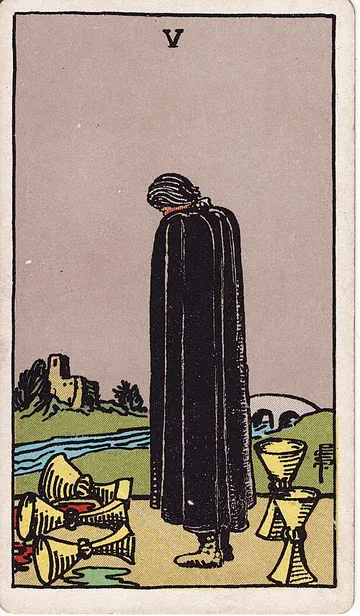
Five of Cups
The grief the homecoming returns from. The Five of Cups is the figure mourning the spilled wine; the Six is the same figure, weeks or years later, learning that the cups still standing are enough. Together the pair maps the precise emotional arc of integrating a loss — not erasing the spill, but coming to live alongside it. Often appears in readings about a relationship that ended badly and has begun, very slowly, to be remembered with more tenderness than anger. Do not rush the integration; the Six is the gift the Five gives once the Five has cried itself out.
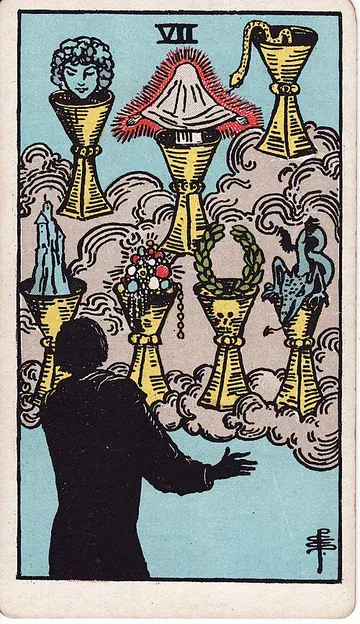
Seven of Cups
The decan neighbor — Sun in Scorpio handing off to Venus in Scorpio. Together the pair warns of clean nostalgia tipping into over-romanticized fantasy. The Six remembers what was; the Seven embellishes it. When both appear, the seeker is being asked to inventory which warm memories are accurate and which have been quietly upgraded by longing. Some of the cups are real. Some are projection. The work is to tell them apart, and to let the real ones keep their warmth while the projected ones return to the air they were made of.

Six of Pentacles
The number sibling — both sixes, both about giving and receiving, but with very different temperaments. The Six of Cups is the unconditional childhood gift; the Six of Pentacles is the measured, transactional kindness of the merchant weighing coins. Together they pose a question about the kind of giver you want to be. Often appears when a seeker is deciding whether to help a loved one with money — the cards ask whether the help is the unconditional cup or the calibrated coin. Both are valid; they are different gestures. Do not confuse them.

Death
The tonal contrast — Death cuts what the Six of Cups returns to. Together the pair describes a seeker being asked to honor what has ended even as they hold what continues. Often appears in readings about the last visit with a dying relative, the final stage of a long illness, the closing of a chapter that has been kept warm by memory. The Six is permission to remember tenderly. Death is permission to let the remembering stay remembering, not denial. Together they are the deck's most honest grammar for the love that survives the body of its object.

The Sun
The decan ruler doubled — Sun in Scorpio II amplified by the Sun himself. The pair describes a particularly luminous return: the long-lost friend arriving in the same week the personal weather lifts, the recovery coinciding with a season of unusually warm light, the project from your past blooming into one of the brightest things in your present. One of the deck's most generous combinations for any reading about renewal. The instruction is simply to be in the warmth. Do not interrogate it. Do not measure it. Sit in it for as long as it lasts.
Frequently Asked Questions
What is the Six of Cups reversed meaning?
The Six of Cups reversed describes nostalgia that has hardened into a refusal of the present — the seeker who has set up residence inside an earlier season and is asking the present to perform as a continuation of it. It can also indicate unfinished childhood material leaking into adult relationships, or, more lightly, the cue that it is finally time to leave a piece of the past where it is. The cup is still beautiful; the instruction is to walk out of the picture and into the present where you actually live.
Is the Six of Cups reversed refusing the thing, or refusing my old picture of it?
The picture, nearly every time. The card reads as a soft no, or a conditional yes. Whatever you are asking about may technically happen, but the version of it you are picturing belongs to an earlier you, and the present you has to adjust the picture for the answer to land usefully. For questions about returns and reconciliations especially, the card asks you to verify in concrete terms what is actually different now before reading the answer as positive.
Is my partner loving me, or the person I was when we met, under the Six of Cups reversed?
That is the card's central question, and it is asked of both people. Reversed in love readings, the Six of Cups describes the bond held in suspended animation by an older story — partners loving who the other person used to be rather than who they are now, the unconscious casting of a present person in the role of someone from the past, the old flame reaching back to a memory wearing your name. The warmth is real. The accuracy is not. The work is mutual updating, or, if updating is not possible, honest release.
Can I do anything if the Six of Cups reversed says their warmth is aimed at an older me?
One thing: become visible as you are now. The warmth is genuine, and it lives in a previous chapter. They feel something tender toward you — the way one feels toward a place one used to live — and they have not yet updated their interior model to the present you. Read it as care that is real but not yet calibrated. The feelings exist; the recognition has not caught up. Updating the picture is labor that belongs to whoever is holding it.
What is the Six of Cups reversed as advice?
As advice, the Six of Cups reversed asks you to take down the emotional shrine you have been quietly maintaining. Update one assumption that was true some years ago and may not be true now. Have the conversation you have been having only inside your own head. Stop using a memory of one person as the standard against which living people fail. Forgive your earlier self for the things they did not yet know how to do. The reversed card responds to the small concrete acts of letting the past finish so the present can finally arrive.