
Six of Pentacles · Core Meaning
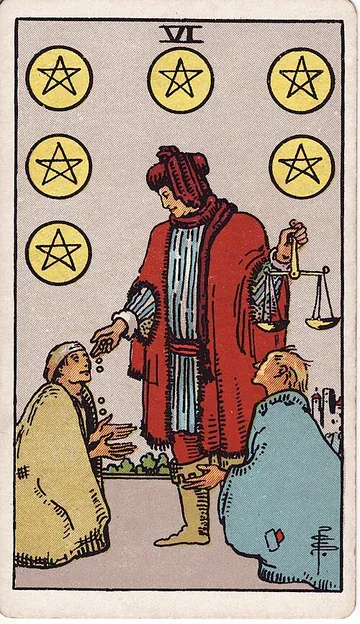
The Six of Pentacles meaning begins with a piece of furniture: a scale held level in one hand. The other hand is dropping coins — chosen, one at a time — into the open palm of someone kneeling. There are two figures kneeling, not one. Above the merchant's head, six pentacles hang in a careful grid. Not abundance. Arrangement. The image is about measure, and about a hand that does not look down while it gives.
This is the deck's card of the calibrated transaction. Money, attention, time, knowledge — anything one person has and another person needs — passes between them, and the question the card asks is whether the exchange leaves both people standing. The merchant's crimson robe is the color of his office: status and duty share the same hue. The kneeling figures' posture is temporary. They came to collect a measure, not to take a permanent shape. The card's signature tension lives in that distinction. Generosity that solidifies someone's lowness is not generosity. The Six of Pentacles is the card that knows the difference.
Measure is written into the sky-lore as well: the pip is Moon in Taurus, second decan — nourishing water on settled earth. Taurus is the body knowing how much, knowing when full is full and when more is not better. The Moon, in this earth-sign decan, slows the impulse to give-everything-now into the rhythm of feeding: a portion sized to the receiver, not to the giver's mood. Generosity becomes bodied. It can be weighed. It can be returned.
Kabbalistically, the card sits at Tiphareth in Assiah — the sun at the center of the tree, dropped into the world of action. Tiphareth is the meeting point where every force finds its proper weight; it is the sephirah of beauty because beauty is the felt experience of right proportion. The Six of Pentacles is what Tiphareth looks like once it has hands. The merchant is not the lord of charity. He is the small, daily figure who has been entrusted with making sure the proportion holds.
The card's elemental dignity adds one more layer worth holding. Earth meeting Water (the Cups) is its most natural pairing — generous heart paired with physical scale; together they describe the warmest version of measured giving. Air (the Swords) is opposed: language has a way of turning the simple act of giving into the more complicated act of owing, and a Six of Pentacles inflected by surrounding Sword cards often warns of a contract or conversation in which what was meant as a gift is being reframed as a debt. Fire (the Wands) is neutral but can inflate the portion past what's appropriate — passion and generosity tend to swing larger than the scale calls for. Knowing which suit your spread is leaning into changes the precise shape of the card's instruction.
Count the pentacles before you read the figures. Six of them, ranged in a quiet rectangle above the transaction, evenly spaced, none crowding another. Six is the number at which many forces meet without pressing on one another — harmony not as sweetness but as spacing. That is what the arrangement is drawing. Nothing in this picture is piled. The coins leave the merchant's hand one at a time because a heap would be a different card altogether: a card about volume, about the gesture of plenty. This one is about placement. Quantity yields to arrangement, and the whole ethic of the Six of Pentacles follows from that single visual fact — the same sum of money, badly placed, tips everyone in the room.
The hour is worth having, too. This is a card of one hour past noon, when the shadow has just begun to stretch out from the foot — light still high enough to read a scale by, the day already leaning into its second half. Its temperament is melancholic: weighted, unhurried, faintly serious. Late spring. North. Copper and silver. Sandalwood and parchment. Held together, those details make a room rather than a mood — a counting room in the early afternoon, ledgers open, the lamp not yet needed. The Six of Pentacles does its work in that ordinary light. Nothing about it is ceremonial. The generosity happens at a desk, between one appointment and the next, and is over in a minute.
Read the Six of Pentacles tarot card meaning the way you would read a still life: not as a verdict on the giver or the receiver, but as a study of the relation between them. Whatever weather the card describes for your situation will live inside that relation — the angle of the scale, the height of the kneel, the moment the coin leaves the hand.
Six of Pentacles · Love & Relationships
In love readings, the Six of Pentacles describes a relationship organized around honest exchange. Not bookkeeping — recognition. The labor each person brings, the tenderness, the quiet sacrifices nobody else sees, are seen. There is room for the words "you do more of this and I do more of that, and we have decided that's all right" to be said out loud without the relationship cracking. The card is one of the more grown-up love cards in the deck. It is also one of the more easily misread — the gift it offers is dignity in giving, not romance in the cinematic sense.
For an existing partnership of long standing, the Six of Pentacles love meaning often arrives during a season of structural rebalancing. One partner has been carrying more of the practical weight — money, household, child-care, the emotional ballast — and the relation has begun to ask whether the imbalance is sustainable. The scales in the giver's hand are not an exit sign. They ask for a weighing. Sit at the table. Name the actual portions. Decide together whether they are still right. Couples who do this work move through the card cleanly. Couples who refuse to weigh quietly drift toward the reversed reading.
For a new spark, the Six of Pentacles can describe a person who shows up with their hands full — they are someone who knows how to give. The early dates feel materially considered: they remember what you said you liked, they pay for the meal in a way that doesn't make you feel small, they bring the small object you mentioned wanting last week. This is not flash. This is the card's love language. Watch how they handle the first imbalance — the first time you cannot match what they extended. If they receive your smaller offering with the same dignity, this is the real card. If a small flicker of disappointment crosses the table, the offer was always a measurement.
For a single seeker who is asking whether love is possible, the answer is yes — and the work the card asks for is to learn to receive before love arrives. The kneeling figures in the image are not failures. They are people in a moment of need, accepting what is given, planning to stand again. If you cannot let yourself need anything, no one will know how to love you. Practice receiving in small ways: a compliment, a favor, a meal someone else pays for. Let it land without instantly volleying back. The card responds to that practice.
In the question of love after a wound, the Six of Pentacles describes a careful re-emergence. The wound made you wary of debt — you do not want to owe anyone, you do not want to be owed. This is reasonable; it is also an obstacle. Love includes asymmetry. There are seasons when one of you is carrying the other. The card is the season after a wound when you allow someone to carry you for a stretch and discover the world does not collapse. They are pleased to. The carrying is not interest accruing.
For a partner in a quietly imbalanced bond — one of you earns much more, one of you holds much more emotionally, one of you sacrificed a career or a city — the Six of Pentacles asks for transparency. The imbalance is not the problem. The silence around the imbalance is. Speak it. Name the gift you are receiving. Name the gift you are giving. The card invites both partners to put the actual amounts on the table so neither has to live in the shadow of an unspoken ledger.
The card's particular love language is measured giving. The lover who shows up under this card does not flood you. They do not perform abundance to earn your awe. They watch how much you can hold this week, and they fill that exact cup. They will sometimes seem less romantic than the lover who flings everything at you — and they will, in the long run, be more reliable. They have read the scale.
If you are asking whether someone is in love with you and the Six of Pentacles arrives upright, read it as a yes shaped by their fairness. They feel responsible to your wellbeing. They are calibrating what to offer so that you can receive it without collapsing under it. They will not over-pour. They are studying you. This is not coolness; this is care that has manners.
For a partner you suspect has been holding back, the card can name what they are doing: they are afraid of giving you so much that you would not survive their eventual absence. Their restraint is not rejection. It is a strange, almost old-fashioned form of protection. The work of the relationship is to let them know that you can hold what they actually carry. The cup is sturdier than they think.
For seekers in cross-cultural or long-distance bonds, the Six of Pentacles offers a particular reassurance. The card respects the structural realities — the time-zone gap, the different family expectations, the unequal access to travel — and asks both partners to weigh those realities honestly rather than pretend they don't exist. The visit one of you takes is a gift; the late call the other answers is a gift. Both are real currency. The card asks for the conversation in which the actual costs are named, so neither partner can resent the other for an invisible expenditure later. Long-distance and cross-cultural partnerships that survive often do so because the partners stayed under this card for years.
For someone considering whether to commit publicly — engagement, marriage, moving in, a shared lease — the Six of Pentacles upright is one of the more reassuring cards to draw. The structural foundation is solid. The math has been done. Both partners know what they are signing up for, and the asymmetries that exist have been named and accepted rather than papered over. This is rarer than it sounds. Most public commitments happen with at least one partner hoping a structural issue will resolve itself after the ceremony. The card describes the bond where it has actually been worked through.
Six of Pentacles · As Feelings
Responsibility with warmth folded into it — that is the texture the Six of Pentacles gives when the question is how someone feels. They feel something steady about you — but the feeling is not free-floating. It is structured. They have been measuring how to be in your life in a way that does you good, and they are quietly proud of the calibration. This is the card of the partner who has decided that loving you well requires accuracy, not volume.
If they are reserved by nature, the Six of Pentacles in feelings reads as a private inventory of what you mean to them. They are keeping a careful account, not in the suspicious sense, but in the way a careful person keeps any precious thing. They know what you have given them. They know what they owe. The silence around the feeling is not absence; it is the silence of someone making sure they get the next gesture right.
If they are demonstrative, the card describes a public version of the same care. They want others to know how good you are to them. They will tell their family the specific things you did. They will pay for the meal with friends in a way that quietly honors you. They are advertising the relation as one in which the books are kept honestly. They are proud of the fairness as much as of you.
For a partner you have been with a long time, the Six of Pentacles in feelings can mean the bond has stabilized into a working contract that both of you actually like. The romantic part has matured into the part where you trust each other to carry your share. They feel, when they think of you, the small relief of someone who knows the household will hold. This is not unromantic. For long bonds, this is what the deeper layer of love feels like once the surface has settled.
For a new connection, the Six of Pentacles in feelings means they are weighing what kind of presence to be in your life. They have not decided not to be — they have decided to enter at a measured pace so that what they offer does not exceed what either of you can sustain. This can be frustrating for someone who wants the flood. The flood was never going to last. What this person feels is durable, and they are designing their entrance to match the durability.
For someone you suspect is struggling with the difference in your circumstances — money, status, life-stage — the card describes the felt weight of that difference. They are conscious of it. They are not pretending it doesn't exist. They feel something genuine for you, and they are working out, internally, how to give what they have to offer without it turning into a power difference that ruins the affection. Read this as care, not as hesitation.
For a long-standing partner who has gone quiet, the Six of Pentacles in feelings can mean they are tallying the season. They are not falling away; they are taking stock. Sometimes a quiet stretch in this card is the partner who is preparing the next gift — the proposal, the move, the structural commitment — and they have gone internal because the calibration is delicate. Be patient. The silence is preparation, not withdrawal.
A note specific to this card: the Six of Pentacles in feelings is rarely the card of new infatuation. The pulse is slower. The temperature is even. If you were hoping for the rush, this card may read as muted — but the muted register is the card's strength. It is the temperature at which long things grow. They do not feel a fire about you. They feel a steady fire by your side.
For an ex you have remained in contact with, the Six of Pentacles in feelings can mean they have decided to be a fair presence in your life — not the rekindling, not the ghosting, but the considered middle path of someone who knows what you meant to them and intends to honor it without confusing the past for the present. They feel warmth, properly weighted. If reconciliation is the question, this card is rarely a yes for the romance and often a yes for the friendship. They are giving you what they can give without misrepresenting what is left between you.
For a partner you have wronged, the Six of Pentacles in feelings can describe forgiveness in motion — they have decided not to keep punishing you, but they are also not pretending the harm did not happen. The feeling is real, and it is being held in proportion to the work you have done since. They are weighing your repair, not your apology. The card asks you to keep doing the actual repair work; the feelings are not the prize at the end, they are the steady byproduct of the changed behavior.
Take the card as confirmation that what they feel is real and ethically held. They do not want to harm you. They do not want to over-offer. They want the relation to be one that stands up to weighing — and the act of weighing, for them, is itself a form of love.
Six of Pentacles · Career & Work
Somebody senior is holding the ladder and not making a performance of it: at work the Six of Pentacles is the card of the calibrated patron. It is also, sometimes, the card of being on the receiving end — the season in which you are being mentored, given a chance, lifted. Either side of the exchange is a real reading, and the card asks you to know which side you are on.
For someone in a current role, the Six of Pentacles often describes the moment a senior person decides whether you are ready for the resource — the budget, the team, the title, the introduction. They are weighing. They are not toying with you. They are calibrating the size of the offer so that it lands cleanly and you can receive it without buckling. The card is positive: they have decided you are worth the consideration. The work, on your side, is to be visible enough to be measured accurately. Make sure your senior knows what you are actually carrying.
For someone considering a new role, the Six of Pentacles upright is a green light with a structural caveat. The role has been designed in a way that respects you. The compensation is fair. The reporting line is honest. There is no hidden trick in the offer letter. The caveat: the role places you, by design, on one side of a scale. You are placed either as the patron extending resources to a smaller team, or as the protégé receiving them from a larger one. Know which seat you are taking. Both seats are real seats. Each has a different ethical weight.
For an entrepreneur or freelancer, the Six of Pentacles describes the season when paying clients align with the actual size of what you offer — the pricing settles, the proposals get accepted at fair rates, the difficult negotiation about scope ends with both sides feeling their dignity preserved. This is rare and worth sitting with. The card warns against the freelancer's two opposite traps: pricing-yourself-too-low (giving more than the scale calls for, out of fear of losing the work) and pricing-yourself-too-high (giving less than the scale calls for, out of fear of being underpaid). The card asks for accuracy, on both sides.
For a creative practice, the Six of Pentacles can describe the relationship between you and a benefactor — a grant, a gallerist, a publisher, a senior artist who has taken an interest. They are extending real resource, and they are extending it because they have decided your work merits it. Receive cleanly. Acknowledge the gift specifically. Do not flatter; thank precisely. The card is the card of the dignified protégé, and dignity in this relation is not pride — it is honest acknowledgment of the help.
For someone in a season of layoff, transition, or job-search, the Six of Pentacles upright is one of the gentler cards. It can describe the unexpected referral — the senior contact who passes your name along, the former boss who writes the letter, the friend who mentions you to their hiring manager. The help is real. It is not pity. It is calibrated by someone who thinks well of you and has decided to extend a hand. Receive. Send the specific thank-you note. Pay it forward later, with someone newer than you.
For a team lead or manager pulling the card about how to handle their reports, the Six of Pentacles asks for measured giving. Praise that is specific, not effusive. Resources distributed by need, not by squeak. Difficult feedback delivered in a way that lets the person stay standing. The card warns against the manager who confuses generosity with display — handing out praise in front of others to seem benevolent rather than to actually help. The card responds to private accuracy more than public flourish.
For a question of promotion, raise, or recognition, the Six of Pentacles upright is a soft yes with terms. Yes, the recognition is coming. Yes, the senior who decides has decided in your favor. The terms: it will arrive in the size that matches what you have actually contributed, not in the size you may have been hoping for. Take the offer. Take the offer in good faith. The next round of weighing happens later; this one was honest.
For someone who is the senior in their field considering whether to mentor someone newer, the card is unambiguous: yes, and do it well. Find the protégé. Calibrate the gift. Do not flood them. Give what they can carry, then give a little more next quarter. The card asks the giver to not look down while giving. The instruction is precise. The merchant in the image does not look down. He is paying attention to the scale, not to the height of the kneel.
A note on stability: the Six of Pentacles is not an expansion card. It is a card of well-administered stability. If your career question is "should I leap," this card answers "the leap is not what this season is about." The season is about consolidating the ground you are on, paying out what you owe, collecting what you are owed, leaving the ledger clean. The next card, the Seven of Pentacles, is the long pause. The card after that is the patient labor. The Six of Pentacles is the moment the books square.
Six of Pentacles · Money & Finances
Proportion is the whole of the Six of Pentacles' money question — does what leaves the hand match what it was worth? It is also, more specifically, the card of charity, patronage, and the considered loan. Money in this card is not abstract. It has a hand on either side of it. The question the card asks is whether the hands are level.
For someone in a stable financial period, the Six of Pentacles describes a season in which what you are paid matches what you produce. The promotion's raise reflects the work. The project payment lands as agreed. The freelance invoice clears without dispute. There is a particular relief in this card around money — not the relief of windfall, but the relief of fairness. The world has, in this small moment, been honest with you.
For a question about whether to make a charitable gift — to a friend in difficulty, to a cause, to a family member who has asked — the Six of Pentacles answers with careful permission. Yes, give. The card supports the giving. Two conditions, both gentle. First, give what you can give without resentment; the merchant in the image is not stripping his own household to extend the coin. Second, give in a way that preserves the receiver's dignity. The how matters as much as the how-much. A loan that humiliates is worse than no loan. A gift that requires gratitude-performance is not a gift.
For a question about whether to ask for help, the card answers yes, and again with two conditions. First, ask the right person — someone whose generosity has structure to it, who can give without it costing them the friendship. Second, receive the help cleanly. Do not perform unworthiness. Do not over-thank. Take the help, name what was given, plan to return it (or pay it forward) when the season turns. The card is the card of the dignified receiver as much as the dignified giver.
For investments, gambles, or speculative moves, the Six of Pentacles upright is conservative. It does not say no. It says: read the scale. The card supports investments in stable, well-understood instruments — the boring index fund, the predictable bond ladder, the rental property in the neighborhood you actually know. It does not support the high-risk tip from a friend of a friend. The merchant in the image is not a gambler. He is a record-keeper.
For the seeker working their way out of debt, the Six of Pentacles upright is encouraging. The plan is working. The principal is moving in the right direction. The discipline you have been keeping is in proportion to the shape of the climb. Do not loosen too early. The card describes the season when you are visibly closing the gap — not done, not free, but unmistakably on the right slope.
For someone who has been carrying a debt to another person — money, but also unpaid obligations of any kind — the Six of Pentacles asks for closure. Pay it. Not with interest, not with apology, just with the clean amount you agreed to. Money debts that go unaddressed quietly poison friendships. The card respects friendship more than it respects elegant procrastination. Move the money. Send the message. Close the loop.
For a question about windfall — inheritance, bonus, gift — the Six of Pentacles upright suggests the windfall arrives appropriately, in the size it should be, without a hidden cost. Receive it. Allocate part of it to the obligation you already have (the debt, the savings goal, the household need), part to genuine pleasure, and part — this is the card's favorite move — to someone else. Find a person whose week would be improved by a portion of this. Send it without making them feel small. The card responds to the spread.
A practical note when the card appears in finances: review the accounts this week. Not as anxiety. As respect for the scale. The Six of Pentacles likes spreadsheets done with care. Run the numbers. Notice where the proportions have drifted. Adjust. The card responds to attention more than to amount.
Six of Pentacles · Health
The scale in the merchant's hand becomes the body's own metering when the Six of Pentacles lands on a health question. The element is earth; the temperament is melancholic — weighted, measured. The body part the card holds is the hand: the organ of weighing, of giving, of receiving. When the card arrives in a health question, listen for what your body is being asked to do less of, and what it is being asked to do more of, until the two columns balance.
If you are asking about general vitality, the Six of Pentacles answers with calm, qualified good news. The body is in working order. The energy is sufficient. The condition you have been concerned about is responding to attention. There is enough margin — sleep, food, rest, support — for healing to land. The card is not the card of dramatic cure; it is the card of the steady week, the quiet recovery, the labs that come back unremarkable in the best sense of the word.
For someone managing a chronic condition, the card describes the relationship between input and output that the condition asks for. The medication taken on time, the food choices made consistently, the movement done in the right dose — the condition responds to accuracy, not heroism. The card warns against the patient who does ten days of intense self-management followed by ten days of nothing. The discipline is the proportion held over time. Smaller and steadier wins this card.
For someone considering a new treatment, surgery, or course of intervention, the Six of Pentacles upright reads as a yes provided the choice is well-measured. Get the second opinion. Read the materials. Know what you are choosing. The card supports informed care. It does not support the panicked yes to the first option offered. It also does not support the avoidant no that delays good care. Weigh, then choose. The hand on the scale is yours.
For mental and emotional health, the Six of Pentacles describes the value of structured support — therapy at a real cadence, medication taken as prescribed, the weekly call with the friend who knows the history. The card is not opposed to spontaneity, but it knows that mental health, like financial health, is mostly built by small honest practices repeated. Keep the appointments. Take the medication. Do the journaling at the time you said you would. The card responds to commitment more than to inspiration.
For someone in caregiving — for a parent, child, partner, or friend in declining health — the Six of Pentacles is one of the kinder cards. It describes the calibration of what you can offer without dissolving. The merchant in the image gives out of his purse, not out of his own ribs. The instruction for the caregiver is the same: give what you can give without erasing yourself. Eat your own meals. Sleep your own nights. The care you provide will be of better quality if you remain a person while providing it.
For digestive and metabolic questions, the Six of Pentacles' particular signature is portion. The body is asking for honest measurements — neither restriction nor over-supply. Eat the meal that matches today's hunger. Drink water in the quantity the body actually wants. Move in the dose your joints can absorb. The card warns specifically against the swing between austerity and indulgence; both leave the body in a state of unbalanced books.
For someone in recovery from a long illness, the card describes the patient re-entry into normal life. The energy is returning, but it is finite — spend it deliberately. Choose two things to do well this week, not eight. The body responds to honest pacing the way the merchant's scale responds to honest weight. None of this is medical advice; the card is simply showing the felt season. Keep your practitioners. Take your medicine. The card describes the weather of healing, not the diagnosis or the prescription.
Six of Pentacles · Spirituality
Right relation is the Six of Pentacles' entire spiritual subject — to gift, to teacher, to lineage, to the small daily decisions that turn a practice into an ethics. The card sits at Tiphareth in Assiah: the sun of beauty dropped into the world of action. What this means in practice is that the spiritual life of this card is not an inner experience that happens in solitude. It is the felt experience of a correctly weighted exchange with the people and traditions around you.
For seekers in active practice — meditation, prayer, journaling, ritual — the Six of Pentacles describes the season in which the practice begins to move outward. What started as private maintenance has matured into something that wants to be useful. You find yourself listening differently to friends. You notice what other people need before they ask. You catch yourself extending small kindnesses you used to overlook. The card confirms this is real spiritual progress, not a side-effect to discount.
For seekers in relation to a teacher, lineage, or tradition, the Six of Pentacles asks for honest accounting of what you have received. Name the teachings that shaped you. Name the people who lifted you. Send the email. Make the donation. Show up to the memorial. The card is the card of the disciple who has not pretended to be self-made. Spiritual paths poison when their practitioners forget where they got their bread.
For seekers exploring belief, the Six of Pentacles asks a structural question: what does my spirituality cost me, and what does it give me? Not in transactional language — in honest accounting. A path that asks nothing of you and gives you only good feelings is a path you are decorating. A path that asks everything of you and gives you only obligation is a path that has grown crooked. The card asks for the felt sense of fair exchange between you and your tradition.
The card's spiritual caution is the inverse of its strength. The Six of Pentacles can curdle into spiritual book-keeping — the practitioner who has begun to keep score of their good deeds, their generosity, their merit. The merchant in the image is not counting his coins on the way home. He has emptied his hand and is now walking past. The instruction for the seeker is to let the gift go cleanly. Name the amount once, to yourself, and then forget it.
For questions about path, the Six of Pentacles answers that you are in right relation. The teacher is the right teacher. The community is the right community. The small daily practices you have committed to are the right size for this season. The work, going forward, is to let the practice extend outward — to find one person, this week, you can quietly help. The card returns to its full strength when its practitioner gives.
A small practice when this card appears: send one specific thank-you. Pick a teacher, an author, a friend whose example shaped you. Tell them, with one specific instance, what they gave. Do not ask anything in return. The card responds to the closing of these small loops more than to grand spiritual gestures. The scale reads what is named.
For seekers tracking the soul's journey across the Minor Arcana arc, the Six of Pentacles is the moment in the earth suit where the labor of the Three (the apprentice's first competent work) and the consolidation of the Four (the held-tight resource) and the wound of the Five (the cold doorway, the season of need) cohere into something useful. The path is: learn the craft, accumulate enough to be useful, suffer the season of insufficiency, then become a person who can administer resource fairly. The card is the soul's small graduation into measured generosity. What you do with it is your contribution to the lineage of seekers behind you on the same path.
Six of Pentacles · Yes or No
Yes — but with terms.
For the Six of Pentacles yes or no question, the card is one of the deck's measured yes-cards. It is not the wish-card's full-throated yes, nor the Sun's celebratory one. It is the yes of the considered offer, the fair contract, the help that arrives properly sized. For yes-or-no questions, treat this card as a yes that asks you to read the terms before you sign.
For questions about a relationship, a job, a move, the offer in front of you, a help being extended: yes. The path is workable. The other party is acting in good faith. The exchange is fair. There is no hidden penalty in the offer. The scales in the merchant's hand are reading true.
For questions about whether someone is being honest, whether the offer is what it appears to be, whether the proposal is what it claims, the Six of Pentacles upright says yes — provided you read the document. The card has no shadow in the upright orientation, but it always asks for the act of weighing. The yes survives careful reading; an offer that does not survive careful reading was not the Six of Pentacles to begin with.
The conditioning embedded in the yes is dignity. The Six of Pentacles answers yes when both parties to the exchange remain standing afterward. If the path you are considering would humiliate someone — including yourself — the card's yes thins. Find the version of the path that lets everyone keep their footing. The yes returns to full strength.
Asked how soon the exchange completes, the Six of Pentacles upright suggests the answer is yes, in due course. Not instant. The card moves at the speed of careful weighing. There is a process. There are signatures. There are the small administrative steps that make the offer real. The yes is firm; the timeline has a shape. Trust the shape.
For binary decisions — should I act, should I wait — the Six of Pentacles upright says act, and adds: act with measure. Send the email. Make the offer. Pay the debt. Accept the help. But do these things in the way the card prescribes — with proportion. A yes done at the wrong size becomes a different question.
For the question of whether you deserve the thing you are asking about, the card answers yes, and adds that the question itself is a small misdirection. You are not the only party to the exchange. The other side has its own yes to give. The work is not to convince yourself you deserve it; the work is to receive it cleanly when it is offered.
If the question was: should I extend the help, should I make the gift, should I be the one who acts generously here? The Six of Pentacles upright says yes — and reminds you that the gift is a gift only if the receiver remains a full person afterward.
For the question "is this person trustworthy with what I am about to share with them" — money, vulnerability, opportunity — the card's upright yes is reliable. They are the kind of person who returns what they borrow, who keeps the confidence in proportion to the closeness, who treats the resource you extended with the same care they would treat their own. This is rarer than it sounds and worth honoring when it shows up. Trust them. Watch them honor it. The relationship that survives this card's quiet test tends to survive the louder ones too.
Six of Pentacles · Advice
Weigh first, then give — the Six of Pentacles upright is emphatic about the order. Do not extend the hand before you have looked at the scale. The merchant in the image is not slow because he is reluctant; he is precise because precision is the form his care takes. Whatever you are about to offer this week — money, time, a word, a chance — find the right size for it before you offer it. Too much humiliates. Too little dismisses. The right size honors.
If there is one specific instruction the card offers, it is this: pick one person near you who is in a smaller season than you are, and extend a calibrated piece of what you have. Not what makes you feel generous. What they actually need. Pay for the meal of the friend who has been quietly tightening their belt. Send the introduction the junior colleague has been hoping for. Give the book to the protégé who would actually read it. The card responds to the matched offer more than to the dramatic one.
A second instruction: if you are on the receiving end of a kindness right now, receive it cleanly. Do not perform unworthiness. Do not over-thank. Do not immediately try to volley back something larger so you can pretend you weren't given to. Take the gift. Name what was given. Plan, internally, to pay it forward when your turn comes. The kneeling figures in the image are not failed people. They are people in a season of being given to, planning to stand again. Be one of them when it is your turn.
A third instruction: close one open ledger this week. The friend you owe money. The colleague whose favor you never returned. The mentor whose specific teaching shaped you, who never heard the thank-you. The Six of Pentacles is the card of squared books. Open ledgers, even small ones, generate quiet weight. Move the money. Send the email. Write the note. The card does not ask for grand acts — it asks for the closing of small loops.
A fourth instruction, addressed specifically to the giver: give once, cleanly, and then forget the amount. The integration cue from the card's shadow is this exact move. Name the gift to yourself one time so you remain honest about what you extended. Then release the count. Generosity that you remember in detail at year's end has stopped being generosity and has become a private archive of leverage. The merchant has paid out and walked past. He is not adding it up over dinner.
Write the number down before the conversation. Whatever the exchange is — the sum you can lend without resentment, the hours you can give to the friend who is moving, the ceiling on what you can spend to get someone through a bad month — decide it on paper, alone, at your own table, before you walk into the room. The scale in the picture is held up where both parties can see it; it is not adjusted mid-transaction. A written figure protects you from the pressure of the room: the face across the table, the guilt, the impulse to round upward so you can leave the meal feeling generous. Round up afterward if you still want to. Decide the amount while your hands are steady.
Practical advice for the day the card appears: find the scale in your life and look at it. Money, time, attention — pick one and check the proportions. Not as anxiety. As respect. The card responds to attention. Notice where you have been over-pouring; notice where you have been under-pouring. Adjust by a small honest amount. The next time the card appears, the proportions will be different. The work is iterative, not dramatic.
A final note: the Six of Pentacles asks for clarity about which side of the scale you are on this season. You are not always the giver. You are not always the receiver. Most of an honest life is spent on both sides at different times. The card asks you to know, today, which seat is yours, and to occupy it without shame. Both seats are fully human. The shame begins only when you pretend to be on a seat you are not actually on.
Six of Pentacles · Card Combinations
The Six of Pentacles deepens when read against another card — the scale becomes legible only when something specific is being weighed. The pairings below are five of the most load-bearing combinations: a tonal contrast, a suit successor, a series sibling, and two Major modulators. Each is its own paragraph below in the combinations list at the bottom of the file. The short orientation here:
Six of Pentacles + Four of Pentacles is the card of measured giving meeting the card of held-tight resource. The contrast is the entire teaching: hoarding versus the calibrated extension of the hand. Whichever way you sit between these two cards, the question is whether the resource in your possession is meant to be held or released. The Four says hold; the Six says release in proportion. Most lives need both gestures. The trouble begins when you confuse which season you are in.
Six of Pentacles + Ten of Pentacles is the suit successor pairing. The Six is the calibrated transaction; the Ten is wealth that has accumulated into lineage, family, structure that outlives the individual. Read together, the cards describe the long arc of stewardship — from the moment of the fair exchange to the moment the books square across generations. What you give well in the Six becomes part of the structure the Ten depicts.
Six of Pentacles + Six of Cups is the series sibling at the same number. Both are sixes — the number of harmony, of forces meeting without crowding. The Cups Six is generosity from memory, gift offered out of tenderness for what was shared. The Pentacles Six is generosity from accountancy, gift offered in proportion to need. Together they describe the fullness of giving: tender at the source, accurate at the hand.
Six of Pentacles + The Empress brings the merchant into the orbit of the major arcana's most maternal figure. The Empress is generosity at its source — the body that produces, the earth that feeds. The Six of Pentacles is the felt organization of that generosity into a daily practice of measured care. Together they describe a household, an institution, or a teacher who has decided to keep faith with the people in their care.
Six of Pentacles + Justice doubles the scale. Justice is the card of weighing; the Six is the card of the weight being administered. Together they ask for systemic accuracy — not just the right gesture in the moment but the right structure across time. When these cards appear together, the question has gone larger than personal generosity. It has become a question about fairness as architecture.
Three further pairings turn up often enough at the table to be worth naming here.
Six of Pentacles + Five of Pentacles is the pairing that reads as sequence rather than contrast. The two kneeling figures in the Six are the same two who were outside in the snow, passing the lit window nobody opened. Read together, the cards hold a whole arc: the season of insufficiency, then the door opening. The question they sharpen is one of timing — did the help arrive while the person was still themselves, or after the cold had already taught them to expect nothing? Help offered late is still help. It simply lands in a person who has had to build something hard to survive the waiting, and the giver should not be surprised by the hardness.
Six of Pentacles + King of Pentacles sets the merchant's purse beside the man who owns the whole estate. The King has resource at a scale the Six only administers — land, holdings, the bull carved into the throne, a wealth that no longer has to be counted daily. Together the cards ask what the largest purse in the room has decided to be: a source or a wall. The King who has read the Six gives structurally — he funds the apprenticeship, underwrites the workshop, pays the invoice the week it arrives. The King who has not simply accumulates, and calls the accumulation prudence. The combination is a favorable one for questions about a wealthy relative, an investor, or a family that holds the money.
Six of Pentacles + The Sun is a kabbalistic echo rather than a contrast: this pip already sits at Tiphareth, the sun at the center of the tree, and here the Sun itself arrives in the major arcana's own voice. The pairing describes giving done in full daylight — unhidden, unembarrassed, with the child on the horse and the banner up and nothing arranged to be discreet. Not every gift should be anonymous. Some help works better when it is visible, because the visibility is what tells the receiver they have nothing to be ashamed of. These two cards together give permission to be openly generous without the generosity curdling into display.
Card Combinations
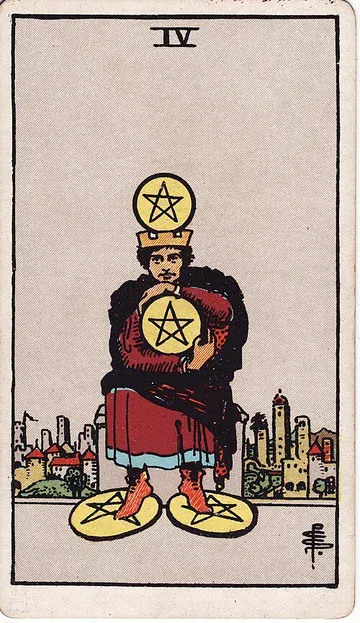
Four of Pentacles
Measured giving meeting held-tight resource — the entire teaching is the contrast. The Four says hold; the Six says release in proportion. Together they ask whether the resource in your possession this season is meant to be guarded or extended. Most lives need both gestures; the trouble begins when you confuse which season you are in. Confusion tilts the Six toward its reversed form: hoarding dressed up as careful giving.
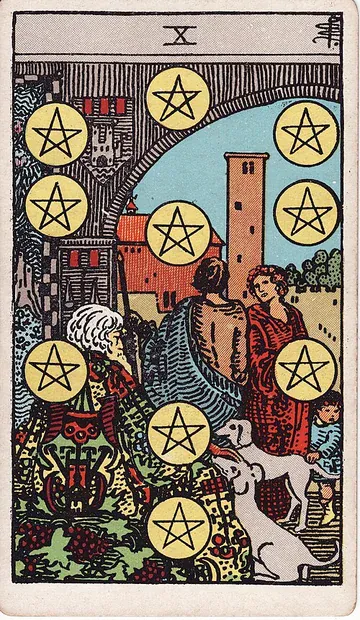
Ten of Pentacles
The calibrated transaction maturing into wealth as lineage. The Six is the moment the books square; the Ten is the structure that books-squared, repeated across years, eventually builds. Read together they describe stewardship across generations — what you give well in the small daily exchange becomes part of the durable architecture the Ten depicts. The combination asks: am I giving in a way that compounds, or in a way that ends with me?
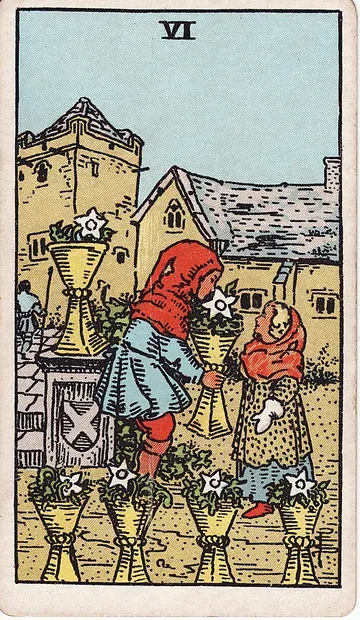
Six of Cups
Series siblings at the same number — sixes, the harmony of forces meeting without crowding. Cups Six is generosity from memory, gift offered out of tenderness for what was shared; Pentacles Six is generosity from accountancy, gift offered in proportion to need. Together they describe the fullness of giving: tender at the source, accurate at the hand. Without the Cups, the Pentacles risks coldness; without the Pentacles, the Cups risks sentimentality. Read in pair, the giver is whole.
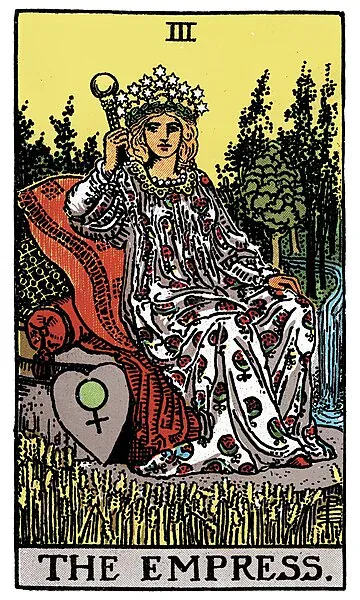
The Empress
The merchant brought into the orbit of the deck's most maternal figure. The Empress is generosity at its source — the body that produces, the earth that feeds without counting. The Six of Pentacles is the felt organization of that generosity into a daily practice of measured care. Together they describe a household, an institution, or a teacher who has decided to keep faith with the people in their care, organizing abundance into a rhythm everyone can stand in.
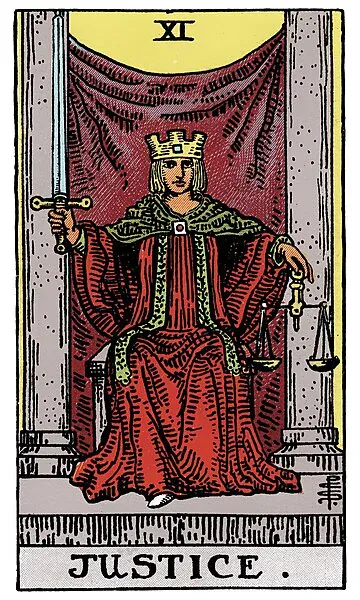
Justice
Two scales, doubled. Justice is the card of weighing as principle; the Six is the weight being administered as practice. Together they ask for systemic accuracy — not just the right gesture in the moment but the right structure across time. When these cards appear together, the question has gone larger than personal generosity. It has become a question about fairness as architecture: does the system itself produce proportional outcomes, or has it tipped in ways no single act of kindness can correct?
Frequently Asked Questions
What is the meaning of the Six of Pentacles in tarot?
The Six of Pentacles tarot card meaning centers on the calibrated exchange — money, time, attention, or knowledge passing between two parties in a way that leaves both standing. The image is a merchant in crimson holding a level scale while dropping coins into the open palms of two kneeling figures. The card asks for proportion: too much humiliates, too little dismisses, the right size honors. Read it as the deck's card of measured giving, fair pay, and dignified receiving.
Does the Six of Pentacles mean one of us is giving more than the other?
Possibly, and upright the imbalance is named rather than hidden: the Six of Pentacles describes a relationship organized around honest exchange — both partners' contributions are seen and named. For existing partnerships, it can mean a season of structural rebalancing handled with grace. For new sparks, it shows a partner who knows how to give without flooding. For singles, the work is to learn to receive before love arrives. The card's love language is measured giving, not cinematic flood.
What are the terms attached to the Six of Pentacles' yes?
The Six of Pentacles is a yes — but with terms. It is not the unconditional yes of the Sun or the Nine of Cups; it is the considered yes of the fair offer, the honest contract, the help that arrives properly sized. Read the document, weigh the proportions, and the yes survives. The card answers yes when both parties to the exchange remain standing afterward — when the proposal does not require anyone to lose their dignity to accept it.
Does the Six of Pentacles mean they feel responsible for me rather than drawn to me?
The Six of Pentacles as feelings is responsibility laced with warmth — they feel something steady about you, but the feeling is structured. They are calibrating how to be in your life in a way that does you good. For reserved partners, this reads as a private inventory of what you mean to them. For demonstrative partners, as public care kept in proportion. The pulse is slower than infatuation; the temperature is even. This is the card of the lover who treats fairness as a form of devotion.
What does the Six of Pentacles say about giving and receiving?
The Six of Pentacles is the deck's clearest teaching on the ethics of exchange. The merchant gives without looking down; the kneeling figures receive without losing their footing. Both gestures are skills. The card asks the giver to weigh before extending — too generous and you humiliate, too sparing and you dismiss. It asks the receiver to take the gift cleanly, name what was given, and plan to pay it forward. Generosity, in this card, is a precision practice, not a flood.
Continue Reading
Six of Pentacles · Card overview · symbols · correspondences →
Return to the full card view — image, symbols, sensory correspondences, and Hermetic axes.
Read the reversed meaning →
Read the same depth on the opposite orientation.
Draw your reading now →
Bring this card to a question — open a quiet ritual.