
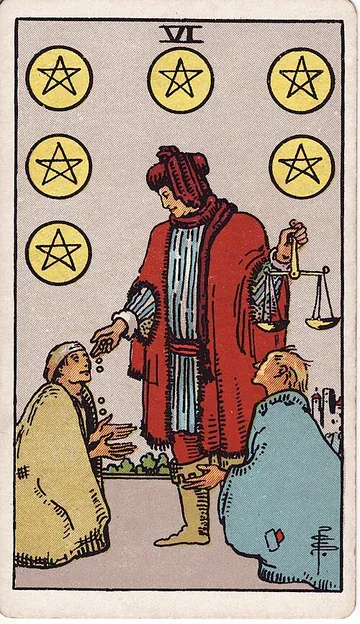
Six of Pentacles Reversed · Core Meaning
The Six of Pentacles reversed meaning lives in the moment the scale tips. The merchant is still standing between the two kneeling figures, the coins are still moving, but something in the geometry has shifted. The hand that gives has begun, subtly, to look down. The kneeling figures have stopped planning to stand. The exchange that should have been a passing transaction has hardened into a permanent shape — and the shape has a name: power that remembers itself.
This is the central knot of the reversed card: the calibrated giving has lost its calibration, and the generosity has become a pose. There are two flavors of this. In the first, the giver's hand has acquired strings — the help is real, but it carries an unspoken interest. The receiver, accepting it, also accepts a debt that was never named in the contract. In the second flavor, the receiver has settled into the kneel. The position that was supposed to be temporary has become identity. They no longer arrive to collect a measure; they arrive to be ratified as small.
For the reader trying to identify which flavor is in play, the test is the body's response. Help that tightens something in your chest is the first flavor — your body is naming the interest the giver has not. Comfort that has begun to feel like erosion is the second flavor — you have been receiving for so long that you have lost the muscle for standing. Neither flavor is the recipient's fault. Both are correctable. The card is not a verdict; it is a diagnosis.
The astrological signature reverses too. Moon in Taurus, second decan, was the card's nourishing rhythm. Reversed, the rhythm becomes either the smothering parent (Taurus's tendency to hold and provide curdling into possession) or the dependent inertia (the Moon's water pooling in the body until it cannot move). The earth that was settled has become heavy. The scale is no longer the instrument of fairness; it is being used to confirm the existing imbalance.
Kabbalistically, the card still sits at Tiphareth in Assiah — sun at the center, dropped into action — but reversed, the centering function has gone wrong in a specific way. Tiphareth in its right form weighs every force and lets each find its proper place. Tipped, the centering function has begun to enforce the existing arrangement rather than to balance forces freshly. The same instrument that should have produced fairness is now producing the appearance of fairness while the underlying weights are being thumbed. This is why the reversed card is rarely identifiable from the outside. The merchant looks the same. The kneelers look the same. Only the felt experience of those inside the exchange knows the scale has been compromised.
A specific note on the surrounding suits: Sword cards near the reversed Six of Pentacles tend to confirm the diagnosis — language has been used to convert the original gift into a debt, and the verbal contract is now being held against the receiver. Cup cards next to the reversed Six can soften the reading or sharpen it depending on orientation; upright Cups argue that the warmth is still recoverable, reversed Cups suggest the warmth has already drained. Wand cards introduce volatility — the imbalance may resolve quickly but rarely cleanly. Pentacle cards close around the Six tend to show the structural shape of the tipping more clearly: which institution, which family, which arrangement is doing the work of unbalancing.
Look at the hour. The card's light is one hour past noon, the shadow only just starting to stretch out from the foot — and reversed, the shadow keeps stretching. What tips a Six of Pentacles is very often not a bad motive but a missing end date. The help was extended for a season and nobody said which season. The loan carried no term. The stay on the sofa had no month named. The mentorship had no graduation. The exchange runs on past its hour into a long afternoon neither party can now declare closed, and in that stretched light the two people slowly stop being people doing a thing for each other and start being their positions. Naming a term — even late, even clumsily, even three years after the fact — is frequently the whole of the repair.
Reversed, the Six of Pentacles asks: whose dignity is the exchange costing? And: who in this arrangement has stopped trying to stand?
Six of Pentacles Reversed · Love & Relationships
Somewhere in the relationship a private ledger is being kept, and neither of you has said so out loud. The Six of Pentacles reversed love meaning is rarely the simple story of one person bullying the other. It is more often the slow accumulation of small unspoken obligations, the gifts given with quiet expectations, the imbalance that becomes invisible because both partners have stopped looking at it.
For an existing partnership, the reversed card frequently describes the dynamic where one partner has decided, internally, that they are the giver in the relationship — the more practical one, the more emotionally intelligent one, the one who carries — and that the other partner owes them for it. The owed-to partner is rarely cruel. They simply keep a quiet ledger that the other partner does not know about and cannot pay. The owing partner senses something is off without being able to name it. The card is asking for the ledger to be put on the table and read together.
For a new connection, the Six of Pentacles reversed in love can describe a partner who shows up generously and then, three weeks later, mentions something specific they did for you in a way that lands like a small invoice. The generosity was real. It was also conditional in a way they did not disclose. This is not always malicious; some people learn early that generosity is how they earn safety, and they do not realize they are presenting kindness as currency. The work, on your side, is to notice, name it gently, and decide if the bond can become honest.
For the question of whether someone is in love with you and the card arrives reversed, read it carefully. The feelings may be real. The feelings are tangled with a transactional structure they have not yet decoupled from. They may love you and also feel that you owe them — for the time they invested, for the chances they took, for what they gave up. This is one of the harder configurations the deck describes. It is correctable, but only by both parties choosing honesty over the comfortable silence of the imbalance.
For someone in a relationship with a significant material asymmetry — money, status, life-stage — the Six of Pentacles reversed warns that the asymmetry has begun to do damage. The wealthier partner has started using the asymmetry, even unconsciously, to settle disagreements. The less-resourced partner has begun to discount their own perspective. The card asks for structural change, not just emotional reassurance. Restore the felt sense that both partners' opinions weigh the same.
For the single seeker, the reversed card warns against two recurring patterns. First, the rescuer pattern: choosing partners who clearly need you so that your value in the relationship is never in question. Second, the rescuee pattern: choosing partners who can clearly do for you so that you never have to risk being chosen for who you are alone. Both patterns produce relationships that look like the Six of Pentacles upright from the outside and are the reversed card from the inside. The work, in either case, is to date toward equals.
For the question of love after a wound, the reversed Six of Pentacles can describe the seeker who has decided, after the wound, never to be in debt again. They have walled off the part of themselves that needs. They date carefully. They never let the relationship tip. This looks like strength and is, slowly, a form of starvation. The card is gentle but specific: love includes asymmetry. There will be seasons when you owe someone. There will be seasons when they owe you. The vow to never tip the scale, while understandable, is also a vow to never enter a real relationship.
For a partner who has gone quiet, the reversed card can mean they have begun keeping a private ledger they have not shared with you. They are tallying what they have given and feeling that you have not given back in equal measure. This may be accurate; it may not be. The diagnostic is not whose tally is correct. The diagnostic is that the ledger has gone underground. The card asks for the ledger to surface — gently, without accusation, with both partners speaking the actual numbers.
For someone considering whether to stay in a relationship that has tipped, the tipped scale is not an instruction to go. It is an instruction to weigh first and decide second. Many tipped relationships can be re-leveled. The conversation is hard. It often requires saying out loud the things both partners have been pretending not to notice. If, after the conversation, both partners are willing to do the structural work — to actually rebalance the labor, the money, the emotional weight — the card returns toward upright. If one partner refuses, the card has answered.
For someone whose partner has begun using shared finances, family pressure, or the threat of withdrawal as bargaining tools, the Six of Pentacles reversed is more direct. The structural imbalance has crossed from unspoken into actively weaponized. The kindness that was real once is now being held over you. The card asks for serious assessment of safety — emotional first, often financial second. Speak to someone outside the relationship. Many tipped bonds repair when the weight is named. A few cannot. The card respects your judgment about which kind you are inside.
For seekers contemplating reconciliation after a break, the reversed card warns of the rebuild that would only restore the tipped shape. You would return to each other, and within months the same imbalance would reassert itself, because the imbalance is the structure neither of you addressed before the split. The card does not refuse reconciliation; it asks for the structural conversation to happen first, before reunion. If both of you can name what tipped and commit to the repair, the bond can return as the upright card. If the longing is for the warmth of what existed before the tipping became unbearable, the longing is for a moment that has passed, not for a relation you can re-enter.
Six of Pentacles Reversed · As Feelings
The Six of Pentacles reversed as feelings describes warmth that has acquired strings, or care that has become quietly weaponized. They feel something for you, but the feeling has stopped being free. It is held in their hand the way the merchant holds the coin — except now they are deciding whether to drop it, and the decision is happening on terms you have not been told.
If they are reserved, the reversed card can mean their feelings have curdled into a private sense of being owed. They feel that they have given more than you have, that they have been more patient, that they have invested more deeply in the relationship — and the feeling about you is now bound up with this private accounting. They will rarely say it directly. It will surface as small comments, as withdrawn moments, as the half-second of tension when you fail to anticipate something they think you should have known.
If they are demonstrative, the reversed Six of Pentacles in feelings warns of performative generosity. They will make sure others know what they have done for you. The kindness is real, but it is also being staged. They are using you, not unkindly but unconsciously, to confirm their own image as a person who gives. Watch what happens when you stop performing gratitude. If the kindness thins, the offer was always a measurement.
For a partner you have been with a long time, the reversed Six of Pentacles in feelings can describe the long bond that has slipped into transactional habit. They love you, and they have begun to organize the love around what they expect from you in return. The morning coffee they make has become an item on a list they think you owe back. The errand they ran has become a small grievance when you do not run an equivalent one. The card warns that the bond has stopped being mutual generosity and has become two parallel ledgers, neither of which feels like home.
For a new connection, the reversed card can mean they like you and also feel ambivalent about how to integrate you into a life they have already arranged for themselves. They are weighing what you would cost them — time, energy, the rearrangement of routines. The weighing is not unkind, but it is happening without you. They have not decided to invest. They have decided to keep evaluating. The feelings exist; the willingness to commit them does not.
For someone who has been slowly pulling away, the reversed Six of Pentacles in feelings often describes the partner who has decided, internally, that they have been giving and you have been taking. This may be accurate. It may also be a story they have been telling themselves to justify the withdrawal. The diagnostic, again, is not whose tally is correct. The diagnostic is the silent ledger. The card asks: have they told you what they feel they are owed? If not, the silence is the problem.
There is a register this card keeps that ordinary vocabulary struggles with: feeling that has acquired weight, that implies obligation, that the one holding it cannot set down. Read the reversed Six of Pentacles in feelings as warmth that has become heavy for the one carrying it. They feel for you, and they feel burdened by feeling for you. This is sometimes survivable. It requires honest conversation about what the relationship is actually asking from both sides.
For someone you suspect is using their resources — emotional, financial, social — to control the relationship, the reversed card confirms what you are sensing. The kindness is being deployed strategically. They feel something genuine for you and are also using the genuineness as a tool. This is a difficult diagnosis to receive about someone you care about. It is also rarely permanent. People who deploy generosity as control often do so because they have been on the other side of the dynamic and learned the trick early. The card does not condemn them. It simply names the pattern so you can decide how to respond.
Consider the friend who borrowed money and has since gone strange. The reversed Six of Pentacles is unusually precise about what that person feels, and it is almost never the thing you fear. They have not forgotten and they are not indifferent. They are ashamed — and shame, from the outside, never looks like shame. It looks like a slow drift: messages answered a day later, plans that dissolve, a warmth that has turned faintly formal. The unpaid sum is standing in the doorway between you, and they assume you see it every time you see them. If the friendship is worth more to you than the amount, the move is to say the amount out loud, plainly, with a term attached and no apology required. The warmth tends to come back the moment the number stops being a secret.
A note on receiving this reading: the Six of Pentacles reversed in feelings is not inherently a no. It is a yes with conditions that need to surface. Their feelings can become clean again. Yours can too. The work is the conversation neither of you wants to have.
Six of Pentacles Reversed · Career & Work
Patronage that has begun charging interest is the reversed Six of Pentacles at work. The card warns of the moment the helpful relation calcifies into the controlling one.
For someone in a current role, the reversed Six of Pentacles often describes the senior who has decided that your loyalty is the rate they are charging for their support. The mentorship was real. The advocacy was real. And somewhere along the way, they began to expect a level of deference, of agreement, of allegiance that has nothing to do with the actual work. The card warns that the patronage has become a soft form of capture. The work, going forward, is to disentangle the gratitude (which is appropriate) from the obedience (which is not).
For someone considering a new role, the Six of Pentacles reversed asks careful questions about the offer. Is the title real, or is it titular and the actual authority belongs to whoever is recruiting you? Is the compensation what it appears, or are there clawbacks, vesting cliffs, non-compete clauses that change the math? Is the team you are joining functional, or are you being brought in to absorb someone else's failure? The card does not say refuse. It says read the document carefully. Patronage that requires you to be small is not patronage.
For an entrepreneur or freelancer, the reversed card warns of the client who has confused payment with ownership. They are paying you, fairly perhaps, but they have begun to behave as though the payment buys something other than the agreed-upon service. They expect availability outside the contract. They expect emotional labor outside the scope. They expect the level of attention that an employee gives, at freelancer rates. The card asks for boundaries, and specifically the boundaries that translate the asymmetry of payment back into the symmetry of professional respect.
For a creative practice, the reversed Six of Pentacles can describe the gallerist, publisher, or producer who has become more invested in being your benefactor than in supporting your work. They want to be known as the one who discovered you. They subtly resist the moves that would make you visible without their attribution. They give generously and also slightly resent your independence. The card asks for difficult clarity: the work is yours; the support has been valuable; the attempt to capture you in the discovery story is not the same as the support. Disentangle.
For someone in a season of layoff, transition, or job-search, the reversed card warns of the help that arrives with strings. The friend who recommends you and then expects to be involved in your decisions afterward. The former boss who writes the letter and then expects you to take the role they prefer. The recruiter whose enthusiasm for your candidacy quietly serves their commission, not your career. The card is not paranoid; most people offering help do so cleanly. It simply asks you to notice when help arrives with subtle interest attached.
For a team lead or manager, the reversed Six of Pentacles is a mirror. Have your acts of generosity toward your reports become tools of management? Are you praising in public to seem benevolent, in ways that produce indebtedness rather than capability? Are you giving resources to the favored ones and starving the others, while telling yourself you are running a meritocracy? The card asks for honest review of your own giving as a manager. The merchant in the upright image does not look down. Look up. Ask if you have begun to.
For a question of promotion, raise, or recognition, the reversed card warns of the offer that comes with concessions designed to make you grateful enough to accept less than you are worth. The promotion that requires you to take on more without proportional pay. The bonus that is contingent on agreeing to a non-disparagement clause. The title bump that arrives instead of the raise. The card does not say refuse — it says weigh the actual exchange. What you are being offered is not what is being said. Read the gap.
For someone who is the senior in their field, the reversed card asks the harder question: have you become the patron who collects gratitude rather than develops talent? The protégés you helped early in your career — where are they now, and have they been allowed to surpass you, or are they still in your orbit because your generosity was always meant to keep them slightly below? The card respects the senior who can pour generously into someone whose star will eventually be brighter than theirs. The card is suspicious of the senior who selects their mentees by who is unlikely to outshine them.
A note on stalled-but-paying work: the reversed Six of Pentacles can describe the comfortable role that has stopped growing the worker. The pay is fine. The colleagues are fine. The work is well within your range. And you have not learned anything new in eighteen months. The card warns that the security has become a soft trap. The skills are atrophying. The market is moving. The role pays but no longer pays in development. Decide whether the trade is still worth it or whether the comfortable plateau has begun to charge interest in capability.
Six of Pentacles Reversed · Money & Finances
The spreadsheet balances and the month still does not, which is the financial signature of the reversed Six of Pentacles. The leak is rarely a single bad decision. It is more often the small unspoken obligations that have begun to attach themselves to your money like barnacles.
For someone in a stable financial period, the reversed card warns that comfort is producing drag. The treats that began as celebrations have become the baseline. The subscriptions that made sense once are still being charged, are no longer being used, and are going unaudited because checking the totals would require the small unpleasantness of facing the number. The card asks for an honest review of where the money is actually going. Not as punishment. As respect.
For a question about whether to make a charitable gift or a loan to a friend or family member, the Six of Pentacles reversed warns to look hard at the arrangement before saying yes. Is the gift actually a gift, or is it the latest in a sequence that has begun to feel like an entitlement? Is the loan actually a loan, or are you and the borrower both quietly understanding that it will not be repaid? Is the cause you are giving to one whose mission you believe in, or one that has begun to use guilt as its primary fundraising voice? The card does not say refuse to give. It says give with eyes open.
For a question about whether to ask for help, the reversed card asks whether the help on offer comes with strings. The relative who would help, but with comments. The friend who would lend, but who would mention it later. The institution that would extend credit, but at terms that will compound into a problem larger than the current one. The card recommends declining the kindness that tightens your chest — the tightness, in this card, is the interest. There is often a cleaner version of the help available; look for it.
For investments, gambles, or speculative moves, the reversed Six of Pentacles is firmly cautious. The deal that looks good has hidden weight. The opportunity that arrived through a charismatic friend should be inspected by someone with no skin in the game. The fund that promises the unusual return should be researched at length before any money moves. The card warns of the financial relation in which one party is much better informed than the other and the asymmetry is being used.
For the seeker working out of debt, the reversed card describes the season when the discipline has slipped. The plan that was working is being followed less often. The small comforts that you allowed yourself as relief have grown into routines. The card asks for honest re-engagement with the original plan. Not for shame. The slip is human. The recovery from the slip is what the card supports.
For someone who has been carrying an unpaid debt to another person, the reversed Six of Pentacles is direct. Pay it. The debt has begun to do invisible damage to the relationship. The friend who lent you the money has not asked because they value the friendship more than the cash, and the asking-not has begun to wear them down. Send the message. Move the money. If the full amount is not possible, send a portion and a clear plan for the rest. The card asks for the closing of the loop, not the perfection of it.
For a question about windfall — inheritance, bonus, gift — the reversed Six of Pentacles warns of the windfall that arrives with strings. The inheritance that comes with family expectations about how it will be spent. The bonus that has been dressed up to look larger than the underlying compensation actually warrants. The gift from a person whose generosity is not free. Receive carefully. Allocate slowly. Do not announce the receipt to people who would feel entitled to a share.
For someone considering whether to extend the help: the reversed card asks whether the help would actually help. Some kinds of giving prevent the receiver from doing the work they need to do. The parent who covers the adult child's overspending is not always extending generosity; they may be funding a pattern. The friend who lends repeatedly is sometimes preventing the friend from facing the structural problem. The card distinguishes between the help that lets someone stand and the help that lets them stay seated. Choose the first.
A practical move when this card appears in a money question: track one week of spending with full attention. Not as discipline. As inquiry. The reversed card responds to attention; what is hidden in the books is the source of the drag. What you find may surprise you. The drag, named, often loses much of its power.
Six of Pentacles Reversed · Health
The body keeps its own books, and reversed, the Six of Pentacles finds them no longer balancing. The energy in does not match the energy out. The rest taken is not actually restorative. The food eaten is not actually being absorbed. The system has tipped, and the tipping has begun to produce symptoms that the surface metrics do not yet show.
If you are asking about general vitality, the reversed card answers that something is off — not catastrophically, but specifically. The body is asking for an audit. Sleep that has become abundant but not refreshing. Appetite that is disproportionate to actual hunger or curiously absent when it should be present. Energy that fluctuates in patterns that do not match what you are doing. The card recommends paying attention to the imbalance rather than overriding it with willpower.
For someone managing a chronic condition, the reversed Six of Pentacles describes the season when self-management has slipped into a new equilibrium that is technically functional but quietly costing more than the previous one. What the body is owed is being paid late and paid short, the way every other account in this card is. The exercise is happening — sometimes. The discipline that held the condition stable has loosened, and the loosening has felt like rest. In a card built on payments made late and short, that loosening is itself the unpaid balance. Begin paying the balance down; the routine you dropped is the payment.
For someone considering a new treatment or course of intervention, the reversed card recommends slowing the decision. The opinion you have been given may be correct; it may also be the recommendation that is most convenient for the practitioner offering it. Get the second opinion. Ask the questions you have been avoiding. The Six of Pentacles reversed warns specifically of the medical exchange in which the patient has stopped weighing — has begun simply to receive whatever the system extends. Restore your hand on the scale.
For mental and emotional health, the reversed card describes the gap between feeling functional and being well. The depressive season may have surfaced into something more manageable; the practices that produced the surfacing may have been quietly abandoned. The therapy is on pause. The journal is closed. The walks have stopped. So the card sets the question on its own scale: are you actually well, or have you only learned to perform wellness convincingly enough that nobody around you checks the weight any more? Either way, gentleness with yourself; either way, a return to the practices that worked.
For someone in caregiving, the reversed Six of Pentacles is one of the more specific cards. It describes the caregiver who has tipped — who has begun to give from their own ribs rather than from their purse. The body is starting to register the cost. Sleep is shorter than it should be. Meals are scattered. The small daily restorations have been deferred too long. The card asks the caregiver to remember that the people who depend on them depend on them remaining a person. The integration cue is the same as the upright shadow: name the gift you have given, once, and then take care of the giver.
For someone whose relationship with food, alcohol, or substances has tipped, the reversed Six of Pentacles is gentle but precise. The behavior began as a measured comfort. Comfort that you took because you needed it, in proportion. Somewhere, the proportion shifted. The comfort began taking from you what you had not agreed to give. The card asks for honest re-weighing — not punishment, not panic, but the practical act of looking at the actual amounts and asking whether the exchange is still serving you. Often it is not. Often the path back to upright begins with one honest conversation with a practitioner who can help.
For digestive and metabolic questions, the reversed card describes the body that has been over-fed in some channels and under-fed in others. The scale of the meal does not match the day's actual exertion. The body is storing what it cannot use. The card asks for proportion, not restriction — the wisdom of the upright Taurean rhythm, which knows when full is full and when more is not better.
A note on receiving this reading: the Six of Pentacles reversed in health is rarely catastrophic. It is most often diagnostic — a signal that something has tipped and is correctable through honest attention. Calling an imbalance correctable is a reading of weather, not medical advice. Keep your practitioners. Take your medicine. The card is showing the felt weather of imbalance; the practical work is in real life, with real professionals, in real time.
Six of Pentacles Reversed · Spirituality
The spiritual damage in the reversed Six of Pentacles happens at the exact point of the gift. Either they are giving spiritually with strings — extending teachings, offering wisdom, performing generosity in ways that subtly purchase status — or they are receiving spiritually without ever planning to stand. The card asks for the audit of these exchanges, because spiritual paths poison faster than other parts of life when the giving and receiving go silent.
For seekers in active practice, the reversed Six of Pentacles can describe the moment the practice has become a private ledger of merit. You are tracking your sittings. You are quietly proud of your discipline. You have begun comparing your practice favorably to people who do less. The card warns: the practice has stopped producing fruit and started producing self-image. The merchant in the upright image does not look down at the kneelers; he is too busy reading the scale. The reversed seeker has begun looking down. Return to the scale.
For seekers in relation to a teacher, lineage, or tradition, the reversed card asks hard questions about the exchange. Is the teacher actually teaching you, or have they begun teaching you to be useful to them? Is the tradition actually pointing toward freedom, or has it begun pointing toward the perpetuation of itself? Is the community actually a sangha, or has it become a place where the price of belonging is the surrender of your own spiritual judgment? Nothing here hands you an exit. It hands you the scale. Some traditions tip and rebalance; some have tipped and refused to rebalance. Knowing the difference is part of the path.
For seekers exploring belief, the reversed Six of Pentacles warns of spiritual consumerism — the collection of teachings the way one collects objects. You have read everything. You have tried many practices. You have not committed to any of them long enough for the actual transformation to do its work. The card asks for one practice, sustained, in proportion to what the practice actually requires. The flow has been generous; the receiving has stayed shallow.
The card's spiritual caution is the inverse of its strength. The Six of Pentacles can curdle into the spiritual gift-economy turned currency. The teacher who gives generously to students who flatter and withholds from students who challenge. The seeker who has decided that spirituality should be free, while accepting many things from teachers and never giving anything in return. Both are forms of the scale tipped. The card asks each seeker to look at their own end of it.
For questions about path, the reversed Six of Pentacles asks whether the path has begun to charge interest you did not agree to. The community that wants more of your time than you have. The tradition that asks for forms of agreement that have nothing to do with the original teaching. The teacher whose criticism of you has begun to be punishment rather than instruction. The card supports the seeker who can leave a relationship that has tipped — without melodrama, without bitterness, with respect for the gift that was real before the relation soured.
A small practice when this card appears: pay one specific spiritual debt. Send the donation to the teacher whose work you have absorbed without contributing to. Tell the friend who introduced you to the practice that you remember the introduction. Acknowledge, out loud, one teaching you have used without naming. The reversed card returns toward upright when these small loops close. The work is to restore proportion to your own spiritual exchanges, not to fix the larger system.
Six of Pentacles Reversed · Yes or No
No — at the price currently on the table.
The Six of Pentacles reversed yes or no answer is rarely a clean negation. It is more often the offer that arrives in the shape you wanted, on terms you did not see, with strings that surface only later. The literal answer to the literal question may be yes; the unspoken question — will this serve me without quietly costing me something I have not been told about? — gets a softer, more troubling response.
For yes-or-no questions about a relationship, a job, a move, a help being extended: the answer is conditional. The path is workable only if the conditions are surfaced and renegotiated. The other party is acting in something less than full faith — not malicious, often, but with parts of the offer kept off the table. The card asks you to ask the questions you have been avoiding, and to weigh the answers against your gut rather than against the desire to say yes.
For questions about whether someone is being honest, the reversed card is precise. Pleasant surfaces are real; full disclosure is missing. They are not exactly lying. They are also not telling you the parts of the truth that would change your decision. Read the contract. Ask the second question. If the second question produces discomfort, you have found the part that was being kept from you.
The conditioning embedded in the reversed yes is the price. The Six of Pentacles reversed answers yes when the recipient is willing to pay — in dignity, in autonomy, in future obligation — for the thing being offered. This is sometimes a reasonable trade. It is more often a worse one than it first appears. Ask the question: what would I be giving up that no one is mentioning? The answer to that question is often the better diagnostic than the surface yes.
Pressed on how soon, the reversed Six of Pentacles suggests the literal yes can come quickly, but the soonness rarely relieves the underlying issue. The card describes the shape in which the promotion can arrive while the pay-rate still feels wrong; the relationship can cohere while the imbalance still aches. The thing you are waiting for can land, and the discomfort you thought it would solve often turns out to be structural rather than situational.
For binary decisions — should I act, should I wait — the reversed card more often counsels wait. Not forever. Long enough to see what is being kept from you. A week. A month. Long enough that the second offer, the better one, the one without the hidden interest, has time to surface. The first offer, in this card, is rarely the best one available.
For the question of whether you deserve the thing you are asking about, the reversed card answers in two parts. First: yes, you deserve it. Second: the offer in front of you is not actually the version you deserve. Better terms exist. The work is to hold out for the version of the offer that does not require you to apologize for receiving it.
If the question was: should I extend the help, should I make the gift, should I be the one who acts generously here? The Six of Pentacles reversed says weigh harder. Some offers of help, made in this season, would do more damage than withholding. Some gifts, given now, would attach you to outcomes you should not be attached to. The card supports thoughtful refusal as much as it supports thoughtful generosity.
Six of Pentacles Reversed · As Advice
The Six of Pentacles reversed as advice asks you to re-read the scale. Not as paranoia — as honesty. Whatever exchange you are currently inside has begun to tip, and the tipping is being managed by silence. The card's advice is to break the silence and put the actual proportions on the table, even at the cost of the temporary peace the silence has been buying.
If there is one specific instruction the reversed card offers, it is to decline the kindness that tightens your chest. The body is the most reliable scale you have. The help that arrives and produces a small uneasy clench in the body is the help that carries hidden interest. The Six of Pentacles reversed advice meaning is precise here: the tightness is the interest. You are feeling, in advance, the weight of the obligation the offer has brought with it. Decline. There is usually a cleaner version of the help available; if there is not, declining is itself the right move.
A second instruction: surface the ledger you have been keeping in private. If you have been quietly counting what you have given to a partner, a friend, a colleague, a parent — the ledger is doing damage. It is doing damage to them, who cannot pay a debt they do not know they owe. It is doing damage to you, who is losing the texture of the relationship to the bookkeeping. Put the numbers on the table. Some of them will be wrong. Some of them will be more or less than you remembered. The act of putting them down is more important than their accuracy.
A third instruction: pay one debt you have been avoiding. The unpaid debt is rarely about the money. The unpaid debt is about the discomfort of being on the lower side of the scale, of acknowledging that you owe someone, of feeling small in the relation. Pay it anyway. The discomfort is the medicine. The relationship returns to fairness only when the literal debt is closed; the felt sense of being indebted thins shortly after.
A fourth instruction, addressed to the giver: stop counting. If you have begun to keep score of your generosity — to that partner, that friend, that colleague — the generosity has stopped being generosity. It has become a slow form of manipulation, even if you have not consciously chosen it. The integration cue is the upright card's discipline: name the gift to yourself once, then forget it. If you cannot forget it, the gift was always a measurement.
A fifth instruction: leave the relation that will not rebalance. Some exchanges have tipped and cannot be untipped. The teacher who has begun to require obedience for the wisdom. The friend whose generosity has become a tool. The job whose patronage has become capture. The card does not require you to stay. It asks for honest weighing, then permission to leave when the weighing tells you the relation has gone past the point of repair.
Practical advice for the day the card appears: choose one exchange in your life, today, and look at it honestly. The relationship with the parent. The arrangement at work. The friendship that has felt subtly off for months. Ask the body the simple question: in this relation, am I standing? Are they? The body answers faster than the mind. The card responds to the body's answer.
A final note: the Six of Pentacles reversed is not a card of doom. It is a diagnostic card that names a pattern so it can be corrected. Most tipped exchanges can be re-leveled if both parties are willing. The card supports the work. The work is hard but rarely as bad as continuing the silence that has been costing both sides.
Six of Pentacles Reversed · Card Combinations
Reversed, the Six of Pentacles deepens its diagnostic edge when paired with another card. The pairings below repeat the upright shape — tonal contrast, suit successor, series sibling, two Major modulators — and each is its own paragraph in the combinations list at the bottom of the file. The short orientation here:
Six of Pentacles Reversed + Four of Pentacles is the card of the tipped exchange meeting the card of held-tight resource. Together they describe a relation in which the giver has begun to use the act of giving as a way of reinforcing their own grip on the resource. The hand that opens does so just enough to display the abundance, never enough to actually share it. This is one of the harder combinations to live inside; the work is to identify which side of it you are on and then either rebalance or leave.
Six of Pentacles Reversed + Ten of Pentacles describes wealth that has accumulated into structure but the structure is keeping its inhabitants small. The family money that comes with strings. The lineage that gives generously and withholds approval. The institution that funds your work and shapes it. The cards together ask whether the accumulated resource is functioning as ground or as fence.
Six of Pentacles Reversed + Six of Cups brings tipped giving against memory-based generosity. The gift from the past that is still being charged for in the present. The kindness from years ago that the giver has begun to invoice against the relation now. Together they ask whether the warmth that began the bond is still alive in it, or whether it has hardened into the leverage that holds it together.
Six of Pentacles Reversed + The Empress is one of the more specific configurations. The maternal source has begun to use the providing as control. The household, the parent, the teacher, the institution that nurtured you has tipped from generative to possessive. The cards do not require severance, but they require honest naming. The Empress reversed-shaped, partnered with this Six, names the smother.
Six of Pentacles Reversed + Justice describes the system that has lost its proportion. The arrangement that was meant to be fair has tipped, and the formal mechanism that should restore the balance has been captured by one side. The court that favors. The HR department that protects. The structure that was supposed to weigh has begun to thumb the scale. The combination asks for clear-eyed assessment of whether the system can be repaired from within or whether the repair has to come from outside the system itself.
Three more pairings recur often enough in tipped situations to name.
Six of Pentacles Reversed + Five of Pentacles describes the door that opens onto a longer corridor. The help is real — the soup is hot, the voucher is valid, the assistance arrives on the first of the month — and the arrangement has been built, without anyone intending it, around its own continuation. The recipients stay recipients. The queue is permanent. The cards together point at charity that has become an institution with its own interest in the need it addresses, and they ask the reader to notice whether the help in their life is designed to end. Applied personally: the parent, the partner, the agency whose support has no exit written into it.
Six of Pentacles Reversed + King of Pentacles puts the deck's largest purse beside a tipped scale. The King is not a villain in this pairing; he is a man who has confused holding resource with holding the people his resource reaches. His generosity is genuine and his terms are unspoken, because at his scale the terms have never needed to be spoken — everyone around him has learned them by watching. The combination often shows up for questions about a family patriarch, a founder, a wealthy in-law, a benefactor whose approval sets the temperature of a whole household. The work is to convert an assumed arrangement into a stated one, which will feel, to him, like an insult, and is not one.
Six of Pentacles Reversed + The Devil names the mechanism plainly. The chains on the two figures in the Devil's picture are loose enough to lift over the head, and nobody lifts them; that is the card's entire argument. Set beside the tipped Six, it identifies the chain as obligation — the job kept because they paid for the training, the relationship kept because they covered the deposit, the family arrangement kept because of a debt from a decade ago that has never been converted into a number. The pairing is not a sentence. It is the observation that the thing holding you is a sum, and that a sum can be paid, refused, renegotiated, or named aloud, and that any of those four loosens it.
Card Combinations
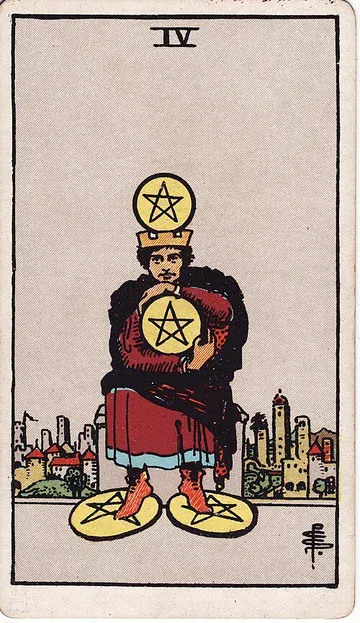
Four of Pentacles
Measured giving meeting held-tight resource — the entire teaching is the contrast. The Four says hold; the Six says release in proportion. Together they ask whether the resource in your possession this season is meant to be guarded or extended. Most lives need both gestures; the trouble begins when you confuse which season you are in. Confusion tilts the Six toward its reversed form: hoarding dressed up as careful giving.
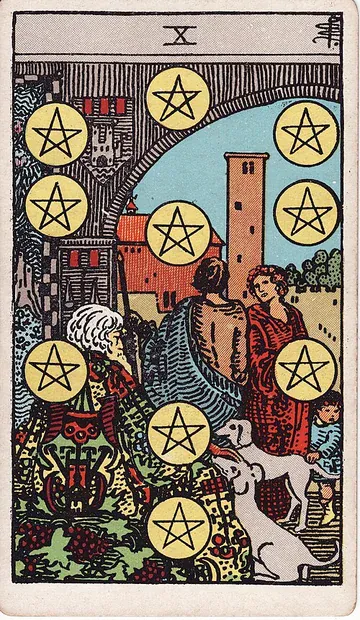
Ten of Pentacles
The calibrated transaction maturing into wealth as lineage. The Six is the moment the books square; the Ten is the structure that books-squared, repeated across years, eventually builds. Read together they describe stewardship across generations — what you give well in the small daily exchange becomes part of the durable architecture the Ten depicts. The combination asks: am I giving in a way that compounds, or in a way that ends with me?
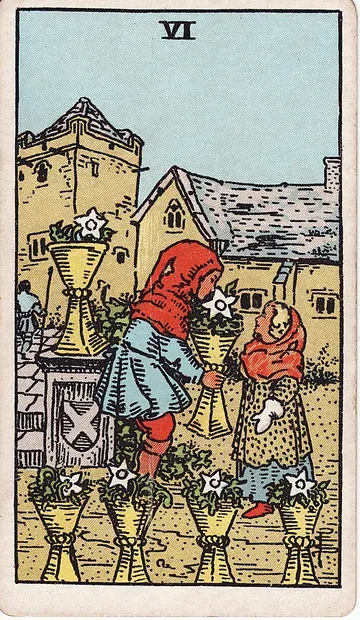
Six of Cups
Series siblings at the same number — sixes, the harmony of forces meeting without crowding. Cups Six is generosity from memory, gift offered out of tenderness for what was shared; Pentacles Six is generosity from accountancy, gift offered in proportion to need. Together they describe the fullness of giving: tender at the source, accurate at the hand. Without the Cups, the Pentacles risks coldness; without the Pentacles, the Cups risks sentimentality. Read in pair, the giver is whole.

The Empress
The merchant brought into the orbit of the deck's most maternal figure. The Empress is generosity at its source — the body that produces, the earth that feeds without counting. The Six of Pentacles is the felt organization of that generosity into a daily practice of measured care. Together they describe a household, an institution, or a teacher who has decided to keep faith with the people in their care, organizing abundance into a rhythm everyone can stand in.
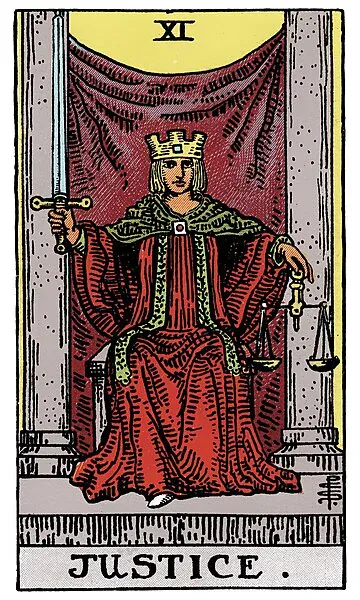
Justice
Two scales, doubled. Justice is the card of weighing as principle; the Six is the weight being administered as practice. Together they ask for systemic accuracy — not just the right gesture in the moment but the right structure across time. When these cards appear together, the question has gone larger than personal generosity. It has become a question about fairness as architecture: does the system itself produce proportional outcomes, or has it tipped in ways no single act of kindness can correct?
Frequently Asked Questions
What is the hidden interest attached to a Six of Pentacles reversed yes?
The Six of Pentacles reversed yes or no answer is rarely a clean no — it is more often a soft no, or a yes that arrives with hidden interest attached. The path may be technically workable, but it carries unspoken terms: a debt of obligation, a power imbalance, a string the offer-er has not disclosed. Treat it as a caution to read the document, ask the second question, and decline the kindness that tightens something in your chest. Wait for the version of the offer without strings.
With the Six of Pentacles reversed, which one of us has become the creditor?
Reversed in love readings, the Six of Pentacles describes a relationship in which the scale has tipped and neither partner has named it out loud. One has quietly become the creditor — keeping a private ledger of what they have given — while the other senses something is off without being able to identify it. The card asks for the ledger to be surfaced and read together. For new connections, it warns of generosity presented as currency. For singles, it cautions against the rescuer or rescuee patterns that look like the upright card from outside.
What does the Six of Pentacles reversed mean as a card?
The Six of Pentacles reversed meaning centers on the calibrated giving that has lost its calibration. Either the giver's hand has acquired strings — help arriving with hidden interest — or the receiver has settled into a kneel that was supposed to be temporary, making 'being given to' an identity rather than a passing season. Both flavors are correctable. The card is a diagnostic, not a verdict, asking: whose dignity is the exchange currently costing?
Is the Six of Pentacles reversed describing care that now has strings attached to it?
The Six of Pentacles reversed as feelings describes warmth that has acquired strings — care that has begun to be quietly weaponized. They feel something for you, but the feeling is bound up with private accounting: what they have given, what they think you owe, the small invoices they would never name out loud. The feelings exist; they have stopped being free. The card asks for honest conversation about the silent ledger, gently, without accusation, before the bond hardens into permanent imbalance.
What does the Six of Pentacles reversed mean as advice?
The Six of Pentacles reversed as advice asks you to decline the kindness that tightens your chest — that tightness is the interest. Surface the private ledger you have been keeping in any relationship. Pay one debt you have been avoiding, even at the cost of small discomfort. If you have been the giver, stop counting; gifts that you remember in detail have stopped being gifts. And if a relation will not rebalance after honest weighing, the card grants permission to leave. Most tipped exchanges can be re-leveled when both parties are willing — the work begins by breaking the silence.
Continue Reading
Six of Pentacles · Card overview · symbols · correspondences →
Return to the full card view — image, symbols, sensory correspondences, and Hermetic axes.
Read the upright meaning →
Read the same depth on the opposite orientation.
Draw your reading now →
Bring this card to a question — open a quiet ritual.