
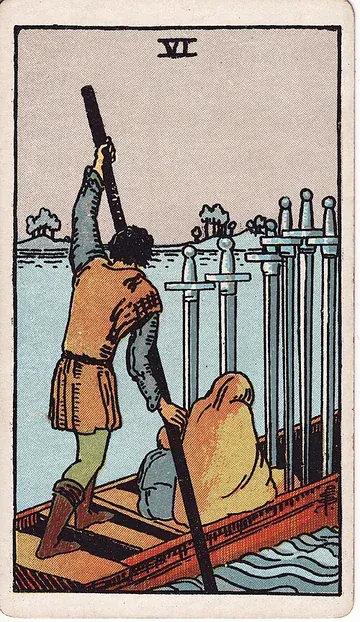
Six of Swords · Core Meaning
The Six of Swords is the boatman card. A figure stands at the stern of a flat-bottomed boat, a long pole pressed lightly against the unseen riverbed, the boat moving with the unspectacular forward motion of someone who has done this crossing a thousand times. Six long swords are planted upright in the bow — points to the sky, planks beneath them, no hands wrapped around the hilts. A cloaked woman and a child sit with their heads bowed. They neither weep nor look back. The water on the right of the hull still carries small, fretted ripples. The water on the left is already smoothing. The sky is washed gray. There is no wind.
Read the picture closely. The swords are not abandoned. They are not raised. They have been neither sheathed nor thrown overboard — they are carried, planted in the bow like six unburned candles, taken along into the new place. The boatman uses a pole rather than an oar. He is not rowing against the current; he is pushing gently off the bottom, asking the river to do most of the work and only correcting the line. The boat is moving on — that is the phrase the card answers, the one the figure on the bench would use — but it is moving on with weight, and with witnesses, and without victory.
This is the card's signature tension: the carried sorrow that has finally agreed to travel. The Six of Swords is not the card of forgetting. It is not the card of clean escape. The swords are still aboard. The wound that the Three of Swords planted, the truce that the Two of Swords held, the betrayal that the Five of Swords engineered — all of it is on the boat in some form. What has changed is the relationship to the weight. The blades are no longer being used. They are being transported. The card describes the moment a person stops fighting the situation that hurt them and agrees, instead, to leave it.
The traditional astrological signature reinforces this: Mercury in Aquarius, second decan. Mercury is the planet of crossings — messages, journeys, the small functional intelligence that gets people from one shore to another. Aquarius is the air sign of detachment, the high cool perspective that can see a situation without needing to live inside it any longer. Together, Mercury in Aquarius is the detached mind that has finally drawn the route map. It can see the far shore from here. It does not require the heart to come aboard willingly; it only requires the heart to come aboard. The kabbalistic signature is Tiphareth in Yetzirah — the sixth sephirah, Beauty, the central balance, the harmony reached among opposing forces. The card sits at the moment when two opposing pulls, the shore-just-left and the shore-not-yet-reached, find their workable ratio in a third thing: the boat itself, in motion, between them.
The asymmetric water is the small detail most readers miss on the first pass. The right side of the hull is still ridged with small waves. The left side is glassy. You are still inside the tremor of what just happened, the way the back of the body remembers a near-miss for hours afterwards. And you are also, already, on the side that is calming. The card does not pretend the crossing has been completed. It names, exactly, the texture of being mid-river.
Read the Six of Swords as the description of someone who has stopped trying to win the previous chapter. Whatever the question — relationship, job, city, identity — the card answers: the work now is the journey to calmer waters, not the rebuttal of the storm. Sit in the boat. Let the boatman pole. The far shore is closer than it looks.
Six of Swords · Love & Relationships
The shore that was hurting the relationship is finally behind the boat. The sorrow has not vanished — the swords are still in the boat — but the fighting has stopped. Both partners, or one partner moving for both, have made the small decisive gesture that turns endless relitigation into actual motion. The card describes the season after the worst conversations have been had and the next, quieter chapter is being inched toward. It is not a victory and it is not a loss. It is a healing crossing, with the people who matter most still in the boat.
For an existing partnership that has weathered a hard chapter, the Six of Swords upright is one of the most honest cards the deck offers. The therapy worked, sort of. The crisis is past, mostly. The two of you are not the same as you were, and you have agreed not to pretend that you are. You sit across from each other at the kitchen table now without the old bracing in the shoulders. You make plans for the long weekend. You buy the new sheets. The card describes the practical, untheatrical work of moving the relationship to a calmer shore — together, in the same boat, without making a victory speech about the wound that almost capsized you. The cloaked woman and child are not strangers; they are the ones you brought through.
For a new spark in the early stages, the Six of Swords describes a connection that begins as a rite of passage rather than a fireworks display. The two of you have met in the afterwards of separate hard seasons. Neither of you is the bright single you would have been five years ago. You have both arrived at this dock with weight already carried, and the connection forming between you is forming partly because you can both see, plainly, what the other is bringing aboard. This is not a damaged love. It is a precise one. The card's love language is the one where the second person in the boat does not ask you to drop your swords overboard before climbing in.
For a single seeker asking whether love is possible right now, the Six of Swords answers with patient honesty. Love is possible — but the season you are in is the crossing season, not the harbor season. The work right now is the journey itself, the slow movement away from the shore where the previous chapter happened. The right partner, when they appear, will not appear at the dock you are leaving. They will appear at the dock you are quietly poling toward — and the version of you that meets them will be the version who has finished the crossing. This is not a counsel of waiting forever. It is a counsel of finishing the passage you are already inside.
For the question of love after a wound, the Six of Swords is one of the deck's most precise cards. The Three of Swords is the wound. The Five of Swords is the betrayal that produced the wound. The Six of Swords is what comes next: the carried trauma being transported, deliberately, away from the place it happened. You are not pretending the wound did not occur. You are not asking the next person to fix it. You are loading the experience into the boat as experience, points-up, no longer a weapon, and you are letting the river do its quiet healing work as you cross. The next love, when it forms, will form in the calmer water on the left side of the hull — not in the storm you have just left.
For an on-again-off-again connection, the Six of Swords reads as the difficult-but-correct departure. You have done this dance many times. Each time, you have stayed at the same shore, and the shore has not gotten any kinder. The card describes the moment one of you — perhaps both of you — finally agrees to take the boat across instead of swimming back. This is the leaving without victory the card is famous for. There is no triumph here, no told-you-so, no satisfaction. There is only the small, dignified gesture of unhitching the rope and letting the pole find the bottom. Honor the lack of drama. The lack of drama is the maturity of the choice.
For a long-distance or geographically-suspended relationship, the Six of Swords often describes a literal move — one of you traveling toward the other, the relationship undergoing the actual physical crossing the metaphor names. The card supports this move when it appears. The water on the right is still rough — there will be logistical chop, visa friction, the apartment that costs more than expected — but the water on the left is calmer, and the direction of motion is toward the lower-friction shore. Trust the boatman. The pole has found the bottom.
For a seeker asking whether someone else is in love with them and the Six of Swords arrives upright, read the card as: they are choosing you quietly, and they are choosing you in the middle of their own crossing. They are not at the height of bright availability. They have weight aboard their own boat — a recent loss, an ongoing recovery, a season they are leaving. Their love for you is not less real for being carried alongside the swords. It may, in fact, be more real, because it has been chosen by someone who knows what loving is going to cost and is choosing it anyway. The signal is not loud. The signal is the cloaked figure who stays in the boat with you across the whole river.
For a relationship in the early stages of dissolution, the Six of Swords names the texture exactly: the parting that does not need a final fight to be real. The decision has been made. What is left is the practical crossing — the dividing of furniture, the changing of the address, the careful conversation with the children, the call to the lawyer. The card does not require either of you to be the villain. It asks only that the boat be allowed to move, that the swords be allowed to ride along instead of being swung. The healing crossing is possible even when the destination is two separate shores.
A note on the card's particular love language: the Six of Swords loves the way a person loves who has already lost something and decided to love anyway. It does not promise the absence of weather. It promises the willingness to pole the boat, even when the water on the right is still rough. This is not the love of the bright beginning. It is the love of the second chapter, the one that knows what the first chapter cost and has chosen to keep going. Take it seriously. It is rarer than the first kind, and it lasts longer.
If you are asking whether someone is in love with you and the Six of Swords arrives, read it as a quiet, carrying yes — the kind of yes that does not announce itself but stays in the boat for the whole crossing.
Six of Swords · As Feelings
Relieved, but not yet light: that is the register this card reports a feeling in. The other person is in the texture of the just-after — after the worst of something, before the full ease of the next chapter. They feel toward you the way the body feels when it finally sits down: grateful, slightly tired, aware of what it just survived. This is not the high of new feeling. It is the lower, more honest register of someone who has come through a season carrying weight and has decided to keep moving with you in the boat.
If they are reserved by nature, the Six of Swords feeling-state goes deeper still into quiet. They are not withdrawing from you. They are riding out the asymmetric water — the right side of their interior still ridged with the small ripples of whatever they are leaving behind, the left side already beginning to smooth. Read silence here as crossing, not absence. They are pole-deep in their own river. What they say to you when they finally speak from the calmer side will be more precise than what they would have said in the storm. Honor the wait. The wait is the work.
If they are demonstrative, the Six of Swords describes someone who has gone unusually quiet — not in a worrying way, but in the way a normally chatty person goes quiet on the morning of a long drive. They are conserving. They are paying attention to the route. They will be themselves again on the far shore, and they will be more themselves than before, because they will have made the crossing. The current quietness is a signal of the seriousness of the journey, not a signal of cooling toward you.
For a partner you have been with a long time, the Six of Swords in feelings describes a private mid-river moment in the relationship. They are not deciding whether to love you — the loving is settled, has been for years. They are deciding what shape the loving needs to take going forward, after the recent hard season. They are doing this work mostly alone, and they are doing it in motion rather than stationary, which is healthier than it looks. Trust the crossing. The relationship that emerges on the far shore will be a more calibrated version of what you already have, not a different relationship.
For a new connection, the Six of Swords in feelings means they are bringing you with them across a personal threshold. They have decided you are someone they want in the boat for the next chapter. This is a quieter declaration than a passionate one, but it is more committing. They have looked at the swords they are carrying — the past relationship, the family difficulty, the work loss, whatever the recent weight has been — and they have chosen you as one of the people who gets to be in the boat while they cross. This is not a small choice. Receive it as the signal it is.
There is a particular feeling-shape this card carries that few other cards do: companionship in silence. The other person does not need you to perform reassurance. They do not need you to fill the air with conversation. They need you to be in the boat — to ride out the asymmetric water with them, to not require them to be brighter than they are right now, to sit with the heads bowed and not interpret the bowed head as rejection. Some people cannot do this. The seeker who is willing to is, often, exactly the person the Six of Swords figure brought aboard for the crossing.
For someone who has wounded you and is now in a Six of Swords feeling-state, the card describes their honest, quiet effort to leave the version of themselves that did the wounding. They are not asking you to forgive yet. They are doing the slower work of moving themselves to a different shore — going to therapy, ending the friendship that enabled the worst of them, leaving the city, taking the medication, doing the thousand small repairs that constitute a real change. The boat is heavy. The pole is finding the bottom. If you can be patient enough to see them at the far shore rather than at the dock they are leaving, what arrives will be different from what wounded you. If you cannot wait, the card respects that too. The seeker is not obligated to ride along on someone else's crossing.
For a partner who has been distant, the Six of Swords in feelings is reassuring in an unusual way. The distance is not a falling out of love. The distance is the room they are giving themselves to make the crossing without dragging you into the rough water on the right side of the hull. They are protecting your shared boat from their own weather. The texture is patient, internal, lit by the washed gray sky and the soft sound of the pole.
A small caution: the Six of Swords feeling-state can be misread as detachment. The other person is not uninterested. They are in motion, and motion at this register often looks like flatness from the outside. If you are tempted to read the muted affect as cooling, look instead at whether they are staying in the boat — staying in your text thread, staying available for the call you ask for, staying physically present on the weekends. Staying in the boat is the signal. The flatness is just the weather.
Take the Six of Swords in feelings as confirmation that the other person is taking the relationship seriously enough to bring it into their crossing. Whatever they feel, they are not feeling it lightly. Whatever they decide on the far shore, they are deciding it with the weight of having actually crossed the river to get there. The relationship that emerges from this season will be a steadier one than the one that began at the original dock.
Six of Swords · Career & Work
Work moves here without drama and without ceremony. The job change without a big farewell party. The team you leave on quiet good terms. The project you finish, document, hand off, and walk away from cleanly. The card is not the card of triumph and it is not the card of defeat. It is the card of the transition itself — the boat moving from the shore that has stopped serving you toward the shore that has not yet fully come into view. Pack the useful experience into the boat. Take an unceremonious leave. Let the pole find the bottom.
If you are asking whether to leave a current role, the Six of Swords answers: the time is approaching, and the leaving will be quiet rather than triumphant. The role is not the catastrophe you sometimes feel it to be on the worst Tuesdays. It is, simply, a shore you have outgrown — the projects no longer challenging you, the manager no longer learning from you, the company no longer the company you joined. The card describes the season when the leaving begins to be planned in earnest: the resume gets quietly updated, the recruiter messages get answered for the first time in months, the financial buffer gets built. There is no need to make the leaving a confrontation. The boat does not need a victory speech to push off from the dock.
For someone weighing a specific new offer, the Six of Swords describes the move that should be made for room rather than for excitement. The new role may not be the promotion of your dreams. It may not be the prestige bump you wanted. What it is, is the calmer shore — the company with the saner culture, the team without the toxic incumbent, the role with the manager who actually listens. The card respects the unglamorous arithmetic. Take the role that lets the asymmetric water on the left of the hull get smoother, even if the right side is still going to take a quarter to settle.
For someone weighing whether to start a venture, the Six of Swords often arrives with a specific message: the venture is real, but the launch should be quiet. Do not announce. Do not throw the party. Push the boat off the dock without ceremony. The Six of Swords entrepreneur does the slow, methodical work of building the first three months of operations on a calmer shore, and then — only then — looks back to discover the company has already shipped its first ten units. The card is suspicious of the loud launch. The loud launch creates wake on a river that wants to be poled smoothly.
For freelancers and entrepreneurs in active business, the Six of Swords describes the season of moving the business — to a new niche, a new market, a new client base, a new pricing tier, a new geography. The current configuration has worked for a while and is now beginning to chafe. The card supports the move. It also asks for the quiet methodicalness of the boatman: pack the assets that travel well, leave the ones that do not, do not waste the trip relitigating which clients should have been better. Move the business across the river. The far shore is where the next phase of the practice happens.
For a creative practice, the Six of Swords is one of the deck's most useful cards. It describes the season when the previous body of work is finished and the next has not yet declared itself, and the creative is doing the patient work of carrying the experience forward without trying to immediately monetize it, restate it, or re-launch it. The studio is quiet. The notebook is filling slowly with marginalia rather than finished pieces. The artist is, in effect, mid-river — the previous shore is the completed work, the next shore is the not-yet-named work, and the boat is the present practice that holds them both. Trust the crossing. The next work is being prepared at a depth the daily check-in cannot detect.
For someone considering a promotion, the Six of Swords asks an unusual question: does the promotion move you to a calmer shore, or does it bind you more tightly to the rough water you are currently in? Promotions can sometimes be the boat across. They can also sometimes be the anchor. The card asks for the discernment to tell the difference. If the promotion takes you out of the meeting cadence that wears you down, away from the project that has been bleeding your evenings, into a new register where the work is harder but the pace is calmer — take it. If the promotion is just more of what is already exhausting you, with a new title — let the role go to someone else and pole your own boat across to a different company.
For job-search readings, the Six of Swords describes the long, useful middle of the search. You have left the previous role, or are about to. The new role has not yet appeared. The card is not predicting drought. It is describing the interval of the crossing, when the most important discipline is to stay in the boat — to keep applying, keep networking, keep the financial discipline tight, keep the daily structure that prevents the search from becoming a void. The far shore is closer than it looks. The recruiter who replies on a Tuesday in the middle of the third week will be the one who matters.
For someone in a difficult workplace conflict, the Six of Swords reads as the strategic exit. Do not write the parting email that explains how everyone wronged you. Do not stage the meeting where the truth comes out. The card describes the quieter, more dignified move: the hand-off documented, the two-week notice given, the LinkedIn updated, the next role quietly assumed. The colleague who has been at the other end of the conflict is being left on the original shore. They will continue their pattern with someone else. Your job is not to fix the shore; your job is to leave it.
For someone in the aftermath of a layoff, the Six of Swords is exactly the right card to have drawn. The shock of the cut is the rough water on the right of the hull. The next role is the calming water on the left. You are mid-river. The work right now is to pole steadily — to use the severance carefully, to keep the daily structure firm, to apply for the right jobs rather than every job, to take the recruiter call without panic. The far shore is real, and it is reachable. The crossing is the work; the work is the crossing.
A note on the card's particular career language: the Six of Swords is not a card of acceleration. It is a card of correct relocation. For ambitious seekers in fast-moving industries, the card can feel slow — the impulse is always to push for the next launch, the next promotion, the next round. The card respects that, and still asks: have you finished this crossing yet? Some career moves cannot be rushed. The boat goes at the speed of the pole and the river. Pretending the boat goes faster than the pole and the river only puts the boat in the rough water again.
Six of Swords · Money & Finances
Money crosses in this card carefully, in small competent movements. The relocation expense. The rebuild after a hard year. The careful, unspectacular movement of resources from the configuration that no longer serves to the one that does. The card is rarely the card of windfall. It is, more often, the card of competent forward motion under modest constraint — the quiet money work that happens after a difficult season has passed and before the next abundant one has arrived.
For a question about whether to make a major purchase, the Six of Swords answers: only if the purchase is part of the crossing. Buying the house in the calmer city, yes. Buying the new car you need for the new commute, yes. Buying the luxury thing as a victory speech for surviving the rough year — no, not yet. The card distinguishes precisely between expenditure that enables the crossing and expenditure that attempts to mark the crossing as already complete. The crossing is not yet complete. Spend on the boat, the pole, the supplies. Do not spend on the celebration.
For an investment decision, the Six of Swords is unusually direct: choose the calmer instrument. The high-volatility play that promises the dramatic rebound is the wrong choice for this season. The card is the card of the patient, lower-yield, more reliable allocation — the index fund rather than the speculation, the bond rather than the leveraged bet, the savings account rather than the option. There may be a time for the bigger move; this is not it. The asymmetric water has not yet finished smoothing. Choose accordingly.
For a seeker carrying debt, the Six of Swords describes the slow, methodical repayment that finally begins to actually move the balance. Not the dramatic windfall that erases the debt overnight. The patient monthly contribution, made on the same date, in the same amount, for the next eighteen months, that takes the balance from a number you cannot look at to a number you can finally look at without flinching. The card supports this exactly. It asks for the boatman's discipline: pole, breath, pole, breath, pole, breath. The shore is closer with each push.
For someone in financial recovery after a hard season, the Six of Swords reads as the affirmation of the slow rebuild. This year does not make you rich. It does, however, leave you more solvent than last year, by an honest margin. The savings account that had nothing in it now has something. The credit score that dropped hard has begun to recover. The debt that was overwhelming has begun to feel manageable. The card describes this exact texture — the modest, real, patient improvement that does not look like victory from the outside but feels like a different kind of body to the person living it. Stay the course. The crossing is well underway.
For windfall — inheritance, bonus, unexpected income — the Six of Swords is one of the most useful cards the deck offers, because it asks for the unusual discipline. The money has arrived. The temptation is to deploy it immediately to repair every small irritation that has accumulated during the lean year. The card says: pole steadily. Three months in a high-yield account, untouched. Then deploy half of it to the structural fix that will save you the most over the next five years — the debt, the emergency fund, the retirement contribution. Save the other half for the actual crossing — the move, the next degree, the venture, whatever the larger transition is that the windfall is in service of. The windfall is the supplies for the boat. Do not eat the supplies on the dock.
For questions of long-term financial planning — retirement, real estate, insurance, succession — the Six of Swords describes a moment of moving the plan to a calmer shore. The financial advisor you have been working with may need to be replaced. The retirement account that was set up when your life was a different shape may need to be reallocated. The estate plan that has not been updated in seven years may need the patient afternoon of reading and rewriting. The card supports this work. It also asks for the quietness of the work: do this work by yourself or with a single trusted professional, not by polling friends, not by reading internet forums, not by trying to outperform a market that does not care whether you win.
A note on the trap of this card with money: the Six of Swords financial pattern can curdle into carrying too much — the seeker who packs the entire old shore into the boat out of fear that the new shore will be barren. This is the shadow the card explicitly names in the deck schema: the boat moves, but the load already renders the direction meaningless. Watch for it. If you are paying for storage units containing things you have not opened in three years, the boat has been overloaded. If your monthly fixed costs are still calibrated to the income you had two years ago, the boat has been overloaded. The card asks for one specific discipline: leave one item on the shore before crossing. Cancel one subscription. Sell one possession. Close one account. The lighter boat moves more easily, and the asymmetric water on the left smooths faster.
A practical move when this card appears in a money question: write a list of the swords currently in your boat — the financial obligations, the expenditures, the recurring costs — and beside each one, write whether it is experience being carried forward (worth the weight) or weight being dragged out of habit (not worth the weight). Sit with the list for a week. The card responds to materialized weighing. The boatman who knows what is in the boat poles more efficiently than the boatman who does not.
Six of Swords · Health
The body here is mid-river — past the acute crisis, not yet on the calmer shore, in the patient work of moving from the rough water of illness or injury toward the smoother water of restored function. The body is not in danger right now; it is in transition. The card asks the seeker to recognize the actual texture of recovery, which is not a triumphant return but a quiet daily poling toward better function.
The card's particular health signature, read against its element and body associations, is the throat, the lungs, and the nervous system — air's territory, the physical seat of breath and the long alert posture. When the Six of Swords appears in a health reading, watch for the small symptoms of carried tension that has begun to release: the breath that has finally started to deepen for the first time in months, the throat that no longer scratches at the end of every day, the shoulders that have begun to drop a quarter-inch from their long-held position. The body is being poled toward the calmer shore. The work is to let the poling happen without rushing it.
If you are asking whether a treatment will work, the Six of Swords answers with measured affirmation. The treatment is real. The body is responding. The response is the slow, asymmetric kind — the right side of the body still ridged with the symptoms that have not yet fully resolved, the left side already beginning to smooth. Stay the course. Trust the protocol. The temptation in this season is to evaluate the treatment too early, to read partial improvement as either failure or completion, and the card warns against both. The crossing takes the time it takes. The pole has found the bottom. The boat is moving.
For someone managing a chronic condition, the Six of Swords describes a stable plateau that is, itself, a kind of crossing — not toward cure but toward competent management. The metrics have stabilized. The acute interventions of the early phase have settled into routine maintenance. The doctor says you are doing well, and the doing-well does not feel like victory; it feels like the boat moving steadily across a wide gray river. The card respects this exactly. Chronic conditions teach the body to be in motion without arriving — to pole steadily across a river that does not have a far shore in the conventional sense. The seeker who has learned this poling has learned a discipline most well bodies never learn.
For acute issues, the Six of Swords reads as the recovery interval. The acute event is past — the surgery, the injury, the illness, the breakdown — and the body is now in the patient work of the post-acute crossing. The card asks for the discipline of the slow rebuild: the physical therapy actually done, the medication actually taken, the sleep actually protected, the rehab actually attended. Recovery from acute events takes longer than the seeker usually wants it to. The card respects the impatience and asks for the patience anyway. The far shore is real. The crossing is the work that gets you there.
For mental health questions, the Six of Swords is one of the most precise cards the deck offers. The depressive or anxious season is no longer at its worst — the breakdown has been averted, the medication has stabilized, the therapist is helping, the structure is holding. The card describes the crossing season, the long middle of the recovery, the months when the immediate crisis has passed but the full restoration has not yet arrived. This is the season most therapists describe as the hardest part of recovery, precisely because it lacks the dramatic relief of the breakdown ending. The card affirms the work. The poling is real. The smoother water on the left of the hull is forming. Trust the crossing.
For someone managing nervous-system issues — insomnia, anxiety, panic, the chronic alertness that does not turn off — the Six of Swords is the card of the first real ease after a long season of activation. The body is finally beginning to remember what calm feels like. The breath is finally beginning to lengthen on the out-breath. The sleep is beginning, very slowly, to deepen. The card asks for the small daily protections that allow the crossing to continue — the morning walk, the protected evening, the screen-free hour before bed, the breath practice that costs only ten minutes. None of this is medical advice; keep your practitioners, take your medicine. The card simply names the texture of the recovery: a slow boat, a steady pole, a river that is calming.
For questions about somatic recovery — the body that is rebuilding strength after a long inactive period, the digestive system that is finally settling after months of dysregulation, the immune system that is finally able to handle a normal viral load again — the Six of Swords names the pattern with precision. The recovery is not glamorous. The recovery is daily. The recovery rewards the seeker who shows up consistently rather than the seeker who tries to sprint to the finish. Pole, breath, pole, breath. The body knows the way.
For questions about sleep, the Six of Swords often arrives because sleep is exactly where the asymmetric water is most felt. The right side of the body is still in the activation of the day; the left side is beginning to sink. The card asks for the small ritual that signals the daily crossing — the same gesture, the same room, the same hour, the same dimming of the lights, the same removal of the day's load. The body learns to cross when the crossing is rehearsed. None of this is a substitute for medical care for actual sleep disorders. The card simply names the texture the body is asking to be helped into.
The card respects the body's intelligence. It does not say "be well now" — sometimes the wellness is months away. It asks: what is the smallest unit of forward motion you can give the body today? The card responds to that question, and the body responds to it too. The boatman does not row hard. He uses the pole. The pole finds the bottom. The boat moves.
Six of Swords · Spirituality
A rite of passage, and a quiet one: that is this card's spiritual register. Not the dramatic initiation — the quieter one, the one that happens in motion, mid-river, with the heads of the cloaked figures bowed and the standing swords riding the bow as silent companions. The card describes the seeker who has agreed, finally, to leave the spiritual configuration that is no longer adequate to who they are becoming, and who is doing the patient work of crossing toward the configuration that will be.
For seekers in active practice, the Six of Swords often arrives at the threshold of a spiritual transition the daily practice has been preparing them for. The teacher you trained under is no longer the teacher you need. The tradition you grew up in has begun to feel like a shore you have outgrown. The community that held you for years has begun to feel like the rough water on the right side of the hull. The card asks for the dignity of the quiet leaving. Do not denounce the previous shore. Do not write the manifesto. Pole the boat across. The next teacher, the next tradition, the next community will be on the calmer shore, and they will receive the version of you that finished the crossing rather than the version of you that staged the dramatic departure.
For seekers in a season of doubt, the Six of Swords is one of the kindest cards the deck offers. Doubt, the card says, is itself a crossing. The certainty you carried for years has revealed its limits, and what is forming on the other side of the doubt is not the absence of belief but a more honest, more weather-tested belief — the kind that has been carried through actual water rather than recited from the dock. The standing swords on the bow are the questions you are not throwing overboard; they are the experience you are taking with you. The card respects the doubt and asks for the patience of the crossing.
For seekers exploring new practice, the Six of Swords describes the careful introduction of the new form into the daily life. Do not abandon the old practice in a single dramatic gesture. Pole the boat across, with the old practice still in the boat as one of the standing swords — points up, no longer being wielded with the old fervor, but carried, honored, taken into the new configuration. The synthesis that emerges on the far shore will include both the old and the new in some form. The crossing is the work of letting the new form arrive without forcing the old form to disappear.
The card's spiritual practice — the one specific practice it asks for — is the slow walking meditation, ideally near water if water is available. Twenty minutes, twice a week, of walking at the pace of the pole — slow, deliberate, with the breath finding its own rhythm. Notice what becomes loud when the walking begins. Notice what tries to hurry the pace. Notice the moment the body settles into the rhythm of the boat rather than the rhythm of the rushing day. The card responds to this practice — twenty minutes that the rest of the week is changed by. If walking is not available, the same practice can be done seated, with one hand resting on the chest, breath following the pace of an imagined pole pushing off an unseen river bottom.
The asymmetric water is the spiritual image the card asks the seeker to sit with. The right side of the interior is still ridged with what is being left behind. The left side is already beginning to smooth. Both are real at the same time. The spiritual maturity the card describes is the capacity to hold both — to neither pretend the rough water is already gone nor be paralyzed by it being still present. The boat moves through both, holding both, neither denying the difficulty nor refusing the calming. This is the central balance of Tiphareth — the sixth sephirah, Beauty, the harmony among opposing forces — finding its physical form in the asymmetric water on either side of the hull.
For questions about path, the Six of Swords answers that the path is the crossing itself — not the previous shore, not the next shore, but the patient daily motion of the boat between them. The seeker who has learned to be in transition without requiring the transition to be over has learned a discipline most spiritual paths take decades to teach. The Mercury in Aquarius signature reinforces this: the detached mind that has finally drawn the route map, the cool intelligence that can see the far shore from here without insisting the heart already be there.
A small caution: the Six of Swords spiritual posture can become a permanent identity. The seeker who is always crossing, never arriving, always in transition between traditions, never settling into a practice long enough to be changed by it, is at some point hiding behind the romance of the boat. The card distinguishes the dignity of the actual crossing from the avoidance of the actual landing. If the boat has been mid-river for five years, the card asks for the discipline of the eventual disembarkation. There is a far shore. It exists. The point of the crossing is to reach it.
The card invites the seeker to honor the crossing as a real spiritual season — not a placeholder, not a delay, not a failure to have arrived already. The boat is the practice for now. The pole is finding the bottom. The cloaked figures sit with their heads bowed because bowed heads are the appropriate posture for crossing water. Sit with them. Let the boatman pole. The far shore receives crossings in their own time, not on the schedule of impatience.
Six of Swords · Yes or No
Yes — but the crossing is quiet, not a victory.
The Six of Swords upright answers yes-or-no questions with a particular kind of yes: the yes of forward motion that does not look like winning. The thing you are asking about will move forward. The move will be made. The transition will happen. What it will not have is fanfare. The card does not promise the dramatic resolution. It promises the workable, modest, real resolution — the boat actually pushed off the dock, the swords actually loaded into the bow, the river actually crossed.
For yes-or-no questions about a relationship, a job, a move, a decision: the answer is yes, with the caveat that the path forward is the crossing rather than the arrival. Yes, the move is the right move. Yes, the new role is the right role. Yes, the conversation should be had. None of these will feel like the triumphant culmination of a long arc. They will feel like the patient work of the next phase, undertaken without spectacle. Honor the lack of drama. The lack of drama is the maturity of the choice.
For questions about whether someone will return — a partner, a friend, a colleague — the Six of Swords answers ambiguously by design. The card describes leaving, not returning. If the question is "will they come back to the original shore," the answer is usually no — they have made the crossing. If the question is "will the connection continue in a new form, on a new shore," the answer is often yes. The card asks the seeker to update the shape of the question. The relationship that returns will not be the same relationship; it will be a relationship that has crossed water, and it will be a different shape on the far side.
For questions about whether an offer is genuine, whether a plan will hold, whether a project will succeed: the Six of Swords answers with a sober yes. The thing is real. It will not be glamorous. It will move forward at the pace of a poled boat — slower than you want, faster than you fear. The far shore is real. The crossing takes the time it takes.
For binary questions about whether to act — should I take the offer, should I send the message, should I make the move — the Six of Swords upright says yes, and adds: quietly. Take the offer; do not throw the announcement party. Send the message; do not require the dramatic reply. Make the move; do not make the move a story. The card respects the action. It also asks for the action to be undertaken in the register of the boatman, not the register of the campaigner.
For questions about timing — when will this happen? — the Six of Swords describes the medium arc. Not soon in the urgent sense. Not far in the despairing sense. The next several weeks to the next several months, depending on the question. The crossing has begun; the far shore is approaching; the arrival is in the calculable middle distance. Patience is the discipline the card asks for; the discipline is the way the timing eventually opens.
For questions where the seeker has already privately decided and is asking for confirmation, the Six of Swords answers warmly: yes, you know. You have already begun the crossing. The card is not asking you to second-guess the boat that is already in motion. It is asking you to stay in the boat, to keep poling, to not turn back to the shore you have already left. This is the rare upright reading where the card simply confirms what the seeker already understands and asks for the courage to continue.
For yes-or-no questions about a difficult conversation — should I say the thing, should I confront the person, should I clarify the misunderstanding — the Six of Swords upright says yes, but speak from the boat, not from the dock. Speak as someone who has already begun the crossing, who is not asking for permission to leave the shore, who is simply naming the direction of travel. This is not a confrontation. It is a notification. The card respects the courage of the conversation. It also asks for the dignity of the boatman's tone.
For yes-or-no questions where neither path is clearly correct, the Six of Swords reads as: choose the path that is the quieter crossing. Both options have real virtues. Both options have real costs. The question to ask is which option lets you pole steadily across calmer water and which option requires you to fight a current. Take the calmer crossing. The energy you save will be the energy that carries you to the next decision.
If the question was: am I leaving cleanly? The card answers yes, and adds that the cleanliness is the leaving itself — not a final speech, not a settled score, not a public reckoning. Just the boat, the pole, the river, the standing swords, and the cloaked figures who came along. The crossing is the answer to the question.
Six of Swords · Advice
Let the departure be silent, and let it stay that way. Do not require this transition to be marked by a victory speech, a final argument, a public declaration, or a clean break that ties up every loose end. The card asks for the discipline of the boatman: pole, breath, pole, breath, motion in the direction that is actually available, rather than the dramatic gesture that would feel like resolution and would actually be theater. Holding the silence is one of the harder things the deck asks of the seeker.
If there is one specific instruction the card offers, it is to cancel one item on the calendar that no longer belongs to you. This is the deck-schema's situational cue, and it works as advice across nearly every question the card answers. Find the recurring meeting that has outlived its purpose. Find the standing dinner with the friend who has slowly become a person you tolerate. Find the volunteer commitment that is now an obligation rather than a contribution. Cancel one. Send the polite email. Do not over-explain. The card responds to literal practice. The figure on the bench is not a metaphor. The pole is not a metaphor. The cancellation is the pole pushing off the bottom.
A second instruction: check what you are still carrying that should have been set down a season ago. Walk through the rooms of your apartment. Walk through the folders on your desktop. Walk through the recurring transactions on your bank statement. For each item, ask: is this experience being carried forward, or is this weight being dragged out of habit? Set down one item this week. Just one. The boat that is one sword lighter moves more easily, and the asymmetric water on the left side smooths faster. Do not stage a purge. Do not declare a cleanse. Just set down one thing.
A third instruction: get rid of one object tied to the old chapter, not stashed in a box but actually sent away. This is the deck-schema's reversed integration cue, but it works upright too — the difference is that upright, you do this from the boat that is already in motion rather than from the dock you have not yet left. Donate the clothing. Sell the equipment. Mail the letter back. Let the old object find a new owner who has no history with it. The act of sending away is what the card responds to — not the act of moving the object from one closet to another, but the act of letting it leave your possession entirely.
A fourth instruction: protect the cloaked figures. Whoever is in the boat with you for this crossing — the partner, the children, the dog, the close friends, the colleagues you trust — needs you to not require them to perform brightness during the transition. They are bowing their heads because bowed heads are the appropriate posture for crossing water. Do not interpret their quietness as withdrawal. Do not require them to reassure you that the crossing is going to end well. Sit with them. Pole the boat. Let the silence be the form of the companionship. The relationships that survive the Six of Swords crossing are usually the ones that did not require either party to be louder than the river.
A fifth instruction: trust the boatman's tools. The boatman uses a pole, not an oar. He pushes off the bottom rather than rowing against the current. The card asks the seeker to use the actual tools of the situation — the small efficient interventions that work with the available conditions — rather than the dramatic tools that would be appropriate in a different situation. If the river is shallow, use the pole. If the conditions are quiet, do the quiet work. Do not try to row a flat-bottomed boat. Do not try to sail a river that has no wind. The card describes the modesty of the right tool for the actual situation.
A sixth instruction: do not look back. The cloaked figures bow their heads and do not look back — not because looking back is forbidden, but because looking back is unhelpful during the actual crossing. The shore you have left is real, and it gets integrated later, on the far shore, when the crossing is complete. During the crossing itself, looking back disrupts the boat's balance. Keep the eyes on the direction of motion. The shore you are heading toward is the one that needs your attention now.
A seventh instruction, for seekers carrying the most weight: if the boat is overloaded, leave one item on the shore before crossing. This is the deck-schema's primary integration cue, and it is the hardest of the card's instructions. Some seekers arrive at the dock with so much accumulated experience, so many loyalties, so many obligations, so many old griefs, that the boat would sink if everything were loaded. The card asks for the unsentimental triage. What is the one thing — relationship, project, identity, possession, story you have been telling about yourself — that needs to stay on the original shore? Leave it. The crossing requires the lighter load. The thing you leave does not follow across the water; it stays on the shore where it belongs, the boat sits lighter, and the crossing finally begins.
If the seeker takes only one of these instructions away from the reading, take this one: the crossing is the work, and the work does not require fanfare. The boat moves at the pace of the pole. The pole finds the bottom. The river does the rest. Trust the rhythm. The far shore is closer than it looks.
Six of Swords · Card Combinations
The Six of Swords reads particularly well alongside cards that name what is being carried, what is being smuggled, what is being left, and what is being moved toward. The combinations below are the load-bearing five — the cards that, paired with this Six, produce a compound image richer than either card alone. They are not the only combinations; they are the ones that most clearly reveal the texture of the boatman card.
With the Three of Swords, the combination names the wound that the Six is now ferrying away from the original shore. The pierced heart upstream, the boat moving downstream toward smoother water — both visible at once, the cause and the consequence in the same frame. The pairing affirms that the seeker is not pretending the wound did not happen; the wound is real, the wound is acknowledged, and the wound is now being carried away from the location where it occurred. The healing is the crossing.
With the Seven of Swords, the combination asks what got smuggled aboard during the loading. The Six is supposed to be a clean crossing — six standing swords, accounted for, points upward, dignified. The Seven asks what you couldn't bring yourself to leave behind in the dark of the dock — the secret you packed without telling anyone, the resentment you wrapped in cloth and stowed under the bench, the version of yourself you should have left on the shore. The combination is a question, not an accusation: is the boat carrying the right cargo, or is it carrying the cargo you could not bring yourself to refuse?
With the Eight of Cups, the combination names the same departure in two registers. The Eight of Cups is the voluntary leaving — the figure walking away under a moon, deliberate, having chosen to leave the cups behind. The Six of Swords is the same departure rendered differently — the boat poled across the water, the cloaked figures bowed, the swords loaded but the leaving completed by another. The pairing describes a transition that has both the inner consent of the Eight (the seeker actively chooses to leave) and the outer support of the Six (the boatman, the boat, the river — the structures that carry the leaving).
With Death, the major arcanum, the combination raises the crossing from logistical relocation to fundamental transformation. The Six of Swords on its own describes a workable transition; with Death alongside, the crossing becomes the kind that does not have an off-ramp, the ferry that is not optional, the movement from the version of life that was to the version of life that will be. The pairing is sober. It is also affirming — Death paired with the Six of Swords does not destroy the boat. It confirms that the crossing is the correct crossing, and that the far shore is genuinely different from the shore being left, and that the seeker who arrives there will be transformed enough to belong on the new shore.
With the Star, the combination shows what waits on the far side once the asymmetric water finishes its calming. The Star pours her water back into the river. The Six of Swords poles the boat across. Together, they form the image of the long healing arc that the card was always for: the crossing is not the destination, but the crossing makes the destination possible. The Star shore is where the trauma being carried in the boat is finally received with grace — where the swords can finally be set down in a meadow and remain there as honored objects rather than carried weight. The combination is the deck's most generous reassurance that the crossing is in service of something genuinely better.
Card Combinations
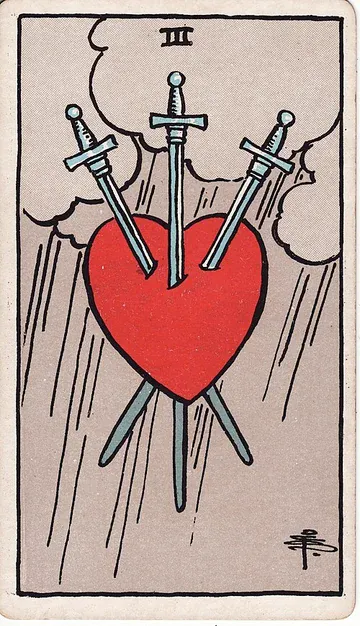
Three of Swords
The Three of Swords beside the Six of Swords names the wound on the original shore that the boat is now ferrying away from. The pierced heart upstream, the boat moving downstream toward smoother water — both visible in the same frame. The pairing affirms that the seeker is not pretending the wound did not happen; the wound is real, the wound is acknowledged, and the wound is being carried away from the location where it occurred. The healing is the crossing itself. Reversed alongside the Six, the pair often shows the wound that has not yet been processed and is therefore still open in the boat — the work then is the actual grief that was skipped before the leaving.
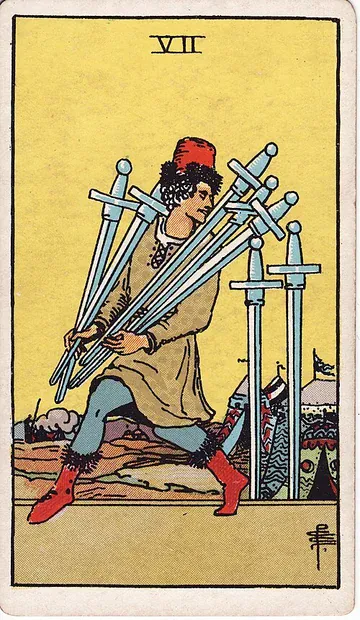
Seven of Swords
The Seven of Swords beside the Six asks what got smuggled aboard during the loading. The Six is supposed to be a clean crossing — six standing swords, accounted for, points upward, dignified. The Seven asks what you couldn't bring yourself to leave behind in the dark of the dock: the resentment wrapped in cloth and stowed under the bench, the secret carried without declaration, the version of yourself you should have left on the shore. The pairing is a question, not an accusation: is the boat carrying the right cargo, or is it carrying the cargo you could not bring yourself to refuse? The answer determines whether the crossing arrives clean or arrives with a problem already aboard.
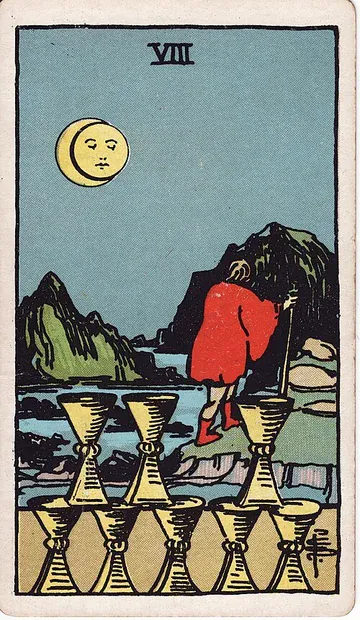
Eight of Cups
The Eight of Cups beside the Six of Swords shows the same departure in two registers. The Eight is the voluntary leaving under a moon — the figure walking away from the cups by clear deliberate choice. The Six is the same departure poled across water — the boat carrying the figures who have made the choice into the crossing the choice required. Together they form the complete picture of an honest leaving: the inner consent of the Eight, the outer support of the Six, the moon and the river both witnessing the same forward motion. When both appear, the seeker is not just thinking about leaving; the leaving is in motion in both the heart and the practical world.
Death
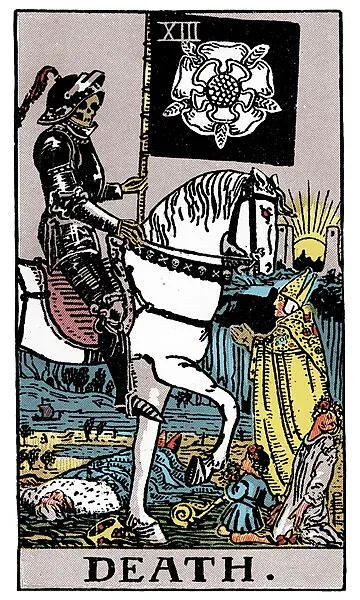
Death beside the Six of Swords raises the crossing from logistical relocation to fundamental transformation. The Six on its own describes a workable transition; with Death alongside, the crossing becomes the kind that does not have an off-ramp. The ferry is not optional. The seeker who arrives at the far shore will not be the seeker who left the dock; the crossing will have changed them at the foundations. The pairing is sober and confirming at once. Death does not destroy the boat. Death affirms that the crossing is the correct crossing, and that the seeker who arrives on the far shore will be transformed enough to genuinely belong there. The previous self cannot make the journey; the previous self is what is being released into the river.

The Star
The Star beside the Six of Swords shows what waits on the far side once the asymmetric water finishes its calming. The Star pours her water back into the river under a clear night sky. The Six poles the boat across the same river toward her shore. Together they form the image of the long healing arc the card was always for: the crossing is not the destination, but the crossing makes the destination possible. The Star shore is where the swords being carried in the boat can finally be set down in a meadow and remain there as honored objects rather than carried weight. The combination is the deck's most generous reassurance that the crossing is in service of something genuinely better — that the patience of the boatman is rewarded by the receptivity of the Star.
Frequently Asked Questions
Why do the six swords stand in the boat instead of being carried in hand?
Because they are cargo now rather than weapons. This is the card of the quiet crossing — a small boat being poled from rough water toward calmer water, six standing swords riding the bow as carried experience rather than wielded weapons. It describes a transition that is real and forward-moving but undramatic: the relocation, the recovery, the moving on without victory. The card asks the seeker to allow the departure to be silent and to trust the boatman's slow steady pole.
Does the Six of Swords promise a calm arrival, or only forward motion?
Forward motion, and the card is careful about the distinction. It is a soft yes — but a yes whose shape is movement rather than triumphant arrival. The thing being asked about will move forward, the transition will happen, the crossing will be made. What it will not have is fanfare. Take the answer as confirmation that the path is workable, and undertake the action in the register of the boatman rather than the register of the campaigner.
What does it mean that we are leaving a hard season in the same boat?
It means the departure is shared, which is the quiet good news this card carries. In love it describes a relationship that has agreed to leave the shore that was hurting it — together, in the same boat, without a victory speech. It can name the season after a hard chapter when both partners are in the patient work of moving toward calmer water. For singles, it describes the crossing season itself: the right partner appears at the dock you are quietly poling toward, not the dock you are leaving.
Is the muted feeling in a Six of Swords reading cooling, or crossing?
Crossing, in almost every case. The card describes someone who feels relieved but not yet light — in the texture of the just-after, after the worst of something, before the full ease of the next chapter. They are bringing you with them across a personal threshold rather than performing brightness. Read the muted affect as crossing, not cooling. They are staying in the boat with you, which is the signal that matters.
What is the Six of Swords' astrological signature?
The Six of Swords carries Mercury in Aquarius, second decan — the detached mind that has finally drawn the route map and can see the far shore from here. The kabbalistic placement is Tiphareth in Yetzirah, the sixth sephirah of Beauty and central balance, where two opposing forces find their workable ratio in a third thing. Together, they describe the cool intelligence of the boatman who poles steadily across the asymmetric water.