
Six of Swords Reversed · Core Meaning
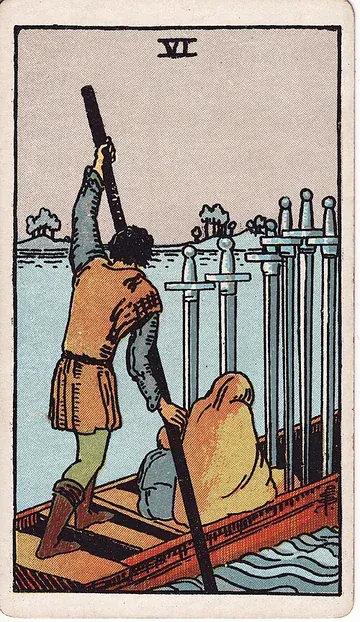
The crossing has stalled, or has turned back on itself. The boat that was supposed to push off does not. Or pushes off, drifts halfway across, and turns back when the rough water on the right of the hull becomes too uncomfortable. Or makes the full crossing in the body but leaves the heart on the original shore — sharing the new roof but still living in the old room. The image inverts: the standing swords in the bow are no longer being carried with dignity but being dragged, the cloaked figures begin to lift their heads and look back, the asymmetric water no longer smooths but begins to chop on both sides as the boat loses its line.
Read the picture inverted. The pole is no longer finding the bottom; it is being driven into mud, or struck against a rock, or worse, simply not put in the water at all. The boatman is no longer poling; he is standing at the stern arguing with someone on the original shore. The boat has begun to drift sideways. The river is no longer doing the work. The crossing, instead of being the patient transition the upright card promises, has become a different difficulty entirely — the difficulty of being neither here nor there, of having committed to leaving without fully leaving, of having packed for a journey that the body has not actually undertaken.
This is the card's signature reversed tension: the unfinished departure. The Six of Swords reversed is not the absence of the desire to leave — the desire is real, the dock has been considered, the boat has been prepared. What is missing is the actual leaving. Either the seeker has not pushed off the original shore (refusal to leave), or has pushed off too soon without preparing the crossing properly (premature crossing), or has reached the far shore physically but is still mentally and emotionally in the old place (carrying too much). The Mercury in Aquarius signature reverses too: the detached mind that should have been able to chart the route is no longer detached — it has been pulled back into the emotional field of the original shore, and the route map is being abandoned in favor of one more litigation of what happened back there.
The reversed Tiphareth signature is the loss of the central balance. Upright, the third thing — the boat in motion between two shores — holds the polarity workably. Reversed, the boat collapses into one of the two shores rather than maintaining the dignified between-state. The seeker is either entirely back on the original shore in some functional sense, or has fled to the new shore without integrating what the leaving was supposed to teach. Either way, the Beauty of the harmony is replaced by the discomfort of the partial commitment.
Read the Six of Swords reversed as the description of someone who is almost leaving, or has left geographically without leaving in any other sense, or is dragging the previous chapter into the current chapter with such force that the current chapter is being shaped by it instead of being its own thing. Whatever the question — relationship, job, city, identity — the card answers: the crossing has not actually been completed. The work is to recognize where in the journey the boat actually is, and to either return to the original shore deliberately and do the work that was skipped, or to genuinely commit to the crossing and finish it cleanly.
The card respects how hard this is. The shore you are trying to leave was not just the location of the wound; it was also the location of years of identity, relationship, routine, and meaning. Leaving it for real is harder than the brochure suggested. The reversed card names this honestly. It does not shame the stuck crossing. It asks the seeker to see the situation accurately, so that the next move — whatever it is — can be made deliberately rather than by drift.
Six of Swords Reversed · Love & Relationships
Technically ended and not actually ended; or technically ongoing and not actually begun — a love reading here arrives in two shapes. The shape varies; the underlying texture is the same: there is a transition the relationship needs to make, and the transition has stalled. The card describes the season of being neither here nor there, of saying the words of departure without making the actual move, of moving the body across the river while leaving the heart at the old dock.
For an existing partnership in difficulty, the Six of Swords reversed describes the couple who has had the conversation about needing to move forward without actually moving forward. The therapy continues without producing change. The book about communication is read by both of you and then placed on the shelf. The plan to take a trip together to reset the relationship is made and then deferred for the third time. The card respects the difficulty. It also asks: what is the actual obstacle? Often, with this reversed, one or both partners is carrying a sword that should have been declared aboard at the beginning — an unspoken resentment, an unprocessed grief, a secret that has not yet been said out loud. The crossing cannot complete until the cargo is named.
For a partnership that is in the slow dissolution, the Six of Swords reversed describes the couple who has agreed to separate without actually separating. The lease is still shared. The accounts are still joint. The conversations about the dissolution are had on the same couch in the same apartment. The card is not judging this — sometimes the practical separation cannot happen quickly. But it asks for honesty about the current state. You are mid-river, the boat is drifting, and the longer the drift continues, the harder the eventual completion of the crossing becomes for both of you. Set a date. Make the next move. Pole the boat to one shore or the other.
For a new spark that should have already become more, the Six of Swords reversed describes the connection that has stalled at the early stages. You have had the four good dates. You have established the texture of the connection. The next move — defining the relationship, introducing the families, making the commitment to exclusivity — has not been made, and the silence around the next move is beginning to be louder than the connection itself. The card asks: what is being carried into this connection from a previous one that is preventing the crossing? Often, the obstacle is not the new person; it is the unfinished business with the previous person.
For a single seeker asking whether love is possible right now, the Six of Swords reversed answers honestly. Love is possible — but the previous chapter has not yet been crossed completely, and the seeker is meeting potential new partners while still emotionally on the original shore. The pattern is recognizable: the new person reminds you of the previous person, the new conversation circles back to the previous wound, the new relationship structure looks suspiciously like the structure that did not work last time. The card asks for a season of finishing the previous crossing before beginning the new one. The far shore is not yet reached; the new partner cannot meet you there until you arrive.
For the question of love after a wound, the Six of Swords reversed describes the recovery that has stalled. The acute pain of the wound has passed. The structural change that the wound demanded has not been made. You are functioning, dating again, telling friends you are over it — and the body knows otherwise. The card distinguishes between the narrative of recovery and the actual recovery. The narrative is that you have crossed the river. The actual situation is that the boat has been drifting in the middle of the river for some time, and the seeker has been describing the drift as forward motion. Honest assessment is the start of the actual crossing.
For an on-again-off-again connection, the Six of Swords reversed names the pattern with surgical precision. The relationship has crossed the river so many times that neither shore is a real destination anymore. The boat is in perpetual motion between two shores, and the motion has become the relationship. The card asks for the unsentimental decision: which shore are we actually choosing? If the answer is the original shore — meaning, this relationship as it is, with all its known difficulties — commit fully and stop pretending you are leaving. If the answer is the new shore — meaning, the life without this relationship — commit fully and stop pretending you are returning. The middle is not a destination.
For a long-distance or geographically-suspended relationship, the Six of Swords reversed often describes the move that has been planned for too long without being executed. The visa is in process indefinitely. The job in the new city is being searched for without conviction. The conversation with the family about the move keeps being deferred to "next holiday." The card asks for the actual date. Not the abstract intention. The actual date. Set it. Tell the relevant people. Begin the practical preparation. The crossing that exists only in the future tense forever begins, eventually, to feel like a fiction that both partners are quietly humoring each other about.
For a seeker asking whether someone else is in love with them and the Six of Swords arrives reversed, read the card as: they are partially with you and partially still on the previous shore. Their feelings for you are real. Their availability for you is incomplete. They are still in conversation, sometimes literal and sometimes only emotional, with the previous partner. They are sharing the new roof with you, but they are still living, in some real way, in the old room. The card does not declare the situation hopeless. It asks the seeker to see the situation accurately. The other person needs to finish their own crossing before they can be fully present with you. Whether you can wait for that, and whether they will actually do that work, are separate questions the card cannot answer for you.
For a relationship in the early stages of return after a separation, the Six of Swords reversed asks: is this an actual reunion, or is this both of you returning to the original shore because the new shore was harder than expected? The card distinguishes carefully. A real reunion has integrated the lesson of the separation; the relationship that resumes is genuinely different. A drift back is the same relationship resuming on the same shore with the same swords still buried at the dock. The card does not forbid the drift back; it asks the seeker to not call the drift back a healing. Name the situation accurately. Then choose deliberately.
A note on the carried trauma: the Six of Swords reversed, more than almost any other card in the deck, names the way that unprocessed difficulty from a previous chapter shapes the current chapter. This is not a moral failure; it is simply the human condition. The card asks for the patience to do the actual work of putting down what is being dragged — through therapy, through honest conversation, through the deliberate ritual of letting the previous chapter end. The new chapter cannot fully begin until this work is done. The boat cannot reach the new shore while still tied to the old dock by a rope no one has remembered to cut.
Six of Swords Reversed · As Feelings
When the Six of Swords reversed appears as feelings, the answer is: they are stuck. Their feelings for you are real, but they are mid-crossing in their own life and the crossing has stalled. They are not at full availability. They are not at full unavailability. They are in a partial commitment that they themselves probably could not articulate clearly if asked. The texture is one of being half-present — physically there, emotionally elsewhere, with attention that flickers between the connection with you and a reckoning with something that has not yet been resolved on the original shore.
If they are reserved by nature, the Six of Swords reversed feeling-state goes still further into withdrawal — not the dignified quiet of the upright card, but a more anxious silence, the silence of someone who is trying to figure out whether to commit to the crossing or turn the boat back. They are not consciously punishing you with the silence. They are, themselves, paralyzed by a decision they have not yet made. Read the silence as their own confusion, not as a verdict on you. The seeker, however, should also not over-read the silence as deeper feeling than it is. Sometimes the silence is just the silence of someone stuck.
If they are demonstrative, the Six of Swords reversed describes someone whose displays of affection have begun to feel slightly performed. They are still saying the right things. The energy behind the things has begun to thin. They are reaching for the gesture more frequently, perhaps, precisely because the underlying availability is incomplete and they are using the gesture to compensate. This is not necessarily conscious. It is the natural pattern of someone who is partially elsewhere trying to be fully present and almost succeeding.
For a partner you have been with a long time, the Six of Swords reversed in feelings describes a private rumination about the relationship that they have not yet shared with you. They are weighing something internally — perhaps a regret, perhaps a temptation, perhaps a sense that the relationship has drifted from what it once was. The reversed card does not necessarily mean infidelity or impending departure. It often means an unspoken comparison happening in their interior life: the relationship as it was vs. the relationship as it is, the version of you they fell in love with vs. the version of you they share a life with now. The card asks the seeker to invite the conversation rather than wait for the conversation to be initiated by the silence.
For a new connection, the Six of Swords reversed in feelings means they are bringing more weight into the connection than they have yet declared. They like you. They are also still actively recovering from the previous person, processing the previous job loss, navigating the family difficulty they have only mentioned in passing. The card asks the seeker to gently make space for the weight without rushing to take it on. The other person needs to be the one who finishes their own crossing. The seeker can sit in the boat with them — but cannot pole the boat for them, cannot push off the dock for them, cannot decide for them which shore to commit to.
There is a particular feeling-shape this card carries that few other cards do: ambivalent forward motion. The other person is moving toward you, but with one hand still tied to the original shore by a rope they have not yet decided whether to cut. They are not playing games. They are not dishonest. They are partially available, and the partiality is real, and the seeker who pretends the partiality is not there will eventually be hurt by the unspoken truth of it. Honest reading of the situation is the kindest move available.
For someone who has wounded you and is now in a Six of Swords reversed feeling-state, the card describes an incomplete reckoning. They feel something — guilt, regret, a desire to make it right — but they have not yet done the structural work that an actual repair would require. They want to skip from the wound to the new chapter without doing the crossing. The card warns the seeker against accepting the apology that arrives without the work. An apology made before the crossing has been completed is an apology made from the same shore where the wound happened, and the wound will repeat. Wait for the apology that arrives after the actual change. If the actual change does not happen, the apology that is offered is not the apology the situation requires.
For a partner who has been distant, the Six of Swords reversed in feelings is more concerning than the upright. The distance is not the temporary protection of the upright card; it is the distance of someone who has begun the leaving without telling you, or has stayed but emotionally relocated to a different shore. The card asks the seeker to name the distance directly. Not in an accusatory register. In a clear, naming register: "I've noticed that the energy between us has changed. What's happening for you?" The conversation may not produce a comfortable answer. It will produce a more honest one than the silence has been producing.
A small caution: the Six of Swords reversed feeling-state can be read by the seeker as more deeply meaningful than it actually is. The other person's stuckness is not romantic; it is just stuck. The depth of their internal struggle is not a measure of how much they love you; it is a measure of how unfinished their previous chapter is. Do not project the meaning of their depth onto the relationship. Take the situation at face value: they are partially available, and the question is whether partial availability is enough for what you need.
A premature crossing reading: sometimes the Six of Swords reversed in feelings means they have moved on from the previous relationship too quickly and are now bringing the unfinished grief of that ending into the new connection with you without realizing it. They feel toward you the way someone feels who is dating again three weeks after a long marriage ended — present, sincere, but also using the connection with you as a way not to feel the weight of what just ended. The card asks the seeker to be wary of this configuration. The new love that begins as a flight from the old grief is not the new love it presents itself as.
Take the Six of Swords reversed in feelings as confirmation that the relationship is in a complicated season. The other person's feelings are real but their availability is partial. The work, if there is work, is in helping the situation become honest — neither pretending the partiality is full availability nor catastrophizing it as imminent end. Sit in the boat. Pole steadily. Ask for the conversation that the silence has been deferring. The crossing, when it finally completes, will complete in a different shape than either of you currently imagines.
Six of Swords Reversed · Career & Work
A work transition that stalled, turned back, or was made far too quickly is what the inverted boat shows. The job change that should have happened a year ago and has not. The new role that was taken in haste and has turned out to be the same dynamic with a different logo. The relocation that the body completed but the loyalty did not. The card describes the texture of being professionally mid-river with no clear shore — a state most modern workers will recognize even if they have not had a name for it before.
If you are asking whether to leave a current role, the Six of Swords reversed answers with a more uncomfortable diagnosis than the upright. The role is no longer serving you, you know it, and you have not yet been able to leave. Either the financial fear is keeping you tethered, or the identity attachment to the company is heavier than you have admitted, or the next role has not yet appeared and you are afraid to leave without one in hand. The card respects all of these. It also asks: what is the actual obstacle? Naming the obstacle is the start of the leaving. The decision to stay one more quarter to build the financial buffer is a real plan; the decision to stay another year because you cannot bring yourself to update the resume is not.
For someone who recently took a new role and is finding it disappointing, the Six of Swords reversed names the premature crossing. The previous role was unbearable. The next role appeared and you took it, fast, without fully evaluating whether it was the calmer shore or just a different shore. The card does not shame the move. The previous role was unbearable; leaving was correct. The card asks for the next move to be made more carefully. Diagnose what made the new role disappointing — the manager, the politics, the work itself, the trade-off you did not realize you were making. Do not jump again without the diagnosis. The next jump made on the same pattern will land on the same kind of shore.
For someone weighing whether to start a venture, the Six of Swords reversed often arrives precisely at the moment the venture is being abandoned for the wrong reasons. The savings did not stretch as far as planned. The first six months were harder than the brochure promised. The temptation to give up and return to employment is strong, and the venture has not yet had the time required to demonstrate whether it could work. The card asks: is the return to employment the deliberate honest decision that this venture was the wrong one, or is it the unfinished crossing — the boat being turned back to the original shore because the rough water was rougher than expected? The two require different responses. The first is wisdom. The second is something to look at more carefully.
For freelancers and entrepreneurs in active business, the Six of Swords reversed describes the business that has been pivoting for too long. Each pivot is announced as the new direction. The new direction lasts six months. The next pivot is announced. The card respects strategic agility. It also names the pattern of perpetual repositioning that prevents any one direction from accumulating the patience required to actually work. New water, same boat. The card asks the seeker to commit to the next direction for an honest minimum period — eighteen months at least — and to do the work of actually crossing to that shore before evaluating whether it was the right shore.
For a creative practice, the Six of Swords reversed is one of the deck's more useful diagnostic cards. It often arrives when the creative is producing without finishing — many drafts, no completed work; many projects begun, none shipped; many disciplines studied, none mastered. The pattern is the boat that keeps drifting in the middle of the river without ever reaching either shore. The card asks for the unsentimental commitment to one project to completion. Not a new direction. The current direction, finished. The far shore is reached by poling steadily, not by repeatedly turning the boat to consider new shores.
For someone considering a promotion, the Six of Swords reversed asks an unusual question: is the promotion an actual move forward, or is it the same job with a heavier load and a slightly more impressive title? Promotions can sometimes be the boat across; they can also be the same dock with a renovation. The card asks for the careful evaluation. If the promotion takes you to genuinely calmer water — different responsibilities, a different kind of work, a different relationship to the company — take it. If it just gives you more of the same with a new business card, consider whether the promotion is the move you actually need or whether the move you need is to a different company entirely.
For job-search readings, the Six of Swords reversed describes the search that has stalled. The applications have been sent. The replies are not coming. The energy for the search is depleting. The temptation to take the first offer that arrives, regardless of fit, is increasing. The card warns against the desperation move. Better to extend the search by another six weeks than to take the role that will require another search next year. The crossing must be made to the actual far shore, not to whichever rock happens to be nearest in the current.
For someone in a difficult workplace conflict, the Six of Swords reversed describes the conflict that has been technically resolved without being actually resolved. The HR meeting happened. The agreement was reached. The colleague is being polite to you in meetings. The underlying dynamic continues unchanged. The card asks: what is the actual move available? Sometimes the answer is the leaving the upright card promises — pole the boat across to a different team, a different department, a different company. Sometimes the answer is a more direct confrontation than the formal channels allowed. Either way, the situation as it currently stands is not the resolution it presents itself as.
For someone in the aftermath of a layoff, the Six of Swords reversed describes the recovery that has stalled. The shock of the cut has passed. The next role has not appeared. The financial cushion is thinning. The structure of the day has begun to dissolve. The card asks for the urgent re-establishment of structure — the daily walk, the daily applications, the weekly check-in with one trusted advisor, the protected sleep schedule. The crossing cannot be made by someone who has stopped poling the boat. Pick up the pole again. The far shore is still real.
A note on the carried battle: the Six of Swords reversed names the specific career pattern of changing jobs without changing the war. New water, same boat — the deck-schema's exact phrase. The seeker who has had four jobs in five years and finds, in the fifth job, the same conflict that drove them out of the first four, is in the reversed card's territory. The conflict is not the colleagues at any of those companies. The conflict is something the seeker is bringing aboard each time. The card asks for the patient work of identifying what is being brought — the avoidance pattern, the communication style, the unprocessed wound, the unmet need — and addressing it before the next job change. The next job will repeat the pattern unless the pattern is named.
A premature departure reading: the Six of Swords reversed sometimes names the specific career mistake of leaving a role before it has finished teaching what it had to teach. The role was difficult, true. The role was beneath your aspirations, true. The role was, also, in the middle of a chapter that would have produced a particular skill, a particular relationship, a particular reputation, that you would have wanted in the next role. The card asks for the discernment to know the difference between the role you should have left a season ago and the role you should stay in for one more cycle. Sometimes the rough water on the right of the hull is the price of the calm water that is beginning to form on the left. Pole through it. Do not turn the boat back to the dock just because the crossing got hard.
Six of Swords Reversed · Money & Finances
The money crossing has either stalled midstream or been rushed. The move that was supposed to be cheaper turned out to cost more. The savings plan that was supposed to consolidate has begun to dissipate. The financial restructuring that was supposed to simplify the picture has actually complicated it further. The card describes the texture of being financially mid-river with the boat drifting and the pole not finding the bottom. The asymmetric water that was supposed to smooth on the left has begun to chop on both sides.
For a question about whether to make a major purchase, the Six of Swords reversed answers with caution. The purchase is being considered for the wrong reason — not because it enables the next chapter, but because it would mark the previous chapter as complete in a way the previous chapter actually has not finished. Do not buy the celebration thing. The celebration is premature. The card asks for one more cycle of actual saving before the purchase, and one more honest assessment of whether the purchase is for the version of life that is or for the version of life that was.
For an investment decision, the Six of Swords reversed warns against the move made out of impatience or fear. The investment that promises to rapidly recover what was lost in the previous bad year is the wrong investment for this season. The investment that requires you to ignore the warning signs because you have committed to the move emotionally is the wrong investment. The card asks for the unsentimental return to the basics: the diversified portfolio, the patient time horizon, the boring allocation that does not require the dramatic narrative. The crossing to financial calm is made by poling steadily, not by leaping.
For a seeker carrying debt, the Six of Swords reversed describes the debt repayment plan that has been started and abandoned, started and abandoned, started and abandoned. Each restart promises this time will be different. Each abandonment is met with self-recrimination that prevents the next restart from being clean. The card asks for the structural change rather than the willpower change. Set up the automatic transfer that does not require your daily decision to repay. Move the debt to an instrument that prevents the recidivism. Make the repayment something the system does, not something you have to choose to do every month. The boat needs a rudder, not just a pole.
For someone in financial recovery after a hard season, the Six of Swords reversed describes the recovery that is being actively undermined by the carrying-too-much pattern. You are making more money than you were. You are also spending more than you were, in ways that are subtly tied to the previous lean season — the small luxuries that signal to yourself that the lean season is over, the renewed subscriptions to services you didn't miss when you canceled them, the lifestyle creep that absorbs the increase before it reaches the savings account. The card asks for the unsentimental audit. Where is the new income going? What of the new spending is actual new value, and what is reflexive consumption? The recovery completes when the savings account begins to actually grow, not when the spending begins to feel familiar again.
For windfall — inheritance, bonus, unexpected income — the Six of Swords reversed warns specifically against the carrying too much trap. The windfall arrives and is immediately allocated to projects and purchases the seeker had been deferring during the lean year. Within six months, the windfall is gone, and the structural improvement to the financial picture that the windfall could have made has not materialized. The card asks for the discipline the upright explicitly named: three months in a high-yield account, untouched, before any of it is deployed. Add to the upright's instruction one more: deploy at most half of the windfall in the first year. The other half must remain. The crossing is not made by spending the supplies on the dock.
For questions of long-term financial planning — retirement, real estate, insurance, succession — the Six of Swords reversed describes the plan that has not been updated despite the major life change that should have triggered the update. The retirement plan that was set up when you were single. The estate plan that was last touched before your second child was born. The insurance that was purchased for the income level you had three jobs ago. The card asks for the patient afternoon of bringing the plan up to date — not because the situation is acute, but because the gap between the plan and the actual life is increasing every year, and the longer the gap, the harder the eventual crossing back to alignment.
A note on the trap of this card with money: the Six of Swords reversed financial pattern includes a specific shadow — premature financial victory laps. The seeker who has had a good month, or a good quarter, and has begun behaving as if the financial difficulty is decisively over, when in fact the structural changes that would make the difficulty actually over have not yet been made. The good month is the calmer water on the left side of the hull; the structural reality is the still-rough water on the right. Both are present. The card asks the seeker to not declare the crossing complete before it is. Continue the discipline. Continue the saving. Continue the careful expenditure. The completed crossing will declare itself when the savings account, the debt level, the income stability, and the lifestyle expense have all moved to the new shore. Until all four have moved, the boat is still mid-river.
A practical move when this card appears reversed in a money question: review the last three months of bank statements line by line. Not a quick scroll. An actual line-by-line review. Highlight every expenditure that is carrying weight from the old chapter — the subscription you no longer use, the recurring expense for the car you sold, the gym membership for the gym you stopped attending, the storage unit for the things you have not opened in a year. Cancel three of them this week. The boat that is three swords lighter moves more easily, and the asymmetric water on the left smooths faster.
Six of Swords Reversed · Health
Recovery stalled, treatment abandoned early, a body technically out of crisis and not permitted to finish the post-acute crossing. The body asks for one thing — patient sustained recovery time — and the seeker keeps trying to negotiate for less. The card describes the texture of the half-recovered body: not in active danger, not yet in restored function, suspended in a partial wellness that the seeker has begun to mistake for the destination.
The card's particular health signature, read against its element and body associations, is again the throat, the lungs, and the nervous system — air's territory. Reversed, this becomes the field of the body's stalled recovery. Watch for the breath that has shortened back to the high-chest pattern after a brief season of deeper breathing. Watch for the throat that has begun to scratch again at the end of the day after weeks of feeling clear. Watch for the shoulders that had finally dropped a quarter-inch and have crept back up. The body is signaling that the crossing was not completed, and the old shore's tension has begun to recolonize the territory.
If you are asking whether a treatment will work, the Six of Swords reversed answers with concern about adherence. The treatment can work. The treatment is being executed with insufficient consistency. The medication is being skipped on the days it feels less needed. The physical therapy exercises are being shortened from forty-five minutes to fifteen. The protocol is being modified by the seeker without the practitioner's knowledge. The card asks for the unsentimental return to full adherence. The boat does not cross by being polled some days and not others. The treatment is the pole. Use it daily.
For someone managing a chronic condition, the Six of Swords reversed describes the slow regression that has begun to happen as the seeker has become casual about the maintenance protocol. The metrics are still acceptable, but they are quietly drifting in the wrong direction. The doctor visits have been spaced out further than was prescribed. The dietary adjustments that were strict at the beginning have been quietly relaxed. The card asks for the renewed seriousness about the maintenance. Chronic conditions reward the seeker who never stops poling. They punish the seeker who decides, after a stable year, that the poling is no longer necessary.
For acute issues, the Six of Swords reversed reads as the recovery that has been declared complete prematurely. The doctor cleared you to return to normal activity at week six. You returned at week four. The body that was poling toward recovery has now been asked to also do the work of normal life, and the recovery has stalled. The card asks for the patience of the actual prescribed recovery period. The body knows the pace it needs. The seeker who tries to compress the recovery on a shorter timeline almost always pays for the compression in extended overall recovery time.
For mental health questions, the Six of Swords reversed is one of the deck's most precise diagnostic cards. The depressive or anxious season has improved enough that the seeker has begun to negotiate with the maintenance protocol. The therapy frequency has been reduced before the practitioner agreed to the reduction. The medication has been skipped on the better days. The wellness practices that were daily during the worst phase have become weekly, then occasional, then forgotten. The card warns against this pattern with surgical precision. Mental health recovery, more than almost any other domain, rewards sustained protocol adherence and punishes premature negotiation. The boat is still mid-river. Keep poling.
For someone managing nervous-system issues — insomnia, anxiety, panic, the chronic alertness that does not turn off — the Six of Swords reversed describes the body that has had a brief season of ease and has interpreted the ease as the destination. The anxiety has quieted. The sleep has improved for two weeks. The seeker has begun to say to themselves, "I think I'm through it." The card respects the improvement. It also asks: what specifically caused the improvement, and is it being maintained? Often, the improvement was caused by a structural change — the early bedtime, the reduced caffeine, the daily walk, the protected weekends — and the seeker has begun to drift away from the structure that produced the improvement. The improvement will not survive the drift. Return to the structure. The crossing requires sustained discipline.
For questions about somatic recovery, the Six of Swords reversed names the pattern of the body that is being asked to do too much too soon. The seeker who is technically cleared for exercise but is doing the exercise at intensity rather than at rehabilitation pace. The seeker who has just finished a course of antibiotics and is treating the day after as a return to full capacity. The card asks for the slower, gentler reintroduction. The body is generous; it will recover. It also has a pace, and the seeker who fights the pace will be fighting it for longer than the seeker who respects it.
For questions about sleep, the Six of Swords reversed often arrives because the sleep recovery has stalled. The seeker has implemented the sleep hygiene protocol and seen initial improvement. Three weeks later, the protocol has been quietly degraded — the screens have come back into the bedroom, the bedtime has crept later by half an hour at a time, the morning routine that supported the sleep has been abandoned. The card asks for the renewal of the protocol. None of this is a substitute for medical care for actual sleep disorders. The card simply names the texture of the recovery that has begun to drift.
A specific reversed warning: the Six of Swords reversed sometimes names the body that is carrying the previous chapter's stress as ongoing physical tension even though the previous chapter is actually over. The acute stressor has resolved. The body is still in the alert posture it adopted during the stressor. The shoulders are still high. The breath is still shallow. The jaw is still clenched. The card asks for the active practice of releasing the holding — not the assumption that the body will release on its own. The body will not release on its own; it needs the explicit invitation, repeated daily, before the holding lets go. Massage, somatic therapy, breath practice, the slow walk — whichever of these you can actually access, access. The boat is still mid-river. The body is still in the crossing. The crossing is not yet complete.
The card respects the body's intelligence. It does not say "be well now" — the wellness is closer than the seeker fears, but only if the protocol is honored. It asks: what specifically have you stopped doing that you should restart this week? The card responds to that question, and the body responds to it too. The boatman picks up the pole. The pole finds the bottom. The boat begins to move again.
Six of Swords Reversed · Spirituality
A spiritual transition can stall, and it can also be forced. The teacher you were supposed to leave a year ago and have not. The tradition you have technically left but still measure yourself against. The new practice you have adopted prematurely without finishing the integration of the old. The card describes the seeker who is mid-river spiritually with the boat drifting, the standing swords on the bow either being dragged or having become the focus of the attention that should be going to the poling.
For seekers in active practice, the Six of Swords reversed often arrives at the threshold of a transition the seeker has been unwilling or unable to make. The teacher who was the right teacher five years ago is no longer teaching what the seeker needs to learn, and both teacher and seeker know it, and neither has been able to acknowledge it. The community that held you through the first phase of practice has begun to feel constraining, and the obligation to remain present in the community is preventing the natural next step. The card asks for the dignity of the honest acknowledgment. Not a public denouncement. Just the quiet move — fewer attendances, less correspondence, the gradual making-room for the next teacher to appear.
For seekers in a season of doubt, the Six of Swords reversed describes the doubt that has turned into avoidance. The questions about the inherited belief system are real and worth asking; the avoidance of the questions, by simply ceasing to think about them while continuing to perform the practice, is the reversed pattern the card names. The boat is mid-river — neither the original belief held with conviction, nor the post-belief life embraced honestly. The card asks for the patient return to the questions. Sit with them. Read what challenges them. Talk to people who have made the crossing in either direction. Do the actual work of the doubt, rather than letting the doubt continue indefinitely as a low-grade dissatisfaction.
For seekers exploring new practice, the Six of Swords reversed describes the spiritual tourism pattern. New practice begun with enthusiasm. Practiced for six weeks. Replaced with the next new practice. Repeat. The card respects the genuine seeking that is often behind this pattern. It also asks: what would it take to commit to one practice for the duration required for the practice to actually change something? Most contemplative traditions describe a minimum integration period of one to three years for any practice to begin showing its actual effects. The seeker who changes practice every six weeks is sampling the menu without ever eating the meal. The card asks for the meal.
The card's spiritual practice — the one specific practice it asks for in the reversed orientation — is the honest examination of what is actually being carried. Sit for twenty minutes. Imagine the boat. Imagine yourself in it. Imagine the standing swords in the bow — the experiences, traditions, identities, beliefs, griefs, loyalties that you are taking with you into the next chapter. For each one, ask: am I carrying this because it serves the next chapter, or am I dragging this because I have not yet found the courage to leave it on the original shore? Most seekers, doing this practice honestly, find at least one sword that should have been left on the original shore long ago. The practice is to set that sword down, in the imagination first, and then to make the corresponding small real-world gesture in the following week.
The asymmetric water reversed is the spiritual image to sit with. In the reversed configuration, the water on the right of the hull continues to be ridged with the past, and the water on the left, which should be smoothing, is also beginning to chop because the boat has lost its line. The spiritual maturity required is not the upright maturity of holding both shores in workable balance. It is the more difficult maturity of recognizing that the boat has lost its line and committing to one shore long enough to actually arrive. The reversed Tiphareth signature describes this exactly: the central balance has collapsed, and the work is to either re-establish it deliberately or to commit to one of the polarities and let the central balance reform on the other side.
For questions about path, the Six of Swords reversed answers that the path has been disrupted by the stalled crossing. The seeker who is always crossing, never arriving, has eventually a different problem from the upright seeker who is patiently mid-river. The reversed seeker is in avoidance of arrival, and the avoidance is preventing any of the work that arrival would make possible. The card asks for the unsentimental commitment: pick a shore. The crossing has been long enough. There is more to learn from arriving and being changed by the arrival than from continuing to drift. The teacher on the new shore cannot teach the student who has not yet disembarked. The community on the new shore cannot include the seeker who is still tied to the old dock.
A small caution: the Six of Swords reversed spiritual posture can disguise itself as humility. The seeker who refuses to commit because they are "still learning," who refuses to teach because they "do not yet know enough," who refuses to claim a tradition because they are "open to all wisdom," may be performing humility while actually performing avoidance. The card distinguishes carefully. Genuine humility does the daily work of the practice. Avoidance dressed as humility refuses the daily work in favor of the perpetual exploration. The card asks the seeker to look honestly at which is happening.
The card invites the seeker to honor the stalled crossing by naming it as stalled. Not catastrophizing it. Not shaming it. Just naming it. Once it has been named, the next move becomes possible. The boat has been drifting. The pole is still in the boat. The river is still moving past. The shore on either side is still real. Pick up the pole. Choose a direction. Begin to push.
Six of Swords Reversed · Yes or No
Soft no — or yes-but-not-yet.
The Six of Swords reversed answers yes-or-no questions with a particular kind of no: the no of the crossing that has not yet been completed, the move that has not yet been made cleanly, the action that the seeker has been meaning to take and has not. The thing being asked about is not impossible. It is, currently, not yet done, and the obstacles that are preventing the doing are real obstacles that must be addressed before the yes can become genuinely available.
For yes-or-no questions about a relationship, a job, a move, a decision: the answer is no in the current configuration, with the qualifier that yes becomes possible if the structural obstacle is named and addressed. The relationship cannot proceed in the current shape because one or both partners is still tied to the previous chapter. The job change cannot happen in the current shape because the financial or emotional preparation is incomplete. The move cannot happen in the current shape because the carried weight is still too heavy. Address the obstacle. Then ask the question again. The answer will be different.
For questions about whether someone will return — a partner, a friend, a colleague — the Six of Swords reversed answers with a more complicated no than the upright. The card describes the person who keeps almost-returning without actually returning — the texts that arrive at midnight and then fall silent, the visit that gets scheduled and then canceled, the apology that is drafted and then never sent. The energy is not absent; the follow-through is. The card asks the seeker to read the pattern accurately rather than reading the pattern as evidence of impending return. The almost-return is the relationship as it currently is. Whether to wait for the actual return, or to consider the almost-return as the answer in itself, is the seeker's call to make.
For questions about whether an offer is genuine, whether a plan will hold, whether a project will succeed: the Six of Swords reversed answers with concern. The offer may be genuine in intent but inadequate in execution. The plan may be sound on paper but stalled in implementation. The project may have potential but be actively undermined by the unresolved issue from the previous project. The card asks for the additional information that has not yet been gathered. Get the second opinion. Read the contract one more time. Talk to one more person who has been in this kind of situation. The current information is insufficient for a clean yes.
For binary questions about whether to act — should I take the offer, should I send the message, should I make the move — the Six of Swords reversed says: not yet, and not in this shape. The action is not wrong in principle. The action in the current shape is premature or incomplete. The offer should be negotiated before being accepted. The message should be revised before being sent. The move should be planned more carefully before being executed. The card asks for one more cycle of preparation before the action is taken.
For questions about timing — when will this happen? — the Six of Swords reversed describes the longer arc that the upright would not have promised. The thing the seeker is asking about will happen, but it will happen later than the seeker wants and in a different shape than the seeker currently imagines. The card warns against the question that demands a specific date in service of the seeker's calendar. The crossing happens at the river's pace, not the seeker's. The patience required is real, and the impatience that is producing the question is itself part of the pattern that is preventing the crossing.
For questions where the seeker has already privately decided and is asking for confirmation, the Six of Swords reversed answers gently: you are afraid of the decision you have made, and the fear is preventing you from acting on it. The card is not asking you to second-guess. It is asking you to recognize that the deliberation has, in fact, finished, and the only thing remaining is the courage to do what you already know. The reversal sometimes points to the seeker who has been asking the same question, of the same cards, of the same confidants, for months — circling because the act of circling is easier than the act of crossing. The circling is the reversal. The crossing is the upright.
For yes-or-no questions about a difficult conversation — should I say the thing, should I confront the person, should I clarify the misunderstanding — the Six of Swords reversed says: yes, but not in the way you have been imagining. The conversation as you have been rehearsing it in your head will fail because the version you have been rehearsing is calibrated to the version of the situation that existed three months ago. The situation has moved. The conversation must move with it. Update the conversation. Have it from where things actually are now, not from where they were when you first decided the conversation needed to happen.
For yes-or-no questions where neither path is clearly correct, the Six of Swords reversed reads as: choose, even if the choice is imperfect. Both options are flawed. Continuing to refuse to choose between them is not preserving optionality; it is producing the worst version of both — the partial commitment to each, the avoidance of the work either would require, the slow erosion of the seeker's confidence by the perpetual unresolution. Pick. The wrong choice can often be corrected later. The non-choice tends to compound.
If the question was: am I done with this chapter? The card answers no, gently, and asks what specifically has not yet been finished. Once that question can be answered, the actual completion of the chapter becomes possible. Until that question can be answered, the chapter continues to be in process, and the next chapter cannot fully begin.
Six of Swords Reversed · Advice
Look honestly at where the crossing actually stuck, then do the small, specific work of unsticking it. Do not require the unsticking to be dramatic. Do not require the unsticking to be complete in a single gesture. The card asks for the discipline of the boatman who has noticed the boat has lost its line and is working, patiently, to get it back. Holding the honest assessment without collapsing into shame is one of the harder things the deck asks of the seeker.
If there is one specific instruction the card offers in the reversed orientation, it is to check what swords in the boat should never have come aboard, and leave one on the far shore. This is the deck-schema's reversed advice, and it works as practical guidance across most reversed questions. Walk through the rooms of your apartment. Walk through the recurring transactions on your bank statement. Walk through the standing items in your weekly calendar. For each one, ask: should this have come on the crossing with me? Find one that should not have. Set it down. The act of setting down is the unsticking.
A second instruction: get rid of one object tied to the old chapter, not stashed in a box but actually sent away. This is the deck-schema's reversed integration cue, and it is the most concretely actionable instruction the card offers. The object is something specific — the ring, the photograph, the gift, the piece of clothing, the book that was inscribed for you. Donate it. Mail it back. Throw it away if no other option fits. Do not move it from one closet to another. The act of sending away is what the card responds to. The boat that has begun to drift can find its line again only after the cargo that was being illegitimately carried is unloaded.
A third instruction: ask whether your body believes what your mouth has been saying. The deck-schema's reversed right-now cue: the "that's all behind me" you keep saying — does your body believe it? Spend ten minutes paying attention to the body during a moment when you are saying, or thinking, the official narrative about how you have moved on. Notice the breath. Notice the shoulders. Notice the small contraction in the gut. The body is the truthful witness. If the body does not believe the narrative, the narrative is the avoidance, not the truth. The card asks for the honest revision of the narrative to match the body's actual signal.
A fourth instruction: do not start a new crossing while still in the middle of an unfinished one. The reversed pattern often arrives because the seeker has begun the next chapter — new relationship, new job, new city, new practice — without completing the previous one. The card asks for the patience to finish the current crossing first. The new chapter will wait. The new chapter that is begun in the middle of the unfinished previous chapter will inherit the pattern of the unfinished previous chapter, and the seeker will spend the new chapter doing again the work that should have been done before the new chapter began.
A fifth instruction: ask for help. The reversed Six of Swords often describes a crossing that has stalled because the seeker has been trying to make it alone when the situation actually requires a guide. Therapy. Coaching. The wise friend. The professional who has helped people through this exact transition before. The card respects the desire to do the work alone. It also names the limit of what can be done alone in certain crossings. If the boat has been drifting for months despite your best efforts, the missing element is probably the boatman with the right pole. Hire one. Trust one. Let one help.
A sixth instruction: make the structural change that prevents the regression. Most reversed Six of Swords patterns are not about willpower failures; they are about structural failures. The recurring expense that should be canceled but is not because canceling it requires fifteen minutes on the phone. The standing meeting that should be removed but is not because the removal requires a slightly awkward email. The relationship that should be ended but is not because the ending requires the conversation no one wants to have. The card asks for the small structural change that makes the next regression impossible. Cancel the subscription. Remove the meeting. Have the conversation. The structural change holds the recovery in place when willpower wavers.
A seventh instruction, for seekers who have crossed without crossing: go back and finish the work that was skipped. This is the most uncomfortable of the card's reversed instructions, and it is sometimes the most necessary. The seeker who left the relationship without doing the work of the actual ending — the conversations, the rituals, the goodbye that meant something — may need to go back, in some form, and do the work that was skipped. The seeker who left the job without doing the work of the actual ending may need to write the email to the former colleague, attend the gathering they avoided, or simply mark the ending in their own private ritual. The crossing that was made without the proper ending continues to leak the unfinished business into the new chapter until the unfinished business is, finally, finished.
If the seeker takes only one of these instructions away from the reading, take this one: the stalled crossing is real, and naming it as stalled is the start of the unsticking. The shame about the stalling is not productive. The unsentimental assessment is. Look at the boat. See where it actually is in the river. Pick up the pole. Begin to push, in the direction you actually want to go. The far shore is still real. The crossing can still be made. The pace from here is the boatman's pace — slow, steady, undramatic, real.
Six of Swords Reversed · Card Combinations
The Six of Swords reversed reads particularly well alongside cards that name the pattern of the stalled crossing — what is being smuggled aboard against better judgment, what is being left undone, what is being repeated under the cover of a new direction. The combinations below are the load-bearing five reversed — the cards whose pairing with this Six most clearly reveals where the crossing has actually stuck.
With the Three of Swords, the combination reversed names the wound that has not been processed and is now being carried, dragging, into every new chapter. The pierced heart upstream is not historical; it is current, still active, still bleeding into the boat. The reversed pairing asks the seeker to do the actual grief work that was skipped at the original shore. The crossing cannot complete while the wound is still open. The first move is not to leave the dock; the first move is to allow the wound to actually heal, after which the leaving becomes available.
With the Seven of Swords, the combination reversed describes the cargo that was loaded by stealth and is now compromising the whole journey. The seeker brought aboard the secret, the resentment, the unfinished business that should have been declared at the dock — and the boat is now riding lower in the water because of the additional weight. The combination asks for the disclosure. Not necessarily public. But internal, at least: the honest naming of what is actually being carried, so that the boat's actual configuration is known to the boatman.
With the Eight of Cups, the combination reversed names the pattern of leaving without leaving. The Eight of Cups upright is the deliberate departure under the moon — the figure walking away from the cups by clear choice. The Six of Swords reversed alongside it shows the seeker who has staged the departure without actually completing it — the figure walks away, then circles back to look at the cups, then walks away again, then circles back. The combination asks for the unambiguous step. Either go, or stay. The endless almost-going is itself the reversal.
With Death, the major arcanum, the combination reversed describes the resistance to a transformation that the situation actually requires. Death has arrived. The fundamental change is being demanded. The Six of Swords reversed is the seeker who is still trying to negotiate the terms of the change — to keep the parts of the old life that should be released, to refuse the depth of the transformation, to ask Death for a smaller version of itself. The combination asks for the surrender that the situation has actually been requesting. The crossing through Death cannot be partial. The card pair asks for the genuine willingness to be changed.
With the Star, the combination reversed shows what is being missed by the failure to complete the crossing. The Star pours her water back into the river. The Six of Swords reversed is the boat that has not yet reached her shore, the seeker who has not yet arrived at the healing the journey was always for. The pairing is sober but not despairing. The Star is still real. The healing is still possible. The condition is the actual completion of the crossing — and the completion requires the work that the reversed Six is currently avoiding. Once the work is done, the Star's reception is waiting. The card pair is, in its difficult way, an invitation to finish what was started.
Card Combinations
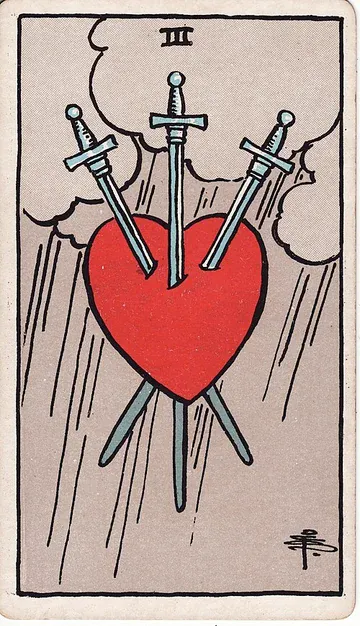
Three of Swords
The Three of Swords beside the Six of Swords names the wound on the original shore that the boat is now ferrying away from. The pierced heart upstream, the boat moving downstream toward smoother water — both visible in the same frame. The pairing affirms that the seeker is not pretending the wound did not happen; the wound is real, the wound is acknowledged, and the wound is being carried away from the location where it occurred. The healing is the crossing itself. Reversed alongside the Six, the pair often shows the wound that has not yet been processed and is therefore still open in the boat — the work then is the actual grief that was skipped before the leaving.
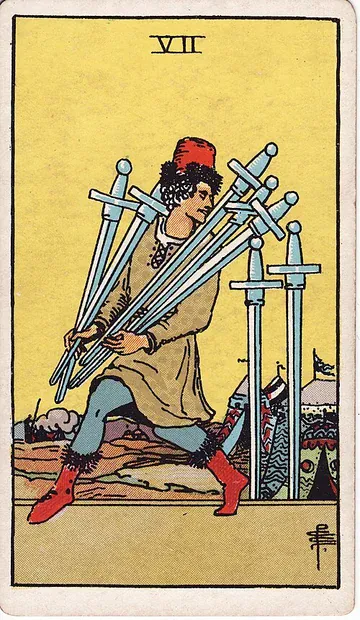
Seven of Swords
The Seven of Swords beside the Six asks what got smuggled aboard during the loading. The Six is supposed to be a clean crossing — six standing swords, accounted for, points upward, dignified. The Seven asks what you couldn't bring yourself to leave behind in the dark of the dock: the resentment wrapped in cloth and stowed under the bench, the secret carried without declaration, the version of yourself you should have left on the shore. The pairing is a question, not an accusation: is the boat carrying the right cargo, or is it carrying the cargo you could not bring yourself to refuse? The answer determines whether the crossing arrives clean or arrives with a problem already aboard.

Eight of Cups
The Eight of Cups beside the Six of Swords shows the same departure in two registers. The Eight is the voluntary leaving under a moon — the figure walking away from the cups by clear deliberate choice. The Six is the same departure poled across water — the boat carrying the figures who have made the choice into the crossing the choice required. Together they form the complete picture of an honest leaving: the inner consent of the Eight, the outer support of the Six, the moon and the river both witnessing the same forward motion. When both appear, the seeker is not just thinking about leaving; the leaving is in motion in both the heart and the practical world.
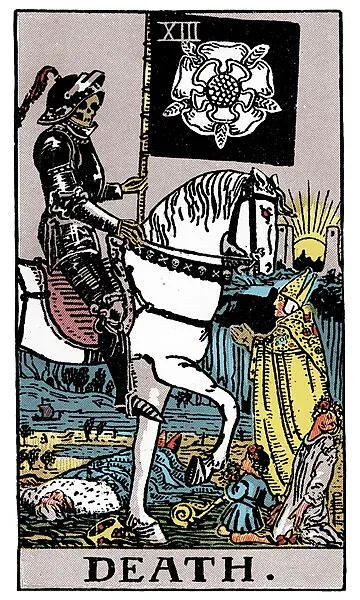
Death
Death beside the Six of Swords raises the crossing from logistical relocation to fundamental transformation. The Six on its own describes a workable transition; with Death alongside, the crossing becomes the kind that does not have an off-ramp. The ferry is not optional. The seeker who arrives at the far shore will not be the seeker who left the dock; the crossing will have changed them at the foundations. The pairing is sober and confirming at once. Death does not destroy the boat. Death affirms that the crossing is the correct crossing, and that the seeker who arrives on the far shore will be transformed enough to genuinely belong there. The previous self cannot make the journey; the previous self is what is being released into the river.

The Star
The Star beside the Six of Swords shows what waits on the far side once the asymmetric water finishes its calming. The Star pours her water back into the river under a clear night sky. The Six poles the boat across the same river toward her shore. Together they form the image of the long healing arc the card was always for: the crossing is not the destination, but the crossing makes the destination possible. The Star shore is where the swords being carried in the boat can finally be set down in a meadow and remain there as honored objects rather than carried weight. The combination is the deck's most generous reassurance that the crossing is in service of something genuinely better — that the patience of the boatman is rewarded by the receptivity of the Star.
Frequently Asked Questions
What does it mean when the boat crossed but the heart stayed on the old shore?
That is the signature failure of the inverted card, which describes the crossing that has stalled or turned back on itself. The boat that was supposed to push off does not, or pushes off and turns back, or makes the crossing physically while leaving the heart on the original shore. The card describes being neither here nor there — the unfinished departure, the premature arrival, or the new chapter being shaped by the unprocessed weight of the previous one.
Is the reversed Six of Swords a no, or an unfinished yes?
Unfinished, which is why it reads as a soft no — the no of a crossing that has not yet been completed cleanly. The thing being asked about is not impossible; it is currently not yet done, and the obstacles preventing the doing are real. Address the structural obstacle, then ask the question again. The answer will be different. The current configuration is the no; the cleared configuration may be the yes.
How should I read a partner who shares the new roof but still lives in the old room?
As mid-crossing rather than as dishonest. Reversed in love, the card describes the relationship that has technically ended but has not actually ended, or the one that is technically ongoing but has not made the necessary internal crossing. It can name the partner who is sharing the new roof with you while still living in the old room, or the connection that has stalled at an early stage because of unfinished business with a previous partner. The card asks for the honest naming of where the crossing has stuck.
Can their feeling be real while their availability is still partial?
Under this card, routinely. Reversed, it describes someone who is partially with you and partially still on the previous shore. Their feelings for you are real but their availability is incomplete — they are mid-crossing in their own life and the crossing has stalled. The texture is ambivalent forward motion. The card asks the seeker to read the partiality accurately rather than projecting full availability onto a half-present configuration.
Which of the swords in the boat should never have come aboard?
That is the question the inverted card hands the seeker, and it expects one of them to be left on the far shore. Do the small, specific work of unsticking the stalled crossing — cancel one recurring obligation that no longer serves, send away one object tied to the old chapter, ask for help if the crossing has stalled despite your best solo efforts. Naming the stuckness honestly is the start of the unsticking.