
Six of Wands · Core Meaning
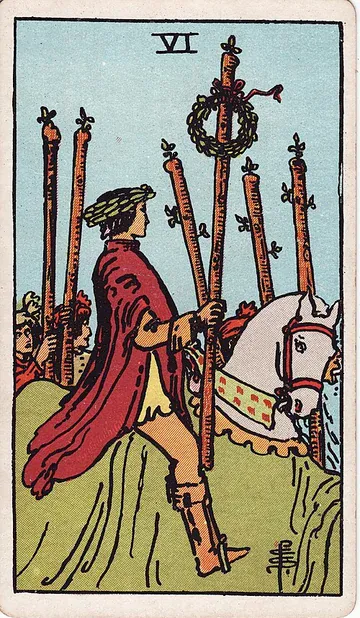
The Six of Wands is the procession card of the deck, and the procession is for you, but is not entirely about you. A rider sits astride a white horse draped in red cloth, a laurel wreath at the brow, the staff in his hand crowned with a matching ring of green. Walking alongside, a small company lifts five staves into the air at a single tilt; the angle of those five matches the angle of the staff he carries, and the line they make in the afternoon air is the real subject of the card. The horse is decorated, the rider is named, the road has turned home — but what holds the picture together is the choice the five made, somewhere back along the road, to march at his pace and angle their wood toward his.
The afternoon light is honey-colored. The town gate is visible at the far end of the road. No one is shouting. This is not a parade in the noisy sense; it is recognition, which is quieter than triumph and slower than applause. The Six of Wands tarot card meaning, when read carefully, lives in this gap between the two — between the event of victory and the aftermath of being seen for it. The card is not the moment you crossed the line. It is the half-hour after, while the body is still alert from the run, and a few of the people who watched you train are walking you home.
This is the card's signature tension: arrival and incompleteness in the same frame. The wreath is on the brow; the gate is not yet behind you. You have been recognized; you have not yet rested. The five staves are tilted in your favor; the five companions have their own roads to walk after this procession ends. Read the picture as a held breath — the breath someone takes after the news lands, before the next thing the news will require of them.
The traditional astrological signature reinforces this: Jupiter in Leo, the second decan, dated 8/2 to 8/11 in the tropical wheel. Jupiter is the planet of expansion and benevolent fortune; Leo is the king's fire, the heart at its most outward. Together, Jupiter in Leo is generosity wearing a crown — the king who lifts the room with the heat of his own warmth, who is rewarded not because he conquered but because he kept the company warm enough that they wanted to walk him home. Kabbalistically the card sits at Tiphareth in the world of Atziluth — Beauty, the central sephirah, where the forces of the Tree are gathered into a balance that can be seen by all. Fire arrives at the center. The will that began as a spark in the Ace, defended itself through the Five, is now collected into a shape the room recognizes.
Read the Six of Wands the way you would read a photograph of someone walking back into their hometown after a long absence — not the airport hug, not the wedding party, the half-block before the door. Whatever lives in that pause — relief, gratitude, the impulse to wave at every face, the impulse to look at the ground — is the six of wands meaning for that reading. The horse, the wreath, the laurel-crowned staff, the five tilted shafts, the gate at road's end: name them, and the card will read itself.
Six of Wands · Love & Relationships
In love readings, the six of wands love meaning describes the relationship that has stepped into public life. Whatever the two of you came through — the lean year, the long argument, the slow rebuild after the crisis no one outside knew about — the bond has now reached the part of the road where it can be seen. The procession is gentle. The applause is real. And the work the card asks for is to receive the visibility without losing the intimate version of the relationship that earned it.
For an existing partnership, the Six of Wands often arrives in the season of the engagement, the housewarming, the wedding the friends throw at the rented hall, the first family dinner after the long pandemic of low-key visits. The relationship is being witnessed by people who matter. The compliments are sincere. Aunts approve. Old roommates show up. There is a quality of vindication in this — the partnership had its critics in the lean years, and now the critics have either come around or gone silent. The card describes the afternoon walk back from the registry office, the cab ride home from the announcement party, the kitchen at midnight after the relatives leave. Both of you are tired and pleased in the way procession-tired pleases a body: not the high of the event, but the quiet warmth of being escorted home.
For a new spark, the Six of Wands love reading is unusual and worth dwelling on. The card means the new connection is the kind your friends will like. The first time you bring this person to the table the friends already trust, the table receives them without flinching. There is no sub-conversation in the kitchen later that begins with "are you sure." The new person fits, and the fit is publicly legible. This is rarer than people credit. Most early-stage relationships do not pass the friend-table test for months. When the Six arrives early in a courtship, the message is: this is the kind of person you can stand next to in daylight.
For a single seeker asking whether love is possible, the card answers yes, and adds a specific shape: the love is likely to arrive through the procession rather than away from it. Through the work-friends. Through the hiking group. Through the rehearsal you almost skipped. The card describes love that walks in alongside the rest of your life, not love that requires hiding the rest of your life to make room for it. Show up to the events. Stand in the line. Tilt your staff at the same angle as the people you trust, and someone will eventually appear walking the same direction.
For love after a wound, the Six of Wands is the slow, deserved card of being trusted again. The grief did its work. The quiet year of unglamorous repair did its work. The friends who held your hand through the worst of it are now the friends who hold your other hand into the next chapter. The card is the procession that did not exist in the lean year, when no one wanted to tell you anything good was happening to them because they did not want to flaunt it. Now they are walking you home. Receive it. Say thank you out loud.
A note on long-distance and cross-cultural relationships: the Six of Wands favors the bond that has been seen by both communities. If only one half of the relationship's family or friend-group has ever met the other, this card asks for a procession on the other side too. Bring the partner home. Take them to the wedding. Sit at the unfamiliar table. The card responds to the bond that has been carried at one angle by two sets of people walking from different directions toward the same gate.
For pursuer-distancer dynamics — when one of you has been quietly carrying more visibility-work than the other — the upright Six of Wands warns gently against confusing the procession for the relationship. The applause is for both of you. The walk is for both of you. If one of you keeps stepping forward to take the wreath while the other is off to the side, the bond will eventually mistake itself for an audience. Share the visibility. Hand the laurel back and forth.
For mismatched-desire and household-constraint readings — children, in-laws, cohabitation logistics, the long compromises of grown-up love — the Six of Wands signals a passage of mutual recognition. The compromise has been worth it. The thing you each gave up has built the thing you now share. The card is the dinner where the in-laws say the right thing for the first time, the year the kids stop being a problem to manage and become people you both clearly love.
For the question of public-versus-private — should the relationship be announced, posted, named — the Six is the rare card that says yes, when the relationship has earned it. Not the new-fling Instagram post. The slow, deserved announcement that arrives only after the bond has been tested. If you are asking whether to make the relationship public, and the Six arrives upright, the answer is that the procession is already underway, and your job is to step into the road it is making for you, not to keep the bond hidden out of habit.
If the question is whether someone is in love with you, and the Six of Wands arrives upright, read it as a yes that has been ratified by witnesses. The friends who watch them have watched the change. The colleagues who have watched the way they talk about you have noticed a shift. They are not hiding the feeling. They are carrying it the way you carry a wreath you did not weave for yourself — proudly, but with a small awareness that the weaving was done by something larger than just the two of you.
Six of Wands · As Feelings
Proud-of-you warmth is a category of its own, and the Six of Wands is the card that carries it. The person on the other end of the question is not in the dizzy phase. They are in the phase where their pride in you has begun to overlap with their affection for you, and the two are no longer separable. They feel like the friend who watched you train and now watches you cross the line. They feel slightly responsible for your success in a way they would never admit out loud. They feel honored to be near you.
If they are reserved by nature, the Six of Wands as feelings means their silence is an act of stewardship rather than withholding. They are not advertising the relationship at work. They are not posting. They are not telling everyone. But when they meet someone who knows you — even peripherally — they speak about you in the warm register of someone who has noticed your road. Read silence here as careful, not cold. They are protecting the procession from the noise of the street. They want the company the two of you keep to remain dignified.
If they are demonstrative, the card as feelings means they are looking for occasions to walk you publicly. They want to be at the dinner. They want to introduce you to the parent who matters. They want to be seen in your company because being seen with you reflects something they are quietly proud of in themselves: that they were the one chosen to walk alongside this version of you. There is no insecurity in this — only a slow, public love that has earned its visibility.
For a long bond — a marriage, a years-deep friendship, a working partnership that has weathered three industries — the Six of Wands in feelings means the affection has stabilized into respect. They no longer need to test you. They no longer measure you against the version of you they imagined. They have arrived at the actual you, and the actual you is someone they would walk a long road for. This is what mature love looks like in a deck that does not always know how to draw it.
For a new connection, the card as feelings can mean they have decided you are someone worth telling their friends about. They are introducing you to their inner circle. They are bringing you to the events. They are building you, in their own social fabric, as the person they want to have arrived in their life. The signal is clear and not coy. They feel like they have been recognized, by their own life, for being the kind of person who would attract this kind of partner — and the recognition is part of how they feel about you.
For reconciliation after a conflict — an argument, an estrangement, a slow-drift that ended in not speaking — the Six of Wands in feelings can describe the moment one person has decided to walk back toward the other in a way that the rest of the room can see. Not a private apology. A public re-acknowledgment. They want the friends who knew about the rift to also know about the repair. They are not hiding the return.
For distance — physical separation, time-zone-stretched courtship, the long winter of texts only — the card as feelings means they are talking about you in your absence. The mutual friends know. The colleagues at the new job know. The roommate they barely speak to knows. You are part of the procession of their daily life even when you are not in the room.
For cultural or life-stage differences — the partner from another country, the friend from a different generation, the person whose way of loving doesn't match the script you grew up with — the Six of Wands as feelings asks you to read their love through their public gestures rather than their private ones. They may not say the words. They will introduce you to their grandmother. They may not text often. They will fly across an ocean for the wedding. Read warmth in the shape of the procession they make for you, not in the shape you expected.
A small caution embedded in the upright reading: the Six of Wands feelings can sometimes mean the other person feels admiration that has not yet quite become attachment. They love who you are; they have not yet decided whether they love being yours. This is not a problem when the bond is new. It becomes a problem if it stays this shape forever. If the procession is generous but the private intimacy stays thin, ask gently — over time — whether the public bond is being used to substitute for the private one. The card responds well to that question, asked plainly.
If you came to the Six of Wands as feelings looking for a verdict, here is the texture: pride that has warmed into love, witness that has crossed into commitment, a feeling steady enough that they no longer mind being seen carrying it. They are walking you home. They are tilting their staff at your angle. The procession is honest.
Six of Wands · Career & Work
In career readings, the Six of Wands upright is the card of public recognition — the promotion that gets announced at the all-hands, the project that wins the award, the byline that finally gets noticed by the right desk, the title change that arrives with a ceremony rather than a quiet email. The card describes the moment your work is named in front of the people whose naming matters. It is the closest the Minor Arcana comes to a coronation card, and the coronation here is small, warm, deserved, and slightly terrifying for those who built the work in privacy.
For someone in a current role asking whether the role will turn out well, the Six of Wands answers with vindication. The work is being seen. The people you have been quietly impressing for two years have finally said it out loud, in a room with other people, in a way that goes on a record. The role is doing what you needed it to do. There is a quality of "at last" in the card when it appears at work — the long stretch of being the most-undercredited member of the team has ended. The card is the first quarterly review in which someone other than you names the contribution you have been making.
For a promotion specifically — the most card-shaped career question — the Six of Wands is one of the deck's clearer yes-omens. The signal you have been waiting for is on its way; or, if it has just arrived, the card confirms that the ratification is real and the colleagues who matter agree with the decision. Take the promotion. Wear the new title without apology. The card warns specifically against the impulse to undercut your own win in conversation — the false-modest reflex that says "oh, it wasn't really me, the team did all the work." There is a more honest move available: name the team explicitly and hold the title proudly. The Six of Wands does not ask you to choose between the wreath and the company. The whole point of the card is that the wreath honors both at once.
For someone considering a new role, the Six of Wands upright is a green light with a precise condition. The new role will give you the visibility you have been quietly hoping for. Yours is the name spoken in meetings you used to attend silently. The work you did in the last role will be cited in the new role's onboarding. Take the offer. The condition is that visibility, once granted, becomes a tax — your name attaches to the failures as well as the wins, and the procession that walks you in will also walk past you on its way to escorting someone else later. Accept the role with both hands open. Do not clutch at the title.
Entrepreneurs and freelancers should read the Six as confirmation that the brand has reached the part of its road where the audience is doing some of the carrying. The product is being recommended. The clients are referring you. The newsletter is being forwarded. The card describes the stretch of the small business where you stop having to push the marketing every week, because the people you have served are walking the marketing for you. Take the victory lap. Acknowledge the testimonials. Say thank you to the early customers — by name, in public, in a way they will see.
For creative workers — writers, painters, musicians, anyone whose work has a public surface — the Six of Wands upright describes the season of being read, watched, listened to in a way that crosses into recognition. The book is reviewed in the right place. The show sells the necessary number of tickets. The piece is shared by the editor who has the audience that matters to you. The card does not promise fame. It promises being met. Your work has reached the company who can carry it. They are tilting their wood at your angle.
For students, apprentices, and early-career seekers, the card is the small public moment that often turns out to matter — the conference talk that goes well, the paper that gets cited, the internship that ends with a recommendation letter from the person whose name opens doors. The procession at this stage of a career is small, but it is the procession that will walk you the rest of the way. Pay attention to who is in the company. Remember each name. The five staves at one angle are easier to count when the road is still short.
For managers and leaders, the upright Six asks a specific question: are you walking your team as a procession, or are you walking your team as a parade? A parade requires an audience and a star. A procession requires a company who chose to walk at one angle. The card validates leadership that earns the company's tilt rather than commanding it. Look at the people walking with you and ask whether they tilted their staves freely. If the answer is yes, the card confirms the leadership is real. If the answer is no, the card warns gently that the procession is only as long as your title's reach.
For care, teaching, and ritual workers — the people whose work is mostly invisible by design — the Six of Wands describes the rare day when the work is named. The patient sends the letter. The student returns years later to say the class mattered. The community gathers around the elder who held them quietly through the long winter. The card respects this kind of recognition specifically: it does not require performance, only that the work eventually be witnessed by someone in a position to say so out loud.
For layoff and transition readings, the Six of Wands upright is unusual but legible. The transition is being walked publicly; the people who watched your work are willing to recommend you, refer you, walk you into the next room. Cash in the visibility. Ask the people who have witnessed your work to say so on the record. The card warns that hiding the transition out of pride will cost you the procession. Let the company carry you across the gap. That is what they are tilting their staves for.
For cross-functional teams and collaborative careers, the Six of Wands describes the project whose success was shared rather than seized. Read the card as a signal to make the credit explicit in writing. Do not assume the company will remember who carried what. Write it down. Name the names. The procession survives in the documentation; the parade evaporates the day after it ends.
A note on stability: the Six of Wands is not the next mountain. It is the rest stop with a view of the gate. The card after this one in the suit is the Seven of Wands — the defense of the position you have just won. Use the Six's afternoon to gather the company's names, refresh your alliances, write the thank-yous. The next chapter will require you to know who is still walking with you.
Six of Wands · Money & Finances
Money in the Six of Wands arrives with witnesses attached — the bonus announced at the team lunch, the raise that catches up with three years of underpayment, the contract that gets re-priced upward after the project lands, the invoice that finally clears with the round number you originally quoted. The card is rarely about windfall. It is about the slow ratification of value you have been quietly carrying without it being matched by the numbers on the page.
For someone in a salaried role, the Six of Wands is the card of the deserved correction. The market has noticed. The internal benchmarks have caught up. The conversation with the manager goes well, and the new offer letter shows up shortly after. There is a quality of "finally" in the card around money: the gap between what you have been earning and what your work is worth is closing, in a way that is visible to people other than you.
For freelancers, consultants, and the self-employed, the upright Six describes the season when your rates can rise without losing the clients. The portfolio has reached the point where the procession of past work argues for the next price. Raise the rate. The clients who walk on can be replaced by clients walking toward you on the strength of what the procession shows. The card supports the upgrade.
For someone considering a financial bet — an investment, a loan, a major purchase — the upright Six is a guarded yes. The bet is sound if it is a bet on the work that has already been seen. Buy the house in the neighborhood you have been renting in for five years and now know. Invest in the small business of the friend whose work you have watched mature. Take the loan that funds the next phase of the practice that has already reached recognition. The card warns against bets on procession that has not yet started — the speculative trade in something you have not earned the right to read.
The Six's signature trap with money is the parade-spend: spending in the shape of the visibility rather than in the shape of the life. The promotion arrives, and the new car follows; the bonus lands, and the watch appears on the wrist. None of these are wrong, exactly. The trap is that the spending becomes a costume the procession puts on, and a year later the costume costs more to maintain than the procession itself can carry. Receive the recognition financially. Save into the structure of the life. Let the visible spend be small enough that the invisible foundation is the actual beneficiary.
For debt and recovery questions, the Six of Wands is one of the kinder cards in a long financial winter. The card describes the season when the climb out of debt becomes legible to others — the friends who held your hand through the lean year see you pick up the check at the dinner; the family member who lent you money receives the repayment with the small note; the credit score finally crosses the threshold that opens doors. Acknowledge the people who walked the lean road with you. The recognition is part of what closes the chapter.
For windfall readings — inheritance, prize money, unexpected payouts — the Six of Wands upright is calmer than the wish-card cards. It frames the windfall as a public event the procession is helping you navigate. Tell the trusted advisor. Bring the lawyer. Walk the windfall through the company of people who have walked your money for you in the past. Solo windfall management is one of the card's specific cautions; the procession exists for a reason.
For someone managing money inside a couple or family, the Six describes the conversation that finally brings the financial reality of the relationship into the open. The savings get named. The debts get named. The plan gets agreed. The visibility itself is the work; the numbers fall out of the visibility being honest. The card supports the awkward but worthwhile conversation, especially after a long stretch of avoidance.
A practical financial move when the card appears: write a list of every person who has materially helped your work reach the current level — the colleague who recommended you for the role, the mentor who introduced you to the editor, the friend who covered the rent in the bad month. Send each of them a real, specific thank-you, in writing. The Six of Wands as money is the card of the procession's named beneficiaries. Living on the procession's labor without naming it back curdles into the reversed card faster than people credit.
Six of Wands · Health
A body that has been cared for quietly becomes a body that can carry a public day, and the Six of Wands is that turn — cardiovascular vitality, energy returning, heat with somewhere to go. The element is fire; the body part is the liver and the blood. The temperament is choleric, outward and hot. The card describes the body that has come through a season of quiet repair and is ready to walk into a room without arriving exhausted.
If you are asking about recovery from an illness, a procedure, or a long stretch of low-energy living, the Six answers yes — the body is responding. The labs are improving. The energy is returning at the right rate. The appetite for the next thing has come back. The card describes the morning of the first walk after the long convalescence, the first dinner with friends after the months of being too tired to host, the first workout that felt like the body welcoming the work rather than enduring it.
For chronic conditions, the Six of Wands describes the well-managed plateau — not cure, not the disappearance of the issue, but the stretch where the management is working publicly enough that you can plan around it. Take the trip. Host the gathering. Schedule the surgery in the season where your support network can walk you through the recovery. The card is asking you to use the visibility of the good stretch to make commitments your future self will be glad you made.
The card's particular health signature is the heart and the liver — the cardiovascular system, the blood, and the metabolic seat that processes both literal toxins and figurative ones. Watch for the body that is being asked to publicly perform vitality before its private reserves have actually refilled. The Six of Wands' shadow side, in the body, is the burned-out high-performer who has accepted the procession as the new baseline and has stopped sleeping enough to keep the procession running. Read the card as permission to rest in the afternoon shade between the procession and the gate. The road is not over yet. You have not arrived. Conserve.
For acute issues — the sudden flare-up, the symptom that appeared this week — the Six of Wands is calmer than most fire-cards. The acute condition is most often responding to treatment, and the social support around it is real. Take the meds. Show up to the appointment. Tell the friend who would want to know. The card warns against the heroic-solo move with acute health: you do not need to walk this stretch without the procession.
For mental health, the Six of Wands upright is one of the deck's clearer good-news cards. The depressive season has lifted; the anxiety has loosened; the therapeutic work has begun to bear fruit publicly. The card describes the morning the friends notice you are back — not because you announced it, but because something in the way you held the room has changed. The energy is returning. The light has reached the eyes. None of this is medical advice — keep your practitioners, take your medication, follow the plan your team has built with you. The laurel only records that the effort has begun to show where other people can see it.
For someone managing the body in mid-life — perimenopause, andropause, the long recalibrations of the forties and fifties — the Six of Wands describes the quiet success of the practice that finally fits. The eating that works for this body. The exercise that respects the joints. The sleep that the new schedule actually allows. The card is the procession of small lifestyle decisions that have accumulated into a daily life that the body can sustain into the next decade. Honor the practice. Do not let the procession's visibility tempt you back into the punishing routines of an earlier age.
For the body's relationship to performance — athletes, dancers, public speakers, surgeons, anyone whose work asks the body to perform on cue — the Six is a green light with a specific instruction: warm up properly, rest properly, and let the company around you do their share of the carrying. The card warns against the soloist's habit of carrying the whole performance through sheer adrenaline. Tilt your wood at the same angle as the team. Let the team walk you toward the gate.
Six of Wands · Spirituality
Spiritually, the Six of Wands upright sits at Tiphareth in the world of Atziluth — at the center of the Tree of Life, in the world of pure emanation. Tiphareth is Beauty, the sun-heart of the Tree, the place where the forces of Will and Mercy and Severity gather into a balance that can be seen by the rest of the room. The card's spiritual question is whether the seeker can occupy the center without confusing the centrality for personal achievement. The wreath at the brow was woven by the company. The horse was saddled by hands other than yours. The road was walked by feet that included your own among many.
For seekers in active practice — meditation, journaling, ritual, devotional work — the Six of Wands means the practice has reached the part where it has become legible to others. The friend at the dinner notices you are calmer. The teacher passes the next teaching. The community begins to ask you to hold space rather than only attending the spaces others hold. This is delicate territory. The card validates the recognition; it also asks you to remember that the practice is the practice, and the recognition is a side-effect that can become a substitute if you are not careful.
For seekers exploring belief — those rebuilding a cosmology after rejecting the one they grew up in, those returning to a tradition they had walked away from, those crafting a syncretic practice from many sources — the Six describes the season when the belief begins to carry you in public. You can sit at the table where the question of God is asked and answer without flinching. You can tell the family member who scoffs without losing your footing. The belief has arrived at a shape you can be seen with. The card warns gently against making the procession the practice — against turning your spirituality into something you mainly perform. Keep a private altar. Keep a discipline that only you know about.
The card's spiritually-weighted symbol is the laurel-crowned staff — your tool, granted a second form. The staff was the instrument of the Ace, the will that started this road. Now it has been crowned by the procession. It is no longer only yours; it is also a sign that can be received and returned, given to the next person who walks this road, used to walk someone else home. The spiritual work the card asks for is the willingness to hand the staff back when the procession is not yours to lead. Carrying a wreathed staff for too long, when the road has actually turned away from you, is one of the surer ways to lose touch with the Ace's original spark.
For questions about path, the Six of Wands answers that you are walking the right one and that the road is being walked alongside you by the right company. The work is to keep the company. Do not abandon the friends who walked the lean year for the new friends who arrived in the recognition season. The lean-year friends are the ones still tilting their staves at your angle; the recognition-season acquaintances are tilting toward the procession itself, and they will tilt the same way for the next person tomorrow.
A real practice the card invites — doable in thirty minutes, this week: write a list of five people whose tilted wood has carried you to where you are. Light a candle. Read each name aloud. Sit in silence after the last name for five minutes. End by writing one short note to one of them — not the most distant, not the most recent, the one whose name surprised you most when you read it on the list. Send the note. The Six of Wands as spiritual practice is the card of named gratitude, and named gratitude has weight that anonymous gratitude does not.
Six of Wands · Yes or No
Yes — and the yes will be public.
When seekers ask the six of wands yes or no question, the upright card is one of the clearest yes-cards in the deck. As the procession card, it confirms not only that the answer is yes but that the answer will be witnessed. What you are asking about is on the way, has arrived, or will arrive in a form the people around you can see. The yes does not happen in private. The yes is the kind that gets announced.
Asked about a relationship, a job, a move: yes — and the yes will have witnesses on it. The path you are considering is the right one, and the road has already begun to be walked alongside you by the company that will carry you home. The person you are asking about cares, the opportunity is real, the move will be ratified. There is no hidden trap. The card has no shadow in the upright orientation.
Asked whether a person is being straight with you or an offer has substance behind it, the Six of Wands says yes and does not qualify it. The procession is real. The applause is real. The wreath at the brow was woven by people whose intentions are not concealed. The procession has no second column walking behind it.
The conditioning embedded in the yes is that you must receive it. The Six of Wands' yes is wasted on the seeker who refuses the procession out of habitual modesty. The yes only delivers if you step into the road being made for you. If you flinch — if you decline the title, hide the relationship, postpone the move because the visibility frightens you — the yes does not become a no, but it does not become a yes either. The yes lives in the cooperation you bring.
Asked how soon the procession reaches the gate, the Six of Wands upright suggests yes, within the same season. The procession is already moving; the gate is already visible at road's end. The arrival is not instant. It is the last stretch of a road already walked. Days to weeks for small decisions. Weeks to a season for larger ones. The body of the journey is behind you.
For binary questions about whether to act — should I take the offer, should I send the message, should I accept the recognition — the Six of Wands upright is unambiguous: act. The card warns specifically against the false-modest decline. Saying no to a deserved yes is one of the surer ways to dishonor the company that walked you here. They tilted their wood. The least you can do is step under the gate they are pointing at.
Some seekers are quietly asking whether the recognition is deserved. The card answers yes, and adds: the question of deserving is the wrong question. The procession is not a verdict on your moral worth. It is a recognition of the road you walked, the staves you held, the company you kept. Take the wreath. The deserving sorts itself out in the years of carrying it well.
Six of Wands · Advice
Receive the wreath without flinching and without overclaiming — the Six of Wands asks for both in the same breath. Both halves of that instruction matter equally. The seeker who flinches at the procession sends the company home confused; the seeker who overclaims the wreath turns the procession into a parade and loses the company by next season. The middle path is to stand straight on the horse, hold the laurel-crowned staff at the angle the five staves match, and remember each face walking alongside you.
If there is one specific instruction the card offers, it is to name the company. Out loud. By name. Not "I couldn't have done this without my team" — that is the parade version of gratitude, and it costs nothing. The Six of Wands advice is to write down five names: the colleague who covered for you in the lean season, the friend who recommended you for the room you are now standing in, the mentor whose phrase you keep using, the partner who held the household together while you trained, the elder whose teaching unlocked the work. Write each name. Send each name a specific note that quotes the specific thing they did. Do this within the week the card appears. Named gratitude is the practice the card most reliably responds to.
A second instruction: do not skip the procession. The seeker who has finally reached the moment of recognition often has a long history of declining recognition out of either humility or self-protection. The card asks for the harder, more dignified move — sit on the horse, ride into the gate, accept the wreath. Cancel the meeting that would conflict with the ceremony. Show up to the dinner the team is throwing. Wear the title. The card warns specifically that the seeker who skips the procession out of false-modesty is, in the long arc, the seeker who eventually loses the company. You cannot keep tilting the staves of people whose recognition never comes back to you.
A third instruction: tilt your own staff toward someone else's procession this week. The Six of Wands is reciprocal in its deepest reading. The seeker who has been carried must, when the season comes, also carry. Look around at the other people in your life whose road is at the same stretch yours was three years ago. Show up for their announcement. Endorse their work in writing. Recommend them to the editor, the casting director, the hiring manager, the agent. The card returns to the deck refreshed when the procession's logic flows in both directions.
A fourth instruction, slightly contrarian: stay alert for the procession that is not yours. Sometimes the Six of Wands appears upright in a reading where the recognition being handed to you was actually earned by someone else. This is rare in the upright card and common in the reversed — but the upright still asks for the small honest check. Did the work you are being praised for actually belong primarily to someone else? If so, redirect the wreath. Public credit-redirection is one of the rarest and most generative spiritual moves available in a career, and the Six of Wands upright is the card that supports it.
Practical advice for the day the card appears: stand up straight. Wear something the procession would recognize you in. Send one thank-you note in writing — actual paper, actual stamp, actual mail. Walk somewhere visible to the people who would want to see you walking. Sit at a table where the company knows your name and let them speak it. The card responds to active reception. Passive reception is the seed of the reversed card. Move.
Six of Wands · Card Combinations
Six of Wands + Five of Wands
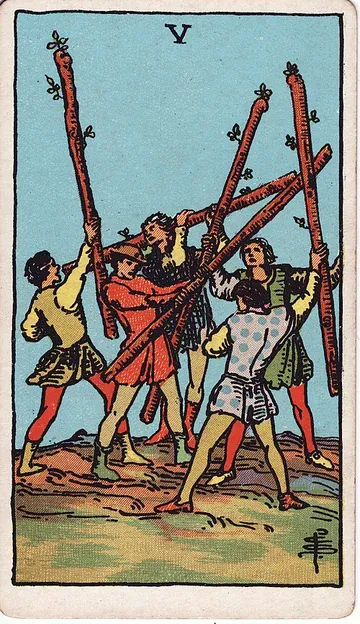
The chaos before the procession. When these two cards appear together, the reading describes the resolution of conflict into recognition — the team that argued, fought, and eventually figured it out is now being honored for the work the conflict produced. The combination is the morning after the difficult board meeting, the season after the messy collaboration, the year the band stopped hating each other and finally toured. The instruction is to remember that the procession is being walked by the same five people who, six months ago, were swinging their staves at each other. Generosity in recognition is the only thing that prevents the next conflict.
Six of Wands + Seven of Wands
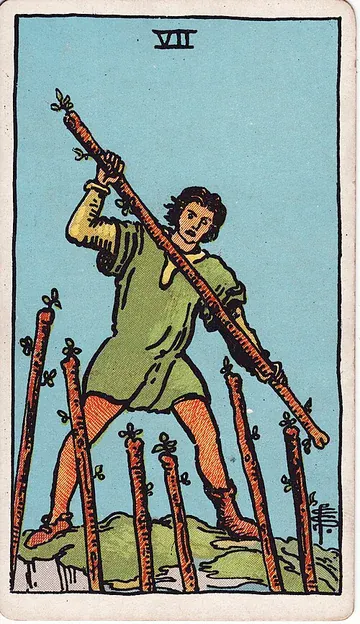
The procession that is about to require defense. The Seven of Wands is the card of holding the high ground against challenge, and it follows the Six in the suit's natural sequence. When the two appear together, the recognition has just landed, and the next chapter — sooner than you expected — will require you to defend the position. Spend the afternoon of the procession well. Rest. Eat. Name the company. Write down what you learned on the road, because next week, someone will ask you to defend the road's value, and the better you remember it, the more effortless the defense will be.
Six of Wands + Six of Cups
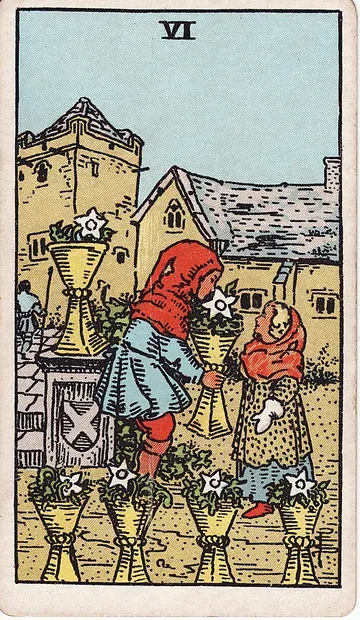
Sibling sixes, in tonal contrast. The Six of Cups is the private return — the inner-child memory, the visit home, the pleasure of being known by people who knew you when you were small. The Six of Wands is the public return — the procession through the town, the recognition by the people you had to leave home to earn. Together, the two sixes describe a homecoming that succeeds on both registers: you walk into the public square with the wreath, and then you walk into your grandmother's kitchen and eat the same bread you ate at six. The combination warns against choosing one register and abandoning the other. The procession honors the public arrival. The cups honor the private one. Both are necessary.
Six of Wands + The Chariot
The outer triumph card next to the public-recognition card. The Chariot was the moment of conquest; the Six of Wands is the moment after, when the city receives you. Together they describe a victory that has been earned through outward, willed action and is now being met by the world's acknowledgment. The combination warns gently against confusing the two: the Chariot's drive is not the Six's procession. The Chariot pushes; the Six is carried. Trying to keep pushing during the Six's afternoon exhausts the company. Lay down the reins. Accept the wreath. Let the horse, finally, be led.
Six of Wands + The Sun
The deep summer combination. The Sun is the laurel-crowned wreath at full noon; the Six of Wands is the procession walking under it. Together the cards describe a season of unambiguous good — recognition arriving in clear daylight, with no hidden cost, witnessed by people whose witness is itself a gift. The combination is rare and worth honoring when it appears. Do not rush past it. Sit in the high-summer afternoon. Let the laurel be exactly the symbol it is. The card after the next card may bring complication; this card is permission to be, briefly, simply happy.
Card Combinations
Five of Wands
The chaos before the procession resolved into recognition. What was a tangle of staves at conflicting angles has become a tilt at one angle. The team that argued, fought, and figured it out is now being honored for the work the conflict produced. Generosity in recognition is the only thing that prevents the next conflict from forming.
Seven of Wands
Recognition that will require defense in the next chapter. The Six's procession has just landed; the Seven asks whether you can hold the high ground from challenge. Spend the procession's afternoon well — rest, name the company, write down what you learned. Next week's defense will be effortless in proportion to how clearly you remember the road.
Six of Cups
Sibling sixes in tonal contrast — public return meeting private return. The procession through the town opens the gate; inside the gate, the grandmother's kitchen waits with the bread you ate at six. The combination honors a homecoming that succeeds on both registers and warns against choosing only one. Both arrivals are necessary.
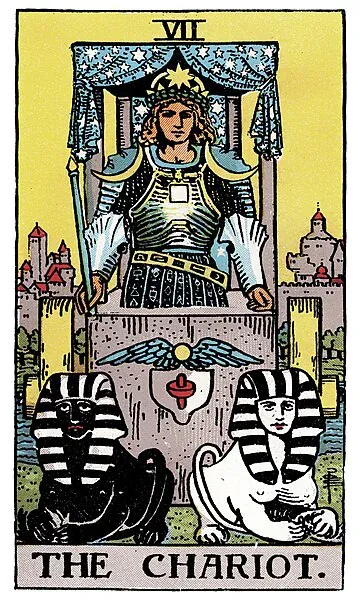
The Chariot
The outer triumph card meeting the public-recognition card. The Chariot was the conquest; the Six is the moment after, when the city receives you. The Chariot pushes; the Six is carried. The combination warns against confusing the two: lay down the reins, accept the wreath, let the horse, finally, be led toward the gate the road has earned.

The Sun
Deep summer at full noon. The Sun is the laurel-crowned wreath at high light; the Six is the procession walking under it. Together the cards describe a season of unambiguous good — recognition arriving in clear daylight, witnessed by people whose witness is itself a gift. Do not rush past it. Let the laurel be exactly the symbol it is.
Frequently Asked Questions
What is the six of wands tarot card meaning in a reading?
The six of wands tarot card meaning, in any reading, is public recognition arriving for a road already walked. A rider in laurel sits on a white horse while five companions tilt their staves at his angle. The card is the half-hour after the win, the procession back into town. It signals victory ratified by witnesses, with the work of receiving cleanly and naming the company who carried you.
Does the Six of Wands mean the yes gets announced?
It does, and that is not incidental to the answer — it is the shape of it. The Six of Wands is one of the deck's clearer yes-cards, and its yes arrives witnessed: said out loud at the all-hands, put in writing where others can see it, ratified by people whose opinion has weight in your life. So it supports every decision that steps into visibility. Take the offer. Accept the title. Let the relationship be named in front of the people it will have to live among. The one condition attached is reception. A procession only works if the rider rides into it; the seeker who hides from the announcement, deflects the credit, or waits to be asked twice sends the whole company home confused.
What is the friend-table test the Six of Wands applies to a relationship?
It is the card's quiet standard: how the bond holds up at a table full of people who know you well. The Six of Wands describes love that has stepped into public life — the engagement, the housewarming, the introduction to the family whose opinion actually counts — and the test is whether the two of you are the same people there as you are alone. A bond that shrinks in front of your friends, or that requires a different version of you at the table, has not passed. For a newer connection, the card confirms it has. For someone single, it suggests love arriving through your existing communities rather than from somewhere outside them. For a long partnership, it names the season in which the bond becomes legible to the people who watched you both grow.
Six of Wands feelings: is being admired the same as being loved?
Not the same, and in this card not separable either. The Six of Wands describes proud-of-you warmth crossed with affection — someone who watched the road you walked and now walks beside you on it, feeling a little honored to be there. Admiration on its own can sit at a distance and stay comfortable. What makes this card's version love rather than spectatorship is that the person has joined the procession: they carry part of the weight, they say your name to others, they include you in the ordinary traffic of their week. Reserved people steward the bond carefully in public. Demonstrative people look for occasions to walk you through their world. The reliable tell is whether their daily life has you in it when you are not in the room.
Which cards combine well with the six of wands?
The six of wands pairs strongly with the seven of wands (next-chapter defense), the five of wands (chaos-resolved-into-recognition), the six of cups (public homecoming meeting private one), the chariot (outer triumph followed by being received), and the sun (deep-summer unambiguous good). Each pairing reads the combined image rather than two separate readings, so a six-of-wands-plus-tower means recognition that breaks what no longer fits, not two unrelated cards.