

Six of Wands Reversed · Core Meaning
The Six of Wands reversed is the procession that has set out before the wreath has actually been earned. The horse is still draped, the rider is still smiling, the company is still walking — but the road behind them is shorter than the wreath suggests, and somewhere in the rider's chest there is a small, private knowledge that the laurel was woven ahead of time. Or, in the second reading the reversed card carries: the procession is honest, the work was real, but the wreath has been placed on the wrong brow — the rider is not the one who actually walked the road. Either way, the tilt of the five staves now reads as a question rather than an answer. Whose angle is this? Whose road did this procession actually walk?
This is the reversed card's central knot: applause without the substance to receive it cleanly. The figure on the horse hears the cheers, but the cheers do not yet correspond to anything that can be called done. The promotion came before the project landed. The book was praised before the manuscript was honest. The relationship was announced before the two of you had finished the conversation that would have changed what the announcement meant. The six of wands reversed meaning, when read carefully, lives in the gap between the visibility and the substance — the moment when one has outrun the other, and the seeker has to choose whether to slow the procession or to keep walking and hope the substance catches up.
There is a second flavor of the reversed card, equally common. The procession is real, the work was real — and someone other than you is the actual author of the road being celebrated. You are seated on the horse. The wreath is at your brow. The five staves are tilted toward you. And privately, you know, or are beginning to know, that the work was carried by a colleague, a partner, a former boss, a co-author, a teacher, a junior team member whose contribution has been quietly subsumed into yours. The reversed card asks whether you are willing to step off the horse and place the wreath where it belongs.
A third reading: the procession is honest, the wreath is yours, but the audience has begun to doubt. The applause is thinning. The five staves are still tilted, but two of them are looking at each other rather than at you. The reversed card can describe the season when public recognition begins to erode — not because the work has changed, but because the audience's attention has drifted, the political climate has shifted, the cultural moment has moved on. This is a particularly painful reading and worth naming explicitly: not all reversed Six of Wands moments are the seeker's fault. Sometimes the procession ends because the audience is no longer there.
The astrological signature reverses too. Jupiter in Leo upright is generous expansion crowned by the heart's warmth. Reversed, it becomes performance without containment — the king's fire turned into spectacle, the laurel worn for the audience rather than because the road was walked. Leo's shadow is the need to be seen at any cost. Jupiter's shadow is excess. Together, in the reversed Six, the combination describes the seeker who has begun to substitute the look of arrival for the substance of arrival, and is now uncomfortably aware of the substitution.
Reversed, the Six of Wands asks: is this procession actually for you? And: does the wreath belong on this brow? And: is the company tilting their staves toward the road you walked, or toward the road they wish you had walked?
Six of Wands Reversed · Love & Relationships
A bond can be paraded long before it has been ratified, and the reversed Six of Wands is where the parade got ahead. The procession through social life — the introductions, the announcements, the photographs — has outrun the slower, quieter conversations that would have ratified the bond from the inside. The relationship looks beautiful in the family group chat. Sitting alone with each other on a Tuesday night, both of you can feel that something has not yet been said.
For an existing partnership, the reversed Six often describes the season when the public version of the relationship has become more elaborate than the private version. The wedding was lovely. The anniversary photos are widely admired. The friends speak well of you both. And in the kitchen at midnight, the conversation that the wedding was supposed to seal has not actually happened. The procession is real; the substance is incomplete. The card asks whether the visibility of the bond has been used to substitute for the labor of the bond. This is not a verdict on the relationship. It is an invitation to slow the parade and finish the conversation.
For someone in a new connection, the reversed card warns of the partner — or the seeker themselves — who is rushing to make the bond public before the bond has actually formed. The early-stage Instagram post. The introduction to the family in the second month. The label applied before the relationship has been lived. None of these are inherently wrong. The card asks whether the public visibility is being used to create the bond rather than to honor it. If the announcement is doing the work the relationship has not yet done, the procession is reversed.
For the question of whether someone is in love with you, the six of wands reversed love reading is precise. They feel something that they want to be seen feeling. They are performing affection for an audience as much as for you. This is not always insincere — many people learn to feel by seeing themselves feel — but the card asks for honesty about whether their feelings are being directed at you or at the version of themselves that is in love with you. Watch for the partner whose private behavior toward you does not match their public posture.
For reconciliation after a break, the reversed Six is one of the deck's gentler warnings. Returning to the relationship would require a procession of public re-announcement before the private rebuilding has actually happened. The friends would receive the news. The family would celebrate. And the two of you would walk into the same room you walked out of, with no new conversation having actually been had. The card asks: do you want this person, or do you want to be visibly back together with this person? A laurel and a partner are not the same prize, and only one of them rides home with you. If the answer is the visibility, the card warns gently against the reconciliation. If the answer is the person, the card asks for the slower, less-celebrated path: rebuild privately first, and let the procession follow if it wants to.
For the single seeker, the reversed Six can describe the loneliness that has begun to perform fine-ness for the social media audience. The single life looks excellent in photographs. The dinners are well-curated. The travel is well-documented. And the card asks, gently, whether the procession of the visible single life has begun to substitute for the actual life. The wreath of solo achievement is real; the question is whether you have been wearing it long enough that the desire for partnership has been hidden underneath.
For long-distance and cross-cultural relationships, the reversed Six warns of the bond that exists most vividly online and least vividly in the room. The texts are constant. The video calls are warm. The mutual friends know about the relationship. And the substantial private time — the difficult, unglamorous time of being in the same kitchen for a week — has not happened, or has been postponed indefinitely. The card asks for the harder logistics. Book the trip. Visit. Let the bond be tested by ordinary days.
For pursuer-distancer dynamics, the reversed Six can describe the partner who keeps wanting the relationship to be more visible — more posted, more announced, more sealed by external markers — as a way of avoiding the deeper closeness that would require unguarded private time. Read this carefully. The visibility is not the closeness. Sometimes the most generous move is to refuse the next public seal until the private bond has done its slower work.
For household-constraint and mismatched-desire questions, the reversed Six warns against the family meeting that has been scheduled to fix the conversation that should have happened between the two of you first. The procession of involved relatives can become a way of avoiding the simpler, harder conversation. Talk first. Procession after.
For "is this person performing love for the audience" disambiguation — a question seekers sometimes ask without quite naming it — the reversed Six is the card that confirms the suspicion. The performance is real. The audience is real. The interior is unclear. Read the partner's private gestures, not their public ones, to find the truth of the bond.
Six of Wands Reversed · As Feelings
There is real feeling in a reversed Six of Wands, and it is wearing its good coat. They feel something — but the feeling has been shaped by the audience around it more than by the private interior. The six of wands reversed as feelings is the texture of someone who likes the look of being with you more than they like the slow private work of being with you. This is not a verdict that they do not care. It is a precision: the caring has been organized for visibility, and the visibility is doing some of the work the feeling is not yet doing.
If they are reserved by nature, the reversed Six in feelings can describe the partner who is privately uncertain and is using the public version of the relationship to stabilize the uncertainty. They post the photo because the post helps them feel like the relationship is real. They introduce you to the family because the introduction tells them the relationship is real. The feelings underneath are softer and less stable than the public posture suggests. None of this means they do not feel anything; it means the feeling is being scaffolded by the visibility rather than supported by an interior conviction.
If they are demonstrative, the reversed Six warns of performative affection — the public statement that does not match the private temperature. They will tell people they are in love. They will write the long social-media post. They will buy the gifts in front of the friends. And in the room, alone with you, the depth of attention is thinner than the public statement implies. The card asks you to read their private behavior as the more honest signal.
For a long bond, the reversed Six in feelings can describe the partner who has stopped feeling and started maintaining the appearance of the feeling. The marriage that runs on its own publicity. The friendship that exists mostly on social media now. The working partnership where both of you keep talking about your bond to outside audiences while the bond itself has thinned. The card is not punitive. It is asking for the honest acknowledgment of the gap between the relationship's surface and its substance.
For a new connection, the reversed Six can describe the partner who likes the look of you in their life more than they like the actual you. They want to be the kind of person who is with someone like you. The desired identity is more vivid than the felt attraction. Few things are harder to hear about an admirer than that the admiration has a mirror in it. The relationship, if it continues, will require the partner to do honest interior work — to figure out whether the attraction is to you or to the version of themselves that is with you.
For reconciliation after a conflict, the reversed Six in feelings can mean the other person wants to be seen reconciling with you more than they want to actually reconcile. The public re-friendly gesture; the comment on the post; the public toast at the mutual friend's wedding. The card asks: are they reaching for you or reaching for the audience's approval of having reached? Read the private follow-up. If there is no private follow-up, the public gesture was the whole thing.
For distance, the reversed Six warns of the partner whose feelings are mainly visible in the texts and posts and absent in the actual encounters. The relationship, when you are in the same room, is thinner than the long-distance correspondence suggested. This is a precise and surprisingly common reading — the feelings that thrive on absence and wilt on presence.
For divided warmth — the partner whose affection seems to brighten in the company of others and dim when alone with you — the reversed Six in feelings is the card that names the pattern. They are warmer at the dinner party than at the breakfast table. They are more affectionate in the group photo than in the bedroom. The card invites the difficult, generous question: what would it take for them to feel toward you privately what they perform toward you publicly?
For the public-praise reading — when you are wondering whether someone's flattering social presence about you matches their interior — the reversed Six is the card of the gap. They speak well of you in public. They list your virtues to mutual friends. They are kind in writing. And the interior feeling has not yet caught up with the public praise. The work, if there is work, is theirs: to bring the feeling out of the procession and into the actual room with you.
Six of Wands Reversed · Career & Work
Recognition at work goes wrong in three separate ways, and the reversed Six of Wands covers all three: praise with nothing under it, praise that landed on the wrong shoulders, praise that has begun thinning while you are still standing in it. The card is precise and sometimes painful, and it is asking for an honest inventory of what is actually being honored, by whom, and for whose work.
For someone in a current role, the reversed Six warns of the comfortable visibility that has stopped corresponding to substantive contribution. The promotion came two years ago; the public posture of seniority is intact; the actual work has thinned. You are still being treated as the person who built the thing, and the thing has not been built or rebuilt in some time. The card asks whether the procession around your role has begun to outrun the road you are actually walking. This is a quiet warning, not a crisis. Re-engage with the substance.
For someone considering a new role, the reversed Six is one of the deck's clearer cautions. The new role offers the visibility you have been wanting — the title, the platform, the public profile — without the underlying substance that would justify the visibility. Yours becomes the name spoken in rooms you have not actually earned the right to be in. The procession will form quickly. Within a season, the gap between the title and the work will become visible to people other than you. The card asks: are you ready to do the substantive work that catches the procession up to the title? If yes, take the role. If no, the reversed card warns that the title will eventually erode under you.
For promotion specifically — and this is a common upright/reversed inversion to read carefully — the reversed Six describes the promotion that is being given for political reasons rather than performance reasons. The new title is real; the underlying assessment of your work is mixed. The promotion is being used to retain you, or to fill a structural slot, or to balance some internal politics. The card asks whether you want a title that the people awarding it do not entirely believe you deserve. Sometimes the right move is to take it anyway and grow into it. Sometimes the right move is to decline and ask for the substantive work that would actually justify the title later.
For credit-misplacement readings — and this is the reversed Six's signature career theme — the card describes the praise that has been routed to the wrong person. You are being congratulated for work that someone else carried. Or, in the harder reading, you have been quietly accepting credit for work a colleague did, and the card is asking you to redirect it. The most generative move available in this reading is the public credit-redirection: in the meeting, in the email thread, in writing, name the person whose work this actually was. This is rare and difficult and the card supports it strongly.
For entrepreneurs and freelancers, the reversed Six warns of the brand that has outrun the practice. The newsletter is large; the audience is engaged; the testimonials are warm; and the actual work product has thinned, or has been increasingly delivered by a junior or by automation, while the public face of the practice continues to be you. The card asks for honest recalibration. Either rebuild the substance to match the brand, or rescale the brand to match the actual practice. The middle position is unsustainable.
For creative workers, the reversed Six can describe the season when the praise has begun to feel hollow. The reviews are still kind. The audience still arrives. And privately you know that the last work was not your best, and the next work has not started, and you are living on the credit of an earlier season. Nobody is calling the procession off. The reversal is asking for honest rest and for the courage to begin the next thing under the protection of the procession's afterglow rather than waiting until the procession ends.
For students and apprentices, the reversed Six warns of the early visibility that has been granted before the foundations are solid — the conference talk that went well based on a thesis you do not yet fully understand, the citation that was generous beyond the work's actual contribution, the recommendation letter that overstated the case. None of these is a crisis. Each is an invitation to do the substantive work the procession has prematurely promised.
For managers and leaders, the reversed Six asks whether the team's procession is honoring the team's actual road. Are the people being publicly praised the people who actually carried the work? If not, the card asks for re-balancing. The longer the procession honors the wrong members of the team, the faster the team's tilt-angle will collapse.
For care, teaching, and ritual workers, the reversed Six describes the recognition that has been requested by the institution rather than offered by the community. The award the school wants you to receive. The profile the magazine wants to write. The public talk the conference is asking you to give. The card asks whether the visibility is something you have wanted, something you have been pressed into, or something you are accepting because it is easier than declining. There is dignity available in declining the procession that is not actually for the work you do.
For layoff and transition readings, the reversed Six describes the transition that is being walked through rumor and gossip rather than through honest conversation. The card asks for direct communication: tell the truth about the situation, in writing, to the people whose information matters. The procession of speculation is the wrong procession. End it by naming the actual road.
For cross-functional teams and collaborative work, the reversed Six warns of the colleague who has been quietly absorbing credit for shared work. Document the contributions. Write the email that specifies who did what. The card supports the practical, unglamorous administrative move that prevents the procession from drifting toward the wrong shoulders.
A final, gentler reading: sometimes the reversed Six is not about misplaced credit or hollow visibility, but simply about the season when the public attention you have been receiving begins to shift away. The article has run its cycle. The buzz has cooled. The room you used to be the named person in now names someone else. This is normal and not a verdict on you. The card is asking for the honest reception of the procession's natural ending. Step gracefully off the dais. Walk back into the company. Tilt your staff at someone else's angle for a season. The procession will form again, on a different road, when you have walked far enough to deserve a new one.
Six of Wands Reversed · Money & Finances
Visibility can outrun the balance sheet, and reversed, the Six of Wands puts a price on that gap — lifestyle inflation in the shape of the procession, public spending that performs success rather than expressing it, credit drawn against a recognition that the actual income has not yet caught up with. The card is one of the deck's clearer warnings about the gap between the look of being financially fine and the substance of being financially fine.
For salaried workers, the reversed Six warns of the spending pattern that has scaled to match the new title without checking whether the new title's compensation has actually matched. The promotion came; the apartment upgrade followed; the car payment landed; the dinners with new colleagues have become routine — and somewhere in the bank statements, the math has stopped working. The card asks for an honest spreadsheet. Pull the numbers. The procession is real. The procession's costs need to be matched by the procession's income, and right now they may not be.
For freelancers and consultants, the reversed Six describes the brand that has been priced ahead of the practice's actual delivery capacity. The new rate looked right when you announced it; the work that arrives at that rate is harder to deliver than the old rate's work was; the margin has thinned because the procession of premium clients has demanded a premium experience that the practice's infrastructure does not yet support. Either build the infrastructure or recalibrate the rate.
For someone considering a financial bet — an investment, a loan, a major purchase — the reversed Six is a yellow light. The bet is being driven more by the look of having arrived than by the substance of having arrived. Wait a season. Let the income catch up. The investment that requires the procession's costume is rarely the right investment.
The Six's reversed signature trap with money is the parade-spend that has begun to consume the procession's actual gains. The bonus paid for the watch; the watch required the insurance; the insurance is now a recurring expense; the next bonus has not yet been earned. The card asks for the honest reset: which of the recent expenses are still aligned with the life you actually want, and which are aligned only with the version of the life that the procession has been performing?
For debt and recovery questions, the reversed Six warns of the rebound spending after a long austerity — the season when the constraint loosens and the body over-corrects in the direction of pleasure. The card is forgiving and specific. Track one week of spending. Notice what is genuine pleasure and what is the comfort of finally being able to spend without thinking. The first category is fine; the second category is the seed of the next financial winter.
For windfall readings — inheritance, prize money, sudden payouts — the reversed Six is one of the deck's stronger cautions. The visible windfall attracts the procession of people who want to be near it; the procession's gravitational pull leads to spending that performs the windfall's existence rather than building from it. Slow down. Tell only the necessary advisors. Resist the impulse to perform the new wealth in any visible way for at least a season. Let the windfall settle into the structure of the life before the structure of the life is reshaped to fit the windfall.
For couples and family money, the reversed Six can describe the household whose visible lifestyle does not match the underlying reality, and whose conversations about the gap have been postponed. The card asks for the awkward conversation. Pull the numbers together. Agree on what is true. The procession of the household's visible life cannot continue to outrun the substance without consequences.
For investments and speculative moves, the reversed Six warns of the trade that is being made because the procession of other investors has made it visible. The hype has carried the asset; the underlying substance is unclear; the buy is being made because the procession is moving and you do not want to be left behind. Step off the procession. The trade that is right for you in this season is the trade that survives the procession's reversal — and the procession is, in this card's reading, on the verge of reversing.
A practical financial move when the reversed card appears: cancel one recurring expense that has been justified by the procession rather than by the actual life. The subscription that was added because the new role required it. The membership that was joined because the new circle expected it. The car payment that exceeds what the actual commute requires. Pick one. Cancel it. The reversed Six returns to upright through this kind of small, honest right-sizing.
Six of Wands Reversed · Health
Performing health takes more out of a body than resting puts back, and the reversed Six of Wands is that arithmetic. The element is fire; the body part is the liver and the blood. The temperament is choleric, outward and hot. Reversed, the choleric outward fire has become exhausting performance — the body running on adrenaline rather than on actual reserves, the cardiovascular system being asked to support a procession that the underlying nutrition and rest have not actually provisioned for.
For someone managing a high-performance schedule, the reversed Six warns of the burnout pattern that is still invisible from the outside. The colleagues think you are thriving. The friends think the new role suits you. The body, sitting alone on the bathroom floor at 5 AM after the third short night in a row, is telling a different story. The card asks for honest acknowledgment of the gap between the procession's appearance and the body's actual condition. Rest, in the form the procession has not yet been told about — sick days that are not announced, naps that are not posted, the quiet cancellation of the optional event.
For someone in chronic-condition management, the reversed Six describes the season when the management has slipped because the procession's demands have crowded out the practice. The medication is still being taken — sometimes. The exercise is still happening — sometimes. The sleep is being sacrificed to events the procession requires you to attend. The card warns that the chronic condition has begun to drift away from stable management, and the visibility of the procession is making the drift harder to acknowledge.
The reversed card's particular health signature is the cardiovascular system under sustained adrenaline — the heart that has been asked to drive the procession for too long without rest. The liver, in traditional readings, processes both literal toxins and figurative ones; the reversed Six asks whether the figurative toxins of the procession (the social drinking that keeps the dinners running, the late-night work that fuels the visible output, the chronic low-grade stress of being publicly visible) have begun to register in the body's metabolic system. This is not medical advice. It is a signal to schedule the labs, see the doctor, get the actual numbers.
For mental health, the reversed Six describes the gap between feeling well and being well. The depressive season may have lifted in the public sense — the friends notice you seem better, the work seems back on track — and the private interior has not actually caught up. You are performing recovery before the recovery has finished. The card asks for the honest inventory. Are the practices that helped still in place? Has the therapy been canceled? Has the journal been closed? Has the morning walk been replaced by the morning rush?
For acute issues — the symptom that flared this week — the reversed Six warns against the heroic-solo response. The procession of your daily life is making it hard to actually attend to the body's signal. Cancel the meeting. Take the day. The body that is being asked to keep walking the procession during an acute issue will lengthen the recovery and complicate the eventual return.
For someone managing weight, food, or appetite, the reversed Six can describe the eating pattern that has shaped itself around the procession's events rather than around the body's actual rhythm. The dinners. The drinks. The late-night work food. The card asks for the small, unglamorous rebuild of the daily eating pattern. Three meals at the right times. Less optional food. More water. The procession will continue. The body will be steadier walking through it.
For someone managing alcohol, recreational drugs, screen use, or other comfort-and-performance behaviors, the reversed Six is one of the deck's clearer mirrors. The behavior may have begun as social — the part of the procession's evening — and has now become a daily structure. The card asks for honest accounting. The procession's social drinking is real. The body's daily drinking is a separate thing. Distinguish them.
For mid-life and life-stage readings — perimenopause, andropause, the long recalibrations of the forties and fifties — the reversed Six warns against carrying the same procession schedule into a body that has changed. The body that performed at thirty is not the body that performs at fifty. The card asks for the recalibration the procession has not yet been told about. Eat differently. Sleep differently. Train differently. Let the procession update its expectations of you.
For the body's relationship to performance — public speaking, athletics, surgery, any work that asks the body to perform on cue — the reversed Six warns that the body's reserves have not been refilled between performances. The procession's pace has compressed the recovery window. Lengthen it. The card supports the unglamorous move of declining the next performance to honor the body's need for actual rest.
A practical move when the reversed card appears in a health reading: cancel one event the procession was assuming you would attend. Use the time for actual rest — sleep, silence, food, walking, a long bath, a phone call with the friend who helps you remember what your body actually wants. The reversed Six returns to upright through this kind of honest slowing.
Six of Wands Reversed · Spirituality
A public role can be accepted long before the interior work exists to hold it, and reversed, the Six of Wands names those roles one by one — the influencer's altar, the community leader's title, the public profile of a teacher whose private practice has thinned. The card sits at Tiphareth in the world of Atziluth, and reversed, it describes Tiphareth performed rather than inhabited. Beauty is a station; you cannot occupy it by standing at its edge and waving.
For seekers in active practice, the reversed Six warns of the season when the practice has been replaced by the public version of the practice. The Instagram altar is more elaborate than the actual altar. The talk-circuit takes more hours than the meditation. The teaching schedule has eaten the daily silence. The card asks for the honest acknowledgment: when did you last sit, alone, without an audience, without a recording, without a planned outcome, in the practice that originally opened the door?
For seekers exploring belief, the reversed Six describes the cosmology that has been shaped for legibility to others rather than for the seeker's actual interior. The belief is talkable; the belief is shareable; the belief has stopped being lived. The card asks what would happen if you stopped explaining your spirituality to the people who want it explained, and simply practiced it in private for a season. The procession of public belief is one of the harder spiritual traps, because the visibility itself begins to feel like devotion.
The card's spiritually-weighted symbol — the laurel-crowned staff — reverses into the staff that has been crowned without earning the wreath. The tool is still yours; the second form has been granted prematurely. You are being asked to teach what you have not yet finished learning, to lead what you have not yet finished walking, to write the book the practice has not yet finished giving you. The card supports the slower, less-visible move: keep practicing, decline the procession, let the wreath be woven later by the practice's actual fruit.
For questions about path, the reversed Six asks whether the procession of teachers, communities, and traditions you have been walking with has actually been carrying you toward the practice's deeper life, or whether it has become a substitute for the practice. The seeker who collects teachers is not the same as the seeker who studies under one. The seeker who shares teachings is not the same as the seeker who absorbs them. The card asks you to slow the consumption and deepen the practice.
For someone in spiritual leadership — the teacher, the elder, the community holder, the small-circle facilitator — the reversed Six is a particularly important card to read carefully. The procession has formed around you. The community looks to you. The students show up. And the card is asking, gently and seriously, whether the inner practice has continued to deepen at the rate the outer responsibilities have grown. If the answer is no, the reversed card supports the unusual move of stepping back from the procession to do private work. The community will survive. The teacher who has continued to learn is the only kind of teacher who is worth following.
A small practice when this card appears: cancel the next public-facing spiritual obligation that you have agreed to without fully wanting. Use the time for honest private practice — silence, sitting, walking, the journal you have been avoiding. Tell no one. The reversed Six returns to upright through this kind of unwitnessed return to the actual work.
Six of Wands Reversed · Yes or No
Not a no — a wreath handed over before the road was walked.
Denial is not what the wreath is doing. It is more often the answer that arrives in the visible shape you asked for and not in the substantive shape you needed. The procession comes; the wreath is woven; and underneath the laurel, the road has not yet been finished. The six of wands reversed yes or no question is best read as: yes to the appearance, not yet to the substance.
For yes-or-no questions about a relationship, a job, a move, a decision, the reversed card answers technically yes but warns that the yes is premature. The new role will be offered before you have finished the work the role is supposed to recognize. The relationship will be publicly named before the conversation that should have justified the naming. The move will be ratified by the people around you before the inner readiness has actually formed. The yes lands. The yes does not yet feed.
The reversal is not a demotion. It is being precise. The reversed Six insists that you ask the right question. If you asked "will the procession form" and the answer is yes, but you actually wanted to know "will the procession honor the road I have actually walked," the reversed card distinguishes those two questions and answers only the first.
Asked whether a person is being straight with you or an offer has substance behind it, the reversed card points instead at how pleasant the surface is. The procession is real. The wreath is real. The interior of the offer is less robust than the procession suggests. Read the contracts. Ask the second question. Do not let the visibility of the yes prevent you from interrogating its substance.
Asked whether the recognition comes soon, the reversed Six suggests yes, but warns that the soonness will not relieve what you thought it would relieve. The promotion will land; the new role will not feel like the answer to the question you have been carrying. The relationship will be announced; the announcement will not finish the conversation. The arrival of the visible answer will not, by itself, complete the underlying work.
For a question asked on somebody else's behalf — whether a colleague's contribution gets credited, whether a partner's long quiet labor is finally going to be seen — the reversed Six answers with redistribution rather than refusal. The recognition is in the room. It has simply come to rest on the nearest shoulders instead of the right ones, which is how credit behaves when nobody corrects it. Saying the actual author's name out loud, in the same meeting where the applause happened, is the single move that turns this card back toward its upright form.
Asked to choose between moving now and holding, the reversed Six of Wands holds. Long enough to know whether the procession you are about to step into is honoring the road you have actually walked, or the road you wished you had walked. A week. A season. Enough time for the substance to catch up with the visibility.
For questions about whether to accept a public role, an award, a recognition, a title — the reversed Six asks the harder question: do you want this for the practice's deepest reasons, or do you want it because the procession of your peers makes its absence feel like a verdict on you? If the latter, the card supports the unusual move of declining. The wreath that is woven prematurely loosens with time; the wreath that is woven by the practice's actual fruit lasts.
Asked from underneath, whether the wreath was earned. The reversed card answers: the question of deserving is irrelevant. The honest question is whether the procession that is being offered to you is the procession of the road you actually walked. If yes, take the wreath. If no, redirect it.
Six of Wands Reversed · Advice
Step down from the dais you did not earn, or slow the procession until the substance underneath has caught up to it. Both moves are difficult. Both are honest. The seeker who takes the reversed card's advice loses some of the visibility they had been counting on, and gains a road that can be walked into the next decade rather than the next quarter.
If there is one specific instruction the reversed card offers, it is to redirect the credit. Pick one piece of recent praise — for work, for the relationship, for the practice — and identify the person whose contribution has been unacknowledged. Name them. Out loud, in writing, in the room where the original praise was given if possible. This move costs visibility in the short term and earns the procession's deeper trust over the long arc. The reversed Six returns to upright through this kind of public credit-redirection more reliably than through any other practice.
A second instruction: cancel one performance the procession was expecting from you. The talk you agreed to give without quite wanting to. The dinner the new role's social calendar made you accept. The interview the brand has been pushing for. Pick one. Cancel it without elaborate explanation. Use the recovered time for the substantive work the procession has been pulling you away from. The reversed Six is the card of the seeker who has been over-promising visibility and under-delivering substance; the cure is the unglamorous restoration of the substance.
A third instruction: identify the company. Who is actually walking with you right now, tilting their staves at your angle? The reversed Six often surprises seekers by revealing that the procession around them has thinned — the early supporters have drifted away, the new acquaintances are tilting toward the visibility rather than toward you, and the company that would actually carry you home is smaller than the social media impression suggests. Make a list of three to five real people whose tilt is honest. Call one of them this week. The procession's actual strength is in this small company, not in the wider audience.
A fourth instruction: re-articulate the original wish. The reversed Six describes the procession that has been organized around a goal you achieved, but the goal you achieved was not the goal you originally had. The promotion you got was not the promotion you wanted. The relationship that was announced was not the relationship you imagined. The audience that arrived was not the audience whose attention you actually craved. The card asks: what was the wish, before the procession formed around the visible substitute? Articulate it again. Aim for it.
A fifth instruction, the gentlest: forgive yourself for the procession. Most ambitious people, somewhere in their thirties or forties, walk a procession that exceeds the substance underneath. The reversed Six is not failure. It is a stage of the work that asks for honest correction. The seeker who corrects gracefully is the seeker who, at sixty, walks an unmistakably real procession that the company has actually woven.
Practical advice for the day the card appears: cancel one optional event. Walk somewhere alone. Write down the actual work that has been postponed by the procession. Begin the work today, in whatever small form the actual interior of the day allows. Send one note that names a person whose contribution has been quiet. The reversed card returns to upright through these unglamorous, private, accumulative moves.
Six of Wands Reversed · Card Combinations
Six of Wands Reversed + Five of Wands
The chaos that has been papered over by a premature procession. The team is still fighting; the underlying conflict has not been resolved; and the visible victory is being announced as if the resolution had already happened. The combination warns against using public celebration as a way of avoiding the harder, more substantive private work. Pause the procession. Finish the conflict. The victory, when it comes, will be honored more deeply by the company that actually walked the road together.
Six of Wands Reversed + Seven of Wands
The premature procession that is about to require defense it cannot actually provide. When the reversed Six is followed by the Seven of Wands, the reading describes recognition that has been claimed before the foundation can support a challenge. The challenge will come, and the defense will be thin, because the wreath was woven before the road was finished. The instruction is to walk back from the dais now, before the challenge arrives, and to do the substantive work that would let the next procession be defended honestly.
Six of Wands Reversed + Six of Cups
The public homecoming that exposes the private homecoming has not happened. The procession through the town reaches the gate; the gate opens; and inside the house, the relationships that the procession was supposed to honor are thinner than the procession suggested. The combination describes the rare and painful moment when the public arrival finds no private arrival waiting for it. The instruction is to do the slow private work — the unspectacular reconnection with the people who knew you when you were small — before staging another public homecoming.
Six of Wands Reversed + The Chariot
The conquest that has been announced before the conquest is finished. The Chariot is the card of outward willed movement, and when the reversed Six follows it, the reading describes the warrior who has stopped pushing the chariot and started accepting the procession before the road was actually closed. The combination warns against premature laurel-acceptance during an active campaign. Hold the reins. Finish the road. Let the procession form when the gate is actually behind you.
Six of Wands Reversed + The Sun
The deep summer combination, in shadow. The Sun is unambiguous good; the reversed Six is the procession that does not yet match its substance. Together the cards describe the season when the visible warmth has been mistaken for the underlying alignment, and the seeker has been performing the Sun's clarity without doing the Sun's work. The combination is unusually instructive when it appears: the alignment the Sun would offer is available, but only if the seeker steps back from the premature procession and lets the actual light do its slower work in private.
Card Combinations

Five of Wands
The chaos before the procession resolved into recognition. What was a tangle of staves at conflicting angles has become a tilt at one angle. The team that argued, fought, and figured it out is now being honored for the work the conflict produced. Generosity in recognition is the only thing that prevents the next conflict from forming.
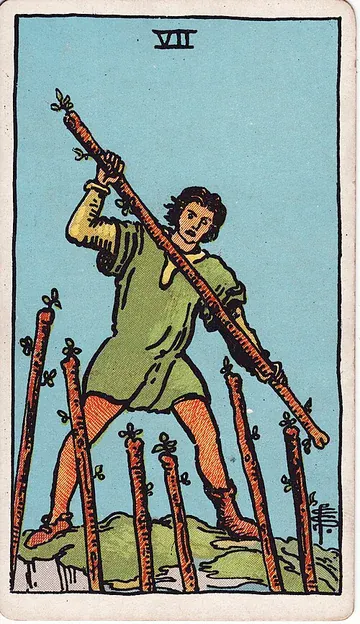
Seven of Wands
Recognition that will require defense in the next chapter. The Six's procession has just landed; the Seven asks whether you can hold the high ground from challenge. Spend the procession's afternoon well — rest, name the company, write down what you learned. Next week's defense will be effortless in proportion to how clearly you remember the road.
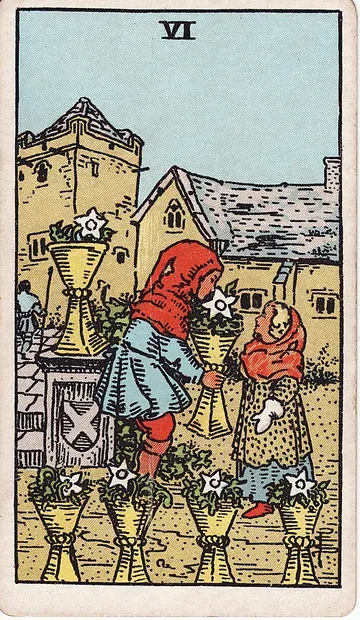
Six of Cups
Sibling sixes in tonal contrast — public return meeting private return. The procession through the town opens the gate; inside the gate, the grandmother's kitchen waits with the bread you ate at six. The combination honors a homecoming that succeeds on both registers and warns against choosing only one. Both arrivals are necessary.

The Chariot
The outer triumph card meeting the public-recognition card. The Chariot was the conquest; the Six is the moment after, when the city receives you. The Chariot pushes; the Six is carried. The combination warns against confusing the two: lay down the reins, accept the wreath, let the horse, finally, be led toward the gate the road has earned.

The Sun
Deep summer at full noon. The Sun is the laurel-crowned wreath at high light; the Six is the procession walking under it. Together the cards describe a season of unambiguous good — recognition arriving in clear daylight, witnessed by people whose witness is itself a gift. Do not rush past it. Let the laurel be exactly the symbol it is.
Frequently Asked Questions
What is the six of wands reversed meaning in a reading?
The six of wands reversed meaning describes a procession that has set out before the substance was finished — premature laurels, hollow applause, or recognition placed on the wrong shoulders. The wreath is at the brow but the road has not been fully walked. The card asks the seeker to slow the visibility, redirect misplaced credit, or step gracefully off a dais that was never theirs in the first place.
Does the Six of Wands reversed yes actually feed the question I asked?
Often not, and noticing that early saves a season of confusion. Reversed, this is rarely a clean no. It is a yes to the appearance and a not-yet to the substance: the visible answer shows up more or less on schedule while the underlying work it was supposed to honor stays unfinished. The promotion lands and the feeling of being underqualified does not lift. The relationship is announced and the conversation you actually needed is still pending. Read the reversed card as a soft caution rather than a refusal — what was asked for probably arrives. The useful work is to name, before it does, which question you were really carrying, so that the arrival of the visible version does not get mistaken for an answer to the invisible one.
Six of Wands reversed: are we announcing the relationship instead of repairing it?
That is the substitution the card is built to catch. Reversed, it describes a bond whose public visibility has outrun its private substance: the announcement made before the conversation, the photographs before the foundation, the dinner with his family scheduled in the same week the two of you stopped speaking honestly to each other. Public gestures feel like progress because they are legible and dated, and a repair conversation is neither. So the parade gets scheduled and the talk gets postponed, and the parade becomes evidence that the talk is no longer needed. For a reconciliation, the same warning is sharper: rebuilding the visible bond without finishing the private repair produces a relationship everyone else believes in. Slow the parade. Finish the talk. The order is the whole instruction.
What is the six of wands reversed advice?
The six of wands reversed advice is to redirect public credit to the colleague or partner whose contribution has been quiet, cancel one performance the procession is expecting from you, and use the recovered time for substantive work that has been postponed. Forgive yourself for the procession that exceeded the road. The card returns to upright through this kind of private, accumulative right-sizing — not through louder gestures.
Six of Wands reversed: do they want me, or the picture of being with me?
Some of both, which is the uncomfortable and accurate answer. Reversed, the card describes warmth shaped more by the audience around it than by the private interior underneath it. They like the look of being with you. They post the photograph partly because the posting helps them feel the relationship is real, and the help is temporary, so the posting repeats. None of this makes the feeling counterfeit — there is a person in there who does care. It makes the feeling scaffolded rather than founded, and scaffolding comes down when the viewers leave. The honest signal is always the private one: how you are treated on an ordinary Wednesday with nobody watching, whether the same tenderness exists when there is no occasion to be seen having it.