
Ten of Cups · Core Meaning
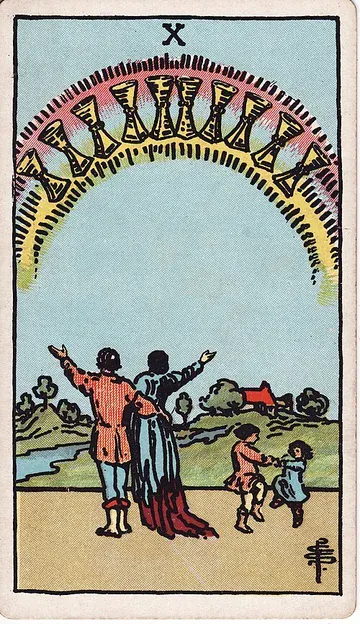
The Ten of Cups tarot card meaning rests on a single image: joy that has come home. After the long search of the suit — the choice at Two, the toast at Three, the regret at Five, the door of the wish-card at Nine — the Ten arrives at the threshold and stays. The picture is unmistakable. A family stands beneath the eaves of a small house. The children run. The parents hold each other in a half-turn that says they have done this many times before. And above the roof, seven cups arc in a rainbow — not painted, not symbolic in the abstract, but tilted mouth-down, spilling years of held water into the light.
This is the card's central insight: the rainbow is not new weather. It is the cumulative shape of every cup the seeker has poured along the way. The grief at the Five, the partial joy at the Six, the pleasures of the Nine — all of it is in that arc. The Ten of Cups is the moment the soul stops looking for the next vessel and notices it has been refilling the air around it the whole time.
The signature tension of the card is not absent. It is quieter. The riverbank lies in the distance — the same water the seeker once chased in youth — and it is far now, no longer in need of reaching. The pull of elsewhere has thinned. What remains is the question of whether you can be at home in the home you have built. Some seekers find the Ten of Cups easy. Others find it almost unbearable: the dream came true, and now the work is to inhabit it. The card is here to say that inhabiting is a separate practice from arriving.
The traditional astrological signature anchors this. The Ten of Cups is Mars in Pisces, third decan — the Gregorian window 3/11 through 3/20, the very last days of winter just before spring equinox. Pisces is water at its most porous, dissolving back into source. Mars is the planet of will, drive, the thrust that pushes a thing across the finish line. Together, Mars in Pisces is the surprising muscle inside softness — the willed quality of finally letting yourself land. Pisces wants to dissolve; Mars insists on a body. The Ten of Cups is the soft, decisive yes of someone choosing the eaves over the open sea.
Kabbalistically, the card sits at Malkuth in Briah, the World of Creation. Malkuth is the kingdom — the lowest sephirah, the place where every higher emanation finally takes physical form. In the watery suit of cups, Malkuth is the felt body of love made domestic: not the spark, not the intention, but the kitchen, the threshold, the bowl set on the table. Briah holds it as a creation still — alive, ongoing, not yet calcified. This is the sephirah where heaven begins to look like a roof.
Ten is the last number the suit has, and the Ten of Cups holds it as a full plate rather than a finish line. Nine cups could still be counted one by one; the tenth closes the count and begins the spill. Notice that the vessels in the arc are not being drunk from — they are tipped, emptying, giving their contents to the air above a house. A suit that spent nine cards learning how to fill something ends by pouring it out over a roof. That is what a landed number does in water: it stops accumulating and starts irrigating. Whatever the seeker has gathered along the way — patience, humor, the tolerance for another person's worst morning — has become weather that other people now stand under without knowing what it cost to make.
The children in the picture are doing something the adults are not: they are running, and neither of them has looked up at the rainbow. To them the arc is simply the sky over the yard. This is the layer of the card most readers skip — the household is a backdrop for somebody, and that somebody is usually younger, or newer, or less scarred than the seeker holding the question. What cost you fifteen years is, to them, the ordinary shape of a Tuesday. The Ten of Cups asks that this land as relief rather than insult. A structure you had to build is a structure someone else gets to simply live inside, and being taken for granted by the people under your roof is closer to success than to theft.
Read the Ten of Cups as a tarot card meaning the way you would read a photograph someone took without telling anyone. Whatever lives in that pause — the porch light already lit, the children mid-stride, the parents not posing — is the card's gift. The picture is not for an audience. It is the household catching itself at peace. The work of the seeker is to stop performing the photograph and step inside it.
Ten of Cups · Love & Relationships
In ten of cups love readings, this card is one of the deepest yeses the deck offers — but unlike the Nine's private wish, the Ten's yes is structural, social, lived in. The bond has stopped being a private negotiation and has become a household two people belong to. The card describes the relationship that has settled into the everyday — not the peak of passion but the second of morning tea, the half-asleep "I'll get the kids," the porch light left on for the late return. The Ten of Cups is what real love looks like after it has stopped trying to be photogenic.
For an existing long-term partnership, the Ten of Cups arrives when the relationship has crossed from project to habitat. The arguments still happen, but they happen in a marriage that knows how to argue. The seasons of distance still come, but they come inside a roof. The card most often turns up before a public commitment that is already inwardly true — the engagement that surprises only the cousins, the renewal of vows after the long stretch, the quiet decision to start trying for a child. The wish from the Nine has become the structure the Ten breathes inside.
For a new spark, the Ten of Cups is rarer but unmistakable. It means the new relationship is family-shaped from the start. You meet, and within weeks the way they hold their nephew is the way you have always wanted someone to hold a niece. The first weekend you spend together has the rhythm of a household that has not yet been founded but is already implied. The card warns against rushing the externals — moving in too soon, announcing too soon — but it confirms that the form is real. Sometimes new sparks are not preludes to families. This one is.
For a single seeker asking whether love is possible, the Ten of Cups answers yes — and adds the specific note that the love available to you is family-shaped love, not merely romance. The card describes a person whose presence will rearrange not just your weekends but your address, your holidays, your idea of home. Single seekers who are still in love with the story of being chosen will find this card uncomfortable. The Ten is not the chase. It is the period after the chase, when love becomes infrastructure. Prepare to be loved in the kitchen, not on the cliff.
For love after a wound, the Ten of Cups is one of the deck's most generous answers. The grief did its work. The capacity for trust — the soft membrane that the wound seemed to puncture for good — has been rebuilt by the slow work of years. What returns is not the love you had before. It is the love that knows. The Ten describes the second household, the marriage after the first marriage ended, the partner who shows up after you finally stopped looking. They are not a consolation prize. They are the education of the wound made into a roof.
For seekers whose romantic question is not about a single person but about the texture of their family-of-choice, the Ten of Cups validates the chosen family. The friends who have become siblings. The mentor who has become a parent figure. The neighborhood that has become a village. The card insists that family is a practice and a structure, not a bloodline — and confirms that the structure you have been quietly building is real.
Not every household beneath these eaves has children in it, and the Ten of Cups is less literal about the two running figures than it first appears. What the picture asks for is noise that is not yours alone — a dog with strong opinions about the door, a sibling in the spare room, a friend who keeps a key, godchildren every August. Couples weighing whether to become parents often draw this card and take it as an instruction to reproduce. It is a description of texture instead: the card wants to know whether your shared life contains anyone with standing to interrupt it. A life sealed tight around two people can still be a home, but the rainbow in this picture falls over a door that opens from the outside.
Two people who love each other across two cities get a particular reading of the eaves. The Ten of Cups does not care which address wins; it cares that one of them is eventually chosen and furnished. Couples who keep both apartments "for now" across several years are often still living inside the Nine — pleasure preserved, commitment deferred, the cup held rather than poured. This card describes the weekend one of them stops packing a bag and starts leaving a coat. Love at distance under the Ten is not fragile, only unfinished, and the finishing is logistical rather than emotional. The conversation the card lights up is the one about lease dates, school catchments, visa timelines — the unromantic paperwork that is, in this card's language, the romance itself.
A note on the card's specific love language: the Ten of Cups loves the way a household loves. It cooks. It plans. It schedules. It remembers the dentist appointment. It absorbs the flu without resentment. This is a love that runs — that takes care of the small infrastructure of two lives sharing a kitchen, a calendar, a bed. The seeker who confuses love with intensity will mistake this card for boredom. The seeker who has lived a little will recognize it as the deeper register the intensity was always pointing at.
If you are asking whether someone is in love with you and the Ten of Cups arrives upright, read it as a yes that has already started building. They are not just in love. They are planning — sometimes consciously, sometimes only in the way they automatically include you in the future tense. The card describes the partner who has stopped asking whether you fit and has started asking how to make space. Whatever they have said most recently about the next year, the next move, the next holiday, they meant it. Take them at their word.
For seekers in the long middle stretch of a relationship — past the spark, before the eventual death — the Ten of Cups is a benediction. It says that the middle is not a holding pattern. It is the substance. The middle is where most of the love has lived, and most of the love will continue to live. The peaks were never the point. The roof was.
Ten of Cups · As Feelings
At home with you — that is the entire answer the Ten of Cups gives when the question is how somebody feels. Not infatuated — that's a different card. Not starstruck — also different. They feel the way a person feels in their own kitchen on a Sunday afternoon. Comfortable. Unguarded. Quietly delighted that the room exists. They are not bracing in your presence. They are resting in it.
This is the central distinction of the card as feelings. The Ten of Cups is not the high of a new connection — it is the low, sustained warmth of a person who has stopped wondering whether you are temporary. The thinking has resolved. They no longer ask themselves whether to invest. The investment has happened, and what is happening now is the slow, ordinary pleasure of returning to a thing they have already chosen.
If they are reserved by nature, the Ten of Cups in feelings does not look like declarations. It looks like the way they save you the better cut of the apple without thinking about it. The way they include you in plans that have nothing to do with you — a doctor's appointment, a tax deadline, a difficult conversation with their mother — because your presence in their week is now structural, not decorative. Read the silence here as belonging, not absence. They are not performing a feeling. They are inhabiting one.
If they are demonstrative, the Ten of Cups in feelings looks like the public household. They post the photographs of you in their kitchen rather than at restaurants. They want their family to meet you not as an event but as a continuation. They name you in plans that span years. They are not in the new-spark performance phase. They are in the here is my life and you are inside it phase.
For a partner you have been with a long time, the Ten of Cups in feelings is one of the most reassuring cards the deck can offer. It means the long internal work of accepting the relationship has not collapsed into apathy — it has deepened into permanence. They no longer wish you were a different person. They no longer wish the relationship had a different shape. They have arrived at this one, and what they feel is the slow gratitude of someone who got the household they wanted, even if the household looks nothing like what they imagined when they were twenty-five.
For a new connection, the Ten of Cups in feelings reads as something rare and significant. They are not just attracted. They are quietly orienting their life around the possibility that you are in it for a long time. The fantasy is not romantic — it is domestic. They imagine making coffee for you. They imagine introducing you to their best friend's children. They imagine the holidays. This is not casual feeling. This is feeling that has already begun to construct.
A small caution embedded in the card as feelings: the Ten of Cups can occasionally describe satisfaction so settled that it forgets to remain curious about you. The partner who has decided you are family can stop asking questions, can stop noticing what you are becoming. Read this carefully. If the warmth is real but the attention has narrowed, the card is asking for re-noticing — not new feelings, just new looking. The feeling is solid. The attention may need to be invited back.
For seekers asking specifically whether someone is "the one," the Ten of Cups answers yes in a particular register. They are the one in the sense that they are the one you can build something durable with. The card does not promise lifelong infatuation. It promises something more useful — the partner whose feelings have already organized themselves around the long form. This is the card of the person who, in their interior life, has already made you part of home.
For the question of mutual feelings — whether the warmth runs in both directions — the Ten of Cups confirms it. The card is a household card. It cannot describe a one-sided household. If the Ten of Cups arrives in a feelings reading, the structure of feeling between you and the other person is symmetrical even if the public expressions are not. You are both at home with each other. The shape is real on both sides.
For Japanese-style "kare no kimochi" / "kanojo no kimochi" questions — what is in the other person's heart — the Ten of Cups answers that what is in their heart is home. The most generous gift the deck offers when this question is asked.
Ten of Cups · Career & Work
In ten of cups career and work readings, this card describes the season after the long climb, when the work has become the life — and the life is good. Not the dramatic ten-x quarter. Not the IPO. The Ten of Cups is the year you realize you stopped dreading Sunday nights. The role has settled. The team has shape. The compensation has stabilized into something that funds the household rather than dictating it. The career has stopped being the thing you do instead of a life and has become the thing you do inside one.
For someone asking whether a current role will turn out well, the Ten of Cups answers yes — and adds that the answer has already been visible for a while if you are willing to see it. The work is not the enemy. The colleagues are not the obstacle. The role has done the slow work of fitting itself to your life, and your life has done the slow work of fitting itself to the role. The fruit of years of labor is now in hand. The card's instruction is not strive harder. It is steward what is.
For someone considering a new role, the Ten of Cups upright is more nuanced than at first. The card supports the move — but only if the move is in the direction of more household, not more proving. If the new role pays slightly less but lets you make dinner four nights a week, the card says yes. If the new role pays significantly more but eats the evenings you have been quietly building with someone, the card asks you to read carefully. The Ten of Cups measures career success in time at home. Other cards measure it in title, in revenue, in scope. This one measures it in the porch light.
Entrepreneurs and freelancers should read the Ten of Cups as the confirmation that the practice has become sustainable. Not exploding, not viral, not at the inflection point — sustainable. The clients have stabilized. The income has stabilized. The brand has settled into a recognizable thing. The card is the morning of the fifth year, the moment the founder realizes the business will not collapse if they take a real vacation. There is a deep pride in this card for those who built without a safety net. The pride is the pride of a household built from raw labor.
For a creative practice, the Ten of Cups can describe the body of work that has finally cohered. Not the breakout — the catalogue. The third album, after which the artist is no longer trying to break in. The fifth book, where the recurring concerns of a writer's life become legible as a project. The retrospective at the local gallery. The card is the moment the work stops being a series of attempts and starts being a career. Stay long enough to be seen.
For someone in a creative practice who has not yet had this kind of arrival, the Ten of Cups can describe the internal version. The day you realize you are no longer asking whether you are a writer / painter / composer — you are simply at the desk, and the work is the day. The external arrival may or may not come. The internal arrival is what the card actually marks.
For job-search seekers, the Ten of Cups upright suggests that the role you find will have unusual durability. Not the flashiest offer. The one whose shape will fit your life in three years, in five, in eight. The card warns against optimizing for the wrong axis — title at the cost of energy, money at the cost of evenings — and confirms that the offer aligned with your household will be the one that quietly outperforms over time.
For those facing layoff or transition, the Ten of Cups reframes the disruption. The household survives this. The career chapter you are leaving will, in retrospect, look like a complete thing rather than an interrupted one. The card does not minimize the shock — losing a role you loved is real grief — but it insists that the household built around you predates the role and will outlast it. What you are losing is a chapter. What you have is a structure.
For seekers asking about authority, leadership, or stewardship at work, the Ten of Cups describes the leader who has become a kind of host. The colleagues who report to you experience your team the way a guest experiences a well-run home — fed, considered, respected, not asked to perform for the household's benefit. This is the highest expression of the card in a career setting. Lead like a host.
A note on stability: the Ten of Cups is not a card of expansion in career. It does not say go bigger. It says you have arrived at a station. For ambitious seekers, this can read as disappointing — the card is not promising the next mountain. But the card is making a different argument. The next mountain, if you climb it from a household that is unattended, will erode the household. The Ten of Cups asks whether the next mountain is worth what climbing it would cost the structure that has formed at the threshold. Answer honestly. Sometimes the answer is yes. Often, with this card present, the answer is not yet.
Ten of Cups · Money & Finances
Enough is a figure no spreadsheet can derive, and the Ten of Cups upright arrives at it anyway. Not abundance the way the Nine of Cups celebrated abundance — the wish-card answered the financial question with luck. The Ten answers it with infrastructure. The accounts are settled. The recurring bills go out without anxiety. The family is fed. The lights stay on. The card describes the financial position in which money has stopped being the loud thing in the household and has become the quiet thing it should always have been.
For someone asking whether a financial decision will work out — a mortgage, a move, a major household purchase — the Ten of Cups upright supports the decision when it is in service of home. Buying the house: yes. Paying off the last of the student loans: yes. The renovation that lets the family eat together: yes. The card is biased toward investments in domestic infrastructure. It is less enthusiastic about speculative instruments.
For the seeker who has been in a long climb out of financial scarcity, the Ten of Cups marks the arrival at the plateau where survival is no longer the daily question. The grocery budget has stopped being a source of stress. The medical co-pay does not require choosing between bills. The car repair does not become a crisis. This is not wealth in the dramatic sense. This is something more important — the cessation of financial fear. The card honors the years it took to get here.
For questions about windfall — inheritance, bonus, unexpected income — the Ten of Cups has a specific instruction. Use it for household. Not for spectacle. Not for status. Not for proving to someone that you have arrived. The most aligned use of windfall under this card is to strengthen the structure that already exists: pay down the mortgage, fund the children's education, set aside the buffer that lets the family take a real vacation, pay for the medical procedure that has been deferred. The card warns against the windfall that becomes consumption instead of foundation.
For investments and long-term financial planning, the Ten of Cups upright describes the patient strategy that has begun to compound. The retirement account that quietly grew while you focused on the children. The index fund that doubled while you forgot to check it. The diversified slow strategy that made you, somehow, a person with savings. The card validates the boring choice. The boring choice was correct.
The card's caution around money is gentle but specific: do not let the household's financial security become an excuse to stop being generous. The Ten of Cups, fully integrated, is generous. It pays for the niece's piano lessons. It funds the friend's medical bill anonymously. It tips well at the diner where the staff knows your order. The card sours when the household closes its doors to the financial reality of others. The opposite of the Ten of Cups in money is not poverty — it is the household that has decided its enoughness is private.
For seekers carrying debt, the Ten of Cups upright is a green light to consolidate and end the worry. Pay off the thing. Close the account. Build the buffer. The card supports the quiet move that ends the gnawing. The household runs better when there is no overdue notice in the drawer.
For seekers in financial recovery after a divorce, a job loss, a medical event — the Ten of Cups upright describes the rebuild as already underway. You have laid more foundation than you can see. The next year is when the structure becomes visible. Continue.
A practical note: the Ten of Cups upright responds well to the financial practice of naming what is already enough. List the recurring expenses that no longer require effort. List the buffer that exists. List the years of compounding that have happened without your daily attention. The card teaches that abundance, fully arrived, is often invisible until we count it. Count it.
Ten of Cups · Health
A body stops bracing some time before it notices that it has stopped, and the Ten of Cups upright arrives at exactly that lag. The chronic vigilance has loosened. The acute crisis has resolved. The chest — the card's body part, the chamber of the heart — sits unbraced. The breath is full. The sleep is deep. The appetite is real. The body has stopped being a problem and has become, again, a place to live.
If you are asking whether a treatment will work, whether a recovery will hold, whether the long process of getting well will reach completion, the Ten of Cups answers yes. The system is willing. The household around the body — the relationships, the routines, the practitioners, the quiet support that surrounds illness and convalescence — has held. The recovery is not a solo achievement. The card honors the people who showed up. Continue your practical work. Take the medication. Show up to the appointment. The card describes the season in which the body cooperates with the work.
For someone managing a chronic condition, the Ten of Cups can describe the season of stable management — not cure, not the disappearance of the issue, but the stretch in which the condition has become part of the household rather than its central crisis. The medication routine is automatic. The flare-ups are anticipated. The body has become a known instrument again. Use the season. Plan the trip. Rest deeply when you can. The chronic body teaches a different relationship with time, and the Ten of Cups offers a particular grace inside that relationship: domestic ease.
The card's specific health signature is the heart in the broadest sense — the chest, the rib cage, the breath that the cardiac and pulmonary systems make possible. Watch for the somatic signs that the heart is being asked to do too much for the household: shortness of breath under stress, the chest that tightens when the schedule is over-full, the irregular rhythm that appears when the family demands have outstripped your capacity. The Ten of Cups, unaltered, is the card of the open chest. When the chest closes, the card is asking the household to redistribute the load.
For mental health questions, the Ten of Cups upright is profoundly affirming. The depressive winter has lifted. The anxiety that braced the chest has released. The therapeutic work has taken root. The medication, if you are taking it, is working. The household around your mind — the relationships, the daily practices, the quiet structures of self-care that no one but you sees — has stabilized your interior in a way that makes the difficult days survivable and the ordinary days actually ordinary. The card is the morning after the long bad season, the first walk where the world does not feel hostile, the first night of unbroken sleep that did not require pills. The first unbroken night is worth noticing and is not a clinical finding; no medical advice is being given. The ten of cups reads a felt season inside a household and never a diagnosis. Keep your practitioners. The arc of cups overhead only notes that what you and your household have been doing has begun to reach the ordinary hours.
For those caring for someone else's health — parent, partner, child, ailing friend — the Ten of Cups acknowledges the toll the household has absorbed. The card holds the caregiver as well as the cared-for. It says the labor of love that is illness-care does not go unseen, even when no one outside the household notices. The card validates rest. The card validates asking for help. The card warns against the caregiver who becomes invisible in their own household — set the porch light. Let yourself be seen.
For pregnancy questions, the Ten of Cups is one of the deck's most affirming cards. The body is preparing the household. The new soul is welcome. The conditions for a stable arrival are present. The card does not promise the absence of complication — no card can — but it describes the body that has become a shelter and a future the family can grow into.
For elder care and end-of-life questions, the Ten of Cups can describe the late season of a life that has become, in retrospect, a household. The person at the center of the question is not alone. The family, in whatever shape, has gathered. The rooms have been arranged. The conversations that needed to happen have happened or will happen. This is the card of the good death — not painless, but accompanied. The card honors the slow, generous labor of the people at the bedside.
Ten of Cups · Spirituality
Grace comes down into the kitchen in the Ten of Cups upright, and it stays for dinner. The mountaintop is not the destination. The retreat is not the destination. The spiritual experience that lifted you, two years ago, into a different register of attention is not the destination either. The destination is the everyday — the meal made for someone you love, the dish washed without resentment, the conversation in the doorway that turns out to be the most important conversation of the year. The Ten of Cups places the divine in the household.
For seekers in active spiritual practice — meditation, journaling, ritual, devotional work — the Ten of Cups means the practice has migrated. What used to require the special seat, the special hour, the special silence, has begun to happen anywhere. The breath that grounds the prayer also grounds the laundry. The presence that visits the meditation cushion also visits the diaper change, the long drive, the difficult phone call with the parent. The card is the season in which spiritual practice stops being a separate department and becomes the texture of everything.
For seekers exploring belief, the Ten of Cups describes the integration of the cosmologies you have lived through. Whatever you grew up with, whatever you rebelled against, whatever you cobbled together in your twenties and thirties — the card describes the season where the parts settle into something usable. You no longer need to defend your spiritual life. You are simply living it. The arguments with the tradition you came from have gone quiet. The hunger for the next teaching has softened. What remains is practice.
The card sits at Malkuth in Briah — the kingdom in the World of Creation. Malkuth is the lowest sephirah, the place where all higher emanations finally take physical form. To say a card belongs to Malkuth is to say the card teaches the lesson of embodiment. The Ten of Cups is not the spiritual high, the ecstasy, the breakthrough. It is the moment the breakthrough becomes the way you fold the laundry. Briah holds it as a creation still in motion — alive, ongoing, growing. This is the sephirah where the divine first wears a roof.
The card's spiritual caution is small and specific: do not mistake domestic peace for spiritual completion. The household at peace is a profound achievement, but the soul has further work. The Ten of Cups invites you to enjoy the peace without using it as an excuse to stop seeking. The mystics who lived inside ordinary households were not less mystic for the household. They were more — because they had nowhere to escape into. Stay at the threshold. Keep practicing.
A real practice the card invites: spend thirty minutes tonight cooking a simple meal in silence. No music. No podcast. No conversation. Just the chopping, the heating, the stirring, the smell. Let the kitchen become the meditation room. The Ten of Cups responds to the practice that does not separate the sacred from the daily. The dishes washed afterwards are part of the practice. The leftovers wrapped and refrigerated are part of the practice. Stay in the household for the whole arc.
For questions about path, the Ten of Cups answers that you are aligned. The work, the relationships, the practice you keep — these are the right things. The way your days are arranged is not an accident; you built it one ordinary decision at a time. Enjoy the fit without gripping it — a household holds better when nobody is clutching the walls. The next phase will ask you to share some of what has gathered in this household. For now, simply be at home.
Ten of Cups · Yes or No
Yes — and the kind that needs no announcement.
In ten of cups yes or no readings, this card is one of the deck's clearest yeses. The wish has not only been granted — it has been built into a household. The thing you are asking about is on the path of becoming part of your everyday life. The answer comes without drama. It comes the way a porch light comes on at dusk: expected, welcome, almost unnoticed.
For yes-or-no questions about a relationship, a job, a move, a major life decision: yes. The path you are considering leads to a more integrated life, not a more performed one. The person you are asking about is the kind of person who builds rather than performs. The opportunity is real. There is no hidden trap. The yes is structural.
For questions about whether someone is being honest with you, whether an offer is genuine, whether a plan will hold — the Ten of Cups answers yes. The rainbow is not painted on a backdrop. The household-building card has very little tolerance for false fronts. If the situation were inwardly hollow, this card would not be the one to arrive.
The one caution folded into it is to notice what kind of household the yes is building. The Ten of Cups answers yes the way a parent answers when a child asks if there is going to be dinner: of course, sit down, the table is being set. There is no fanfare in it, none of the noise a party card makes. It answers with quiet sufficiency. If you were hoping for a thunderous yes, the soft confirmation may feel anticlimactic. Trust the soft yes. It is the kind of yes that builds.
On the question of how soon the household settles, the Ten of Cups suggests yes, within a season that aligns with the natural rhythm of household-building. Not instant, not far. The card is associated with the dateRange 3/11 to 3/20 — the last days of winter, the threshold of spring equinox. The yes lands in a window that feels seasonally inevitable rather than urgent.
For binary questions about whether to act — should I propose, should I move in, should I have the child, should I take the role — the Ten of Cups says yes, with the further note that the action is the seal on something that has already inwardly been decided. The decision was made some time ago, perhaps without your conscious awareness. The action is the formality the household requires. Sign the lease. Buy the ring. Say the thing.
For questions about whether to stay — in the relationship, in the job, in the city, in the house — the Ten of Cups answers stay. The roots that look invisible from your seat are deep, and pulling them up will cost more than transplanting them is worth. The card respects the discomfort of the present without treating discomfort as a verdict. Sometimes the answer is to leave. With this card, the answer is to stay and let the household keep teaching you what stay means.
For questions of whether something will last — the marriage, the friendship, the business — the Ten of Cups answers yes. Not because it cannot be broken (anything can be broken) but because the structure underneath is real, and the structures that are real tend to outlast the seasons of strain that test them. The card is biased toward durability.
If the question was: do I deserve this household? The card answers yes, and asks why you keep needing to be told. The deservingness question is the seeker's old wound talking. The household has already chosen you. Sit down at the table.
Ten of Cups · Advice
Come home cleanly, and let the door close behind you without a speech; that is the whole instruction of the Ten of Cups upright. Whatever has arrived in your life — the partner, the family, the household, the role that fits — receive it without bracing. Not with the small voice at the back of the throat insisting this is on loan. Not with the rehearsed mourning that tries to pre-pay for a loss that has not come. The card asks you to walk through your own front door, set down your bag, and stay long enough to be seen at home.
If there is one specific instruction the card offers, it is to make coming home a rite. The threshold is sacred and the seeker treats it as routine. Spend the extra ten minutes lighting the lamps. Change clothes deliberately when you arrive — the work clothes become the home clothes; the role you played all day becomes the person you are at the table. Greet the people in the household by name when you walk in, even after twenty years. The Ten of Cups responds to ritualized arrival. The household becomes more itself when it is entered with attention.
A second instruction: do not arrange family time to the standard of an outside viewer. The card warns against the household optimized for the photograph. If the dinner is real, the dinner does not need to be plated. If the holiday is felt, the holiday does not need to be documented. Most households erode in the small space between living the moment and posting the moment. The Ten of Cups upright asks you to keep one meal a week unphotographed, one weekend a season unannounced, one anniversary celebrated only between the two people for whom it is real.
A third instruction: invite someone in. The Ten of Cups is not a closed household. The card describes a roof under which the chosen family is welcome — friends, mentors, neighbors, strangers in temporary need. The empty seat at the table is not a problem to solve; it is a slot the household keeps open for the next person who needs it. Once a season, set a real place for someone outside the immediate household. Cook the meal that was always too big for two. Make the household the kind of structure that other households can rest inside, briefly, without performance.
A fourth instruction: check the door no one has walked through. This is the shadow note of the upright card. Even at peace, every household has a closet that has not been opened in a while. The conversation that has been deferred. The grief that has been quietly stepped around. The relative whose absence everyone has stopped naming. The Ten of Cups invites you to open one such door this season. Not melodramatically. Curiously. Take the household into the room that has been kept closed and see what is there.
A fifth instruction: if there's a gathering tonight, pick your home over a venue. The card has a specific bias. The most aligned use of the Ten of Cups is to stay in. To host. To set the table for the friends rather than meet them at a restaurant. To celebrate the birthday in the kitchen rather than at the bar. Not always — there are seasons for the venue — but the card's signature movement is inward, toward the eaves. When given the choice, choose the threshold.
A sixth instruction, gentler than the others: let yourself receive. Many seekers who draw the Ten of Cups have spent years building. The reflex to keep building is so habituated that the season of enjoying what is built feels foreign. The card asks you to spend one full evening doing nothing useful in the household you have made. Sit on the porch. Read the book. Watch the children run. The next phase of building requires you to know what you are building toward. The Ten of Cups is the period of knowing.
Practical advice for the day the card appears: arrive home on time. Light the lamps before sitting down. Eat dinner at the table, not at the desk. Have one real conversation with a person who lives in your household. Ask a question and listen to the answer. The card responds to inhabited presence. Performed presence does not work. The Ten of Cups, fully integrated, is one of the simplest cards in the deck — and one of the hardest, because the simplicity is what most seekers spent the previous nine cups avoiding.
Ten of Cups · Card Combinations
The Ten of Cups deepens or curdles depending on the cards beside it. As a household card, it interacts with other cards by asking how they fit under the roof. A card next to it that is not householdable becomes the question the Ten asks of the reading — what is this volatility doing inside a structure built to last?
Ten of Cups + Ten of Pentacles
The two completion-tens of the deck. The Ten of Cups is the felt completion: family, threshold, the porch light. The Ten of Pentacles is the structural completion: lineage, inheritance, the legal framework that lets the household persist beyond a single generation. Together, the combination describes the moment the household has both the felt warmth and the formal scaffolding. The trust is funded. The will is signed. The grandparents have met the grandchildren and approve. This is one of the deepest pairings the deck offers — the marriage of emotional and material completion. Build the structure that lets the warmth outlast the people who started it.
Ten of Cups + Nine of Cups
Suit predecessor and successor in adjacent positions. The Nine of Cups is the wish granted in private — the figure behind the long table, arms folded, savoring. The Ten of Cups is what happens when the wish leaves the host's hands and becomes the household. The combination describes the seeker who has stopped hoarding the gift. The wish is no longer the seeker's private satisfaction; it has become the structure other people now live inside. This is the card of the host who finally invites the family to the table they have been preparing alone.
Ten of Cups + The World
The major-arcana modulator of completion. The World is the great cycle ending — the soul's arc closing, the journey done, the dancer surrounded by the four creatures of the corners. The Ten of Cups is the household where that completion lives. Together, they describe the rare reading where a long arc of a life is recognized as having completed itself in domestic form. The seeker who set out to find their place in the world finds it not at the summit but at the threshold. The journey ends in the kitchen.
Ten of Cups + The Sun
Major modulator of unguarded joy. The Sun is the radiant child, the horse, the open field, the day that does not hide. The Ten of Cups is the household whose children, in the picture, are running. Together, the combination is the deck's clearest image of joy with no shadow side — joy that is simply joy, daylight at the threshold, the laughter that does not cost anyone. Let yourself be in this combination without flinching. The seekers who have seen too much expect the other shoe. With these two cards together, there is no other shoe. Stay long enough to believe it.
Ten of Cups + Four of Cups
The householder who has stopped tasting the water. The Four of Cups is the figure seated under a tree with three cups ignored at their feet and a fourth offered out of a cloud they will not turn toward. Set beside the Ten, it names the person standing under the rainbow with their back half-turned to it — fed, housed, surrounded, quietly unmoved. The pairing is not an accusation of ingratitude; it is a diagnosis. Contentment that is never spent goes stale, and a household where nobody is hungry for anything slowly becomes furniture. What the two cards prescribe together is small and doable: accept one offered thing this week that you would ordinarily wave away — the invitation, the help, the second helping.
Ten of Cups + Three of Swords
The deck's most painful pairing for a household card. The Three of Swords is the heart pierced by three blades — the betrayal, the named grief, the wound that cannot be undone. Together with the Ten of Cups, the combination describes heartbreak inside the household: the affair revealed, the family member who has died, the fracture that runs through the kitchen everyone is still pretending is intact. The cards do not say the household will dissolve. They say the household must now hold something it did not previously hold. The roof does not come down. But under the roof, the people are now changed. Honor the wound. The Ten of Cups, reading next to the Three of Swords, asks the household to grow to the size of its grief — not to deny it, not to flee it, but to become the kind of structure that can hold a sorrow this real.
Card Combinations
Ten of Pentacles
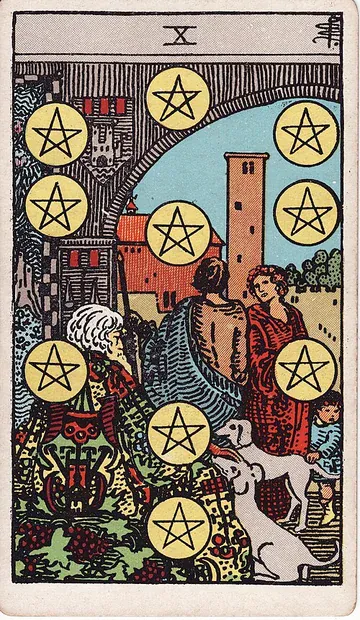
The two completion-tens of the deck. Cups Ten is the felt completion: family, threshold, the porch light. Pentacles Ten is the structural completion: lineage, inheritance, the legal framework that lets the household persist beyond a single generation. Together, the trust is funded, the will is signed, the grandparents have met the grandchildren and approve. Build the structure that lets the warmth outlast the people who started it.
Nine of Cups
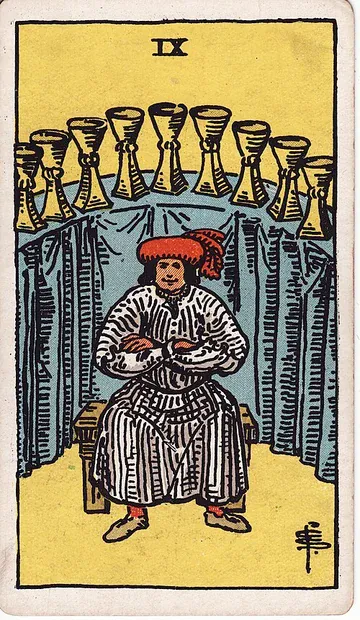
Wish-card landing into household. Nine of Cups is the wish granted in private — the figure behind the long table, arms folded. Ten of Cups is what happens when the wish leaves the host's hands and becomes shared infrastructure. The combination describes the seeker who has stopped hoarding the gift; the wish has become the structure other people now live inside. The host has finally invited the family to the table they were preparing alone.
The World
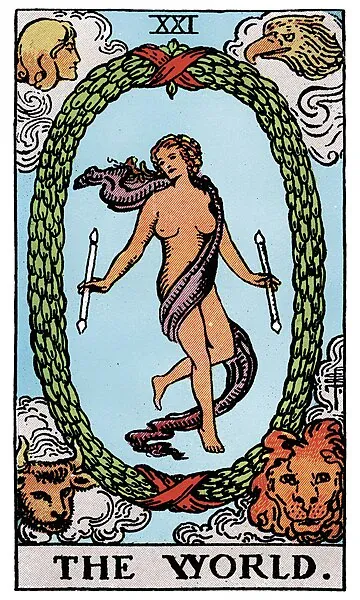
The World is the great cycle ending — the soul's arc closing, the dancer surrounded by the four creatures. The Ten of Cups is the household where that completion lives. Together, they describe the rare reading where a long arc of a life is recognized as having completed itself in domestic form. The seeker who set out to find their place in the world finds it not at the summit but at the threshold. The journey ends in the kitchen.

The Sun
The Sun is unguarded radiance — the child on the horse, the open day, the laughter that does not cost anyone. The Ten of Cups is the household whose children, in the picture, are running. Together, the deck's clearest image of joy without shadow side: daylight at the threshold, undefended laughter, the domestic warmth that needs no announcement. The seekers who have seen too much expect another shoe. With these two together, there is no other shoe. Stay long enough to believe it.
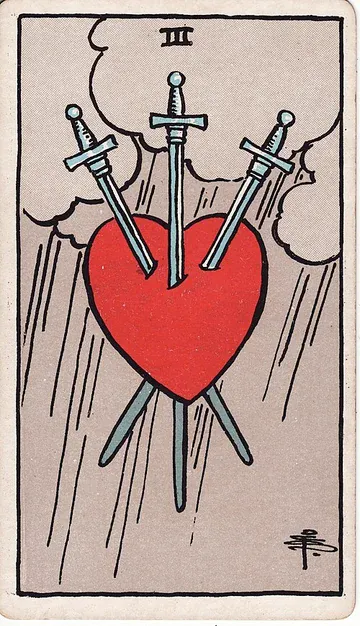
Three of Swords
The deck's most painful pairing for a household card. The Three of Swords is the heart pierced by three blades — the betrayal, the named grief, the wound that cannot be undone. With the Ten of Cups, heartbreak inside the household: the affair revealed, the family member who has died, the fracture running through the kitchen everyone is still pretending is intact. The roof does not come down. Under the roof, the people are now changed. Honor the wound; the household must grow to the size of its grief.
Frequently Asked Questions
Is the rainbow in the Ten of Cups a promise, or something the family already built?
Something already built — the arc is made of feeling that has been poured for years. This is the card of landed joy — the family beneath the eaves, the rainbow built from years of feeling already poured. It describes the household-shaped completion of the cups suit, where private wishes have become the everyday structure of a shared life. Read it as the affirmation that the search has resolved into a home you can stay inside.
Does the Ten of Cups say yes to a life I would have to share with other people?
That is the only kind of yes it knows how to give. The card is one of the deck's clearest yes cards — particularly for questions about relationships, family, household decisions, and whether something will last. The yes is structural rather than dramatic: not the loud announcement of a new beginning, but the quiet confirmation that what you are asking about is on the path of becoming durable. Trust the soft yes.
Does the Ten of Cups require marriage and children, or will any household do?
Any household, on the card's own terms — what it wants is a roof people are glad to be under. In love, the Ten of Cups describes the relationship that has crossed from project to habitat — a bond settled into the everyday rhythm of shared life. For new sparks, it can mean a connection that is family-shaped from the start. For long partnerships, it marks the arrival at structural permanence. For singles, it confirms that family-shaped love is available, but asks you to stop performing the chase and learn to be loved at home.
Is being someone's Ten of Cups less romantic than being their Two or their Knight?
Quieter, not lesser — this is the feeling that survives an ordinary Tuesday. They are at home with you. They are not bracing in your presence — they are resting in it. The feeling has stopped being a question they ask themselves and has become the quiet architecture of how they organize their life around you. They have already, inwardly, made you part of home.
What's the difference between the Nine of Cups and the Ten of Cups?
The Nine of Cups is the wish-card — granted in private, savored by a single figure behind a long table. The Ten of Cups is what happens when the wish leaves the host's hands and becomes shared infrastructure: a household, a family, a threshold other people walk through. The Nine is contentment. The Ten is contentment that has made room for others. Most readings move from Nine into Ten the moment the gift becomes generous.