
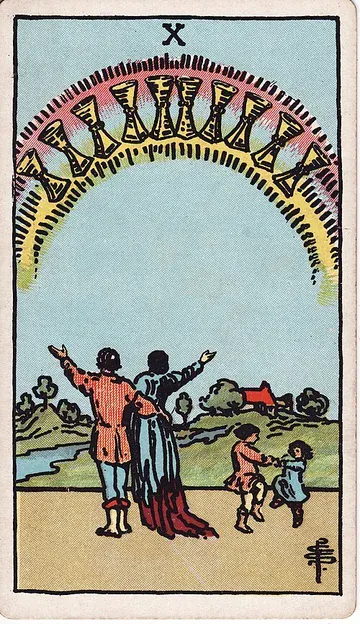
Ten of Cups Reversed · Core Meaning
The Ten of Cups reversed describes the household whose surface is intact but whose interior has gone quiet. The eaves are still standing. The porch light is still lit. The family photograph is still on the mantel. And inside the rooms, someone is silently skipping dinner. The card is not the absence of the household. It is the household that has begun to perform itself for an outside viewer rather than inhabit itself for the people who live there. The wish was granted. The wish has been arranged on a shelf. And what was once felt has become décor.
This is the reversed card's central knot. The Ten of Cups upright is landed joy. The reversed version is posed joy — joy that has stopped being the lived texture of the household and has become a kind of public claim the household makes about itself. The seven cups still arc above the roof. But on closer inspection, they are not tilting. The water is no longer pouring. The rainbow is painted, not made. The household has stopped generating its joy and has begun to exhibit it.
The astrological signature reverses too. Mars in Pisces upright is the surprising muscle inside softness — the willed quality of finally letting yourself land. Reversed, it becomes the rigid Mars trying to enforce a Piscean dissolution that the household needs but is not permitting. The water wants to move; the will is holding it in shape. The result is brackish — beautiful at a glance, stagnant at a deeper one. The third decan of Pisces, the last days before equinox, becomes the days when the winter has overstayed and the thaw is being refused.
There is a second flavor of the reversed card: the household whose joy is real but has been built on a foundation of unspoken fracture. The marriage that everyone admires, where one partner has been quietly grieving for three years. The family gatherings that look harmonious because the difficult relative has been silently excluded. The career-and-household balance that is photogenic from the outside because the children have learned not to interrupt the performance. The reversed Ten of Cups is the card of the unspoken fracture — the thing the household is collectively choosing not to name in order to preserve the picture.
A third flavor: the household full of obligation rather than felt warmth. The seeker who hosts because hosting is what their family does, not because they want anyone in the kitchen. The visits to the parents that are dutiful but not connecting. The marriage that is intact because divorce is unthinkable, not because either party still chooses the other every day. The reversed card describes the household running on duty long after love stopped being its engine.
Kabbalistically, Malkuth reversed is the kingdom that has lost its connection to the higher sephiroth — the body without the breath, the form without the form-giver. In Briah, the World of Creation, this becomes the household that has stopped being a creation and has become a museum. The structure is intact. The ongoing creative act has stopped. Without the upward stream from the higher waters, Malkuth dries.
Reversed, the Ten of Cups asks: who in this household has not been heard? And: which door has not been opened in how long? And: is the rainbow painted, or is it pouring?
Ten of Cups Reversed · Love & Relationships
In ten of cups reversed love readings, the card describes the relationship that has begun to perform itself. We're fine becomes the refrain. The friends still admire the partnership. The photographs still circulate. And inside the rooms where no one is watching, both partners have started to live separate interior lives that no longer require the other person to know them. The household is intact. The household has stopped being a meeting place.
For an existing long-term partnership, the Ten of Cups reversed is one of the more difficult cards the deck offers — not because the relationship is over (it usually isn't) but because the relationship has reached a stage where its survival depends on a hard conversation neither partner wants to have. The agreements that hold the household together have started to function as agreements that prevent its growth. Both partners are doing the form of partnership. Neither is letting the other into the interior anymore.
The most common shape of this reversed card in marriages and long bonds is the locked room. Every household has at least one — the topic that gets quietly skirted, the relative whose name is no longer mentioned, the financial decision that was made unilaterally and never discussed, the grief one partner is carrying alone. The reversed Ten of Cups is the card of the locked room becoming the center of gravity in the household. The lock holds, but the room is now louder than any of the unlocked ones.
For a new connection, the Ten of Cups reversed in ten of cups reversed love can describe a partner who is in love with the idea of the household more than with you. They want a family. They want a partner. They want the photograph. And the photograph happens to have your face in it for now. The card warns of the partner who is performing the early-stage relationship the way a real-estate agent stages a house — every detail correct, every detail aimed at an outcome, none of it actually being lived. Read carefully. The hesitation you feel may be the card asking you to notice the gap between presentation and presence.
For singles asking whether a future partnership will be real, the reversed Ten of Cups is one of the deck's more useful warnings. It describes the seductive pull of the household-shaped outcome — the relationship that solves the question of where you'll spend the holidays, the partner who looks correct on the family Christmas card. The card does not condemn the desire for a household. It cautions against settling into a relationship that fits the shape without containing the substance. The work, single seekers, is to stop optimizing for the picture and start asking who the actual person under the roof would be.
For reconciliation questions — should we get back together, can the marriage be repaired — the reversed Ten of Cups offers a specific answer. The household can be rebuilt. The rebuild requires opening the locked rooms before the household is reentered. Returning to the same rooms in the same configuration, with the same unspoken topics still unspoken, will reproduce the same fracture. The card asks: do you want this person, or do you want the household-shape you remember? They are not the same. If the answer is the person, prepare to renegotiate the household from the foundation. If the answer is the shape, build the new household with someone for whom the shape is being created freshly.
For someone considering divorce or a long break, the Ten of Cups reversed is gentle but precise. The reversed arc is not pointing anyone at the door. It says stop pretending. Whatever decision you eventually make — to stay and rebuild, or to leave and grieve — must be made with the full picture visible. The reversed card refuses the comfort of the lie that holds the photograph together. Sometimes households dissolve. Sometimes households deepen. Both outcomes require seeing what is actually there. Begin with the seeing.
For partners whose relationship has stabilized after children, the reversed Ten of Cups can describe the marriage that became the parenting team and forgot to remain the marriage. The household runs. The schedule works. The schools have been chosen. And the two adults at the center of the operation have not had a real conversation that wasn't logistical in eighteen months. The card invites the conversation that has been deferred. Not to dismantle. To re-meet.
For polyamorous, queer, or nontraditional households, the Ten of Cups reversed has the same teaching it has for any household — but with the additional note that nontraditional households are often more fragile to performance, because they have already chosen to do this differently and the temptation to over-perform the chosen-family ideal is strong. Watch for the chosen family that has become a brand. Watch for the polycule that schedules its meetings but cannot have its honest conversations. The reversed Ten of Cups warms back into upright through the same medicine in any household configuration: actual presence with the people who are actually there.
For seekers asking whether the love they are receiving is real, the reversed Ten of Cups is precise. The love is real but held inside. The partner feels something pleasant about the household and has not yet figured out how to make the feeling into an offering you can receive. Read the card as warmth that has not yet learned to flow.
Ten of Cups Reversed · As Feelings
When the Ten of Cups reversed appears as feelings to describe how someone feels about you, the warmth is real, but it has been quietly subordinated to other concerns. They feel attached to you. They feel grateful for you. They feel that the household you would build together is correct. And they have not yet found the courage or the language to let any of these feelings move from the interior of their life out into the relationship itself, where you could actually receive them.
This is the central distinction of the reversed card as feelings. The feeling is present. The feeling has not become an offering. The cup is full. The water is not being poured. They are not pretending. They are also not yet showing up.
If they are reserved by nature, the reversed Ten of Cups can mean smug satisfaction — they feel pleased with themselves for having you in their life, in a way that is closer to acquisition than connection. Being someone's good fortune is not the same as being their person, and the difference deserves stating. Not all warm feelings are equal. Some warmth is a person enjoying their own weather, and you happen to be standing in it. Watch for the partner who enjoys having you the way they enjoy a piece of well-curated furniture: present, attentive to its placement, not exactly accountable to what you need next.
If they are the demonstrative kind, the reversal points at contentment played to a room. They will tell their friends they are happy with you. They will post the photographs. They will say the right phrases at family gatherings. But in the room, alone with you, the depth of conversation does not match the public claim. They are using the household-shaped relationship to stabilize their own image as a person who has the things one is supposed to have. The household is for an outside audience. The inside has not yet been built.
For a partner you have been with a long time, the reversed Ten of Cups in ten of cups reversed as feelings can mean settled affection that has stopped being curious about you. They love you, in the structural sense, and they have stopped asking who you are becoming. The feeling is intact; the looking has gone narrow. The card asks for re-noticing. Not new feelings — new looking. The partner who once read your face every morning has learned the face well enough to stop reading it. Re-introduce yourself.
For a new connection, the reversed Ten of Cups can describe someone who is enjoying you privately, in the imagined-future sense, but has not yet figured out how to integrate the imagined future into present-tense action. They like you in the household they daydream about. They are uncertain how to like you in their actual schedule. The card is not negative — it is precise. The work, if there is work, is theirs: to bring the feeling out of the imagined household and into the household you would actually build together. No amount of effort from your side furnishes a house they have not decided to enter.
There is a particular shape the reversed Ten of Cups takes in feelings around obligation. The partner who feels they should love you in this way. The family member who feels they should be present for the household. The friend whose feelings about you have become entangled with their feelings about what kind of person they want to be. The card warns of love that is structurally correct and emotionally absent. The performance is not malicious. It is the result of obligation having outpaced felt warmth. The reversed card returns to upright when the obligation is set down and only the actual feeling — whatever it is, however small — is allowed to remain.
For partners who have grown apart but have not separated, the reversed Ten of Cups in feelings reads as the warmth that remains for the structure rather than for you. They love the household. They love the children. They love the years. They feel something less specific about you, the actual person who shares the bed. This is one of the most painful versions of the card to read, but it is honest. The work is to ask whether the household-love can be re-routed back through the actual person, or whether the structure is now living off the residual warmth of a love that has already left.
For Japanese-style "kare no kimochi" / "kanojo no kimochi" questions — what is in the other person's heart — the reversed Ten of Cups answers that what is in their heart is the household-shape, and the household-shape is not yet you. They feel something about the future you imply. They have not yet felt their way to the present-tense person you are. The card asks: have they introduced you to the actual life, or only to the picture of the life?
For seekers asking whether a partner's feelings will deepen, the reversed Ten of Cups is gently affirming with conditions. The feeling can deepen. The deepening requires them to stop using the household-shape as a substitute for the work of actually meeting you. If they are willing to do that work, the card warms back to upright. If they are not, the shape of the months ahead is solitude inside a beautifully arranged photograph. Read carefully. Do not perform the household for someone who is not yet present in it.
Ten of Cups Reversed · Career & Work
In ten of cups reversed career and work readings, this card describes the success that has been arranged in a display case. The achievement landed. The title was awarded. The promotion was announced internally and on social media. And the morning after, sitting at the desk that is now slightly more important, the seeker noticed the question they had been avoiding: is this what I actually wanted, or is this what I could be photographed having wanted?
For anyone weighing whether to stay where they are, the reversal names the comfortable compromise by its full name. The role pays well. The colleagues are pleasant. The work is not unpleasant. The feedback has been positive. The career fits the shape of the life you were supposed to have. And week to week, the soul is slightly absent. A rainbow painted on the inside wall of a room is still a wall. Nothing here is bad enough to justify walking out the door. Nothing is alive enough to stay for. The achievement is being placed in the display case, shown off to the appropriate audiences, and is no longer useful to the person who earned it.
For someone considering a new role, the reversed Ten of Cups indicates that the new role will deliver in the metrics — title, money, recognition, the kind of LinkedIn announcement that draws congratulations from people who have not spoken to you in three years — but may not deliver in the meaning. Read the offer carefully. Go back to the week you started looking: what were you actually after? Was it status? Stability? Permission to stop trying so hard? The visible evidence that you are not your father's failed version of yourself? Or was it the work — the chance to spend your hours on something that would hold up? If the offer answers the second question and leaves the first one standing, the reversal is blunt about it: the empty room you are carrying gets loaded into the moving van with everything else.
Anyone running their own thing should treat this reversal as a question asked at the kitchen table. Has the practice become about the metrics — the followers, the revenue, the launches, the keynotes — at the expense of the work? The Ten of Cups reversed warns that the small business has, sometimes, replaced the dream that started it. The household-version: has the founder become so busy stewarding the appearance of the business that they have stopped doing the thing the business was originally for? Reconnect to why you began.
For a creative practice, the reversed Ten of Cups can describe the season after a successful project, when the praise has not refilled the well and you are quietly worried that you used yourself up — except now there is also the additional weight of the audience expecting the next thing. The output is being arranged for an outside viewer rather than generated from the inside. The card warns the artist who has begun making for the platform rather than toward the work. Lie fallow. Let the soil re-form. Whatever comes next is waiting on the far side of an honestly empty season.
For questions about authority and recognition at work, the reversed card warns of the smug colleague — the figure who has arrived at a comfortable seniority and has stopped extending the ladder, except now the seniority is being performed in elaborate ways. Mentorship as branding. Generosity as content. The reversed Ten of Cups asks the senior leader: are you actually mentoring, or are you posting about mentoring? If that description lands close to home, the card is handing you the chance to catch it early. And if you work under someone like that, it confirms what you have been picking up: the contentment is genuine, the generosity has gone thin, and the door out of your current floor is probably not in their office.
For job-search seekers, the reversed Ten of Cups is one of the deck's clearer warnings against the optimization trap. The role you are pursuing, on paper, fits the household-shape your family expected of you. The role may not fit you. The card asks: are you applying for the job, or are you applying for the version of the LinkedIn announcement your parents would frame? Honest answer required.
For those facing layoff or transition, the reversed card warns of the temptation to perform stability that is no longer there. The severance is in negotiation. The next thing is not yet visible. The household is anxious. The reflex is to perform the resilient professional in transition — the LinkedIn post about exciting new chapters, the cheerful coffee meetings, the framing of the loss as opportunity. The card asks for honesty. The transition is hard. The household is anxious. Saying so plainly, to the people who actually need to know, is the work. Performing transition as if it were a campaign is not.
For seekers in workplace cultures that have become performatively warm — the company that talks constantly about family but cannot give people real time off, the team that schedules elaborate bonding activities while the work itself rots — the Ten of Cups reversed is the card of the corporate-household lie. The card does not say leave the job. It says do not believe the household-language. The company is not your family. The team-bonding retreat is a trade. Treat the role as a contract, not a kinship system. The reversed Ten of Cups protects you from giving more than the structure has earned.
Ten of Cups Reversed · Money
Nobody has opened the household's books in a while, and the surface has been reassuring enough that nobody has wanted to. The Ten of Cups reversed reads money from inside that reluctance. The bills are being paid. The accounts are not in crisis. The vacation photos look prosperous. And underneath, the unspoken structural tension — the credit-card balance no one mentions, the retirement that has been deferred for fifteen years, the unequal financial weight one partner has been carrying — has begun to compound.
For seekers in long households, the reversed card is the financial mirror of the unspoken-fracture flavor of the upright reading. There is a money topic that has been quietly avoided in the household for a long time. The avoidance was, originally, kind. Then it was strategic. Now it is a structural problem that is no longer about the original topic. The card asks for the conversation. Not all at once. Once a quarter is enough, in many households, to keep the financial picture from quietly developing a crack the household will eventually fall through.
For a question about whether to make a major household purchase — house, second car, renovation, the kitchen redo — the reversed card answers with caution. The purchase is being driven by the display logic of the household more than by its felt needs. The kitchen does not need redoing. The house is fine. The second car will be a tax on the household's attention more than a help to it. The reversed card asks whether you are spending to enjoy the household or to demonstrate it. The answer changes which purchases make sense.
For windfall — inheritance, bonus, gift — the reversed Ten of Cups warns against the common household trap of using the windfall to upgrade the appearance of the household. New furniture. New car. The trip everyone will see photographs of. The card is not anti-pleasure. It cautions against converting financial good fortune into status props. The most aligned use of windfall under this reversed card is to use the money to fix the household's quiet problems — the deferred medical procedure, the long-overdue therapy, the debt no one mentions. Solve the silent problem before furnishing the visible room.
For investments and financial planning, the reversed card describes the seeker who has been managing money according to someone else's idea of what a successful household looks like. The portfolio that mirrors the parent's portfolio. The savings strategy borrowed from a colleague whose life is structurally different from yours. The financial advisor whose recommendations sound correct but do not fit the actual shape of your household's needs. The card asks for a financial review that begins with this household, not with the template.
For seekers in financial recovery — from a divorce, a job loss, a medical event — the reversed Ten of Cups warns of the temptation to perform recovery faster than recovery is actually happening. The post-divorce house staged for visitors. The post-layoff lifestyle that maintains the old standards on credit. The post-illness travel that proves the body has bounced back. Each is a small lie the household tells itself for an outside audience, and each accumulates real financial weight. The card asks for the honest pace of recovery. Slow is not failure. Performance is.
For seekers carrying debt while maintaining the appearance of household stability, the reversed Ten of Cups is one of the deck's more compassionate warnings. The card sees the trap. Most households that carry hidden debt are not financially reckless — they are protecting an image, often for the sake of children, partners, or aging parents who they fear cannot bear the truth. The card honors the love behind the protection. And it warns that the protection is becoming a structural risk. Begin with one honest conversation. Often the household members can bear more truth than the seeker assumes.
A practical move when the reversed card appears in a money question: list the financial topics you have not discussed with the people in your household in the last six months. Not as a punishment. As inventory. The card responds to attention. Hidden financial topics gather weight. Visible financial topics begin to be solvable.
For seekers who have built genuine household financial security and find the reversed card in a financial reading, the warning is gentler. The household is not in crisis. The household has begun to use its security as a wall against the financial reality of others — friends struggling, family members who could use help, communities that the household has stopped participating in financially. The reversed Ten of Cups in this register asks for renewed generosity. The household's security is not threatened by giving. It is strengthened by it. The household closed against the world is the card sliding from reversed into something darker still.
Ten of Cups Reversed · Health
Photograph-well and well are not the same condition, and the Ten of Cups reversed can tell them apart — a body quietly carrying weight that nobody in the house has named out loud. The labs are normal enough. The visible signs of health are present. And the deeper baseline is dulled. Sleep is plentiful but unrefreshing. Food is abundant but not nourishing. The chest — the card's body part, the heart-chamber — has tightened in a way the seeker has stopped noticing because the tightening has become the new normal.
This is the gap many readers sense between looking healthy and being well. That distance between the photograph and the body is exactly what the reversal is pointing at. It often appears in households where one or more members have been silently bearing the somatic cost of an unspoken family tension. The body has become the leak — the migraines that started two years ago, the digestive issues that no specialist can name, the chronic fatigue that the seeker has begun to describe as their personality. The reversed Ten of Cups asks: what is the household asking your body to swallow?
For someone managing a chronic condition, the reversed card describes the season when self-management has slipped into a household-performed wellness rather than a felt one. The prescription sits where the family can see it and empties on a slower schedule than that shelf suggests. The exercise is happening — sometimes. The discipline that held the condition stable has loosened, and the loosening has been masked by the household's reflex to present fine. The household has come to need the seeker to be well, and the seeker has begun to perform wellness for the household's sake. Under the reversed arc it is the loosening, not the condition, that nobody in the house is looking at.
For someone managing weight, food relationships, or appetite, the reversed Ten of Cups describes the household-mediated normalization of patterns that began as comforts. The portions are calibrated to the household's idea of celebration. What used to be Sunday food is now Tuesday food. The drinking that began as we always have wine with dinner has, slowly, become a quantity no one in the household has audited. The card asks for the honest inventory. Not as crisis. As the kind of conversation a household has when it has decided to stop performing wellness and start practicing it.
For someone managing alcohol, recreational drugs, screen use, or other comfort behaviors that started as pleasures and became routines, the reversed card is one of the deck's clearer mirrors — and it adds a household-specific note. These behaviors are often household-mediated. The drinking that the household has normalized. The screen use that has filled the silence the household no longer knows how to fill with conversation. The card asks the household to look at the pattern together, not as one member's problem.
For chronic conditions that have flared because the household's emotional weather has shifted — the autoimmune flare during the difficult year with the parent, the recurrence of the gut issue during the marital cold spell — the reversed Ten of Cups offers a specific reading. The body is not malfunctioning. The body is reporting. The household stress that the seeker has been refusing to name in conversation, the body has begun to name in symptom. The card invites the conversation that the body has been having alone.
For mental health, the reversed Ten of Cups can describe the distinction between feeling fine and being well, in the specifically household register. The depressive season may have lifted, but the practices that held you through it have been abandoned because the household no longer permits them. The therapy is on pause because of the schedule. The journal is closed because there is no quiet hour in the day. The walks have stopped because the household has filled the time with appointments. The card asks: are you well, or have you simply learned to perform wellness convincingly enough that the household has stopped checking?
For caregivers in households where someone else is ill, the reversed Ten of Cups is the card of the caregiver becoming invisible inside the very household that depends on them. The body absorbs more than it can name. The chest tightens. The sleep thins. The card honors the labor and warns the caregiver: a household that requires the invisibility of one of its members in order to function is a household with a hidden crack. The crack will, eventually, be paid in the caregiver's body. Begin asking for help before the body forces the household to.
Asking the household for help is a domestic suggestion and not medical advice. Keep your practitioners. Take your medicine. The card simply offers a gentle, honest mirror: the household-photograph version of health and the actual condition of the body are not always the same, and the reversed Ten of Cups is the card of the gap between them. Closing the gap begins with the conversation no one in the household wants to have. The body has been asking for it for a while.
Ten of Cups Reversed · Spirituality
A beautiful spiritual household can be built and then not lived in, and the Ten of Cups reversed is the seeker standing in its doorway with a coat on. The altar is set. The rituals are scheduled. The vocabulary is fluent. The Instagram is tidy. And the practice itself — the actual sitting, the actual silence, the actual encounter with the difficulty of being a soul in a body — has become decorative rather than alive.
This is the spiritual seeker who has confused furnishing the household with inhabiting it. The teachings that once cracked the seeker open have been domesticated into talking points. The traditions that once required real surrender have been arranged into a curated lineage. The retreats that once felt like genuine encounter have become content. There is no reproach in the reversal, only the observation that a house can be fully furnished and unlived-in. Every household of belief has a season when the rooms go quiet. Shame is not the useful response; noticing that the household has been standing in for the practice is.
For someone in active spiritual practice, the reversed Ten of Cups describes a plateau that has become a stop. The breakthroughs have ended. Every teaching sounds like something already hanging on a wall at home. Routine has slid from the steady sense of the word toward the dull one. The household-version: the practice has become the spiritual equivalent of vacuuming — necessary household maintenance, not the encounter the practice was meant to host. The card invites a reset: a new teacher, a new tradition, a new question, a new room in the household that has not been entered in years.
For someone exploring belief, the reversed card warns against spiritual consumerism in the household register. Do not collect traditions the way one collects décor. The teachings are meant to move through the household — into your relationships, into your work, into the way you sit at the dinner table. Teaching that stops circulating through a house goes off, the way milk left in the door does. The Buddhist practice that has not affected how you talk to your mother. The astrology you read religiously but never act from. The yoga you have done for fifteen years that has not loosened the actual rigidity in your actual life. The card asks: is the spiritual household running, or is it being curated for visitors?
For questions about path, the reversed Ten of Cups asks whether you have mistaken comfort for arrival. Last year's practice was transport, not an address. Are you still traveling, or have you unpacked at the spot where the transport happened to stop? The card respects the comfort. It only points out that the comfort has quietly taken over the job the next stretch of work was meant to do.
For seekers whose spiritual life is intertwined with their household-life — the family that prays together, the couple that meditates together, the parent teaching children a tradition — the reversed Ten of Cups can describe the moment the shared practice has become performance for the children rather than the actual ground the parents stand on. The card asks the parent: are you living the tradition, or are you teaching it to your children as a household script? Children read the difference instantly. They will inherit whichever one is real, regardless of what the household says it is teaching.
For seekers in spiritual communities, the reversed Ten of Cups can describe the community that has become a household-shape — complete with the family-of-choice promises — but is not actually meeting the depth of the seekers inside it. The community knows your name. The community remembers your birthday. The community has not, in eighteen months, asked you a question whose answer required honesty. The card validates the leaving, when leaving is the right move. It also validates staying, when the staying is paired with bringing the actual difficulty into the community's attention. Performance, in either case, is the trap.
The card sits at Malkuth in Briah even when reversed — Malkuth is the kingdom; Briah is creation. The reversed reading describes the kingdom that has stopped being a creation. The household has stopped being made. To return the card to upright, the household-shaped spiritual life must begin to be built again, daily, freshly. The altar dusted. The cushion sat on. The morning page actually written. The disciplines of household-spirituality returned to from the inside.
A small practice when this card appears: choose one element of your spiritual life that has gone decorative and remove it for thirty days. The morning crystals you no longer feel. The newsletter you read religiously without it changing anything. The astrology app you check more than your own breath. Take one item out. Notice the small, real ache the removal creates. The card returns to upright when the seeker is willing to feel the ache rather than refurnish around it.
Ten of Cups Reversed · Yes or No
A yes to the house — but look at who is standing in the photograph.
In ten of cups reversed yes or no readings, the card is rarely a clean no. It is more often the answer that arrives in the literal household-shape you asked for and not in the felt shape you needed. The form lands. The form does not feed. The structure is built. The interior is empty.
On a yes-or-no about a relationship, a job, a move, a decision: the answer is yes on paper, and the paper does not cover the thing you were quietly hoping the yes would include. The household arrives, and the household does not feel like the answer. The partnership holds, and the partnership keeps its shape. The literal question gets a literal answer. The unspoken question — will this be the kind of household I can rest inside? — gets nothing.
Nothing here penalizes the household you asked about. It is being precise. The reversed Ten of Cups insists that you ask the right question. If you asked will I have a family with this person and the answer is yes, but you actually wanted to know will the family be the kind that talks to each other, the card distinguishes those two questions and answers only the first.
Honesty, the soundness of an offer, whether a plan holds: reversed, the lit porch and the intact eaves are themselves the pleasant surface to be careful about. Nothing in the statement is untrue. A lit porch shows the house from the road and says nothing whatsoever about the rooms. Nobody is lying; somebody is comfortably declining to say the rest. The household-shape is being shown. The interior is being withheld. Read the contracts. Ask the second question. Ask the third one.
On when the household picture finally assembles, the reversed Ten of Cups suggests yes, but the soonness will not relieve what you thought it would relieve. Whatever the underlying urgency was — let me have this household so I can finally relax — the arrival of the answer will not make the urgency go away. The work is upstream of the timing. The household-shape lands; the interior peace it was supposed to grant does not arrive on the same schedule.
Act or wait: the reversed Ten leans on wait, and specifically on the conversation that has to happen first. Not forever. Long enough to know whether the household you are about to commit to is the household you actually wanted, or the household-shaped solution to an older problem the household will not solve. A week. A season. Long enough for the answer to settle and show its own shape.
For questions about whether something will last — the marriage, the friendship, the business, the family configuration — the reversed Ten of Cups is more nuanced than a no. The structure can last. The structure is, in fact, often built to last. The card asks whether what is inside the structure will last as long as the structure does. Households can persist long after the people inside them have stopped being honest with each other. The card warns of the durable but hollow form.
For questions about reconciliation, return, or the resumption of a household-bond that has fractured, the reversed card answers softly. The return is possible. The return as the same household is not. Whatever caused the fracture will recur if the household is rebuilt without the conversation that the original household refused. The yes is conditional on the work. The no is automatic if the work is skipped.
If the question was: do I deserve a household? The reversed card answers yes, and asks why you keep needing to be told, and adds a further note. The deservingness question, when it appears around the Ten reversed, is often the household-shaped wound from the family of origin — the one that taught you that household-warmth was conditional. Begin there. The household you build in adulthood is a different household. You can practice receiving it. The card returns to upright when the receiving is real.
Ten of Cups Reversed · Advice
Every household keeps one door nobody walks through. The Ten of Cups reversed is asking, without drama, for that one to be opened. The conversation that has been deferred. The grief that has been silently stepped around. The relative whose absence has stopped being mentioned. The financial topic that gets quietly skirted. The medical issue that the body has been carrying without telling anyone. The reversed card asks you to choose one such door this season and walk through it. Not melodramatically. Curiously. Take the household into the room that has been kept closed and see what is there.
If there is one specific instruction the reversed card offers, it is to check the door no one has walked through; completion is not a group photograph. The card warns against the household optimized for the album. If the holiday photograph was orchestrated, the holiday was not. If the family picture omits the family member who is in pain, the picture is a lie. The reversed Ten of Cups asks for one season in which the household stops curating itself for an outside viewer and lets the actual interior be visible to the people inside it.
A second instruction: don't arrange family time to the standard of an outside viewer. This is one of the card's most useful corrections. Most households erode in the small space between living the moment and staging the moment. The reversed Ten of Cups invites you to keep one meal a week unphotographed, one weekend a season unannounced, one anniversary celebrated only between the two people for whom it is real. The household becomes more itself when the audience is gone.
A third instruction: re-ask the wish. What did you actually want when you wished for this household? Whose voice was in the wish — yours, your parents', your culture's, the version of yourself you were performing for an audience that no longer exists? This reversal is what it looks like when the wish is answered in the wrong dimensions. Look back at the wish. Was it the marriage, or was it being chosen? Was it the children, or was it being unlonely? Was it the house, or was it being safe? The literal version was answered. The deeper version is still waiting. The card asks you to re-articulate it in the actual household you have built, and let the actual household begin to answer it.
A fourth instruction, gentler than the others: forgive yourself for the household-shape. Most people pass through this card. Most adults, somewhere in their thirties or forties, encounter the version of themselves who built the household-photograph and then realized the household-photograph was not the household. The reversed Ten of Cups is not failure. It is information. The information is that the next phase of your household life will require a different question than the one that built the original.
A fifth instruction: invite an unphotographed witness. The closed circle of the household needs someone whose love for you does not require the household-image to be intact. The friend from before the household. The sibling who knows the family stories. The mentor who has watched you for decades. Have the meal with them. Tell them what is actually happening in the household. Let one person see the interior. The reversed card warms back into upright through this kind of seen-ness — the household-tension lifted, briefly, by being witnessed.
A sixth instruction: keep one evening a month for the conversation no one wants to have. Not as crisis. As maintenance. The household that schedules a regular small honest conversation does not develop the kind of fracture that the reversed card describes. The fracture forms in households where every conversation has to either be light or be a full breakdown. The card asks for the middle register: the regular small honest exchange. Once a month. One person at a time. What have you actually not said? — and listen to the answer without trying to fix it.
Practical advice for the day the card appears: do something that requires you to leave the photographed version of the household. Eat a meal in your own kitchen with no music, no phones, no audience. Have one conversation with a household member that you would not put on social media. Open one drawer that has not been opened in months. What turns this card back upright is plain, unmanufactured curiosity. The performed kind does nothing. Real curiosity, in small doses, does.
Ten of Cups Reversed · Card Combinations
The reversed Ten of Cups deepens or softens depending on the cards beside it. As the card of the household whose surface and interior have come apart, it asks the cards around it: which one are you describing — the photograph, or the room?
Ten of Cups Reversed + Ten of Pentacles
The two completion-tens, both reversed in tone. The reversed Ten of Cups is the household whose felt warmth has hollowed; the Ten of Pentacles, when it appears in this register, can describe the family lineage whose structural inheritance has become a constraint rather than a gift. Together, they describe the multi-generational household that has begun to function as a museum — the family business, the inherited estate, the lineage everyone is meant to be grateful for. The card combination warns of the obligations of inheritance that have outpaced the love. Honor the ancestors by asking which of their habits the current household is ready to put down.
Ten of Cups Reversed + Nine of Cups
The wish-card and its hollowed completion. When the Nine and the Ten reversed appear together, the reading describes the seeker who got the private wish and built the public household — and is now realizing the household was built around the wrong wish. The Nine asks what you actually wished for. The reversed Ten admits the structural answer was a near-miss. The combination invites a re-wishing. Not a tearing-down. A re-articulation. What were you asking for, back before you had the vocabulary for it? Some part of that wish is still waiting to be heard inside the household you built for the official version.
Ten of Cups Reversed + The World
The major modulator of completion meeting the household whose completion has gone hollow. Together, this combination describes the seeker who has formally completed a chapter — the degree, the marriage, the children raised and gone, the career arc — and is realizing the completion did not deliver the integration the World was supposed to mark. The dance happened. The dancer is alone in the room afterwards. The combination is gentle but precise: completion is real, and completion is not enough. The next chapter will require a different relationship with arrival than the one that completed this one.
Ten of Cups Reversed + The Sun
The Sun is unguarded radiance — the child on the horse, the open day, the laughter that does not cost anyone. When it appears next to the reversed Ten of Cups, the combination describes the disconnect between the radiant moments inside the household and the structural strain holding the household up. The Sun-moments are real. The household around them is performing. Children, especially, often hold the Sun-energy in households where the adults have entered the reversed Ten — the laughter at the dinner table that is the only honest thing in the room. Honor what the Sun is showing. Then ask why the household around it is so quiet.
Ten of Cups Reversed + Three of Swords
The reversed household meeting the heart pierced. This is one of the more painful pairings the deck offers in the household register. The Three of Swords names the wound the reversed Ten has been refusing to acknowledge. Together, they describe the moment the unspoken fracture in the household has been spoken — the affair revealed, the death named, the diagnosis announced. The combination is hard, and the combination is also a kind of mercy. The household can finally begin to hold what it has been pretending not to carry. The roof does not come down. The people under the roof are now changed by what has been admitted. The reversed Ten of Cups returns to upright when the Three of Swords has been honored — wept through, sat with, allowed to teach. Do not flee the wound. The household built on the far side of an admitted wound is more durable than the household built on the photograph that hid one.
Card Combinations
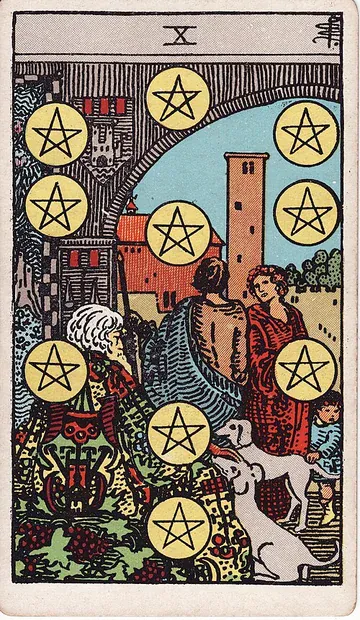
Ten of Pentacles
The two completion-tens of the deck. Cups Ten is the felt completion: family, threshold, the porch light. Pentacles Ten is the structural completion: lineage, inheritance, the legal framework that lets the household persist beyond a single generation. Together, the trust is funded, the will is signed, the grandparents have met the grandchildren and approve. Build the structure that lets the warmth outlast the people who started it.
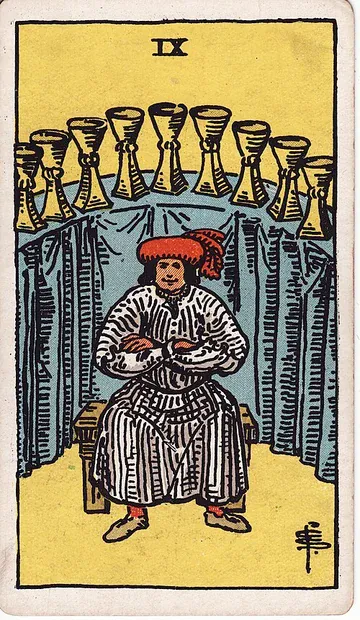
Nine of Cups
Wish-card landing into household. Nine of Cups is the wish granted in private — the figure behind the long table, arms folded. Ten of Cups is what happens when the wish leaves the host's hands and becomes shared infrastructure. The combination describes the seeker who has stopped hoarding the gift; the wish has become the structure other people now live inside. The host has finally invited the family to the table they were preparing alone.
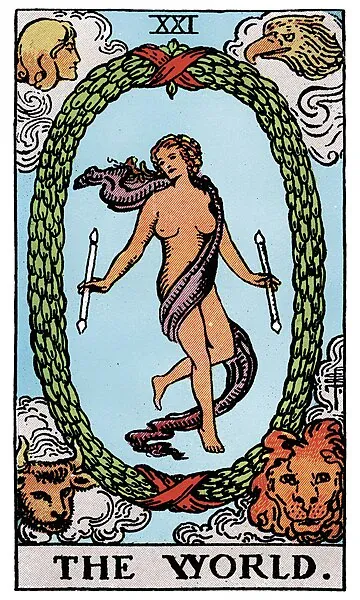
The World
The World is the great cycle ending — the soul's arc closing, the dancer surrounded by the four creatures. The Ten of Cups is the household where that completion lives. Together, they describe the rare reading where a long arc of a life is recognized as having completed itself in domestic form. The seeker who set out to find their place in the world finds it not at the summit but at the threshold. The journey ends in the kitchen.

The Sun
The Sun is unguarded radiance — the child on the horse, the open day, the laughter that does not cost anyone. The Ten of Cups is the household whose children, in the picture, are running. Together, the deck's clearest image of joy without shadow side: daylight at the threshold, undefended laughter, the domestic warmth that needs no announcement. The seekers who have seen too much expect another shoe. With these two together, there is no other shoe. Stay long enough to believe it.
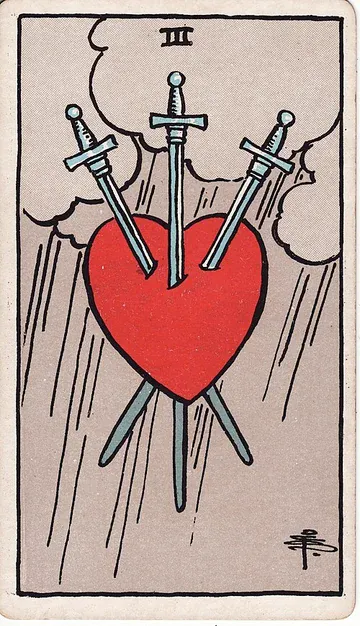
Three of Swords
The deck's most painful pairing for a household card. The Three of Swords is the heart pierced by three blades — the betrayal, the named grief, the wound that cannot be undone. With the Ten of Cups, heartbreak inside the household: the affair revealed, the family member who has died, the fracture running through the kitchen everyone is still pretending is intact. The roof does not come down. Under the roof, the people are now changed. Honor the wound; the household must grow to the size of its grief.
Frequently Asked Questions
Can the Ten of Cups reversed give me the household and still withhold the home?
That is precisely its move. The reversal is rarely a clean no — it is more often a partial yes, or a yes that arrives in literal household-shape but does not feed the deeper question you were asking. Treat it as a soft caution: the literal request is likely to be granted, but interrogate whether the household-form will be inhabited or merely arranged. The card asks you to ask the second question.
Which room in the house is the Ten of Cups reversed pointing at?
The one with the door that nobody has opened this year. Reversed in love, the Ten of Cups describes the relationship that has begun to perform itself — pleasant on the surface, with locked rooms inside. For partnerships, it warns of the comfortable plateau that has hardened into refusal. For new connections, it suggests a partner who is in love with the household-shape more than with you. For reconciliation questions, it offers a soft no — returning would rebuild the comfortable surface that broke. The card asks for the conversation no one in the household wants to have.
Do they want the household more than they want me, under the Ten of Cups reversed?
Sometimes, and the card will let you ask it without cruelty. The warmth is real and held inside. They feel attached, grateful, even quietly delighted — and have not yet found the courage or the language to let any of these feelings move out of their interior into a relationship you can actually receive. Read it as warmth that has not yet learned to flow. Finding that language is their labor, and it does not transfer to you.
What is the Ten of Cups reversed warning about?
The performed household. The completion that has hardened into a display case. The unspoken fracture inside a marriage that everyone admires. The family photograph that omits the family member in pain. The card warns against the household optimized for the outside viewer at the cost of the people who actually live there. It also warns against using a granted household-wish as a wall against further growth.
What is the advice of the Ten of Cups reversed?
Open the door no one has walked through. Stop arranging the household to the standard of an outside viewer. Ask the wish again — underneath the version you were handed, which older one is still standing there? Keep one evening a month for the conversation no one wants to have, before the unspoken topic becomes the structural crack the household falls through. The reversed card returns to upright through honest curiosity, real relational presence, and the courage to keep meeting the people who already live with you.