
Ten of Pentacles · Core Meaning
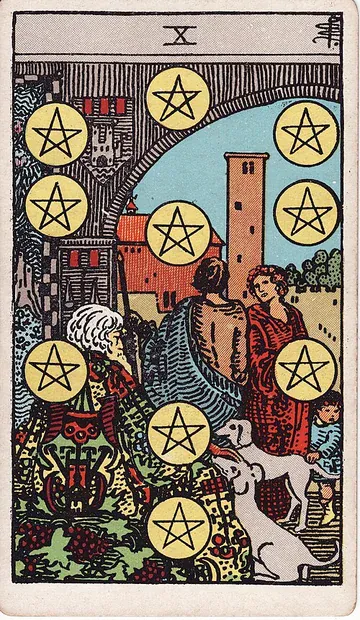
The Ten of Pentacles is the dynasty card — the moment in the Pentacles arc when private labor has passed through enough hands to become public ground. In the Rider-Waite-Smith image, an old man sits outside a stone archway, robe embroidered with the family crest, two hounds pressed against his knees. Inside the arch a young couple speaks softly. A child reaches for the dogs. Behind everyone, ten coins on the stone wall arranged in the pattern of the Tree of Life, the highest one nearly lost to shadow. Three generations are in the same frame. None of them are looking at the same thing.
The signature tension of the Ten of Pentacles is between the labor and the inheritor. The old man built it; the couple lives in it; the child will receive it without knowing it was ever in question. The card holds them all in suspension. Nothing dramatic is happening. Nothing dramatic needs to. The work has done what work does when it works: it has hardened into ground.
Read the card as the photograph taken on a cold evening before the winter solstice. The hearth is already lit. The children are already asleep upstairs. The hounds, who arrived in this house before any of the humans and will leave before any of the humans, are pressed against the one person who knows their names. This is the season the arc has been working toward. The cups in the Tens of Cups are about communion; the swords in the Tens of Swords are about ending; the wands in the Tens of Wands are about burden. The pentacles in the Ten are about ground that holds.
The traditional astrological signature is Mercury in Virgo's third decan — the final decan of harvest, where the work of speech becomes document, where craft becomes inheritance, where the spoken instruction becomes the written casebook. Mercury here is not the trickster. Mercury here is the scribe at the end of the field, copying down what the harvest taught him so that next year's harvest can begin from his page rather than from the empty soil. The card lives in the Sephirah of Malkuth, the kingdom, the lowest sphere on the Tree of Life — Assiah, the world of action, the place where all the higher work finally takes material form. Whatever was wished in Atziluth, planned in Briah, formed in Yetzirah lands here. The Ten of Pentacles is the card of landing.
Ten is the number of that landing, and in the pip sequence it is also the number with nowhere further to travel: after a Ten the suit starts again at an Ace, in a hand that is not yours. Malkuth sits at the foot of the Tree for the same reason — it is the sphere where everything from above has finished arriving, and the only movement left from it is a beginning somewhere else. The old man on the step is sitting exactly on that hinge. His stretch of the sequence is finished. The child reaching past his knees for the hounds is where the next Ace is quietly being seeded.
Read each of the five canonical symbols and you find the card's argument articulated in objects. The family crest on the wall is not glory; it is a reminder of who we are — the answer that is given to the next generation before they have learned the question. The ten coins arranged in the pattern of the Tree of Life are not stacked but placed: wealth that has found its order, that flows along the paths it was meant to flow along rather than piling up at one sphere. The two hounds at the old man's knees mark a slower, more honest time than human time — they arrived before the elder did, and they will leave before the elder does, and their lives measure the house's hours in a way no calendar can. The archway divides the picture into two simultaneous instants: inside, the life in progress; outside, the one who watches over it. And the child reaching for the dogs is the next generation's first motion toward what has been built — not yet to take, only to touch curiously, to confirm that the inheritance has texture, that it is real enough to lean against.
Read in any spread, the Ten of Pentacles describes the season in which what you have built becomes larger than the building of it. It does not predict; it names a weather. The weather is generational. Whether you welcome that weather or quietly resist it is the work the card asks you to do.
Ten of Pentacles · Love & Relationships
Love arrives in the Ten of Pentacles with in-laws attached, and a mortgage, and a Sunday table that expects you. It is no longer about whether the two people choose each other on a Tuesday — that was settled years ago. It is about what the choice has built. The household, the routines, the in-laws, the calendar of birthdays, the joint accounts, the seat at the family table. The love has become a small institution. The card asks whether the institution still serves the love, or whether the love has begun to serve the institution.
For an existing partnership, the Ten of Pentacles upright is one of the warmer cards in the deck. It describes the long bond that has settled into ground — the one where you stop calling each other to confirm you exist and start moving through the same life with the unconscious coordination of two old hounds. The arguments have become the agreed-upon arguments. The patterns have become rituals. You speak about the future in plurals. You assume each other's presence at the funeral, the wedding, the hospital. This is the card of the bond that has stopped being a question.
For a new spark, the Ten of Pentacles is rare and quiet — when it does arrive it suggests that the new connection carries the felt weight of the long version. You meet, and within weeks the two of you are already speaking in the cadence of people who have known each other for a decade. The friends fold them in. The family wants to meet. The body relaxes into the chair before the chair has been earned. This is not love at first sight in the dramatic sense — it is recognition. Something in the family architecture has made room for them already.
For a single seeker asking whether love is possible, the Ten of Pentacles upright answers yes — and locates the answer not at the dating-app level but at the life-architecture level. The question the card asks back is: have you built a life that a partner can move into? Not a perfect life, not a finished life — a life with rooms. The card is sometimes drawn by people who have been single for a long time precisely because they have over-perfected their solitude; the wealth of the household has filled every chair. To welcome someone in, you may need to leave one chair literally empty. The card describes the shape of love that arrives when there is room for love to arrive.
In the question of love after a wound, the Ten of Pentacles can describe the season in which the broken thing is rebuilt with sturdier materials. The first bond may have been bright and brief. The second bond is being built from what the first one taught. The card holds both: the old man on the step has lost things you do not see in the picture, and he is sitting now beside hounds and grandchildren. Recovery, on this card, looks like ground.
A note on the card's particular love language: the Ten of Pentacles loves with continuity. It remembers the anniversary of the first apartment. It keeps the photograph from the first holiday on the mantle. It builds traditions slowly and refuses to abandon them. This love language is not flashy. It is felt across decades, not weekends. If your partner is a Ten-of-Pentacles person, the affection will rarely arrive in declarations. It will arrive in the small ways the household has been arranged so that you can come home to it.
For long-distance partnerships, the Ten of Pentacles upright is the card of the bond that has begun to plan its merger. The conversation has shifted from how to keep going apart to which city, which apartment, which set of in-laws to meet first. The card supports the consolidation. It does not romanticize the distance.
For cohabitation questions — should we move in, are we ready — the Ten of Pentacles answers with a structural yes. The relationship has the bone density to hold the merger. Read the practical contracts carefully (whose name on the lease, how the bills split) but read the felt question already settled. The card describes the bond that survives the move-in.
For the family-meets-family threshold — engagement, introducing a partner to the elders, blending two clans — the Ten of Pentacles is the card most directly named. The card is the family-meets-family card. The two families recognize each other faster than expected. The elders nod across the table. The objections, if there are objections, are minor compared to the ground that is being laid. This is the card of the wedding that is not just a wedding but a pact between two histories.
Where there are children from an earlier marriage, the Ten of Pentacles reads the second household rather than the first. Two histories move into one set of rooms. A child who did not choose you reaches, or does not yet reach, the way the child in the picture reaches for the hounds — curiously, on their own schedule, to see whether the thing has texture. The card is unhurried about this. Standing inside a blended family is earned in ordinary weeks: the school run, the third Christmas, the night you happen to be the one who is awake. What the upright card confirms is that ground is being laid underneath all of it, including on the days when nobody thinks to say thank you for it.
When the two families do not match — different money, different country, different faith, a crest on one wall and nothing at all on the other — the upright card still reads in the couple's favor, but it names exactly where the labor sits. The arch in the picture has one family inside it. A second one has to be written in, and writing in is slow work: a name learned properly, a dish cooked the way their mother cooks it, one argument survived without anyone leaving the table. The Ten of Pentacles describes a bond with enough bone density to outlast an elder's first opinion — on the condition that the two of you do the translating yourselves instead of waiting for the families to do it for you.
If you are asking whether a specific person is serious about you and the Ten of Pentacles arrives upright, the answer is yes — they are thinking of you in the long shape. They have already begun, privately, to fit you into the future they imagine for themselves. They have mentioned you to the family member whose opinion they trust most. They have started using the word "we" without thinking. The card confirms what your instinct has already been telling you. They mean it.
Ten of Pentacles · As Feelings
Steady, grounded and quietly serious is the whole of what the Ten of Pentacles reports about someone's feelings. They do not feel about you the way one feels about a new spark — bright, fluttering, uncertain. They feel about you the way one feels about a piece of land. They are looking at you and thinking in years, not weeks. They are imagining the holidays. They are imagining the photograph on the mantle in twenty years.
If they are reserved, the Ten of Pentacles in feelings looks like a man who has stopped speaking about you to test the words. He has decided. His silence is not coldness — it is the quiet that follows a decision the body has already made. He is making space inside his life for you in the way one makes space in a house for a piece of furniture that will live there for decades. The signs are structural, not effusive. He keeps the second toothbrush. He puts your birthday into the calendar shared with his family. He talks about you to the elder he most respects.
If they are demonstrative, the Ten of Pentacles in feelings looks like someone who wants to integrate you into the life that already exists rather than build a separate, secret life for you. They want you at the family dinner. They want you to meet the friends from college, the cousin who was the ring-bearer at their parents' wedding, the dog that has been alive longer than any romantic relationship. The signal is integration, not seduction. They are not performing the relationship. They are placing you inside the architecture.
For a partner you have been with a long time, the Ten of Pentacles in feelings is one of the cards you most want to draw. It describes the partner who has stopped wishing you were different. They have stopped wishing the relationship were different. They have arrived. The feelings are no longer subject to small moods. They are the bedrock from which the small moods are felt. This is the card of the bond that has stopped flinching at its own depth.
For a new connection, the Ten of Pentacles in feelings can mean they are surprised by how seriously they are already taking you. They were prepared to enjoy you in a small way. They are now imagining you at their grandmother's table. They are quietly alarmed and quietly grateful. The card describes the lover who has begun to feel you as ground rather than as weather.
If the two of you have already broken once and come back, the Ten of Pentacles describes a person quietly re-laying floorboards. They are not narrating the reconciliation out loud; they are testing whether the floor takes weight again. The feeling shows up as small domestic restorations — your mug back in the cupboard, your name returned to the shared calendar, the spare key that was never asked for. Someone in this state says it later than they did the first time and means it more steadily once said. What they feel is not the old bright thing repaired. It is a second structure, built by somebody who now knows what the first one cost to lose.
There is a specific texture worth naming: the Ten of Pentacles personality, when in love, often goes quiet rather than loud. Their seriousness about you may not feel like passion in the dramatic sense. It will feel like reliability. Like a person you can lean into without having to ask. Like a presence that is steady when you are not. If you have been reading the relationship through the romantic-comedy template, you may misread Ten-of-Pentacles feelings as lukewarm. They are not lukewarm. They are stone.
For someone who is privately wondering whether you are the one — the Ten of Pentacles in feelings often appears at the threshold where they have begun to think yes. The card describes the moment of internal commitment, before the proposal, before the public statement, before they tell their best friend. They have decided. They are simply waiting for the structure to catch up with the decision.
There are three generations under this archway and only one of them is a couple. Drawn for a parent, an in-law, a manager, a teacher, the Ten of Pentacles gives the same grounded reading in another key: you have been counted into the family, or you are the person the work is meant to go to next. An elder reading this way may never say anything warmer than a question about your rent or whether the car passed its inspection. That question is the sentiment, in the only dialect they were taught. With a mentor it looks like being handed the file nobody else is trusted with. Affection in this register arrives as inclusion in the arrangements, and it is easy to miss entirely if you are listening for a compliment.
A small caution: the Ten-of-Pentacles partner can sometimes confuse the structure with the feeling. They can pour their love into the household, the calendar, the birthday traditions — and forget to say the words out loud. If you sense them building, building, building and never naming the bond, gently ask. The card responds to direct invitations. The architecture is real. So is the love. The love sometimes needs the words for the architecture to feel like home.
Take the Ten of Pentacles in feelings as confirmation that this person is in for the long shape. Whatever they feel, it is not a passing weather. Whatever they feel, it is being slowly written into the documents of their life. The work, if there is work, is structural — not whether they care, but whether the two of you have the conversations that translate the felt commitment into shared plans.
Ten of Pentacles · Career & Work
Tenure is the career subject of the Ten of Pentacles — the years that convert a job into a place. It is no longer just a job. It is a position inside an institution, a chair at a long table, a name on a building. The card describes the season when the labor you have done finally consolidates into reputation, equity, and the kind of standing that makes the next decade easier rather than harder. Whatever the specific shape — corporate seniority, a stable practice, a profitable small business, a tenured chair — the Ten of Pentacles names the moment when the work has begun to compound.
If you are asking whether to stay in a current role, the Ten of Pentacles upright reads as a structural yes — provided the role still serves the next chapter and not just the last one. The card supports the seasoned professional who has earned their place and is now drawing the rewards of staying. It also distinguishes itself from the Nine of Pentacles, which is the solitary harvest. The Ten is the shared harvest. Stay if your staying builds something that will outlast you in this institution. Stay if the work has begun to mentor the next generation of workers in your shadow. Stay if your name is now load-bearing inside the organization.
For someone considering a new role, the Ten of Pentacles upright is favorable when the new role offers the long-shape benefits — equity, vesting, deep institutional standing, a path to leadership over years rather than months. It is less favorable when the new role is merely a higher salary at the same level. Read the offer for what it builds, not just what it pays. The card asks the question that distinguishes a job from a career: in five years, will this role have built me a chair I can sit in for the next twenty?
For freelancers, the Ten of Pentacles is the card of the practice that has become a small business. The clients refer other clients without being asked. The operation runs itself. You have begun to think about hiring, or about systematizing, or about the version of the practice that does not require your direct hand on every project. The card supports this consolidation. The freelancer's transition into a real business is the Ten of Pentacles transition.
For corporate workers, the card describes the ascent into the layer of the organization where decisions are made. The promotion lands. The seat on the leadership team is offered. The chair at the long table now has your name on it. The card does not flatter the position — it does ask whether you are ready for the responsibility that the chair brings. The chair is heavier than it looks from the outside. It is being offered because you have, perhaps without noticing, become the person it requires.
For someone inside a family business, the Ten of Pentacles is the card most directly named. The card is the family-business card. It can describe the season of taking over from the elder generation, the slow handoff of authority, the quiet transition where you stop being the heir-apparent and become the person who makes the decisions. The card supports the transition. It also asks for honesty about what the elders built and what you are inheriting — including the things they would not have said out loud about the cost.
For someone considering an inheritance career — taking over a family practice, stepping into a parent's profession, accepting a role that has been held for you — the Ten of Pentacles upright suggests that the fit is real. The inheritance is not just material. It is the accumulated wisdom of those who came before you, the relationships, the reputation, the body of work. Read the card as confirmation that the inheritance is yours to take. Then ask the older question: do you want it for yourself, or are you taking it because they want you to? The card supports the answer either way. It only insists on the question.
For a creative practice, the Ten of Pentacles upright describes the season in which the body of work has begun to live independently of the artist. The earlier books are still selling. The earlier shows are still being studied. The new work builds on the older work in a way that students of the practice can now trace. The card describes the artist whose practice has become a tradition. This is the moment to think about archives, about the form the practice will take when you are no longer the one making it, about the people the work might mentor after you.
For someone facing a layoff or transition, the Ten of Pentacles upright is unusually steadying. The card suggests that the institutional ground beneath you, even in turbulence, holds. You have built relationships, reputation, and a body of work that the layoff cannot erase. The next chapter will rest on the inheritance you have built, even when the current chapter ends. The card does not predict — it describes the steadying ground that is already underneath.
For a mid-career promotion question, the Ten of Pentacles answers yes with the further note that the promotion is structural rather than ornamental. The new title comes with real authority, real budget, real responsibility for the work of others. Take it as a chair you intend to sit in. Read the responsibility before you read the perk.
Ten of Pentacles · Money & Finances
Settled is the word the Ten of Pentacles wants for money: not large, not dramatic, settled. The house is paid off. The retirement account compounds quietly. The emergency fund is full. The children's tuition is set aside. There is enough margin in the budget that small surprises (the broken dishwasher, the unexpected medical bill) no longer become structural emergencies. The card describes financial ground that holds.
For a question about whether a financial decision will pay off, the Ten of Pentacles upright tends to favor the structural move over the speculative one. Pay off the mortgage. Fund the index account. Build the trust. Sign the will. The card is not the lottery card and not the venture-capital card. It is the card of the boring move that compounds across decades. The ten coins on the wall behind the old man are arranged by the order of the Tree of Life — they are not stacked, they are placed. Wealth, on this card, has a shape. The shape rewards patience.
For someone considering a major purchase, the Ten of Pentacles upright is favorable for purchases that build long-term ground — the family home, the building that will house the practice for decades, the durable goods that will outlast their warranty. It is less favorable for status purchases. Read the purchase for what it builds, not what it signals. The card is the friend who has wealth and dresses plainly.
For someone managing scarcity, the Ten of Pentacles upright can describe the inflection where the long climb begins to compound. The first rung was hard. The second rung was hard. By the seventh or eighth, the ladder begins to feel like a staircase. By the tenth, the stairs are the building. The card is patient with the seeker who is still climbing — it names the destination without minimizing the climb.
For inheritance and windfall questions — bequests, trusts, family money arriving — the Ten of Pentacles is the card most directly named. The card is the inheritance card. When it appears in a question about money from family, it confirms the receiving is real. The bequest is yours. The trust will distribute as named. The card also asks the deeper question: what will you build with what was passed to you? Inheritance, on this card, is not the end — it is the seed of the next generation's tree.
Money moving sideways inside a family is its own weather, and the Ten of Pentacles is unsentimental about it: the cousin who asks, the sibling whose business needs a bridge until spring, the parent whose pension stops reaching the end of the month. Mercury in Virgo's last decan is the scribe at the edge of the harvested field, and his instruction here is plain — write it down. An amount, a date, and whether the thing is a loan or a gift, said once out loud and recorded once on paper. Families rarely fracture over the sum. They fracture over two honest, incompatible memories of what the sum was for.
For investments and long-term financial planning, the Ten of Pentacles upright supports the architecture rather than the bet. Diversify. Rebalance. Update the beneficiaries. Read the actual fee structure on the retirement account. Sign the documents that have been sitting in your inbox. The card rewards the small administrative moves that, compounded across years, make the difference between drift and ground.
A practical move when this card appears: open the document you have been avoiding. The will. The estate plan. The conversation with the elder about their wishes. The conversation with the inheritor about yours. The Ten of Pentacles responds to the structural moves we keep deferring because they are not urgent and not fun. The card insists, gently, that they are the shape of love expressed as paperwork.
For debt questions, the card is unusually patient. It describes the long, structural payoff — the consolidation, the disciplined monthly payment, the date on the calendar at which the obligation finally clears. Not the dramatic windfall that ends it overnight. The boring move that compounds. The card supports the seeker who is willing to do the long thing.
Ten of Pentacles · Health
Decades rather than months are the unit the Ten of Pentacles uses when it reads a body. It is not the athletic card, and not the immortal card. It is the card of the body that has been kept walking, kept fed, kept seen by its practitioners, year after year, until the discipline has become invisible and the body has become a piece of ground that holds.
If you are asking whether a treatment will work, whether a procedure will go well, whether a recovery will hold, the Ten of Pentacles answers with grounded confidence. The body has the bone density of long care. The system is patient. The recovery will follow the slow arc that long-cared-for systems follow. Do the boring practical things — take the medication on time, show up to the follow-up, keep the appointments. The card supports the architecture of care more than any heroic intervention.
For someone managing a chronic condition, the Ten of Pentacles describes the long stable management — not the cure, not the dramatic remission, but the year-after-year discipline that has become the way you live. The card is gentle here. It honors the patient who has stopped expecting the condition to disappear and started building a life that the condition can fit inside. This is its own kind of inheritance: the wisdom of how to live with a body that has its own weather.
The card's particular health signature lives in the knees, the thighs, the lower back — the parts of the body that support the seated generations. The card asks: how is the body that holds you up? Are you sitting too long without moving? Are the joints that have carried you for forty years getting the attention they deserve? The Ten of Pentacles is the card of the elder who walks the same path every morning, not for cardio but for continuity. Walk. Move the joints. Honor the body that has held you this long.
For digestive and metabolic health, the card describes the slow, steady patterns rather than the dramatic intervention. Eat the meals that the long body has agreed to eat. Sleep the hours that the long body has agreed to sleep. The card is suspicious of the new fad and patient with the old habit. If your habits are working, they are working precisely because they have compounded across years.
For mental health questions, the Ten of Pentacles upright describes the steadying that comes after the long internal work. The therapy has paid off — not in dramatic breakthroughs, but in the steady erosion of the old pattern. The depressive seasons are shorter and softer. The anxieties are familiar enough that you know how to walk them. You have built a life with rooms for the moods to live in without taking over the house. The card is not the absence of difficulty; it is the practiced relationship with difficulty.
For elder-care and family-health questions — your aging parents, the relatives whose health is now part of your weekly attention — the Ten of Pentacles is the card most directly named. The card is the multigenerational-health card. It asks for the structural conversations: the medical proxy, the will, the wishes about end-of-life care, the arrangements that turn fear into preparation. None of this is medical advice — keep your practitioners, take your medicine, do the work. The card simply names the shape of family attention required when the generation above you is the generation whose weather is changing.
For long-term wellness, the Ten of Pentacles describes the body whose maintenance has become the unconscious shape of the daily life. The walk after dinner. The annual appointment. The conversation with the doctor who has known you for ten years. The card honors the boring, structural practice of keeping a body across time.
Ten of Pentacles · Spirituality
Inheritance is the spiritual weight of the Ten of Pentacles — what came down the line to you, and what may go on through you. The card lives in Malkuth, the kingdom, the lowest sphere of the Tree of Life, the world of Assiah, the realm of action where all the higher work finally takes material form. Whatever was wished, planned, formed in the upper worlds lands here. The Ten of Pentacles is the card of the spiritual life that has come down out of the head and into the legs of the household.
For seekers in active practice — meditation, prayer, ritual, journaling — the Ten of Pentacles describes the season when the practice has begun to live in your hands rather than in your concepts. You no longer have to remember to do it. The body remembers. The morning sit, the evening reflection, the small daily acknowledgement before the meal — these have become the unconscious architecture of how you move through a day. The card honors this. It also asks: what part of the practice can you now hand on? Is there a younger seeker who would benefit from the early version of what you have built? The card describes the moment when the practitioner becomes, quietly, a teacher.
For seekers exploring belief, the Ten of Pentacles often describes a return — not a regression, but a recovery. The cosmology you grew up in, which you may have spent your twenties and thirties dismantling, can sometimes be re-met in the Ten as something more complex than you remembered. The grandmother's prayers. The grandfather's holiday traditions. The small pieces of family religion that survived generational drift. The card invites you to read them again with the eyes you have now. Some of them will still be empty. Some of them will turn out to be load-bearing. The card is patient with the seeker who returns to the inherited tradition with a more honest question.
For someone exploring lineage — ancestral practice, family-of-origin work, the recovery of elder voices — the Ten of Pentacles is the card most directly named. The card is the lineage card. It asks: who are the people whose work you are continuing whether or not you know their names? The card supports the work of finding those names. Photographs. Letters. Conversations with the oldest living relative. Family records pulled out of the attic. The Ten of Pentacles in spiritual context describes the season when the seeker realizes their own inner life is not original — it is downstream of currents that have been moving for a long time.
The card's spiritual caution is gentle: the inheritance must be living to be inheritance. A tradition kept only as duty becomes a tomb. The Ten of Pentacles, at its shadow edge, is the family altar that is dutifully maintained but inwardly empty. The card asks: which of the practices you have inherited still actually breathe? Keep those. Lay the others down with respect. Inheritance is not the museum of what was — it is the seed of what continues.
For questions about path, the Ten of Pentacles upright suggests that you are aligned with a current larger than your own decade. The work you are doing has been done before by people whose names you may or may not know. You are part of a transmission. The card invites you to receive that knowledge gratefully and to consider what your own contribution to the transmission will be. The next generation, on this card, is always already implied. The seeker is not the end of the line. The seeker is a station in the line.
A small practice when this card appears: write down one thing the elder generation taught you that you actually use. Not the cliché. The real thing. Then ask whether you have ever told them you use it. Then either tell them or, if they are gone, write it into the journal as a small acknowledgement. The Ten of Pentacles responds to the practice of conscious gratitude across generations.
Ten of Pentacles · Yes or No
Yes — and the yes is structural.
The Ten of Pentacles upright is one of the deck's clearest yes cards, but the yes is not the loud yes of celebration. It is the steady yes of ground that holds. Whatever you are asking about — a relationship, a job, a move, a financial decision — the card answers that the structural conditions for the answer are in place. The architecture supports the outcome. The bone density of the situation is real.
For yes-or-no questions about a relationship, a partnership, a long-term commitment: yes. The bond has the materials to last. The card supports the merger of households, the engagement, the move-in, the public statement. There is no hidden trap. The seriousness on both sides is the same seriousness.
For yes-or-no questions about a job, a role, a career step: yes. The role builds the long shape. The institutional standing is real. Take the chair. The card supports the move that compounds across decades rather than the move that flatters across months.
For yes-or-no questions about a financial decision — a house, a major purchase, a long-term investment, an inheritance acceptance: yes. The card is favorable to structural financial moves and patient with the slow returns. Sign the documents. Do the boring move. The card honors patience.
For yes-or-no questions about whether someone is being honest, whether an offer is genuine, whether a plan will hold: yes. The Ten of Pentacles has very little shadow in the upright orientation. The arch, the hounds, the old man's cloak — everything in the courtyard is what it says it is. The contract reads as it reads. The promise matches the offer.
Place is the other question this card answers cleanly. Move back to the town the family is still in; buy here instead of renting there indefinitely; put the practice in this building rather than the cheaper one across the river. The Ten of Pentacles says yes to the address that can be inhabited for a long time and stays indifferent to the address that only looks good this year. It measures a decision in decades, not in seasons. Ask which door a ten-year-old version of your household would recognize on sight, then answer from that door.
On the question of when the structure is finally in place, the Ten of Pentacles upright suggests yes, but the timing is the slow yes. Not instant, not far. The structural yes lands when the structures are ready, which is usually the season after the question is asked, not the week. The card rewards the seeker who can wait through the ordinary procedural delays without panicking.
For binary questions about whether to act — should I take the offer, should I make the move, should I sign — the Ten of Pentacles answers yes, with the further note that the action is the seal on the structural yes already in place. The path was already going to converge here. Your action is the cooperation that lets the convergence land in your particular life.
The only caution embedded in the yes is to read which yes you are receiving. The Ten of Pentacles answers the long-term questions more clearly than the short-term ones. If you are asking "will I be happy this weekend," the card has less to say. If you are asking "will this last," the card answers with quiet certainty: yes, this will last, and the lasting is the gift the card is bringing.
If the question was: am I building something that will outlive me? The card answers yes, and asks why you needed to ask.
Ten of Pentacles · As Advice
As advice, the Ten of Pentacles upright instructs the seeker to think generationally. Not in the abstract — in the specific. Look up from the present quarter, the present project, the present argument, and ask what you are building that will still matter in twenty years. Then orient the smaller decisions of this week toward what you found. The card is the instruction to make decisions at the long altitude rather than at the short one.
If there is one specific instruction the card offers, it is to do the structural paperwork you have been deferring. Sign the will. Update the beneficiaries. Have the conversation with the elder about their wishes. Have the conversation with your partner about yours. Open the financial document you have been avoiding. The Ten of Pentacles describes the seeker whose inner life is rich and whose external architecture has been quietly neglected. The card asks for the small, boring, structural moves that turn felt commitment into durable form. None of this is glamorous. All of it is load-bearing.
A second instruction: call an elder. Specifically, an elder. Not the friend, not the partner, not the therapist — the family member or mentor or teacher whose generation is above yours, whose health is finite, whose stories may no longer be available to ask for in five years. Call them, write to them, sit with them. The card's invocation says: "What I leave behind is a patch of ground that holds." Receive what they leave you while they are still here to leave it. The card is patient with the seeker who delays this call. It is also clear that the delay has a cost.
A third instruction: open the family record. The literal one. The photographs in the box. The letters in the drawer. The album that has not been opened since the last funeral. The casebook the older practitioner left you. The grandfather's journal. The Ten of Pentacles is the inheritance card, and the inheritance is not just material. It is the accumulated attention of those who came before you, written down or left in objects. Open it. Read it. Some of it will be empty. Some of it will be the foundation of the next chapter of your own work.
A fourth instruction: leave a chair empty. In love, in friendship, in the household, in the calendar — leave room for someone to arrive who has not yet arrived. The Ten of Pentacles describes the well-built household. The well-built household, when it is over-furnished, becomes the gilded cage of the reversed card. Build the architecture and leave the seat. The next generation, the next partner, the next colleague, the next student — they need a place at the table that is not yet occupied. The card responds to architecture that has been built with future inhabitants in mind.
A fifth instruction, gentler than the others: enjoy what you have built. The Ten of Pentacles describes ground that holds. The temptation, for the seeker who has worked this hard, is to immediately begin building the next thing. The card asks for a season of inhabiting what is. Sit on the porch. Watch the children run past. Notice the hounds at your knees. The work has done what work does. The reward is the quiet evening, before the winter solstice, the hearth already lit, the children already asleep. Do not skip this evening for the sake of tomorrow. The next chapter will arrive on its own time. This evening only happens once.
Practical advice for the day the card appears: write one sentence about what you intend to leave behind. Not the eulogy. Just one sentence, this evening, in a notebook. Then do one small structural thing — send the email, sign the document, make the call — that is consistent with that sentence. The card responds to alignment between the long shape and the day's small move. Begin there.
Ten of Pentacles · Card Combinations
The Ten of Pentacles is a card that gains depth in the company of others. It is the dynastic ground; the cards that arrive next to it tell you what kind of dynasty is being built and what kind of weather it is sitting under. Below are seven pairings that load the Ten of Pentacles with specific situational meaning. Read the combination as a single image, not as two readings stacked.
Ten of Pentacles + Ten of Cups
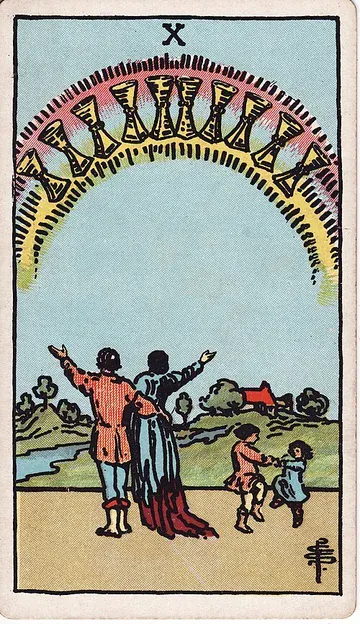
Both Tens, one in earth and one in water — the dynasty card meeting the family-joy card. Together they describe the household in which the structural architecture and the emotional warmth are both in place. Not just the inheritance, not just the love, but both. This is the rare combination of long-term partnership in which the merger of households has produced both a stable institution and a felt joy. The instruction, if any, is to honor that you are receiving a kind of grace most households do not. Do not take it for granted. Build the small rituals that thank it.
Ten of Pentacles + Nine of Pentacles
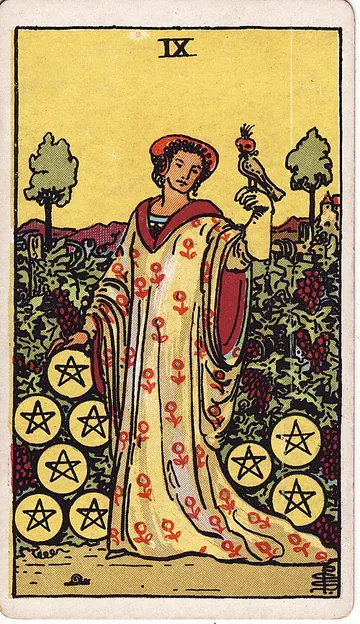
The immediate suit predecessor — the solitary harvest meeting the dynastic harvest. The Nine of Pentacles is the woman alone in her vineyard, the falconer of her own success; the Ten is the household that has incorporated others. Together the cards describe the inflection point where the seeker's solitary mastery is being asked to become shareable. The vineyard is now ready to produce wine for more than just the vintner. The instruction is to consider what part of your accumulated wisdom is ready to be handed on. Mentorship. Apprenticeship. The next person in the line.
Ten of Pentacles + Four of Pentacles
Same suit, same metal, opposite grip. The Four is the figure clutching one coin against his chest with two more under his feet; the Ten has laid all ten on a wall where anyone crossing the courtyard can see how they are arranged. Put side by side, they ask a single question of the seeker: is the wealth placed, or is it held? Family money that is never discussed, a parent who will not say what the will contains, a business whose books exactly one person has ever opened — that is the Four sitting inside the Ten's household, wearing the household's clothes. The pairing asks for one disclosure, made while everyone concerned is still well enough to sit at a table and hear it.
Ten of Pentacles + Page of Pentacles
The child in the archway, grown just enough to be given something. The Page is the student holding a single coin up at eye level, still learning what it is for; the Ten is the house with ten of them already set in order. Read as one image, they describe a transmission that has found its inheritor — the apprentice who will actually use the tools rather than shelve them, the younger colleague worth the slow hours, the son or daughter who has started asking real questions about how the thing was built. The pairing favors teaching over gifting. What changes hands here is a method, and a method is only ever received by someone who has been made to practice it.
Ten of Pentacles + The World
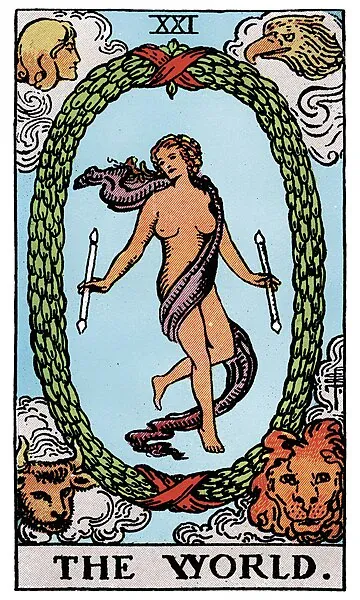
The dynasty card meeting the completion of an arc. When these cards appear together, the seeker is being shown the closing of a long chapter — not just a personal one, but a generational one. The work that began with an ancestor finds its consummation. The pact that was made decades ago is finally honored. The card pair describes the season of arrival at the destination that has been moving toward you for longer than you realized. Receive it. The next arc will begin from this ground, but this evening is the close of the old one.
Ten of Pentacles + Death
A grave and necessary pairing — the dynasty card meeting the inevitable transmission across generations. When these cards appear together, the seeker is at a threshold of inheritance that requires loss. An elder is passing, or has passed; a structure is being handed down because the previous holder can no longer hold it. The card pair is not predicting tragedy — it is naming the shape of how inheritance actually arrives. Receive what is being handed to you. Mourn what is leaving. The two motions are the same motion. The Ten of Pentacles softens Death; Death sharpens the Ten of Pentacles. Together they describe the funeral that becomes the start of the next generation's work.
Ten of Pentacles + Five of Pentacles
A tonal contrast — the warm-arch family scene meeting the two figures outside the lit church window. When these cards appear together, the question of who is inside the warmth and who is outside it becomes load-bearing. Has your dynasty's prosperity been built in a way that left others stranded? Is there a cousin, a sibling, a family member who is sitting in the cold while the household celebrates inside the arch? The pairing asks for honesty about the cost of consolidation. The instruction is to look outward — not to give the inheritance away, but to ensure that the people who should have been inside the arch are not freezing on the steps because of an old, forgotten dispute.
Card Combinations
Ten of Cups
Both Tens — the dynasty card meeting the family-joy card. The household where structural architecture and emotional warmth are both in place: long partnership, merger of clans, the rare bond in which the form holds and the love inside the form is still felt. Honor what most households do not receive.
Nine of Pentacles
Solitary harvest meeting dynastic harvest. The seeker's private mastery is being asked to become shareable — the vineyard ready to make wine for more than the vintner. Mentorship, apprenticeship, the next person in the line. Consider what part of your accumulated wisdom is ready to be handed on.
The World
The dynasty card meeting the completion of an arc. A long chapter — generational, not just personal — is closing. The work begun by an ancestor finds its consummation; the pact made decades ago is finally honored. Receive the closing. The next arc will begin from this ground, but this evening is the close of the old one.
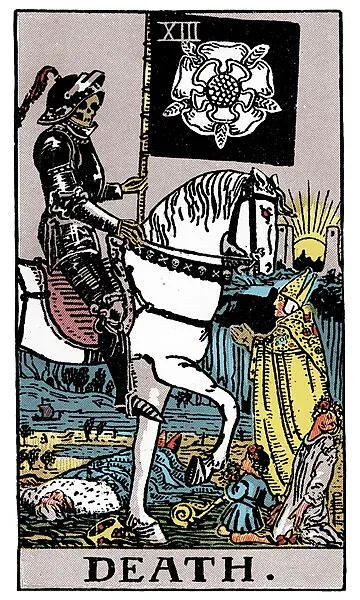
Death
A grave and necessary pairing — the dynasty card meeting the inevitable transmission across generations. An elder is passing; a structure is being handed down because the previous holder can no longer hold it. Receive what is being handed to you. Mourn what is leaving. The two motions are the same motion, and the funeral is the start of the next generation's work.
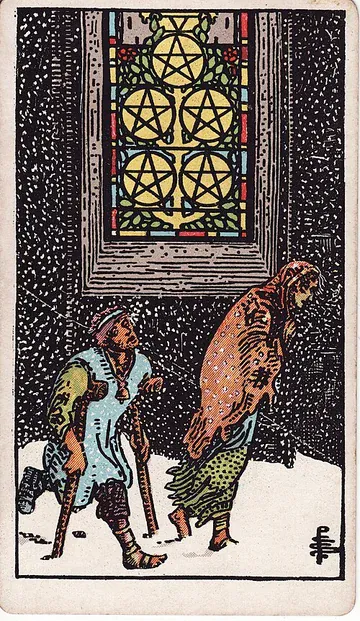
Five of Pentacles
A tonal contrast — the warm-arch family scene meeting the two figures outside the lit church window. Has the dynasty's prosperity been built in a way that left others stranded? Look outward — not to give the inheritance away, but to ensure the people who should have been inside the arch are not freezing on the steps because of an old, forgotten dispute.
Frequently Asked Questions
Why is the Ten of Pentacles called the dynasty card?
The Ten of Pentacles is the dynasty card — labor that has finally landed across three generations. The image shows an old man outside a stone archway, a young couple inside, a child reaching for two hounds, and ten coins on the wall arranged as the Tree of Life. Read it as the moment when private work has consolidated into public ground: inheritance, family, household, long-term wealth that holds.
Does the Ten of Pentacles mean marriage, or only a merged household?
In love readings, the Ten of Pentacles upright is the family-meets-family card. It describes relationships that have graduated into a structure — engagement, cohabitation, the merging of two households, the bond that will outlast the moods of any given week. For new connections, it suggests a relationship with the felt weight of the long version. For existing partnerships, it confirms the bond has settled into ground.
Is the Ten of Pentacles a yes for something I want to still be standing in twenty years?
The Ten of Pentacles upright is a clear yes — but a structural yes, not a celebratory one. It answers long-term questions (will this last, should I commit, should I sign) more clearly than short-term ones. The bone density of the situation is real, the architecture supports the outcome, and what is presented is what is. There is very little shadow in the upright orientation.
What paperwork is the Ten of Pentacles asking me to stop deferring?
As advice, the Ten of Pentacles instructs the seeker to think generationally and to do the structural paperwork that has been deferred — the will, the conversation with the elder, the financial document. Call an elder. Open the family record. Leave a chair empty for the person who has not yet arrived. Then enjoy what you have built. The card asks for alignment between the long shape and the small daily moves.
What's the difference between the Ten of Pentacles and the Nine of Pentacles?
The Nine of Pentacles is the solitary harvest — the woman alone in her vineyard, mastering her own success. The Ten is the dynastic harvest — that mastery shared with a household, a family, a lineage. Where the Nine is private competence, the Ten is the moment when the competence has become shareable, when the vineyard is ready to produce wine for more than just the vintner.
Continue Reading
Ten of Pentacles · Card overview · symbols · correspondences →
Return to the full card view — image, symbols, sensory correspondences, and Hermetic axes.
Read the reversed meaning →
Read the same depth on the opposite orientation.
Draw your reading now →
Bring this card to a question — open a quiet ritual.