
Ten of Pentacles Reversed · Core Meaning
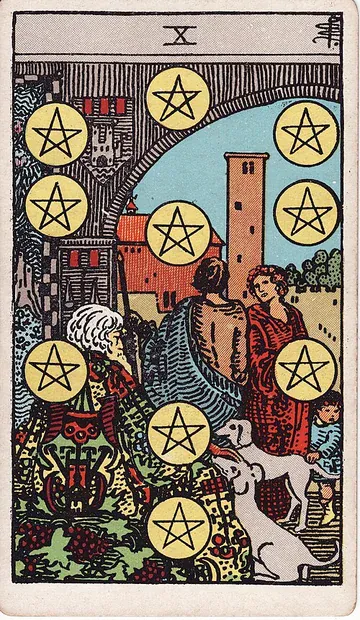
The Ten of Pentacles reversed is the same archway scene seen from the wrong side of the door. The old man is still on the step. The hounds are still at his knees. The couple is still inside, the child still reaching for the dogs, the ten coins still arranged behind everyone in the pattern of the Tree of Life. Nothing in the picture has moved. What has shifted is the felt weight of the structure. The household is no longer ground; it is weight. The inheritance is no longer gift; it is ledger. The family crest on the wall, which once said "this is who we are," now reads "this is what you owe."
This is the card's central knot when reversed: the dynasty has hardened into obligation. The structure that was built to support the next generation has begun to consume it. The young couple inside the arch is no longer simply living — they are performing the family's expectations of how a young couple inside the arch should live. The old man is no longer simply present — he is monitoring. The hounds are still hounds, but the hounds are easier than the humans, which is why the child reaches for them rather than for the elders. The card describes the moment when the household stops feeding the people who live in it.
There is a second flavor of the reversed card: the gilded cage at work. The role pays well. The benefits are excellent. The title is impressive. And every Sunday evening, at the threshold of Monday, the body grieves the week ahead. The cost of leaving has been calculated and is too high. The cost of staying is invisible because no one has been keeping the ledger. The reversed Ten of Pentacles names that hidden ledger — the slow erosion of the soul by a life that has all the right structures and none of the right air.
A third flavor: the inheritance that arrives as debt. Family money that comes with strings the seeker did not negotiate. The expectation, dressed as love, to follow the elder's profession, marry within the appropriate circle, take over the practice, fund the cousin's business, host the holidays in perpetuity. The reversed card is the card of expectations laundered as inheritance. The seeker is asked to disambiguate what is genuinely a gift from what is a contract presented as a gift.
The astrological signature reverses too. Mercury in Virgo's third decan, upright, is the scribe at the end of the harvest copying the wisdom of the field into the casebook so the next year's harvest can begin from his page. Reversed, Mercury becomes the family lawyer with the unsigned documents — speech that has hardened into legalism, craft that has hardened into trade-secret hoarding, harvest that has been locked in the granary while the field workers go hungry. The lower world of Assiah, the world of action, becomes the world of forced action — doing not because the soul has chosen but because the structure demands.
Reversed, the Ten of Pentacles asks: which of the structures you are inside still serves the life you actually want? And: which of the obligations you carry are genuinely yours, and which were handed to you under a label that did not match the contents? And: where, in the well-furnished household, is the air for someone to actually breathe?
Ten of Pentacles Reversed · Love & Relationships
The house is beautiful and the two of you have gone quiet inside it, which is the Ten of Pentacles reversed in a love reading. The household is enviable. The photographs are excellent. The friends and family say the right things. And in the quiet between the two of you, alone, after the guests have left, the room feels strangely far away. The institution has begun to substitute for the bond.
For an existing partnership, the reversed Ten of Pentacles often describes the comfortable plateau that has hardened into a refusal to grow. The two of you have stopped fighting because you have stopped reaching. The agreements that hold the household together are also the agreements that prevent its evolution. Both partners are pleasant on the surface and individually busy with their own corners of the calendar; the shared center, which used to be the felt heart of the bond, has been pushed to the edge of the table by the architecture. The card asks: are you a partnership, or are you co-administrators of a small institution?
For someone in a new connection, the reversed Ten of Pentacles can describe a partner whose family or background already fits you so well that the relationship is being conducted partly between the families and partly between the two of you. The merger of households is moving faster than the merger of hearts. You feel chosen for what you offer the structure rather than for who you are inside it. None of this is necessarily fatal. The card is precise: notice the asymmetry, and ask for the conversations that center the actual you.
Asked whether someone loves you, the reversed Ten of Pentacles answers by pointing at the household rather than at the heart — weigh that difference carefully. They feel something — a structural respect, a sense of fit, a recognition that you would belong in their life — and the feeling has not yet translated into the felt yes that lives below the structure. They may be choosing you partly with their family's voice in their head. They may be choosing you partly because their last partner did not fit and you do. The card is not naming malice. It is naming a partial yes, where the structure has decided before the heart has caught up.
For the family-meets-family threshold reversed — engagement under family pressure, in-laws who want to merge clans regardless of what the couple wants, the wedding being planned by everyone except the bride and groom — the reversed Ten of Pentacles is the card most directly named. The card describes the moment when the dynasty's logic begins to override the couple's autonomy. The instruction is to claim, gently and clearly, the small space inside the merger where the two of you actually decide. Not all of it. A protected portion. The reversed card warms back into upright when the couple recovers their own voice inside the larger family chord.
For someone in a long-distance partnership reversed, the card can describe the relationship that has become too dependent on the family-of-origin support that the distance requires. You stay because his mother helps with the kids. You stay because her family's house is closer to your work. The structure is real and the love has thinned. The card asks whether the relationship can be honestly named as still alive, or whether it has become an arrangement masquerading as a marriage.
For cohabitation questions — should we move in, are we ready — the reversed card warns of the move that is being made for the wrong reasons. The lease ends. The rent in two apartments is more than the rent in one. The parents are pressuring. The friends have all moved in with their partners. The reversed Ten of Pentacles is suspicious of the cohabitation that is structural rather than felt. Wait, if you can. The card responds to the move that emerges from the relationship's own readiness, not from the calendar's pressure.
For the single seeker, the reversed Ten of Pentacles is one of the deck's gentler cautions. It can describe the seeker who has built a life so well-furnished — the perfect apartment, the curated friendships, the established career, the rhythms that work — that no actual person could move in without disturbing the architecture. The wealth of the household has filled every chair. The card asks: have you built solitude into a gilded cage? The work is to leave a real seat empty. Not strategically empty. Actually empty. So that someone, when they arrive, could sit down without rearranging.
For after-wound questions — coming back to love after a marriage ended, after a long bond broke — the reversed Ten of Pentacles can describe the seeker who has rebuilt the household alone and is now afraid to risk it again. The fear is honest. The card respects it. It also notes that the rebuilt household, kept too well, becomes the same gilded cage as before, only this time without even the pretense of a partner. The work is gradual: first the willingness to imagine letting someone in, then the willingness to have the conversation, then the willingness to leave a real chair empty. The card returns to upright slowly, through the practice of small courage.
For the question of reconciliation — should I return to the relationship that broke, the card answers with a soft no or a partial yes that does not satisfy. Returning would rebuild the comfortable shape, but the comfortable shape was the shape that broke. The card asks: do you want this person, or do you want the household you remember? They are not the same. If the answer is the household, find a new place to build it. If the answer is the person, prepare to rebuild on different ground.
Ten of Pentacles Reversed · As Feelings
Reversed, the Ten of Pentacles describes someone who has run the numbers on you and found that they work, while the feeling has not caught up. They appreciate you. They see how you would fit. They have privately measured the merger and concluded it would work. And in the chamber of the actual heart, where the words "I cannot imagine my life without this person" live, the door is not yet open.
This is the card of the partner who likes the idea of you in their life and has not yet figured out how to feel you in their life. They are not pretending. The respect is genuine. But the respect is not yet love, and the line between the two — for the Ten of Pentacles personality, who tends to think structurally — is not always easy for them to find.
If they are reserved, the reversed Ten of Pentacles in feelings can mean possession without intimacy. They feel pleased with themselves for having you, in a way that is closer to acquisition than connection. Said plainly it sounds harsh, and the plainness is what makes it usable. Not all warm feelings are love. Some warm feelings are a kind of accomplishment that has nothing to do with the person being accomplished. Watch for the partner who treats you as a successful outcome of their selection process rather than as a person whose interior they want to know.
If they are demonstrative, the reversed card warns of performative satisfaction. They will tell people they are happy with you. They will post the photographs. They will narrate the relationship at family dinners. But in the room, alone with you, the depth of attention does not match the public statement. They are using the relationship to stabilize their own image as a person who has built the right kind of life. They are not yet a partner whose felt center includes you.
For a long-term partner, the reversed Ten of Pentacles in feelings can mean settled fondness that has stopped being curious about you. They love you, and they have stopped asking who you are becoming. The feelings are real and the attention has narrowed. The card asks for re-noticing — not new feelings, new looking. The shape of long love, when it is alive, includes the willingness to be surprised by the partner you have been with for a decade. The reversed card describes the moment when that willingness has thinned.
For a new connection, the reversed Ten of Pentacles can describe someone who is privately enjoying the structural fit but not yet ready to integrate the enjoyment into their actual life. They like you in their fantasy of the future household. They are uncertain how to like you on a Tuesday in February when the family is not watching. The card is not negative — it is precise. The work, if there is work, is theirs: to bring the felt yes out of the architecture and into the daily room with you. That crossing from blueprint to ordinary Tuesday is not one you can make for them.
For the partner who has been quietly considering the long shape with you and the card arrives reversed, the answer is: they are hesitating. Not because they do not respect you. Because they are afraid that committing to you fully will require them to commit to a life they are not yet sure they want. The fear is about the shape of the future, not about you specifically. The reversed Ten of Pentacles describes the threshold where the structural decision is being made and the heart is privately weighing whether the structure is the structure they actually want. Be patient. Be clear. Do not perform readiness on their behalf.
For someone whose family is part of the felt question — the partner who is choosing you partly with their parents in mind, the partner who is choosing you against their family's wishes, the partner who is afraid the family will object — the reversed Ten of Pentacles names the family weight directly. Their feelings about you are real. The feelings are also being filtered through the larger family chord. The card asks for honesty about how much of their hesitation is about you and how much is about the structures they cannot yet rearrange. Often it is the structures, not you. The card is more patient with the seeker who can read this distinction than with the seeker who personalizes everything.
For the partner whose feelings have curdled into resentment about a household imbalance — who carries more of the labor, who pays more of the bills, who manages more of the family relationships — the reversed Ten of Pentacles can describe the slow drift from love into ledger. They are keeping score. They are no longer assuming you. The reversed card asks for the structural conversation that returns the household to felt fairness. The feelings can recover. The conversation has to happen first.
Take the reversed Ten of Pentacles in feelings as a precise diagnosis: the structural respect is in place, the felt center has not yet caught up. The work is theirs, but the question is yours: are you willing to wait for them to bring the heart through the door, or are you ready to ask for it directly?
Ten of Pentacles Reversed · Career & Work
The gilded cage is a real job with real benefits, and the reversed Ten of Pentacles is how it reads from the inside. The salary is good. The benefits are good. The title is impressive. The colleagues are pleasant. And every Sunday evening, at the threshold of Monday, something inside you grieves the week ahead. The cost of leaving has been calculated. The cost of staying has been carefully not-calculated. The reversed card is the precise card for that quiet imbalance.
For someone considering whether to stay in a current role, the reversed card warns of the comfortable compromise that has begun to thin the soul. The role pays well enough that leaving feels irresponsible. The benefits are good enough that the family has come to depend on them. The title is significant enough that the social cost of stepping back is real. And the work itself — week to week, project to project, meeting to meeting — has stopped feeling like yours. An inherited archway is a comfortable thing to stand under and a hard thing to walk out from. Nothing is bad enough to justify leaving. Nothing is alive enough to justify staying. The reversed card invites the honest accounting of which of those two truths is currently the more dangerous one.
For someone considering a new role, the reversed Ten of Pentacles indicates that the new role may deliver in the metrics — title, money, recognition — without delivering in the meaning. Read the offer carefully. Read it for what it actually requires you to be five days a week, not for the press release version. The reversed card warns specifically of the role that looks like a step forward on the resume and is actually a step deeper into a life you did not choose.
For freelancers and entrepreneurs, the reversed card describes the practice that has become about the metrics — the followers, the revenue, the launches — at the expense of the work that started the practice. You are still doing the work. You are also spending more and more of your week tending the structure of the business: the bookkeeping, the platform, the brand, the audience-management. The reversed card asks: when did the structure become the point? Reconnect to why you began. The wealth of the practice should serve the practice, not replace it.
For corporate workers in family-owned businesses, the reversed Ten of Pentacles is the card most directly named. The card is the family-business-trap card. It can describe the seeker who took over the business out of obligation rather than calling, who is competently maintaining what the elder generation built without ever stopping to ask whether the inheritance fits them, who is performing the role of the heir while quietly grieving the life they would have built if the business had not been there to inherit. The card is gentle here. It does not say leave. It says read honestly. Some seekers, having read honestly, find that the inheritance does fit and renew their commitment with full awareness. Some seekers find that it does not, and the reversed card supports the harder conversation that follows.
For someone facing an inheritance career decision — the elder is preparing to hand over, the practice is being offered, the chair is being held for you — the reversed card is the precise card for ambivalence. You feel the obligation and you feel the resistance. Both are real. The card asks you to separate them. What does the elder genuinely need? What do they want as a way of feeling their life completed in you? And what do you want for your own life? Often these three are not the same. The reversed Ten of Pentacles supports the long, uncomfortable conversation that distinguishes them.
For a creative practice reversed, the Ten of Pentacles can describe the artist whose body of work has begun to feel like an institution they have to maintain rather than a living practice. The audience expects a particular shape of work. The previous work has set expectations. Each new piece is being made partly for the practice's reputation and partly for the actual interior of the artist. The reversed card asks: which of those two is currently driving the choices? And what would it take to let the work risk again? The card is patient with the artist who reorients toward the felt center.
For someone considering a layoff or transition reversed, the Ten of Pentacles can be unexpectedly honest. The reversed card sometimes describes the layoff as the breaking of the cage rather than the breaking of the seeker. Not all role-loss is loss. Some role-loss is liberation that the seeker would not have chosen and is now grateful for, six months later. The reversed card does not predict — it describes the shape of how forced transitions can sometimes free a life that the structure would not have released voluntarily.
For a mid-career promotion question reversed, the card warns of the promotion that consolidates the gilded cage rather than offering a genuine new chapter. The new title is bigger. The new responsibilities are bigger. The interior life is the same. The card asks whether the promotion is actually a step forward or a deeper investment in a track that was already not yours. Read the offer for what it locks in, not just what it offers.
For corporate vs. small-business career questions, the reversed Ten of Pentacles can describe the seeker stuck inside a corporate structure they have outgrown but cannot afford to leave. The card supports the slow exit plan: building the secondary income, training the replacement, having the conversations with the family about what a transition would require. None of this is dramatic. All of it is the structural unwinding the card actually rewards.
Ten of Pentacles Reversed · Money & Finances
Wealth turns into weight when the Ten of Pentacles lands reversed on a money question. The accounts look healthy. The balance sheet is solid. And somewhere inside the structure, the money has begun to constrain rather than enable. The lifestyle has crept upward to match the income. The fixed costs have absorbed the flexibility. The seeker is technically rich and functionally trapped.
For someone managing a comfortable financial life and finding the reversed card in a money reading, the warning is gentle but specific: prosperity is creating drag. The house that was bought because it was achievable now requires a job that funds the house. The lifestyle that was earned has become the baseline that must be maintained. The card is asking you to notice what your wealth is requiring of you — and to ask whether the requirements are still in service of the life you actually want.
For inheritance and family money questions reversed, the Ten of Pentacles is the card most directly named. The card is the inheritance-trap card. It describes the bequest that arrives with strings, the trust that comes with conditions, the family money whose acceptance entails an unwritten contract. The reversed card asks for honest reading of what the gift requires. Is the inheritance free? Is it free of expectations? Is it free of the older sibling's resentment? Is it free of the implicit obligation to follow the family's professional path? Often the answer is no. The card supports the seeker who can name the contract embedded in the gift.
For someone navigating family financial entanglement — the loan to the cousin, the investment in the brother's business, the long-term financial support of an elder, the bailout that keeps becoming necessary — the reversed Ten of Pentacles describes the slow erosion of personal financial freedom by the dynasty's pull. None of the individual moves were wrong. The aggregate has begun to consume your own ground. The card asks for the structural reset: clear boundaries, renegotiated terms, the conversation with the family member that has been postponed for years.
For someone in golden-handcuffs at work, the reversed card can describe the financial trap that holds the seeker in the role they have outgrown. The mortgage, the lifestyle, the children's tuition, the retirement plan that requires staying — all of these are real. The card does not minimize them. It does ask whether you have ever modeled the alternative honestly. Most golden-handcuff calculations assume the current lifestyle is fixed. The reversed card invites the experiment of asking what would actually be required to leave, run honestly, and discover that sometimes the cage was smaller than the fear made it.
For someone considering a major purchase reversed, the card answers with caution. The purchase may deliver the literal thing without delivering the felt thing. The bigger house. The second property. The luxury upgrade. Read what the purchase will require of you in the years ahead — the maintenance, the taxes, the lifestyle creep, the relationships it pulls into orbit. The reversed Ten of Pentacles is suspicious of the purchase that consolidates the cage rather than building real ground.
For investments and long-term planning reversed, the card warns of the structures that have been built for someone else's life rather than yours. The retirement account targeting the wrong age. The portfolio designed for the elder's risk tolerance. The financial plan that assumed you would follow a path you have since left. The reversed card asks for the honest review and the realignment. The structures should serve you. If they have begun to constrain you, rebuild them.
For debt questions reversed, the card describes the obligation that has begun to feel impossible. The mortgage that exceeds the household's safe capacity. The family loan whose forgiveness feels permanently out of reach. The structural obligation that is consuming the seeker's flexibility. The card is patient. It does not predict bankruptcy or rescue. It asks for the honest accounting and the structural moves — the renegotiation, the consolidation, the difficult conversation — that begin to release the weight.
For a windfall reversed — a sudden inheritance, a surprise bonus, a windfall that feels too large — the Ten of Pentacles reversed can describe the trap of the unprepared receiver. The money arrives. The structure to hold it does not exist. The lifestyle expands to absorb it. Within a season, the windfall is gone, and the seeker is back to where they were, with no durable change. The reversed card asks for the discipline that turns the windfall into ground rather than into spending. Wait. Plan. Build the structure first.
A practical move when this card appears: write down what the wealth you have is currently requiring of you. Not what it is providing — what it is requiring. Then ask which of those requirements you would willingly choose if the money were not pulling. The reversed Ten of Pentacles responds to the seeker who can read the cost of the structure honestly.
Ten of Pentacles Reversed · Health
Somebody in the household has been carrying it, and the reversed Ten of Pentacles is asking about that person's body. The visible signs are still in place. The labs are still acceptable. The body still does what it is asked to do. And underneath, the slow attrition has begun to show — the joints that ache without specific cause, the sleep that no longer refreshes, the chronic low-grade something that is not yet diagnosable but is increasingly hard to ignore. The body knows the household is a weight before the mind has admitted it.
For someone managing the health of multiple generations — aging parents, a child with chronic needs, a partner whose system requires care — the reversed Ten of Pentacles describes the caregiver's own slow erosion. The card honors the labor. It also names what the labor is costing. The caregiver who has not slept a full night in eighteen months. The adult child whose own appointments keep being postponed because the elder's appointments are urgent. The parent whose body has been the household's infrastructure for too long. The card asks: who is taking care of the caregiver? If the answer is no one, the card is naming the condition the body is starting to express.
For someone in a stable but joyless health regimen, the reversed card describes the discipline that has become punitive rather than supportive. The diet that has stopped being enjoyable. The exercise routine that has become a duty. The medical compliance that is technically maintained but spiritually abandoned. The card is gentle here. It does not say abandon the discipline. It asks whether the discipline can be reconnected to the felt life it was originally meant to serve. Sometimes the prescription needs to change. Sometimes the practitioner needs to listen again.
For chronic conditions reversed, the Ten of Pentacles can describe the season when self-management has slipped under the weight of the family's other demands. The refill waits unclaimed at the pharmacy behind three other people's emergencies. The exercise is happening — sometimes. The follow-up appointments have been postponed because the elder's surgery, the child's school crisis, the partner's career emergency took priority. The card warns that the slipping has begun to compound. Re-engage with the practice that was working — not as an additional obligation, but as the foundation that allows you to keep showing up for the others.
For chronic pain reversed, particularly in the knees, hips, and lower back — the parts of the body the upright card associates with supporting the seated generations — the reversed Ten of Pentacles can describe the somatization of the household weight. The body is carrying what the spirit has not been allowed to put down. The card does not replace medical care. It asks: what part of the family's emotional or financial weight have you been bearing in your body? And what would change in your body if you set down the part you have not actually been asked to carry?
For mental health reversed, the Ten of Pentacles can describe the depression that lives inside the well-furnished life. Nothing in the external picture justifies the heaviness. The job is good, the family is fine, the household is intact. And the interior weight has been climbing for months. The reversed card is the precise card for that mismatch. It is not the dramatic depression of crisis. It is the chronic, low-grade dimming that emerges when a life looks correct from the outside and feels stranded from the inside. The card respects the diagnosis and asks for the structural conversation. Therapy. Medication if appropriate. The honest examination of what the well-furnished life is missing.
For inherited health risks — the conditions that run in your family, the genetic factors you have begun to notice in yourself — the reversed Ten of Pentacles names the inheritance directly. The card asks: what have you inherited from the bodies of those before you, and what care does that inheritance now require? Family medical history. The conversation with the doctor about screening. The conversation with the elder about what they wish they had known. None of this is fatalism. The reversed card is the card of the seeker who reads the inheritance honestly so that the next chapter can be written with awareness.
For the body that has begun to show the cost of long-deferred care — the dental work that was put off, the screening that was skipped, the follow-up that was not scheduled — the reversed card invites the structural re-engagement. Make the appointments. Sign the forms. Have the conversations. The card is patient with the body that has been neglected and steady in supporting the slow recovery of the regimen that holds.
Supporting the return of a regimen is not the same as prescribing one, and this is not medical advice. Keep your practitioners. Take your medicine. The reversed Ten of Pentacles is a precise mirror, not a diagnosis. It names the weather. The work, including the medical work, is yours.
Ten of Pentacles Reversed · Spirituality
A tradition can be kept perfectly and felt by nobody, and that is what the reversed Ten of Pentacles watches for. The altar is dutifully maintained. The holiday is correctly observed. The family religion is performed at the appropriate intervals. And the interior of the practice has been hollow for so long that no one in the household has noticed. The reversed card is the card of the inheritance kept as obligation after the felt center has departed.
For someone raised in a tradition they have begun to outgrow, the reversed Ten of Pentacles describes the threshold of honest examination. Some parts of the inherited practice are still load-bearing. Some parts have become museum pieces, kept because the elders would be hurt by their absence rather than because the practice itself still feeds the seeker. The card invites the slow, respectful inventory. Keep what is alive. Lay down, with care, what is no longer. The card is suspicious of two opposite errors: the wholesale rejection of the tradition out of adolescent rebellion, and the wholesale preservation of it out of guilt. Both miss the harder work, which is discernment.
For seekers in active spiritual practice reversed, the card can describe the practice that has hardened into routine in the dull sense rather than the steady one. The morning sit has become rote. The prayers are said without their meaning being felt. The journal entries are short, dutiful, and the same as last month's. The card invites a reset — a new teacher, a new tradition, a new question — that disturbs the inherited rhythm enough to recover its life. An inheritance stays alive only for as long as it keeps being used.
For someone wrestling with the family-of-origin religion — the Catholicism you cannot fully leave or fully return to, the Buddhism you absorbed as a child and have rebelled against, the practice your parents observed and you abandoned — the reversed Ten of Pentacles is the card most directly named. The card describes the threshold of mature reckoning with inherited belief. It does not dictate the answer. It honors the question. Some seekers, having sat with the question, return to the tradition with the new eyes of the person who chose it consciously. Some seekers find that the tradition was never theirs and put it down with respect. Some seekers carry forward what they can use and gently release the rest. All three are valid endings the reversed card supports.
For seekers exploring spiritual consumerism reversed, the Ten of Pentacles describes the collector who has accumulated traditions the way one accumulates coins. The library is impressive. The vocabulary is ecumenical. And the felt practice — the actual time on the cushion, the actual time with the breath — has thinned to the point where the collection has become a substitute for the work. The card asks: which of these teachings are you currently practicing, and which are you holding on the shelf? Practice the one. Let the others rest in the library until they call you.
For ancestral and lineage work reversed, the card describes the seeker who has begun the work of recovering the elder voices and is finding, painfully, that not all of what is recovered is wisdom. Some of the inherited material is wound. Some of the lineage carries patterns that the next generation should not extend. The reversed Ten of Pentacles is patient with this. It does not romanticize the ancestors. It asks for honesty about what was passed down — the gifts, the wounds, the silences, the things that should have been said and were not. The work is to keep the gifts and refuse to inherit the wounds.
For questions about path reversed, the Ten of Pentacles asks whether you are walking the path or maintaining its appearance. The retreats. The teachers. The practices. The vocabulary. The card warns of the seeker who has built a beautiful spiritual structure and stopped quietly meditating inside it. The reversed card is gentle. Most families of practice include a generation that only kept the forms. The work is not to feel ashamed but to notice the substitution and return to the simpler practice.
A small practice when this card appears: choose one inherited tradition and ask honestly whether you currently believe in it. Not whether you observe it. Whether you feel it. If you do, deepen your relationship to it consciously. If you do not, lay it down with respect — write the elder a letter explaining the change, or simply make the inner acknowledgement that you are no longer practicing what they passed to you. The reversed Ten of Pentacles returns to upright through the courage of honest examination of what one has been carrying.
Ten of Pentacles Reversed · Yes or No
Yes on paper — and the paper is the problem.
The answer here is not a door closing; it is a door opening onto the wrong room. It is more often the answer that arrives in the literal shape you asked for and not in the felt shape you needed. The structure says yes. The interior life says wait. The cage is well-furnished. The cage is still a cage.
For yes-or-no questions about a relationship, a job, a move, a decision: the answer is technically yes, but the yes arrives bound to obligations the seeker did not negotiate. The role arrives, and the role owns you. The relationship holds, and the relationship subordinates you to the family chord. The move happens, and the move locks in a life you did not fully choose. The literal question gets a literal answer. The unspoken freedom does not.
No fine is being levied on the estate. It is being precise. The reversed Ten of Pentacles insists that you ask the right question. If you asked "will I get the inheritance" and the answer is yes, but you actually wanted to know "will the inheritance set me free or constrain me," the card distinguishes those two questions and answers only the first.
For questions about whether to enter into a structural commitment — sign the contract, accept the offer, say yes to the family arrangement — the reversed card asks for an extra beat. Not a refusal. A pause. Read the document. Read the implicit terms that are not in the document. Negotiate the parts you can. Walk away from the parts you cannot. The reversed Ten of Pentacles supports the seeker who can hold the structural decision long enough to ensure the structure actually fits.
For yes-or-no questions about whether someone or something is being honest, whether the offer is what it claims to be, whether the family's framing of the situation is accurate — the reversed card warns of pleasant surfaces. No one under this archway is lying. The family picture is accurate and it is also cropped. There is a comfortable refusal of full disclosure, often unconscious, often well-meaning. Read the contracts. Ask the second question. Get the answer in writing.
Asked how quickly the family question closes, the reversed Ten of Pentacles suggests yes, but the soonness will not relieve what you thought it would relieve. Whatever the underlying urgency was, the arrival of the answer will not make it go away. The promotion lands; the gilded cage closes. The inheritance arrives; the family expectations crystallize. The work is upstream of the timing.
Should I act or should I wait: reversed, the Ten of Pentacles answers wait, and it means waiting inside the structure rather than outside it. Not forever. Long enough to know whether the structure you are about to enter is one you can leave. The Ten of Pentacles upright is the dynasty card; the reversed card is the seeker noticing, in time, that the dynasty was about to acquire them rather than welcome them. Take the extra season. Read the fine print. Rehearse your exit before you sign your entrance.
For questions about whether a difficult family conversation should happen, the reversed Ten of Pentacles answers yes — and the yes is harder than the comfortable no. Have the conversation. Name the imbalance. Ask for what you actually need. The card is patient with the seeker who is afraid the structure will not survive the honesty. Most structures survive. The ones that do not survive were not structures; they were silences pretending to be structures.
If the question was: do I have to keep doing this? The reversed card answers no. And asks why you have been telling yourself you do.
Ten of Pentacles Reversed · As Advice
As advice, the Ten of Pentacles reversed instructs the seeker to interrogate the structure. Not to abandon it. Not to suspect it of being secretly malicious. To notice which parts of it are still serving the life the seeker actually wants and which parts have begun, quietly, to substitute for it.
If there is one specific instruction the reversed card offers, it is to separate the family's expectations from your own. Not metaphorically. Literally. Make two columns. Write down what your elders, your family of origin, your in-laws, your inherited culture expect of you in the next year. Then write down, in the second column, what you yourself want for yourself in the next year. The two columns will overlap. They will also diverge. The reversed card asks you to be honest about the divergence. Where the expectations are genuinely yours, you can carry them gladly. Where they are not, you can either renegotiate them or quietly return them. The card supports both.
A second instruction: refuse, today, one small thing wrapped in "for the family's sake" that you yourself do not want. Not the dramatic refusal — the small one. The holiday tradition that exhausts you and that no one would actually miss. The phone call you have been making out of duty rather than connection. The spending pattern that is sustained by family pressure rather than your own preference. Refuse one. See what happens. Most of the time, very little happens. The structure was holding mostly because no one had tested its real shape.
A third instruction: open the document you have been avoiding. The same as the upright instruction, but with a different inflection. Upright, the document is the will or the estate plan or the long-term financial structure that needs your attention. Reversed, the document is the one whose terms you are afraid to read because reading them would force a decision. The contract you signed years ago. The trust whose conditions you have never actually examined. The family agreement whose specifics you have always taken on faith. Open it. Read it. Sometimes what you find is exactly what you assumed. Sometimes what you find is the basis for the next chapter of your work.
A fourth instruction: build a private exit plan. Not because you intend to leave. Because the seeker who knows they could leave inhabits the household differently from the seeker who feels trapped. The reversed Ten of Pentacles describes the cage that is partly maintained by the conviction that there is no door. Map the door. Cost it. Know it exists. You may never use it. Knowing it exists is itself a structural shift.
A fifth instruction: have the conversation you have been postponing. Specifically, the one where you ask the elder, the partner, the family member whose expectations you have been carrying — directly, kindly, clearly — what they actually need from you and what they have been assuming you would do. The reversed Ten of Pentacles describes the obligations that grow in silence. Direct conversation does not resolve every imbalance. It does almost always reveal that the imbalance was a third the size of the version you had been carrying in your head.
A sixth instruction, gentler than the others: forgive yourself for staying as long as you have. Most seekers, somewhere in their thirties or forties, encounter this version of the Ten of Pentacles. The version where the well-built life has begun to hold them rather than support them. There is no shame in the recognition. The reversed card becomes integration when the recognition is followed by structural movement. Not dramatic. Honest.
Practical advice for the day the card appears: write down one obligation you are currently carrying that you suspect is not actually yours. Then write down what would change if you returned it. Not necessarily today — but with the intention of returning it within the season. The reversed Ten of Pentacles responds to small, structural acts of returning what was never asked for in the form it was given.
Ten of Pentacles Reversed · Card Combinations
The reversed Ten of Pentacles, in combination with other cards, often sharpens the precise shape of the cage being inhabited. The cards that arrive next to it tell you which wall you are pressing against and where the door, if there is a door, is located. Below are five pairings that load the reversed Ten of Pentacles with specific situational meaning.
Reversed Ten of Pentacles + Ten of Cups
Both Tens, structural earth meeting communal water, but with the earth reversed. The pairing describes the household that looks like the picture-perfect family from the outside while the inner emotional reality has thinned. The holiday photographs are excellent. The interior dinners are cold. The card pair is the precise diagnosis of the comfortable family that has stopped being a family and become a performance of one. The instruction is to recover the felt center — not by tearing down the structure, but by returning warmth to the rooms that have begun to feel staged.
Reversed Ten of Pentacles + Nine of Pentacles
The dynastic harvest reversed meeting the solitary harvest upright. The pairing describes the seeker who is being invited to step out of the family structure, even temporarily, and recover their own private competence. The Nine of Pentacles is the woman alone in her vineyard. The reversed Ten is the household that has begun to consume its members. Together they suggest that the work is to reclaim a portion of solitude inside the dynasty — a private practice, a private income, a private name — that belongs only to you. Build the vineyard at the edge of the family's land. The card pair supports this.
Reversed Ten of Pentacles + The World
The dynasty card reversed meeting the completion of an arc. When these cards appear together, the seeker is being shown that a chapter is genuinely ending — and the ending may include the structure they had assumed would be permanent. The family business is closing. The elder generation is passing. The household is being dissolved by some force the seeker did not choose. The card pair is grave but not despairing. The completion is real. The next arc will require building from new ground rather than inheriting from the old.
Reversed Ten of Pentacles + Death
A heavy pairing — the dynasty card reversed meeting the inevitable transmission. When these cards appear together, the seeker is at a threshold of inheritance that requires loss, and the loss is structural. The elder generation is leaving without the affairs being in order. The transmission is happening through grief rather than through ceremony. The estate is contested. The will surfaces complications. The card pair is not predicting tragedy beyond what is already underway. It is naming the shape of inheritance that arrives through harder doors. Honor the loss. Then begin the slow work of structural repair.
Reversed Ten of Pentacles + Five of Pentacles
A pairing where two cards of inherited difficulty meet. The reversed Ten describes the cage of the well-furnished household; the Five describes the two figures outside the lit church window, denied entry to the warmth that should have been theirs. Together, the cards name the seeker who is either inside the cage looking out at the cousins who were not given a place, or outside the window looking in at the household they were excluded from. The pair asks for repair across the dispute that froze a relative out of the inheritance. Sometimes the repair is the seeker stepping into their own cold and refusing to participate further in the freezing of others. Sometimes the repair is the older work of finding the cousin and inviting them, finally, back inside.
Card Combinations
Ten of Cups
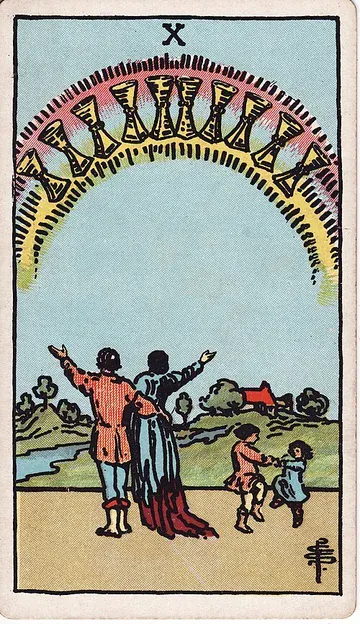
Both Tens — the dynasty card meeting the family-joy card. The household where structural architecture and emotional warmth are both in place: long partnership, merger of clans, the rare bond in which the form holds and the love inside the form is still felt. Honor what most households do not receive.
Nine of Pentacles
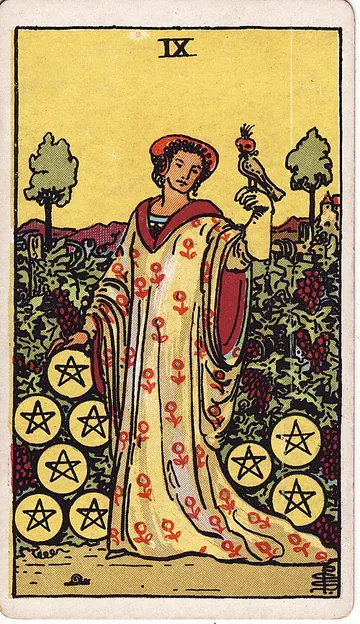
Solitary harvest meeting dynastic harvest. The seeker's private mastery is being asked to become shareable — the vineyard ready to make wine for more than the vintner. Mentorship, apprenticeship, the next person in the line. Consider what part of your accumulated wisdom is ready to be handed on.
The World
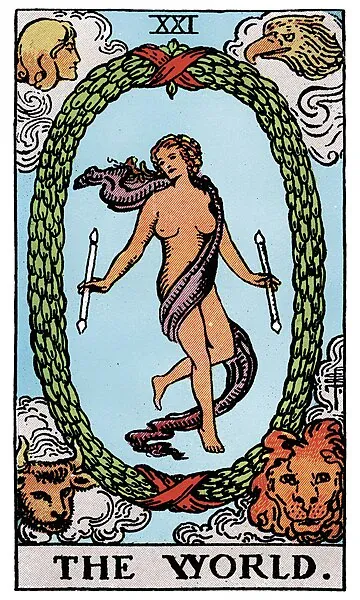
The dynasty card meeting the completion of an arc. A long chapter — generational, not just personal — is closing. The work begun by an ancestor finds its consummation; the pact made decades ago is finally honored. Receive the closing. The next arc will begin from this ground, but this evening is the close of the old one.
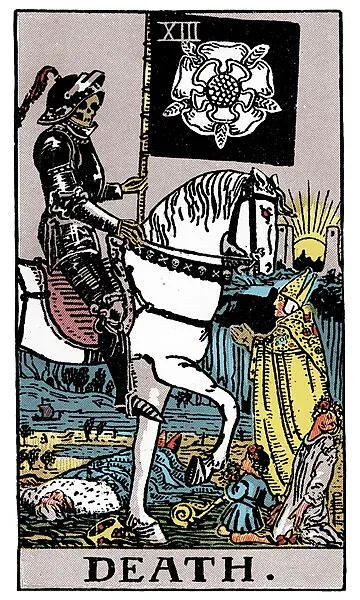
Death
A grave and necessary pairing — the dynasty card meeting the inevitable transmission across generations. An elder is passing; a structure is being handed down because the previous holder can no longer hold it. Receive what is being handed to you. Mourn what is leaving. The two motions are the same motion, and the funeral is the start of the next generation's work.
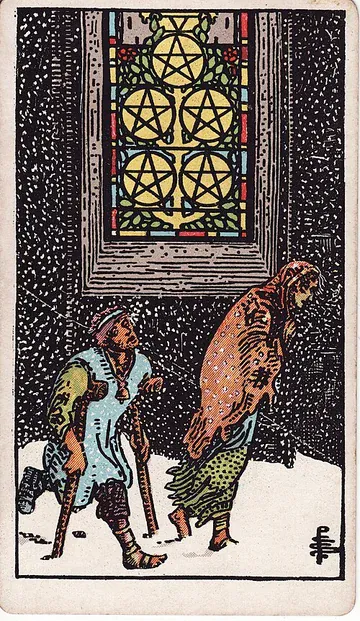
Five of Pentacles
A tonal contrast — the warm-arch family scene meeting the two figures outside the lit church window. Has the dynasty's prosperity been built in a way that left others stranded? Look outward — not to give the inheritance away, but to ensure the people who should have been inside the arch are not freezing on the steps because of an old, forgotten dispute.
Frequently Asked Questions
With the Ten of Pentacles reversed, what has hardened — the family, the money, or the role?
The reversed Ten of Pentacles is the dynasty card facing the wrong way. It describes the household, the role, or the inheritance that has hardened into a gilded cage — well-built, well-funded, well-respected, and quietly suffocating. The structure is real. The freedom inside it is not. Read it as the precise diagnosis of the obligation that has been mistaken for a gift, or the comfort that has begun to substitute for life.
Is the Ten of Pentacles reversed a no, or a yes with the freedom taken out of it?
The reversed Ten of Pentacles is rarely a clean no — it is more often a yes that arrives without freedom. The structure says yes; the interior life says wait. Treat it as a soft caution: the structure is likely to deliver what was asked for, but interrogate whether what was asked for binds you to obligations you did not negotiate. Read the fine print before you sign your entrance.
With the Ten of Pentacles reversed, is the problem us or the life we built?
Reversed in love readings, the Ten of Pentacles describes the relationship whose structure has begun to outweigh its life. For partnerships, it can warn of a comfortable plateau that has hardened into refusal. For new connections, it describes the partner choosing you partly with their family's voice in their head. For reconciliation questions, it offers a soft no — returning would rebuild the comfortable shape that broke.
Does the Ten of Pentacles reversed mean they want the life I offer more than they want me?
When the Ten of Pentacles appears reversed to describe how someone feels about you, the structural respect is real but the felt yes has not arrived. They appreciate you, see how you would fit, have privately measured the merger and concluded it would work — and the door of the actual heart is not yet open. Read it as commitment without intimacy: real, but not yet shared from the inside.
How do I separate the family's expectations from my own under the Ten of Pentacles reversed?
The reversed Ten of Pentacles asks the seeker to separate the family's expectations from their own — literally, in two columns — and to refuse, today, one small thing wrapped in 'for the family's sake' that they themselves do not want. Open the document you have been avoiding. Build a private exit plan, even if you never use it. The card returns to upright through small structural acts of returning what was never asked for in the form it was given.
Continue Reading
Ten of Pentacles · Card overview · symbols · correspondences →
Return to the full card view — image, symbols, sensory correspondences, and Hermetic axes.
Read the upright meaning →
Read the same depth on the opposite orientation.
Draw your reading now →
Bring this card to a question — open a quiet ritual.