
Ten of Swords · Core Meaning
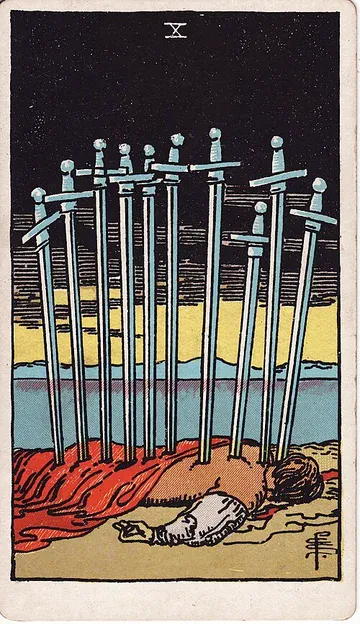
An ending has finally, completely arrived, and nothing further is being asked of you. A figure lies face-down on the shore beside still water. Ten long swords have been driven upright into the back in a tight, regular row. The sky is still deep indigo — but at the distant horizon, a fine line of whiteness has risen. Night is truly passing. There is no wind. The water beside the body is flat enough to mirror. No one stands nearby to add another blow, because another blow is no longer required.
This is the card's signature tension, and it is not the tension most readers expect. The image looks catastrophic; the meaning is closer to relief. The body in the image is not braced. It is not the posture of someone fighting. It is the posture of someone who has stopped. The number ten — completion in the suit of air, landing in Malkuth — means the set is full. There will be no eleventh sword. Whatever the worst was, it has happened. The card describes the strange, vast quiet of the morning after, when the thing you were dreading has finally occurred and you discover, to your surprise, that you can still breathe.
Look at how the swords entered. They came from behind, into the back, where nothing can be defended — and they landed in a straight, evenly spaced row rather than a frenzy. That regularity matters. A frenzied wound is an accident; a regular one is a structure. The Ten of Swords rarely describes a single catastrophe arriving out of nowhere. It describes the last blade in a sequence that has been landing for a long time in the same place, at the same angle, from a direction the seeker could not watch. Many people who draw this card can, if they sit with it long enough, name all ten: the small betrayals, the repeated conversation, the compromises that each cost a little more than the one before. Counting them is not morbid. It is how the seeker learns that the tenth was not a surprise, and that the counting is now finished.
The traditional astrological signature reinforces the absoluteness: the Sun in Gemini's third decan, the final 10° of the sign, ruling roughly 6/11–6/20. Gemini is air at its most articulate, the suit's native sign of thought and naming. The Sun in this last decan is illumination at full brightness on a thinking thing — and what the brightness reveals, with no shadow left to hide it, is the full scale of the damage. Solar light is what makes ending possible. You cannot end what you cannot fully see. Once seen, the situation cannot continue as it was. The revelation itself is the close.
Kabbalistically, this is Air in Malkuth, in the world of Yetzirah — the wind of thought arrives at the base of the Tree of Life. Everything that has been thought is now forced to land as a result, including the conclusion the seeker most wished to avoid. Malkuth is the kingdom, the place where ideas finally take physical form; for swords, that form is the ending made factual. The cards that came before — the Eight (paralysis), the Nine (anguish, the dark night) — were still inside the head. The Ten is the moment the head stops protesting and the body finally accepts.
The water beside the body is the detail most readings skip. It is flat enough to mirror, and what it mirrors has stopped moving. In the suit of air that is unusual — swords cards are almost always agitated, and the feeling-layer beneath them almost always churns. Here it has gone still. This is the one card in the suit where the emotional weather has finished happening. Cold iron and wet sand are its smell: mineral, washed, without heat. The stillness is why the card, for all the violence in it, is quiet to sit beside. Nothing is being decided. Nothing is being argued. Whatever kept the surface trembling has run out, and the seeker is looking into water that no longer shakes.
Read the Ten of Swords the way you would read a photograph of someone the moment after a long-resisted truth has finally been said out loud. Whatever lives in that exhalation — the strange relief, the grief that no longer has to be smuggled in code, the body that can finally release its grip — is the meaning of the card for that reading. The image looks like death. The card is closer to permission. The night ends because nights end. The dawn at the horizon is not earned and not magical; it is simply unconditional. The card asks only that you stop trying to hold the night open.
Ten of Swords · Love & Relationships
The relationship has reached its actual, final end, and the seeker is being permitted — perhaps for the first time — to stop administering life-support. This is one of the deck's clearest endings in the love arena. There is no quiet hope in this card that the relationship will revive in three months. There is, instead, a different kind of mercy: the mercy of the door fully closed, the lights turned off, the locks changed, the silence that follows. The card is not cruel. It is honest. The work the card asks for is not in the relationship. The work is in your own breath.
For an existing partnership that has been struggling for a long time, the Ten of Swords upright reads as the official end of the chapter. The arguments have arrived at their final form. The patterns that wore both of you down have been named so completely that there is nothing left to discover. What looked like the worst night turns out to have been the last night. The card describes the morning after the conversation neither of you wanted to have, when the body that has been braced for years suddenly does not need to be braced anymore. The grief is real. The relief is also real. The card holds both without forcing the seeker to choose between them.
For a relationship that ended some time ago and that the seeker has been quietly grieving, the upright Ten of Swords confirms the ending was real and that no return is happening. This is not a card that suggests the ex will text. The card asks the seeker to stop checking. It asks the seeker to stop reading old messages as if they were tea leaves. The story has reached its last page. Closing the book is allowed.
For a new spark whose early warmth has begun to chill, the Ten of Swords upright suggests the spark did not survive its first real test. Whatever you both saw in the first weeks did not turn out to be solid enough to hold the first honest disagreement. There is no shame in the brevity. Some sparks are weather, not climate. The card asks the seeker to honor the brief warmth without trying to keep the smoke alive after the fire is out.
For someone single after a long stretch of being single, the Ten of Swords upright is rarely a card of new arrival. It is more often a card describing the end of an internal era — the death of a particular hope, a particular fantasy, a particular version of the partner you were holding open a place for. The card asks the seeker to mourn that internal figure properly. Not the external person who never came; the internal expectation that has finally exhausted itself.
For someone in love after a wound, the Ten of Swords upright is paradoxically gentle. It describes the moment the old wound stops actively bleeding — when the story of how the previous person hurt you finally becomes a story you can tell without your voice changing. The wound has not vanished; it has scarred. The new person, if there is one, can finally meet you instead of meeting the bandage.
For someone asking whether a particular person will come back, the Ten of Swords upright answers no — and adds that the asking itself is the wound that needs to close. The fantasy of return is the eleventh sword the seeker keeps trying to add to a set that is already complete. Set the eleventh blade down. The set is finished without it.
There is a particular reader this card keeps finding: the one grieving something that never had a name. The months of almost. The person who wrote every day and never once used the word. The upright Ten of Swords grants the ending anyway. A chapter you actually lived through does not require the other person's ratification to close; the absence of a title does not make the loss smaller or the ending less real. The card is direct with this reader — the thing is over, it counted, and the grief is legitimate. What it declines to support is the long private argument about whether you were entitled to be hurt at all. The blades are in the back regardless of what anyone agreed to call it.
For a long marriage where one partner has died, the Ten of Swords upright sometimes appears as the card of the official acceptance — the season, often months or years after the death, when the body finally agrees with what the mind already knew. The grief has not gone. The grief has settled. The card honors the long work of reaching this season. There is no acceleration available; there is only the unconditional arrival of dawn, when dawn arrives.
For seekers asking whether an affair, a betrayal, or a deep breach of trust can be repaired, the Ten of Swords upright leans toward no. The trust was the floor; the floor has been removed; the room cannot be furnished. What can be built on the new ground, with someone else, in another season, is a separate question. The card holds the line on this particular ending without speculating about what the seeker will build next.
Separated parents draw this card often, and it answers them with unusual precision. The romantic relationship is finished and will not restart; the logistical relationship continues for another decade. The upright Ten of Swords asks these seekers to let the first thing die completely so the second can become workable. Every handover that carries a trace of the old argument keeps the body warm. The instruction here is unglamorous: shorter messages, fewer explanations, no relitigating within earshot of the child, no reading a scheduling text for evidence of residual feeling. What ends is the couple. What remains is a working arrangement between two people who share someone they both love. Keeping those two things separate is the entire discipline the card is asking for.
A small note on the card's particular love language. The Ten of Swords loves the way a long winter loves spring — by ending. The card does not promise warmth. It promises the conclusion that makes warmth possible. If you ask the card "is this person right for me," and the card lands upright, the answer is that the question is over. The card asks you to set the question down before you reach for the next one.
Ten of Swords · As Feelings
When the Ten of Swords appears upright to describe how someone feels about you, the answer is: depleted. Not angry. Not cruel. Not in love with someone else. Simply emptied of what they had to give. The card describes a person whose relationship-self has reached the end of its capacity. They feel like a body that has run out of bracing. The fight is over because the fighter has nothing left.
If they are reserved by nature, the upright Ten of Swords as feelings describes a quiet that is not strategy. They are not punishing you with silence. They have arrived at a true finality, and the silence is the natural sound of finality. They are not waiting to see what you do next. They have already understood, at the level of the body, that the chapter is over. Reading their silence as ambivalence is a generous misread; the silence is a verdict.
If they are demonstrative, the Ten of Swords as feelings can describe the strange flatness that follows a final, public breakdown. They cried it all. They said it all. The thing they were going to do for theatrics, they did. And now, sitting in the empty room afterward, they feel oddly serene — not because they are happy, but because the long performance of trying to make the relationship work has finally ended. Reading their composure as a sign that they are open to reconciliation misreads them. The composure is the calm of completion.
For a long bond, the Ten of Swords as feelings is one of the deck's harder cards to receive. It describes the partner who has stopped contesting the shape of the relationship because they have stopped believing the shape can change. They are not gone. They are present, and they are quiet, and the quiet is not peace. It is the absence of further appeal. The relationship may continue; the bargaining inside it has ended.
For a new connection, the Ten of Swords as feelings can describe someone who has just finished a much larger loss elsewhere — a previous relationship, a family death, a long professional collapse — and who has met you in the silent, depleted aftermath. They are not feeling little about you because of you. They are feeling little about everything. The card asks the seeker to read this carefully: you have not failed; the other person is, simply, fallow. They cannot give what they do not yet have.
Friendships surface here more often than readers expect. Asked how a friend feels, the upright Ten of Swords describes someone whose affection is intact and whose willingness is spent. They have carried their share of the friendship — the initiating, the remembering, the showing up — for long enough that the carrying has reached its end. They do not dislike you. They have stopped reaching, and the stopping was never announced because friendships are given no ceremony for ending. They get a fade instead. The card names the fade plainly and asks the seeker to look, without defensiveness, at the ledger of who has been doing the calling.
For someone you have hurt, the Ten of Swords as feelings can describe the moment they have stopped re-litigating the hurt. They are not forgiving you. They are not forgetting. They have decided, internally, that the hurt is now part of the record and that arguing further with you about it would only re-open the wound. They are closing the wound by closing the conversation. Read this not as cooling but as final adjudication.
For someone considering whether to bring up something difficult to you, the Ten of Swords as feelings describes the moment they have decided not to. They have done the calculation. They have weighed the cost. They have concluded that telling you would not change the outcome, and so they have folded the truth back into themselves and chosen to live with it. This is not betrayal. It is, to them, kindness — for both of you. The card asks the seeker who suspects this to consider whether their own posture has made the truth feel unsafe to deliver.
Turn the question around and the card is just as exact. Seekers also draw this asking what they themselves feel, and the upright Ten of Swords answers: past the point of wanting. The anger has burned down to nothing. The longing has gone quiet. What remains is a flat, level tiredness that the seeker often mistakes for depression, or for coldness in their own character. It is neither. It is the feeling-layer at rest after a long churn — the same still water lying beside the body in the picture. The card asks the seeker to trust the flatness rather than to keep poking it for traces of the old heat. Its arrival is the evidence that something inside has genuinely concluded.
A small caution: the upright Ten of Swords in feelings is rarely a forecast of dramatic action. The card describes someone who has run out of dramatic gestures. They will not write the long letter. They will not stage the confrontation. The card describes the felt texture of someone who has, in some specific way, completed their availability. The seeker's work is to read this honestly rather than to translate the depletion into a more flattering story.
Take the Ten of Swords in feelings as a precise mirror, not a verdict. The other person may revive. They may, in another season, refill. They may return as a friend, as a colleague, as a stranger you nod to in passing. What the card does not promise is that they will return as the partner they once were. That particular configuration has reached its end.
Ten of Swords · Career & Work
Something at work has officially, unambiguously ended. A project closes. A role ends. A contract is not renewed. A long employment that had been quietly bleeding for months finally hemorrhages and the relationship is over. The card does not always describe a layoff — it can equally describe the resignation that has been forming in the body for a year and finally surfaces — but it always describes the moment the conversation about whether the work could continue is no longer a live conversation. The set of swords is complete. The role you were performing is done.
For someone asking whether a current role will turn out well, the Ten of Swords upright answers that the current role has reached the end of what it can teach you, the end of what it will pay you in meaning, or the end of its actual lifespan in the company. The role is not bad. The role is over. The seeker who sleeps on this card and dreams of the office often wakes already knowing what the calendar still pretends is undecided. The card is asking the seeker to stop pretending the decision is in the future. The decision has been made by reality; the seeker's work is to catch up.
For someone considering whether to take a new role, the Ten of Swords upright is a complex signal. If the decision is whether to leave the old role, the card answers yes — leave. If the decision is whether the new role is the right one, the card declines to answer in those terms. The new role is downstream of the ending. Make the ending first. Choose the next step from the empty seat, not from the seat that is still on fire. Many career mistakes happen because the seeker tried to choose the next chapter before they had finished the current one.
For someone considering a layoff, a company restructure, or a forced exit, the Ten of Swords upright is one of the deck's most direct cards. The exit is real. The negotiation is over. The decision has been made several pay periods ago in a meeting you were not in. The card asks the seeker to stop campaigning for a decision that has already been made and to focus instead on landing well: the severance, the reference, the relationships preserved, the cleanest possible record. There is dignity available in the ending. Spend the energy on the dignity, not on the appeal.
For entrepreneurs and freelancers, the Ten of Swords upright can describe the official end of a venture. The company shuts down. The product line is retired. The client roster you spent five years building has thinned past the point of recovery. The card does not predict failure as a moral judgment. It names the moment the seeker stops trying to revive what is already gone. The next venture, if there is one, is born from the silence that follows the closing — not from the frantic attempt to keep the dying one alive.
For a creative practice, the Ten of Swords upright can describe the death of a body of work. The novel you have been writing for seven years is not the novel that will publish. The album you spent two years on did not land. The exhibition came and went. The card asks the seeker to honor the dead work properly — to stop using its body to insulate the next attempt. The new work cannot grow on top of the old one. The old one must be buried. The next thing will rise from clear ground.
For a question about a difficult colleague, a hostile boss, or a long political situation at work, the Ten of Swords upright suggests the situation will not be repaired — and that the seeker's energy is better spent on exit than on reconciliation. The other person has decided who you are to them. Further evidence will not change their mind. The card is direct: stop arguing, plan the leaving, leave well.
For a seeker considering retirement or a long pause from professional life, the upright Ten of Swords confirms the ending. The career has run its arc. The body has done its work. The identity that was forged inside the profession can be set down without dishonor. The card respects the decades. The card also asks the seeker to stop holding the role open after the role has stopped being a real role.
A note on tone. The Ten of Swords in career is not a card of disgrace. It is a card of completion. Some careers end loudly; many end quietly. The card describes both. The seeker who reads this card as a verdict on their worth has missed the card. The card is a verdict on the role's lifespan, not on the seeker's value. The dawn at the horizon is unconditional; it does not check whether you deserved it before it arrives.
Ten of Swords · Money & Finances
A financial chapter has officially closed. A debt is paid. A balance is finally cleared. A long financial entanglement with another person — a shared account, a co-signed loan, a business arrangement — is dissolved. The card does not always describe a loss; it can equally describe the moment a long-running cost finally stops. What the card always describes is that a particular financial story has reached its end and the seeker can stop carrying it forward in the budget of their attention.
For someone in financial difficulty, the Ten of Swords upright can describe the moment the difficulty becomes unignorable — the eviction notice, the bankruptcy filing, the conversation with the credit counselor that the seeker had been avoiding. The card is not punishment. The card is the official acknowledgment of a situation that was already true. There is, embedded in the unignorability, a specific kind of mercy: once the situation is fully named, the work of repair can finally begin. You cannot rebuild from a denial.
For someone asking whether a financial gamble will pay off, the Ten of Swords upright answers no. The bet is at the end of its arc. The investment has not delivered. The speculative position should be closed before further losses accumulate. The card warns specifically against doubling down — the impulse to add an eleventh sword to a set that is already complete. The set is full. Adding more does not change the outcome. It only deepens the cost of the closing.
For someone in debt, the Ten of Swords upright is sometimes the card of the final payment, the last installment, the moment the obligation is officially discharged. Read in this light, the card is one of the most quietly liberating cards in the deck. The long bleeding of the monthly payment is over. The balance, after years, is zero. The body, which had been holding the debt as a low-level pressure for so long that the pressure had become invisible, finally exhales.
For someone managing the financial aftermath of a death, divorce, or major separation, the Ten of Swords upright describes the moment the legal and financial dissolution is complete. The accounts are split. The estate is settled. The names are removed from the deeds. The card honors the difficulty of the work and confirms that the work is done.
For windfall — inheritance, settlement, unexpected payment — the upright Ten of Swords is rare and worth reading carefully. It can describe an inheritance that arrives only after the ending of the relationship that produced it; the money comes with the death, the divorce, the formal severance. The card asks the seeker to feel both at once: the gratitude for the inheritance and the grief of how it was paid for. Spending it cleanly, with conscious acknowledgment of where it came from, is part of the card's instruction.
For long-term financial structure, the Ten of Swords upright is a green light to close out positions, consolidate accounts, and end the financial complexity that has been quietly costing you energy. Close the dormant accounts. Cancel the subscriptions you stopped using. Pay off the small debt that is more annoying than expensive. The card supports the boring move that ends the worry. Simplification is the financial application of this card's central virtue: the willingness to let endings be endings.
For someone running a small business or a freelance practice that has reached the end of its useful life, the Ten of Swords upright endorses the wind-down. The clients have thinned. The margins have closed. The spreadsheet has been telling the same story for three quarters in a row. The card asks the seeker to perform the wind-down with dignity rather than by attrition — to write the final invoices, return the unused retainers, send the honest closing email, and complete the legal paperwork that ends the entity. Quiet, well-managed endings cost less than long, frantic ones, both financially and reputationally.
For a seeker considering a major financial reset — moving cities for a lower cost of living, downsizing the home, taking a less prestigious but less consuming job — the upright Ten of Swords supports the reset. The card recognizes the previous chapter as complete and the new, smaller, simpler structure as appropriate to where the seeker actually is now. The reduction is not a defeat; it is the financial application of the card's clarity. Carrying the previous scale forward is the eleventh sword. Choosing the smaller scale honestly is the morning at the horizon.
Ten of Swords · Health
The long crisis has crested and begun to break. The acute phase is over. The body has done the worst of what it was going to do. Recovery, in some form, is possible — not because the difficulty has vanished, but because the difficulty has reached the end of its escalation. The card's signature in the body is in the lungs and nerves: the system that breathes and the system that signals. After a long stretch of holding both too tight, both can begin to release.
For someone in the middle of an acute illness, the Ten of Swords upright can describe the night the fever breaks, the morning after the surgery, the first deep breath after the long pneumonia, the moment the panic attack finally ends and the room comes back into focus. The card does not promise that everything is fine. The card promises that the worst of this particular wave has passed and that the slow work of getting back to baseline can begin.
For chronic conditions, the Ten of Swords upright can describe the end of a particular flare, the resolution of a long diagnostic uncertainty, the moment the doctors finally name what has been happening. Naming is itself a kind of ending — the ending of the not-knowing. The seeker who has spent years inside an unnamed condition often experiences the diagnosis itself as a strange relief. The card honors this. The road forward is still long; the road backward is closed.
For mental health, the Ten of Swords upright can describe the breakthrough at the end of a long depressive season — the day the seeker realizes the heaviness has lifted by a degree, the morning the suicidal ideation that had been a daily companion is suddenly quieter, the week the therapy that had felt useless for months suddenly clicks. The morning the weight lifts by a degree is worth marking, and marking it is not medical advice. What is being read here is how the end of a hard season feels, not what a clinician would chart. Keep your practitioners. Take your medicine. Do the work. The card simply confirms that the season of the worst has, in this card's reading, ended.
For someone considering ending a treatment that is no longer working — a medication that has stopped helping, a therapist who has reached the end of their usefulness for this seeker, a regimen that has been dutifully followed without result — the upright Ten of Swords can support the ending. The treatment has run its arc. Continuing further out of loyalty or fear of change can become the eleventh sword. The card asks the seeker to consult their providers honestly and to recognize that endings inside care are sometimes the most important act of care.
For body work — exhaustion, burnout, the long collapse after a sustained period of overworking — the upright Ten of Swords describes the moment the body finally refuses. The collapse is the cure. The illness that pulled you out of work was the body's last available message. The card asks the seeker to receive the message without arguing with it. The rest is not negotiable. The body has set the terms.
A specific note on the lungs and nerves. The card's elemental body — air, with its lungs and nerves — often shows up in real health when the difficulty has been respiratory or anxious. Watch the breath. Watch the racing thoughts that have been running on a loop for too many months. The Ten of Swords as a health card asks the seeker to notice both as messages from the elemental ground of the suit, and to let the long-held tension in either system finally release.
Long-held tension releasing is an image drawn from the suit's element, not medical advice. The card describes weather, not diagnosis. Keep your practitioners. The card simply confirms that the long, hard chapter inside the body has reached the end of its escalation. Recovery, slow and unconditional, can begin.
Ten of Swords · Spirituality
An absolute ending turns out to be the precondition of the next beginning. It is not the card of a small ego death dressed up in retreat-language. It is the card of the structure you built your inner life around finally falling completely. The card describes the moment the seeker stops protecting the old framework and lets it collapse the rest of the way. There is no eleventh sword left to fend off. The framework is down. The dawn at the horizon is the silent confirmation that something else, unannounced, is about to arrive.
For seekers in active practice — meditation, journaling, ritual, devotional work — the Ten of Swords upright often appears at the end of a long retreat, the close of a multi-year cycle of practice, the moment a particular teaching has finished its work in the seeker's life. The card does not say the practice has failed. The card says the practice has completed what it came for. What comes next will not be more of the same practice. It will be a different practice, or a long pause, or the silence that practice was always pointing at.
For seekers in the middle of a spiritual crisis — a loss of faith, a falling-out with a community, a discovery that a teacher was not what they seemed — the Ten of Swords upright is precise. The community is gone. The teacher is finished. The faith you held is over. The card does not soften this. The card asks the seeker to stop trying to revive the dead version. What is built next will have its honest foundations; what was built on the dishonest old ones could not have lasted.
For seekers in the long, slow, unspectacular work of spiritual maturation, the Ten of Swords upright can describe the death of the dramatic spiritual self — the version of the seeker who needed the experience, the breakthrough, the marker. After this card, the practice becomes quieter. The need to perform spirituality, to achieve spiritually, to have stories of one's spiritual life, slowly subsides. What remains is the practice itself, done because it is the practice, with no audience and no narrative.
The card's specific spiritual instruction is gentle but precise: stop performing resuscitation. Whatever spiritual story has been quietly dead for some time — the practice that no longer feeds, the cosmology that no longer fits, the community that has become an obligation — let it finish. The energy you have been spending to keep it alive is the energy the next thing will need to arrive. You cannot meet the new while you are still nursing the old.
A specific practice when the Ten of Swords arrives in a spiritual reading: spend thirty minutes at the threshold of dawn, alone, with no phone. Sit at the window facing east. Watch the actual sky lighten from indigo to gray to pale blue. Do not journal. Do not pray. Do not narrate. Let the ending of the night be uncommented. The card responds to silence the way it does not respond to articulation. The work, here, is to let the dawn arrive without making it mean anything yet.
The deeper spiritual question the card asks back is this: what part of you is still performing being alive after the part you performed has died? The honest answer is the doorway through. The performance can stop. The next thing — the genuinely next thing, not the recycled previous thing in a new costume — will arrive in the silence that follows.
Ten of Swords · Yes or No
No — and the no is final.
The Ten of Swords upright is one of the deck's clearest no-cards. Whatever you are asking about, the answer is that the situation in question has reached its end. The relationship will not revive. The role will not be saved. The bet will not pay off. The hope will not be realized. The card is not a soft no, not a "wait and see," not a "depends on context." It is the no that arrives because the situation has run its full arc and there is no more arc available.
For yes-or-no questions about whether someone will return, whether a chance will reopen, whether a closed door will open again, the upright Ten of Swords answers no. The door is not closed pending further negotiation. The door is closed because the room behind it has been emptied. The card asks the seeker to stop knocking and to turn around and look at the room they are actually standing in.
For yes-or-no questions about whether a difficult situation will improve in its current form, the card answers no. What will improve is on the other side of the ending, not inside the continuation of the present. The seeker who keeps trying to optimize within the dying structure is, in this card's reading, doing the wrong work. The work the card endorses is the work of closing the structure cleanly so that something else can begin.
For yes-or-no questions about whether to act — to send the message, to make the move, to take the new offer — the upright Ten of Swords answers in two parts. First: the underlying situation that prompts the question is over, and the seeker should orient from that fact. Second: the specific action being asked about should be measured against the ending, not against the lingering hope. If the action is consistent with closing the chapter, do it. If the action is a disguised attempt to reopen the closed chapter, do not do it.
For yes-or-no questions about whether the seeker is right to feel as they feel, the upright Ten of Swords answers yes — and adds that the feeling is the body's accurate reading of an ending the mind has not yet fully accepted. The body is ahead of the head. Trust the body.
Asked when the ending arrives, the Ten of Swords upright answers that the relevant ending has, in some real sense, already happened. The calendar is the slow follower. The week, the month, the official date when the ending becomes administratively visible may still be in the future. But the ending itself, in the reality the card is reading, has already occurred. The seeker is being asked to catch up to a present that has already moved.
For yes-or-no questions about whether the seeker should grieve, mourn, take time, or pause before moving forward, the upright Ten of Swords answers yes — emphatically, without condition. The pause is not weakness. The pause is the practice the card most explicitly endorses. The seeker who skips the pause finds it later, larger, less convenient. The seeker who takes the pause now passes through the chapter once instead of repeatedly.
For yes-or-no questions about whether to forgive someone whose part in the ending was painful, the upright Ten of Swords does not require an answer. Forgiveness, in the sense the card recognizes, is not a verdict the seeker pronounces; it is the eventual byproduct of having genuinely closed the chapter. The card asks the seeker to focus first on the closing rather than on the verdict. Forgiveness, when it arrives, will arrive as quietly as the dawn. It cannot be performed into existence.
If the question was: should I keep trying? The card answers no. Stop. The set of swords is complete. There is no eleventh blade you need to add. Set the question down. The dawn arrives whether you fight it or rest into it; resting into it is the only available kindness to yourself.
Ten of Swords · Advice
Stop performing resuscitation on what has already died. Whatever you have been keeping alive by force — the relationship, the role, the project, the version of yourself the work was supposed to deliver — has reached the end of what your effort can do for it. The work the card asks for is not more effort. The work is the willingness to recognize that the effort has finished its term, and to set down the instruments of revival.
If there is one specific instruction the card offers, it is this: today, formally move the dead thing into the folder labeled "ended" — even if the other party has not. Do not wait for the other side to ratify the ending. Do not wait for the calendar to acknowledge it. Do not wait for the public announcement. Inside your own mind, in the private accounting that runs your attention, mark the chapter closed. Stop reading the old messages. Stop refreshing the page. Stop running the simulation in which the situation continues. The card responds to this internal closure even when the external closure is still pending.
A second instruction: do not rush to find the next thing to worry about. The mind, accustomed to the long anxiety of the dying chapter, will reach for a new anxiety to fill the silence. Resist. Allow yourself, in the morning light after the long night, to do nothing at all. Only acknowledge that it is over. The temptation to immediately replace the old grief with a new project is one of the most common ways the Ten of Swords curdles into the reversed card. The pause between endings and beginnings is itself a sacred span. Do not collapse it.
A third instruction: count what is actually finished. Pull out a piece of paper. Write down, with as much specificity as you can manage, what has actually ended. The relationship of this particular shape with this particular person. The role at this particular company under these particular conditions. The version of you that operated inside the constraints of those endings. The accuracy of the list is itself a form of the work. Vague endings remain undead. Specific endings can actually finish.
A fourth instruction: do not announce your ending too widely, too quickly, or too triumphantly. The Ten of Swords upright is not the social-media post; it is the long, private quiet. Tell the one or two people who need to know in order to be present with you. Hold the rest. The card warns specifically against the seeker who tries to shore up the ending by performing it for an audience — the audience will eventually move on to other content, and the seeker will be left alone with an ending they have already metabolized into entertainment.
A fifth instruction, the gentlest: let the dawn at the horizon arrive without requiring it to mean anything yet. The unconditional whiteness at the edge of the indigo is not yet a forecast of the next chapter. It is simply the morning. Receive the morning as morning. Make tea. Walk slowly. Do not, in the first hours after the long night, demand that the new day deliver a meaning to compensate you for what has just ended. Compensation is not the deal. The deal is much simpler: the night ends because nights end, and the day is what comes next.
Practical advice for the day the card appears: cancel one obligation that exists primarily to prove you are functioning. Eat something simple. Sleep early. Do not begin the next thing today. The card responds to honest fallowness. Performative recovery is the seed of the reversed card. Move slowly, or do not move at all.
Ten of Swords · Card Combinations
The Ten of Swords gathers most of its meaning by sitting beside the cards that frame the ending. The Nine of Swords names the long anguish that preceded this morning; the Ten of Wands shows the burdened ending that is its sibling in the suit of fire; the Death card is the major-arcana modulator that asks whether this collapse is a small ending or a deep transformation; the Sun is the unconditional dawn the card describes already present at the horizon; Judgement is the slow rising afterward. Reading these combinations carefully turns the Ten of Swords from a single statement into a sequence — the long arc of an ending and the slow movement that follows.
Ten of Swords + Nine of Swords
The full sequence of the dark night and its end. The Nine is the anguish that runs all night long — the racing thoughts, the catastrophizing, the dread without object — and the Ten is the morning after the Nine, when the worst that the mind was rehearsing has finally happened and the body discovers it can still breathe. Together these cards describe a long process that has, finally, completed its arc. The seeker is being asked to honor the difficulty of the night and to permit the morning. There is no shortcut available; there is also no further escalation coming.
Ten of Swords + Ten of Wands
Two endings of opposite character. The Ten of Wands is the burdened ending — the seeker still carrying the bundle, struggling under its weight, almost at the door but not yet through it. The Ten of Swords is the total ending — the bundle finally set down, the seeker no longer carrying anything. Together, the cards describe the moment the seeker realizes the burden they have been carrying did not need to be carried this far. The Ten of Wands is the question; the Ten of Swords is the answer. Set the bundle down.
Ten of Swords + Death
The total ending modulated by the major-arcana card of transformation. Death does not make the ending lighter; Death makes the ending more meaningful. Together, these cards describe an ending that is not just an event but a passage. Whatever ends here will not be replaced by a similar version of itself in three months. The structure that ends will not regrow. What grows next will be different at the root. The combination asks the seeker to recognize that this is not a small loss; it is a real change of life.
Ten of Swords + The Sun
The card of total ending beside the card of the unconditional dawn already at the horizon. Together these cards describe the ending that is, in fact, the precondition of an unmistakable warmth. The sun does not arrive because the seeker deserved it. The sun arrives because suns arrive. The combination is one of the deck's quietly hopeful pairings, but the hope is not earned through effort — it is given. The seeker's only work is to stop performing resuscitation on the previous chapter so that the new warmth has somewhere to land.
Ten of Swords + Judgement
The card of lying down after the worst beside the card of rising. Together, these cards describe the resurrection that follows the full ending — not the rising in the middle of the night, not the rising before the night was finished, but the rising after the night has properly closed. Judgement does not arrive while the seeker is still bracing. Judgement arrives in the silence after the bracing has stopped. The combination is among the most precise descriptions in the deck of how endings actually become new beginnings: not through force, but through the willingness to fully complete the ending first.
Card Combinations
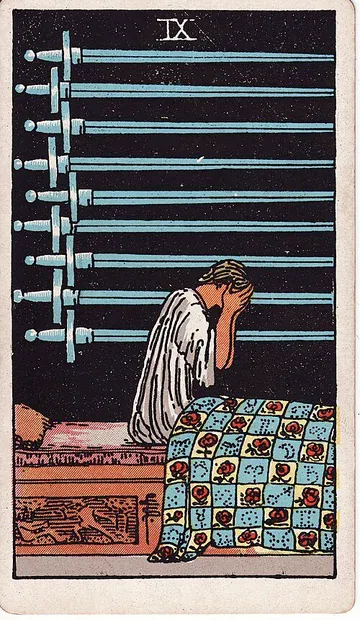
Nine of Swords
The dark night and its end. The Nine of Swords is the sleepless anguish, the racing thoughts, the dread without object that ran all night long. The Ten is the morning after — the worst the mind was rehearsing has finally happened, and the body discovers it can still breathe. Together these cards describe a long arc that has, finally, completed. There is no shortcut available; there is also no further escalation coming. Honor the difficulty of the night and permit the dawn.
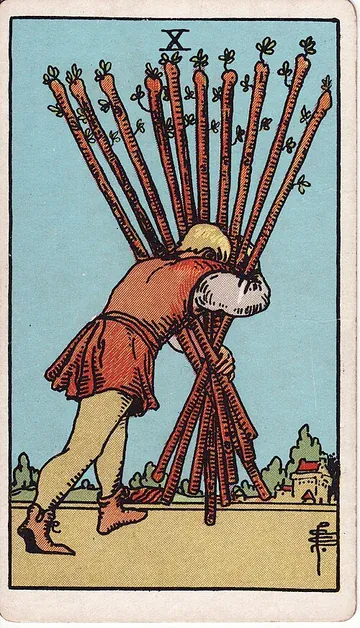
Ten of Wands
Two endings of opposite character. The Ten of Wands is the burdened ending — the bundle still on the back, the door almost reached but not yet through. The Ten of Swords is the total ending — the bundle finally set down, the body no longer braced against anything. Together, the cards describe the moment the seeker realizes the burden they were carrying did not need to be carried this far. The Ten of Wands asks the question; the Ten of Swords answers it. Set the bundle down.
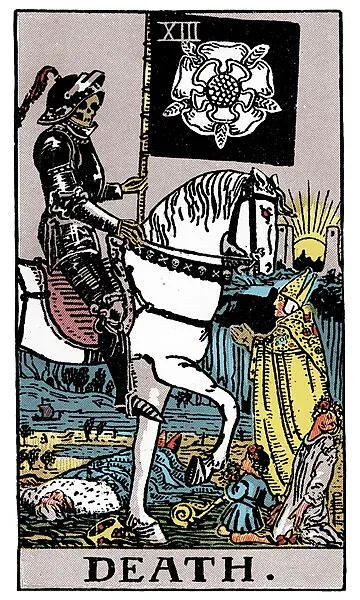
Death
Total ending modulated by ritual death. Death does not make the ending lighter; Death makes it more meaningful. Together, these cards describe an ending that is a passage rather than an event. What ends here will not be replaced by a similar version of itself in three months; what grows next will be different at the root. The combination asks the seeker to recognize that this is a real change of life, not a small loss to be metabolized and moved past.
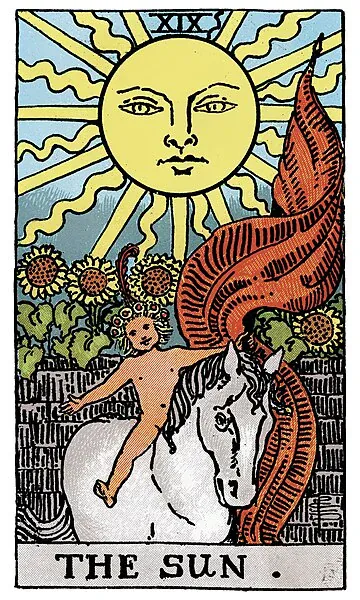
The Sun
The card of total ending beside the unconditional dawn. Together, these cards describe the ending that is the precondition of an unmistakable warmth. The sun does not arrive because the seeker deserved it; the sun arrives because suns arrive. The combination is among the deck's most quietly hopeful pairings, but the hope is given rather than earned. The seeker's only work is to stop performing resuscitation on the previous chapter so the new warmth has somewhere to land.
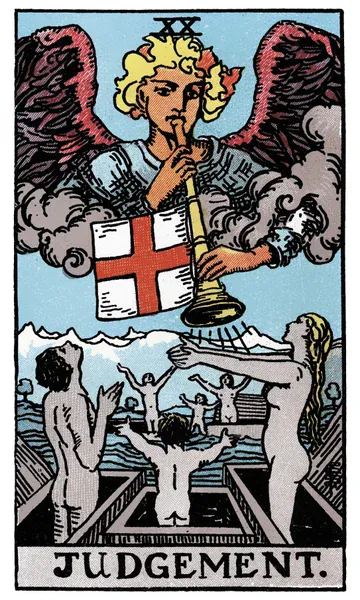
Judgement
Lying down after the worst, beside the card of rising. Together, these cards describe the resurrection that follows full ending — not the rising in the middle of the night, not the rising before the night was finished, but the rising after the night has properly closed. Judgement does not arrive while the seeker is still bracing. Judgement arrives in the silence after the bracing has stopped. Among the most precise descriptions in the deck of how endings actually become beginnings.
Frequently Asked Questions
How final is the ending the Ten of Swords describes?
Completely final, which is where its odd mercy comes from. Upright, it is the card of the total ending — the chapter that has finally, completely closed. The image shows a figure face-down on the shore with ten swords in the back, but the body is no longer braced and the horizon shows the first whiteness of dawn. The card describes the moment after the worst has happened, when resuscitation can stop and the unconditional morning can be permitted to arrive.
If the Ten of Swords is a no, is it a no to trying again?
That is precisely the question it answers, and the answer is no. The upright card is one of the deck's clearest no-cards. The situation in question has reached the end of its arc; the door is not closed pending negotiation but because the room behind it has been emptied. If the question is whether to keep trying, the answer is no. If the question is whether the ending you sense is real, the answer is yes — and the card asks the body to catch up to what the body already knows.
Is there any version of this relationship left to save?
The card says no, and it says it as mercy rather than as cruelty. In love it describes a relationship that has reached its true end — and the seeker who is finally being permitted to stop administering life-support. The card is direct rather than cruel. The work it asks for is not in the relationship; the work is in the seeker's own breath. Reconciliation is not what the card describes. The mercy of the closed door is what the card describes.
Does their silence under the Ten of Swords mean strategy, or depletion?
Depletion, and the difference decides everything you do next. The answer is depleted — not angry, not in love with someone else, simply emptied of what they had to give. They have arrived at a true finality, and their silence is the natural sound of finality rather than a strategic withdrawal. The card asks the seeker to read the depletion honestly rather than to translate it into a more flattering story about ambivalence or distance.
Why is the Ten of Swords not as bad as it looks?
The Ten of Swords looks catastrophic because the image shows ten blades in a body — but the card's actual meaning is closer to relief than to disaster. The set is complete; no eleventh sword is coming. The body is no longer braced. The horizon shows the first whiteness of dawn. The worst has happened, and the strange grace of completion is that you can finally stop bracing for it. The card describes the morning, not the murder.