
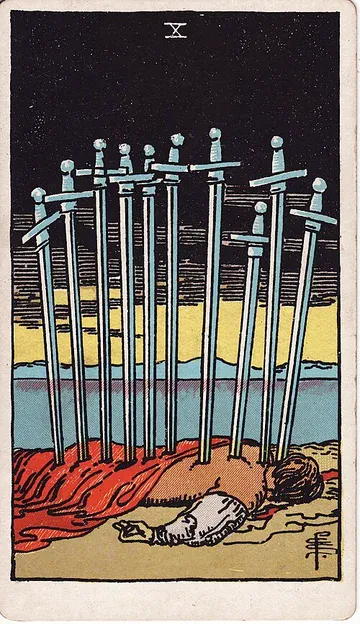
Ten of Swords Reversed · Core Meaning
An ending has not been allowed to end. The image, inverted, has a particular psychological shape: the figure has seen the whiteness at the horizon and turned over, pulling the quilt back over the head; or the figure has forced itself up too quickly, performing "I'm fine" for an audience while several of the ten blades are not yet drawn out. The card is not punishing the seeker. The card is naming, with precision, the way the upright card's offered grace has not yet been received.
There are two distinct flavors of the reversed Ten of Swords, and they look like opposites but share a single root. The first flavor is the refusal to let the ending end — the seeker who knows the chapter is over and keeps reopening it through small acts of contact, surveillance, or rumination. The second flavor is the premature declaration of recovery — the seeker who jumps up too soon, schedules the social event "to prove I'm better now," tells everyone they have moved on, and uses the public performance to avoid the slower internal reckoning the upright card asked for. The shared root, in both flavors, is the same: the seeker is not yet able to be honestly in the middle, in the silent in-between where ending and beginning have not yet sorted themselves.
The reversed card's signature anxiety is identity. The seeker has been the wounded one for so long that ceasing to be the wounded one would mean not knowing who they are. Or, in the second flavor, the seeker has so much invested in being the resilient one that admitting the wound is still open would feel like a defeat. Both postures are forms of clinging. The reversed Ten of Swords asks the seeker to release both — to stop being identified with the wound, and to stop being identified with having transcended the wound. To be, simply, in the actual condition of the actual healing, which is messy, slow, and not photogenic.
The astrological inversion deepens this. The Sun in Gemini's third decan, upright, is illumination at the close of thinking — the light that ends what it reveals. Reversed, the same configuration becomes light that exposes a refusal: the seeker who keeps thinking around the ending instead of sitting still inside it. Gemini's mercurial intellect, deprived of acceptance, generates loops — the same conversation rehearsed with a different friend, the same scenario re-imagined with a different ending. The card warns that intellect, used to avoid the ending, becomes the eleventh sword the seeker themselves is now adding.
Kabbalistically, this is Air in Malkuth refusing to land. Malkuth is the kingdom, the place of physical fact; the reversed card describes the seeker who keeps the conclusion floating in the head, never letting it become embodied. The body is the only place real endings can occur. The mind can keep a relationship alive forever in retrospective replay; only the body can stop reaching for the phone.
Reversed, the Ten of Swords asks the seeker three things. What part of the wound are you still actively keeping open? What part of "I'm fine" are you performing for someone other than yourself? And: are you willing to be in the slow, unphotogenic middle, where neither the old chapter nor the new one is fully real?
Ten of Swords Reversed · Love & Relationships
The relationship-ending has not been permitted to close, and the seeker is, in some specific way, holding it open. The image is precise. The seeker knows it is over, and yet keeps secretly checking the other person's posts, watching their location on shared apps, asking mutual friends for updates. The wound is being maintained. The card is gentle about this; most seekers spend at least a season in the reversed card after a real ending. But the card is also clear: the wound is open because the seeker is not yet ready to stop being the one who was hurt.
For an existing partnership where the breakup has formally happened but emotional closure has not, the reversed Ten of Swords describes the long aftermath in which both people are technically separated but neither has fully released the other. The middle-of-the-night text. The half-meant lunch where you both pretend it is friendship. The silence that follows for three weeks until one of you breaks it. The card warns that this in-between is not a path back; it is the long, private continuation of an ending neither party will let conclude. The honest move is not to stop caring. The honest move is to stop reaching.
For someone in a relationship that is privately dead but publicly intact, the reversed Ten of Swords describes the comfortable fiction the couple has agreed to maintain. They live together. They post the photos. They show up at each other's family events. And inside, between them, the actual relating has stopped. The card asks the seeker who recognizes this to consider whether the fiction is being maintained for the children, for the lease, for the parents, for the social standing — or whether, at some point, the fiction must be allowed to drop. The card does not demand a particular timeline. It does ask the seeker to be honest about what is actually happening.
For a seeker who has been "moving on" from a relationship for over a year and is still not actually moving, the reversed Ten of Swords describes the small daily rituals that keep the previous person alive in the seeker's interior. The driving past the old apartment. The keeping of the playlist. The story you still tell about how it ended that has not changed in a year. The card invites the seeker to notice these as living practices that maintain the relationship in absence. The relationship cannot end while you are still tending its memorial.
For someone in a new connection that is going well while a previous wound remains unhealed, the reversed Ten of Swords warns that the new partner is being asked to date the wounded version of the seeker rather than the seeker themselves. The new person can love the seeker through the healing; the new person cannot do the healing for the seeker. The card asks the seeker to do the unromantic work of finishing the previous chapter privately so the new chapter can be met without the old wound running interference.
For a seeker considering reconciliation after a major break, the reversed Ten of Swords is one of the deck's more cautious cards. It does not categorically forbid the reconciliation. It does ask the seeker to be honest about whether they want the person or whether they want the relief from the pain of the ending. They are not the same. Reuniting to escape the ending is the eleventh sword the seeker is adding to a complete set. Reuniting because the relationship has, in fact, become a different and viable thing is a separate story — but the reversed card asks the seeker to be unsparing in distinguishing between them.
For someone single and convinced that they will never find love again because of a past wound, the reversed Ten of Swords names the conviction itself as the eleventh sword. The wound is real; the conviction is the seeker's own addition. The card asks the seeker to do the slow, undramatic work of letting the conviction soften without forcing themselves into a pretended optimism. Both extremes — the permanent identification with woundedness and the brittle declaration of healing — keep the actual healing at bay.
For someone whose previous partner has died, and who is in the long, slow widowhood after the death, the reversed Ten of Swords can describe the season when grief has become a structure the seeker is afraid to leave. The grief has been the way the seeker has stayed in relationship with the lost person. To grieve less would feel like loving less. The card holds this with great tenderness and offers the same instruction it offers to all flavors of the reversed card: the relationship to the lost person can continue without requiring the wound to stay open. The honoring is in the living, not in the bleeding.
For someone whose partner is keeping the wound open, while the seeker is ready to move forward, the reversed Ten of Swords advises witness without rescue. You cannot heal the other person's refusal to heal. You can be present with them. You can refuse to participate in the daily reopening rituals. You can decline to be the audience for the long performance of the wound. Whether the other person eventually puts the wound down is their work, not yours.
Ten of Swords Reversed · As Feelings
Warmth or bitterness — whichever it is — has been kept in a state that prevents the next move. They are stuck inside the ending — either refusing to let it end, or performing an ending that is not real underneath. Either way, the feeling has not yet completed its work in them, and the relating between you is still inside the long aftermath of something that never properly closed.
If they are reserved, the reversed Ten of Swords as feelings can describe quiet resentment that has not yet fully surfaced. They have not forgiven. They have also not chosen to confront. The grievance lives in the interior, occasionally leaking out as a sharp comment or an unexplained withdrawal, but it has not been brought into the open where it could be addressed. The card is direct: their feelings about you are not finished. They are holding the wound at low temperature. Read silence here as unfinished business, not as resolution.
If they are demonstrative, the reversed card warns of the partner who keeps publicly re-litigating the past — the friends and family already know the story; the story is not done because the storyteller is not done. They feel real pain and real anger and real love, all at once, and they have arranged themselves so that the audience for these feelings is everyone except you. The card asks the seeker to recognize that the public performance is itself a refusal to close the loop privately with you. Until the loop closes privately, the public version will continue.
For a long bond, the reversed Ten of Swords as feelings can describe the partner who, after a major rupture some time ago, has officially "moved on" while privately still tracking you, still measuring themselves against you, still privately hurt by the way it ended. The official line is that they are over it. The internal line is that they are not. The card invites the seeker to read this without condescension. They are not bad for being unfinished. They are simply unfinished.
For a new connection where things have gone wrong recently, the reversed Ten of Swords as feelings often describes the moment they have decided you have hurt them in a way they cannot quite name to themselves yet. The feeling is real; the articulation is not yet ready. They may withdraw without explanation. They may go quiet for a stretch that is too long to be casual. The card asks the seeker not to project a more decisive verdict onto them than they have actually arrived at. They are inside the un-named hurt. The hurt has not chosen its words.
For someone you are no longer with, the reversed Ten of Swords as feelings describes the lingering, unresolved residue. They have not stopped thinking about it. They are not actively planning to come back, but they have not let the chapter close in their own interior. They check your activity in small ways. They mention you in conversations without being prompted. They hold the door slightly open in their own mind even though the door is, externally, closed. The card asks the seeker to read this as their unfinished business, not as a coded invitation. The door in their mind is not the same as a real door.
For someone who has performed a public closure that you suspect is not real, the reversed Ten of Swords as feelings confirms your suspicion. They have announced they are over you. They have written the closing speech. They have made the final-seeming gesture. And underneath, the feeling is not finished. The card does not advise the seeker to push on the discrepancy. The work is theirs. The card simply confirms that what you are sensing is accurate.
A small caution. The reversed Ten of Swords in feelings can describe a partner who is using the wound, real or rehearsed, to keep you on the hook. The repeated reminders of how you hurt them. The small jabs designed to provoke remorse. The maintenance of the grievance as a relational tool. Watch for this pattern. It is not the same as someone honestly carrying an unfinished feeling; it is the deployment of the unfinished feeling as a lever. The card asks the seeker to distinguish between the two and to refuse, as gently as possible, to be moved by the lever.
Take the reversed Ten of Swords as feelings as a precise mirror of an unfinished interior — theirs and, possibly, yours. The other person is not done. The relationship's emotional content is still in motion in them. What this means for the future depends on what both of you do with the unfinished thing. Forcing it closed will not work. Forcing it open will not work. Letting it slowly resolve, with honest attention and without dramatic intervention, is the only path the card endorses.
Ten of Swords Reversed · Career & Work
A job can end on paper and stay open in the head for months afterward. There are two common forms. The first is the seeker who has been laid off, fired, or pushed out, and who has been replaying the betrayal in their head for months without metabolizing it. The second is the seeker who has officially "moved on" to a new role and is still secretly checking the old company's news, still rehearsing the conversations they wished they had had, still measuring their new role against the dead one. Both postures keep the previous chapter alive at the cost of the current one.
For someone considering whether to stay in a current role, the reversed Ten of Swords warns that the role has, in some real sense, already ended — and the seeker is staying inside the corpse. The official function continues. The paycheck continues. The meetings continue. And inside the seeker, the meaning has finished. The card asks the seeker to be honest about whether they are staying because the role is alive or because leaving would mean acknowledging an ending they are not ready to acknowledge. Comfortable refusal of the ending is its own kind of cost.
For someone who has just been laid off, fired, or pushed out, the reversed Ten of Swords describes the dangerous middle — the weeks immediately after, when the body has not yet processed what happened and the mind is running interference at full speed. The seeker rehearses the conversations they wished they had had. The seeker drafts but does not send the angry email. The seeker reads the company news daily, looking for evidence that the place is failing without them. The card asks the seeker to recognize all of this as the active maintenance of a wound the seeker themselves is refusing to close. The company has moved on. The card is not asking the seeker to forgive the company; it is asking the seeker to stop bleeding for an audience that is not watching.
For someone who has officially "moved on" to a new role, the reversed Ten of Swords describes the secret ways the previous role is still running inside the seeker. The conversations the seeker still has with the old colleagues. The unconscious comparison of every new manager to the old one. The framing of every present challenge as evidence that the old place was actually better. The card warns that the new role cannot succeed while the old role is still being grieved in this particular way. The grief is fine. The grief disguised as comparison sabotages the new chapter.
For entrepreneurs whose venture has failed, the reversed Ten of Swords describes the long aftermath in which the seeker keeps re-pitching the dead venture in their head — the version where the funding came through, the version where the partner did not leave, the version where the timing was right. The yellow line of dawn at the bottom of this card is not impatient with you. The work of metabolizing a failed venture is real. But the card warns against the seeker who never stops re-pitching, who two years later is still telling the story of what would have happened if. The story is the eleventh sword. The seeker is the one adding it.
For a creative practice whose major project did not land — the book that was not picked up, the show that did not get its second season, the album that came and went — the reversed Ten of Swords describes the long, private bargaining with the failure. The seeker rereads old reviews. The seeker drafts but does not publish the long defense. The seeker reaches out to the people who praised the work and slowly stops reaching out to the people who did not. The card asks the seeker to release the project as a measurement of self-worth and to allow it to become, simply, a thing that was made and is now done. The next work cannot grow until this one is properly buried.
For a seeker considering whether to forgive a colleague, a boss, or an institution that has hurt them, the reversed Ten of Swords does not demand forgiveness. It does ask the seeker to consider whether the un-forgiveness is now serving them or whether they are continuing it because letting it go would feel like a defeat. There is a real difference between a held grievance that is still doing useful work in the seeker's life and one that has become a structure of identity. The card asks the seeker to know which one this is.
For someone in a long professional plateau where nothing is dramatically wrong but the soul has quietly absented itself from the work, the reversed Ten of Swords can describe the comfortable, slow non-ending — the role that should have ended two years ago and has not because no one has had the energy to officially close it. The card asks the seeker to perform the closing themselves, even at cost, because the alternative is more years of the same low-grade absenting.
A note on the practical posture. The reversed Ten of Swords in career often appears for seekers who are pretending to themselves that they have moved on while their body is still entirely inside the previous chapter. The body is the place the ending must occur. The body knows whether it is over. The seeker who is honest with the body, in this card's reading, is the seeker who eventually escapes the loop the reversed card describes.
Ten of Swords Reversed · Money & Finances
A financial ending can be complete on the ledger and integrated nowhere else — or, in the second flavor, it is the collapse the seeker keeps deferring by adding the eleventh sword. Either way, the relationship to money is being shaped by an unresolved past chapter rather than by the actual present.
For a seeker who has paid off a major debt and yet still feels broke, the reversed Ten of Swords describes the long lag between the financial ending and the felt ending. The number on the balance sheet has changed; the body has not yet caught up. The seeker still flinches at small purchases. The seeker still narrates their financial life as if the debt were ongoing. The card invites the seeker to consciously update the internal accounting to match the external one — to literally say, out loud, that the debt is paid, that the chapter is closed, that the next chapter can use a different vocabulary.
For someone in active financial difficulty, the reversed Ten of Swords describes the tendency to keep adding the eleventh sword — the small additional commitment, the new monthly subscription, the impulsive purchase made to soothe the distress of the underlying situation. The card warns that comfort spending in the middle of difficulty deepens the difficulty without resolving its source. The eleventh sword is not what brings the ending; it only delays the moment when the actual structural change becomes unavoidable.
For someone managing the financial aftermath of a divorce, separation, or family rupture, the reversed Ten of Swords describes the long, slow disentanglement that has not yet completed. The accounts have been split. The legal work has been done. And inside the seeker, the financial life is still entangled — still measured against the previous arrangement, still narrated in a vocabulary the previous arrangement made habitual. The card asks the seeker to do the unromantic work of building a financial vocabulary that belongs to the new life rather than to the dissolved one.
For someone in long financial recovery from a previous collapse — a bankruptcy, a major loss, a long stretch of unemployment — the reversed Ten of Swords describes the phase when the recovery is technically working but the seeker still feels permanently haunted by the previous collapse. Every financial decision is filtered through the memory of the worst time. The card honors the survival and asks the seeker to gently begin loosening the grip of the previous chapter — to allow the present to be assessed on its own terms rather than through the lens of the worst year.
For someone considering whether to make a major purchase, take on a loan, or commit to a long financial obligation, the reversed Ten of Swords advises caution rooted in honesty. Are you making the commitment from the present, or from a past chapter you have not fully released? The seeker who buys the house to prove to themselves that they have recovered from the previous loss is making the purchase from the wound, not from the present capacity. The card asks for a more honest accounting before the commitment is made.
For windfall — inheritance, settlement, unexpected payment — the reversed Ten of Swords warns of the trap of immediate replacement. The money arrives, and the seeker rushes to fill the hole the previous loss left. The card asks the seeker to slow down. Receive the money. Sit with it. Let it become familiar. Decide its disposition only after the initial relief has settled into something steadier. Money spent in the first wave of relief tends not to land where the seeker wishes it had landed.
For a seeker whose financial difficulty is being kept hidden from the people who could help — partner, family, close friend — the reversed Ten of Swords describes the eleventh sword the seeker is now adding by maintaining the secret. The original difficulty is the ten. The secrecy is the eleven. The card asks the seeker to consider what would change if one trusted person knew the actual numbers. The relief, in many cases, is the beginning of the real solution.
A practical move when the reversed card appears in a financial context: write down the financial chapter that has actually ended, even if the body has not yet caught up. Write it explicitly. The debt that is paid. The contract that is closed. The obligation that is discharged. Read the list out loud once. The card responds to the act of consciously closing what has, in fact, closed. Lingering financial chapters that nobody officially ends quietly continue to charge rent on the seeker's attention.
Ten of Swords Reversed · Health
The body has been declared recovered too early — the seeker got up out of the sickbed to prove that everything is fine while several of the ten blades have not yet been drawn out. The metric on the chart has improved. The visible behavior has resumed. And the underlying condition is still present, requiring more rest, more attention, more honest acknowledgment than the seeker is currently willing to give it. The card is not punishing the seeker. The card is naming the cost of the premature standing-up.
For someone recovering from an acute illness — surgery, injury, infection, the long flu — the reversed Ten of Swords describes the dangerous phase when the seeker resumes normal life before the body is actually ready. The fatigue is dismissed as laziness. The lingering pain is masked with painkillers and ignored. The follow-up appointment is postponed. The card asks the seeker to give the body the rest it is asking for, even if the rest is socially inconvenient. Recovery rushed is recovery interrupted.
For chronic conditions, the reversed Ten of Swords describes the seeker who declares a flare over before it actually is. The good days appear. The discipline relaxes. The medication is taken less reliably. And the underlying condition, given an opening, returns in a stronger form. The card invites the seeker to be more honest about the long-term shape of the condition and less responsive to the seductive optimism of a few good days. The condition does not negotiate. The seeker who works with it survives longer than the seeker who keeps trying to argue with it.
For mental health, the reversed Ten of Swords can describe the seeker who declares the depressive season over after the first relief, and who stops the practices that produced the relief. The therapy is paused. The medication is "experimented with." The morning practice is set aside because the seeker feels good now. The card warns that the practices were not the symptoms of being well; the practices were the production of being well. Stopping them returns the seeker to the previous condition. The card asks for steadiness in the recovery rather than premature triumphalism.
For someone with a long history of trauma whose acute symptoms have begun to ease, the reversed Ten of Swords describes the phase when the seeker is tempted to declare themselves healed and to stop the slower, deeper work that the trauma still requires. The acute episodes have stopped. The new triggers do not feel as catastrophic as the old ones. And the underlying trauma is still present, still shaping daily life in ways the seeker has not yet looked at directly. The card respects how hard the work has been and asks the seeker to keep going. Premature declarations of healing become, themselves, a form of avoidance.
For body work — exhaustion, burnout, the long collapse — the reversed Ten of Swords describes the seeker who returns to the previous workload too quickly, who interprets the first energy as the recovery of full capacity. The body, in this card's reading, has shown the seeker what it can no longer carry. Returning to the previous load is the eleventh sword. The seeker who refuses the message ends up needing to receive it more painfully a second time. The card asks for the harder discipline of accepting the new, smaller capacity until the body itself signals genuine recovery.
For the lungs and nerves specifically — the elemental body of the suit — the reversed Ten of Swords often shows up when the breathing has not properly settled and the nervous system is still in low-grade alarm even after the acute crisis has passed. The seeker may not notice. The breath may have become shallow as a habit. The nervous system may have set its baseline at a higher level of activation than is sustainable. The card asks the seeker to spend deliberate time each day in restorative practices — long exhales, walks without purpose, time spent doing nothing. The body resets only when given the silence to do so.
For someone managing comfort behaviors — alcohol, recreational drugs, food, screens, anything that has moved from pleasure to maintenance — the reversed Ten of Swords can describe the relapse after a declared recovery. The seeker said they had stopped. The seeker actually stopped, for a stretch. And then, in a moment of low pressure, the behavior returned. The card is not condemning. The card is naming the pattern: premature declarations of healing produce relapses. The seeker who is honest about being mid-recovery rather than recovered tends to recover.
Naming the relapse pattern is observation, not medical advice. Keep your practitioners. Take your medicine. The card simply offers a precise mirror: the body has not finished what it is doing, and the performance of finished-ness is, itself, the obstacle. Real healing is slow, unphotogenic, and unwilling to be rushed.
Ten of Swords Reversed · Spirituality
A real ending has happened — a loss of faith, a falling-out with a community, the dissolution of a framework that had been trusted — and the response is either to refuse the ending or to perform a transcendence that has not yet occurred. Either response keeps the seeker outside the slower, more honest work that the upright card was offering.
For a seeker who has lost a teacher, a tradition, or a community, the reversed Ten of Swords describes the long aftermath in which the seeker is still arguing with the lost thing in their head. The teacher has been disgraced; the tradition has revealed its rot; the community has dispersed. And inside the seeker, the relationship continues — through reading the old books with new suspicion, through running the same arguments with imagined interlocutors, through a low-grade bitterness that has become a daily companion. The card asks the seeker to recognize that the ongoing argument is the seeker's own continuation of the chapter. The teacher does not know they are being argued with. The community does not know they are being haunted. Only the seeker carries the unfinished business.
For a seeker who has officially "moved past" a spiritual chapter and yet keeps returning to it in subtle ways, the reversed Ten of Swords describes the half-closure that is its own kind of trap. The new tradition is being practiced; the old one is being secretly checked. The new community is being loved; the old one is being secretly compared. The card asks the seeker to be honest about whether the new chapter is being given a real chance or whether it is being measured perpetually against the dead one.
For a seeker who has performed a public spiritual transformation that does not match their interior — declared a new path, made the pilgrimage, taken the vows, posted the announcement — the reversed Ten of Swords names the gap. The performance is not the practice. The seeker who has built a public identity around a transformation they have not yet made is, in this card's reading, sitting on a fragile structure. The card asks the seeker to allow the public version to deflate enough that the actual interior can be present without performance. This is not failure. This is the precondition of a real transformation that will, eventually, be quieter than the announced one.
For a seeker in active grief over a spiritual loss, the reversed Ten of Swords distinguishes between honest grief and the construction of a grieving identity. Grief, here, is allowed and necessary. The construction of an identity around the grief, where the seeker becomes "the one who lost faith" or "the one who left the community" in a way that defines the seeker's social presence years later, becomes the eleventh sword. The card asks the seeker to grieve fully without making the grief the new home.
For a seeker whose spiritual practice has gone stale and who is clinging to it out of loyalty rather than aliveness, the reversed Ten of Swords can describe the moment to honestly acknowledge the staleness. The practice did good work for a long stretch. The practice is no longer doing the work. Continuing it as ritual habit is fine if it brings comfort; continuing it as a substitute for the next stage of growth is the trap. The card asks the seeker to be honest about which one is happening.
For a seeker tempted to immediately replace one spiritual structure with another, the reversed Ten of Swords advises the patient empty. The dissolved structure has left a hole. The seeker, made anxious by the hole, wants to fill it. The card asks the seeker to leave the hole open for longer than feels comfortable, so that whatever arrives next is genuinely different rather than a rebrand of the previous thing. The fastest path out of the loss is the slow one.
A specific practice when the reversed Ten of Swords arrives in a spiritual reading: spend one hour, weekly, doing nothing. Not meditating. Not journaling. Not reading. Sitting, walking, lying down, with no defined practice. Let the silence be its own teacher. The reversed card returns to upright when the seeker becomes capable of an honest empty hour. The hour does not produce content. The hour produces space. The space is what the next chapter, when it arrives, will have to land in.
The deeper spiritual question the reversed card asks back: what part of your spiritual life are you currently performing, and what part are you actually living? The honest answer, given even silently to oneself, is often the whole healing the reversed card is asking for.
Ten of Swords Reversed · Yes or No
A muddled no — or a yes that has not yet earned its yes.
The Ten of Swords reversed is rarely a clean answer. It is more often the answer that comes through partial. The situation has, in fact, ended; the seeker has not yet permitted the ending to land. The card refuses to give a clean yes or no because the seeker is, in this moment, not yet capable of receiving one. The card asks the seeker to first sit honestly inside the ending the upright card describes before the next yes-or-no question can be answered cleanly.
For yes-or-no questions about whether someone or something will return — the ex, the role, the friend, the chapter that closed last year — the reversed Ten of Swords answers no in the relevant sense, but warns that the seeker is still treating the door as if it were ajar. The door is closed. The seeker's continued knocking is not opening it; it is only keeping the seeker at the door. The card invites the seeker to walk away from the door, at which point the question of whether the door will open becomes moot.
For yes-or-no questions about whether to keep trying — to keep applying the strategy that has not been working, to keep having the conversation that has not been progressing, to keep performing the role that has not been recognized — the reversed Ten of Swords answers no. The trying is now the eleventh sword. Setting the trying down is the actual move available to the seeker.
For yes-or-no questions about whether the seeker has actually moved on from a previous chapter, the reversed card answers no, with affection. The seeker has performed moving on. The seeker has not yet metabolized the chapter that needed metabolizing. The card is not blaming the seeker for the gap. The card is asking the seeker to return to the slower work the upright card invited.
For yes-or-no questions about whether to act now — to send the message, to make the offer, to take the new role — the reversed Ten of Swords usually answers wait. Not forever. Long enough to be sure the action is rising from the present rather than from an unresolved past. The seeker who acts from the wound tends to recreate the wound in the next chapter. The seeker who acts from the present tends to write a different story.
On the question of soonness, the reversed Ten of Swords answers that the seeker's current sense of timing is being distorted by the unfinished previous chapter. The clock the seeker is reading is the wrong clock. The card asks the seeker to set down the previous clock entirely before asking about the timing of the next thing.
For binary decisions where the seeker is oscillating, the reversed card asks one question back: which of the two options is being chosen from the wound, and which is being chosen from the present? Once that is honestly answered, the binary tends to resolve. The card does not give the answer; it gives the question that contains the answer.
If the question was: am I done healing yet? The reversed card answers no, gently — and asks why the seeker needs to be done. The honest answer to that question is often the next step.
Ten of Swords Reversed · Advice
Stop performing — in either direction, for either audience. Stop performing being still wounded if the wound is, in fact, ready to begin closing. Stop performing being recovered if the recovery is, in fact, only an inch deep. The work the card asks for is the slow, undramatic, unphotogenic middle, where the seeker is honest with themselves about exactly how much of the ending has actually been processed and how much remains.
If there is one specific instruction the reversed card offers, it is to count the blades that are still in. The upright card said: the set is complete; no eleventh sword is coming. The reversed card adds a second count: of the ten that arrived, how many have you actually drawn out, and how many are still in your back? Sit honestly with the answer. The seeker who is performing recovery while several blades are still in cannot heal until they admit the count. The seeker who is keeping the wound open by refusing to draw out the blades that are ready to come out cannot heal either. The card asks for the honest inventory.
A second instruction: cancel the social event you scheduled to prove you are better now. The reversed card knows this event. It is the dinner with the friends you have been avoiding. It is the date you said yes to before you were ready. It is the work commitment you took on to demonstrate to yourself that you are capable. The card asks the seeker to cancel one such performance this week and to notice what arises in the space the cancellation opens. Often, what arises is the actual feeling the seeker had been performing past.
A third instruction: stop watching the previous chapter from a distance. Stop checking the ex's profile. Stop reading the old company's news. Stop revisiting the old neighborhood. Each of these small surveillance acts is a way of keeping the dead chapter on life support. The card does not demand that the seeker forget. The card asks the seeker to stop monitoring. There is a difference between memory and surveillance. Memory is allowed; surveillance is the eleventh sword.
A fourth instruction: tell one person the unflattering truth of where you actually are. Not the version you tell at parties. Not the version that sounds like you have grown from the experience. The actual version, with the shame and the messiness and the parts that have not yet been narrative-cleaned. Tell one trusted person. The card responds to honest articulation in a way it does not respond to the cleaned-up retrospect. The act of telling the truth out loud often closes a loop the silence had been holding open.
A fifth instruction, the gentlest: forgive yourself for being still inside the ending. Most seekers, when the Ten of Swords reverses, are quietly ashamed of how long the previous chapter is taking to finish. The shame is itself a form of the wound. The card asks the seeker to release the timetable. The body finishes when the body finishes. There is no acceptable rate at which an honest grief is allowed to occur. The seeker who lets the timetable drop tends to discover that the ending arrives sooner than the timetable would have permitted.
Practical advice for the day the reversed card appears: do one small act of un-performance. Cancel a thing. Say no to an invitation. Put the phone in a drawer for an afternoon. Skip the post. Wear the comfortable clothes. Eat the simple food. Be alone in your house in the way you have been pretending you no longer need. The reversed card returns to upright through these small refusals of performance. Honest fallowness, even for an afternoon, is the practice the card is asking for.
Ten of Swords Reversed · Card Combinations
The Ten of Swords reversed gathers most of its meaning in the same constellation as the upright card, but with the inversion playing through each pairing. The Nine of Swords next to it is the anguish that has not been allowed to discharge into the morning; the Ten of Wands is the bundle the seeker keeps re-shouldering after they were already permitted to set it down; Death asks whether the seeker is refusing the deeper transformation by clinging to the surface of the loss; the Sun is the dawn the seeker has seen and turned away from; Judgement is the rising the seeker is rehearsing without yet enacting. Reading these combinations honestly turns the reversed card from a vague difficulty into a precise diagnosis.
Ten of Swords Reversed + Nine of Swords
The dark night that has not been allowed to end. The Nine is the sleepless anguish, the looped catastrophizing, the dread without object. The reversed Ten beside it describes the seeker who has been holding the night open even though the dawn has been visible for some time. The mind, accustomed to the long anxiety, has not allowed itself to release into the morning. The combination asks the seeker to consider what part of the anguish is still present because of the situation and what part is now habit. The first the seeker cannot rush. The second the seeker can begin to release.
Ten of Swords Reversed + Ten of Wands
The seeker who keeps re-shouldering a bundle they were already permitted to set down. The Ten of Wands is the burden carried; the reversed Ten of Swords beside it is the burden the seeker has been told they may release and which they continue to pick back up. The combination is one of the deck's clearer mirrors of self-imposed continuation. The card asks the seeker to genuinely set down what they have been told they are allowed to set down — and to notice the strange grief that arises when the burden is actually released. The grief is the precondition of the next chapter. The reluctance is its postponement.
Ten of Swords Reversed + Death
The seeker refusing the deeper transformation by clinging to the surface of the loss. Death asks for a real change; the reversed Ten of Swords describes the seeker who has performed change without enacting it. The combination is direct: the surface ending has happened; the deeper transformation has not been permitted. The card is not punishing the seeker. The card is naming the gap and asking, with patience, for the seeker to allow the deeper change to occur. The surface ending is a doorway, not a destination.
Ten of Swords Reversed + The Sun
The dawn the seeker has seen and turned away from. The Sun is the unconditional warmth waiting at the horizon; the reversed Ten beside it is the seeker who has glimpsed the warmth and pulled the quilt back over the head. The combination is one of the deck's gentler readings — the warmth has not gone anywhere; it is still at the horizon, still waiting. The card asks the seeker to consider what would change if they got out of the bed. The warmth is not less available because the seeker delayed. It is still simply waiting to be received.
Ten of Swords Reversed + Judgement
The rising the seeker is rehearsing without yet enacting. Judgement is the resurrection, the call that names the seeker into the next chapter. The reversed Ten of Swords beside it describes the seeker who has heard the call and has been preparing the speech rather than answering it. The combination asks the seeker to stop rehearsing and to begin moving. The rising is not a performance to be perfected; it is a movement to be made. Imperfect rising is rising. Perfect not-yet-rising is staying down.
Card Combinations
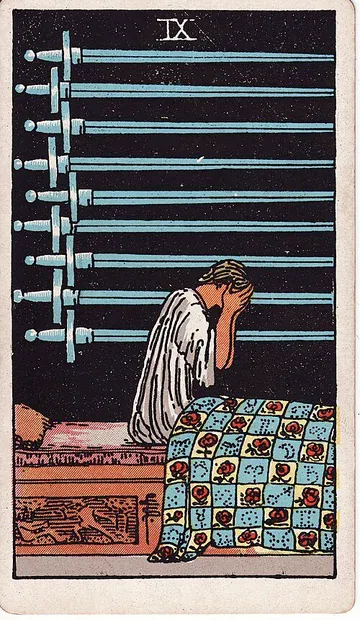
Nine of Swords
The dark night and its end. The Nine of Swords is the sleepless anguish, the racing thoughts, the dread without object that ran all night long. The Ten is the morning after — the worst the mind was rehearsing has finally happened, and the body discovers it can still breathe. Together these cards describe a long arc that has, finally, completed. There is no shortcut available; there is also no further escalation coming. Honor the difficulty of the night and permit the dawn.
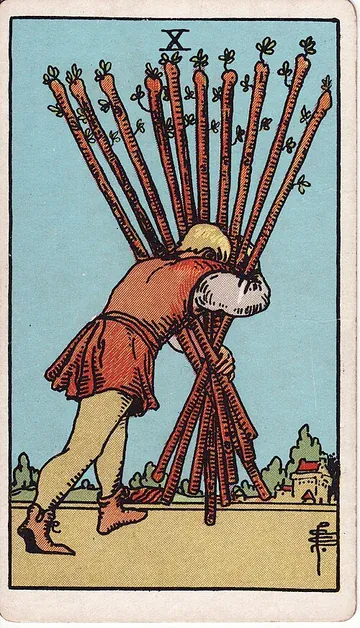
Ten of Wands
Two endings of opposite character. The Ten of Wands is the burdened ending — the bundle still on the back, the door almost reached but not yet through. The Ten of Swords is the total ending — the bundle finally set down, the body no longer braced against anything. Together, the cards describe the moment the seeker realizes the burden they were carrying did not need to be carried this far. The Ten of Wands asks the question; the Ten of Swords answers it. Set the bundle down.
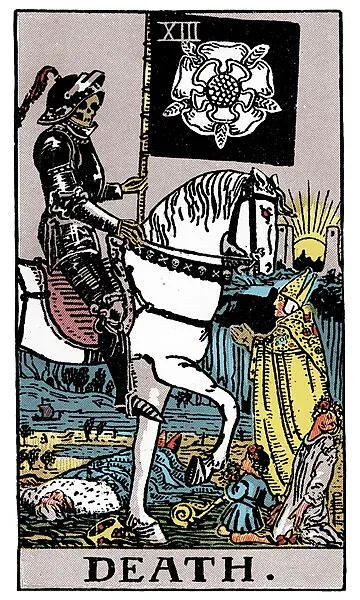
Death
Total ending modulated by ritual death. Death does not make the ending lighter; Death makes it more meaningful. Together, these cards describe an ending that is a passage rather than an event. What ends here will not be replaced by a similar version of itself in three months; what grows next will be different at the root. The combination asks the seeker to recognize that this is a real change of life, not a small loss to be metabolized and moved past.

The Sun
The card of total ending beside the unconditional dawn. Together, these cards describe the ending that is the precondition of an unmistakable warmth. The sun does not arrive because the seeker deserved it; the sun arrives because suns arrive. The combination is among the deck's most quietly hopeful pairings, but the hope is given rather than earned. The seeker's only work is to stop performing resuscitation on the previous chapter so the new warmth has somewhere to land.
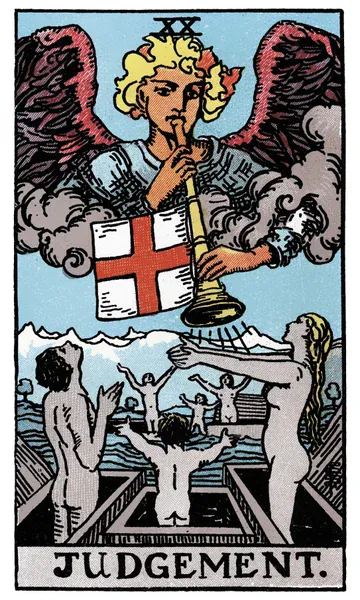
Judgement
Lying down after the worst, beside the card of rising. Together, these cards describe the resurrection that follows full ending — not the rising in the middle of the night, not the rising before the night was finished, but the rising after the night has properly closed. Judgement does not arrive while the seeker is still bracing. Judgement arrives in the silence after the bracing has stopped. Among the most precise descriptions in the deck of how endings actually become beginnings.
Frequently Asked Questions
What keeps an ending from landing once all ten blades are already in?
Two habits, and the card names both. Reversed, it is the ending that has not been allowed to end — either the seeker who keeps the wound open by refusing to let the chapter close, or the seeker who performs premature recovery while several blades are still in. The card is not punishing; it is naming, with precision, the way the upright card's offered grace has not yet been received. The work it asks for is the slow, honest middle.
Is the reversed Ten of Swords saying the trying itself has become the problem?
It is, and it calls that trying the eleventh sword. The reversed Ten of Swords is rarely a clean yes or no. It typically answers that the underlying situation has, in fact, already ended, and that the seeker has not yet permitted the ending to land. If the question is whether to keep trying, the answer is no — the trying is now the eleventh sword. If the question is whether the seeker has truly moved on, the answer is also no, with affection.
How do I finish a breakup that formally ended months ago?
Privately, and without an audience. Reversed in love, the Ten of Swords describes the breakup that has happened formally but has not been permitted to close emotionally — the secret checking of profiles, the unsent texts, the bargaining with the ending. It can also describe the relationship that is privately dead but publicly intact. The card asks the seeker to do the unromantic work of finishing the previous chapter privately so the next chapter can be met without it.
Is performed closure the same as closure, when this card comes reversed?
It is not, and the card is exact about the gap. Reversed in feelings, it describes someone whose feeling about you has not yet completed its work — quiet resentment that has not surfaced, performative closure that hides unfinished business, or a private grief they are publicly denying. They are stuck inside the ending, either refusing to let it end or performing an ending that is not real underneath. Read it as a precise mirror of an unfinished interior.
How do I stop performing an ending I have not actually finished?
By stopping in both directions at once. Cancel the social event you scheduled to prove you are better now. Stop the small surveillance rituals that keep the previous chapter on life support. Tell one trusted person the unflattering truth of where you actually are. Forgive yourself for being still inside the ending. The card returns to upright through honest fallowness, not through accelerated triumph or extended grief.