
Ten of Wands · Core Meaning
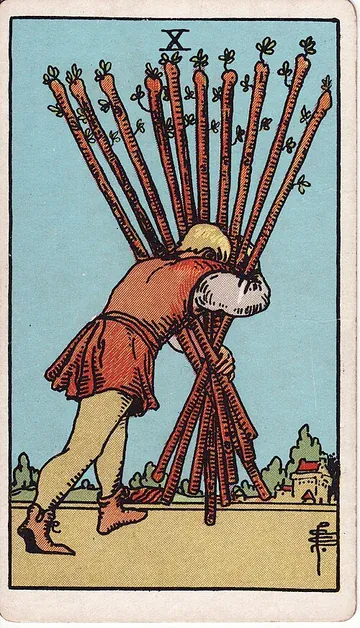
The Ten of Wands is the almost-there card — and like all almost-there cards, it asks who actually agreed to carry this. A figure walks bent forward, arms wrapped around ten staves clutched together, on the last stretch of road toward a small town on a low hill. The bundle is badly ordered. Shafts jut in every direction. The view ahead has become a tangle of black lines, and the carrier has stopped seeing the road. He sees his own feet. He has decided he can simply make it. He is correct, and the cost is real.
This is the card's signature tension: capacity exceeded inside a frame the carrier still calls reasonable. The Nine of Wands stood at his fence, scarred, watchful, ready. The Ten has already accepted the load that the Nine wondered whether to take on. The bundle is no longer a question. It is a posture. The body has agreed before the will that this is mine. That unconscious yes is more dangerous than any visible refusal. The figure does not look distressed. He looks practiced. He has carried this kind of load before.
The Ten of Wands' core meaning is not failure. It is the moment when over-functioning has become identity. The shoulders know the angle. The breath has adapted. The carrier has organized his life around the bundle and would not know who he was without it. The card describes the worker who cannot remember a Sunday without the laptop, the mother who does not recognize an empty afternoon, the eldest sibling who picks up every thread the family drops, the freelancer who has not declined a project in eighteen months. The bundle is not a single project. It is the shape of a life.
The traditional astrological signature reinforces this: Saturn in Sagittarius, third decan, December 13–21 — the final paces inside the year's shortest day. Saturn is the planet of structure, duty, the spine of obligation. Sagittarius is the wide aim, the far-reaching arrow, the vision that wants to cover ground. Together, Saturn in Sagittarius gathers an expansive fire into the skeleton of responsibility. The aspiration is not wrong. It is simply that one person's back is now expected to deliver it. The kabbalistic placement is Malkuth in Atziluth — fire in the kingdom, will arriving at the base of the Tree, the spark of every earlier wand in the suit landing here as material weight. Whatever you once kindled, the ash also belongs to you.
There are four signature symbols in the Rider-Waite-Smith image. The ten staves clutched together: the entire task lifted in one motion, ten being a complete bundle and a number two arms cannot actually hold properly. The bent spine: posture as confession. The line of sight blocked by the staves: the load itself obscuring the direction of travel. And the small town on the low hill: the destination genuinely close — which is exactly what makes the card so misleading. Because you are almost there, the argument for "just a little longer" remains eternally valid. The card does not promise the gate is far. The card asks whether the price of arriving in this posture is the one you actually meant to pay.
Read the Ten of Wands the way you would read a photograph of someone hauling boxes up the last flight of stairs at the end of a moving day. Whatever lives in that bent frame — pride, exhaustion, refusal of help, the silent calculation that asking would cost more than carrying — is the card's meaning for that reading. The picture itself is neutral. The posture is the question. The answer is whether you can set two staves down before you reach the door.
Ten of Wands · Love & Relationships
In love readings, the Ten of Wands describes a relationship that has become a load. Not always the wrong load — often the load that comes with real life, real children, real careers, real households. But somewhere along the way, the share that should have been carried by two has been quietly gathered into one person's arms. The bundle is full. The body is bent. The view of the partner across the table has been blocked by the very tasks the carrier has decided are theirs alone.
For an existing partnership, the Ten of Wands often arrives when over-functioning has hardened into the architecture of the relationship. You manage the calendar. You remember the birthdays. You schedule the doctor's appointments. You initiate the difficult conversations and then absorb the residue of how they go. You are the one who notices the dwindling shampoo and the lapsing insurance and the friend who hasn't been called. None of these things, individually, are unreasonable. The accumulation is what the card sees. The accumulation has become the thing that prevents you from looking at your partner with curiosity instead of inventory. The love is real. The capacity has been spent.
For a new spark where you are already overloading the bond, the Ten of Wands warns of a familiar shape arriving early. You have been single long enough to know how to hold a life by yourself. Now there is a person, and instead of dividing the load you are quietly absorbing theirs into yours. You answer their texts at the speed you answer your boss. You remember their preferences before they have stated them twice. You are auditioning to be indispensable. The card asks: do you want this person to love a real you, or do you want them to love the version of you who has agreed to carry everything? Those are not the same offer.
For a solo seeker carrying old weights, the Ten of Wands reads as the card of dating while exhausted. Every previous relationship, every family role, every responsibility that other people set down and walked away from, you have been quietly holding for years. The bundle has gotten heavy enough that meeting someone new feels like another stave. You decline the second date because the math of integrating a person into the schedule does not work. The card is not telling you love is impossible. It is telling you that love cannot move into a life that has already been over-furnished with obligation. Set something down before you go looking.
For someone post-wound and still triaging, the Ten of Wands describes the season after a major break, when the emotional cleanup has consumed you. You are carrying the practical aftermath — the lease, the shared accounts, the children, the explanations to families — and also the interior aftermath, which has its own weight. The card is gentle here. It does not shame you for the load. It simply names that you are carrying it, and asks whether anyone at all has been allowed to help. Often, with this card, the answer is no. The pride that pulled you through the worst week is now preventing the help that would shorten the worst year.
For a reconciliation question, the Ten of Wands offers a careful answer. The relationship can be rebuilt — but only if the load that broke it is divided differently this time. If you return on the same terms that produced the bundle, the bundle will reform. The card asks: what specific staves would have to be handed to your partner before reconciliation became a real division of work, not a re-acceptance of the old arrangement? Until you can name three, the return is premature.
For long-distance or cross-cultural relationships, the Ten of Wands speaks to the carrier of all the connective tissue. You are the one who books the flights. You are the one who explains your culture to their family and their culture to yours. You are the one whose visa is at stake, whose career has flexed, whose language has bent. The card is not necessarily indicting the partner. Sometimes the asymmetry is structural. But the card insists that it be named. Unspoken asymmetry is the most reliable poison of long-distance bonds.
For the pursuer–distancer dynamic, the Ten of Wands surfaces a specific version: you are the over-pursuing one, not because you cannot leave them alone, but because you have made yourself indispensable. They cannot distance because you have made the relationship a system that requires your hand. Their distance reads as ingratitude. Your pursuit reads as care. Both readings are partial. The card asks you to remove one piece of indispensability — one task, one decision, one daily check-in — and watch what shape the relationship takes when you stop holding it together by yourself.
For a household constraint reading — money pressure, caregiving, blended family logistics, eldercare — the Ten of Wands describes the seam where love and labor meet. You may genuinely love this person and also be drowning in what loving them requires. The card validates the weight without asking you to resent the relationship. The work, if there is work, is structural: a conversation, a list, a reallocation, a hire, a no said to a third party who has been demanding from the relationship's reserves. Love that lasts is load-bearing. Load-bearing requires shared bearing.
For a partnered-but-isolated reading — you are inside the relationship and somehow alone in it — the Ten of Wands names the worst version of the dynamic. You have a partner. You also have nine staves clutched to your chest while standing next to them. They do not see the bundle because the bundle has been so thoroughly normalized. The card asks for the conversation you have been postponing, in which you describe — concretely, without escalation — what is actually in your arms. Not the abstract phrase "I'm overwhelmed." The specific list. The specific list is what makes the bundle visible.
If you are asking whether someone is in love with you and the Ten of Wands arrives upright, read it carefully. They may love you. They may also be exhausted by their own load — work, family, an internal life you cannot see — and the love is being delivered in the smallest possible packets because the larger ones cannot be lifted right now. The card does not say the feeling is absent. It says the bandwidth is. Whether to wait, whether to ask for more, whether to step back — those are questions of your own carrying capacity, not of their feeling.
Ten of Wands · As Feelings
Invested, weary, and quietly afraid the investment is starting to show as need — that is the Ten of Wands on the question of someone's feelings. They feel something — often something real and substantial — but the feeling is being carried alongside the rest of their bundle, and the bundle is at capacity. They are not cool toward you. They are not playing it slow on purpose. They are conserving energy because their tank is closer to empty than they are willing to say out loud.
The body language the card describes is bent forward, arms full, eyes on the feet. Translated to feelings, this is the partner who answers thoughtfully but late, who arrives present but heavy, who says the right things in the right tone and then disappears for forty hours. The warmth is genuine. The transmission is delayed. Read silence here as bandwidth, not absence — but read it accurately, not generously. There is a difference between a person whose silence is recovery and a person who has decided you are one of the staves.
If they are reserved by nature, the Ten of Wands in feelings means they have gone quiet under the load. They have not stopped caring; they have stopped narrating the caring. The internal monologue about you is still running. It is simply not making it past the lips, because everything past the lips today has gone to obligations. With this kind of partner, what you do not get is real-time processing of the relationship. What you do get is consistency, presence at the appointed times, the absence of drama. The card asks whether you can read love in those low-key signals, or whether you need the verbal layer too. Either is a legitimate need.
If they are demonstrative by nature, the Ten of Wands in feelings means they are performing capacity. They are showing up bright. They are sending the heart emojis. They are making the gesture. And underneath, they are exhausted, and the brightness is partly the cost of not letting you see the exhaustion. They feel for you. They also feel that letting you see the truth of the load would be one more weight, because you might respond to the load instead of to them. With this kind of partner, the gentlest question is not "do you love me." It is "what are you actually carrying right now."
For a long bond that has stabilized into resignation, the Ten of Wands describes feelings that have ossified into obligation. They love you the way they love the mortgage — not without warmth, but with a sense of inevitability that has displaced choice. The thrill is gone, but the commitment is intact, and the commitment is doing most of the daily work. The card asks whether resigned love is enough for you. Some seekers say yes. Some say no. The card does not judge the answer. It only insists that the answer be honest, not assumed.
For a new connection where they feel watched-out-for not seen, the Ten of Wands warns of a specific texture. You have been so attentive, so capable, so reliable, that they have begun to relax into your competence rather than meet you as a person. They feel grateful. They feel held. They do not feel as if they have to bring their full self to the table, because you are already doing the heavy lifting. The card describes the partner who likes how easy you make it for them and has not yet realized you are also a person who needs holding. The feelings are warm. They are also, currently, asymmetric.
For reconciliation under fatigue, the Ten of Wands names a careful feeling. They do still love you. They are also tired of the version of the relationship that ended. Returning will require energy they are not sure they have. The feeling is not coldness; it is depletion. The card asks for patience without naivety: this is not a no, but it is not yet a yes that has the strength to follow through.
For distance — geographical, professional, schedule-based — the Ten of Wands says they feel for you across a load they cannot easily set down. The distance is not the obstacle. The bundle on either side is. The card wants honesty about whose bundle is heavier, and whether the relationship is currently asking the more loaded partner to also be the more available one. That arrangement does not last.
For divided warmth — they feel something for you and also for someone else, or for an ex, or for the version of their life that does not include you — the Ten of Wands is precise. They are not duplicitous. They are over-extended. They cannot meet the demands of more than one emotional architecture at this volume. The feeling for you is real. So is the feeling pulling them elsewhere. The card asks whether you want to be the thing they reach for once they have set something else down, or whether you want to be the present priority. Those are different relationships.
For the case where they may simply be avoiding rather than truly exhausted, the Ten of Wands offers a gentle disambiguation. Real exhaustion looks like brief, warm contact with apology. Avoidance looks like absence dressed up in the language of busyness. The bundle in this card is real — it is not a euphemism for not wanting you. If their messages, when they come, are warm and present and remorseful about the pace, the load is genuine. If their messages, when they come, are vague and impersonal and easy to send to anyone, the bundle is being used as cover. Read which one. The card supports the reading either way.
Ten of Wands · Career & Work
The last stretch is where the Ten of Wands does its working life, and it does it with your arms already full. The project is in delivery week. The launch is on Friday. The quarter closes in nine days. Everything you have been holding for three months is now squeezed into a window that does not fit it, and you have decided you can simply make it. You are correct. The cost is real, and the cost will land in the second week of the next quarter, when your body finally registers what you ran on borrowed for ninety days.
For someone asking whether a current role is sustainable, the Ten of Wands gives a careful, specific answer. The role itself may not be the problem. The shape of how the role has been allowed to expand is. You took a job. The job became two jobs because someone left and was not replaced. The two jobs became three because you turned out to be reliable, and reliability is the most efficiently exploited resource in any organization. The card asks: what was actually in the original job description? What has accreted? Of the accreted work, which pieces would you legitimately give back if you could? Until you can name them, the load remains invisible to the people who are loading it.
For someone considering a new role, the Ten of Wands is a warning embedded in a practical question. The new role may be better. It may also be the same shape with a different title. The card asks you to read the offer not for what it adds — title, money, credit — but for what it would let you set down. If you cannot identify a single stave you would relinquish, the role is the same role with a heavier bundle. The next promotion that arrives in this posture will not be relief. It will be more.
For freelancers who can't decline, the Ten of Wands is the card of the booked-out calendar that will not stop accepting bookings. Each project, individually, looks reasonable. Saying no to one feels arbitrary. So you say yes to all of them, and the accumulation eats the white space that used to be where the work actually got done. The card describes the freelancer whose Saturdays have quietly become workdays, whose evenings have become catch-up sessions, whose vacations have become "working remotely." The instruction the card offers is not "decline more." It is "decline at the level of the system, not at the level of the individual project." Pick one day per week. Pick one type of project. Pick one client tier. The bundle gets lighter when the system changes, not when willpower is reapplied.
For creative workers with backlog, the Ten of Wands describes the dread of the unfinished. The half-edited manuscript. The opened-and-closed file. The album that has stalled on track seven. The exhibition catalog that needs three more essays. The work is good. The work is also a weight, and the weight has begun to displace the joy that started the work. The card asks: which piece of the backlog can you genuinely declare finished as it is, even if it is not what you imagined? Releasing one stave by completing it on lesser terms is sometimes the move that frees you to actually finish the rest. Perfection in this card is the heaviest stave.
For students or apprentices, the Ten of Wands describes the version of learning that has tipped from formative into crushing. The reading list is real. The deadlines are real. The standards are real. And the body that is supposed to absorb this education has stopped having margin for the absorption itself — it is only metabolizing the next assignment. The card warns of the credential earned at the cost of the curiosity that should have come with it. Slow down where you can. Skip the optional. The diploma will be the same; the head behind it will be different.
For managers and leaders bottlenecking decisions, the Ten of Wands names a specific failure mode. You have become the chokepoint. Everything routes through you because you are the one who knows how everything works. The team waits for your eyes on every step. You are working twelve-hour days and the team is working seven-hour days and the difference is your refusal — usually unconscious — to actually delegate the parts you have decided only you can do correctly. The card asks for one decision, this week, that you hand to someone else with the explicit instruction not to bring it back to you. Even if they do it slightly worse the first time. The cost of their learning curve is lower than the cost of your bottleneck.
For care work and teaching — nurses, therapists, social workers, teachers, parents-as-vocation — the Ten of Wands is the card of compassion fatigue with the added cruelty that the work is morally legible. You cannot easily say no. The case is real. The student is struggling. The patient needs you. The child is small. The card honors the legitimacy of the load. It also asks whether the institution is using your moral seriousness as a budget line. Often, in care work, the bundle is structurally impossible — and the worker pays in body, sleep, and relationships for what should have been hired. Naming the structural impossibility is not weakness. It is the first move of integrity.
For a promotion that's actually load-without-power, the Ten of Wands gives you the language. You have been promoted into a role that has the responsibility but not the authority. You can be blamed for outcomes you cannot control. You answer for a team you cannot actually direct. The promotion looked like an arrival. The bundle has doubled. The card asks: is this a stepping-stone that earns the authority later, or a ceiling that will keep loading you while withholding what you would need to deliver? Distinguish carefully. The first is worth a season of bearing. The second is the trap of staying.
For a layoff or transition, the Ten of Wands often describes the months immediately after. You have lost the role. You are also still carrying the role's weight — the colleagues you worry about, the unfinished projects, the identity built around the work, the emotional residue. The card warns against immediately replacing the bundle with a new one. The most dangerous post-layoff move is to take the first thing offered because the empty hands feel worse than the heavy ones. Stay empty-handed long enough to remember what shape your arms naturally make.
For a cross-functional team where you became the connective tissue, the Ten of Wands names the role no one was hired for and everyone now depends on. You translate between engineering and product. You smooth the friction between sales and operations. You catch the things that fall between teams and route them quietly. None of this is in your job description. All of it would collapse without you. The card asks for the conversation in which the connective tissue is named — and either compensated, formalized, or shared. Continuing to do the invisible work invisibly is the surest path to the bundle becoming the spine.
Ten of Wands · Money & Finances
Money in the Ten of Wands is a load with only one set of arms under it. Not necessarily debt — though sometimes debt. More often, it is the structure of obligation: the mortgage, the dependents, the loans that funded the credential, the family member you quietly support, the lifestyle that has expanded to fill the income you have. The numbers may technically work. The carrier knows, at the body level, that the margin has been spent. There is no slack. A single bad month would expose the system.
For a question about whether to take on a new financial commitment — a house, a loan, a major purchase, a financial obligation to family — the Ten of Wands answers with caution. The commitment may be sound on paper. The carrier is already at capacity. Adding the new commitment to the existing bundle does not fail in the first month. It fails in month seven, when the cumulative weight of compounding obligations meets a non-negotiable surprise — a medical bill, a job loss, a relative who needs help. The card asks: what gets set down before this gets picked up? If the answer is nothing, the commitment is premature.
For someone in financial recovery — the climb out of debt, the rebuild after a setback, the long austerity of consolidation — the Ten of Wands describes the season when the discipline that produced recovery has begun to consume the life it was supposed to protect. You are paying down the cards. You are saving for the buffer. You are not buying anything frivolous. And you have not had a moment of unbudgeted joy in eleven months, and the carrier is starting to wonder what the destination is. The card asks for one small, deliberate piece of margin — a meal out, a book, a weekend — that does not undo the recovery but does remind you why the recovery is being done. Discipline without margin becomes its own bundle.
For the seeker carrying others financially — the eldest child sending money home, the partner who covers the asymmetric income, the friend who keeps lending — the Ten of Wands is one of the deck's most precise mirrors. The support is real. The need is real. The weight is also accumulating, and it accumulates faster than the carrier admits, because the moral weight of declining is so much higher than the moral weight of stretching. The card asks for the honest accounting: how much, how often, for how long, with what implicit exit condition. Open-ended financial support without a stated structure becomes the backbone of the carrier's life rather than an act of generosity.
For a question about a side income or a financial stretch into a second source of revenue, the Ten of Wands asks whether you have the capacity to add work. If the day job is already at the edge of what your week can sustain, layering a side hustle on top is a recipe for the body breaking before the income materializes. The card is not against the second income. It is against adding it without subtracting something. What gets removed from the existing schedule to make room for the new work? Until you can answer, the side hustle is a stave waiting to be added to the pile.
For investments and speculative moves, the Ten of Wands warns of the bet placed under fatigue. Decisions made by an exhausted carrier are systematically worse than decisions made by a rested one. The card does not say the investment is wrong. It says the timing of the decision is wrong. Postpone the move two weeks. Sleep. Eat actual meals. Talk to a person who is not financially involved. Then look at the spreadsheet again. Most decisions made in this card lose money less to the wrong asset than to the wrong state of the carrier's mind.
For the windfall question — bonus, inheritance, settlement, unexpected income — the Ten of Wands offers a counterintuitive instruction. The most useful first move with the windfall is not to deploy it. It is to use a portion of it to set down a stave. Pay off a recurring obligation that has been quietly draining your margin. Hire help for the household task that has been consuming your evenings. Buy yourself one month of not freelancing on the side. The card describes a carrier whose problem is not lack of resources but lack of slack. Convert the windfall into slack first. Then decide.
A practical move when this card appears in a money question: write down every recurring financial obligation you currently service — subscriptions, payments, ongoing supports, lifestyle baselines. Look at the list. The card responds to that list becoming visible. Most carriers have been carrying staves they no longer remember picking up.
Ten of Wands · Health
The body agreed to carry more than it should, and the Ten of Wands is where that agreement comes due. The body is the most honest reader of this card. While the will is still saying "I can do this" and the mind is still calling the load reasonable, the body has already begun to register the cost in low-grade signals — the persistent shoulder tightness, the headache that returns every Wednesday afternoon, the sleep that no longer refreshes, the digestion that has become an event rather than a process. The card does not predict illness. It names the season in which the body is no longer absorbing the load silently.
The card's traditional body associations — liver and blood, ruled by the choleric, outward, hot temperament — speak to the metabolic systems that process effort. The liver filters, the blood carries, both keep moving regardless of whether you have asked them to rest. The Ten of Wands describes the seeker whose internal organs are doing the work the schedule has refused to do. Watch for liver-zone signals: the dull ache under the right rib, the morning irritability, the alcohol that hits harder than it used to, the food sensitivities that have surfaced this year. Liver-zone language is traditional symbolism, not medical advice. The body is simply asking for the rest the calendar has been declining to give.
For someone managing a chronic condition, the Ten of Wands often appears in the season when self-management has begun to compete with everything else for the same shrinking pool of attention. The medication is being taken — most of the time. The exercise is happening — when there is room. The sleep hygiene is intact — except on the deadline weeks, which have become every week. The card warns of the slow erosion of the practice that was holding the condition stable. The condition does not collapse in a single missed dose. It collapses in the cumulative drift of a hundred small surrenders. Re-engage with the practice this week, in the smallest possible form, before the drift compounds.
For acute symptoms, the Ten of Wands asks whether you have been ignoring the body's earlier requests. Most acute presentations of stress-related illness — migraines, back episodes, GI flares, panic responses — were preceded by weeks of warning signals the carrier waved past. The card offers a gentle but specific instruction: when the body sends a signal in this season, treat it as a higher-priority message than the work it would interrupt. The cost of pausing for an hour to attend to a signal is much lower than the cost of ignoring it until it becomes a week in bed.
For mental health questions, the Ten of Wands describes a particular weather: the depression of the over-functioner. Not a depression of emptiness. A depression of fullness — of obligation that has displaced joy, of competence that has displaced curiosity, of saying yes so many times that the self that wanted to say no has gone quiet. The seeker who is functional, who is meeting deadlines, who looks fine to colleagues, who is also slowly losing the parts of themselves that did not serve the bundle. The card validates that this is real. Functional depression is still depression. It is also more answerable to structural change than to medication alone — though both, where appropriate, help.
For sleep, the Ten of Wands describes the seeker who falls asleep instantly out of exhaustion and wakes at 3 a.m. with the bundle reorganizing itself in their head. The body went down. The mind kept working. The card asks for one practice, before bed, that puts a wall between the day's load and the body's rest — a real wall, not a Netflix wall. A walk. A bath. A book. A genuine conversation. The body sleeps better when the bundle has been formally set down before the lying-down.
For the question of when to worry and when to rest, the Ten of Wands gives a useful threshold. Rest, when the symptom is responsive to rest — when a real weekend disappearing the headache means the headache was a stress signal. Worry, when the symptom persists through the rest you have given it — when the headache is still there on Sunday night after a real Saturday off. The card does not replace your practitioners. It asks for the honest test: have you actually rested the body enough to know what it would look like rested? Many seekers in this card have not, and call mysterious what is simply the absence of margin.
A practical move when this card appears in a health question: identify one piece of the bundle that, if set down, would let the body sleep an extra hour next week. Set it down. The card responds to subtraction more than to addition. The body does not need a new supplement. It needs a removed obligation.
Ten of Wands · Spirituality
Fire arrives in matter at the Ten of Wands — fire in Malkuth, the one place where fire can finally be weighed. The spark that was ignited at the Ace, fanned at the Three, organized at the Six, defended at the Nine — all of that arrives here as the kingdom, the body, the daily life, the actual hands that have to hold it. Will has met weight. The card describes the spiritual season in which the practice that began as illumination has become labor, and the labor is testing whether the will was a true vocation or merely an enthusiasm.
For seekers in active practice — meditation, journaling, ritual, devotional work, study — the Ten of Wands describes the year when the practice has become a chore. The cushion still calls. The page still calls. The teacher still calls. And the seeker has begun to schedule the practice the way they schedule a meeting, and the meeting has begun to feel like a load. The card does not say abandon the practice. It says examine the relationship to the practice. A practice that has become a stave in the bundle is a practice the carrier has stopped letting themselves be transformed by. The cure is sometimes shorter sessions. Sometimes a different practice. Sometimes a sabbatical from formal practice and a return to walking, talking, eating attentively as the only practice for a season.
For someone exploring a tradition, the Ten of Wands warns against the consumer model of spiritual seeking. You can collect teachings the way a carrier collects staves. The shelf fills. The bookmarks accumulate. The notes app overflows. And somehow the seeker is no closer to integration than they were three years ago. The card describes the spiritual student who confuses acquisition with arrival. The instruction is to set down nine teachings and stay with one. The one will reveal what the nine were standing in for.
The card's spiritual signature, Saturn in Sagittarius, is the test of whether the vision can survive being made structural. Sagittarius reaches; Saturn measures. The aspiration arrives at the place where it must become daily. Many seekers love the aspiration and resent the structure, and the structure is what the Ten of Wands is asking for. Not punitive structure. The structure of a life that can actually hold the practice — sleep, food, relationships, work — without the practice becoming another reason the carrier is exhausted.
For questions about path, the Ten of Wands often describes the moment when the path has become unmistakably yours and also unmistakably heavy. You did not choose this calling lightly. You also did not understand, when you chose it, what it would actually require. The card asks: now that you know, do you choose it again? Often the answer is yes, but the yes is different from the original yes — older, less romantic, more consenting. That second yes is what makes the practice durable.
A real practice for the day this card appears: sit for thirty minutes with the explicit intention of carrying nothing. Not even the meditation. Not even the practice. Set down the spiritual identity that requires you to do this well. Sit as a person, not as a seeker. The card is asking the seeker to remember that they are a person beneath the seeking — a body, a breath, a name — and that the spiritual life that does not return periodically to that base becomes another version of the bundle. Spirit, in the Ten of Wands, is what remains when the staves have been laid down.
Ten of Wands · Yes or No
Yes — but at a hidden cost.
The Ten of Wands upright is technically a yes. The thing you are asking about will land. The project will deliver. The relationship will hold. The decision will play out the way you are pushing it to. The card describes the carrier reaching the gate. He does reach it. The question the card insists on is what he looks like when he gets there.
For yes-or-no questions about whether you can finish what you have started — the degree, the project, the season, the marriage, the build — the answer is yes. You have the capacity. The carrier reaches the gate. The card is not promising failure. It is naming that the arrival will be more depleting than you have estimated, and that the depletion will follow you into the next chapter.
For yes-or-no questions about whether to take on something new, the answer turns. Yes, you can take it on. The bundle can hold one more stave. But the card is asking a different question underneath: should you? Capacity is not the same as wisdom. The fact that you can carry more is the most reliable predictor that more keeps being asked. The card answers yes to the literal question and asks a harder question back.
For questions about whether to push through a difficult stretch — finish the term, complete the assignment, hold the relationship through the rough season — the Ten of Wands gives a qualified yes. You can push through. The push will work. The card invites you to distinguish between the push that ends in arrival and rest, and the push that ends in arrival and the next push immediately. If the post-arrival rest is real and visible on the calendar, push. If the post-arrival rest is hypothetical, the push is the trap.
For binary questions about whether someone is being honest about their capacity — the partner who says they can handle more, the colleague who promises a deliverable, the contractor who assures you of the timeline — the Ten of Wands warns. Yes, they will deliver. They are also already at capacity, and the delivery is being made with reserves they do not have. The cost will surface later, in the form of resentment, missed details, or burnout that affects the next phase. Plan for it.
Asked how far the gate still is, the Ten of Wands suggests yes, within the season. The gate is close. The resolution is not theoretical. The card's "soon" is not the soon of arrival followed by ease, however; it is the soon of arrival followed by a body that needs to recover from the arrival. Plan the recovery into the timeline.
For binary decisions about whether to act now — should I send the message, should I take the meeting, should I commit — the Ten of Wands says yes if you have the bandwidth, and no if the act would be added to a system already at capacity. The deciding question is not "is it the right thing." It is "do I currently have margin to do the right thing well?" If the answer is no, the right thing done badly becomes another stave.
If the question was: am I doing too much? The card answers yes, immediately, without conditioning, and asks why you needed to confirm what your shoulders have known for months.
Ten of Wands · Advice
Set two staves down before you reach the gate — the Ten of Wands asks for exactly that much and no more. Not all ten. Not the bundle entirely. The card knows you are committed to this arrival, and the commitment is not wrong. It asks, with surprising specificity, for the smallest possible release — two staves, set down on the road, before you cross the threshold. The relief from those two will determine whether the arrival is celebration or collapse.
If there is one specific instruction the card offers, it is to ask, of each item in your current load, "is this one mine?" The bundle is mixed. Some staves you picked up because they were yours to carry. Some you picked up because someone else dropped them and no one else would. Some you picked up because carrying them gave you a sense of self you did not know how to find without the carrying. The first category is yours. The second is shareable. The third is the dangerous one — the staves that are no longer functional but are now identity. The card asks for honesty about which is which.
A second instruction: stop adding while you are at capacity. The most reliable way the bundle gets heavier is the carrier accepting a new stave because saying yes is faster than negotiating a no. "I can fit it in." "It's not a big deal." "I'll figure it out." Each of these is the sound of a fresh stave being added without subtraction. The card asks you to enforce a one-out-one-in policy this week. If you accept something new, something old must be set down in the same conversation, ideally aloud, ideally to the same person.
A third instruction: ask for help once. Not a structural overhaul. Not a difficult conversation about the entire arrangement. One specific ask, of one specific person, for one specific stave. "Can you handle Thursday's pickup?" "Can you take the lead on the client call?" "Can you read this draft before I send it?" The Ten of Wands describes the carrier so practiced at carrying that the muscle of asking has atrophied. Asking small, this week, retrains the muscle. Asking big, in a month, becomes possible because the small asks have rebuilt the skill.
A fourth instruction: notice the posture. The bent spine of the card is not metaphor — it is a literal description of what the load is doing to the body. Stand up. Roll the shoulders back. Take three slow breaths into the upper chest. The carrier in the card has not done this in days. The body in the card has agreed to a shape that is now its default. Reclaim the upright posture, even just once a day, before any of the structural changes are possible. The body is the first thing the bundle conquers and the first thing that has to be returned to itself.
A fifth, gentler instruction: forgive yourself for having taken on so much. Most carriers in this card are not carrying out of pathology. They are carrying out of love, duty, ambition, and an unreasonable but human belief that they could handle it. None of those motives are shameful. They are simply not load-bearing structures for the rest of a life. The card asks for compassion toward the version of you that said yes too many times. That version did the best they could with what they understood. The current version is allowed to know more.
Practical advice for the day the card appears: name three things in your bundle aloud, to a real person — friend, partner, therapist, journal read aloud to yourself in an empty room. The card responds to the bundle becoming visible. Carriers in this card live alongside loads that have become invisible to everyone, including themselves. The naming is the first move of the setting down.
A final note. The card's most misleading feature is that the gate is genuinely close. The carrier does, in fact, almost certainly reach it. The argument for "just bear it a little longer" is not wrong on the literal question. It is wrong on the deeper question: who do you want to be when you cross the threshold? If the answer matters to you, the time to set the two staves down is now. Not at the gate. The carrier who arrives empty-handed and rests has a very different next chapter than the carrier who arrives bent and immediately reaches for the next bundle.
Ten of Wands · Card Combinations
Ten of Wands + Nine of Wands
The watchful guard who became the burdened porter. The Nine of Wands is the figure at the fence, scarred but ready, weighing whether to take this one on. The Ten is the same figure a season later, having taken it on, now bent under what the Nine wondered whether to accept. Together they read the trajectory of over-vigilance hardening into over-carrying — the seeker whose alertness was once useful and has now become a posture they cannot release. The instruction is to look back and find the moment the Nine became the Ten. That moment is the place where a different choice could still be made today.
Ten of Wands + Ten of Pentacles
Completion held in a household, not in one back. The series sibling — both Tens, both arrival cards — but the Pentacles' arrival is generational, communal, structurally shared. Together they describe the seeker whose work has produced something real, durable, and worth inheriting, and whose body has not yet been allowed to enjoy the inheritance because it is still in delivery posture. The combination asks whether the architecture of family, household, or institution that has been built will be allowed to actually hold the carrier — or whether the carrier will hold the architecture, alone, in perpetuity. Real legacies are load-bearing for the people who built them.
Ten of Wands + The World
The major modulator: the gate the carrier is staggering toward turns out to be the gate of completion itself. The World is the cosmic threshold, the dance of the four corners, the integrated end of a journey. Together with the Ten of Wands, the combination reads as a true arrival reached in the wrong posture — the seeker who has, in fact, completed the long thing, and whose completion is being shadowed by the bent-spine momentum of how it was completed. The instruction is to take longer at the threshold than feels reasonable. The World does not collect on a clock. The carrier who actually sets the bundle down before crossing through can experience the completion as completion. The carrier who staggers across simply begins the next bundle.
Ten of Wands + The Hanged Man
Deliberate suspension as the inverse of compulsive bearing. The Hanged Man hangs by choice; the Ten of Wands carries by accumulation. Together they offer a sharp diagnostic: the seeker who has confused over-functioning with sacrifice. Real sacrifice, the card pairing insists, is conscious — chosen, time-bound, transformative. Compulsive carrying is none of those. The Hanged Man asks the Ten of Wands to stop, hang upside down, and look at the bundle from a different angle. From that angle, several staves reveal themselves to have never been the carrier's at all. The combination is a card of deliberate, productive pause — and a warning against the seeker who calls their burnout "service."
Ten of Wands + Four of Wands
Tonal contrast: the celebration the carrier is too heavy to attend. The Four of Wands is the threshold festival, the four staves under garlands, the public moment of completed arrival shared with community. Together with the Ten of Wands, the combination becomes one of the deck's most poignant pairings — the carrier so close to the doorway through which the celebration is happening, and unable to feel the celebration because the bundle is still in their arms. The instruction is to set the bundle down at the gate, even if temporarily. Walk in empty-handed. Let yourself be received. The celebration will not survive the carrier who refuses to be a guest at it. Many seekers in this combination have built the entire festival and then attended it as staff. The Four of Wands is asking them, this time, to come as themselves.
Card Combinations
Nine of Wands
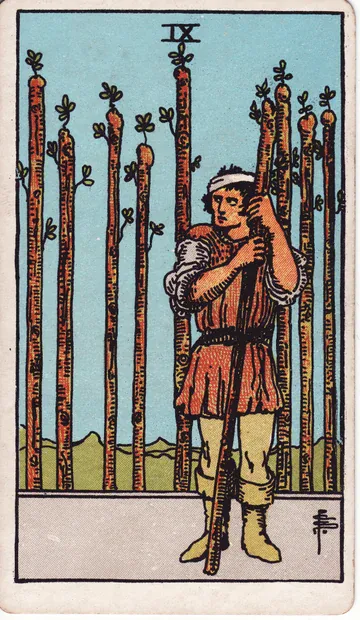
The watchful guard who became the burdened porter. The Nine wondered whether to take this on; the Ten has accepted the bundle and is bent under it. The trajectory from vigilance to over-carrying — and the moment the choice could still be made differently today.
Ten of Pentacles
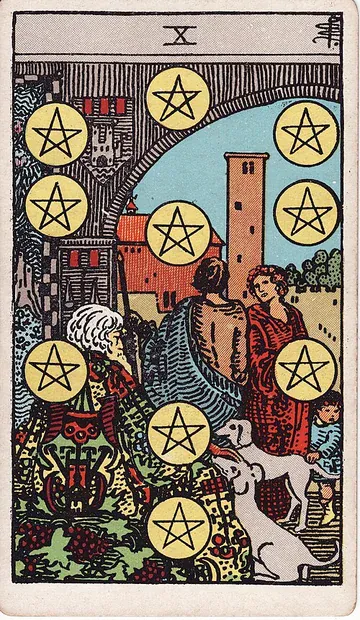
Completion held in a household, not in one back. Series sibling — both Tens, both arrivals — but the Pentacles' arrival is generational and shared. The combination asks whether the architecture you have built will be allowed to actually hold you, or whether you go on holding the architecture alone.
The World
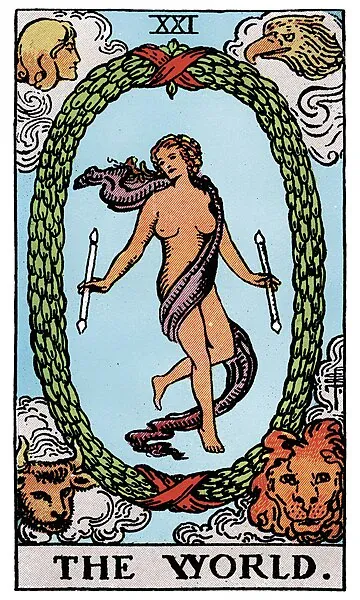
The gate the carrier is staggering toward. The World is the integrated completion the Ten of Wands is moving toward — and the question is whether the carrier crosses the threshold bent under the bundle, or sets two staves down first and walks through with hands free. The pause at the threshold is the whole work.
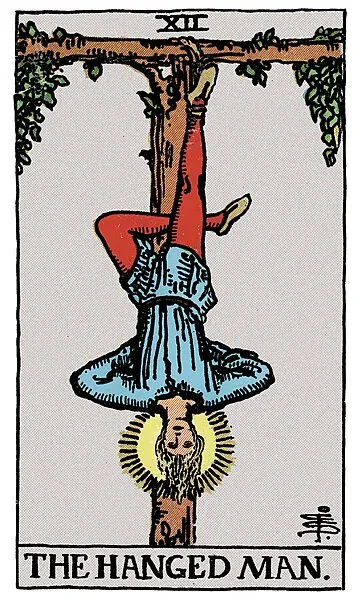
The Hanged Man
Deliberate suspension as the inverse of compulsive bearing. The Hanged Man hangs by choice; the Ten of Wands carries by accumulation. Together a sharp diagnostic: real sacrifice is conscious and time-bound; compulsive carrying is neither. Stop, hang upside down, and look at the bundle from a different angle.
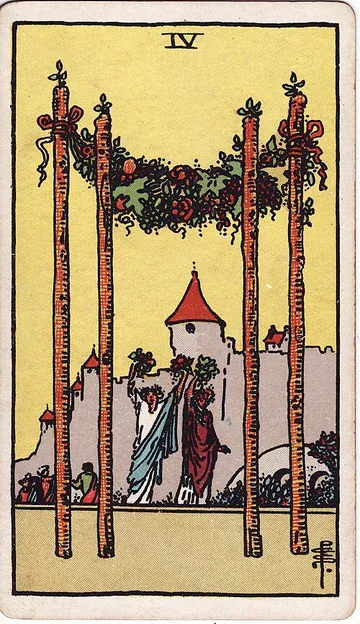
Four of Wands
Tonal contrast: the celebration the carrier is too heavy to attend. The Four of Wands is the threshold festival; the Ten of Wands is the carrier just outside, unable to feel the celebration because the bundle is still in his arms. Set the bundle down at the gate. Walk in empty-handed. Let yourself be a guest at the festival you helped build.
Frequently Asked Questions
Why does the carrier in the Ten of Wands hide the town behind his own bundle?
Because that is the precise defect the card is built to show. The town on the low hill is genuinely close — this is the almost-there card, not the lost-in-the-wilderness one — and the ten staves clutched to the chest are positioned exactly where the view should be. The carrier cannot see the destination because of what he is carrying toward it. Everything else in the image follows from that: the bent posture, the badly ordered bundle, the shafts jutting at angles nobody would choose if they had set the load down and stacked it properly. It describes the stage where over-functioning has quietly become identity. Not failure, and not punishment — the arrival happens. The cost is the arriving posture, and the instruction is small: two staves down before the gate.
What does arriving under the Ten of Wands actually cost me?
More than the plan accounted for, and the overrun is paid in a currency nobody budgeted. The card is technically a yes: what you are pushing toward does land, the project delivers, the relationship holds, the season ends at the gate it was aimed at. What it flags is the depletion, which does not stop at the finish line — it follows you into whatever comes next, so the chapter after this one begins with an empty tank and a body that has forgotten how to stand up straight. The practical response is unglamorous. Put the recovery into the timeline as a real block before you push, not as something to be arranged afterward if there is room. There is never room afterward. That is what this card is reporting.
Am I carrying a share of this relationship that was meant for two?
The card raises that question because it is usually the accurate one. In love, the Ten of Wands describes a bond that has turned into a load, with one person quietly holding what two people agreed to hold. The love can be entirely real and the capacity still be spent; those are separate accounts. What makes it hard to see from inside is that nobody decides this. It accumulates — the person who is better at remembering does the remembering, the person who minds the mess less does the mess, and within two years the division has hardened into the architecture of the relationship rather than a habit either of you chose. For someone single, the same question turns inward: whether the bundle of old responsibilities still leaves enough room for another person to actually move in.
Ten of Wands: is their silence bandwidth, or am I becoming another stave?
Both are live readings of this card, and the difference matters enormously. The baseline answer is invested but weary: the warmth is genuine, the transmission is delayed, and they are conserving energy because the tank is nearer empty than they are willing to say out loud. Silence in that case is bandwidth, not absence. The second reading is harder. Someone who has started filing you under obligations answers differently — the replies are prompt and flat, the plans get honored without warmth, the tone is that of a task being completed on time. Depletion sounds apologetic and inconsistent; being carried as a duty sounds efficient. Watch which one you are receiving over a fortnight rather than in a single exchange, because one exchange can be either.
What is the spiritual lesson of the Ten of Wands?
The spiritual lesson is that fire arriving in matter still has to be carried by a body, and the carrier must periodically remember they are a person beneath the seeking. Will has met weight. The card asks the seeker to set down the spiritual identity that requires them to do this well — to sit, breathe, eat, rest as a person, not as a practitioner. Spirit, in the Ten of Wands, is what remains when the staves have been laid down.