
The Emperor · Core Meaning
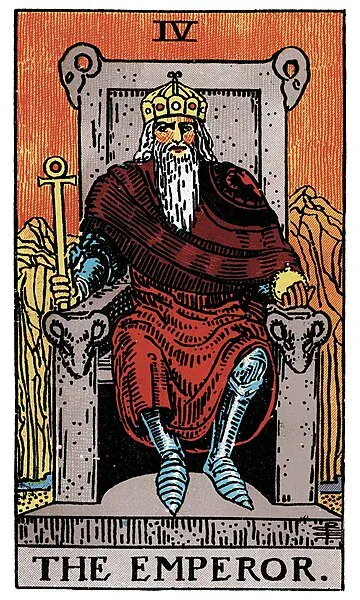
The Emperor tarot card opens with a man who has sat down. That single fact, often missed, is the card's whole engine. The Magician stands; the High Priestess sits in attendance; the Empress reclines into her own fertility. The Emperor is the first figure in the Major Arcana who has chosen a seat and refused to rise. The Rider-Waite-Smith image gives him a throne carved out of gray stone, four ram heads cut into its corners, iron armor showing under a long crimson robe. In one hand he holds an Egyptian-style ankh-topped sceptre crowned with an orb — the kingdom circumscribed. In the other, a small golden globe — the world he carries personally. Behind him, a range of red mountains, dry and bony in profile, the kind of mountains weather has already done its worst to. At his feet, a thin stream slips through bare ground. He does not smile. He does not frown. He has simply taken the seat that needed taking.
The signature tension of The Emperor is between fire and stone. He is ruled by Mars, exalted in Aries — cardinal fire, the season of equinoctial sunrise, the impulse that begins. By every astrological signature he should be charging. Yet here he is, seated. The card is the moment when first impulse has agreed to hold its shape long enough to be useful. Aries says "begin." The Emperor says "begin, and then sit on the beginning until it stops trying to bolt." This is why the throne is stone and not gold: stone is what fire eventually has to live inside if it intends to last.
The traditional astrological signature is Aries first decan (Mars in Aries, March 21–March 30). The hardest fire of the zodiac, raw and undifferentiated, is the same energy the card houses — but tempered into office. The polarity is masculine; the temperament choleric, the medieval reading of a body that runs hot, dry, fast. Read this layer carefully: the Emperor is choleric not because he is angry, but because his nature is to act first. The discipline of the card is acting first and then staying.
On the Tree of Life, The Emperor walks Path 15 — the path from Chokmah to Tiphareth, from the unfocused outpouring of Wisdom into the harmonized center of Beauty. Eliphas Levi and the Golden Dawn give Path 15 the title of the Constituting Intelligence. The path is the moment Wisdom takes a shape it can be lived inside. The Hebrew letter is Heh (ה), the window — the opening through which the formless first becomes seeable. (Note: Crowley's Liber AL swap, which moves Heh to The Star and gives Tzaddi to The Emperor, is the more recent revision; Lunarcana follows the older Golden Dawn assignment that the card itself was drawn under.) Heh as window matters more than it looks. The Emperor is not the wall; he is the frame through which form becomes visible. He gives the world its edges so it can be looked at, not so it can be locked away.
Count the corners. Four ram heads, four legs, the number four sitting under the whole card the way a footing sits under a wall. Four is the first number that can enclose ground — three points make a plane, four make a room with a door in it. The Empress bore; The Emperor draws the line around what she bore, and the line is what lets it be inherited instead of scattered. Then read the thin stream at his feet against that fourness. It is the only water in a dry, bony landscape, and he has neither dammed it nor diverted it. It runs through the enclosure unlegislated. A territory with no ungoverned water left in it is not a kingdom; it is a quarry. Whatever this card asks you to enclose, notice also what you are leaving free to run.
To read The Emperor in any spread is to read whatever in your life has been calling for an adult to sit down. The card is rarely about another person who needs to step up; it is more often about the chair you are circling, the office you are pretending you are not the right age for, the household where someone has been waiting for you to decide. The picture itself is neutral — a seated figure on a stone seat, ram heads at the corners, a crimson robe. The seat is the question. Will you take it?
The Emperor · Love & Relationships
The Emperor tarot in love is the card of structure entering the bond. It is not a romantic card in the soft sense — it is romantic in the architectural sense, the sense in which two people decide to actually build something with weight. When this card arrives in a love reading, the relationship is being asked to grow bones. Not to feel more; to hold more. The cup that the Empress overflowed needs a vessel sturdy enough to carry it across a long room without spilling, and that vessel is what The Emperor offers.
For an existing partnership, The Emperor upright often arrives at the threshold of an explicit commitment — the conversation about moving in, the conversation about marriage, the conversation about merging finances or starting a family. The card asks both partners to bring their adulthood to the table at the same time. This is not the card of one person taking charge while the other drifts; it is the card of two people deciding, jointly, to stop treating the relationship as provisional. The crimson robe and the iron armor exist together for a reason: to commit visibly is to also become responsible for defending what you have committed to. If your relationship has been living in pleasant ambiguity for a long stretch, this card describes the season ambiguity ends.
For a new spark, The Emperor warns gently against fragility. The connection is real, the chemistry is genuine, but the card asks whether the structure exists yet to hold what is being felt. Have you met each other's friends? Have you spent a weekday together, not a curated weekend? Have you handled a small disagreement without it becoming a referendum on whether the relationship should exist at all? The Emperor does not kill new sparks; it asks them to start adding bone before the romance gets put under any weight it cannot yet carry. A new connection that survives The Emperor becomes a partnership; one that cannot is not a tragedy, only a flame that needed less iron in it.
For a single seeker asking whether love is possible, the Emperor offers an unusual answer: yes, but stop dating like a teenager. The card asks you to become legible. The single seekers who draw The Emperor are often the ones who have made themselves accidentally invisible — the friend everyone says is wonderful but has somehow not been "in the dating pool" for years, the person whose schedule has become so private it would take a small bureaucratic effort for a partner to insert themselves into it. The card asks you to put your life on a frame that another adult could plausibly join. Pick one weeknight that is for new connections. Tell two friends honestly that you are open. Update the photographs that are six years old. Build the porch the visitor can stand on.
For love after a wound — divorce, betrayal, a bereavement that took years — The Emperor is one of the deck's slowest, kindest cards. He is the seated figure who has taken the long view. He says recovery is not the return of innocence; it is the building of a structure that can hold a love which knows what loss is. The next love, if it comes, will not be the love before the wound. It will be the love after it. Different bones, harder edges, real protection rather than blanket trust. The Emperor is the patron of love that has read the contract and is still willing to sign.
The Emperor's particular love language deserves its own paragraph. He loves through provision — the unsexy, often invisible provisions that keep a beloved's life from collapsing at the seams. The bills paid on time. The rideshare arranged when the partner is too tired to think. The legal paperwork sorted before it becomes urgent. The boundary held with the difficult in-law. People who love this way are sometimes accused of being unromantic; they are usually the most romantic people in the room, but their romance is structural, not lyrical. If you are loved by an Emperor, watch what they do in the practical register. The flowers may be rare. The gas tank in your car will always be full.
If the question is whether someone is in love with you and The Emperor arrives upright, the answer is yes — and the further answer is that they are taking it seriously enough to be slightly worried about it. They are not playing. They are weighing. They are not looking for a fling that ends with the season. They are checking, privately, whether the two of you could build something that would hold up under decades. That weighing can read as cold from the outside. It is not cold. It is the silent calculation of someone who only wants to commit to what they can keep. Trust the silence. The Emperor does not propose without having already done the math.
Sometimes the card lands in a bond where all the structure sits on one side. One partner does the taxes, books the appointments, remembers whose mother's birthday falls this week, keeps the single calendar that holds two lives; the other lives inside that scaffolding and experiences it as being loved. The Emperor names the arrangement without scolding it, then asks the one in the chair to feel the fatigue hiding under their own competence — and asks the other to take back one permanent piece of the structure. Not a favor performed once and mentioned for a year. A domain owned outright, with the deciding attached. Sovereignty in a couple is shared or it quietly turns into parenting, and the parented partner is never quite a lover.
One reading of this card is almost administrative, and it matters most to couples the law does not recognize by default — unmarried partners of fifteen years, chosen families, two people building a life across two passports. The Emperor is the patron of the documents nobody wants to spend a Saturday on: the medical proxy, the will, the named beneficiary, the tenancy that carries both signatures, the letter that says who decides when one of you cannot speak. Ask what would happen to the two of you in a hospital corridor at three in the morning. If the answer depends on a stranger's goodwill, or on a relative who has never approved of the relationship, the card is pointing directly at the gap. Love is the feeling. The paperwork is how a feeling gets standing.
For couples in genuine difficulty, The Emperor is rarely the card of "leave"; it is the card of "decide." Stop floating between two postures. Either bring full adulthood to the bond and rebuild the joint structures — finances, schedules, sexual contract, who handles what — or admit honestly that you are ready to dissolve them. The middle, where one partner is half-in and half-out, is the position The Emperor most explicitly refuses.
The Emperor · As Feelings
They have rearranged something structural to make room for you — a standing Thursday, a line in the budget, a spare key — and with The Emperor the rearranging is the declaration. Not infatuated. Not breathless. Serious. They have considered you. They have made a quiet decision about you. They are no longer at the stage of "is this attraction interesting" — they have moved into the stage of "what would building something with this person look like." This shift is internal and they may not yet have voiced it. They almost never voice it before they have privately confirmed it.
The body language the card describes is the seated body. They become more grounded around you, not more flighty. They put their phone face-down. They sit through silences. They are not performing pleasure; they are calibrating presence. If you have ever watched someone deliberately decide to be present with you rather than entertain you, you have watched The Emperor in feelings. It can read as flat at first. It is not flat. It is the most settled version of attention an adult can give.
If they are reserved by nature, The Emperor in their feelings is one of the deepest commitments their interior can make. They have folded you into the small, well-defended core of their actual life. You are no longer in the periphery of "people I'm seeing." You are inside the wall, and the wall is made of iron because what is inside is precious to them. They will not perform this for you. It shows because their schedule begins to organize itself around your existence, quietly, without announcement.
If they are demonstrative, The Emperor in their feelings means the demonstrativeness has a structure under it now. They are not just enthusiastic — they are accountable. They keep their commitments to you. They show up when they said they would. They follow through on the small promises that most people let slip. The volume may not have changed, but the reliability has. Watch for the second category. Reliability, in The Emperor's love language, is the most romantic gesture available.
For a partner you have been with a long time, The Emperor in feelings often signals a quiet re-deepening. They are looking at the long horizon. They are thinking about the years ahead, not just the week ahead. They may be considering retirement together, the children's futures, where you both want to be at sixty, seventy, eighty. This is not a card of crisis in long bonds; it is a card of consolidation. They are building the second half of the joint life, and they are doing it because they have decided you are the one they want in the second half.
For a new connection, The Emperor in feelings can read as overwhelmingly grown-up. They are not playing the early-stage games. They are not punishing you with strategic delays in their replies. They are not using uncertainty as a flirtation tool. They are showing up exactly as they are, with the full weight of who they are, and they are watching to see if you can meet it. This can be intimidating. It is also rare. If you have spent years in connections built on hot-and-cold attention, The Emperor's steadiness can feel almost suspicious. It is not. It is the alternative you forgot existed.
Not every feelings question is romantic, and The Emperor is drawn for the other kind more often than almost any card in the deck. Asked about a father, a boss, a mentor, an older brother you have not spoken to properly in four years, the card answers that the regard is genuine and has never once been fluent. That temperament, that generation, that office — none of them were handed a vocabulary for affection, so the affection got routed through provision instead: the roof, the tuition, the advice you did not ask for, the car quietly serviced before a long drive. That is not the same as being told, and you are allowed to want to be told. If you want it in language, the asking has to come from your side — one direct question, and the patience to sit through the long silence that arrives before the answer does.
Where the person has recently come out of a divorce, a bereavement, or a long collapse, the seated figure reads differently again. Their feeling for you is not tentative; their timeline is. They are moving at the speed of someone who is rebuilding a structure that once fell on them, and they will not lay a floor they cannot yet stand on. Read the slowness as construction, not as doubt. What they are checking is not whether you are worth it — that they settled early. It is whether they have anything load-bearing to offer you yet.
A small caution embedded in this very steady card: The Emperor in feelings can occasionally tip into the paternal, especially when the age gap is large or the life stages mismatched. Watch for the shift from protection into supervision. The good Emperor protects what you are building yourself. The compromised Emperor builds it for you, and then gradually you become a feature inside his structure rather than a co-architect of it. The first feels like being safe. The second feels like being managed. If the relationship is healthy, his presence asks more adulthood of you, not less.
Read The Emperor in feelings as confirmation that the seriousness on the other side matches what you suspected. Whatever they have not yet said, they have decided. The work, if there is work, is to give them the structure to say it inside — a calm conversation, a quiet weekend, a real evening with no scrolling. The Emperor speaks when the room has settled enough for words to land cleanly.
The Emperor · Career & Work
Who signs off on the thing you are building? The Emperor upright puts that question in the middle of the table, because he is the card of the chair that is finally being claimed. The seat at the table you have been standing behind for a year. The team lead role that has been silently expecting you. The own business you have been talking about for three years and never registered. The card is unsentimental about ambition: it does not flatter you, it does not promise you anything, it asks only whether you are prepared to stop being the talented person in the room and become the responsible one.
For someone considering whether to stay in a current role, The Emperor's question is whether you have outgrown your current seat. The card is not asking if you are unhappy; it is asking if your weight is now bigger than the structure you are sitting in. Talented people often stay too long in roles that have stopped being able to hold them, because the staying feels safer than the negotiation that taking a larger seat would require. The Emperor calls this what it is: a refusal of office. If your seat has become too small, the card asks you to stop pretending it still fits. Either negotiate the larger one inside this organization, or build the larger one elsewhere.
For someone considering a new role, The Emperor upright is one of the strongest green-light cards in the deck — with a footnote. The role will deliver what it promised. The title, the authority, the comp, the people you'll have under you, the budget you'll control: all of it is real, all of it lands. The footnote: the role will require you to become the title, not merely to hold it. The first ninety days of an Emperor-level role are the period in which most people fail not because they lack the skills but because they refuse the chair. They keep performing the rank below the one they were just hired into. The Emperor asks you to take the chair on the first morning. Sit in it. Speak from it. Make the decisions it expects. The competence will catch up to the posture; the posture cannot catch up to the competence. This is the card's most precise career instruction.
For founders and entrepreneurs, The Emperor is the card of structural maturation. The early phase of any company is Empress energy — fertility, generation, the willingness to try anything. The middle phase is Emperor energy — the building of the org chart, the writing of the operating documents, the introduction of the no-bullshit cadence that lets the company stop running on the founder's nervous system. If you are at this stage and resisting it, The Emperor names the resistance: you are afraid that imposing structure will kill the magic. It will not. Magic without structure is a candle in a hurricane. Structure does not kill magic; it gives magic a hearth to live inside. Build the operating manual. Hire the COO you have been delaying. Define the roles. The fire keeps. The fire is grateful for the stone.
For freelancers and independent practitioners, The Emperor asks about the business of the practice. You may be a brilliant designer, therapist, writer, coach — and you may also be running your finances on a spreadsheet your accountant is too polite to mock. The card asks for the unsexy infrastructure: the clear contracts, the deposit policy, the calendar boundary, the rate that reflects what you actually charge for your time, the legal structure that protects you if a client decides to behave badly. None of this is the work. All of this is what lets the work survive. Do one piece of it this month.
For a creative practice, The Emperor describes the season after the muse and before the masterpiece — the long, structured stretch in which the daily hours have to be put on the calendar and held against everything else that wants them. Most artists do not fail at the vision; they fail at the Emperor. They cannot keep the chair warm long enough for the vision to be transcribed. The card asks you to put the studio hours in writing. Defend them like a contract. The talent will arrive when the chair is reliably occupied.
For someone in a layoff, transition, or extended job search, The Emperor advises against the panic posture. The job search itself needs to become The Emperor's seat: scheduled hours, a real desk, weekly metrics, the running list of contacts and follow-ups, the boundary with family and roommates that says these hours are work even though no employer is paying for them yet. The seekers who run their job search like a job find the next seat fastest. The seekers who run it like a fugue state stay in the fugue state.
For workplace authority specifically, The Emperor names a recurring trap: people who have been promoted into management often try to remain "one of the team." The instinct is good — they don't want to lord over people. The execution is wrong. You cannot help your team if you refuse the seat the team needs you to occupy. They need you to make decisions they cannot make. They need you to absorb conflict that should not reach them. They need you to defend their work upward. None of this happens if you keep performing peer. Take the chair. Hold it kindly. Hold it firmly. They will trust the firmness more than they would have trusted the friendship.
The Emperor · Money & Finances
The Emperor tarot card in money readings is the card of the financial framework. Not the windfall, not the gamble — the structure. When this card arrives in a money question, the deck is asking whether your finances have bones yet, or whether you are still running them on improvisation and hope. The card is unromantic about money for the same reason it is unromantic about love: structure is what lets the thing survive a bad year.
For someone managing day-to-day finances, The Emperor asks for the boring upgrade: a real budget, an automated transfer to savings on the day after payday, a separate account for taxes if you are self-employed, a written list of fixed expenses, an honest monthly review. People resist this for two reasons. The first is shame — they don't want to look at the numbers because the numbers might confirm something about them they have been avoiding. The second is identity — they have built a self-image around being "not the kind of person who tracks every dollar." The Emperor responds to both: the numbers are not a moral document, they are a map. You cannot navigate without one. Tracking is not pettiness; it is sovereignty.
For a question about a major financial decision — the house, the apartment, the investment, the loan, the partnership — The Emperor leans toward yes with a strict precondition. Get the contract in writing. Read every clause. Pay the lawyer before you sign. Insist on the inspection. The card has no patience for handshake agreements between adults who should know better. Most of the financial regrets people carry into their forties trace back to a moment in their twenties or thirties when they trusted a verbal arrangement that should have been written. The Emperor asks you to interrupt that pattern now, even if it feels paranoid, even if it feels insulting to the person across from you. Anyone who would be insulted by your asking for a written agreement was already going to disappoint you.
For investments and speculative moves, The Emperor's caution is specific: invest the way an institution invests, not the way a gambler invests. Diversify. Time-frame the position. Define in advance what would make you sell. Do not check the price every hour. The Emperor is not anti-risk — Mars in Aries is the most willing fire in the chart — but he is anti-chaotic risk. Risk inside a structure is sovereignty. Risk outside a structure is sentiment.
For someone in financial recovery — coming out of debt, rebuilding after a job loss, recovering from a costly mistake — The Emperor describes the season of slow re-stabilization. The debt comes down month by month. The emergency fund crosses one thousand, then three thousand, then six. The credit score climbs. None of this is dramatic. All of this is real. The card asks you to refuse the temptation of the rapid-recovery shortcut — the get-rich scheme, the consolidation loan with a worse rate, the retirement-account raid. Slow recovery sticks. Fast recovery, with this card, almost always undoes itself within eighteen months.
For inherited or windfall money, The Emperor is the patron of the waiting period. Park the money. Do not move it for ninety days. Use the ninety days to pay for one good financial advisor, read three books on the relevant decisions, and let the emotional charge of the windfall dissipate. The money you receive in a hot moment is the money you regret most quickly. The money you decide on after the heat has gone out of it is the money that builds something.
For long-term financial structure — retirement, estate, the question of generational wealth — The Emperor is the card most explicitly aligned with the work. The will. The beneficiary forms. The retirement contributions automated. The conversation with your partner about what happens to the children if neither of you is here. None of this is morbid. All of this is sovereignty. The Emperor is the figure who has done his estate planning so the people who come after him are not punished by his absence.
The Emperor · Health
In health readings, The Emperor tarot card describes the body as a system that needs governance. Not punishment, not optimization, not the latest protocol — governance. The same way a body of land needs the right level of intervention to remain habitable, the body needs the right level of rule to remain alive. The card's element is fire and its planet is Mars; its temperament, in the medieval reading, is choleric — hot, dry, fast-burning, prone to inflammation. The Emperor's body part traditionally is the head — the seat of will, also the seat of headaches, jaw clenching, eye strain, the part of the body that takes the brunt when authority has not been distributed elsewhere.
For someone in basically good health asking about maintenance, The Emperor asks for the structural minimums — the boring practices that an adult body needs to carry it past fifty. Sleep on a schedule. Eat real food at roughly the same times each day. Move the body for thirty minutes most days. Drink water. See the doctor on the schedule the doctor recommends, not on the schedule of when something has already started to break. None of this is exotic. All of this is the chair the body needs you to sit in. Skip the supplements that promise reversal and do the basics that promise continuity.
For someone managing chronic conditions, The Emperor describes the season of taking the management seriously. This is the card that arrives when someone has been improvising their diabetes care, their blood pressure, their autoimmune flare, their thyroid — and the improvisation is starting to cost. The card asks for the calendar entry, the medication taken at the same time daily, the blood work on schedule, the specialist visited even when there is nothing acute to report. Chronic conditions punish improvisation; they reward governance. The Emperor is the patron of the unglamorous adherence that lets a chronic condition become a manageable companion rather than a crisis manager of the whole life.
For acute issues — injuries, infections, the sudden body event — The Emperor advises against the toughing-it-out impulse that is so often Mars's distortion. Mars wants to push through. The Emperor wants the system to last. Stop. Rest. Take the antibiotics for the full course. Take the recovery time the orthopedic surgeon prescribed, not the abbreviated version your schedule preferred. The body is the kingdom; pushing through an acute issue is the equivalent of letting an invader skip the gate and figuring you'll deal with it later inside the keep. Deal with it at the gate.
For mental health, The Emperor describes the structural side of recovery. Therapy on a schedule. Medication on a schedule. Sleep on a schedule. Sober time, social time, alone time, all on a schedule. People in mental-health recovery often resist the structural side because it feels rigid, and rigidity is what depression and anxiety distorted in the first place. The Emperor's structure is not rigid; it is load-bearing. It is the trellis the recovering plant grows up. Without it, every recurrence has to be fought from the floor. With it, the recurrences are caught earlier and dispatched faster. The chair holds the day even on the days when the day cannot hold itself.
For someone who has been over-controlling the body — too much exercise, too restrictive an eating pattern, too many tracked metrics, too much fear about every signal — The Emperor offers a counterintuitive read: governance is not surveillance. Sovereignty is not totalitarianism. The body, like a kingdom, needs ungoverned spaces. A meal eaten without counting. A walk taken without tracking. A weekend with no metrics. The Emperor at his best is the figure who knows when to stop legislating. None of this is medical advice — keep your physicians, take your medication, follow the protocol that keeps you alive. The card simply offers a frame: the body asks for the right amount of rule, not the maximum.
The Emperor · Spirituality
Spiritually, The Emperor is one of the most counter-intuitive cards in the deck. He looks like the antithesis of a spiritual figure — armored, seated, civic, governing. But the deeper you read him, the more clearly he sits inside the spiritual sequence rather than outside it. He is Path 15 on the Tree of Life, the bolt from Chokmah to Tiphareth, the moment in which Wisdom takes a liveable shape. A Wisdom that cannot be governed is not yet usable; an Authority that has no Wisdom in it is tyranny. The Emperor is the structural marriage of the two.
For someone in active spiritual practice, The Emperor describes the discipline phase. The honeymoon of practice has passed. The interior thrills of the early months have receded. What is left is the chair — the cushion, the prayer book, the daily fifteen minutes, the practice that no longer feels like anything in particular and is therefore the practice that finally begins to actually work. The Emperor is the patron of the practitioner who shows up after the dopamine has stopped, and he names the showing up as the practice itself. The throne is the cushion. The crown is the willingness to sit there even when nothing is happening.
For someone exploring belief, The Emperor asks the question of commitment without asking the question of certainty. You do not have to be sure. You do have to choose. The seeker who oscillates between traditions for years, sampling everything and committing to nothing, is making a particular kind of move that The Emperor names: the avoidance of submission. The card does not ask you to submit to a teacher or a tradition forever. It asks you to commit to one for long enough that it can actually do its work on you. Six months in the chair of one tradition, sincerely, with the doubts held in suspension, will teach you more than two years of comparison shopping.
The Hebrew letter Heh — the window — is the spiritual instruction in compressed form. The window is the structure that lets light in. Without the window, the wall is closed; without the wall, there is no window, only the undifferentiated outside. The Emperor's spirituality is the construction of windows: the small disciplines that let the formless touch the formed. A prayer at the threshold of the day. A rule about the hour of waking. A specific gesture before a difficult conversation. None of these are the divine; all of them are the windows the divine can come through.
For practice, The Emperor asks for the simplest, hardest commitment available: choose one practice, one time, one place, and keep the appointment for forty days. Not forty days of striving. Forty days of attendance. You may be exhausted on day eleven and have a transcendent experience on day twenty-three; it does not matter. The practice is the appointment kept. By day forty, the practice has taught something nothing in the early-thrill phase can teach: that the sovereign is the one who can be relied upon to sit in the chair when nobody is watching, and that this reliability, more than any visionary state, is the spine of a spiritual life.
The Emperor · Yes or No
Yes — but the question becomes a structural one.
The Emperor tarot yes or no is among the deck's clearer yes-cards, but the yes carries the card's character. The Emperor does not promise the romantic outcome, the lottery outcome, the lucky-break outcome. He promises that what is being asked about is possible to build, and that if you build it the way an adult builds, it will hold. The yes is a yes for a structure. It is not a yes for a fairy tale.
For yes-or-no questions about a relationship, a job, a move, a decision: yes — and your work is to bring the yes the structure it needs. Yes, you can take the role; the structure required is to actually become the title rather than performing the rank below. Yes, you can move in together; the structure required is the conversation about money, chores, family rules, and the shape of your separate adulthoods inside the joint home. Yes, you can buy the property; the structure required is the inspection, the lawyer, the contingency. The Emperor does not say no to ambitious actions. He says yes, and asks you to honor the yes by handling the bones of it.
For questions about whether someone is being honest, whether an offer is genuine, whether a plan will hold, The Emperor leans yes — if you have the contract in writing. The card does not endorse paranoia, but it does endorse the document. Verbal agreements between adults who like each other have a way of mutating, six months later, into different memories of what was agreed. The Emperor is not skeptical of your counterparty. He is realistic about how human memory works under pressure. Get it written.
Asked how soon the structure stands, The Emperor leans toward steady, not fast. The Emperor does not deliver overnight. He delivers on the timeline of well-built things: the right number of months for the relevant structure to mature. A job change might take three months. A property closing might take ninety days. A relationship turning into a marriage might take a year of explicit conversation. The card is not slow because something is wrong; it is slow because the bones of a thing take time to set. Soft yeses arrive on the timeline they should.
For binary decisions — should I take Offer A or Offer B, should I commit to X or Y — The Emperor prefers the option that has been better defined. The opportunity that comes with a clearer structure, a more legible role, a more written-down compensation package, a more spelled-out path forward, is the option the card endorses. Vague good feelings are not enough. Charisma is not enough. Promise of upside is not enough. Show me the org chart. Show me the contract. Show me the explicit terms. The option with the structure is the option that survives.
The single caution embedded in this yes is to ask whether the yes is yours. The Emperor occasionally arrives in spreads where the seeker is being asked to take a chair their family or culture has set out for them — a career a parent expected, a marriage a community expects, a life path the surrounding system has been quietly preparing them for. The card does not automatically endorse this kind of yes. It asks you to verify that the seat you are about to take is one you have personally chosen, not one that was reserved for you while you were not paying attention.
Some of these questions are really about whether the seat is deserved. The Emperor answers yes, with a firmness that brooks no further argument. Whatever you have been doubting — the role, the relationship, the recovery, the sovereignty — you deserve. Stop interrogating yourself. Take the chair.
The Emperor · Advice
The Emperor's advice is to take the chair. It is almost always that simple, and almost always that hard. The chair you have been circling — the role, the conversation, the boundary, the financial decision, the household responsibility, the office no one else seems willing to occupy — is the chair the card asks you to take. Not to wait until you feel ready. Not to wait until the situation is clearer. To take the chair, and then to act, from the chair, as the seated figure does. The competence will arrive. The clarity will arrive. They arrive because you took the chair, not before.
If there is one specific instruction this card gives, it is to make a decision today that you have been deferring. Not a large decision. A real one. The conversation you have been postponing for two weeks. The email you have been drafting for ten days. The form you have been meaning to file. The boundary you have been meaning to set with the difficult relative. Pick one. Sit down with it. Decide. The Emperor cares less about which decision you make and more about whether you make one. Decisional drift is the central poison the card is here to interrupt.
A second instruction: build the structure before you need it. The Emperor is the patron of the unglamorous infrastructure — the will, the budget, the calendar, the contract, the operating agreement, the standing meeting. People resist building infrastructure because infrastructure feels boring on the day you build it. It only becomes valuable on the day a crisis would otherwise destroy you. The card asks you to identify one piece of infrastructure your life is currently missing, and to build it this month. Not a lot. One. A backup of your important files. A meeting with your accountant. A conversation with your partner about money. The piece that, if you had it, would let you sleep slightly better.
A third instruction: practice firm kindness. The Emperor at his best is not harsh; he is firm. Firmness without kindness is tyranny. Kindness without firmness is permission for everything to dissolve. The combination — the firm no said warmly, the boundary held without resentment, the standard maintained without contempt — is the Emperor's signature register. This week, identify one situation where you have been kind without being firm, and one where you have been firm without being kind. Adjust both by one notch. Watch what changes.
A fourth instruction, gentler than the others: rest in the chair. The Emperor is sometimes mistaken for a card of relentless effort. He is not. He is a card of sufficient effort — the effort required to keep the chair occupied, no more, no less. Once the chair is occupied and the work is being done, rest. Read. Be with your family. Sleep. The Emperor is exhausted only when he confuses sovereignty with martyrdom. The seated figure is seated; he has not been told to also be the army.
Practical landing actions for the day this card appears: take one document that has been sitting in your inbox for over a week and either respond to it or delete it. Make one phone call you have been postponing. Set one boundary you have been meaning to set, in plain language, without elaborate justification. Sign one piece of paperwork. Pay one bill before its due date. These actions are small. They are not symbolic. They are the literal, unglamorous, real-world acts that constitute taking the chair. The Emperor responds to actions, not intentions.
The fifth and most important instruction: stop waiting for permission. The card is, at its deepest level, about the granting of one's own authority. You are not waiting for an older person to die. You are not waiting for your boss to retire. You are not waiting for a spiritual teacher to anoint you. You are not waiting for the universe to send a sign. You take the chair, and the taking is the legitimacy. There is no other ceremony. The seated figure on the throne of stone began as a man who simply, one day, sat down.
The Emperor · Card Combinations
The Emperor + The Empress
The two parental thrones of the Major Arcana, drawn together. The Empress provides the fertile body, the abundance, the soft generation; The Emperor provides the structure that lets her abundance be inherited rather than dissipated. When this pair appears together, you are looking at the card of the founded household, the established business with both creative output and operational rigor, the relationship that has matured into both warmth and weight. Read the pair as instruction: where you have been giving Empress without Emperor, structure is needed. Where you have been giving Emperor without Empress, life is needed. The two together are the household that holds.
The Emperor + The Hierophant
The two figures of established authority side by side — the secular father and the spiritual father. This pairing usually arrives when the seeker is being asked to step into a tradition rather than improvise one. Either an institution is offering you a defined seat (a religious vow, an academic appointment, a civic role, a teaching lineage), or the card is asking you to find the institutional structure that can hold the personal authority you have already developed. The combination warns against the trap of refusing all institutions out of principle. Some structures exist because they work. Read the offered seat carefully; if it is a real fit, accepting institutional form is not a betrayal of your personal sovereignty. It is its expression.
The Emperor + The Chariot
Both cards are cardinal, both carry martial signatures, both involve the disciplined will. The Emperor is willed stillness — sovereignty held by sitting. The Chariot is willed motion — sovereignty held by the driven team and the controlled course. When they appear together, the question is which mode the moment requires. If you have been moving for too long without consolidating, The Emperor is asking you to stop, sit, and govern what you have already won. If you have been seated for too long without advancing, The Chariot is asking you to harness the team and move out from the throne. The pair often shows up at the threshold between expansion and consolidation phases; read which one is dominant in the spread.
The Emperor + The Tower
The most cautionary pairing The Emperor enters. Both cards carry Mars's signature; the Tower is what happens when Mars has been driven into a structure that will not bend. The combination almost always appears when a seemingly stable system — a job, a marriage, an institution, an identity — is being held together by a rigidity that is no longer serving its function, and the rigidity is about to fail dramatically. The card pair is not a sentence; it is a warning. If you can identify the Emperor structure that has become brittle and soften it deliberately, the Tower may be averted. If you cannot, the Tower will arrive and force the softening through collapse. Either way, what comes after is a structure built with give in it.
The Emperor + Four of Pentacles
The number 4 doubled — the Emperor's structural fourness expressed both as sovereignty (Major) and as material clutch (Minor). Read carefully: this is the pair that warns when Emperor energy has slid into the shadow of pure holding. The Four of Pentacles is the figure clutching his coins, defending what he has against an unspecified threat. When it sits beside The Emperor, the message is that the structure you have built has become a fortress against rather than a frame for. The card pair asks you to release one grip. Loosen one rule. Permit one expense. Allow one piece of your kingdom to remain ungoverned. The reign that grips everything ceases to govern anything. The Emperor at his best holds the throne with an open hand.
The Emperor + Death
The throne beside the scythe — the card of a reign next to the card that ends reigns. Together they almost always concern succession. The founder who has to hand over the company he is still the best operator in. The parent whose authority over a grown child expired years ago and was never formally surrendered. The version of you that built the current structure and is not the version that should run it next. Death does not attack the Emperor's work in this pair; it retires the ruler and keeps the kingdom standing. The question the two cards ask together is plain: what are you still holding office over that has outlived your term? Stepping down from the smaller chair while you can still name the successor is the whole instruction.
The Emperor + Ten of Wands
A seated sovereign next to a figure bent double under ten staves he is carrying alone, face hidden by his own load. Read as one image, the pair is the anatomy of a specific exhaustion: authority that never learned to distribute weight, so the office and the labor have collapsed into the same pair of arms. The people around this person are not idle out of laziness — they have simply never been handed a territory of their own to defend. Take the pair as an instruction to audit what you carry. Name one load a specific other person could own outright by the end of the month, and hand it over with the deciding attached. A load passed down without the authority to decide is not delegation; it is a longer errand, and it comes straight back to the throne.
Card Combinations
The Empress
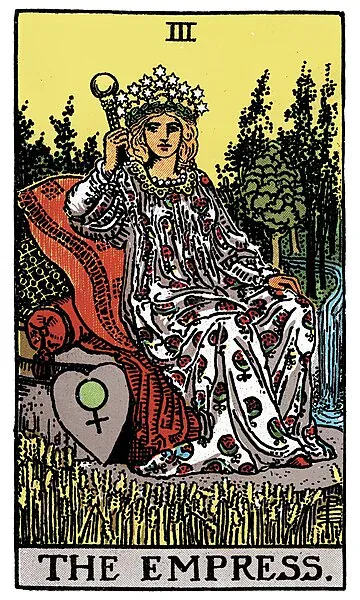
The two parental thrones of the Major Arcana — Empress fertility met by Emperor structure, soft generation given the bones it needs to be inherited rather than dissipated. Together they are the founded household, the established business with both creative output and operational rigor, the relationship that has matured into both warmth and weight. The journey predecessor pair: she bore it, he bounds it.
The Hierophant
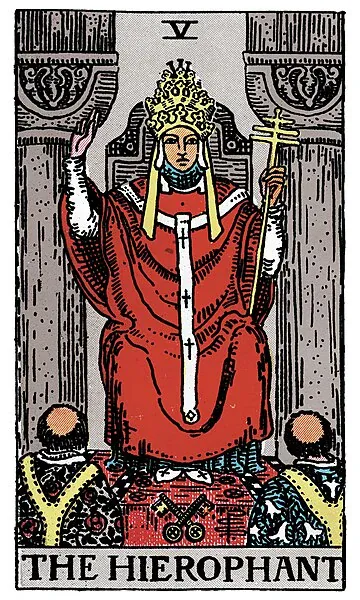
Secular father into spiritual father — the Emperor's civic seat handed across to the Hierophant's traditional seat. The journey successor pair. When they appear together, the seeker is being asked to step into a tradition rather than improvise one — institutional form holding personal authority. Refusing all institutions on principle is sometimes the move; accepting the right one is sometimes the move; the card pair forces the discernment.
The Chariot
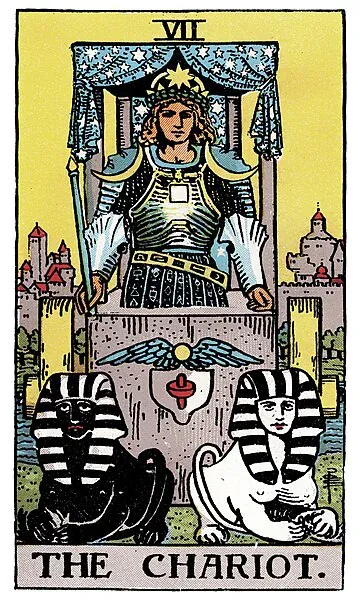
Cardinal modality siblings — both decisive, both willed, both martial in signature. The Emperor is willed stillness, sovereignty held by sitting; The Chariot is willed motion, sovereignty held by the harnessed team and the controlled course. Together they ask which mode the moment requires. Stop and govern what you have won, or harness and move out from the throne — read the spread for which is dominant.
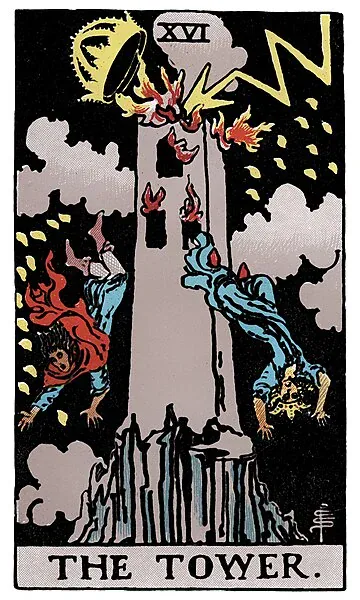
The Tower
Mars meets Mars — when the Emperor's structure has gone brittle past its natural life, the Tower follows. The most cautionary pair in The Emperor's range. The reading is not punishment but physics: a rigid sovereignty that will not bend will be forced to break. Either soften the structure deliberately now, or accept that collapse will do the softening. What is built afterward will have honest give in it.
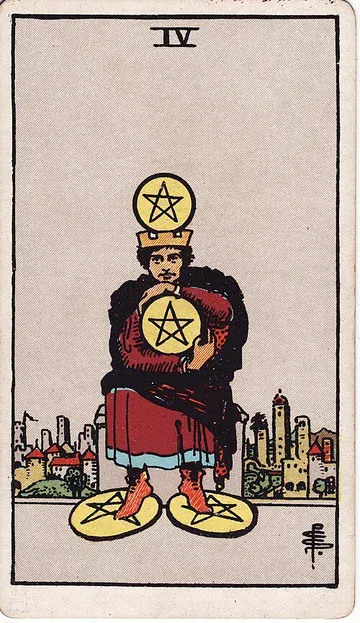
Four of Pentacles
Number sibling pair — 4 in the Major Arcana beside 4 in earth. Tonal contrast: the Emperor's sovereign frame beside the miser's clutched grip. When they appear together, the message is that structural authority has slid into pure holding — the kingdom has become a fortress against rather than a frame for. The card pair asks you to release one grip, loosen one rule, allow one piece of your kingdom to remain ungoverned. The reign that grips everything ceases to govern anything.
Frequently Asked Questions
Why is The Emperor sitting down?
Because the seat is the argument — nothing about him is in a hurry. The Emperor is the fourth card of the Major Arcana, ruled by Mars in Aries and walking Path 15 from Chokmah to Tiphareth. It represents authority, structure, protection, and the willingness to sit in the chair others are circling. The card asks not for force, but for the steady weight of someone who will hold a workable patch of ground long enough for others to build on it.
Does The Emperor mean they want to define the relationship?
Usually yes, and in plain words rather than hints. Upright in love, The Emperor signals structure entering the bond — the season of explicit commitment, defined roles, written agreements, and adulthood brought to the table by both partners. For new sparks it asks whether the relationship has bones yet to hold the romance; for long partnerships it often arrives at moving-in, marriage, or merging-finances thresholds. His love language is provision: the unromantic reliable acts that keep a beloved's life from collapsing at the seams.
Is The Emperor tarot a yes or no card?
Yes — but a structural yes. The Emperor confirms that what you are asking about is possible to build, and that if you build it the way an adult builds, it will hold. The card does not promise overnight outcomes; it promises that well-structured plans survive. Get the agreement in writing, define the timeline, and accept the steady pace at which well-built things arrive.
Why does a card about armour and authority have a spiritual reading at all?
Because his Hebrew letter means window — a hole cut deliberately into a wall. Spiritually, The Emperor walks Path 15 (Chokmah to Tiphareth) and corresponds to Hebrew letter Heh — the window through which form first becomes visible. The card describes the discipline phase of any practice: the season after the early thrills, when the work becomes simply showing up to the cushion or the prayer book. The throne is the chair. The crown is the willingness to sit there even when nothing is happening.
Why is The Emperor associated with Aries and Mars?
Aries is the cardinal fire of beginnings; Mars is its ruling planet and the planet exalted in the sign. The Emperor is the moment when this raw, decisive, willed energy agrees to take a stable shape — fire learning to live inside stone. The first decan of Aries (Mars in Aries, March 21–March 30) is the card's traditional astrological signature, which is why his throne is carved with ram heads and his armor shows beneath the crimson robe.