

The Emperor Reversed · Core Meaning
The Emperor tarot reversed is the seat gone wrong. Like every reversed Major, the card has two opposing faces — and as with The Fool reversed, beneath the opposing faces is the same root problem. In the upright card, sovereignty is the willingness to sit in the chair and act from it with calibrated weight. In the reversed card, the calibration has failed. Either the hand has tightened until the kingdom is ruled by fear, or the chair has been abandoned and the kingdom is ruled by no one, which is to say it is ruled by whoever decides to grab the moment.
The first face: the tyrant. The figure on the throne has fused with the throne. He no longer holds office; office has eaten him. Decisions are made unilaterally, downward, without consultation. Disagreement is read as disloyalty. Protection has slipped into possession; provision has slipped into control. The household, the team, the relationship begins to organize itself around managing his moods rather than around the work. The most painful version of this face is the one in which the tyrant is not even angry, only tired and rigid — running his small kingdom by reflex, no longer remembering why the rules exist, no longer remembering the soft impulses that originally caused him to take the seat in the first place. The crimson robe has stiffened into ceremonial armor. The window has been bricked up.
The second face: the absent father. The figure on the throne is not on the throne. Sometimes literally — he has left, divorced, dropped out, vanished into work, into addiction, into another country, into a second family. Sometimes structurally — he is physically present but emotionally absent, technically holding the title but actually outsourcing every decision the title is supposed to make. The household, the team, the business begins to feel rudderless. People who should have been protected are exposed. People who should have been given clear authority are left guessing. Children, employees, partners begin to either parentify themselves or collapse, depending on temperament. The chair is empty, and the absence at the chair is the loudest fact in the room.
Both faces are common in real readings. The tyrant face appears more often in workplace and family-of-origin spreads, where the seeker is trying to name something about a parent or a boss that they have not yet had language for. The absent face appears more often in romantic spreads, where a partner has technically committed but has not actually arrived in the relationship as an adult. The card asks you to honestly check which face is operating — and then asks you to also check, painfully, whether you yourself have been wearing it in some corner of your own life.
Mars in Aries does not come through the turn unchanged. Mars in Aries upright is decisive, willed, the seat of calibrated initiative. Reversed, Mars in Aries becomes either explosive — anger as the only operational mode — or paralyzed, the fire turned inward and consuming the body of the figure who refuses to act. Aries-as-tyrant rules by impulse; Aries-as-absent has lost contact with impulse altogether. Both are versions of the same problem: the cardinal fire is no longer in proper relationship to the structure it was meant to inhabit.
The Hebrew letter Heh, the window, also inverts. In the tyrant face, the window has been walled over — no light enters, no light leaves, the kingdom is sealed against the outside. In the absent face, there is no wall and therefore no window — only the wide indifference of a world without form. The reversed Emperor asks you to rebuild the window: a wall sturdy enough to define a room, a window honest enough to let the world in.
The reversed card is rarely a final verdict. More often it is a diagnosis: somewhere, sovereignty is malfunctioning. The integration work is not the destruction of authority — that is what well-meaning seekers often mistake the reversed card for. The integration work is the recalibration of the hand. Rule less harshly, or rule more presently. Adjust the grip until the structure can do its actual job, which is to protect what is being built inside it.
The Emperor Reversed · Love & Relationships
The Emperor tarot reversed in love is one of the more complicated cards in the deck because it can describe situations that look opposite but share the same root. On one face, the relationship is being run by an authority that has hardened into control — schedules dictated, finances surveilled, friendships restricted, opinions corrected. On the other face, the relationship is being undermined by an absence — the partner who refuses to commit, refuses to define the relationship, refuses to take any structural responsibility for what is being built. Both faces leave the other person feeling unsafe in the same way. Sovereignty in the bond has gone wrong.
For an existing partnership in the controlling face, The Emperor reversed often arrives when one partner has slipped from protector into manager. The moves usually feel reasonable from the inside: I am only worried about your safety, I am only trying to help with your career, I am only watching the household budget because you are bad with money, I am only restricting that friendship because they are a bad influence on you. Each individual move can be defended. The cumulative effect is a smaller life. The card asks the controlling partner to identify one area where they have been managing their partner's adulthood and to consciously withdraw — not as punishment, but as restoration of the partner's sovereignty. It also asks the partner being managed to recognize that being managed by someone who loves you is still being managed.
For an existing partnership in the absent face, The Emperor reversed describes the partner who has technically committed but has not actually arrived. He attends the events but is mentally elsewhere. He participates in the family but does not lead any part of it. He earns money but contributes no plan. He shows up but does not show up. The card asks for a real conversation, named clearly: I need you to take a seat I have been holding alone. The instruction is concrete because vague conversations about emotional presence are the genre of conversation absent partners are most skilled at deflecting. Name a specific structure: this calendar, this finance, this child, this household decision, this conversation with the in-laws. Take responsibility for one. Then another.
For a new connection, The Emperor reversed warns of the controlling early move. The partner who, three weeks in, has opinions about your wardrobe; the partner who, two months in, is scheduling your week; the partner who, six months in, has somehow become the gatekeeper of your friendships. Early control is a serious signal. Do not gaslight yourself into reading it as devotion. Devotion does not minimize. The card also describes its inverse — the partner who is enthusiastic in private but refuses to be claimed in public, refuses to define the relationship, refuses to integrate his life with yours. Both are sovereignty disorders. Both will not fix themselves through your patience.
For a single seeker, the reversed Emperor asks an uncomfortable question. The card sometimes appears when a seeker has been unconsciously seeking the corrupted authority — the controlling partner, the absent partner, the parental stand-in — because that is the love language they grew up inside. The card is not punishing this; it is naming it. The integration work is to widen the type. Date someone outside the familiar shape for one season. You may find the integrated Emperor feels foreign, even boring, at first. He is not boring. He is calibrated. The boredom is your nervous system asking why nothing is on fire. Let it learn.
For the question of reconciliation after a break, The Emperor reversed warns specifically against returning to the same structure. If the relationship broke because of control, returning will reinstate the control. If it broke because of absence, returning will reinstate the absence. Sovereignty disorders do not heal through emotional intensity, however genuine. They heal through structural change — therapy, separate living for a season, a written agreement about what will be different, a defined probation period during which both parties can withdraw without further negotiation. The card does not forbid reconciliation. It forbids reconciliation without rebuilt structure.
When the question is whether this person loves you, The Emperor reversed splits its answer along two faces, and neither half survives a quick reading. The controlling face says yes, but in a way that wants to consume rather than love. The absent face says they are not yet able to love at the level you are asking for, regardless of how genuine their warm feelings are. In both cases, the answer is not to push harder. It is to pay attention to the specific texture and decide whether what is being offered, as it actually exists, is what you want to spend your one life inside.
The Emperor Reversed · As Feelings
Their feelings are real; their governance of those feelings is what has gone wrong, and The Emperor reversed puts the whole weight of the reading on that second half. Either they have over-claimed you in their interior — they feel you are theirs in a way that has nothing to do with what you have actually consented to — or they have under-claimed you, treating their feelings as a private weather event they have no responsibility to act on. Both are sovereignty failures in the felt register.
If they are reserved by nature, The Emperor reversed in feelings often signals a person who has decided about you privately and is acting on the decision without consulting you. They are organizing their life around you internally — what they buy, what they save toward, what conversations they have with their family — but they are not communicating any of this. You are walking inside a structure they built without your knowledge. The card asks you to surface the unspoken: ask, plainly, what they are picturing. The answer will be illuminating one way or the other. If they have been quietly planning a future with you, that is real information. If they have been quietly assuming a control over you that you did not give them, that is also real information.
If they are demonstrative, the reversed Emperor in feelings often shows as performative authority — the partner who acts publicly like a husband while privately offering nothing of what husbands offer. Big talk about protection, big gestures of provision, big speeches about loyalty — and yet, in the daily small registers where Emperor energy is actually spent, nothing. The bills the wrong way. The follow-through absent. The reliability missing. This is the absent-Emperor face wearing the costume of the present one, which is a particularly painful version because the costume confuses you. Trust the daily registers, not the big speeches. The reliable man does not need to tell you he is reliable.
For a partner you have been with a long time, the reversed Emperor in feelings often signals a kind of fossilization. They love you, in a sense, but the loving has become a fixed shape into which you are expected to fit. They have stopped seeing you as a person who continues to change; they relate to a version of you they decided on in year three of the relationship. The card asks them to update — not to fall in love with someone new, but to fall in love with the actual person you have become. This is hard work and they cannot do it without your cooperation. Show them, in conversation and in action, the parts of you that have changed. Watch which parts they receive and which parts they refuse. The information is valuable.
For a new connection, the reversed Emperor in feelings can describe a person who is moving on you faster than they have processed. They have decided about you, but the deciding has happened in the wrong order — outside of actual knowledge. They have projected an authority onto you, or projected the role of subject onto themselves, before they have the data to support either casting. This is not yet love; it is sovereignty fantasy. Slow it down. Real Emperor-shaped feelings move at the pace of actual familiarity, not at the pace of projection.
For the question of "are they over me" after a break, The Emperor reversed often answers with surprising honesty. The controlling-face partner has not let you go and may be silently surveilling — not because they want you back exactly, but because they cannot tolerate the loss of jurisdiction. The absent-face partner has filed you under "past chapter" and is no longer considering you, regardless of what they say in occasional late-night messages. Read the texture. The first will feel like being watched. The second will feel like being forgotten. Neither is a basis for reconciliation, though the card does not foreclose growth on either side over time.
A small but firm reminder: if you have repeatedly drawn this card asking the same person, the reversal is the message. The card is not waiting for you to ask the question one more time in hope of a different answer. The card has been answering. Listen to the answer.
The Emperor Reversed · Career & Work
The Emperor tarot reversed in career readings describes leadership that has malfunctioned — either at the level of an authority above you, or at the level of authority you yourself are wielding (or refusing to wield) over your own work. The card is rarely subtle; if you draw it in a career spread, the dysfunction is usually already visible to you. The card's job is to validate what you are seeing and ask you to act on it.
For someone working under a difficult boss or executive, the reversed Emperor confirms the diagnosis. You are not imagining it. The leadership above you has tipped into the controlling face — micromanagement, unilateral decisions, fear-based culture, weaponized praise and withdrawal — or into the absent face, where decisions are deferred indefinitely, accountability is delegated downward, and the people supposedly in charge cannot be located when they are needed. Either is exhausting. The card asks you to stop spending energy trying to fix the dysfunction from below. You almost certainly cannot. What you can do is decide how long you are willing to stay inside it. Set a date. Begin the search. The dysfunction will not improve on the timeline you can afford.
For someone being the difficult leader without realizing it, The Emperor reversed is a hard but kind mirror. People who fall into the controlling face often did so because they care intensely and cannot tolerate their team's failures; people who fall into the absent face often did so because they were promoted past their own confidence and have been hiding ever since. Neither origin makes the dysfunction acceptable to the people working under you. The integration is to identify which face you have been wearing and to act, this week, against it. If you have been controlling, delegate one decision genuinely and do not override it. If you have been absent, take one decision back into your own hands and make it cleanly. The team will notice. The recovery is faster than you fear.
For someone considering whether to stay in or leave a job, The Emperor reversed warns of the false binary. Sometimes the issue is not whether to stay or leave; it is whether the role itself has structural problems that no amount of personal effort will fix. A job with no clear authority lines, a job where you are accountable for outcomes you do not control, a job where two senior leaders are at war and you are in the crossfire — these are structural Emperor-reversed problems. They cannot be solved by you working harder or being more diplomatic. The card asks you to identify whether the dysfunction is one you have inherited (in which case you can leave with no shame) or one you have contributed to (in which case leaving does not save you, because the pattern reproduces wherever you go).
For someone considering a new role, the reversed Emperor warns of the prestige trap. The role looks impressive on paper. The title is bigger. The compensation is larger. And — read carefully here — the actual operating conditions are concerning. The previous person in the role left under unclear circumstances. The reporting line is to a famously difficult executive. The team has experienced significant turnover in eighteen months. The card asks you to look past the title at the structural reality of the seat. A bigger chair on top of a wobbly base is not a promotion; it is an exposure.
For founders and entrepreneurs, The Emperor reversed names two specific founder pathologies. The first: the founder who cannot let go, who insists on personally approving every decision, who has built a company structurally incapable of operating without them and is exhausted but cannot diagnose why. The second: the founder who has checked out, who is running the company by vibes and impulse, who has not done the structural work required for the company to scale past a certain size. Both founders need the same intervention: build the org chart, write the operating documents, hire the second-in-command, hold the standing meetings, accept that running a company past a certain stage means transitioning from heroic improvisation to institutional discipline. The Emperor reversed is the warning that this transition has been refused.
For freelancers and creatives, The Emperor reversed often shows the pattern of self-tyranny — the practitioner who has internalized a brutal inner manager, who works themselves into illness, who treats every day as a referendum on their worth. Or its inverse: the practitioner who cannot get themselves to do anything without external pressure, who wakes up each day with no structure and is collapsed by the absence of one. Both are sovereignty disorders, and both heal through the same integration: a real, kind, sustainable structure. Office hours. Defined breaks. A weekly review. A boundary against work outside those hours. The boring scaffolding that lets the work continue for thirty years rather than burn out at three.
For job-seekers, the reversed Emperor warns against the panic posture. The card's failure mode in job search is the loss of sovereignty over the search itself — applying to anything, accepting interviews you do not want, taking offers because the offer was offered rather than because the offer fits. Build the structure of the search. Define what you actually want. Reject what does not fit, even early. The seeker who runs the search like a sovereign finds a sovereign seat. The seeker who runs it like a refugee finds a refugee seat.
The Emperor Reversed · Money
The Emperor tarot reversed in money readings describes a structural problem in your financial life — not a problem of having too little (that is the Five of Pentacles) and not a problem of overspending pleasure (that is the Nine of Cups reversed). It is a problem of governance. Either the money is being ruled too tightly, or the money is being ruled by no one, and in both cases the resulting financial life does not match the life you are actually trying to live.
For someone running their finances with extreme rigidity — every dollar tracked, every purchase justified, every pleasure deferred, every spreadsheet up to date — the reversed Emperor warns of the financial-tyranny face. Money has become the governing logic of every decision rather than a resource that supports the decisions. The card does not ask you to abandon discipline. It asks you to soften one rule. Take the unbudgeted dinner out. Buy the book without first looking at the savings rate. Allow one financial decision per month to be made on the basis of joy rather than spreadsheet. Money disciplines that do not include any joy eventually generate either burnout or rebellion. The rebellion is usually expensive.
For someone running their finances on improvisation — no budget, no tracking, no plan, vague hope, occasional crisis — the reversed Emperor describes the absent-Emperor face. The card asks for the basic governance: open the bank app, look at three months of statements, write down where the money has actually gone, set up one automated transfer to savings on the day after payday. Not as punishment — as sovereignty. The card is not asking for elaborate systems; it is asking for the minimum infrastructure that lets you tell yourself the truth about your own financial life. Most of the resistance to doing this is shame. The card respects the shame and asks you to do it anyway.
For a question about a major purchase or financial decision, The Emperor reversed asks whether the decision is actually yours. People in the reversed-Emperor seat often make financial decisions on behalf of older parental authority — what their family expects, what would make their parents proud, what would prove something to a sibling, what would silence a long-running internal critic. Or they refuse to make decisions that any adult should make, because the absent-father pattern means they have never internalized the right to make them. The card asks you to surface the silent voice and decide whether it is yours. Make the decision from your own seat or postpone the decision until you can.
For investments and speculative moves, the reversed Emperor warns of the two extreme postures. The first: the rigid risk-aversion that keeps so much money in cash savings that inflation slowly devours the real value, while you sleep soundly believing you are being responsible. The second: the chaotic risk-seeking that treats investing as gambling, chasing returns, buying tips, and confusing intensity for strategy. The integration is the same: a real risk profile, written down, defended even when the market is exciting and even when it is terrifying. The Emperor's risk posture is calibrated. Both extremes are uncalibrated.
For someone in financial recovery — coming out of debt, recovering from a costly mistake, rebuilding after a job loss — The Emperor reversed warns specifically against shame-driven austerity. The pattern: a financial mistake triggers self-punishment severe enough to make basic life impossible, which triggers rebellion spending, which triggers more shame, which triggers more austerity. The cycle continues. The card asks you to stop punishing yourself for the original mistake. Treat it as data, not as moral failure. Set a reasonable repayment plan. Allow yourself basic life inside it. Recover at sustainable pace.
For windfall or inherited money, the reversed Emperor warns of the double trap. The first trap: clutching the windfall so tightly that you fail to use it for anything, until inflation or events erode it. The second trap: spending it in a flush of relief without any planning, until it is gone within eighteen months. Both are governance failures. The card asks you to install the temporary structure: park the money for ninety days, hire the right professional advice, then make decisions from a calmed-down state. Most windfall regret originates in the first ninety days.
The Emperor Reversed · Health
In health readings, The Emperor tarot reversed describes a body whose governance has gone wrong. Either it is being ruled too harshly — over-trained, over-restricted, over-monitored, over-disciplined — or it is being ruled by no one, with the chair empty and the body running on autopilot of bad habits. Both are versions of the same problem: the seat that should be governing your physical life is not being properly occupied.
For someone over-managing the body, the reversed Emperor warns of the harm hidden inside discipline. The training program that has become injury. The diet that has become disordered eating. The supplement stack that has become a daily fear ritual. The sleep optimization that has become insomnia from anxiety about sleep. People in this pattern often look extremely healthy on the outside. They are praised by their fitness communities. They are admired for their willpower. Inside, the body is being run by a tyrant, and the body's quiet protest is showing up as injuries, fatigue, hormonal disruptions, joylessness in the very practices that were supposed to produce vitality. The card asks for one act of disobedience this week. Skip a session. Eat the meal you have been avoiding. Sleep without tracking. Watch what your body actually does when the regime relaxes by one notch.
For someone under-managing the body, the reversed Emperor describes the slow-motion crisis. The doctor's appointment two years overdue. The medication not refilled in months. The diagnosis being managed by hope rather than by treatment. The exercise that was supposed to start in the new year and never did. The sleep that has been bad for so long that you have stopped registering how bad. The card asks for one action this week — not a transformation, one action. Make the appointment. Refill the prescription. Walk for ten minutes. The reversed-Emperor body responds to something. The pattern of nothing is what is hurting you.
For someone managing chronic conditions, The Emperor reversed warns of the two failure modes. The first: brittle adherence, where any deviation from the protocol triggers shame and self-flagellation, eventually leading to abandonment of the protocol entirely. The second: chronic non-adherence, where the protocol is treated as advisory and the condition is allowed to progress untreated. Both lead to crises that could have been avoided. The integration is the same: a kind, sustainable, structurally supported relationship with the protocol. Build the reminder system. Schedule the appointments. Do not punish small lapses; do not normalize large ones. Govern the body as a kind sovereign would govern a beloved kingdom.
For acute issues, The Emperor reversed warns of the toughing-it-out impulse, which is the Mars-in-Aries shadow at its most dangerous. The acute condition that gets worse because you would not stop working. The injury that became chronic because you would not rest. The infection that escalated because you would not take the antibiotics for the full course. The card asks you to interrupt the pattern. The body is the kingdom; if the gate has been breached, you must close the gate before you can defend any other line.
For mental health, The Emperor reversed describes structural failures specific to the mental-health register. The therapy attended sporadically, the medication discontinued without consultation, the support system allowed to wither, the basic life-architecture (sleep, food, movement, social contact) abandoned during a depressive episode and not rebuilt during recovery. The card does not ask for heroic effort. It asks for the smallest possible governance: one therapy appointment kept, one medication taken on schedule, one walk, one phone call to a person who knows you. The chair held by even the smallest sovereign is better than no sovereign at all.
For stress-related conditions specifically — the headaches, the jaw clenching, the insomnia, the digestive issues that show up when the head has been holding too much — The Emperor reversed names the source. You have been sitting in a chair too large for any one person to occupy without distributing some of the weight. Whatever you have been carrying alone, identify one piece of it that can be delegated, automated, dropped, or shared. Hire the help. Ask the partner. Drop the responsibility that was never actually yours. The body's symptoms are often the only language it has to ask the chair to be made the right size.
(Resizing the chair is a structural suggestion, not medical advice. Keep your physicians, take your medication, follow the protocol that keeps you alive. The card simply offers a frame: the body needs a sovereign, but it needs a calibrated one.)
The Emperor Reversed · Spirituality
Spiritually, The Emperor tarot reversed describes a sovereignty problem in the inner life. Either an authority external to you has been allowed to govern your spirituality in a way that is no longer serving you, or you have refused to construct any inner structure at all, and your spiritual life has become a chronically unfinished house in which the rain comes through the roof.
For someone embedded in a religious or spiritual tradition that has tipped into the controlling face, the reversed Emperor names what is happening. The community demands more obedience than wisdom. The teacher's word has become unquestionable. Doubt is treated as failure rather than as a normal stage of practice. The cost of leaving has been made socially or psychologically prohibitive. People remain in such structures for years because the structure itself has redefined their sense of what is permitted to be felt. The card does not necessarily say leave — leaving traditions is its own complex act and is not always the right move. But the card does ask you to recover the right to private judgment. You are allowed to disagree internally. You are allowed to question. You are allowed, eventually, to leave if the structure cannot hold honest questioning. The window cannot be permanently bricked over.
For someone whose spirituality has become its own internal tyranny — the rigid practice schedule, the harsh self-judgment when sessions are missed, the spiritual perfectionism that has made the practice into a referendum on personal worth — the reversed Emperor offers a softer instruction. The harshness is not the practice; it is a distortion of it. Most authentic spiritual traditions warn against this exact pattern: the seeker so identified with being a "good practitioner" that the actual subtle work has become impossible. The card asks for one missed session held without shame. One day off the practice. One return to the cushion that begins not with self-examination but with simple greeting.
For someone with no spiritual structure at all — drifting between curiosity and avoidance, sampling but never committing, reading and never practicing — The Emperor reversed describes the absent-father face in the inner life. The card asks for the smallest possible structure. Five minutes daily of one practice, for thirty days. No more, no less. No grand frame, no tradition, no teacher, no community. Just the chair occupied for five minutes, daily. Most resistance to spiritual practice is not theological; it is structural. The chair has not been built. Build a small one. The size will grow if it needs to.
For someone in late-stage spiritual discontent — long-time practitioners who feel the practice has gone hollow, traditions that no longer ring, communities that feel exhausted — the reversed Emperor names the diagnosis without prescribing the cure. Sometimes the discontent is a sign that the structure has become brittle and needs softening. Sometimes the discontent is a sign that the structure has been outgrown and a new structure is being asked for. The card cannot tell you which from a distance. It can ask you to take the discontent seriously rather than performing satisfaction you no longer feel.
For the question of authority in the spiritual life — guru, teacher, lineage, tradition — The Emperor reversed warns equally against the tyrannical lineage and the credulously self-elected one. The teacher who treats students as personal property is dangerous. The seeker who declares themselves teacher because no human teacher has been willing to formally authorize them is also dangerous. The card asks for honest discernment. Real spiritual authority is calibrated, accountable, and ultimately self-effacing — it points past itself toward the work the student must do. Authority that is none of these things is sovereignty malfunctioning, regardless of how impressive its credentials.
For practice, the reversed Emperor returns you to the simplest possible structure. Choose one short practice — a breath count, a single prayer, a five-minute sit, a body scan, a journaling prompt — and commit to it for two weeks. Two weeks. Not forever. Hold the chair only that long. Notice what happens. The integration of the reversed Emperor in spiritual life is almost always small: a window installed in a wall that had been blank, a doorframe added to a room that had been wide-open, a sovereign restored to a kingdom that had been ruled by either tyranny or chaos.
The Emperor Reversed · Yes or No
Wait — or a yes whose structure needs rebuilding before it is safe to act on.
The Emperor tarot reversed yes or no is rarely a clean no. It is more often the answer that the action you are considering is not in itself wrong, but the structural conditions around the action are misaligned, and proceeding now will produce a result that does not hold. The Emperor upright says yes to well-built futures. The Emperor reversed says wait until you have done the building.
For yes-or-no questions about a relationship, a job, a move, or a decision: the action is likely possible, but your current circumstances carry one of two specific structural problems. Either an authority above you (a parent, a boss, a partner, a tradition, an unspoken expectation) has been making this decision with you in a way that has compromised your sovereignty over it — and the resulting choice is partly theirs, not yours. Or you have been refusing to take real authority over the choice, hoping circumstances or other people will decide for you, and the resulting drift is producing a decision that does not feel like one. In both cases the card asks for sovereignty restoration before action.
For questions about whether someone is being honest, whether an offer is genuine, whether a plan will hold, the reversed Emperor warns of the unwritten arrangement. What is being offered may be sincere in the offering moment. It is also unrecorded, unstructured, unverifiable, dependent on the goodwill of someone whose goodwill might shift. The card asks for the document. The contract. The clear written understanding. If your counterparty resists writing it down, that resistance is itself the answer to your question.
On timing, The Emperor reversed says the timeline is being controlled by something other than you. Either an external authority is dragging it (the bureaucracy, the slow boss, the family that is still deliberating, the institution that has its own pace) or your own avoidance is dragging it (the application not submitted, the conversation not initiated, the threshold not crossed). The card asks you to identify which. If the delay is external, accept the pace and stop spending energy fighting it; structure your life around the wait. If the delay is internal, the answer to "will it happen soon" depends entirely on whether you are willing to take the chair and act.
For binary decisions, The Emperor reversed asks you to first identify whether you have actually defined the choice. People often present themselves with two options that are not the real options. The real choice is sometimes a third path that has been quietly excluded by family pressure, identity attachment, or fear. The card asks for one week of honest examination before the binary is accepted as binary. Often, in that week, the real choice surfaces and the original two options stop looking like the right frame.
The single hidden hint in the reversed yes-no: if you have repeatedly drawn this card on the same question, the answer the card is giving is not "ask again." The answer is "the structure of the asking is the problem." You are asking from a sovereignty deficit — too much external authority, too little internal authority, or both — and no answer the card gives will land cleanly until the structure of the asking shifts. Stop asking. Build the chair from which the question can be asked properly. Then ask once.
And if the worthiness question survives the reversal? The reversed Emperor answers: deservingness is not the question — it never has been. The real question is whether you are willing to take the chair this thing requires. If yes, it is yours to claim. If you are still waiting for permission from a seat outside yourself, the answer the card gives is to first build the seat inside.
The Emperor Reversed · Advice
The Emperor tarot reversed advice is to recalibrate the hand before you reach for the sceptre again. The card does not ask you to drop authority. It asks you to repair your relationship to it. If you have been ruling too tightly, soften one grip. If you have been ruling too loosely, restore one structure. If you have been governed by an external authority that has tipped into harm, recover the right to your own seat. The integration is always the same: sovereignty calibrated, neither tyrannical nor absent.
If there is one specific instruction the reversed card gives, it is to identify the chair you have been wearing wrong and adjust it this week. Not next month. This week. People in the reversed-Emperor seat often have a small concrete adjustment they have been avoiding for years — the conversation they have not had, the apology they have not made, the boundary they have not held, the responsibility they have not taken, the dictate they have not softened. Pick one. Just one. Make the conversation. Make the apology. Hold the boundary. Take the responsibility. Soften the dictate. The recovery from the reversed Emperor begins almost always with one specific act, not with a wholesale transformation.
A second instruction: locate the unconsulted authority in your life. Most people in the reversed-Emperor pattern are being silently governed by a voice or expectation they have never directly examined — a parent's unspoken standard, an institution's unwritten rule, an old wound's permanent verdict, a culture's default. The voice runs your decisions while pretending not to. Sit down with paper and pen and write: in this current question, the pressure I feel is coming from where? Be specific. Be honest. The voice almost always has a name and a face. Once it is named, you can decide whether to keep listening to it. Many people, having identified the voice, choose to stop. The card respects either decision; it only asks for the surfacing.
A third instruction: if you have been in the absent-Emperor seat, take one structural action this week that an adult in your position would take. Not a heroic one. A normal one. Make the doctor's appointment. File the tax extension. Schedule the difficult conversation. Pay the bill before the late fee. Sign the paperwork. Send the email you have been postponing for three weeks. The reversed-Emperor recovery is almost entirely small acts of presence, repeated until the absence stops being your default register.
A fourth instruction, gentler than the others: forgive yourself for the chair so far. Most adults have at some point either ruled too harshly or vacated the seat entirely. Most parents, partners, bosses, sovereign-of-their-own-life have made one of these errors at scale. The reversed Emperor is not a permanent verdict on your character. It is a recoverable position. The integration is the recovery, and the recovery requires that you stop using shame about the original error as the reason you cannot do the recalibration now.
A fifth instruction: practice firm kindness against yourself. The same calibration the upright Emperor asks you to bring to others applies inward. The harsh inner critic who has been ruling your interior for years is a tyrant, and you have been the kingdom under that tyranny. The absence of any inner standards at all is also a sovereignty failure, and you have been the abandoned kingdom under that absence. Build the calibrated inner sovereign. Speak to yourself the way an integrated Emperor speaks to a beloved subject — firmly, kindly, with weight, with patience, without performance.
Practical landing actions for the day this card appears: take one document, paperwork, or piece of administrative debt that has been sitting for over two weeks and either close it or delegate it. Have one direct conversation you have been having indirectly via avoidance, hints, or third parties. Set one boundary in plain words rather than in ambiguous behavior. Make one decision that has been waiting, even imperfectly. The reversed Emperor recovers through the same currency the upright Emperor inhabits: the unglamorous concrete acts of an adult sitting in a chair.
The sixth and most important instruction: stop waiting for the original authority to relinquish the seat for you. The card is, at its deepest level, about taking the chair before it has been formally offered. The parent will not necessarily release the right to govern your life. The institution will not necessarily acknowledge that its authority over you has expired. The old wound will not necessarily concede that it no longer applies. You take your own seat, and the taking is the legitimacy. There is no other ceremony.
The Emperor Reversed · Card Combinations
The Emperor Reversed + The Tower
The most direct cautionary pairing in the reversed Emperor's range. Both cards carry Mars's signature — Mars in Aries for the Emperor, Mars as falling structure for the Tower. When this pair appears together, a rigid sovereignty has been holding a structure together past its natural life, and the structure is about to fail dramatically. This is not punishment; it is physics. The card pair asks you to identify the brittle structure now and either soften it deliberately or accept that the Tower will arrive to do the softening through collapse. What comes after either route will be more honest. The faster route, painfully, is the deliberate softening before the Tower has to arrive.
The Emperor Reversed + The Hierophant Reversed
Two reversed authority figures — secular and spiritual — drawn together. This pair almost always describes a moment when both the institutional structures (work, family, civic) and the inner authority structures (belief, tradition, conscience) have lost their proper calibration in the seeker's life. The reading is rarely about external authorities going wrong simultaneously; more often, it is about the seeker's own relationship to authority going wrong on both fronts. The integration is to rebuild on a smaller scale: one external structure governed properly, one interior structure restored honestly. The simultaneous recovery on both fronts is the work of years; the start is one act on each side this month.
The Emperor Reversed + Five of Wands
Sovereignty failure inside conflict. Five of Wands is the chaotic five-way struggle without clear rules; the reversed Emperor is authority that has either tyrannized or vacated. Together they describe a workplace, family, or relationship in which the absence (or distortion) of legitimate authority has turned ordinary differences into chronic warfare. The instruction is structural rather than emotional. The conflict will not resolve through better feelings. It resolves through better governance — clear roles, written rules, a real decision-maker with calibrated authority, accountability for everyone in the conflict. If you can install the structure, you can dissolve the war. If you cannot, walk.
The Emperor Reversed + Eight of Swords
The cage and the absent jailer. Eight of Swords is the figure bound, blindfolded, surrounded by swords — but with the bonds loose enough to step out of and an unblocked path forward. When the reversed Emperor sits beside it, the card is naming the source of the cage: an authority figure (often a parent, partner, or institutional figure, sometimes an internalized voice) has convinced the seeker they cannot leave. The bonds are imaginary. The cage was built by a sovereignty that had no actual right to bind you. The card pair is, at its deepest, a permission slip — you can step out. The blindfold can be removed. The swords were always props.
The Emperor Reversed + Four of Pentacles Reversed
Doubled four energy, both reversed. The Emperor's structural fourness combined with the Four of Pentacles' clutched sovereignty over material goods, both inverted. The card pair describes a season in which authority and possession have both lost their calibration — either you are clutching too tightly while the structures around you erode, or you are letting go too loosely while clutch was actually appropriate. Read the rest of the spread to determine which. The integration is to bring both the seat and the hand back into relationship: govern what you actually own, release what you have been over-managing, and stop confusing possession with sovereignty.
Card Combinations

The Empress
The two parental thrones of the Major Arcana — Empress fertility met by Emperor structure, soft generation given the bones it needs to be inherited rather than dissipated. Together they are the founded household, the established business with both creative output and operational rigor, the relationship that has matured into both warmth and weight. The journey predecessor pair: she bore it, he bounds it.
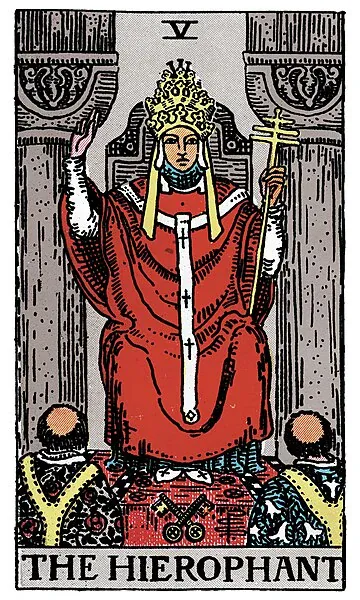
The Hierophant
Secular father into spiritual father — the Emperor's civic seat handed across to the Hierophant's traditional seat. The journey successor pair. When they appear together, the seeker is being asked to step into a tradition rather than improvise one — institutional form holding personal authority. Refusing all institutions on principle is sometimes the move; accepting the right one is sometimes the move; the card pair forces the discernment.

The Chariot
Cardinal modality siblings — both decisive, both willed, both martial in signature. The Emperor is willed stillness, sovereignty held by sitting; The Chariot is willed motion, sovereignty held by the harnessed team and the controlled course. Together they ask which mode the moment requires. Stop and govern what you have won, or harness and move out from the throne — read the spread for which is dominant.
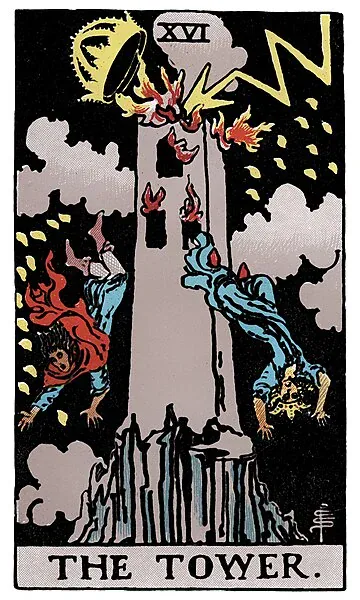
The Tower
Mars meets Mars — when the Emperor's structure has gone brittle past its natural life, the Tower follows. The most cautionary pair in The Emperor's range. The reading is not punishment but physics: a rigid sovereignty that will not bend will be forced to break. Either soften the structure deliberately now, or accept that collapse will do the softening. What is built afterward will have honest give in it.
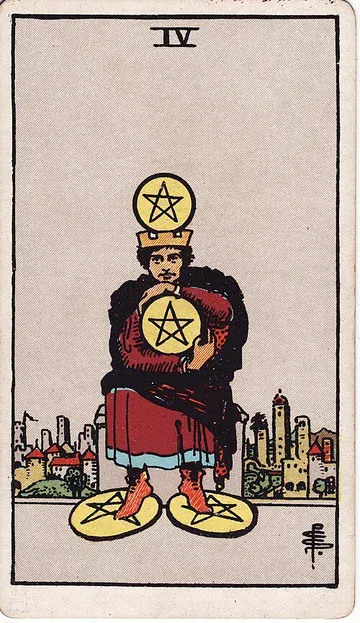
Four of Pentacles
Number sibling pair — 4 in the Major Arcana beside 4 in earth. Tonal contrast: the Emperor's sovereign frame beside the miser's clutched grip. When they appear together, the message is that structural authority has slid into pure holding — the kingdom has become a fortress against rather than a frame for. The card pair asks you to release one grip, loosen one rule, allow one piece of your kingdom to remain ungoverned. The reign that grips everything ceases to govern anything.
Frequently Asked Questions
Is The Emperor reversed the tyrant, or the empty chair?
Those are exactly its two faces: the tyrant who has fused with the seat and rules through control, or the absent figure who has vacated the chair entirely, leaving a household, team, or life rudderless. Beneath both is the same problem: sovereignty has lost its calibration. The card asks you to identify which face is operating in your life and to recalibrate the hand — soften the grip, or restore the structure — rather than abandon authority altogether.
Is the trouble in this relationship too much control, or no structure at all?
Reversed in love, The Emperor describes structural dysfunction of either kind — either control that has hardened into management of a partner's life, or absence in which the seat of adulthood has been left empty and one partner is carrying a structure alone. New connections show as either premature controlling moves or refusal to be claimed in public. The card asks for a real conversation that names the specific structural piece needing repair — finance, household, schedule, family, child — rather than a vague conversation about feelings.
Is The Emperor tarot reversed a yes or no?
Rarely a clean no — more often a wait. The action you are considering is not necessarily wrong, but the structural conditions around it are misaligned, and proceeding now will produce a result that does not hold. The Emperor reversed often appears when an external authority is silently controlling the decision or when the seeker is refusing to take real authority over their own choice. Restore your sovereignty over the question first, then ask once.
Am I the one who has hardened, or the one who left the chair empty?
Sovereignty malfunction takes both shapes. Either authority that has tipped into tyranny — micromanagement, emotional rigidity, control of money, schedule, friendships, identity — or sovereignty that has gone absent, leaving an empty seat that exposes whoever depended on it. The card warns equally against the rigid structure that has stopped serving its function and the chaotic absence that pretends to be freedom. Calibration, not abandonment, is the integration the card asks for.
How do I take the chair back after the ruling has gone wrong?
Recalibrate the hand before you reach for the sceptre again. Identify whether you have been ruling too tightly or vacating the seat — and adjust by one notch this week. Locate the unconsulted authority in your life (parent, institution, old wound, internalized voice) and decide whether you still consent to be governed by it. Take one small structural action that an adult in your position would take. Forgive yourself for the chair so far. Stop waiting for the original authority to formally release the seat — take it.