
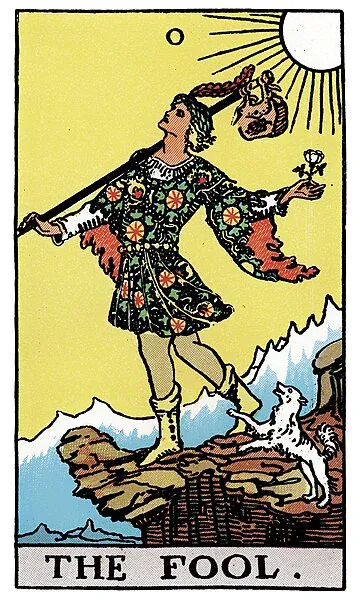
The Fool · Core Meaning
The Fool is the first card of the Major Arcana — but to call it "first" already misreads what it does. Numbered 0, it sits outside the sequence, not before it. The deck does not begin with The Fool. The deck passes through The Fool, the way a body passes through a doorway, the way a question passes through a question mark. Every other Major card is something becoming someone. The Fool is the moment before naming, the second before the world has placed an edge under your feet.
Look at the Rider-Waite-Smith image carefully and what's strange becomes obvious. A youth in fine vestments stands at the brink of a precipice somewhere among the great heights of the world. He does not look down. He looks outward, toward the blue expanse of sky beyond the cliff. A white rose rests lightly in one hand. In the other, a costly wand bearing an embroidered wallet — the bag of seeds from past lives, the things he carries that he does not yet know he carries. The sun rises behind him. A small white dog bounds at his heel. A laurel wreath sits on his brow already; a red feather rises from it. The wind that comes up from the valley below lifts his hair. In the next second he could leap, or he could turn and walk back along the ridge. In this second, he has not decided. And the not-deciding is the card.
This is the signature tension. The unsigned soul has met the first edge. The world is asking him to confirm who he is. He is choosing not to answer — not because he is hiding, but because he knows that any name given before the leap will be erased by the leap itself. The white rose is opened for exactly this restraint: desire shed of red, wanting refined into the act of wanting itself, no longer aimed at possession. The dog is the instinct beneath that restraint, jumping, warning, encouraging, but never deciding for him. The precipice is the seam between the known and the leap. What's below isn't in the picture.
The traditional astrological signature reinforces this: Air, Uranus, Hebrew letter Aleph (א — mother letter, ox, the primal breath). On the Tree of Life, The Fool walks Path 11, from Kether to Chokmah — the bolt that strikes between Crown and Wisdom, the moment where the One has not yet split into Two. This is not the card of the adventurer; it is the card of the source. Read it as "encouraging risk-taking" and you have shrunk it to a self-help platitude. Read it as "naive" and you have missed it entirely. The Fool's innocence is not ignorance. It is the unity that exists before "I" and "you," "inside" and "outside," "should" and "should not" have separated themselves out from a single field.
Two details in the picture are easy to skip and worth the time. The sun at his back is not rising for him; it has already risen, and it lights the road he came down, not the sky he faces. Whatever he has been — the past lives folded into the embroidered wallet — is behind him and fully lit; what is ahead is not dark, only unlit, which is a different thing. And the mountains: white, distant, enormous, and asking nothing of him yet. Later cards set the seeker on those slopes. Here they are scenery. A reading that rests on this card is often describing exactly that proportion — the difficulty is real, it is visible, and it is not today's difficulty. The white rose is held lightly. So, for now, is the mountain.
Two objects in the picture argue with each other, and the argument is worth following. The wand on his shoulder is costly — slender, carved, the staff of someone who was not born with nothing — and from it hangs an embroidered wallet, small enough to hold almost nothing, stitched carefully enough to have been made by someone who loved him. He is not fleeing poverty. He is leaving a place that had a name for him. And on his brow, before a single step has been taken, a laurel wreath sits already, with a red feather standing out of it like a pilot flame nobody has spent yet. Nothing has been earned and the crown is in place. Held together, those two facts say something exact about the seeker this card lands on: you are not starting from zero resources. You are starting from zero record — and that is the only kind of zero The Fool has ever meant.
To read The Fool is to read the face of someone about to do something they have never done before. In that pause — fear, exhilaration, the quiet rehearsal that has happened a thousand times in private, the small smile of "alright then" — is the meaning of the card for that reading. The picture itself is neutral. The cliff edge only asks what kind of step you are about to take off it.
The Fool · Love & Relationships
The Fool tarot in love is the card of beginnings — but more precisely, the card of the dawn light before the relationship has agreed to call itself a relationship. It does not describe maturity, commitment, or the long fruit of a bond. It describes the hour the first glance lands, the morning a name keeps quietly returning to the inside of your thoughts, the early walk where you both pretend you are not noticing each other notice each other. In love, this card is permission to let beginning be beginning.
For a new spark, The Fool says: do not rush to give it shape. The fastest way to ruin a new connection is not betrayal, distance, or misunderstanding — it is forcing language onto something that has not yet earned it. "Are we dating," "do you see a future with me," "is this serious" — these questions are reasonable in their own season, and lethal in the wrong one. The Fool asks you to delay them. Let the meeting itself have a breathing rhythm. Let the new road show itself by being walked, not by being mapped.
For an established partnership, the upright Fool is a tender summons back to first sight. Not back to the historical past — back to the gaze that made the first months feel strange and important. The most reliable way long love starves is not betrayal or argument; it is two people deciding too soon that they have already met each other, and quietly stopping the work of looking. The Fool asks you to let your partner become unfamiliar to you again. Ask one question you assume you already know the answer to. Then actually listen. The answer that comes back may rearrange what you thought you knew.
For a single seeker asking whether love is possible, the answer is yes — but not in the shape you have written down. The Fool refuses fixed scripts. It does not bring people who match the imagined "ideal type." It brings people who can make you feel surprised again. If you have been filtering hard — by height, by industry, by family background, by some private calculus you've half-stopped admitting to — this card gently suggests folding that list and putting it in a drawer. Try meeting one person while not consulting it. Love at the threshold of The Fool begins as "I never thought it would be someone like this."
Someone opening a dating app at forty-eight, after twenty years of marriage that ended, is looking at the white rose whether they know it or not. The rose is a passion flower with the red drained out of it — not desire extinguished, desire unaimed. That is the accurate description of where you are, and it is not a deficiency. You are not a beginner, and yet the entire grammar has changed: how people write, what a first meeting is understood to mean, how fast anyone expects an answer. The card's counsel runs against the advice everyone around you is giving, which is to decide what you want this time. You do not have to decide. Meet three people with no filter except curiosity, tell the truth about the length of your life without apologizing for it, and let the early months be genuinely early months. The embroidered wallet holds what you already lived. It travels with you. It is not on display.
For someone in recovery from a wound, The Fool means the door you swore was closed has begun to open without your permission. You don't have to charge through it. You only have to not block it. Your work right now is not to find the next person; it's to allow the next person to appear from an angle you did not anticipate. The Fool is allergic to "I have decided to find someone." It cooperates with "I have started being curious about the world again."
A friendship that has started to hesitate is this card's home ground. You have known them for years. Lately there is a half-second before you answer their messages, and you have begun choosing which photograph to send. The fear is specific and entirely reasonable: saying it out loud risks the thing that already works. The Fool does not order you to confess. It points out that the two of you are standing at an edge already, and that the pretense of flat ground has begun to cost more than the truth would. Try the smallest available move instead of the speech — one evening arranged on purpose rather than by accident. Then watch whether they arrange the next one. This card's method with a friendship is never the announcement. It is a slight, deliberate change in the weather that either of you could still walk back from, and that neither of you does.
If the question is whether someone is in love with you and The Fool arrives upright, read it carefully. They are curious about you. Not yet decided, not yet given up — they are holding you as an open question. They are looking at you the way you look at a path you might take. This is rarer and more valuable than it feels. Don't try to force a verdict. Curiosity is a real form of caring. It needs space, not interrogation.
A note on this card's particular love language: The Fool loves by leaving an unfinished edge. It does not require you to explain yourself. It does not demand the long roadmap of "what we will be." What it offers, instead, is "we are both still on the way, so I won't rush you either." That ease looks light, but its weight is precisely in the lightness — they are not binding you with promises, because they are trusting you to stay on your own.
Two people who want the same thing on different clocks — one ready to move in, the other still finishing something — get an unusual verdict from The Fool. It declines to call the gap incompatibility. It reads it as one road with two walkers at different points along it, and it cares about direction rather than position. So ask the question that actually separates the two cases: is the slower one moving, or standing still and calling it slowness? Someone on the way produces movement you did not ask for — a plan mentioned in passing, a small door left visibly open, a date said out loud. Someone who is not produces reassurance instead of movement. The card is patient with the first and quietly unsentimental about the second.
If your relationship has just survived a major rupture and you're asking whether you can begin again, The Fool says yes — but not by returning to the past. From today, both of you re-walk the early meeting. You're older. You know which paths not to take. But the starting line has to be drawn fresh.
The Fool · As Feelings
The traveler holds the white rose loosely, the way a person holds something they have not yet decided to keep — and with The Fool, that loose grip is the whole answer: this person is opening the question of you. Not closing it in either direction. They have not filed you under "in love." They have not filed you under "not interested." You are, to them, an unfinished thought that they keep returning to without quite admitting that they are returning to it. This state is uncomfortable. It is also rare and worth honoring.
This is "I haven't worked it out, but I haven't stopped trying to" — and that combination, in adult emotional life, is precious. They have interest in you. That part is real. The interest has not yet hardened into desire, has not yet crossed into commitment, has not made the leap from caring to wanting. If you press them for a verdict — "are you into me, yes or no" — their honest answer will be "I'm still feeling it out," and that answer is often misread as evasion or stalling. With The Fool, it is unusually truthful. They are refusing to give you a clean answer they don't yet possess.
If they're reserved by nature, The Fool in their feelings often shows up as "there is a softness in the air when they are around you." They don't seek you out aggressively. But when you're present, their shoulders drop a little. They won't tell you this directly. You'll have to read the atmosphere between you, not the literal sentences. Silence here is not distance. It's "I haven't been able to put this down internally yet."
If they're outwardly expressive, The Fool's feelings often show as "they get younger around you." They start telling you stories they don't tell other people — the childhood thing, the half-formed ambition, the small private hobby they usually hide. This is one of the most reliable signals of Fool-shaped affection: they are willing to be less polished in front of you. Take that as serious affection. Sweet talk can be cheap. Letting their guard down is not.
Someone who has been badly hurt before feels toward you in pulses when this card describes them. Three warm days, then a flat one. A long voice message, then two short replies. That rhythm is easy to file as game-playing; with The Fool it almost never is. Each warm stretch is them stepping out onto the ledge, and each flat one is them checking whether the ground held their weight. Read the trend across a month instead of the temperature of a given Tuesday. If the warm stretches are getting slowly longer, you already have your answer — it simply is not being delivered in sentences.
For a long partner, The Fool in their feelings means they are seeing you again. Not that they hadn't been looking — that the looking had become habit, and lately some specific small thing about you has interrupted the habit. Maybe a recent practice you started, an unusual reaction, a face you make in the morning. They are quietly, in small increments, rediscovering who you've become. Don't startle this. Don't ask "why are you looking at me like that." Let it grow.
For a new connection, The Fool's feelings often mean they are treating you as "uncategorized." They haven't decided whether you're a friend, a potential romance, a new kind of collaborator, or something not yet defined. This makes some people anxious; for The Fool, it isn't yet the problem. It's the openness still being open. What you need is patience, not interrogation.
Where the contact is mostly typed — a thread across time zones, a colleague in another city, someone you met once and have been writing to ever since — The Fool's feeling shows up in the length of the messages rather than their content. They write more than the exchange requires. They answer a logistical question and then attach a paragraph about their afternoon that nobody asked for. That surplus is the whole signal. What a person feels lives in the part of a message that had no reason to be there.
Where the person you're asking about is someone you already left, or who left you, The Fool describes a feeling with no folder to go in. They have not refiled you as a partner and have not completed the move to past tense either. You surface in their week unannounced — a street, a song, a stranger's coat at a distance. This is not the same as wanting you back, and reading it as that has cost people whole seasons. It is the sun in the picture: it lights the road behind him with great clarity, and he is still facing the other way.
A small caution embedded in this beautiful state: The Fool's "still deciding" is fragile. It's sensitive to outside pressure — one careless comment from a friend, family disapproval, an awkward social-media comparison can snap that undecided door shut. If this person needs protection right now, give it. Not control — space. Mute the noise of the outside world a little. Let the soft, undecided light between you have room to breathe.
Read The Fool in feelings as "uncertain but real." Uncertain doesn't mean false. In this deck's language, the love that is most certain in the end is the love that began in honest uncertainty. Every Ten of Cups starts as a Fool.
The Fool · Career & Work
Numbered zero, The Fool is the only card in the deck that occupies no rung on any ladder — which is precisely why it turns up when the question is work. You are standing at the entrance to a path you have not walked, with the familiar position behind you and an open landscape ahead whose terrain is not yet legible. It is not the card of small adjustments. It is the card of beginnings, of thresholds, of the first day of something whose name you do not yet know.
If you're asking whether to stay in your current role, The Fool's answer is implicit: you have already left in your interior. It does not say "quit immediately." It says the inner pressure has shifted toward the door. Ask yourself again — what is making you hesitate is not this job, but the fact that you don't know what comes next. The Fool will not solve that not-knowing for you. It only insists: not-knowing is not a reason to stay still. Many people use "I haven't figured out my next step" as permanent rationale for inaction. The Fool reframes the equation: "having figured it out" was never the precondition for departure. Walking is.
If you're considering a new role, The Fool gives a tender but unmistakable green light — with a single footnote. The new role will not reveal its full character in the first week. Expect to spend the first three months oscillating between "this is the right call" and "what have I done." That oscillation is not a sign you chose wrong. It is the standard atmosphere of any genuinely new chair. Make a decision in advance to remove the first three months from the "did I make the right call" tribunal. Just be there. You earn the right to evaluate it in month four.
For founders, freelancers, and anyone starting an independent project, The Fool is among the deck's most generous opening cards. Its reading is precise: your greatest asset is what you don't yet know. You haven't internalized the industry's "we don't do that" and "everyone tried that and failed." That ignorance will let you attempt things experienced operators wouldn't dare. It will, of course, also lead to mistakes that veterans will wince at. The Fool asks you to remember those mistakes are part of the entrance fee. The newcomer's eye is the rarest resource any field has.
Coming back to work after a long absence — years of caregiving, a period of illness, a stretch at home with small children — puts you exactly where the youth stands, and the card is unusually kind about it. The panic in that return is always the same sentence: everyone else kept moving and I did not. The Fool contests the premise. What was accumulating in those years was not a gap; it was the embroidered wallet, which is small, unglamorous, and full of seeds. Triage under pressure. Reading a room in four seconds. Doing work that nobody measured and finishing it anyway. Write the years into the record rather than around them, apply to one role slightly above what the absence makes you feel entitled to, and let the interview be the first walk down a road you had stopped believing existed.
Being handed something with no precedent inside a large organization — a new function, a team nobody has run before, a market the company has never sold into — is the specific career shape this card takes when it lands on a person mid-career. There is no playbook, no predecessor to ask, no way to be measurably right for a while. The Fool reframes that vacancy as the actual job. The first three months will consist of making decisions with a quarter of the information you would normally require, and the discipline that matters is writing down why you made each one. Not for your defense. For your own instruction. The white dog runs ahead into terrain nobody mapped, and it barks at real things.
For a creative practice, The Fool describes the pressure when the next work has not taken form yet. You've just finished one, or you're realizing the last one wasn't actually finished. Something new is knocking at the back of your skull but doesn't have shape. This card asks you not to rush it onto the page. Let it float. The floating period is the period in which it is growing flesh. Sit down to "finalize" too early and what you finalize is the unripe version.
For someone job-searching, The Fool is "stop looking with the old map." If you've sent forty applications and gotten no response, this card doesn't mean fix your resume — it means search in places you haven't been considering. Industries adjacent to yours. Companies you'd dismissed. Cities you'd ruled out. Employment structures you hadn't entertained. The Fool tends to show up when "what you assumed was outside your scope" was, in fact, where the opportunity was waiting.
For someone weighing leaving everything to study, retrain, move countries, restart entirely — The Fool arrives weighted. It will not decide for you. But it asks one specific question: you fear "what if I take this step and it goes wrong" — but should you also fear "what if I never take this step, and twenty years from now I have to live with that"? The Fool measures being alive, not success or failure.
For workplace authority, The Fool warns against rising too fast. If a senior position is reaching for you and a quiet voice inside says "I'm not quite ready," listen to that voice. Not by refusing — but by entering with continued openness rather than performed certainty. Fool-shaped leadership is the leadership that lets itself keep learning.
The Fool · Money & Finances
In money readings, The Fool upright shows resources still in motion — your money, your financial structure, your payment rhythm are all in a "not fully formed" state. This is not a problem. It means in the coming season, your finances behave less like a static balance and more like a flow.
For someone considering a new outlay — startup capital, a course enrollment, a bold trip — The Fool leans toward yes. But it asks you to distinguish two kinds of yes. First: the considered yes — you've looked at the numbers, you know what the next three months look like after the money leaves. Second: the impulsive yes — you've been pushed forward by a sense of newness and haven't actually examined the ground. The Fool blesses the first. It warns against the second. It is not anti-spending; it is anti-absent-spending.
For someone in a tight period, The Fool gives unusual counsel: stop contracting further. When life is already lean, most financial advice says "cut more." The Fool reverses it. Your tightness, in part, is because you've shrunk your world too small. You haven't eaten out, bought a book, allowed any "unnecessary" expense in a month. That over-contraction is itself producing scarcity — and scarcity, once felt, suppresses your courage to earn more. Keep one small "ease" in your life even in the lean stretch. Not extravagance — permission to live in a world slightly larger than your account suggests.
For an investment or speculative move, The Fool's answer is hedged. It does not bet hard the way the Two of Wands does, nor counsel pure observation the way the Hermit does. It says: if you make this move, it teaches you things you would not otherwise have learned. You may also lose part of what you put in. If that loss is bearable, the action has educational value. If it isn't, step back. The Fool never asks you to go all-in. It asks you to be present.
For an unexpected windfall — a small bonus, a refund, a surprise gift — The Fool asks you to slow your processing. Let that money sit in your account an extra week. Don't immediately allocate it. Held in "unnamed" form, it may, by the third day, reveal where it actually wants to go — somewhere different from your first impulse.
Two people sharing one ledger get a distinct reading from The Fool. Almost always, one of you is the cliff and the other is the rope — one wants to take the trip, start the thing, put money into a possibility; the other cannot sleep until the buffer is restored. The usual mistake is treating this as a fight over a number, when it is a difference in how each of you experiences risk in the body. Sit down and each name the figure at which you personally stop being able to sleep. Say it out loud. The figures will differ by a factor nobody expected, and once they are on the table the argument turns into arithmetic instead of character. The Fool's household money works when one person's leap has the other person's measured rope attached, by agreement rather than by ambush.
Pricing your own work is the one place this card contradicts its own lightness. Sending a first invoice, naming a day rate, quoting a project — The Fool's failure mode is not greed; it is the apology built into the number. You lower it before anyone has objected, because charging fully feels like claiming a record you have not earned. Look at the laurel already on the brow of the youth in the picture. The crown precedes the victory in this image, deliberately. Quote the figure you would quote on behalf of a friend with your exact résumé, then say nothing after saying it. The silence on the other end is not disapproval. It is someone doing their own arithmetic.
For long-term financial structure, The Fool challenges a quiet assumption: the "stability" you think you need may be larger than what you actually need. Many people accumulate safety cushions far in excess of real risk, and miss the window when they could have spent on themselves more boldly. The Fool isn't anti-savings. It asks: in the picture of your life that those savings are buying — is there a life you'd actually want to be living? If not, the picture has to be redrawn.
The Fool · Health
In health readings, The Fool upright is the card of a body returning to its own rhythm. It doesn't describe full recovery (that's the Sun), nor a turning of disease (that's Death). It describes the state of "the body speaking before the schedule does" — your body telling you what it wants today, and you, for once, willing to listen without consulting your calendar.
For someone living inside planned eating, planned exercise, planned sleep, The Fool suggests an actual rest day for the body. Not indulgence — delegation. Let the body decide the rhythm for one day. If it wants to sleep until it wakes, sleep. If it wants rice and not salad, rice. If it doesn't want the gym, walk. Use one day of "no plan" to recalibrate long-term over-planning. The Fool's air-element, sanguine temperament heals through soft breath, not through punching the clock.
For someone managing chronic conditions, The Fool's appearance suggests the relationship between you and your body is being re-established. The last months or years have framed it as "I manage this thing / it gives me trouble." Recently something has shifted you toward seeing it as "we are collaborating." Cultivate that. Spend five minutes daily, without judgment, simply feeling some part of the body. What is the stomach saying today? Is the shoulder loose or tight? Is the breath shallow or deep? Don't interpret. Just listen.
For acute issues — colds, sprains, sudden discomforts — The Fool generally bodes well. The body's recovery capacity is intact. Cooperate with conventional medicine, but during recovery let the body exercise its native repair function: sleep heals a great deal, water heals a great deal, simple food heals a great deal. Don't pile ten supplements onto a mild acute period — over-intervention can actually delay healing.
A restless body, unable to settle, is the classic complaint of this card's element. Air and a sanguine temperament produce a particular kind of tiredness: the mind quick, the attention scattered across eleven open tabs, sleep light and easily interrupted, a jaw that has been clenched since a meeting that ended on Tuesday. Nothing here is illness. It is an airy system running without ballast. What such a body asks for is weight rather than more stimulation — food that has to be chewed, a hot shower long enough to get boring, a walk at dawn outdoors rather than a session on a screen at midnight. Spring, east, first light: the card's own coordinates are the prescription, and they are free.
For mental health questions, The Fool is the card of a slackening. The string that has been pulled tight inside you has, recently, found a small slack. You're no longer doing the constant interior self-audit you used to. Old loops that you used to spiral inside have lately stopped feeling so sticky. This is healing finding its own legs. Don't break it with "I should be recovered faster" or "why did it come back briefly." The healing curve is naturally uneven. Let yourself have off-days.
For the body as spiritual vessel — and remember, this card is bound to Air and to Aleph, the primal breath — The Fool invites you to renew acquaintance with breathing itself. Once a day, do one thing only: exhale, inhale. Not a complex meditation technique. Just the acknowledgment that you are alive because you are breathing. Aleph is one of the deck's least complicated gifts. It is right there, every minute.
(The Fool's invitation to notice the breath is not medical advice. The card describes a state of body-mind relationship, not a diagnosis. Keep your physicians, take your medication, do your follow-ups. The card simply offers a gentle reminder — the body is not your management subject. It is the home you live in.)
The Fool · Spirituality
Spiritually, The Fool is the entrance to the Major Arcana — and, more accurately, the deck's actual spiritual threshold. Numbered 0, it is not the zeroth element of the sequence; it is the card outside sequence. To walk the full Major from 0 through 21 is to walk a soul from the unsigned to the consummated. Every time you draw The Fool, the path is being offered to begin again.
It governs Air — the most invisible and least pinnable of the elements. Air moves through a room; you cannot grasp it, but you feel it pass. The Fool's spirituality is exactly that "uncatchable but undeniably here" quality. If your recent practice has slid into anxiety about "am I doing this correctly" or "am I making progress," the card asks you to release the grip. Spirituality is not a project that admits scoring. It is a room you are either inside or outside. The act of grading "how far along am I" has, by definition, already stepped you out of the room.
It corresponds to Aleph (א) — mother letter, ox, primal breath. In Hebrew mystical tradition, mother letters carry a unique status: they correspond to the three originating breaths that exist before the differentiated created world. Aleph is the first inhalation of all of it. To draw The Fool is to be invited back to the place "before all specific beliefs, before specific methods, before specific teachers." Not to abandon them — to return to the root they came from. What you believe in: what is it before it had a name? Before it had a teaching? Before it had a ritual? That before-state is exactly what Aleph is pointing at.
On the Tree of Life, The Fool walks Path 11, from Kether to Chokmah — the bolt before unity has divided into Wisdom. This path is traditionally called the "Scintillating Intelligence" — the lightning before it has entered its first form. If your practice has been stuck in "I know too much, none of it lands in my body anymore" exhaustion, the card asks you to return to "not knowing." Let the accumulated concepts drift away for a season. Sit inside the openness of "I haven't figured anything out yet."
Suppose you have never done any of this. No tradition, no teacher, no practice, and a private suspicion that people who sit in silence know something you were not issued. The Fool is the card that disqualifies the entrance exam. Aleph is a mother letter — it precedes every method that was ever built on top of it, which means no method is the door. Parsifal, one of the faces behind this card, is remembered for asking the obvious question that all the trained knights were too well-bred to ask. Start there. Ask the plain thing you have been embarrassed to ask, of nobody in particular, and sit with it for as long as it takes to become boring. Ignorance is not the obstacle in this card's world. It is the qualification.
For someone reconsidering their spiritual direction, The Fool means a "spiritual restart" — not converting to a new tradition, but re-examining everything you've defaulted to and asking whether it is actually yours. This is a hard process. People around you may read it as a crisis. The Fool tells you it isn't. It is the necessary purity before the lightning enters its first form.
For practice, The Fool asks something extremely simple: choose five to ten minutes a day to walk out of the house with no goal. Not exercise-walking, not meditation-walking, not a specific practice — just "leave, and come back." Let the feet lead. Let the mind follow. Let the wind cross your face. Let the small white dog — the untrained instinct in the body — decide whether to turn left or right today. This practice, simple to the point of barely qualifying as practice, is the card's actual gift.
The Fool · Yes or No
Yes — but a conditional yes.
The Fool tarot yes or no is one of the deck's most experimental kinds of yes. It is not the firm "this will happen" of clarity cards. It is not the hidden no of warning cards. It says: you should go, but please do not make "this will turn out well" your reason for going. The Fool does not promise angels will catch you. It promises that the leap itself is how this path comes into being. If you do not leap, the card does not exist; once you have leapt, whatever happens next is inside the card's range, and there is no such thing as "a failed Fool."
For yes-or-no questions about a relationship, a job, a move, or a decision: yes. The path is worth walking. But shift your attention from "will this work out" to "the act itself." The Fool does not guarantee outcomes — it asks you to release the demand for guarantees in advance. The angels in the picture are not in the picture. Faith in their existence is not the same as proof of it.
For questions about whether someone is being honest, whether an offer is real, whether an invitation is worth accepting, The Fool leans toward yes — without certifying quality. It will get you to the door; what happens past the door is your read of the new light. Read this card as "go look," not as "this is verified perfect."
For timing — "will this happen soon?" — The Fool leans fast, but the speed is the speed of suddenness, not of cumulative momentum. It does not stretch fire across your field of vision the way the Wands do; it arrives like a gust. What seemed far this week may be at your door next week. Don't expect it linearly. Stay in the posture of "ready to be opened."
For binary choices — should I take Offer A or Offer B, should I be with X or Y, should I jump now or wait for the next wave — The Fool prefers the option you have not fully convinced yourself of. The option you've talked yourself into is usually a continuation of the known. The option that still feels unconvinced is usually the new road. The Fool does not reward the safest choice.
"Should I say it out loud?" is a yes in this card's hands, with one adjustment: say it as information rather than as a demand. The Fool is comfortable with an unanswered sentence. Tell them what is true — that you have feelings, that the arrangement is not working, that you want the role — and then do not stand there waiting to be given something in return. The youth on the cliff is not asking the sky for a guarantee before he speaks to it. A statement placed into the air and left there has more force than the same statement attached to an ultimatum, and it costs you less to survive.
The single caution in the yes is to hear why. This is not a "go forward at all costs" card; it is a "step forward with awareness" card. If the action you're about to take is what you would do by inertia anyway, The Fool quietly suggests reconsidering. If the action you're about to take is one you'd never normally do — one that requires real courage — then this card backs you fully.
Sometimes a yes-or-no is a worthiness question wearing a schedule. The Fool answers: deservingness isn't the question. The door is open.
The Fool · Advice
The Fool's advice is to take the step, then let the road show itself. The hardest part is not the stepping — it is the first hours after stepping, when the part of your mind addicted to mapping the route in advance begins to protest, to demand retreat, to use "maybe I should reconsider" to drag you back to the safety of the ridge. The card asks you, during those protests, to choose not to retreat. Let your feet take the weight.
If there is one specific instruction, it is this: today, do one thing you've filed under "next month." It doesn't have to be enormous. Send the message you've been planning to send. Open the book you said you'd read and read the first page. Walk into the café you've been meaning to try. The Fool doesn't teach grand gestures. It teaches the conversion of "later" into "today."
A second instruction: shorten your "criteria list." The list inside your head about what your future partner should look like, what your next role should provide, what your next chapter should include — it has been quietly filtering out things that could be entering your life. Fold it. Put it in a drawer. Spend a month looking at the world without consulting it. Things you'd previously filtered out will become visible.
A third instruction: allow yourself to be temporarily un-skilled at something. The Fool's chief enemy is the tightness of "I'm a competent adult; I must always look like I know what I'm doing." Take up something — drawing, poetry, dance, a new instrument, an unfamiliar class — and exist there as a beginner for a stretch. Ungainly. Embarrassed. Possibly bad. Awkwardness is one of this card's most important gifts.
A fourth instruction, gentler than the others: give the body more vote than the mind on a few recent decisions. The mind has been roughly tied on the choices you're weighing. Try this: which option lets your shoulders drop slightly? Which option makes mornings feel less heavy? Which option, when you imagine choosing it, has your body answer "this one" before your mind weighs in? The body knows earlier than the mind. The white dog at your heel is exactly the body's instinct for the answer.
Practical landing actions, pick one for today: stand at an open window for three minutes doing nothing — just looking far. Send one person a "how are you" that doesn't ask about anything specific. Take off your shoes and walk barefoot across the floor once. Write one sentence in a notebook that you haven't dared to write — and then don't show it to anyone. These actions are small to the point of seeming trivial. They are how this card actually operates. The Fool doesn't teach you to do big things. It teaches you to reconnect with the present.
Put a date on it and give the date to one person. Not a plan, not a strategy — a date, said aloud to somebody who will remember it. The thing you have been circling for months lives entirely in the conditional until a calendar accepts it, and the conditional is the most comfortable room in the house. Pick the date this evening, choose a witness who is fond of you and slightly merciless, and send them one sentence naming the day. What changes is not your motivation. What changes is that the day arrives regardless of how you feel about it, and arriving regardless is what a road does.
The fifth, and most important, instruction: stop trying to be "ready" before you begin. "Ready" doesn't exist in The Fool's world. Nobody is ever a hundred percent ready — and the result of waiting for full readiness is a lifetime spent on the ridge. Move "ready" out of your dictionary, into the file of "concepts you no longer need to wait for." Then step.
The Fool · Card Combinations
The Fool + The World
The two ends of the sequence meeting on the same surface — 0 and 21, departure and consummation, leaving and returning. This pairing usually appears when a major cycle is closing while a new one is opening. A move, a graduation, the end of a long project, an identity change. It tells you: what you think is ending is actually one door closing while another opens. Allow these two things to happen at once. Don't rush to file the World as "the past" or The Fool as "the future." In this moment, they are two ends of the same beam of light.
The Fool + The Magician
The 0 → 1 sequence — unsigned potential meeting its first specific form. The thing you want to do has just met its tools. The Fool brings the pure impulse; the Magician brings the table on which the impulse becomes action. When this pair shows, look around — the tools, contacts, and skills you need are mostly already in place. You only haven't admitted it. Admit it. Then take one specific small action that connects The Fool's impulse to the Magician's surface.
The Fool + The Hanged Man
In Hebrew tradition, Aleph and Mem are two of the three mother letters — air and water, the breath and the descent. When this pairing appears, "step forward" and "stop and look inward" are revealed as two faces of the same act. The Hanged Man asks you to halt and reverse your gaze; The Fool asks you to stop looking and just leap. If both arrive together, the message is usually: a leap of the body is needed, but immediately after the leap, sit in stillness and reflect. Move first, still second. This rhythm has more force than the more-common "think first, act second."
The Fool + The Devil
The most cautionary pairing. The Fool's pure leap beside the Devil's bondage means the leap you're about to take might be one some hidden chain is pushing you into. You think you are choosing freely; in fact some unseen dependency, addiction, or social pressure is pressing the "jump" key for you. Before you leap, ask yourself: is this jump growing from my own root, or is it being pushed out of me by fear, vanity, or someone else's gaze? If it is the latter, postpone. Solve the chain first. Then the same jump, with completely different meaning, becomes available.
The Fool + The Hermit
Two kinds of not-knowing, facing opposite directions. The Hermit carries a lamp and lights one step at a time; The Fool carries a rose and lights nothing. Drawn together, the pair is usually telling you that you have been using study as a substitute for departure — another course, another book, another conversation with someone who has done it. Keep the lamp. Stop reading by it. The instruction the two cards produce jointly is narrow and practical: take the single next step the lamp already shows, tonight, before the light gets any better than it currently is.
The Fool + Death
Zero beside thirteen — the origin and the threshold that takes things away. This pair shows up when a departure is not optional: a role ending, a city you are leaving whether or not you agreed, a version of yourself that has stopped fitting. Death does the removing; The Fool decides what the removal is for. Read together, they say the ending is not a punishment and not a loss of direction, but the clearing of the one road you kept declining to walk. Do not decorate the leaving. Take the wallet, leave the furniture.
The Fool + Ace of Wands
Air meets fire — a single bolt of lightning igniting a torch. The deck's purest opening combination. Inner potential has found its specific form to burn in. This pair shows up in the first week of a venture, the first sparks of a new relationship, the first month after relocating, the morning a creative project finally puts ink on the page. The instruction is simple: stay with the fire, but don't try to plan it. It knows where it wants to burn. Your only job is not to step on it and not to put it into a too-small container too early. Let it burn for a while. Watch how it shapes itself.
Card Combinations
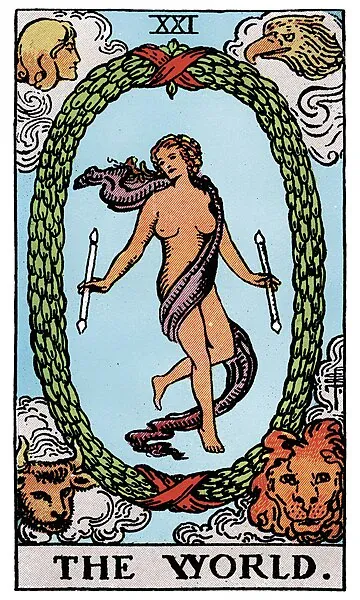
The World
The two ends of the sequence on the same surface — 0 and 21, departure and consummation, leaving and returning. A major cycle is closing while a new one is opening. Don't rush to file the World as 'past' or The Fool as 'future' — in this moment they are two ends of the same beam of light.
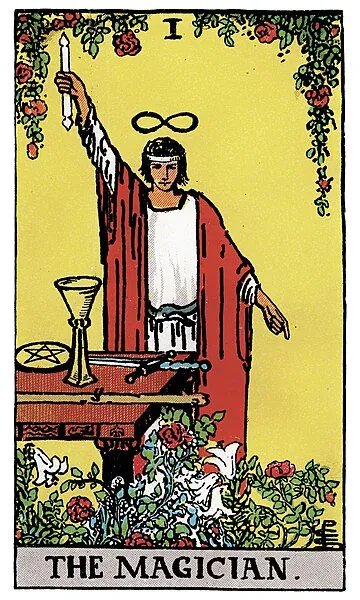
The Magician
The 0 → 1 sequence — unsigned potential meeting its first specific form. The thing you want to do has just met its tools. The tools, contacts, and skills you need are mostly already in place. Admit it. Then take one specific small action that connects The Fool's impulse to the Magician's table.
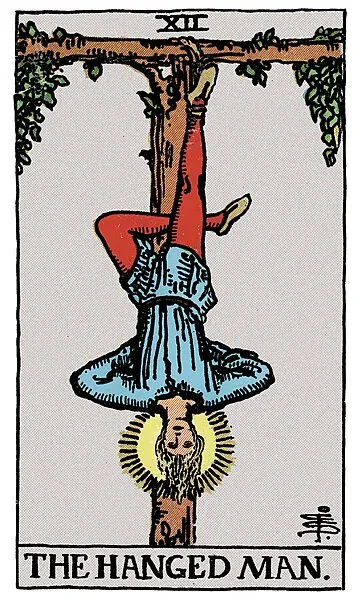
The Hanged Man
Aleph and Mem — two of the three Hebrew mother letters, air and water, breath and descent. 'Step forward' and 'stop and look inward' revealed as two faces of the same act. A leap of the body is needed; immediately after the leap, sit in stillness. Move first, still second — more force than 'think first, act second.'
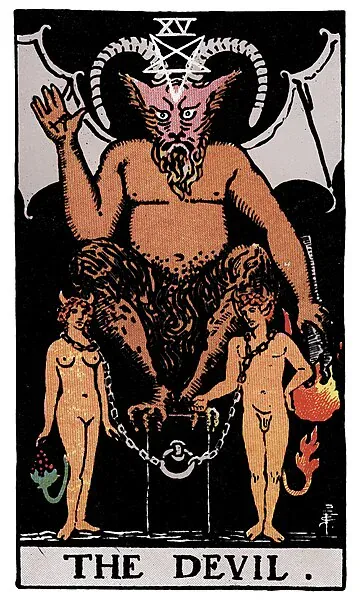
The Devil
The most cautionary pairing. The pure leap beside the Devil's bondage means the leap may be one some hidden chain is pushing you into. Before you leap, ask: is this jump growing from my own root, or is it being pushed by fear, vanity, or someone else's gaze? If the latter, postpone — solve the chain first.
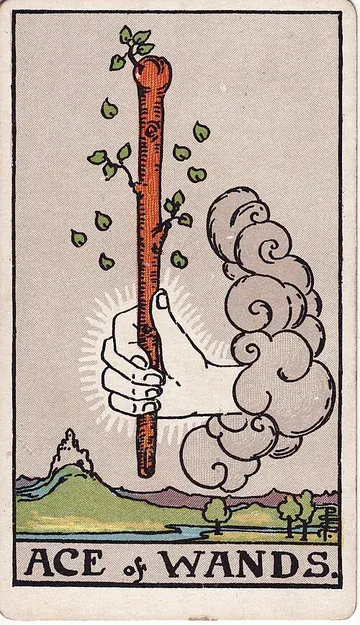
Ace of Wands
Air meets fire — a single bolt of lightning igniting a torch. The deck's purest opening combination. Inner potential has found its specific form to burn in. Stay with the fire, but don't try to plan it. It knows where it wants to burn. Your only job is not to step on it and not to put it into a too-small container.
Frequently Asked Questions
Is The Fool about the leap, or about the moment before it?
Mostly the moment before, which is why the figure is still on the cliff and not in the air. The Fool is the first card of the Major Arcana, numbered 0. It represents the threshold of the soul's journey — pure potential, trust, and the willingness to leap before the path has shown itself. Bound to Air, Uranus, and the Hebrew letter Aleph (the primal breath), it asks you to step into what is calling, and to let the road reveal itself in motion rather than mapping it in advance.
Why is The Fool numbered 0?
Because 0 is neither first nor last — it is the card outside sequence, the one that exists before counting begins. To walk the Majors from 0 to 21 is to walk a soul from "unsigned" to "consummated," and 0 is the second before that walk starts. It is space, potential, the lightning before it has entered its first form. Many traditions place The Fool either at the beginning or the end of the deck — both work, because it is, by nature, on either side of the sequence at once.
Does The Fool mean the relationship is not serious?
It means the relationship has not been named yet, which is a different thing. Upright, The Fool in love is the card of beginnings — the dawn light before a relationship has agreed to call itself one. It asks you to delay naming, let the meeting have its own breathing rhythm, and let the road appear by being walked. For new sparks, it confirms the right person is arriving but not in the shape you wrote down. For long partners, it asks you to let your partner become unfamiliar to you again. For singles, it suggests folding the criteria list into a drawer for a month.
Does The Fool mean the risk I am weighing is safe to take?
It means something narrower than safe. Upright, it is a conditional yes. The path is worth walking — but the card does not certify outcomes. It guarantees that the leap itself is how this path comes into being. If your action is one you'd take by inertia anyway, the card quietly suggests reconsidering; if your action requires real courage, the card backs you fully. Treat it as "go, with awareness," not as "this will end well."
What does Aleph, The Fool's Hebrew letter, add to the card?
Aleph is the primal breath — the letter with no sound of its own, the exhalation that precedes speech. The Fool corresponds to Air, Uranus, the Hebrew mother-letter Aleph (primal breath), and Path 11 on the Tree of Life — Kether to Chokmah, the bolt before unity has divided into Wisdom. Spiritually, it asks you to return to the place before specific beliefs, methods, or teachers — to the root those things came from. The practice it most consistently asks for is simple: walk out of the house with no goal for ten minutes, and let the body lead.