The Hanged Man · Core Meaning
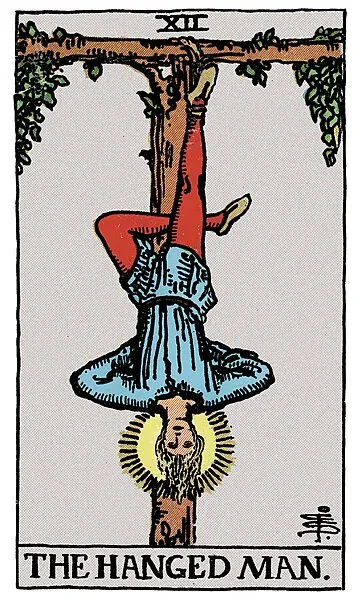
The Hanged Man is the twelfth card of the Major Arcana — and the card the deck reserves for the moment you cannot move forward and have not yet agreed to stop. A young man hangs upside-down from a tau-cross of living wood, fresh leaves still on it. His right ankle is bound by a rope; his left leg crosses behind the right to make an inverted figure-4. His hands are clasped behind his back. Around his head, a quiet golden halo. His face is not in pain. It is the face of someone seeing the road they walked, this once, from below.
Look at the image carefully and the strangest detail is the wood. The tau is not dead lumber. It is alive, still leafing — the gallows that holds him is in the act of becoming a tree. He is not punished by the structure. He is being held by something still growing. This single visual fact reframes the whole card. Suspension here is not arrest. It is gestation. The body has been hung up so the tree, and the seer in the tree, can finish becoming what they are turning into.
His right ankle is bound by a rope someone else tied — but the willingness is written not in the rope but in the unstruggling. He has not kicked free. The hands behind the back say what the hands have to do is, for now, nothing — what must be done is not in the hands. The inverted figure-4 is the number of stability turned the other way: stability is not lost in the inversion, only re-oriented. The golden halo is not a performance of holiness; it is the by-product of blood reversing direction within the head and consciousness being polished by the change. The calm face is the face of the looker, not the endurer. He is not waiting it out. He is reading.
The card's signature tension is forward motion arrested by willing pause. Not the Tower's collapse, not the Death card's ending — those are involuntary. The Hanged Man is voluntary. Something in the seeker has agreed to be hung up before life forced the issue. The world wants more doing; he has answered with not-doing, and inside the not-doing a different organ of perception has woken. He cannot chase the answer; he has to let the answer come up from the roots.
The astrological signature anchors all of this. The Hanged Man corresponds to the Hebrew letter Mem (מ) — one of the three mother letters of the alphabet, whose name and shape carry the meaning water. Not stream water; mother liquid, the original solvent, the womb-water in which forms first take shape. On the Tree of Life he walks Path 23, running between Geburah (Severity, the sephirah of cutting and judgment) and Hod (Glory, the sephirah of intellect and form). Path 23 carries the residue of the verdict downward into the place where the verdict can be understood. The Hanged Man is the seeker after Justice has fallen — force is withdrawn, the scale is set down, and what remains is not more striving but the patience to be hung up between two truths and let the next form rise out of the water.
The four mythic figures the card sits inside reinforce this. Odin hung nine nights upon the world-tree Yggdrasil, pierced by his own spear, fasting, until the runes — the alphabet of meaning itself — rose up to meet him. Peter, in apocryphal tradition, asked to be crucified inverted, refusing equivalence with his teacher's death and choosing the upside-down posture as the only one fit for him. Mahākāśyapa, of the Buddhist lineage, kept the austere practices the Buddha had set aside, holding the difficult position long enough for his disciples to understand what discipline meant. Zhuangzi dreamt he was a butterfly, woke, and could no longer say with certainty whether he was the man dreaming the butterfly or the butterfly dreaming the man. One inversion, and reality no longer has only a single orientation. The Hanged Man is everyone who has consented to that inversion.
Read the Hanged Man as the photograph of a person between two postures. The old posture has run out; the new one has not yet arrived; he is letting the in-between be the work. Whatever lives in that suspension — relief, terror, the quieting of a long argument, the surfacing of an old idea — is the meaning of the card for that reading. He is not stuck. He is steeping. The tree around him is alive, and he is borrowing its time.
The Hanged Man · Love & Relationships
In love readings, The Hanged Man is the card of the relationship that has stopped moving forward and has not collapsed — and the seeker who has been asked, gently or not so gently, to change the angle from which they are looking. This is not a card of breakup, even when it appears in stark spreads. It is a card of suspension. Whatever the relationship has been chasing — the next milestone, the resolution of the long argument, the partner's promised change, your own decision — is being held in mid-air. The hanging is not the punishment. The hanging is the work.
For a long-term partnership, The Hanged Man often arrives during the season the bond has stopped evolving in the direction either of you assumed it would. The conversations that used to lead somewhere now circle. The plans that used to feel exciting now feel obligatory. Nothing is wrong, exactly — the relationship is well-fed, the routines are stable, both of you would describe yourselves as committed. And yet there is a strange stillness, as though something old is finishing without anything new yet announcing itself. The card asks you not to fix this immediately. Hang for a season. Let the angle do its work. The most reliable way long love stales is not betrayal or distance; it is two partners who refused to let a fallow stretch be fallow and rushed to overwrite it with activity. The fallow stretch was the field re-fertilizing.
For someone in a new relationship, The Hanged Man can describe the moment you realize the other person is not exactly what you first thought. Not worse — different. The story you were telling yourself about who they were, who you would be together, where this would go, has paused. You are now seeing them more accurately, and accuracy is heavier than fantasy. The card asks you not to leap to a verdict. Let the inversion finish. Often, what looks like disappointment in the first weeks of seeing someone clearly is, on the other side, the actual beginning of being able to love them. The fantasy was a relationship with no one in it. The pause is making room for the real person to enter.
For a single seeker asking whether love is possible, The Hanged Man does not say no — but it does ask you to stop searching for a season. The card describes the seeker who has been on dating apps for a long time, sending good messages to reasonable people, going on dates that go fine, and not arriving anywhere. The card's instruction is counterintuitive: stop. Not forever, not as resignation — for a clear interval, perhaps a season. Delete the apps for three months. Stop asking friends to set you up. Stop running the inner audit of "am I doing enough." Hang. What surfaces, hung up, is what you were actually wanting underneath the searching. Often the searching has been so loud that the real wish has not had room to surface. From the inverted position, the wish becomes legible.
For someone in love after a wound, The Hanged Man is the card of the long fallow. The grief has done its initial work. The acute pain has subsided. And now you are in the strange middle stretch — you can imagine being open again, but you are not actively pursuing it; you can imagine staying alone, but you have not committed to it. This middle is uncomfortable because nothing is clear. The card validates the middle. It tells you: the middle is the work. You are reorienting your relationship to your own wanting from below, and that reorientation cannot be hurried. Let the middle have the months it needs. Forcing yourself back into the dating market in this stretch produces relationships that re-injure rather than heal.
For the question of whether someone is in love with you and The Hanged Man arrives upright, the answer is layered. They are thinking about you in a way they have not yet acted on. They have taken the question of you off the daily list and moved it somewhere quieter — not abandoned, suspended. They are letting the question of who you are to them mature on its own terms, without forcing a verdict. This can feel from your side like coldness or distance. Read it more carefully. Real silences in relationships are often the silences of someone who has stopped performing and started reflecting. They will speak when the reflection has clarified. Do not interpret their pause as your rejection.
A note on the card's particular love language: The Hanged Man loves by not insisting. It does not demand the relationship move at a given pace. It does not use love as leverage to make a partner change. It does not weaponize patience as silent ultimatum. Its patience is real patience — the willingness to let the other person become who they are in their own time, and to become who you are in yours, while staying in the same room. This love feels strange at first to anyone raised on more dramatic models — its quietness can be mistaken for absence. It is the opposite. The Hanged Man's love is the love that does not need to be performed daily to be present.
For a relationship that has reached a hard impasse — the unresolvable argument, the incompatible vision, the difference of values that is not budging — The Hanged Man asks you to invert the angle of looking at the impasse before you decide whether to leave or stay. The argument is not the problem; the way both of you are looking at the argument is. Both of you are upright; both of you are seeing only one orientation of the disagreement. One of you needs to hang for a season — to stop arguing, stop defending, stop scoring points — and look at the same disagreement from below. Often, hung up, the structure of the disagreement reveals itself to be carrying something neither of you has named. That naming, when it surfaces, is what unlocks the impasse. The verdict from upright was wrong. The verdict from inverted is the one the relationship has been waiting for.
For "is this person right for me," The Hanged Man flips the question. It does not answer "yes" or "no" — it asks "what would the answer be if you were not afraid of being alone?" The fear of being alone is one of the most common upright postures from which we look at a partner; the inverted view shows the partner stripped of that fear's distortion. From hanging, ask the same question again. The honest answer that comes back is the answer the card was always pointing toward.
The Hanged Man · As Feelings
They have not moved toward you and they have not moved away, and under The Hanged Man that stillness is a posture rather than a verdict — the feeling itself is suspended. Not over you. Not committed to you. Hung up between two possible postures toward you, and unwilling to leap to either one prematurely. This is one of the most easily misread states in modern dating, where speed is read as interest and slowness as rejection. With The Hanged Man, slowness is the work of the feeling, not the absence of it.
The defining quality of these feelings is willing pause. They are not stalling because they cannot decide; they are pausing because they sense that any decision made from the upright posture would be the wrong decision. They have agreed, somewhere in themselves, to hold the question of you in suspension long enough for the truer answer to surface from below. From outside this looks like ambiguity. From inside it is unusually adult — most people, faced with not knowing how they feel, force a conclusion to escape the discomfort. This person has chosen to stay inside the not-knowing.
If they are reserved by nature, The Hanged Man in their feelings often shows up as a long internal silence in which you keep returning. They are not telling you about the silence. They are not telling anyone. But a small portion of every day, sometimes more, has you in it — not as fantasy or rehearsal, but as a question they keep turning. They are not waiting to feel certain. They are waiting to feel honest. When the honesty arrives, they will speak. Until then, the silence itself is the form their attention takes.
If they are demonstrative, The Hanged Man's signature is more disorienting — they are warm with you, present, attentive, and yet there is a layer of reserve that you cannot quite name. Not cold; not hidden; suspended. They are letting themselves enjoy the time with you without pre-committing to what the time means. This can feel painful if you are someone who reads sustained warmth as a sign of impending commitment. With this card, the warmth is real and the commitment is not yet on the timeline. Their feelings are steeping. Asking them to skip the steeping ruins the steeping.
For a partner you have been with a long time, The Hanged Man in their feelings is one of the more nuanced readings. It often means they are quietly reconsidering the shape of the relationship — not whether to leave, but what to ask for next, what to release, how to be with you in a way that fits who they have become. They have not announced this reconsideration. They may not have words for it yet. The card asks you not to interrogate. Let them think. The reconsideration is generally protective of the relationship, not threatening to it; what comes out of it, when it comes, will be a more honest version of their care.
For a new connection, The Hanged Man in feelings means they are unsure — and they are honoring the unsureness rather than papering over it with a false verdict. They have not filed you under "interested" or "uninterested." They are letting the question stay open. This is rare in adult dating, where the pressure to declare oneself is enormous, and most people respond to ambiguity by performing certainty in either direction. This person is refusing the performance. Read it as respect, not evasion. They are taking you seriously enough not to lie to you.
For an ex or a long-paused relationship, The Hanged Man in their feelings often means they are looking back at the relationship from below — seeing what they could not see when they were inside it. The story they were telling themselves about you, about the breakup, about who was at fault, has paused. They are letting the inverted view do its work. They may not contact you. They may not ever contact you. But the way they are holding you in their interior has shifted from indictment to question. If contact does come, it will arrive after this work has finished, and it will sound different from anything they said before.
A small caution embedded in the card's feeling-shape: The Hanged Man's suspension can become a refuge from action. Some people use the inverted posture to avoid taking the steps the relationship needs. They tell themselves they are reflecting; they are actually hiding. If their suspension has gone on for many months without any visible movement — no honest conversation, no actual change in pattern, no clarification — the card has begun slipping toward reversed. Hung-on-purpose is different from hung-out-of-fear, and only honest self-inquiry tells which is which.
Read The Hanged Man in feelings as "deciding to not yet decide, on purpose, with respect for the question." That phrase is awkward and that awkwardness is precise — there is no single English word for what this person is doing. They are giving the feeling time to ripen. They are refusing to pluck it green. Whatever decision eventually arrives will be more durable than the fast decisions that surrounded it.
The Hanged Man · Career & Work
The rope holds one ankle and the hands are clasped out of use behind the back: that is the working position The Hanged Man describes, a project, role, or whole career that has reached the point where forward motion is no longer the right answer. Not failure, not collapse — the moment the seeker has been pushing in one direction long enough that the direction itself has stopped being legible, and the wisest move is to stop pushing and let the inverted view do the next piece of work. This is unusually counterintuitive in professional life, where stopping is read as defeat. The card insists otherwise. The pause is part of the project.
For an ongoing project that has stalled, The Hanged Man asks: what would the project look like if you stopped trying to finish it for a stretch? Not abandoned; suspended. Often when a project stalls, the stall is the project's way of asking you to revisit the original premise. Maybe the deliverable you committed to is not the deliverable the work actually wants to produce. Maybe the timeline you built around it was always wrong. Maybe the audience for it shifted while you were heads-down. The first move is not to push harder; it is to climb the tree, hang upside down, and look at the project from below. From that angle, the actual problem reveals itself — and it is usually different from the problem you have been solving.
For someone considering whether to stay in a current role, The Hanged Man's instruction is to make no decision yet. The pressure you feel to decide — the inner monologue of "should I stay or go," the spreadsheets of pros and cons, the conversations with friends — is itself the upright posture that cannot see what the role actually is. Hang for a defined period. Three weeks, a month, a season. During that period, do not entertain leaving and do not entertain doubling down. Just be in the role and watch. What you notice from the suspended position is not what you would notice from the deciding position. Often, the role that looked clearly wrong from the upright posture is more nuanced from below — there is something it is teaching you that you have not yet finished learning. Or, the role that looked salvageable from upright reveals from below an unbridgeable gap. Either way, the verdict from inverted is the one to trust.
For someone considering a new role, The Hanged Man asks you to delay the decision past the deadline you have set yourself. Most career decisions feel time-pressured in the moment and look, from a year out, as though weeks of additional consideration would have been free. The card supports asking the recruiter for one more week. Asking the new company for a longer decision window. Sitting on the offer in your inbox for an additional weekend. The pressure to decide quickly is rarely the role's pressure; it is the seeker's discomfort with not knowing. Let the not-knowing breathe. The right answer surfaces when you stop demanding it.
For founders, freelancers, and independent operators, The Hanged Man is the card of the strategic pause. The card describes the founder who has been shipping nonstop for two years and feels the next product needs to launch immediately to maintain momentum — and is wrong. The right move, with this card, is a deliberate three-month interval of not shipping. Not vacation, not retreat; ordinary days, but no launches, no marketing pushes, no new product builds. Sit in the business as it is. Watch which assumptions the panic of momentum had been masking. The product that emerges on the other side of that pause is usually two grades better than the product that would have emerged from continued sprinting.
For a creative practice — writing, painting, music, film — The Hanged Man is one of the most precise cards in the deck. Creative work, more than any other kind, requires fallow seasons. The artist who has been producing without pause is not, in the long run, more productive than the artist who works in cycles of intense output and intentional pause. The card asks you to honor the pause. The blank stretch you have been ashamed of, the months you "haven't produced anything" that you have been hiding from your peers, the idea you cannot find the shape of — these are not failure. They are the tree-hanging period. Whatever wants to come next is being grown by the suspension. Forcing it down before it is ready produces the work that later reads as the one you should not have released.
For job-seeking, The Hanged Man often arrives during the long unstructured stretch between roles. The card asks you to use the stretch differently than the search-engine model of job-hunting suggests. Yes, send applications. Yes, take the calls. But also: deliberately spend a portion of every week in unstructured time, reading things outside your industry, talking to people whose work has nothing to do with yours, sitting with the question "what is this transition actually for" rather than rushing to fill it with the next role-shaped thing. Many of the best career pivots happen during exactly these stretches, and the seeker who treats the stretch as something to escape misses the door the stretch was opening.
For a leadership question — should I take this larger role, should I accept this promotion, should I step into this scope — The Hanged Man asks for a longer pause than feels natural. Often the leadership step the world is asking you to take is one your previous self would have taken without question, and the part of you hesitating now is the wiser part. Listen to the hesitation. Ask the hesitation what it sees from below. If, after honest inversion, the answer is still yes, take the role with full weight. If the answer is no, decline without apologizing. Both answers are mature. The unwise move is the one made from upright pressure to "look like a leader."
For someone who has been laid off, made redundant, or fired, The Hanged Man can be one of the deck's gentlest cards. The forced suspension is real. The pause was not voluntary. But the card reframes the involuntariness — what you have been given, beneath the loss, is the inverted view that you would not have permitted yourself otherwise. Most people never voluntarily hang. Life occasionally hangs them. The work, in this season, is to receive the hanging without resentment, let the new perspective surface, and only re-enter the upright world when the perspective has finished its work. The role that comes next, taken from inversion, will fit you in a way the previous role did not.
The Hanged Man · Money & Finances
In money readings, The Hanged Man describes a financial situation that has stopped moving in the direction the seeker was pushing it — and the wisdom in not pushing harder. Not crisis, not abundance; the strange suspension of "neither getting better nor worse, and I do not know what to do." The card answers: do less. The doing has been part of the problem. Hang for a season and let the structure of your financial life become visible from below.
For someone managing tight finances, The Hanged Man is unusually counterintuitive. Most financial advice during scarcity says optimize, hustle, monetize the side, find the second income. The card does not oppose those moves — but it questions whether you have done the harder thing first: stop, look at what is actually happening, and let the real shape of the scarcity become legible. Often the scarcity is not what it appears. The seeker is bleeding small amounts in places they have not noticed because the noise of hustling drowns out the signal. Hang upside down on your finances for a week. Read every transaction from the past three months without judgment. The leak that becomes visible from below is the leak that was invisible from upright.
For someone considering a major financial decision — buying property, leaving a stable salary, taking a large loan, making a sizeable investment — The Hanged Man asks you to delay. Not forever; for a clearly defined interval. Six weeks. Three months. The interval is not for further research; it is for the inverted view. Most major financial decisions feel urgent in the moment and look, from twelve months out, like decisions that would have been better made one season later. The card supports being late. Lateness is rarely the cost it appears. The decisions made in haste are the decisions that look most painful in retrospect.
For investments, speculative moves, or any "this opportunity will not be there if I do not act now" pressure, The Hanged Man is direct: do not act. The pressure is the upright posture. From inverted, the same opportunity either looks more clearly worth taking, or reveals itself as the kind of opportunity that exists only because someone is benefiting from your hurry. Either way, the inversion clarifies. If after the pause the opportunity has passed, that is information about the opportunity — the genuinely good ones generally re-appear in different forms.
For the seeker who has been overspending without quite admitting it, The Hanged Man is a gentle but firm mirror. The spending has been a way of staying in motion when something inside has been asking for stillness. The card does not shame the spending. It asks you to recognize what the spending was substituting for, and to let the substitution end. Often what the spending was masking is exactly the kind of inner inversion the card is describing — a sense that life has reached a position from which forward motion is no longer the right move, and the seeker has been using purchases to manufacture forward motion artificially. Stop the purchases. Sit in the stillness the purchases were covering. The financial recovery and the inner recovery happen on the same path.
For someone in financial recovery — climbing out of debt, rebuilding savings, repairing a credit history — The Hanged Man describes a stretch in which progress feels invisible. You are doing the right things. The numbers are inching the correct direction. And week to week, nothing seems to change. The card asks you to trust the inching. Recovery rarely looks like recovery from the upright posture; it looks like progress only from below, when you can see the slow accumulation against the long horizon. Do not abandon the discipline because the visible reward is delayed. The reward is being grown by the discipline. Hung-up trust is the spiritual discipline of long financial repair.
For windfall — inheritance, large gift, unexpected bonus — The Hanged Man asks you not to deploy it immediately. Park it. Sit with it for a season. Let the real shape of what the money is for become visible. Most windfalls, deployed in the first weeks after receipt, are deployed against the seeker's most recent anxiety rather than their actual longer-term wish. The same money, deployed three months later, often goes to a completely different and wiser destination. The pause is the windfall's instruction manual.
For long-term financial structure, The Hanged Man invites a one-season audit conducted from the inverted posture. Spread your full financial picture out — income, fixed expenses, variable spending, savings, debt, investments — and ask not "what should I optimize" but "what is this structure for." The structure was built by an earlier version of you for an earlier life. Some parts of it still serve the present you; other parts are vestigial. The inversion makes the vestigial parts visible. Once visible, they can be unwound. The financial life that emerges from a Hanged Man audit is generally simpler, smaller, and more honest than the financial life that preceded it.
The Hanged Man · Health
In health readings, The Hanged Man is the card of the body asking to be held still. The card belongs to water, the mother liquid, and to a temperament traditional readers called phlegmatic — still water running deep. It is bound to the season of rain, to spring snow turning to water, to the downward direction of descent. None of that points to acceleration. The card describes the body that has been pushed past its natural rhythm and is asking, quietly or not so quietly, for a season of letting be.
For someone running on fumes — chronic short sleep, irregular meals, constant low-grade exhaustion, the kind of life where every week feels survived rather than lived — The Hanged Man is unambiguous. The body has filed its complaint. You have been overriding the complaint with caffeine, willpower, narratives about how this stretch is temporary. The card says: it is not temporary unless you make it temporary. The override mechanism is not free. Each year of running on fumes withdraws from a savings account whose statements you do not see until much later. Hang for a season. Sleep when sleepy. Eat when hungry. Walk when restless. Stop performing wellness; start practicing it.
For someone managing a chronic condition, The Hanged Man often describes the moment of accepting what the condition is, after a long period of resisting it. The body has not become what the seeker wanted it to become. The condition has not yielded to willpower. The card asks for a different relationship — not surrender in the defeated sense, but the willing inversion that acknowledges this body, in this season, is not the body of the previous version of you, and trying to operate it as if it were is the source of much of the suffering. From the inverted view, a different rhythm becomes possible. The condition does not change. The seeker's relationship to it does, and that change is often where actual stabilization begins.
For acute issues — a sudden illness, an injury, a discrete medical event — The Hanged Man asks for the rest the body is asking for, not the rest you have negotiated with yourself. Most injuries heal slower than they would otherwise because the seeker returns to ordinary motion before the tissue is ready. The card supports the unfashionably long convalescence. Old traditions knew this; modern productive life forgot it. Take the full time off. Cancel the appointments. Decline the social obligations. Let the body, hung up in its own way, do the unseen repair work.
For mental health, The Hanged Man describes the depressive or anxious season after which a quieter and more honest self can emerge — but only if the season is allowed to do its work. The card resists the impulse to medicate-and-resume on the previous schedule. Some kinds of low mood are signals that the life that was producing the low mood was not the right life, and the resumption of that life — even with pharmaceutical support — only buries the signal again. The card supports getting whatever clinical help is needed and using the clinical help to gain the stability from which the inverted view can be tolerated, rather than as a tool to return to upright as quickly as possible. Real recovery, in many cases, includes a stretch of looking at the prior life from below and deciding which parts of it were causes rather than backdrop.
For someone managing high stress — demanding job, caregiving role, recent loss, period of overlapping pressures — The Hanged Man asks you to deliberately drop one obligation. Not the obligation you most resent; an obligation. The card knows you cannot drop them all. It asks for one. One canceled meeting per week. One declined favor. One social commitment removed for a month. The counterintuitive truth is that the body's stress is not regulated by reducing the dominant stressor; it is regulated by reducing the cumulative load just enough that the nervous system can find ground again. One released obligation, sustained over weeks, restores capacity that "I will rest after this is over" never delivers.
For the body's water rhythms specifically — sleep, hydration, digestion, mood weather, hormonal cycles, the slow tides — The Hanged Man asks for renewed attention. These are the systems that respond to the card's element. Drink more water than you have been. Sleep on a regular schedule. Eat foods that do not require digestion to fight you. Honor the cycles that the body has rather than the schedule the work demands. Mem is the mother liquid; the card heals through water in every sense.
For someone considering a significant medical intervention — surgery, a new medication, a different treatment protocol — The Hanged Man asks for one more conversation, one more opinion, one more night of consideration before consent. The intervention may be exactly right. It may not be. The pause does not negate the doctor's recommendation; it lets the seeker meet the recommendation from the inverted posture and confirm, from below, that this is the choice the body is asking for. Most medical mistakes are not made by doctors; they are made by patients who consented from the upright posture of urgency rather than the inverted posture of clarity.
(The Hanged Man can slow a decision down; it cannot give medical advice about the decision. Keep your practitioners. Take your medication. Make your appointments. The card simply describes a felt season — the body asking for the suspension that lets it heal at its own pace, in its own water, on its own time.)
The Hanged Man · Spirituality
Spiritually, The Hanged Man is the card of the seeker who has hit the limit of what striving can give them and has been asked, by the path itself, to be hung up for a stretch and let the next teaching come from below. Every authentic tradition has this stage. The Christian mystics called it the dark night — not of the senses, which is purification, but of the soul, which is suspension. The Buddhist traditions describe it as the great doubt, the long sitting in not-knowing before understanding ripens. The Sufi poets sang of the moth circling the flame, neither fully fed nor fully consumed. The Daoists wrote of returning to the root, where action is no longer the medium of growth. Every contemplative path, somewhere in the middle of it, requires hanging.
The card corresponds to the Hebrew letter Mem (מ) — one of the three mother letters, whose name and shape carry the meaning water. The mother letters are aleph (air), mem (water), and shin (fire), the three primary elements from which the alphabet of meaning unfolds. Mem's water is not stream water; it is the original solvent, the womb-water in which forms first take shape, the great deep over which the spirit moved. To draw The Hanged Man is to be invited back into that water — to release the hardened forms one's spiritual life had taken, and to let new forms gestate in the solvent rather than in the air.
On the Tree of Life, the card walks Path 23, between Geburah (Severity, the sephirah of the cutting verdict) and Hod (Glory, the sephirah of intellect and form). The path runs downward — what was decided in Geburah's flame is being carried, through the inverted seer, into the place where Hod can give it form. The Hanged Man is the seeker after Justice has fallen. Force has been withdrawn. The scale has been set down. What remains is not more striving but the patience to be hung up between the verdict and its understanding, and to let the understanding come up through the water at its own pace.
For someone in active practice — meditation, journaling, ritual, devotional work — The Hanged Man often arrives at the moment the practice has stopped producing new openings. The breakthroughs that defined the early years have ended. The teachings have begun to repeat themselves. The seeker is doing everything correctly and feels nothing. This is not failure; it is the practice's invitation to a deeper register. The card asks you to slow the practice down, sit longer in the dryness, stop chasing the next opening, and let the dryness itself become the practice. Many traditions name this the plateau — and they are unanimous that the plateau, walked patiently, becomes the door to the depth that the initial openings were promising.
For someone reconsidering belief, The Hanged Man describes the long and uncomfortable middle where the cosmology you grew up in has loosened, the cosmology you tried to build for yourself has not yet stabilized, and you are spiritually hanging between the two. The temptation in this stretch is to grab for any new framework that promises certainty. The card asks you to refuse. Stay in the not-knowing for the season it asks for. The cosmology that emerges from a real Hanged Man passage is generally simpler, more honest, and more durable than the cosmology that would have emerged from an early grab.
The four mythic figures the card sits inside are all spiritual hangers. Odin pierced himself with his own spear and hung nine nights from Yggdrasil, the world-tree, fasting, until the runes — the alphabet of meaning — rose up from the well of memory to meet him. The card's wisdom in his story is that the alphabet does not arrive through more action; it arrives through the willing hanging. Peter, in apocryphal tradition, asked to be inverted on the cross, refusing to claim equivalence with his teacher's death — the inversion was his last act of orientation, choosing the upside-down posture as the only one fit for the seeker. Mahākāśyapa kept the austere practices the Buddha himself had set aside, holding the difficult position long enough for his disciples to understand what discipline was — the hanging as transmission. And Zhuangzi dreamt the butterfly, and on waking could no longer say which dreamt the other — one inversion, and reality no longer had only a single orientation. The card belongs to all four of them at once.
A real practice the card invites: this week, choose one thing you have been doing spiritually — a practice, a study, a service, a discipline — and stop it for three days. Not as abandonment. Not as test. As the willing hanging the card is asking for. On the fourth day, return to it and notice what has changed about your relationship to it. Often the practice that returns is the one you needed all along; sometimes the practice that returns is honestly different from the one you set down, and the difference is the inversion's gift. Either way, the act of suspending and returning teaches something the unbroken practice cannot.
A quieter practice, for the person who finds even three days of stopping difficult: each evening for a week, sit somewhere comfortable and consciously imagine yourself hung upside down — feet at the ceiling, head toward the floor — looking at the day from below. Walk through the day in reverse, in this inverted position, without commentary. Just see. The view from below is rarely the view you walked the day with. After seven evenings, something about the seeker's relationship to their own life will have softened. That softening is the card's actual teaching.
The Hanged Man · Yes or No
Wait — and let the answer surface from below.
The Hanged Man is one of the deck's clearest "wait" cards in yes-or-no readings, and the wait it asks for is not deferral, not cowardice, not a polite refusal to commit to a verdict. It is the card asking you to suspend the question itself for a defined interval, and to let the real answer rise up through the water once your insistence on a verdict has stopped pressing on it. The card does not refuse to answer. It answers: not yet, and the not-yet is the answer.
For yes-or-no questions about a relationship, a job, a move, a decision: hang. Whatever you are deciding, you are deciding from a posture that cannot see what the decision actually is. The pressure to decide now is rarely the situation's pressure; it is your discomfort with not knowing. Sit in the not-knowing for a clearly defined interval — three weeks, six weeks, a season. Do not abandon the question. Do not pretend it is not pressing. Just refuse to force the verdict. What surfaces during the suspension is the answer the upright posture could not access.
For questions about whether someone is being honest, whether an offer is real, whether a plan will hold, The Hanged Man asks you to delay the verdict and watch. The card does not say the person is dishonest, the offer is fake, the plan is hollow. It says: from where you are looking, you cannot tell, and acting before you can tell is the actual mistake. Let time pass. Watch how the situation behaves when you do not push. Real situations reveal themselves in the watching; performances unravel when not actively maintained.
For timing — "will it happen soon?" — The Hanged Man's answer is "later than you want." The card has Mem's water-time, not Mercury's quicksilver-time. What it shapes arrives slowly. The slowness is not a punishment; it is the form of the arrival. If the answer to your question were a fast answer, a different card would be in front of you. The card you drew is telling you the right thing about this situation is that it will take longer than the urgency suggests, and the longer arrival is what makes it durable.
For binary decisions — should I take Offer A or Offer B, should I act now or wait for next quarter, should I confess or hold — The Hanged Man asks: which option are you choosing from the upright posture, and which option would you choose from inverted? Often these are different options. Spend a week or two living each option in your imagination from the inverted view — visualize yourself a year into Option A, hung upside down, looking back at the choice; same for Option B. The body knows from the visualization which one feels closer to ground. That answer is more reliable than the spreadsheet.
For "should I act on this opportunity that will not be there if I wait" — the card is direct: do not act. The pressure to act is the test the card is asking you to pass. Genuine opportunities tolerate honest consideration; opportunities that demand instant decision are usually opportunities someone else benefits from your hurry on. If, after the suspension, the opportunity has passed, the card was telling you it was not your opportunity. If the opportunity is still there, you can act on it from a posture that can actually receive it.
For yes-or-no questions about the seeker's own readiness — "am I ready to leave this relationship," "am I ready to start the project," "am I ready to commit" — The Hanged Man flips the question. It does not answer "yes" or "no" — it asks "what is the readiness for?" The pursuit of readiness is itself often the upright posture. From inverted, readiness is rarely something to be achieved; it is something to be recognized, often after the fact, when the seeker has already stepped without quite noticing. The card's instruction is not to prepare more, and not to leap before preparing. It is to hang for a season, and notice — at some point during the hanging — that the question has answered itself, quietly, from below.
Some questions arrive dressed as timing and are really about worthiness. The Hanged Man does not answer that question. It asks what the question is for. The pursuit of deserving is, in this card's view, an upright pursuit that the inverted seer has already let go of. The seeker after deserving is still upright. Hang, and the question loses its grip.
The Hanged Man · Advice
The Hanged Man's advice is to stop, and to stop on purpose. Not to retreat, not to give up, not to fail forward — to choose, deliberately, to be hung up between the posture you have been holding and the posture you have not yet earned, and to let the suspension do the work that more action could not have done. This is one of the deck's hardest instructions, because every instinct of contemporary life argues against it. The card argues for it anyway, and the argument is older than the instinct.
If there is one specific instruction the card offers, it is this: this week, choose one thing in motion in your life and pause it for three days. Not abandon, not quit, not delete — pause. Not the easy thing; pick a thing whose pausing actually costs you something. The project you have been pushing through every weekend. The conversation you have been re-having with the same friend. The dating app you check three times a day. The decision you have been forcing yourself to make. Set it aside for seventy-two hours. Do not look at it. Do not work on it. On the fourth day, return to it and notice what has changed. The angle of looking at it has shifted. Often, the answer that was hidden from the upright posture is now visible. Sometimes, the project you pause never resumes — and that, too, is the answer the card was asking for.
A second instruction: invert one habitual posture you have not noticed is a posture. The way you sit at your desk. The way you arrive at a conversation. The way you scroll your phone in the morning. Pick one. For a week, do the opposite. Sit at the desk on a different chair. Arrive at conversations by listening for ten minutes before contributing. Leave the phone in another room until after breakfast. The point is not the specific change. The point is that the habitual posture you did not know was a posture, once interrupted, reveals itself — and the interruption opens room for the inverted view that the unconscious posture was blocking.
A third instruction: stop arguing the case you have been making. There is a thing you have been explaining to yourself, justifying, defending — to your friends, to your inner audience, to no one in particular. This week, stop making the case. Just for the week. If someone asks, say "I am thinking about it." Do not produce the polished argument. Do not solidify the position. Let the case be unmade for seven days. What you discover, when you stop arguing, is what you actually believe — which is sometimes the same as what you have been arguing, and sometimes startlingly different. Either way, the case made from below is more honest than the case made from above.
A fourth instruction: do nothing about the thing you most want to do something about. This is the hardest of the card's instructions and the one the card most insists on. There is one situation in your life right now that you are most pressed to address. Address it, this week, by not addressing it. Not by pretending it is fine. Not by suppressing the pressure. By acknowledging the pressure and choosing, deliberately, not to act on it for a defined interval. Watch what the pressure does when it is met with willing stillness instead of reactive motion. Often, the pressure speaks differently when it is not being answered with movement. What it says is the answer that movement would have drowned out.
A fifth instruction, for the seeker who finds the others impossible: do not add anything new to your life this week. No new commitments. No new subscriptions. No new relationships. No new projects. No new identity narratives. Just be in the life you already have, with no additions, for seven days. This sounds trivial. It is not. Most of contemporary life is structured around continuous addition, and the inability to be in what one has without immediately adding is itself the upright posture the card is asking you to invert. Seven days of no additions is a small and precise hanging.
A sixth instruction, gentler than the others: forgive yourself for the seasons you spent upright. The Hanged Man does not punish the seeker for having been upright; it knows everyone has been upright, often for years. What it asks is that the recognition of having been upright not become its own new performance. The hanging is the work, not a posture to broadcast. Hang quietly. Tell no one. Let the suspension be its own audience.
A seventh instruction, the one the card least often offers but most precisely fits this card: choose three days this season to stop completely. Not vacation, not retreat in the spiritual-tourism sense — three plain days where you do nothing on the to-do list. Walk. Eat. Sleep. Read. Stare at the wall. Do not perform the rest. Do not photograph the rest. Do not journal about the rest. Just rest. The body, the mind, and the seeker's relationship to time itself reset in three such days more than in three weeks of half-rest. The card is asking, gently but with full weight, for the unperformed three days.
Practical advice for the day the card appears: cancel one thing on tomorrow's calendar. Pick the one you would cancel last and cancel that one. Notice what comes up. The thing that comes up is the posture the card is asking you to hang from.
The Hanged Man · Card Combinations
The Hanged Man + Death
Suspension followed by real release. Two of the deck's most misread cards, drawn together, often reframe each other. The Hanged Man is the willing pause; Death is the genuine ending of what the pause revealed could not be carried forward. When this pair appears, the message is usually that the suspension has done its work — what was being held in mid-air has now finished steeping, and what comes next is the clean release the seeker had been postponing. This is not catastrophe. It is the natural sequence: hang, see, let go. The relationship that was suspended ends honestly. The role that was paused is set down without bitterness. The story that was inverted is finally rewritten. Both cards together describe the seeker who has done the slow inner work of letting go before the outer letting-go arrives, and so the outer release, when it comes, is met from inside rather than survived from outside.
The Hanged Man + The High Priestess
Submerged Mem-water knowing. The Hanged Man's mother liquid meets the High Priestess's lunar pool — two cards of inner water, two cards of what surfaces only when the seeker stops insisting. Together, they describe a season of unusually deep listening. The answer the seeker is looking for cannot be reasoned to; it is being held by an older and quieter part of the self, and that part will only speak when the active mind has hung up its argument. This pair often appears around dream work, the resurfacing of old memories, the slow recognition of an intuition the seeker has been overriding for months. The instruction is to write it down. Not to publish it. Not to act on it immediately. Just to record what surfaces, and to let the record accumulate. Over weeks, the pattern of what is surfacing becomes its own teaching.
The Hanged Man + The Tower
Refused surrender meeting forced collapse. One of the deck's most cautionary pairings. The Hanged Man asks for willing inversion; The Tower describes what arrives when the inversion is refused long enough. Together, the pair often appears in retrospect — when the seeker, looking back, recognizes that the tower-collapse they survived was preceded by a long stretch of opportunities to hang voluntarily, and the refusal to hang is what made the eventual collapse necessary. The instruction, when this pair lands in a present-tense reading, is unambiguous: there is something being asked of you to suspend, voluntarily, that the situation will otherwise suspend for you in less generous form. The window for willing inversion is still open. Use it.
The Hanged Man + Four of Swords
Rest doubled. The themed sibling — the Four of Swords is the small-card cognate of The Hanged Man's instruction, and when both arrive in the same spread the message is unusually clear. The seeker has been overriding the body's request for rest, the mind's request for stillness, the spirit's request for quiet, for too long. Both cards together remove the ambiguity: stop. Not for an afternoon. For a real interval. Cancel what can be canceled. Decline what can be declined. Spend the suspension actually resting rather than performing rest. The pair is unusually merciful — it arrives before the situation has reached the breaking point that more dramatic cards would describe, and it asks the seeker to act on the mercy by accepting the rest before the rest becomes mandatory.
The Hanged Man + Eight of Cups
Sequel — departure after the inverted view. The Eight of Cups is the seeker walking away from what has been built, often under moonlight, often without a clear destination. When it arrives after The Hanged Man, the pair describes a particular kind of leaving: not impulsive, not reactive, but the leaving that comes from below — the seeker has hung long enough to see the shape of the life they have been inside, and the seeing has clarified that this life, however good, is not the life that comes next. The departure that follows the inversion is not the dramatic exit of the impulsive leaver. It is quiet. It is mostly without explanation. The cups are left on the shore not because they were bad, but because they were no longer the cups the seeker is meant to carry. This pair is one of the gentler permissions in the deck — it tells the seeker the leaving is honest, the leaving is right, the leaving is what the suspension has been preparing.
Card Combinations
Death
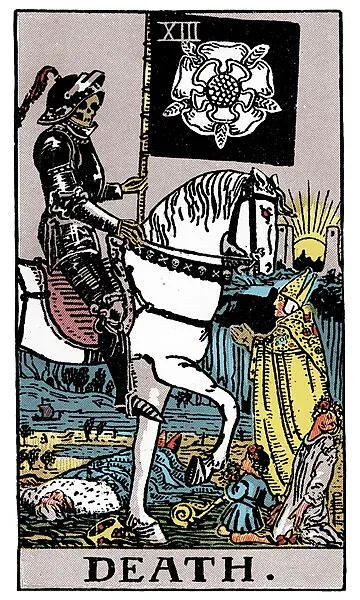
Suspension followed by real release. The Hanged Man's willing pause has finished its work, and Death names the clean ending the pause revealed could not be carried forward. The relationship suspended ends honestly. The role paused is set down without bitterness. The seeker who has done the slow inner work of letting go meets the outer letting-go from inside rather than surviving it from outside.
The High Priestess
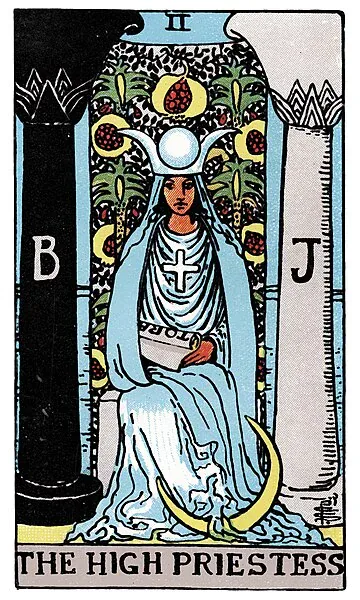
Submerged Mem-water knowing. The Hanged Man's mother liquid meets the High Priestess's lunar pool — two cards of inner water, two cards of what surfaces only when the seeker stops insisting. A season of unusually deep listening: the answer cannot be reasoned to, only allowed up. Often appears around dream work, resurfacing memory, the slow recognition of an intuition long overridden. Write it down; let the record accumulate.
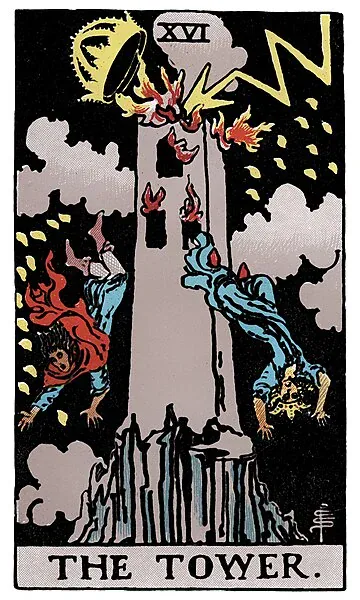
The Tower
Refused surrender meeting forced collapse. The Hanged Man asks for willing inversion; the Tower describes what arrives when inversion is refused long enough. The pair is the deck's clearest reminder that the window for voluntary hanging is real but limited. There is something the situation is asking you to suspend voluntarily, and it will otherwise suspend you in less generous form. Use the window.
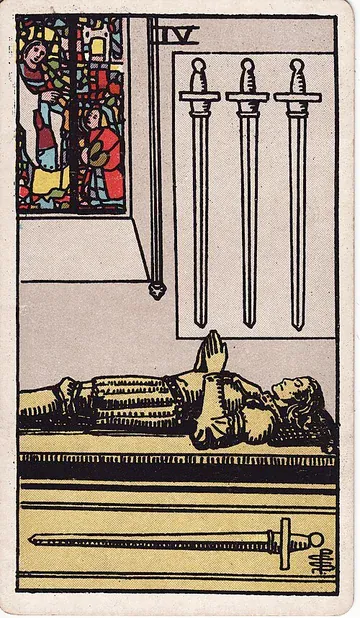
Four of Swords
Rest doubled. The themed sibling — Four of Swords is the small-card cognate of The Hanged Man's instruction. Together the message is unambiguous: stop, and not for an afternoon. Cancel what can be canceled. Decline what can be declined. The pair is unusually merciful — it arrives before the breaking point, asking the seeker to accept the rest before the rest becomes mandatory.
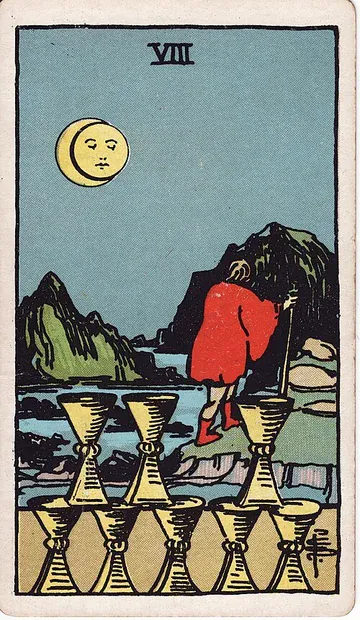
Eight of Cups
The departure that the inverted view made possible. The seeker has hung long enough to see the shape of the life they have been inside, and the seeing has clarified that this life, however good, is not the life that comes next. The leaving is not impulsive; it is quiet, mostly without explanation. The cups left on the shore were not bad — they were no longer the cups the seeker is meant to carry. One of the deck's gentler permissions.
Frequently Asked Questions
What does The Hanged Man tarot card mean?
The Hanged Man is the twelfth Major Arcana card — willing inversion, the seeker hung from a living tree to see the road just walked from below. Its element is water, its Hebrew letter Mem (the mother liquid), its tree-path 23 from Geburah to Hod. Read it as the pause that lets the unseen vein surface: not failure, not waste, but the suspension that does the work more action could not. The body is held still; the angle does the rest.
How long does The Hanged Man want me to stay hanging?
Long enough for the answer to surface from below, and not a day past that. The Hanged Man is one of the deck's clearest 'wait' cards in yes-or-no readings, and the wait is not deferral; it is the card asking you to suspend the question for a clearly defined interval and let the real answer rise once your insistence on a verdict has stopped pressing on it. The not-yet is the answer. Force a verdict from the upright posture and the verdict will be the wrong one.
Does The Hanged Man mean a relationship is stalled, or only suspended?
Suspension that is not breakdown. The relationship has stopped moving forward and has not collapsed; both partners have been asked to change the angle of looking. For long bonds, it is the fallow stretch the relationship needs to re-fertilize. For new sparks, it is the moment fantasy gives way to the real person. For singles, it is the season of stopping the search so the actual wish underneath can surface. The card's love language is willing patience — letting the other person become who they are in their own time.
Why is someone taking so long to decide about me when The Hanged Man appears?
Because they are hung between two postures about you, on purpose. They are not over you and not committed to you; they have agreed, somewhere in themselves, to hold the question of you in suspension long enough for the truer answer to surface. From outside this looks like ambiguity. From inside it is unusually adult — they are refusing to force a verdict that would not last. Read their slowness as steeping, not as absence. When they speak, the words will have weight the fast verdict could not have given them.
What is The Hanged Man's spiritual lesson?
The seeker who has hit the limit of striving is asked, by the path itself, to be hung up and let the next teaching arrive from below. The card corresponds to Mem (the mother liquid) and walks tree-path 23 from Geburah to Hod, carrying what was decided in the verdict downward into the place where it can be understood. Every authentic tradition has this stage — the dark night, the great doubt, the long sitting in not-knowing before understanding ripens. The practice it asks is simple: pause one thing for three days, return on the fourth, and notice the angle has changed.
Continue Reading
The Hanged Man · Card overview · symbols · correspondences →
Return to the full card view — image, symbols, sensory correspondences, and Hermetic axes.
Read the reversed meaning →
Read the same depth on the opposite orientation.
Draw your reading now →
Bring this card to a question — open a quiet ritual.