
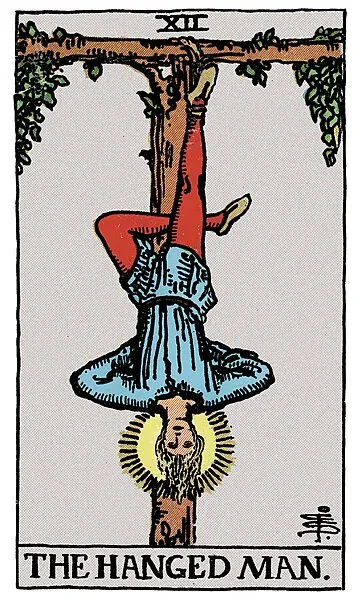
The Hanged Man Reversed · Meaning
The Hanged Man reversed has two opposing faces, and they share a single underlying problem: the seeker's relationship to the willing inversion has gone wrong. Either they are hanging when they should have come down, using the suspended posture as cover for refusing to live; or they are refusing to hang at all, forcing themselves to stay upright through every season that asked for inversion, and so they are running on a perspective that has never been corrected from below.
The first face is stalling dressed as reflection. The youth still hangs from the tau. He has been hung long enough that the work the inversion was supposed to do has, in fact, been done — the inverted view has surfaced, the truth that the pause was incubating has become legible. He could come down now. The rope around his ankle is not what is keeping him up; he is still hanging because coming down means walking, and walking means accepting the consequences of the new view. So he stays. He tells himself, and others, that he is still reflecting. But the reflection ended weeks ago. What he is doing now is using the posture of the hanged to avoid being responsible for what the hanging revealed. This is the most common reversed reading in modern practice — the seeker who has spent six months "figuring it out," and the figuring stopped being honest in month two.
The second face is forced upright. The youth never permitted the hanging at all. Every time life asked him to suspend — to stop a project that was draining him, to leave a relationship that had ended in fact, to step down from a role that was hollowing him out — he refused, and pushed harder. He is proud of the not-having-stopped. He frames the constant motion as discipline, as resilience, as character. From outside it can look like strength. From inside, the cost is the absence of the inverted view; he has been seeing the same single perspective for years, and the perspective has gradually drifted away from honest. He needs to hang and cannot bring himself to. The reversed card describes this exactly — the willing pause refused, the verdict unprocessed, the seeker carrying the residue of every uncorrected choice as accumulated weight.
A third face is suspension performed for an audience. The seeker has discovered that hanging looks holy from outside — the calm face, the golden halo, the apparent depth — and has begun to perform the hanging rather than do it. The Instagram post about "taking a sabbatical." The visible inactivity that is, in fact, an active campaign for sympathy or admiration. The "I am healing" that has become a permanent identity. The card distinguishes between the unperformed hanging that does its work in private and the performed hanging that is just upright posturing in inverted clothes. The reversed card is the second.
A fourth face is martyrdom. The seeker hangs not because hanging is the work, but because hanging produces a felt sense of moral weight — "look how much I have sacrificed," "look what I am giving up for you," "look how heavy this position is." The hanging is being weaponized. Often this shows up in relationships, where one partner stays hanging in a difficult position long past honest necessity in order to harvest the other partner's guilt. The card has nothing in common with this. The willing inversion is a private practice between the seeker and what is greater than them. The moment it becomes leverage, the rope is no longer the tau-cross of living wood; it is just rope.
The astrological signature inverts in a precise way. Mem upright is the mother liquid in which forms gestate. Reversed, it becomes water that has stopped moving — stagnant, heavy, beginning to spoil. The seeker is no longer steeping; they are sitting in old water. On the tree of life, path 23 is blocked: what was decided in Geburah is not making its way down to Hod, because the inverted seer has begun to use the inversion to avoid the descent rather than enable it.
Reversed, The Hanged Man asks: are you actually doing the inner work, or are you using the posture of inner work to defer the outer work the inner work has already pointed to? And: have you ever, honestly, been willing to be hung up — or has every season that asked for it been overridden? Both questions land in different seekers; the seeker reading honestly will know which is theirs.
The Hanged Man Reversed · Love
The Hanged Man reversed in love describes the relationship that has been suspended too long, or the seeker who has refused to let the relationship be suspended at all. Both errors prevent the inverted view that would otherwise correct the relationship. Both errors keep the relationship running on a posture that has stopped serving anyone in it.
For an existing partnership, the reversed card most often describes the bond that has been stuck in a holding pattern for many months. There has been an unresolved conversation. There has been a question one partner asked that the other never answered. There has been a turning point both partners felt and neither named. And rather than hang in it cleanly — letting the impasse be the impasse, letting the silence speak its piece — both partners have been performing ordinariness around the suspended thing, going through the motions of the relationship while the actual relationship is on hold somewhere overhead. The card asks: how long are you both going to keep doing this? Not as accusation. As honest question. The performance of ordinariness costs more than either of you yet sees.
For a relationship that ended but has never quite ended, The Hanged Man reversed is unusually precise. The relationship has been suspended for months, sometimes years. You broke up but kept texting. You moved on but kept checking their social media. You started seeing other people but the other relationships felt thin because some part of you was still hanging in the previous one. The card calls the bluff. The hanging here has stopped being the integration of the breakup and become the avoidance of fully being out of it. The work the suspension was supposed to do has finished. What remains is descent — actually leaving, actually grieving the leaving, actually allowing the relationship to be in the past tense. As long as you are still hanging, the next love does not have room to land.
For someone in a new relationship, the reversed card warns of premature suspension. The relationship has hit the first real difficulty — the first conflict, the first revealed difference, the first moment of seeing the other person with less idealization. And rather than work through it, both partners have hung the relationship up — going quiet, withdrawing, giving each other "space" — and the space has become the relationship's atmosphere. Some pauses are productive; this one is not. The relationship needed a difficult conversation, and the suspension has become the substitute for the conversation. Come down. Have the conversation. Either the relationship survives the descent or it does not — and either answer is more honest than the suspended version.
For "is this person in love with me," the reversed card warns of the partner who has been reflecting on you for too long without ever speaking. They are real. Their feelings are real. They have been in some inner suspension about you for months. But the suspension has stopped serving the feelings — it has become the way they avoid the risk of declaring themselves. The card asks you to give yourself a deadline. If, by a clearly chosen date, they have not moved, the suspension is no longer a noble inversion; it is a comfortable refusal. You do not have to wait forever for someone whose hanging has stopped being honest. The card supports you in walking on.
For a seeker pursuing reconciliation after a break, The Hanged Man reversed is one of the deck's clearer "no" signals — but it is a specific kind of no. It does not say the other person does not still care. It says the reconciliation you are imagining requires the seeker who broke the relationship to have done real inner work in the suspension, and the real inner work has not been done. They have been hanging, on the surface; they have been performing reflection. But the actual change the relationship would need has not arrived. Reconciliation in this configuration produces the same relationship six months later, with one more layer of resentment added. The card does not forbid the reunion. It tells you what the reunion will become.
For someone single who has been "working on themselves" for an extended stretch and finds the reversed card in a love reading, the message is firm but loving: the work is real, and it has gone on long enough. The hanging that began as healing has become the seeker's identity, and the identity is now blocking the door it was supposed to clear. The card asks you to stop calling it "working on yourself" and ask what you are actually still working on. Often, the honest answer is that the work has been finished for some time, and the continued hanging is now fear of being chosen — or worse, of choosing. Come down. Risk being seen unfinished. Real relationships do not wait for finished people; they happen between two people in the middle of becoming.
A particular caution, for the partner who has been hung in a position of "patient waiting" for the other partner to change: the reversed card is direct. Patience that has gone on past honest length is no longer patience. It is martyrdom. The narrative of "I have given them so many chances," "I have endured so much," "I have been so understanding," is the narrative of someone who has begun to harvest moral credit from the hanging rather than do the inner work of leaving or asking honestly for what they need. The relationship will not be saved by more patience. It will be addressed by descent — into either an honest conversation that risks the relationship, or an honest leaving that ends it.
The Hanged Man Reversed · As Feelings
When The Hanged Man reversed describes how someone feels about you, the warmth or interest is real but has been suspended too long, or has been refused entry to suspension at all and is therefore still being run from an upright posture that cannot see clearly. Either way, the feelings are not where they should be. The card describes feelings that have either fermented into stagnation, or that the person has been refusing to let themselves actually have.
The most common flavor: they have been thinking about you for a long time and have not acted, and the not-acting has stopped being honest. In the upright reading of the same configuration, the suspension is real work — they are letting the feeling clarify before speaking. Reversed, the work has finished and they are still not speaking. They have a verdict; they will not declare it; the not-declaring is now its own choice. They may be afraid of what the declaration would cost. They may be enjoying the ambiguity for reasons that are about them, not you. They may have decided in private and not wanted to face delivering the decision to you. Whichever it is, the suspension has become the position rather than the path through the position.
A second flavor: they have refused to let themselves actually hang in the question of you, and so they are still running on a story about you that has not been corrected. They decided early what you were to them — friend, possibility, off-limits, a passing crush — and have refused to update the verdict, even as the actual relationship has been telling them otherwise. The reversed card warns: the feelings they declare are not necessarily the feelings they have. The story is in the way of the seeing. Until they let themselves hang in the question of you, the verdicts you get keep fitting the old story rather than the present situation.
A third flavor: they have been performing reflection for an audience. The "I need time to think about us" that has gone on too long, the "I am working on myself" that has acquired the character of a permanent identity, the cycle of pulling away to reflect and returning with the same words and no actual change — these are the reversed Hanged Man's feeling shape. Their suspension is decorative. It is something they have learned looks emotionally mature, and they are using the look without doing the underlying work. The signature: the reflection produces no change. Real reflection produces change.
A fourth flavor, more painful: they are using the suspension to avoid being responsible for the relationship's drift. As long as they are "still figuring it out," they cannot be held to anything. The hanging functions as moral cover for not deciding. They will tell you, sincerely, that they need more time. They will mean it. And the time will go on indefinitely, because deciding would mean accepting the consequences of the decision, and the suspension lets them have the relationship without the consequences. The card asks you, gently, to recognize this for what it is. Their honest pain is real. Their refusal to descend is also real. Both can be true.
A fifth flavor: they have refused to suspend at all, and are still running a fast read on you that has never had time to deepen. They like you, they think, because you fit the slot. They are not curious about who you are beyond the slot. They have not let themselves hang in the question of who you actually are versus the role they have cast you in. From your side, this often feels like being seen and not seen at once — they are warm with the version of you they have built, and they have not noticed the larger version standing behind it. The card warns: this kind of feeling, however warm, does not become love when stretched. It becomes disappointment when the cast role no longer fits.
For a long-term partner whose feelings are reading as Hanged Man reversed, the most common reading is that they have been quietly stuck in some inner question about the relationship for far longer than they have admitted to you. The question has not been about whether to leave. It has been about how to bring something honest into the open. They have hung in the question for so long that the suspension has become the relationship's atmosphere, and they no longer know how to come down without it feeling like rupture. The card asks for a specific kind of opening — not a confrontation, but a gentle, low-stakes invitation: tell me one true thing this week. Sometimes the hanging breaks when the door is small enough.
For an ex who has been quietly suspended in the question of you, The Hanged Man reversed often means they have been hanging long past honest length and will not come down on their own. They are not contacting you. They are not actively integrating the relationship's ending. They have reached a kind of equilibrium in the suspension and are unlikely to disturb it. The card does not promise contact will come. It tells you, more usefully, that whatever they are doing with their feelings about you is no longer your work to receive. Live as if the suspension will not break. If it does, the breaking will surprise both of you.
The Hanged Man Reversed · Career
The Hanged Man reversed in career readings describes either the project, role, or whole career that has been suspended too long, or the seeker who has refused suspension at all and is therefore making decisions from a posture that cannot see what the decisions are. Both errors produce the same outcome at different speeds: the inverted view that would have corrected the trajectory has not been allowed to arrive.
The first and most common reading: stalling dressed as deliberation. You have been thinking about leaving the role for many months. You have been thinking about the new project for two years. You have been "considering your options" for so long that considering has become its own occupation. The honest work of the deliberation has, in fact, been done — somewhere in the early months, you knew what you wanted. What has happened since is the costume of deliberation worn over a refusal to act. The card asks you, with unusual firmness: is the thinking still doing anything, or is it now the way you avoid the consequences of what you have already decided? Most readers, asked honestly, know the answer. The answer is the descent the card is requesting.
A second reading: refusal to ever pause. You have been pushing for years. Project after project, role after role, sprint after sprint. Each season that asked you to stop, you overrode. Each invitation to suspension, you treated as defeatism. The pride in "not having stopped" is real and the cost is real and growing. The card describes the seeker whose career, looked at from above, is a long line of forward motion that has gradually drifted away from anything the seeker actually wants. The forward motion has become its own purpose. The reversed card asks: when, exactly, are you going to be allowed to stop? If the answer is "after the next milestone," you already know it will be the same answer at the next milestone, and the next. The descent has to be chosen. It will not be granted.
A third reading: martyred suspension. The seeker has been hung in a difficult role — a job they describe as "killing me," a project they have stayed on out of obligation, a position they have been holding "for the team" — long past honest necessity. The suspension has become moral capital. They tell themselves and others how much they are sacrificing. The sacrifice is partly real and partly performance, and the proportion has tipped. The card asks: who is actually benefiting from your continued hanging? Often the honest answer is, no one. The team would survive your departure. The project would find another shape. The "indispensability" was your own narrative as much as theirs. Stop selling yourself the story of the noble martyr and look at what the role is actually costing. The cost has exceeded the meaning.
A fourth reading: performed sabbatical. The seeker has stopped, on the surface — left the job, taken the year off, announced the pause — and is using the visible stopping as an identity rather than the unperformed work it was supposed to be. The Instagram chronicle of the sabbatical. The newsletter about the pause. The increasingly polished "I'm in a season of rest" public persona. The reversed card warns that the rest has become its own production. Real rest is unrecorded. If the rest you are taking has acquired a publishing schedule, it has stopped resting and started performing.
For a project that has been stalled for too long, The Hanged Man reversed asks for a specific decision: either resume the project with full weight, or formally end it. Not a third time saying "I'll get back to it next month." Either get back to it, or write its obituary in your own notebook and release the energy. The half-state — the project that is technically still alive but has not moved in eighteen months — is the most expensive position. It costs you the energy of carrying it without any of the satisfaction of doing it. Free yourself or finish it.
For someone considering leaving a current role, the reversed card most often means the leaving has been delayed past honest length. Whatever the suspension was supposed to teach, it has taught. What remains is the act. The card supports the resignation. It does not promise the next role is ready. It only confirms that this role is no longer the right place to stand, and that continuing to stand on the suspended position is producing the depletion you keep reading as evidence that you should keep waiting for clarity. The clarity is here. You have just refused to descend with it.
For founders and freelancers in extended pauses — products that have not shipped, businesses that have been "pivoting" for over a year, creative projects that have lost momentum — the reversed card asks for honesty about whether the pause is gestation or stagnation. Gestation produces; stagnation only postpones. If twelve months of pause has produced nothing recognizable as forward movement, the pause is no longer doing what pauses do. Either return to the work with renewed clarity or close the chapter. Founders, especially, have a particular tendency to refuse to close projects out of identification with them. The reversed card asks: is this still the work you are doing, or is this now an identity you are protecting from the discomfort of releasing?
A particular note on creative practice: the reversed card often describes the artist who has been "between projects" for a stretch that has stopped being legitimate. Real fallow periods produce a specific quality of restless interior — ideas brewing, dreams more vivid, certain old questions returning. False fallow produces the opposite — a flatness, a disengagement from the work, a relief at not having to face the blank page. If your pause has been more flat than restless for many months, the card is naming the pause as avoidance rather than gestation. The cure is small and specific: write one bad page tomorrow. Make one ugly sketch. Record one thirty-second voice memo. Begin again, badly. Beginning badly is the descent the suspension has been refusing.
The Hanged Man Reversed · Money
The Hanged Man reversed in money readings describes financial life that has stopped moving for the wrong reasons. The pause is no longer doing the work the pause was supposed to do. Either the seeker has been delaying financial decisions for so long that the delay has become its own decision, or they have refused to let any financial situation be paused at all and are therefore making decisions from a posture that cannot see what the decisions are.
The most common first reading: financial avoidance dressed as caution. You have been "thinking about" your finances for a long time. You have been meaning to consolidate the accounts, to make the budget, to look at the retirement allocation, to face the credit card balance. The thinking-about-it has been going on for many months. The card distinguishes between considered delay (which produces eventual action) and used-as-shelter delay (which produces nothing). If the delay has not produced action, the delay is the action — and the action is to remain unaware. The reversed card asks for the small descent: today, open one account. Just one. Look at the actual number. Whatever the number is, the suspension has been costing more than the number.
A second reading: paralysis at a major financial fork. The seeker has been at a financial decision point — buy or rent, leave the job or stay, make the investment or pass, take the loan or wait — for far longer than the decision warrants. The hanging began as appropriate consideration and has become inability to commit. The reversed card asks the seeker to set a deadline and honor it. Pick a date. By that date, decide. The decision made on a deadline is rarely worse than the decision indefinitely deferred, and the energy released by the actual decision frees capacity that the hanging has been consuming.
A third reading: refusing the suspension entirely. The seeker has been pushing financial momentum nonstop — earning more, spending more, investing more, never letting any financial structure stabilize before adding another layer. The reversed card describes the trader who has not been out of a position in five years, the founder whose savings have been continuously redeployed into the next venture, the seeker whose financial life has never been allowed to consolidate because consolidation feels like stopping. The card asks for the willing pause that the seeker has refused to grant. Stop expanding for one quarter. Sit with the financial structure as it is. The pattern that becomes visible during the unforced pause is the pattern that the constant motion has been hiding.
For someone in financial crisis, the reversed card warns specifically against martyred suspension. The narrative of "I am in this hard stretch and I am bearing it" can begin to function as moral capital — a sense of being noble in the suffering — and the moral capital can outlast the genuine necessity. The card asks honestly: how much of your continued financial difficulty is genuine, and how much is your unwillingness to take the slightly humbling actions that would partially resolve it? Calling the bank. Asking for the lower rate. Declaring bankruptcy if bankruptcy is the right tool. Asking the family member you have been refusing to ask. The descent into the partial solutions that pride has been blocking is more honoring of the seeker than the continued elevated suffering.
For someone who has been "saving for the right moment" for longer than the right moment has plausibly remained ahead — the seeker who has been building a war chest for the project they have been about to start for three years, the saver whose retirement account has more in it than the retirement they keep deferring will spend — the reversed card is unusually direct. The saving has become its own occupation. The accumulated amount has stopped serving the original purpose and started serving the seeker's relationship to control. The card asks: when, exactly, will you actually use what you have saved? If the answer is permanently deferred, the saving has become a way of not living the life the saving was supposed to enable.
For windfalls that have been received but not deployed, The Hanged Man reversed describes the inheritance that has been sitting in checking for two years, the bonus that has been "waiting for the right investment" since last summer, the gift that has been parked because deciding what to do with it has felt heavier than receiving it. The card asks for descent. Make a decision. Even an imperfect deployment is more honoring of the gift than indefinite suspension. The fear of using the money badly has begun to function as the way of not using the money at all — and not-using is its own use, and not the right one.
For everyday spending patterns, the reversed card sometimes describes the seeker who has been hanging in the same financial-life decisions for so long that the spending has become the only place forward motion still happens. The big questions are stuck; the small purchases are the only thing that keeps moving. The result is an account that drifts down without quite naming why. The card asks for the suspension of the small spending so the larger questions can be addressed. Pause the small motion that has been substituting for the larger motion. The redirected attention will land on what has actually been waiting.
The Hanged Man Reversed · Health
The Hanged Man reversed in health readings describes the body that has been signaling for a long time and the seeker who has either suspended every signal indefinitely without ever responding, or refused to let the body slow down at all and is therefore running on a posture the body has long since stopped agreeing with. Both errors leave the body in worse shape than it should be in for the season the seeker is actually in.
The most common reading: postponed care. The body has been raising its hand for months. The recurring symptom that you keep meaning to get checked. The fatigue that has been settling deeper. The sleep that has been thinner. The appointment you keep meaning to schedule. The card calls out the suspension for what it has become: not careful consideration, but avoidance. The reversed card asks for the small descent — the act of making the appointment, today, with whoever you have been meaning to call. Not all the appointments. One. The first one you have been most postponing. Make it. The rest will follow.
A second reading: the chronic condition that has been "managed" for so long that the management has become the seeker's identity, and the seeker has stopped looking for actual improvement. The reversed card warns that some conditions remain stable and some conditions slowly worsen, and the difference often matters. If your management strategy has not been re-examined in years, the strategy may have stopped fitting the current state of the body. Ask the doctor a question you have not asked. Get a second opinion you have been avoiding. Try a small change in protocol you have been resisting. The willingness to disturb the comfortable management is often where the next stage of stabilization lives.
A third reading: refused rest. The seeker has been pushing the body through every season that asked for slowness — illness worked through, injuries trained on, exhaustion overridden. The card describes the athlete who is a year past the injury and still flares because the rest was never honored, the worker whose body has filed complaint after complaint and been overridden each time. The reversed card asks for the rest that has been refused. Not the dramatic medical rest. The boring, daily, undramatic rest. Eight hours of sleep, sustained. Cancellation of the social plan that you would have white-knuckled through. The afternoon walk that has nothing to recommend it but rest itself.
A fourth reading: martyred illness. The seeker has been visibly suffering for a long time and has begun to draw moral or social capital from the suffering. The position of "the one who is going through it" has become role and identity. The reversed card distinguishes between honest suffering, which is private, and performed suffering, which has an audience. If your illness has acquired a public narrative — frequent posts, constant updates, an identity built around the condition — the reversed card asks whether the visibility is helping the healing or substituting for it. The healing path often passes through a quieter and less narrated phase. Quiet the narration. Let the body have less of an audience. The body responds to less attention from the outside, sometimes, more than to more.
For mental health specifically, the reversed Hanged Man describes the seeker who has been "doing the work" for so long that the doing-the-work has become the way of not actually living. Therapy that has gone on for years without the kinds of changes therapy is meant to produce. Self-help reading that has accumulated into an identity rather than into life adjustment. Constant introspection that has stopped producing insight and started producing fatigue. The card does not oppose any of these activities. It questions whether they have begun to function as the seeker's permanent posture rather than as the path through a particular passage. Reflection that has not produced change for an extended period is not, anymore, reflection. It is hanging that has stopped being honest.
For somatic complaints that the seeker has been describing for a long time without ever investigating physically — "my back has been bothering me for years," "I've had this stomach thing forever," "I'm always tired" — the reversed card asks for a real medical visit, not a continued suspension in the discomfort. Many seekers who have spent years in the language of "I should look into this" have never actually looked into it. The looking-into-it is the descent. The card supports it firmly. The body has been waiting.
For the seeker who has been in active treatment but has stopped being honest about whether the treatment is working, the reversed card asks for the difficult conversation with the practitioner. The protocol has not been delivering. You have been telling yourself it will catch up. The card asks: how many more months are you willing to wait before raising the question? The answer the card prefers is "this week."
(Being urged to raise the question this week is not medical advice about the answer. Keep your practitioners. Take your medication. Make the appointments — make especially the appointment you have been postponing. The card is naming, gently but firmly, the pattern of suspended care that the body has been carrying alone.)
The Hanged Man Reversed · Spirituality
Spiritually, The Hanged Man reversed describes the seeker who has hung in the long suspension past the point where the suspension was doing its work, or who has refused to permit the suspension at all and is therefore living a spiritual life that has never been corrected from below. Both errors block the path that the upright card walks. Both errors produce a spiritual life that is being run from a posture that has stopped being honest.
The first face: spiritual stalling. The seeker has been "in a season of integration" for years. The retreat is over. The teaching has been received. The work the suspension was supposed to incubate has, in fact, been done. And the seeker remains in the suspended posture, not because the integration is still happening, but because re-engaging with the world from the new view is heavier than continued retreat. The card distinguishes between integration that is producing change in life and integration that has become its own permanent condition. If you cannot point to specific ways your life has shifted as a result of the long inner work, the inner work has stopped being inner work and become its own kind of avoidance. The descent is not the abandonment of the practice. It is the bringing of what the practice taught into the rest of life.
The second face: spiritual refusal. The seeker has never permitted themselves a real suspension. Every season that asked for it was overridden — too much to do, too many people relying on them, too many obligations. The spiritual life has become a series of squeezed-in practices that never had room to actually do anything. The card describes the seeker who has been meaning to take a real silent retreat for fifteen years and never taken it, the practitioner whose meditation has remained the same daily twenty minutes for a decade because the longer sittings would require admitting that something in the regular life would have to give. The reversed card asks for the willing inversion that has been refused. Not as guilt; as long-overdue honesty.
A third face: the performed spiritual journey. The seeker has discovered that hanging looks holy from outside, and has begun to perform the hanging. The visible asceticism. The publicly chronicled silence retreat. The carefully curated dark-night-of-the-soul. The card distinguishes between the unperformed hanging that does its work in private and the spiritual practice that has become content. The latter is not condemned; it is simply named. The work is being done somewhere; it is rarely being done in the post.
A fourth face, more painful: spiritual martyrdom. The seeker has been hanging in a difficult spiritual position — staying with a teacher whose teaching has stopped delivering, holding a practice that has gone hollow, remaining in a community that has changed in ways the seeker has not allowed themselves to acknowledge — and harvesting moral weight from the staying. The hanging has stopped being suspension and become identity. The card asks honestly: when is the loyalty to the teacher, the practice, the community, helping; and when has it become a way of not facing the seeker's own next step? Real loyalty includes the courage to leave when leaving is the right next move. The hanging that refuses to ever consider descent is no longer suspension. It is the avoidance of personal authority.
For someone deep in active practice, the reversed card often describes the plateau that has gone on too long without the practitioner asking whether the practice itself needs to evolve. Plateaus are part of every practice; they have a season. A plateau that has lasted three years and produced no movement is no longer a plateau in the technical sense. It is the practice asking for revision, and the practitioner refusing to hear. The card asks: what would you change about the practice if you were not afraid to disrupt your relationship to it? The answer is often the next step the practice has been waiting for.
For someone whose spiritual life has been "on pause" — no active practice, lapsed teacher, abandoned discipline, but with a continuous sense of "I should get back to it" — the reversed card asks for the small honest restart. Not the grand return, not the dramatic re-commitment, just one minute of practice tonight. Then one minute tomorrow. The seeker who hangs in "I should get back to it" for years rarely does, because the imagined return is too large to face. The descent is small. It is one minute. The minute does what the suspended intention does not.
For a seeker who has begun to use spirituality to avoid the rest of life — the difficult relationship the practice has been asked to "transcend," the financial reality the meditation has been asked to "spiritualize," the body's needs the inner work has been asked to "transmute" — the reversed card is firm. Real spiritual practice strengthens engagement with the rest of life; it does not provide cover for evading it. If your practice has become the wall between you and your relationships, your finances, your body, the practice is no longer doing what practice does. Come down. Address what the practice has been letting you not address. The practice will be there when you return, deeper for the descent.
The integration of the reversed card is rarely dramatic. It is usually the small quiet day on which the seeker stops calling the suspension by its old name and recognizes that the suspension has, in fact, run its course. Coming down is not the abandonment of the path. It is the path's next step.
The Hanged Man Reversed · Yes or No
Soft no — and the no is asking you to descend.
The Hanged Man reversed in yes-or-no readings is rarely a clean no, and almost never a yes. It is most often the answer that says: the question you are asking has been suspended past honest length, and the descent the situation requires is the act, not whatever yes or no you are trying to extract. The card refuses to participate in the deferral. It asks for the move.
For yes-or-no questions about a relationship, a job, a move, a decision: the answer is no — meaning, no, you cannot continue to hang in this question without paying for the hanging. The card does not necessarily say the underlying answer is no. It says the suspension has reached the limit of what the suspension can do. Whatever you are deciding, you have to decide now or formally release the question. The third option — "I'll keep thinking about it" — has been used up.
For questions about whether someone is being honest, whether an offer is real, whether a plan will hold, the reversed card warns that the answer is being kept in suspension by the other side as well. They are stalling. The hanging is not your inner work; it is their refusal to deliver. The card asks you to set a deadline, communicate it cleanly, and honor it. The situation that cannot survive a clean deadline was never a real offer.
For timing — "will it happen soon?" — the reversed card answers: not without your descent. The arrival is being held up by the seeker's own refusal to come down from the suspended posture. The thing you are waiting for is, in some sense, waiting for you. The next move is yours, and the move is not more waiting. It is action that the long suspension has been postponing.
For binary decisions, the reversed Hanged Man sometimes flips the question entirely — neither A nor B is the right answer; the right answer is the third option that the long hanging has been keeping you from seeing. The card asks: have you really considered the third option, or have you stayed in the false binary because the binary feels less risky than the actual choice waiting underneath? The genuine third option often looks scarier from the upright posture and clearer from below — but the reversed card describes the seeker who has refused to bring the inverted view into the open. The descent is partly the act of letting the third option become real.
For "should I keep waiting" — the card answers no. Not because waiting is always wrong, but because in your particular situation, the waiting has gone on past the useful length. The hanging that began as honest patience has become a refusal to act. The card does not promise the action will resolve the situation cleanly. It only confirms that more waiting will not.
For "should I let this go" — the card answers yes, often more clearly than the seeker wants. The thing has been held in suspension long past its season. Carrying it any further is not respect for what it was; it is fear of the descent into the life that does not include it. Let it go. The release is the descent. The descent is the answer the long suspension has been pointing at.
And the worthiness question, still hanging there? The reversed Hanged Man answers: the question has been hanging for long enough. The seeker who keeps asking the question of deserving has stopped doing the work of becoming someone who lives the answer. Stop asking. Move.
The Hanged Man Reversed · Advice
The Hanged Man reversed's advice has one core: choose, with full clarity, whether the suspension you are inside is still doing work, or whether it has begun to substitute for the work it was meant to incubate. Then act on the answer. If the suspension is real, surrender into it more completely. If the suspension has finished, descend without performance.
If there is one specific instruction the reversed card offers, it is to make a clean call. There is one situation in your life that has been hanging too long — too long meaning past the point where the hanging was producing anything useful. You know which situation. Stop asking whether to address it. Address it. This week. Not the perfect address; the actual one. Send the email. Have the conversation. End the project. Make the appointment. The form of the address matters less than the fact that you are no longer using "I am still figuring it out" as the cover for never moving.
A second instruction: distinguish honestly between gestation and stagnation. Both look like hanging. Gestation produces a felt sense of inner movement, dreams that feel important, ideas that arrive unbidden, a quiet certainty that something is becoming. Stagnation produces a flat, dull, increasingly resentful background — the sense that you are doing the same thing every day and going nowhere. Sit for an honest hour and ask which one your suspension is. If gestation, surrender further into it; the work is still happening. If stagnation, the suspension has become avoidance, and the descent has been refused for too long.
A third instruction: stop performing the inner work. Whatever practice has begun to function as content — the public sabbatical narrative, the visible therapy journey, the announced "season of integration," the carefully maintained "I am healing" identity — pause the performance for a defined period. Not the practice. The performance. Take down the post. Stop announcing the work. Let the work, if it is real, continue without an audience. Real work survives the loss of an audience; performed work falls apart, and the falling apart is its own teaching about what the work had become.
A fourth instruction: refuse martyrdom. If you have been hanging in a difficult position long enough that you have begun to draw moral weight from the hanging — "look how much I am sacrificing," "I am doing this for them," "no one understands what I am carrying" — the card asks you to set down the moral weight. The hanging that has become leverage has stopped being suspension. Stop using your suffering to harvest others' guilt or admiration. Either continue the difficult position because it is genuinely the work, without the narrative around it, or descend.
A fifth instruction: come down small if coming down feels too large. The reversed card recognizes that for the seeker who has been hung up for years, the dramatic descent feels impossible. So begin small. Address one element of what you have been suspending. Send one email. Make one phone call. Schedule one appointment. Hold one honest conversation. The small descent breaks the spell of the large suspension more reliably than the dramatic announcement. Repeat the small descents over a season, and the entire suspended posture quietly becomes ground.
A sixth instruction, for the seeker who has been refusing suspension entirely: take three days off this week. Not vacation. Not retreat. Three plain days where you do nothing on the to-do list. The body will resist. The mind will produce convincing reasons that this particular three-day window is impossible. Do it anyway. The seeker who has never permitted hanging will find the three days unsettling, then revealing, then valuable. The valuable part is the inverted view that has been refused for a long time. Begin the descent into willing pause with a small, specific, non-negotiable interval.
A seventh instruction, gentler than the others: forgive yourself for whichever face of the reversed card has been yours. Stalling and refusing-to-stop are both common. Both are forgivable. The reversed card does not punish; it names. The naming is the gift, and the response to the naming is the work. Be kind to the version of yourself that has been hanging too long, or refusing to hang at all. That version was protecting something. Thank it. Then, gently, take its job back.
Practical advice for the day the card appears: pick the situation in your life you have been "thinking about" for the longest time. Take the smallest possible action toward resolving it today. Send the message. Schedule the call. Open the file. Write the line. The smallest possible action is the descent. The descent is the answer.
The Hanged Man Reversed · Card Combinations
Hanged Man Reversed + Death
The deferred ending. Death calls for the clean release, and the reversed Hanged Man describes the seeker who has been hanging in the question of whether to release for too long. Together, the pair is unusually direct: the ending the seeker has been postponing is not coming under its own power; the seeker has to choose it. Whatever has been "ending soon" for months — the relationship that has been over in fact and not yet over in form, the role that has been finished and not yet released, the chapter that has been done and not yet closed — has to be ended by the seeker's own hand, this week. Continued hanging in the suspended ending is not respect for what was; it is fear of the after. The pair asks for the descent into the after.
Hanged Man Reversed + The Tower
Refused suspension meets forced collapse. One of the deck's clearer warnings. The seeker has refused to let themselves be hung up, voluntarily, through every season that asked for it; The Tower describes what is now arriving because the willing pause was not chosen. The pair often appears in retrospect, after the collapse, as the cards' way of explaining what just happened. When it appears in present-tense reading, the message is unmistakable: there is still a small window for willing inversion, and the window is closing. Stop pushing. Sit down. Let the next hour be the suspension you have not allowed yourself for years. Either take the hanging now, or the situation will deliver it less kindly.
Hanged Man Reversed + Eight of Cups
The leaving that has been suspended. The Eight of Cups is the seeker walking away from what has been built; reversed Hanged Man often describes the seeker who has been about to walk away for a long time and not yet walked. Together, the pair is the long-postponed departure. The cups have been left mentally for months; the seeker has not yet picked up and gone. The card asks for the actual leaving, not the further suspended version of leaving. The departure is not as catastrophic as the inner staging has been making it. Step. The shore that opens under your feet is more solid than the suspended shore you have been imagining.
Hanged Man Reversed + The Devil
Suspension as bondage. The reversed Hanged Man's stalling meeting the Devil's chain — together the pair often describes the seeker hung in a position they could leave at any time, and have not, because the staying has begun to feel like fate. The chain in the picture is loose, the ankle binding is rope only, the descent is not impossible. The card asks the seeker to look at the suspension and recognize how much of it is voluntary, and has been voluntary for a long time. The bondage is not external. It is the inner refusal to descend. Naming the refusal honestly is the first move toward release.
Hanged Man Reversed + Four of Pentacles
The grip beneath the stalling. The Four of Pentacles holds tightly to what is owned; reversed Hanged Man hangs in the position that has long since stopped being honest. Together, the pair often describes the seeker who refuses to descend because descending would mean releasing some specific thing — a financial cushion, a relationship structure, a professional identity — that they have been gripping for years. The pair asks: what are you actually holding onto, and what would happen if you let go of just a portion of it? The willing descent often begins with a deliberate small release. Not all of it; one specific item. The released item teaches the rest of the grip how to loosen.
Card Combinations
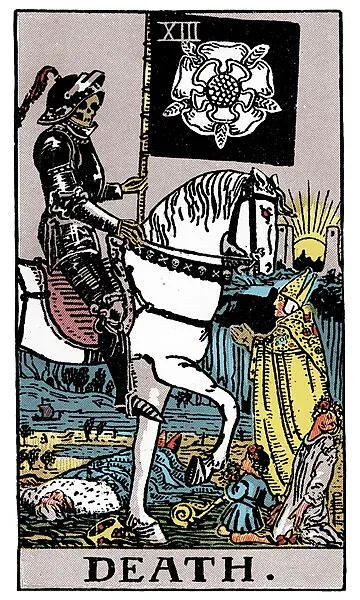
Death
Suspension followed by real release. The Hanged Man's willing pause has finished its work, and Death names the clean ending the pause revealed could not be carried forward. The relationship suspended ends honestly. The role paused is set down without bitterness. The seeker who has done the slow inner work of letting go meets the outer letting-go from inside rather than surviving it from outside.
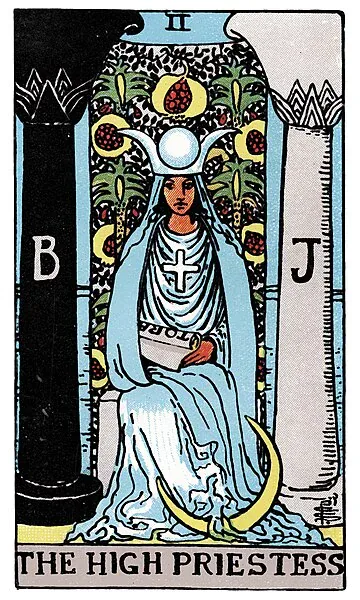
The High Priestess
Submerged Mem-water knowing. The Hanged Man's mother liquid meets the High Priestess's lunar pool — two cards of inner water, two cards of what surfaces only when the seeker stops insisting. A season of unusually deep listening: the answer cannot be reasoned to, only allowed up. Often appears around dream work, resurfacing memory, the slow recognition of an intuition long overridden. Write it down; let the record accumulate.
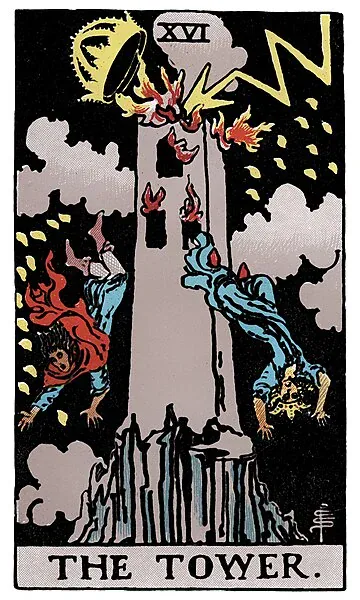
The Tower
Refused surrender meeting forced collapse. The Hanged Man asks for willing inversion; the Tower describes what arrives when inversion is refused long enough. The pair is the deck's clearest reminder that the window for voluntary hanging is real but limited. There is something the situation is asking you to suspend voluntarily, and it will otherwise suspend you in less generous form. Use the window.
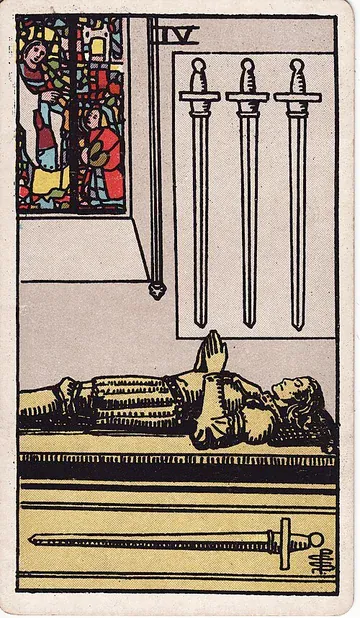
Four of Swords
Rest doubled. The themed sibling — Four of Swords is the small-card cognate of The Hanged Man's instruction. Together the message is unambiguous: stop, and not for an afternoon. Cancel what can be canceled. Decline what can be declined. The pair is unusually merciful — it arrives before the breaking point, asking the seeker to accept the rest before the rest becomes mandatory.
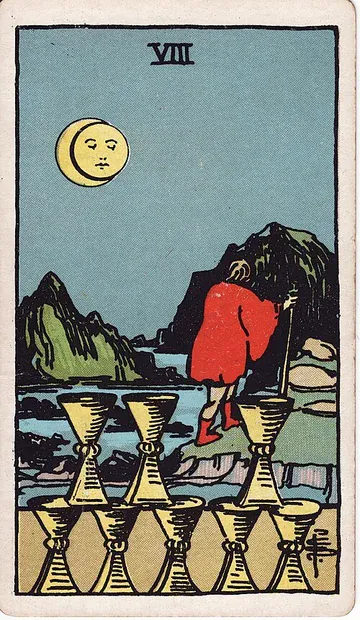
Eight of Cups
The departure that the inverted view made possible. The seeker has hung long enough to see the shape of the life they have been inside, and the seeing has clarified that this life, however good, is not the life that comes next. The leaving is not impulsive; it is quiet, mostly without explanation. The cups left on the shore were not bad — they were no longer the cups the seeker is meant to carry. One of the deck's gentler permissions.
Frequently Asked Questions
What does The Hanged Man reversed mean?
Suspension that has stopped being honest. Either the seeker is hanging long past the point where the inversion was doing work — using 'I am reflecting' as cover for refusing to descend — or refusing the willing pause entirely and running on a posture that has not been corrected for years. Both errors block the path the upright card walks. The reversed work is to choose: surrender further into the suspension if it is still real, or descend into the action the long suspension has been postponing. The half-state is the most expensive position.
Is The Hanged Man reversed saying the waiting is over?
That is close to what it says, and the soft no inside it is asking you to descend. The reversed card refuses to participate in continued deferral. The waiting has gone on past the useful length. Whatever you are deciding has to be decided now or formally released; the third option of 'I'll keep thinking about it' has been used up. The card does not necessarily say the underlying answer is no — it says the suspension has reached its limit and the descent is the act. Set a deadline. Honor it. Move.
Does The Hanged Man reversed mean a relationship has been on pause too long?
The relationship suspended past honest length, or the seeker refusing to let the relationship be paused at all. For long bonds, it is the unresolved conversation both partners have been performing ordinariness around. For ended relationships that never quite ended, it is the texting, the social-media checking, the new connections that feel thin because some part of you is still hanging in the previous one. For pursuing reconciliation, it is a specific kind of warning: the inner work the other person needed to do during the suspension has not, in fact, been done.
Why has someone been thinking about me for months without ever saying it?
Because they are hung between two postures about you and have stopped letting the suspension do its work. Most often: they have been thinking about you for a long time and have not acted, and the not-acting has stopped being honest reflection — they have a verdict, they will not declare it, the not-declaring is now its own choice. Or they refused to let themselves hang in the question of you at all, and are still running on a story that has not been corrected. Real reflection produces change; the reversed card describes reflection that does not.
How do I climb down when The Hanged Man is reversed?
Choose, with full clarity, whether your suspension is still doing work or has begun substituting for the work it was meant to do. Then act. Make the call you have been postponing. Distinguish honestly between gestation (felt inner movement) and stagnation (flat, dull background). Stop performing the inner work; let real practice continue without audience. Refuse martyrdom — set down the moral weight you have been harvesting from the hanging. If descending feels too large, descend small: send one email, make one call, schedule one appointment. The small descent breaks the spell of the large suspension.