
The Hermit · Core Meaning
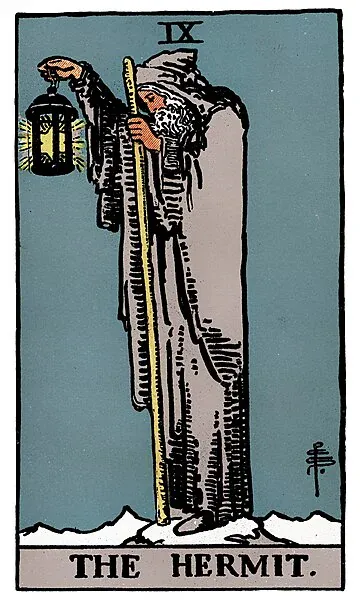
On a snow-covered summit an old man stands alone. The robe is gray, almost the color of the cliff behind him, and the hood is drawn so far over his face that, from any distance, you would not be sure there is a face at all. His right hand is raised; from it hangs a lantern shaped to hold a six-pointed star — two triangles closed upon each other, fire and water, mind and heart, the small joined diagram of a finished thing. His left hand rests on a long staff, the same staff the Magician once held, only time has worn it thinner. His head is bowed. He is not looking at the horizon. He is looking at the patch of snow where the lantern's gold actually falls. The Hermit is the figure who has climbed away from the noise, who has accepted that the next step can be lit but the road cannot, and who keeps walking anyway. This is a tarot card about discernment by lantern-light.
For seekers searching the hermit tarot card meaning, the central image is the trade between view and clarity. To stand on the ridge alone and see the whole valley once is the privilege of withdrawal; to be down inside the valley with friends, with errands, with the warm distractions of company is the privilege of belonging. The Hermit has chosen the ridge, not because the valley is corrupt, but because something in him has stopped being able to hear his own voice in the chatter. So he climbs. The lantern is small. He gives himself permission to see only one step. There is grief in the choice and there is also relief — the relief of someone who has finally taken the question seriously enough to stop asking other people what to do.
The card's signature tension lives in that lantern. He could lift it higher and try to light the road. He does not. He could pretend he sees further than he does and walk faster. He does not. He has accepted that the answer to the question he is carrying is not visible from the summit; it is only visible one step at a time as the foot lands. The bowed head is not humility — it is attention. His gaze follows the gold and does not outrun it. The whole card is a portrait of someone who has stopped trying to know more than he can know.
The traditional astrological signature reinforces this: Mercury in Virgo, the planet of discernment in the sign of patient sorting. Virgo is the harvest after the work — the kitchen at the back of the year where what was grown is sifted, what was rotting is composted, what is keeping is sealed in clay. Mercury in Virgo gives the Hermit his particular intelligence: not the bright, public, performative intelligence of the orator but the quiet sift of the analyst alone with the manuscript. He is mutable Earth — yielding to detail, attentive to the grain, willing to throw out a whole season's draft and start again from a single line that is true. The kabbalistic placement is path 20 on the Tree of Life, the road from Chesed to Tiphareth — from sovereign mercy to harmonised beauty — carried by the Hebrew letter Yod, which means hand, single spark, and the seed from which all the other letters begin. Yod is the smallest letter and the most loaded; it is the one drop of fire from which the alphabet is born. The Hermit's lantern is Yod made visible.
Look, too, at the snow. It is the one surface in the deck that keeps a record. Every step the old man has taken is written behind him, and he has chosen to stand where no other footprints lie — not out of pride but because only untrodden ground lets the next step be heard clearly. This is the Hermit's number at work. Nine is the last of the single digits, the point where everything is drawn inward and the road, near its end, narrows to a few questions asked with precision. The Fool asked everything; the Hermit asks one thing, and asks it well. Diogenes carried his lamp through Athens at noon looking for a single honest man; the Desert Fathers went into the sand to find out what was left of them when the city was subtracted. The Hermit belongs to that lineage — the tradition of subtracting until what remains is true.
Read the Hermit, in any spread, as the season of an inward turn. He is not a card of permanent retreat; he comes after Strength, where the lion's jaws were closed and the force folded back, and he comes before the Wheel of Fortune, where the world starts turning again under the seeker's feet. He is the night of climbing the ridge, the long thinking, the lit foot. The pause is not the end of the story. It is the place where the next sentence is composed.
The Hermit · Love & Relationships
Two people in the same house, in two different rooms, and neither of them unhappy about it — that is the Hermit's love image, and it is among the most misread in the deck. It looks, on first glance, like the card of being alone. The fear it usually arrives with is quiet and specific: does this card mean love is off the table this year? It does not mean that. It means the relationship — the existing one, the new one, the imagined one — is asking for a stretch of solitude inside it. Not distance as flight. Not a break. Room enough to hear the voice underneath the voice that has been managing the relationship.
For an existing partnership, the Hermit describes the season when both partners stop performing the relationship for each other and start sitting in it. The dinners go quieter. The conversations shorten. There is, sometimes, a few weeks of mistaking the quiet for distance; this is the card's particular trap. What is actually happening is closer to maturation. The relationship is no longer producing the constant low electricity of new attention; it is producing the deeper signal of two people who can stand to be alone in a room together. If you have been together long enough that this card appears, the silence is the work, not the symptom. Use it. Eat the meal without the screens. Walk together without filling the walk with talk. The Hermit's love does not need to entertain itself.
For a new spark, the Hermit upright is more cautionary. It says — pause. Whatever pull you are feeling, the card asks you to take a few weeks before letting the pull determine the shape of your life. This is not coolness. The Hermit is not the card of playing it cool. It is the card of not yet knowing whether the spark belongs to this person or to a hunger you carried into the meeting. The lantern shows one step. Take that step. Then take the next. Do not make the future of the connection on the morning of the second date. The card respects the spark; it just refuses to let the spark do the planning.
For a single seeker who is asking whether love is possible while the Hermit is on the table, the answer is yes — but the card warns against pursuing love as relief. The seeker who climbs down from the summit only because the summit was lonely will pick a partner the way a person sips the first drink at a long party: too quickly, with too much gratitude, before the tongue has registered the taste. Stay on the ridge a little longer. Notice what the solitude is teaching. The right person, when they come, will be someone who can sit with you in your particular quiet. They will not require you to be louder than you are. They will not need to be entertained out of their own silence. The Hermit's love is not crowded.
For love after a wound, the Hermit upright is one of the deck's gentler companions. It describes the long season when the worst of the heartbreak has lifted and the seeker is no longer in active grief, but is also not yet ready to be social again. The body is convalescent. The lantern is small. The card supports the slow walk back to the world. Eat the small meal. Take the morning walk. Read the book that is asking nothing of you. The Hermit is the friend who would not make you talk if you did not want to talk; he would simply sit nearby with his lantern and let you borrow the light.
A note on the card's particular love language: the Hermit loves by witnessing. Not by performing care, not by managing the relationship's logistics, not by saying the bright reassuring sentence at the right moment. By watching. By remembering. By being able to describe the seeker back to themselves in a way the seeker had been unable to. The Hermit's gift, when given, is the line you hear from the lover that makes you think — that is who I have actually been. This is rare. It is also slow. The card cannot be rushed.
If you are asking whether someone is in love with you and the Hermit arrives upright, read it as a yes that has not yet been spoken aloud. They have decided. They are still waiting to be sure. They are not playing games. They are running the kind of internal audit that, in their character, has to finish before any declaration. They will speak. The card does not say when. The card says they are not lying when the silence stretches.
The Hermit · As Feelings
They go quiet for three days and come back with something exact to say about a thing you mentioned once. The Hermit as feelings has that texture — contemplative, slow, and unmistakably attached. Not the high voltage of a new attraction; not the pleased glow of someone who has caught a good thing. Something more careful. They are thinking about you. They are thinking about you in the way a person thinks about a question that matters: in the morning, on the walk, before falling asleep. The Hermit's feelings are not flashy. They are durable.
If they are reserved by nature, the Hermit in feelings reads as a deepening fondness that has not yet decided how to make itself visible. They will not bring you flowers. They will not write the long message. They will not, on most days, even tell you what they have been thinking about. But the next time you see them, they will have remembered the small detail you mentioned three weeks ago — the book you were reading, the trip you were dreading, the friend you were worried about. This is how their feelings move. Through retention. Through attention. Through small acts that are easy to miss if you are looking for the loud signal.
If they are demonstrative, the Hermit in feelings is more interesting still. The demonstrative person, under this card, becomes briefly quiet. They withdraw from their usual register. There is a stretch where they seem less available, less effusive, harder to read. Do not interpret this as a cooling. The demonstrative person, when in the Hermit's hour, is doing something they rarely do — going inward to weigh what they actually feel before announcing it. The next round of contact, when it comes, will be slower and more honest than what they have offered before.
For a partner you have been with a long time, the Hermit in feelings is one of the kinder readings the deck offers. It means they have stopped wishing you were different. They have done the slow internal work of accepting the relationship's actual shape. The romance you might be missing is not gone — it has reorganised into a deeper acceptance that is harder to see and easier to live in. They are no longer running scenarios where you are someone else. They have arrived at you.
For a new connection, the Hermit in feelings can describe someone who is unusually careful with what they feel. They are not avoiding you. They are being deliberate about not over-naming the feeling before they understand it. This care can feel like distance from the outside. From the inside, it is closer to reverence — they have decided the connection is worth getting right rather than getting fast. The card asks you to give them the time they are giving themselves.
Someone who went quiet after a good stretch — the two intense weeks and then the thinning replies — is a different question, and the Hermit answers it more kindly than the silence suggests. What happened, under this card, is that the closeness arrived faster than their capacity to hold it, and they have climbed a little way up the ridge to find out what they actually feel now that the first heat has settled. They are not comparing you to someone else. They are comparing the person they were at the start of those two weeks to the person they are now, and checking whether the feeling survived the comparison. Under the Hermit it usually does. The snow keeps a record; they can see their own footprints leading toward you, and they are deciding whether to keep walking in that direction with their eyes open rather than closed.
An ex's feelings, when the Hermit describes them, are the feelings of someone who has done the sifting. Virgo's harvest kitchen has been at work: what was rotting has been composted, what was true has been sealed and kept. They think of you without the old charge — no longer as the wound, no longer as the escape, but as a person they knew closely and can now see whole. This is not the same as wanting you back. It is closer to respect that has outlasted the relationship. If you are hoping for a return, read the card as a door that is not locked but is also not being held open; if you are hoping for peace, the card says they have most of the way arrived at it, and that your own quiet would be met by theirs.
A small caution embedded in the card's feelings shape: the Hermit personality, when in love, can confuse internal processing with shared processing. They can think about you for weeks and assume you somehow know they have been thinking. They can decide something important about the relationship in solitude and forget that the decision has not yet been spoken to the other person. If the silence has been long, ask gently. The card responds well to a direct question. It does not respond well to mind-reading.
And if the Hermit is describing your own feelings — if you laid the card for yourself and the question was what do I actually feel about this person — the answer is that you already know, and you have been declining to hear it because hearing it would require a decision. The bowed head in the image is yours. Your gaze has been following one small patch of lit ground, one message, one evening, and refusing to look at the shape the footprints make behind you. Look once. The snow has kept the record. Whether the shape is a path toward them or a slow circle around them, the card says you are the person best placed to read it, and that the reading does not need a second opinion.
Take the Hermit in feelings as confirmation that whatever the other person feels, it is being weighed properly. The verdict, when it lands, will be the one they actually meant. They are not deciding fast. They are deciding well.
The Hermit · Career & Work
Count the meetings in tomorrow's calendar, then count the hours in it that belong to nobody. The Hermit upright is the card of stepping half a pace back from the noise. Not quitting. Not vanishing. Trimming. The agenda has grown crowded. The calendar has eaten the thinking. The work is producing output but the output is no longer interesting to the person making it. The Hermit arrives and asks what would change if you wrote one fewer email today, took one fewer meeting, said no to the next thing that arrives without considering it. He is the card of the deliberate pause that lets judgment become sharp again.
If you are asking whether a current role is working, the Hermit answers with a question. Are you still inside the work, or are you only inside the role? There is a difference. Some seekers, when this card appears, recognize that the role has stayed and the work has quietly drained out of it — the title is the same, the salary is the same, the calendar is full, and there is no longer a single afternoon in the week where the seeker remembers why they took the job. Others recognize the opposite: the work is still alive, but the role has crusted over with politics, performance, and emails that have no afternoon owner. The Hermit will not tell you which version is yours. He will hand you the lantern and ask you to walk the territory once, slowly, without anyone watching.
For someone considering a new role, the Hermit upright reads as a pause card. The offer may be real, the timing may even be right, but the card asks for a season of solitude before the decision lands. Take a long walk. Sit with the offer for two weeks before answering, if the conditions of the offer permit it. The Hermit is not against the new role. He is against deciding the next chapter of your life on the same week the offer arrived. Decisions made in the Hermit's hour are usually the ones the seeker still respects three years later.
Entrepreneurs and freelancers should read the Hermit as a mirror. The practice has become busy. The output is steady. The accounts are steady. And the founder has, somewhere in the last six months, stopped reading. Stopped writing. Stopped thinking on the long walk. The Hermit warns against the slow erosion of the inner life that comes from running a business that works. The remedy is not radical. It is structural. Block one half-day a week. Walk. Read something unrelated to the work. The card returns to upright when the founder has somewhere quiet to think.
A redundancy, a contract that ended, a company that folded under you: the Hermit drawn in that week reads differently from the Hermit drawn from inside a busy role, because the withdrawal was not chosen. The card's counsel here is to accept the enforced ridge rather than scramble straight back down it. There is a strong pull, in the first fortnight after a job ends, to fill every hour with applications so that the silence never has a chance to speak. The Hermit asks for a short, deliberate refusal of that pull. Give the first two weeks to the lantern — to walking the territory of what the last role actually was, what it cost, which parts of it you would choose again. Seekers who take that fortnight tend to apply for fewer roles and land better ones. The season is early autumn, after the harvest is gathered; the field is meant to lie empty for a while before it is sown.
The analyst in a loud team is the Hermit's other native habitat — the person whose work is the careful sift, sitting among colleagues whose work is the pitch. Mercury in Virgo does not win meetings. It wins the audit six months later, when the thing everyone applauded turns out to have the flaw the quiet person flagged in a comment nobody read. If this is your seat, the card confirms that the seat is right and asks you to stop apologizing for the register. Write the flag down. Date it. Keep the footprints. You are not being asked to become louder; you are being asked to keep the record so precisely that the record eventually speaks for you.
For a creative practice — the writer, the painter, the composer, the maker of any body of work — the Hermit upright is one of the most generous cards the deck offers. It says the next phase of the work is on the other side of an honest withdrawal. Not sabbatical. Not vacation. The slow, lit, patient walk where the next chapter, the next canvas, the next song begins to assemble itself in the body before it reaches the page. The card asks for protected time. Take it. The work that comes after will recognize itself.
A note on visibility: the Hermit is not a card of public ascent. He does not promise the promotion, the launch, the viral hit. He promises the quality of judgment that, when public ascent later arrives, will still feel like yours. Career-wise, the seeker drawing the Hermit is being asked to invest in the inner instrument. The market responds eventually. The instrument is what matters first.
For job-search and career-transition questions, the Hermit upright asks for one extra week of looking before applying. The role you would have grabbed in the first wave is rarely the one that suits you most. Sit with the listings. Notice which one keeps coming back to the surface of your mind on the walk. That is usually the lit step.
The Hermit · Money & Finances
He carries one staff, one lamp, and nothing else up the mountain. Upright, the Hermit is the card of careful counting and the long view. He is not a card of dramatic windfall, and he is not a card of scarcity. He is the figure who has reduced his expenses to what the lantern can light — and who, in the reduction, has discovered a kind of room he did not know was available to him. The card describes the financial season in which less is not deprivation but spaciousness.
For a seeker who has been overspending, the Hermit upright reads as a quiet invitation to track. Not punitively, not as discipline, but as attention. Watch where the money goes for a season. Notice which expenditures still earn their place and which ones have become routines that no longer correspond to felt pleasure. The Hermit will not ask you to give up anything. He will ask you to look. Looking, with this card, is most of the work.
For someone in financial recovery — climbing out of debt, rebuilding after loss, recovering from a bad season — the Hermit is one of the deck's most patient companions. He confirms that the slow path is the correct path. The dramatic recovery, the sudden investment that doubles, the inheritance that solves it all, is not the shape of this card. The shape is the one extra month, then the next, then the next, of holding the line. The lantern shows one step. The card respects the seeker who walks it.
For a financial bet, an investment, a major purchase, the Hermit upright answers with caution. Wait. Sit with the decision through one full cycle of moods — the optimistic Tuesday and the worried Sunday. If, after that cycle, the decision still looks reasonable, proceed. The card warns against the purchases that look good on the bright morning and look like errors by the evening. He is the figure who has learned, the hard way, that judgment is local to mood, and that the slow walk smooths the moods out.
The Hermit's signature trap with money is the small luxury that becomes a moral position. The seeker decides they have earned the comfort, then decides the comfort is who they are, then decides that questioning the comfort is beneath them. The reversed card lives there. Upright, the Hermit catches the trap before it closes. He asks the seeker, gently, whether the daily expense is still a pleasure or has merely become an identity. The answer is not always painful. Sometimes the small luxury is exactly correct. The card simply asks the question.
Being asked for money — by a sibling, an adult child, a friend whose business is failing — is a question the Hermit answers with a distinction rather than a verdict. The lantern lights one step: it can show you whether this loan is one you can make without needing it back, and it can show you whether the person asking has come to the ridge for light or for rescue. It cannot show you whether they are going to repay, and the card asks you not to pretend it can. Lend what you can lose and call it a gift in your own ledger. Refuse what you cannot lose and say so plainly, without the lecture. The Hermit's money is private, but his refusals are honest; he does not hide behind "it's not a good time" when the truth is "I have decided not to."
Late in a working life, the Hermit is the card of the ledger at the back of the year. Nine is the number of drawing inward, and the financial version is the audit that asks not "how much more" but "how much is enough." The harvest is gathered. The question is what to keep, what to seal, what to hand on. Seekers approaching retirement who draw this card are being asked to do the unglamorous sums alone, without the adviser's optimism or the family's anxiety in the room, and to arrive at a number they can say aloud without flinching. Once that number exists, most of the noise around money goes quiet on its own.
For debt recovery questions, the Hermit upright supports the boring move that ends the worry. Pay the thing off methodically. Close the account. Build the small buffer. The card is uninterested in financial drama. He is interested in nights of sleep that are not interrupted by the same bill. Restructure quietly. Tell as few people as possible. The Hermit's wealth is privacy.
For windfall — inheritance, gift, unexpected income — the Hermit upright says wait before deciding what to do with it. Park it for a season. The right use of the money will reveal itself when the first burst of celebration has subsided. Decisions made in the first week of a windfall are almost always the ones the seeker later wishes they had made more slowly. Keep the lantern. Walk the perimeter. Then move.
The Hermit · Health
The body has started declining invitations a beat before the mind does. The Hermit upright is the card of the body that has learned to ask for less. Less stimulation, less noise, less rich food, less late nights, less of the social weather that used to be tolerable and now drains the system faster than it refills. The card does not describe illness. It describes the body's intelligence finally being heard. The seeker who draws the Hermit in a health reading is usually being told something the body has been saying for months and the schedule has been ignoring.
If you are asking whether a treatment will work, whether a recovery will hold, whether the body can return to a previous state, the Hermit upright answers yes — slowly. The card has Mercury's signature, refined through Virgo's patience: small, exact, careful. The treatment will work, but the work is incremental, and the seeker who tries to accelerate the timeline will set themselves back. Take the medication on time. Show up to the appointment. Do not skip the boring parts of the regimen because they are boring. The card rewards consistency more than effort.
For someone managing a chronic condition, the Hermit can describe a stable plateau — not cure, not the disappearance of the issue, but a window of cooperative quiet. Use the window. Plan the smaller, gentler version of the trip you have been deferring. Have the conversation that requires energy the bad seasons did not allow. The card supports the seeker in claiming the season of relative health rather than waiting passively for the next flare.
An acute illness — the flu that takes a week, the minor surgery, the back that goes out and puts you on the floor — is the Hermit's enforced version of the ridge, and the card asks you to treat it as one rather than as an interruption. The body has removed you from the valley. The calendar has been cleared without your consent. Most seekers spend the week in bed answering email from the pillow so that the withdrawal never quite happens; the Hermit says let it happen. Sleep in the afternoon. Read nothing that demands a reply. Notice, around the fourth day, what surfaces when the noise has been subtracted by force: the decision you have been deferring, the conversation you owe, the plain fact of how tired you were before you were ill. The recovery is faster when the pause is accepted whole, and what the pause shows you is usually worth the week.
The card's hour is the deepest one before dawn, and its temperament is melancholic — withdrawn and clarifying. If you have been waking at four in the morning, wide awake and oddly lucid, the Hermit asks you not to file it automatically under insomnia. Sometimes it is. Sometimes it is the one hour of the day the body has found where nobody is asking anything, and it is using that hour to think. Test the difference. If the waking mind circles the same anxious sentence, that is the nervous system asking for less caffeine, less late screen, more daylight — a health signal, and the earlier paragraphs apply. If the waking mind is calm and simply awake, keep a notebook by the bed and write down what it offers before it goes; then let yourself sleep again. The Hermit's clarity has always kept odd hours. Snowdrop and narcissus, the card's flowers, both open in the cold before anything else has decided to.
The card's particular health signature is the nervous system and the digestive tract — Virgo's traditional rule, the gut and the channels of fine-grained processing. Watch the small inputs. The cup of coffee that used to be a pleasure has become a fault line. The third evening drink has begun to cost the next morning. The Hermit asks for the audit of small, repeated inputs that have crept into the daily pattern and are quietly costing more than they give. An audit of small repeated inputs is not medical advice. The card simply says: the body is keeping a careful ledger; read the ledger.
For mental health questions, the Hermit upright is one of the more honest cards in the deck. It describes the season after the worst of a depression has lifted, when the person is no longer in active crisis but has not yet returned to the social register that defined them before. There is a temptation to perform recovery before recovery has actually consolidated. The card asks for restraint. Stay on the ridge. Walk slowly. Let the convalescence be the work for a few more weeks. The full return to the world is a real return, when it comes; it does not need to be hurried.
For sleep, the Hermit upright supports the quiet evening. Cut the screen at a reasonable hour. Read in low light. Walk briefly before bed. The card is not original about sleep hygiene; it simply takes the boring rules seriously. Most of what the Hermit asks of the body is unglamorous. All of it works.
The Hermit · Spirituality
Spiritually, the Hermit upright is one of the deck's clearest cards. He is the figure of the inward turn — the seeker who has stopped looking for the answer in books, in teachers, in retreats, in podcasts, in the spiritual literature of the moment, and has accepted that the next stage of the work happens alone, slowly, with the small lantern of a daily practice. He does not abandon teachers; he simply stops needing a new one each season. He does not abandon books; he stops collecting them and begins re-reading the few that have actually changed him.
The Hermit's sephirothic placement on path 20 — from Chesed, sovereign mercy, to Tiphareth, the harmonised beauty at the center of the Tree — names what the card is doing in the soul's journey. The seeker is bringing a wider, kinder vision down into a more centred and personal one. The mercy that loved the whole world is being pulled into the chest where it has to actually live. This is the work of the lantern. He is not climbing the ridge to escape humanity. He is climbing it to find the small, exact place inside himself where humanity becomes practicable rather than abstract.
The Hebrew letter Yod, the open hand and the seed-spark of the alphabet, is the lantern made literal. Yod is the smallest letter. It is the first letter of the divine name. It is the drop from which all the other letters extend themselves into being. The Hermit's lantern is one of these drops, held in the palm, lighting one step. The mystical claim of the card is that the small lit thing in the hand is, in essence, the same fire as the large invisible one above. There is no second flame to chase. The flame in the lantern is enough.
For seekers in active practice, the Hermit upright reads as confirmation that the practice is working. Not in dramatic ways. In the quiet ways. The compulsive checking of the phone is loosening. The reflexive irritation in queues is softening. The conversation with the family member who used to derail you can now be heard without you derailing back. The card does not promise visions or breakthroughs. It promises something quieter and more durable: a slow re-tuning of the daily inner climate.
For seekers exploring belief, the Hermit can describe a softening of needing to know. Whatever cosmology you grew up in, whatever you rebelled against, whatever you have cobbled together since — the card describes a season where you become less interested in defending your spirituality and more interested in inhabiting it. The defending was loud. The inhabiting is quiet. The Hermit prefers the quieter posture. He does not argue with strangers about the nature of God on the internet. He keeps walking.
Two older figures stand behind the one on the summit, and it helps to know which of them your reading is quoting. Merlin withdrawn to his cave is the sage who has finished advising kings and gone to sit with the stones — the Hermit of the completed vocation, whose solitude is earned rest. Diogenes with his lamp at noon is the other: the searcher who has not finished, who walks through the crowded market holding his light up to each face, not in contempt but in a stubborn refusal to stop looking for the true thing. If your inner life feels like the cave, the card is confirming a rest you have paid for. If it feels like the market at noon, lamp raised, faces passing, the card is confirming the search — and reminding you that the lamp is meant to be held up, not hidden under the robe. Both are the Hermit. Only the second is still walking.
The card's spiritual practice, if you want a single one, is this: thirty minutes a week, alone, with no input. No book. No music. No phone. Walk if you can; sit if you cannot walk. Watch the breath. Watch the foot. Notice what surfaces when nothing is being delivered to you from outside. Do this for one season. The Hermit returns the favor by sharpening the inner ear. The voice you have been unable to hear becomes audible again.
The Hermit · Yes or No
Conditional yes — but it asks you to listen first.
The Hermit upright is rarely a clean instant yes. He is closer to the answer that arrives only after the question has been allowed to mature. If you are asking yes-or-no questions about a path that requires solitude, contemplation, slow building, careful study — the answer is yes. If you are asking questions that demand crowd, momentum, fast action, public signal — the Hermit is more cautious; the answer is yes, but only after you have spent the patient time the card is pointing at.
For yes-or-no questions about whether to take a slow step — start the practice, begin the writing, enrol in the long course, accept the role that requires depth before visibility — the Hermit answers yes. The card supports the patient build. It rewards the seeker who is willing to walk slowly enough that the lantern can light each step.
For yes-or-no questions about whether to take a fast step — accept the offer this week, send the message tonight, make the decision before the weekend — the Hermit asks for an extra cycle. The card is not against the step. He is against deciding it on the wrong timescale. Wait two weeks. The right answer almost never expires inside two weeks. If it does expire, the urgency itself was the warning the card was pointing at.
For questions about whether someone is being honest, whether an offer is genuine, whether a plan will hold, the Hermit upright answers yes — with the note that the yes has to be verified by listening rather than by asking. The truth, in the card's hour, is rarely volunteered loudly; it is offered in the small unguarded moments when the other person stops performing. Pay attention to those moments. The Hermit's truth is detectable, but only by the person who has slowed down enough to detect it.
Should I move — to the smaller town, the other coast, the flat on my own after years of sharing? Yes, says the Hermit, with a condition on the direction. His direction is north, the cold clear bearing, and his move is always toward less noise rather than away from a particular person. If the relocation is a climb toward a quieter life you have actually pictured — the kitchen, the walk, the work you would do there — the card is warm. If it is a flight from a conversation you could have without leaving, the same move gets a softer answer: go if you like, but the conversation packs itself into the boxes and travels with you. Should I say the thing — confess the feeling, tell the friend the truth, name the problem at work? Yes, and later than tonight. The Hermit's speech is composed on the ridge and delivered in the valley; write the sentence down, sleep on it twice, and say the version that survives.
What a Hermit yes looks like in lived life is worth describing, because seekers often miss it. It does not feel like a green light. It feels like a small, steady certainty that arrives on the third or fourth quiet morning, when the question has stopped being interesting and the answer is simply there, unglamorous, unarguable. Nobody applauds. The lantern has not brightened; the foot has just landed. If you are waiting for the yes to feel like excitement, you may walk past it. The Hermit's yes is the one you stop needing to ask other people about.
Asked how long the descent lasts, the Hermit upright generally suggests later than you hoped, but on a more reliable schedule than the impatient version. The thing you are asking about is real. It is also being prepared in the slower kitchen. Trust the slower kitchen.
For binary decisions — should I act, should I wait — the Hermit upright leans toward wait. Not forever. Long enough to know whether the impulse to act came from the inner voice or from the louder voice that wants the question to be over. A week. A season. Enough time for the answer to clarify itself in your own quiet.
If the question was: am I on the right path? The Hermit answers yes — and asks why you keep needing to be reassured. The path is yours. The lantern is in your hand. The next step is lit. The card does not promise the road. It promises the next foot.
The Hermit · Advice
Take the inner walk seriously, the way the Hermit takes his. Not as a productivity hack, not as a wellness routine, not as the new thing that will fix the old thing. As the actual work of the season. The card asks the seeker to make room in the week for the kind of time that has nothing to deliver and no audience watching. Half a day. A long evening. The walk that has no destination. The card asks for protected solitude — and asks you to mean it.
The first specific instruction: cut one input. Pick one source of the constant inflow — a particular feed, a particular news habit, a particular person whose updates colonise your thinking — and remove it for thirty days. Not as a moral statement. As a practical experiment. The Hermit cannot light the next step in a head full of other people's lanterns. Most seekers, when they try this, are surprised by how quickly the inner voice returns. The voice has not been gone. It has been drowned out.
The second specific instruction: keep a paper notebook for thirty days. Not a digital journal. Paper. Pen. The act of slow writing changes what gets written. The thoughts that survive the friction of pen on paper are usually the thoughts worth following. The Hermit's wisdom does not arrive in tweets; it arrives in long, careful sentences that have had to wait for the hand. Give it the hand.
The third specific instruction: walk alone, daily, without earphones, for at least twenty minutes. The body is one of the Hermit's instruments. The mind that walks is not the mind that sits. The walking mind tends to surface what the sitting mind has been refusing to consider. Most seekers, walking alone for the first time in months, are startled by what their own thinking offers them. The card was that gift waiting under the noise.
The fourth specific instruction, gentler than the others: do not use the solitude as a wall. The Hermit's lantern is meant to be carried back to the village eventually. The withdrawal is a phase, not an identity. Notice if the quiet, after a while, has begun to feel like a fortress — if you are using it to avoid the conversation you owe a friend, the call you owe a parent, the difficult sentence you owe a partner. The card does not endorse that use of solitude. The lantern is for walking, not for hiding.
A practical move for the day this card appears: turn the phone face-down for one full evening. Cook a meal without a podcast. Eat the meal without a screen. Read for an hour from a book that does not require you to perform reading. Sleep early. The Hermit is not asking for a sabbatical. He is asking for one quiet night. Most weeks contain at least one. Use it well, and the rest of the week sharpens.
A final note. The Hermit's advice is not heroic. It does not photograph well. The seeker who lives inside this card's instructions for a season often comes back outwardly unchanged — the same job, the same relationships, the same address — but inwardly recalibrated, capable of judgment that surprises them by its accuracy. The card is one of the deepest engines of transformation in the deck precisely because it asks for so little. One step at a time. One lit foot. The rest follows.
The Hermit · Card Combinations
The Hermit changes the cards around him the way a lantern changes a room: nothing is added, but what was already there becomes legible in a smaller, more exact circle. Beside a loud card he is the pause before the loudness is acted on; beside a slow card he doubles the slowness and the reading becomes a question about whether the slowness is still nourishing. When the Hermit sits in a spread with the Sun or the Three of Cups, the pairing asks what the seeker owes the crowd once the ridge has done its work; beside the Eight of Cups he confirms a departure already under way; beside the Two of Cups he asks whether the bond can hold a person who needs whole evenings alone. The five pairings below are the ones the card meets most often and reads most distinctly.
The Hermit + The World
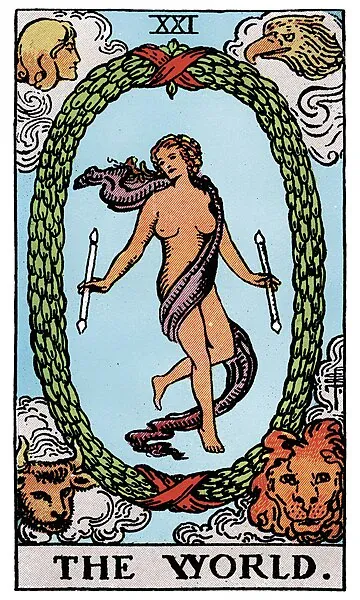
The lantern's small light meets the closing dance of the great cycle. When these two appear together the reading is almost always about a long arc that has finally arrived at its honest end — a long study, a long marriage, a long version of yourself — and the card asks you to walk the last stretch alone before stepping into the new circle. The World is the room of joined hands; the Hermit is the corridor of one careful foot before the door. Do not enter the room before you are ready. The world will wait. It always does for the seeker who walks the last steps with the lantern lit.
The Hermit + The Moon
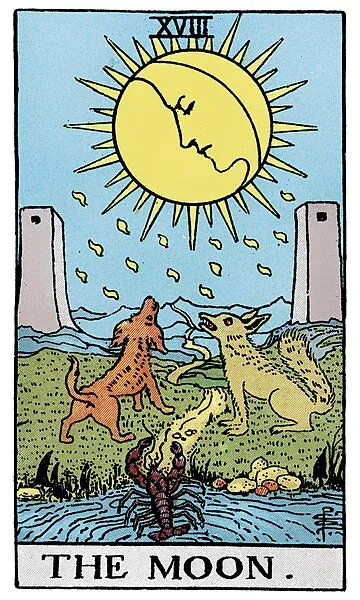
The lantern alongside the larger uncertain moon. This combination describes the season when the seeker is walking through fog with only enough light for the next step. The Moon's anxiety wants to read the whole road; the Hermit's lantern refuses to. The pairing asks the seeker to trust the small lit foot rather than the large unlit horizon. Whatever shape your fear is taking, the card pair says: you cannot see further yet, and you do not need to. The small light is enough to land the next step, and the next step is enough to keep walking.
The Hermit + The Empress
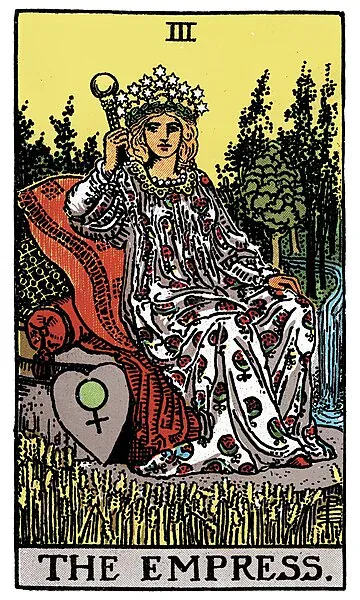
Withdrawal beside sensual fullness. This is the rarer pairing the deck offers — the hooded ascetic on the ridge meeting the green earth of the garden below. The reading usually means the seeker is being asked to integrate two halves of their life that have been kept separate: the inner life of solitude and study, and the outer life of body, relationship, and pleasure. Neither half can become the whole. The Empress brings the meal to the Hermit's table; the Hermit brings the discernment that lets the meal be tasted properly. Build a life that contains both rooms.
The Hermit + The Hierophant
The private knower next to the public teacher. This combination, when it arrives, asks the seeker to consider the relationship between inherited wisdom and personally lit truth. The Hierophant carries the tradition; the Hermit carries the lantern. The pairing is most generative when the seeker stops choosing between them — when the tradition is studied seriously and then walked, slowly, with personal verification. The reading often appears for teachers, scholars, contemplatives, anyone whose work involves carrying received material into personal practice. Honor both. Refuse neither.
The Hermit + Nine of Pentacles
The lantern and the cultivated garden. Both are Virgo cards in different keys — one in the snow, one in the orchard — and together they describe the seeker who has built a life of self-sufficient depth. The reading is usually one of the deck's most quietly affirming. You have made the room you needed. The discipline has paid the dividend it was supposed to pay. The work now is to inhabit what you have built rather than to keep climbing in search of the version of it that does not yet exist. Eat the figs from the wall. Read by the lantern. The garden was the point.
Card Combinations
The World
The lantern's small light meets the great closing circle. A long arc has reached its honest end and the card asks you to walk the last stretch alone before stepping into the new room. The World is the dance of joined hands; the Hermit is the corridor of one careful foot before the door. Do not enter before you are ready — the world waits for those who arrive lit.
The Moon
The lantern alongside the larger uncertain moon. The seeker walks through fog with only enough light for the next step, and the Moon's anxiety wants the whole road while the Hermit's lantern refuses to. Trust the small lit foot rather than the large unlit horizon. Whatever your fear is mapping, you cannot see further yet — and you do not need to.
The Empress
Withdrawal beside sensual fullness — the hooded ascetic on the snowy ridge meeting the green earth of the garden below. The reading asks the seeker to integrate the inner life of solitude with the outer life of body, relationship, and pleasure. Neither half can become the whole. The Empress brings the meal; the Hermit brings the discernment that lets the meal be tasted properly.
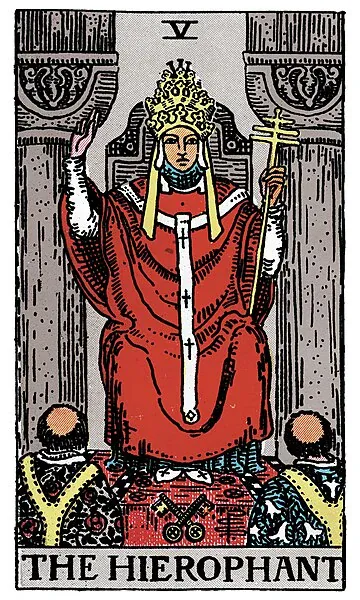
The Hierophant
The private knower next to the public teacher. The Hierophant carries the inherited tradition; the Hermit carries the personally lit lantern. The pairing is most generative when the seeker stops choosing between them — studies the tradition seriously and then walks it with personal verification. For teachers, scholars, contemplatives, anyone carrying received material into personal practice. Honor both. Refuse neither.
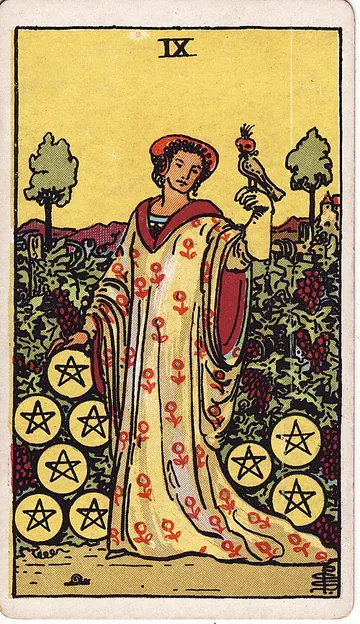
Nine of Pentacles
Two Virgo cards in different keys — the lantern in the snow and the cultivated garden in the sun. Together they describe the seeker who has built a life of self-sufficient depth and earned its quiet rewards. The discipline has paid the dividend. The work now is to inhabit what you have built rather than to keep climbing in search of a version that does not yet exist. Eat the figs. Read by the lantern.
Frequently Asked Questions
What is inside The Hermit's lantern?
A six-pointed star, and it is the only light he is offering anyone. The Hermit tarot card describes a season of deliberate solitude — withdrawal from the noise so the inner voice can be heard again. He is the figure on the snow summit lifting a small lantern that lights only one step at a time. Read him as the card of careful pace, patient discernment, and the quality of judgment that only returns when the days have quieted.
Is the Hermit telling me to wait, or to go ahead on my own?
Both, in that order. The Hermit upright is a conditional yes — yes to the slow, contemplative version of what you are asking about, and a request to wait when the question demands fast public action. He supports paths that require depth before visibility, and asks for one extra cycle of patience on decisions that feel urgent. The waiting is finished when you can say what you want in one plain sentence without rehearsing it first. After that, going alone is not the consolation prize; it is the method this card actually prefers. The right answers, under the Hermit, almost never expire inside two weeks.
Can the Hermit describe a happy relationship, or does it always mean being alone?
It describes a great many happy relationships — it simply describes the quiet ones. Upright, the Hermit means the bond is asking for room: not distance as flight, but space inside it where each person can hear themselves again. For new connections, he counsels patience. For long partnerships, he confirms a maturation into a quieter, more durable register. For singles, he asks you to stay on the ridge a little longer rather than coming down for relief. The card that looks like solitude is most often describing two people who have stopped needing to perform for one another.
If someone reads as the Hermit toward me, is their silence thinking or avoidance?
Upright, it is thinking. When the Hermit appears as feelings, the other person is considering you carefully, slowly, and durably — not flashy, not loud, but unmistakably attached. They retain detail. They notice things. Their feelings are being weighed before they are spoken. Read it as a yes that has not yet been declared aloud rather than as indifference; the silence is preparation, not absence. Avoidance belongs to the reversed orientation and has a different texture — replies that get shorter rather than slower, and a warmth that thins as the quiet lengthens instead of deepening inside it.
Why is the light in The Hermit's lamp so small?
Because the small lit thing in the hand — the daily practice, the morning sit, the patient walk — is the same fire as the great invisible one above. There is no second flame to chase. The card invites a thirty-minute weekly practice of solitude with no input, and rewards it by sharpening the inner ear so the voice you have been unable to hear becomes audible again.