
The Hermit Reversed · Core Meaning
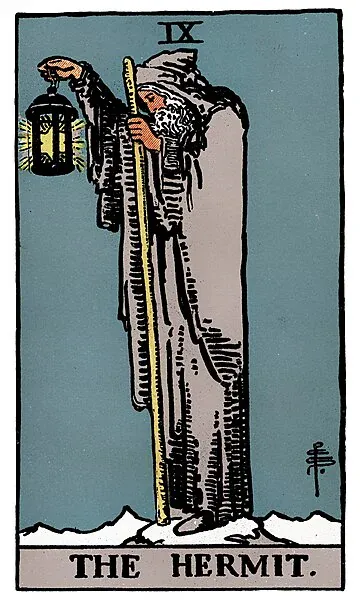
The Hermit reversed is the same figure on the same summit, but the lantern has lowered. Where, upright, the small gold of the lantern lit one step ahead of the foot, reversed it now lights only the foot itself — and not for guidance, but for guarding. The hood is drawn further. The staff is planted. The figure has stopped walking. The card describes the seeker who climbed the ridge for good reasons, found something true, and then refused to come down. Withdrawal has stopped being a phase and started being a fortress.
For seekers searching the hermit reversed meaning, the central inversion is the small but decisive shift between solitude and isolation. Solitude is a season of inward attention that nourishes the rejoining; isolation is a habit of inward retreat that postpones it. The Hermit reversed is rarely the card of someone who has just begun avoiding people. He is the card of the seeker who has been alone long enough that the aloneness has become the identity, and the rejoining feels, increasingly, like a defeat. The lantern, lowered, has begun to function as a wall.
The snow tells you which of the two you are looking at, because the snow keeps a record. Upright, the footprints behind the figure make a line — one step, then the next, each landing where the light had just reached. Reversed, they make a circle. The old man has been walking the same small perimeter around the same planted staff for so long that the ground is trodden hard and nothing new can be heard in it. This is the diagnostic the card offers in lived life. Solitude produces a line: a decision reached, a sentence composed, a piece of work that was not there before the quiet. Isolation produces a circle: the same evening repeated, the same conversation rehearsed and never had, the same reasons for not descending polished a little brighter each week. Ask what the last month of quiet has produced. If the answer is a line, the card is upright in your life whatever the deck says. If the answer is a circle, the reversal is exact.
The reversed card has a second flavour. Not the lonely hermit who cannot come down, but the proud one who will not. The seeker has done the inner work. The lantern is real. The discernment is real. The hours of contemplation have produced something genuine. And, in the genuineness, a quiet contempt has begun to assemble for those who have not yet done the work. The Hermit reversed becomes the figure who keeps the lantern but stops handing it to strangers. The wisdom calcifies into a threshold. Knowing becomes a posture of keeping others out. The card warns against this slowly. It is one of the more painful reversals in the deck because the inner work that produced it was, originally, real and good.
The astrological signature reverses with the figure. Mercury in Virgo upright is patient analysis and discernment that nourishes; reversed, it becomes nitpicking, perfectionism, and the exhausted critique that finds fault in every approach so that nothing has to be tried. Virgo's gift becomes Virgo's prison: the seeker who can see every flaw stops being able to commit to anything imperfect, and life becomes a long sequence of refused offerings rather than a finite sequence of imperfectly chosen ones. The path 20 from Chesed to Tiphareth, when blocked, leaves Chesed's mercy stranded above and Tiphareth's beauty starved below. The Yod, that single drop of fire, is held but never given.
Nine, the card's number, is the drawing-inward that narrows the road to a few questions asked with precision. Reversed, the narrowing continues past precision into a single question asked so many times it has stopped being a question and become a groove. The melancholic temperament that made the upright figure clarifying — withdrawn so as to see — becomes, when the withdrawal outlives its purpose, simply heavy: the deep-blue and ash-gray of the card's palette without the lantern-gold. The card's animals name the two exits. The owl hunts by night and returns to the same tree, but it hunts; the solitary stag stands apart from the herd through the autumn, but comes down to the river to drink. Neither of them stays on the summit. The reversed Hermit is the figure who has forgotten that even the creatures who belong to solitude keep an appointment with the valley.
Reversed, the Hermit asks: when did the solitude become the answer rather than the question? And: who, in the village below, has been waiting for you to come back? And: where, in the well-furnished cave you have built, is the door for anyone else?
The Hermit Reversed · Love & Relationships
"I just need some space," said in the tone that closes a door rather than opens a window. The Hermit reversed describes intimacy refused under the language of needing space. Not the genuine need for solitude that the upright card defends — that one is real and the card honors it. Reversed, the card describes the seeker who has discovered that "I need space" is a sentence that ends most conversations and has begun to use it as a shield. Or it describes a partnership in which both people are on separate summits, each waiting for the other to be the first to raise the lantern across the divide, neither willing to make the descent.
For an existing partnership, the reversed Hermit often indicates the slow accumulation of small absences. One partner has been emotionally elsewhere for months. The other has not asked, partly out of respect, partly out of a quiet fear of what the answer would be. The household runs. The bills are paid. The bed is shared. And the actual relationship, the one made of attention exchanged, has thinned to a habit. The reversed card warns that the structure cannot hold indefinitely on habit alone. The descent — the conversation, the warmth, the willingness to be seen unguarded — has to be made by someone, and waiting for the other person to make it first is one of the quieter ways relationships end.
For someone in a new connection, the Hermit reversed can describe a partner who is using the language of self-protection to avoid showing up. They are honest about needing solitude — and they are using the honesty strategically. They never quite refuse. They simply never quite arrive. The card asks the seeker to read this clearly. There is a difference between a person who is reserved and earning trust over time, and a person who is reserved and using the reservation as a permanent excuse. The first will, eventually, bring the lantern across the divide. The second will not. The reversed Hermit leaves the verdict to the seeker; it just provides the framework to see clearly.
For the question of whether someone is in love with you and the card arrives reversed, read with care. They feel something. They have been thinking about you. The thinking has become its own world for them — a private inner room where the relationship is, in some sense, more developed than it has been in any actual conversation. They have decided things in the room. They have not told you. The reversed card warns that you cannot wait indefinitely for the room to open. The work, if there is work, is theirs: to bring the contemplation into the actual relationship. You can ask. You cannot mind-read.
For reconciliation questions — when an old relationship is in question — the reversed card offers a soft no, or a yes that arrives with a heavy condition. Returning to the relationship would mean returning, also, to the patterns of withdrawal that defined it. Both of you went up your own ridge. Coming back would require both of you to come down. If only one of you is willing, the reconciliation will rebuild the same exhausted shape. The card asks: have either of you actually changed in the time apart, or have you both simply gotten more practiced at being alone? The honest answer determines the reading.
There is a version of this card that lasts three days rather than three years: the silence after the argument. One of you said the thing, the other went quiet, and the quiet has now outlived the anger it was meant to protect. The hood is up. The staff is planted in the hallway. The reversed Hermit describes stonewalling with unusual sympathy, because it knows the impulse is often not punishment but overwhelm — the person who has gone silent genuinely cannot find the sentence, and every hour the silence lasts the sentence gets harder to find. The card's counsel is to shorten the interval rather than to win it. If you are the one who has climbed, come down with a small sentence, not the whole reckoning: "I'm not ready to talk about it yet, but I'm here." If you are the one waiting at the foot of the ridge, do not shout up. Leave the light on in the kitchen. The Hermit reversed descends toward a lit room far more readily than toward a raised voice.
For the single seeker, the reversed Hermit is gentle but specific. The solo life has become so well-arranged that no actual person could enter without disturbing the arrangement. You have made the silence so beautiful that any voice would feel like noise. The card is asking whether the arrangement is still serving you, or whether it has begun to serve only itself. The remedy is not to abandon the solitude. It is to leave one chair empty in a way that someone could actually sit in, without having to first re-arrange the room.
A final note on the card's love language reversed: the Hermit personality, when wounded, can confuse withholding with depth. They can convince themselves that not saying is a higher form of feeling than saying. It is not. The unspoken love is real to them. To everyone else, it is functionally absent. If the card is yours, the assignment is to risk speaking. If the card describes someone you love, the assignment is to ask once, gently, and to not chase if no answer comes.
The Hermit Reversed · As Feelings
The warmth is real and it is being kept in a room whose door has not been opened yet — with the Hermit reversed, the shut door is a fact about them, not a verdict about you. They feel something. They have been feeling it for a while. The feeling has been going inward instead of outward, and the longer it stays inward the harder it becomes for them to translate it into a sentence the other person could hear. The reversed Hermit in feelings is the card of the unsent letter that has been re-drafted so many times it has lost its original heat.
If they are reserved by nature, the Hermit reversed in feelings can mean prolonged paralysis. They are not moving toward you. They are not moving away from you. They are sitting with the question of you in a private room, and the sitting has gone on long enough that the room has started to feel safer than the actual conversation would. This is not malice. It is the reservation curdling into stasis. The card asks the seeker to read the stasis honestly: warmth that never makes it across the table, after a certain interval, is functionally equivalent to absence, however much the other person feels it inside.
If they are demonstrative, the reversed Hermit in feelings is more uncomfortable. The demonstrative person, under this card, has often gone unusually silent. They have stopped performing. They have not, however, replaced the performance with anything more honest. They are, in some quiet way, hiding. They feel something, and they are choosing not to show it because showing it would commit them to a version of the future they have not yet decided they want. The reversed card warns against waiting for them to arrive at the decision in their own time without input. Sometimes, the input is the thing that lets the decision finish.
For a partner you have been with a long time, the Hermit reversed in feelings can describe the season of well-fed contempt. They love you, or they did love you, and the love has accumulated a quiet ledger of small grievances they have never said aloud. The grievances are not large enough to justify saying. The unsaying has, over years, hardened into a faint ambient irritation that you can feel in the room without being able to name. The card is asking for the conversation neither of you wants to have. The longer it is deferred, the more crowded the cave becomes.
For a new connection, the reversed Hermit in feelings can describe someone who is keeping you in a permanent drafting room — interesting to them, considered, even cared about, but never quite advanced into the real schedule of their actual life. They like the idea of you. They have not yet committed to the version of themselves that would let you enter the schedule. The card is not negative. It is precise. The work is theirs.
Someone who disappeared — the replies that stopped mid-conversation, the plans that were never canceled because they were never confirmed — is the Hermit reversed at its most literal, and the card is more honest about them than the silence lets you be. They did not stop feeling something. They stopped being able to bear the version of themselves that would have to explain the feeling, and the not-explaining became its own small fortress. Every week that passes makes the first message back more expensive, and they know this, and the knowing is part of what keeps the lantern lowered. What the card cannot tell you is whether they are going to pay that cost. It can tell you that the silence is about their own circle in the snow, not about a flaw in you — and that a door left open for a year is not hospitality, it is a draught. Close it gently. If they come back, they can knock.
An ex, described by the reversed Hermit, is someone who thinks about you more than they would ever admit and has arranged their life so that the thinking never has to become contact. The old grievances have been kept and sorted — Virgo reversed does not compost, it catalogues — and the catalogue is warm to the touch, which is not the same as wanting you back. If you are hoping for a return, the card says the door is unlocked from their side but they have pushed a chair against it. If you are hoping to be left in peace, the card says you largely are; the noise you sense is happening inside their cave, not at your gate.
A small caution that recurs: the Hermit personality, reversed, can profoundly underestimate how much their silence costs the people around them. They are inside the silence. To them, the silence is full of careful thought about you. To everyone else, the silence is a flat blank. If you love this person, ask once, gently, what they have been thinking. Do not chase if no answer arrives. The Hermit reversed responds to a single direct invitation more than to repeated knocking.
The Hermit Reversed · Career & Work
Twenty-one tabs open, a document still called "notes", and not one message sent. The Hermit reversed describes thinking used to postpone doing. The research has gone deep. The analysis is meticulous. The understanding of the problem is more refined than anyone else's in the room. And the hands have not moved. The reversed card warns of the seeker who has mistaken the preparation for the work — who has spent so long sharpening the lantern that the walk itself has not begun.
If you are asking whether to stay in a current role, the reversed card warns of the comfortable hiding place. The role lets you think. The role does not require you to be very visible. The role pays adequately and asks little of your public energy. And, somewhere in the slow comfort, the seeker has stopped doing the work they actually came to do. The reversed Hermit is the card of the senior engineer who has stopped shipping, the senior writer who has stopped drafting, the senior practitioner who has stopped seeing patients with full attention. The expertise is real. The instrument has rusted from disuse.
For someone considering a new role, the reversed Hermit indicates that the new role will not solve the underlying problem if the underlying problem is the seeker's own withdrawal. The role will not be the ridge that finally rejoins the village; it will become another quiet ledge from which the seeker watches. The card is not against changing roles. It is against changing roles as a substitute for changing the inner pattern.
Entrepreneurs and freelancers should read the reversed card as a check-in question. Has the practice become an excuse for not engaging with the world it was supposed to serve? The reversed Hermit warns of the founder who has built a small business so they would never again have to attend the meeting, take the call, sit in the room with the colleague who challenges them. The autonomy of the freelancer can become, over years, a sophisticated avoidance. Re-engage with one collaboration. Take one client whose taste differs from yours. The card returns to upright when the practice begins to include voices other than your own.
Remote work gave the reversed Hermit a habitat it never had before. The camera stays off. The status light is green and the person behind it has not spoken in a meeting for a month. The work still gets done — usually well, because the solitude was genuinely productive at first — and nobody on the team could now say what this colleague is thinking, wants, or is quietly planning to leave over. If this is you, the card is not asking for performance; it is asking for one visible foot. Turn the camera on for one call. Write the short message that says what you are working on before anyone asks. The circle in the snow, in a distributed team, is invisible to everyone but the person walking it — which is exactly why it lasts.
The specialist who has become the only one who knows is the reversed card's other office shape. The knowledge is real and hard-won, and over years it has been kept rather than handed on: no documentation, no second person trained, every question routed through one head. It feels like indispensability. Read closely, it is the lantern lowered — the light kept so near the bearer's own feet that the team cannot walk without them, and the bearer cannot take a holiday without dread. The card asks you to write the thing down and teach it once. You lose nothing that was yours. You gain the ability to leave the room.
For a creative practice, the Hermit reversed can describe the artist who has been "working on the book" for seven years, or the painter whose next exhibition has been "almost ready" for three. The work has become a ritual rather than a body. The reversed card is gentle but exact. Ship the imperfect version. The fear that the work is not yet good enough is, often, the lantern lowered against the page rather than over it. Show the work. Take the criticism. The next iteration is real only after the current one has met the world.
For questions about authority and recognition, the reversed Hermit warns of the colleague who has used seniority to install themselves above the actual work — the figure who attends meetings, opines, gatekeeps, and never quite contributes anymore. If you are this person, the card offers the chance to notice and step down from the ledge. If you are working under this person, the card validates what you are sensing: their wisdom is partially real and is being deployed, increasingly, to keep their position rather than to build the work. The path forward for you may not be through them.
For job-search and career-transition questions, the reversed Hermit warns against the perpetual sabbatical. There is a difference between the protected solitude of the upright card, which produces clarity, and the extended drift of the reversed card, which produces the appearance of clarity without the commitment. If you have been "thinking about your next chapter" for more than a year without any concrete movement, the lantern has lowered. Apply for the imperfect role. Take the imperfect step. Movement, not contemplation, is now the corrective.
The Hermit Reversed · Money & Finances
Frugality can be a practice, or it can quietly become a verdict on everyone who spends more; the Hermit reversed catches the moment it turns into the second — or, in the opposite tilt, the seeker who has stopped looking at the accounts at all because looking has become unbearable. Both are versions of the lantern lowered. In the first, the seeker is so proud of their austerity that they cannot accept the offered abundance when it arrives. In the second, the seeker has retreated from the financial reality so thoroughly that the small fixable problems have become large unfixable ones.
For the seeker who has been managing scarcity, the reversed Hermit warns against the identity of being someone who needs nothing. Frugality, when it has hardened, becomes a refusal to receive. The seeker turns down help. Turns down opportunities. Turns down the meal a friend offers because accepting it would disturb the careful image of the self-sufficient ascetic. The card asks for a softer relationship with abundance. You are allowed to receive. The lantern was for walking, not for refusing.
For the seeker who has been overspending, the reversed Hermit can describe the comfort that has crept upward without being noticed. Small luxuries have multiplied. None of them, alone, would count as extravagance. Together, they have begun to consume the buffer that used to be there. The reversed card asks for the audit you have been deferring. Look at the statements. Look at the patterns. The information will not punish you. It will simply tell you what you have been doing.
For someone in financial recovery, the reversed Hermit describes the rebound or the relapse — the long climb out of debt that has stalled because the discipline has loosened, or the careful budget that has cracked under the pressure of one bad month. The card is gentle. Most recoveries are non-linear. The point is not that you slipped; the point is whether you keep walking after the slip. Resume the practice. Do not punish the lapse for so long that the punishment becomes its own reason to stop.
For a financial bet, an investment, a major purchase, the reversed Hermit warns against the seductive analysis. You have studied the decision so long that the studying has begun to feel like the decision. It is not. At some point the seeker has to land the foot, and the lantern's job is not to remove the risk but to light the next step. Pick the version you are willing to live with if it is wrong. Make the move. The reversed card stops being reversed the moment the hand actually moves.
For investments, gambles, or speculative moves, the reversed card warns of the trap of clever isolation. The seeker who has done all their thinking alone, refused outside counsel, refused to test the thesis with anyone whose taste differs from theirs, has produced a thesis that may be brilliant and may be hermetic. Test it. Show the math to one trusted person. The reversed Hermit's worst trades are usually the ones nobody else saw before they were made.
For windfall, the reversed Hermit describes the seeker who receives money and immediately retreats into private deliberation without inviting any input. The deliberation is fine. The hermetic version of it is not. Sit with the money for a season; do not, however, refuse all counsel for the season. There is a difference.
Two people in one household, two ledgers that never meet: each pays a share, each knows a balance, and neither could describe the whole. It looks like respect for autonomy. Under this card it is often two summits with no light crossing between them. The same shape appears in families around an ageing parent — the care costs, the will, the account nobody opens — where everyone protects everyone else by saying nothing until the arithmetic arrives all at once. Put the numbers on one table for an hour. Not to merge the money; only so that one person stops being the only one who knows. What goes unspoken about money in a house tends to be charged as interest somewhere else.
An invoice sixty days old sits in a folder beside three unsent versions of the email chasing it. This is the reversed Hermit in the accounts of the self-employed: money already earned and quietly abandoned, because asking for it would mean being seen wanting something. The rate has not moved in three years for the same reason. Virgo's precision is entirely intact here — the hours logged to the quarter, the spreadsheet immaculate — and all of it points inward, at a record nobody else reads. Send the plain version. Two sentences, the amount, the date. The discomfort of being seen asking lasts about four minutes; the resentment of going unpaid has already lasted a season.
A practical move when this card appears in a money question: open the accounts you have been avoiding. Spend twenty minutes looking. Twenty minutes is enough. The reversed card softens the moment the lantern is raised again over the actual numbers.
The Hermit Reversed · Health
A whisper ignored long enough turns into a knock, and then into a bang on the door. The Hermit reversed describes the body whose signals have gone unanswered until the system had to start raising the volume. The condition that was a whisper has become a sentence. The fatigue that used to lift on a Saturday has begun to follow the seeker into the next week. The card is rarely about a sudden illness. It is about the slow accumulation of refused information from a body that has been speaking quietly for months.
If you are asking whether a treatment will work, whether a recovery will hold, whether the body can return to a previous state, the reversed Hermit answers with conditional yes. The treatment will work — but only if the seeker stops using stoicism as a substitute for follow-through. The reversed card warns of the patient who skips appointments because the appointments are inconvenient, who decides on their own that the medication is no longer needed, who has read enough on the internet to second-guess the practitioner. None of this is judgment. The card simply says: a body cannot be managed by lantern alone. Sometimes other people's lanterns are needed.
For someone managing a chronic condition, the reversed Hermit can describe the season when self-management has slipped under the cover of independence. The prescription is followed on the days the seeker privately agrees with it. The exercise has shrunk to the absolute minimum. The discipline that once held the condition stable has loosened, and the loosening has been described to the self as "trusting the body." The reversed card does not endorse this story. The body trusted is the body listened to with attention; the body neglected is something else.
The card's particular health signature reversed is the digestive and nervous system in distress — Virgo's traditional rule, the gut and the channels of fine-grained processing, complaining. Bloating. Disordered sleep. The mind racing at three in the morning around problems that, in daylight, are smaller than the racing suggested. The reversed Hermit names this pattern. Audit the small inputs again. The third coffee. The late-evening glass. The screen at midnight. The card is not original about lifestyle changes; it is exact about which changes matter.
For someone managing food relationships, the reversed Hermit can describe the discipline that has hardened into rigidity, or the rigidity that has cracked into chaos. Both are reversals of the patient ordering the upright card represents. The remedy is the same in both directions: bring an outside witness. A practitioner. A friend who is not afraid to name what they see. The hermit cave, in matters of food, is one of the quieter places where harm hides.
For mental health questions, the reversed Hermit describes the long retreat into the inner world that has stopped producing insight and started producing static. The journaling has become rumination. The walks have become loops of the same anxious sentence. The therapy has lapsed because going felt harder than not going. None of this is failure. It is information. The card asks for re-engagement with one external structure — a clinician, a group, a friend who can be honest. The lantern, at this stage, needs another lantern to find its way home.
Recovery conducted behind a closed door is the other reversed shape: the surgery, the burnout leave, the fracture, the long infection that nobody was told about, because being seen diminished felt worse than healing slowly. The exercises get done in a locked room for eleven days and then stop, and there is no one near enough to notice that they stopped. Convalescence in this card's hour keeps the rhythm of early autumn, after the harvest is in — shorter days, less output, the body's work done quietly under a cold sky. That rhythm holds better with one witness inside it. Tell one person the actual state of things, not the summary you give at work, and let them ask you about it on Thursday.
Two years of holding the lantern over someone else's feet, and the bearer's own ground has gone unlit. The seeker in the caregiver's season knows another person's medication schedule by heart and could not say when their own last check-up was. The dentist. The scan. The referral that expired. Each deferral individually defensible, the pile of them not. The reversed card is not scolding this. It notices only that Virgo's care has been aimed entirely outward, and that the body doing the carrying has been filed under later. Book your own appointment inside the same call in which you book theirs. One descent, one afternoon. Nobody being cared for is served by a carer who is quietly coming apart.
A card can tell a carer to make the appointment; what happens inside it is medical advice, and that comes from a clinician. Keep your practitioners. Take your medicine. Schedule the appointment you have been deferring. The card simply offers a gentle, honest mirror: independence is not the same as wellness, and the reversed Hermit is the card of the gap between the two.
The Hermit Reversed · Spirituality
The practice has become beautiful and nobody has been let anywhere near it. The Hermit reversed describes the seeker whose interior life has grown so refined and so private that the original purpose of the practice — to live more honestly with other people — has slipped out of view. The cave has become beautiful. The library is impressive. The meditation cushion is worn at the center with use. And the seeker has, somewhere in the years of dedication, lost the willingness to be visible to anyone who has not done the same work. The wisdom is real. It is also being kept.
This is the spiritual seeker who has read deeply, sat carefully, and stopped sharing. Not out of secrecy in the traditional sense. Out of a slow contempt for the ones who have not yet read what they have read, sat as long as they have sat, walked the road they have walked. The reversed card names this without melodrama. Most lifelong practitioners, somewhere in the journey, encounter this version of themselves. Shame is the least useful response available; noticing that the lantern has been turned inward is the useful one. Wisdom kept is wisdom curdling. The lantern was made to be raised.
For someone in active spiritual practice, the reversed Hermit describes a plateau that has hardened into a position. The breakthroughs have stopped. The teachings have stopped feeling alive. The practice has become routine in the dull sense rather than the steady one. The seeker has begun to defend the form they once received as if questioning it would be betrayal. The reversed card invites a reset. A new teacher whose lineage is unfamiliar to you. A practice you have been quietly dismissive of. A conversation with someone whose path differs from yours. A lantern that never leaves the summit lights nothing at all.
For someone exploring belief, the reversed card warns against intellectual hoarding. The collection of teachings has become a substitute for the surrender any one of them was supposed to invite. The seeker can speak fluently about half a dozen traditions and inhabits none of them. The reversed Hermit asks for one teaching, taken seriously, lived for one full season without the comfort of the others to fall back on. Not as fundamentalism. As fidelity.
For questions of path, the reversed Hermit asks whether you have mistaken the cave for the journey. The retreat that was meant to be a phase has become an address. The cushion that was meant to be a meeting place with the larger life has become a refuge from it. The card respects the cave. It just notices that you have stopped leaving it. The work, gently, is to walk back down the mountain once. Bring the lantern. Sit at the table with people whose questions are not yet your own.
The card's spiritual practice, reversed: give one teaching away. Send the book to the friend who is in the season you were in five years ago. Have the conversation about your practice with a stranger at the dinner who asked. Teach the small thing you know without claiming the larger thing you do not. The reversed card returns to upright the moment the lantern is raised for someone who is not the bearer.
A final note. The Hermit reversed, integrated, can become one of the most useful figures in the deck — the seeker whose interior depth is balanced by a willingness to come back into the village without losing the depth. The unintegrated reversed card sits in the cave forever, the library larger every year, the visitors fewer every season, until the cave has become the world and there is no village left to descend to. Choose, instead, to descend.
The Hermit Reversed · Yes or No
Soft no — or a yes whose conditions you have not yet met.
The reversed Hermit is rarely a clean instant yes. The hermit reversed yes or no question, when it lands on this card, is more often answered as: not under the current conditions, and the current conditions are largely the seeker's own withdrawal. The thing you are asking about may be available; the version of you available to receive it is not yet ready. The reversed card asks you to look at what is being asked of you before counting the answer.
For yes-or-no questions about whether someone will return — to a relationship, to a friendship, to a job they once had with you — the reversed Hermit answers no, or a soft maybe that depends on whether the original distance has been understood by either party. Returning to the same shape that drove the distance is unlikely; returning to a renegotiated shape is possible if the work to re-shape it has been done. The card is honest. Most reconciliations under this card succeed only when both people have actually changed in the time apart.
For yes-or-no questions about whether to act now — accept the offer, send the message, make the move — the reversed Hermit warns against impulsive action driven by loneliness or restlessness. If the question would still feel important in two weeks, ask it then. If the urgency is what is driving the question, the reversed card answers no. Wait. The lantern has lowered for a reason; raise it deliberately before you walk.
For yes-or-no questions about a creative or professional project — should I ship it, should I publish, should I launch — the reversed Hermit, this time, often answers yes. Counter-intuitively. The reversed card frequently means the seeker has been hiding behind preparation, and the verdict is to ship the imperfect thing rather than perfect it for one more season. The reversed card distinguishes between "wait so the work matures" (upright) and "wait so the seeker never has to test the work against the world" (reversed). If you have been working on it for years, the answer is yes — go.
For questions about whether someone is being honest, whether an offer is genuine, whether a plan will hold, the reversed Hermit warns of pleasant retreating answers. They are not exactly lying. They are simply never quite committing. Watch for the pattern of softly evasive responses. The reversed card asks the seeker to count behaviors rather than statements.
Should I move away — the new city, the cottage at the end of the lane, the country where nobody knows me? Reversed, the Hermit answers no more often than yes, and the reason is the direction of travel. The upright figure climbs toward north, toward less noise, toward a life he has pictured in detail. The reversed figure moves away from a face, and a move made away from a face rather than toward a place ends with the same face waiting in the new kitchen. If you can describe the mornings you would have there without mentioning what you are leaving, the card softens to a yes. If every sentence about the destination is really a sentence about the departure, the answer is to stay one more season and have the conversation the move was designed to avoid. Should I say it — the apology, the confession, the truth the family has agreed not to name? Here the reversed card reverses its usual caution and says yes, and sooner than you would like. The sentence you have been drafting for a year is not getting better. It is getting heavier. Send the version you have.
A reversed-Hermit yes, when it comes, looks like descent rather than arrival. It does not feel like certainty; it feels like the small physical relief of a door opened after a long time closed — the message sent, the appointment booked, the camera switched on — followed by the surprise that nothing terrible happened. Seekers waiting for the reversed card's yes to feel like the upright card's calm are waiting for a weather that this orientation does not produce. The reversed yes is the foot moving before the mind has finished agreeing. Count it when it happens. It is the answer.
Asked how soon, the reversed Hermit suggests that timing is being controlled by the seeker's own avoidance rather than by external factors. The thing you are asking about could happen as soon as you stop deferring it. The reversed card does not promise the future will arrive on its own. It promises the future arrives on the schedule of the foot that walks.
If the question was: should I keep waiting? The reversed card answers: only if waiting is the work. If waiting is the avoidance, then no — the answer is to descend. The lantern is not a permanent address.
The Hermit Reversed · Advice
Come down the mountain once. Not permanently, not in defeat, not as a renunciation of everything the solitude has taught. Once. Long enough to remember what the village looks like, what other people's questions sound like, what the lantern is actually for. The reversed card returns to upright through the act of return.
The first specific instruction: have one conversation you have been avoiding. The friend you have not called. The parent whose voice has begun to feel like an obligation rather than a relationship. The colleague whose feedback you preempted before they could give it. The reversed card responds to one honest conversation more than to a month of further reflection. Pick the one you most want to avoid. That is usually the one the card is pointing at.
The second specific instruction: lend the lantern out. Find one person whose situation you know how to think about, and offer them what you know — without conditions, without superior framing, without the implicit "if only you had read what I have read." Just the small gift of attention to their actual question. The reversed Hermit's wisdom is real. It curdles only when it stops moving. Move it.
The third specific instruction: re-enter one room you have been refusing. The dinner party you stopped attending. The class you dropped. The committee you left because the politics felt beneath you. Go back once. You do not have to return permanently. The point is to break the closed circle, to remind the body that other rooms exist, to refuse the slow narrowing that the reversed card describes. Most seekers, after the first re-entry, are surprised by how much of their resistance was inertia rather than principle.
The fourth specific instruction, gentler than the others: forgive the years on the ridge. The reversed Hermit is often a card of seekers who blame themselves for the long withdrawal once they finally see what it cost. The withdrawal was not a mistake. It was the season the soul required. The work now is not to be ashamed of it but to begin the next season — the one in which the lantern walks back down the mountain. Most of what looks like wasted years, in the Hermit's hour, was actually preparation that simply ran longer than it should have.
Some seekers cannot descend in any literal way. The posting is remote. The child is six weeks old. The illness makes leaving the flat a project of its own. The town genuinely holds nobody who speaks your language about the things that matter to you. The instruction scales down without losing its shape. Learn the name of the person behind the counter. Keep one correspondence alive with a real letter in it. Answer the voice note the same day rather than composing the perfect reply for a fortnight. A descent is any act that leaves you reachable by one other human before the week ends. The mountain in this picture is not a place; it is the distance the bearer keeps, and that distance is adjustable in inches.
There is a way of descending that fails, and it is worth naming before you try it: coming down as an oracle. The seeker who has spent two years on the ridge arrives at the table carrying conclusions, and the table, reasonably, closes. Come back as a beginner instead. Ask three questions before offering one opinion. Let someone tell you about a show, a job, a grief you have no framework for, and resist the urge to file it inside your system. Yod is a hand, and a hand that only ever gives is still a hand that receives nothing. The descent works when the village finds you curious about it, not when it finds that you have been thinking about it from above.
A practical move for the day this card appears: send one message to one person you have lost touch with. Not a long message. A single line. "I have been thinking of you. How are you?" The reversed card responds to this single act more than it responds to grand resolutions. The descent begins with one sentence sent to one human.
A final note. The reversed Hermit's advice is unglamorous. It does not ask for transformation; it asks for re-engagement. The seeker who follows it often comes back into the world in small unspectacular ways and discovers, six months later, that the world has rearranged itself around the smaller human movements. The promotion that would not come finds the seeker once they are visible again. The relationship that had been on hold becomes possible once the seeker is reachable. The card does not promise this; it simply notes how often it happens once the lantern is raised again over the actual road.
The Hermit Reversed · Card Combinations
The Hermit Reversed + The World
The lantern lowered against the closing dance of the great cycle. This pairing usually describes the seeker who is technically at the end of a long chapter — the degree finished, the relationship over, the project completed — and who is refusing to step into the next circle. The World is offering the door; the Hermit reversed is refusing to walk through it. The reading asks the seeker what they are protecting by staying. Often it is the identity of the person who has been in transit for so long that arrival itself has become threatening.
The Hermit Reversed + The Moon
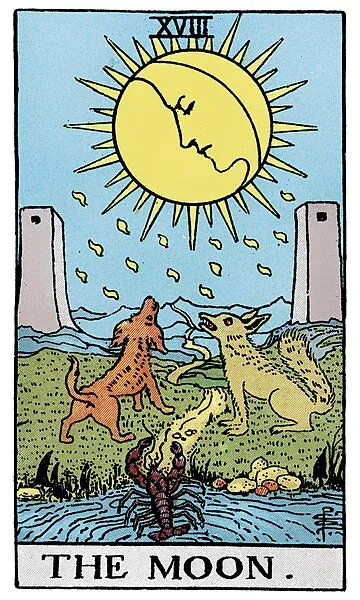
The lowered lantern beside the larger uncertain moon. This combination describes a long fog of avoidance — the seeker is no longer walking, and the road is no longer visible, and the inability to see further has become an excuse not to move. The pairing warns that the lantern's small light is still enough to land one step. The Moon's anxiety wants the whole map; the reversed Hermit has agreed with the Moon. Both cards together ask for the smallest movement available. One step lit. One foot landed. The rest will follow.
The Hermit Reversed + The Empress
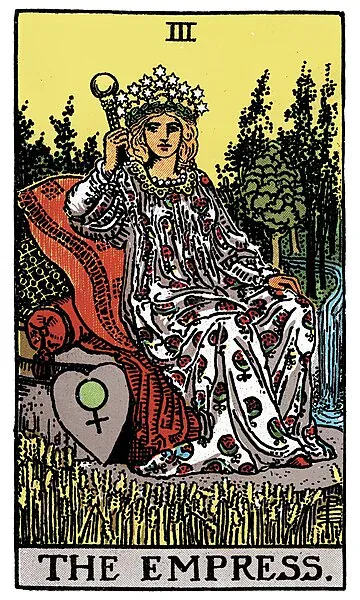
Refused withdrawal beside refused fullness. This pairing is the reading of the seeker whose interior life has hardened against the green earth of the body, the relationship, the meal. The Empress is offering the table; the reversed Hermit is refusing to sit at it. The reading asks the seeker to come back into the senses. Cook. Eat with people. Touch the partner. Walk in the actual garden rather than the abstract one. The cave was a phase. The earth has been waiting.
The Hermit Reversed + The Hierophant
The closed cave next to the public teacher. This pairing usually means the seeker has used personal contemplation to refuse all received tradition — or, in the inverse, has used received tradition to refuse personal contemplation. The two cards together ask for an integration neither extreme allows. Read one teacher's tradition seriously for a season; verify it with personal practice. Or sit alone for a season; then return to a community that holds you accountable. Neither lantern is enough on its own.
The Hermit Reversed + Nine of Pentacles
The lowered lantern in the cultivated garden. Both Virgo cards reversed produce a particular kind of melancholy: the seeker who has built a refined life of self-sufficient depth and now sits inside it unable to receive any visitors. The reading asks for hospitality. Open the gate. Invite one person into the garden you have made. The cultivation was real. It becomes generous only when shared.
Card Combinations

The World
The lantern's small light meets the great closing circle. A long arc has reached its honest end and the card asks you to walk the last stretch alone before stepping into the new room. The World is the dance of joined hands; the Hermit is the corridor of one careful foot before the door. Do not enter before you are ready — the world waits for those who arrive lit.
The Moon
The lantern alongside the larger uncertain moon. The seeker walks through fog with only enough light for the next step, and the Moon's anxiety wants the whole road while the Hermit's lantern refuses to. Trust the small lit foot rather than the large unlit horizon. Whatever your fear is mapping, you cannot see further yet — and you do not need to.
The Empress
Withdrawal beside sensual fullness — the hooded ascetic on the snowy ridge meeting the green earth of the garden below. The reading asks the seeker to integrate the inner life of solitude with the outer life of body, relationship, and pleasure. Neither half can become the whole. The Empress brings the meal; the Hermit brings the discernment that lets the meal be tasted properly.

The Hierophant
The private knower next to the public teacher. The Hierophant carries the inherited tradition; the Hermit carries the personally lit lantern. The pairing is most generative when the seeker stops choosing between them — studies the tradition seriously and then walks it with personal verification. For teachers, scholars, contemplatives, anyone carrying received material into personal practice. Honor both. Refuse neither.

Nine of Pentacles
Two Virgo cards in different keys — the lantern in the snow and the cultivated garden in the sun. Together they describe the seeker who has built a life of self-sufficient depth and earned its quiet rewards. The discipline has paid the dividend. The work now is to inhabit what you have built rather than to keep climbing in search of a version that does not yet exist. Eat the figs. Read by the lantern.
Frequently Asked Questions
How do I tell healthy solitude from the Hermit reversed?
By which direction the lantern is pointing. Healthy solitude lights one step ahead and is raised again when someone asks the way; the Hermit reversed describes solitude that has hardened into avoidance, or wisdom that has calcified into a threshold against others, with the lamp lowered until it shows only the bearer's own feet. The practical test is a small one: after a week of it, is there anything you want to hand to another person? If the honest answer is no, the card asks for descent — one conversation re-entered, one room returned to, one lantern lent out. The cure is re-engagement, not further reflection.
Does the Hermit reversed mean I have been overthinking instead of acting?
Frequently, yes — and the card is rarely a clean yes about anything else. For impulsive questions driven by loneliness or restlessness, the answer is no — wait. For questions about returning to a previous relationship or role, the answer is no unless the original distance has been honestly understood. Counter-intuitively, for creative or professional projects you have been over-preparing, it can answer yes — ship the imperfect version rather than refining it into another year of hiding.
My partner says they need space — is that the Hermit or the Hermit reversed?
The difference is whether the space has a shape. Upright, someone asks for a Tuesday evening and comes back on Wednesday with more of themselves available. Reversed, the Hermit describes intimacy refused under the language of needing space, or both partners on separate summits each waiting for the other to descend first. For new connections, it warns of the partner who is honest about wanting solitude and uses the honesty strategically to never quite arrive. For reconciliation, it offers a soft no — returning would rebuild the same patterns of withdrawal that drove the distance in the first place.
Does the Hermit reversed mean they have lost interest, or that they cannot say it yet?
Almost always the second. When the Hermit reversed describes how someone feels about you, the warmth is real but held inside a closed room they have not yet decided to open. They have been thinking about you carefully, perhaps for a long time, and the longer the thinking has gone unsaid the harder it has become to translate into a sentence. Read it as warmth without offering. The work, if there is work, is theirs — but a single direct question from you can sometimes break the silence.
How do I reverse the Hermit reversed in my own life?
Descend the mountain once. Have one conversation you have been avoiding. Lend the lantern out — give one teaching, one piece of attention, one small gift to someone whose situation you understand. Re-enter one room you stopped attending. The reversed Hermit returns to upright through small acts of re-engagement rather than through further inner work. The wisdom you have built is real; it becomes useful again only when it begins to move outward.