
The Hierophant · Core Meaning
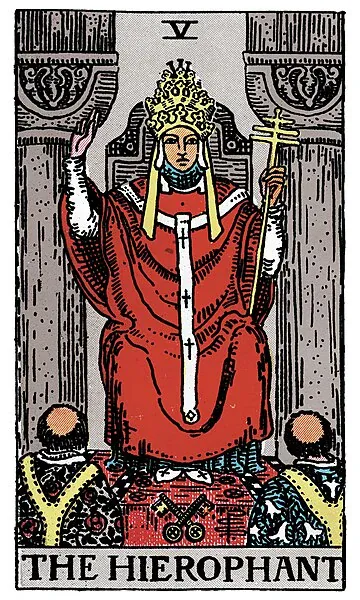
The Hierophant tarot card opens with a man who is not inventing. That single fact, easily missed in the visual density of the throne, is the card's whole engine. The Magician makes the world out of his own hands; the Empress generates from her body; the Emperor governs what is already standing. The Hierophant does none of these things. He sits in a hall of stone pillars, wearing a triple crown — the three-tiered cap of one who claims authority over nature, soul, and the sacred — and his work is to take a flame that arrived in his lifetime from teachers who are now dead, and pass it, ember by ember, to a pair of acolytes kneeling in front of him. One acolyte wears red roses, the other wears white lilies. At the foot of his throne, two crossed keys glint against the floor. He invents nothing. He hands on.
The signature tension of The Hierophant is between fire and form. By his planetary signature he is Venus — the planet of beauty, attraction, the principle of the elegant fit — and by his zodiacal signature he is Taurus, fixed earth, the patient ground that resists novelty for the sake of it. Together they describe a particular kind of intelligence: the intelligence that understands a teaching is not yet a teaching until it has found a vessel that can carry it across centuries without the carriers having to be geniuses. The mystery is hot; if it is to last, it has to be poured into a form cool enough to hold without burning the hands of the next generation. This is what the Hierophant does. He takes the flame and inscribes it into a rite, a chant, a sequence of gestures, a syllabus, a habit — anything formal enough to be transmitted to someone who has not yet had the original experience.
The traditional astrological signature is Taurus, ruled by Venus. The temperament is phlegmatic in the medieval reading — slow, grounded, fluid in the way that earth is fluid (a mountain range moves; it just does so on a longer clock). Late spring is the card's season; dusk is its hour; frankincense and cedar are its scents; the bull and the elephant are its animals. Read this layer carefully: the Hierophant is not the ecstatic mystic. The ecstatic mystic shows up elsewhere in the deck. The Hierophant is the figure who comes home from the mountain, sits down, and writes the manual.
On the Tree of Life, The Hierophant walks Path 16 — the path from Chokmah to Chesed, from raw Wisdom into the founding mercy of structured form. The path's traditional title is the Triumphant and Eternal Intelligence; the Hebrew letter is Vav (ו), the nail — the small pin that fastens one thing to another, the connector that lets two pieces of wood become a beam, the joint that turns a sentence into a paragraph. Vav as nail matters more than it looks. The Hierophant is the joint between the inner experience and the outer transmission, the nail that pins the mystery to a shareable shape. Without him the Wisdom of Chokmah would never become the merciful structure of Chesed; it would simply burn itself out in the sky.
To read The Hierophant tarot meaning in any spread is to read whatever in your life has been calling for the form rather than the improvisation. The card is rarely about another person teaching you something; it is more often about the lineage you have been resisting, the rite you have been skipping, the manual you have refused to read because reading it would feel like submission. The picture itself is neutral — a seated figure between two columns, hand of blessing raised with two fingers up and two fingers down (a single teaching with two faces, the shown and the hidden), triple crown gleaming dully under the hall's slow light. The form is the question. Are you willing to learn it before asking what it means?
The Hierophant · Love & Relationships
The Hierophant tarot in love is the card of the bond that wants to be marked. It is not a romantic card in the candlelit sense — it is romantic in the sacramental sense, the sense in which two people decide that what they have between them is real enough to deserve a public form. When The Hierophant arrives in a love reading, the relationship is being asked to step out of the private space where most relationships live and into a structure that other people can see, witness, and hold. Vows. Rituals. The meeting with the parents. The ring. The names spoken in front of the room. The card is not insisting on any particular tradition; it is insisting that the bond is ready for some tradition.
For an existing partnership, The Hierophant upright often arrives at the threshold of a public commitment — the engagement, the wedding, the religious blessing, the legal partnership, the housewarming with both families present, the public acknowledgement that the bond is serious and not provisional. The card asks both partners to step into the rite together. This is not the card of a private love that has decided to remain private; it is the card of a love whose interior has matured to the point where it wants a witnessed exterior. The two acolytes of the Rider-Waite-Smith image, kneeling together before the throne, are the structural picture of this moment: two adults bringing their separate biographies into the same hall and accepting a shared form. If your relationship has been living in a beautiful private bubble for a long stretch, this card describes the season where the bubble is asking, gently, for an architecture.
For a new spark, The Hierophant warns against the modern temptation to skip the formalities. The connection is real, the chemistry is genuine, but the card asks whether you have allowed the bond to inherit any of the protective forms that older couples used to lean on. Have you met each other's families? Have you sat at a table with the friends who knew each of you before the relationship existed? Have you spoken about the values you each carry forward from the homes you came from — the food rules, the holiday rituals, the religious gravity, the family structure that will shape your shared life if you let it? The Hierophant does not kill new sparks; he simply refuses to let them pretend the past does not exist. New connections that survive The Hierophant become rooted partnerships; ones that cannot are not failures, only flames the form would have asked too much of.
For a single seeker asking about the hierophant love question — whether love is possible, whether the right person is on the way — the card offers an unusual answer: yes, but in the form already on offer rather than the form you are still trying to invent. The card is not asking you to date someone you do not love because it is socially convenient; it is asking you to notice that you have, perhaps quietly, been ruling out every available partner because none of them matches an idiosyncratic private template you assembled in your twenties. The Hierophant asks you to consider the possibility that love arrives most often inside the standard shapes — through introductions from friends and family, through community, through the ordinary settings most people meet in — rather than in the bespoke movie scenarios you may have been waiting for. Look at what is on offer. Some of it may be more right than your private template suggested.
For love after a wound — divorce, betrayal, religious crisis, the long bereavement — The Hierophant is one of the deck's quietly healing cards. He is the seated teacher who has watched many couples come apart and many others stay together for reasons they could not have named when they began. He says the next love, if it comes, will be helped enormously by the borrowed wisdom of those who have walked this road before you. Read the books. See the therapist. Talk to the elders in your life who survived their own marriages. Do not insist on inventing recovery from scratch. The form is not a cage; it is the trellis the new growth uses to find the sun.
A note on the card's particular love language: the Hierophant loves through ceremony. The anniversary noticed every year. The Friday-night meal that becomes sacred because it is repeated. The phrase that becomes a private ritual only because the two of you have said it to each other a thousand times. The shared religious or ethical practice that re-binds the two of you to each other and to something larger. People loved by a Hierophant are sometimes accused of being conservative; they are usually the most romantic people in the room, but their romance lives inside repetition rather than novelty. If you are loved by a Hierophant, watch what they ritualize. The repeated gesture is the love letter.
For the question of whether someone is in love with you and The Hierophant arrives upright, the answer is yes — and the further answer is that they are taking the bond seriously enough to want it placed inside a recognized form. They are not playing. They are not improvising. They are quietly considering, somewhere in the back of their mind, what it would look like to bring you into the ceremonies that organize their life — the family holidays, the religious practice, the long-term plan that has been waiting for the right partner to make sense of. This consideration can read as slow from the outside. It is not slow because the feeling is shallow. It is slow because the form itself is being prepared.
For couples in genuine difficulty, The Hierophant is rarely the card of "leave"; it is the card of "seek the form that has helped others." Counseling. The retreat for couples. The teacher who knows about long marriages. The friends and family members who can hold the conversation without taking sides. The middle, where one partner is privately leaving while pretending to stay, is the position The Hierophant most explicitly rejects. Either re-enter the bond inside a form that is willing to do real work, or admit honestly that the form is the wrong one and dissolve it with the same dignity the card asks for in beginning.
The Hierophant · As Feelings
When The Hierophant appears as feelings to describe how someone feels about you, the answer is: committed in the formal sense. Not infatuated. Not breathless. Not playful. They have considered you in relation to the long structure of their life — their family, their faith, their professional standing, their place in their community — and the consideration has come back favorable. This is the card of the partner who is privately working out whether to introduce you to their grandmother, whether to invite you to the religious holiday, whether to mention you in the conversation with their oldest friend. The decision is not yet announced. It is being made.
The body language the card describes is the seated body in attendance. They become more deliberate around you, not more impulsive. They listen with their whole face. They remember small things you said weeks ago and refer back to them in passing. They are not performing pleasure; they are calibrating fit. If you have ever watched someone quietly consider whether the two of you could share a household, a holiday calendar, a set of values across decades — you have watched The Hierophant in feelings. It can read as old-fashioned at first. It is not old-fashioned. It is the most considered version of attention an adult can give.
If they are reserved by nature, The Hierophant in their feelings is one of the most stabilizing commitments their interior can make. They have begun mentally placing you inside the architecture of their actual life — the family Sunday, the religious observance, the standing meeting with the friends from school, the trip taken every year to the same place. You are not yet in that architecture publicly. You are inside it privately, and the wall around the architecture is being widened, slowly, to make room for a second adult to live in it. They will not perform this for you. It shows because they begin including you in the rituals they would otherwise have done alone or with their original family.
If they are demonstrative, The Hierophant in their feelings means the demonstrativeness has acquired gravity. They are not just enthusiastic — they are consecrating. They keep the small ceremonies. They call on the date that mattered. They observe the anniversary you mentioned in passing. The volume may not have changed, but the weight has. Watch for the second category. Repeated observance, in The Hierophant's love language, is the most romantic gesture available.
For a partner you have been with a long time, The Hierophant in feelings often signals a deepening of the formal commitment. They are looking at the long horizon — the renewal of vows, the conversion to a shared faith, the merging of estate plans, the conversation with the children about what the marriage has stood for. This is not a card of crisis in long bonds; it is a card of consecration. They are re-pledging. They are reaffirming inside themselves the choice they made years ago, and they are doing it because the choice has held up under time.
For a new connection, The Hierophant in feelings can read as overwhelmingly grown-up, even traditional. They are not playing the early-stage games. They are not punishing you with strategic delays. They are asking the questions adults ask: where does your family come from, what do you believe, how were you raised, what do you want your forties to look like. This can be intimidating. It is also rare in a culture that increasingly avoids the formal. If you have spent years in connections built on calculated coolness, The Hierophant's seriousness can feel almost foreign. It is not foreign. It is what most of human history considered the entrance ramp to a real bond.
A small caution embedded in this very steady card: The Hierophant in feelings can occasionally tip into the expectational, especially when the surrounding culture or family has strong views about what your relationship should become. Watch for the shift from genuine consideration into compliance with someone else's script. The good Hierophant feeling considers you against the structures of his own life and freely chooses to include you. The compromised Hierophant is performing the inclusion because his community expects it, and underneath the form there is no actual choice. The first feels like being honored. The second feels like being slotted. If the relationship is healthy, the form is alive.
Read The Hierophant as feelings as confirmation that the seriousness on the other side matches what you suspected. Whatever they have not yet said, they have decided. The work, if there is work, is to give the decision a setting in which it can be voiced. The Hierophant speaks in formal moments — the dinner with both families, the conversation prefaced by "we should talk about the future," the evening that has been deliberately cleared. Make the room for the form. The words will follow.
The Hierophant · Career & Work
Name the lineage you are working inside. If you cannot name one, that blank is the whole reading — because The Hierophant tarot upright is the card of the credential, the lineage, the institution, the apprenticeship. The seat at the table you are being asked to earn through the established route rather than improvise around. The graduate degree the field actually values. The certification the senior people quietly checked for before they decided whether to take you seriously. The career is unsentimental about credentials: the card does not flatter you, it does not promise you the bypass, it asks only whether you are prepared to walk in by the front gate rather than negotiating the side door for the rest of your life.
For someone considering whether to stay in a current role, The Hierophant's question is whether the role is teaching you a transmissible craft. The card is not asking if you are happy; it is asking if the work you are doing every day is depositing real, named, demonstrable competence into your hands — competence that another adult could verify, that has a vocabulary, that connects you to a lineage of practitioners. Roles that pay well but teach nothing transferable are the trap The Hierophant most precisely names. If your current seat is not building a craft, the card asks you to either redesign the role to add training, or to find a role elsewhere where the apprenticeship is real. Time is short. Crafts take years. Begin.
For someone considering a new role, The Hierophant upright is one of the strongest yes cards in the deck — with a precondition. The role will deliver what it promised, if it places you inside a tradition. A team where the seniors are generous with what they know. A company whose practices have been refined over decades and are written down. A mentor who has done what you want to do and is willing to show you how. Take the role that comes with the lineage, even if the comp is slightly lower than the alternative. The Hierophant's most precise career instruction is to optimize for the apprenticeship in your twenties and thirties, and let the comp catch up later. People who reverse this order — high pay, no teaching — usually arrive in their forties technically wealthy and professionally hollow.
For founders and entrepreneurs, The Hierophant is the card of standing on the shoulders. The early instinct of every founder is to invent everything from scratch — the product, the culture, the operational rhythm, the financial structure, the management practice. The Hierophant names the cost of this instinct: most of what you are inventing has already been solved better by people who came before you, and reinventing it is a quiet form of vanity that costs you years. Read the books. Hire the consultants. Adopt the operating cadence the best companies in your field use. Save invention for the genuine product differentiator. Borrow ruthlessly everywhere else. The fire of the company is yours; the form should be borrowed from people who have already learned what burns and what holds.
For freelancers and independent practitioners, The Hierophant asks whether you are connected to a lineage. Not a job — a lineage. Have you found the teachers, alive or dead, whose work yours is in conversation with? Have you read the canonical texts of your field? Do you know who the practitioners you respect most learned from? The independent practitioners who flourish over decades are almost always practitioners with explicit teachers; the ones who flame out are usually the ones who insisted on autodidact authority and never felt accountable to a tradition. Find the teachers. Pay for the courses. Sit in the rooms. Lineage is what allows independence to deepen rather than thin.
For a creative practice, The Hierophant describes the season of formal study. Most creators have a wild early phase — improvisational, untaught, the brilliant amateur. Most then face the question of whether to formalize. The Hierophant arrives at this threshold and asks for the discipline of the workshop, the apprenticeship, the residency, the conservatory, the long reading list. Do not romanticize the autodidact identity past its expiration date. The artists whose late work is most lasting are usually the ones who paid for tuition somewhere — to a person, an institution, a tradition. Pay it.
For someone in a layoff, transition, or extended job search, The Hierophant advises against the path of "I will make myself up from scratch." The card asks you instead to identify the established route to the next thing. The certification programs. The bootcamps the hiring managers actually respect. The introductions through established networks. The recruiter at the firm that places people into the roles you want. Traditional channels move faster, in most cases, than the bespoke approach the post-2010 internet trained you to prefer. Use the channels. They exist because they work.
For workplace authority specifically, The Hierophant names a recurring trap: the senior practitioner who refuses to teach. The card calls this what it is — a quiet refusal of the role's true responsibility. If you are senior in your field, your job is no longer only to do the work. It is also to transmit what you know to the people coming up. Take the apprentice. Run the training. Write the playbook. Hold the office hour. The hierophant career step for the senior career is to become the teacher you once needed.
The Hierophant · Money & Finances
The Hierophant tarot card in money readings is the card of conventional wisdom — and, importantly, the card that asks you to actually follow it. When this card arrives in a money question, the deck is reminding you that most financial mistakes people regret in their forties were not failures of insight; they were failures of obedience to advice that was already, plainly, available. Spend less than you earn. Index funds beat active management for most people. Buy the modest house, not the aspirational one. Carry no consumer debt. Insure against the catastrophes you cannot self-insure. The Hierophant is unromantic about money for the same reason he is unromantic about love: the standard form, followed honestly, almost always outperforms the bespoke private system you are tempted to build instead.
For someone managing day-to-day finances, The Hierophant asks for the boring conventional move: open the retirement account if you have not. Set up the automatic monthly transfer. Use the budgeting framework that has helped millions of people, even if it feels generic. Pay the bills before the late fees. People resist this for two reasons. The first is the secret belief that they are too special for ordinary financial advice. The second is the feeling that following the standard playbook somehow makes them less interesting. The Hierophant responds to both: the playbook is not a moral document, it is a working set of practices refined by generations who watched what happened to those who ignored them. Use it.
For a question about a major financial decision — the house, the apartment, the investment, the loan, the partnership — The Hierophant leans toward yes, if it has been done before. The card endorses the well-trodden path: the conventional thirty-year mortgage at the prevailing rate, the index fund held for decades, the legal partnership structured the standard way for your jurisdiction, the inheritance handled by the established estate planner. The card is more cautious about the bespoke financial vehicle — the elaborate trust structure your one cousin insists on, the new asset class that does not yet have a hundred-year track record, the unconventional partnership terms that nobody has tested through a downturn. Follow the form. The form has survived because most attempts to outsmart it fail.
For investments and speculative moves, The Hierophant's caution is specific: prefer the index to the picker. The Hierophant is not anti-risk — Venus in Taurus is patient with growth — but he is anti-idiosyncratic risk. The bond that has been issued by the same kind of issuer for two centuries is more conservative than the new fund that has been around for two years, even if the new fund's recent returns are more dramatic. Time-tested vehicles are where the Hierophant places his Pentacles. Speculative side bets, if you must, should be a small fraction of the portfolio, not the architecture of it.
For someone in financial recovery — coming out of debt, rebuilding after a job loss, recovering from a costly mistake — The Hierophant describes the season of obedient practice. The debt comes down via the standard repayment ladder. The emergency fund is built one deposit at a time. The credit score climbs. The card is impatient with the get-rich shortcut, the consolidation product that promises miracles and delivers a worse rate, the multilevel marketing pitch from the relative who insists you are too smart not to see the opportunity. Slow recovery sticks. The Hierophant is the patron of the unglamorous repayment that, three years on, is the reason your life has stabilized.
For inherited or windfall money, The Hierophant is the patron of the advisor visit. Do not move the money on impulse. Do not lend it to the family member who appears within forty-eight hours of the announcement. Do not invest it in the next thing your most enthusiastic friend brings you. Park it. Pay for one good fee-only fiduciary financial advisor. Let them walk you through the standard moves for a windfall of this size. The advice will sound boring. Boring advice on windfalls is what preserves them.
For long-term financial structure — retirement, estate, the question of generational wealth — The Hierophant is most explicitly aligned with the work. The conventional retirement vehicles in your jurisdiction. The standard will. The standard medical directive. The standard guardianship designation if you have children. The card does not romanticize improvisation here. It asks for the form that the legal and financial professions have refined precisely because most attempts to be clever in this domain create problems for the people who survive you. Use the form. Let your sovereignty be expressed through the well-built document, not through the eccentric one.
The Hierophant · Health
In health readings, The Hierophant tarot card describes the body as something that responds best to rite — the ritualized practice rather than the heroic intervention. Not the new protocol, not the optimization stack, not the supplement regimen marketed by an algorithm — the boring, repeated, well-studied practice that an entire tradition has refined over decades or centuries. The card's element is earth and its planet is Venus; its temperament, in the medieval reading, is phlegmatic — slow, fluid, durable. The Hierophant's body part traditionally is the throat and neck — the meeting point between head and trunk, the column the voice passes through, the place where the body holds tension when it has been asked to swallow something it could not say.
For someone in basically good health asking about maintenance, The Hierophant asks for the conventional, ritualized minimums. Sleep on a regular schedule. Eat real food at roughly the same times every day, in roughly the same shapes — the meals your grandmother would have recognized are usually the meals your body knows what to do with. Move daily, modestly, in a form that has been practiced for centuries — walking, simple resistance exercise, basic stretching. See the doctor on the schedule the doctor recommends. The Hierophant is the patron of the unflashy adherence. Skip the optimization fad. Do the basics that have kept human beings alive for ten thousand years.
For someone managing chronic conditions, The Hierophant describes the season of obedient management. This is the card that arrives when someone has been improvising their care — taking the medication when they remember, exercising when they feel like it, reading promising-but-unproven articles instead of following the protocol their doctor wrote — and the improvisation is starting to cost. The card asks for the calendar entry, the medication taken at the same time, the blood work on schedule, the specialist seen even when there is nothing acute. Chronic conditions punish improvisation; they reward repetition. The Hierophant is the patron of the unglamorous adherence that lets a chronic condition become an old companion rather than a crisis manager of the whole life.
For acute issues — injuries, infections, the sudden body event — The Hierophant advises listening to the established practice rather than the latest contrarian wisdom. Take the antibiotics for the full course. Get the surgery the surgeons agree on. Rest the way the orthopedic protocols say to rest. The wisdom of the medical tradition is not perfect, but it has been refined through millions of cases, and your private intuition about your acute injury is almost certainly less informed than the practice. The Hierophant is the figure who reminds you that humility about the body is older and wiser than any single experimental protocol.
For mental health, The Hierophant describes the structural side of recovery — therapy in an established modality with a well-trained practitioner, medication taken consistently if it has been prescribed, the daily practices that the field has consistently found to support stability. Sleep. Movement. Connection. Time outdoors. Limited substance use. Regular meals. People in mental-health recovery often resist the conventional advice because it feels generic. The Hierophant responds: the advice is generic because it is universal. It works for most people most of the time, and the cases where it does not work are the cases where a careful practitioner can help you adapt the form to your particular shape — not the cases where you should abandon the form entirely.
For someone who has been over-controlling the body — too many trackers, too many supplements, too much fear about every signal — The Hierophant offers a counterintuitive read: trust the tradition more than the data feed. Most of the technology that promises to optimize your body has not existed long enough to know what the long-term effects of using it really are. The forms that have lasted — the religious fasts that exist in nearly every tradition, the daily walk, the bodily ritual of rest, the social meal — have lasted because they actually worked over centuries. None of this is medical advice; keep your physicians, take your medication, follow the protocol that keeps you alive. The card simply offers a frame: the body asks for what the tradition has refined, not what the algorithm has predicted.
The Hierophant · Spirituality
Spiritually, The Hierophant is the card most explicitly about the form. He is Path 16 on the Tree of Life, the bolt from Chokmah to Chesed, the path on which raw Wisdom becomes the founding mercy of structured tradition. The Hebrew letter Vav — the nail — is the spiritual instruction in compressed form: the nail is the small, humble piece that fastens the experience to a transmissible shape, the joint that lets one practitioner hand the practice to the next. Without the nail, the experience evaporates with the experiencer. With the nail, it becomes a tradition.
For someone in active spiritual practice, The Hierophant describes the moment when private exploration is being asked to enter a lineage. Most contemporary seekers spend their early years in the marketplace of practices — sampling Buddhism, Christianity, Hermetic study, Sufi reading, depth psychology, breathwork, plant medicine, the latest book — without ever submitting to a single form long enough to be changed by it. The Hierophant arrives when this phase has run its course. The card asks: which tradition will you actually study? Which teacher will you actually obey for a season? Which set of practices will you take on for long enough that they cannot be talked you out of? You do not have to choose forever. You do have to choose for long enough that the form can do its work on you. Six months in a single practice, sincerely, with the doubts held in suspension, will alter you more than ten years of comparison shopping.
For someone exploring belief, The Hierophant asks the question of submission without asking the question of certainty. You do not have to believe everything the tradition believes. You do have to be willing to follow its forms long enough to discover what they have to teach you that cannot be discovered by inspection from the outside. The card names the modern resistance to this: most contemporary seekers prefer to remain in the position of the connoisseur, evaluating each tradition from above. The connoisseur position is comfortable. It is also the position that learns the least. The Hierophant asks you to step down from connoisseurship into apprenticeship. The view from inside is different from the view from above. Both are valid. Only one is transformative.
The image of the Hierophant carries the spiritual instruction. The two acolytes kneel, not because the teacher is greater than them in any final sense, but because the teaching cannot be transmitted standing up. There is a posture the learner has to take, and the posture is humility — not abasement, but the willingness to receive. The crossed keys at the throne's foot are the two halves of a single lock; what is above and what is below open with the same pair. The Hierophant is the figure who knows that the inner experience and the outer form are not enemies but the two sides of the same key. To skip the form is to skip half the key.
For practice, The Hierophant asks for the simplest, hardest commitment available: choose one tradition, one teacher (alive or dead), one daily practice, and apprentice yourself for a hundred days. Read the foundational texts of the tradition rather than the contemporary commentary about them. Adopt the daily practice the tradition prescribes, even when it feels foreign or boring. Speak to no one about your practice for the first thirty days; the talking dissipates the practice's interior force. A hundred days in, you have learned something the comparison-shopping seeker never learns: how a single tradition feels from the inside, and what it can give to a life that has agreed to be shaped by it.
The Hierophant · Yes or No
Yes — but in the form already on offer.
The Hierophant tarot yes or no answer is among the deck's clearer yeses, but the yes carries the card's character. The Hierophant does not promise the maverick outcome, the bypass outcome, the lucky-loophole outcome. He promises that what you are asking about is available — and that the available path is the conventional one, the one that has been walked by people before you, the one whose forms already exist. The yes is a yes for the well-trodden route. It is not a yes for the bespoke shortcut.
For yes-or-no questions about a relationship, a job, a move, a decision: yes — and the card asks you to enter the situation through the standard door rather than negotiating a private side entrance. Yes, you can take the role; the path is the formal application, the proper interview, the standard contract. Yes, the relationship is real; the path forward is the meeting of families, the explicit conversation about commitment, the form most adults around you have used. Yes, you can buy the property; the path is the licensed agent, the standard inspection, the conventional financing. The Hierophant does not say no to the request. He says yes, and reminds you that the yes lives inside a form that has worked for many people before you. Use it.
For questions about whether someone is being honest, whether an offer is genuine, whether a plan will hold, The Hierophant leans yes — if the form is conventional. The standard contract from the standard firm is more trustworthy than the unusual deal structure with the unusual terms. The introduction through the established network is more trustworthy than the cold approach from the unknown party. The card does not endorse paranoia, but it endorses the wisdom of the established practice. People who insist on operating outside conventional forms often do so because the forms would not have approved of what they are doing.
Asked when, The Hierophant leans toward the traditional timeline. The card does not deliver overnight; it delivers on the calendar of well-built things. A career credential takes the credential's traditional length. A relationship moving toward marriage takes the rhythm most relationships actually take — months and years, not days and weeks. A spiritual transformation takes the season the tradition has named. The card asks you to respect the clock the form has earned. Soft yeses arrive on the timeline they should.
For binary decisions — should I take Offer A or Offer B, should I commit to X or Y — The Hierophant prefers the option that connects you to a lineage. The role with the better mentor, the partner with the more grounded family, the school with the more established faculty, the practice with the longer history. Vague gut feelings are not enough. Charisma is not enough. The promise of upside is not enough. Show me the lineage. Show me who has done this before. Show me what they learned. The option with the lineage is the option that survives.
The single caution embedded in this yes is to ask whether the form is alive. The Hierophant occasionally arrives in spreads where the seeker is being asked to enter a tradition that has technically all the right credentials but is, internally, hollow. The institution that still gives the diploma but no longer teaches the craft. The religious community that still performs the rite but no longer believes. The marriage form that two families still want, even though the two people involved are no longer compatible. The card does not automatically endorse this kind of yes. It asks you to verify that the form you are about to enter still has fire in it. If it does, sign. If it does not, the reversed card is closer to your situation than the upright.
Sometimes what is being asked is whether you deserve to be admitted at all. The Hierophant answers yes, with the additional note that the question is misframed. You do not enter the form because you deserve it; you enter the form because you have agreed to be shaped by it. Drop the merit calculation. Take the seat the lineage is offering.
The Hierophant · Advice
The Hierophant's advice is to find the form. It is almost always that simple, and almost always that hard. Whatever you have been trying to figure out from scratch — the relationship, the career move, the financial decision, the creative practice, the spiritual question, the recovery from the wound — the card asks you to stop reinventing it and locate the form that already exists. Someone else has been here before. The path has been walked. The wisdom has been written down. The teacher is alive somewhere, or the books they wrote are still in print. Locate the form, enter it, and do the work the form prescribes. The chair you are circling has been sat in many times before you were born.
If there is one specific instruction this card gives, it is to apprentice yourself somewhere. Not the casual workshop. Not the weekend retreat. A real apprenticeship, formal or informal, that lasts long enough to change you. Pick the field. Pick the teacher. Pick the lineage. Tell that teacher you would like to be their student in whatever form they offer — paying for instruction, doing the unglamorous work of a junior in their world, reading what they assign, executing what they ask. The Hierophant cares less about which lineage you choose and more about whether you submit to one. The submission is the first instruction the form will teach.
A second instruction: read the canon of your field. Most practitioners in any field — therapy, programming, finance, art, parenting, spiritual practice, marriage, health — operate without ever having read the foundational texts of the field they claim to practice. The card asks you to identify the five or ten works that the senior practitioners of your area would name if asked, and to read them. Not summaries. Not articles about them. The works themselves. This sounds quaint. It is the move that distinguishes practitioners from posers, and the Hierophant is the patron of the work.
A third instruction: keep one rite. Not a complicated one. The morning prayer. The evening journaling. The weekly meal with family. The Sunday walk. The yearly retreat. Pick one rite and keep it for a year, no matter what happens, with the discipline of someone who knows that the form is what holds the soul together when everything else is flexing. The hierophant advice on practice is always the same: choose the rite, keep the rite, defend the rite from the day's claim that the rite is too small to matter. The rite is exactly the right size.
A fourth instruction, gentler than the others: respect the elders. The Hierophant arrives in many readings exactly when the seeker has been quietly contemptuous of the older generation in their life — the parents, the mentors, the seniors at work, the grandparents, the teachers from earlier seasons. The card does not ask you to agree with everything the elders say. It asks you to recognize that they have walked the road longer than you have, and that some of what looks like rigidity in them is actually wisdom that has cost them more than you yet know. Call the elder. Ask the question. Listen for the answer with the patience that the form requires.
Practical landing actions for the day this card appears: register for the formal class you have been postponing. Pay the tuition. Schedule the appointment with the established practitioner. Read the first canonical book on your reading list. Make the meal you grew up with, exactly the way it was made then. Light the candle in the form your tradition uses. These actions are small. They are not symbolic. They are the literal acts that constitute apprenticeship to a lineage.
The fifth and most important instruction: stop pretending you have to invent everything. The card is, at its deepest level, about the relief of inheritance. You are not the first person to face what you face. The form already exists. The teachers already lived. Your work is to find the door, knock, and enter. Authority is not in your invention; it is in the lineage that has already walked.
The Hierophant · Card Combinations
The combinations The Hierophant most often participates in tell the story of what form means in context. The card is rarely the dramatic figure of a spread on its own; it is most expressive when it stands next to its neighbors and discloses, by contrast, which kind of form is being asked for. The five pairings below cover the most common axes — the predecessor in the Major sequence, the successor, the inverse teacher, the solitary teacher, and the dark twin.
The Hierophant + The Emperor
The two figures of established authority side by side — the secular father and the spiritual father, the Emperor's external order and the Hierophant's order turned inward and inscribed on the body. When this pair appears, the seeker is being asked to recognize that authority lives in two registers at once: in the world (institutions, positions, responsibilities) and in the soul (rites, practices, transmitted wisdom). Either you are entering a position whose civic and spiritual responsibilities have to be balanced, or the card pair is naming a present-day imbalance — too much Emperor without Hierophant produces empty competence, too much Hierophant without Emperor produces unworldly piety. Read which side is dominant in the spread.
The Hierophant + The Lovers
The natural successor to The Hierophant in the Major Arcana sequence: where the Hierophant transmits the form, the Lovers face the choice that takes place inside the form. This pairing usually arrives when the seeker is being asked to make a real decision within a tradition they have already entered — which partner, which path, which commitment, which version of themselves to align with. The Hierophant is the form; the Lovers are the choice the form does not make for you. The pair warns against using tradition as a way to avoid the choice ("the elders will tell me what to do") and equally against dismissing tradition in the name of choice ("only my own desire matters here"). The mature reading is: enter the form, and then make the choice that is yours to make inside it.
The Hierophant + The High Priestess
The two complementary teachers of the deck — the exoteric and the esoteric, the spoken and the silent, the form and the veil. The Hierophant teaches what can be transmitted through words and rites; the High Priestess holds what can only be approached in silence and dream. When they appear together, the seeker is being asked to honor both modes of teaching. Either you have been over-relying on the spoken teacher and are being invited to make room for silent practice, or you have been over-relying on private intuition and are being asked to submit to a tradition that can stress-test what intuition has produced. The two thrones face each other across the deck; the seeker stands between them and learns to read the difference between the teaching that arrives in words and the teaching that arrives without them.
The Hierophant + The Hermit
The pair of solitary versus institutional teaching. The Hermit is the figure who has gone up the mountain and lit the lamp himself; The Hierophant is the figure who has come down from the mountain and built the school. Neither is wrong. They are two ways the lineage continues. When they appear together, the question is whether your current season calls for the school or the cave. The young seeker often confuses the two: refusing the school out of pride, then arriving in middle age in a private isolation that turns out not to have been the cave at all but the avoidance of both. The Hierophant + Hermit pairing usually arrives at a threshold where the seeker has to choose, this season, which mode of learning serves them best. The Hierophant is right when the soul needs structure. The Hermit is right when the soul needs solitude. Both modes will be needed across a long life; the card asks which is needed now.
The Hierophant + The Devil
The most cautionary pairing The Hierophant enters. Both cards involve binding — the Hierophant binds through tradition, the Devil binds through appetite. When they appear together, the seeker is being asked to look honestly at the kind of binding their life is currently inside. Has the form become a chain? Has the tradition begun to function the way an addiction functions — as an unexamined repetition that no longer transmits anything alive? The pair warns that even sacred forms can curdle into bondage, and that the path out is not to abandon all forms but to find the one that has fire in it again. The reversed Hierophant is the doorway between the upright Hierophant and the Devil; this pairing names the doorway and asks you to walk through it consciously rather than slip through it asleep.
Card Combinations
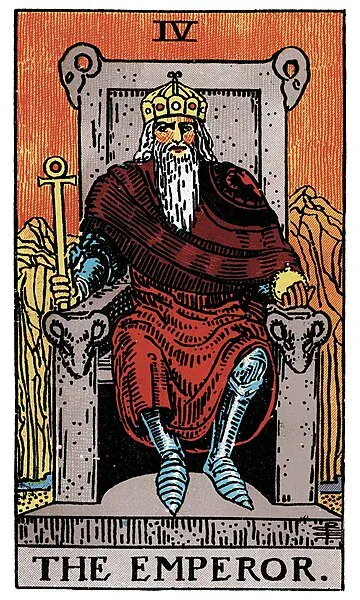
The Emperor
The Emperor sets the order outside; The Hierophant turns that order inward and inscribes it on the body through rite. Together they describe the moment authority moves from civic structure into spiritual structure — or, in difficulty, the moment one register of authority is being asked to compensate for the other's absence.
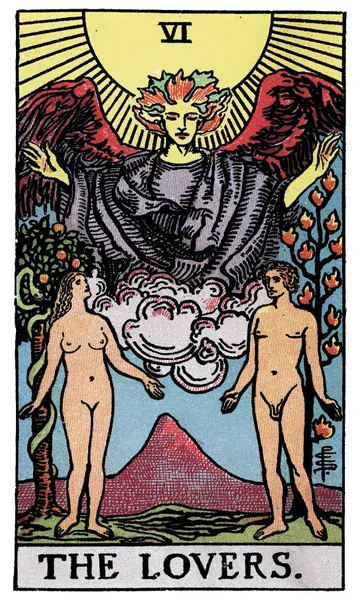
The Lovers
The Hierophant transmits the form; The Lovers face the choice that takes place inside the form. The pair asks the seeker to enter the tradition seriously enough to be shaped by it, then to make the choice that is theirs to make from inside it. Not the form instead of the choice. The form so the choice has weight.
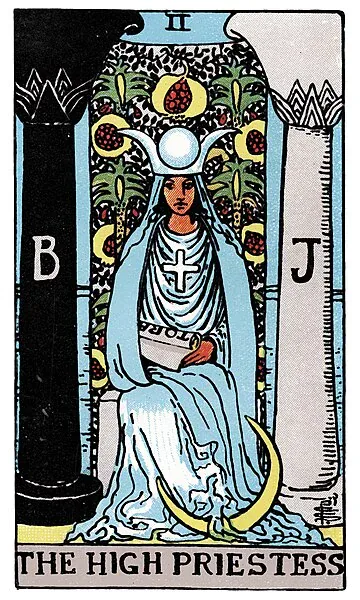
The High Priestess
The exoteric teacher and the esoteric teacher facing each other across the deck. The Hierophant teaches what can be transmitted in words and rite; the High Priestess holds what can only be approached in silence. Both teachings are real. The mature seeker learns when each is required, and which throne to sit before in any given season.
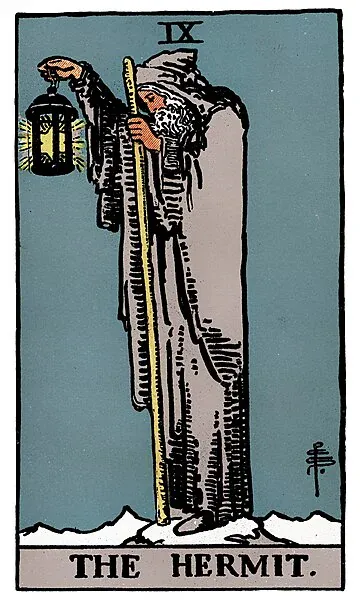
The Hermit
The school and the cave. The Hierophant builds the institution; the Hermit walks alone with the lamp. Neither teacher is wrong. The pair asks which mode the soul currently needs — the structure of the school or the solitude of the long walk — and warns against confusing one for the other.
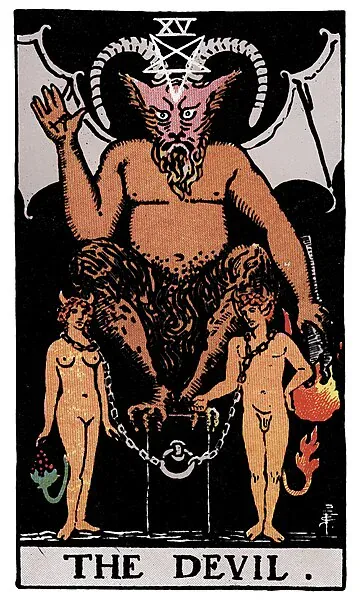
The Devil
The two cards of binding. The Hierophant binds through tradition; the Devil binds through appetite. Together they ask honestly which kind of chain is currently around the seeker, and warn that even sacred forms can curdle into bondage when the fire has left them. The path forward is to find the form that has fire in it again, or to break the chain consciously rather than slip from one bondage to another.
Frequently Asked Questions
What are the two crossed keys at The Hierophant's feet?
They are what a lineage hands over — one key for the outer door, one for the inner. The Hierophant tarot card means tradition, transmission, and the formal teaching that lets a mystery be passed from one generation to the next. The card describes the moment when raw experience is fitted into a shape another person can inherit — a rite, a vow, a curriculum, a lineage. Read it as the patron of the apprenticeship rather than the invention. For the full picture, see the core meaning section above.
What condition does The Hierophant attach to his yes?
A form to put it in. He is a yes card, but a particular kind of yes. It says yes to what you are asking about, on the condition that you enter the situation through the conventional door rather than the bespoke side entrance. The standard application, the established route, the well-trodden path is the yes the card endorses. Read it as a soft, structural yes — the answer the lineage gives.
Does The Hierophant always mean marriage?
Not always, and never as a forecast. The Hierophant in love is the card of the bond that wants to be marked — vows, ceremony, the meeting of families, the public form that adults use to make a private love legible to the world. For new connections it asks whether the bond has earned a structure yet; for long partnerships it often signals an explicit commitment on the horizon. The hierophant love reading is rarely about playful romance; it is about the architecture love decides to grow inside.
Has this person told anyone about me?
Under The Hierophant, usually — and the telling is the signal. The other person feels committed in the formal sense — they have considered you against the long structure of their life and decided you fit. The feeling is steady, considered, slightly serious. They are quietly working out where you sit in their family, faith, and forward plan. This is not infatuation; it is consecration in early stages.
When does a tradition stop being a container and start being a cage?
At the exact point the orientation flips. Upright, The Hierophant is the living tradition — the form that still carries fire and can pass it on. Reversed, the form has either lost its flame or has begun to choke it. Upright asks you to apprentice yourself; reversed asks you to question whether the institution you are inside still does what it claims to do. Both orientations honor lineage; only the upright endorses the institution as it currently stands.
Continue Reading
The Hierophant · Card overview · symbols · correspondences →
Return to the full card view — image, symbols, sensory correspondences, and Hermetic axes.
Read the reversed meaning →
Read the same depth on the opposite orientation.
Draw your reading now →
Bring this card to a question — open a quiet ritual.