The World · Core Meaning
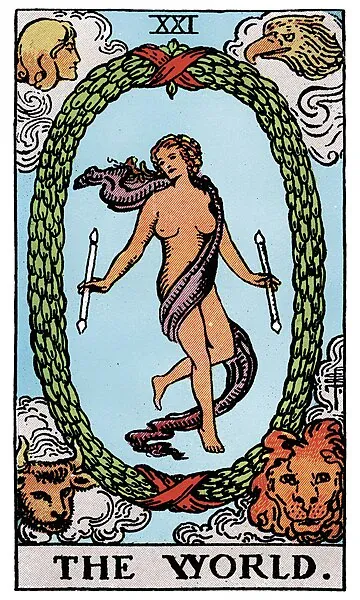
A deep-green laurel wreath floats in black space. At its top and bottom, two red ribbons knot it like the closed loops of an infinity sign. At the center, a half-nude dancer turns — a violet scarf at the hips, a short white wand in each hand, one pointing up, one pointing down. The legs cross in a slanting mark, as though the last beat of a slow rotation has just landed and the next is about to begin. In each of the four corners: a winged human, an eagle, a bull, a lion. Four faces watching a dance that does not stop. This is the image The World presents — the closing card of the Major Arcana, the twenty-second card, completion drawn as a body still in motion.
The card's signature tension is that completion and continuation occur in the same frame. Most of the deck reads completion as cessation: the project ends, the relationship ends, the cycle reaches its terminus. The World refuses that grammar. The wreath is woven of living leaves — laurel — which means it can wither and re-sprout. Closure here is not a seal. It is a closed shape that can keep growing. The dance does not end because the circle was drawn; the drawing of the circle was always the precondition for the next turn. The card asks you to feel completion not as a stop but as the ground from which the next motion lifts.
The traditional kabbalistic signature anchors this. Path 32 on the Tree of Life runs from Yesod to Malkuth — from the lunar foundation, the dreaming reflective sphere where the unconscious gathers, down into Malkuth, the kingdom, the manifest world, the actual ground beneath the actual feet. The Sepher Yetzirah names this path the Administrative Intelligence — the path that governs the descent of pattern into matter, the path by which dream becomes thing. Of all the paths that touch Malkuth, this is the one that does the work of incarnation: the moon-light reaching ground. The World is the card of that arrival. What you have been turning over in the deeper, dreaming part of yourself has now reached the floor of your life. It is no longer interior. It is here.
The Hebrew letter is Tav — ת — meaning Mark, Signature, the Closing Cross. Tav is the last letter of the Hebrew alphabet. In the older mystical traditions it is also the seal that completes a document, the sign drawn at the end of a name to confirm authorship. As a double letter, it carries two faces — dominion and slavery, the freedom of completion and the bondage of refusing to begin again. The card's name in some older systems is The Universe, and the play between mark and universe is the card's particular gift: the smallest signing gesture and the largest possible field, both contained in the same image. You have signed something. Look at what you signed.
The four beasts in the corners are the four fixed signs of the zodiac — the lion (Leo), the bull (Taurus), the eagle (Scorpio in its high form), the human-faced angel (Aquarius). The same four faces appear in the corners of the Wheel of Fortune, ten cards earlier in the Major Arcana. There, they witness the turning of fortune from a distance, books in hand, still studying. Here, the books are closed. The work has been done. They are now the four pillars that hold the dance at center. Wholeness, the card says, is not everything moving at once. It is a center in motion supported by a stable periphery. The dancer turns because the four corners do not.
Astrologically, The World is associated with Saturn — the slowest of the visible planets, the planet of structure, time, limit, and the lessons that arrive only with sustained pressure over years. The element is earth. The polarity is feminine — receptive, holding, the earth that takes what is given and shapes it. This combination is the card's signature: the dance that looks light and free is held aloft by Saturnine work, by long discipline, by the time and patience of years that allowed the pattern to become real. The lightness is earned. The dancer has paid for the dance.
Numerologically, 21 reduces to 3: 2+1=3. Two has been the polarity, the duality, the masculine and feminine pulling against each other through the entire arc of the Major. Three is the resolution of duality in a third — the dance lives between the polarities, belonging to neither side. The dancer is neither man nor woman and is both; the wands point both up and down; the wreath both ends and continues. The card's wisdom is the wisdom of the third position, the perspective that holds both poles without choosing.
What the card asks in any spread: which circle in your life has been drawn, and which foot are you about to lift?
The World · Love & Relationships
In the world tarot love readings, The World describes the relationship that has arrived at its own shape. The other no longer needs to be re-formed. You no longer need to be explained. The two of you have become a closed shape — not closed in the sense of inaccessible, but closed in the sense of complete. You can be together, go out separately, return to find each other still familiar. This is the card's particular love signature: wholeness that allows independence, completion that does not become confinement.
For an existing partnership, The World arrives in the season after the long inner work has finished — sometimes the work of years. The patterns that nearly broke you have been understood and either resolved or accepted as the actual landscape of the bond. The version of yourself that you brought into the relationship has been replaced, not by performance, but by an honest revision. You know now what you needed and what you can give. They know now what they needed and what they can give. The arithmetic, finally, works. The card describes the year you stop being afraid of your own partnership. Often, in this season, a public commitment becomes possible — a marriage, a major shared decision, the joining of households that had been living parallel. The card does not predict the wedding; it describes the soil in which the wedding becomes natural.
For a new relationship still finding its early shape, The World means what arrived is genuinely matched. Not the projected partner of the early infatuation — the actual person, walking in their actual life, fits the shape your life has carved out for them. The card does not promise permanence. It confirms recognition. You are not inventing this fit. The four corners of your life — what you do, where you live, who you are when no one is watching, what you wish for in the dark — accommodate this person without distortion. They accommodate you the same way.
For the single seeker asking whether love is possible, The World offers a particular kind of yes — the yes that begins with the recognition that you are no longer waiting in pieces. The years of partial selves, of bringing only the presentable parts, of waiting to be loved before becoming wholly yourself, have ended. The dance you are now ready for is the dance of someone who has already finished the work of becoming. What appears now meets you as you actually are. The card warns gently: do not rush past the wholeness into the relationship. The wholeness is what makes the relationship real. Stay in it long enough that you would be content if no one arrived. Then the one who arrives will not be a rescue.
For someone asking about love after a wound — after the end of a marriage, after grief, after a betrayal that altered your sense of who you were — The World describes the integration of the wound into the larger pattern. The love that comes through this card no longer arrives the way it once did; that is correct. It arrives carrying the wisdom the wound made available. The card is not the card of forgetting or healing-as-erasure. It is the card of the wound becoming structure. The scar tissue is part of the wreath now. It does not need to be hidden. The next love can include it.
For the question of love in a long marriage that has felt static — the partnership where neither of you is unhappy but neither of you is exactly alive in the bond — The World describes the season in which the staleness is revealed as a circle that has been drawn but not yet been the ground for the next dance. You have completed something together. What you have not yet done is begin the next chapter from inside the completion. The card asks the older couple, the long-married, the long-partnered: what is the new circle you can draw from this circle's edge? The relationship is not over. It is at the threshold of a different mode of being together. Lift a foot.
For the question of whether someone is in love with you, The World upright answers yes — and adds a particular quality to the yes. Their feeling is not infatuation, not hopeful, not contingent on the next signal from you. It has the weight of decision made. They have completed the inner movement that brings someone from interest to actual love. They are not measuring your reaction. They have arrived at their own answer about you, and the answer is whole. They want you in the architecture of their life, not just in the moments. The card describes the lover who has finished the question and is now living the answer.
For someone asking about reconciliation after a break — whether the relationship that ended can be re-entered — The World gives a complex but honest reading. It does not promise a return to the relationship as it was. The relationship as it was has ended; that is what the closing of the wreath means. What it offers is the possibility of a different relationship with the same person, built on the ground that the ending cleared. If both parties have done the integration work, the new shape can be real. If either has been sitting in unprocessed grief or in stale resentment, the next attempt will repeat the previous shape. The card asks: have you both drawn the previous circle to its full closure, or are you trying to re-enter mid-revolution? Only the closed circle can be the ground for a new one.
For someone who has spent a long time alone by choice — and is asking whether to remain in that solitude — The World affirms that the solitude has been the work, not the avoidance. What you have built in that quiet time is the wreath itself. The completion of the self is not the failure to find love; it is, in many traditions, the precondition for the love that does not consume. If you choose now to remain alone, the choice is whole. If you choose now to enter relationship, the choice is also whole. The card lifts both options into honor. There is no wrong answer in this season because the chooser has become whole enough to choose.
A note on the card's particular love language: The World loves the way a long dance partner loves. It does not perform for you; it moves with you. The body language is mutual. The two wands of the dancer, one pointing up and one pointing down, are a single body holding heaven and earth at once — and a partnership under this card has the same quality: each of you is whole, and together you complete a circuit that neither of you completes alone. This is the card of the love that does not require fusion to be real, the love that allows the other their full size.
The World · As Feelings
The dancer has finished the turn and is not checking whether anyone applauded — and what The World describes as someone's feeling for you is whole. Not partial, not provisional, not waiting on a final piece of information. They have completed an inner movement about you. The conclusion they have reached is that you belong in the larger pattern of their life — not as a possibility, not as a hopeful candidate, but as a person whose presence is part of the shape they are now living.
This is the card of feelings that have stopped checking. In earlier stages of any connection, the interior is busy with assessment: is this safe, is this real, am I reading them correctly, are they going to stay. The World in feelings means that internal weather has settled. They are no longer measuring you against the previous template, the previous wound, the imagined version of who you could disappoint them into being. They have arrived at a clear and integrated view of you, and that view holds.
If the person is naturally reserved — someone who does not narrate emotion easily, who shows feeling through consistent action rather than declarations — The World in their feelings means the interior is full and stable. They will not say it loudly. They may not say it directly for a long time. But watch for the structural choices they make that include you: the calendar shared, the introduction to the family, the small daily routines that begin to assume you. Reserved love under The World is the love that builds infrastructure. The architecture itself is the declaration.
If the person is naturally expressive, The World in feelings is easy to read because the expression is no longer hedged. They want you in their public life, in their friendships, in the visible part of their existence. They are not compartmentalizing. The feelings have moved out of the private corner of their interior and become part of how they live in the world. The four beasts at the corners of the card become the four corners of how this person organizes their days — and you are now visible at every one of them.
For a long partnership, The World in feelings is one of the deepest signals the deck offers. It means the accumulated history has not eroded the original recognition; it has confirmed it. The version of you that they fell for is still legible to them, even after the years of friction, the seasons of disconnection, the difficult chapters. They have not idealized you. They have integrated you. Their love has the quality of practiced precision rather than fresh heat — which, for a long bond, is the more durable signal.
For a new connection that has moved past the early phase, The World in feelings means they have made a decision about you that has the texture of finality. They are not promising they will never have doubts; they are saying that the decision-floor underneath the doubts is solid. They want you. The wanting is whole. They are not waiting for more information.
For the question of whether someone who has been distant still cares — when communication has been thin, when the texture of contact has changed, when you are not sure how to read what is happening — The World offers a particular kind of reassurance. The person is not lost. They are not gone. The inner attachment is intact. What may be happening is that they are doing their own circle-closing: an old chapter of their life requiring inner attention before they can fully be present in the new one. The World does not describe abandonment. It describes someone who is, perhaps, in a different point of their own rotation. The dance has not ended. Their arms are still open in your direction. They may simply be looking elsewhere for the moment.
For the precisely difficult question — the silence that has gone on too long, the relationship that ended without clear closure — The World in feelings describes a person who, even in distance, has integrated you into their own story. You are not erased from their interior. They will think of you with the same texture for the rest of their lives. This is not a promise of return; it is a clarification of the inner state. What they do with the integration is their work. What you do with the knowledge of it is yours.
A small caution embedded in this whole-feeling card: the wholeness can become stillness. The lover who has decided about you may stop actively pouring the warmth across the table because they assume the warmth is understood. The dancer at the center is moving, but in some readings the dancer's movement is felt only by the dancer — the four beasts at the corners watch, and the dancer turns, and the partner watching from outside the card may not feel the motion. If you sense them feeling whole about you and not actively offering — gently ask. The World responds to clear questions. It is not a card of withholding; it is a card that may assume the warmth is visible when the warmth has, in fact, gone interior.
For Japanese readers searching for the partner's inner state — the quiet, careful question of what they are actually carrying — The World in feelings is an answer that needs no decoding. The feeling is large, complete, and present. What it asks for is not interpretation but the willingness to receive a love that has decided.
The World · Career & Work
The last beat of the rotation has landed, and in a working life The World is the cycle that has come fully round. A project, a role, a body of work, a chapter of professional life — has reached the point of delivery. The thing you have been building is finished, or so close to finished that the remaining work is closing the seam rather than constructing the body. The card describes the morning you sit at the desk and realize the project is done. Not the morning of the press release. The earlier, quieter morning, when the maker first knows.
For someone in a current role that has been the long work of years, The World's arrival often signals the end of one chapter and the beginning of the question of the next. The role has delivered what it could deliver. You have learned what it had to teach. The version of you that took the job has been replaced — through honest work — by a version of you that has outgrown some of the role's original premises. This is not the same as needing to leave. The card does not insist on departure. What it insists on is the recognition that a turn has completed. From here, the question is what the next turn will look like — whether it happens inside the same role, with new responsibilities and new scope, or whether it requires a different setting. The card asks: what is the next circle you intend to draw, and is the room for it already inside this job?
For someone considering whether to leave a role, The World tilts toward honest closure rather than impulsive departure. If you leave now, leave whole. Do the closing work that makes the cycle complete. Hand the project off well. Write the documentation. Have the conversation you have been postponing with the colleague who matters. The card respects departure but insists on the completion of the loop. A career under The World is built of well-closed circles, each one becoming the soil for the next. A poorly closed circle becomes a snag in the next role; you carry the half-finished business into the new chapter, and it surfaces in unexpected forms. Close cleanly. Then go.
For someone considering a new role, The World indicates that the new opportunity is itself a complete shape rather than a fragment. What is being offered is not a piece of a larger negotiation; it is the full thing. The role description is what it is. The trajectory is real. The team is the team. There is no hidden codicil that will surface in month three. The card validates the move when the move is into a setting that respects the wholeness of what you bring. If the role asks you to bring only a fragment of yourself, look closer. The World is the card of the work that uses the full body, both wands, both poles. The role that asks for less is not necessarily wrong, but it is not what this card most fully blesses.
For an entrepreneur or founder, The World in career describes the season when the business has become a coherent thing — when the brand, the offering, the team, and the customer base have aligned into a working system rather than a collection of working pieces. The business is no longer a collection of experiments held together by your personal effort; it is an actual structure that other people can also work inside. This is the threshold between founding and operating, and The World names it precisely. The work now is to step back enough that the structure can do its own dancing. Your role shifts from the dancer at center to one of the four corners — supporting, witnessing, allowing the system you built to continue without your constant management.
For a freelancer or consultant, The World describes the season when the practice has consolidated into something with real shape. The clients arriving now are the clients you wanted; the projects fit your full capacity; the rates reflect the value. You are no longer in the building phase. You are in the dancing phase. The challenge specific to this point in the practice is to keep the dance fresh — to not let the consolidation become a routine that hardens into unwillingness to take the new shape that next year's work might require.
For a creative practitioner — the writer, designer, musician, artist who has finished a body of work — The World in career is the card of the body of work itself. The book, the album, the exhibition, the portfolio: it is now a thing. It exists outside you. People can encounter it without your translation. The card describes the particular bittersweet of this completion: the work you spent years inside is now complete enough that it lives without you. The mourning of that is real. The freedom of it is also real. From here, the question is what the next body of work will be — and the wreath in the card's image, made of living leaves, is the reminder that the previous body of work is not the end. The leaves can re-sprout. The next book will be different and will draw, secretly, on what the previous one taught you.
For someone in the middle of a job search, The World describes the trajectory rather than a single placement. The role that arrives is not a stopgap; it is part of a larger pattern that is now coming into focus. Take it in the spirit of the larger pattern, not in the spirit of urgency. The card supports the patient choice — the role that fits the shape of what you have completed, not the role that fills the panic of being between things.
For a career stage at mid-life — the question of what to do with the remaining decades of working life, the interrogation of whether the path you have been on is the path you intend to keep walking — The World offers a generous, complete answer. Whatever you have built so far has been real. It does not need to be defended or dismissed. From here, you can either deepen the existing pattern (the next book in the same vein, the next role in the same field, the next chapter that builds on the previous chapters) or you can use the closed circle as the ground for a different one (the second career, the late-life pivot, the work you have always wanted to do that is now possible because the previous work made you ready). The card respects both moves. What it asks is that the choice be made consciously, from the position of someone who has just completed something, rather than reactively, from the position of someone fleeing or grasping.
For the question of recognition or promotion, The World confirms that the work you have done has earned the recognition that is on its way. The wreath is the visible mark of the inner completion. You may stop arguing for what you have already proven. The recognition arrives because the work has become legible to those whose attention matters. Wear the wreath. Do not brandish it. Move into the next phase from inside the recognition rather than from inside the desire for it.
The World · Money & Finances
In money readings, The World describes financial completion — the long-built situation that has finally consolidated into what it was meant to be. Not a windfall, not a sudden shift, but the recognition that the patient years have produced the structure they were always going to produce. The numbers reflect the work. The accumulated savings, the paid-off debt, the slowly-built investment, the career income at its mature level — these have arrived at the shape they were quietly being built toward.
The element is earth. The planet is Saturn. Together, these are the signature of slow, real abundance — wealth that does not erode under ordinary pressure, money that holds its meaning across years rather than seasons. The World does not describe lucky money. It describes earned money. The card does not bless the gamble; it blesses the patient pattern that has finally produced its result.
For someone in a stable financial season, The World confirms that the structure you have been building is sound. The retirement account is real. The investments have done their work. The home, the savings, the conservative bets that did not promise excitement — these have produced something that can hold weight. The card encourages you to recognize the wealth you actually have rather than to compare it to the wealth others perform. The four beasts at the corners are the four pillars; your finances now have four pillars instead of three. You can rest on this structure.
For someone considering a major financial decision — buying a home, making a large investment, restructuring debt, signing a significant contract — The World indicates that the decision is well-timed if it consolidates rather than disperses. The card supports the move that completes a pattern: paying off the last of the debt, making the down payment that closes the long save, signing the agreement that locks in what you have been building toward. It is more cautious about decisions that scatter the consolidation: the impulse to take the consolidated savings and put them into a speculative new venture, the move that breaks up a working financial structure to chase a new one. Complete the circle before drawing the next one.
For someone who has been managing scarcity, The World can describe the genuine turning of the corner — not the morning the worry ends, but the season when the worry stops being the daily texture. The patterns that have been pulling you under have been broken; the patterns that pull you toward stability have taken hold. This is not the end of the work, but it is the end of the deepest crisis. The card validates the long climb. From here, the work is consolidation: building the buffer, paying down the structural debts, making the boring decisions that keep the corner turned.
For the question of inheritance or unexpected money — The World in this position often describes money that arrives because of a completion in someone else's life. An estate settling, a long contract paying out, a family financial pattern resolving. Receive cleanly. The card asks for thoughtful integration: do not let the arriving money disturb the structure you have built. Let it become part of the existing architecture. Money that arrives at the close of someone else's circle can fund the next phase of yours, but only if it is not allowed to dissolve the pattern.
For investments and long-term planning, The World favors the boring patient approach over the dramatic one. Index funds outperform stock-pickers over decades; the same wisdom applies to most financial behavior under this card. Continue the small consistent action. The dance is the discipline of the slow turn. The card does not promise excitement. It promises arrival.
For a question about generosity — about whether to give money to a cause, a person, a project — The World gives a specific answer: give from the completed portion. Not from the working capital, not from the buffer, but from the part of your wealth that you have already integrated as overflow. Saturnine generosity is structural; it is built into the budget rather than impulsive. Set aside a portion that is for the giving, and give it from there. The card does not bless the impulsive donation made out of emotional pressure. It blesses the planned generosity that comes from a place of completed enough.
The card's particular financial caution: completion can become refusal. The seeker who has built the comfortable financial structure can stop making any financial moves out of an excess of caution — refusing to upgrade the house, refusing to take the well-considered risk, refusing to invest in the tools that would unlock the next phase. The wreath, if too tightly closed, becomes a wall. Money that does not move stops being abundance and becomes hoard. The card asks: is there a small motion that the next chapter requires, and are you avoiding it because the current structure feels complete? Lift one foot.
A note on debt: The World is an excellent card to draw when the question is whether the long debt-pay-down will finish. Yes. The trajectory holds. Continue the boring discipline. The last payment, when it arrives, is the closing of the wreath. The money that becomes available after that closure is the seed of the next financial chapter — and the card asks that you not spend it immediately, but allow the closure to settle before you decide what the next pattern will be.
The World · Health
For health readings, The World describes the body that has reached integration. The condition that defined your relationship with your body for a season has either resolved or become part of the larger pattern of who you are. You are no longer at war with the body. The body is no longer in active rebellion. There is a working alliance — sometimes uneasy, sometimes graceful — between the awareness and the flesh.
The element is earth. The body part associated with Saturn is the skeleton — bones, joints, teeth, the deep structural framework. The temperament is the saturnine one: slow, durable, the body that ages well rather than burns brightly and quickly. The World in health is not the card of vitality at peak (that is The Sun); it is the card of the body that has settled into its actual capacity. You know what you can ask of yourself. You know where your edges are. The wisdom is not theoretical; it is somatic.
For someone managing a chronic condition, The World can describe the season of genuine integration — the period after diagnosis and adjustment, after the experiment with treatments and the building of a daily protocol, when the condition is no longer the thing that organizes your life but is one of several things you live with. The protocol has become routine in the steady sense, not the dull sense. The body has adjusted. The life has accommodated. This is not cure; it is a form of wholeness that includes the condition. The card respects this kind of completion.
For acute illness or recovery, The World indicates that the recovery is reaching its natural completion. The body is no longer in the active healing phase; it has reached the consolidation phase. The strength is rebuilding. The function is returning. The chapter is closing. The card validates the patient continuation of recovery practices, even when the urgent pressure has eased — the long stretching, the consistent walks, the boring regimen that turns intermittent improvement into stable health.
For mental health questions, The World describes the integration of long therapeutic work into actual life. The patterns that defined the depressive season, the anxious chapter, the period of unresolved grief — these have been understood and either healed or accepted as part of the larger landscape. You are not pretending to be okay. You are actually okay, in the specific saturnine way: not light and effortless, but durable and real. The work that produced this stability was long, and the card respects the length of the work. The integration is permanent in the way that things produced through Saturn's slow pressure are permanent. They do not vanish under the next wave of stress.
For the question of fertility, pregnancy, or family planning, The World carries particular weight. The card's signature is completion that allows new beginning — and biologically, this is the precise quality of the body that has reached fertile maturity. For couples trying to conceive, The World is one of the deck's more affirmative cards, especially when the trying has been long. The body is in the shape it needs to be in; what arrives, arrives. For someone considering whether to begin trying, the card affirms that the readiness is real — not just emotional, but structural.
For someone managing aging — the body that is not failing but is shifting, the recognition that the energy patterns of thirty are no longer the energy patterns of fifty — The World offers a generous reading. The body is in its current shape; that shape is a complete one. The work is to live within the current capacity rather than mourn the previous one. The wisdom of the aged body is real. The card honors it.
The somatic signature of The World is in the alignment of structure and motion. The dancer at the center is moving with the body's full integration — both wands held, both feet engaged, the whole figure participating in the turn. This is the body in its functional wholeness. For someone whose practice involves the body — yoga, dance, martial arts, athletic training — The World indicates the season when the practice has become integrated rather than effortful. The poses have become natural. The movement has become expressive rather than performed. The body has consented to the discipline.
For chronic pain, The World offers a careful, honest reading. The pain may not have resolved. What may have changed is the relationship to the pain — the recognition that the pain is part of the body's communication rather than an enemy to be defeated. This is not resignation; it is integration. The card honors the work of finding sustainable accommodation with what cannot be eliminated.
A specific health practice The World invites: a weekly review of the body's actual patterns. Not the optimization-style review of metrics, but the slower question of how the body has actually been across the week — the sleep, the hunger, the energy at different times of day, the small somatic signals that the busy schedule tends to drown out. The Saturn body responds to attention paid steadily over time. The dance is the discipline of the slow turn.
Steady attention paid to somatic signals is a practice, not medical advice. The card describes a relationship with the body, a felt season, a quality of integration. Keep your practitioners. Take your medicine. Do the work the body is actually asking for. What The World confirms is the felt truth: the body has arrived at a shape it can hold, and that shape is now yours to live inside.
The World · Spirituality
Spiritually, The World describes the completion of one arc of the soul's work and the recognition that the completion is itself the threshold of the next. The card is the closing of the Major Arcana — and yet, in any deck the Fool follows it, the cycle begins again. The card's spiritual signature is precisely this: the arrival that is not the end. What you have learned in this cycle of practice has become part of you. What remains to be learned is now visible from the new ground.
Path 32 on the Tree of Life — Yesod to Malkuth, the path the Sepher Yetzirah names the Administrative Intelligence — is the path of incarnation: pattern descending into matter. The spiritual experience this card describes is the one in which what you have been doing in interior practice has now reached the floor of your actual life. The teaching is no longer something you are studying; it has become how you live. The morning meditation has become the morning, not an event within the morning. The journaling has become a way of attending, not a separate act. The ethical commitments have become the structure of decision rather than the rules to remember. This is the spiritual completion the card names.
The Hebrew letter Tav — the Mark, the Signature, the Closing Cross — anchors the work. To draw a tav at the end of a name is to confirm that the name belongs to the writer. The spiritual completion of The World is the recognition that you have signed the work; the work belongs to you in a way that cannot be unsigned. The teachings you have integrated are not borrowed any longer. They are part of how you see. This is sometimes a subtle moment — there is no single morning when the teaching becomes yours. But looking back, the seeker recognizes the change: a season ago, this would have required effort; now it is simply how I see.
The four beasts at the corners — lion, eagle, bull, human — are also the four worlds of kabbalistic cosmology, the four levels at which existence operates. Their stillness around the dancer at center is the spiritual lesson: when the four levels of being are aligned and stable, the dance at center happens naturally. You do not have to manufacture the dance. The dance is what occurs when the periphery is in order. The spiritual practice The World invites, then, is the practice of attending to the four corners — the body, the heart, the mind, the spirit — equally and steadily, without privileging one over the others. The integrated life is not the spiritualized life or the embodied life or the intellectual life or the emotional life; it is the life in which all four are tended, and the dance arises from their cooperation.
The archetype is The World-Dancer — the cosmos moved by its own rhythm. Shiva as Nataraja in the Hindu tradition is the closest mythic correlate: the lord of the dance, whose dancing is the activity of the universe itself, who creates and sustains and destroys all in one continuous turn. This is the card's deepest spiritual register: the seeker who has reached the World position recognizes that the personal dance and the larger cosmic dance are not separate. What you do at the center of your own life is the cosmos's own dancing through you. This is not megalomania; it is the dissolving of the false distinction between the personal and the universal.
For seekers in active practice — meditation, journaling, ritual, devotional work — The World confirms that the practice has reached integration. The breakthroughs of the previous chapter have settled into ground. The next chapter of practice is now visible: not as a different kind of practice, but as a deeper engagement with the practice you are already doing. The teacher who said the practice is the practice was right. There is no further technique to acquire. There is only deeper participation in the technique you have.
For seekers exploring belief, The World can describe the season when the various traditions, teachings, and frameworks that have shaped your inner life have settled into a coherent whole. You no longer need to choose between traditions; you have absorbed what each had to offer and let them inform each other inside you. The cosmology you live in is no longer borrowed; it is yours. This is not syncretism in the loose sense of mixing everything together; it is integration in the saturnine sense of slow, structural settlement.
The card's spiritual caution: completion can become refusal of the next cycle. The Fool is the next card after The World — the seeker who steps off the edge of the cliff, with the white dog and the small bundle, beginning again. The seeker at The World position who refuses to step off is the seeker who has confused arrival with destination. The wreath is the closure of one circle, not the closure of all circles. To stay inside the wreath forever is to make the wreath into a tomb. The card asks for the next step. It does not insist on a dramatic step. But it insists that the dance continue.
A specific spiritual practice The World invites: a ritual of completion. Not a major ceremony, but a deliberate act that marks the closing of the current cycle of practice. Light a candle for what you have learned. Write a letter of thanks to the teacher (alive or dead, embodied or symbolic) who held the work. Burn or bury or release a token of the chapter. Then, after the closure, sit with the question of what the next opening looks like. The cycle wants to be marked; refusing the marking keeps the closure incomplete. The card responds to ceremony — to the body's participation in the recognition that something has ended.
The deeper spiritual lesson: you are the dance, not the dancer. The figure at the center of the card is moving, but the dance is not separate from the cosmos that holds it. The body at the World position has become the means through which the dance occurs, rather than the agent who performs the dance. This is the dissolution of the false sense that the spiritual life is something you do to yourself. The spiritual life is what is happening through you when you have stopped obstructing it.
The World · Yes or No
Yes — full, completed, earned.
The World tarot yes or no answer is one of the deck's most affirmative. Not the sudden yes of The Sun, not the wished-for yes of the Nine of Cups — but the durable yes of long pattern arriving at its natural completion. When this card appears upright in a yes-or-no reading, the answer is whole. What you are asking about has come fully round. The path is clear. The arrival is real.
For yes-or-no questions about a relationship — should we commit, should we marry, should we move in, should we make this public — yes. The relationship has reached the shape that supports the commitment. You are not jumping; you are stepping into ground that has already been built.
For yes-or-no questions about a job, a project, a major professional decision — yes. The opportunity is the completion of a pattern that has been building. The work you have done has prepared you for what the role requires. The decision is not a leap into the unknown; it is the natural next step of the trajectory you have been on.
For yes-or-no questions about a major life change — moving to a different city, returning to school, beginning a long-deferred project — yes. The conditions are aligned. The interior readiness has reached the moment of exterior action. Whatever has been preparing you for this change is now complete. You may move.
For yes-or-no questions about a financial decision — buying the home, making the investment, signing the long contract — yes, with the specific quality that this is a completion-style yes rather than an expansion-style yes. The decision will consolidate what you have built rather than venture into new territory. If your question was about a speculative bet rather than a consolidating move, the card's answer becomes more cautious: it favors the patient confirming move over the dramatic departure.
For yes-or-no questions about a person's character — is this person trustworthy, are they who they say they are, will they honor what they have committed to — yes. The World shows what is fully present. There is not a hidden version of this person that will emerge later. What you see is the complete shape.
For yes-or-no questions about an outcome that has been long anticipated — the awaited promotion, the long-delayed resolution, the slow process finally bearing fruit — yes. The wait is ending. The cycle is closing. What you have been building toward is arriving in the form it was always going to take.
For timing questions, The World suggests that the arrival is on its natural schedule. Not immediate (this is not a card of urgency) but not far. Within the current larger cycle. If the question concerns months, the answer is months; if it concerns a season, the answer is the current or imminent season; if it concerns a year, the answer is within this year or the immediate next. The card is patient but not infinitely so. What is coming is coming on its proper time.
The texture of the yes The World gives: not exclamatory, not dramatic, not accompanied by trumpets. It is the yes of someone who has reviewed the situation in full light and seen that the pattern is whole. The wreath is closed. The dance continues. The yes is structural, not emotional. It rests on what has been built rather than on the hope of what might be.
For binary questions about whether to act now or wait — should I make the move today, should I send the message, should I begin — The World tilts toward act, with the qualification that the action should have the quality of stepping into the next phase of a pattern rather than reacting to a pressure. If you would act today out of completion, act. If you would act today out of urgency or anxiety, wait. The card distinguishes between the two motivations and supports only the first.
If the question was: am I done? The card says yes — and then asks the more interesting question: what is the next thing you intend to begin? The yes that closes one chapter is also the yes that opens the next. You are done with what you were doing. You are not done with the larger work. The card answers both questions in the same gesture: the chapter is finished, and you are still moving.
A small caution embedded even in this affirmative card: The World's yes is the yes of the whole shape. If the question you are asking is about a single component while the larger shape is incomplete, the card may answer yes about the larger shape and yes about the component, but the felt experience of the answer may be ambiguous — because you are receiving a structural yes about a question framed in fragments. If the answer feels less clear than the card's reputation, look at the question. Is it the right question? Often, with this card, the question we ask is smaller than the question the card is answering. The yes is real. The yes may be answering something larger than what we were asking.
The World · As Advice
The advice of The World is to bow to the circle before you draw the next one. The cycle that has just completed deserves the recognition of its completion — not in a small mental note, but in some specific ritual gesture that the body participates in. Most seekers, at the threshold of a major closure, want to rush into the next thing. The card asks for the pause. The pause is not idleness; it is the conscious closing of the loop, the act that converts the completion from event into ground.
A first specific instruction: name what has ended. Out loud, in a letter, in a journal, in a specific conversation with the person who shared the chapter with you. The patterns we leave unmarked tend to follow us into the next chapter as ghosts. The pattern that is consciously named, with whatever ceremony or simplicity is available, releases its claim on the next phase. Whatever has just closed in your life — name it. The naming completes the closure.
A second instruction: do not skip the bow. The dancer in the card's image has the body of someone whose practice includes the formal acknowledgement of the dance. The wreath, the four corners, the ribbons — these are not background; they are part of the dance. The seeker at The World position who pretends not to notice the recognition that is appropriate to the moment — who minimizes the milestone, who deflects the praise, who refuses the public marking — is denying themselves a step of the actual cycle. Receive what is being offered. Wear the wreath without brandishing it. The acknowledgment is not vanity; it is structural.
A third instruction: do not let completion become refusal. The Fool stands at the next edge, ready to step. You are not yet The Fool; that is a separate card and a separate moment. But The Fool is the natural next step. The seeker who confuses completion with destination — who uses the closure of this circle as the reason not to begin the next — turns the wreath into a wall. The card asks for the next step. The step does not have to be dramatic. But there must be a next step. Lift a foot.
A fourth instruction: thank the four corners. The lion, the bull, the eagle, the human — these are the four supports that held the dance you completed. In the actual life, they are the people, the structures, the practices, the resources that allowed the cycle to finish. The friend who held you through the difficult chapter. The teacher whose work shaped your seeing. The structure of your daily life that made the long work possible. The previous version of yourself who endured what was required for this version to arrive. Thank each of them. The thanks does not have to be elaborate. It does have to be specific.
A fifth instruction: live in the new shape for at least one full season before deciding what comes next. The temptation, after a major closure, is to immediately project forward — what is the next role, the next book, the next relationship, the next chapter. The card asks you to actually live inside the wreath for a while before drawing the next one. Notice how the world feels different when you are no longer the person you were. The season of integration is not wasted time; it is when the closure stops being an event and starts being the new ground.
A sixth instruction, gentler than the others: forgive yourself for what the cycle did not include. No completed circle is the perfect completion of the imagined version. Things were left undone. Hopes were unfulfilled. Mistakes were made. The wreath includes them. The card respects the wholeness of the actual circle, including its imperfections, more than it would respect the projected perfection of what could have been. Let the actual cycle close, not the imagined one. The actual one is what you have.
A seventh instruction, specific and practical: identify the seed. Somewhere in the closing circle, there is a small detail — a person you met near the end, a question that surfaced in the late phase, an interest that emerged from the work that has not yet been pursued — that is the seed of the next cycle. Do not pluck it prematurely. But notice it. Mark it. Let yourself become curious about what it might become. The next circle is not invented; it is recognized. The dancer's foot, lifting, knows where to land because the previous landing prepared the ground.
The card does not ask for a dramatic gesture. It asks for an honest one. Bow. Mark. Thank. Live. Notice. Then, in the natural rhythm of the body that has just completed a long turn, lift the next foot. The dance continues. It does not need to be performed. It needs only to be allowed.
Practical advice for the day this card appears: take thirty minutes to write down what you have completed. Not the outcome, but the cycle. What were you doing six months ago, a year ago, two years ago? What pattern has now closed? Read the list aloud. Let yourself feel the weight of what is no longer ahead of you because it has now been done. Then, separately, write the smallest visible seed of what wants to become next. Keep them separate. The closing and the opening are different gestures, even though they happen in the same dance.
The World · Card Combinations
The World becomes more legible when read against the cards that touch it. Five pairings illuminate the card's particular character — and reading the combined image often surfaces a meaning that neither card holds alone.
The World + The Fool
The closing card of the Major Arcana with its opening card. The wreath is the cliff edge seen in plan view; the cliff edge is the wreath unfurled. When these two appear together, the seeker is at the precise seam of the cycle — finishing one journey and standing at the threshold of the next. The Fool's white dog is already at the dancer's heel. The bundle on the stick is the seed identified at the previous cycle's close. The combination instructs the reader to notice that the next chapter is not borrowed; it is built from the ground the previous one cleared. The arms open the same way. Step.
The World + Wheel of Fortune
Both cards turn. The Wheel is the rotation that produces fortune — the larger pattern of rise and fall that the seeker is inside. The World is the dancer who has learned to turn with the wheel rather than against it. When they appear together, the message is that the seeker has reached the position from which fortune's turning is no longer threatening; it is the natural medium of life. The four beasts in the corners of both cards are the same four beasts. They have moved from witnesses (Wheel) to pillars (World). The combination affirms that the long work of the previous cycles has produced the steadiness that makes the rotation bearable, even welcome. The wheel turns again. The dance continues.
The World + Death
The last card of the suit-cycle paired with the Major card of necessary endings. Death is the cycle's last breath; The World is the cycle's first bow. Together, they describe the precise seam where ending and completion meet. Not every ending is a completion; not every completion involves an ending. When these two appear together, the seeker is asked to attend to the difference. What is ending here is what needs to end; what is completing here is the larger arc that the ending serves. The combination is one of the deck's most honest pairings: it does not soften the loss, but it places the loss inside the larger pattern that makes the loss meaningful. Mourn. Mark. Move.
The World + The Hanged Man
Both figures cross their legs. In The Hanged Man, the crossed legs are the body suspended — the seeker held in the pause that precedes insight. In The World, the crossed legs are the body turning — the same suspension, now converted into the balance of a turn. When these two appear together, the seeker is being shown the trajectory: the pause that felt like nothing was happening was, in fact, the preparation for the dance that has now arrived. The waiting was not waiting; it was incubation. The combination affirms that the patient seeker who endured the suspension has earned the rotation that follows.
The World + Ten of Cups
Wholeness in the small arcana, wholeness in the major. The Ten of Cups is the family rainbow — the household where the love has integrated, where the children play and the parents have arrived at a shared peace. The World is the cosmos's version of the same wholeness: the larger pattern of life come round. When these two appear together, the seeker is being shown that the personal completion (the marriage, the family, the home that finally holds) is also a participation in the larger cosmic completion. The small wholeness mirrors the large one. The combination is the deck's most generous family-life signal: what is being built in the household is real, and it is part of something larger than the household alone.
Card Combinations
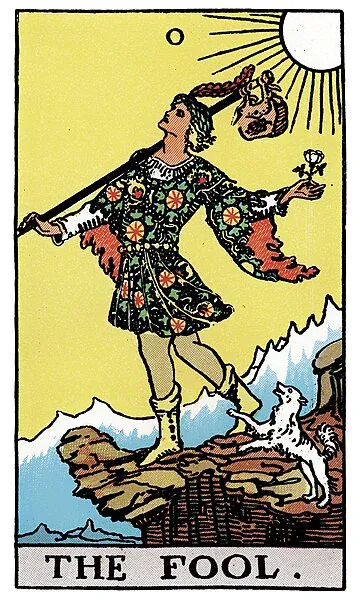
The Fool
The closing card of the Major Arcana with its opening card. The wreath is the cliff edge seen from above; the cliff is the wreath unfurled. The Fool's small bundle is the seed identified at the previous cycle's edge — the new beginning is not borrowed but built from what the closure cleared. Both bodies open the same way: arms unbraced, foot lifting. The dance does not end. It begins again with new ground beneath it.
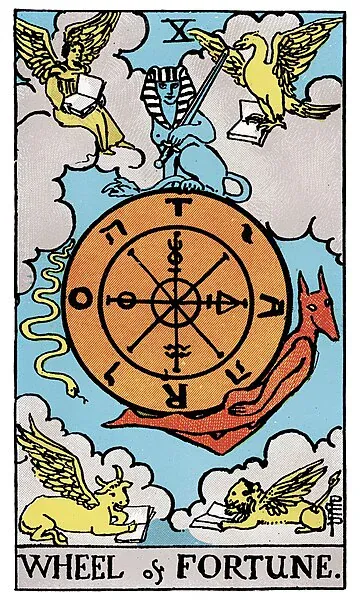
Wheel of Fortune
Both cards turn. The Wheel is the rotation that produces fortune; The World is the dancer who has learned to turn with it rather than against it. The four beasts in the corners of both cards are the same — they have moved from witnesses to pillars. Together, they affirm that the long work of previous cycles has produced the steadiness that makes fortune's rotation bearable, even welcome. The wheel turns again. You keep dancing.
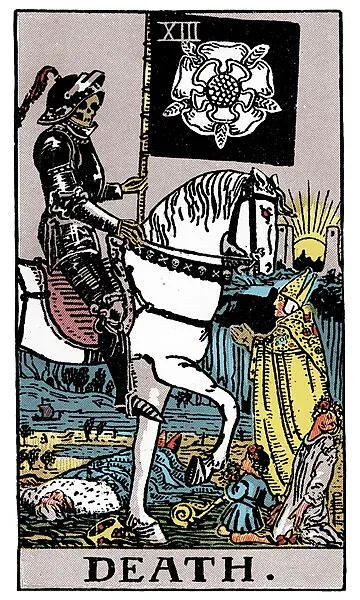
Death
The cycle's last breath paired with the cycle's first bow. Death is the necessary ending; The World is the larger arc in which the ending sits as completion. Together they show the precise seam where loss and wholeness meet. Not every ending is a completion; not every completion involves an ending. The combination does not soften the loss but places it inside the pattern that makes it meaningful. Mourn. Mark. Move.
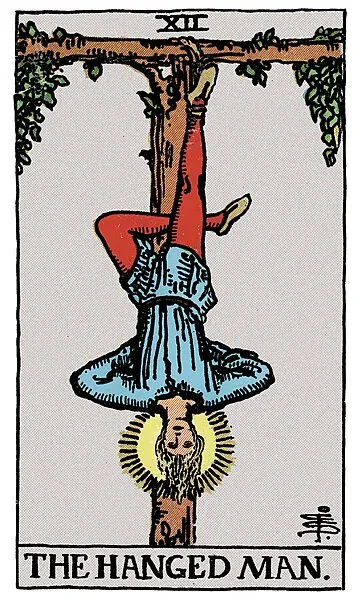
The Hanged Man
Both figures cross their legs. The Hanged Man's suspension is the pause that produces insight; The World's crossed legs are the same suspension converted into the balance of a turn. Together, they describe the trajectory of the seeker who endured the long pause and has now arrived at the rotation it was preparing. The waiting was not waiting; it was incubation. The dance has begun on the body the suspension trained.
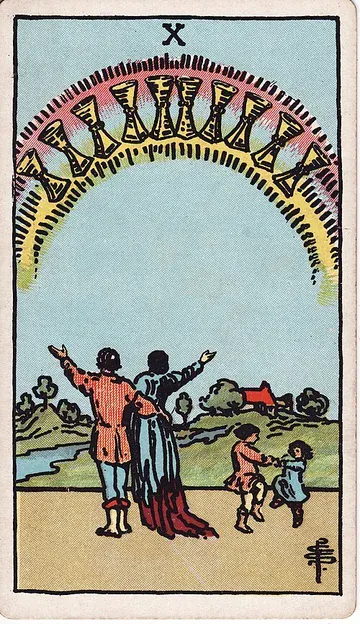
Ten of Cups
Wholeness in the small arcana mirrored against wholeness in the major. The Ten of Cups is the family rainbow — the household where love has integrated. The World is the cosmos's version of the same wholeness, the larger pattern come round. Together, they show that the personal completion is also a participation in the larger one. The home that finally holds is itself a small image of the wreath that holds the dancer at center. Both are real. Both contain the next motion.
Frequently Asked Questions
What does The World tarot card mean?
The World tarot card meaning is completion that allows continuation. A cycle has come fully round — a project, a relationship, a chapter of becoming — and the same body that closed it is already lifting its foot for the next. The wreath is woven of living leaves; the closure can keep growing. Not finale. Coda, then re-entry. Wear the wreath. Lift a foot.
Is The World a completed yes, or a yes that is only beginning?
Completed — and the completion is exactly what makes it durable. The World tarot yes or no answer is yes: full, earned, arrived. It is the durable yes of a long pattern arriving at its natural completion. The path is clear, the arrival is real, and the structure beneath the answer holds. For commitments, decisions, and outcomes that have been long building, the card affirms what you have already prepared.
Does The World mean a relationship has arrived at its own final shape?
In the world tarot love readings, The World describes the relationship that has arrived at its own shape — neither needing reshaping nor explanation. For singles, it means the long inner work has finished and the love that arrives meets you whole. For couples, it often signals a public commitment becoming natural. The card's love is the love that allows independence and still comes home.
What does The World tarot card mean for career?
For career, The World describes the cycle that has come fully round — a project, a role, a body of work has reached delivery. The work has earned the recognition arriving with it. The card invites honest closure of the chapter, the bow before the next move, and the recognition that the next circle's seed has already been planted at this circle's edge.
What does The World ask of you next?
The World asks you to bow to the circle before drawing the next one. Mark the closure with a specific gesture. Thank the four corners — the people, structures, and practices that supported the cycle. Live in the new shape for at least one season before deciding what comes next. Do not let completion become refusal. The dance continues.