
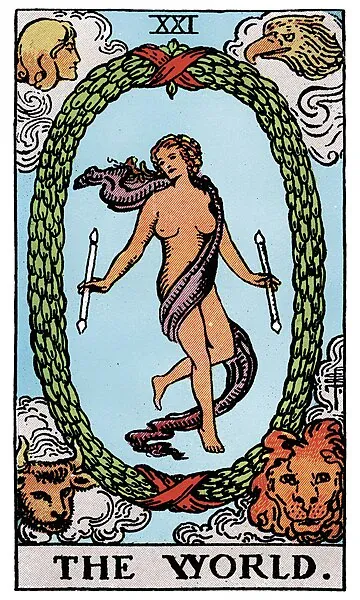
The World Reversed · Core Meaning
The two red ribbons are knotted and the circle they close is still a beat short: The World reversed is completion announced before the last stitch. The wreath is drawn — the photograph has been taken, the announcement has been made, the official ceremony has been performed — but inside the closed circle, a seam has not been pulled tight. Something is leaking. The dancer is still turning, but the rhythm is off. The four corners no longer hold the same way. The card describes the false closure, the perfectionist stall, the refusal of the next cycle, integration arrested at the threshold.
This is the reversed card's central knot: the appearance of completion standing in for the actual completion. There are two flavors of this in lived experience. The first is the cycle closed too early — the project shipped before the difficult work was done, the relationship declared healed before the wound was actually integrated, the chapter announced as finished while a thread of unfinished business remains visibly loose. The second is the cycle closed correctly but then refused as the ground for the next — the seeker who has genuinely completed something and uses the completion as a wall against beginning again. In one, the dancer rushed the bow. In the other, the dancer bowed and then would not lift the foot.
The traditional astrological signature, reversed, becomes specific. Saturn upright is the slow, durable, structural authority that produces things that last. Saturn reversed is rigidity without growth — the structure that has hardened past usefulness, the authority that has become control, the discipline that has stopped serving the living work and started serving the appearance of discipline. The seeker under reversed Saturn often has the externals of a complete life — the roles, the relationships, the financial structure, the public identity — and a private sense that the externals are now a costume rather than a garment. The reversed card asks: what part of the structure has stopped breathing?
The reversed reading of path 32 — Yesod to Malkuth — describes incarnation arrested. The dream has descended toward matter but has not landed. The pattern has nearly become thing, but at the last threshold, something pulled it back. The seeker in this position often experiences the felt sense of being almost there — the project almost done, the relationship almost what it could be, the inner work almost integrated — without the final step into actual ground. This is not laziness. It is often perfectionism in its more sophisticated form: the refusal to let the imperfect actual landing replace the perfect projected one.
The Hebrew letter Tav reversed becomes the unsigned mark — the document drafted but not finalized, the closing cross drawn but not sealed. There is a particular ache to this position, because the seeker is often very close to the completion. The work has been done. The integration has nearly happened. What remains is the small final act of declaring the cycle closed — and that small act has become the obstacle. The reversed card sits in the space of the loose thread that has become a story unto itself.
The four beasts reversed take on a different quality. Upright, they are the four pillars that hold the dance at center. Reversed, they can become the four corners that the seeker has stopped tending — the body, the heart, the mind, the spirit, each given lip service while one or two have become depleted. The dance at the center continues, but it is being held up by an increasingly uneven periphery. The card asks: which of the four corners has gone quiet, and what would it take to restore it?
Reversed, The World asks: what stitch is still loose? And: what cycle have you closed in image while still living its incomplete reality? And: what next motion are you refusing because the current closure feels too costly to disturb?
The World Reversed · Love & Relationships
The world reversed love readings describe the relationship that is performing wholeness while still missing the integration. The photographs are right. The anniversaries are kept. The shared accounts are present. The friends and family see a coherent partnership. And inside the relationship, the two of you can feel the line that has not yet been drawn — the conversation that has been deferred for years, the wound that was patched rather than healed, the structural truth that has been navigated around rather than addressed.
For an existing partnership, the reversed card often indicates the comfortable plateau that has hardened into refusal. You have stopped fighting because you have stopped reaching. The agreements that hold the relationship together include unspoken agreements not to disturb certain rooms — the room where one of you is unhappy, the room where one of you has been quietly negotiating with a different life, the room where the original wound from the first year of the relationship still sits, sealed but not healed. The card describes the partnership that has been declared whole and is, in fact, almost whole — and the gap between almost and actually is the work that the reversed card names.
For a new relationship still in early formation, The World reversed warns of the move to public commitment that is rushing past the inner integration. The relationship is good. The relationship is even right. But the announcement, the move-in, the engagement, the major declaration is happening before the deeper work of mutual integration has finished. The card does not say the relationship is wrong. It says the timing of the closure is being forced. Slow the announcement. Let the relationship continue to find its actual shape before sealing it with public form. The wreath drawn too early can become the wreath that constrains the very growth it was meant to honor.
For the single seeker, the reversed card can describe the closed circle of self-sufficiency that has hardened into refusal. You have built a beautiful solitary life. The structures are real. The contentments are real. And the door has been closed for so long that you no longer notice it is closed. The card asks: have you confused completion of the self with completion of the possibility? A closed wreath and a closed door are different shapes, and only one of them is the card's. The self can be complete and the possibility can still be open. If the possibility has closed, examine whether the closure was a choice you made or a wall that quietly arose.
For someone asking about love after a wound — the reversed card warns of the integration that has not finished. You have done much of the work. The crisis has passed. The capacity to love again is technically present. But there is a stitch in the original wound that has not been pulled tight, and it surfaces at unexpected moments — the small comment that triggers a reaction larger than the comment, the patterns from the previous relationship being avoided so carefully that they distort the new one, the protection that has become its own kind of wound. The card does not say you cannot love again. It says the loose stitch from before is still affecting how you love now.
For someone asking about reconciliation after a break — the world reversed love often describes the temptation to declare reconciliation before the closure has actually happened. You have started speaking again. The contact is warm. The plans for getting back together are being made. And the card warns that you are sealing a wreath whose seam has not yet been pulled tight. What broke the relationship has not been faced; it has been navigated around. The reconciliation, if rushed, will repeat the original break. The card asks: are you returning to the relationship, or are you returning to the version of yourselves you were before the break? They are not the same. Real reconciliation requires both partners to have integrated what the break taught. If only one has integrated, the partnership re-enters the same loop.
For a partner whose feelings about you are difficult to read — the reversed card can describe someone who has decided about you in a private way and refuses to bring the decision into the shared space. They know what they want. They will not say it. The reasons are their reasons — fear of the change, attachment to the comfort of the current undecided state, the pattern from their own previous relationships that taught them not to declare. The card respects that the work is theirs. It also names what is happening: the decision exists, and the closure is being withheld.
For someone in a very long marriage that has felt static — the reversed card can describe the chapter that has actually ended without either of you acknowledging it. You are still living in the marriage as it was three or seven years ago. The marriage as it was is over. What might be possible — a different kind of partnership, built on the closed circle of the previous one — is not possible until you both acknowledge that the previous chapter has ended. The reversed card describes the unmarked transition. The transition has happened in fact. It has not happened in conscious speech. The work is the speech.
A specific note about the world reversed love and the reluctance to make oneself vulnerable: the wreath is closed at the top and bottom by red ribbons that, in the upright card, hold infinite possibility inside completion. Reversed, the ribbons can become locks. The same gesture of closing can become the gesture of refusing further entry. The card asks the partner who has been guarding the bond too tightly: what would it cost to allow one new thing in? Not a dramatic disruption. A small vulnerability. The card's healing is the gradual loosening of the over-tight seal.
The World Reversed · As Feelings
When the world reversed appears as feelings, the warmth is real but contained. They feel something whole about you — a private decision has been made, an inner conclusion has been reached — and the feeling has not yet crossed the threshold into the shared space. They have arrived at a clear interior view of you, and the view is favorable, and the door from interior to exterior has been kept closed. This is the feelings position of the lover who knows and will not say.
This is the card of the partner whose interior has integrated you and whose exterior is still performing the version of themselves that has not. The feelings are not fake. The conclusion is not provisional. What is incomplete is the journey of the feeling from inside to outside. They are guarding the wreath. The reasons are usually their own previous patterns: the wound from a prior relationship that taught them not to declare, the family pattern that taught them love is dangerous to name, the personal protection from the visibility that comes with admitting how much they care. The card names this without judgment. It also names that the position is unsustainable. Held feeling, over time, becomes either declared or strangled. The reversed card describes the threshold.
If the person is naturally reserved, The World reversed in their feelings can mean the feelings have hit a particular kind of structural ceiling. They feel — they have decided — and they are convinced that the decision is so internal as to not require external expression. They believe you can feel it without their having to say it. They are perhaps half right; you may sense the warmth. What you cannot do, without the external expression, is build the relationship on the warmth. The card asks them to speak. They are unlikely to do so without specific invitation. The card also asks you to consider whether you can build a life around inferred warmth. Some can. Many cannot.
If the person is naturally expressive, The World reversed in their feelings warns of performative wholeness — the public displays that mask private incompleteness. They may be very loud about how good things are. They may post the photographs, write the captions, announce the milestones. And the loudness can be doing the work that intimate communication is failing to do. The reversed card describes the externalized version of the bond standing in for the actual one. If you sense the public performance and the private quietness, the card is naming the gap. The reversed move is to ask for the private warmth, not the public performance.
For a long partnership, The World reversed in feelings can mean the lover whose feelings have stabilized into a settled assumption about you — and who has stopped actively renewing the feeling. They love you in the way that someone loves the architecture of their life: as a given, not as a chosen presence. This is not absence of feeling. It is feeling that has gone interior in a way that no longer reaches you across the table. The card asks for the noticing — for both partners, and especially for the one in the position of the lover who has stopped pouring. The settled feeling needs to be translated back into pouring, or the partnership becomes the wreath without the dance.
For a new connection, the world reversed feelings can describe someone who has decided about you privately and is not yet ready to make the decision public. They are not stringing you along. They are not pretending. The interior decision is real. The exterior delay is also real. Their reasons are their reasons; usually some combination of timing, prior commitments, fear of declaring, or simply the discomfort of bringing private warmth into public visibility. The card respects the reality of the feeling and names the obstruction in its expression. The work, if you choose to wait, is to wait without requiring; if you choose not to wait, the choice is also valid.
For the question of whether someone who has been silent or distant still cares, the world reversed offers a particular kind of reading. Yes, they still care. The feeling is intact. What has happened is that they have closed the wreath of their own response prematurely — they have decided, internally, that the chapter with you is over, or paused, or impossible — and they are now living inside the closed wreath rather than risking the disturbance of opening it. This is not erasure of you. It is the protection of their own equilibrium. The card describes the structure of the silence; what to do with the silence is your work, not the card's.
For the precisely difficult question — the unrequited love, the relationship that ended with one party more invested than the other — The World reversed in feelings can describe the partner who has integrated the relationship as part of their past in a complete way, while you are still inside the open question. They are not coming back. The integration has already happened on their side, and the wreath has been closed in their interior. This is hard to read. The card does not soften the difficulty. What it offers is the precision of the situation: the warmth was real, the chapter is closed for them, and the work is for you to do your own closing.
For an ex who keeps reappearing in soft ways — the message that arrives on the anniversary, the like on the old photograph, the casual question about how you are — The World reversed in feelings reads as the partner who has not finished closing their own circle. Their feelings are real and incomplete. They are looping back because the wreath of their own departure has a stitch loose. This does not mean they are returning. It means they have not yet finished leaving. The card asks you to recognize the difference and not to mistake the unfinished closure for the beginning of reconciliation.
A small final note: the reversed card in feelings is rarely about deception. The warmth is genuine. What is incomplete is the structural movement of the warmth from inside to outside. The card asks both parties to look for what stitch is still loose between them — not as accusation, but as the honest recognition that the relationship's wreath has not yet been fully tied. The work is to find the loose stitch and pull it tight. Sometimes this means a single direct conversation. Sometimes it means a longer integration that one party must do alone. The card does not predict which. It only names that the seam is there.
The World Reversed · Career & Work
In career and work readings, The World reversed describes the cycle that has been declared complete while still leaking, or the cycle correctly completed and then refused as the ground for the next. The card sits in the space between the announcement and the actual finish, between the ship date and the shippable thing, between the resignation letter and the integrated departure.
For someone in a current role, the reversed card warns of the comfortable role that has, in fact, become a closed loop. You have mastered it. The challenges have flattened. The work that was once stretching you has become routine. And rather than acknowledge that the cycle has closed and ask what the next cycle should be, you have been performing continued investment in the role for the appearance of continuity. The card asks: what would it take to acknowledge that the role's natural arc has finished, and what would the next phase look like? Sometimes the answer is a different role at the same place. Sometimes it is a different setting. Sometimes it is a fundamental rethinking of what you do for a living. The card does not insist on departure; it insists on honest acknowledgment of where the cycle actually is.
For someone considering whether to leave a role, The World reversed warns of the premature departure. The role is not yet finished. There is unfinished work — a project that needs landing, a relationship that needs repair, a skill that has not yet been fully developed inside the current setting — that, if abandoned now, will not be available for the next role to build on. The card asks for honest review: what is the genuine status of the cycle? If the cycle has closed, leave well. If the cycle is incomplete, finish what you started before declaring the chapter over. The poorly closed circle becomes a snag in the next role.
For someone considering a new role, the world reversed cautions against the move that is more about leaving than arriving. The new opportunity is being chosen because the current situation has become uncomfortable, not because the new opportunity is genuinely the right next step. The card asks: are you running toward something or away from something? If toward, the move can be sound. If away, the move will repeat the pattern in the new setting. The reversed card insists on the integrity of the next circle's drawing. Draw the next circle from the closure of the current one, not from the rejection of it.
For the entrepreneur or founder, The World reversed in career can describe the business that has been declared successful while still missing a critical structural piece. The brand is loud. The press is good. The investors are pleased. And the team is unhappy, or the unit economics do not work, or the founder has been sustaining the business by sheer effort that cannot continue indefinitely. The card describes the gap between the public completion and the private incompleteness. The work is to close the actual seam, not to keep performing closure on the leaking one. This is hard, especially when external indicators favor the appearance of closure. The card respects the difficulty. It also names the cost of the false closure: it compounds.
For a freelancer or consultant, the reversed card warns of the practice that has consolidated in image but not in reality. You have a steady stream of clients, but they are not the right clients. The rates are not what they should be. The work has become a job in the worst sense — repetitive, depleting, no longer building toward anything. The card asks: what would it take to acknowledge that this version of the practice has reached the end of its cycle, and what would the next version look like? Sometimes the answer is reshaping the offering. Sometimes it is ending the practice entirely and beginning a different one. The reversed card insists that the conscious closure happen before the next phase.
For a creative practitioner, The World reversed in career describes the body of work that the creator is refusing to complete — the manuscript that is almost done but never finalized, the album that is being polished past the point of return, the project that is being reworked when the rework has become a way of avoiding the publication. The perfectionism has become the obstacle. The card insists: ship the imperfect actual thing. The completion is the ground of the next work. If you keep the current work in the perpetual almost-finished state, you also keep yourself in the perpetual almost-creator state. The dancer who refuses to land the next step does not gain perfection; the dancer loses the dance.
For someone in a job search, the reversed card warns of the tendency to keep searching past the point of recognizing the right offer. The job that has been offered fits. You have been looking for one of two reasons: to find the right next role, or to keep searching as a way of avoiding the next role's actual responsibilities. The card asks which has been operating. If the right role has been offered, accept it. The next phase is the next phase; further searching is delay, not due diligence.
For someone in mid-career rethinking the trajectory, The World reversed describes the pattern of repeated half-pivots — small adjustments, lateral moves, role changes that all share a common evasion. You have been pivoting for some time, and the pivots have not produced the larger change you sense is needed. The card asks: what is the actual change you have been avoiding? The reversed card sometimes calls for the bigger move that the small moves were substituting for. This is risky and worth honest consideration. The card does not insist on the dramatic action; it insists on the honest naming of what the smaller actions have not yet accomplished.
For a question about recognition or promotion, the reversed card can describe the recognition that is being withheld because the work is not actually as complete as the public framing suggests. The promotion is not coming because the case for it has gaps. This is not a verdict on your worth; it is a precise reading of the situation. The work is to close the actual gap rather than to keep arguing for the recognition. Sometimes this means asking directly what is missing. Sometimes it means a more honest internal review of the work itself. The reversed card supports the inquiry; it does not support the persistent advocacy without the underlying closure.
The World Reversed · Money & Finances
From outside the structure is finished; from inside it is losing something steadily, and The World reversed puts money in exactly that position. The accounts are organized. The savings are real. The investments are documented. And there is a specific small leak, or a specific large refusal, that the seeker has been navigating around. The card asks for the honest seam check.
For someone in a stable financial situation, the reversed card warns of the structure that has become a wall against further financial growth. The savings have plateaued because they are no longer being added to with intention. The investments have been left to drift because the active management felt complete. The income has not been renegotiated in years because the previous level felt sufficient. The card asks: which part of the structure has gone passive, and what would the active version of it look like? Saturn reversed in money is rigidity without growth. The structure becomes a tomb if it stops being tended.
For someone in financial recovery, the reversed card warns of the rebound spending that follows extended austerity. The constraint loosened, the system relaxed, and now the body is over-correcting. The card describes the seductive return to comfort spending after the long discipline. This is human. This is forgivable. But the card asks for self-honesty: the long climb out of debt is undone faster than the climb itself, and the reversed card describes the precise risk of the post-recovery loosening. Re-engage with the discipline that produced the recovery. Not from punishment; from recognition.
For someone considering a major financial decision, the reversed card cautions against the decision that is being rushed for the sake of closure. The home purchase, the investment commitment, the long contract — there is pressure to seal the deal because the deal-state is uncomfortable. The card asks: is the timing of the closure being chosen for the merits of the deal, or for the relief of having made the decision? If the latter, slow down. The reversed card supports patient closure over rushed closure, especially in financial matters that have long-term consequences.
For someone in a financial situation that has become hard to read — where the numbers are okay but the felt sense of the finances is uneasy — the reversed card describes the gap between the stated and the actual. There is a piece of the picture that has not been reviewed. A subscription that has been bleeding for years. A debt that has been minimized. An investment that has been quietly underperforming. A balance that has been growing but not at the rate it should. The card asks for a full review — not punitive, but accurate. The leaking seam in the financial wreath is usually small. Finding it and closing it produces disproportionate relief.
For windfall — inheritance, bonus, unexpected income — the world reversed warns of the trap of receiving the windfall into an unfinished structure. The gift arrives, the structure cannot quite hold it, and the gift is dispersed in ways that do not honor it. The card asks for the structural review before the gift is integrated. Where would the gift sit, in your existing financial life? If there is no clear answer, the gift will fund the existing patterns — including the patterns you have been meaning to change. Build the new pattern first; then receive the gift into the new pattern.
For investments and speculative moves, the reversed card cautions against the bet that is being made because the gambler refuses to accept that the previous gamble has actually concluded. You won, or you lost, or the play simply ended; the next move should be from the closed previous move, not from the desire to keep the previous move alive. The card warns of the hand that does not know when to leave the table. Saturn reversed becomes the gambler who has lost the structure. Take the closed position. Walk away. The next opportunity will be different and will require the cleared head.
For a question about debt, the reversed card describes the debt-pay-down that has stalled near the end. You did the hard part. The numbers came down. And the final stretch — the last several months of the discipline — has become harder, not easier, because the urgency has eased. The card asks: are you avoiding the last payment because the closure of the debt would also close the structure of struggle that has organized your financial behavior for years? Sometimes seekers have built their identity around the climb. The closure of the climb is also the closure of an identity. The reversed card names this and asks for the conscious crossing of the final threshold. Pay it off. Close the loop. Then begin the next financial chapter from inside the closed circle.
A note on financial generosity: the reversed card can describe generosity that has hardened into an expectation rather than a flow. You have been giving, but the giving has become routine in a way that no longer serves either party. The recipient has stopped feeling the gift; the giver has stopped feeling the giving. The card asks for the conscious renewal — either deepen the generosity into something that lives, or close the cycle of giving honestly so that it can be replaced with something more alive.
The card's overall financial caution: completion is not refusal. The structure you have built is real. The money is real. The work it represents is real. Do not let the completeness become the reason to stop tending it. Living finances breathe; dead structures rigidify. The reversed card asks you to find the place where you have stopped breathing into the financial life and to begin again, even in small ways. A single fresh review. A single new conversation about money. A single small adjustment that signals to the structure that it is not yet a tomb.
The World Reversed · Health
For health readings, the world reversed describes the body whose surface metrics look fine while a specific seam is leaking. The labs are normal. The visible signs are present. And there is a particular fatigue, or a specific pain, or a small chronic something that has been navigated around for long enough that it has become invisible to the seeker but is still doing its quiet work in the background. The card asks for the honest body review.
The element is earth; the bodily association is the skeletal system, the structural framework, the bones and joints and teeth — the slow, deep, foundational tissues. Saturn reversed in health often shows up as structural issues being ignored: the chronic back pain that has been managed by avoiding certain motions rather than addressed, the joint that has been stiffening for years without examination, the dental work that has been postponed past prudence. The card asks: what structural body matter have you been navigating around rather than facing?
For someone managing a chronic condition, The World reversed warns of the protocol that has been followed for so long that it has become rote, and the rote-ness has produced small slippages — the medication taken at slightly wrong times, the dietary discipline relaxed in small ways that have compounded, the exercise that has been performed without the original attention. The card describes the integration that worked and is now being eroded by inattention. The work is to renew the active engagement with the condition rather than to keep performing the historical engagement.
For acute illness or post-recovery, the reversed card describes the recovery that has been declared complete while a seam is still healing. You have returned to full activity. You feel mostly well. And there is a small remaining symptom — a fatigue at the end of the day that did not used to be there, a vulnerability to certain stresses that did not used to be present, a sense of not being quite the same body that existed before the illness — that is being minimized. The card asks for honesty: the recovery is at 90%, not 100%, and continuing to perform 100% will erode the remaining 10% rather than build it. Slow down. Finish the recovery. Real wholeness comes after the seam is fully closed.
For mental health, The World reversed can describe the integration that has been declared complete while a piece of the original difficulty is still active. The depressive season lifted, the therapy has wound down, the journal has been closed — and a specific feeling, a specific trigger, a specific pattern of inner reaction is still operating in the background. The card does not ask for resumption of the full therapeutic work. It asks for the honest naming of the seam that has not been closed. Sometimes this is a single conversation. Sometimes it is a return to a specific practice that worked. Sometimes it is the recognition that the next phase of work is different from the previous one, and that the new phase has not yet begun.
For someone managing weight, food relationships, or appetite, the reversed card describes the relationship with the body that has stabilized but not actually integrated. The patterns that produced the original difficulty have been disciplined out, but the discipline has become its own kind of management — the food is being navigated rather than enjoyed, the body is being maintained rather than inhabited. The card asks for the integration that the discipline was meant to produce. What would actual ease around food look like? Sometimes the seeker has been so focused on the discipline that the question of ease has been deferred; the reversed card brings it back into view.
For someone managing comfort behaviors that have started to slide — the alcohol that has crept upward, the screen time that has become more, the small dependencies that have grown into larger ones — the reversed card mirrors the slow progression. Nothing dramatic is happening. No alarm has sounded anywhere inside the wreath. And the trend is in the wrong direction. The card asks for the honest counting: how much, how often, for what purpose? The wreath of healthy behavior has been declared closed while the seam is, in fact, fraying. The work is to acknowledge the fray and pull the stitch tight.
For chronic pain, The World reversed honors the long management while naming the specific position the pain occupies. The pain has not resolved. It is, perhaps, more controlled than it was. And the pattern of life has organized around the pain in ways that are no longer fully serving you. The card asks: what would it take to renegotiate the relationship with the pain — not to eliminate it, but to find a more current accommodation? Sometimes the body that has been in pain for years has built habits of avoidance that are now obsolete. The reversed card invites the review.
For aging, The World reversed describes the seeker who is fighting the aging process by performing the previous body's energy levels rather than living within the current body's actual capacity. The exhaustion at the end of the day. The injuries that take longer to heal. The recovery time that has lengthened. These are being denied rather than acknowledged. The card asks for the integration of the actual current body, including the parts that are different from before. Real wholeness includes the changing. The denial is the wreath drawn around an outdated picture.
For fertility questions, the reversed card can describe the conception that is being refused on a level the seeker may not have fully acknowledged. Sometimes this is structural — a body that is not quite ready, a partnership that has not finished its earlier work. Sometimes it is psychological — a part of the self that is not actually yet able to make space for the next being. The card respects the difficulty and refuses to predict either way. What it offers is the precision: the seam is somewhere. Find it. Close it. Then the conception can occur from a fully closed previous circle rather than from an open one.
A specific health practice the world reversed invites: a thirty-day body review. Each day, write a single sentence about how the body actually was — not the optimization metrics, but the honest texture. At the end of the thirty days, read the entries together. The pattern that has been invisible because it lives at the daily level becomes visible across the month. The leaking seam declares itself. From there, the work is specific.
A month of entries read together is a record, not medical advice. The card describes a relationship with the body, the felt sense of where the integration is and is not. Keep your practitioners. Take your medicine. Do the work the body is actually asking for. What The World reversed insists on is the honest recognition of what is and is not yet integrated. The body responds to attention paid steadily over time. The dance of health is the discipline of the slow turn — and the reversed card asks whether the turn has actually been finished, or only declared finished.
The World Reversed · Spirituality
Spiritually, The World reversed describes the practice that has been declared complete while a piece of the integration is still pending, or the genuine completion that has hardened into refusal of the next cycle. The seeker at this position has done much of the work. The teaching has been received. The transformation has occurred in real ways. And a stitch is loose — a piece of inner work that has not been allowed to land, an old identity that has not been fully released, a teaching that has been intellectually understood but not yet bodily integrated.
This is the seeker who has built a beautiful inner practice and quietly stopped doing the actual work. The shrine is more elaborate than the practice. The vocabulary of the tradition is fluent. The conversations about the path are lively. And the daily disciplines that originally produced the opening have, in subtle ways, been replaced by the comforts of the opening's afterglow. The reversal points at the substitution with no edge in its voice. Most people who walk a complete circle spend part of it coasting. The work is not to feel ashamed but to notice the substitution and renew the actual practice.
The reversed reading of path 32 — Yesod to Malkuth — describes the descent that has not landed. The dream nearly became thing. The pattern nearly became actual life. And at the last threshold, something pulled the descent back into the dream. The seeker often experiences this as the felt sense of being almost there in their inner life: almost integrated, almost arrived, almost the version of themselves the practice has been pointing toward. The reversed card asks: what is the small final step the integration is refusing? Often it is the step that requires the seeker to actually live as the new version, not just to know about being the new version. The knowledge is complete. The embodiment is incomplete.
The reversed Hebrew letter Tav — the Mark unsigned — describes the work that has been done but not declared. The seeker has integrated the teaching and refuses to acknowledge the integration. The reasons are usually a particular flavor of spiritual humility: it would be presumptuous to claim arrival, the path is endless, the genuine seeker remains a beginner. These framings can be true and can also be the cover for the refusal to claim what has actually been integrated. The card asks: what would it cost to acknowledge what has happened? The acknowledgment is not arrogance; it is the closing of the cycle that allows the next cycle to begin. The unsigned mark keeps the seeker forever in the rough draft.
The four beasts reversed in spirituality describe the practice that has neglected one or more of the four corners. The body has been ignored in favor of the mind. The mind has been bypassed in favor of the heart. The heart has been deferred in favor of the spirit. The spirit has been treated as the only domain that matters. The card describes spiritual development that has hypertrophied in one direction while atrophying in another. The dance at the center cannot continue if one of the corners has fallen away. The work is to return to the neglected corner. For most seekers in this position, the neglected corner is the body or the relational heart — the spiritual life has become an interior or transcendent project, and the actual life of the actual person in actual relationships has been subtly dismissed.
For someone in active spiritual practice, the world reversed warns of the plateau that has become a stop. The breakthroughs have ended. The tradition's language arrives pre-digested, with nothing left in it that resists you. The practice has become routine in the dull sense, not the steady sense. The card invites a reset — but specifically, a reset that does not abandon the previous work. Find a new teacher within the same tradition. Add a complementary practice that addresses a corner you have been neglecting. Return to the foundational text and read it as if for the first time. A circle stays alive only while something inside it keeps turning. The reversed card asks for honest renewal rather than dramatic change.
For someone exploring belief, the reversed card warns of spiritual consumerism that has crystallized into identity. You collected the teachings. You arranged them into a coherent framework. You have stopped letting any of them disturb you. The framework has become a position rather than a path. The card asks for the willingness to be disturbed again — to read something that contradicts your current synthesis, to attend a practice that does not fit your aesthetic, to listen to a teacher whose framing offends your settled view. The disturbance is the reopening of the wreath. The settled position is the wreath as tomb.
For questions about path, The World reversed asks whether you have mistaken comfort for arrival. The peace you have found is real. The integration you have done is real. And the comfort that has resulted has begun to function as a substitute for further work. The next phase of the path is on the other side of the comfortable closure. The reversed card does not insist on a dramatic disruption; it insists on a small honest step beyond the current settled position. The Fool is the next card. The Fool is not yet you. But you may be at The World position, looking at the cliff, considering whether to step off. The card asks for the consideration. It does not insist on the step. But the consideration must be honest.
A small specific practice when this card appears: examine the language you use about your spiritual life. The vocabulary that has become fluent — the teachers cited, the concepts named, the practices described — has it become a costume? Try a week of speaking about your inner life without using any of your fluent vocabulary. What can you still say? What can you no longer say? The reversed card uses this exercise diagnostically: what is left when the language is stripped is what has actually been integrated.
The deeper spiritual lesson of the reversed position: the wreath is not the end. The Fool follows The World in every deck. The cycle does not stop with the closing of the circle; it continues with the lifting of the foot. The seeker who has refused the next cycle has not failed the previous one — but has refused the gift that the previous cycle's closure was meant to enable. Lift a foot. The dance continues. It does not need to be performed dramatically. It needs to be allowed to continue.
The World Reversed · Yes or No
Almost — but not yet.
The World reversed yes or no answer is rarely a clean no. It is more often the conditional yes that stalls at the threshold. What you are asking about is genuinely on its way, or already nearly arrived — and a specific stitch has not been pulled tight, and the closure that would convert almost into actually has been delayed. The card describes the precise position of the answer that is approaching: visible, not quite landed.
For yes-or-no questions about a relationship — should we commit, should we marry, should we move in — the reversed card warns that the larger answer is yes, and the timing is wrong. The relationship is real. The future is possible. And the move you are considering is being made before a piece of the prior work is finished. The card asks: what is the piece that has not yet been completed, and what would it take to complete it before the public step? Slow the announcement; finish the seam.
For yes-or-no questions about a job, project, or major professional decision, the reversed card cautions that the opportunity is genuine but the readiness is partial. The role would suit you, eventually. The version of yourself that would thrive in it has not yet fully arrived. The card asks for an honest look at the gap between current capacity and required capacity. If the gap is small and would close inside the new role, the move can be sound. If the gap is structural and would require pretending, the move will produce strain. The reversed card asks: which is it, actually?
For yes-or-no questions about a major life change, the reversed card describes the change that is being chosen reactively rather than from completion. You are leaving the city because the city has become uncomfortable, not because the new place is genuinely calling you. You are returning to school because the work has stalled, not because the academic path is genuinely the next step. The card asks for the honest distinction. Reactive moves produce the same patterns in new settings; completion-based moves produce genuinely new chapters. Which kind is this?
For yes-or-no questions about a financial decision, the reversed card warns of the timing being forced. The decision itself may be sound, and the rush is the problem. The card supports patient closure. If the offer requires acceptance today, ask whether the urgency is genuine or constructed. Most decisions of this scale benefit from a few days of integration. The reversed card asks: what would change if you took the time?
For yes-or-no questions about another person's character — is this person trustworthy, are they genuine, will they honor what they have committed to — the reversed card warns of the gap between presented and integrated. The person is mostly who they say they are, and there is a piece of the picture that is still in transition. They are working on it. They are also, in this season, not yet there. The reversed card asks for honest recognition of the in-process nature of the person rather than for either the cynical no or the trusting yes. The trustworthiness is partial and being worked on.
For yes-or-no questions about an outcome that has been long anticipated, the reversed card describes the outcome that is on its way and is being delayed by a small remaining piece. The promotion is coming, and a specific approval has not yet been signed. The release is coming, and a specific final review is pending. The card respects the proximity of the answer and names the delay precisely: not a refusal, a pause. The wait is short but real.
For timing questions, the reversed card suggests that the answer is delayed by a measurable but real amount. Not far in the larger sense, but further than you had hoped. A few weeks more, a season more, occasionally a year more. The delay is structural, not accidental — there is a specific reason the closure has not yet happened, and the reason is doing its work. Patience. The arrival is real.
For binary decisions about whether to act now or wait — the reversed card tilts toward wait, with the specific instruction to use the wait actively. Not passive delay; active completion of what is incomplete. If you wait until the seam is closed, the action will succeed. If you act before the closure, the action will be partially absorbed by the prior incompleteness. The card asks: what could you finish in the time you would otherwise be acting?
If the question was: am I done? The reversed card answers: almost. There is a small final piece. The question is whether you can identify it and address it, or whether you declare doneness while the piece remains. Both are legitimate choices. The card does not insist on the closure. It does name that without the closure, the doneness will not function as the ground of the next phase.
The texture of the answer: not a refusal. Not even a conditional refusal. A stalled yes. The card respects the work that has been done and names what is still pending. Most seekers, in receiving this answer, can identify the loose stitch immediately. The card's gift is in making the stitch visible.
The World Reversed · As Advice
The world reversed as advice is to return to the loose thread. Whatever has been declared complete in your life that still feels incomplete — that is the seam that needs the stitch. Most seekers in this position know exactly which thread is loose. The card simply asks for the return to it, not as failure of the closure, but as the honest completion of what was almost completed.
A first specific instruction: name what is actually unfinished. Not what you have been performing as finished, but what — when you look honestly — has not yet been pulled tight. This may be a project where a final step has been deferred. A relationship where a conversation has been postponed. An inner pattern that has been navigated around rather than addressed. A health matter that has been minimized. A financial structural piece that has been ignored. The card is precise: there is one thing, perhaps two, where the closure has been declared while the seam remains open. Find that thing.
A second instruction: do not declare closure as substitute for the actual closure. The seductive move at this card's threshold is to perform completion more thoroughly — more announcements, more public ritual, more explicit framing of the chapter as finished — in the hope that the performance will accomplish what the actual work has not. It will not. The reversed card describes precisely this trap. The closure is not closure when it is performed instead of done. Stop the performance. Do the actual final piece.
A third instruction: examine where you have refused the next cycle. If the closure is genuine and has happened, the reversed card may be describing the refusal of the next motion rather than the incompleteness of the previous one. You have done the work. The cycle has closed. And you have been sitting inside the closed wreath, refusing to lift the foot for the next step, because the next step is uncertain and the current closure is comfortable. The card asks for the small first motion of the next cycle. Not a dramatic step. A small signal that you have agreed to continue dancing.
A fourth instruction: tend the four corners. Lion, eagle, bull, human — body, intuition, perception, mind. Or, in another reading: physical health, emotional life, intellectual practice, spiritual discipline. Or any other quadripartite framework that fits your life. The reversed card often describes the dance that is faltering because one of the four corners has been neglected. Identify the corner. Return to it. The dance does not steady itself by attending to the dance; it steadies itself by tending the corners.
A fifth instruction: stop confusing the wreath for a wall. The closure that completed the previous cycle was not meant to be permanent. It was meant to be the ground of the next phase. If you have been using the closure to refuse anything that might disturb it — new relationships, new opportunities, new versions of yourself, new ways of working — the reversed card asks for the gentle softening of the boundary. Not the demolition of the wreath. The recognition that the wreath was always meant to be permeable. The dance does not stop; it simply turns the next direction.
A sixth instruction, especially for the perfectionist: ship the imperfect actual thing. The reversed card describes the seeker who refuses to land the closure because the closure is not perfect. The book is not yet the perfect book. The relationship is not yet the perfect partnership. The role is not yet the perfect career. And the perpetual not-yet has become its own avoidance. The card insists: the imperfect actual completion is the doorway. The perfect imagined completion is the trap. Land the imperfect thing. The next chapter is not built on the perfection of the previous one; it is built on the closure of it.
A seventh instruction, gentle and structural: forgive yourself for the cycle that did not close perfectly. Most cycles do not. The reversed card respects the wholeness of the actual circle, including the parts that were not what you hoped. The forgiveness is not a softening of standards; it is the recognition that the actual cycle is what you have, and the actual cycle is enough to be the ground for the next one. Imperfect closure with conscious recognition is more useful than perfect closure imagined. Choose the actual.
An eighth and more subtle instruction: notice what the closure asks you to give up. Often, the reversed card describes the cycle that has not yet closed because the closure would require the release of an identity, a self-image, a framework of meaning that has organized your life. You have been the person who is doing this work. The closure of the work means becoming someone who is no longer doing this work. That transition is genuinely difficult, and the reversed card names the difficulty rather than dismissing it. The card asks: what would you become without this current cycle defining you? The honest answer to that question is the seed of the next chapter. The closure becomes possible when the next identity is at least faintly visible.
A practical action for the day this card appears: take thirty minutes to identify the single most loose stitch in your current life. Write it down. Do not solve it; just name it. The naming is more than half the work. Then, separately, write what would be true about you if that stitch were pulled tight. The version of you on the other side of the closure is what wants to come into being. The reversed card asks you to recognize that version and to make space for it. Then, on a different day, do one specific small thing that begins the actual closing of the seam. Not the dramatic gesture. The small honest one. The wreath wants to be closed. Help it close.
The card does not require dramatic action. It requires honest action. Most seekers in this position know exactly what is loose. The work is in the willingness to address what they already see.
The World Reversed · Card Combinations
When the reversed card appears alongside others, the loose stitch becomes specific to what the other card describes. Five pairings illuminate the reversed card's particular signature in lived life.
The World Reversed + The Fool
The wreath that refuses to give way to the next cliff edge. The seeker is at the threshold of the next cycle and has stopped at the lip. The Fool's white dog has been waiting at the dancer's heel for some time now. The bundle on the stick has been set down. The combination describes the specific refusal of the next beginning — the closure has happened, and the new opening has not been allowed. The instruction is gentle and clear: the dog is patient but not infinitely so. Lift the foot. The next cliff is not as far as you fear, and the bundle is lighter than it looks.
The World Reversed + Wheel of Fortune
The wheel turns, and the dancer who was supposed to be turning with it has stopped. The combination describes the seeker who has refused the rotation of fortune that was the natural next phase after the previous cycle's closure. The luck is moving. The opportunities are appearing. And the dancer has stayed inside the closed wreath, watching the wheel turn from outside the dance. The four beasts in the corners of both cards are the same beasts; they are watching the seeker fail to rejoin the rotation. The instruction is to step back into the turning. Not dramatically. Just begin.
The World Reversed + Death
The cycle's last breath paired with the closure that has not yet released what needs to die. Death is the necessary ending; The World reversed is the unfinished closure. Together, they describe the precise position where the seeker is refusing to acknowledge that something has, in fact, ended. The relationship is over but is being maintained as if it were not. The role has ended but is being performed as if continuation were possible. The combination is one of the harder pairings the deck offers. It does not soften the message. The thing has died. The closure is being refused. The wreath cannot close around the corpse if the corpse is not acknowledged. Acknowledge it. Then close.
The World Reversed + The Hanged Man
Both figures cross their legs; both are suspended. In The Hanged Man, the suspension is intentional — the seeker hanging in the necessary pause that produces insight. In The World reversed, the suspension has overstayed its purpose. The hanged man's insight has arrived; the dancer has not lifted the foot. The combination describes the seeker who has remained in the contemplative pause past the point of useful contemplation. The next motion is overdue. The instruction is to land. The body has been suspended long enough. The integration that the suspension produced has happened. What remains is the actual step, and the suspension is now the obstacle to the step.
The World Reversed + Ten of Cups
The family rainbow paired with the wreath whose seam has not been pulled tight. The Ten of Cups is the household at peace; The World reversed is the larger pattern in which the household sits, with one specific structural piece still incomplete. The combination often describes the family life that looks complete in photographs while a specific generational pattern, a specific sibling estrangement, a specific unfinished conversation across the family table is still leaking. The peace is real. The peace is also partial. The card asks for the honest naming of the family seam that remains open — the conversation that needs to happen, the apology that needs to be offered, the boundary that needs to be set. The household becomes whole when the larger circle that holds it is finished.
Card Combinations
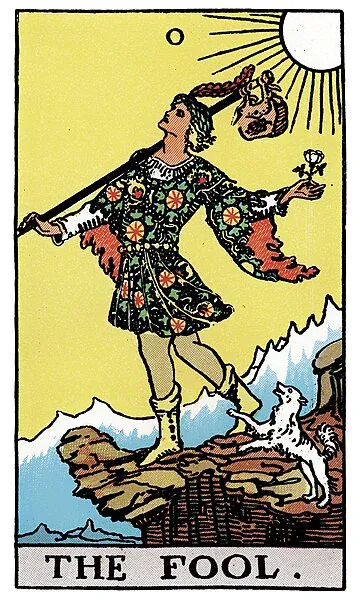
The Fool
The closing card of the Major Arcana with its opening card. The wreath is the cliff edge seen from above; the cliff is the wreath unfurled. The Fool's small bundle is the seed identified at the previous cycle's edge — the new beginning is not borrowed but built from what the closure cleared. Both bodies open the same way: arms unbraced, foot lifting. The dance does not end. It begins again with new ground beneath it.
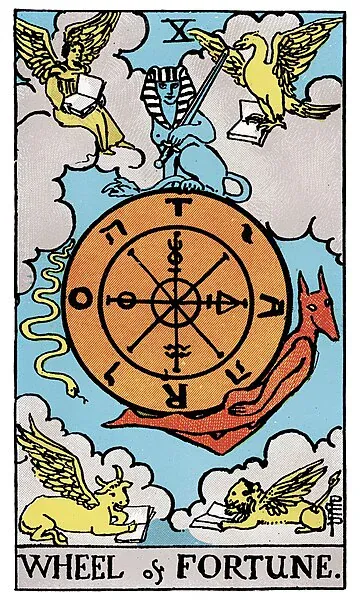
Wheel of Fortune
Both cards turn. The Wheel is the rotation that produces fortune; The World is the dancer who has learned to turn with it rather than against it. The four beasts in the corners of both cards are the same — they have moved from witnesses to pillars. Together, they affirm that the long work of previous cycles has produced the steadiness that makes fortune's rotation bearable, even welcome. The wheel turns again. You keep dancing.
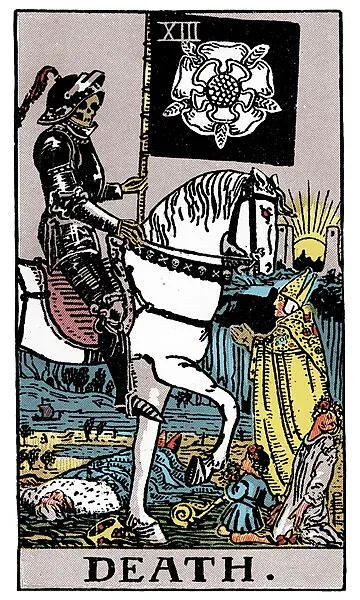
Death
The cycle's last breath paired with the cycle's first bow. Death is the necessary ending; The World is the larger arc in which the ending sits as completion. Together they show the precise seam where loss and wholeness meet. Not every ending is a completion; not every completion involves an ending. The combination does not soften the loss but places it inside the pattern that makes it meaningful. Mourn. Mark. Move.
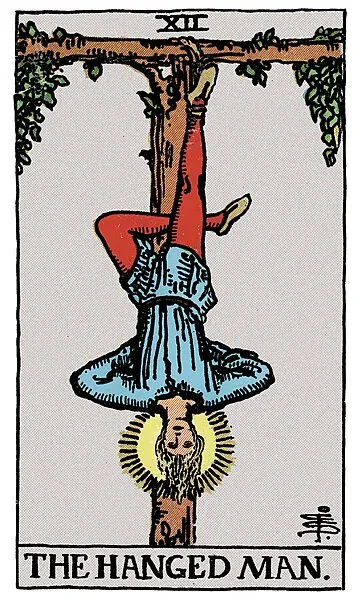
The Hanged Man
Both figures cross their legs. The Hanged Man's suspension is the pause that produces insight; The World's crossed legs are the same suspension converted into the balance of a turn. Together, they describe the trajectory of the seeker who endured the long pause and has now arrived at the rotation it was preparing. The waiting was not waiting; it was incubation. The dance has begun on the body the suspension trained.
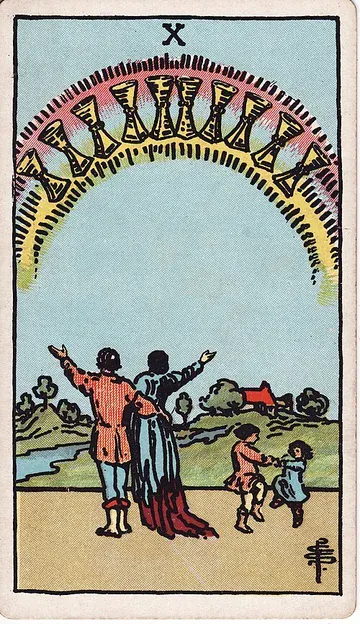
Ten of Cups
Wholeness in the small arcana mirrored against wholeness in the major. The Ten of Cups is the family rainbow — the household where love has integrated. The World is the cosmos's version of the same wholeness, the larger pattern come round. Together, they show that the personal completion is also a participation in the larger one. The home that finally holds is itself a small image of the wreath that holds the dancer at center. Both are real. Both contain the next motion.
Frequently Asked Questions
Is The World reversed a stalled yes?
The World reversed yes or no answer is rarely a clean no — it is more often a stalled yes, the answer that is on its way but has not yet landed. Treat it as a conditional almost: what you are asking about is genuinely possible, and a specific stitch has not yet been pulled tight. Identify the loose stitch, address it, and the answer that has been delayed will arrive in its actual shape.
Does The World reversed mean a relationship is performing wholeness?
The world reversed love describes the relationship that is performing wholeness while still missing a piece of integration — photographs are right, anniversaries kept, and the partners can both feel the line that has not yet been drawn. For partnerships, it warns of comfortable plateaus that have hardened into refusal. For new connections, it cautions against rushing public commitment past the inner work. For singles, it describes the closed circle of self-sufficiency that has stopped being a choice.
What does The World reversed feel like as feelings?
The world reversed as feelings describes warmth that has been decided but not declared. They have arrived at a clear inner view of you, and the view holds, and the feeling has not yet crossed the threshold into shared expression. The lover knows and will not say. The card respects the genuineness of the feeling and names the obstruction in its expression — usually the partner's own previous patterns rather than absence of care.
What does The World reversed mean as advice?
The world reversed as advice is to return to the loose thread. Whatever has been declared complete in your life that still feels incomplete — that is the seam that needs the stitch. Stop the performance of closure; do the actual final piece. Tend the corner that has been neglected. If the closure is genuine, lift the foot for the next cycle rather than turning the wreath into a wall. The card asks for honest action, not dramatic action.
What does The World reversed mean as a person?
As a person, The World reversed describes someone who has built a complete-looking life with one significant piece still unaddressed — usually a structural emotional matter, a deferred conversation, or a refusal to begin the next chapter after a genuine ending. They are not deceptive; they are sincerely committed to the closure they have declared. The work, if you are in their life, is to recognize what is actually in process beneath the appearance of completion, without expecting them to name it before they are ready.