
Three of Wands · Core Meaning
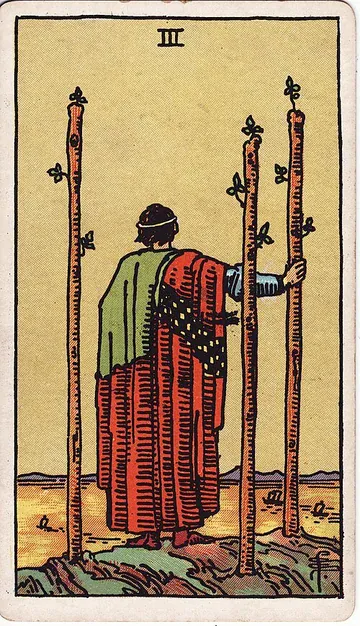
The Three of Wands describes the moment after a launch — and like all moments after a launch, it asks the launcher to do the one thing he is least trained for, which is to wait. A figure in ochre-red robes stands on a cliff above the sea, his back to the viewer. Three staves stand upright before him: two driven into the earth at the cliff's edge, one still loosely held in his right hand. The horizon is distant. A few sails hover between here and not-yet-far. He has not turned to hurry anyone back.
This is the card's signature tension: the action is finished and the result is not yet in. The will has been spent. The plan has been executed. The boats have been put in the water and pushed out, and now the ocean is doing whatever the ocean does. The figure has nothing left to give the project, and yet he cannot leave the cliff — because the cliff is where he will be standing when the sails reappear. The Three of Wands lives in the gap between departure and return, and the gap is longer than anyone planning the launch wanted to admit.
The Crowley/Thoth tradition names this card "Virtue," and the older title is worth carrying. Virtue here is not the moral kind. It is the structural kind: the card describes the discipline of having sent the right thing out and trusting the sending. Most plans collapse not because they were ill-conceived but because the sender keeps reaching back to grab them. The Three of Wands is the card of a sender who has, for once, not done that.
The traditional astrological signature reinforces the patience. This is Sun in Aries' second decan — the Sun's clear morning light landing on Aries' first fire after the impulse has fully ignited. Aries' opening decan is pure spark; the second decan is the spark stabilized into directed flame. The Sun rules it. So the card's energy is not "go faster" — it is "see further," because the seer is calibrated, not still igniting. The fire has organized itself into vision. What the eye now sees is what the will built.
In Kabbalistic terms, the Three of Wands sits in Binah, the third sephirah, "Understanding," sometimes called the womb of form. Fire enters the mother and is given its first shape. This is action's first stable architecture — not the spark of the Ace, not the polarity of the Two, but the third thing that emerges when a paired plan is committed to motion and a structure forms around it. Binah holds the Three. Binah is also why the card asks for stillness: the womb does not chase what it has released into the world. The womb watches.
Read the Three of Wands the way you would read a photograph of an architect on the day the foundation is poured but the walls are not yet up. The work is real. The work is not yet visible. The body has stopped moving. The eye has not. Whatever asks to be done now is done with the eye, not the hand.
Three of Wands in Love & Relationships
The Three of Wands reads love from after the vow rather than before it — the months in which a real commitment is left alone long enough to do its slow work instead of being re-decided every morning. Whatever shape the bond has taken — the move-in, the proposal, the long talk that finally happened, the reconciliation that took a year of silence to land — the card says the launching has been done. The relationship is already moving in the direction the two of you chose. Your work now is to stop reaching back to verify it.
For an existing partnership, the Three of Wands is the card of the patient long view. The two of you have made the agreements that were too hard to make for too long, and the agreements have begun to settle into the shape of an actual life together. The seven-year apartment. The merged bank account. The routine of the dog-walk. There is no drama on the cliff. The drama happened months ago, when the staves were driven into the earth. What remains is the slow watching of how the life you built moves out across its own horizon — kids, careers, the families coming into and out of focus, the slow re-negotiation of who does what. The card asks you to trust the structure you built more than you trust your daily anxiety about it.
For a new spark, the Three of Wands describes the early stretch when something real has been said but the rest of the relationship has not yet caught up. Maybe the first "I love you." Maybe the decision to stop seeing other people. Maybe the move from one city to the other. The launch happened. Now the two of you are watching the consequences land in real life — meeting friends, surviving a holiday with a parent, learning each other's bad week. Don't keep launching. The new ships you are tempted to send out — bigger gestures, faster commitments, more elaborate plans — will only crowd the harbor while the first ships are still finding their wind. Let the original commitment travel.
For the solo seeker — the one asking whether love is on the way at all — the card's answer is gentler than its imagery first suggests. The figure is alone on the cliff, yes, but the staves are planted and the sails are already out. The Three of Wands rarely shows up for someone who has done no work; it shows up for someone who has made some real internal decision (to stop dating people who confirm the old wound, to leave the city that wasn't working, to be honest about what they actually want) and is now in the patient stretch where that decision is finding its match in the world. Don't add new effort. Tend the cliff. The sails are inbound.
For the post-wound seeker — the one re-entering after a major break — the Three of Wands describes the season in which the wound has stopped being the loudest thing in the room. You did the work. The therapy worked, the months of rest worked, the year of celibacy or quiet did its quiet repair. The first new connection that arrives now is unlike the last one — and unlike all the ones you used to choose. The temptation will be to keep auditing whether you have healed enough. The card asks you to trust that the part of you which made the launch is more reliable than the part of you which keeps checking.
For the long-distance, cross-cultural, or cross-time-zone bond, this is one of the deck's most relevant cards. The whole imagery is distance — the figure on one shore, the sails on another, the body of water between. The card validates what you are doing. The bond can survive the geography. What it cannot survive is the pacing of someone who does not trust the geography — daily verification messages, demands for plans the timezone cannot accommodate, the pressure to collapse the distance before the structures (visa, lease, work permit) are ready. Tend the harbor. The harbor is the receiving life on your side: the friends, the apartment, the work, the actual room into which the partner will eventually arrive. Build that, instead of refreshing the inbox.
For the seeker asking the "is this person in love with me" question — and finding the Three of Wands upright — the answer is yes, with the texture of someone who has already decided. They are not on the fence. They have made an internal commitment that has not yet been fully spoken aloud. They are watching how the relationship lands in the rest of their life before they say more. Read silence here as deliberation, not avoidance. They are not pulling back; they are letting the launched thing reach you.
For the pursuer-distancer dynamic, the Three of Wands names the medicine plainly. If you have been the pursuer, the card is asking you to put the pursuit down. The other person has felt every reach. They will return on their own pace once they stop feeling chased. If you have been the distancer, the card asks whether your distance has tipped into the figure who never turns — never returns the gaze, never names the bond. The cliff is a place to stand, not a place to disappear from.
For the question of reconciliation after silence, the card offers a careful reading. The launching has happened — you sent something out, whether an apology or an invitation or a piece of writing. Do not send a second one. The first message is in the water. Their reply, if it comes, will arrive on its own ocean. A reconciliation that will hold cannot be rushed across the gap; the gap is part of how it stabilizes. Stand on the cliff. Make the harbor habitable for both of you. Wait.
For households navigating logistics constraints — joint custody, care of an aging parent, two careers in two cities, a child's school catchment — the Three of Wands is the card of the structure already in place. You have made the calendar, the agreements, the divisions of labor. They are not perfect. They are the structure you have. The card asks you to stop renegotiating from the bottom up every Sunday night. Let the structure run for a season. Adjust at the edges. The relationship is not the calendar; the relationship is what happens inside the calendar when you both stop fighting the calendar.
A note on desire mismatch. When the card arrives in a reading about whether two desires can be matched in a long bond — different sex drives, different timelines for kids, different appetites for travel or solitude — the Three of Wands is honest. The two of you are launching from the same cliff. You are not going to the same island. The card does not say this is fatal. It says it requires a longer view than most couples are willing to take. The horizon is wide enough to hold two slightly different sails. The patience is in not collapsing one to match the other.
A final note on the card's particular love language. The Three of Wands loves the way a port master loves — by maintaining the place to which the beloved returns. This is the love that pays the bill, fixes the heater, remembers the appointment, plans the trip well in advance. It is not flashy. It is reliable to the point of being invisible. Upright, this is its beauty. Reversed, this same orientation can curdle into bookkeeping. Held cleanly, the Three of Wands' love is the love that lets distance be safe.
Three of Wands as Feelings
There is a particular calm in a person who has already decided about you and has not gotten around to announcing it, and the Three of Wands is that calm. They feel like someone who has decided. They are not in the storm of new attraction; they are not in the panic of a wavering commitment. They are standing on the cliff, watching the relationship's sails move out across their week, and the watching itself is the feeling.
If they are reserved by nature, this card describes them perfectly, and you should read their silence as occupied rather than absent. Reserved Three of Wands feelings often look, from the outside, like distance — long stretches without intense contact, a slowness about declarations, a reluctance to over-explain. The internal weather is different. Internally, they have made a place for you. They have begun to plan around the assumption that you are part of their life. They are not in a hurry to inform you because they assume the relationship is already real; the announcing of it feels redundant to them. This is annoying. It is also deeply stabilizing once you adjust to it.
If they are demonstrative, the card's feelings register has a different surface but the same engine. They tell you what they want, plan things they want to plan with you, name you to friends — but the actual emotional core, on closer attention, is held in reserve. Not cold reserve. The reserve of someone who has already given the deeper thing and does not need to perform it daily. The demonstrative Three of Wands lover is the one who tells you about the trip he is planning for next year and forgets to say "and I love you" — because the year-long planning is the loving.
For a long bond settling, the Three of Wands in feelings is one of the most generous cards you can draw. It means the relationship has stopped being a question for them. They are no longer auditioning. They are not weighing alternatives. They have moved past the season in which the relationship was a piece of their identity they had to defend. Now it is the ground they stand on. They feel about you the way a person feels about the city they live in — daily, structurally, without commentary.
For a new connection still concluding what they think about you, the card describes a person who has made a private decision faster than they have made the public one. They have looked at you and recognized you. They have made the small internal pact that says, "I am going to keep showing up for this, see what it becomes." That pact is a launching. The sails are out. They are watching. The verbal declaration has not happened yet — and may take months — but the internal decision is already binding.
For reconciliation aftermath — the period after a real repair, when both of you are quietly testing whether the new agreement holds — the Three of Wands describes someone who has chosen to trust the distance the rupture revealed. They are not pretending nothing happened. They are letting the repair work without re-litigating it every weekend. This is the gift of an adult who has done their own work. Honor it by not poking at the seam.
For conflict aftermath, before any explicit repair, the card is more careful. Someone whose feelings register as Three of Wands after a conflict has stepped back from the edge. They are not chasing reconciliation, and they are also not building resentment. They are watching to see what the relationship does on its own — whether you reach in, whether the pattern repeats, whether the stakes match what they thought they did. Their silence is not strategy. It is observation. Approach them honestly. Do not approach them with a script.
For physical-distance pause — the relationship that has been on hiatus for a stretch because of work, travel, illness, or family obligation — the card reads someone who has held the relationship in mind across the gap. They feel about you the way they did before the pause, intensified slightly by absence. They are not waiting for the pause to end before deciding. They have decided. They will simply receive you again when the geography permits.
For cultural or life-stage difference — someone older or younger, someone from a different country, someone in a different career stage — the card reads as patience and seriousness. They have looked at the difference and decided it is workable. They are not romanticizing the difference; they are not pretending it doesn't exist. They are letting time and distance reveal whether the bond is sturdier than the gap. So far, in their reading, it is.
A small caution embedded in this composed card. Three of Wands feelings can curdle, when the watching becomes withholding — when the patient distance hardens into a refusal to come closer. If you sense them watching but never approaching, never naming, never receiving anything from your side either, the card has tipped toward the reversed shape. Then the question is no longer "do they care" — they do — but "are they ever going to step off the cliff and walk down to the harbor?" The card responds to honest invitation. It does not respond to demand.
A note for distinguishing pacing from avoidance. With the Three of Wands, the test is the harbor: are they tending the receiving life on their side? Do they have a place in their schedule, their apartment, their week, where you fit? If yes, the watching is pacing. If no — if the relationship lives entirely on the cliff and never in the harbor — the watching is avoidance. Honest pacing has a structure waiting on the other side. Avoidance has only the cliff.
Take the Three of Wands in feelings as confirmation that the emotional foundation is real, settled, and oriented toward you, with the proviso that the foundation expresses itself as steadiness rather than display. What is not displayed is not absent. It is built in.
Three of Wands in Career & Work
What do you do in the hour after the thing ships? The Three of Wands is that hour at work — strange, uncomfortable, important, with nothing left to do but watch how the thing performs out in the world. The proposal is in. The product is launched. The book is at the publisher. The pitch has been made. The hire has been signed. Whatever the metric was for "we did the work," the work has been done. The numbers will come in next week, or next month, or next quarter. The card describes the patience required to let them.
For a current role check, the Three of Wands upright says the role is doing what it should be doing and you are sitting at the edge of a real harvest you cannot yet see. Most of the value of the year you have spent in the role has not yet shown up on any visible metric. It is moving toward you through long-lead work — the relationships you built six months ago, the project you finished last quarter that is still working in the customer's life, the reputation you have been quietly accruing in a market that does not give awards weekly. The card says: do not leave too soon. The harvest takes longer than the planting did, and most professionals walk away from real returns one year before they would have arrived.
For a new role decision — the question of whether to take a job or wait — the Three of Wands offers a careful answer. If the offer is the result of long-lead work you have already done (years in the field, reputation, a former colleague's referral), take it; the offer is the harvest of a launch you forgot you made. If the offer is a way to escape your current launch before its returns have come in, wait. The figure on the cliff does not abandon the cliff because a faster boat is sailing past. He is here because his sails are out. Yours are too.
For the freelancer or founder, the Three of Wands is the card of the business that has built its first real outward-facing structures — the ones that work even when you are not actively pushing them. The website that brings inbound leads. The product that customers refer to other customers. The course that re-sells itself in the second cohort. The hire who runs without daily oversight. The card says these structures are real and you can stop micromanaging them. The temptation in this stretch is to launch a second thing because the first thing has stopped feeling urgent. Resist. The first launch's full return is still arriving. Wait for it.
For the creative practice — the body of work being built across years — the Three of Wands describes the season after a real piece has been put out. The book is published. The album is out. The exhibition has opened. Reviews are coming in slowly, in pieces, from places you cannot fully predict. The work is finding its readers. You are not allowed to know yet whether the work has done what you wanted it to do — that knowledge is a year away, sometimes longer. The card asks you to honor the gap. Begin the next piece in private. Do not measure the current piece against a calendar that is not yours.
For the student or apprentice, the card describes the moment when some real foundational competence has been achieved but the visible payoff is still in the future. You have done the boring repetitions that will turn into mastery — but mastery does not declare itself in the year you complete the repetitions; it declares itself in the second project you take on, the conversation with the senior practitioner you can finally hold, the problem you can now see your way through that used to baffle you. Stay. Don't leave the practice before the practice has been allowed to ripen.
For the manager or leader, the Three of Wands is the card of the team you have built, the strategy you have committed to, the organizational changes you have already made. You are now in the watch-and-tend phase. Do not over-direct. The team needs space to deliver against the structure you set, and your continued micro-intervention will both slow them down and undermine their authority over their own work. The cliff is your seat. Be visible from there. Be available. Do not row out to fix the boats.
For the care worker, teacher, or ritual practitioner — anyone whose work is tending other people's becoming — the card describes the season when a former student or client is doing the long, invisible inner work that you cannot accelerate. They will come back. They will, sometimes years later, tell you what you said that mattered. None of it is knowable in real time. The card asks you to keep the harbor lit and the practice running, regardless of who is currently sailing.
For a promotion question, the Three of Wands upright is encouraging but not predictive. The work that justifies the promotion has been done. The visibility has been earned. The next step depends on whether the organization is wide-eyed enough to see the work, and that is partly outside your control. Do not lobby in the week before the decision. The lobbying you should have done was twelve months ago, in the form of the work itself. That work is in the water. Let it return.
For a layoff or transition, the card has a different texture but the same medicine. Whatever ended, ended for reasons that were already in motion before the formal end. The launches you made in that role are not invalidated by your departure; they will continue to do their work in the world (and in your reputation) regardless of whether you are still there to watch. Tend the harbor on your side — the rest, the network, the next inquiry — and trust that what you sent out is still sailing.
For cross-functional team work, the card validates patient coordination. You have set up the dependencies, written the spec, scheduled the recurring sync. Other teams are now doing their part. Do not call a sync earlier. Do not write a status-on-the-status. The structure is the thing that makes the coordination work; over-managing the structure breaks the structure.
For the stay-or-go diagnosis when the role has gone slightly stale, the Three of Wands offers a useful distinction. If the work is still launching things and you are still tending real returns, stay. If the work has reduced to maintenance of a launch that has already played out — if there are no new staves to plant, no new sails to send out, no new horizon to scan — the card has tipped reversed. Then leaving is honest. The cliff is a place to stand only when there are still ships out.
A final note on stability vs ambition. The Three of Wands is not the card of the next big move. It is the card of the move you already made. For ambitious seekers, this can feel like an anti-climax. The card is asking you to hold a position long enough for the position to bear fruit. The next move is real, and it will arrive — but it arrives on the other side of patience, not as a substitute for it.
Three of Wands and Money
Under the Three of Wands, money is a decision already made and quietly compounding rather than one still being weighed. The retirement contribution has been set up. The business expense system is in place. The investment is invested. The mortgage is being paid down. The structural choice that defines your financial life over the next decade has already been made, and the card describes the patient stretch in which the choice is allowed to do its work.
For someone watching a long-term financial bet — whether a stock position held for years, a real estate purchase, a stake in a small business, a slow-growth career investment — the Three of Wands reads as steady. The bet is performing the way a multi-year bet performs, which is to say invisibly most weeks and visibly only across years. Do not check the daily valuation. The check is itself the trap. The card asks you to keep the architecture of the bet (the contributions, the rebalancing schedule, the operational contributions if it's a business) and let the result be a result.
For a question about a major financial move — buying a house, taking a loan, making a significant career-driven move — the Three of Wands says the move you are considering is one launch among many you have already made, and you should weigh it against the launches still in the water. Do not commit your entire patient stretch to a new venture before the current one has shown its returns. The figure on the cliff who keeps re-launching from a smaller and smaller harbor will run out of staves.
For ongoing income work — the salary, the freelance retainer, the steady client — the card is the card of the long lead. You did the relationship work months or years ago that is now generating the contracts that pay this month's bills. Keep tending the relationships even when they aren't currently transacting. The income that arrives eighteen months from now is the relationship work being done today.
For debt repayment, the Three of Wands describes the slow, structural climb. The plan you set up — the automatic transfer, the debt avalanche, the monthly review — is doing its work. Do not abandon the plan because the climb feels imperceptible week to week. It isn't imperceptible across the year. The card honors boring discipline and rewards it.
For investment timing questions, the card is conservative. It does not encourage doubling down, leveraging up, or trying to catch a wave. The Three of Wands is the card of the position already taken, and its advice is to honor the position. If the position needs adjustment for legitimate reasons — rebalancing, tax loss harvesting, a real change in circumstance — adjust deliberately, not reactively. Do not let the daily news hijack a decade-long structure.
For windfall — bonus, inheritance, unexpected check — the upright Three of Wands says: receive it, then move slowly. Most windfalls evaporate within a year because the recipient acts on the windfall before it has found its place in their broader plan. The card asks you to leave the windfall in a savings account, an index fund, or an interest-bearing structure for at least one season before deciding what it does. Whatever the windfall is for, the structure you put around it is more important than the speed of deployment.
For the entrepreneur watching the business's cash position, the Three of Wands describes the moment when you can see the next quarter clearly because the launches in motion will deliver. Do not hire too aggressively against forecasted revenue that has not landed. Do not commit to fixed costs that assume the best case. The card respects forecasted optimism but pairs it with patience: hire after the revenue lands, not in anticipation of it.
A practical move when this card appears in a money reading: take one financial check that you have been doing daily and reduce it to weekly. The portfolio app, the sales dashboard, the bank balance refresh. The Three of Wands' particular money trap is the misplaced sense of control that comes from frequent checking. The check is not the work. The structure that operates between checks is.
Three of Wands and Health
The protocol is in place, and what remains is the least medical part of any recovery: leaving it alone long enough to work. That stretch is where the Three of Wands stands. The exercise plan has been started. The medication has been adjusted. The sleep schedule has been fixed. The hard conversation with the doctor has been had. Whatever the recent intervention was, it has been launched, and the body now needs the time it actually takes to respond.
The card's elemental signature is fire — choleric, outward, hot — and the body parts it traditionally touches are the liver and the blood. This carries practical weight. For seekers asking about general energy and vitality, the Three of Wands says the metabolic engine is running and the steady inputs are reaching the right places. Do not over-stimulate. Do not add fuel to a fire that is already burning correctly. Liver-and-blood worry usually arises in two directions: not enough heat (sluggish circulation, low motivation, cold extremities, the body underbuilt for the season) or too much heat (inflammation, irritability, sleep that is technically long but not restorative, the body running hot on stress). The upright Three of Wands describes the corrected middle: the fire is in its proper hearth, the work is in motion.
For someone in active recovery — from injury, surgery, illness, or burnout — the card describes the long middle of the recovery, when most of the dramatic intervention is finished and the only remaining thing is for the tissue, the chemistry, the nervous system to slowly come back online. This is the stretch most people botch. The temptation is to test the limits before the body has finished healing — to go for the run, lift the weight, take the trip, return to full hours. The figure on the cliff who keeps running back to the harbor pulls his own ships in. The figure who waits gets to receive what was sent.
For chronic conditions — autoimmune, metabolic, mental health long-term — the Three of Wands describes a season when the management plan is working. The disease is not gone; the disease is being managed. The medication holds. The lifestyle adjustments hold. The window of stable function is wide. Use the window for what it offers — sleep, work, relationships, plans — without using it as evidence that you can stop the management. The window stays open as long as the management continues.
For acute issues, the card is more specific. The intervention has been made. The antibiotic has been started. The injury has been treated. The procedure has been completed. The body now needs days, sometimes weeks, to do its part. Do not call back into the harbor early. Take the medication for the full course. Rest for the full prescribed window. The card does not reward shortcuts. It rewards full courses.
For mental health questions, the Three of Wands upright is gentle good news. The therapy is working — slowly, in the way therapy actually works, which is by changing the substrate underneath the daily thoughts before changing the daily thoughts. The medication, if you are on it, is in its proper window. The practices (sleep, exercise, journal, ritual) are settling in. Don't keep adjusting. The figure on the cliff who relaunches every Sunday — new modality, new app, new theory — never lets any one practice do its actual work. Pick the practices you have. Let them work.
For appetite, energy, and somatic signaling, the Three of Wands suggests honest reading of the body's signals. The fire wants its proper fuel — protein, warmth, sun, movement, and bright clear input rather than dim numbing input (less doom-scrolling, less alcohol, less compensatory caffeine). Liver and blood respond to clean inputs and steady rhythm. The card invites a quiet inventory of the inputs: which ones are still nourishing the launched plan, and which ones are inertia from a previous version of yourself?
An inventory of inputs is not medical advice. The card describes a felt season; your practitioners describe your actual case. Keep the practitioners. Take the medicine. The card simply confirms the work is meeting you and asks you to give it the time it requires.
Three of Wands in Spirituality
A practice stops being a search once it has been chosen, committed to, and let into the ordinary fabric of a week — and the Three of Wands stands exactly there. Not the season of seeking, when every tradition is tried and every teacher is sampled. Not the season of conversion, when the new framework is loud and self-conscious. The slower, quieter season after — when the practice has stopped being identity-shaped and has become floor-shaped, the thing you stand on rather than the thing you announce.
The card sits in Binah, the third sephirah, "Understanding," sometimes called the womb of form. Fire in Binah is the will receiving its first stable container — the spark organized into vessel. Spiritually, this means the seeker has moved past pure intuition or pure intention into a structure that holds the intention across days, weeks, years. A meditation cushion that gets sat on most mornings. A journal that stays open through dry weeks. A weekly Sabbath, a weekly fast, a weekly silence, a daily walk. The practice is small enough to be sustainable and serious enough to be load-bearing.
For seekers in active practice, the Three of Wands describes the season when the practice has stopped feeling like work. Not because the practice has gotten easier — the difficult sessions are still difficult — but because the practice has integrated into the rhythm of life. You no longer have to decide each morning whether to sit. You sit. The decision was made months ago, and the launching has finished. What remains is the patient watching of how the practice changes you, slowly, in directions you cannot fully predict.
For seekers exploring belief, the card warns gently against re-launching every season. The Three of Wands' particular trap is the seeker who plants three staves, watches the sails go out for a week, and then yanks the staves back up to plant a different set. Each tradition gets tried just long enough to feel its shape and then abandoned for the next. The card says: pick a launching, and let the launching travel. The depth comes from staying.
For questions about path, the Three of Wands offers a clear answer. The path is the path you are on. The teacher is the teacher you have. The tradition is the tradition you have committed to. Whatever the next refinement looks like, it is downstream of staying — not of switching. The figure on the cliff sees far because he has stopped moving. The seeker who keeps re-arriving in new traditions never gets the long view.
A real practice the card invites — specific, doable in thirty minutes — is what the Hermetic tradition calls "taking the watch": sit somewhere with a long view (a window, a hilltop, a porch), and for thirty minutes do nothing but observe the landscape and your own breath. No phone. No journal. No reading. No conversation. The practice is not meditation in the formal sense; it is the deliberate cultivation of patient watching, the inner posture the card describes. Most spiritual seekers cannot sustain thirty minutes of this. The Three of Wands says: that is exactly why the practice is the practice. The capacity to watch is what the rest of the path is built on.
The Crowley/Thoth name for this card, "Virtue," has its spiritual reading here too. Virtue is the steadiness that allows action to ripen into result. The opposite is not vice; the opposite is impatience. The seeker who has not yet built the inner virtue is the seeker who breaks every protocol just before it pays out. The Three of Wands honors the slower kind of seeker — the one who can stay on the cliff after the staves are planted and trust that what was sent out will return in its own time, on its own ocean.
Three of Wands · Yes or No
Yes — but the answer is already on its way; your work is to stop reaching for it.
The Three of Wands upright is one of the deck's most patient yes-cards. As the card of completed launches and patient watch, it confirms that what you are asking about has already been set in motion. The yes is not in the future. The yes is in the water. Your job is to let it sail to you without interfering.
Asked about a relationship, a job, a move: yes — and a yes that is already at sea while the question is still being asked. The structural conditions for the answer have already been built. The launch has happened. The horizon is wide enough to deliver the result. The only thing that can compromise the yes is your own impatience — the urge to relaunch, to re-decide, to reach back and verify what you already set in motion.
For questions about whether someone will return — a colleague, a partner who has gone silent, a project's external counterpart — yes, on their own timing. The card respects gaps. The figure on the cliff does not turn to hurry anyone back. The return arrives when the return arrives, and the watching, not the calling, is what allows the return to take its full shape.
For questions about whether a plan will work, the answer is yes, with the proviso that the plan needs to be left alone long enough to work. The card warns against the trap of constant adjustment. Most plans that fail were correct plans that were re-engineered too often. The Three of Wands rewards the plan that is allowed to run.
Asked how soon the ships come in, the upright card is honest. The yes is not instant. The yes is in the medium horizon, the kind of distance that holds a few sails between you and not-yet-far. Days and weeks, sometimes months. Not years. The card is not the card of the very long wait. It is the card of the stretch in which the launch is in transit.
For binary action questions — should I act, should I wait — the Three of Wands answers wait. The action you have already taken is sufficient. Adding more action does not strengthen the yes; it crowds the harbor. The discipline the card asks for is the discipline of stopping work after the work is done.
For questions about whether the thing you wanted will arrive in the shape you wanted, the card offers a careful yes. The thing arrives. The shape may surprise you slightly — the sails may come from a different direction, the cargo may be subtly different from what you originally requested — but the substance is honored. The card does not say "the thing arrives exactly as you pictured it." It says "what you sent out will return."
If the question was: am I ready for what's coming? The card answers yes — and asks why you keep reaching back to relaunch instead of standing on the cliff and watching it arrive.
Three of Wands as Advice
Stop launching. Start watching. The Three of Wands puts its whole instruction into those four words, and the second half is the one that costs something. Whatever plan you have been building, whatever pitch you have been refining, whatever message you have been re-drafting — the action has been taken, or is now sufficient, and the next move is patience. The card asks you to step back from the desk, walk to the cliff, and let what you sent out find its own way across the water.
If there is one specific instruction the card offers, it is to tend the harbor instead of chasing the ships. The harbor is the receiving life on your side: the structure, the rest, the readiness to receive what comes back. Most senders forget that the return needs a place to land. They send out ships and then immediately fill the harbor with new launches, so that when the original ships return, there is no room for them. The advice is to clear the harbor. Make space. Have somewhere for the result to dock.
A second instruction: cancel one redundant verification. Pick the thing you have been checking obsessively — the inbox, the analytics, the partner's read receipts, the bank balance, the medical results — and reduce the check to once a day, or once a week. The Three of Wands' specific trap is the misplaced sense of control that comes from frequent looking. The looking does not move the ships. The looking only wears the watcher.
A third instruction: identify the staff still in your hand. The figure on the cliff holds one of his three staves loosely. Two are driven into the earth — finished work — but one remains. This is the part of the project that still needs you, even though the launching is done. It might be a single ongoing relationship, a single oversight task, a single weekly action that keeps the architecture alive. The card asks you to identify which of your current activities is the held staff and which are simply nervous activity. Keep the held staff. Put down the rest.
A fourth instruction, gentler: forgive yourself for the speed at which the world moves now. The Three of Wands is a slow card, and most modern seekers have been trained to expect rapid feedback loops. The card describes a returns horizon that is longer than a week and shorter than a year. It is not the world's job to deliver in two days. It is your job to develop the patience that can hold the season required.
A fifth instruction, optional but powerful: take a real long view. Once a week, deliberately, sit somewhere with a wide horizon — a window, a balcony, a hill, a beach — and look at the actual far distance for fifteen minutes. The card responds to the physical practice of seeing far. The long view is not metaphor; it is a position the body takes that recalibrates how the mind treats the gap between launch and return.
Practical advice for the day the card appears: do not send a follow-up message you have already sent. Do not check the metric you checked an hour ago. Do not relaunch the project you launched last week. Take a walk somewhere with a long view. Eat a meal slowly. Talk to one person who is not connected to any of your launches. The card returns to its full power when the figure on the cliff is allowed to be the figure on the cliff.
Three of Wands · Card Combinations
The Three of Wands sits in Crowley's Thoth tradition under the name "Virtue" — the steadiness that allows action to ripen — and the cards it most powerfully combines with are the ones that test or amplify that steadiness. The five pairings below are the load-bearing ones for this card. Each is described in full prose below; here is the orientation a reader needs before they get there.
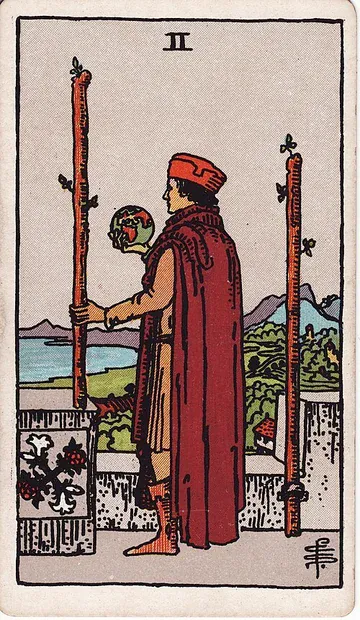
Three of Wands + Two of Wands. The pair from inside its own suit, the launch's predecessor. The Two of Wands is the choice — two staves held, the world ahead, the decision about which direction to send energy. The Three is the answer to that choice in motion. Together they describe a clean execution of a real decision: the planning was honest, the sending was committed, and now the sails are doing what sails do. This is the combination of the seeker who has stopped negotiating with their own decision.
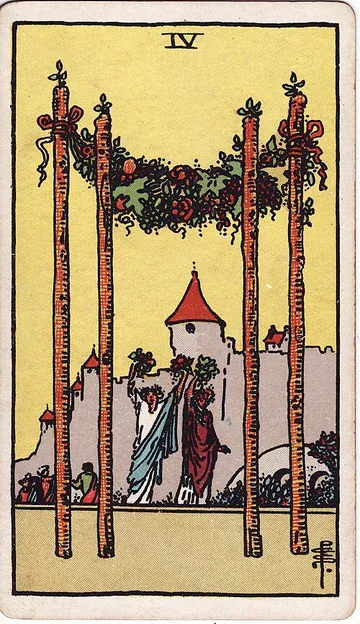
Three of Wands + Four of Wands. The card after, in the same suit, the receiving harbor. The Four of Wands is the homecoming, the canopy, the threshold of arrival. When these two appear together, the season of waiting is bounded — what you sent out is on its way, and the welcome on the other side is being prepared. This combination is the antidote to the Three's worst fear, which is that the wait is endless. It isn't. The Four is real. The harbor is being prepared.
Three of Wands + The Sun. A Major modulator of unusual closeness — the Sun rules the Three of Wands' decan (Sun in Aries, second decan), and so the pair amplifies the card's own native frequency. The clarity is dialed up. The watching is done in full daylight. The shape of the launched thing becomes visible to others, not just to the seeker. This is the combination of public success arriving cleanly, without ambiguity, and being witnessed.
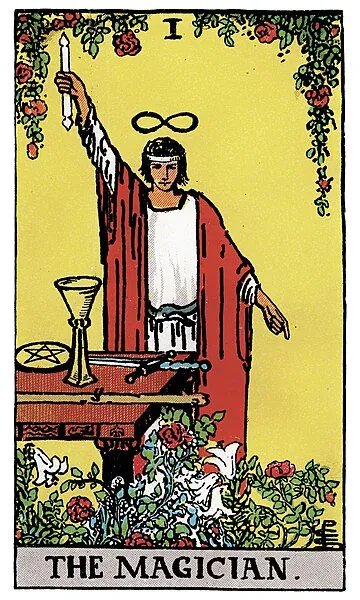
Three of Wands + The Magician. The founding gesture of will paired with the patient watch over what was launched. The Magician sets the four tools on the table and chooses the work; the Three of Wands sends that work into the world and stands back. Together they describe the full arc from intention to launch to patient watch — the Magician's certainty inside the Three of Wands' patience. The combination warns against either pole alone: pure Magician without the Three becomes manic launching; pure Three of Wands without the Magician's willed clarity becomes vague waiting on nothing in particular.
Three of Wands + Eight of Swords. The tonal contrast — perceived stuckness versus actual patient watch. The Eight of Swords is the figure bound, blindfolded, swords planted around her in the mud, convinced she cannot move. The Three of Wands is the figure standing freely on the cliff, also still — but for a different reason. The pair, when read together, asks the seeker to distinguish which kind of stillness they are in. The two cards look superficially alike from outside; from inside, one is paralysis and the other is mastery. The work is the discernment.
Card Combinations
Two of Wands
The launch's predecessor, from inside its own suit. The Two of Wands held the choice — two staves weighed, the world ahead, the decision pending. The Three is that choice committed to motion. Together they describe a clean execution of an honest decision: the planning was real, the sending was committed, and the sails are now doing what sails do. The seeker has stopped negotiating with their own choice and is letting it travel.
Four of Wands
The receiving harbor, the next in the suit. The Four of Wands is the homecoming, the canopy, the threshold of arrival. When these two appear together, the patient stretch is bounded — what you sent out is on its way, and the welcome on the other side is being prepared. The combination is the antidote to the Three's worst fear, that the wait is endless. It isn't. The Four is real. The harbor is being readied.

The Sun
The Sun rules this card's decan — Sun in Aries' second decan — and so the pair amplifies the Three of Wands' own native frequency. The clarity is dialed up. The watching is done in full daylight. The shape of the launched thing becomes visible to others, not just to the seeker. This is the combination of public success arriving cleanly and being witnessed without ambiguity. What was sent out comes back in the sun.
The Magician
The founding gesture of will paired with the patient watch over what was launched. The Magician sets the four tools on the table and chooses the work; the Three of Wands sends that work into the world and stands back. Together they trace the full arc from intention to launch to patient watch — the Magician's certainty inside the Three of Wands' patience. The combination warns against either pole alone: pure Magician without the Three becomes manic launching; pure Three without the Magician becomes vague waiting on nothing in particular.
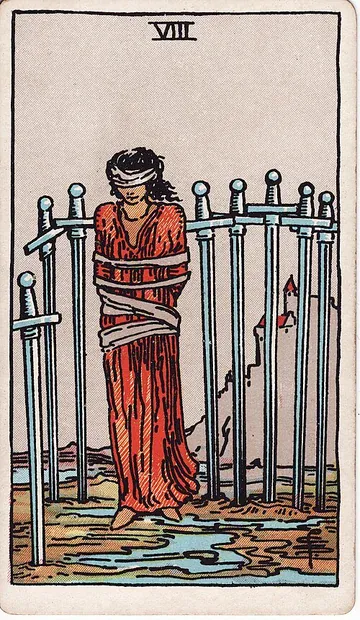
Eight of Swords
The tonal contrast — perceived stuckness versus actual patient watch. The Eight of Swords is the figure bound and blindfolded, swords planted around her, convinced she cannot move. The Three of Wands is the figure standing freely on the cliff, also still — but for a different reason. The pair asks the seeker to distinguish which kind of stillness they are in. From inside they can register similarly; from outside, one is paralysis and the other is mastery. The work is the discernment, not more motion.
Frequently Asked Questions
Why is the figure in the Three of Wands facing away from us?
Because the card is about what he is looking at, not about him. The figure in ochre-red stands on his cliff with his back turned and his attention entirely on the water, where ships he already sent are doing their slow work. A face would make the card a portrait of a man; a turned back makes it a picture of watching. That is the Three of Wands: the patient stretch after a real launch, when the work has been done, the thing has shipped, the commitment has been made, and nothing remains but the discipline of letting it travel. He is not stuck out there. He is on watch — trusting what he sent and tending the harbor that will receive whatever comes back, instead of relaunching out of nerves.
Is the Three of Wands telling me to wait, or telling me it is already done?
Both, and the order matters: it is already done, therefore wait. The Three of Wands is one of the deck's clearer yes-cards, but the yes is not an instant one. It sits in the medium horizon — days to months rather than years — because the conditions for it were established by work already finished. Nothing further is being asked of you at the level of effort. What is being asked is restraint at the level of nerves. The one thing that reliably compromises this card's yes is relaunching: reopening the decision, sending a second version of the message, adding another initiative beside the one already sailing. The ships are out. Waiting here is not passivity, it is the last part of the work.
How does the Three of Wands read distance in a relationship?
Generously, which surprises people who expect distance to be the problem. The card's whole image is a bond with water in the middle of it: a commitment already made, ships already sailing, and a stretch of ocean that has to be crossed at the speed oceans are crossed. For a long-distance partnership, the Three of Wands validates the geography and relocates the difficulty — the miles are not what is straining the bond, the impatience with the miles is. For a new spark, it says a real internal decision has quietly been made and is being lived with rather than announced. For someone single, it says the inbound sails are already on the horizon and the useful work is harbor work: making a life with an actual berth in it, rather than launching something new every time the water looks empty.
What does the Three of Wands mean for career?
The Three of Wands describes work that has shipped and is now in the medium-horizon stretch where its returns are still arriving. The card respects long-lead professionals — the freelancer whose website is bringing inbound leads, the manager whose team is delivering against the structure they set, the writer whose book is finding readers. The card's main career advice is don't leave the launch one year before the harvest. Most professionals walk away from real returns just before they would have arrived.
What is the Three of Wands as feelings?
When the Three of Wands describes how someone feels about you, the feeling is composed and oriented — they have made an internal decision and are watching the relationship land in their actual life rather than performing the decision daily. Reserved Three of Wands feelings look like patient distance from the outside; inside, they have already made room for you. The test for distinguishing pacing from avoidance is the harbor: do they have a real place in their life that you fit into? If yes, the watching is patience. If no, the card has tipped reversed.
Continue Reading
Three of Wands · Card overview · symbols · correspondences →
Return to the full card view — image, symbols, sensory correspondences, and Hermetic axes.
Read the reversed meaning →
Read the same depth on the opposite orientation.
Draw your reading now →
Bring this card to a question — open a quiet ritual.