
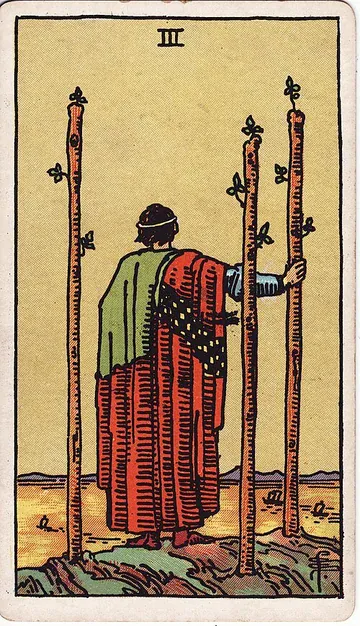
Three of Wands Reversed · Core Meaning
Watch the reversed Three of Wands long enough and you see a man wearing a path into his own cliff-edge. The cliff is still there. The staves are still planted. The sails are still out across the water — but now the figure paces. He returns to the edge every hour. He squints. He counts. He reaches a hand out toward the horizon as if his reach could pull the boats back faster, or if he could see whether they have begun to turn. The launching was real. The patience is missing. And the missing patience, in the long run, is the problem the card is naming.
This is the reversed card's central knot: a sender who has lost trust in his own sending. The plan was good. The execution was honest. The conditions for return were set. And then — as soon as the boats slipped over the horizon — the second-guessing began. Maybe the wrong port. Maybe the wrong timing. Maybe a different boat would have carried the cargo more reliably. The reversed Three of Wands describes the season in which legitimate work has been done and the worker cannot stop interfering with it.
There is a second flavor of the reversed card, equally common and slightly different in shape: the figure who has launched too many ships at once. Five staves, eight, twelve. Sails everywhere on the horizon, going to ports the figure can no longer name. None of the launches receives his full attention. None of them arrives carrying what he actually wanted. Each return is thinner than expected because the original sending was thinner than it should have been. The reversed card describes the trap of overextension — the seeker who has confused the number of launches with the depth of the launching.
The astrological signature reverses too. Sun in Aries' second decan upright is fire calibrated by clarity, the spark stabilized into directed flame. Reversed, that calibration slips — the fire becomes restless again, the impulse returns, the seeker who had organized his energy into a vessel begins acting like a spark without a vessel. Aries is naturally cardinal, naturally initiating; the upright card is the medicine for that energy, and the reversed card is the medicine forgotten.
In Kabbalistic terms, the Three of Wands sits in Binah — the womb that gives form to fire. Reversed, the womb has been disturbed. The form has not yet stabilized. The seeker who keeps re-launching is, in effect, breaking and remaking the container before it has been allowed to set. The Crowley/Thoth name for this card upright is "Virtue," and the reversed card is the loss of that virtue — not into vice, but into restlessness.
Reversed, the Three of Wands asks: which of the ships you sent out are you actually still trying to receive? And: which were sent for the relief of sending, rather than for the substance of the cargo? And: where, in the harbor on your side, is there room for any of them to dock if they did return tomorrow?
Three of Wands Reversed in Love & Relationships
A commitment can be entirely real and still be outweighed by the daily worrying about it, and the reversed Three of Wands is where that scale has tipped. The vow was honest. The choice was clear. And then, after the launching, the doubting began — the morning audits, the read-receipt analysis, the post-mortem of every conversation. The reversed card is the figure who runs back to the cliff every hour, not because the ships have failed, but because he cannot bear the silence between sightings.
For an existing partnership, the reversed card often describes the long bond that has tipped from patient watching into chronic surveillance. You know each other's schedules. You can map the texts. You have noticed that the response time has shifted by twenty minutes. None of these data points is conclusive of anything. The reversed card warns that the watching has become a feeling-state — anxiety dressed as attention — and the relationship is being slowly worn down by the pacing more than by any actual problem in the bond.
For a new spark, the reversed Three of Wands describes the early stretch in which a real declaration has been made and the maker of the declaration is now harassing themselves about whether the declaration was premature. They are not pulling away from you. They are pulling away from their own commitment, second-guessing the launch, looking for a reason to relaunch from a slightly different position. The card names this clearly. The medicine is not to chase them with reassurance; the medicine is to refuse to participate in the relaunching ritual. Hold the original commitment. Let them come back to it.
For the solo seeker, the reversed card describes the searcher who has launched too many lines at once. Three dating apps simultaneously. Five conversations in parallel. The new colleague at work, the friend's introduction, the person met at the wedding, the slow-burn of an old college flame. None of the lines gets the full attention. Each returns thinner than expected because the seeker is everywhere at once and nowhere fully. The card asks for the recall of at least two of the ships. Pick the ones in which something real is actually possible. Let the others go.
For the post-wound seeker, the reversed Three of Wands has a careful warning. The wound is the launching that you are still secretly trying to recall. The relationship that ended a year ago, two years ago — you have built new structures, new dating accounts, new social patterns, but a quiet hourly part of you keeps running back to the cliff to scan the horizon for the previous vessel. The card says: that ship is not coming back. Recall it consciously. Stop scanning. The harbor cannot receive a new launch as long as a phantom ship is being waited for.
For the long-distance, cross-cultural, or cross-time-zone bond, the reversed card is one of the most common and most painful diagnoses. The geography is the same. What has changed is your capacity to bear it. The daily verification messages have become the relationship. The video calls, instead of being a sustaining ritual, have become the proof of life that you require to function. The reversed card warns that the bond can survive the distance but cannot survive the sender who has lost faith in distance itself. The work is internal: rebuild a real, full life on your side of the water — the friends, the work, the body in motion, the actual room — so that the relationship is again something you carry with you, not something you constantly check on.
For the seeker asking the "is this person in love with me" question — and finding the Three of Wands reversed — the answer is more nuanced than a clean yes or no. They have feelings that have not yet stabilized into a launching. They are still on the planning side of the cliff, still negotiating with themselves about whether to drive the staves into the earth. Or, in the second flavor of the reversed card, they are someone who has launched many partial commitments to many people and you are one ship among several. Either way, the situation is ambiguous because they have not yet committed to a single launch. Do not press. Pressing collapses ambiguity into withdrawal. Make yourself a real port; let them choose to sail in.
For the pursuer-distancer dynamic, the reversed card names the trap. The pursuer is the figure on the cliff who paces and reaches and calls — and the calling itself is what keeps the distancer at distance. The reversed card asks the pursuer to put the binoculars down. The distancer is also implicated: in the reversed reading, the distancer is the one who has launched without ever planning a return, sailing the relationship out into a horizon they have no real intention of crossing back from. Both can correct. Neither can correct by continuing the dance.
For reconciliation after silence, the reversed Three of Wands offers a careful, honest answer. If you have already sent the message — apology, invitation, opening — do not send a second one. The reversed card is the card of the sender who has lost faith and is rushing the response. Their reply, if it comes, will arrive when it arrives. If it does not, the reversed card is also the card of the launch that, in retrospect, was sent partially for the relief of sending rather than for the substance of repair. That is information too. Honor it.
For households navigating logistics constraints, the reversed card describes the partnership that has begun to confuse calendar maintenance with relational maintenance. The weekly sync about the kids' schedules has become the only conversation. The shared spreadsheet has replaced the shared bed. The reversed card warns that logistical efficiency, when it consumes the entire bandwidth of the relationship, hollows the bond. Re-launch one non-logistical ritual. A real meal alone together. A walk without the phone. Something that is not the calendar.
For desire mismatch, the reversed card asks for honesty. The two of you are not just sailing to different islands; one of you has begun to suspect the other is no longer sailing toward the original agreement at all. The reversed card describes the partnership in which one launched honestly and the other launched as performance. This is not necessarily fatal. It is, however, the kind of conversation that cannot be put off another season without curdling. The card invites the harder talk.
A note on the card's reversed love language. Where upright Three of Wands loves like a port master — by maintaining the place to which the beloved returns — the reversed card loves like a port master who has begun to ration the welcome. The harbor lights flicker. The receiving room has been quietly converted to other uses. The reversed card warns the seeker that they have, without realizing, made themselves harder to come home to. The medicine is not to demand the partner sail faster; the medicine is to remember why the harbor was lit in the first place.
Three of Wands Reversed as Feelings
The warmth in a reversed Three of Wands is not in question; what has worn thin is the patience holding it. They feel something — likely something significant — and the feeling is being eroded by their own difficulty with the gap between their decision and their declaration. They are caught in a loop. They want to commit. They commit privately. They begin to second-guess the private commitment. They walk it back internally. They reapproach. The reversed card describes the feelings of someone who has not yet stabilized into a single sending.
This is the card of the partner who is in love with you on Tuesday and uncertain by Friday — not because the feelings are fake, but because their capacity to hold a launched commitment without re-checking it every other day has not yet matured. They are not lying when they say what they feel. They are also not yet able to hold what they feel across the patient stretch the relationship requires. The reversed card is honest about this without being dismissive of it.
If they are reserved by nature, the reversed Three of Wands feelings often look like withdrawal that doesn't quite resolve. They retreat — but they don't fully leave. They reappear — but they don't fully arrive. The pacing is exhausting from the outside, and from the inside it is the experience of someone who cannot settle their own internal launch. They are watching the sails of their own feelings and constantly flinching back from the cliff. Read this carefully. It is not contempt for you. It is contempt for their own capacity to commit, projected outward.
If they are demonstrative, the reversed card has a different surface but the same engine. They will declare. They will plan. They will name. And then a week later they will be quieter than they should be, slightly retracted, apparently busy with something else. Then another declaration. Then another retreat. The reversed Three of Wands feelings register as a relationship being held in a constantly relaunching state, where the declarations themselves are the relaunching mechanism, attempting to overcome the discomfort of patient watching by simply launching more.
For a long bond settling, the reversed card describes someone who has technically made the lifelong commitment but is privately, daily, re-deciding it. The marriage is real. The years are real. The shared house, the shared accounts, the shared friends are real. And every Sunday morning, in some private interior, they are re-running the case for whether to stay. This does not mean they will leave. Many people live an entire long marriage in this register. The card simply names that the relationship is being conducted as a perpetual relaunch rather than as a settled architecture, and that this consumes energy the relationship needs for its actual substance.
For a new connection still concluding what they think about you, the reversed card describes someone whose feelings have already passed the threshold of decision but who has not yet allowed themselves to know it. They will tell you eventually. The telling will surprise them, in the moment of telling, more than it surprises you. Until then, their behavior will be intermittent — leaning in, pulling slightly away, checking, returning. Read the pattern, not the individual data points. The pattern is "deciding."
For reconciliation aftermath, the reversed card is more careful. After a real repair, they should be in patient watch. If instead they are in restless verification — checking to see if the old patterns have returned, asking the same reassurance question slightly different ways every weekend, looking for evidence the repair didn't take — the reversed card warns that the repair has not yet been fully accepted internally. The relationship can hold this for a season. It cannot hold it forever. The work is theirs.
For conflict aftermath without explicit repair, the reversed Three of Wands feelings are particularly tender. They are not in clean withdrawal and not in clean approach. They are reaching toward you and pulling back, drafting messages and not sending them, planning to call and finding reasons not to. They are the figure on the cliff who has launched the apology in his head a hundred times and has not yet driven the staves into the earth. They feel something. They are afraid of their own feeling. Approach the situation honestly without demanding the relaunch happen on your timeline.
For physical-distance pause, the reversed card warns that the distance has begun to fray them. The bond is real. Their capacity to carry it across the gap is wearing thin. They miss you in a way that is not stabilizing but destabilizing — and they may make impulsive decisions (book an unplanned trip, send an emotional message at 3 a.m., tentatively explore other connections) that are symptoms of the wear rather than expressions of their actual feeling. Hold the structure. Their feelings are still oriented toward you. Their patience is the thing under stress.
For cultural or life-stage difference, the reversed card describes someone who has decided, internally, that the difference is workable but is now in a stretch of doubting their own decision. The doubting is not really about you. It is about their own capacity to hold a non-default choice across the long distance such choices require. The medicine, on your side, is to be a stable port — not to launch counter-arguments to their doubts, not to perform the defense of the relationship for them, but simply to keep the harbor lit and let their own internal launching reach steady state.
Distinguishing pacing from avoidance, with the reversed card, is harder than with upright. The test remains the harbor: do they have a real, sustained place in their life that you occupy? But the reversed card warns that the harbor itself may be flickering — fully lit some weeks, dim others. Watch the trend across months, not the spot reading on a given Friday. If the harbor is intermittently lit but the long arc is toward more light, the reversed card is correctable through patience on your side. If the harbor is darkening across months, the reversed card has tipped into avoidance, and the honest reading is to step off the cliff yourself.
Take the Three of Wands reversed in feelings as confirmation that something real is happening on the other side of the water and that the other person has not yet matured into the patience their feelings require. The card is not a verdict. It is a description of unfinished internal work. The work, if it gets done, gets done by them. The figure on your cliff cannot do the work of the figure on theirs.
Three of Wands Reversed · Career & Work
A project that should be sitting in patient watch is instead being reopened every week, and the reversed Three of Wands names that habit precisely. The launch happened. The team is competent. The conditions for the result are real. And the launcher cannot stop reaching back into the project — re-spec'ing the deliverable in week three, sending the same status email twice, scheduling the additional sync that wasn't planned. The reversed card is the manager whose anxiety has begun to interfere with the work he commissioned.
There is a second, equally common reversed flavor in career: overextension. The seeker has launched too many initiatives at once. Three side projects, two day-job tracks, a freelance practice on the side, a small course they meant to ship by Q2, an investment in someone else's startup that they're nominally advising. None of these get the whole of the launcher. Each return is thinner than promised. The reversed card describes the professional who has confused the number of plates spinning with the depth of any individual plate.
For a current role check, the reversed Three of Wands reads either as the worker who has stayed past the harvest or the worker whose anxiety is now worth more than his contribution. The first case: the launches that justified your continued presence have played out. The role has become maintenance of stale architecture, and the soul has begun to leave even though the body still attends meetings. The second case: the role is healthy, the launches are still in motion, but the worker has lost trust in his own capacity to let them ripen — and the constant re-checking has begun to read, externally, as someone who cannot let go of work that no longer needs him.
For a new role decision — take or wait — the reversed card asks for harder honesty than the upright card. If the offer is genuinely better and the move is structurally correct, the reversed card warns against staying in a launch that has run out of returns simply because leaving feels like abandonment. If the offer is a way to escape the discomfort of patient watching on your current launch, the reversed card warns against the relaunch instinct. The diagnostic question is: what specifically is unfinished in your current role? If you can name it, stay until it is finished. If you cannot, you have already left.
For the freelancer or founder, the reversed card is one of the deck's clearer warnings about overextension. You are launching too many products. You have too many irons in the fire. The website is up, the course is in pre-sale, the consulting business has its own prospect list, the second SaaS idea is being built nights and weekends. None receives the strategic depth required. The card asks, plainly, for the recall of at least one ship. Pick the most viable launch. Pour the rest of the year's attention into it. The other initiatives can return later. They will not return at all if the primary launch fails for lack of attention.
For a creative practice, the reversed card describes the artist who cannot stop publishing. Newsletter every week, social posts daily, drafts mid-edit posted as if final, the next book announced before the current one has been read. The reversed Three of Wands warns that the constant publishing is preventing any individual piece from being received in its full depth. The cure is not to publish more carefully; the cure is to publish less and live in the patient gap during which the published work is doing its work in the world. Most artists who are convinced they need more output need, instead, more silence between outputs.
For the student or apprentice, the reversed card describes the seeker who keeps switching disciplines just before competence stabilizes. Three years of one practice, then abandoned for the next promising thing. Each restart resets the clock. The reversed card warns that the discipline of staying with a practice through the long unrewarding middle is the discipline that produces actual mastery, and that the seeker who keeps relaunching is buying excitement at the cost of depth.
For the manager or leader, the reversed Three of Wands is the card of the over-managing leader. The team has been hired. The strategy has been set. The structure has been built. And the leader cannot stop reaching into the work — re-writing other people's documents, re-running other people's meetings, re-deciding decisions that were properly delegated months ago. The reversed card asks the leader to step back and trust the architecture. The leader's job is the cliff, not the rowing out to fix each boat. Continued intervention does not strengthen the team; it teaches the team that their authority is conditional on the leader's mood.
For the care worker, teacher, or ritual practitioner, the reversed card warns of the helper who cannot let students or clients do their own slow internal work. The seeker who is still in the cocoon does not need the cocoon broken open by an impatient witness; the breaking is the very thing that compromises the eventual emergence. The reversed Three of Wands describes the well-meaning caregiver who interferes with patient watching because the watching itself is uncomfortable. The medicine is to bear the discomfort.
For a promotion question, the reversed card is honest. The work that would justify the promotion has been done — but the constant re-checking, the visible anxiety about the timeline, the lobbying against silence has begun to undercut the case. Promotions in most organizations are decided as much by perceived steadiness as by performance, and the reversed card describes the worker whose steadiness has eroded under the wait. Stop lobbying. The lobbying is the leak.
For a layoff or transition, the reversed card describes the worker whose attempt to control the timeline of the transition has begun to consume them. The role is ending. The role is going to end. The end will be on its own schedule, not yours. The reversed card asks the worker to spend the wait building the harbor on the next side — the resume, the network, the rest, the actual readiness for what comes next — rather than running back to the cliff every hour to see if the layoff conversation has been scheduled.
For cross-functional team work, the reversed card describes the dependency-tracker who has confused tracking the dependencies with completing them. The Gantt chart is updated daily. The status doc has six versions. The team is exhausted by the meta-work of coordinating coordination. The card asks for trust in the structure already in place and a deliberate reduction of overhead. Other teams need space to deliver their part; constant micro-management of their delivery slows them down and reads as distrust.
For the stay-or-go diagnosis, the reversed card offers a sharp tool. If your current launches have actually played out and the role is now maintenance of stale architecture, leaving is honest and correct. If your current launches are still in motion but you have lost the capacity to wait for them, the reversed card says: the problem is not the role. The problem is your relationship with patient stretches. Leaving the role will not fix the relationship; the same anxiety simply re-creates itself in the next launch. Address the root.
Three of Wands Reversed · Money
What does checking actually cost? The reversed Three of Wands answers with a financial life run by anxiety rather than by the structure already built to run it. The plan is sound. The contributions are happening. The investments are diversified. And the daily checking, the constant rebalancing, the impulsive moves prompted by news cycles, are slowly bleeding value out of an architecture that would, if left alone, compound quietly across years.
For someone watching a long-term financial bet, the reversed card warns of the trap of frequent intervention. You did the analysis. You took the position. The position is correct for the time horizon you set. And now, week after week, you are checking the value, reading the headlines, re-running the case for an exit, agonizing over a 5% drawdown that is statistically meaningless across the time horizon you committed to. The reversed Three of Wands is the card of the investor who exits a winning position in month nine because he could not bear the patient stretch of months three through eight. The cure is to reduce the checking. The checking is the leak.
For overextension, the reversed card is plainspoken. You have too many financial commitments at once. The mortgage, the second mortgage, the car loan, the student loan, the credit-card balance you are slowly working down, the new subscription that seemed reasonable at signup, the health-savings contribution, the side-project budget that has begun to creep, the obligation to a family member that you took on in good faith and is now harder than you anticipated. Each commitment is reasonable in isolation. Together, they exceed your capacity. The reversed card asks for the recall of at least one ship — one commitment closed, one obligation renegotiated, one expense honestly cut.
For income work, the reversed card warns of the freelancer who has too many small clients and not enough deep ones. The prospect list looks busy. The bank balance does not match the busyness. The reason is that small clients require nearly the same overhead (calls, contracts, invoicing, scope arguments) as large clients but pay a fraction. The reversed Three of Wands asks for the consolidation: fewer, deeper relationships, with clients whose work is significant enough to justify the overhead they require.
For debt repayment, the reversed card describes the seeker who keeps changing the strategy. One month it is debt avalanche, the next month it is debt snowball, the next it is a balance transfer to a new card with a teaser rate, the next it is a personal loan from a credit-union to consolidate. Each strategy has merit. The constant switching forfeits the compounding benefit any single strategy would have produced. Pick one. Run it for at least a full year. Adjust only at year-end.
For investment timing questions, the reversed card is sharp. Whatever instinct you have right now to make the move — to sell because the market is uncertain, to buy because the market is undervalued, to rebalance because the allocations have drifted — examine carefully. The reversed Three of Wands is often the card of the investor whose anxiety, dressed as analysis, is the actual driver of the move. Sleep on it for a week. If the move still looks right after a week of not thinking about it, make the move deliberately. If it doesn't, the move was a relaunch instinct.
For a major financial commitment — buying a house, taking a loan, signing a multi-year contract — the reversed card asks for the harder due diligence. Are you committing because the structural conditions support the commitment, or because the patient stretch of waiting for the right opportunity has worn you down? The reversed Three of Wands describes the seeker who buys the wrong house because he cannot stand to wait through one more season of looking. The waiting is the work. The wrong launch will outweigh, in cost, every additional season of patience would have required.
For windfall — bonus, inheritance, surprise check — the reversed card warns of impulsive deployment. The windfall arrives. Within a week, half is committed to a vacation, a renovation, a generous gift, a new piece of gear that "you've been needing." Within three months, the windfall is gone and the underlying financial situation has not actually improved. The reversed card asks for the deliberate stillness that windfalls require. Move the windfall to a separate account. Do nothing for one full season. Then, deliberately, decide.
For the entrepreneur watching the business's cash position, the reversed card warns of hiring against optimistic forecast. The prospect list looks good. The forecast assumes the deals will close at recent historical rates. The hire is made. The deals closes at half the historical rate because something has shifted in the market and you didn't see it in time. The reversed Three of Wands is honest: the launches in motion are not as solid as you are telling yourself. Hire after the revenue lands.
A practical move when this card appears in a money question: do not make any non-mandatory financial decision for one week. Inventory all the financial moves you were considering — the rebalance, the new investment, the impulse purchase, the renegotiation — and write them on a list. After seven days, return to the list. Most of the items will have lost their urgency. The remaining items will be the actual decisions. The reversed card responds to this kind of forced patience.
Three of Wands Reversed · Health
Recovery has a rhythm of its own, and the reversed Three of Wands is the patient interrupting it. The protocol is correct. The intervention has been made. The medication is right, the rest schedule is appropriate, the physical therapy plan is well-designed. And the patient cannot stop testing the limits — going for the run before the tendon has finished healing, taking on the stressful project before the nervous system has fully reset, returning to full hours one week before the doctor's actual recommendation.
The card's elemental signature reversed is fire that has slipped its calibration — the choleric outward heat that is supposed to be in the proper hearth has spilled. Liver and blood, the body parts traditionally associated with the card, can register this as inflammation, irritability, sleep that is technically long but unrefreshing, the body running hot on stress that it cannot metabolize. The reversed Three of Wands describes the seeker whose vitality is being eaten by his own restlessness about his vitality.
For active recovery, the reversed card is one of the deck's most direct warnings. The body needs the full window. The window is longer than you wanted. Cutting the window short produces re-injury, secondary infection, prolonged recovery on a longer timeline than the original window would have required. The figure on the cliff who keeps running back to the harbor pulls his own ships in; the patient who keeps testing the body before it has finished healing pulls his own recovery into a longer arc. Take the full course. Rest the full window. Honor the protocol.
For chronic conditions, the reversed card describes the season when self-management has slipped — but the slipping is from the inside, not from any external pressure. You know the medication. You know the practices. You know what stabilizes you. And the reversed card describes the patient who has begun to skip — not dramatically, but sometimes — because the discipline has begun to feel boring, because a "good week" has produced false confidence, because the urgency that drove the original protocol has faded. The reversed Three of Wands warns that chronic conditions reward steady management and punish lapses on a delayed schedule. The lapse this month is the flare three months from now. Return to the protocol that was quietly keeping the flares at a distance.
For acute issues, the reversed card describes the seeker who is testing the limits. The infection is mostly clear; the antibiotic is on day five of seven; you are tempted to stop the course. The reversed card says: complete the course. The injury is mostly healed; the brace is supposed to be on for two more weeks; you are tempted to take it off for the wedding. The card says: keep the brace on. Most acute setbacks happen in the last week of recovery, not in the dramatic early days, and they happen because the patient has run back to the cliff before the ships have actually returned.
For mental health questions, the reversed Three of Wands is honest and gentle. The therapy is working — but you are testing the therapy. You are pushing the practitioner to "do more," demanding that the slow work happen faster, switching modalities every six weeks because the previous one didn't deliver fast enough. The card describes the patient who has launched a real intervention and is now interfering with it from impatience. Therapy works on a timeline that is not yours to set. Hold the appointment. Stay with the practice. The work is doing its work.
For appetite, energy, and somatic signaling, the reversed card describes the body running hot on inputs it cannot metabolize. Too much caffeine, too little water, sleep that is fragmented by anxiety, food eaten faster than it should be eaten, screen time that is functioning as a substitute for rest. The fire — choleric, outward, hot — has spilled into the bloodstream. Liver and blood register the spill before any other system. The medicine is not heroic. The medicine is boring: more water, more sleep, fewer screens, slower meals, walks without the phone. The reversed card responds to plain physical practices that re-contain the fire.
For the seeker tempted to relaunch the protocol — switching from one diet to another, from one trainer to another, from one supplement stack to another, from one therapy to another — the reversed card is plainspoken. The constant relaunching is the problem. The stickier the protocol you commit to, the more time it has to actually work. Pick the practice you already know works for you. Run it for a full quarter without modification. Then, deliberately, evaluate.
Which protocol you run is yours and your practitioners' to choose; the Three of Wands offers no medical advice. The card describes a felt season; your practitioners describe your actual case. Keep the practitioners. Take the medicine. The reversed card simply names the trap of impatience and asks for the boring discipline that healing actually requires.
Three of Wands Reversed · Spirituality
Some seekers plant the same three staves every season and pull them up before anything has rooted; reversed, the Three of Wands is that seeker. A new tradition every season. A new teacher every year. A new modality every six months — Zen, then Vipassana, then a Christian contemplative practice, then Sufi music, then a return to the Hermetic books, then a flirtation with shamanism, then back to whatever tradition felt warmest in childhood. Each is genuine. Each gets started honestly. None gets long enough to bear its actual fruit.
The card sits in Binah, and Binah is the womb that gives form. Reversed, the womb has been disturbed before the form could stabilize. The seeker has not allowed any single container to hold the fire long enough for the fire to take its first real shape. The reversed card describes the spiritual life of perpetual relaunch.
For seekers in active practice, the reversed card warns against the modification instinct. You have a practice. The practice is good enough. The modification — adding a new tradition's posture, a new teacher's framing, a new app's gamified approach — is, more often than not, the resistance dressed up as upgrade. The reversed Three of Wands describes the practitioner who keeps tinkering with the practice instead of doing the practice. Stop tinkering. The unmodified, unupgraded, slightly boring version of your practice that you committed to a year ago is the practice. Do it.
For seekers exploring belief, the reversed card describes the consumer of spirituality — the seeker who collects traditions the way a person collects books, with a comparable degree of having actually read them. Each tradition gets sampled enough to develop opinions, never enough to develop transformation. The reversed card asks for the deliberate end to comparison and the deliberate beginning of commitment. Pick one. Stay long enough that the staying becomes the practice.
For questions about path, the reversed card is sharp. The path is the path you already chose and keep abandoning. The teacher is the teacher you already had and keep leaving. The tradition is the tradition you already committed to and keep restarting from a different vector. The reversed Three of Wands names this clearly: you do not need a new path. You need to stop launching new paths. The next chapter of depth is on the other side of the patience you have not yet developed.
A real practice the card invites — specifically for the reversed posture — is what desert traditions called "remaining in the cell." Pick one practice (the meditation cushion, the journaling stretch, the Sabbath, the daily walk). Commit to it for forty days without modification. No new teachers, no new books, no new podcasts about the practice. Just the practice itself, repeated, in the boring middle. Most seekers who try this report that the first week is restless, the second week is irritated, the third week begins to settle, and the fourth week begins to deepen. The reversed card responds to this kind of structural patience.
The Crowley/Thoth name for this card upright is "Virtue," and the reversed card is what happens when the virtue is forgotten — not vice, exactly, but restlessness. Most contemporary spiritual culture rewards the restless seeker (more content, more launches, more traditions sampled, more credentials collected). The reversed Three of Wands is the card asking the seeker to step out of that incentive structure and into the slower one. Depth is not on the other side of more launches. Depth is on the other side of staying.
Three of Wands Reversed · Yes or No
Yes, technically — and thinner than the yes you were reaching for.
Nothing here has been denied outright. It is more often the answer that says: yes, technically, but you have compromised the conditions for the yes by your own impatience or overextension, and the yes that arrives is going to feel thin. The launch happened. The launching has been disturbed. The result will be smaller than the original launch could have produced.
For yes-or-no questions about a relationship, a job, a move, a decision: the answer is conditional. The thing can still happen, but only if you stop relaunching. If you keep reaching back to recall the ship every hour, the ship eventually does come back — empty, pulled in by your own gaze. If you can recover the patience the upright card requires, the yes is still available. If you cannot, the answer functionally tips to no, not because the conditions failed but because the launcher could not bear the wait.
For questions about whether someone will return — the silent partner, the offer that has not yet come back, the project's external counterpart — the reversed card asks for the recall of one ship before reading the others. Have you launched too many lines at once? If yes, the return will be thin because the original sending was thin. Pick the one you actually want back. Stop signaling the others. The bandwidth was diluted by overextension.
On the question of how long the wait runs, the reversed card is honest. The wait is going to be longer than you wanted. The reversed card describes the season in which the launcher has compromised the timing through interference, and the recovery of the original timeline requires a stretch of stopping the interference. Days you spent reaching back are days the ships had to recompose themselves. Patience now lengthens the wait less than impatience does.
For questions about whether a plan will work, the reversed card warns that the plan has been over-managed. The original plan was good. The constant adjustments — the re-spec'ing, the re-sequencing, the re-budgeting — have introduced enough variance that the original plan is no longer recognizable. The card asks: can you commit to the plan you have without further modification for thirty days? If yes, the answer is yes. If no, the answer is no, not because the plan was wrong but because the modifier cannot stop modifying.
For questions about whether someone is being honest, whether an offer is genuine, whether a plan will hold, the reversed card warns of the compromised launch. What is presented may be technically real and yet thinner than it should be — because the sender has launched too many partial commitments to too many parties, or because the sender is themselves in the reversed posture and second-guessing what they sent. Read carefully. Ask the second question.
For binary action questions — should I act, should I wait — the reversed card answers wait, and asks specifically for the recall of at least one of the actions you have already taken. The act of un-launching one thing — the canceled meeting, the renegotiated commitment, the closed account — is itself the move the reversed card is recommending. Less, not more.
If the question was: am I overextended? The reversed card answers yes — and asks why you keep adding ships when the existing fleet is already thin.
Three of Wands Reversed as Advice
Recall one ship. The reversed Three of Wands asks for that and for nothing heroic — not the fleet, one hull. Pick the launch that was made out of optimism rather than out of actual need. The commitment you took on because the moment seemed right rather than because the underlying structure required it. The project, the obligation, the relational promise, the financial pledge, the side-track. Cancel it. Renegotiate it. Close it. Let it go.
The reversed card describes the seeker overextended across more launches than he can attend to, and the most reliable medicine is the deliberate recall. This is not failure. This is the restoration of the seeker's own shape — the figure on the cliff regaining enough density of presence to actually watch the ships that remain.
A second instruction, in the same direction: stop relaunching. Whatever project, relationship, plan, or practice you are currently in the temptation of restarting from a slightly different vector — don't. The reversed card describes the seeker whose anxiety registers as the impulse to relaunch. The impulse feels productive. It is not. The relaunch resets the clock and consumes the patience the original launch needed. Sit with the original launch. Let it finish.
A third instruction: return to the cliff. Not metaphorically. Literally. The card responds to the physical practice of standing somewhere with a long view and looking at the actual far distance for a stretch. Fifteen minutes. Thirty minutes. A morning. The reversed card is what happens when the seeker has stopped doing this and has begun mistaking the close-up of his own anxiety for the situation. Re-engage with the long view, and the close-up rebalances itself.
A fourth instruction, harder: identify the wait you are most uncomfortable with, and ask honestly whether the discomfort is information or noise. Sometimes the impatience is real signal — the launch has actually failed, the answer is actually not coming, the relationship has already ended on the other person's side. More often, the impatience is noise: the launch is fine, the answer is in the medium horizon, the relationship is in patient watching. The reversed card asks for the deliberate, honest distinction. Most relaunchings are made in the second case while telling themselves they are responding to the first.
A fifth instruction, optional: tell one person about the ship you are most worried about, and let them sit with the worry without solving it. The reversed Three of Wands is the card of the seeker who has carried the launch alone past the point where carrying alone serves the launch. Sometimes the impatience is the unprocessed emotion of the launching, asking to be witnessed. Once witnessed, the impatience often subsides on its own.
Practical advice for the day the card appears: cancel one thing. Reduce one check from daily to weekly. Take a walk somewhere with a long view. Tell one person about the wait. Do not send a follow-up message you have already sent. Do not relaunch the project you launched last week. The card returns toward upright when the figure on the cliff stops pacing and starts standing.
Three of Wands Reversed · Card Combinations
When the Three of Wands reversed appears in a spread, its combinations are read by the same five companions as the upright card, but each pairing inverts toward the reversed card's particular pathology — the fraying patience, the over-launching, the interference with the seeker's own sending. The five companions are set out below; the reversed reading of each follows here in prose.
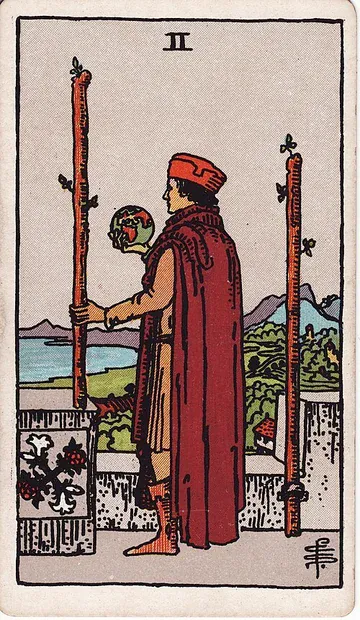
Three of Wands reversed + Two of Wands. The pair from inside its own suit — but here, the planning that should have settled into clean execution has been re-decided. The Two of Wands' two staves are still being weighed, again, weeks after the launch. The seeker has begun second-guessing the original choice. The combination warns that the relaunch instinct is operating at the wrong layer: the choice is already made, and revisiting the choice is consuming the energy required to let the choice play out. The medicine is to honor the original Two-of-Wands decision and stop relitigating it.
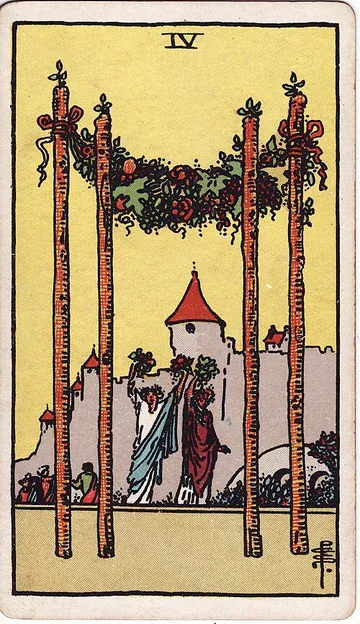
Three of Wands reversed + Four of Wands. The harbor is being prepared but the ships are being recalled before they arrive. The Four of Wands' welcome stands ready — the homecoming, the canopy, the threshold — and the seeker on the cliff keeps signaling the boats back to a different shore before they make landfall. The combination describes the seeker who is in danger of forfeiting the Four of Wands' arrival because they cannot bear the patient stretch the Three required. The medicine is to allow the harbor to receive what was sent, even if the sending now feels uncertain.
Three of Wands reversed + The Sun. The Sun rules this card's decan, and reversed, the combination describes the launch that should have been visible and clear becoming obscured by the seeker's own impatience. The clarity the Sun would otherwise grant is being undermined — the public success is happening but the seeker cannot enjoy it because they are still re-checking, still re-decoding the sails, still demanding more verification than the Sun's daylight already provides. The medicine is to trust the daylight. What is visible is real.
Three of Wands reversed + The Magician. The founding gesture of will paired with the reversed posture's overextension. The Magician's certainty becomes manic launching when not held by the Three's patience — too many initiatives, too many "yes" responses, too many tools picked up and used briefly before being put back down. The reversed combination warns of the seeker whose Magician-energy has run unchecked, with no Three of Wands' restraint to anchor it. The medicine is to pick one tool and put the others down for a season. Will without patience is just expenditure.
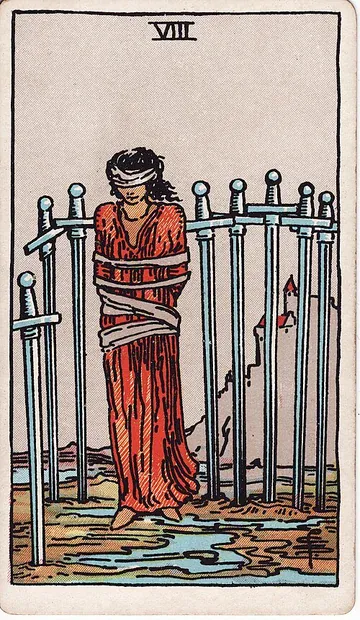
Three of Wands reversed + Eight of Swords. The tonal contrast becomes a literal mirror. Both cards now describe stuckness — but of different kinds. The Eight of Swords' figure is bound and convinced she cannot move; the reversed Three of Wands' figure is unbound and pacing himself into exhaustion. The combination asks for the discernment of which kind of stuckness the seeker is in, and warns that the two register similarly from inside even though they require opposite medicines. The Eight of Swords needs the realization that the binding is loose; the reversed Three of Wands needs the realization that the cliff is a place to stand. Both medicines are recognition. Neither is more action.
Card Combinations
Two of Wands
The launch's predecessor, from inside its own suit. The Two of Wands held the choice — two staves weighed, the world ahead, the decision pending. The Three is that choice committed to motion. Together they describe a clean execution of an honest decision: the planning was real, the sending was committed, and the sails are now doing what sails do. The seeker has stopped negotiating with their own choice and is letting it travel.
Four of Wands
The receiving harbor, the next in the suit. The Four of Wands is the homecoming, the canopy, the threshold of arrival. When these two appear together, the patient stretch is bounded — what you sent out is on its way, and the welcome on the other side is being prepared. The combination is the antidote to the Three's worst fear, that the wait is endless. It isn't. The Four is real. The harbor is being readied.

The Sun
The Sun rules this card's decan — Sun in Aries' second decan — and so the pair amplifies the Three of Wands' own native frequency. The clarity is dialed up. The watching is done in full daylight. The shape of the launched thing becomes visible to others, not just to the seeker. This is the combination of public success arriving cleanly and being witnessed without ambiguity. What was sent out comes back in the sun.

The Magician
The founding gesture of will paired with the patient watch over what was launched. The Magician sets the four tools on the table and chooses the work; the Three of Wands sends that work into the world and stands back. Together they trace the full arc from intention to launch to patient watch — the Magician's certainty inside the Three of Wands' patience. The combination warns against either pole alone: pure Magician without the Three becomes manic launching; pure Three without the Magician becomes vague waiting on nothing in particular.
Eight of Swords
The tonal contrast — perceived stuckness versus actual patient watch. The Eight of Swords is the figure bound and blindfolded, swords planted around her, convinced she cannot move. The Three of Wands is the figure standing freely on the cliff, also still — but for a different reason. The pair asks the seeker to distinguish which kind of stillness they are in. From inside they can register similarly; from outside, one is paralysis and the other is mastery. The work is the discernment, not more motion.
Frequently Asked Questions
Have I thinned out my own answer with the Three of Wands reversed?
That is the question the card is actually posing, and the honest answer is usually a partial yes. Reversed, the Three of Wands describes a launch disturbed by the launcher: too much relaunching, too many hulls in the water at once, too much reaching back into something that was already traveling under its own power. The conditions did not fail. They were interfered with, which is a different and more recoverable thing. So the answer comes back as a soft no, or as a yes that arrives thinner than what was needed — a job that materializes at lower terms, a reconciliation that happens with less warmth in it. Stop reaching and the fuller yes is often still available. Keep reaching and the thin version becomes the whole of it.
Why does the Three of Wands reversed show love as declaring and retracting?
Because the decision was made once and is being re-made every morning, and a bond cannot absorb that many launches. Reversed, the card describes a real commitment weighed down by the daily anxiety about the commitment, until the worrying outweighs the thing worried over. In a long-distance bond the geography is unchanged and the patience has frayed, so the miles start getting blamed for something they are not doing. With a newer spark it shows as cycles: the warm declaration, then the retreat, then the apology, then the warmth again, each swing sincere and each one costing the other person a little more footing. For someone dating several people it is simply too many lines in the water to tend any of them. The medicine does not change: recall one ship and let your own shape come back.
What does the Three of Wands reversed feel like (as feelings)?
When the Three of Wands reversed describes someone's feelings about you, the feeling is real but the patience is fraying. They have made an internal decision and are then second-guessing it, declaring and retracting, leaning in and pulling back. This is not a verdict against you; it is a description of unfinished internal work on their side. The test for whether the situation is correctable is the harbor — whether they have a real, sustained place in their life that you occupy. If the harbor is intermittently lit but the long arc is toward more light, patience may resolve it.
What does the Three of Wands reversed mean overall?
The full three of wands reversed meaning describes either a project that should be in patient watch and is instead being chronically interfered with, or a seeker who has launched too many initiatives at once and cannot give any of them the depth required. The card asks for the deliberate recall of at least one initiative — the side project closed, the additional commitment renegotiated, the over-managed team given space — so that the remaining launches can actually return what they were meant to return.
What is the advice of the Three of Wands reversed?
The three of wands reversed advice is to recall one ship. Not heroically, just one — the launch made out of optimism rather than need, the commitment taken on because the moment felt right rather than because the structure required it. Cancel it, renegotiate it, close it. The reversed card responds to the deliberate restoration of the seeker's own shape, the return to the cliff as a place to stand rather than a place to pace, and the discipline of letting the remaining launches travel without further interference.