
Two of Cups · Tarot Card Meaning
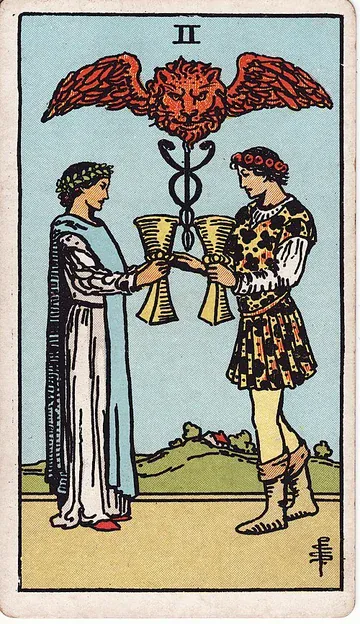
The Two of Cups is the vow card of the deck. Two figures stand opposite each other, each holding a cup at the same height, rims almost touching. They have not merged. They have not embraced. They have done something quieter and more dangerous than either: they have looked at each other and agreed, in the same breath, to lift the cup at the same line. The card is the moment a bond is named out loud — the first time a felt thing becomes a spoken thing.
Above the cups, in the Rider-Waite-Smith image, hovers a strange device: a caduceus crowned with a winged lion's head. This is Hermes's old covenant of healing — two serpents coiled toward each other around a single staff. The device is older than the lovers underneath it. It says, without saying, that the promise being made is medicine. Whatever else the bond will become, it begins as a thing that cures something in both of them. A vow kept is a kind of cure. A vow broken, as the reversed card will know, is a kind of wound.
The signature tension of the Two of Cups is that the wholeness of the card depends on two separate completenesses. The man and the woman do not stand close. They face each other across a clear space. The vow needs the gap to be itself. If they collapsed into one figure, the card would become something different — Lovers, perhaps, or merged confusion, or codependence. The Two of Cups insists on the second person. There is no toast without the other arm. The card describes the dignity of partnership where neither party is dissolved by it.
The older language says it too, and says it exactly: the Two of Cups is Venus in Cancer, first decan, 6/22-7/1 — tenderness rising into a vessel that knows how to hold it. Venus is the planet of attraction and pairing. Cancer is water at its most domestic, most protective, most concerned with what gets kept safe inside the shell. Venus in Cancer pours feeling into a container that closes around it. The bond described by this card is not exposed to the weather. It is sheltered. It is a bond made indoors, between two people who have decided to be each other's roof.
Kabbalistically, the card sits at Chokmah in the suit of Cups — Wisdom, the second sephirah, the first motion that differentiates from Kether. This is the suit of Water at the moment it first separates into two. Before Chokmah, there is only the Ace, undivided source. At Chokmah, the source has produced its first echo. The Two of Cups is therefore the card of the original pair — the first time water recognizes itself in another vessel. The reading the card carries everywhere, regardless of question, is: this is the moment recognition turns into pledge.
There is one more figure in the image worth naming: the distant hill and the quiet stream at the figures' feet. A vow needs a still backdrop. The Two of Cups is set in landscape that is not asking anything of the moment — no storm, no crowd, no rival voice. The card insists, quietly, that recognition this clean is rarely possible inside chaos. If the seeker is trying to make the toast inside a noisy season, the card invites them to find the still field first, even if only for an hour, and let the cups go up there.
The suit's temperament sets the tempo of the vow. Water here is phlegmatic — inward, soft, slow to gather and slower to leave. A Two of Cups agreement does not move at the speed of a decision; it moves at the speed of water finding its level. This is why the card so often marks a sentence that took a season to become sayable and then took four seconds to say. A seeker trying to force the recognition ahead of its own pace gets no help from this image. The cups fill at the rate they fill. What the seeker controls is whether they are standing at the table when the level is reached.
The card also behaves differently depending on what sits beside it. Water settles beside Earth: a Two of Cups next to Pentacles becomes a lease, a joint account, a household with a second key cut. Beside Fire it can boil off — the vow spoken at the top of an intensity that does not survive the week it was made in. Beside Air it is stirred and also roused: the bond gets talked about, argued into clearer language, sometimes clarified past what either party meant. Read the neighbors before deciding how solid the toast is. This card supplies the recognition, not the container.
Read the Two of Cups in any spread the way you would read a photograph of two people in the second before they say something they will not be able to take back. The frame is still. Both arms are at the same height. The mouth has not yet opened. The card asks the seeker to notice, with the same care, who is at the other end of their own cup, and whether they are about to lift, or to stay still.
Two of Cups · Love & Relationships
The Two of Cups is the most exact love card in the deck. Other cups carry love — Three is companionship, Nine is wish-granted contentment, Ten is the family it grows into. The Two is the moment the love is recognized for what it is, named, and pledged. It is the card of the vow specifically: not romance, not chemistry, not infatuation, but the deliberate naming of a bond between two equals.
For an existing partnership, the Two of Cups upright describes a refresh of the original vow. Whatever you said when you began — at the wedding, at the moving-in, at the first I love you — the card returns the relationship to that line. It often appears when a couple has been through a stretch of imbalance and is finding the same height again, both cups lifted, both heads turned toward each other rather than past each other. The reading is not "everything is perfect." The reading is "the original agreement still holds, and you are remembering it together." This is one of the cards you most want to draw mid-marriage. It means the architecture is intact.
For a new spark, the Two of Cups means the early connection is real and reciprocal — not a projection from your side, not a polite response from theirs, but a genuine first echo. The signal is not heat; the signal is symmetry. You laughed at the same beat. You fell quiet at the same moment. They reached for the bill at the same second. The card describes the new bond at its most diagnostic stage: before either of you has done anything irreversible, before vulnerability has been tested, the recognition is already mutual. Pay attention to the symmetry, not the intensity. The Two of Cups loves the matched line.
For a solo seeker asking whether love is possible, the card answers yes — but it conditions the yes on a particular preparation. The Two of Cups arrives in a single's reading when the seeker has finished the work of becoming whole on their own. Not perfect. Not invulnerable. Whole enough to lift their own cup. The card warns against partnership entered from incompleteness, where one person hopes the other will fill the shape they could not fill themselves. That partnership does not pour into a cup; it pours into a hole. The card is asking: are you ready to meet someone at the same line, or are you still hoping someone will come over to your side and lift your cup for you?
For someone in love after a wound — divorce, break, betrayal, grief — the Two of Cups is one of the most generous cards in the deck. It says the body is again capable of vow. The capacity to pledge has returned. The trust that was burned out has reformed in the slow way trust does. The new love, when it comes, will not need to compensate for what was lost. It will start fresh. The card is the morning after the long winter of solo life — the first morning the second cup feels imaginable rather than dangerous.
For the question of reconciliation after a break, the Two of Cups upright is one of the most encouraging signals possible. It means the original vow can be re-spoken. The card does not promise the relationship will return to the exact shape it had — it rarely does. It promises that the shape it returns to will hold the same weight. Read this carefully: the card is not nostalgia. The card is the upright vow, made again, this time with the knowledge of what nearly broke it. That knowledge is part of the new bond, not a stain on it.
For a long-distance relationship, the Two of Cups speaks specifically to the symbolic vow that holds the geography together. The cups can be lifted across miles. The card describes the relationship that survives because both people keep the vow visible to themselves and to each other — daily check-ins, named anniversaries, the deliberate ritual of remembering the other one is real. The card does not require physical proximity. It requires symbolic equality. As long as both cups are lifted to the same line, the distance is just terrain.
For the pursuer-distancer pattern — where one person is always reaching and one is always pulling away — the Two of Cups is a precise diagnostic. It says: this dynamic is not the vow. The vow is two people lifting at the same height in the same instant. If one cup is up and the other is on the table, you are not in this card. You are in the reversed card or in a different card altogether. The reading is corrective: stop lifting alone, and see what the other person does in the silence.
For a household where desire mismatch has become the central conversation — the conversation about how often, how much, who initiates — the Two of Cups upright suggests the underlying vow is sound and the desire structure can be renegotiated within it. The card frames the conversation: you are not bargaining about sex; you are tending to the vow's particular shape. The work is to talk about the cups, not the wine.
A note on the card's love language: the Two of Cups loves through deliberate parity. It does not love through grand gestures or sacrificial generosity. It loves by making sure both cups are at the same line every morning, every conversation, every decision. This is unspectacular love. It is also, in the long run, the love most often described as deep, because the parity has had time to set into the bond like silt settles into a riverbed. The card asks: are you keeping watch on whether your cup and your partner's cup are at the same height, or have you been so focused on filling theirs that you forgot to lift your own?
If you are asking whether someone is in love with you and the Two of Cups arrives upright, read it as a clear yes. They are not playing at it. They have decided. They are waiting for you to lift your cup so they can match the line. The card is one of the cleanest signals in the deck. Whatever they have said about the future, they meant. Whatever vow you have not yet spoken, they are already prepared to make.
Two of Cups · As Feelings
Someone has looked at you twice — once to see you, once to check what they saw — and lifted their cup anyway. That second look is what the Two of Cups reports as feeling: recognition. Not the giddy lift of a brand-new crush, not the warmed-over comfort of long habit — the specific, slightly serious feeling of someone who has looked at you, looked at themselves, and noticed that the two cups want to be raised together. They feel met. They feel chosen. They feel, in the careful interior way the card always describes, ready.
For a reserved person, the Two of Cups in feelings means the vow is being formed silently. They are not going to announce it. They may not even mention it for weeks. Inside, however, a small ceremony is happening: they are deciding what they would say if asked, deciding which version of themselves they want you to meet, rehearsing the line their cup is already at. Read silence here as architecture, not absence. They are building the vow before they speak it.
For a demonstrative person, the Two of Cups in feelings means they want to make the vow visible. They will introduce you to the friends. They will mention you in stories. They will use the language of partnership before you do, sometimes by accident, sometimes deliberately. The card does not describe show; it describes the desire to align the public and private versions of the relationship. They want what they feel inside to match what is seen outside.
For a long bond — partner of years, spouse, the person across the breakfast table — the Two of Cups in feelings describes a re-noticing. They have looked up from the routine and seen you again. The first vow you both made has, after long submersion in the dailiness, surfaced. Whatever felt rote yesterday has been refreshed. They feel, in this card, the particular gratitude of someone who has remembered why they signed up. This is one of the most stabilizing feelings cards a long-bond reading can carry.
For a new connection, the Two of Cups in feelings means the early reciprocity is real on both sides. They are not stringing you along. They are not waiting to see if a better option appears. They have already begun to organize their attention around you. The card is precise about this — it does not describe certainty, exactly. It describes a clear and growing intention to lift the cup with you and see what happens when the rims touch.
For someone you have had a difficult conversation with, the Two of Cups in feelings can mean the conversation worked. Whatever was misaligned has been re-aligned, and they are quietly relieved that the bond survived the honesty. There is a small, careful warmth in their interior — the warmth of someone who almost lost something and is now holding it more deliberately than before.
For distance — partner traveling, the long-distance relationship, the friend who moved away — the card means they are still raising the cup. The geography has not weakened the gesture. They feel, when they think of you, the same line they felt when you were across the table. The card is one of the cleanest signals that distance is not eroding the bond.
Two people raising cups to each other are not always courting. Asked about a friend, a sibling, a colleague you have quietly loved for years, the Two of Cups says the regard runs both ways and has for longer than either of you has mentioned. They count you. In their private inventory of who is actually theirs, your name sits on the short list. Friendships rarely get a naming ceremony, which is why the card is so useful here: it reports that the vow exists even though nobody has ever said the word. Say it anyway, if you want to. This card has never once regretted a spoken thing.
Some people do not translate feeling into language at all; they translate it into logistics. For them, the Two of Cups in feelings looks like a filled tank, a remembered prescription, the coat handed over at the bus stop without comment. The vow is being made in errands. Reading this correctly matters — a seeker waiting for the sentence can miss a year of the actual pledge because it arrived as a car service and a charged phone. The card asks you to count what they do at the same weight you count what they say. Both are the cup. Only one of them is ever going to be eloquent.
A small caution embedded in this beautiful card. The Two of Cups in feelings can sometimes describe someone whose vow is almost ready but not yet articulated. They feel it. They are close to saying it. They have not said it. If you sense the feeling but the words are not arriving, the card invites patience — but also invites your own initiative. Sometimes the vow needs one person to speak it out loud before the other can match. If your cup is the one ready to lift, lift. The card responds to deliberate action.
Take the Two of Cups in feelings as confirmation that the recognition is mutual and structural, not fleeting. Whatever they feel, it is already shaped like a vow. The work of the relationship, if there is work, is not whether they care — that is settled. The work is how the two of you say it, when, and what you build on top of it.
Two of Cups · Career & Work
Ask any working partnership one question: when the difficult part arrives, does the other person lift or watch? The Two of Cups upright answers that they lift — the contract that is genuinely two-sided, the alliance that is reciprocal, the colleague who takes the other handle of the work instead of standing back to assess it. The card describes the specific moment in a working life when someone says yes, and the yes is mutual, and the agreement has the architecture to hold.
For a current role, the Two of Cups can mean a key working relationship is consolidating. The colleague who has been adjacent to your work has become an actual partner in it. The manager who was reading your output from a distance has begun to engage with it directly. Whatever the formal structure of the team, an informal vow is forming: the two of you are aligned, you trust each other's word, the cups tend to go up at the same line when the difficult decisions come. This is one of the most quietly powerful cards a workplace reading can carry. It is the foundation of the workplaces people stay at for decades.
For a new role decision, the Two of Cups upright reads as a strong yes when the role involves a specific person you are joining — a co-founder, a hiring manager, a partner. The card is not about the company at large; it is about the bond at the heart of the offer. If the person you would be working most closely with feels like a Two of Cups partner, take the role. The card is rarely wrong about the texture of working alongside another person. The job description is secondary.
For a freelancer, the Two of Cups can describe the client who turns into a long-term collaborator. Not the one-off project. The relationship that becomes the spine of your business. These clients are often the ones you almost passed on because the brief was modest — and then the second meeting went so well that the work expanded. The card is the moment that expansion begins. Honor it. The next decade of your freelance life can be built on three or four such bonds.
For a creative worker — designer, writer, musician, artisan — the Two of Cups upright describes the creative partnership that doubles your reach. The collaborator who brings the half of the practice you do not have. The editor who hears the line before you write it. The producer who knows where you are about to wander off and gently corrects the angle. The card is the moment two practices recognize each other. These collaborations, when they are real, often outlast marriages.
For a student, the Two of Cups can describe the teacher-mentor bond that shapes the next decade. Not a casual professor; the kind whose office hours stay on the seeker's calendar seven years on. Or it can mean the study partner whose mind sharpens against yours so reliably that the two of you become each other's seminar. Either way, the card is naming a working friendship that is about to become structural.
For a manager, the Two of Cups upright is one of the cards most worth listening to. It describes the direct report whose loyalty is real and reciprocal — the person who will tell you the truth, who will lift the difficult work alongside you, who is not building toward leaving the moment the next offer appears. Treat this person well. The card is rare in a manager's deck.
For a promotion or recognition question, the Two of Cups can mean the advancement is being supported by a specific advocate inside the organization. Someone has lifted their cup on your behalf. The card warns against attributing the win to the system or to your own work alone — there is a person whose vow has shaped the path. Find them. Thank them. The bond will continue to matter beyond the immediate promotion.
For a layoff or transition, the Two of Cups can describe the unexpected ally who emerges in the difficult season. Not necessarily a peer — sometimes a former colleague, a mentor from years ago, a recruiter you barely remember meeting. The card is the moment someone shows up to lift the second cup while your hands are full with the loss. Receive the help. Match the line. The card responds to mutuality, not to one-sided rescue.
For a cross-functional team — engineering plus product plus design plus marketing — the Two of Cups upright is the card of the working alliance that bridges the function gap. Two people from different sides of the organization have decided to operate as a single unit. Their cups are at the same line; the rest of the org gets pulled into orbit around their alignment. If you are one of the two, treat the partnership as a serious commitment. If you are watching it from outside, learn from it. This is what cross-functional work looks like when it actually works.
For care work — teaching, nursing, social work, the helping professions — the Two of Cups upright is the card of the colleague-as-co-witness. The work is heavy, and the bond with another practitioner who sees what you see allows the weight to be held in two pairs of hands. The card is the moment the colleague becomes the friend who keeps you in the work. These bonds, in helping professions, are often what makes long careers possible. Without them, burnout is a matter of years; with them, decades become possible.
A note on stability and ambition: the Two of Cups in career is not a card of solo expansion. It does not say "build the empire." It says "build the bond, and the bond will carry the work." For ambitious seekers used to going it alone, this card can feel slow at first. The slowness is the point. Vows in working life take longer to form than projects do, but they outlast them. The next decade of your career is the people who lifted cups with you when this card appeared.
Two of Cups · Money & Finances
A shared account is a document about trust that happens to have numbers in it. That is where the Two of Cups upright locates money — the partnership budget, the loan made out of trust, the investment pooled with someone whose word you accept as collateral. The card is rarely about money in isolation. It is about money as the ledger of a vow.
For a couple consolidating their finances — moving in, getting married, deciding whose name goes on the mortgage — the Two of Cups upright is one of the most encouraging signals. It says the financial joining is built on a real bond, that the negotiation will reach a fair line, that both of you are bringing your cups to the same height. The card warns gently against the unconsciously asymmetrical setup, where one party's earning shapes both parties' lives without that asymmetry being named. Name it. Lift the cups deliberately.
For a business partnership, the Two of Cups asks whether the financial structure of the partnership is genuinely two-sided. Equal equity? Different equity, and both parties have agreed in writing? The labor split matches the equity split? The card is not telling you what the right answer is — partnerships have many shapes — but it is asking you to make the shape explicit. Unspoken financial accord is not a partnership. It is a setup for a future broken vow.
For a loan made between friends or family, the Two of Cups upright says the trust is real on both sides. The money will come back. The relationship will not be damaged. The card respects loans made on a vow rather than on a contract — but it warns that the vow needs to be spoken, not assumed. Tell the borrower the timeline you expect. Let them tell you the timeline they can meet. Match the lines.
For a financial decision involving a partner — buying a house, taking on debt together, deciding to scale back to one income — the Two of Cups upright says the decision is sound when made by both cups together. It is not sound when made by one cup alone, even with the other's distracted nod. The card asks for the deliberate, side-by-side, both-pens-on-the-page version of the decision. That is the version that will hold when the financial weather turns.
For a windfall to be shared — inheritance with a sibling, prize money split with a collaborator, the unexpected gift to a couple — the Two of Cups upright recommends a structured conversation about how the windfall is held. Will the money be split? Pooled? Used for a shared purpose? The card prefers explicit answers over implicit ones. The vow that survives money is the vow that has met money in language first.
For investments made together, the Two of Cups upright says the two of you have a similar risk tolerance and a similar time horizon. This is rarer than seekers think. Many couples have wildly different relationships with money risk; the card means the alignment exists. Use it. The investments you make jointly during this season will outperform the investments either of you would make alone, because the deliberation is doubled.
For prenuptial agreements, family-trust conversations, and the financial scaffolding around long-term partnership, the Two of Cups upright actually welcomes the explicit document. The card is not romantic about money; it is precise about parity. The conversation that names what each party is bringing, what each party expects, and what happens if the bond ends is itself a Two of Cups conversation. Couples who can have it without rupture tend to have stronger bonds afterward, because the parity has been made visible. Couples who cannot have it tend to discover that the parity was always more imagined than real.
The card's caution around money is gentle: do not let money become the language of the bond. Money is a ledger, not a love language. The Two of Cups loves with words and parity, not with transfers. Use money to keep the parity legible — but the parity is the vow, and the vow comes first.
Two of Cups · Health
The chest answers before the mouth does, and the Two of Cups upright is the card of healing through bond for exactly that reason. The body responds to relational presence; the chest opens when there is someone across from it. The card's body part, in the traditional correspondence, is the chest — the heart and the lungs together, the two organs that work in pairs, that breathe in and out, that beat across each other. When the Two of Cups appears in a health reading, the question is rarely about isolated symptoms. The question is about the relational field around the body.
For someone managing a chronic condition, the Two of Cups upright describes the season when a partner — spouse, caregiver, close friend, therapist — has truly engaged with the condition alongside you. They are not standing back. They are in the room. They are lifting the second cup of the management plan, and the load is no longer sitting on one set of shoulders. Use this season. The body heals more reliably when it is held in a witnessed way.
For acute illness or recovery from surgery, the card means the support structure is reciprocal. The friends are not just performing care; they are being received and thanked, and the loop is closing properly. Caregivers who give without the receiver acknowledging burn out; receivers who take without acknowledging the giver isolate. The Two of Cups holds both sides of the exchange. It is the model for healthy convalescence.
For mental health questions, the Two of Cups upright is one of the deck's clearer signals that therapeutic work is landing. The relationship with the therapist, the partner, the close friend has become genuinely two-sided — not the client receiving wisdom, but a real meeting of two people. The work begins to move once the relationship in the room is a Two of Cups rather than a one-way performance of help. If you are in therapy and the card appears, the bond is real; trust it.
For loneliness as a health concern, the Two of Cups names the issue exactly. Loneliness is not the absence of people; it is the absence of the second cup. The card asks: where, in your life, is there a relationship that lifts at the same line you do? Even one. Even slowly. The body is calmer when one such relationship is functional. The card does not require many; it requires at least one.
For somatic complaints — chronic chest tightness, shallow breathing, the body's quiet protest at unspoken things — the Two of Cups can describe the relational situation that is being held in the chest. The unspoken vow, the relationship where parity has not been asked for, the bond that wants language and has not received it. The body knows. The card invites the conversation that may relieve what the body is carrying.
For couples therapy or relational repair, the Two of Cups upright is one of the most encouraging signals. It says the underlying bond is intact. The work being done is the work of restoring parity to a relationship that drifted, not of building a relationship that was never there. The recovery is real and likely to hold.
For pregnancy and the months around it, the card sometimes appears as the bond between the carrier and the partner, or between the carrier and the not-yet-born. The vow being formed in this season is one of the most consequential vows the card describes. Treat it with the gravity the card asks for.
Nothing the Two of Cups says about the relational body counts as medical advice. Keep your practitioners. Take your medicine. The Two of Cups simply notices that the body is a relational organ as much as it is a private one, and that healing for many conditions includes the relationships in the room.
Two of Cups · Spirituality
Two people keeping the same silence in the same room make a different silence than one person alone, and the Two of Cups upright is the card of that difference: devotional bond. It describes the practitioner who has stopped seeking alone and has begun to practice with another — a teacher, a partner in the work, a sangha, a community small enough that everyone knows your name. The card is the moment seeking becomes shared. The single cup of the Ace has become two, and the two are raised together.
For someone in active practice, the Two of Cups can describe a teacher relationship that has crossed a threshold. The student has stopped consuming the teacher's content and begun, instead, a real exchange. The teacher has begun to receive from the student, even if the student does not see it. The bond has become reciprocal. This is rare and important. Practice deepens differently inside such a relationship; the lone seeker can go a long way, but the bonded seeker goes farther.
For someone exploring belief, the Two of Cups names the comfort of finding a tradition that meets you halfway. Not a tradition you submit to, not a tradition you customize beyond recognition — a tradition that sees you and that you see, and the rims of the two cups touch. This is what conversion at its best feels like, and what spiritual maturity often looks like: not abandoning what raised you, but finding the second cup that completes the toast.
The card's spiritual practice is the deliberate vow. The card invites the seeker to make a small, real promise to a specific person, a specific deity, a specific practice — and to keep it. Not a grand promise. A promise sized to your actual life. Daily prayer for thirty days. A weekly call to the friend you have been meaning to call. A monthly ritual at the new moon. The card teaches that vow-keeping is itself a spiritual discipline. Each kept vow strengthens the body's capacity to hold the next one.
For a question about path, the Two of Cups upright says the path you are walking is improved by walking it with someone. Find the second cup. The card does not require romance; the bond can be friendship, mentorship, fellowship. It does require that the bond be reciprocal — that your seeking and theirs lift at the same line.
For ritual practice, the Two of Cups recommends partnered ritual: shared candle-lighting, joint meditation, paired journaling exchanges, the conversation after sitting together that is itself part of the practice. The card warns against the spiritual life that has become entirely interior, where no other human ever witnesses the work. Witness is medicine. Witness is the second cup. The vow that is never said out loud loses some of its force; the vow that is witnessed locks in.
A small caution: the Two of Cups is not the card of the guru relationship in its dependent shape. The card insists on parity. If the spiritual bond you are in is structured as one teaching, one receiving, with no exchange, you are not in this card. You are in a different structure that may be useful for a season but that the Two of Cups will eventually invite you to outgrow. The card's spiritual ideal is two practitioners standing across from each other, both lifting cups, both seekers, both teachers.
The card also speaks to the relationship between the seeker and their own deeper self — the inner figure who is sometimes called the soul, sometimes the higher self, sometimes simply the one who has been waiting. The Two of Cups in this register describes the moment the conscious self stops bargaining with the deeper self and meets it across the table. Both cups are raised. The toast is internal. The vow is between you and the part of you that has been quietly steadfast for years. Many seekers find this is the most important Two of Cups in their lives — the one whose terms make every external partnership possible.
Two of Cups · Yes or No
Yes — but only when both cups go up at the same time.
The Two of Cups is one of the cleanest yes-cards in the deck for any question about partnership, agreement, alliance, or vow. As the card of the matched line, it confirms that the bond you are asking about is real, the agreement is mutual, and the path forward is consensual. The answer comes without drama. The vow can be made.
For yes-or-no questions about a relationship — should I commit, are they the one, will this last — the answer is yes. The bond is sound. The two of you are at the same line. Whatever fear has been generating the question can be set aside. The card is one of the deck's most confident affirmations of partnership.
For yes-or-no questions about a working partnership — should I take the offer, should I sign with this collaborator, will this alliance hold — the answer is yes, conditioned on the bond being explicitly named. Sign the document. Have the meeting where both of you state what you are agreeing to. The Two of Cups loves explicit vows; it warns against implicit ones.
For yes-or-no questions about reconciliation — should I reach back out, will they meet me halfway — the answer is yes. The other person is ready. Their cup is already at the line; they are waiting for yours. The card does not promise the reconciliation will be effortless, but it confirms that the conversation will be received.
For yes-or-no questions about whether someone is being honest with you — about their feelings, about their intentions, about their plans — the answer is yes. The Two of Cups has no shadow in the upright orientation. What is being said is what is meant.
The only conditioning embedded in the yes is the symmetry condition. The card says yes to mutual things. It says no to things that look like vows but are actually one person lifting alone. If your yes-or-no question is really "will this person finally commit if I keep waiting" or "will the vow form on its own without me lifting my cup," the card declines to answer in the affirmative. It would rather be precise than encouraging.
Asked how soon the vow gets spoken aloud, the Two of Cups upright suggests yes, within a season. The bond is forming or already formed. The naming, the formal moment, the spoken vow comes when both parties are ready, and the card says they are nearly there. Do not rush. Do not delay either. When the moment arrives — the conversation, the proposal, the contract — both parties tend to recognize it together, often in the same breath.
For binary decisions about whether to act — should I say it, should I make the offer, should I propose — the Two of Cups upright says yes. Lift your cup. The other one is already lifted. The card responds to deliberate action; the moment will not arrive on its own.
Asked whether to request something — help with the move, a loan, an introduction, a year of someone's patience — the Two of Cups answers yes, and attaches a condition that is easy to miss: ask in a form the other person can decline. A request that leaves no room for no is not a toast, it is a summons, and this card has no appetite for summons. Phrase the ask so the other cup stays free. The yes that comes back is then worth having, because it was given by someone who could have said the other thing.
If the question was: do I deserve this bond? The card answers yes, and asks why you needed to check.
Two of Cups · Advice
Say it out loud. There is no reading of the Two of Cups upright in which the vow gets to stay inside someone's head — whatever bond you are in, whatever agreement you are making, whatever partnership has formed silently — name it. Use the words. The card is suspicious of unspoken accord. Most relationships do not fail because the feeling was not there; they fail because the feeling was never converted into spoken commitment, and the silent version drifted slowly out of true.
If there is one specific instruction the card offers, it is to ask the other person to state, in their own words, what they are agreeing to. Not so you can correct them. So you can hear what the agreement actually sounds like from the other side. The Two of Cups lives at the seam between two interiorities. The seam holds when both interiorities have been spoken into the same room. The seam fails when one of the interiorities is being assumed.
A second instruction: lift your cup first, sometimes. The card insists on parity, but parity does not mean perfect synchronization. In real bonds, one person frequently lifts a beat earlier — names the difficult thing, asks the unaskable question, says the I love you out loud first. The card honors that. What it cautions against is the chronic asymmetry where one person is always the lifter and the other is always responding. Take your turn lifting. Watch what they do. The pattern of who lifts, over time, is the pattern of the relationship.
A third instruction: when the cups are at different heights, set both of them down and start over. Do not keep lifting yours hoping theirs will catch up. Do not push theirs higher. The card's gesture is mutual. If the gesture is broken, return to neutral, ask what each of you is actually holding, and rebuild the toast from there. Many relationships rebuild this way. The pause is not the failure; the pretending nothing has changed is the failure.
A fourth instruction, lighter than the others: notice the bonds that already function as Two of Cups in your life and tell them so. The friends who have lifted with you for decades. The colleague who has saved you more times than you have thanked. The sibling who has been steadfast through the hard seasons. The card is generous about gratitude; it asks you to make explicit what has been implicit. A spoken thanks is itself a re-lifting of the cup.
Write the agreement down somewhere it can find you again by accident. Not a contract — a line in a notebook, a note in your phone, the back of the ticket from the night you said it. The Two of Cups is a card of speech, and speech evaporates; the written line becomes the still field the vow can land on months later, when the memory has gone soft and each of you remembers a slightly different sentence. Couples who keep such a line tend to discover the drift early, while it is still a wording problem rather than a grievance.
Audit the smallest exchange of your week — who texts first, who suggests the plan, who apologizes, who books the table. The card lives at that scale. Grand parity is easy to claim and hard to verify; the parity of small gestures is visible inside seven days and lies to nobody. If the small exchanges are level, the vow is in good repair whatever the larger season looks like. If they have been running one way since spring, that is the thing to name this week, while it is still small enough to name without a fight.
Practical advice for the day the card appears: have one conversation in which you name something you have been feeling but not saying. Not necessarily about the relationship the card is describing — sometimes about a different one. The card moves the energy of vow-making into your life as a whole. Use it. Send the message. Pick up the phone. Say the line. The card responds to deliberate articulation. Vague articulation does not work; specific articulation does.
Two of Cups · Card Combinations
The Two of Cups speaks most clearly when read against another card that locates the vow in time, in scope, or in tonal register. The five combinations below cover the most common pairings — the source that fed this cup, the formal elevation of the vow, the alchemical work that contains it, the companionship that opens past the duo, and the shadow that the vow is always being made against.
Two of Cups + Ace of Cups
The Ace is the source — the single cup overflowing, the unconditioned love before it has found a face. The Two is what the Ace pours into. Together, the cards describe a love that is anchored in something larger than the two people in it. The bond is not just chemistry between two interiorities; it is two interiorities receiving from the same upstream source. This combination often appears when a relationship is being formed inside a shared spiritual or creative purpose — the bond is fed by something both partners drink from, and that shared upstream is what keeps the bond from drying out.
Two of Cups + The Lovers
The vow elevated to formal choice. Where the Two of Cups is the moment of recognition, The Lovers is the moment of commitment in the public, archetypal register. Together they describe the wedding rather than the courtship — the vow that has been made, witnessed, and entered into the record. For seekers in long courtships, this combination confirms that the moment of formal choice has arrived. For seekers already married or partnered, it confirms that the vow is operative at full strength. For seekers asking whether to make a major commitment, it answers yes.
Two of Cups + Temperance
The alchemical mixing. Temperance is the figure pouring water between two vessels at angles no human pours; the Two is the moment two vessels recognize each other. Together, the combination describes the long alchemical work of partnership — the slow, careful blending of two interiorities into a third thing that is neither fully you nor fully them. This is the combination of the marriage that has lasted, of the collaboration that has produced a body of work, of the friendship that has reshaped both friends. Receive the work. Do not rush it. The card of patient mixing is here for a reason.
Two of Cups + Three of Cups
Companionship that opens past the duo. The Three is the friends added to the bond, the celebration that includes more than two, the community the couple is held inside. Together, the combination describes the healthy expansion of a vow into a wider relational field — friends invited to the wedding, the partnership announced, the bond integrated into a real community. The card warns against vows held too privately; it encourages the announcement, the celebration, the public meal. The Two opens; the Three witnesses.
Two of Cups + Three of Swords
Tonal contrast: the vow severed. The Three of Swords is the heart pierced, the vow broken, the cups never raised. Together, the combination is one of the deck's most painful — the recognition that the vow was real and that something has cut it. This appears in readings about betrayal, divorce, the friend who became a stranger. The combination does not predict; it describes a felt season. The advice it carries is to honor what was made before the cut, even while acknowledging that the cut has happened. The vow being broken does not mean the vow was never real. The Two of Cups remains the truth of what was, even when the Three of Swords is the truth of what is now.
Card Combinations
Ace of Cups
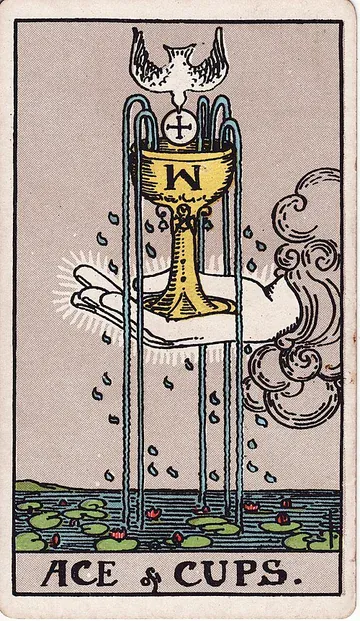
The source feeding the cup that gets raised. Ace of Cups is the unconditioned love before it has found a face; the Two is what the Ace pours into. Together they describe a bond anchored in something larger than the pair — two interiorities receiving from the same upstream source, the vow fed by a love that did not begin with either of them.
The Lovers
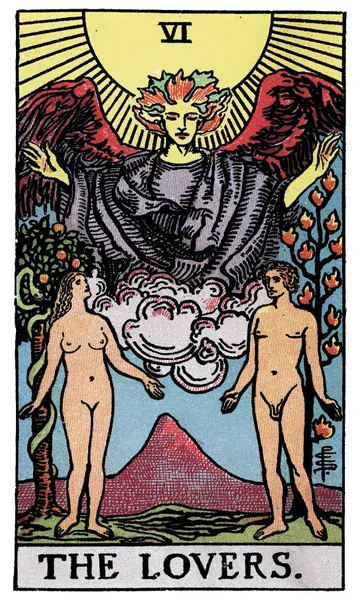
Vow elevated to formal choice. The Two is private recognition; The Lovers is the moment of public commitment in the archetypal register. Together they describe the wedding rather than the courtship, the partnership entered into the record. For seekers in long courtships, this combination confirms that the moment of formal choice has arrived.
Temperance
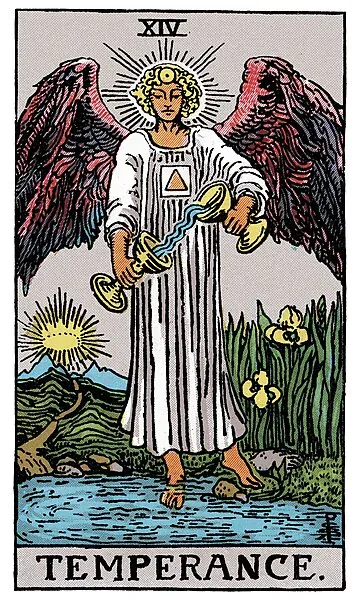
Alchemical mixing — the vessel that holds the vow. Temperance pours water between two vessels at impossible angles; the Two is the moment two vessels recognize each other. Together they describe the long alchemical work of partnership, the slow blending of two interiorities into a third thing that is neither fully you nor fully them.
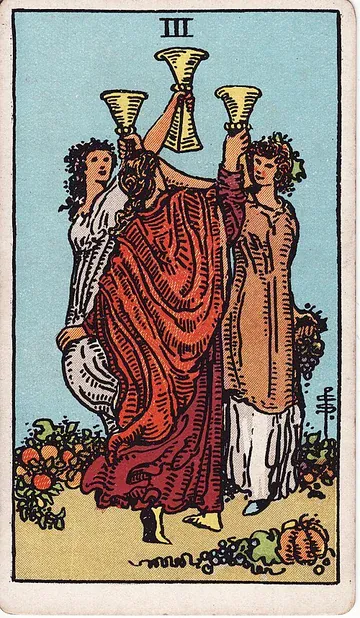
Three of Cups
Companionship that opens past the duo. The Three is the friends added to the bond, the celebration that includes more than two. Together they describe the healthy expansion of a vow into a wider relational field — the wedding, the announcement, the partnership integrated into a real community. The Two opens; the Three witnesses.
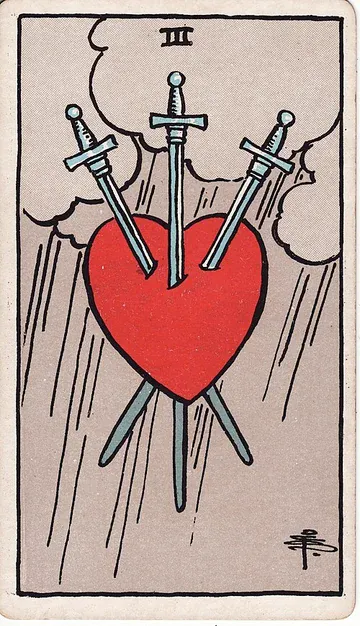
Three of Swords
Tonal contrast: the vow severed. The Three of Swords is the heart pierced, the cups never raised, or once raised and now cut. Together they are one of the deck's most painful pairings — the recognition that the vow was real and that something has cut it. Honor what was made before the cut, even while acknowledging that the cut has happened.
Frequently Asked Questions
What is the Two of Cups tarot card meaning?
The Two of Cups is the vow card of the deck — two figures raising cups to the same height, rims almost touching, a bond being recognized and named. It describes mutual partnership, reciprocal love, two-sided agreement, and the moment a felt connection becomes a spoken commitment. As Venus in Cancer's first decan, it brings tenderness rising into a vessel that knows how to hold it.
Can the Two of Cups say yes when only one person has lifted their cup?
No — and that is the whole condition on its answer. The Two of Cups is one of the deck's clearest yes cards for any question about partnership, vow, alliance, or mutual agreement. Read it as a confident yes — but only when both cups go up at the same time. It says yes to mutual things and declines to answer in the affirmative to questions disguised as one-sided commitments hoping the other party will eventually catch up.
Why do the two figures in the Two of Cups stand apart instead of embracing?
Because the vow needs the gap; a bond that dissolves both people is no longer a pair. In love readings, the Two of Cups means recognition has become reciprocal — the bond is real on both sides, and the moment of pledge is here or imminent. For partnerships, it returns the relationship to its original vow. For new sparks, it confirms genuine symmetry. For singles, it means love is possible if you have done the work of being whole on your own. For reconciliation, it confirms the other person is ready.
Has someone with the Two of Cups already decided, or are they still only feeling it?
Usually both, in that order — the card sits at the hinge between the two. What it reports is recognition. They feel met. They feel chosen. They are forming the vow internally and, often, preparing to speak it. The feeling is not the giddy lift of a new crush; it is the slightly serious warmth of someone who has decided to lift the cup with you and is waiting for, or already matching, your line.
What is the difference between the Two of Cups and The Lovers?
The Two of Cups is the recognition; The Lovers is the choice made in the public, archetypal register. The Two is the moment two interiorities meet at the same height. The Lovers is the moment that meeting has been formalized — the wedding rather than the courtship, the vow witnessed rather than the vow privately felt. They often appear together when a relationship is moving from intimate recognition into public commitment.