
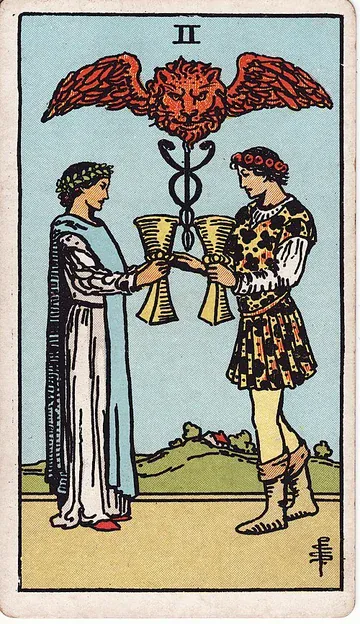
Two of Cups Reversed · Core Meaning
One cup is up; the other is still on the table, or still in a hand that has not decided. Sometimes both are down and neither party has met the other's eye. Reversed, the Two of Cups is the card of the broken or incomplete vow, and the recognition that defined the upright card has slipped. What is left is the gesture without the meeting — the language of partnership without the parity that would make the language true.
The reversed card has two main flavors, and a careful reading distinguishes them. The first is the misread signal: you thought the bond was mutual, and the other party did not feel what you felt, or felt something different, or said the right words without meaning them. The vow exists in your hand alone. The cup you raised has nothing across from it. This is the painful but recoverable version of the reversed card. Once you see that you have been lifting alone, you can stop, set the cup down, and decide what to do next.
The second flavor is the uneven exchange: both parties have lifted, in their own ways, but the cups are at different heights and the rims do not meet. One person has pledged more. One person has held more back. The vow exists in some form, but it is structurally lopsided — the labor, the emotional weight, the financial contribution, the future-planning, the showing up. Over time, this asymmetry creates a slow erosion that neither party fully sees. The reversed Two of Cups in long bonds often describes years of accumulated lopsidedness that is now beginning to make itself known.
A third, rarer flavor: the vow that was real and has been broken. Betrayal, withdrawal, the partner who left, the friend who became a stranger, the colleague who broke the alliance. Here the cups were once at the same height, and one of them has been put down. This is the sharpest version of the reversed card; the upright vow was not imaginary, and its absence is a real loss.
The astrological signature reverses too. Venus in Cancer upright is tenderness held inside a protective vessel. Reversed, the protection turns inward — the shell closes against the very partner it was supposed to make a home with. Cancer guards. Reversed, the guarding becomes the wall. The bond cannot reach across because one or both parties have retreated into the shell, sometimes invisibly, sometimes in ways the other party recognizes only later as withdrawal.
Kabbalistically, the reversed Two stays at Chokmah but reads as the first echo failing to reach back. The source has produced its second motion, but the second motion has not yet recognized the source as itself. There is differentiation without recognition. The card asks the seeker to investigate where the recognition has stalled — within them, within the other, or in the language between them.
The suit's temperament explains why these bonds outlast their honesty by so many years. Water is phlegmatic — inward, soft, slow to move — and an asymmetric arrangement made of water does not rupture; it silts up. Nobody ends it, because ending would take a heat this element does not naturally produce. Seasons pass inside a structure both parties privately know is lopsided, and neither says so, and the silence stays comfortable in the specific way lukewarm water is comfortable. The reversed Two of Cups is frequently the first cold draft through that room.
The landscape reverses along with the figures. Upright, the promise is made against a quiet hill and a thin stream — stillness giving the words somewhere to land. Reversed, the backdrop is rarely still: the agreement was reached in a loud season, during a move, in the week of a funeral, at the end of a night when both of you were tired enough to say anything. Look back at the weather around the original promise. A vow made inside noise often turns out to have been two different vows, spoken over each other, neither one fully heard.
Read the Two of Cups reversed in any spread the way you would read a photograph of two people whose arms are at different heights. The frame catches the gap. One mouth is open; one is set. The vow is in the room without being completed. The card asks the seeker to stop performing the gesture of toast, set both cups down with care, and ask the slow unwelcome question: is the bond at this table actually two-sided, and if not, what would honesty look like next?
Reversed, the Two of Cups asks: which cup is unlifted? And: have you been holding both? And: what was actually agreed to, and is the agreement still in force?
Two of Cups Reversed · Love & Relationships
The upright card needs the gap between the two figures; reversed, that gap stops being clear space and becomes distance, and the cups no longer come up at the same line. The relationship may look right from the outside; the relationship may feel almost right from the inside; but the two of you, asked separately, would describe different agreements. The card is precise about this. It is not a card of catastrophic incompatibility. It is a card of misalignment that has not yet been named.
For an existing partnership, the reversed Two of Cups often describes the season when the original vow has drifted. The two of you said yes years ago to one thing, and over time, without renegotiation, you have ended up saying yes to slightly different things every morning. The misalignment is small enough that no single conversation feels urgent, and large enough that the bond is quietly tiring. The card asks for the explicit renewal: sit down, name what each of you is currently committed to, and check whether the lines still match. Often they can, with adjustment. Sometimes they cannot.
For a new connection, the reversed Two of Cups warns of one-sided enthusiasm. You are reading the relationship through your own cup. They are present, pleasant, agreeable. They are not lifting at the same line, and the difference is being smoothed over by your generosity. The card is not telling you they are bad people. It is telling you the symmetry is not yet there. Do not premature-vow. Watch what they actually do, not what you hope they will do. The card will return to upright if and when their cup actually rises.
For a solo seeker, the reversed Two of Cups can describe the recurring pattern of incomplete vows — relationships that always end up lopsided, with you doing more of the lifting. The card invites the harder question: is this the kind of partner you keep choosing, or is this what you teach the other person to do once you are in the bond? The answer is rarely flattering, and it is almost always the path back to upright. The bonds that work are bonds where you arrive whole and require parity.
For someone in love after a wound, the reversed Two of Cups warns against the wounded version of vow-making — the rush to commitment driven by the fear of being alone again, or the over-cautious refusal to vow that comes from never wanting to be hurt again. Both extremes are reversed Two of Cups. The first overlifts; the second never lifts. Healing here is the slow restoration of capacity to lift the cup at the same time as another person, neither sooner nor later.
For the question of reconciliation after a break, the reversed Two of Cups offers a careful answer. The vow was real once. It is not currently operative. Returning would require both cups to be deliberately re-lifted, and the card warns against the version of reconciliation where one party lifts hoping the other will eventually match. The right reconciliation, if there is one, looks like a fresh, two-sided conversation about what each of you is actually willing to commit to now — not a return to the old shape, which broke for a reason.
For long-distance, the reversed Two of Cups describes the geography eroding the vow despite the words. Words are easy across distance; what fails is the small dailiness — the matched morning text that became a one-way ritual, the shared rhythm that drifted as time zones diverged, the felt sense that the other person is in your week. The card invites a candid look at whether the long-distance bond is being maintained on parity or on the assumption of parity. They are different.
For the pursuer-distancer pattern, the reversed Two of Cups names the dynamic exactly. One cup is permanently lifted; one cup is permanently not. The card's instruction is the same as the upright pattern's diagnostic: stop lifting alone, and see what the other person does in the silence. If their cup rises in your absence, the bond is recoverable. If it does not, the bond was the lifting itself, and ending the lifting is ending the bond. Either result is information.
For desire mismatch in a household — the partner who wants more closeness and the partner who wants less, or vice versa — the reversed Two of Cups describes the conversation that has not yet been had, or the conversation that has been had so often it has become its own ritual without leading anywhere. The card invites a structural conversation rather than a tactical one. Not "how often." Not "whose turn." But: what do each of us actually want from this bond, in the next year, in the next decade, and is the version we are living the version we both signed up for?
For someone asking whether their partner is being honest — about their feelings, their commitment, their other relationships — the reversed Two of Cups is a careful caution. The card does not accuse. It says: the words and the gestures are not currently matching. The vow being claimed is not being enacted. Investigate calmly. Do not perform a trial. Ask the questions that get you specific answers, and notice whether the answers themselves are at the same line as their behavior.
Some asymmetries are nobody's fault. One of you got sober, or started therapy, or lost a parent, or found a faith, and came back at a different height than the one you left at. The vow was made between two earlier people. The reversed Two of Cups is precise and unsentimental here: it does not say one of you is failing the bond, it says the bond was calibrated for a pair that no longer exists. Whether it can be recalibrated is a real question with a real answer, and the answer only arrives when both of you agree to ask it out loud instead of managing around it.
The card does not restrict itself to romance. Read on a friendship — the one that has carried more of your life than most of your relationships have — the reversed Two of Cups describes the slow tilt nobody names, because friendship has almost no vocabulary for renegotiation. You have become the one who calls. The visits happen in your city. The hard seasons are yours to talk about and theirs to be busy during. Friendships end this way far more often than they end in argument, and they end unannounced. If the tilt is already visible to you, it is old enough to say out loud.
For a single seeker considering a connection that feels almost right, the reversed Two of Cups suggests the almost is the whole story. Not in a punishing way. The card simply notices that "almost" is the diagnostic. Wait. Either the symmetry resolves, or you have learned that this connection is not the one. Either is useful. Premature vow-making is the trap.
Two of Cups Reversed · As Feelings
The warmth is real; the arm has not moved. Reversed, the Two of Cups reports a feeling that reaches chest height and stops short of the lift — they feel something pleasant, something interested, something that may be growing — and the feeling has not yet been integrated into a pledge. The card describes withheld vow more than absent feeling. They are not indifferent. They are not yet committed.
This is the card of the partner who likes you and is not ready to let the liking become a stake in their life. They are sitting with their cup at the table while you have lifted yours. The asymmetry is not malicious; it is a fact. They may be afraid. They may be distracted by their own life. They may genuinely not know yet whether they want to lift. The card asks you to notice the cup at the table without dramatizing what it means.
If they are reserved, the reversed Two of Cups in feelings can mean a private warmth that has not made it across the table — and may not, soon. They are protecting the feeling from the world, from you, sometimes from themselves. The reservation may be appropriate to their character; it may also be the long shape of avoidance. Read it carefully. The card does not tell you which it is; it tells you that the cup has not crossed.
If they are demonstrative, the reversed Two of Cups in feelings can mean performative warmth — the affection is loud, public, charming, and the underlying vow is not being made. The performance is a substitute for the pledge. It is an unkind thing to say about a charming partner, and it still needs saying. Not all warm feelings convert into commitment. Some warm feelings remain feelings, indefinitely, and the demonstrative version of withheld vow is one of the most disorienting because it looks so much like the upright card.
For a partner you have been with a long time, the reversed Two of Cups in feelings can mean settled affection that has stopped being curious. They love you. They have stopped looking up. The vow is technically intact and is no longer being enacted in attention. The card asks for re-noticing. This is recoverable; many long bonds pass through this season and return to upright. But it cannot recover invisibly. Someone has to look up first.
For a new connection, the reversed Two of Cups in feelings can describe a partner who is enjoying you but is still keeping their options open, or who is still tied to a previous bond, or who is privately undecided. The card is not a verdict; it is information. The work, if there is work, is theirs — to either make a clearer pledge or to acknowledge the absence of one. The pledge has to be made with their own hand.
For someone after a difficult conversation or conflict, the reversed Two of Cups in feelings describes the warmth that survived the conflict but has not yet returned to its full shape. The bond is intact; the parity is provisional. The card invites time. The cup will lift again, often. The card asks for patience rather than re-litigation.
For distance that has stretched a relationship, the reversed Two of Cups in feelings describes the partner whose feelings remain real but whose engagement has thinned. They miss you, in the sense that the absence is felt. They are not actively building toward closing the distance. The vow is more inherited than re-made each week. The card asks whether the inherited vow is what either of you wants long-term.
Sometimes the unlifted cup has nothing to do with you. Someone inside grief, depression, or a collapsing job holds every cup at the table, including the ones they want to raise. The reversed Two of Cups in this register describes a feeling that is intact and immobilized. It is worth separating from the other kind, because the response differs: withheld-by-choice asks you to stop lifting; withheld-by-weather asks you to keep a low, undemanding presence and to stop reading the silence as a verdict on your worth. Ask them which one it is. Most people, asked plainly and without heat, will say.
There is also the version where the cup rises only when you reach for your coat. The warmth arrives exactly at the edge of your leaving and withdraws the moment you stay. That is not a vow; it is a thermostat. The reversed Two of Cups names the pattern without condemning the person — often they are not calculating, only feeling accurately, and what they feel is the worth of what they are about to lose rather than the worth of what they have. The card asks you to notice which of those two is being expressed, because only one of them can be built on.
Take the reversed Two of Cups in feelings as a precise descriptor of a withheld pledge. The work, if there is work, is in the gap between feeling and vow. They feel. They have not yet pledged. Either they will, or the season of withholding will reveal itself as the actual shape of their availability. Both outcomes are useful information.
Two of Cups Reversed · Career & Work
Paper says two. Practice says one. The Two of Cups reversed is the precise name for that discrepancy at work: the contract was signed by both parties; the work is being lifted by one. The alliance was named at a meeting; the follow-through has been chronically uneven. The card is the precise diagnostic for working relationships that have lost their parity.
For a current role, the reversed Two of Cups can mean a key working relationship has drifted. The colleague who was a partner is now a coworker. The manager who used to advocate is now distant. The team alignment that you built your week around has thinned. The card invites a candid look. Often this is repairable — a direct conversation, a reset of the arrangement — but it cannot be repaired by silence. The card warns against pretending the parity is intact when it has eroded.
For a new role decision, the reversed Two of Cups warns of the offer that sounds great on paper but is built on an asymmetric working relationship. The hiring manager may be charming; the underlying job may be lifting their cup while yours sits on the table. Read the offer carefully. Ask the second-round questions. Talk to people who have worked under this person before. The card is not telling you to refuse — it is telling you to verify whether the partnership at the heart of the role will actually be two-sided.
For a freelancer, the reversed Two of Cups describes the client relationship that has crossed into one-sidedness. They want more than they are paying for. They expect responsiveness they do not reciprocate. They negotiate every line item while assuming the freelancer absorbs scope creep silently. The card invites firm renegotiation. If the parity cannot be restored, the card invites a clean ending. Freelance careers fail more often from chronic asymmetric clients than from too few clients.
For a creative worker, the reversed Two of Cups can describe the collaboration that has become uneven — the producer who has stopped producing, the co-writer who has stopped writing, the bandmate who is contributing less while still claiming equal credit. These are some of the hardest situations to navigate because creative bonds are often friendships, and the asymmetry is hard to name without rupture. The card insists on naming it anyway. Unspoken creative imbalance corrodes the work and the bond simultaneously.
For a student, the reversed Two of Cups can warn of a teacher-mentor bond that has become extractive, or a study partnership that is no longer mutual. The mentor who used to develop you is now performing ownership of your output. The study partner who used to challenge you is now coasting on your effort. The card invites a careful inventory of which intellectual relationships in your life are still reciprocal.
For a manager, the reversed Two of Cups is one of the cards most worth reading carefully. It can describe the direct report whose loyalty has thinned — the person who is actively interviewing, who is no longer fully present, whose vow to the team has been internally rescinded even if they have not announced it. Or it can describe the senior peer whose alliance with you has shifted, the political shape of your team having moved while you were not watching. Either way, the card invites direct, calm conversation. Pretending the alignment is intact when it is not is the manager's most expensive mistake.
For a promotion or recognition question, the reversed Two of Cups can mean the advocate you thought you had has gone quiet. The internal sponsor is no longer pushing. The card warns against assuming sustained advocacy without checking. Find the person. Ask directly whether the support is still active. The card responds to direct articulation.
For a layoff or transition, the reversed Two of Cups can describe the colleague network that has thinned faster than expected. The people you thought would show up have not. The card is a hard but honest reading: networks are mutual, and they atrophy when they have been one-sided. The advice is gentle: rebuild the bonds that were real, do not waste energy chasing the bonds that were always asymmetric, and use this season to establish new working bonds on Two-of-Cups terms — explicit, mutual, named.
For a freelancer or solo founder considering a co-founder, the reversed Two of Cups is one of the most important warnings the deck can give. It describes the partnership that will form in language but not in labor — the co-founder who wants the title, the equity, the credit, and is not actually going to do half the work. Test the parity before signing. Many founders learn this card the expensive way; the card invites learning it the cheap way.
For care work and helping professions, the reversed Two of Cups warns of compassion fatigue with no peer to share it with. The colleague who used to debrief the difficult case has stopped debriefing. The supervisor who used to provide reflection has become an administrator. The work continues, and the relational fuel that used to make the work survivable has thinned. This is one of the most expensive forms of asymmetry in working life, because the consequences arrive as physical and emotional collapse rather than as a clear professional event. Address it early. Find the second cup, even if it is outside the workplace.
For a promotion declined or a recognition denied, the reversed Two of Cups can describe the political reality that the advocate you assumed you had was never actually advocating at the volume you imagined. The card invites a clear-eyed reassessment: who in this organization is genuinely supporting your trajectory, and who has been paying lip service? Build new alliances on Two-of-Cups terms — explicit, witnessed, mutual. The career you build out of this season tends to be more durable because the relationships at its base have been deliberately tested for parity.
For a cross-functional team, the reversed Two of Cups describes the alliance that was never fully formed. The two people from different functions said the right words at the kickoff and then went back to their respective queues. The card invites a deliberate re-naming of the alliance, this time with specific commitments, specific touchpoints, and a way to notice if the parity slips again.
Two of Cups Reversed · Money & Finances
Count who has paid for the last ten small things, then count who has been thanked for them. The Two of Cups reversed reads that arithmetic: joined finances gone uneven, the loan that was never repaid, the financial vow that has quietly eroded. The card is rarely about money in isolation; it is about money as the ledger of an asymmetric bond.
For a couple, the reversed Two of Cups can describe the financial setup where one party's earning quietly shapes both parties' decisions, or where one party is carrying a disproportionate share of the household labor against the financial structure that was originally agreed. The card invites a candid financial conversation. The conversation is uncomfortable because it tends to expose other asymmetries the financial one was symptomatic of. The discomfort is the path forward; the silence is the trap.
For a business partnership, the reversed Two of Cups can mean the partnership financials are out of true. The labor split no longer matches the equity split. The decisions are being made by one party with the other's distracted nod. The card warns against the slow legal mess that asymmetric financial partnerships eventually become. Either restore the parity now, with explicit renegotiation, or end the partnership cleanly. The third option — drifting along — is the most expensive.
For a loan made between friends or family, the reversed Two of Cups means the trust assumed by the loan is no longer being honored. The repayment has stalled. The borrower is avoiding the topic. The lender is quietly resentful. The card invites direct conversation, not for the money's sake but for the relationship's. Many friendships are killed by loans never repaid; the card is asking you to address it before the bond corrodes further.
For a financial decision involving a partner, the reversed Two of Cups warns against decisions made by one cup. The big purchase, the new debt, the decision to scale back — if it is being made by one party with the other's trailing assent, the card says wait. Restore the conversation. Make sure both cups are at the same height before the decision is recorded.
For a windfall to be shared, the reversed Two of Cups warns of the unspoken expectations that turn windfalls toxic. The inheritance with a sibling who assumed a different split. The prize money that was supposed to be reinvested but is being claimed. The unexpected gift to a couple that becomes a wedge. The card insists on explicit conversation before any disbursement. Vague generosity becomes specific resentment.
For investments made together, the reversed Two of Cups can describe the slow drift of risk tolerance over time. What you both signed up for at thirty is not what one of you wants at forty. The portfolio that felt aligned now feels off. The card invites a periodic rebalancing of the conversation, not just the holdings.
For debt, the reversed Two of Cups can describe the financial weight that has become a private burden inside what is supposed to be a joint life. One party is carrying the awareness of the debt; the other is in soft denial. The card invites the shared recognition. Debt held by one cup poisons the other cup eventually.
For the household where purchases have started happening quietly — the parcel opened before anyone gets home, the account nobody mentions, the subscription buried in a joint statement — the reversed Two of Cups reads the secrecy as a withheld word rather than as theft. Money became the place the ungiven sentence went. Small hidden spending is almost never about the money; it is a person buying a narrow strip of sovereign ground inside a bond that has stopped offering any. The card invites the conversation about the ground, not the audit of the statement. An audit produces a confession. A conversation produces a renegotiated vow.
The card's caution around money in the reversed orientation: do not let financial asymmetry become the unspoken language of an emotional asymmetry. If money is the symptom, the disease is usually elsewhere. Address both. The card returns to upright when the financial conversation has been brought back into parity, even if the numbers themselves remain unequal — what matters is whether both cups are at the same height in the conversation about them.
Two of Cups Reversed · Health
Something that arrives on the drive home and lifts again on the drive back out is the kind of signal the Two of Cups reversed is asking about — the body registering relational asymmetry rather than illness. The chest tightens. The breath shortens. The heart works harder. The card's body part — the chest, heart and lungs together — is the part that registers unequal bonds first, often before the mind has named them. When the reversed Two of Cups appears in a health reading, the question is rarely about isolated symptoms; the question is about the relational field around the body.
For someone managing a chronic condition, the reversed Two of Cups can describe the caregiving burden carried by one party. The partner who has been the primary support for years, the family member shouldering the management plan alone, the patient who has stopped asking for the second cup because asking has become exhausting. The card invites the difficult conversation about whether the caregiving structure is sustainable. Burnout is real. Resentment is real. The condition gets worse when the caregiving system around it has gone uneven.
For acute illness or recovery, the reversed Two of Cups can describe the support that has thinned, or the care that has become performative, or the recovery being slowed by isolation. The card invites the request — the explicit ask for the second cup, even when asking feels like weakness. The body recovers more reliably when it is in a real relational field.
For mental health, the reversed Two of Cups can describe a therapeutic relationship that has become one-sided in the wrong direction. The therapist has gone through the motions; the client has stopped engaging; the work has become a transaction rather than a meeting. The card invites the candid conversation in the room — and, if the conversation does not restore the bond, invites finding a new therapeutic relationship where the parity is real.
For loneliness, the reversed Two of Cups names the precise shape of the suffering — not absence of people, but presence of one-sided relationships that mimic connection without providing it. The card invites the inventory: which relationships in your life are mutual, and which are asymmetric? Often the path out of loneliness is not adding more relationships but addressing the asymmetric ones that are draining the energy.
For somatic complaints — chronic chest tightness, panic that lives in the breastbone, the fluttering heart, the squeezed feeling that no exam finds — the reversed Two of Cups can describe the relational situation the body is registering. The unspoken vow imbalance. The bond where you are lifting alone. The relationship that drains in ways the mind has been minimizing. The body knows. The card invites you to listen.
For couples therapy or relational repair, the reversed Two of Cups can mean the work has revealed the depth of the asymmetry, and the question is now whether the parity can be restored. Many couples can. Some cannot. The card does not predict; it names the work. Restoration requires both cups; if only one is willing, the work cannot complete.
For pregnancy, postpartum, or parenting, the reversed Two of Cups can describe the lopsided division of new-parent labor, the partner who has retreated into work while the other is doing the night feeds, the bond strain that no one wants to name during a season that is supposed to be tender. The card insists on naming. Postpartum asymmetry is one of the most common silent ruptures of long bonds; addressing it earlier is always cheaper than addressing it later.
For sleep, the reversed Two of Cups can describe the bed where one party is sleeping deeply and the other is lying awake — the asymmetric night that mirrors the asymmetric day. The body's autonomic system reads relational unsafety; the partner who is doing the unspoken emotional labor of the bond is often the one whose sleep degrades first. The card invites the conversation that names the labor. Sometimes simply being heard restores the sleep. Sometimes the structural change required is larger.
For appetite, both literal and metaphorical, the reversed Two of Cups can describe the season in which one party is over-feeding the bond — over-giving, over-extending, over-accommodating — while the other is barely consuming. The over-feeder usually shows up with digestive complaints, exhaustion, or a slow loss of taste for food the way they have lost taste for the asymmetric exchange. The card invites a return to balanced appetite — eating what nourishes, giving what is received, declining what is not.
Reversed, the card is reading an exchange rather than a chart, and it has no medical advice to give. Keep your practitioners. The Two of Cups reversed simply notices that the body is a relational organ, and that ignoring relational asymmetry has somatic consequences over time.
Two of Cups Reversed · Spirituality
Who is being fed by this practice? The Two of Cups reversed puts that question to the devotional bond that has become uneven, to the practice that was supposed to be shared and has quietly gone solitary, to the teacher relationship that has crossed from reciprocal into extractive. The card is the precise mirror for spiritual lives that have lost their parity.
For someone in active practice, the reversed Two of Cups can mean the teacher relationship has become asymmetric in a way that needs naming. The teacher is performing wisdom; the student is performing devotion; nothing real is being exchanged. The card does not necessarily call for ending the relationship — sometimes a candid conversation restores it. But it warns against the long, slow, unaddressed dependency that some teacher-student bonds become.
For someone exploring belief, the reversed Two of Cups can warn against the tradition that asks for total submission without offering meeting. The tradition that wants your devotion and does not see you as a person. The community that expects giving and does not reciprocate witness. Spiritual asymmetry is real, and the reversed card flags it. The right tradition meets you halfway.
The card's spiritual practice is the deliberate restoration of parity in your devotional life. Where, in your spiritual practice, are you giving without receiving? Where are you receiving without giving? Are the bonds you call sacred actually mutual? The card invites a careful inventory and an act of restoration. Sometimes that means ending a one-sided practice. Sometimes that means asking the friend, the teacher, the community for the second cup explicitly.
For a question about path, the reversed Two of Cups says the path has become solitary in a way that may be feeding isolation rather than depth. The seeker who started in community has drifted into solo practice and has stopped noticing what was lost. The card invites a return to witnessed practice — not necessarily the same community, but some form of bond in which the spiritual life is shared.
For ritual practice, the reversed Two of Cups warns against rituals performed without witness when those rituals were meant to be witnessed. The vow that was supposed to be made publicly and was made silently. The promise to a deity or to oneself that was never spoken aloud. The card invites the speaking. Witness is part of the practice for many traditions; the reversed card means the witness has been quietly skipped.
A small caution: the reversed Two of Cups can describe the spiritual community where unspoken hierarchies have replaced explicit parity. The senior members have the unspoken right to expect; the junior members have the unspoken duty to give. The card invites either renegotiation or departure. Healthy spiritual communities maintain explicit parity even across roles; unhealthy ones rely on unstated asymmetry that compounds over time.
The card can also describe the seeker's internal asymmetry — the part of you that is doing all the spiritual work while another part of you stays at the table, refusing to lift. The discipline that one part of you maintains; the resistance that another part of you keeps in reserve. The reversed Two of Cups in this register invites the slow internal conversation rather than a heroic doubling of effort. Pushing the disciplined part harder will not bring the resistant part to the table. Asking the resistant part what it actually wants — and being willing to hear an unflattering answer — sometimes does.
Two of Cups Reversed · Yes or No
Soft no — or wait until both cups go up at the same time.
Two cups that never meet is not the same thing as a no. It is more often the answer that says: not in the current shape. The thing you are asking about may exist as a possibility, but the symmetry that would make it real is not currently there. The vow cannot be made until both parties are actually at the same line.
For yes-or-no questions about a relationship, an offer, or a commitment, the answer is wait. Not forever. Long enough for the actual symmetry to clarify. If you push the vow now, the lifting is done alone, and the cup you raise will return to your hand empty. The card is not punishing the seeker; it is saving the seeker from a premature pledge.
For yes-or-no questions about reconciliation, the reversed card answers with caution. The other party may eventually be ready, but they are not currently. Returning now would rebuild the old asymmetric shape. The card invites time and a different conversation than the one you are about to have — a conversation about whether the bond can be re-formed on new, explicit, two-sided terms.
For yes-or-no questions about whether someone is being honest, the reversed Two of Cups is a careful caution. The words and the gestures are not currently matching. There is something being held back, or something being said that does not match the felt tone underneath. Investigate calmly. Ask the second question. Notice the difference between what is said and what is enacted.
For yes-or-no questions about a working partnership, the reversed card answers no on the current terms, and asks whether different terms could be negotiated. Many no answers from the reversed Two of Cups are really invitations to renegotiate. The original terms were not actually two-sided; the new terms could be. If renegotiation is possible, the card will move toward upright. If not, the no is final.
On timing, the reversed Two of Cups says it cannot happen until the symmetry is real. Sometimes the symmetry resolves in weeks. Sometimes the asymmetry is a long-term pattern that will not resolve. Watch the actual behavior, not the stated intention. The card respects what is enacted; it is suspicious of what is only said.
For binary decisions about whether to act — should I say it, should I make the offer, should I propose — the reversed card says wait. Lifting your cup alone in this moment is the wrong move. The card responds to two-sided action. One-sided action, this season, will be returned without a match.
For the question of whether to walk away — should I leave, should I stop trying — the reversed Two of Cups can answer yes when the asymmetry has been named, attempted to be addressed, and met with continued unwillingness from the other party. Walking away from the reversed card is not a failure; it is sometimes the only way to free both cups for future bonds where the parity is real. The card respects the seeker who knows when to set down a cup that has nothing across from it.
If the question was: do I deserve this bond? The reversed card answers yes — and asks why you are about to settle for an asymmetric version of it.
Two of Cups Reversed · Advice
There is a way of pausing that is not punishment, and the Two of Cups reversed asks for that one: both cups down, at the same time, on the same table. Whatever asymmetric bond you are in, whatever lopsided agreement is currently in force, whatever silent vow you have been carrying — pause it. Not as punishment, not as ultimatum — as a return to neutral. The card insists that the toast cannot be made from a tilted table.
If there is one specific instruction the reversed card offers, it is to ask the other party to state, in their own words, what they have actually committed to. Not what you assumed. Not what they implied. What they would say, on the record, the agreement was. The reversed card thrives on the gap between assumed accord and actual accord. Closing that gap requires the explicit re-statement. Often it is uncomfortable; almost always it is clarifying.
A second instruction: stop lifting alone. If you have been carrying the bond — emotional labor, financial labor, planning labor, household labor — without matching engagement from the other party, lower your cup deliberately and see what happens. The card is not advising abandonment. It is advising the pause that lets the other party either rise to meet you or reveal that they were never going to. Both outcomes are useful. The continuous one-sided lifting is the trap.
A third instruction: name the asymmetry. Not in a fight. Not in a complaint. In a calm, specific sentence: this is the labor I have been carrying alone; this is the labor I would like us to share; this is the agreement I would like to renegotiate. The reversed Two of Cups responds to articulation. Vague resentment does not work; specific articulation does.
A fourth instruction, gentler than the others: forgive yourself for the asymmetric bonds you have been in. Most adults have at least one. The reversed card is not a verdict on your character. It is information about a particular structure that needs adjusting. The integration is in the adjustment, not in the self-blame.
A fifth instruction, specific to long bonds: schedule a periodic vow-review. Once a year, perhaps on the anniversary of the original vow, sit down with the other person and explicitly re-state the agreement. This is unromantic and load-bearing. Most long bonds drift; the ones that endure tend to be the ones where the vow gets re-named on a schedule. The reversed Two of Cups is the card of the bonds where this never happened.
A sixth instruction, for seekers in the harder version of this card: be willing to walk. The reversed Two of Cups, when fully unable to be repaired, sometimes simply names a relationship that has run its course. Some asymmetries cannot be renegotiated. Some cups will not lift no matter how long you wait. The card's deepest advice in this register is the unromantic one: an honest ending is more dignified than a chronic asymmetry. The dignity of the original vow is preserved by acknowledging when it can no longer be enacted, rather than by performing its empty form indefinitely.
Keep a plain record for two weeks. Not a case file — a list: who initiated, who followed through, who carried the thing that had to be carried. Asymmetry is hard to argue about from memory, because memory is loyal to whoever is more tired. Fourteen days of small entries turns a grievance into a description, and a description is something two people can look at together without either of them having to be the villain. If the record comes back level, you have learned something worth more than the argument you were preparing.
Practical advice for the day the card appears: have one conversation in which you ask the other party to articulate, in their own words, something you have been assuming was understood between you. The conversation may surprise you. The reversed card moves toward upright through these specific articulations. Vague articulation does not work; specific articulation does.
Two of Cups Reversed · Card Combinations
The reversed Two of Cups speaks most clearly when read against another card that locates the broken or asymmetric vow in time, in scope, or in tonal register. The five combinations below cover the most common pairings — the source the cup was supposed to draw from, the formal commitment that is being declined, the alchemical work that has stalled, the companionship that has narrowed back to two, and the contrast card that has already arrived.
Two of Cups Reversed + Ace of Cups
The source has not yet found its second vessel. The Ace pours abundantly; the Two has not yet been made. Together, the combination describes a love or bond that exists in potential but has not yet differentiated into reciprocal pledge. For seekers in early stages, the combination invites patience and attention to what the source is actually offering. For seekers stalled in incomplete bonds, the combination invites a return upstream — what was the original intention of this love, before it became uneven? Drinking from the source again may be what restores parity downstream.
Two of Cups Reversed + The Lovers
The vow declined or unconfirmed in the public, archetypal register. Where the reversed Two is the asymmetric private bond, The Lovers is the moment of public choice that is being avoided, postponed, or refused. Together, the combination describes the partnership where the formal commitment will not be made — the engagement that does not arrive, the wedding that keeps getting delayed, the move-in that stays just outside reach. The card invites a candid look at why the formal commitment is not coming. Sometimes the underlying bond cannot support it; sometimes one party is the holdout and the other is being kept waiting.
Two of Cups Reversed + Temperance
The alchemical mixing has stalled. Temperance pours water between two vessels at impossible angles; the reversed Two means one of the vessels has been put down. Together, the combination describes the long collaborative work that has lost its motion — the marriage that has become routine without integration, the creative partnership that has stopped producing the third thing, the friendship that has arrested. The combination invites either a deliberate restart or an honest acknowledgment that the alchemical work is over. The slow unaddressed version is the trap.
Two of Cups Reversed + Three of Cups
Companionship that has narrowed back. The Three is the celebration shared with friends; the reversed Two is the bond that has retreated from that wider field. Together, the combination describes the relationship that has lost its community — the couple that no longer goes to anything, the friendship that has stopped including others, the partnership that has become an isolated pair. The card invites a re-opening to the wider field. Bonds that close entirely tend to suffocate; bonds that breathe in the larger community tend to last.
Two of Cups Reversed + Three of Swords
The vow already cut. Where the upright Two next to the Three of Swords describes the painful contrast of made-and-broken vow, the reversed Two next to the Three of Swords describes the ongoing process of cutting — the relationship that is in the active phase of breaking, not the wound after the fact. The combination is rarely encouraging in the immediate; the cut is happening. What the combination invites is honesty about the cutting, neither pretending it is not occurring nor dramatizing it more than it deserves. The work after the Three of Swords is the slow restoration of the capacity to lift the cup again with someone else — eventually.
Card Combinations
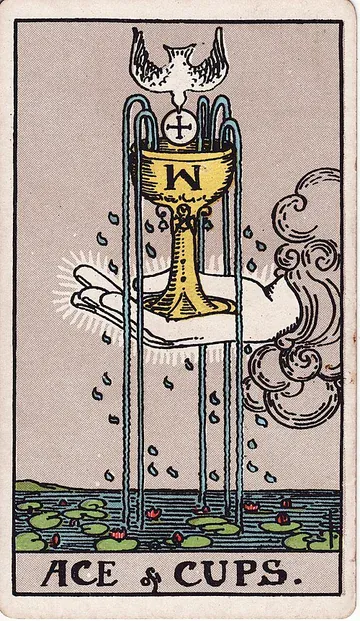
Ace of Cups
The source feeding the cup that gets raised. Ace of Cups is the unconditioned love before it has found a face; the Two is what the Ace pours into. Together they describe a bond anchored in something larger than the pair — two interiorities receiving from the same upstream source, the vow fed by a love that did not begin with either of them.
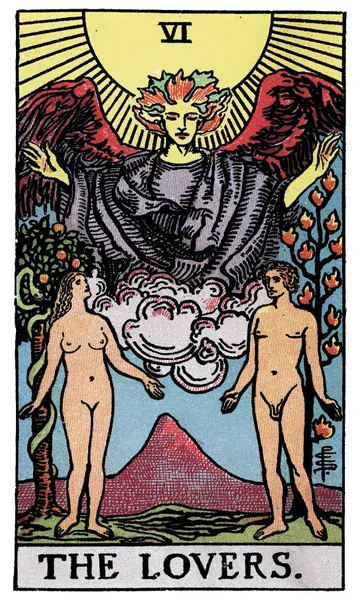
The Lovers
Vow elevated to formal choice. The Two is private recognition; The Lovers is the moment of public commitment in the archetypal register. Together they describe the wedding rather than the courtship, the partnership entered into the record. For seekers in long courtships, this combination confirms that the moment of formal choice has arrived.
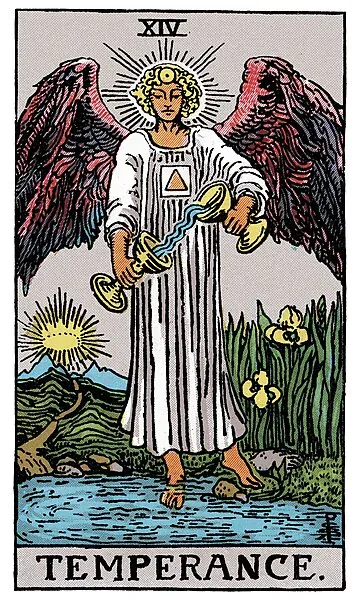
Temperance
Alchemical mixing — the vessel that holds the vow. Temperance pours water between two vessels at impossible angles; the Two is the moment two vessels recognize each other. Together they describe the long alchemical work of partnership, the slow blending of two interiorities into a third thing that is neither fully you nor fully them.
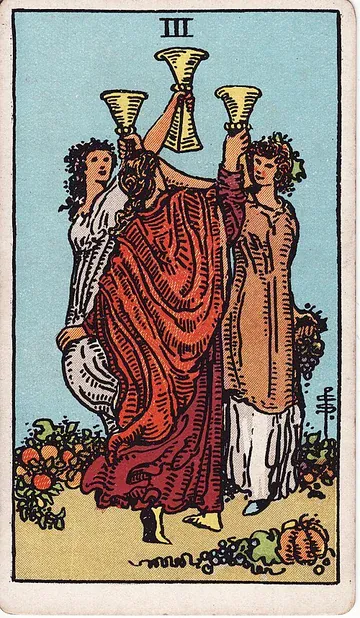
Three of Cups
Companionship that opens past the duo. The Three is the friends added to the bond, the celebration that includes more than two. Together they describe the healthy expansion of a vow into a wider relational field — the wedding, the announcement, the partnership integrated into a real community. The Two opens; the Three witnesses.
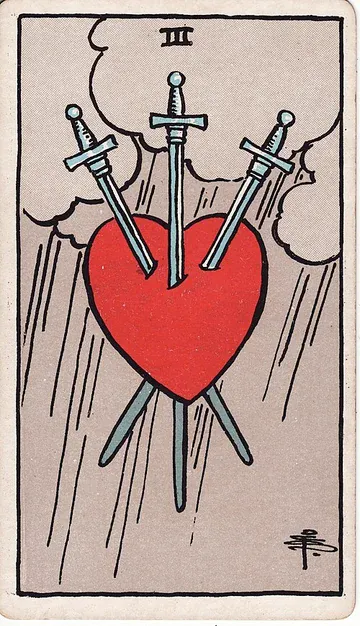
Three of Swords
Tonal contrast: the vow severed. The Three of Swords is the heart pierced, the cups never raised, or once raised and now cut. Together they are one of the deck's most painful pairings — the recognition that the vow was real and that something has cut it. Honor what was made before the cut, even while acknowledging that the cut has happened.
Frequently Asked Questions
Is the Two of Cups reversed a refusal, or a request to renegotiate the terms?
Far more often the second. The reversed Two of Cups is rarely a clean no — it is more often a soft no, or a wait until the symmetry is real. The bond, the offer, the vow you are asking about cannot be made on the current terms because both cups are not at the same line. Many reversed Two answers are invitations to renegotiate rather than refusals. Watch the actual behavior, not the stated intention.
In the Two of Cups reversed, which cup stayed on the table — mine or theirs?
The card names the asymmetry without assigning it; read the behavior of the last month to find the hand. The Two of Cups reversed is the card of the broken or asymmetric vow — one cup lifted, the other still on the table; or both cups lifted to different heights and never meeting. It describes misread signals, uneven exchanges, withheld pledges, and bonds that look mutual on paper while running one-way in practice. The work is to set both cups down and renegotiate, or to acknowledge that the parity will not form and let the pseudo-bond end cleanly.
Can a relationship survive the Two of Cups reversed without someone naming the imbalance?
Rarely for long — unnamed asymmetry is what the card is made of. Reversed in love readings, the Two of Cups describes the relationship where the two cups are not at the same height. For partnerships, it warns of slow accumulated asymmetry. For new connections, it warns of one-sided enthusiasm. For reconciliation questions, it offers a soft no on the current terms — returning would rebuild the old asymmetric shape. The card invites explicit renegotiation or, where the parity cannot form, a clean ending.
Is the Two of Cups reversed a withheld feeling or a withheld promise?
A withheld promise, almost always: the warmth is real and the cup has not been lifted. They feel something — interest, affection, growing care — and they have not yet integrated the feeling into a pledge. The card describes withheld vow more than absent feeling. The work, if there is work, is theirs: either they bring the cup across the table, or the season of withholding reveals itself as the actual shape of their availability.
What advice does the Two of Cups reversed give?
The reversed Two of Cups advises setting both cups down and returning to neutral before any further pledge is made. Stop lifting alone. Ask the other party to state, in their own words, what they have actually committed to. Name the asymmetry calmly and specifically. Renegotiate, or end cleanly — but do not keep performing the gestures of a vow that is not currently mutual. The card responds to specific articulation; vague resentment will not move it.