Two of Swords · Core Meaning
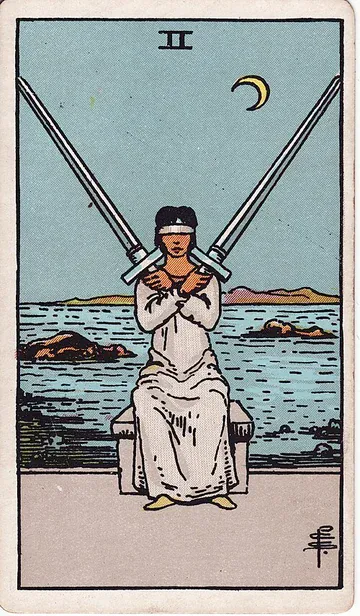
A truce is not peace; it is two blades agreeing, for now, not to move. A woman sits on a gray stone bench, blindfolded in white cloth, a silver blade in each hand crossed at her chest into a precise cipher. Behind her, a sea under the moon — the waves are small, the outcrops sharp, like judgments not yet rounded. A waxing crescent hangs above her right shoulder. She has no expression, no tilt. She sits still, and so two forces take their seat for now.
Read the picture closely. The blindfold is not imposed; the cloth is white, evenly tied, almost ceremonial. She put it there. The blades are not sheathed — they are held aloft, weight on the wrists, edges still keen — but they are also not raised against anything in particular. They are pointing at each other. This is the card's signature posture: a guard kept active, a gaze deliberately deferred, the body sitting through what most bodies would interrupt.
This is the card's signature tension: equilibrium that costs something to maintain. The Two of Swords is not the calm of resolution. It is the harder calm of the second before resolution, indefinitely extended. Both blades are heavy. Both arguments are real. The woman has decided that the cost of judging now is greater than the cost of waiting — and the wait is itself a discipline. Lower one blade and the cipher breaks. Open one eye and the architecture of patience collapses. She has chosen the configuration that holds, and she is holding it.
The traditional astrological signature reinforces this: the Moon in Libra, first decan. Libra is the scale, the held weighing, the air-sign whose virtue is the postponement of the easy answer for the accurate one. The Moon adds reflection — moonlight that lets each pan of the scale be seen without forcing a reading. And the kabbalistic signature is Chokmah in Yetzirah, the primordial Two: the first polarity drawn from Unity, not yet bodied, not yet given a side. The card sits at the moment polarity becomes visible and refuses to collapse into preference. Two has appeared. Two has not yet become a third thing.
The waxing crescent above the right shoulder is the small private signal that this stillness is not death. The moon is gaining light. Behind the held pause, something is growing — slowly, off the page, not yet ready to be looked at. The Two of Swords is not asking the seeker to pretend nothing is happening. It is asking the seeker to let what is happening ripen, in private, behind the cipher of crossed blades, before it is pulled out into daylight and judged.
Read the Two of Swords as a description of someone who has chosen the harder kind of patience. Not the patience of indifference — the patience of refusal to ruin what has not yet declared itself. Whatever the question, the card answers: not yet. Sit. Hold the cipher. The judgment, when it lands, will be cleaner for the wait.
Two of Swords · Love & Relationships
Two truths, both of them true, and a couple seated between them — that is the shape of this love reading. Both people are tired. Both people are still here. Neither is sure whether the next step is forward or out. The card describes the season when the loud arguments have stopped and a quieter calculation has begun — not coldness, exactly, but a held stillness, the same stillness the figure on the bench is holding. Whatever the architecture of the bond — long marriage, new attachment, on-again-off-again — this card means the deciding has been deferred on purpose.
For an existing partnership, the Two of Swords arrives at the season when both partners have privately admitted that something has to change and have not yet agreed on what. The arguments that used to break weekly have gone quiet. The conversations that need to happen have been deferred politely. You sit across from each other at dinner and the silverware does most of the talking. The blindfold is not a forecast of ruin. It is describing the truce that lets the relationship survive long enough to be repaired. The work, for both of you, is to keep the truce honest — to not mistake silence for resolution.
For a new spark, the Two of Swords describes hesitation on both sides. They like you. You like them. Both of you have reasons — old wounds, current commitments, geographic awkwardness, the timing problem that always seems to attach to the right person — and neither of you is ready to push. The card says this hesitation is not a verdict. It is the early version of a careful yes that does not yet know how to be said out loud. Do not force the conversation. Let the crescent wax. Read what the silence is protecting before you try to break it.
For a single seeker who is asking whether love is possible right now, the Two of Swords answers softly. The card describes a person who is not yet open. Not closed in the bitter way — closed in the deliberate way, the way someone closes their eyes to listen better. You are still digesting the previous chapter. The second chair at the table is being kept empty on purpose. This is not failure; this is recovery. The card asks: are you waiting for the right person, or are you waiting for the right version of yourself to meet the right person? The answer changes what you do next.
For the question of love after a wound, the Two of Swords is one of the most precise cards the deck offers. The wound has been processed enough that the worst is over. The blades are no longer pointing outward at the world; they are pointing at each other, holding, balanced. You are not bleeding. You are also not yet whole. The card describes the long middle of the recovery — not the rupture, not the new love, but the patient work of the seat held until the body remembers it can rest in it.
For an on-again-off-again connection, the Two of Swords reads as the pause before the next motion. Both of you are in a private deliberation. Neither of you wants to be the one who ruins the truce by speaking first. The card warns against the temptation to break the silence with a gesture, a text, a confrontation. The truce is real even if it feels suspended. Whatever lives in the suspension is allowed to land before it is named.
For a seeker asking whether someone else is in love with them and the Two of Swords arrives upright, read the card as: they are being careful with you. They feel something. The feeling has not yet decided what to do with itself. They have crossed their blades at the chest and chosen not to act on the feeling either way. This is not coldness, and it is not a no — it is a deliberate honoring of the weight of the situation. They are protecting you both from a hasty answer.
For a long-distance or geographically suspended relationship, the Two of Swords describes the strange honesty of distance. The fights you would have if you saw each other every day cannot be had over the phone. The intimacies you would build in the same room are deferred. Both of you are in a held configuration the geography enforces. The card says: use the suspension. Decide what you would actually want if the geography resolved. Do not let the truce of distance become the relationship.
A note on the card's particular love language: the Two of Swords loves the way someone listens with closed eyes loves. It does not perform. It does not promise. It listens. It keeps the second chair available without making a show of the chair. The love it describes, when it eventually opens its eyes, will have been patient enough to see clearly. That is its gift and its risk. Some people will not wait for that kind of love to declare itself. The seeker drawing this card is being asked: will you?
If you are asking whether someone is in love with you and the Two of Swords arrives upright, read it as a careful, deferred yes. They are weighing — not whether they care, but how to care responsibly. The wait is not rejection. The wait is the work the love requires before it lands.
Two of Swords · As Feelings
Held is the entire answer when this card stands in for someone's feeling about you. They feel something — the blades are not lowered, the seat is taken — but the feeling has been deliberately suspended at the chest, neither pursued nor dismissed. They are not pretending to be neutral. They are choosing a stance in which both possibilities, the moving toward and the moving away, are kept available. They have not decided. They have not failed to decide. They have decided to wait.
If they are reserved by nature, the Two of Swords personality goes into a deeper interior than usual. They are the partner who answers the difficult question with a long pause and then a careful sentence. They are not stalling. They are weighing. Read silence here as concentration, not absence. Whatever they say next will have been said only after both blades were felt at the wrist for hours — and what they say next, when they finally say it, will be true.
If they are demonstrative, the Two of Swords describes someone who has gone unusually quiet. They have not stopped feeling. They have stopped performing. The party-version of them is on hold. Around you, they are smaller, slower, more careful with their words. This is one of the most easily misread signals in the deck — a demonstrative person going still is often felt as withdrawal, when in fact the stillness is exactly the depth of the feeling.
For a partner you have been with a long time, the Two of Swords in feelings describes a private deliberation about the relationship. They are not deciding whether to love you — they have loved you for years and the loving is settled. They are deciding what kind of relationship the love now needs to be. This is the season when the structure that held you both for a decade is being privately reviewed. Do not panic. The review is honest. The deferral is not abandonment.
For a new connection, the Two of Swords in feelings means they are weighing whether to risk you. They have a sense that pursuing you would change them. They are not sure they are ready to be changed. The feeling is real. The question is courage, not chemistry. The card asks the seeker to be patient with the calculation — and to be discerning about whether the wait is the wait of a careful person or the wait of someone who will never finally cross the chest with their hands and rise.
There is a particular feeling-shape this card carries that few other cards do: dignified ambivalence. The other person is not anxious. They are not avoidant. They are aware of the polarity in their own response and have chosen not to collapse it before its time. They are letting both possibilities exist inside them at once, and the holding of both is not weakness — it is a kind of internal Libra, the scale that does not let one side win on momentum alone. Take the dignity seriously. It is the part of them you are most likely to fall in love with.
For someone who has wounded you and is now in a Two of Swords feeling-state, the card describes their honest reckoning. They are not yet ready to apologize. The apology that arrives now would be too quick to mean anything. The blades are still being weighed. If you can wait for the apology that lands after the cipher is finally lowered — without exhausting yourself in the waiting — what arrives will be real. If you cannot wait, the card respects that too. The seeker is not obligated to hold the truce alone.
For a partner who has been distant, the Two of Swords in feelings is reassuring in an unusual way. The distance is not a falling-out-of-love. The distance is the room they are giving themselves to feel the love responsibly. They are not pulling away. They are listening more carefully to what loving you means. The texture is patient, internal, lit by a small private moon.
A small caution: the Two of Swords personality in feelings can become its own trap. The longer the cipher is held, the harder it becomes to lower the blades. If the seeker senses the deliberation has stopped being deliberation and become the relationship itself — the held position now operating as a permanent shape — the card asks for a gentle, named question. Not an ultimatum. A real question, asked in real words: what are we waiting for? Sometimes the question is the only thing that lets the wait end.
Take the Two of Swords in feelings as confirmation that the other person is taking you seriously. Whatever they feel, they are not casual about it. Whatever they decide, they are deciding it well. The work, if there is work, is in the rhythm of the wait — making sure the truce stays alive instead of calcifying into avoidance.
Two of Swords · Career & Work
At work this card defends a decision deliberately not made, and calls the deferral correct rather than cowardly. Two roles, two directions, two offers, two strategies — and neither is yet ripe enough to push. The card is not asking you to be passive. It is asking you to recognize that the moment of pushing has not yet arrived, and that pushing prematurely burns the ammunition the real moment needs.
If you are asking whether to stay in a current role or leave, the Two of Swords answers: not now. Not because the stay is correct or the leave is wrong — but because the data you would need to decide accurately has not yet arrived. The next quarter will tell you something. The conversation with the new manager will tell you something. The reorganization being rumored will tell you something. The card describes the discipline of remaining in place, doing competent work, not signaling either restlessness or commitment, while the situation reveals itself. Lay your hand down for now; let time do the sifting.
For someone weighing two job offers, the Two of Swords describes the genuine difficulty of the comparison. Both have real virtues. Both have real costs. You are not failing at deciding because you are weak — you are sitting with two roughly equivalent paths, and the ranking has not declared itself. The card warns against deciding on momentum alone (the offer that arrived first, the recruiter who pressed harder, the salary that crossed the round number). Sit one more night. Read both letters again in the morning. The blade that should be lowered will declare itself; until then, hold both.
For someone weighing whether to start a venture or stay employed, the Two of Swords often arrives precisely at the moment of false readiness. You have been preparing for two years. The plan is good. The savings are nearly enough. And something — small, articulate, patient — is asking you to hold one more season. The card respects the preparation. It also names the risk of moving on the date you set yourself rather than the date the work is actually ready to be moved on. The crescent is waxing. Something is still being built that the launch would prematurely interrupt.
For freelancers and entrepreneurs in active business, the Two of Swords describes a stalled negotiation. The client wants one shape; you want another. Both of you are dug in. The card says: do not concede on momentum. Do not push to break the stalemate. Lay the proposal down for a week. Often, in a Two of Swords business stalemate, the resolution arrives through a third party, a new development, or a small concession the other side offers when they realize you are not going to break the truce out of impatience. Holding is leverage, when held correctly.
For a creative practice, the Two of Swords is one of the deck's most useful cards. It describes the season in which the work is in the chrysalis. The previous project is finished. The next project has not yet declared itself. The temptation is to fill the silence with anything — a launch, a pivot, a public announcement — to prove to yourself the practice is still alive. The card asks for trust in the empty studio. The crescent is waxing behind the closed eyes. The next work is gestating. Honor it by not interrupting it.
For someone considering a promotion, the Two of Swords is unusually honest. The promotion may come, and the new title may not be the answer to the question you were actually asking. The card asks: do you want the role itself, or do you want the recognition that the role would carry? These are different. The promotion answers one and not the other. Sit with the question for a season before you let the title resolve it for you.
For job-search readings, the Two of Swords describes the long middle. You have applied. The replies are slow. Two leads are warm and neither is yet hot. The card is not predicting drought. It is describing the held interval between application and offer, when the most important discipline is to keep the truce with yourself — not to spiral, not to over-apply in panic, not to take the wrong role just to make the waiting end. The right offer will arrive. The wait is not the absence of the offer; the wait is the offer being prepared in someone else's office.
For someone in a difficult workplace conflict, the Two of Swords reads as the strategic pause. Do not escalate this week. Do not write the email. Do not request the meeting. Sit with the cipher. The colleague who is at the other end of the conflict is also tired. Often, when this card arrives, the conflict resolves not through your action but through the other party's exhaustion — they retreat first, or a third party steps in, or the underlying issue becomes irrelevant when the project ends. Holding is not weakness. Holding is the answer the situation requires.
A note on stability: the Two of Swords is not a card of acceleration in career. It is a card of measured patience. For seekers in fast-moving industries, this can feel maddening — the impulse to keep moving is part of the culture. The card respects that. It still says: hold this one. Not every season is the season for the next sprint. Some seasons are the season for the held cipher, and the seeker who can hold the cipher when the culture says move will find that the eventual move, made from the held seat, is cleaner and longer-lasting than the moves of those who never paused.
Two of Swords · Money & Finances
The money question on the table has not finished ripening. The investment, the purchase, the move, the change in plan — whatever is on the table has not yet declared itself clearly enough to be acted on. The card asks for the discipline of the held wallet. Not no. Not yes. Wait until the picture finishes drawing itself.
For a question about whether to make a major purchase, the Two of Swords answers: hold for one more cycle. The thing you want is real. Your need is real. The cost is also real, and the version of the purchase that will be available next month — same item, different financing, better timing, or the alternative product that will appear out of nowhere precisely when you stop searching — is part of the picture. The card respects the desire and asks for one more month of the cipher.
For an investment decision, the Two of Swords is unusually direct. Do not move on this one yet. There is something you do not yet know about the asset, the market, or your own appetite for the risk. The waxing crescent is the small signal: information is forming. It has not yet arrived in your inbox. When it arrives, the decision will be obvious. Until then, the held position is the right position.
For a seeker carrying debt, the Two of Swords describes the precise moment of weighing two competing debts, two repayment strategies, two consolidation offers. Both have merit. Both have hidden cost. The card says: do not decide this week. Read both offers again in seven days. The one that should be chosen will become more obvious not because new information has arrived, but because your relationship to the offers has settled. Decisions about money, like decisions about people, can be made too quickly and then carried for years.
For someone in financial recovery after a hard season, the Two of Swords reads as the held stability. The worst is over. The next phase is not yet clear. You have not yet decided whether to rebuild aggressively, sit at the current level, or take a calculated risk that could either rebuild faster or set you back. The card asks for one more month of the cipher. The answer is forming. Not deciding now is not stagnation; it is the patience the recovery requires before the next move can be honest.
For windfall — inheritance, bonus, unexpected income — the Two of Swords is one of the most useful cards the deck offers. The money has arrived. The temptation is to deploy it immediately, to make the windfall feel earned by spending it well. The card says: hold for one cycle. Three months in a high-yield account, untouched. The decision about what to do with the money will be a different decision in three months than it is today, and the difference is not loss — the difference is the windfall being received, instead of received-and-spent in the same gesture.
For questions of long-term financial planning — retirement, real estate, insurance, succession — the Two of Swords describes a moment of two-paths weighing. The financial advisor is offering one strategy. Your gut is offering another. Both have reasoned cases. The card says: get a second opinion. Then sit with the second opinion for a month. Long-horizon decisions made in the held cipher tend to outperform decisions made in the urgency the financial industry generates around quarterly cycles.
A note on the trap of this card with money: the Two of Swords can curdle into avoidance if held too long. The held wallet is wisdom; the avoided account statement is not. The card distinguishes precisely between the two. Pay attention to whether the cipher you are holding around money is genuine deliberation or the blindfold turned hiding place. If you have not opened the bank account in two weeks, the held cipher has become avoidance. Open the account. Read the number. Then return to the deliberation, with the eyes momentarily uncovered, before crossing the blades again.
A practical move when this card appears in a money question: write the two paths on paper. Not a spreadsheet. Actual paper. Two columns. Costs, benefits, timing, what you would feel if the path went well, what you would feel if it went badly. Sit with the paper for a week. The card responds to materialized weighing — the act of putting the deliberation outside your head and into the world. The seat on the bench is held more steadily when the seeker has done the writing.
Two of Swords · Health
Held tension, neither crisis nor ease: the body in this card sits in the long alert posture of waiting for something to clarify. The shoulders are slightly raised. The jaw is gently set. The breath sits high in the chest. The body is doing the work of holding two possibilities at once, and it is doing the work with discipline, but the work is real. The card asks the seeker to recognize the cost of the holding before the holding becomes the body's default.
The card's particular health signature, read against its element and body associations, is the throat, the lungs, and the nervous system — air's territory. When the Two of Swords appears in a health reading, watch for the small symptoms of held breath: the throat that scratches at the end of the day, the dry cough that arrives when nothing else is wrong, the shoulders that have crept upward without you noticing, the back of the neck that does not relax even in sleep. The body is carrying the cipher. The body is asking for permission to set it down.
If you are asking whether a treatment will work, the Two of Swords answers with measured patience. The treatment is real. The body is responding. The response is not yet the full response, and the temptation to evaluate the treatment too early — to read a partial improvement as either failure or completion — is part of what the card warns against. Stay with the protocol. Trust the practitioner. Give the body the full course. The crescent is waxing. The healing is forming below the level the daily check-in can detect.
For someone managing a chronic condition, the Two of Swords describes a plateau that is not stagnation. The metrics have stabilized. The acute interventions of the early phase have settled into routine maintenance. The doctor says you are doing well and the doing-well does not feel like victory; it feels like the held cipher. The card respects this exactly. Chronic conditions teach the body to hold two truths — well-managed and ongoing — and the seeker carrying this card has learned the holding. Use the plateau. Do not interrupt it for novelty's sake. The next change in the condition will declare itself when it is ready.
For acute issues, the Two of Swords reads as the diagnostic interval. The symptom is real. The doctors are weighing two possibilities. The test results have not yet arrived. The card asks for the patience of the diagnostic wait — and the discipline of not catastrophizing in the silence. The crescent above the right shoulder is the small reminder that information is forming. It has not yet arrived. The work of the wait is to keep the body fed, the sleep regular, the nervous system as low as possible while the data clarifies.
For mental health questions, the Two of Swords is unusually precise. The depressive or anxious season is not at its worst — the breakdown has been averted, the stabilization has happened — but the recovery has not yet declared itself either. You are not in the active darkness. You are not yet in the open day. The card describes the held middle — the season after the worst is over and before the new chapter has clearly begun. This is the season most therapists describe as the hardest part of recovery, precisely because it lacks the dramatic relief of the breakdown ending. Trust the held cipher. The healing is happening below the level of the felt evidence.
For someone managing nervous-system issues — insomnia, anxiety, panic, the chronic alertness that does not turn off — the Two of Swords names the pattern with surgical accuracy. The body has been holding the cipher for so long that the holding has become the default. Setting down the blades has become hard not because you do not want rest but because the body has forgotten what rest looks like. The card asks for the small re-introduction of receiving — a hand on the chest, a five-minute lying-down without intention, a breath that is allowed to be longer on the out than the in. The crescent waxes when the cipher is finally lowered, even briefly, even just before sleep.
For questions about sleep, the Two of Swords often arrives because sleep is exactly where the held cipher is most expensive. The body cannot fully release into sleep while still maintaining the daytime guard. The card asks for the small ritual that signals the cipher's nightly suspension: the same gesture, the same room, the same hour, the same removal of the day's blindfold replaced with the more honest darkness of closed eyes that have given up the watch. None of this is medical advice — keep your practitioners, take your medicine, do the sleep hygiene the doctor prescribes. The card simply names the held pattern the body is asking to be helped out of.
The card respects the body's intelligence. It does not say "stop holding" — sometimes the holding is the only thing keeping you upright. It asks: what is the smallest unit of release you can give yourself today? The card responds to that question, and the body responds to it too.
Two of Swords · Spirituality
Discernment still being carried is what the white cloth over the eyes protects. Not the discernment that already knows, and not the confusion that does not know — the harder middle, the discernment that is patient enough to refuse premature certainty. The card describes the seeker who has learned that some questions cannot be answered until they have been carried long enough, in the dark, behind closed eyes, with both possibilities held in the hands without preference.
For seekers in active practice, the Two of Swords often arrives at the threshold of a spiritual decision the daily practice has been preparing them for. Two paths have appeared. Two teachers have spoken. Two understandings of the same teaching are in tension within you. The card asks for the discipline of the held cipher: do not collapse the polarity into a side too quickly. The Chokmah signature — primordial Two, polarity drawn from Unity, not yet bodied — is the kabbalistic name for exactly this moment. Stay in the Two before you move toward the Three. The Three is where the polarity finds its third thing, the synthesis, and the synthesis cannot be forced. It declares itself, in time, when both blades have been honored.
For seekers in a season of doubt, the Two of Swords is one of the kindest cards the deck offers. Doubt, the card says, is not the absence of faith. Doubt is the held stance of someone honest enough not to settle for a faith that has not been weighed. The card respects the doubt. It also reminds the seeker that doubt held forever becomes its own kind of avoidance — the blindfold turning, eventually, into the hiding place. The work is to let the doubt do its weighing without claiming the weighing as the final answer.
For seekers exploring belief, the Two of Swords describes the moment two cosmologies are sitting on the bench at once. The childhood tradition you grew up in is in your right hand. The adult understanding you have built through reading and experience is in your left. They cross at the chest. They are both real. The card asks for the patience to not yet collapse them into a single answer. The synthesis, when it lands, will not look like either side. It will be a third thing, and the third thing only forms after the two have been held side by side long enough to be clearly seen.
The card's spiritual practice — the one specific practice it asks for — is sitting meditation with the eyes deliberately closed and the hands crossed lightly at the chest. Not as performance. As recognition. Twenty minutes, twice a week, of holding the cipher consciously. Notice what becomes loud when the eyes close. Notice what tries to pull one hand toward the front. Notice the moment the body tries to interrupt the holding because the holding is uncomfortable. The card responds to this practice — twenty minutes that the rest of the week is changed by.
For questions about path, the Two of Swords answers that the path is the holding itself. The seeker who has learned to sit on the bench between two clear directions has learned a discipline most spiritual paths take years to teach: the difference between knowing-with-haste and knowing-with-time. The card says you are in the school of the latter. The Moon in Libra signature reinforces this: the lunar weighing of both pans, by reflection, until the right pan declares itself by reflected light rather than by force.
A small caution: the Two of Swords spiritual posture can become a performance of nuance. The seeker who is always weighing, always honoring both sides, always refusing to commit, is at some point hiding behind the cipher. The card distinguishes the patience of held discernment from the cowardice of held non-commitment. If the cipher has been held for a year on a question the body knows the answer to, the card asks for the lowering of one blade. The synthesis cannot form forever. At some point, the Two becomes the Three or it stops being spiritual practice at all.
The card invites the seeker to honor the held season as a real season — not a placeholder, not a delay, not a failure to arrive. The seat on the bench is the practice for now. The crescent waxes. Whatever is being prepared in the held quiet will declare itself. The patience is the path.
Two of Swords · Yes or No
Soft yes — but only as a pause.
The Two of Swords upright is rarely a clean yes or a clean no. It is the deck's most precise "not yet" — the answer that says the question is real, the answer is forming, and the moment of asking is not yet the moment of receiving. Treat the card as a yes-with-conditions, where the condition is the patience of the wait itself.
For yes-or-no questions about a relationship, a job, a move, a decision: the answer is conditional. Yes, the path you are considering is workable, but not yet. The data you need to commit fully has not yet arrived. The action you would take this week would be premature. Hold for a cycle. Ask again in a month. The same question, asked from the held seat, will receive a clearer answer.
For questions about whether someone is being honest, whether an offer is genuine, whether a plan will hold: the answer is technically yes, with the caveat that the situation is still in flux. What is presented is not deceptive. What is presented is also not yet final. Read the contracts; do not sign in haste. Often, when this card appears around a question of trust, the additional information that arrives in the next two weeks confirms the original honesty while also revealing nuances the seeker would have missed by deciding too quickly.
For binary questions about whether to act — should I take the offer, should I send the message, should I make the move — the Two of Swords upright says wait. Not no. Wait. The action is not wrong; the timing is wrong. The right move made at the wrong moment fails because of the moment, not the move. Honor the held seat. The window for action will open, and the action made from the held position will land cleanly.
Asked how long the held position holds, the Two of Swords describes the longer arc. Not soon in the urgent sense. Soon in the sense of the next cycle, the next season, the next quarter. The crescent is waxing. The arrival is forming. Patience is the discipline the card asks for; the discipline is the way the timing eventually opens.
For questions where the seeker has already privately decided and is asking for confirmation, the Two of Swords answers gently: you know. You are pretending not to know. The card is not telling you that you are wrong. It is asking you to recognize that the decision has already been made, behind the held cipher, and the cipher is being held now to delay the saying-it-out-loud. This is the rare upright reading where the card asks for the lowering of the blades — not because the deliberation has finished, but because the deliberation finished some time ago and you are afraid of acting on what you already know.
For yes-or-no questions about a difficult conversation — should I say the thing, should I confront the person, should I clarify the misunderstanding — the Two of Swords upright says yes, but speak from the held seat. Speak after the deliberation, not during it. Write the message. Do not send the message until tomorrow. Read the message in the morning. Send the part of it that survives the night. The card respects the courage of the conversation. It also asks for the discipline of the timing.
For yes-or-no questions where neither path is clearly correct, the Two of Swords reads as: stay where you are for now. Both options have real virtues. Both options have real costs. The seat on the bench is itself the answer. Continue what you are doing. Continue letting the situation reveal itself. The decision will not be deferred forever — but it will be deferred long enough for the right answer to declare itself by its own weight, rather than by your forcing.
If the question was: do I deserve clarity right now? The card answers yes, and then asks why you are demanding it from the cycle that has not yet finished forming.
Two of Swords · Advice
Honor the held seat, and do not break the truce merely because impatience has arrived early. Do not force a resolution because the resolution would relieve your discomfort. The card asks for the discipline of remaining in the cipher long enough for the situation to declare itself — and the discipline is not passive. It is active, deliberate, costly. Holding the seat is one of the harder things the deck asks of the seeker.
If there is one specific instruction the card offers, it is to sit with the question literally. Find a chair. Sit upright, both feet on the floor, hands lightly crossed at the chest. Close the eyes. Stay for ten minutes. Notice what tries to interrupt the position — the urge to check the phone, the urge to make a decision just to feel decisive, the urge to declare yourself one way or the other on the question you are carrying. The card responds to literal practice. The figure on the bench is not a metaphor. She is a model.
A second instruction: write the two sides on paper. Two columns. Whatever the question is — stay or leave, pursue or release, speak or stay quiet — give each side its full case. Not a quick list. A letter, in your own hand, advocating for each path as if you were a lawyer for that path. Then put the paper away for one week. The card responds to externalized weighing. Decisions held only inside the head spiral; decisions placed outside the head settle.
A third instruction: do not ask anyone for advice this week. The Two of Swords is the card of internal discernment, and outside voices, however well-meaning, will collapse the cipher prematurely. Friends will tell you what they would do. Family will tell you what they wish you would do. The internet will tell you what its algorithm thinks you want to hear. All of this is noise relative to the precise discernment the card is asking for. Hold the question privately for at least seven days before consulting anyone outside.
A fourth instruction: lift the blindfold once. Not the whole way. Just enough to glance at one piece of information you have been deliberately not looking at. The bank statement, the message you have not opened, the calendar event you have been avoiding, the conversation you know is waiting. Look once. Then re-tie the blindfold. The card distinguishes between the deliberate deferral of judgment (wisdom) and the deferral of seeing the data the judgment would be based on (avoidance). Look once at what you have been refusing to see. Then return to the held cipher with one more piece of honesty available to it.
A fifth instruction: track the wait. The Two of Swords is a card of patience, and patience without a horizon becomes paralysis. Set a date. Three weeks from today, four weeks, six weeks — whatever feels honest — and write it on the calendar as the day the question gets revisited. The crescent waxes on a known schedule. The seeker who knows when the next revisit is can hold the held seat without falling into infinite deferral. If the date arrives and the question is still not ripe, set another date. But know what you are doing.
Practical advice for the day the card appears: do something quiet. Walk by water if water is available. Sit in a room without a screen for an hour. Eat a meal slowly, alone, with attention. The card responds to acts of held attention — the small daily disciplines that mirror, in miniature, the larger held cipher of the question. The bench is a posture. The posture is a practice. The practice changes what the seeker is capable of receiving when the answer eventually lands.
A final instruction, gentler than the others: forgive yourself for the wait. The seeker who has drawn the Two of Swords often arrives with the private suspicion that they should already know, should already have decided, should already have moved. The card disagrees. The held seat is the correct place to be right now. The deliberation is honest. The patience is integrity. The synthesis will form. Until it does, the seat is the work.
Two of Swords · Card Combinations
The Two of Swords does not work alone in a spread; it gains color from whatever sits next to it on the table. A held cipher next to the Three of Swords is a different held cipher than one next to the High Priestess. Below are five combinations the card most frequently lights up, with the combined image read directly rather than the two cards listed in sequence.
Two of Swords + Three of Swords
The truce broken. The held cipher gives way to the wound. When these two appear together, the card describes the arc most readers fear — the held seat of the Two has been kept past its useful life, and the breaking, when it comes, is sharper because the holding was so long. Read this combination as the warning the card gives most pointedly: not every cipher should be held forever. Some cipher must be opened, at some moment, and the opening — done in time — prevents the wound. Done too late, the wound replaces the deliberation. The combination is not predictive; it is descriptive. It names the cost of the indefinite held seat.
Two of Swords + The High Priestess
The held cipher reflected by the deeper one. The Two of Swords sits before her sea; the High Priestess sits before her veil. Both are blindfolded, in their own ways — the Two by the white cloth, the Priestess by the moon-knowledge that does not need eyes to see. Together they describe the seeker whose patience has matured into wisdom. The deferral is no longer just strategic. It has become a way of knowing. The card combination respects the seeker's capacity for held silence and asks them to trust the deeper register the silence has begun to speak from.
Two of Swords + The Moon
The held cipher inside the unresolved. When these two appear together, the question is real and the situation is unclear in ways the seeker cannot fully name. The Moon's sea is ambiguous; the Two of Swords' sea is sharp-edged but small-waved. Together they describe a season of held navigation through fog — when the seeker cannot trust the surface impressions of any choice and must hold the cipher patiently while the deeper picture clarifies. The combination warns against decisions made by the moonlight alone; it asks for the longer view, the daylight wait, the willingness to remain in not-yet-knowing without forcing premature shape.
Two of Swords + Justice
The deferred ruling and the actual one. Justice is the card of the verdict that has lifted the blindfold and seen clearly; the Two of Swords is the verdict still holding the blindfold by choice. Together they describe a sequence — the patience of the Two giving way, eventually, to the precision of the Eleventh. The combination is a teaching: the seeker who has learned to hold the cipher has earned the right to a Justice ruling that lands cleanly when it lands. The Two is the apprenticeship. Justice is the work the apprenticeship was for. Honor the held seat now, and the eventual ruling will be sharp because the patience was disciplined.
Two of Swords + Two of Cups
Same number, opposite suit — the dialogue the Two of Swords delays. The Two of Cups is the toast across the table, the meeting of eyes, the offering accepted. The Two of Swords is the meeting deferred, the eyes closed, the offering held in the air. Together they describe the relationship that is waiting to become a real conversation. The seeker is being asked: what is the cipher protecting? The held silence keeps the relationship from breaking, but it also keeps the relationship from deepening. Eventually one of you must open the eyes and meet the other's. The combination respects the patience and asks, gently, for the timing of its end.
Card Combinations
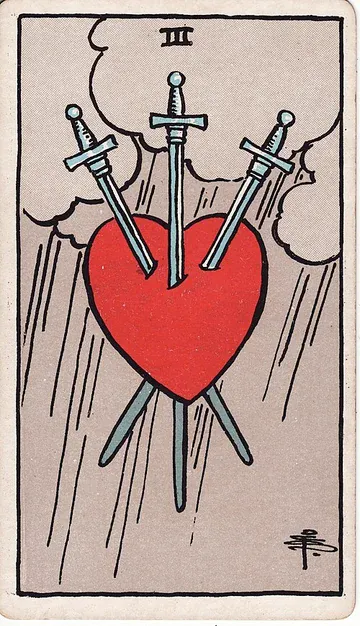
Three of Swords
The truce broken. The held cipher of the Two gives way to the wound of the Three — the holding kept past its useful life, the breaking sharper because the holding was so long. Not every cipher should be held forever; the warning the card gives most pointedly is that some cipher must be opened in time. Done late, the wound replaces the deliberation. The combination names the cost of the indefinite held seat.
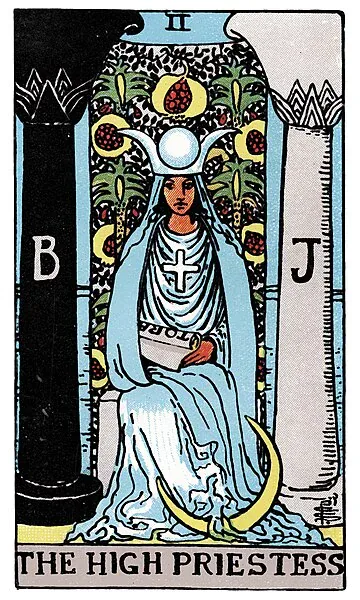
The High Priestess
The held cipher reflected by the deeper one. The Two of Swords sits before her sea; the High Priestess sits before her veil. Both are blindfolded in their own ways — the Two by white cloth, the Priestess by lunar knowledge that does not need eyes to see. Together they describe the seeker whose patience has matured into wisdom. The deferral has become a way of knowing. Trust the deeper register the silence has begun to speak from.
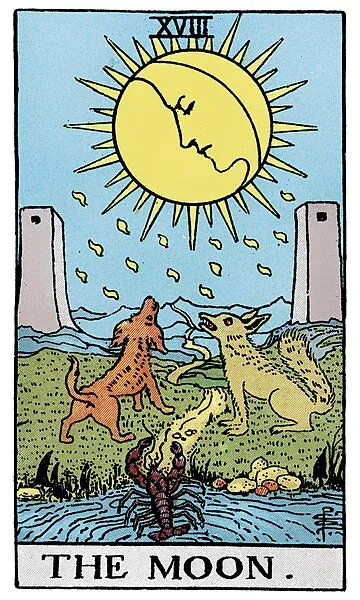
The Moon
The held cipher inside the unresolved. The Moon's sea is ambiguous; the Two's sea is sharp-edged but small-waved. Together they describe a season of held navigation through fog — the seeker cannot trust surface impressions of any choice and must hold the cipher patiently while the deeper picture clarifies. The combination warns against decisions made by moonlight alone; it asks for the longer view, the daylight wait, the willingness to remain in not-yet-knowing.
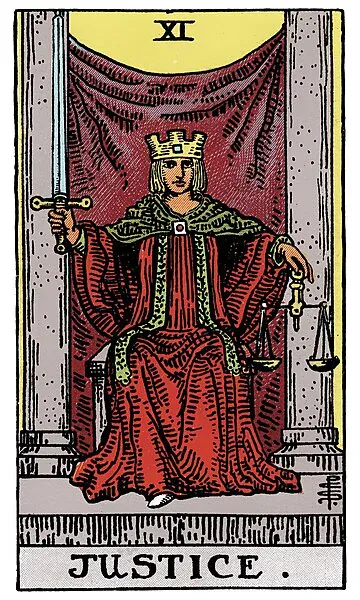
Justice
The deferred ruling and the actual one. Justice has lifted the blindfold and seen clearly; the Two of Swords still holds the blindfold by choice. Together they describe a sequence — the patience of the Two giving way, eventually, to the precision of the Eleventh. The combination teaches that the seeker who has learned to hold the cipher has earned the right to a Justice ruling that lands cleanly. The Two is the apprenticeship; Justice is the work it was for.
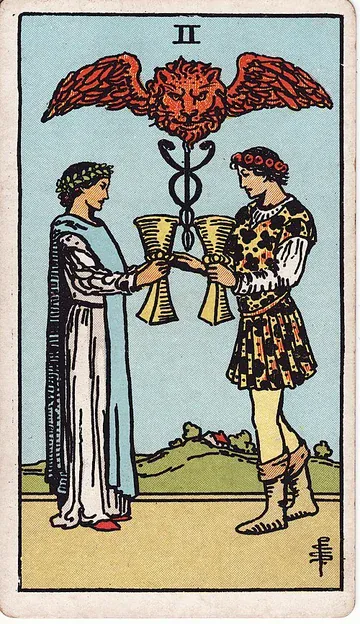
Two of Cups
Same number, opposite suit — the dialogue the Two of Swords delays. The Two of Cups is the toast across the table, the meeting of eyes, the offering accepted. The Two of Swords is the meeting deferred, eyes closed, offering held in the air. Together they describe the relationship waiting to become a real conversation. What is the cipher protecting? The held silence keeps the bond from breaking but also from deepening. Eventually one of you must open the eyes and meet the other's.
Frequently Asked Questions
What does the Two of Swords mean in a tarot reading?
The Two of Swords means the held truce — a deliberate pause between two real options, neither yet ripe enough to choose. It is the card of the woman on the bench, blades crossed at her chest, blindfold tied by her own hand. Read it as protective patience, not paralysis. The card respects the wait and asks the seeker to honor the cipher long enough for the situation to clarify itself.
Does the Two of Swords answer wait rather than yes or no?
It does, and that is the most honest thing a pair of crossed blades can say. The upright Two of Swords is a soft yes-with-conditions and the condition is timing: the path you are asking about is workable, but not yet. Hold for a cycle. Ask the same question in a month, and the held cipher will have produced a clearer reading by then. A reading taken inside the pause measures the pause rather than the outcome, which is why re-asking every few days returns the same blindfolded figure on the same bench.
Why are both people in a Two of Swords relationship still waiting?
Because neither truth has yet outweighed the other. The card describes a bond suspended between two of them — both partners tired, both still here, neither sure whether the next step is forward or out. For new sparks, it means hesitation on both sides for honest reasons. For singles, it describes the deliberate pause between chapters. The card asks for patience with the held configuration before any decisive move, and it treats that patience as work rather than as delay.
Is the Two of Swords as feelings indifference, or deliberate weighing?
Weighing, and the difference is the whole reading. The other person feels something — the blades are not lowered — but the feeling has been deliberately suspended. They are weighing, not pretending neutrality. Read it as dignified ambivalence: they are taking you seriously enough to refuse a hasty answer. Whatever they decide will have been decided well; the wait is the work the feeling requires, and pressing for an early answer usually gets the answer that protects them rather than the one that is true.
What is the spiritual meaning of the Two of Swords?
Spiritually, the Two of Swords is the card of held discernment — the patience that refuses premature certainty. Its kabbalistic signature is Chokmah, the primordial Two, polarity drawn from Unity but not yet bodied. The card asks the seeker to remain in the Two before collapsing into a side. The synthesis arrives, in time, by its own weight rather than by force.