Two of Wands · Core Meaning
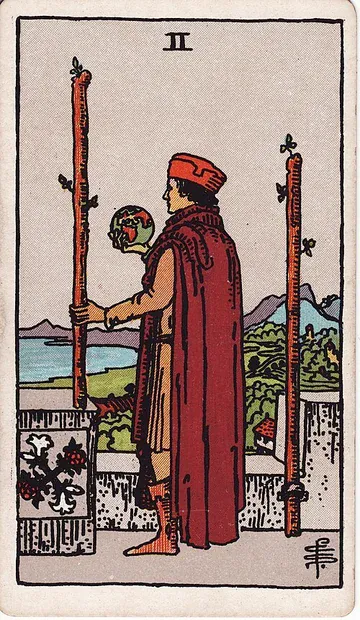
The Two of Wands meaning starts with a posture, not a verdict. A figure in deep-red robes stands on the battlement of his own castle. One wand has already been planted into the wall beside him — set, fixed, no longer needing a hand. The other wand is gripped in his right hand, upright. In his left, against the line of his chest, he holds a small gold globe. The world has been condensed into a thing the size of an apple. He is looking out, not down. He has not yet pointed.
The card belongs to the moment after a small thing has been built and before a larger thing has been chosen. The wand fixed in the wall is the half of the will that is already established — a first ground won, a small kingdom that runs on its own. The wand in hand is the half that has not yet decided where to go. The small gold globe is the catch in the throat: the world held as something specific enough to choose between. The shadow of the battlement falls across his feet. He is standing, the card insists, on his own edge.
The tension of the two runs between the wand bolted to the wall and the wand still loose in his grip. He is not stuck. He is not afraid. He is on a high place he himself built, looking at a country he himself drew, holding a globe he himself gilded — and the question he is being asked is which direction he will commit to. Both of his options are real. Neither has become inevitable yet. The Two of Wands tarot meaning is the moment of dominion before motion. It is the long view from the wall.
The traditional astrological signature for the Two of Wands is Mars in Aries, first decan — pure ignition fire, the most direct form of "I will." Mars rules Aries, so this is Mars at home, undiluted. The first decan is the rawest, most unmixed face of the sign. There is no resistance here yet. The card does not describe the long campaign or the hard middle of the project; it describes the first warm wind on the morning of the spring equinox, when the body knows the season is turning before any leaf moves.
Kabbalistically, the card sits at Chokmah in Atziluth — fire in the second sephirah, the world of pure emanation. Chokmah is the first branching beyond the source, the active principle of motion. The Aces are the seed; the Twos are the seed splitting into the first pair. For wands, that pair is "the self, and where the self means to go." This is why the card has two wands and not one. The single will of the Ace has begun to recognize that it must point — and pointing requires the world be measured, even just to the size of a small gold globe in the palm.
Read the Two of Wands the way you would read someone standing in a doorway with a coat halfway on. They have not left. They have also not stayed. They are at the threshold, surveying. Whatever you bring to the reading — a job offer, a relationship at a turn, a city you are considering, a side project that is starting to insist on itself — the card is describing the shape of the decision you are inside, not the verdict. The verdict is yours to write. The card opens the map.
Two of Wands · Love & Relationships
In love readings, the Two of Wands meaning takes a particular shape: it is the card of the relationship at a deciding altitude. Less about the heat of feeling, more about the choice of direction. The two wands stand for two paths the bond could take. The small gold globe is the world the bond will move through. The card is asking what you both want this love to become, not whether you love each other now.
For an existing partnership, the Two of Wands often arrives at the year the relationship has stabilized enough to plan. The fights that defined the early days have softened into known patterns. The work of fitting two lives together has finished its hardest stretch. What follows is the open question of expansion — the move, the marriage, the child, the move abroad, the company started together. Both partners are standing on a battlement they built. The card is asking whether they will descend together or stay where they are. Both answers are legitimate. The card does not punish staying.
For a new spark, the Two of Wands describes a meeting that has the texture of decision rather than infatuation. You are not swept off your feet. You are surveying. You can already see the shape of what this could be. The body is interested but the mind is also interested — and they are not yet in conflict. The card here means the connection has architecture. There is a horizon line you both can name. This is the card of the early conversation that already includes the future without forcing it.
For a single seeker asking whether love is possible, the Two of Wands answers yes — and adds that the question of love is, for you, currently a question of direction rather than availability. You are not lonely in the desperate way. You are alone on a vista you have built, and the question is whether you descend the wall toward another life or remain in the dominion you have made. Single by choice has become the shape your life is in. The card is asking whether the choice is still being chosen, or whether it has hardened into a habit you can no longer remember choosing.
For someone considering a long-distance or overseas partnership, the Two of Wands is one of the deck's clearer affirmations. The card has horizon, ships, distant coastlines built into its imagery. The small gold globe in his palm is, after all, the whole world condensed. Cross-border love, expat partnership, the relationship that requires one or both of you to leave home — the card recognizes all of these as legitimate descents from the wall. There is no penalty in the card for choosing the partner who lives across an ocean. The penalty, if there is one, is for refusing to choose.
For someone in a love that has reached a fork — stay or go, same city or new one, marry or remain unmarried, take the formal step or keep things informal — the Two of Wands meaning is that the fork is real, and you are the one who must walk it. The card is not deciding for you. It is naming the question accurately, which is its own gift. Many seekers come to a fork and pretend it is a single path. The card declines that comfort. It says: there are two wands. One you have already planted. The other is in your hand. Do not pretend you are not holding it.
For love after a wound, the Two of Wands describes the wall built by the recovery. The grief built you a battlement. The work you did on yourself made you somebody who can survey love rather than be swept by it. This is a real gift. The card asks, gently, whether the wall has now become the relationship — whether the survey has become the substitute for descending into a real bond with a real person whose particularity will inevitably scratch the gilt of the small gold globe. To love again is to climb down. The wall does not love anyone back.
For the question of partnership of equals — the relationship in which neither person is the leader, the relationship in which two people who built their own dominions are now considering merging them — the Two of Wands is a strong card. It does not erase the difficulty of merging. It honors that two real territories are being mapped against each other. The card invites both partners onto the same wall before they descend together. Talk before you move. Draw the map. Decide where you are going.
A note on the card's particular love language: the Two of Wands loves the way a strategist loves. It honors the partner whose presence makes the future legible. It is the love that asks "where are we going" early in the relationship, and means the question kindly. Not all loves speak this language. The Two of Wands relationship can read as cool to a partner who needs the heat of the Aces or the abundance of the Cups. Know your card. Know your love language. Build a love that does not punish either partner for the language they speak.
If you are asking whether a specific person is in love with you and the Two of Wands arrives upright, read it this way: they are interested in the future with you. They are not casual. They are surveying their own life and including you in the survey. The body of the answer is in their long view, not their immediate gestures. They may not be the one who buys you flowers every Friday. They are the one who moves cities for you when the time comes. Trust the slower signal.
Two of Wands as Feelings
When asked the Two of Wands as feelings — what is this person feeling toward you right now — the card answers with a particular texture: considered interest. They are not infatuated. What reads as distance is elevation. They have looked at you the way the figure on the battlement looks at the horizon: deliberately, slowly, with a small gold globe of you held in the palm of their attention. They are taking the measure of you, and the measure is favorable.
This is the card of the partner whose feelings include a future. They are not just enjoying the current weather of you. They have noticed the architecture. They are wondering, quietly, what it would be like to descend from their own wall toward yours. The wondering is itself a strong feeling — stronger than many of the more demonstrative cards — because it has weight. It carries cost. They are not idly curious. They are calibrating.
If they are reserved by nature, the Two of Wands feelings can read almost like distance to a partner who needs warmer signals. Do not misread the slowness. The reserved Two of Wands type savors privately. They are not quiet because they don't feel; they are quiet because the feeling is being weighed. They will not say the big thing until the big thing has been measured against the rest of their life. When they do say it, it will be precise, and they will mean it.
If they are demonstrative, the Two of Wands as feelings still carries that survey quality. They will say warm things, but the warm things will be specific — they will mention the future, they will reference your particular qualities, they will name what they are noticing about how you fit. This is not generic affection. This is feeling that has done the work of looking. Take the specificity as a sign of depth. They are not flattering you. They are telling you what they have actually seen.
For long bonds — partners you have been with for years — the Two of Wands as feelings means the relationship has reached a planning altitude in their interior. They are not just loving you day to day. They are thinking about you in the long arc. Where will we live in ten years. Whose career bends around whose. What city. What life. The card describes the lover who has stopped wishing the relationship were different and started imagining what it might become. That shift is one of the more important shifts in long love, and the Two of Wands names it precisely.
For new connections, the Two of Wands as feelings describes someone who is unusually thoughtful for the early stage. Most new lovers are at the Ace — pure flame, no map. To draw the Two of Wands so early means this person is already considering you in the shape of their actual life. They are not making promises. They are making space. The space is itself a strong signal.
For the question of are they choosing me, are they thinking about me, do they want me — the Two of Wands answers yes, and adds that they are also thinking about everything else their life touches, and they are weighing you in the context of all of it. This is not divided attention. This is the way some people love: by integrating, by mapping, by holding the whole thing in the palm before deciding where to walk. If your last partner loved you the Cups way (full immersion) or the Aces way (immediate fire), this Two of Wands love can feel cool. It is not cool. It is composed.
There is a small caution embedded in this composure. The Two of Wands feelings type can substitute the survey for the descent. They can spend so long on the battlement, holding the small gold globe of you in their hand, that they never come down to actually be with you. The shadow of the battlement falls across the present moment. Watch for the partner who is always planning the future together but never quite arrives in the now. The card is at its best when the survey concludes with motion. The descent is the test.
For the seeker asking what to do when the other person is in this Two of Wands posture — wait or push? — the card recommends neither. Do not wait passively for them to come down off their wall; that becomes its own kind of suspended decision. Do not push them off; the choice they make under pressure is not the choice that will hold. Instead, climb your own wall. Stand on your own battlement. Hold your own small gold globe. Match the altitude. Two figures on facing battlements can build a bridge between the two walls without either having to descend in surrender. The Two of Wands as feelings rewards parity. It does not reward chase.
Two of Wands · Career & Work
Something you built is running now without you standing over it, and the question has quietly changed from how to keep it alive to what to aim it at. That change of question is the Two of Wands at work. It is rarely the early-Ace card of the brand-new venture. It is the second-stage card. The first ground has been won. The first wand has been planted in the wall. The role, the company, the practice has stabilized. Now the seeker is being asked: do you scale, do you stay, or do you start over?
For someone in a current role asking whether to stay, the Two of Wands says the role is doing what it was supposed to do. Your work is functioning at the small scale. Your reputation is sound. The team respects you. The deliverables ship. There is nothing in the role asking to be fled. What there is, instead, is a quiet question about whether the role is still where you most belong — whether the wall you built has become the limit of your view rather than the platform for it. The card is honest: sometimes the answer is yes, stay, this is enough. Sometimes the answer is no, plant another flag elsewhere. The card does not pre-decide. It hands you the wand still in your hand.
For someone considering a new role, the Two of Wands is one of the deck's clearer "yes, but think first" cards. The new role represents a real horizon. The opportunity is genuine. What the card cautions against is leaping for the new wand without examining whether the move is expansion or flight. Are you climbing a higher wall, or are you fleeing this wall because it has gotten cramped? Both are valid reasons to take the new role — but only the first reason holds up. The flight reason produces a new wall that becomes equally cramped within a year. Open the map. See where you are actually going.
For an entrepreneur, freelancer, or solo practitioner whose practice has reached its first stable plateau, the Two of Wands marks an inflection point. The early scrappy years are over. You have proven the thing works. You have customers. You have referrals. You have a small kingdom on a small hill. The question the card asks is whether to scale (hire, expand, multiply, take investment, build the second product line, open the second market) or to deepen (raise prices, take fewer clients, refine the work, become the master of the small kingdom rather than the lord of a larger one). Both are legitimate. The Two of Wands does not have a preference. What it cares about is that the choice is made rather than drifted into.
For someone considering an overseas role, an international move, an expat job, a company that would require relocation, the Two of Wands carries strong affirmation. The card has the small gold globe built into its imagery. Distant coastlines, foreign cities, the move that is also a re-mapping of the self — all of these are inside the card's vocabulary. If your reading is asking whether to take the role abroad, the card recognizes the legitimacy of the question without flinching. The horizon is real. The horizon, in this card, is not a fantasy.
For someone considering whether to leave a familiar industry, profession, or city — the senior person at a firm wondering whether to start their own practice, the corporate worker considering academia, the person who has been in one city for fifteen years considering another — the Two of Wands describes the honest version of that question. Not the romantic version where the leap is a fix for unhappiness. The harder version where the leap is a real choice between two real lives. The card does not soften the tradeoff. It honors that you have already won the first ground. The second ground will require leaving the first.
For a creative practice — the writer between books, the painter between bodies of work, the musician between albums, the founder between companies — the Two of Wands describes the dangerous productive interval where the previous work has finished but the next one has not yet declared itself. The card warns against two specific traps. The first is the trap of scaling the previous work past its natural size — sequel after sequel, expansion after expansion of the same idea, until what was alive becomes administration. The second is the trap of the perpetual survey — the artist who, post-success, never produces the next thing because the survey itself has become a substitute for the work. Both traps share the same root: the seeker has stayed on the wall too long. The card asks for descent. Make the next thing. Let it be smaller than the last if it must be.
For someone in a major decision about whether to take an offer, the Two of Wands meaning is to draw the map first. Do not say yes from the throat. Do not say no from the gut. Sit with the small gold globe in your hand for a season — not forever, but long enough to see the offer in the context of the whole shape of your life. The card supports careful seekers. It punishes only the seekers who confuse careful with paralyzed.
For a question about partnership at work — co-founder, joint venture, two practices merging, the colleague who wants to start something with you — the Two of Wands is favorable on a specific condition. The two of you must share the same map. Two strong people on two different battlements with two different small gold globes will build a partnership that fights about direction for the rest of its life. Two strong people who climbed the same wall together, looked at the same horizon, agreed on the same descent — those partnerships hold. The card asks for alignment before it asks for action.
For someone who has been waiting too long — the seeker who has been on the wall for years now, refining the plan, drawing the map, postponing the descent until the conditions are perfect — the Two of Wands meaning becomes a gentle reproof. The wall is not the kingdom. The map is not the territory. The small gold globe is not the world. The card describes a posture; it does not describe a life. At some point, the figure has to set down the globe, take the wand in his hand, and walk. If your reading is asking when, the card answers: when you stop pretending that more surveying will make the decision easier. It will not. The risk is the same now as it will be in six months. The wall is not getting any taller.
Two of Wands · Money & Finances
In money readings, the Two of Wands meaning is the card of the financial decision at altitude. You are not in scarcity. You are not in crisis. You have built a small kingdom with money — savings, an income, a foundation that runs — and the question is what to do with the platform you have made. The card is not a windfall card. It is a strategy card. The work, here, is the work of looking at the whole shape of your finances and choosing where to walk next.
For the seeker considering an investment, a major purchase, a business move, the Two of Wands carries cautious approval. The card honors the seeker who looks at the whole horizon before committing capital. It rewards research. It rewards modeling. It rewards the version of the decision that has been examined under multiple lights before it is made. What it does not reward is the impulsive bet placed because the platform feels stable enough to absorb a loss. The platform's stability is precisely what is at stake. Do not use the small gold globe as an excuse to spend the kingdom.
For someone considering relocation, an overseas opportunity, a property abroad, a financial life that crosses borders — the card recognizes these as legitimate expansions. The globe in his hand is round. There is no edge of the world in this card. The seeker who is asking whether to take the financial risk of moving abroad, of opening a foreign bank account, of investing in a different market, of buying property in a country they did not grow up in — the card does not penalize that horizon. It asks only that the decision be measured. Not feared. Not avoided. Measured.
For the seeker managing a windfall — bonus, inheritance, sale of a property, sudden infusion of capital — the Two of Wands meaning is to wait one season before committing the funds. The wall is high. The view is wide. The temptation to immediately re-deploy the windfall into the next ambitious thing is the card's signature trap. The figure on the battlement is not in motion yet. He is surveying. The seeker who has just received a sum of money and is asked which direction to deploy it should sit, hold the small gold globe of the new resource in the palm, and look before committing. A season, in money terms, is often a quarter — long enough for the initial enthusiasm to settle and for the actual shape of the right move to clarify.
The card's signature trap with money is dominion confused with hoarding. The figure on the battlement has built his kingdom. The kingdom runs. He could, theoretically, simply enjoy what he has and stop reaching. There is a version of the Two of Wands that becomes the miserly second wand — never planted, never spent, gripped tighter and tighter while the world goes by below. The card warns gently against this. The first wand has been planted. The second wand is in his hand. The hand is for building, not for clutching. Money that does not move is money that quietly loses meaning.
For someone asking whether to take a financial leap — start the business, invest the savings, fund the project that has been waiting — the Two of Wands answers yes if the map has been drawn. It answers no if the map is still a sketch. The difference matters. Many seekers approach this card with a concept of where they would deploy the money, but not yet a plan. The card asks for the plan. Once the plan exists, the leap is supported. The plan is the map. The map is what permits the descent.
For long-term financial planning — retirement, generational wealth, the structure that will outlive the seeker — the Two of Wands has surprising weight. The card's altitude is the altitude of the long view. It is the card of the seeker who can see further than the next quarter, the next year, the next decade. Use this altitude. The decisions made on the battlement, with the whole horizon visible, hold up better than the decisions made from the courtyard.
For the question of a financial partnership — joining accounts with a partner, going into business with someone, the family member who wants to invest together — the Two of Wands repeats its warning from the career section. Two seekers on two different battlements with two different small gold globes will, in the financial domain, fight about money for the rest of the partnership. Align the maps before you commingle the funds. The alignment is not the boring part. The alignment is the work.
Two of Wands · Health
For health readings, the Two of Wands meaning is rooted in fire — the card sits in Mars in Aries, first decan, and its body associations are the liver and the blood. This is the cardiovascular fire of the body, the engine of motion, the fuel that turns intention into action. The card describes a body at the altitude of decision: capable of motion, currently surveying.
For someone managing baseline vitality, the Two of Wands is generally favorable. The fire is up. The blood moves. The energy that runs the body is online. After a long season of low fire — depletion, recovery, the kind of fatigue that makes even the survey impossible — the card describes the morning the energy returns. Not full sprint yet. The figure has not descended the wall. But the body knows it can. The first warm wind has touched the skin.
The card's signature health caution is heat that is held too long without release. Mars in Aries first decan is the most direct ignition fire of the deck — and pure ignition, sustained without movement, becomes inflammation. The seeker who stays on the wall too long without descending is the seeker whose liver is over-working, whose blood pressure creeps up, whose jaw clenches at night, whose shoulders carry tension the body cannot discharge. Watch for the somatic signal that the survey has gone on too long. The body is asking you to walk the ground you have been looking at from above. Move it. Walk one hour today. Take the long way home. Discharge the held fire before it turns inward.
For the liver specifically, the card asks for clean fuel. Not as moral instruction — as physical accuracy. The Two of Wands is fire that is currently ungrounded by its own active output. If the seeker is also the kind of person who works long hours, drinks more than they intend, eats fast, sleeps short — the liver becomes the bottleneck. The card does not require austerity. It requires honesty about the load.
For the cardiovascular system — blood pressure, heart rate, the vessels that carry the fire through the body — the Two of Wands describes a system that is currently functional but bears a kind of low-grade pressure that comes from holding the future too tightly. Decisions postponed for too long live in the body. The seeker on the battlement who has been surveying for years rather than weeks accumulates a tension the heart eventually metabolizes. The weight of an unmade decision is a metaphor, not medical advice. The card simply offers a mirror: the unmade decision has weight.
For chronic conditions, the Two of Wands describes a season when management is possible. The condition has stabilized enough that the seeker can plan. Use the altitude. Schedule the procedure that has been waiting. Have the conversation with the practitioner about the next phase of treatment. The card supports the planning posture in chronic care, where the right plan is often more important than the next dramatic intervention.
For acute issues, the card warns of two opposite traps. The first is acting before surveying — the immediate, fire-driven response to a symptom that turns out to be a poor read of the situation. The second is surveying without acting — the seeker who notices the symptom, considers the symptom, plans to address the symptom, and quietly never does. Both traps come from the same posture held too long. Find the right speed. The body knows.
For mental health, the Two of Wands meaning is generally good news. The card is not a depressive card. The fire is up. The capacity for decision is intact. What the card does ask of mentally healthy seekers in this moment is not to confuse high-functioning planning with embodied living. The figure on the battlement is awake, alert, capable, and not yet in his life. He is above it. Time spent above your life is real time. It just is not the same as time spent inside it. Schedule a descent. The body is well; let it walk the actual ground.
For sleep, the card warns of the racing-mind shape of insomnia — the seeker who lies in bed surveying horizons rather than resting in the body. If the small gold globe is the last thing in your hand each night before sleep, set it down on the table beside the bed. Trust that the morning will bring it back. Sleep is not a descent; it is a deeper kind of trust.
Two of Wands · Spirituality
Spiritually, the Two of Wands meaning is the card of dominion as a spiritual stage rather than as a worldly achievement. The figure stands on his own battlement with the small gold globe in his hand. He has built something. He has won a first ground. The spiritual question the card asks is what dominion is for. Whether it is a vantage from which to serve, or a fortress from which to refuse.
For seekers in active practice — meditation, journaling, ritual — the Two of Wands describes the season when the practice has begun to bear fruit. The discipline that was hard a year ago has become familiar. The first inner ground has been won. The seeker now has a small kingdom of interiority — a quieter mind, a steadier emotional baseline, the beginning of an actual inner life rather than just a busy one. The card honors this. It also asks: what next? Will you scale the practice (deeper retreats, longer sits, more demanding teachers), or will you take the practice into the world (apply it to your relationships, your work, the way you walk through a city)? Both are legitimate. The card simply names that the seeker has reached the threshold where the question is real.
The card's spiritual signature is in its symbols. The wand fixed in the wall is the discipline already established — the practice that no longer requires daily heroism, that is now part of the architecture of the seeker's life. The wand in hand is the practice not yet decided — the next step that has not yet been chosen. The small gold globe is the world held as a thing the seeker can choose to act upon. And the shadow of the battlement, falling across the figure's feet, is the most important spiritual symbol in the card: the seeker must recognize that he is standing on his own edge. The dominion he has built is also a boundary. The territory beyond is not yet his.
The shadow of the battlement is the card's spiritual humility. The figure has won real ground — but he has not won the whole horizon. There is still a country he has not walked. The Two of Wands warns against the spiritual seeker who confuses the ground already won with the entire spiritual life. The retreat completed is not enlightenment. The book finished is not wisdom. The teacher met is not the Self realized. The map is not the territory. The card asks the seeker to keep the small gold globe in hand and remember it is small.
For a seeker exploring belief, the Two of Wands describes the moment of having taken a first position — the seeker has decided what they do and do not believe, has staked a wand in the wall of one tradition or another, has built a working spirituality — and is now being asked whether the position is final or whether it is the platform from which a further inquiry begins. There is no wrong answer. The card honors both the seeker who has arrived at a place to stand and the seeker who is preparing to descend from this place into a wider one.
A real practice the card invites — specific, doable in 30 minutes, not abstract: take a piece of paper, draw the rough shape of your life across the next five years, mark the wand you have already planted (the practice, the role, the relationship, the body of work that is established), mark the wand you are still holding (the next decision you have not yet made), and look at the map for fifteen minutes without writing anything else. Just look. The Two of Wands is the card of the long look. The look itself is the practice. The descent will follow.
Two of Wands · Yes or No
Yes — but only after you've drawn the map.
Asked as a yes-or-no, the short form is exactly that line — yes, with the condition that you have done the survey. The Two of Wands is one of the deck's conditional yes cards. It does not refuse the question. It does not hand you a clean green light either. The card answers yes to the seeker who has surveyed before asking, and qualified-no to the seeker who is asking from impulse. The condition is the work of looking at the whole horizon before committing to a direction.
For yes-or-no questions about a major life decision — a move, a job change, a relationship turn, a financial commitment — the Two of Wands says yes if the decision has been thought through, mapped, examined from the altitude of the battlement. The card supports the careful seeker. It does not support the seeker who wants the card to spare them the work of looking. If you have not yet held the small gold globe of the situation in your hand and weighed it, the card's answer is "yes, after you have."
For binary questions about whether to act now, the Two of Wands tends toward yes. Not the immediate yes of the Aces, which is "act this morning." More like the yes of the well-considered week. Act, but act after the map is drawn. The window is open. The window does not stay open forever. The figure on the battlement is not paralyzed; he is calibrating. The act follows the calibration.
For questions about whether something is worth pursuing — a person, a career direction, a project, a spiritual path — the Two of Wands meaning is yes, this is worth your attention, and the way you should pursue it is from the long view rather than the close one. Do not chase. Survey, decide, act. The pursuit that comes from the wall holds up better than the pursuit that comes from running.
For questions about whether someone is being honest with you, whether an offer is genuine, whether what is being presented to you is what is — the Two of Wands answers yes, generally. The card is not a deception card. It does not have hidden traps in the upright orientation. What is being shown is what is. The work, if there is work, is yours: to look at what is being shown clearly enough to know what you are saying yes to.
For questions about timing — when, will it happen soon — the Two of Wands answers within the season but only if the seeker descends. The card is not the card of imminent arrival. It is the card of the deciding altitude. Once the decision is made and the descent begins, the timeline accelerates. While the seeker remains on the battlement, time stays still. The card itself does not run a clock; the seeker runs the clock by walking.
For binary decisions about whether to take a specific opportunity — should I take this offer, should I send this proposal, should I step into this role — the Two of Wands says yes, with the further note that the act is the seal on a decision that should already have been made internally. The card is rarely the card of the spontaneous act. It is the card of the act that follows the careful look. If the look has happened, the answer is yes. If the look has not, the answer is "look first, then yes."
If the question was: will my plan work? The Two of Wands answers that the plan, properly drawn, has the structural integrity to work — and adds that the test of the plan is the descent from the wall. Plans that survive only on the wall are not really plans. Plans that survive the descent are.
If the question was: should I trust this vision I have for my life? The Two of Wands answers yes — and reminds the seeker that the vision is not yet a life. Visions become lives by being walked into. The wall is high; the world is wide; the small gold globe is small. The seeker who descends with the globe still in hand walks into the version of the life the vision was pointing toward. The seeker who clutches the globe on the wall watches the vision become decoration.
Two of Wands · Advice
Draw the map first, then walk it — the instruction of the Two of Wands arrives in two movements and collapses if either one is skipped. Not draw the map forever. Not walk without the map. Both halves of the instruction matter, and the seeker who does only one half ends up either as the eternal planner who never lives the plan or as the impulsive actor who never finishes what they start.
If there is one specific instruction the card offers, it is to put the small gold globe down on a table for one hour today. Not metaphorically. Literally — write the decision you are inside on a single piece of paper, lay it on a desk, and look at it as an object outside your body. The figure on the battlement holds the world as a small gold globe. The card is honoring the practice of making the abstract concrete. Make the decision concrete. Write it down. See it from outside.
A second instruction: identify which wand you have already planted. Most seekers who draw the Two of Wands are dwelling on the wand still in their hand — the next decision, the unresolved future, the offer they have not yet accepted, the move they have not yet made. The card asks you also to look at the wand already planted. What has already been built? What ground is already won? What is the actual altitude you are surveying from? Many seekers underestimate the dominion they have already established. The wall they are standing on is real. Naming it is half the medicine.
A third instruction: descend from the wall for one hour this week. Walk the ground you have been surveying from above. The Two of Wands is the card of the long view, but the long view alone is not a life. Go to the place you have been considering moving to and walk one block of it. Talk to one person who is already in the role you are considering. Have one meal in the city you might relocate to. The descent does not have to be the final descent. It can be a reconnaissance. But the survey-only stance, prolonged, becomes the trap. Move it. Today.
A fourth instruction, gentler than the others: do not turn the far gaze into an excuse never to descend. This is the card's signature shadow risk. The seeker who has built a beautiful battlement, drawn a beautiful map, polished a beautiful gold globe, can stay there forever — and the staying becomes its own slow refusal. The card honors the survey. It does not honor the survey as a final destination. At some point, the wand in your hand has to be planted in new ground.
Practical advice for the day the card appears: today, do one thing that makes the future you are surveying slightly more concrete. One email. One phone call. One walk through the neighborhood you have been considering. One sentence of the proposal written. One conversation with the person who would have to come with you. The Two of Wands meaning becomes operational the moment the seeker does anything that translates altitude into ground.
A specific instruction for seekers who have been on the wall for years: stop refining the plan. The plan has been refined. The plan is good enough. The next iteration of refinement is not making the plan better — it is making the descent later. Pick a date. Tell one person the date. Walk into the date. The card describes a posture; the seeker turns the posture into a life by ending the posture.
A specific instruction for seekers who arrived at this card by impulse — who are mid-leap and asking the card whether the leap was wise: the leap was, perhaps, slightly early. The card asks for a brief return to the wall — not a cancellation of the leap, but a moment of altitude before the descent completes. Take a day. Re-look. Adjust the angle. Then continue. The leap survives the brief pause. The leap does not survive the absence of the look.
For the largest decisions — the marriage, the move abroad, the company started, the field changed — the card's deepest advice is to name the wand you have not yet planted. Not vaguely. Specifically. Where exactly will you plant it? In what country? With what partner? At what cost? The small gold globe in his hand is small enough to hold; the decision must be small enough to name. Once the wand has a place and a date, the card's work is done. The descent follows.
Two of Wands · Card Combinations
The Two of Wands meaning sharpens or shifts in the presence of other cards. Below are five combinations that recur in real readings — the suit successor that completes the arc, the series sibling that contrasts the suit's mood with another suit at the same number, and three Major Arcana modulators that change the altitude of the survey itself. Each combination reads the combined image rather than enumerating each card separately.
Two of Wands + Three of Wands
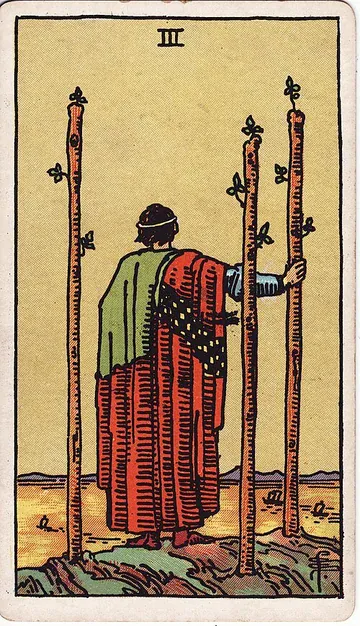
The same figure, one beat later. Where the Two of Wands shows the man on the battlement holding the small gold globe, surveying, the Three of Wands shows him after the descent — ships are already on the water, the maps have moved from the palm into the actual sea, the decision has translated into motion. Together, these two cards describe the complete shape of the well-made decision: the long look, then the well-timed move. When they appear in the same reading, the seeker is being told that the survey is concluding, the descent is about to happen, and the next chapter of the work is already moving toward the seeker even before the seeker has fully arrived in it.
Two of Wands + Two of Pentacles
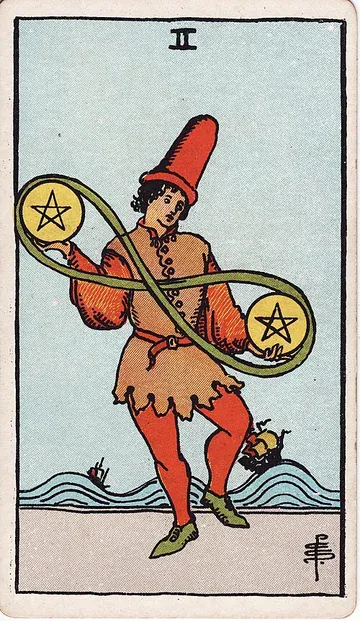
Same number, opposite suits — and the contrast between them is the card's most precise mirror. The Two of Wands surveys two wands at rest, the small gold globe held in the steady palm. The Two of Pentacles juggles two coins in motion, the figurine moving constantly to keep the resources from falling. Together, these two cards describe a seeker who is being asked to hold both stances at once: the long, deliberate fire-altitude of strategy, and the immediate, mobile earth-rhythm of resource management. The combination warns against the seeker who tries to use the Two of Wands posture (long survey) to escape the Two of Pentacles work (daily juggling). Both are the seeker's job. The wall does not exempt you from the courtyard.
Two of Wands + The Emperor
Mars in Aries (the Two's decan) sits behind the throne of The Emperor (whose sign is also Aries). The two cards are kin. When they appear together, the seeker is being asked about dominion as a way of life — not the small kingdom of the Two of Wands, but the structural, established, long-tenured authority of the Emperor's throne. The combination supports the seeker who has been considering whether to formalize what they have built — incorporating the practice, taking the title, claiming the seat. The card pair gives permission. It also names a warning: dominion that hardens into rigidity stops surveying. The Emperor without the Two of Wands becomes the wall that no longer looks out. Keep the small gold globe in hand even after the throne arrives.
Two of Wands + The Hermit
Two figures on two solitary peaks — one carrying a small gold globe and the future, the other carrying a lantern and the inward light. The combination describes a seeker whose decision is being made in deep solitude, and whose solitude is the precondition for the decision. This is not the loneliness card. This is the card of the seeker who has withdrawn deliberately to consult the inner counsel before descending. The Two of Wands by itself can be misread as a purely strategic card — calculation, projection, planning. The Hermit shifts the reading. The decision being made on the wall is also being made in conversation with the deepest, oldest, most considered part of the self. The lantern lights the map. Trust the long retreat. The map drawn under the lantern holds.
Two of Wands + The Hanged Man
The most complex of the five pairings, and the one most worth attention. Both cards describe a figure suspended above the ordinary ground, surveying. The Two of Wands surveys with intent — there is going to be a descent. The Hanged Man surveys without an exit — the suspension is itself the destination. Together, these cards warn of a decision that has crossed the line from deliberation into stuck-ness. The seeker is no longer surveying; the seeker is hanging. The wand has been in the hand so long that the hand has forgotten how to plant it. The small gold globe has become a weight rather than a tool. The combination is gentle but clear: the suspension was useful for a season, and the season has ended. Either descend, or accept that the current position is the position. Pretending the suspension is still surveying is the trap the cards are naming. Walk, or sit. The standing posture is over.
Card Combinations
Three of Wands
The same figure, one beat later. Where the Two surveys with the small gold globe in his palm, the Three has descended — ships are already on the water, the maps have moved from the hand into the actual sea. Together they describe the complete shape of a well-made decision: long look, then well-timed move. When the Two precedes the Three in a reading, the survey is concluding and the descent is imminent.
Two of Pentacles
Same number, opposite suits. The Two of Wands surveys two wands at rest; the Two of Pentacles juggles two coins in motion. Together, these two cards ask the seeker to hold both stances at once — the long deliberate altitude of strategy and the immediate mobile rhythm of daily resource management. The wall does not exempt you from the courtyard; the courtyard does not exempt you from the wall.
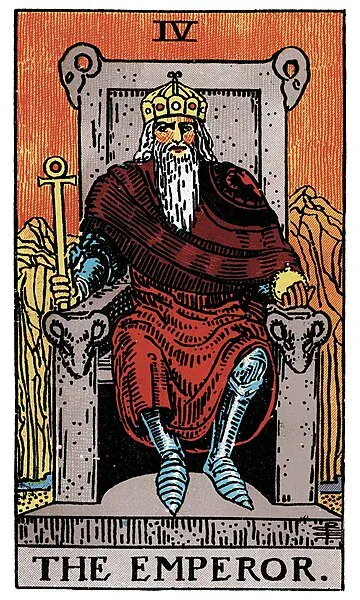
The Emperor
Mars in Aries (the Two's decan) sits behind the throne of The Emperor (whose sign is Aries). The cards are kin. Together they describe dominion as a way of life — the structural authority of the long-tenured throne, the platform of the well-built wall. The pair gives permission to formalize what has been built and warns against dominion that hardens into rigidity. Keep the small gold globe in hand even after the throne arrives.
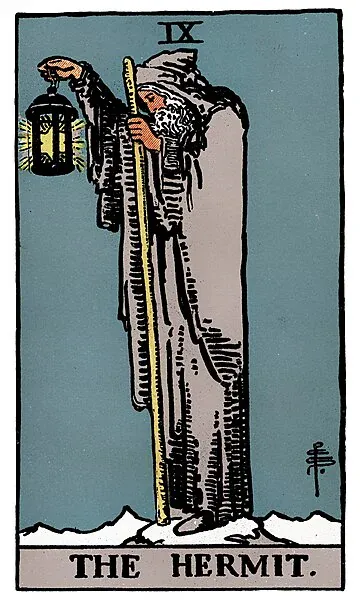
The Hermit
Two figures on two solitary peaks — one carrying the small gold globe and the future, the other carrying a lantern turned inward. The combination describes a decision being made in deep solitude, with the solitude as precondition for the decision. The Hermit shifts the Two of Wands from purely strategic to genuinely consulted. The lantern lights the map. The map drawn under the lantern holds.
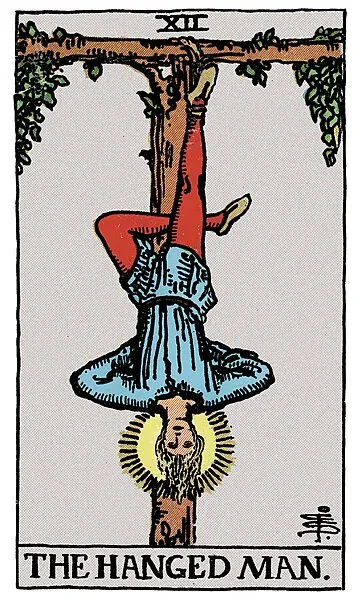
The Hanged Man
Both figures suspended above the ordinary ground. The Two of Wands surveys with intent — there is going to be a descent. The Hanged Man surveys without exit — the suspension is the destination. Together they warn of a decision that has crossed from deliberation into stuck-ness. The wand has been in the hand so long that the hand has forgotten how to plant it. The cards are gentle but clear: descend, or accept that the current position is the position.
Frequently Asked Questions
What is the small gold globe in the Two of Wands?
It is the world, held at the size of an apple. The figure on his own battlement has the whole of it in one palm while his other hand grips a wand that has not yet been carried anywhere — which is the entire Two of Wands in one gesture: dominion before motion. A globe that fits in a hand is a horizon that has been looked at properly and not yet walked. The card describes decision at altitude, the work of surveying the whole map before committing to one direction on it. The astrological signature is Mars in Aries, first decan; the kabbalistic placement is Chokmah in Atziluth — fire's first branching beyond the source, the point at which one becomes two and a choice becomes possible.
Do I have to finish the survey before the Two of Wands says go?
You have to do it honestly, which is not quite the same as finishing it. The Two of Wands is a conditional yes — yes, once the map has actually been drawn. It backs the seeker who looks at the whole horizon before choosing a road, and it withholds nothing from that seeker. What it declines to do is spare anyone the looking: asked to rubber-stamp a decision made on impulse, the card answers with the instruction to survey rather than with a verdict. A genuine survey has an end, though. It ends when you can name what you are giving up by choosing this direction. At that point the answer tilts firmly toward yes, and staying on the wall past it becomes its own kind of refusal.
Does the Two of Wands mean a relationship is waiting on a decision rather than on feeling?
Usually, yes — and that is the good news in it. The Two of Wands describes a bond at deciding altitude: the stage where the question is no longer whether you love each other but where the love is going, which city it lives in, whose career bends. The two wands are the two roads the bond could take, and the figure holds both. That is why the card shows up around moves, marriages, long-distance arrangements, visa decisions, and the merging of two settled lives. For someone single, it points to love arriving as a deliberate choice rather than as sudden infatuation — slower to ignite and considerably harder to talk out of. Partnership between equals is the card's native shape; nothing about it works from below.
If their feelings show as the Two of Wands, why does it feel like being assessed?
Because it is an assessment, and because being assessed by this card is not the cold thing it sounds like. The Two of Wands describes considered interest: someone taking your measure with care and placing you inside the long view of their own life. They are not infatuated, and they are not playing it cool — those are both cheaper states than this one. They are surveying, the way the figure on the battlement surveys, because something about you has entered the question of where their life goes next. The feeling carries weight precisely because it carries cost. Nobody calibrates a person who does not matter. What the card does not promise is speed; the descent from calculation to offering is a separate movement, and it is theirs to make.
How is the Two of Wands different from the Three of Wands?
The Two of Wands is the moment before the descent — the figure on the battlement holding the small gold globe, surveying. The Three of Wands is the moment after — the same figure, ships on the water, the decision translated into motion. The Two is the long look. The Three is the well-timed action. Together they describe the complete shape of a well-made decision; alone, the Two asks for the survey, the Three asks for the move.