
Two of Wands Reversed · Core Meaning
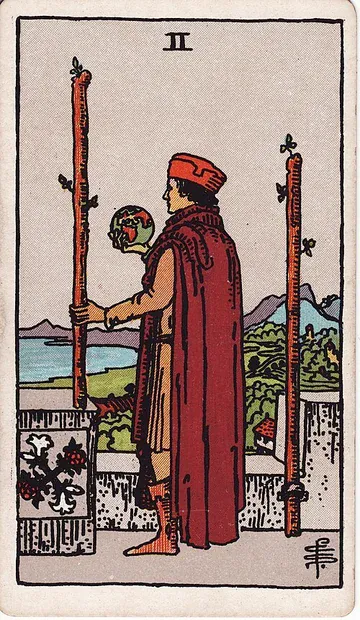
Reverse the Two of Wands and the horizon stops being a destination and becomes decor. The same figure, the same battlement, the same small gold globe in the palm — but the gaze has turned inward. The horizon is still there. He has stopped looking at it. The map is still drawn. He has stopped unfolding it. The wand in his hand is being clutched now rather than held. The wand fixed in the wall has become a flag of a kingdom he no longer leaves.
This is the card's central knot in reversal: dominion that has become refusal. The wall the seeker built was, originally, a platform. It was the high place from which the next decision could be made. Reversed, the wall becomes its own destination. The seeker climbs up, looks out, finds the looking pleasant, and never descends. Over months and years, the looking-out stops being a survey and becomes a screensaver. The horizon is no longer being read; it is being ignored while still being present.
There are two flavors of the reversed card, and most readings will sit somewhere on the spectrum between them. The first flavor is paralysis at altitude — the seeker who is on the wall and cannot bring themselves to descend. The plan has been drawn and redrawn. The pros and cons have been mapped to a degree that no further mapping helps. The friends have heard the same dilemma so many times they have stopped offering input. The seeker is, technically, deciding. In practice, the seeker is hovering. The Two of Wands reversed names this hover precisely.
The second flavor is dominion collapsed into routine. The seeker built the small kingdom — the role, the relationship, the practice — and now spends their days tending it without ever looking up from the work. The grand vision has shrunk to the maintenance of what already exists. The wand fixed in the wall is being polished daily; the wand in the hand has been quietly set on a shelf. The horizon has not gone anywhere; the seeker has stopped including it in the day. This is the corporate version of the card. The lifestyle version. The "I built this and now I just run it" version.
A third flavor, less common but worth naming: overreach without survey. The seeker who has descended too soon, with too small a map, into a country they did not adequately read. This is the Two of Wands reversed in the rare cases where the leap has been made and the leap was premature. The wand was thrown without aim. The territory does not match the dream. The seeker is now in the field below their wall realizing they should have looked longer.
Astrologically, Mars in Aries first decan reversed reads as fire that is misfiring or refusing to fire. Pure ignition that does not light. Pure ignition that lights and burns the wrong fuel. The card warns of the seeker whose engine of motion has either gone cold, gone sideways, or gone into wasteful idle.
Kabbalistically, Chokmah reversed in Atziluth describes the active principle that has lost its connection to the Ace's source — the will that has forgotten what it is willing toward. The first branching beyond the source has become a fork the seeker stands at endlessly without choosing. The reversed Two of Wands meaning lives in this lost horizon.
The card asks, gently: which map have you drawn but never actually unfolded? And: what is the wall doing for you that the descent threatens to take away?
Two of Wands Reversed · Love
On love, the reversed Two of Wands is suspended decision: a relationship that has stalled at the altitude of choosing. In love readings, the Two of Wands reversed describes the relationship that has stalled at the altitude of decision. Both partners are on a wall. Both partners can see the horizon. Both partners are waiting for the other to descend first. The love is real. The future is foreclosed by the joint suspension.
For an existing partnership, the reversed card often describes the comfortable plateau that has hardened. The early decisions — to be together, to live together, to stay together through the first hard year — were made well. The decisions that come next — the move, the marriage, the child, the city change — have been on the table for so long that the table has become its own piece of furniture. Both of you have stopped expecting the decisions to be made. The wand fixed in the wall is the relationship as it currently is. The wand in the hand is the future neither of you is willing to plant. The shadow of the battlement falls across the marriage bed.
For someone in a new connection, the reversed Two of Wands warns of the partner who is endlessly considering you. They like you. They have noticed your qualities. They are weighing the future. And they have been weighing the future for so long that the weighing itself has become the relationship. The card describes the partner who texts thoughtfully, plans theoretically, refers to "us" carefully, and never quite shows up to a real shared life. Their interior is full of you. Their exterior schedule somehow does not contain you.
For the question of long-distance or overseas partnership reversed, the card warns of distance that has become the safety mechanism rather than the temporary condition. The relationship survives because both partners can hold each other in the small gold globe of imagination without ever facing the friction of daily life. The reversed card is the card of the long-distance bond that no one closes — not because the love is false, but because the closing would require either partner to actually descend from their own wall. The card respects the love. It just names the suspension.
For the question of reconciliation after a break, the Two of Wands reversed offers a soft no. Returning to the relationship would mean climbing back up the same wall, holding the same small gold globe, surveying the same horizon you both surveyed before — and not descending again, just as you did not descend the first time. The card is not predicting failure. It is naming the structural risk. If reconciliation is going to hold, both partners must commit to actually walking the ground rather than re-occupying the survey. Without that, the reunion becomes the wall rebuilt.
For the single seeker, the reversed card describes a particular shape of solitude that is worth naming carefully. You have built an excellent life. You can survey the horizon of love from a high and well-furnished wall. The map of what you want, what you would accept, what you would refuse, is detailed and accurate. And the small gold globe of the future is held so carefully that no real person can fit inside it without disturbing the polish. The work, gentle but real, is to allow the globe to be slightly tarnished by an actual partner. The wall is impressive. The wall does not love anyone back.
For the seeker stuck in indecision between two partners — the reversed Two of Wands meaning becomes very specific. The card describes the suspension of choosing not as careful consideration but as a refusal of the loss inherent in any choice. To choose either partner is to lose the other. The reversed card names the seeker who has been holding two wands so long that both have begun to feel weightless, both have begun to feel optional, both have begun to slip from the hand. The card asks for the harder question: which of the two would you grieve more if you lost them? The grief is the compass.
For the partner who has gone quiet, who has been "thinking about us" for months without any movement, the reversed Two of Wands describes the partner stuck on their own wall. They are not pretending. They are not stringing you along strategically. They are genuinely paralyzed at altitude. This is not malice. It is also not movement. The card asks the seeker to consider whether you can keep waiting at the foot of someone else's wall while they decide whether to come down. Sometimes the answer is yes. More often, the answer is no, and the work is to climb your own wall — to stop being available at the foot of theirs.
For partnership of equals reversed, the card describes the relationship in which both partners are too proud of their own dominion to merge them. Two strong people, two strong walls, two small gold globes in two separate palms — and a decade of careful diplomacy that has prevented either map from genuinely overlapping with the other. The card honors the equality. It questions the merger. The work is to draw one map together, not two maps in parallel.
A small note for the seeker asking whether someone is in love with them and the card arrives reversed: they are interested. They have considered you. They are not yet willing to descend. The feeling is real and the action is missing. Read the gap honestly. Their wall is theirs to come down from. You cannot lift them off it.
Two of Wands Reversed as Feelings
When read as feelings reversed, the Two of Wands describes interest that has not converted into offering. They are looking at you the way the figure on the battlement looks at the horizon — with attention, with calibration, with the small gold globe of you held carefully — and they are not descending. The feeling is real. The feeling is also kept at altitude.
This is the card of the partner whose feelings live in the planning room rather than the living room. They think about you. They map you. They include you in their interior survey of the future. And they have not yet, in the actual present, done the work of bringing the feeling across the threshold of their own wall toward you.
If they are reserved by nature, the Two of Wands reversed feelings can read as quiet ambivalence — they feel something, they are uncertain whether what they feel is enough, and they have decided to wait until the uncertainty resolves itself rather than speaking from inside it. The card is honest about this: the resolution is unlikely to come from waiting. Reserved partners on this card often end up requiring an external nudge — not pressure, but presence — to descend.
If they are demonstrative, the reversed card warns of warmth that is performed rather than offered. They will say the right things. They will reference the future together in conversation. They will tell their friends about you. And the actual texture of their daily availability — the calls returned promptly, the evenings cleared, the trips planned, the small daily gestures of inclusion — is thinner than the words suggest. They are reading their own play of being in love. They are not yet being in it.
For long bonds, the reversed Two of Wands as feelings can describe settled fondness that has stopped including curiosity about the future. They love you the way someone loves a wand fixed in the wall — as a known, established part of the architecture of their life. They have stopped wondering what you might become. The card asks whether the relationship has slipped from active partnership into shared furniture. None of this is necessarily fatal. Many long relationships pass through this season. The card is naming the season, not predicting its end.
For new connections, the reversed card describes someone who is interested but unready. They are not ignoring you. They are also not making space. They are, internally, hesitating between the version of their life that includes you and the version that doesn't. The hesitation is real and not personal — it is, often, about their own wall, their own dominion, their own previous self that they are not yet willing to descend from. Read this carefully. The feelings are favorable. The structural situation is uncertain.
For the question of are they thinking about me, do they care, is this real — the reversed Two of Wands answers yes, they are, they do, it is. And adds: thinking about you is not the same as building with you. The reversed card distinguishes the interior weather of feeling from the exterior architecture of choosing. Many readings on this card mistake the first for the second. They are not the same.
There is a particular caution embedded in the reversed feelings reading: do not mistake their suspension for your fault. The seeker often arrives at this card asking what they did wrong, what they should change about themselves, how they could be more attractive, more available, more compelling so that the other person would descend. The card is gentle and clear: the wall is not yours. The seeker on the wall has to choose to come down. Your job is not to summon them. Your job is to live well at the foot of your own life.
For the question of what to do — push, pull, wait — the reversed card recommends climbing your own wall. Match the altitude. Become a seeker on a wall, not a seeker waiting at the foot of someone else's. The Two of Wands rewards parity. The reversed Two of Wands rewards parity even more strongly because the suspension on the other side cannot be resolved by your descent. You can only resolve your own.
A specific texture for new connections that have stalled at this card: the partner who keeps the relationship in WhatsApp but never quite in person, who plans elaborately and cancels gently, who tells you about their feelings in long late-night messages and treats the daytime as a separate country — they are not lying. They are also not yet committed. The reversed card describes this exactly. They are surveying. They are not descending. Decide how long you are willing to be the horizon they look at without walking into.
Two of Wands Reversed · Career
Some roles stop being a platform and start being a fortress; the reversed Two of Wands is the reading in which that has already happened. The early years built something real — a position, a practice, a reputation, a small kingdom. The middle years held it. The recent years have been spent maintaining the fortress rather than looking out from its battlement. The wall is doing what it was built to do. The seeker has stopped using the altitude.
For someone in a current role asking whether to stay or leave, the reversed Two of Wands describes a particular trap: the role that has become protective infrastructure rather than productive ground. You are good at it. Nobody is asking you to leave. The compensation is fine. And the part of you that originally took the role for the long view — the chance to do meaningful work, the platform to build from, the access to a particular kind of horizon — has been quietly retired. The card asks the harder question: are you still building from this role, or are you only defending it?
For someone considering a new role, the reversed card warns of two opposite errors. The first error is overreach — taking the new role as a way of escaping the current wall without having actually drawn a map of the new territory. The leap is real but the destination is fantasy. The second error is refusal — turning down the new role not because it is wrong but because the wall is comfortable. The reversed Two of Wands has both shadows. The seeker must distinguish honestly which one they are inside.
For an entrepreneur, freelancer, or solo practitioner whose practice has plateaued, the reversed card names a specific failure mode: the small success that has become a moat. The practice runs. The clients are loyal. The income is reliable. And the next chapter — the new product, the bigger team, the bolder offering, the move into a new market — has been on the planning shelf for so long that the planning itself has become the work. The card describes the founder who has stopped founding and become an administrator. There is no shame in this. There is only the question of whether it is what you actually wanted. The card asks. The seeker must answer.
For someone considering an overseas role or international move reversed, the card warns of the move that has been postponed past the season for it. The opportunity may have closed; the alignment of life circumstances that would have made the move possible may have shifted; the partner who would have come may no longer be available. The reversed Two of Wands describes the move that should have happened a year ago and may now require a different shape entirely. This is not failure. It is information. The horizon has moved while the seeker stayed on the wall.
For a creative practice, the reversed card describes the artist after the successful work who has not produced the next thing, not because of writer's block exactly, but because the survey of what to do next has consumed the doing. The artist is reading other artists. The artist is talking about a book. The artist is in conversation with editors, agents, peers. The artist has not written the book. The card is gentle but specific: the survey was useful for a season; the season has passed. Make the next thing. Let it be smaller than the last if it must be.
For questions about authority and recognition at work, the reversed Two of Wands warns of the senior person who has stopped extending the ladder downward. The career-long fortress has produced a figure who polices the wall rather than mentors descents. If the seeker is this person, the card offers the chance to notice and shift — to become the senior who points out the horizon rather than the senior who guards the parapet. If the seeker is working under this person, the card validates what the seeker is sensing: their stuck-ness is real, their refusal to descend is structural, and the path forward for the seeker may not be through them.
For someone who has been waiting too long to make a major career move — the seeker who has been on the wall for years drafting the resignation letter, the seeker who has been about to start the company since 2023, the seeker whose plan has been six months from launch for the last two years — the reversed Two of Wands meaning becomes the most direct version of itself. The card stops being subtle. The card says: the wall is not getting any taller. The risk you are protecting against is the same now as it would have been then. The seeking has begun to corrode the seeker. Pick a date. Tell one person. Walk into the date. Or, alternatively, accept that the wall is the life and stop pretending otherwise. Both are real choices. The pretense in the middle is what is corroding you.
For the question of partnership at work reversed — co-founder, joint venture, the colleague who keeps proposing collaborations that never materialize — the card warns of the partnership that lives in the planning rather than the doing. Two seekers, two walls, two careful surveys, no ground walked together. The card honors the talk. It questions the work. If the partnership is real, schedule the first concrete deliverable for inside the next two weeks. If the partnership cannot survive a real deliverable, the partnership is a survey, not a partnership.
For someone whose career has entered a season of frustration — the work is not bad enough to leave but not alive enough to stay for, the colleagues are pleasant but the meaning has thinned, the boss is fine but the work has stopped feeling like yours — the reversed Two of Wands names this season precisely. It does not require that you act dramatically. It requires that you stop pretending the season is fine. The naming is the first descent. The action follows the naming.
Two of Wands Reversed · Money
Money can be held so well that holding becomes the only thing it does, and the reversed Two of Wands is that account. The savings are intact. The income is steady. The systems are well-run. And the deployment of the resources — the investment, the bigger purchase, the move that would require some of the foundation, the philanthropy, the reach toward a wider life — has been deferred so long that the deferral has become the financial life.
The card's signature trap, reversed, is dominion confused with hoarding. The figure on the battlement still holds the small gold globe of his finances in his palm. He has stopped considering where to walk with it. The wall is high. The treasury is full. The seeker is, by every external measure, doing well. And inside, the relationship to money has gone slightly miserly without the seeker noticing.
For someone considering a significant investment, a major purchase, or a financial leap, the reversed card warns of the leap that is being postponed not because it is wrong but because the wall has become too comfortable to leave. The investment is sound. The purchase is reasonable. The leap is appropriate. And the seeker keeps drafting the spreadsheet for one more iteration. The reversed Two of Wands describes the analysis-as-procrastination — the modeling that has stopped being preparation and become substitute action.
For someone who has overreached financially — taken on too much debt, made the leap before the foundation was ready, committed to the bigger life before the cash flow could sustain it — the reversed card describes this version too. The wand was thrown without aim. The territory does not match the dream. The work, here, is honest reduction. The card supports the seeker willing to scale back to a smaller, more honest position rather than the seeker who keeps doubling down on a poorly mapped expansion.
For someone managing a windfall reversed, the card warns of the windfall that has been over-considered. The bonus, the inheritance, the property sale, the unexpected income has been sitting in a cautious account for many months while the seeker plans the perfect deployment. The plan keeps refining. The deployment keeps deferring. Inflation, opportunity cost, the simple shape of time — these are quietly eroding the gain. The card asks for movement. Not impulsive movement. Movement.
For long-term financial planning reversed, the card describes the seeker whose retirement plan has been on the shelf, whose generational wealth strategy has been a draft for years, whose conversation with the partner about money has been postponed indefinitely. The card is gentle. The card is also clear. The plan deferred is not a plan. The conversation postponed is not a relationship to money — it is a private fortress. Open the conversation. Move the plan from draft to action. The wall does not need to be defended. The view needs to be used.
For the question of a financial partnership reversed — joining accounts, going into business, family money decisions — the card describes the partnership that has stalled in its own accounting. Both partners have their own wall. Both partners have their own globe. Neither wants to fully merge the maps. The reversed card warns that financial partnership requires actual merger, not parallel walls with occasional bridges. If the merger cannot happen, the partnership is something else — not bad, not failed, but not a financial partnership in the way the seeker may be calling it.
The card's deepest money advice, reversed, is to spend something today on the future you keep planning. Not lavishly. Not impulsively. One concrete first move. Book the trip you have been saving for. Pay the deposit on the property you have been considering. Send the donation to the cause you have been quietly admiring for years. The reversed Two of Wands warms toward upright the moment a real resource crosses from the wall down to the ground. Money that does not move is money that quietly stops being yours.
A specific instruction for the seeker who has been over-saving: define what the savings are for. Not vaguely. Specifically. The savings that have a name attached to them — house, retirement, child's education, the year off for the project — behave differently than the savings that are accumulating against an unnamed fear. The reversed Two of Wands often describes the second category. Name the goal. The naming itself begins to set the figure on the wall in motion.
Two of Wands Reversed · Health
A body that plans its walks and never takes them is the reversed Two of Wands in its health register. The fire that runs the body — Mars in Aries, first decan, the cardiovascular ignition — is technically online but is being held above the work the body needs done. The seeker is not exhausted. The seeker is also not actively living in their own physical life.
For baseline vitality, the reversed card warns of the seeker who has built a life of altitude without enough ground-level movement. The work is desk work. The exercise is theoretical, calendared, frequently postponed. The body is a tool that holds up the head. The morning warmth that should run through the limbs is held in the head and the chest. The card is the somatic version of the figure on the battlement who has not climbed down to walk the actual ground.
The card's signature health risk, reversed, is held fire that has begun to inflame inward. The liver — Mars's organ, the suit's body — accumulates the unmade decisions and the postponed actions. The blood pressure creeps. The shoulders carry tension that the body cannot discharge. Sleep arrives shallow. The jaw clenches. The card does not require dramatic intervention. It requires honest descent. Walk the building rather than emailing across it. Take the stairs rather than the elevator. Schedule one hour this week of actual outdoor movement. Move it.
For someone managing baseline cardiovascular concerns, the reversed Two of Wands names a specific somatic shape: the body of the person who is technically active enough on the spreadsheet of weekly minutes but is rarely physically committed to anything they do. The exercise is going through the motions. The walks are with the phone. The runs are with the podcast. The seeker is everywhere except in the body. The reversed card asks for one session per week of un-augmented movement — no audio, no input, just the body and the ground. One session a week without audio is an experiment rather than medical advice. The card is offering a mirror, not a diagnosis.
For chronic conditions reversed, the card warns of the management that has slipped because the seeker has stopped engaging with the condition as a real, present partner. The medication is being taken, mostly. The protocols are being followed, mostly. The discipline that was sharp during the early diagnosis has gone slack now that the condition has stabilized. The reversed Two of Wands describes the version of chronic care that has become wall-maintenance rather than active partnership with the body. Re-engage. The looking-down is the practice.
For acute issues reversed, the card warns of the symptom that has been observed for months without an actual conversation with a practitioner. The wall is high. The symptom is visible. The seeker has been considering whether to raise it at the next appointment for so long that the appointment has come and gone three times. The card asks for the descent into the conversation. Make the call. Schedule the consultation. The survey from above is not the same as the doctor's actual examination of the actual body.
For mental health, the Two of Wands reversed describes the seeker who has built an excellent intellectual model of their own emotional life and has stopped actually living inside it. The therapy notes are detailed. The journaling is consistent. The self-knowledge is sophisticated. And the experience of being a person — the feelings as feelings rather than as data points — has thinned. The card asks for descent into the body of feeling. Cry the cry that has been deferred for a season. Have the rage that has been held above the line. Laugh the laugh that requires a real friend in the actual room. The wall of self-knowledge is real and has been useful. The wall is not the life.
For sleep reversed, the card warns of the racing-mind insomnia of the seeker who plans the next day instead of resting in the current night. The figure lies in bed with the small gold globe still in his palm. The map keeps unfolding. The descent never comes. Set the globe down on the table beside the bed. Trust that the morning will return it. The card describes a posture of wakefulness that the body needs released.
For hormonal and digestive concerns, the reversed Two of Wands often describes systems that are responding to held stress — the body's quiet protest against the seeker's refusal to descend. Cortisol rising in the absence of actual physical demand. Digestion bracing as if for action that never comes. The card is gentle. The intervention is small. Walk after meals. Stand from the desk every hour. The body wants to be in the country it has been surveying.
A specific small practice when this card appears in a health reading: take one walk this week without any goal. Not a fitness walk. Not an errand walk. A walk where the only purpose is to be in the body, on the ground, in the actual place. Twenty minutes is enough. The card responds to ground-level presence. Manufactured presence does not work. Real presence, in small doses, does.
Two of Wands Reversed · Spirituality
Spiritually, the Two of Wands reversed meaning describes dominion that has stopped serving the path. The figure on the battlement built his small spiritual kingdom — the practice, the teacher, the discipline, the inner ground — and somewhere along the way the kingdom became more important than the seeking. The wall has become the destination. The horizon has stopped being walked.
For seekers in active practice — meditation, journaling, ritual — the reversed card describes the practice that has hardened into routine in the dull sense. The seat is taken every morning. The pages are filled. The rituals are observed. And the inner movement that the practice originally produced has thinned. The seeker is keeping the wall. The seeker has stopped looking out from it. The card asks gently whether the practice is still alive or whether the practice has become the seeker's identity instead of the seeker's path.
The card's most pointed spiritual warning, reversed, is dominion that refuses descent. The seeker who has built an interior kingdom — quiet mind, steady heart, refined sense of values — and now uses that kingdom as a wall against the world rather than a platform from which to engage it. The shadow of the battlement falls across the seeker's relationships, the seeker's work, the seeker's daily ground-level life. The interior is calm. The exterior is strangely absent. The reversed card names this exactly.
The wand fixed in the wall, reversed, is the spiritual practice that has become decoration. The wand in hand, reversed, is the next inquiry the seeker is not yet willing to make. The small gold globe, gripped, is the cosmology held so tightly that no real new teaching can disturb it. The card is gentle but precise. The seeker has stopped being a seeker. The seeker has become a defender of what was once sought.
For someone exploring belief reversed, the Two of Wands warns against spiritual completion — the conviction that one's current cosmology is sufficient, that the next book is unnecessary, that the next teacher would only repeat what the seeker already knows. This is the seeker who has graduated from seeking. The card is honest: there is no graduation. The wall is not the summit. The path continues past the high places, including the high places of one's own understanding.
For questions about path reversed, the card asks whether you have mistaken altitude for arrival. The discipline that brought you to this wall was a vehicle. The wall was a stop on the journey, not the destination. Are you still moving, or have you set up camp at the place the vehicle stopped? The card respects the camp — most seekers need rest along the path. It questions whether the camp has become permanent.
For seekers who have stopped practicing — meditation gone fallow, journal closed, rituals lapsed — the reversed Two of Wands also describes this version. The wall the seeker climbed is no longer being climbed. The seeker may have built a sophisticated life on top of the previous practice, and the previous practice may have been quietly retired. The card does not insist on returning to the old practice. It asks whether the path is still being walked at all, or whether the past climb is now being lived off as an inheritance.
The card's deeper spiritual question is what the wall is doing for you that the descent threatens to take away. Most seekers who arrive at this card have built the wall for a reason — protection from the chaos that came before, refuge from the suffering that drove them to seek, identity that distinguishes them from the people they were trying to leave behind. The card honors all of that. It also asks whether the protection has begun to function as imprisonment. The wall keeps things out. It also keeps the seeker in.
A specific practice when this card appears in a spiritual reading: identify one teaching you have refused to consider because it would disturb your current cosmology. Read it for thirty minutes. Not to convert. Not to refute. To sit with the disturbance. The reversed Two of Wands warms toward upright when the small gold globe is allowed to be slightly tarnished by an actual encounter with something outside its polish.
Another practice: give one of your established disciplines away. Teach a friend the meditation. Walk a beginner through your morning ritual. Hand a book to someone who needs it. The wand fixed in the wall is most alive when others can also climb it. The reversed card returns to upright through transmission. The seeker who teaches re-enters the state of being a seeker — because nothing teaches a teacher faster than the questions of the new student.
Two of Wands Reversed · Yes or No
Soft no — until you step down from the wall.
Asked as a yes-or-no, the short form is exactly that — a soft no, conditional on whether the seeker is willing to descend. Nothing has been refused from the top of the wall. It is more often an answer that is being suspended — the question is real, the answer is available, and the seeker is not yet in a position to receive it. The card describes the moment when the survey has gone on too long, the planning has begun to consume the doing, and the yes that was once available has begun to soften into something less clear.
For yes-or-no questions about a major life decision — a move, a job change, a relationship turn, a financial commitment — the reversed Two of Wands says the answer is currently unclear because the seeker has been unwilling to do the work of finishing the survey. Not the work of more surveying — the work of finishing it. The plan has been examined enough. Further examination is producing diminishing returns. The card asks the seeker to either commit or release. Choose, or formally let go. The middle ground has begun to be the problem.
For binary questions about whether to act now, the reversed card tilts toward "not yet, but soon," with a sharp warning: the not-yet has been the answer for too long. If the question is being asked again, the seeker is the one who has been postponing. The card is not saying the action is wrong. The card is saying the action keeps getting deferred. Pick a date. Commit. Walk into the date.
For questions about whether something is still worth pursuing — a person, a career direction, a project — the reversed Two of Wands answers ambivalently. It may still be worth pursuing. It also may have closed while you were on the wall. The card warns that pursuit which has been considered for years without action has often, quietly, ended. The opportunity moved. The person met someone else. The market shifted. The reversed card asks the seeker to honestly check whether the thing being weighed is still actually available, or whether the seeker is weighing something that has already left.
For questions about whether someone is being honest, whether an offer is genuine, whether a plan will hold — the reversed card warns of self-deception more than external deception. The deception, in this card, is usually the seeker's own — the way the seeker has been telling themselves a version of the situation that justifies further postponement. Read what is being shown. The other party is, usually, not lying. The seeker is not yet looking.
For timing — when, will it happen soon — the reversed card answers that the timing has been the seeker's own to determine, and the seeker has been determining "later" without naming it as a choice. There is no external clock running. There is only the seeker's hand on the wand. The card asks for the date. Once the date is named, the timing becomes legible. Without a date, the timing remains the wall.
For binary decisions — should I act, should I wait — the reversed card answers that "wait" has been the answer for too long. The waiting is no longer being chosen consciously. It has become the default. The card asks whether the seeker is still in the position of choosing, or whether the choice has become a habit that the seeker no longer notices making. If you cannot remember when you last consciously chose to wait, the wait is no longer a strategy. It is a posture. Step down.
For the question of will my plan work reversed — the card answers that the plan has structural integrity but the seeker has been unable to walk it. The plan is fine. The plan is not the issue. The issue is the descent. Many seekers on this card believe their plan is incomplete and that more planning will resolve the problem. The card disagrees. The plan is finished. The seeker is the next step.
If the question was: should I trust this vision I have for my life? The reversed card answers yes — and adds the warning that the vision is becoming a substitute for the life. Vision, held without descent, slowly becomes nostalgia for a future that never arrives. The card asks: what is the smallest concrete action you could take this week toward the vision? Take it. The vision survives the small action. The vision does not survive the years of refusal.
If the question was: am I ready? The reversed card answers that readiness, as the seeker has been defining it, is unattainable. The seeker has been waiting to feel ready before descending. The card describes a different sequence: descend, then feel ready. The wall does not produce readiness. The ground does.
Two of Wands Reversed · Advice
Asked for advice, the reversed Two of Wands gives one line: step down from the wall today. The advice of the Two of Wands reversed is to step down from the wall today. Not metaphorically. Today. Even if the descent is small. Even if it is only one block of the country you have been surveying. The reversed card responds to actual ground-level motion. The card does not respond to further refinement of the plan.
If there is one specific instruction the reversed card offers, it is this: identify the map you have drawn but never unfolded, take it out, and unfold it. The map is real. You have been carrying it. You have been polishing it, making minor revisions, treating it as a work in progress. The card asks you to declare it finished — not perfect, finished — and to lay it open on a real table where someone else can see it. The act of unfolding is the descent in miniature. The map, once shared, can no longer be the seeker's private fortress.
A second instruction: make one phone call today that leaves the domain you have been curating. The reversed card describes the seeker who has been carefully maintaining a small, well-furnished kingdom of habits, contacts, and conversations — and who has stopped including any voice from outside that domain. The single phone call breaks the seal. Talk to the person you have been meaning to call for months. Talk to the friend who lives in a different part of your life. Talk to the practitioner, the teacher, the colleague, the family member whose perspective you have been quietly avoiding. The reversed Two of Wands is most reliably moved by an actual outside voice. The wall does not break itself.
A third instruction: walk one hour of the ground you have been surveying. If you have been considering a city, walk one neighborhood of it. If you have been considering a field, sit in on one class. If you have been considering a partner, have one entire evening with them in their actual life rather than in the planning version of it. The descent does not have to be the final descent. It can be reconnaissance. But the reconnaissance must be real, embodied, in the actual place. Photographs do not count. Reading about it does not count. Be there.
A fourth instruction: identify the wall the survey has been protecting you from. The reversed Two of Wands describes the seeker who has been on the battlement for so long that the original reason for climbing the wall has been forgotten. Was it the chaos that came before? The relationship that did not work? The career that broke? The version of yourself you were trying to leave behind? The wall served a purpose. The purpose has, often, been served. The wall continuing past the purpose is what creates the reversed card. Name the original threat. Ask whether it is still operating. Often it is not. The wall is still defending a country that no longer exists.
A fifth instruction, gentler than the others: forgive yourself for the wall. The reversed Two of Wands often arrives in the lives of seekers who have been judging themselves for the postponement. The judgment is not the medicine. The judgment is the seeker climbing a second wall on top of the first. The card asks for compassion toward the part of yourself that built the wall in the first place. That part was protecting something. Thank it. Ask it whether it is willing to descend with you. The descent led from a place of self-warmth holds. The descent forced through self-judgment rebuilds the wall on the other side.
Practical advice for the day the card appears reversed: do one thing today that requires you to leave your most curated room. Eat in a restaurant where you do not know the menu. Take a walk in a part of the city you do not know. Call the friend you have been avoiding. Open the email you have been not opening. The reversed card returns to upright through honest curiosity translated into actual motion. The motion does not have to be heroic. It has to be real.
A specific instruction for the seeker who has been on the wall for years: stop refining the plan. The plan has been refined. The plan is good enough. The next iteration of refinement is not making the plan better — it is making the descent later. Pick a date. Tell one specific person the date. Walk into the date. The card describes a posture; the seeker turns the posture into a life by ending the posture. The posture does not end on its own.
A specific instruction for the seeker who has overreached and is now mid-leap, in the wrong country, wondering if they should turn back: the leap was not necessarily wrong. The leap was, perhaps, made with too small a map. The work, here, is to climb a smaller wall — the wall of the new actual situation, not the wall of the old fantasy — and survey from there. Adjust the angle. Continue from a more honest vantage. The original wall is not where to return to. The new ground is where to draw a new map.
For seekers who have been waiting for the right moment, who have been telling themselves they are still preparing: the right moment is the one in which you act. The card has no preferred season. The seeker's preferred season is the season after this one, and the season after that, and the season after that. Stop offering yourself another season. Pick this one. The small gold globe in your hand is small enough to descend with. Walk.
Two of Wands Reversed · Card Combinations
The Two of Wands reversed meaning sharpens or softens in the presence of other cards. The same five pairings that animate the upright card take on different colors when the wall has hardened. The intro paragraph below names the throughline: each combination, in reversal, asks where the suspension has begun to corrode and what kind of descent the seeker is being invited toward.
Two of Wands Reversed + Three of Wands
The descent that should have happened, did not. The Three of Wands, normally the moment of ships already on the water, here arrives ahead of itself — the seeker has been sending ships in their imagination while remaining on the wall. Together these cards describe the entrepreneur, partner, or seeker whose imagined progress has outpaced their actual one. The card pair is gentle but pointed: the ships have not yet sailed because no one has actually built them. Return to the materials. Build one real ship before imagining a fleet.
Two of Wands Reversed + Two of Pentacles
The juggle has stopped — or worse, has become its own avoidance. The Two of Pentacles reversed-adjacent is the seeker dropping the daily resources because the long-survey has been consuming all the attention. Together, these cards warn of a seeker who has used the long view as an excuse to neglect the actual rhythm of the days. The mortgage is late. The check did not get cashed. The grocery list is unwritten. The wall is high; the courtyard is in disarray. The card pair asks the seeker to descend long enough to attend the daily ground. The vision can wait an afternoon. The bills cannot.
Two of Wands Reversed + The Emperor
The throne hardened into a fortress. Mars in Aries (the Two's decan) and Aries (the Emperor's sign) share fire — and reversed, the shared fire turns inward. Together these cards describe the seeker who has built authority and is now using the authority defensively rather than generatively. The Emperor here is not the wise sovereign; he is the king who guards his own diminishing kingdom. The card pair is a strong call to remember why the throne was sought in the first place. Authority is for the use of others, not the protection of self. Open the gate. Let the new petitioner in.
Two of Wands Reversed + The Hermit
Solitary peaks that have stopped being chosen. The Hermit, normally the wise withdrawal that prepares the next descent, here arrives as withdrawal that has become a permanent address. Together these cards describe a seeker whose retreat from the world has, somewhere along the way, replaced the world. The lantern still burns. The cave is well-tended. The seeker has not, in some count of years, descended into the village. The card pair is not unkind. It simply asks whether the cave has become home or whether home is still down the mountain. Pilgrims, even the most committed, eventually return to teach.
Two of Wands Reversed + The Hanged Man
The most precise of the five reversed pairings, and the one most worth attention. The Two of Wands reversed describes the seeker stuck on the wall; The Hanged Man describes the seeker stuck above the ground. Together, they name the deepest version of the suspended decision — the seeker who has crossed from useful surveying into actual paralysis. The wand has been in the hand so long that the hand has forgotten its own grip. The shadow of the battlement has lengthened until it covers the courtyard. The card pair is gentle but final: the suspension is over. Either descend, or accept that the current position is the position. Pretending the suspension is still surveying is the trap the cards are naming together. Walk, or sit. The standing posture has ended.
Card Combinations
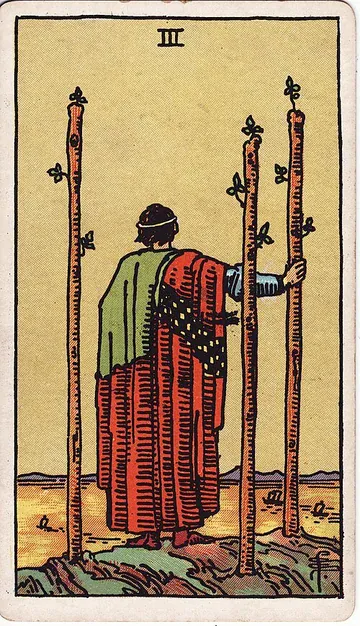
Three of Wands
The same figure, one beat later. Where the Two surveys with the small gold globe in his palm, the Three has descended — ships are already on the water, the maps have moved from the hand into the actual sea. Together they describe the complete shape of a well-made decision: long look, then well-timed move. When the Two precedes the Three in a reading, the survey is concluding and the descent is imminent.
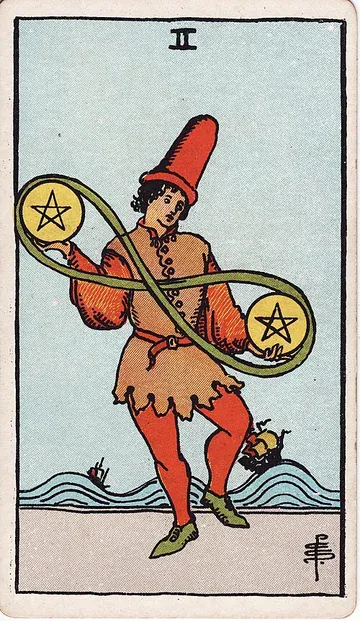
Two of Pentacles
Same number, opposite suits. The Two of Wands surveys two wands at rest; the Two of Pentacles juggles two coins in motion. Together, these two cards ask the seeker to hold both stances at once — the long deliberate altitude of strategy and the immediate mobile rhythm of daily resource management. The wall does not exempt you from the courtyard; the courtyard does not exempt you from the wall.
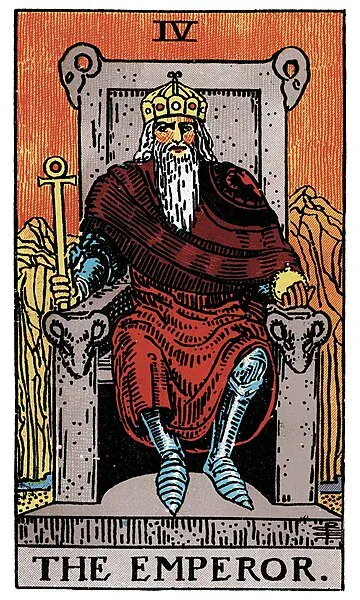
The Emperor
Mars in Aries (the Two's decan) sits behind the throne of The Emperor (whose sign is Aries). The cards are kin. Together they describe dominion as a way of life — the structural authority of the long-tenured throne, the platform of the well-built wall. The pair gives permission to formalize what has been built and warns against dominion that hardens into rigidity. Keep the small gold globe in hand even after the throne arrives.
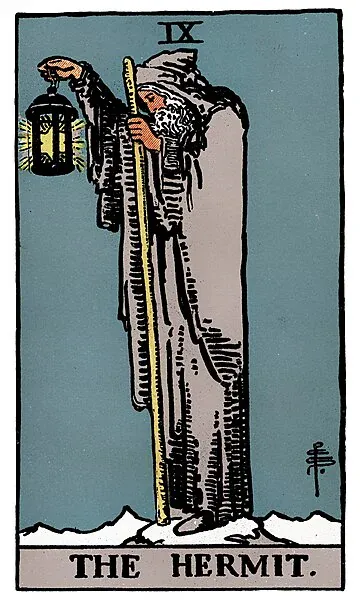
The Hermit
Two figures on two solitary peaks — one carrying the small gold globe and the future, the other carrying a lantern turned inward. The combination describes a decision being made in deep solitude, with the solitude as precondition for the decision. The Hermit shifts the Two of Wands from purely strategic to genuinely consulted. The lantern lights the map. The map drawn under the lantern holds.
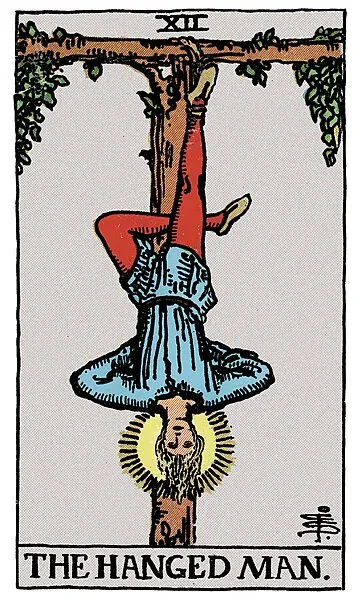
The Hanged Man
Both figures suspended above the ordinary ground. The Two of Wands surveys with intent — there is going to be a descent. The Hanged Man surveys without exit — the suspension is the destination. Together they warn of a decision that has crossed from deliberation into stuck-ness. The wand has been in the hand so long that the hand has forgotten how to plant it. The cards are gentle but clear: descend, or accept that the current position is the position.
Frequently Asked Questions
Why does the Two of Wands reversed turn a battlement into a moat?
Because a wall you never walk out of stops defending a life and starts replacing one. Reversed, the Two of Wands is dominion hardened into refusal: the map drawn and never unfolded, the small kingdom maintained so attentively that maintenance has become the whole occupation, the survey standing in for the descent it was meant to prepare. The horizon has not moved. The looking has simply become the activity. In its other register the card describes the opposite failure — overreach with no survey at all, a road chosen because standing still felt intolerable. Neither version is catastrophe. The reversed card is diagnostic rather than dire: name which suspension you are living in, set a date, and end it with one piece of ground-level motion.
Is the Two of Wands reversed refusing me, or am I the one postponing?
Almost always the second, which is why the card is worth sitting with rather than arguing with. The reversed Two of Wands reads as a soft no, but the no is not coming from the situation — it is the sound of a decision being held in suspension by the person asking. The yes remains technically available. It requires a descent from the wall, and the descent is the part that has not happened. Until it does, the honest answer drifts toward 'not yet, but soon', and the card's one piece of hard news is about that phrase: check how long 'not yet, but soon' has been your answer. If you can no longer date its beginning, the postponement has become the decision, and the only thing that reopens the question is walking an hour of the actual ground.
Why does the Two of Wands reversed keep describing love as a view rather than a place?
Because everyone in the reading is still standing on the wall. Reversed, the card describes bonds stalled at the altitude of decision: the comfortable plateau that hardened into a permanent arrangement, the partner who considers you endlessly and never descends, the long-distance love that both people speak about warmly and neither one closes. A view is safe. A place has weather, neighbors, and cost. For reconciliation the card offers a soft no — returning now would rebuild the same wall with the same sightlines. For someone single it names a subtler version: a life so well-furnished and well-run that no actual person fits inside it without disturbing the polish. The repair is never a better plan. It is one concrete move at ground level, made before it feels ready.
What does the Two of Wands reversed feel like as feelings?
As feelings reversed, the Two of Wands describes interest that has not converted into offering. They feel something real — they have considered you, included you in their interior survey of the future — and they have not yet brought the feeling across the threshold of their own wall. Read it as warmth held at altitude: the calibration is favorable, the descent is missing. The descent from the wall is theirs to walk.
What is the advice of the Two of Wands reversed?
The advice of the Two of Wands reversed is to step down from the wall today. Not metaphorically — today. Unfold the map you have drawn but never opened. Make one phone call that leaves the domain you have been curating. Walk one hour of the ground you have been surveying from above. The reversed card returns to upright through actual ground-level motion, not through further refinement of the plan. Pick a date. Tell one person. Walk into the date.